




Abstract
This work reports the engineering of textile electrodes, considered safe for humans even if worn next to skin for a longer time. Obliging this phenomenon conductive Silver nanoparticles (AgNPs) were biosynthesized from Silver Sulphate (Ag2SO4) and medicinal values enriched Ocimum Sanctum (Tulsi)leaves extract. These conductive Silver nanoparticles were loaded by spray technique on polypropylene nonwoven fabric having inbuilt antifungal characteristics, to reduce its resistivity (10Ω) for the fabrication of textile electrodes. The adequate skin-electrode impedance values were observed for the fabricated textile electrodes, viz; 1.44 MΩ–1.83 MΩ and 1.01 MΩ–1.18 MΩ, in the dry and wet state respectively. The 3-lead health monitoring electrocardiograms (ECG) were obtained on the Analogous system with the textile electrodes; dry and wet state as well as gel electrodes. The cardiograms were also taken at a smaller triangle than usual, only for the high resistance textile electrodes. The wet electrodes have executed considerably better clarity of PQR wavelets than reference gel electrodes ECG plots, and their performance was found consistent when tested after six months’ time leap. However, higher motion artifacts caused in the case of dry electrodes have resulted in distorted PQR wavelets and the tracing became worsen with increased testing time leap. This was mainly due to the encapsulation of conductive AgNPs in the air voids of the fabric, increased resistivity. The cardiogram quality has not shown peculiar benefit for a higher heart pumping pressure at the smaller triangle in either of the cases.
Introduction
Electrodes attached to the surface of the human body can measure depolarization value by converting the ionic current within the body into the electronic current in metal connecting leads. Here term “Depolarization” stands for electrical changes caused due to contraction of the heart muscle. The measured values are usually plotted graphically known as Electrocardiogram popularly known as electrocardiograms (ECG). This plot provides cardiovascular system physiological information, necessary to evaluate heart condition and performance, and is used extensively to detect cardiac abnormalities by medical practitioners [1–3]. The old practice involved the use of a metallic electrode in combination with electro gel for getting the required ECG. However, the use of tacky gel has more or less resulted in patient’s irritation especially when employed for long-term monitoring purposes. The textile structured dry electrode also known as an interactive textile device is thereby anticipated now a day in replacement of sticky gel-based electrode. It has executed a profound influence on the health monitoring system and is customized as a wearable ECG electrode [4,5].
The structure of the interactive electrode is composed of either woven fabric or knitted fabric, conductive in the nature. The fabric can be produced by using constituents either inherently conductive yarns, viz; Stainless-Steel/gold/Silver/Copper filaments or out of non-conductive yarns which are made conductive by subjecting to additional treatments. Coating, embroidering, plating, printing, conductive film form, sputtering, or reinforcing are some of the popularly used techniques for imparting desired conductivity to such non-conductive textile fabric [3,4,6,7]. Hence these electrodes are usually employed in a dry state irrespective of their production route, and thereby referred to as dry electrodes. Series of experiments were done by various researchers on the textile electrodes and ever witnessed better performance over the traditional system. However, a common but major constrain faced was lagging in terms of wearer’s comfort and cost [5–10]. Restricted bending flexibility of the conductive fabric has mainly accounted for this discomfort and unfortunately arisen from the efforts put up for making fabric conductive, viz; use of self-conductive but stiffer polymer or reinforcing the conductive matter on soft but non-conductive yarn [4,9,10]. Stiffness of the self-conductive polymer is mainly dependent on its chemical structure and fineness. Thus the use of finer filament will be the only way out but not at all be a cost-effective solution. On the contrary measures like nanotechnology should be thought off for the effective transmission with considerably reduced consumption of conductive but costlier matter. Nanoparticles offer considerably a higher specific surface area as compared to macromolecules in proportion to their size ratio. Thereby conductive matter for textile electrode fabric, if applied in nano-form can generate targeted functional surface area with a significantly reduced consumption. Thus it can facilitate in curtailing consumption of costlier conductive matter to a great extent without adversely affecting or rather than that with enhanced product performance. This substantial decrease in costlier functional matter add-on descents product cost and fabric bending stiffness proportionately [8–16]. This technology has already been registered its success in meeting products with the desired reduced stiffness, boosted functionality, and a favorable drop in the resultant cost for the other application areas [9–12,15].
The cost of the textile electrode can be further stipulated by controlling base fabric cost. The major share in the fabric cost is coming from its raw material, followed by the cost of manufacturing technique. Thereby swapping the use of costlier natural fiber with cheaper but biodegradable manmade fiber options like polypropylene and adopting the shortest fabric formation route, viz; nonwoven technique, can by a large result in drastic cost reduction of the textile electrode.
Materials and experimental methods
The raw materials procurement and the experimental plans were designed to develop the disposable ECG electrode. it was developed from the silver nano (Ag colloidal)loaded polypropylene nonwoven fabric. Silver is conductive and its conductivity enhances noticeably in nano form due to markedly increased specific surface area, this phenomenon has been made use of. The newly engineered textile electrode was verified for its conductivity (performance) on the classical analog system.
Materials
Designing of the electrode has included the use of three elements, viz;

A metal electrode used in continuous monitoring. (a) A non-disposable metal plate electrode and (b) lead wires.
Experimental methods
Textile electrodes and their ECG measurement setup were designed and verified for their performance about the classical analog system in this course of the investigation.
Preparation of conductive textile material
Spray technique was used to load conductive AgSO4 colloidal on originally non-conductive PP fabric. Hence extent of conductivity of the fabric defines electrode’s proficiency; pilot trials were made on the square cut (30 mm x 30 mm) base fabric by varying add-on of the conductive mean; Ag2SO4 and equal concentration of tulsi herb extract (1:1 proportion) for the synthesis of silver nano colloidal. The synthesis method included the use of 100 ml solution of 1x10⁻³ M Ag2SO4, which was slowly reduced by drop-wise addition of 15 ml methanolic extract of (10 gm of the powder was added to 100 ml methanol) Ocimum sanctum leaves in an atmospheric condition [13]. In the pilot trials, the add-on was varied from 0.1 gm to 1 gm with a uniform increment of 0.1 gm. All the prepared samples were checked for their long-term stability, making an allowance for a time leap of 1 hour, 12 hours, 24 hours, one week, one month, and six months. The samples found satisfactorily stable even after six months span, were checked for their conductivity to find out the best. The concentration level that permits optimum current flow or offers the lowest resistance was treated as the optimum concentration level in the present study. The best performance conductor was considered in the design of the electrode.
Characterization of composite textile material
Characterization of conductive material was done by Fourier Transform Infrared (FTIR), Scanning Electron Microscope (SEM), and EDS. Nicolet 10 FT-IR Spectrometer (Thermo Scientific) was used for defining the chemical composition of untreated and AgNPS treated polypropylene nonwoven fabrics. JSM-5610 LV, Version 1.0, Jeol Japan model Scanning Electron Microscope (SEM) was used to characterize the treated fabric samples from its SEM images formed by transmitted electrons at magnification up to 100,000 X with resolution up to 100 Å. Elemental analysis for the shape, size, and atomic weight measurement of metal particles present in the AgNPs treated polypropylene nonwoven fabric structure was done on the same SEM system but provided with Oxford-Inca software. An elemental curve for different metals present in the test sample was also produced by using this software.
Measurement of electrical resistance
It was measured by using a Digital Multimeter, HAOYUER, DT830D Model with a power supply of 9-volt battery and 20 Hz frequency range, capable of measuring electrical resistance up to 2000 kΩ. It works on the principle of the two-probe method; the probes were held onto the sample at a distance of 25 mm under minimum viable pressure to avoid fluctuations [16]. American Association of Textile Chemists and Colorists (AATCC) standards were followed in electrical resistance measurement. The electrical resistance values were read off directly from the display screen in terms of ohms or kilo ohms (Figure 2).

Electric resistance measurement. (a) Principle of two-probe method and (b) digital multi-meter.
The textile materials to be used for electrodes should possess certain characteristics in addition to better conductivity, may be inherently inbuilt or imparted by external treatment. Untreated as well as treated PP nonwoven fabrics were thereby checked for their original properties and changes occurred on AgNPs treatment respectively. These properties were identified as per their importance for the usage as a textile electrode, viz; physical, mechanical, stiffness, moisture content, water permeability, and air permeability, and tested by following standard test methods. All the tests were conducted after due conditioning of the samples at standard atmospheric conditions, i.e. 27 ± 1 °C and 65 ± 2% RH for 24 hours.
Fabrication of textile electrode
Three round segments with a diameter of 15 mm, 20 mm and 22 mm respectively were cut from the selected AgNPs treated PP fabric. They have been superimposed in ascending order of their diameter magnitude to fill up the inner peripheral cavity of the connecter (Figure 3). In the commercial electrode, this cavity is filled with conductive gel and having adhesive tape on the outermost peripheral surface (Figure 1). A protective but removable plastic round tape covers them well when not in use. In the present study, these fillings (gel + adhesive tape) were replaced by conductive fabric and then sealed by removable plastic tape. To evaluate the influence of hydration on skin impedance conductive fabric used for filling was kept fully dry in one set of electrodes and fully wet in the second set of electrodes. Such newly engineered electrodes were fixed on the human body by applying adhesive pressure bandages externally (Figure 3).

Fabrication steps of textile electrode.
Skin-textile electrode impedance
Normal and abnormal tissue differ in terms of cell size, shape, orientation, compactness, and structure of cell membranes. Such differences in their properties influence the ability of the tissue to conduct and store electricity. The variations so caused during ECG measurement will generate a difference in the physiological signals which should be precisely recorded and reproduced by the ECG measurement system. The nature of the skin-electrode interface and its mismatch with the amplifier input impedance at this particular point is capable of introducing serious distortion in the recording of physiological signals. Therefore, prior knowledge about skin-electrode impedance becomes indeed necessary; this can ensure correct amplifier matching and avoid undue distortion [16–20]. Accordingly efficacy of the electrode gets influenced by the ECG measurement system, status of skein and tissue as well as skin-electrode impedance, how collectively they can able to reproduce the ECG signal morphology with accuracy. Here skein- electrode impedance represents biological material’s resistance to the flow of ionic current as per the clinical status of the tissue under study during ECG measurement [8,20]. Considering this phenomenon skin-electrode impedance was measured for the selected conductive fabric-based textile electrodes in both the conditions; dry and wet, before selecting a suitable ECG measurement system. A physical model, given by Kannaian, et al., 2012 [8] was used for this purpose as illustrated in Figure 4.

Skin-electrode impedance measurement.
Two commercial gel-based Ag/AgCl ECG electrodes (a & c) with known impedance
(Ze1&Ze2 respectively); where Ze1= Ze2, were used as reference electrodes and fixed on human skin at 100 mm distance with the help of their inbuilt adhesive bandages. Textile electrode (b) was fixed right at the center of these two on the skein with the help of a clinically used adhesive pressure bandage, so that d1 = d2. Impedance Zab between the LHS reference electrode and textile electrode as well as impedance Zbc between the RHS reference electrode and the textile electrode was measured, by placing one probe of digital multimeter on reference electrode fastener and a second one on textile electrode fastener. Similarly impedance between two reference electrodes Zac was also measured using the multimeter.
These measures can be represented mathematically as follows:


Hence, reference electrodes were placed at equidistance from the textile electrode, the added inherent impedance values due to multimeter probes were the same (i.e. Zb1 = Zb2). Then unknown impedance (Zx) of AgNPs treated fabric electrode was calculated by resolving these equations as;

ECG unit
Digital and analog are two types of ECG units used by medical professionals. Considering the flexibility of changeover in terms of the electrode and respective lead wires, Analog type BPL CARDIART 6108 T ECG monitoring equipment with a recording speed of 25 mm/s was selected. Monitoring leads were provided with additional connecting leads with crocodile pins at both ends, one was connected with the steel fastener of the textile electrode connector and the second with needle pointer of the basic setup shown in Figure 5(a).

ECG health monitoring set up with textile electrodes. (a) 3-leads ECG set up for health monitoring and (b) placement of the chest tubes.
The cardiogram for health monitoring purposes should be taken by placing three chest leads (V1-3) in a pre-defined size triangular shape (Figure 5(b)). Thereby efficacy of the engineered textile electrodes for health monitoring purposes was verified by replacing only these three leads, viz; V1, V2 and V3 of the basic set up and leaving behind the rest Ag/AgCl metal electrodes lead inactive (Figure 5(a)).
The triangle size can be differed by altering the positioning of the chest lead V3 only, closer will make a smaller triangle and vice versa. The engineering behind this change deals with the capacity of pumping the heart. Smaller triangle setting or say placement of the chest lead V3 done near about the heart, results in more powerful pumping, allows ease of catching the signals, facilitates in obtaining better clarity for PQR wavelet tracing and vice versa [21–23]. The phenomenon is more concerned for intrinsic electrodes rather than gel-based electrodes, as they are prone to give higher motion artifacts. Thereby for the textile electrodes only, the influence of triangle size: smaller and larger, on the outputted cardiogram quality was studied (Figure 6).

Textile electrodes placement for two different size triangle.
Skin hydration reduces skin impedance apart from the characteristics of the stratum corneum. So, experimentations were also carried out with the electrodes having the textile conductor sealed in the dry and wet state after spraying the conductive colloidal.
Regular ECG test with metallic gel electrodes was also carried out without keeping a longer testing time gap under identical test conditions, viz; resting condition of the same patient, using only 3 monitoring leads, etc. (Figure 7). Hence conductive gel used in this case can confirm the contours of the skin and fills the gaps between the skin and electrode well, thus provides a more reliable path for electrical current and not sensitive to the motion artifact. Thereby test was conducted with the standard triangle size; followed by the medical practitioners only. This cardiogram was used as a reference for the performance evaluation of the newly engineered electrodes.

Regular metallic gel electrodes 3-lead health monitoring ECG set up.
Results & discussion
Eco-friendly AgNPs synthesis
The main source used for synthesizing silver particles was Ag2SO4. It carries a Sulphate compound, therefore to get pure silver or silver oxide; Ocimum Sanctum (Tulsi) extract was used as an eco-friendly reducing and stabilizing agent against chemical-based Sodium Borohydride (Na2BH4). Hence the electrodes were kept constantly in direct contact with human skein, this change was worth it. Tulsi can play its role as a reducing agent well due to inbuilt compounds like Ursolic Acid. Additionally, the presence of compounds, like apigenin, luteolin, keenol, alkalide, carolene, and ascorbic acid has made it act effectively as a capping agent and facilitated long-term stability to synthesized nanoparticles in the present study [15,24,25].
The eco-friendly synthesized AgNPs colloidal and its loaded fabrics during pilot trials have acquired a greenish tint. This was attributed to the greenish tint of Tulsi extract which has subsidized the yellowish tint of AgNPs and came prominently on the surface. Going on this ground stability of the colloidal and AgNPs treated fabric was verified, i.e. from their colour. The colloidal, as well as the treated fabrics, have shown long-term stability. i.e.; not changed greenish tint, even after six months to the synthesis time when subjected for time leap study. This behavior was true for the samples prepared up to 0.5gms concentration but on increasing concentration to 0.6 gm or beyond, the treated fabrics have started acquiring dark brown/blackish tint in a short while by losing original greenish tint. The tint acquired was the collective outcome of the greenish color of tulsi and brown color of silver macromolecules formed on the accumulation of unstable AgNPs on loading and losing their yellowish nano form. Similar behavior was observed for unstable AgNPs colloidal, synthesized with Ag2SO4 and chemical-based Sodium Borohydride (Na2BH4), where the colloidal has changed its tint from yellowish to brownish on the accumulation of AgNPs [15,28]. Thereby further experimentation was restricted to the samples prepared between 0.1 gm to 0.5 gm concentrations range only.
Characterisation of base nonwoven PP fabric
Test results for untreated as well as treated PP fabric properties are summarized in Table 1. No change in the fabric properties, as well as variations, was observed on AgNPs treatment.
PP fabric properties.
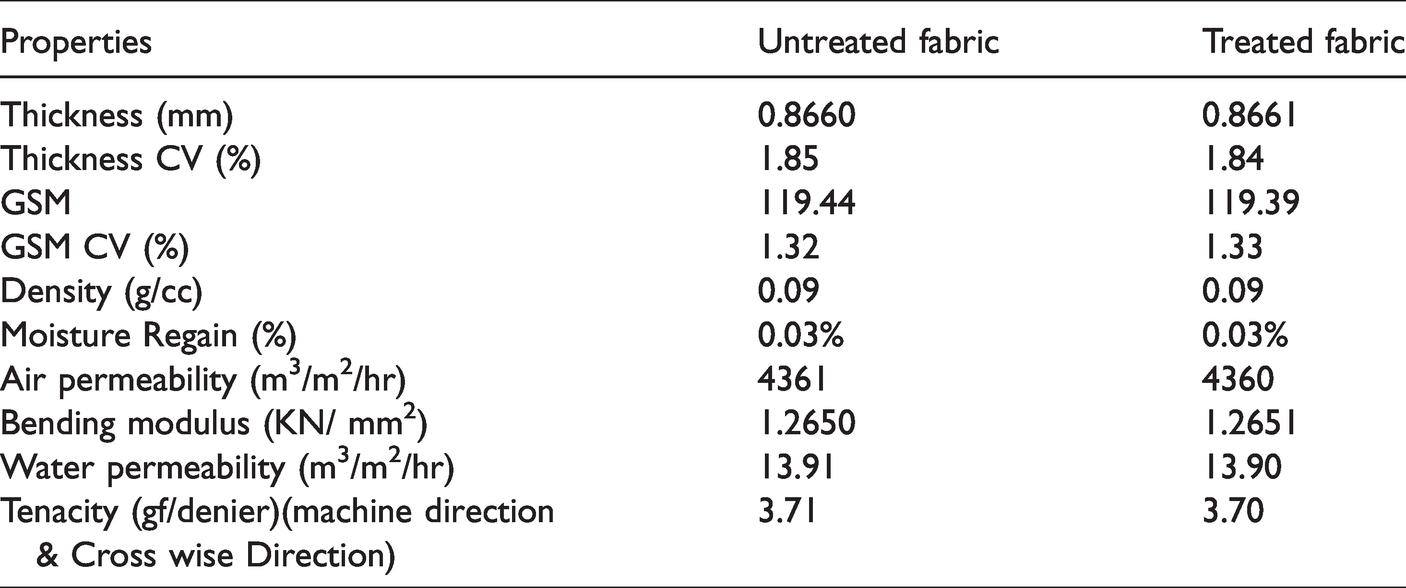
Lower variations in fabric thickness and GSM are quite important for ensuring homogeneity of nanoparticle loading and thereby uniform current flow as well as pressure distribution at the point of ECG measurement by avoiding motion artifact.
The lowest GSM fabric was chosen out of the commercially available range for medical textile materials, viz; 120, 160, 180, 230, 250, 320. Hence it was made out of the lightest density (0.91 gcm−3) synthetic fibers, resulted in the fabric with better cover even though lighter in weight [27]. This better cover has reduced the extent of air voids or porosity in the fabric structure and facilitated in dropping undesirable impedance to the electric current during ECG measure by the non-conductive air. However, the fabric has executed sufficient air permeability (4360 m3/m2/hr) value needed for the patient’s comfort point of view [26]. Such electrode on wearing or fixing next to the body during ECG measurements can cover up working region well, delivers uninterrupted current transmission in the absence of impedance due to non-conductive medium, and also offers due comfort to the user [28].
The moisture regain of polypropylene is the lowest (0.03%) amongst all other materials used for the textile electrode [27]. It means the wet and dry properties of the fibre are identical and water can be transported faster. The argument gets substantiated by the water permeability value of the fabric; 13.90 m3/m2/hr, sufficient for quicker moisture transport and preventing skin-irritation caused to the patient on sweating during long-term ECG monitoring [26,28]. Thus ECG records obtained with such a textile electrode will not only get influenced by the perspiration of the patient, giving reliable ground for measurement along with due comfort to the patient. This is quite an important phenomenon for the textile electrode designed especially for tropical region countries like India.
A bending modulus of 1.2650 KN/mm2was observed for the selected PP fabric and mainly attributed to its lower GSM. The value is reasonably lower in comparison to the woven or knitted conductive fabrics bending modulus reported range of 3 to 8 KN/mm2[27,28]. The low stiffness of the conductive material is beneficial for the textile electrode, as it can easily resume contours of the human body, gives a uniform contact area between the skin and electrode; mandatory to get precise measurements by avoiding motion artifacts. This phenomenon gets substantiated by the findings of Zhang et al., 2008 [1] and Taji et al. [20].
Polypropylene is technically a fiber with high tensile strength and thereby fabric structure coupled with such stronger constituent fibers should possess enough strength [29]. Going in line with this, the strength of the selected nonwoven conductive fabric was observed3.70 gf/denier in the machine direction as well as in a crosswise direction. This strength value fits well within the range of 2 to 7 gf/denier strength fibers used for the creation of woven or knitted conductive fabric structure even with the maximum addition of 1.25 percent of cloth assistance factor [30,31].
Apart from the above mentioned favorable tested properties, polypropylene non-woven fabric has few in-built dynamic characteristics that make it further preferential textile electrode material. They are as follows: It has excellent chemical resistance and is very resistant to most acid and alkalis. It neither supports the growth of mildew/fungi nor attacked by insects and pests.
It is easy to process and ensures high processing yields and profitability [21–33].
Characterization of nanocomposite nonwoven textiles
Conductive material characterization is an essential part and describes all those features of i) surface morphology and structure of a material, ii) chemical composition and chemical homogeneity, as well as iii) analysis of defects and impurities influencing the properties of the materials.
Surface morphology using scanning electron microscope (SEM)
Surface morphology, structure, and orientation of fibers making up the untreated and AgNPs treated nonwoven PP fabrics are illustrated in SEM images (Figure 8(a) and (b)) taken at 35 X–100 X.

Surface morphology of nonwoven PP textiles. (a) SEM 35X image of untreated nonwoven polypropylene fabric, (b) SEM 35X image of AgNPs loaded nonwoven Polypropylene fabric, (c) SEM 100X image of untreated nonwoven polypropylene fabric, (d) SEM 100X image of AgNPs loaded nonwoven Polypropylene fabric.
Enough air voids for the passage of air and water transport can be observed in the structure of the non-woven fabric produced out of random laid polypropylene fibers’ web, interlocked by needle punching (Figure 8(a) and (b)). These pathways are no more be altered on AgNPs treatment and that’s why no change was observed in the untreated and treated fabrics air permeability and the water permeability values (Table 1).
Uniform distribution of the silver nanoparticles along with the spotting of some agglomeration points can be seen throughout the structure of treated PP fabric.
Elemental analysis (EDX)
The elemental analysis test results and their spectrums for untreated and AgNPs treated PP fabrics are demonstrated in Figure 9(a) and (b). The presence of silver 0.33% by weight has been confirmed from the elemental analysis curve. Apart from this presence of S and O indicates that silver may be in sulfate or oxide form, as test sample preparation has involved the use of silver sulfate for synthesizing Ag colloidal in the presence of Ocimum Sanctum (Tulsi) extract as a capping agent. The same has been reflected in the presence of foreign matters like sodium, chlorine, potassium, calcium, and ferrous, in the elemental analysis of the final product.

Elemental analysis of nonwoven PP textiles (a) EDX spectrum of untreated PP non-woven fabric and (b) EDX spectrum of AgNPs treated PP-woven fabric.
Analysis of chemical composition by FTIR spectroscopy
FTIR spectrums for the control sample and AgNPs treated PP fabrics used for evaluating their chemical composition are given in Figure 10(a) and (b). Hence control sample is simply a needle punched polypropylene non-woven fabric thereby major peaks associated are hydrogen-bonded symmetric O–H stretching at 3066 and 3053 cm−1. C–H stretching around 2968 cm−1, C=O stretching at 1743, and 1710 cm−1 Asymmetric –CH stretching vibration at 2908 cm−1. Asymmetrical CH2 bending scissoring type is observed around 1452 cm−1 and symmetrical C–H bending around 1300 cm−1. The presence of polypropylene is confirmed at 972 cm−1 which is irrespective of its tacticity [29,30,34]. But at 1174 cm−1 it is confirmed that the tacticity of polypropylene polymer is iso-tactic. Some O–H stretch and free vibrations peaks are observed around 3600 cm−1.

FTIR spectrums of nonwoven PP textiles (a) untreated (b) loaded with silver nano. (a) Untreated PP nonwoven fabric (control sample) and (b) AgNPs treated PP sample.
Since treated sample contained AgNPs along with Ocimum Sanctum (Tulsi), in its FTIR spectrum major peaks are found at 2908 cm−1, 2972 cm−1, 3429 cm−1, 1726 cm−1 and 1712 cm−1. Peaks at 2908 cm−1 and 2972 cm−1 indicate the formation of C–C–H bonds and asymmetric stretching of CH2. H–O–H stretching (absorption of water) has been noticed at 3429 cm−1, H bonding indicates the presence of alcohols and phenols. 1726 cm−1 and 1712 cm−1 peaks are observed in the spectrum due to absorption associated with stretching vibration of O–H groups and stretching vibration of C=O acidic groups which may be formed due to oxidation. Peaks between 1654 cm−1 and 1600 cm−1 are the indication of C–C alkenes rings, C=C groups, or forming aromatic rings. The bands observed at 1130 cm−1, 1114 cm−1, 1085 cm−1, 1018 cm−1 correspond to C–N stretching alcohols, carboxylic acids, ethers, and esters. Synthesizing of nanoparticles was surrounded by proteins and metabolites such as terpenoids having functional groups of alcohols, phenols, amides, ketones, aldehydes, and carboxylic acids. Hence from FTIR studies, it has been confirmed that phenolic and aromatic rings present in tulsi leaf extract have given stabilization to nanoparticles and even the biological molecules and proteinous substance present in it indicate the capping of silver nano particles [15,25,33].
Electrical characterization of developed textile electrode
Electrical conductivity is the mandatory feature of any textile electrode. Measures involved in defining this characteristic are electrical conductivity (resistance) and skin impedance. All the samples prepared during the experimentation were tested for these characteristics.
Electrical resistance
Test results for electrical resistance measured for the stable AgNPs colloidal loaded fabrics are given in Table 2. The resistance of the fabric goes on reducing with the increased quantum of conductive AgNPs in the structure, i.e.; increased concentration of ingredients. However, the drop in the resistivity was not found uniform, even though the rise in components concentration was the same throughout. The highest drop in resistivity or increase in conductivity was observed with the sample prepared at 0.5 gm concentration, as per expectation. Thereby an innovative textile electrode was made out of this treated fabric as the conductive material.
Electrical resistance values obtained at different concentrations.

Skin-electrode impedance
Skin- electrode impedance values for three electrodes in consideration were falling in the range of 1.44 MΩ to 1.83 MΩ in the dry state and 1.01 MΩ to 1.18 MΩ in the wet state of conducting material. Both the values are falling well within the described range of textile electrode, 1.0–5.0 MΩ suitably used on digital as well as classical analog ECG system [8,9]. Lower skin-electrode impedance value recorded in the wet state of conducting material is mainly due to better hydration of the skin at the point of measurement for the identical test person’s skin variables like stratum corneum thickness, etc. [1,9] .
ECG measurement
The cardiogram obtained with metallic gel electrodes has been illustrated in Figure 11. This has been used as a reference throughout for evaluating the performance of the textile electrode.

ECG obtained with regular gel electrodes system.
Performance of textile electrode
Group I: ECG measurement performed in the dry state
ECG plots obtained for the usually larger and with smaller size triangle are demonstrated in Figure 12(i) to (ii).

ECG tracing in the dry state of textile electrode. (i) ECG with larger triage and (ii) ECG with smaller triangle.
It is apparent from the cardiograms that signal to noise ratio (SNR) is quite high with the textile electrode as compared to the gel electrode in both cases. Comparing the entire tracing lead wise, it can be noticed that waveform of lead I (or lead V1) is showing quite a good resemblance with regular practice tracing (Figure 11), but the thing becomes worsen with lead II and further worst with lead III, with abruptly high signal to noise ratio. However, the deviation noticed from the reference wave in each sector is much higher with the shorter triangle than the usually followed larger triangle size. This higher signal-to-noise ratio was the outcome of motion artifacts, a slippage caused between skin contour and the electrode surface.
The bending modulus of the base fabric was quite low and not even changed with nano-level loading, so conformed to the contours of the skin easily. Arbitrary but enough pressure was applied by pressure bandage to secure electrodes right in the position throughout the test. Under such conditions, the higher motion artifact, especially with a shorter triangle, was emanated from the variations in body curvature. While placements did for a shorter triangle set up, a deep curvature was perceived for lead V3 in comparison to bulged shapes for leads V1 and V2 (Figure 6). This has added to motion artifact although proper skin contours have been met under the required gripping force. Thus wide human body variations have boosted signal-to-noise ratio for shorter triangle ECG in the absence of liquid gap bridge (adhesive gel) in the present study.
Group II: ECG measurement done in the wet state of an electrode:
The cardiograms obtained with the wet electrodes for the larger and smaller size triangles are demonstrated in Figure 13(i) to (ii).

ECG tracing in the wet state of textile electrode. (i) ECG with larger triage and (ii) ECG with smaller triangle.
It is apparent from test results that newly engineered electrodes have executed much more precisely PQR wavelets than gel electrodes in the wet state irrespective of triangle size. This is mainly due to the presence of the conductor in a wet state, the colloidal sprayed just at the point of sealing has created a bridge between skin contour and electrode similar to gel and imparted additional grip to prevent motion artifact without getting influenced by the human body variations. Thus the wet status of conductive material has not only reduced skin impedance in the hydrated state but also facilitated in reducing motion artifact.
No special benefit in terms of easy capturing signals due to more powerful pumping was found with a smaller triangle [8,9]. Thus, the usual large size triangle study is worthwhile for the textile electrode also. This argument was substantiated by medical practitioners also and additionally, they have remarked the efficacy of the newly designed textile electrode in a wet state is much better than the gel electrode.
III Additional qualities
User-friendliness
The use of natural herb Basil/Tulsi extract in a replacement of chemical reducing agent for the synthesis of conductive AgNPs has served as a skin-friendly agent with its preferred antibacterial and aromatic properties. This argument found support from the experience on the set of five patients. Even though patients have worn the textile electrodes continuously for 24 hours in a wet state didn’t complain about skin irritation or allergy.
Shelf life
The ECG trials were taken after the leap period of six months with both sets of electrodes to define their shelf life. Unfortunately in the dry state, the conductivity of electrodes was diminished but consistent performance was observed with the wet electrodes. This was happened due to the presence of air voids in the nonwoven structure as seen in the SEM micrograms. They have permitted nanoparticles to be encapsulated by a non-conductive fibrous matter of base fabric and adversely impacted the conductivity of the dry electrodes [29,34]. Against this PP with very low absorbency and higher water permeability had kept AgNPs on the surface only when sealed in a wet state for a prolonged interval of time and didn’t alter its efficacy [27,34].
Conclusion
The ECG textile electrodes were fabricated by using nanotechnology and Polypropylene non-woven fabric with the virtue to overcome the limitations of wearable textile electrodes in terms of economy and comfort to the wearer. Conductive fabric made by loading AgNPs has not cast any change in its physical, mechanical, flexibility as well as comfort associated properties except the addition of preferable order of electrical conductivity. The skin impedance value of the newly designed electrodes in dry as well as a wet state was well within the preferred range of 1–5 Ω defined for textile electrodes, nevertheless lower side for the wet one. The wet textile electrodes have proven their strength over the traditional gel-based system by executing much more clear PQR wavelets in all three lead health monitoring sections and retaining consistency irrespective of a time gap. Such AgNPs treated fabric nano loaded textile electrode have a bright feature for short term monitoring in a wet state than in a dry state, as the conductive particles remain on the surface by low absorbent and high water permeable base material, viz; PP and not get encapsulated into the air voids of the non woven fabric structure.
Footnotes
Declaration of conflicting interests
The author(s) declared no potential conflicts of interest with respect to the research, authorship, and/or publication of this article.
Funding
The author(s) received no financial support for the research, authorship, and/or publication of this article.
