



Abstract
Digital presence and participation are often imagined as essential for contemporary feminist practices and identities. However, feminist engagements with digital and social media platforms can be tempered by drawbacks and tensions. This leads activists and everyday feminists to the need to negotiate digital dis/connection in their everyday lives. This article explores the affective dimensions of social media dis/connection in feminist contexts, grounding it on 22 in-depth interviews with people engaged with online feminisms and activisms in the Portuguese context. The article foregrounds the relationship between digital activisms and different affective ambiences, both internal and platform-driven. It explores the pressures felt by activists, the sense of disillusionment that paradoxically co-exists with discourses of political potential of social media, and, finally, practices of partial or temporary disconnection that emerge as means to negotiate the affective ambivalences of digital activism.
Introduction
In a context of increased embeddedness of digital and social media platforms in all aspects of everyday life, contemporary feminisms are often imagined as digital and online by default (Fotopoulou 2016). Activists often feel digital presence and participation as “the norm,” essential not only for the dissemination and mobilization of their activities but, to a certain extent, also to their identification as active participants in the feminist movement. Feminist discussions also seep into wider everyday digital cultures, being engaged with not only by activists and other public figures (e.g., journalists, career politicians, or celebrities) but also by so-called “ordinary” people—through less overt everyday feminist practices that can intersect with personal or pop culture concerns (Pruchniewska 2019). While social media platforms can bring varied advantages to feminist communication, they are not without drawbacks—both for individuals and feminist organizations (Edwards et al. 2019). In this context, the experience of feminist activisms in digital spaces can be suffused with contradictions (Linabary et al. 2020), containing both potentialities for empowerment and the looming possibility of anti-feminist backlash and hate. As social media platforms emerge as spaces of ambivalence, digital dis/connection strategies can help to negotiate these at times conflicting perspectives (Kaun and Treré 2020).
This article explores the affective dimension of social media dis/connection in online feminist activisms, addressing the ambivalence of experiences of both activists and everyday feminists. We believe the study of online feminist and activist practices can be enriched by drawing on questions explored in the growing field of digital disconnection studies (e.g., Jorge 2019; Kaun and Treré́ 2020; Syvertsen 2020), in which social media has been a central focus. At the same time, it also seeks to expand disconnection scholarship by considering how feminist media practices call on affective aspects as an entanglement of subjective, social, and material aspects. Drawing on the fields of Feminist Media Studies, Cultural Studies and Affect Theory, and on the subfield of Digital Disconnection, we thus aim to offer a nuanced account of engagement with and disengagement from social media, approaching these practices of dis/connection as situated and multi-layered.
Contextualizing Contemporary Feminisms on Social Media
The growing entanglement of contemporary feminist practices and digital and social media has often been framed as the distinctive feature of the turn towards fourth-wave feminism (e.g., Chamberlain 2017; Munro 2013). While the fourth wave builds upon ideas from earlier feminist waves, it emphasizes the significance of digital and social media for feminist communication, information dissemination, community building, mobilizing and organizing actions, etc. Digital platforms facilitate the pluralization of feminist concerns, bringing together diverse yet intersectionally connected social justice issues (e.g., Caldeira 2023), and creating vibrant spaces for diverse feminist communities (e.g., Peterson-Salahuddin 2022).
These platforms also allow for practices of everyday feminism (Pruchniewska 2019), taking place beyond the traditional realm of institutional politics or established activist organizations but rather integrated into the everyday social media practices of “ordinary” people who may not frame their actions as explicitly activist, but who nonetheless help to spread awareness or contest social inequalities. Digital and social media platforms thus provide spaces not only for overt feminist practices but also sustain wider digital feminist knowledge cultures (Kanai 2021). Nonetheless, despite this reliance on the digital, contemporary feminist practices still rest on hybrid materialities, combining online and offline efforts (Fotopoulou 2016; Mattoni 2020)—such as street protests, face-to-face meetings, etc.
Feminist uses of social media are often framed in a celebratory light (Edwards et al. 2019), seen as a tool for politics of visibility (Whittier 2017)—increasing the visibility and galvanizing support for different identities and political causes. However, the adoption of social media platforms for activist and feminist purposes can also carry tensions. As Edwards et al. (2019) recognize, social media practices also have limitations—being time and labor-intensive, potentially exposing feminists to harassment while not necessarily guaranteeing effective political or social change.
Furthermore, scholars like Barbala (2022) have drawn attention to the platformization of contemporary feminisms—increasingly subjected to negotiations with social media platforms’ conventions, aesthetics, and commercial logics. These platforms are governed by a logic of popularity (Van Dijck and Poell 2013) and inserted in a broader media-saturated attention economy, in which attention is seen as a key, albeit scarce, resource (Goldhaber 1997). Within feminist social media practices, both the politics of visibility and the economics of visibility overlap (Banet-Weiser 2018). Understood as algorithmic activism (Treré 2018), these practices seek to strategically employ social media metrics to trigger algorithmic promotion, to gain visibility and traction of political content, to gain widespread reach and a sense of “legitimacy.” These attention-seeking strategies find parallels in those employed by social media influencers (e.g., Scharff 2023b), creating pressures for continuously developing digital competencies (Scharff 2023a). In this context, digital visibility is not necessarily equally afforded to all feminist discourses, often privileging palatable and commercially friendly feminist views (Savolainen et al. 2022). Online feminisms thus co-exist with possibilities of commercial co-option and appropriation into neoliberal feminist or even postfeminist articulations (e.g., Banet-Weiser et al. 2020).
In addition, the growth in online feminist visibility coincided with a political climate of increased polarization (Willem and Tortajada 2021), with the visibility afforded by digital spaces often carrying the possibility of pushback and backlash for those engaging with sensitive political topics, especially those from marginalized communities and identities (Harvey 2020). Efforts of networked misogyny thus seek to create hostile environments that stifle feminist efforts (Dickel and Evolvi 2023).
We must also recognize the affective labor required by practices of online activism, which implies sustained attention, engagement, and content creation (Mendes 2021). The weight of this labor, as well as the emotional investment of activists and sense of political responsibility, can sometimes lead to mental and emotional exhaustion known as activist burnout, which threaten the continued involvement of activists with their social causes (Gorski and Chen 2015). While similar forms of affective labor have been documented amongst influencers (Lehto 2022; Mäkinen 2021), differing social and political motivations will likely result in different costs and consequences for activists and social movements. Among activists, fatigue and burnout can lead some to adopt strategies of social media disconnection (Kaun and Treré 2020), either as a pushback against a perceived over-reliance on digital media, a strategy to counter the risks of online visibility, or a form of self-management and self-preservation (as Zhu and Skoric 2023 explored in relation to instant messaging in highly polarized societies).
In Portugal, the locus of this research, feminisms have historically been dominated by practices of “state feminism,” rather than by grassroots movements and bottom-up mobilizations that more closely align with online feminist mobilizations (Santos and Pieri 2020). Over the past years, however, feminist mobilizations, both on- and offline, have become more expressive (e.g., Caldeira and Machado 2023; Lamartine and Cerqueira 2023). Nevertheless, these progressive activist practices co-exist with a catholic and generally conservative tradition, thus giving rise to tensions and resistance that warrant further study.
Social Media Dis/Engagement
Engagement with, and disengagement from, social media has been complicated by authors stemming from Cultural Studies, Audience Studies and more. We bring these different strands together to interrogate both what precedes engagement itself and what disengagement might look like, mainly focusing on affect, while considering the situatedness of these processes. Our experience of social media is organized by “infra-structures of feeling,” attributable to technological and institutional foundations, that can be reflected on, for instance, the “compulsion to frequently check on our own or friends’ Facebook posts, or our emails, [or] the lure of the Twitter flow” (Coleman 2018, 87). As Coleman argues, we need to look beyond emotions into “vaguer, or not so easily expressed” affective states (87), as pre-emergent.
Experiences of digital culture are affected by broader cultural environments. Paasonen’s (2021) notion of “affective formations” brings together cultural discourses about social media, informing both their use and non-use. These are generative forces, influenced by societal and cultural perspectives, while still allowing space for individuality (Paasonen 2021). Under this approach, these dialectic forces co-exist in the experiences of connected culture.
Specific platforms can also have particular affective ambiences, resulting from both materialities and vernacular cultures, that make some platforms be perceived as toxic or addictive, widely or by specific groups (Jorge et al. 2023). As Keller (2019) argues, these distinct platform vernaculars and their perceived affective atmospheres also shape the choices of which platforms to use for feminist purposes and the types of activist practices that exist in each platform.
Everyday experiences with social media can accumulate different feelings, being read as ambivalent (Lupinacci 2021). Social media can generate affective states of both excitement and reassurance (Lupinacci 2021) or boredom and fatigue as much as joy (Coleman 2018). Frustration, irritation, boredom and anxiety might arise because of the use of digital media, as much as when such use is not an option (Paasonen 2015).
Furthermore, the seemingly unavoidable presence of social media in everyday life can spark feelings of digital resignation (Draper and Turow 2019), as seen in the sense of helplessness experienced in the lack of control of one’s digital data and privacy. The unfulfilled promise of these technologies in lived everyday experiences can also prompt a sense of digital disaffection (Petit 2015) that leads to disenchantment—and detachment—from digital media.
Scholars thus argue for a more fine-grained view that considers that the use of particular social media platforms might contain disconnective practices (Light 2014) or put strategies in place to manage privacy and safety (Cassidy 2018). Cassidy’s notion of “participatory reluctance” encapsulates how using a particular social media platform might arise not out of volition but instead of a lack of good enough alternatives, and still occur in a selective way.
These conceptualizations see beyond the binary of use and non-use, revealing a wide array of everyday disconnective practices (Light and Cassidy 2014). These can also occur through a myriad of personal tactics of avoidance (Plaut 2015) and be highly situational, dependent on other (often offline) occupations (Tosoni and Turrini 2018). Social media platforms have also incorporated countless options to disengage selectively, through tools to manage connections on digital platforms, for example, limiting one’s time or restricting certain social ties on the platforms (John and Katz 2023). Paradoxically, these emerge as ways to retain users, sustain engagement (Light and Cassidy 2014), and make connectivity manageable in the long run (Karppi et al. 2021, 1600).
While these disconnective practices might not reflect active forms of media resistance, they nonetheless showcase how individuals can exercise their agency in these deeply pervasive digital environments (Gangneux 2021, 461; John and Katz 2023). To us, disconnective practices can be seen as the flip side of what Picone et al. (2019, 2010‒2011) have called “small acts of engagement,” such as liking, sharing, and commenting “as productive audience practices that require little investment and are intentionally more casual than the structural and laborious practices examined as types of produsage and convergence culture.” We thus elaborate more on small acts of disengagement as they are technically but also personally enabled, in looking at the underlying affects among feminists in Portugal.
Methods
This research emerged as part of the On&Off research project, exploring different atmospheres of dis/connection in Portugal. Specifically, the insights shared in this article are grounded in a series of 22 in-depth semi-structured interviews (Gaskell 2006) conducted with people engaged with online feminisms and activisms in the national context. Using the yearly protest organized on International Women’s Day (March 8th)—one of the most expressive feminist mobilizations in Portugal (Lamartine and Cerqueira 2023)—as an entry point for the research, participants were recruited using a multi-situated approach. Recruitment flyers were distributed offline during the 2023 Women’s March; and Instagram users who engaged with the protest or organizers’ accounts were also contacted and invited to participate. This multi-sited recruitment strategy sought to reach both highly engaged participants, participants whose online activity might not leave visible traces (Orgad 2009), and participants who adopt selective disconnection practices. Amongst participants, we included both people with sustained activist engagements and “ordinary” people (i.e., not activists, career politicians, or celebrities) who may engage with these topics sporadically‒ see Table 1 for an overview of participants. This sample does not intend to be representative nor generalizable, but rather offers a qualitative illustration of the studied phenomenon.
Overview of the Interviewees.
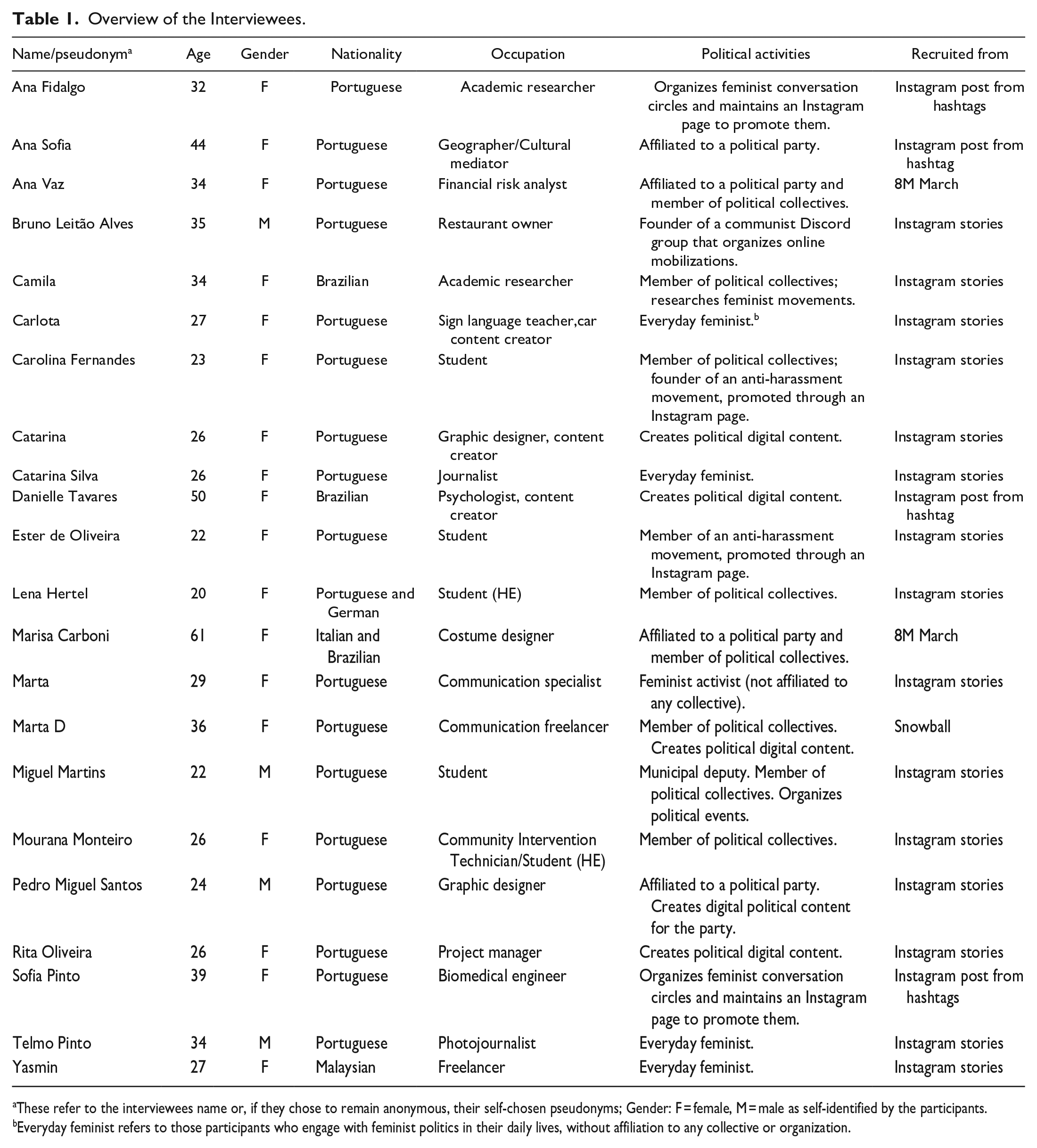
These refer to the interviewees name or, if they chose to remain anonymous, their self-chosen pseudonyms; Gender: F = female, M = male as self-identified by the participants.
Everyday feminist refers to those participants who engage with feminist politics in their daily lives, without affiliation to any collective or organization.
Interviewees were informed about the research and its aims, and gave their informed consent to participate. Participants were given the choice to be identified by a self-chosen pseudonym or by their name, in case they did not wish to participate anonymously. In addition, participants were also asked to fill a brief questionnaire about broad demographics and their general media use.
Although in-person option was offered, all interviews were conducted online (via Zoom), between March and May 2023. These interviews lasted between 35 and 85 minutes (average of about 50 minutes). Most interviews were originally conducted in Portuguese, and all quoted statements were translated by the author. All interviews were recorded, transcribed verbatim, and thematically coded in MaxQDA. After an in-depth familiarization with the data, interviews were coded in an iterative and theoretically-informed process, identifying emerging themes and topics within the data and establishing relationships between them (Gaskell 2006). This coding process was collectively discussed among the research team.
Findings
From the interviews, the most salient findings started with how digital activisms draw on different affective ambiences, both internal and platform-driven. We also explore some of the pressures felt by activists in these digital practices, the sense of disillusionment that paradoxically co-exists with discourses of political potential of social media, and, finally, practices of partial or temporary disconnection explored as means of negotiating the affective ambivalences of digital activism.
Moods and Ambiences
Participants often have ambiguous and affectively-charged encounters with social media for feminist and activist aims. These experiences are highly transient and changing in intensities, drawing on the moods and expectations users bring with them at any given moment. As Catarina puts it, her feelings towards feminist content online are largely dependent on her current state of mind: There are days in which I’m more at peace with the world and when, maybe, I’ll see a post and I think: “Good content, I’ll share it.” Then, on other days when I’m more frustrated maybe I’ll look at that post and think: “This world is really a disaster.”
Other participants reiterated this fluctuation between feelings of hopefulness and disappointment. Lena highlighted that when in a “good” mental state, even the negative content she encounters online, for example, news of an attack on a trans person or a case of gendered violence, can serve to motivate her into action and to initiate debates on the topic with people around her. On the contrary, if similar content finds her in a negative mood, she feels this can exacerbate it, leading her to feel like retreating and disengaging.
In addition to internal affective states, the perceived affective ambiences facilitated by different platforms (Keller 2019; Sampson et al. 2018) also shaped one’s relation to them. Recognizing the heterogeneous media ecology of contemporary digital practices (Zhao et al. 2016), different platforms can be combined to negotiate different needs, norms of use, features, or to reach different audiences. Their ambiences are also affected by those perceived uses. For participants, Facebook, for example, was generally seen as a rather outdated platform, mostly reaching an older audience, often absent from other platforms (Catarina, Lena, Marisa). As Lena further reflected, different activist projects required her to shift between platforms, with her activist engagements in the rural area from which she originates taking place on Facebook, while engagements with feminist and student organizations in the city she later moved to happen mainly on Instagram.
Moreover, social media platforms as activist tools also get imbued with particular symbolic dimensions and ever-changing political imaginaries (Mattoni 2020). Instagram, for example, was quite ambivalently seen by some of the research participants. For some, like Lena or Catarina, it is an essential platform for activist practices—allowing them to connect with other activists and get news and information about upcoming events. For others, like Bruno, it had strong associations with more personal and light-hearted content, which could come with negative associations, seen as a waste of time, or, as he puts it, “zombie scrolling.” In turn, several participants saw Twitter as the political platform par excellence, a “more serious” place where one can find news, varied political opinions, and lively discussions (Catarina S., Danielle, Rita).
The perceived “toxicity” of the environments and cultures of use of specific platforms can also shape activist engagements. For example, reflecting broader beliefs and even platform-led discourses (Duffy and Hund 2019, 4984), participants tended to imagine Instagram as a less hateful platform. As Ana Sofia puts it, Instagram is seen as a fun and aesthetically pleasing platform where she felt more “at ease,” due to the “more luminous” and less confrontational nature of its interactions. Features like the possibility of one-to-one private communication enabled by Instagram Stories were seen as contributing to this ease. This contrasted with perceptions about Facebook, where hateful interactions were seen as likely due to a wider audience who might not share the same political ideals (Ana Sofia, Bruno, Carolina, Miguel), and the (imagined) workings of the algorithm: Facebook was the first platform where I felt that the algorithm was against me. [. . .] I started feeling that all the content I was shown was made by people with whom I argued. I wasn’t shown things that interest me, photos from my friends, none of that. [. . .] It was the first platform where I felt: “Ok, they are really using my anger for the profit of the platform.” (Bruno)
Notably, Twitter was seen by nearly all participants as the most toxic and hateful platform, despite its aforementioned perception as a central political stage. This ambience was understood as caused by multiple factors: distinct audiences and cultures of use, the short-text format, algorithmic influences, or even recent governance shifts (the acquisition by Elon Musk). For some interviewees, this awareness of Twitter’s “toxicity” created ambivalence regarding leaving it: I think I could leave any platform, but not Twitter. [. . .] Twitter can be a toxic place and I can fully recognise that there is a lot of malice there. But it’s also, you see, a way to keep myself up to date with everything. (Rita)
Participants counterposed these toxic ambiences by highlighting the importance of these digital platforms to facilitate a sense of belonging. Although quite critical of social media, Marisa saw the constant connectivity they enabled as important because “at least I don’t stay completely isolated, right?.” Through both carefully curating followed content and algorithmic recommendations, social media was seen as crucial to find people with political affinities or even create a community (Ana V., Catarina, Lena). On one hand, through ongoing digital labor participants were able to create feminist filter bubbles (Kanai and McGrane 2021) that could be positively experienced as curated safe spaces (Zhu and Skoric 2023), reducing risks of backlash and creating an inviting atmosphere. On the other, and echoing the often-repeated contested metaphor of filter bubble (Bruns 2019), these so-called feminist “bubbles” were also ambivalently perceived, understood as potentially siloing oneself to a limited worldview: Your circle shapes the content that is suggested to you. And it’s all on similar themes, right? Which is interesting, but it’s also a bit dangerous. Because we end up in a bubble where we think everyone has the same perspectives. (Ana V.)
Furthermore, as Ana Sofia points out, this promise of community is not always reflected in a sense of actionable impact:
It’s that feeling that we are all worried about the same things, right? So why aren’t things working? And then we realize that there aren’t that many of us, are there?
As we expand in the following section, these ambivalent affective responses coalesce with several pressures experienced by the participants, further highlighting the ambiguous engagements with these practices.
Pressures, Waves, Hypes
Activist and feminist work is often a labor of passion, generating deep affective attachments to one’s involvement (Mendes 2021, 8), which is entangled with many of the pressures experienced by the interviewees. For some participants, their perceived identity as “the feminist” or “the activist” friend, in particular online or offline circles, leads to a sense of pressure to be active in both the receiving and sharing of political information, since they felt their peers expected this from them (Lena, Mourana, Rita). As Lena puts it: In non-activist circles, I end up being seen as “Lena, the activist.” So, often they come up to me asking, “What about your opinion about that?,” “You didn’t share anything about this or that?.” This creates more pressure to share than in a healthy activist environment.
Another common struggle pointed out by the participants was the balancing act between, on the one hand, the desire and need to remain informed and “in the loop” about ongoing political events and activist meetings, and, on the other, feeling overwhelmed by the amount of information available online, as Rita expresses: Sometimes, I kinda force myself to be up to date. Maybe, sometimes, I would just like to switch-off and not care. But then, maybe at the end of the day, I go and see what’s going on. Because I don’t like to be disconnected.
This seems to highlight the common perception that being active online reflects engaged participation in feminist movements, becoming essential to one’s feminist sense of identity (Fotopoulou 2016). This political understanding of connectivity can increase pressure, leading to negotiations between the social media presence’s perceived advantages and disadvantages. Ana V., for example, tells us that her feeling of time wasted on these platforms was overpowered by the perceived political advantages of becoming informed. Mourana framed the pressure she felt to share in quite moral terms: “I feel that each moment that I’m not doing it [sharing], there is evil that continues to be perpetuated.” Framing it as a consequence of our highly digitized and connected society, Miguel delays the possibility of distancing himself from his digital activity: Sadly, I’ve wanted to take a break. Yet, that’s the thing, it’s a civic duty to be present, isn’t it? [. . .] I understand that there are people who are exhausted with social media and want to take a break. [. . .] But I, for now, won’t do it. Because I feel that [being there] is more important.
Furthermore, reflecting the highly hybridized character of contemporary activisms (Mattoni 2020), these motivations to engage online were connected to felt responsibilities towards offline practices, settings, and communities. As Ester puts it: “We’re a very recent movement. It’s very hard for us to mobilise people without social media. [. . .] We organized a protest in April, and it was through social media that we managed to mobilise towards the physical protest.”
However, this pressure to be online does not only reflect an instrumental desire for transmitting information or mobilizing, but can also draw on fears of being forgotten or left out (Fotopoulou 2016, 996)—reflecting the common feeling of FOMO (fear of missing out) that marks so many social media cultures. Mirroring Fotopoulou’s (2016) observations of potential generational disparities, 61-year-old Marisa feels ambivalently towards feminisms in these platforms, simultaneously seeing it as a bit disappointing and, yet, feeling excluded and disconnected if she is not taking part, at least to some extent, in these practices.
The dominant social media logic of continuous production and algorithmic popularity (Van Dijck and Poell 2013) also pushes for constant connection. For example, Rita highlighted the pressure she felt to continue to feed and grow the activist page she created on Instagram, which often led to a sense of guilt for not keeping up the desired regularity: “I’m like, ‘Rita, you created a page and now you don’t post anything for a month.’” While the core aim of her activity is framed in political and educational terms—to share information and elicit reflections that people might not otherwise have—Rita hesitantly acknowledges a desire for a larger audience, beyond the 140 followers she had at the time of the interview: “I’m not gonna lie, I would like to have more followers, more people reading.”
As Dumitrica and Felt (2019) explore, the need to engage with and influence visibility algorithms can create pressures for activists, pushing them to constantly strive for newness and interaction, further contributing to hyper-abundance. Furthermore, striving to both be topical and follow media and protest cycles (Kaun and Treré 2020, 7), some interviewees also reflected on the pressures to engage with “trending” political hypes. For instance, Camila recollected the time when Instagram users, including herself, were urged to share a simple black square as a show of support for the Black Lives Matter movement. While not wanting to miss out, Camila still felt ambivalent towards this trend: With Black Matter, it felt like a wave. I posted the damn black square, but I kept wondering how it was even relevant [. . .] My square didn’t change anything, you know? I wouldn’t say I regret it, but now I look at it more critically.
This push for platform visibility could, at times, contradict the reflective and critical understanding interviewees had of social media platforms, condemning widespread practices of data capitalism, surveillance, and opaque algorithmic governance, mentioned by Lena and Miguel.
These pressures for digital presence and active engagement could often lead to a sense of exhaustion. “There is this feeling that there is so much. So much to do. . . Sometimes there’s this feeling of tiredness associated with all this.” (Ana V.). Expressions like fatigue, wearing, tiring, exhausting emerged in several interviews. They reflect the considerable digital and emotional labor invested in activist work, these discussions echo the notion of activist burnout (Gorski and Chen 2015)—which can lead to a sense of physical and emotional exhaustion and, as we explore next, feelings of inefficacy or even disillusionment.
I feel that I’m involved in so many things, that I need to reach everywhere, that I’m constantly failing, isn’t it? Sometimes it’s exhausting. (. . .) Sometimes I think: “Ok, should I sleep one hour less and produce Stories to reach 500/700 people?” (. . .) I feel like sometimes I neglect my self-care. I’m trying to be a bit gentler on myself. Understand that it is a marathon, not a sprint. (Mourana)
Despite often arising from the demands of online activist practices, this exhaustion was also seen as seeping into one’s offline life, affecting one’s ability to interact with others or to pay attention (Lena). Nevertheless, awareness of the emotional and physical impact of these practices does not lead, necessarily, to the establishment of self-care tactics: I would love to find out [strategies to cope with activist burnout]! *laughs* I tried with all my strength to not get too involved, but I couldn’t. [. . .] I think decompressing is the great dilemma of an activist. It’s the activist burnout, you know? I don’t quite know how to deal with that. (Camila)
This difficulty highlights the deep affective attachments which underly digital feminist work (Gleeson 2016; Mendes 2021; Mendes et al. 2019), wrapping up personal commitments and fears of letting others down. Activists’ sense of political and civic responsibility is often linked to a culture of selflessness and lack of self-care, which is particularly conducive to burnout (Gorski and Chen 2015). Furthermore, while digital activism often involves long and irregular hours of volunteer labor (Gleeson 2016), when taking place in digital platforms that blur the boundaries of work and leisure, the digital labor involved in these mediated activist practices can often become minimized and invisibilized (Mendes 2021). Participants could then feel that they should be doing more: sharing, making comments, producing content—often both in their personal profiles and in the collectives’ they integrate—despite their growing sense of tiredness (Camila). As Mendes (2021, 5) also notes, this burden of digital labor is particularly felt around special events or periods of media engagement—as several participants highlighted concerning dates such as the International Women’s Day, Pride Parade, or other local protests. As the strain of this labor can, at times, lead activists to temporarily or permanently step back from their work, developing strategies to cope with burnout can be vital (Mendes et al. 2019). As will be explored later, these can include disconnective practices.
Shortcomings of Political Potential
The tensions and ambivalences explored above help to shape the participants’ understanding of the feminist potential of social media. While most participants recognized the potential reach and capability for mobilization of these digital activist practices, many noted that, in practice, it often fell short of this perceived potential: In our own experience, this online aspect isn’t working as well as we thought it would. We are not getting the kind of response that we would like to have. (Sofia)
Echoing the desire for better platform metrics that Rita alluded to above, in these social media practices there is an overlap between the politics of visibility (Whittier 2017) and the functioning of the broader attention economy of platforms (Van Dijck and Poell 2013). In these contexts, ensuring visibility for social movements and political messages relies on the careful and strategic mobilization of attention through a wide range of digital labor practices—including continuous sharing and engagement. While these practices can be framed as forms of algorithmic activism (Treré 2018), they mirror similar logic to those employed by influencers (Scharff 2023b).
As Sofia expanded, these labor-intensive digital practices of mobilization and community-building were not always rewarding. She particularly recalls the frustrating experience of contacting other feminists and organizations online, seeking to disseminate her feminist project and upcoming events, only to have her contacts ignored. Even though most participants were relatively active social media users and recognized its importance for contemporary activist practices, many still had a rather negative understanding of the kinds of ties and connections established on these platforms. Some participants described online spaces as “weaker,” “superficial,” or even “inauthentic”—often juxtaposing to offline experiences (Marisa, Sofia). The pull of offline activist practices was frequently framed in affective terms, thinking of offline interactions as more authentic, empathetic, intimate, or even “human”: Young people are used to this technology thing, but I think it gets in the way of the intimacy, the organic thing, you know? Especially within feminism. How can you be a feminist if you’re always online? Where is the space for hugs? For looking people in the eye? (Marisa)
Thus, these digital feminist practices present a tension: on the one hand, they make life easier in practical and logistic terms; on the other, they are seen as diminishing or even damaging the possibilities of community building. This tension leads participants to reiterate the importance of combining online and offline engagements, adopting hybrid activist practices (Fotopoulou 2016; Mattoni 2020).
The lingering possibility of encountering online hate, introduced earlier, also contributed to ambivalent views of these digital activist practices. As Miguel puts it: “Hate comments are normal, unfortunately, and exhausting.” Some interviewees have witnessed hateful comments in response to people sharing their political opinion on the platform, both directed at themselves, friends, or other activists. “I’ve seen people saying horrible things, like, ‘You’re disgusting’ and I don’t know what else. Just because someone is sharing their opinion” (Carolina). The digital and emotional labor involved in constantly preparing oneself for hateful comments and responding or dealing with them by blocking offending users contributes to this sense of tiredness. However, as we saw in Miguel’s earlier statements, a sense of political drive and responsibility prevents him from feeling at ease with disconnecting.
Drawing back on the importance of finding the right feminist and activist circles, Carolina notes that online hate is particularly pervasive when posts overflow beyond their intended audiences—something that she sees as particularly common with Twitter’s algorithm. However, as Catarina and Danielle highlight, this culture of harsh critiques also affects in-group conversations. While disagreements and critical conversations are welcomed, Danielle criticizes the common culture of aggressivity on these platforms.
I think it’s a general issue, both on social media and social movements in general. Constant arguments between people that are on the same side. And that hurts the movement. (Catarina)
Combined with the pressures explored previously, the general awareness and fraught experiences with these flaws of social media for political engagements can lead to negative feelings of emotional fatigue, saturation, or even disillusionment, which can create an affective pull for practices of dis/connection, as Lena remarks: “When I’m stressed, I try to isolate myself from the stimuli, from the daily excess of information of online activism.”
Dis/Connection as Affective Labor
Several participants thus experienced a paradoxical push-and-pull of both “needing” to be active online, while not necessarily enjoying or finding fulfillment in this experience (Lena, Marisa, Miguel), echoing the notion of digital resignation (Draper and Turow 2019): Sometimes I’m saturated. But it’s like there’s a force inside me, that I can’t let go, you know? So I stay there, consuming more and more. Until I reach a point when I just turn off, and that’s it. [. . .] I feel anxious, like I failed my aims. But eventually that thought goes away, and I can return. (Rita)
While fully disconnecting from these platforms was not seen as a viable option for most, some participants described a sense of participatory reluctance (Cassidy 2018) that resulted in unenthusiastic and half-hearted engagements with them.
Participants also negotiated these feelings of saturation by adopting a wide range of everyday disconnective practices (Light and Cassidy 2014), which were often temporary or time-bound (Gangneux 2021). For example, Rita recalled taking a month-long break from Instagram, for personal reasons, while Carolina shared her efforts to limit her smartphone use during the evenings, or users like Carlota or Mourana who take advantage of setting timers or using time-management applications to block their social media apps when needing to concentrate. Others, like Sofia, prefer to focus their social media uses on very deliberate tasks, avoiding casual scrolling and only engaging when they need to research for specific content. Showcasing how the same media can facilitate different forms of attention to different affective outcomes, some participants also framed occasionally shifting to more “mindless” digital activities (Lupinacci 2021) as a, perhaps paradoxical, way to disconnect from the pressures created by these online political activities: I rather waste my time and be distracted on TikTok, making myself laugh, than to be constantly refreshing my Twitter, or my Instagram or Facebook comments. (Rita)
Disconnective practices could also be directed at particular forms of engagement within platforms, often direct interaction with other users, for example, by abstaining from commenting on posts (Ana V.). Especially when dealing with negative or even hateful comments, interviewees like Miguel or Rita highlighted the importance of disengaging—ignoring or refusing to respond to comments, deleting them, or at times simply refusing to read them—as they feel that comments do not lead to any productive political conversation. Selective disconnection could thus be employed to negotiate one’s presence in environments that can be hostile to feminist activism (Mendes 2015). Even when engaging with good-faith followers, the sheer volume of interaction can prompt anxieties and the need for strategies to delay engagement: I have the reputation of being someone who takes a long time to respond to messages. Because I have limits. Sometimes I get 500 messages and I have to say to people: “I’m sorry, I’m going to take a bit longer to respond, I don’t have the capacity right now.” (Lena)
Participants also shared efforts to avoid specific platforms altogether. As Rita puts it: “It’s not as if I turn off the internet. But I won’t open the app. Which seems like a small thing.” In environments perceived as particularly toxic, like Twitter, this avoidance can be significant to preserve one’s mental health (Bruno). To avoid distractions or temptations, users like Rita temporarily remove notifications, set the do-not-disturb mode, or even turn their phones off. These strategies also help minimize the anxiety of feeling they have so much to see, read, or respond to. However, Rita still struggles to ease the guilt caused by this temporary disconnection: I’m like: “Damn Rita, if you can’t be on all the time, you’re no less of a feminist. You’re no less of an activist for not being actively there, expressing yourself on this or another subject. Stop pressuring yourself.”
For participants, disconnection could depend on situational conditions (Tosoni and Turrini 2018), with offline activities being frequently pointed out as providing an alternative, or even an excuse, to continuous digital connection. Moments of digital disconnection can become indissociable from other everyday activities—from going for a coffee, a walk with the dog, a conversation with friends, or taking care of one’s kids (Ana Sofia, Catarina S., Rita). These practices of situational disconnection can also be facilitated by the offline environments where the participants are inserted, as Lena refers to: I feel that it is easier to establish those limits when I’m in Alentejo [rural area]. Because I work the fields, so I’m often in the middle of nature and I have no cell service. [. . .] In a city it is harder.
These small acts of disengagement (Picone et al. 2019) might require less investment than more drastic forms of disconnection, such as deleting one’s account, or more structural practices, like boycotting a platform. But they allow the embeddedness of disconnective efforts in the locus of participants’ everyday lives, creating spaces to negotiate their ambivalent feelings and political aims in a fluid dis/connection.
Discussion and Conclusions
By centering the ambivalent experiences of both activists and everyday feminists with digital feminisms, this article helps to complexify the imagined inevitability of social media use for contemporary feminist engagements (Fotopoulou 2016), showcasing its drawbacks and tensions. The interviews showcase how people negotiate digital dis/connection in their everyday lives, highlighting the affective dimensions of these practices.
As our interviews illustrate, feminist encounters with social media are often ambivalent and affectively charged—oscillating between an awareness of the political benefits of these platforms and a pervasive sense of disappointment and saturation. Different perceived affective ambiences of popular platforms (Keller 2019; Sampson et al. 2018) can contribute to exacerbate the tensions, particularly when it comes to platforms seen as “toxic” and conducive to hateful interactions. This effect also coalesces the varied pressures experienced by participants, whose affective attachment to feminist work (Mendes 2021) could lead to an added sense of political responsibility and pressure, reflected in a sense of duty to be active online in both receiving and sharing political information. The dominant attention economies and algorithmic logics of popularity of social media platforms (Dumitrica and Felt 2019; Van Dijck and Poell 2013) further contributed to the push for constant connection, inciting pressures engage with “trending” political hypes.
In this context, the labor-intensive and affectively charged efforts to maintain one’s feminist digital presence were not necessarily experienced as rewarding, with many participants noting that these platforms can often fall short of their perceived political potential. Feminist social media experiences were often accompanied by feelings of fatigue and exhaustion, echoing concerns with issues of activist burnout (Gorski and Chen 2015). However, despite awareness of these emotional and physical impacts, participants still struggled to establish strategies to curb their digital presence, emphasizing the paradoxical push-and-pull of these platforms.
Our study highlights how selective everyday disconnective practices (Light and Cassidy 2014) can emerge as a way to negotiate these pressures and ambivalences. Participants offer varied accounts of embedding small acts of disengagement (adapting Picone et al. 2019’s argument about engagement) in their everyday social media uses—ranging from temporary or time-bound tactics; selective practices of disconnection; or even drawing on situational conditions.
In a context where political and activist responsibility is increasingly perceived in individualized terms, it becomes important to explore how individuals can exert agency through small acts of disengagement (Gangneux 2021, 458). If dissatisfaction with social media platforms and their labor-intensive demands, alongside with activist burnout, can lead to temporary or even long-term abandonment of political activity (Gleeson 2016; Mendes et al. 2019), it is essential to explore the political significance of these disconnective practices, which can help to manage and sustain connectivity in the long run (Karppi et al. 2021). Exploring the ambivalences felt by feminists on digital environments can prompt imaginings of how safe and inviting digital spaces can look like, calling for sustainable feminist practices (Kanai and McGrane 2021)—that eschew the demands for exploitative digital labor and are compatible with other work-life commitments.
Recognizing the limitations of the present study, which relies on a relatively small sample of nationally-bound interviewees, future research can expand upon these observations by opening to other geographical contexts. In addition, similar dynamics of social media ambivalence and negotiated dis/connective practices might also be studied for other social justice and political struggles. As these tensions can affect long term engagement with activist practices, further ethnographic longitudinal research on the phenomenon is also needed.
Footnotes
Declaration of Conflicting Interests
The author(s) declared no potential conflicts of interest with respect to the research, authorship, and/or publication of this article.
Funding
The author(s) disclosed receipt of the following financial support for the research, authorship, and/or publication of this article: This work was funded by the FCT—Foundation for Science and Technology, under the scope of the project “On & Off: Atmospheres of dis/connection” (2022.01282.PTDC / DOI: 10.54499/2022.01282.PTDC). This work was also partially supported by the European Union’s Horizon Europe research and innovation programme under the Marie Skłodowska-Curie grant agreement No 101059460.
