




Abstract
Danmei culture, a Chinese literary genre that foregrounds male–male romances and/or erotica, has received significant attention in academia. Studies have investigated how it enables women to resist heteronormativity or forms the escapist route for women to express their desires. Danmei culture has evolved into a transmedia landscape and cultural industry, exploited by the logic of capital. However, to date, danmei writers have not been considered as affective laborers living with precariousness in the cultural industry. Drawing on data from interviews with danmei writers foregrounding the datafication of qing (affects and desires), this article examines the writers’ ambivalent affective labor. The findings illustrate the emergence of an increasingly formulaic writing: by searching, selecting, appropriating, and combining elements from the qing database, danmei writers generate a male homoerotic love story that invokes readers’ affects and desires for better monetization. Pleasure and pain mingle, consolidating the precariousness of the labor. However, affects and desires cannot be fully manipulated, for qing embodies transformative momentum.
Introduction
Danmei 耽美 culture, which features male–male romances and/or erotica, emerged in mainland China in the late 1990s (Feng, 2009). In the early 1990s, Japanese boys’ love (BL) comics, which appeared in the 1970s, were introduced into mainland China through pirated copies from Taiwan and Hong Kong (Yang and Xu, 2017a) and heavily influenced the emergence of danmei culture in its early years. The term danmei was also borrowed from the Japanese tanbi, which literally means indulging in beauty. Notably, tanbi served as one of the various labels for BL in Japan during the 1980s and 1990s (Welker, 2015). Since the 2010s, however, Chinese danmei culture has developed its own ecology and evolved into a transmedia cultural landscape, including fiction, animation, comics, audio dramas, web series, films, games, and music (Ge, 2022; Hu and Wang, 2021). Danmei has also become the preferred term among its creators and fans in mainland China.
Henry Jenkins (2006: 20–21) employed the term ‘transmedia storytelling’ to refer to the coexistence of traditional and new media and the ‘new aesthetic that has emerged in response to media convergence – one that places new demands on consumers and depends on the active participation of knowledge communities’. While Jenkins celebrates the audience/fan’s immersive experience in an ever-expanding world, constructed and maintained by transmedia storytelling, the other side of transmedia is the creative labor co-opted by capitalism (Hesmondhalgh and Baker, 2011; Johnson, 2013), which this article seeks to further explore.
Danmei participants are renowned for their intensified qing 情, invested in producing and consuming male homoeroticism. I argue that qing, or the phrase qinggan 情感 or ganqing 感情 (aroused qing), does not merely refer to affects, but rather, both affects and desires. There are a number of reasons for this rationale. First, in contrast to the Tomkins–Sedgwick school (Sedgwick, 2003) or the Spinozist–Deleuzian approach (Massumi, 2002), I do not make a distinction between affects, feelings, and emotions. Following Sara Ahmed, I consider affects to be ‘the feeling of bodily change’ (Ahmed, 2004: 5); further, ‘the attribution of feeling is an effect of encounter, which moves the subject away from the object’ (Ahmed, 2004: 8). Second, in debt to ‘the cult of qing’ in Chinese literary thought in the late Ming dynasty (between the 16th and 17th centuries), I suggest that qing per se also includes desires. In the late Ming dynasty, as exemplified in Mudanting (the Peony Pavilion) by Tang Xianzu (1550–1616) and the collection of male homoerotic stories Bian Er Chai (Hairpins beneath the Cap) by Zuixihu Xinyue Zhuren in the early 17th century (Stevenson and Wu, 2013: 170), Chinese literati scholars began to revalorize qing by embracing yu 欲 (desires) as a means to reinvent and/or challenge the suffocating Confucian cultural heritage, which is held under chronical control by Neo-Confucianists (Huang, 2001).
Qing, which includes affects and desires, however, can be exploited and employed by social institutions, or more precisely, capitalism and the state machinery for governance. Because of their enormous investment in qing, danmei participants work as devoted affective laborers in the danmei cultural industry. Danmei has received significant academic attention in recent years, and different scholars have investigated how this cultural form enables women to resist heteronormativity backed by the Chinese party-state or forms the escapist route for women to express their desires. However, to date, danmei writers have not been considered as affective laborers living with precariousness in the cultural industry.
In the present research, through in-depth interviews with 24 contracted danmei writers on Jinjiang, the hitherto largest website for producing and consuming danmei, I carefully examine how they work as affective laborers and how their intensified qing has become the target of an exploitative capitalism. First, danmei writers’ temporality is governed by writing male–male romance and erotica, and the flexible hours significantly disrupt their work–life balance. Second, driven by data, danmei writers are constantly self-exploiting by inputting more qing to write homoerotic romances that will achieve high rankings on a literature website. Yet, this is at the cost of their mental health, as many also experience anxiety, insecurity, and depression. Pleasure and pain are de facto both involved in doing this ambivalent affective labor.
By exploring the datafication of qing, I examine a distinct feature of danmei writers’ trajectories: ambivalent affective labor. For danmei writers, the datafication and monetization of qing leads to increasingly formulaic writing. By selecting, appropriating, and combining elements from the qing database, danmei writers are able to swiftly generate a male homoerotic love story that efficiently and effectively invokes readers’ affects and desires for better monetization.
However, the ambivalence emerges as these affective laborers continually present their own creativity and subjectivity in efforts to transgress the logic of capital, such as danmei writers’ who constantly break through the existing subgenres and create new modes of worldbuilding and character settings. The transformative potential of these devoted affective laborers is tightly linked with multiple ambivalences in the danmei cultural ecology, where scenes of possibility are constantly generated and intensified in male–male romances and erotica. Rather than unilaterally mapping out how danmei writers are exploited, managed and disciplined by capitalist logic in their affective production, I also attend to the transformative potential of affective labor: the unalienated affective agency of danmei writers, which exceeds capitalist control and regulation.
The article will proceed by offering a brief literature review of affective labor and exploring the concept of qing and its association with commercialization since the 20th century. It will then discuss the methodology and analyze the interview data, highlighting two key areas of concern: temporality and data-driven-ness. This will be followed by a discussion of the findings and concluding remarks that will point toward directions for future research. By illuminating the datafication of qing, this research thus seeks to contribute to a more comprehensive understanding of danmei writers as ambivalent affective laborers. Pleasures and pains are both involved and exploited in their input of qing throughout their production of danmei stories in the cultural industry, while the affects and desires per se cannot be fully manipulated – transformative momentum is embedded and embodied in the fluid qing all the time.
Affective labor: pleasure and pain
Affective labor was first coined by autonomist Marxists Hardt and Negri (2000) to refer to ‘the production and manipulation of affects’ which ‘requires (virtual or actual) human contact and proximity’ (Hardt, 1999: 98). Affective labor, in Hardt and Negri’s framework, is a crucial part of immaterial labor, a hegemonic form of labor in the information economy that produces immaterial goods, including information, knowledge, communication, and affects. Their radical intervention denies the distinction between productive and unproductive labor, material production, and social reproduction. Affective labor hence should be recognized as socially productive labor, as ‘productive labor cannot be limited to waged labor, but must refer to human creative capacities in all their generality’ (Hardt and Negri, 2000: 105). Consequently, affective labor functions to (re)produce social life, and at the same time, can be exploited by capital. Affective labor does not necessarily and directly reproduce labor power, but aims to (re)produce affects, which are constantly captured and expropriated by capital in a digital and informational society.
In tandem with this work, Arlie Hochschild (1983) explored the affective qualities of the industrialized service sectors. Hochschild introduced the concept of emotional labor, which recognizes that workers are required to sell their own emotions to create and maintain social interactions and relationships. Affective labor extends the scope of emotional labor since affective labor has been outsourced not merely in the service sector, but the wider capitalist economy, including the domestic realm, which is becoming increasingly marketized. Although Hardt and Negri (2000, 2004, 2009) acknowledged that affective labor is embedded in the capitalist formation, functioning as a form of creation, management, and control of the population, they also highlighted its transformative power with regard to emergent subjectivities, the possibilities of resistance, and the creation of social networks and communities. Hence, it ‘provide(s) the potential for a kind of spontaneous and elementary communism’ (Hardt and Negri, 2000: 294). Oksala (2016) also argued that ‘affective labor produces spontaneously positive externalities such as social networks, attachments, and passions that capital needs and seeks to appropriate. These positive externalities could also, potentially, form the bases for alternative modes of production and forms of life’ (p. 293).
However, in their debate regarding digital and/or creative labor, Hesmondhalgh and Baker (2008) argued that Hardt and Negri’s framing of affective labor is overly generalized and optimistic about affective labor, thus dismissing the concreteness and specificities of cultural production, and the very precariousness associated with this term. Krüger (2016: 204) pointed out that digital laborers who are constantly lured by creativity in the creative industries have to present themselves as ‘affected in an affective way’ to fit into the sentiments of the platform and for better productivity, and, consequently, performing affects has become a compulsion driven by commodification. Hesmondhalgh and Baker (2011) suggested that the tensions concerning creativity versus commercialization, subjectivity versus self-exploitation, and autonomy versus control permeate affective, creative, and/or digital labor.
Notably, in her exploration of Chinese online literature writers’ precarious experiences, Zhao (2023: 177) pointed out that these affective laborers experience multiple realities of precarity in the platform politics of access, temporality, visibility, and copyright protection, and they are at the same time internalizing inequitable relations through exhibiting entrepreneurial creativity. Kwon (2022) also noted the low wages and time compression of writers in South Korean BL web economy. Zhao (2023: 181) further highlighted how Chinese online literature writers’ ‘emphasis on hope and passion reveals how the design of the platform labour regime cultivates entrepreneurialism associated with neoliberal subjectivities’. However, the creative pursuits which involve intensified investment of qing also contain the potentially unalienated creativity that can be transgressive, and I will explore it further in my following analysis of danmei writers’ affective experiences in the commercialization and datafication process. As Jarrett (2014: 15) reminded us, in the production of affects, affective labor de facto can function ‘both as capitalist productivity and as nonalienated affective agency’. Thus, Gill and Pratt (2008) cogently suggested it is necessary to think about both the pleasures and unpleasant affective experiences of work to furnish a fuller understanding of the lived experiences of cultural and creative work. In essence, we need ‘to grasp both pleasure and pain, and their relation to forms of exploitation that increasingly work through dispersed disciplinary modalities and technologies of subjecthood’ (Gill and Pratt, 2008: 21).
Qing, romance, and commodification
In The Empire of Love, Elizabeth Povinelli (2006: 17) showed that love is an intimate event, which ‘secures the self-evident good of social institutions, social distributions of life and death, and social responsibilities for these institutions and distributions’. Consequently, love, for Povinelli, functions as a socio-political project for the governance of bodies and sociality. In her exploration of the genealogy of love in modern China, Lee (2007: 275) suggested that: People might disagree on whether the inner terrain is ruled by libido, the élan vital, or ‘human love’, but few would dispute its centrality in making the person into a ‘self’, a subject endowed with freedom, rights, and agency. [. . .] Love, after all, has been the modus vivendi of the modern self.
The emergence of the romance fiction genre in China, similar to its Euro-American counterpart, was heavily influenced by urbanization, individualization and commercialization. Specifically, it was in the 1930s that the British publisher Mills & Boon began to release romance novels on a mass scale, which were also distributed and marketed by Harlequin in North America (Regis, 2003; Thurston, 1987). For the burgeoning yanqing (literally, speak of qing) romance novel in early 20th century China, Lee (2007) offered a more complicated reading than purely the industrialization and modernization process, and contended that three structures of feeling – Confucian, Enlightenment (Western), and revolutionary – were at play in the love narratives in romance fiction produced in modern China. She cogently demonstrated how romantic love is transformed by the individual’s transcendent and wholesale commitment to a discourse that is constantly managed and disciplined by the three structures of feeling to ensure its productive engagement in the micropolitics of everyday life.
Since the 1970s and 1980s, neoliberalism has become the dominant governmentality in the late capitalist era. During this time, the logic of economization became the governing rationality, and human beings were cast as a form of human capital, seeking to enhance their values in every domain of life (Brown, 2003). It was with this backdrop that the chick lit genre as a new category of romance fiction emerged in Europe and America in the 1990s. In this genre, heroines are financially independent and sexually assertive compared with their counterparts in the 1960s and 1970s, where ‘the typical heroine was characterized by sexual innocence and passivity’ (Gill and Herdieckerhoff, 2006: 493). As Rosalind Gill suggested, ‘the autonomous, calculating, self-regulating subject of neoliberalism bears a strong resemblance to the active, free-choosing, self-reinventing subject of postfeminism’ (Gill, 2007: 164). The postfeminist sensibilities, including the discourse of ‘empowered’ and women as sexually desiring subjects, in fact, are not for Western girls only but are transnational (Dosekun, 2015). Similarly, the resurgence of yanqing romantic love stories, including the emergence of danmei, since the 1990s, is inextricably linked with the increasingly individualized desiring subjects of post-socialist China (Rofel, 2007; Yan, 2010).
Previous danmei studies have predominantly emphasized Chinese women’s consumption of male–male romance and erotica as either a source of resistant potential (Hu and Wang, 2021; Luo, 2023; Ng and Li, 2020; Zhang, 2016) or a method of escaping from the trappings of hetero-patriarchy (Zhang, 2017). This resistance is also manifested in danmei participants’ constant negotiation with the party-state and platform censorship (Ge, 2022; Hu et al., 2023; Yang and Xu, 2017b). However, little attention has been paid to danmei participants as creative or affective laborers in the ever-expanding creative and cultural sector. The present research, hence, aims to fill this glaring research gap by illuminating the precariousness as well as the enhanced subjectivity danmei participants possess as they participate in ambivalent affective labor.
Methodology
Considering the overarching popularity of Jinjiang among danmei participants, I used purposive sampling to enroll writer–interviewees who are under contract with Jinjiang. Officially established in 2003, Jinjiang is hitherto the largest site for producing and consuming danmei. In 2008, Jinjiang introduced the freemium business model and VIP payment system. Readers are required to pay for their subscription to the following chapters after reading the initial dozen chapters for free. This profit from subscription has formed a major income source for contracted writers. Jinjiang designates that for registered users, the average charge is 0.05 RMB (approx. US$0.01)/1000 characters. One chapter usually has about 3000–6000 characters, so it costs circa 0.15–0.30 RMB (approx. US$0.02–US$0.04) per chapter 1 . The authors share 50 % of the revenue from the subscription if users access the chapter from the web, or 60 % if from the mobile app and Wireless Application Protocol (WAP) gateway.
Eligible danmei writers were contacted by private messaging them on Weibo, one of the largest Chinese social media platforms. I then recruited those 24 writers who expressed an interest in my research project. All interviews were designed as semi-structured and conducted between July 2021 and January 2022, with some follow-up interviews from March to September 2022. The interview length ranged from 60 to 210 minutes and was carried out either online or in person. Face-to-face interviews took place at a private and convenient location for the interviewee. Online interviews were conducted via social media platforms such as WeChat and QQ using the real-time video and voice call function. Follow-up interviews were all scheduled online. All interviews were conducted in Chinese, and all interview quotations in this article are my own translations. The 24 interviewees were born in or after the 1980s. Among them, 15 informants were born in the 1990s. The numbers of participants who were born in the 1980s and after the 2000s were 7 and 2, respectively. Moreover, the majority of my interviewees (23 out of 24) considered themselves to be cis-gender women. Their sexualities were far more diverse, including heterosexual women, bisexual women, and lesbians. To protect the confidentiality of interviewees’ personal information, I refer to them by pseudonyms in the present research.
Notably, I did not sever my research relationship with each participant after our interview. As well as engaging in some essential follow-up interviews, I also kept in touch with my interviewees, and chatted with them concerning specific danmei works or events concerning danmei culture. I regard my interviewees as friend-respondents. As Tillmann-Healy (2003) suggested, practicing friendship as a method means that we should carry out research with the ethics of friendship constantly in mind, and invite respondents further into our (as well as us into their) lives.
Affective labor: investment of qing, manipulation of qing
The danmei cultural ecology is not immune from capitalism. Rather, it is part and subject to the exploitation of the digital capitalist mechanism. Danmei participants, including readers and writers, who have an intensified investment in qing, that is, affects and desires, do not resist the constant (self-)exploitation exerted by commercialized capitalism. Rather, they actively participate in and feed on it. I will now explore the ambivalence this creates through the discussion of two concepts that emerged from the interviews with danmei writers: temporality and data-drivenness.
Temporality
Lulu, a full-time contracted danmei writer on Jinjiang, recounted her enormous investment in qing while writing danmei stories. When we chatted on WeChat to schedule the specific time for the next day’s interview, she invited me to visit her flat, which she shared with her close friend, an English trainee teacher. We agreed to meet at 3.00 p.m. on a Saturday because she mentioned that she usually stayed up late to write her fiction and would not get up until 1.00 p.m. I arrived at her flat at 2.55 p.m. Her flatmate helped me open the door. Lulu had just woken up and was doing her ‘morning toilette’. Lulu’s daily routine is not uncommon among danmei writers. As she explained: Many writers like me are inspiration driven. Sometimes I write all night when inspiration strikes. And on some other occasions, I feel too much pressure and simply cannot fall asleep. Those of us in this profession, as far as I know, do not have a healthy sleep schedule.
Writing danmei stories, for Lulu is extracting her qing to engender male–male romances, which are heavily qing- and time- consuming. The more time spent, the more qing to be drained, and vice versa. Like a nocturnal animal, Lulu is always active in the evening and at night. As evidenced by other interviewees who are either full-time or part-time danmei writers, flexible working hours and disordered work and rest patterns are a typical part of their writing routine.
These writers’ life temporalities are governed by work, as exemplified in Lulu’s everyday life. Work–life balance disappears as their free time is also occupied by work and their working hours are too flexible to come under scrutiny, such as Lulu’s compression of time spent on social networks and constant worries about timely updates. As Morini (2007: 44) put it, ‘when we say ‘‘work’’ in cognitive capitalism, we mean less and less a precise and circumscribed part of our life, and more and more a comprehensive action’. Work therefore fuses with life, and the whole life experience of danmei writers is harnessed in aid of capital (re)production, their free time ceaselessly exploited as free labor. Terranova (2000) argued that ‘free labor is the moment where this knowledgeable consumption of culture is translated into productive activities that are pleasurably embraced and at the same time often shamelessly exploited’ (p. 37). More complex than Terranova’s framing of ‘free labor’, danmei writers’ self-exploitation of their free time and qing is both pleasurable and painful. And perhaps more importantly, it is the pleasure that makes the pain more painful. On one hand, as related by another writer Sangjiu, they enjoy the time when inspiration strikes, and when they form intense affective connections with the fictional characters and the male homoerotic stories they create. On the other hand, they gradually find themselves being trapped in their investment of qing and time when serializing fiction online: they have to put more and more qing and time as urged by the increasingly commercialized danmei cultural industry, which comes into a more salient state in the next section on data-drivenness.
Driven by data: hitting the chart
Around the interview time in Fall 2021, Lulu’s new novel about two talented esports players had recently been serialized and had entered the premium reading stage for a week, which is known as ‘ru v’ (v is short for VIP, and ‘ru v’ means joining the premium service). Jinjiang, like other Chinese Internet literature sites, employs the freemium business model, and ‘authors’ share of revenue is based on a unit price of per thousand words in the premium section’ (Zhao, 2017: 1242). Per the interviewed danmei writers, readers’ subscription to the premium section constitutes one of the three major sources of income for contracted writers. The other two are readers’ tips and the selling of copyrights
2
(including films, TV and web series, audio dramas, games, and derivative creative products). However, Lulu added that there is a hierarchy among contracted writers. For those top-tier writers: They do not need to worry about the number of readers’ bookmarks and paid subscriptions of their serialized novels. On the one hand, they have already accumulated a substantial number of loyal readers. On the other, the online subscription of novels, unlike us middle-level writers, is not the sole primary revenue source for them. The copyrights fee takes up a considerable sum of money for them.
For example, the copyright fee for the television series adaption of Break the Clouds by the top-tier danmei writer Huaishang exceeds over 10 million RMB (approx. US$1.38 million), 3 which does not include other forms of copyright fees such as manga, animation, and audio drama adaptions.
For emerging writers, it is hence more crucial to achieve as many readers’ bookmarks and following paid subscriptions as possible, since this is their primary revenue source and a vital index for their future selling of copyrights. The prominent monitoring index for securing more subscriptions is to be included in readers’ bookmarks and to stay in higher positions on Jinjiang’s lists.
Among the three ways of accessing Jinjiang, that is, web, WAP (mobile web version), 4 and mobile app, the mobile app has taken up the largest data traffic since 2015. Nanchi, like many other danmei writers and experienced readers, noticed the influx of newbies on Jinjiang since 2015, which was accompanied by the advancement of digital technologies and platforms. As related by most of my interviewees, after entering the mobile Internet facilitated by the 4G technology, Jinjiang mobile app has become the dominant entrance for the major readers. The ranking list function introduced on the mobile app then plays a significant role in bringing the writers more traffic and broader exposure. The list known as Xinshu Qianzi Bang (ranking of earnings per thousand words for new novels, see Figure 1) is one of the most important rankings for contracted writers. Their ongoing serialized novel will have the opportunity to make this list on the fourth day of entering the premium stage. Among danmei participants, this list, known as ‘jiazi (bookmark)’, is the exclusive ranking list on the homepage of the Jinjiang mobile app, which hence plays a crucial role in awarding the listed novels’ data traffic.
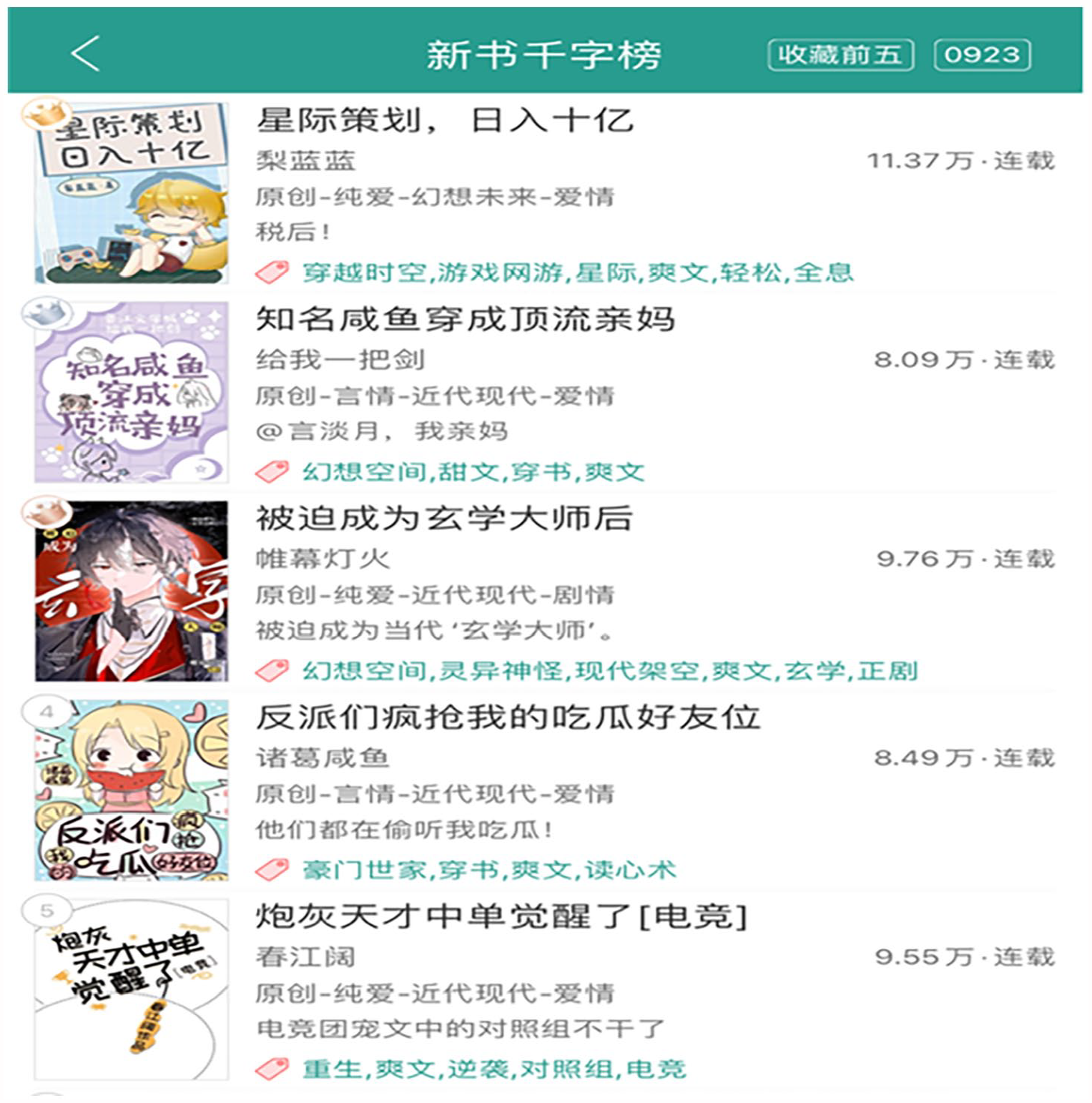
Ranking of earnings per thousand words for new books on the Jinjiang mobile app (accessed 23 September 2023).
When I met Lulu in her rented flat, she complained to me about the increasingly competitive rankings on Jinjiang; at that time, her ongoing novel was merely listed at number 20 of 30 on the list, which as she said, ‘is not very satisfactory’. By contrast, her last novel successfully made it to the top five and brought her more than 10,000 readers’ bookmarks in a single day. Lulu, however, had already accepted this result as she believed that the fluctuation is rather common for writers on Jinjiang. But she also admitted that she still felt pressured before and after making it to the list when serializing stories.
In addition to the depressed feelings that come with trying to hit the chart, serializing fiction on Jinjiang is also heavily qing-consuming, which requires a massive investment of qing. Lulu burns out her qing to write her stories, a process that affords both pleasure and pain. As Lulu related: But every time when I begin to worry if my novel fits with the current trend, or if it can make it to those lists on Jinjiang and achieve great popularity to reach wider readers and activate more paid subscriptions, I feel my pleasures are encroached upon by such haunting ideas.
In particular, during the middle to late stage of serializing a story, Lulu often got stuck on describing a specific plot or creating twists after the male couple officially began their relationship. She mentioned that she tended to become extremely anxious and restless. At its worst, she even suffered from breathing difficulties.
For contracted Jinjiang writers, they are required to finish at least a novel with no less than 200,000 words each year in the 5-year contract period, or more than 1 million words in total within the 5 years. Although Jinjiang only requires contracted writers to update at least four chapters (with each chapter no less than 3000 words) every month, they set the attendance bonus. If the writer updates every day after entering the premium stage, they will be awarded an extra bonus. The prize differs according to their word count: if each update is from 3000 to 6000 words, 6000–9000 words and over 9000 words, then the writer will receive an extra prize of 5 %, 10 %, or 15 %, respectively, of their revenue from the paid monthly subscription. Thus, for the extra bonus and in some cases, the commitment to daily updates for her readers, 5 Lulu gradually declined invitations from friends; her social networks became narrower, and she went out less and less. As she related, ‘I frequently postponed writing from the afternoon to the night, rushing to meet deadlines’.
Another established writer, Momo, who is regarded as a top-tier danmei writer on Jinjiang, also suggested that she often struggled to get into a smooth writing flow and felt pressured sitting in front of her computer when serializing a new story, despite experiencing joy and pleasure when she drafted the story synopsis. Momo added: Yes, I have already accumulated quite a few loyal readers. And it can be true that however badly I write, there are always people reading my new novels. That said, I won’t pretend I’m not concerned about readers’ comments, and I do not want to be irresponsible for my readers. Besides, I also want to make some advancement every time when I begin drafting a new story. [. . .] You know, it is the writing process and the demand of updating in time that become painful.
For Momo, it has become a frequent situation to begin typing her stories after 10 p.m. and to upload and publish the latest chapter before dawn, which means that what should be her nighttime is now her day.
Danmei writers’ investment, consumption, and self-exploitation of their own qing, including affects and desires, in their intense writing experience brings into relief the notion of affective labor. Notably, affective labor herein contains two facets: the investment in qing to write homoerotic romances, and the affective side effects of inputting qing while writing danmei, that is, the anxiety, insecurity, and depression that are endemic for contracted danmei writers on Jinjiang. Thus, an affective ambivalence arises that I will further elaborate on in the following section.
Data have become the new energy in the digital era, and qing, including affects and desires, are ceaselessly invoked for generating more data traffic. As Couldry and Mejias (2019) suggested, data colonialism signifies an emerging order for the appropriation of human life so that data can be continuously extracted from it for profit. Consequently, data work to (re)configure and reproduce social interactions to optimize data extraction. Jinjiang as the digital platform functions as a critical site for ‘the colonial appropriation of life in general and its annexation to capital’ (Couldry and Mejias, 2019: 338). Qing has become the direct factor for capitalist production.
Ambivalent affective labor and precariousness
In the following discussion, I carefully examine the ambivalent affects and precariousness faced by danmei writers while engaging in affective labor in the evolving cultural industry.
Lulu’s ambivalent feelings are emblematic among danmei writers. Pleasure-cum-pain constantly haunts their writing process when they actively extract and drain their creativity as well as qing to weave their homoerotic romances. As pointed out by Gill and Pratt (2008: 15), ‘a vocabulary of love is repeatedly evinced’ in their experience of affective work, while simultaneously insecurity and anxiety are endemic to the creative sector. Precariousness is a conceptual tool to refer to: all possible shapes of unsure, not guaranteed, flexible exploitation: from illegalized, seasonal and temporary employment to homework, flex- and temp- work to subcontractors, freelancers or so-called self-employed persons. But its reference also extends beyond the world of work to encompass other aspects of intersubjective life, including housing, debt, and the ability to build affective social relations. (Neilson and Rossiter, 2005: para.4)
Moreover, beyond precarity in the labor market, precariousness ‘describes the common, but unevenly distributed, fragility of human corporeal existence’ (Neilson and Rossiter, 2005: para.29). In debt to Judith Butler’s (2004) theorizations on precariousness, this term functions as an essential constitution of vulnerability and the fundamental condition of human relations.
Danmei writers as creative workers constantly experience such precariousness, with varied forms of insecurity, contingency, and flexible (self-)exploitation. When Lulu, Nanchi, and Momo constantly express their intensified love for danmei, they are exploiting their own qing, that is, extracting positive and negative affects and desires to engender their creativity, which at the same time has other unhealthy side effects: anxiety, uneasiness, insecurity, and depression. They have to offer updates in time, ensure the synopsis of their ongoing danmei story conforms to the du jour trends and is of interest to readers, and that the serialization succeeds in bringing them into the ranking lists on Jinjiang, thus activating more paid subscriptions.
This precariousness is shaped by the fact that humans are relational beings in the material–discursive continuum. Booming digital technologies and platforms further fortify and intensify these relations, which marks danmei writers’ creative and affective labor as precarious, making them vulnerable to and dependent on the commodified and marketized danmei cultural industries. Zhao (2017: 1237–1238) noted that: ‘the once non-commercial grassroots communities (of Chinese Internet literature) have now formalized into an industry’, and while a small number of star writers get courted by online platforms with prestige contract offerings and reap their share of benefits from the fan economy, the majority of their peers are still navigating the shadow labor market where precarious conditions are rife.
That said, top-tier danmei writers have to respond to the du jour needs of the market and meet the requirements of fans during their serialization. Xuanyuan, who began writing danmei online during the early 2000s, admitted that although she had a steady stream of readers, she was constantly comparing herself to emerging first-tier danmei writers: For example, compared to the writer Zhichu
6
(who has been serializing danmei fiction on Jinjiang since 2018 and is renowned for her series of stories featuring romance between two male idols), I find most of my readers appear to be older than hers. And sure, much less than hers. Her writing style perhaps is one of the mainstreams on Jinjiang [. . .] I also tried to write a story about the relationship between two members of a boy band. But the result was not ideal, though I already anticipated it. My old readers who are accustomed to my established feature did not find this story attractive since it was quite different from my previous ones, while this new trial has not attracted many new readers either. Yeah, I know my stories are already out of the current dominant fashion. It’s pretty normal. Jinjiang as a dynamic site keeps updating itself, and its first-tier writers shall also be continuously renewed accordingly.
Xuanyuan remains a renowned writer on Jinjiang as well as in the danmei cultural ecology, but she recognized the need for constant updates and self-renewal in this formalized cultural industry. She also admitted her concerns about being replaced by emerging star writers, although she has tried to convince herself to accept this fact. The novel she mentioned did not achieve good results. As Xuanyuan mentioned, there are specific measures of success: the numbers of bookmarks and subscriptions to her fiction, and whether these allow her to successfully make it into a higher position on the different ranking lists of Jinjiang.
Both established and emerging danmei writers are situated at a locus of precariousness which has been intensified by digitalization and platformization on Jinjiang since the 2010s, in particular with the release of mobile apps, which have brought numerous new registers to Jinjiang. These include the implantation and implementation of multiple ranking charts across its web, WAP, and mobile platforms.
Zhao (2017: 1248) convincingly highlighted that online literature writers in China are experiencing ‘augmented precarity’ because of their increased work intensity, a creative autonomy restrained by commercial viability, and less negotiation power against publishers. Danmei writers are facing similar precarious conditions regarding the intense work environment, which means that their creativity is being restricted by market demands, and they attempt to fit themselves into the ranking and revenue mechanism designated on the Jinjiang platform. In the following discussion, through further unpacking the term ‘precariousness’ and the datafication of qing, I further illustrate the distinct feature of danmei writers as ambivalent affective laborers in the danmei cultural industry.
Datafication and monetization of qing: formulaic writing versus creativity
First, the datafication of qing in danmei cultural production leads writers’ creative autonomy to be molded by capitalist logic. During my interviews with danmei participants who are from different generations, I noted a common complaint from both readers and writers: ‘danmei has become increasingly formulaic’. This phenomenon is impacted by the commercialization of danmei. The experienced writer Xiaofei suggested that ‘it was from 2008, when Jinjiang introduced the freemium business model, that this cultural field became different. Nowadays danmei culture is spoiled by high commodification’. Xiaofei began their career as a part-time danmei writer in 2005, and experienced Jinjiang’s transformation from a nonprofit online literature forum operated by a group of love stories aficionados to a full-fledged commercial site. In their own words:
Jinjiang has managed to retain some original features back to the nonprofit stage, such as readers’ power on this site to mark and comment on each novel, which exerts their heavy influence on the author’s reputation as well as earnings.
Jinjiang also maintains two sub-forums, Bishui 7 and Xianqing, 8 which are sites for communications among writers (both for yanqing and danmei) and danmei readers, respectively. Danmei readers have a substantial voice on Jinjiang, which has evolved into a fandomization process since reader-fans play an increasing role in swaying danmei production.
The formulaic writing that forms part of the danmei cultural ecology relates to the homogenization of its content production, including character setting, pairings of patterned types of gong-shou (gong and shou refer to the inserter and the insertee, respectively, in sexual intercourse, which are also borrowed from the Japanese seme and uke), scene setting, and worldbuilding. Azuma (2001) pointed out that the reading paradigm in the post-modern era is shaped by ‘database reading’ which consists of a series of micro-narratives, rather than the grand narrative identified in a modernist mode of reading. He further suggested that ‘elements of moe’ form an emblematic database. The Japanese term moe meng and the Chinese translation meng ‘describe the affect, or an unstructured intensity in response to the virtual possibilities of fantasy characters’ (Galbraith, 2009: para.30). In debt to Azuma, I consider the production and consumption, the writing and reading practices of danmei stories, as shaped by a database of qing. Qing is datafied in a multitude of micro-settings which can effectively and efficiently invoke reader’s affects and desires. The datafied qing elements are measured and expressed in terms of monetary value.
For example, the setting of a ‘spoilt and pampered’, ‘mischievous’, and ‘transvestite’ gong with a ‘masterful’, ‘tanned skin’ shou is combined with various datafied qing elements. Moreover, other types of qing elements include character relations such as ‘reunion after enforced separation’ and worldbuilding such as a virtual world managed by an artificial intelligence (AI) system in which the resident is required to complete different levels of adventures to earn essential points to survive, and the Omegaverse (also known as Alpha/Beta/Omega universe, or A/B/O), which inscribes the three additional sex categories on top of the male and female binary such that both males and females are also either alphas, betas, or omegas (Ge, 2021). Writers can employ various elements from the database to generate their own danmei stories in abundance. However, certain elements are du jour within the danmei cultural ecology. For instance, since November 2017, the world’s top-selling video game, Player Unknown’s Battlegrounds, has been available and has grown in popularity in China (Lemon, 2017). Also in the same year, in the League of Legends World Championship, the Chinese team Invictus Gaming defeated the European squad and won the final, which led to the Chinese social media platforms being overwhelmed with ecstasy and pride (Liao, 2018). The year 2018, hence, is known as the year of esports in China. It was also in 2018 that the esports subgenre gained its wide currency in danmei culture, in particular the setting of the love between two talented esports players in the same squad. In response to this trend, AWM: Juedi Qiusheng 9 (Player Unknown’s Battlegrounds’, hereafter AWM) by Manman Heqiduo was serialized on Jinjiang from January to April 2018 and achieved phenomenal success, with over 360,000 readers’ bookmarks by the end of 2018. 10 Since then, the esports subgenre has mushroomed within the danmei cultural ecology. A total of 233 danmei works labeled as esports were published in 2018, whereas in 2017, the number was 113, and in 2016, it was merely 35. 11 Thus, the database is de facto a manifestation of datafied qing, which is constantly renewed to ensure the updated content can effectively and efficiently invoke the affects and desires of reader-fans. The datafication of qing herein refers to the process via which qing is translated and transformed into data, more precisely, a database of qing that is then repackaged into units that offer new forms of (commercial) value.
Before introducing the freemium business model, Nanchi, like many other first-generation danmei participants, wrote danmei out of passion for the genre. The only source of returns for some of them is to publish printed copies in mainland China and Taiwan, but as Nanchi admitted, the earnings are minimal. The commercialization inherently conflicts with the ‘love-powered’ atmosphere in pre-2008 Jinjiang, as it substantially erodes content (re)production. Writers become more reader-centric and market-oriented to gain more profits, leading to limitations and homogenization in terms of themes and plots. Like the case of the burgeoning esports subgenre, after the success of AWM, the character setting of gong in AWM, who is designed to make frivolous remarks, also becomes an archetype (as an element in the database) for following writers to imitate (in varied creative ways). These multiple micro-settings function well to invoke qing and its varied affects and desires. The formulaic writing in the danmei cultural industry hence refers to employing different elements swiftly and flexibly in the accumulative qing database to better evoke the audience’s du jour affects and desires, and in aid of better productivity and profits.
However, the datafication and monetization of qing does not necessarily foreclose writers’ subjectivities and creativities. The transformative momentum embodied and embedded in qing also grants these writers potentially unalienated creativity. Affective labor is constantly co-opted by capitalist logic, whereas it simultaneously functions to present affective agency, which is beyond capitalist regulation. For a (commercially) successful danmei fiction, the strategic deployment of these micro-settings in the database and the style of writing does require writers’ own creativity. For example, in 2021, the writer Diezhiling creatively combined two subgenres: esports and A/B/O in her work Quanneng Zhongdan (‘The Versatile Mid-solo Player’), which achieved more than 420,000 bookmarks and was listed as one of the Novels of The Year on Jinjiang. 12 Moreover, in Xiaomogu (‘The Little Mushroom’), 13 the author Yishisizhou incorporated post-apocalyptic and posthuman sci-fi into a male–male romance between a human judge and a mushroom, and achieved more than 940,000 bookmarks. Moreover, Xiaomogu also won the Silver Prize at the 12th Xingyun Award for Global Chinese Science Fiction in 2021, which is China’s top sci-fi award. 14
Shimian, an emerging danmei writer who also works as a freelance columnist for a digital media company, told me that she got used to the formulaic writing: It’s true that nowadays danmei fiction has become more and more formulaic. But it does not mean that writing a danmei story becomes easy. Rather it becomes more difficult to complete an outstanding work whether you as a writer want to make money or achieve a sense of accomplishment. If you want to stand out from multitudinous writers, you must emanate your own style of writing.
The number of danmei readers on Jinjiang has surged since the 2010s, while at the same time, the number of registered writers has also vastly increased. The experienced editor Zizi revealed that the number of contracted danmei writers on Jinjiang multiplied by more than 20 times in the past decade. Thus, it has become rather competitive for danmei writers to stand out from the crowd, which further requires their distinct creativity. The ‘style of writing’ Shimian mentioned refers to three facets based on our subsequent conversation: the pace of plots, the organization of featured micro-settings from the database, and the style of writing. The three focal points were also confirmed by many other interviewed danmei writers. Notably, the realization of the three aspects requires the writer’s own creative agency to strategically employ multiple micro-settings; organically organize their plots to decide where to install different magnitudes of conflicts, turning points and climax; and present the story in their unique style of writing. Moreover, the micro-settings in the database per se are not static and invariable. On the contrary, the database continuously expands via danmei writers’ affective agencies to instill their unalienated creativities. This very subjectivity is produced within danmei writers’ affective embodied experiences. Danmei writers as desiring subjects perversely construct the masculinities constellation in the multiple and varied gong-shou dynamics, creatively hybridize different genres and invent new genres to create new realms for entering the imagination, all functioning to engender their subjectivities. As Tsianos and Papadopoulos (2006) put it, ‘The subjectivity of the immaterial laborers does not mirror the production process of immaterial labor; it is the diabolic blow up of its contingent intensities and fractures. Subjectivity is not a facticity, it is a departure’ (p. 1). The departure of the affective subject is the materialization in these affective laborers’ bodies and embodied lived experiences. Danmei writers as the affective subject, or more precisely, subject who are infused with qing, sustains their subjectivity and agencies in their everyday dialogues, negotiations, and tensions with platform capitalism. It is in this process that creativity constantly and pertinaciously emanated as well as being exploited – the very ambivalence of affective labor in danmei cultural industry.
Concluding remarks
Having examined the datafication of qing in the danmei cultural industry, I suggest that danmei writers as ambivalent affective laborers are living in an ambivalent and complex field. They present significant creativity and affective agency in the dynamic danmei culture. However, it is precisely their heightened affects, desires and creativity that lead danmei writers to be more easily co-opted by capitalist mechanisms and to be oppressed by party-state censorship, which leads danmei culture and its producers to live in a permanent state of precariousness.
Notably, danmei reader-fans also engage in affective labor in their everyday consumption and communication of danmei. The intensity of their affective labor is significantly strengthened by the commodification of qing to better evoke their affects and desires. Danmei fans’ affects and affective labor are also transformed by the data colonialism entrenched in the digital cultural industry into ‘a new abstracted social form that is also ripe for commodification’ (Couldry and Mejias, 2019: 343) and for constant, autonomous (self-)exploitation. Pleasure and pain are both involved and exploited in their input of qing throughout their consumption of danmei stories in the cultural industry. While the affects and desires per se cannot be fully manipulated, transformative momentum is embedded in qing. Therefore, future research should closely examine how danmei reader-fans work as affective laborers and how their precariousness is represented in the ever-expanding danmei cultural industry. By doing so, we can gain a more comprehensive understanding of the dynamic yet ambivalent danmei culture and its state of being manipulated and exploited by the logic of capital in the datafication of qing. Moreover, the transformative momentum that is always embedded in the invocation of qing, at the same time, should never be neglected, devalued, or underestimated.
Footnotes
Acknowledgements
I would like to extend my deepest gratitude to all my danmei writer friends for their unwavering trust and kind support throughout this research project. I am grateful to Dr Wing-Fai Leung, Dr Christina Scharff, Prof Fran Martin and Dr Heather Inwood for their generous comments and suggestions on an earlier draft. I am also thankful to the two annoymous reviewers for their constructive feedback. Any mistakes that may contain herein are my own.
Data availability statement
The author confirms that the data supporting the findings of this study are available within the article.
Funding
The author(s) disclosed receipt of the following financial support for the research, authorship, and/or publication of this article: This research was supported by Sino-British Fellowship Trust [grant number 16122021]; and Great Britain-China Educational Trust [grant number 15112022].
