




Abstract
Bridging the theory of affective labor and reproductive labor, this paper proposes “affective reproduction” as a critical framework to analyze the unpaid work of volunteer content moderation. Findings from this study problematize the one-sided focus on streamers in the extant literature on platform labor vis-à-vis live-streaming. It contends that fan moderators help streamers reproduce the live-streaming atmosphere as friendly, pleasant, and relevant, facilitating Internet celebrities’ money-making. This study contributes to studies of digital labor in two ways: 1) it expands the labor and work perspective to the study of content moderation and discloses the indirect value-generating nature of this work; 2) the designation of moderator in Chinese live-streaming platforms reveals a new form of work organization that exploits digital intimacy, transforming platform users into non-professional, secondary cultural workers. The proposed framework is applicable to various forms of participatory media, in which users are encouraged to manage and regulate their peers.
It was an ordinary night of Bai’s live-streaming. He is one of the top game streamers of Bilibili with more than 1.2 million followers. When Bai was busy unlocking a treasure chest that determines the winner of the game, a comment popped up in the live-chat with explicit promotions of pornographic websites. Bai was too occupied with the game and some viewers called out in chat: “fangguan, you got work to do.” In just a few seconds, a system notice appeared declaring the sender of the explicit comment was banned from speaking in the channel. Realizing fangguan has already sorted it out, viewers swept the screen with the same message: “Thank you fangguan! We really appreciated it!” A few minutes later, Bai successfully unsealed the chest and escaped from the maze. The chat got lively again with floods of cheers to Bai’s victory.
Fangguan, literally meaning “room manager,” is a special group of moderators organized by streamers of Chinese live-streaming platforms. Constituted by enthusiastic fans, moderators help regulate viewers’ speech during live-streaming. The vignette above shows a typical working scene of fangguan. As live-streaming gains its global popularity to become one of the most used conduits for entertainment and social networking, recent studies have paid attention to the labor involved in live-streaming production (e.g., Guarriello, 2019; Liu et al., 2021; Woodcock and Johnson, 2019). However, existing research on platform labor and live-streaming only examine streamers (Johnson and Woodcock, 2019; Woodcock and Johnson, 2019) or talent agencies (Liu et al., 2021), with fan moderator being an often neglected group. Problematizing such a one-sided focus on the production of live-streaming experiences, this paper examines volunteer fan moderators of Chinese live-streaming as a type of “affective reproduction.”
This paper aims at bridging the theories of affective labor (Gill and Pratt, 2008; Hardt and Negri, 2001, 2005) and reproductive labor (Fortunati, 2009; Whitney, 2018) to highlight an emergent form of labor distribution designated by the platform that capitalizes human affects and digital intimacy. Building upon Christian Fuchs’ conceptualization of “indirect knowledge worker” (Fuchs, 2010: 186), this paper proposes “affective reproduction” to critically examine a form of indirect platform labor whose work is mainly immaterial, affective, but important to the value extraction of platform companies. The work of affective reproductive labor, differing from affective labor that can be directly monetized, is consumed by other cultural workers to prepare for the production of profitable cultural artifacts.
Forged by an understanding of human affects as relational and inter-subjective (Anderson, 2006, 2009), this paper contends that the affective atmosphere of live-streaming which is generative of close relationships among users is a shared work by both sides of the screen. The sensational feelings of excitement and joyfulness not only derive from streamers’ exquisite performances, but also from continuous verbal interactions between streamers and viewers. In this process, fan moderators work in a subtle, sometimes unnoticeable way – maintaining the desired atmosphere and smooth interactions among all participants.
This article contributes to the studies of digital labor in two ways. Firstly, situating content moderation in the framework of affective content production, this paper expands the labor and work perspective to the study of content moderation, which has not been done by previous studies. Secondly, this paper reveals an emergent form of work organization designated by digital platforms that exploits digital intimacy to transform platform users into non-professional, secondary cultural workers. The proposed framework of affective-reproductive labor is applicable to various forms of participatory media, in which users are encouraged to manage and regulate their peers.
Live-streaming, digital intimacy, and the labor of production
Amid various new media formats, live-streaming stands exceptional with its real-time synchronicity and multimodal interactivity. Enabling synchronous broadcasting of online persona and verbal interactions between streamers and viewers, the “liveness” of live-streaming greatly reduced feelings of pre-script and performativity, rendering streamers to appear more “authentic” and “relatable” (King-O’Riain, 2021). Streamers usually broadcast 4 hours or more every day, which makes live-streaming an ideal place for digital companionship. The long-hour companion and constant chit-chatting foster the development of a sense of friend-like closeness, in which the content of live-streaming is inserted into viewers’ daily life. In game live-streaming, this relational closeness is further invigorated by the excitement of game-playing, mixing the friend-like digital intimacy with admiration for gamers’ talent and skills.
The excitement and enjoyment of live-streaming not only attracts large amounts of audiences across the globe, but also generates various monetization opportunities that sustain online persona’s careers and digital platforms’ money-making. It is challenging to account for what motivates live-streaming viewers to send out virtual gifts or join subscription plans, though previous studies have attempted to explain it from different aspects (e.g., King-O’Riain, 2021; Tan et al., 2020; Zhang et al., 2019). Recent ethnography and human geography research have tried to theorize how atmospheres in public or collective events curate affective feelings (Kolehmainen and Mäkinen, 2021; Sumartojo and Pink, 2018). Atmosphere takes shape in collective situations through strategic organizations of human bodies and reaches individuals as felt sensations (Anderson, 2009; Kolehmainen and Mäkinen, 2021). These sensational feelings invoke viewers’ affective responses during live-streaming, generating a sense of gratification and desires to gift or subscribe as rewards to the streamers.
Extant literature on the production of live-streaming also found efforts in curating desired atmospheres. For example, in Guarriello’s (2019) ethnographic study, the streamer imagined her live-streaming could be “an inclusive, communal space where people can unwind from school, work, or bills, and express their everyday struggles or pleasures” (p. 1757). The work of curating atmosphere is largely affective, sometimes requiring instincts or “six-sense” to capture the flow of human affects (Hardt and Negri, 2001, 2005; Wissinger, 2007). To deliver “good” live-streaming experiences, streamers put efforts into both material settings (backgrounds and recording equipment) and immaterial content strategies (e.g., use of humor, streaming in character, etc., see Woodcock and Johnson, 2019) to unleash desired responses from viewers. By envisioning a desirable emotional state of audiences, streamers organize their performance around this imagination and attempt to affect viewers with their gestures, speech, or gaming tactics (Guarriello, 2019).
However, current research predominately focuses on the labor of streamers with the audience labor being marginalized. In fact, live-streaming represents collaborative efforts and is a co-production of streamers and the audience. As indicated by Reade (2021), social media content as an affective assemblage requires cooperation between bloggers and their viewers. The making of atmosphere is collective and trans-subjective (Kolehmainen and Mäkinen, 2021). Interactions between streamers and viewers could be as enjoyable as streamers’ exquisite performances. As revealed in the next section, the neglect of work by the audience can be attributed to its indirect relation to money-making and reproductive nature. To fill this gap, I propose “affective reproduction” as a critical framework to scrutinize indirect knowledge workers of cultural production epitomized by volunteer content moderators. Bridging theories of affective labor and reproductive labor, this framework examines how digital media platforms transform paying users into unpaid, secondary cultural workers.
Content moderation as affective reproduction
The prevalence of digital media platforms not only blurs the boundary between user and producer, but also engenders various new forms of labor (van Dijck, 2009). To facilitate value extraction, digital platforms designate various multisided markets and insert themselves as intermediaries (Nieborg and Poell, 2018). This also leads to the prosperity of the gig economy, in which stable employment relationship gives way to flexible work that perpetuates precarious, unstable, and insecure forms of living (Gill and Pratt, 2008; Milner, 2009). Content creation sites harness interactive affordances and construct themselves as a space for entrepreneurial creator subjectivity (Cunningham et al., 2019). Envisioning a career in the platform economy, content creators such as streamers participate in various forms of visibility labor (Abidin, 2016) and aspirational labor (Duffy, 2017) to curate fun and interesting content, share everyday happenings, all with the ultimate goal of establishing successful self-branding ventures that can sustain their livelihood (Banet-Weiser, 2012).
Compared to entrepreneurial gig workers whose goal is to generate income, volunteer content moderation exhibits an altruistic orientation and is deeply intertwined with social relationships. Volunteer content moderation refers to a form of media participation in which a group of media users assumes the responsibility of regulating the speech of peer participants and removing inappropriate content (Lo, 2018; Taylor, 2019). Usually referred to as “fan moderators,” these participant volunteers play an important role in self-organized online communities in preventing abusive behaviors and securing conversational rhythms (Ruckenstein and Turunen, 2020). Seering et al. (2019) argue that they are the building block of meaningful communities. In the meantime, there have been limited studies conducted on live-streaming moderators. Echoing previous research on online forum moderators, Lo (2018) emphasizes the agency of moderators in shaping the communicative environment of live-streaming. From a functionalist standpoint, Game scholar Taylor (2019) instead argues that the implementation of content moderation, whether manual or automatic, serves as a mechanism for social regulation and control within the platform economy.
In an account for new labor organizations in informational capitalism, Fuchs (2010) proposes the term “indirect knowledge worker” to describe an emergent class of information workers whose work is consumed by wage labor in preparation for their paid work. Fuchs situates this labor in the “backstage” of the labor supply chain, highlighting the reproductivity of labor “in the sense that it reproduces and enables the existence of capital and wage labor that consume the goods and services of unpaid reproductive workers for free” (Fuchs, 2010: 186). His conceptualization invokes Marxist feminist scholarship on social reproduction, shedding light on new forms of unpaid or underpaid labor mediated by network technologies. Similar to other forms of reproductive labor, such as housework (Fortunati, 1996) and care work (Federici, 2020), the labor of indirect knowledge workers, despite being intentionally outsourced by digital platforms, is often obfuscated by the “small choirs” discourse (Fortunati, 2009) and receives limited attention in academic research due to its indirect relationship with money-making activities (Fuchs, 2010).
The concept of indirect knowledge worker underscores the significance of reproduction for the productive forces of platform capitalism (Posada, 2022). However, the immaterial, affective nature of cultural production often leads to its association with pleasure and solidarity rather than traditional notions of work (Milner, 2009; van Dijck, 2009). Expanding on Fuchs’ conceptualization, I propose the term “affective reproduction” to describe the work by indirect cultural workers on social media platforms. This work is primarily immaterial and reproductive, which are integral to the value extraction processes of digital platforms. Compared to Fuchs’ all-encompassing concept that applies to various professions, such as teachers, caretakers, copywriters, and so on, affective reproduction emphasizes the investment of affective labor (Hardt and Negri, 2001, 2005) in digital cultural production, which is usually conducted by freelancers or independent contractors with precarious working conditions (Duffy, 2020; Gill and Pratt, 2008). This theoretical framework also diverges from concepts concerning entrepreneurial digital workers, such as visibility labor (Abidin, 2016) or aspirational labor (Duffy, 2017), in that it portrays a form of cultural work that is motivated by social relationships and not directly monetizable. Through affective reproduction, indirect knowledge workers do not produce original content themselves; rather, they take care of other digital labor’s work (e.g., online celebrities) and transform themselves from platform users to non-professional, secondary cultural workers.
The emergence of affective-reproductive labor in platform capitalism is not arbitrary. Platforms prescribe content creators a sense of precarity by positioning constant competition for visibility and assuming them full responsibility for interactive content. It engenders the need for content moderation and posits fans as a possible source of labor. As indicated in later analysis, the capitalization of human affects is accomplished through interlocking infrastructural and regulatory designs. While content moderation does not directly generate monetary value, it is important to prevent abusive behavior and optimize live-streaming atmospheres. The work of fan moderators is conspicuously for-profit rather than community-oriented. Expressions are moderated and sometimes forcefully implemented through material and immaterial settings with certain affects precluded from the live-streaming sphere. Examining volunteer content moderation as a form of affective reproduction, this article expands the scope of research on digital labor by providing insights to the value and significance of content moderation within cultural production.
Methodology
Data
This study was conducted on Bilibili Live-streaming (https://live.bilibili.com/), a sub-section of the bullet-screen streaming platform Bilibili (https://bilibili.com). Bilibili is one of the most-watched streaming platforms in China with 223 million monthly active users in the first quarter of 2021 (Wang, 2021). It started as a subcultural streaming platform catering to ACG (animation, cartoon, and game) fans in China and is also one of the early adapters of bullet subtitles (see Figure 1 for the basic layout of Bilibili live-streaming). While other Chinese streaming platforms also adopt bullet subtitles, Bilibili is still one of the favorite sites for young Chinese, with 85% of its users aged under 35 (Wang, 2021).
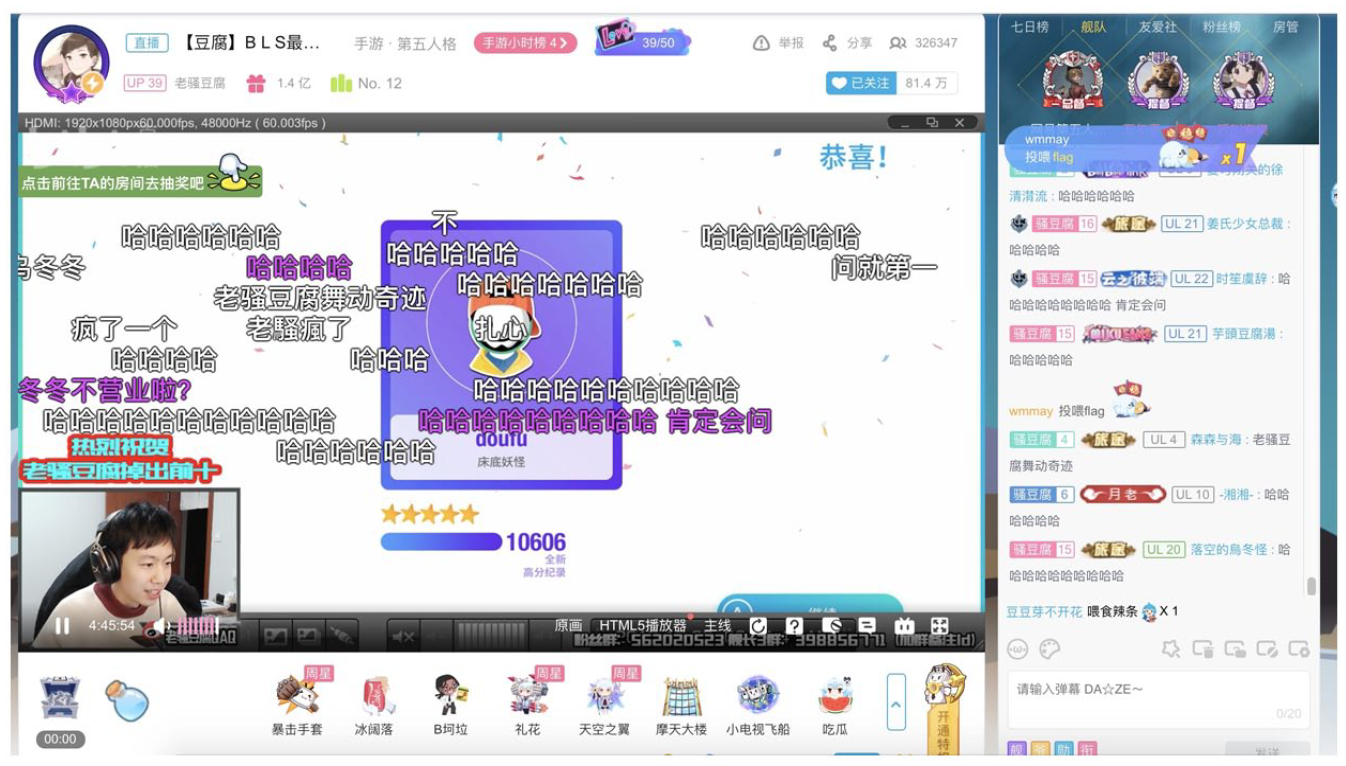
A screenshot of Bilibili Livestreaming (as on 12-01-2019).
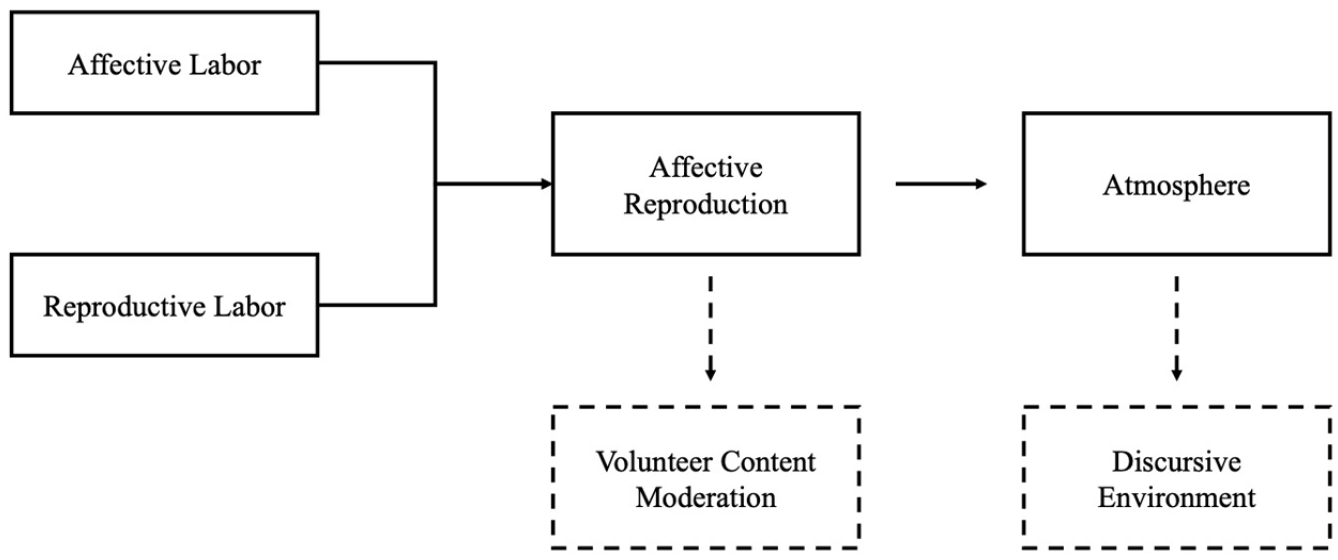
The conceptual framework of affective reproduction. Drawn by the author.
Multiple methods were used to better understand fan labor in volunteer content moderation. First, I conducted participant observation on Bilibili Live-streaming from October 2019 to October 2020. As a participant observer, I actively explored the mobile-game section of Bilibili Live-streaming on both its mobile app and the website. I shuffled from channel to channel from the website’s list and intensively watched five streamers’ channels, taking fieldnotes during the whole period with screenshots and screen-recordings. Second, 21 semi-structured interviews were conducted, including 11 fan moderators and 10 frequent viewers (see Table 1). Interviewees were recruited by direct messaging on Bilibili and a recruitment post on WeChat. Frequent viewers are defined as those who like watching game live-streaming on Bilibili and have been continuously following at least one streamer for more than 3 months. Two moderators were interviewed via text-chatting on WeChat while all others were interviewed through videocalls. Interviews lasted from 25 to 50 minutes. All interviews were conducted in Mandarin and audiotaped and then transcribed with consent obtained from participants. For textual interviews, chats were completely copied and pasted to a Word document without personally identifiable information.
Information of interviewees.
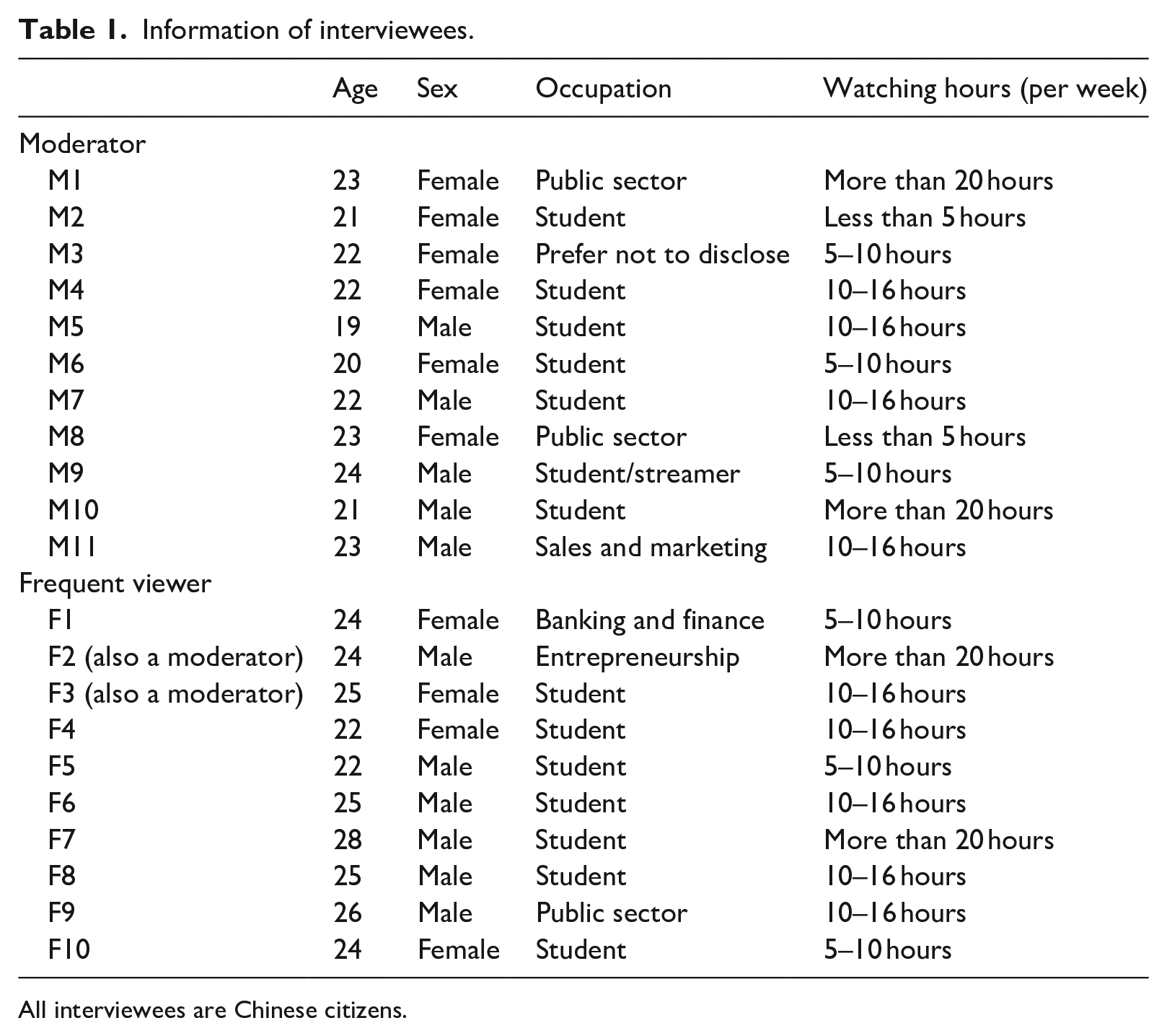
All interviewees are Chinese citizens.
Analysis
Data were analyzed using the constant comparative method (Creswell, 2013; Glaser, 1965) with the qualitative data analysis software MaxQDA. This method concerns the generation of plausible theory of social phenomena. The analytic process included two main activities – fragmenting and connecting (Dey, 1993), in which data were repeatedly categorized, compared, and contrasted to inform conceptual differences and relationships between categories (Boeije, 2002). Relevant data from different sources were examined as triangulation to validate the provisional theory (Glaser, 1965). Three themes were developed regarding the affective reproduction of fan moderators: 1) fangguan as trusted helpers; 2) speech regulation through jinyan; 3) moderating for a friend of mine, which will be elaborated in the following session.
Findings
Fangguan as trusted helpers
In Chinese live-streaming, fangguan work as delegates of streamers. The term fangguan is the Chinese name of fan moderators, literally meaning “room managers” (房管). Their role is incorporated in the Chinese live-streaming system, in which fangguan are marked by a special badge in the live chat (see Figure 3). A part of the work of fangguan is bridging the information gap among viewers in the dense information flow during live-streaming, usually done by a combination of manual and automatic labor. Streamers are responsible for creating a vibrant atmosphere in their lives-streaming channels to keep viewers engaged. However, streamers – especially game streamers – need to spend considerable time and energy on broadcasting content and responding to viewers’ comments, which makes it difficult for them to iterate elementary conversations. Fangguan, as moderators of the performance, continuously monitor the chat of live-streaming and deliver significant information to both sides of the screen. This work aims to show the courtesy on behalf of the streamer as a host of the performance.
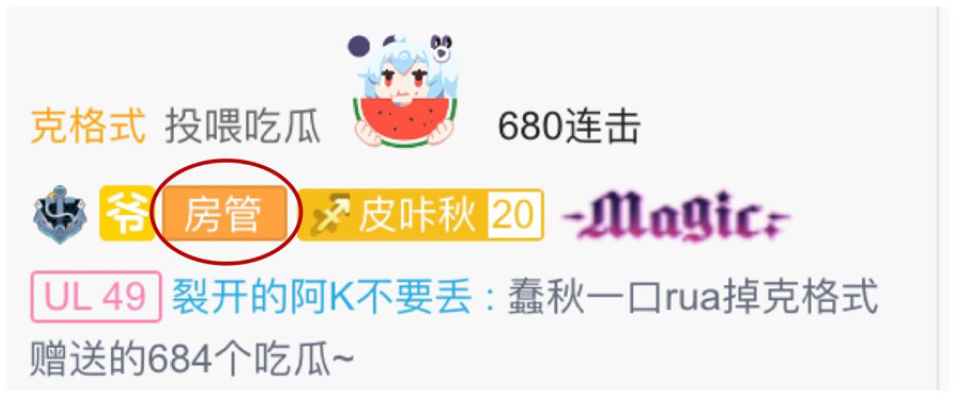
The display of fangguan badge in the live chat (circled).
Fangguan are usually active fans who have spent a high volume of time or money on respective live-streaming channels. Nominated by streamers, frequent and loyal fans are selected and given the chance to become fan moderators. The recruitment process displays a strong sense of mutual intimacy between fangguan and streamers, preparing the selected fans to be legitimate “managers.”
For example, Lilian (M6) became a fangguan because she was at the top of the fan ranking of her streamer’s channel. This ranking system is designed by the platform and depends on viewers’ “intimacy” scores (亲密度). The accumulated scores are independent of each other in different channels. Viewers are supposed to acquire “intimacy” by spending time watching live-streaming or sending virtual gifts to the streamers. Sending gifts is more efficient if one wants to climb up the ranking ladder because there is no imposed daily limit, while the transformation from watching time to intimacy score is capped at maximum 2 hours per day (which equals spending 120 RMB on virtual gifts at the time of August 11, 2021). Fans’ intimacy scores are not directly shown but signaled by their fan badge level. There are total 40 levels of fan badge with different color effects. Paying monthly or yearly subscriptions (ranging from 198 to 1988 RMB per month at the time of August 11, 2021) would straightly boost one’s badge level to 21st. This ranking system helps streamers to identify active fans from general viewers, who are ready to make contributions to the channel.
Apart from fan ranking, fans also demonstrate their activeness by frequent presences and interactions with the streamers:
There was nothing special about why I became his fangguan. It was mainly because I was active in his channel/room. I also sent gifts from time to time. So he remembered my id. It happened that the older generation of fangguan was leaving because they all got their own life . . . He didn’t have enough moderators then, so I became one. (M1) You need to watch a lot, be active in his fan groups and then he will notice you. The takeaway is that it is the easiest to become a fangguan when he does not have lots of fans. When I started to follow my streamer, he only had several thousand fans. If you were active in fan groups he would notice you. And then he would ask whether you want to be a fangguan. Now he has two hundred thousand fans. It’s hard for you to be noticed. (M3)
Becoming a fangguan is not super competitive given that streamers could have much more fangguan than what was needed. But certain investment has to be made, either time or money. Though not all active fans want to become a fangguan, streamers’ nomination acknowledges hardcore fans’ investment and the badge of fangguan displays their close relationship with the streamers. Relational closeness between fangguan and the streamers legitimizes fan moderators’ acts on behalf of their streamers. And the resulting mutual trust makes fangguan ideal housekeepers of the live-streaming.
For example, viewers who are new to live-streaming or not familiar with the streamer tend to ask basic questions, such as how to get a fan badge, what is the game played by the streamer, and so on. These questions recur as people come and go during the live-streaming. Fangguan need to capture and answer these question in the live-chat, as described by Elaine (M4) using a gamer’s term – “the beginner’s guide” (新手教程). Sometimes, fangguan utilize user-developed website plug-ins (e.g., danmuji) to automate the Q&A processes. Plug-ins are able to detect keywords set by fangguan and send out pre-texted replies to the live chats. A typical “beginner’s guide” resembles the following one:
What’s the name of this game?
This is [the name of the game], a role-playing video game developed by [the developer of the game]. If you like this live-streaming please give our streamer a thumbs-up, follow him/her, and join his/her fan group!
Fangguan also utilize these chances to implement promotional messages to call out likes and followings for their streamers. This act strengthens their presence as streamers’ delegates, meanwhile, showing their affective devotion to the streamer by propagating the channel.
Another type of discursive interaction usually done by fangguan is the appreciation of gifts. When a viewer sent virtual gifts to the streamer, fangguan would post a message in the live chat to thank the viewer. By directly addressing the sender, this act conveys a sense of acknowledgment and gratefulness, consolidating the parasocial feelings between streamers and viewers (Hartmann and Goldhoorn, 2011). While the feeling of intimacy was nonetheless reduced when the expression of gratitude is conducted by fangguan instead of the streamer, it is considered more effective due to streamers’ busyness and to avoid any miss. Appreciating gifts not only gives credits to those who make monetary contributions, but also distributes social capital to the sender by remarking the gifting moments. Fangguan’s message also served as a reminder for streamers to thank gifts, especially those with high monetary value:
When someone sends an expensive gift but the streamer is occupied [with the game], we need to remind him of it . . .
How do you remind him of that?
Hmm . . . just like giving special thanks. For example, if a person has sent a very expensive gift and then you said “Thank [the name of the viewer] for [the name of the gift], [the name of the streamer] love you xoxo” things like this. Usually after a while the streamer would notice our messages and give thanks to the viewer herself.
What if the gifts are not very expensive?
I will also express my thanks but not everyone has the same habit. Those popular streamers would implement text robots in their channel. Robots would detect gifts and send out appreciations automatically.
The work of fangguan is both integrative and generative. As hardcore followers and active communal members, they attempt to create a sense of community by providing information to newcomers and recognizing viewers who make significant (monetary) contributions. Amid fast information flows in live-streaming, fangguan help streamers capture and remark moments that are socially and economically valuable. Besides, their messages are often written with pleasant, energetic, and hospitable tones with emoticons, which aim to curate a lively and friendly discursive environment. When I was watching live-streaming and constantly saw fangguan’s messages, I was inclined to mimic their styles if I wanted to say something in the channel. And I also learned some unique words used in respective channels by observing live-chat conversations.
Exemplifying verbal friendliness and upbeat spirits, fangguan moderate discursive interactions through positive reinforcements. The delivery of useful information ensures a hospitable feeling upon viewers’ entrance. The calling-out of likes and followings, while speaking for the streamers’ career aspirations, also fosters a sense of communal bonding in which central fans are willing to reach out and extend the community toward newcomers. The appreciation of gifts confers acknowledgment to viewers who support the streamers’ careers. Working as delegates of streamers, fangguan employ verbal strategies to not only generate a responsive image of Internet celebrities, but also set the standard for the desired discursive environment of live-streaming.
Speech regulation through jinyan
In addition to positive reinforcement through discursive interactions, fangguan also employ punitive means to regulate viewers’ speech, usually through jinyan (禁言). Jinyan is the timing-out of viewers whose comments are deemed inappropriate or offensive. When jinyan is implemented, the sanctioned viewer will be banned from speaking in the channel for up to 720 hours.
Although trolling and flaming might be positively perceived in some circumstances, it is more common for live-streaming viewers to feel annoyed and want to leave the channel (Coles and West, 2016; Moor et al., 2010). Moreover, the triggering effect of trolling is likely to provoke reactive aggressiveness, dragging the live-streaming into meaningless fights and unfriendly conversations (Cheng et al., 2017; Coles and West, 2016). In this case, fan moderators intervene and help regulate the discursive environment. This is the most important, but also the most tedious task of fangguan, as they need to keep monitoring the ongoing messages and capture inappropriate ones. The punishment of jinyan also has a warning effect on other viewers. While the moderation process is invisible to other viewers, a public message will be sent to the live chat once a jinyan decision has been made, showing the name of the viewer who has been banned. The inappropriate message cannot be deleted in an ad-hoc method and thus possible for other viewers to look for which message has been censored.
Advertisements and curses are typical content that will get one’s account suspended, however, the standard for jinyan is less clear when it comes to other less intensive content. Both informants and my observation suggested that daijiezou (带节奏) – literally meaning “leading the rhythm” – is a significant red line. To explain what is daijiezou, fangguan tended to describe the actual scenes in which they made jinyan decisions:
Messages that may induce arguments. For example, when we were watching the streaming, someone out of nowhere mentioned other streamers, and then they began to lead to rhythm (daijiezou), saying that streamer A was not as good as streamer B, or streamer B was more likely to act rashly than streamer A. This would cause fans to argue in the live chat so I had to ban them. (M4) Once my streamer was streaming an ARPG [action role playing game]. One player said that he was from Guangdong [a province of China]. This guy was not playing well and some viewers started saying people from Guangdong were not good at gaming. These messages were inappropriate and leading the rhythm (daijiezou). They were inducing fights. As such, they were banned soon after. (F3)
Daijiezou is used by the live-streaming community to describe phenomena that are similar to both flaming and trolling. However, flaming and trolling are often deemed intentional (Moor et al., 2010) and daijiezou sometimes could be unconscious acts of deliberation. Daijiezou is deemed harmful by fangguan due to two reasons. Firstly, arguments distract viewers from the content of live-streaming; secondly, daijiezou annoys other viewers who want to enjoy streamers’ game-playing:
Streamers will read viewers’ messages from time to time and try to teach us some skills while he is playing. If the live chat is off-topic with viewers arguing with each other, the streamer will feel lonely. We will notice this. (M4) One streamer I followed was controversial some time ago. People came to his live-streaming to dismiss him and fight with other viewers. During that time, I didn’t like to watch live streaming very much. I didn’t enjoy watching that. (F5)
While speech regulation and jinyan are not unique to live-streaming, the standard of jinyan in live-streaming differs from what has been found in previous moderation practices which focuses on protecting communal members’ fair opportunities to participate in open discussions (Matias, 2019; Nielsen, 2022). Jinyan and daijiezou emphasize the harmony of the discursive environment in which tensions among participants remain minimal. Discussions around the phenomenon of daijiezou suggest that an ideal live-streaming environment is imagined to be friendly, pleasant, and relevant. Deliberations are intentionally discouraged because they created a sense of intensity in the discursive environment which might develop into partisanship and confrontations among viewers. While arguments could potentially bring agreement and innovations to the community, they are considered off-topic and unfriendly to streamers (making them feel lonely). Live-streaming, in the perception of fangguan, constitutes less a public sphere for serious discussions but a space for sharing moments of game-playing and digital companionship.
In interviews, both fangguan and viewers agreed that trolling and flaming should be regulated as they ruined the pleasant atmosphere of watching live-streaming. However, irrelevant messages are sometimes handled differently. For example, if viewers start to argue in the live chat, fangguan tend to ban the viewer(s) who initiated the fight (and sometimes also those who follow the rhythm and argue back with offensive messages); if the message is simply off-topic and does not lead to flames, fangguan would rather reorient the conversation by sending out reminders (“Guys keep your conversations relevant. Focus on the live-streaming”). This further demonstrates that the goal of fangguan is to maintain good conversational flows of the live-streaming.
The work of jinyan is reproductive. It aims at bringing back the order to live-streaming and maintaining an ideal atmosphere – a sociable space free from discursive aggressions and any annoyance brought by that. From answering viewers’ questions, appreciating gifts, to regulating speech of the audience, fangguan share a significant part of affective labor of streamers in keeping the live-streaming animated and engaging, which in turn facilitated the generation of positive affections in the environment (Woodcock and Johnson, 2019). Their work was also recognized by viewers:
Sometimes I feel that a fangguan is more effective than a streamer. Streamers need to focus on the content and may not notice the rhythm going wrong. This is the time when we need fangguan to maintain the order and settle things down. (F4)
Strict control over verbal aggressiveness in live-streaming also reflects the edge of Chinese platform governance. Chinese regulating departments have imposed strict regulations on “vulgar content” in media production, which generally refers to explicit and verbally violent content. This regulatory pressure is passed onto individual streamers through both infrastructural settings (i.e., the designated role of fangguan) and ad-hoc review policies (Cunningham et al., 2019). Streamers are held responsible for all controversies that happened in their channels and risk being shut down if their content, including game-playing and live-chat conversations, is deemed inappropriate by the platform. To avoid such risks, fangguan utilize the punitive method to warn viewers against fights or arguments, which possibly lead to fouling and cursing and thus threatening the streamers’ career. By oppressing negative expressions to a considerable extent, positive affects are encouraged (sometimes forced) to construct a light-hearted atmosphere of live-streaming.
Moderating for a friend of mine
Relational closeness with streamers has been an important motivation to fangguan’s free labor. Being a fangguan is sometimes tedious and tiring, as one needs to focus on the live chat for hours and react properly to different kinds of messages, especially for fangguan of popular streamers with hundreds of viewers talking at the same time. Many fangguan quit their job due to conflicts of time allocations. In most interviews, fangguan tended to frame their decisions to persist as personal choices, in which they weigh between their affection for the streamer, the social reward of being a fangguan, and the time they need to spend on their personal life. This narrative downplays the tension of non-wage labor and potential concerns of exploitation:
I do this out of love . . . Because you like a streamer so you think it is not bad to take care of things for him. It is mainly . . . actually I am a mother-like fan. I don’t think much about it. Just like taking care of things for my son. (M6) My streamer used to interact with his fans a lot besides doing live-streaming, especially with fangguan. We shared everyday encounters and played games together. We were like friends so I always attended his live-streaming and did the moderation. (M3)
The work of fangguan constitutes affective reproduction not only because it aims at the maintenance and restoration of the discursive order of live-streaming, but also relates to the reproductivity of affective interactions between fangguan and streamers. By working closely with streamers, hardcore fans are able to participate in live-streaming on a deeper level and take care of their streamers. This is also reflected in the goal of moderation – a harmonious discursive environment that is palatable and profitable. It encourages viewers to interact with the streamers and share their admiration but at the same time avoids conflicts and sensitive content that could put streamers’ careers at risk. In China, streamer is a highly competitive job as many newcomers flooding in the market and rising into fame. A less controversial streamer is more likely to stay on the top of the rankings and earn money. Fangguan gain a sense of achievement by taking a carer’s role, prompting a feeling of solidarity between fangguan and streamers, as indicated by M6’s portrait of a “mother-like fan.”
Being a fangguan is a part of affective interactions between loyal fans and streamers. Despite the existence of “honorable fangguan” who are promoted to the position because of their subscriptions, most fangguan tend to be long-time followers of the streamers. If one follows a streamer from an early stage, the relationship between them could be really deep. This needs not be personal contact with the streamer – although personal contacts usually developed as a result of long-term following - it is more about knowing and admiring a person for a long time. After watching live-streaming for so many hours and continuous interactions, a viewer gets to know a lot about the streamer – thus the streamer becomes more like a friend than a host of a live show. One of my informants (M5) had followed his streamer for more than 2 years, during which the streamer’s followers grew from around 2000 to more than two million. He was very happy about the achievement of a person he liked and grateful for what he had learned from the streamer – gaming skills and, maybe more important, how to stay modest. He also made a bunch of friends who played the same game and watched the same live-streaming. Although he was no longer as active as 2 years ago, his fangguan identity was not laid off by the streamer and he still moderated live-streaming content from time to time.
While stories of long-term following exist, the relationship between fangguan and streamer could also collapse over time, breaking the imaginary that permits free labor. Lily (F3) used to be a fangguan of a game streamer on Douyu (斗鱼), another popular platform specializing in game live-streaming. She was a personal acquaintance of the streamer and she also appreciated his gaming skills. She followed him for around 6 months and spent around 500 RMB on his channel. She also became friend of other three loyal fangguan in the same channel. The five of them – including the streamer – often played games together. They used to be good friends, according to Lily. However, the streamer later hung out with a girl who disliked him playing games with other girls. And the girl publicly complained about female viewers in the channel. As a result, this streamer was less active in playing games with female fangguan, which hurt Lily and her friends’ feelings. They decided to leave the channel. One of them even deleted her fan badge to express her frustration.
Lily’s story can be an extreme case with a dramatic break-down moment of relationships between fangguan and streamers. In many other cases, fans just stopped watching live-streaming and left silently. Some streamers would remove inactive fangguan to let new fans in, others would let the inactive ones stay if there were still plenty of quotas. Once the affective bonding becomes weaker, the legitimacy of free labor dissolves as one’s willingness to care no longer exists. Affective connection, or parasocial relationship between streamers and fans, needs continuous management. This management sometimes includes a nuanced balance between a streamer’s displayed private life and his/her relational closeness with viewers. While the view-streamer relationship could be as deep and loyal as suggested in M5’s story, it can also be ephemeral and fades away quickly once viewers find themselves unable to relate with the streamer anymore.
Discussion
This article examines affective reproduction of fan moderators in Chinese game live-streaming. By collectively imagining a “sociable” live-streaming environment – one that is pleasant, relevant, and friendly with strategically reduced verbal aggressiveness – the labor of fangguan curates the discursive environment and maintains the harmony of the live-streaming atmosphere. This, in turn, contributes to the money-making of online celebrities (i.e. streamers). Conducted by hardcore fans who have spent considerable amounts of time or money supporting the streamers, this free labor is motivated by a sense of relational closeness and is sustained by the fulfillment engendered by the act of caring. The work of fan moderators, designated by the complexity of political risks, social relations, and digital affordances, shares the precarity experienced by content creators. The value they generate is appropriated by digital platforms and later expropriated as a form of maintenance labor.
The relational motivations behind the work of fangguan suggest that this work is likely to be experienced as pleasure or solidarity, rather than traditional notions of work, which aligns with extant literature on reproductive labor (Fortunati, 2009; Jarrett, 2015). The precarity faced by cultural workers is empathized with and transformed into legitimacy for unpaid caring work. Findings from this study move beyond the observation of the blurring boundary between work and leisure associated with digital media, disclosing a situation of “double-paying users,” in which paying consumers also become producers of the atmospheric feelings they later enjoy (Kolehmainen and Mäkinen, 2021). Previous research also suggests that social networks are crucial for low-wage platform workers to resist precarious working conditions (Posada, 2022). The affective reproduction framework proposed in this article contributes to the ongoing discussion surrounding platform labor, emphasizing the value and significance of caring labor associated with digital media, while also shedding lights on the intricate relationships between general users, content creators, and the platform.
This article also contributes to studies of fan labor by expanding beyond the predominant focus on highly skillful and profitable fan productions. In the present study, fans demonstrate technical savvy, as reflected in their agile use of automatic chat-bots. However, their work is characterized by high repetitiveness and low professionalism. In the case of fangguan, fan moderators occupy a liminal space between producer and consumer, acting as gatekeepers of the conversational flow in live-streaming. Their agency lies in the self-organization of work through collectively imagining a desirable “atmosphere.” It is important for future research to uncover more forms of work like fangguan, as affective reproduction often remains hidden and marginalized due to its less skillful and altruistic nature. Additionally, the appearance of professional influencer agencies (e.g., multi-channel networks, guilds, see Cunningham et al., 2019; Liu et al., 2021) in the live-streaming industry has led to the employment of paid moderators in some channels. These contract-based moderators typically work for larger channels in parallel with fan moderators. While beyond the scope of the present study, it would be interesting to explore the differences and interactions between paid moderators and volunteer fan moderators.
Footnotes
Acknowledgements
The author thanks Dominic Yeo, Jeroen de Kloet, Tommy Tse, Abby Youran Qin, Dongli Chen, Shichang Duan, ASCA Transasia Cultural Studies Group, and the two anonymous reviewers for their valuable feedback and advice on this manuscript.
Declaration of conflicting interests
The author declared no potential conflicts of interest with respect to the research, authorship, and/or publication of this article.
Funding
The author received no financial support for the research, authorship, and/or publication of this article.
