



Abstract
In 2020, the Philippines’ largest mobile network provider Smart Communications launched a year-long campaign with South Korean actor Hyun Bin, who gained high popularity among Filipino audiences through the Korean TV drama Crash Landing on You (TvN 2019-2020) aired through Netflix. This article analyzes media texts, government plans, corporate narratives, and infrastructure data to examines two ways that transnational media, such as K-dramas, function as cultural interfaces to disseminate and operationalize the infrastructural desires in the Philippines. First, Philippine internet service providers (ISPs) co-opt Netflix’s language of internet speed as a criterion of infrastructural quality, trying to secure the country’s public and economic recognition in Southeast Asia. Second, through the collaboration, local ISPs successfully translate K-drama’s cultural power into a public campaign presenting high-speed internet as not merely desirable, but a predestined future for digital consumers and the developing nation.
While the growth of subscription video on demand (SVOD) services has slowed in North America, Western Europe and Australia, Southeast Asia emerged as “one of the most hotly contested markets” for both global and regional SVOD platforms with rapidly increasing mobile broadband users and online video consumption (Shackleton 2022). Hong Kong and Singapore-based consultancy Media Partner Asia estimated that in the first quarter of 2022, Southeast Asia added 2.8 million new SVOD subscriptions, reaching a total of 39.5 million (Media Partners Asia 2022). Overall video streaming revenue in the Philippines has increased from 26.22 million USD in 2017 to 110.23 million USD in 2022, and is projected to reach 170 million by 2027 (Statista 2023). Despite these impressive numbers, global streaming platforms such as Netflix and Disney+, and regional competitors such as iQiyi and Viu, find themselves constrained by unevenly distributed and insufficient internet infrastructure across Southeast Asia since 2016. For example, when Netflix first entered the Philippines in 2016, the nation’s average internet speed was a mere 5.5 mbps—the lowest in the entire Asia-Pacific region (Akamai Technologies 2017). During the 2020 COVID-19 lockdown, Netflix faced government pressure to lower its video quality to ease internet congestion in the Philippines, as it did in other countries facing similar infrastructure bottlenecks. Yet within just three years, even under economic recession after the pandemic, the Philippines ranked highly in Netflix’s Internet Service Provider Speed Index, sitting head-to-head with other countries from the Global North and APEC nations (Netflix 2023).
The accelerated growth and accompanying challenges for video streaming in Southeast Asia, while drawing significant business and industry attention, require more systematic investigation into how recent developments extend existing debates around cultural and platform imperialism in Asia (Jin 2015; Mazur et al. 2022), internationalizing strategies in local markets (Putri and Paksi 2021), impacts on local TV and film industries (Asmar et al. 2023; Scott 2019), internet censorship and surveillance (Hanchard 2016), and new regulatory discourses and policy-making (Ramasoota and Kitikamdhorn 2021). In this article, my goal is to build upon these existing debates while rethinking the seemingly straightforward story of the Philippines’ digital leapfrogging, often told as just another case of Netflix’s global expansion. Rather, I demonstrate how the Philippines’ dream of digital connectivity, manifested most evidently in the pursuit of high-speed internet video streaming, draws out the complex corporate and cultural strategies underlying media infrastructure development across Southeast Asia (Fünfgeld 2019).
To elaborate on these sociocultural dynamics, this article explores two interconnected questions. First, what are the different roles of global streaming platforms and national internet service providers in sparking the Philippines’ imagining of high-speed internet and operationalizing infrastructural development across the country? Second, can transnational streaming content translate these intertwined desires for digital modernity in the Global South? These questions emphasize that Southeast Asian countries like the Philippines are not simply the last market to be taken by global capital. Rather, I argue that because of the slow progress of state-led infrastructural projects, internet service providers in the Philippines took the lead to generate and materialize the country’s infrastructural desires by proactively incorporating global streaming discourse on internet speed and transnational cultural power from content like Korean TV dramas. These cultural and industrial strategies may align with the neoliberal logic that has rapidly restructured the global streaming economy, but nevertheless, they also offer substantial bargaining power for countries like the Philippines that want to develop an advantage in Asia Pacific’s economic and geopolitical future. This argument resists the methodological and conceptual separation of cultural and discursive analysis from infrastructural tensions in studies of global streaming. I also challenge the persistent theorization of transnational media circulation and consumption as driven by “cultural proximity” based on shared cultural, religious, and racial values within cultural studies and area studies (Berg 2017; Iwabuchi 2007; Jalli and Setianto 2020; Straubhaar 1991). Instead, this article historicizes the popularity of Korean TV drama both as part of the Philippines’ television network’s search for localized programs beyond the dominance of US media products in the 1990s, and as part of the country’s ongoing search for digital modernity into the 2000s. Methodologically, I examine K-dramas as one of the transnational interfaces that both activate and materialize the Philippines’ infrastructural desires, allowing TV dramas, social media posts, industry data, trade and journalistic sources, and corporate materials to speak with each other.
This article begins by situating Netflix’s development in the Philippines within the country’s telecommunications history and a continuous struggle for digital infrastructure development. Netflix’s compliance to lower video quality in the Philippines in early 2020 did not trigger the debate on net neutrality or proactive platform regulation as it did in North America or South Korea (Kim 2021). On the contrary, the ISPs and state departments in the Philippines co-opted global platform’s language of high-speed internet and high-quality video streaming as a strategy to be registered as a promising part of Asia Pacific’s streaming economy. I then unpack how the Philippines’ major mobile ISP, Smart Communications Inc., carried the cultural role of publicly advocating for high-speed internet and broadband infrastructure as not only an option in the modern consumer lifestyle, but as an “inevitable fate” for the Philippines. They carry out this role by producing a shared cultural imagination of high-speed internet services, drawing on the success of the South Korean romance television drama Crash landing on You (CLOY), streamed through Netflix in 2020. I analyze the history of transnational import and consumption of K-drama in the Philippines, the distinct cultural characteristics and esthetics delivered in CLOY, and further examine Smart Communication’s three-part television commercials with the two leading Korean stars from the drama.
Ultimately, I show that transnational consumption of cultural content such as Korean dramas offers an interface to publicize a desire for infrastructural modernity, where the streaming giant’s goal to expand globally aligns with a national goal to push for more aggressive infrastructural development. This article ends with a cautionary tone that these complex cultural-economic tactics that emerged from the Global South aim less for network accessibility for public consumers than to strategically reposition the developing nations within regional and global digital economies and infrastructure politics.
Seeing the Philippines’ Infrastructure Desires: From National Broadband Plan to Netflix’s ISP Speed Index
With 76 million active internet users, the Philippines ranked fifth in the Asia Pacific by the end of 2022. 1 However, according to global network analyst Open Signal’s 2018 report, the Philippines’ internet availability and speed still ranked low globally with its 63.73 percent LTE 4G network availability and a 4G speed of a mere 9.49 MBPS (Open Signal 2018). Comprised of more than 7,600 islands, the Philippines’s internet access is also heavily conditioned by the country’s archipelago territory as well as its divided socioeconomic demographics. In the 2016 map published by the State Department of Information and Communication Technology (DICT), the nation’s existing broadband infrastructure mainly connects the three island clusters—Luzon, Visayas, and Mindanao—and their metropolitan areas, but across the remote and underdeveloped regions, fiber internet network quality and reception remain uneven, with mobile network towers used as a solution to “patch up” the gaps within the national’s internet service (Figure 1).
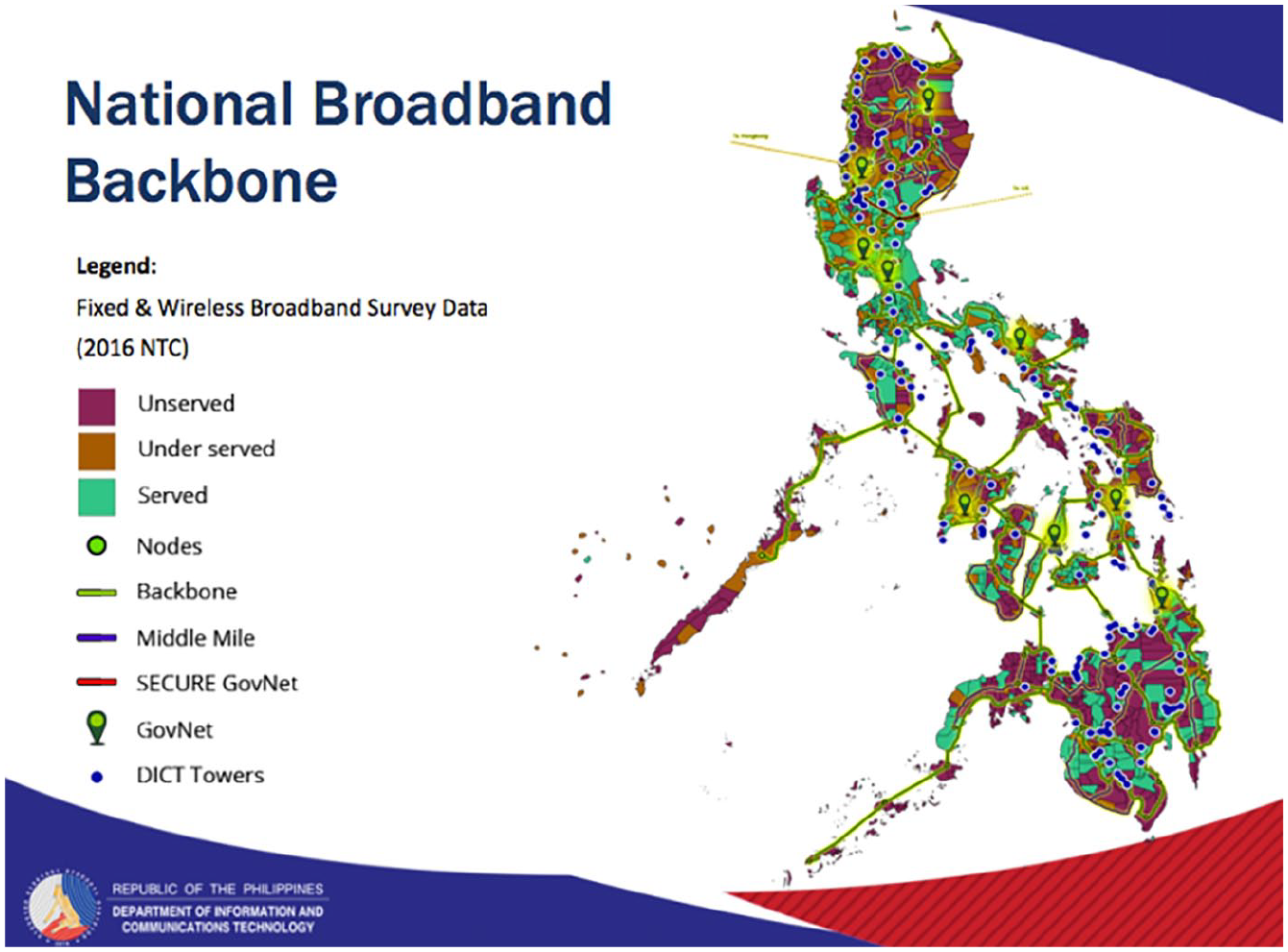
Fixed and wireless broadband survey data, 2016, published by the Department of Information and Communications Technology at the Republic of the Philippines.
This network disparity across the archipelago became both a major motivation and an obstacle in the Philippine government’s efforts to extend internet coverage to isolated locations and improve network affordability. In 2017, DICT published the National Broadband Plan (NBP), aiming to “provide necessary policy, regulatory, and infrastructure interventions to ensure the delivery of universal, fast, reliable, affordable broadband internet services to Filipinos in a digital economy” (DITC 2017). This government-led infrastructural vision was comprehensive in outlining a national broadband ecosystem that would not only accelerate investment and mobilize public and private sectors in the country’s infrastructure development, but also realize digital connectivity through overlaying networks as well as stronger network capacity for public usage. However, the government rollout of the NBP was slow and received strong criticism for taking up more than 20% of DICT’s annual budget (Bacelonia 2022). The first of five phases from the National Broadband Plan—which aimed to activate and strengthen the national fiber broadband backbone across all major cities—was launched in 2019, two years after the initial proposal—but by the end of 2023, phase one was only about 73 percent complete.
As internet users and video streaming markets continued to grow and more competitors come into the Philippines, the slowly progressing government infrastructure development plan was far from enough to meet the rapidly increasing data demand. 2 Netflix’s initial development in the Philippines was heavily restrained by the nation’s insufficient and uneven infrastructure. Local internet service providers and corporate players quickly filled in this developmental gap and became the leading forces investing in refining the national broadband backbone and building mobile signal towers. In 2016, Netflix launched its services in the Philippines, partnered with the two largest telecommunication companies in the country—Philippine Long Distance Telephone Company (PLDT), specifically its mobile network division Smart Communication, and Globe Telecom. This partnership was formed out of infrastructural necessity: it allows Netflix to use local networks to host its content library and tap into existing payment mechanisms and subscriber bases. As media scholar Michael Kho Lim further elaborates, “to create a bundled package that ties the streaming service to the telecom subscribers’ existing plans as an add-on service” became a common approach for streaming platforms in the Philippines (Kho Lim 2018). But publicly, this tactic was “translated” as easy consumer access to high-quality digital entertainment and urban lifestyle. In an official statement, Globe’s chief commercial officer Albert de Larrazabel says, “The Filipino’s swift adaptation to the digital lifestyle and our shift to smartphones also changed the way we enjoy entertainment. Our partnership with Netflix gives us this extensive library that will allow us to give our customers their much-awaited TV and movie titles whether they are at home or on-the-go” (Globe Newsroom 2016).
Netflix’s rapid growth in the Philippines benefited from this corporate discursive shift in “digital lifestyle” but also built upon the accumulated strategies to dominate global media markets in the past decade. Facing highly heterogeneous audiences in terms of cultural, religious, and linguistic backgrounds, Netflix slowly grew its catalog with popular genres such as South Korean melodramas and Filipino movies (Chua 2021). As of April 2022, the Philippines had a library of 7,125 titles, surpassing other nations in the Asia Pacific (Moody 2023). In October 2022, Netflix’s Content Director for Southeast Asia, Malobika Banerji announced that the platform now offers an interface available in Filipino, and users “now have the option to enjoy their favorite Netflix content from all over the world with Filipino subtitles and dubbing” with the support of local dubbing partners such as HIT Productions, Inc. (Soliman 2022). Netflix also created exclusive programs to support Southeast Asian screenwriting and production talents (Tan 2022), and has pushed for Southeast Asian Originals. Modeling on the experience of India, Netflix launched a cheap, mobile-only plan for 149 PHP (about 3 USD) in the Philippines in 2020 to cater to its majority of mobile users. These localization strategies, while fostering audience tastes and industry collaboration, as well as adapting to “soft infrastructure” that shapes the actual experience of streaming, they also attest to the “transnational scaling up” and tendencies of media imperialism in Netflix’s expansion in global media markets (Davis 2023, 1151).
Netflix’s strong advocacy for internet speed, furthermore, accelerated the platform’s global scaling up but it can also turn into a pressure point for national players. Beyond building internet speed testing services, ever month, Netflix published an Internet Service Provider Speed Index, which measures prime time Netflix performance on ISPs around the world and ranks them accordingly. Evan Elkins (2018) demonstrates that this emphasis on speed perpetuated by platforms such as Netflix not only “encourage a desire in users for a better, faster streaming experience” but also “parlay that desire into pressuring ISPs around the world to enter into agreements with these corporations that help ease content distribution” (839). During the first week of COVID-19 community quarantine in early 2020, data traffic spiked 15 to 20 percent as millions of Filipinos turned to work and entertainment at home. Many users complained about sluggish games and video streaming across different platforms. In March 2020, upon request from the Philippines’ government regulator, National Telecommunication Commission (NTC), Netflix reduced their video quality to ease internet congestion, which eventually lowered their network traffic by as much as 25 percent (Cigaral 2020). Similar requests were also made by government regulators in Europe, Australia, India and Mexico under the impact of COVID-19, where these governments later increased regulatory power over global streaming platforms in terms of taxation, traffic usage fees, etc. Major internet service providers as well as government agencies in the Philippines, however, saw this as an opportunity to strategically rebrand the nation’s infrastructure quality through Netflix’s ISP Speed Index and reshape the public image of the Philippines’ digital connectivity. In December 2022, the Philippine News Agency, a government-supervised news outlet, openly celebrated two national broadband providers that “top Netflix’s speed index” (Dela Cruz 2022). Netflix’s ISP index thus became a useful reference point for telecom companies to lobby for infrastructure investment and for the government to assert the Philippine’s network competitiveness. However, despite the fact that Netflix benefits economically from the infrastructural developments prompted by these global discourses on “internet speed,” the streaming platform never directly invests in infrastructural upgrades around the world, except building its own content delivery networks to ease network traffic. By acknowledging the distinct ways developing nations, such as the Philippines, use the global speed discourses as a strategic pressure point for national infrastructural building, we are also critiquing global streaming platform’s imperial undertones in disguised through a universal, developmentalist narrative of equal internet access. Therefore, this collaborative effort from the corporate players and the government is certainly not a coincidence but speaks to the Philippines’ broader aspirations to be a part of and a strong competitor in the Asia Pacific’s booming digital media economy.
Crash Landing on You: Transnational K-drama and the Quest for Modernity
But something seems to be missing in this win-win story. How do these corporate and state visions for internet speed and infrastructural futures of the Philippines enter public imagination and gain public support in such a short period of time? While one may approach this question through policy and industry analysis, I connect this socioeconomic process with transnational consumption of a distinct cultural genre, Korean TV drama.
The South Korean drama Crash Landing on You (CLOY) first aired on December 14, 2019, on the South Korean pay television network TvN, owned by CJ Entertainment and Media. The show became available for streaming through Netflix’s international catalog in January 2020, the same period when the Philippines experienced the substantial internet traffic surge. The drama features a heartrending romance between Ri Jeonyi (played by Hyun Bin), a North Korean military captain and son of the Director of the Korean People’s Army, and Yong Se-ri (played by Son Ye-Jin), the daughter of a South Korean multimillionaire family, who crashed into the North Korean part of the Demilitarized Zone (DMZ) after a paragliding accident. Produced by Studio Dragon, now one of the major content providers in South Korea for Netflix, CLOY gained tremendous success both in Korea and the Asia Pacific at large, and generated a huge and loyal social media fan base for the two leading Korean stars. 3 Nevertheless, even though CLOY remained in the top ten most-watched shows in Netflix Philippines in April 2020, the streaming platform’s other hit Korean dramas in the same year such as The King: Eternal Monarch, It’s Okay to Not be Okay, and Kingdom 2 had more impressive audience data and reputation (Netflix News 2020). Then what made CLOY distinctive and translatable into the national-specific context of the Philippines?
To answer this question, one must first situate CLOY’s success in the Philippines in the long-term economic and cultural exchanges between the two nations, and longstanding regional influences of the Korean Wave, often known as “Hallyu,” long before the arrival of streaming platforms. Since the establishment of diplomatic ties in 1949 between the Philippines and South Korea, the two countries have established extensive exchanges in trade, investment, and culture. This bilateral relation has deep military roots. The Philippines’ military and financial support to the Republic of Korea during the Korean War in the 1950s are now “paid back” by Korea in the form of financial and military partnerships. This reciprocal narrative projects South Korea as a billion-dollar import-export trade partnership, a major source of foreign direct investment, and a strategic partnership in maritime security. In addition, Korean cultural events and circulation of media contents also have long-lasting impacts, cultivating South Korea as an endearing nation to the Filipino public (Wong 2013, 6).
Against these deep historical and political roots, when Korean TV dramas and K-pop music gained increasing popularity and cultural power across Asia in the 1990s, the Philippine TV network took this Korean Wave as an opportunity to break open the dominance of US media content and cultural influences in the country even after the end of American occupation in the Philippines. The Korean Wave as a cultural phenomenon started in the 1990s. Its reach to the Philippines came slightly later in 2003, when GMA-7, the Philippines’s major national television network started to import Korean dramas (also known as Koreanovelas) to compete with its rival network ABS-CBN. GMA-7 introduced to Filipino viewers hit melodramas such as KBS’s Autumn in My Heart (2000) and Winter Sonata (2002), dubbed in local languages. These early dramas’ success prompted the steady acquisition and prime-time broadcasting of Asian TV dramas across the Philippines’ network televisions in the past decades, making Koreanovelas “part of the Filipinos’ daily dose of television scenes” (Igno and Cenidoza 2016, 723). This initial transnational import of Korean dramas to Filipino TV screens in the early 2000s coincided with a period when public TV networks strived to provide television programs more appealing to Filipino audiences, which also echoed the broader resistance across Asia to cultural imperialism perpetuated by US media content accelerated by the emergence of satellite television (Chadha and Kavoori 2000). 4
Filipino cultural scholar Louie Jon Sanchez argues that “In watching hundreds of Koreanovelas, Filipinos had wound up accepting Korea steadily as their new ideal imaginary. As a new fantasy of mobility, Korea had become the reflection of a collective desire for economic, social, cultural, and spiritual freedom” (Sanchez 2014, 13). Sanchez’s statement pushes beyond the earlier theorization that sees Hallyu merely as a method of resistance to cultural imperialism, and emphasizes that transnational consumption of K-dramas can generate a new formation of imagined telemodernities (Espiritu 2011; Lewis et al. 2016). CLOY speaks strongly to this quest of imagined modernity, especially through reproducing a fantasy of physical and social mobility. CLOY achieves this by setting its core dramatic tension upon the practice of border crossing, both in terms of crossing military borderlines and a love story transcending social-class differences. In the opening title sequence of CLOY on Netflix, the show’s leading characters are clearly situated in their respective social and political worlds—a segregated North Korean village stuck in traditional lifestyle and planned economy vis-à-vis the cosmopolitan and luxurious upper-class urban life in South Korea’s capital Seoul. Yet the parallel editing and three-panel framing, as shown in Figure 2, creates an illusion of the two characters walking across these spatial and political boundaries with ease, seamlessly traversing these different worlds (Figure 2). Contrary to this effortless border crossing romanticized through its esthetics, the entire drama is driven by comical clashes of cultural habits across both worlds, and painstaking attempts for the protagonists to cross the heavily militarized DMZ and return to the civilized and democratic South Korea, offering “a lived experience of social class struggles as an essential fabric of modernity” (Han 2019, 39). The drastic socioeconomic differences between South Korea’s 1 percent, represented by Se-ri and her billionaire family, and the villagers living in the planned economy in North Korea’s border town, while fictional in the drama, speak to the stratification of wealth and access in Filipino society.
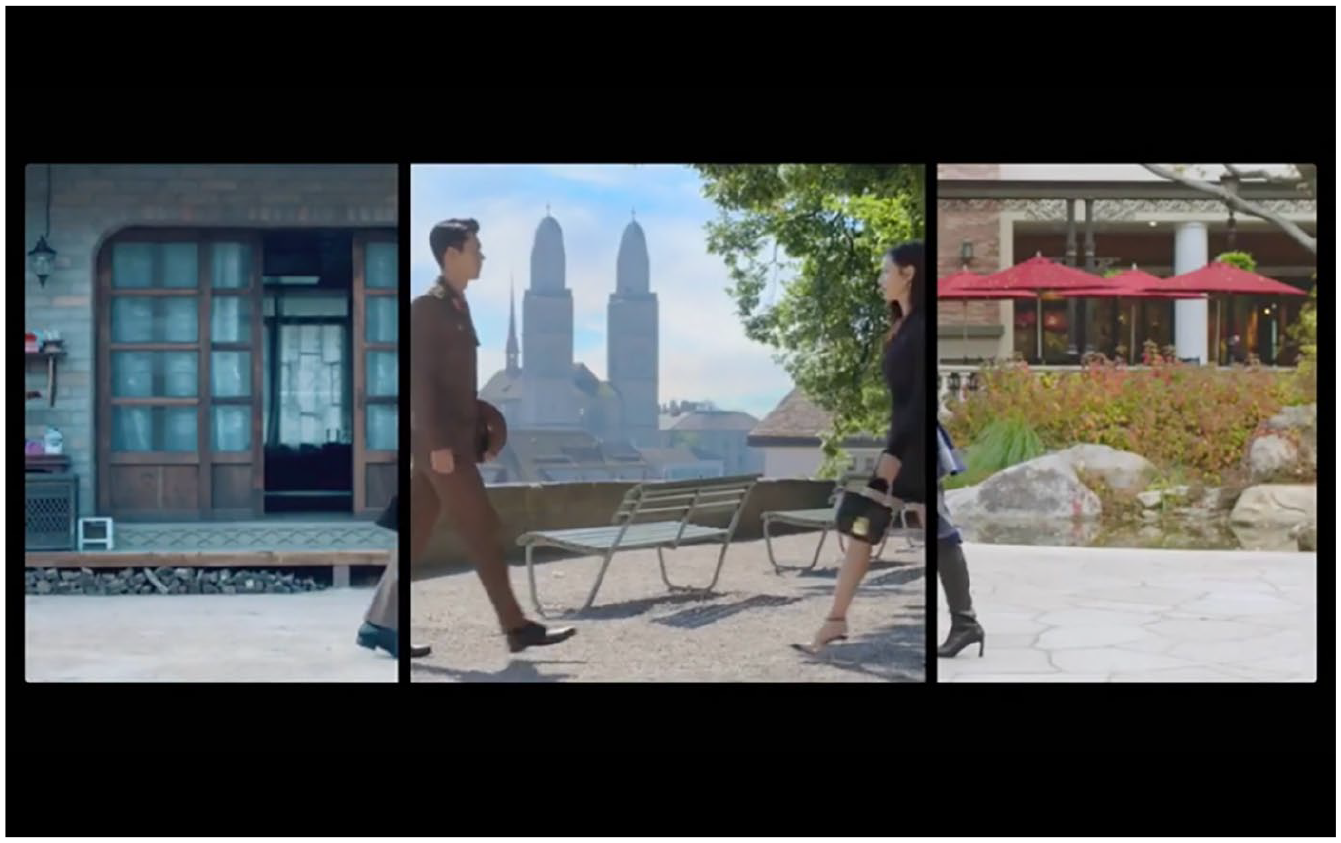
Opening sequence for Korean drama Crash Landing on You. The two protagonists walk toward each other while crossing different locations. Screenshot by the author.
As a cliché “love-conquers-all” melodrama, the desire to return to the modern urban world in CLOY was constantly disrupted by insufficient infrastructure: inaccessible telecommunication, lack of proper documents to pass military checkpoints, and limited availability of modern transportation. In an iconic scene from the first episode, Se-ri’s paragliding equipment tangles with the top tree branches, leaving her immobile and helpless; she frantically speaks into her walkie-talkie but receives no response. The failure of the telecom device and transportation equipment, in this case, also signals her inability to connect to the modern world she is familiar with and her symbolic immobility in this new territory.
Perhaps ironically, this dramatized severance from modern lifestyle and telecommunication, aired in early 2020, got translated too literally to Filippino television audiences who were forced to remain home and experience insufficient network capacity under COVID-19 lockdown. Although this fictional-real life correspondence may seem incidental, I argue that CLOY transforms into a distinctive example of how K-drama’s popularity can bleed into the social fabric, rather than merely offering a fantasy of mobility and escape. That is how K-drama’s transnational cultural power can be used to operationalize broader social change—in this case, the Philippines’ quest for internet infrastructure development and regional recognition.
Smart Hyun Bin: Operationalizing the Philippines’ Infrastructural Desires
Even though Netflix’s collaboration with internet service providers in the Philippines started in 2016, it took both sides some time to figure out what this collaboration could mean for the future of video streaming and internet infrastructure in Southeast Asia. As Brian Larkin summarized, “Many infrastructural projects are copies, funded and constructed so that cities or nations can take part in a contemporaneous modernity by repeating infrastructural projects from elsewhere to participate in a common visual and conceptual paradigm of what it means to be modern” (Larkin 2013, 333). ISPs in the Philippines, such as Smart Communications, actively take part in this paradigm of what it means to be modern, modeled through Netflix since 2020. For Smart, this means upholding Netflix’s streaming quality as a shared standard to evaluate internet infrastructure, while also co-opting the boundary-breaking discourse manifest in Netflix’s globalizing mandate and in transnational K-dramas such as CLOY. The show further cemented its role as a crucial interface for the Philippines to materialize their infrastructure desires through the commercial collaboration triggered by the show’s success since 2020. This collaboration demonstrates the crucial role played by the Philippines’ ISPs to spark the cultural imagination of internet network, to advocate for high-speed internet as a desired and inevitable future for public consumers, and eventually to advance the country’s infrastructure upgrade.
Between 2020 and 2021, Smart Communications released a series of television commercials promoting the company’s high-speed mobile internet services “Smart Ako,” distributing them mainly through its official YouTube channel and Instagram account (@livesmart). This year-long media campaign built on CLOY’s success, merging the fictive love story with a digital world where the two Korean stars, Hyun Bin and Son Ye-Jin, are destined to be brought together by the high-speed mobile network. Smart Communication’s senior Vice President Jane Basas, who acknowledged herself as a CLOY fan, commented that they decided to tap Hyun Bin as their brand ambassador because “it was only fitting to get someone as phenomenal as this actor, who is aligned with the services we’re offering and the kind of content the Filipino subscribers are consuming” (Libero-Cruz 2020). Basas’s endorsement of the Korean actor comes with a 12-month contract with Smart and a price tag that she puts as “a priceless investment.”
Fully aware of the devoted Filipino fan base and the Korean star’s cultural power, Smart’s first step is crucial: to reconfigure an infrastructural decision—switching service providers—into an act of cultural preference. Under @livesmart’s announcement of Hyun Bin as the new Smart ambassador, Filippino users’ comments project a direct co-relation between their choice to switch networks with the star power of Hyun Bin. 5 The company pushed further to suggest a techno-intimacy through one’s network choices: “your love story with Hyn Bin started with three words, Smart Ako.” Behind Smart’s public endorsement and PR campaign around the show and the lead actor Hyun Bin, the message seems quite clear: internet service providers tie the cultural consumption of K-drama and global streaming closely with the Philippines’s network imagination, through framing internet network selection as a cultural choice.
But converting fans into subscribers wasn’t their ultimate goal. Smart’s three-part commercial delivered a much more ambitious public campaign: to advocate high-speed internet service as a desired and inevitable future for both the consumers and the country. The first commercial was released on May 29, 2020. In a cyberpunk-style night scene, Hyun Bin drives through the metropolitan streets meant to invoke a simulated futuristic Manila (despite being filmed in Seoul). He stands in the urban landscape, holding a connected smartphone above his head. Added with CGI effects, the smartphone becomes a digital portal for Hyun Bin to connect with his digital self, projected onto the enormous glass surface of a skyscraper. The high-speed internet network offered by Smart has now transformed the entire city into a digital interface where he can access global entertainment such as Netflix, Spotify, and Instagram (Figure 3). As Hyun Bin is immersed in this modern digital world made through a high-speed mobile network, the voiceover comments in a deep, affirmative tone, “The life you want to live depends on the network you choose. Your movies, music, and games can only be as good as your Netflix speed and strength.” In only a few scenes, the commercial already perpetuated a universal belief that internet speed determined one’s digital lifestyle. Simultaneously, this line reinforces my analysis that ISPs in the Philippines increasingly held Netflix’s “speed and strength” as the yardstick to evaluate the infrastructural quality. Moreover, the most iconic line by Hyun Bin, “Slow means game over, speed means game changing,” does little to introduce Smart’s actual service, yet leaves us wondering for whom is it “game over” and for whom is “game changing”? The line could address network users as a form of consumer education—to direct them to change or upgrade to high-speed internet service to be fully embedded in the digital entertainment world, or “gigalife,” as Smart called it. This tagline also projects the anxiety and urgency to tackle the Philippines’ long-term internet infrastructural inefficiency. In this sense, internet speed is critical for a developing nation that is eager to join the global digital economy and enjoys the economic benefits accompanying such infrastructural power.
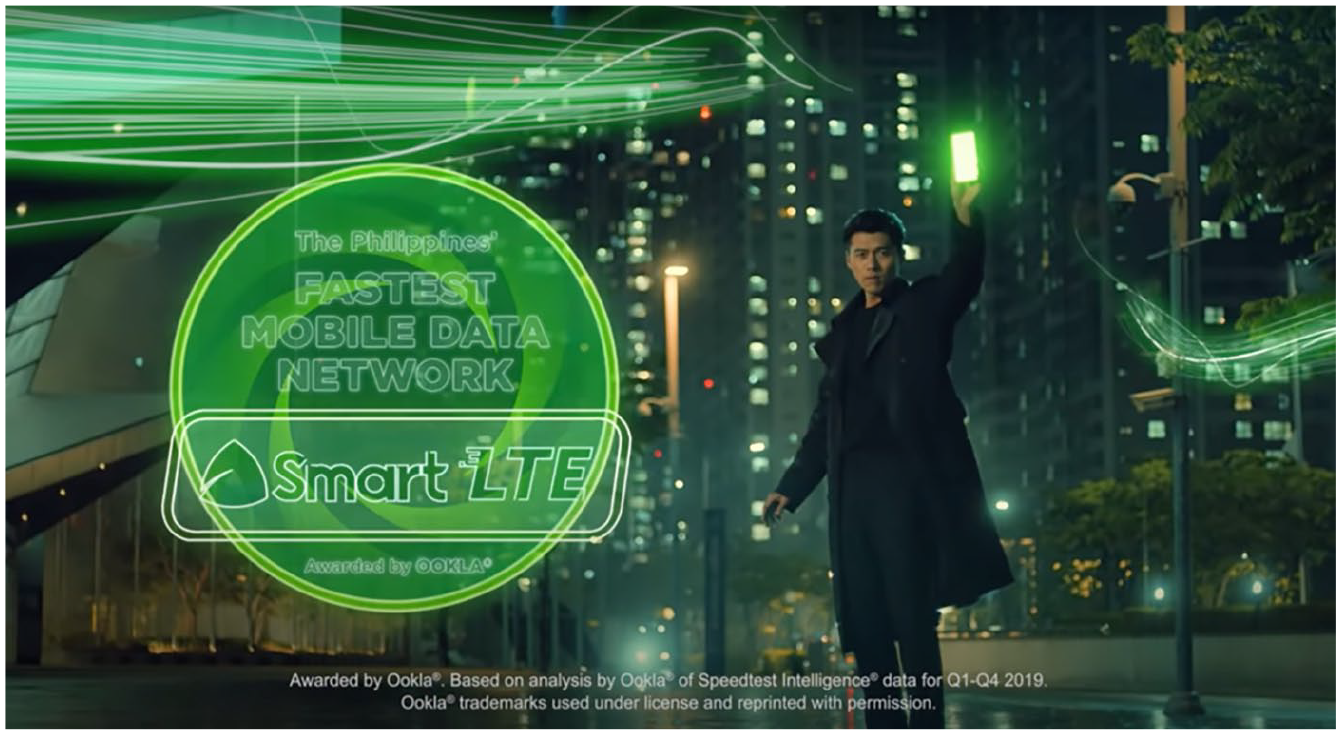
Hyun Bin in Smart’s TV commercial—Part 1, standing in the digital simulated Manila. Screenshot by the author.
The second commercial in the series builds upon the noir-cyberpunk settings, but this time the protagonist is the female lead of CLOY, Son Ye-jin. The commercial similarly starts with her roaming through the networked digital world. Continuing the narrative of how “Smart Ako” offers an immersive and glitch-free digital lifestyle, Son’s commercial pushes this further in two ways. First, Son’s digital world puts a much clearer emphasis on the advantages of Smart’s 5G mobile network, even though it only launched in July 2020 and marked the beginning of commercially available 5G service in key business districts of Metro Manila and North Luzon (Smart Communications 2020). This commercial certainly bears more promotional intention to introduce the different data plans and services offered by Smart, visually surrounding and captivating Son’s attention in the digitally simulated world. Furthermore, Son’s appearance is meant to introduce the Smart Signature program, and in her own words, “a world that gives you priority, when innovations come.” Smart Signature, in the company’s own language, is an exclusive program designed for 5G network/devices and the data demand for entertainment streaming. Signature Plans often come with subscriptions to Netflix and Apple Music, on top of unlimited calls, texts, and various data packages. These protocols and packages indicate a fast-growing internet market and a middle-class demand for high-quality digital entertainment more easily integrated into the existing telecommunication services.
Beyond the VIP treatments in every step of digital communication, what Son refers to as “priority” further carries a network traffic connotation. Smart Signature not only comes with data allocation based on your most used digital apps and entertainment habits, but also enjoys network prioritization on the company’s fastest network to ensure consistent data experience and reliable call and stream quality, even during long duration and peak hours. If we recall the Netflix versus Comcast case where the focal tension point was whether streaming platforms should pay the internet service providers for priority access and data overload (Davies 2016), Smart gives an astounding “yes” but instead turned to train network users to pay for the bill. What has become very clear in the past two years is that Smart has successfully built up this model to “pay for priority” as a digital lifestyle to be desired. This encompasses a high-quality internet experience but also exclusive access to celebrity events, live performances, and the most up-to-date technologies. But as Son ask rhetorically at the end of the commercial, “But how do I know it is meant to be?” The phrase “meant to be” draws out the key motif in the last of the commercial sequels: Choosing Smart and transitioning to a 5G high-speed internet network will become the destiny of this nation and contemporary Filipino life, just as Hyun Bin and Son Ye-jin’s love story.
On Valentine’s Day, 2021, Smart unveiled their last commercial starring both Hyun Bin and Son Ye-jin. In their news release, the company acknowledged that “we owe this commercial to our subscribers and Crash Landing fans who rallied behind the hashtag #InSmartWeTrust, hoping that we would bring them together. We knew that this has turned into something bigger, and the trust of our customers propelled us to fulfill their wish” (TheDiarist.Ph 2021). The long-awaited celebrity collaboration was reframed as a form of subscribers’ “trust” in the Filipino telecom giant, working hard behind the scenes. The final commercial further attests to Smart’s goal to align the K-drama couple’s boundary-breaking romance with an inevitable transition to the 5G network for the Philippines. This time, the two stars are in the same simulated landscape but are unable to get close to each other, echoing the border-crossing motifs of CLOY. Son asks in the voiceover, “what do you do when what you desire is beyond reach?” Hyun then responds, “You use the power that breaks barriers” while using the 5G-connected smartphone in his hand to activate different digital interfaces that lead to different iconic moments from their drama. As Hyun eagerly searches for traces of Son across these portals of digital caches, the simulated figure of Son is transmitted across different global locations. The two celebrities finally meet in the 5G-connected digital world, surrounded by televisual moments of their destined love story. But ultimately, this is a story of the Philippines’ network future in disguise as a romantic fairy tale, as @livesmart reminds us in the commercial’s caption: “Believe that anything is possible with #Smart5G at the palm of your hands. The future is inevitable, it’s time to break barriers. #SmartMadeBinJinInevitable.” Whether it is the political and social borders from the original K-drama or the digital barriers for Filipinos to access modern entertainment life, what could break these boundaries, repeatedly invoked in these cultural imaginations, is the high-speed internet network facilitated by telecom giants such as Smart.
Conclusion
The trajectory I lay out in this article is much more than the classic tale of how the global south is catching up with the world. The story of the Philippines’ infrastructure is certainly about speed—how well you can stream a high-quality video, how fast they can build more signal towers. But the pursuit of internet speed and infrastructure efficiency in the Philippines and Southeast Asia at large is also deeply geopolitical. The Philippines’ obsession with “high-speed” refers not merely to catching up with its powerful neighbors in the emerging digital media economy but also to the possibility of creating competitive regional infrastructural order.
This alternate regional infrastructure order, however, means something different for the Philippines’ government, national telecommunication, and global tech companies. Despite slow development, the Phillipine’s National Broadband Plan includes a clear program, the Luzon Bypass Infrastructure, to allow international tech companies to connect to the Philippines’ multiple landing sites and its national fiber backbone. It also aims to become a “resiliency route” as a backup for the Pacific Light Cable Network that connects the Asia Pacific with the US through Hong Kong, Taiwan, and the Philippines (Hani 2021). Therefore, unlike other similar initiatives such as Digital India that emphasizes digital empowerment of both the nation and the citizen, the Philippines’ National Broadband Plan in reality serves more distinctively as a political bargaining chip rather than improving internet connectivity as a public service and part of modern urban life.
Furthermore, Smart’s parent company, PLDT, recently invested in the new Asia Pacific Fiber-Optic Cable Apricot, which will become fully operational by the end of 2024. The new Apricot cable system is part of a multi-year effort led by Google and Facebook to further improve their fiber network capacity and resilience in the Asia-Pacific. Underlying this frantic infrastructural race is different rationales of cultivating a high-speed digital Philippines. From the perspective of global tech companies, the Philippines is increasingly seen as a strategic cable landing site for security reasons: it allows global data services to bypass the heavily militarized and politically complex South China Sea, subsequently, cutting down the reliance on landing sites along the Chinese coasts. On the flip side, both public and private sectors in the Philippines take up this rising interest from global capital powerhouses to attract international investments and to increase the country’s competitiveness in the regional digital economy. In the short run, the Philippines has benefited by climbing the digital ladder in speed and tripling its infrastructural development projects through new network providers such as Converge. But in the long term, the overreliance on global interests to accelerate high-quality stable internet network risks making regional infrastructure more vulnerable to geopolitical and economic tension (Suruga 2023).
Against this geopolitical context, this article presents an argument that not only accounts for the friction but also alignment across multiple players that together advance the Philippines’ infrastructural desire and development. While the inefficient state broadband project paves the canvas for the nation’s infrastructural future, the internet service providers in the Philippines proactively rebrand the country’s internet quality by incorporating global streaming discourses on speed and video streaming quality. The country’s major mobile ISP, Smart Communications, further takes up the cultural power of transnational K-drama Crash Landing on You to advance their agenda, translating the show’s success in the Philippines into a public consumer education campaign for accessing high-quality internet service as a form of modern, futuristic lifestyle. These cultural imaginings pave the foundation for corporate players to accelerate and advance the country’s infrastructure desires. In order to unpack the complex tactics that emerged from the Global South in regional and global infrastructural politics, scholars should examine not only the history of the telecom industry and global platforms but also pay heightened attention to the cultural interfaces where these dynamics unfold in our everyday media consumption.
Footnotes
Declaration of Conflicting Interests
The author declared no potential conflicts of interest with respect to the research, authorship, and/or publication of this article.
Funding
The author received no financial support for the research, authorship, and/or publication of this article.
