



Abstract
Recently, South Korea has become one of the largest content providers for Netflix. We analyze the textual characteristics of five Netflix Originals K-dramas – Sweet Home (2020), My Name (2021), Squid Game (2021), Hellbound (2021), and All of Us Are Dead (2022) – to unfold the existing genre conventions and uniquely local factors in the context of transnational television. In the process of transnationalization, genres are continuously and simultaneously evolving in the directions of homogenization and heterogenization. Universal values such as humanism, altruism, and family-oriented solidarity, as expected in the existing genre conventions, were homogenizing factors. However, these homogenizing factors were accompanied by uniquely local, heterogenizing factors arising from traumatic collective memories, political, and economic situations in South Korea. We also found that webtoons played a significant role in the transnationalization of the K-dramas genre. This study contributes to genre studies and transnational television research.
Keywords
In recent years, there has been a surge of Korean dramas (hereafter, K-dramas) on Netflix, resulting in South Korea becoming the second-largest content provider for Netflix, after Netflix’ home country, the United States (Yonhap News 2022). Netflix Originals K-dramas attracted global audiences: for example, as of June 2023, Squid Game (2021) is the most-watched show in Netflix’s history (Sohn 2023). Although considerable research attention has recently been paid to global SVODs (subscription video on demand) services, few studies have addressed the question of how to understand the global expansion of SVODs in relation to national television industries in different countries (Wayne and Castro 2021). In addition, most scholarships concerning K-dramas and SVODs have so far focused on audience research and fandom (see Ju 2020; Lee 2018; Min et al. 2019; Park et al. 2021), while overlooking the significance of text and genre. To fill this gap in the field, this study aims to explore the textual characteristics of the five selected Netflix Originals K-dramas from 2020 to 2022, in the context of genre research and Netflix’s transnationalism.
Genres are continually evolving into new forms, and dynamically being redefined and reformulated as a result of the interplay between industry, text, and audiences (Neale 1980). Genre classification in SVODs is therefore the outcome of a discursive practice, which combines the provider’s institutional context, local creative industries, audience expectations, and textual characteristics of the content. SVODs have succeeded in supplanting the extant genre system into micro—genres, providing an increasing amount of international content with personalized recommendations (Ju 2020). In comparison to the past, this new genre classification by SVODs constitutes a qualitatively more sophisticated and personally tailored approach. For example, the Netflix’s recommender algorithm (NRA) is designed to assist users in making choices based on their previous selections (Khoo 2023, 293). The micro-genre system with personal recommendations seems to be one of the factors enabling a significant increase in audience retention and subscriptions. With 223 million subscribers in 190 countries (as of October 2022), Netflix is in fact the largest SVOD service worldwide (Mullin 2022). Often called “the Netflix effect,” the service has transformed the ways in which content is produced and distributed, reshaping how we consume television on a global scale (McDonald and Smith-Rowsey 2016; Vettoretto and Moore 2023). In this respect, the Netflix Originals provide a useful lens through which we can examine how genres are continually reworked and reconfigured in the age of transnational SVODs.
In the process of transnationalization, genres are continuously and simultaneously evolving in the directions of homogenization and heterogenization (Jenner 2021; Mihelj 2011). The impact of transnational SVOD platforms on locally produced television content has remained underexplored, with a limited number of recent studies concentrating on European cases (see Carelli and Garofalo 2020; Castro and Cascajosa 2020) or on Anglophone (Potter 2021). Recent studies on genre and Netflix relied primarily on a single case study: for example, Day’s (2024) analysis of Netflix’s stand-up special Nanette, focusing on gender and the comedy genre, Kim’s (2022b) analysis of Mr. Sunshine, a historical drama genre, and studies about Squid Game (2021) such as Kang and Lee (2022) and Jin (2022). Instead of using only one example, we used purposive sampling to select five Netflix Originals series from 2020 to 2022 as follows: Sweet Home (2020), My Name (2021), Squid Game (2021), Hellbound (2021), and All of Us Are Dead (2022). The details of the sampling process will be explained in greater detail in the methodology section. This study thus fills this gap in literature by exploring the textual characteristics of multiple examples with a non-western origin. While Gómez and Muñoz Larroa (2023) examined the case of Mexico focusing on Netflix’s business strategies, more studies have been done using examples from Anglophone countries. For our analysis, we adopted Silverblatt’s (2007) framework and analyzed the plots, characters, settings, trappings, and genre twists. The remainder of this paper is structured as follows: the following section provides the overview of literature on genre, transnationalization, and Korean dramas. The next section discusses the methodology, followed by findings, discussions, and conclusion.
Genre, Transnationalization, and Korean Dramas
Genres do not solely comprise properties possessed by texts, but also systems of orientations, expectations, and conventions that circulate between industry, text, and subjects (Neale 1980). Genres are not fixed, but rather constantly negotiated between text, industry, and viewers’ expectations. The advent of global SVODs destabilized the existing genre system by using micro-genre codes. As of January 2023, there are over 4,000 genre codes on Netflix, constituting over 6,000 titles (Moore 2023). Netflix has moved from the existing genre categories to micro-genres based on tagging systems (or “alt-genre systems”). However, the concept of genre remains at the core of SVOD’s practice (Sim 2023), and SVOD’s mechanisms of personalized recommendations and interface are heavily reliant on genre (Jenner 2018). For instance, Madrigal (2014) explains that Netflix’s personalized genres are created by human intelligence (e.g., Netflix’s engineers synthesizing a range of genre characteristics of content) combined with machine intelligence (e.g., the individualized preference profiles that the algorithm builds).
Genres are also not static, but fluid; they are in constant negotiation with existing conventions (that are universally recognizable) and innovative elements (that are culturally and historically specific). In the process of transnationalization, genres are continuously and simultaneously evolving in the directions of homogenization and heterogenization. Cultural homogenization and heterogenization co-exist due to globalization and they are not mutually exclusive but deeply intertwined, reinforcing each other (Appadurai 1996). Regarding such phenomena in terms of genre and television, Mittell (2004, 14) argues that the goal in analyzing generic discourse is not to arrive at a genre’s proper definition, interpretation, or evaluation, but to explore the material ways in which genres are culturally operative.
Examples of transnationalizing genres can be found in homogenizing the existing genre conventions by de-emphasizing national or cultural specificities (e.g., specific locations or specific histories). For example, historical series such as The Crown (2016-) offer a transnational version of history (Jenner 2018, 12) by focusing on the psychological inner conflict of the characters. Jenner (2021) also uses the British teen drama Sex Education (2019) as an example to demonstrate how it adopts the American genre conventions in terms of plot and visual iconography, while also remaining indebted to the British tradition of teen drama in terms of storytelling. In a similar vein, Kim’s (2022b) study of a Korean historical drama series Mr. Sunshine (2018) shows how the indulgent display of settings is used to provide visual spectacle to adhere to the overall esthetic style expected by transnational audiences (p. 7). The grammar of transnationalism thrives on differences between cultures; however, it also reinforces national and cultural specificity simultaneously. Mihelj (2011, 29) argues that the grammar of transnationalism does not only imply the direction of homogenization but also heterogenization, such as local authenticity.
Current research indicates that Netflix’s commitment to geographically diverse original productions demonstrates the fundamentally local nature of global taste (Lobato 2019, 182). Cunningham and Scarlata (2020) use the examples of Australian shows such as the crime fantasy series Tidelands (2018) and the comedy mockumentary series Lunatics (2019) to illustrate how Netflix’s multi-territory content strategy appeals to transnational audiences and niche clusters. Similarly, the Israeli military action series Fauda (2015) and the Spanish heist series La Casa De Papel (2017) show how streaming successes stem from a combination of local authenticity, the appeal of morally ambiguous characters, universal elements offering “something for everyone,” and topical elements that function as additional points of audience identification (Wayne and Uribe Sandoval 2023).
Furthermore, Netflix’s transnationalism also influences its distinctive content strategy. It employs the concepts of quality, genre and its conventions, individual narrative, visual spectacle and other cinematic esthetics, and globally accepted values to produce content that appeals to diverse international audiences (Jenner 2018, 226). This is because Netflix’s program sourcing and content strategy operate under the mechanism of multi-nationality (Lotz 2021). Recently, transnational SVODs have markedly increased their investments in original content to maintain and expand their international subscriber bases (Iordache 2022). Netflix has three licensing conditions, namely, commissions (“Netflix Originals”), co-commissions, and acquisitions, depending on the degree of funding, creative input, and rights (Lotz 2021). South Korea has the highest level of co-commissioning and is one of the top five countries in terms of commissioning (Lotz 2021). From 2016 to 2020, Netflix’s investments in Korean content comprised 700 million US dollars, two local production facilities, and the signing of a multi-year content partnership with local companies CJ ENM/Studio Dragon and JTBC (Bing and Ko 2021). In 2021, Netflix invested over half a billion US dollars in Korean content (Brzeski 2022).
Regarding the growing popularity of Korean popular culture globally, Jin (2022, 6) argues that the concept of transnational proximity offers a useful theoretical framework. In transnational cultural studies, cultural proximity theory has been frequently used to explain transnational media consumption, claiming that many audiences select media products proximate to their own cultural backgrounds (Straubhaar 1991). Cultural proximity (defined by similarities in history, ethnicity, religion, language, and geography) cannot explain why audiences beyond the same region consume and enjoy popular culture from other regions (Jin 2022, 7). Transnational proximity is not based on linguistic and cultural affinities, but on the universal uniqueness, namely, specific characteristics that can be commonly shared by audiences who experience similar socio-cultural practices (Jin 2022, 8).
Methodology
In this study, the purposive sampling technique is used to reduce the number of materials and cases to a manageable and at the same time justifiable selection of materials and cases (Flick 2011, 38). As a non-probability sampling method, in purposive sampling, the likelihood of any one case being selected is not known and therefore the degree of generalizability is questionable (Salkind 2017, 91). However, it has the advantage of ensuring some degree of representativeness of the selected materials in the whole group. We therefore defined our sample more purposively and step by step.
Firstly, we identified all the K-dramas available on Netflix from 2016 (when Netflix was introduced in South Korea) to December 2021. There were 188 titles altogether, consisting of 23 Netflix Originals, 48 produced by tvN, 49 by JTBC, followed by 12 by OCN, 28 by terrestrial channels, 13 by general programing channels, and 15 by others. Secondly, for all twenty-three Netflix Originals, we examined the information in “Episodes and Info” sections on Netflix. Thirdly, drawing on the Netflix website and FlixPatrol (https://flixpatrol.com/), we collected Netflix’s official ranking of the global top 100 shows for three years from 2020 to 2022.
The following 10 series were listed in in the top 100 worldwide in 2020 with the detailed rank in brackets: It’s Okay to Not Be Okay (nineteenth), Start-Up (thirty-second), The King: Eternal Monarch (thirty-sixth), Record of Youth (forty-eighth), Crash Landing on You (fifty-ninth), Hospital Playlist 1 (seventy-first), Was It Love? (seventy-third), Sweet Home (seventy-fourth), Mystic Pop-Up Bar (ninety-first), and Stranger (100th). In 2021, Squid Game ranked the highest in the global ranking, followed by Vincenzo (fifteenth), Hometown Cha-Cha-Cha (thirty-first), My Name (forty-sixth, also known as Undercover Nemesis), Hellbound (forty-seventh), Nevertheless (sixty-first), Hospital Playlist 2 (sixty-second), The King’s Affection (seventy-first), Sisyphus: The Myth (seventy-seventh), and The Uncanny Counter (ninetieth). In 2022, All of Us Are Dead ranked as the ninth most watched Netflix show in the world, followed by Extraordinary Attorney Woo (eleventh), Business Proposal (fifteenth), Alchemy of Souls (twenty-third), Twenty Five Twenty One (forty-fifth), Little Women (fifty-first), Money Heist: Korea – Joint Economic Area (fifty-third), Narco-Saints (seventy-fourth), Tomorrow (eighty-eighth), and Our Blues (ninety-second).
In addition to the ranking, we used Creeber (2015) and Afilipoaie et al. (2021) to establish seven genre categories – namely, horror and action, thriller, crime, romantic comedy, fantasy, drama, and science fiction – to determine appropriate sampling. Based on the genre classifications, the three most frequently appearing genres were drama, crime, and horror and action. Consequently, we shortlisted the series that belong to those three categories. Finally, based on the above steps, five Netflix Original series were selected as follows: Sweet Home (2020), My Name (2021), Squid Game (2021), Hellbound (2021), and All of Us Are Dead (2022). These 5 series ranked the global top 100 in 2022 to 2022, belonged to the 3 most frequently appearing genres – drama, crime, and horror and action – and they represented the recent global trend of exposing and satirizing social inequalities (Thorpe 2022) in international television. Although there were several romance comedies in the drama genre, we selected these five series because they were more appropriate to address the research gap, that is, the textual readings of more experimental genre narratives (Kim 2022a). Under the broad category of drama genre, crime, horror and action were significantly under-researched than romance, that is often considered as K-drama’s representative romance genre, the so-called “K-romances” (An 2022, 96). The details of our sample are shown in the following table (Table 1).
Details of the Selected Netflix Originals K-dramas.
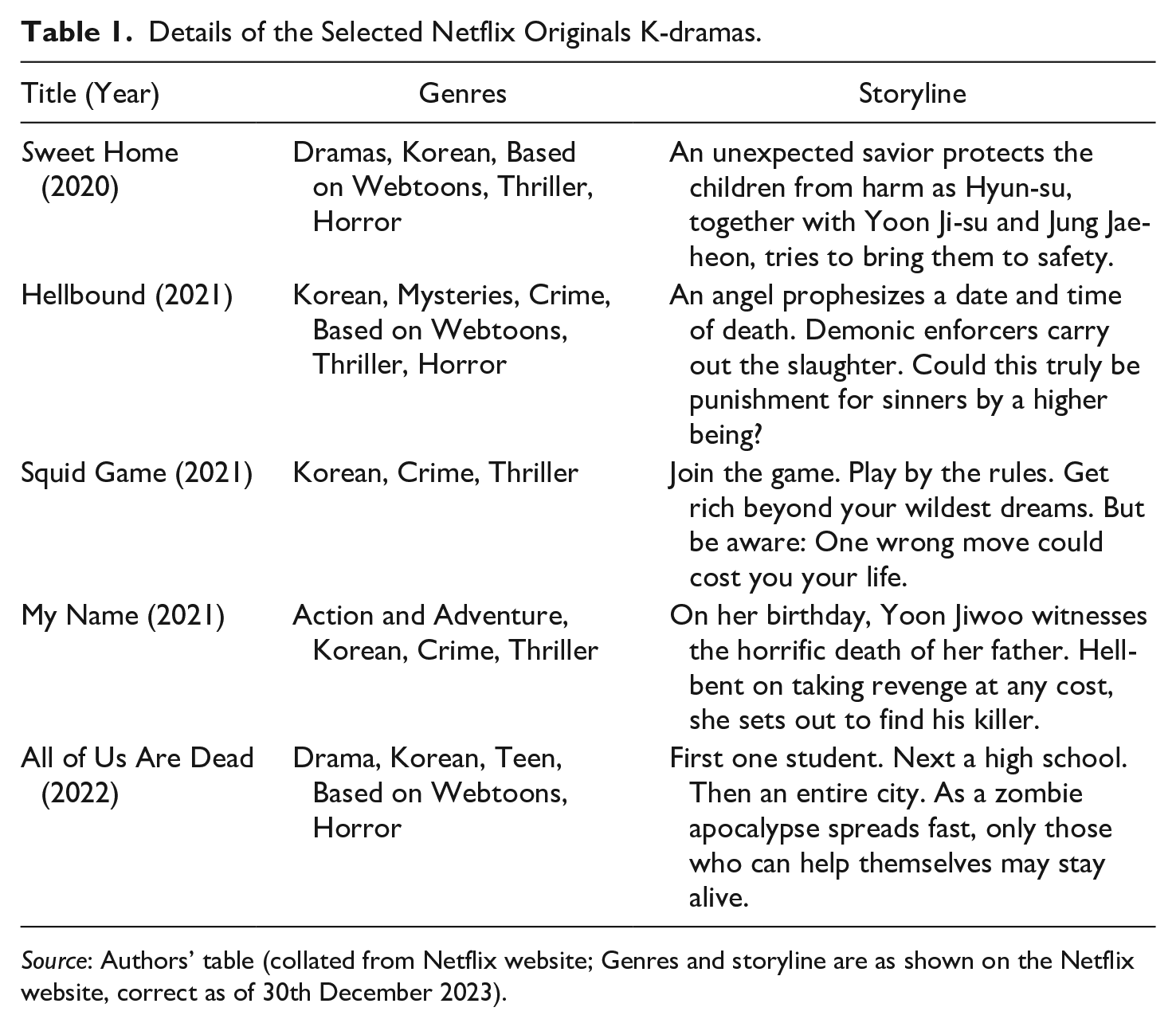
Source: Authors’ table (collated from Netflix website; Genres and storyline are as shown on the Netflix website, correct as of 30th December 2023).
Using the above five series, we then conducted textual analysis to examine plots, characters, settings, trappings, and genre twists, adopting Silverblatt’s (2007) formulaic analysis framework. Firstly, plot is a planned series of events in a narrative, which progresses through a struggle of opposing forces to a climax and conclusion. For a more systematic analysis, this study also utilized Tobias (1993) twenty master plots. 1 Secondly, both main- and sub-characters to examine their inner orientation and character development are identified. Thirdly, the setting is the physical background against which the action of the narrative takes place (e.g., the geographical location and the time or period in which the action occurs). Fourthly, trappings are artifacts that appear so often within a genre that they have become associated with that genre. Lastly, genre twist occurs when a slight change in some of the formulaic elements takes place, such as with characters and/or settings (e.g., genre mixing and blending).
Findings
The findings show that the narrative of “survival” was prominent, whether the series contained zombies or supernatural monsters, conflicts between the rich and the poor, or personal debts. For example, Squid Game (2021) is a death survival game, in which the fear of elimination is equivalent to the fear of death. The foci of conflict here are extreme competitions and inequalities in capitalist societies arising from one’s sociocultural background and wealth. Such narrative of survival stems from external threats and/or social issues, which are consequently developed into an internal question of morality. For instance, some characters in Sweet Home (2020) turn into monsters because of internal avidity, while the ethics of others are constantly tested and challenged as they struggle to remain human. Similarly, in the “Gganbu” episode with the marble round in Squid Game (2021), the plot revolves around characters who betray their close allies’ trust to survive.
Plot
This “survival” narrative consists of a multi-plot strategy, such as “escape,” “rescue,” “sacrifice,” or “temptation.” Plots surrounding escape and rescue appear in zombie and horror dramas, such as All of Us Are Dead (2022), Sweet Home (2020), and Hellbound (2021). For example, Sweet Home (2020) is a story about the residents of an apartment who need to fight monsters in isolated circumstances and survive. The feeling of being trapped in an isolated space leads to the fear of contagion, in which the characters realize that they might become monsters themselves. Escape is depicted as a collaborative process, which is achieved from disasters while the characters are surrounded by savage monsters in an isolated apartment. All of Us Are Dead is also centered on the plot of escape and rescue: a virus outbreak occurs at Hyosan High School and the infected quickly turn into zombies. The story develops as the students, who are trapped in a classroom, struggle to survive and escape, while the Korean military works intensely to isolate the outbreak to protect the country from an even bigger crisis. In the end, isolated students and residents are rescued. Similarly, Hellbound (2021) is a dark fantasy drama series in which supernatural beings (“Angels”) prophesizes a date and time of death, condemning people to “Hell.” Some of those who have been condemned are rescued while others are being slaughtered by demonic enforcers. In addition, the plot of ’temptation’ plays a significant role in Squid Game (2021), the players are greatly motivated to win a large cash prize (of 45.6 billion Korean won), despite their fear of death.
The plots of “transformation,” “maturation,” and “growth” are also prominently evident in the main characters of all seven dramas. A troubled hermit, Cha Hyun-soo, transforms himself and matures in Sweet Home (2020), like all the students in All of Us Are Dead (2022) in the process of survival. Ji-woo in My Name (2021) also transforms herself into a strong woman who is committed to revenge, through harsh training in a drug cartel. Another form of transformation is metamorphosis, which appears in Sweet Home (2020) especially when individuals’ desires transform them into monsters. Examples of the plots driven by “riddle” and “quest” include Hellbound (2021) and Squid Game (2021). The mysteries of demonic enforcers, angels, a cult religious group and the New Truth Society are critical to the storyline of Hellbound (2021). Similarly, in Squid Game (2021), the detective Hwang investigates who is organizing the game and the organizers of the game, including Oh Il-nam, and the identity of the front man are finally revealed.
Characters
In terms of characters, we found that most of the main characters represent the socially weak and “have-nots” who find themselves in desperate and extreme situations. A victim of bullying (in All of Us Are Dead (2022)) and high school dropouts with failed suicidal attempts (in Sweet Home (2020)) constitute representative examples of this finding. The main characters of Squid Game (2021) are confronted with the question of to what extent they are willing to pursue money. Furthermore, these main characters do not just remain as victims, but rather grow (Cunningham and Scarlata 2020) through the issue of morality and an effort to maintain the least amount of necessary dignity and integrity. Moreover, egoistic and altruistic characters co-exist, and, in the end, a strong emphasis is placed upon altruism and humanism, even in these least humane situations. There is also the sense of “relative morality,” as termed by Mittell (2015, 143), in the portrayals of these characters. Wayne and Uribe Sandoval (2023) argue that the moral ambiguity of characters is a viable and important content strategy of Netflix (e.g., the character of Eleven in the U.S. Netflix series Stranger Things). Sung Ki-Hoon in Squid Game (2021) and Bae Yong-Jae in Hellbound (2021) are also good examples.
Settings and Trappings
The use of certain settings and trappings has ambivalent and contradictory meanings, and thus significantly contributes to the storytelling and the build-up of suspense. For instance, schools and related trappings such as school uniforms and clothing for physical education are examples of local specificities. They represent not only the space of the youth, but also a space replete with fear and suppression due to the extremely competitive educational system that exists in Korea, as seen in All of Us Are Dead (2022). Various settings of Hyosan High School in All of Us Are Dead (2022) (e.g., classrooms, common room, dining hall, library, athletic hall, and school rooftop) and trappings (e.g., school uniforms, physical education clothing, army/cadet uniforms, and firefighter uniforms) are a case in point. Sweet Home (2020) also features such trappings as school uniforms, army uniforms, and firefighter equipment, cigarettes, tattoos, alongside typical trappings of zombie apocalyptic stories of monsters.
Outskirts of Seoul and/or the city center have been used as the main settings for Hellbound (2021), Sweet Home (2020), and Squid Game (2021). The New Truth Society building in Hellbound (2021), an old apartment due to be re-developed in Sweet Home (2020), and various places in Squid Game (2021) (e.g., an old residential area called Ssang-mun dong, a traditional market, Yeo-ui-do financial quarters, an orphanage, and a convenience store) are such examples. As for Squid Game (2021), there are settings in real life as well as in the game. For the latter, a desert island is the outdoor space while hyper-real, fairy-tale style interior is shown indoors, with players’ accommodation like a barracks or a prison camp. Such contrast is shown in another series: for example, in My Name (2021), the so-called Academy, a training camp for Dong-cheon gang members, is shown in a stark contrast to natural beauty of the backdrop of the East Sea in Kang-won province, South Korea.
While the settings consist of typical urban landscapes and contrasting images, trappings seem to represent more conventional use. For example, typical gangster movies’ trappings such as leather jackers, suits, body tattoos are shown in My Name (2021) while typical trappings of a zombie story are shown in Sweet Home (2020). Various masks and makeup are used as trappings in Squid Game (2021) (e.g., the front man’s black mask and the animal masks for the VIPs) as well as in Hellbound (2021) (e.g., the YouTuber’s makeup and clothes, the VIP mask at the demonstration).
Genre Twist
All five series use genre twists and genre blending (or mixing) to accentuate novelty and innovation. For example, All of Us Are Dead (2022) employs genre blending between zombie and teen drama films, while Hellbound (2021) mixes the genres of mystery, dark fantasy, and creature films. Similarly, Sweet Home (2020) has elements of creature, disaster, and fantasy genres, whereas in Squid Game (2021), there is the co-existence of a conventional survival game genre and reality television format, replete with contrast between the children’s game and the death/survival reality game. Meanwhile, My Name (2021) shows multiple genres being blended across crime noir, action drama, gangster, and family drama.
Certain prominent themes recur from the above genre twists. Humanism, altruism, family-oriented solidarity, social commentary, and webtoons played a central role in these series. Firstly, the sense of humanism and sacrifice for loved ones persists through personal relationships, closely-knit family bonds, morality, and community love. Across all five series that we examined, there was a clear sense of a deeply humane and emotional approach, even in inhumane situations, such as a death survival game and a zombie apocalypse. An emphasis on humanism and altruism was identified in all dramas, with episodes focusing on family-oriented values and community solidarity. Appreciation of high moral standards, self-sacrifice, and altruist behavior was also evident in relationships with loved ones. For example, the last message of some main characters (e.g., Cho Sang-Woo and Kang Sae-Byeok in Squid Game (2021)) were meant for their families.
Secondly, all five series included the focus of conflict between the “haves and have-nots,” as well as social commentary and satire. They reflected social inequalities (e.g., income disparity and polarization, unemployment, and debt), unfair treatment of North Korean defectors and migrant workers, and mental health issues through plots, characters, and stories. For example, All of Us Are Dead (2022) shows that the hierarchical order in the classroom is built based on where the students live (e.g., social housing vs. luxury apartments). Bullying and violence in schools and the military environment also reflect such social inequalities. These enable social commentary in these dramas about collective violence, gang mentality and madness, exclusion, and discrimination. Such issues were actively addressed by progressive and critical screenwriters and webtoon artists.
Thirdly, known for transcending existing boundaries and for sensational, violent, and often teen-based content, webtoons played a significant role in the genre twists. Three of the series out of five which we examined – Sweet Home (2020), Hellbound (2021), and All of Us Are Dead (2022) - are based on cult webtoons. Coined in the early 2000s, the term “webtoon” is a portmanteau term that merges the words “web” and “cartoon” (Kim 2022a). Its environment offers paid content and/or free creator-owned mobile-optimized comics, allowing readers to scroll vertically and binge-read entire series, and comment on individual episodes (Yecies et al. 2020, 41).
Discussions
Our findings fall into two interconnected categories: homogenizing factors rooted in the existing genre conventions, and heterogenizing factors arising from uniquely Korean situations historically, politically, and economically. Examples of homogenizing factors were universal values such as humanism, altruism, and family-oriented solidarity. Such themes are typically present in the genre of “drama.” Humanism, altruism, and family love are also prominent in the existing conventions of “Crime” and “Action” genres, not just in K-dramas. This can be considered as transnational proximity as suggested by Jin (2023, 21). The ways in which Sweet Home (2020) explores humanity over monstrosity resonate with global audiences because there are both unique elements as well as universal qualities emphasized in the series (e.g., humanism, solidarity within a community) (Jin 2023). In our study, these themes were indeed manifested in plot, characters, settings and trappings, and genre twists. For example, as seen in the character of Kang Sye-byeok in Squid Game (2021), the universal value of family-oriented solidarity was amplified with the current North – South Korea divide as well as economic hardship and a sense of heterogeneity experienced by a North Korean defector (authors’ emphasis). Thus, homogenizing factors and heterogenizing factors were inextricably intertwined in the sample we examined.
Meanwhile, heterogenizing factors such as webtoons and traumatic collective memories of the Koreans enabled the genre twists and blending. For example, webtoon-based dramas such as Sweet Home (2020), Hellbound (2021), and All of Us Are Dead (2022) demonstrated how a zombie genre has been reconfigured in the Korean context. Newman (2021) comments that Sweet Home (2020) imitates soap opera by following the interlocking lives of a range of people in a small community – 1408 of Green Home, an old apartment complex – then shakes the genre up by introducing a large-scale supernatural event. Beyond the conflict between monsters and humans, through various characters (e.g., Hyun-soo, Sang-wook, and Eun-hyuk), social messages about depression, trauma, suicide, and solidarity within a community were embedded in the narrative of Sweet Home (2020). Similarly, plot, characters, and settings and trappings of All of Us Are Dead (2022) showed how local [Korean] viewers could relate to the show more due to the similarity between being stuck in the COVID-19 pandemic and the sinking of the Sewol Ferry, where many students lost their lives when they were instructed to remain inside the ship (Lee 2022). The Sewol Ferry disaster took the lives of 250 students coming from Danwon High School in Ansan, a city south of Seoul, in April 2014 (Choe 2022). To use a high school and related trappings as the setting in Sweet Home (2020) and All of Us Are Dead (2022) was to employ heterogenizing factors of uniquely Korean collective memories and associations through which the conventions of zombie genre and teen shows are twisted.
Korea’s traumatic history and collective memories throughout most of the twentieth century – Japanese colonization (1910–1945), the Korean War (1950 – 1953), and the rule of military regime (1961–1979) – has left deep psychological scars on the national psyche (Lee 2021). Ongoing political situations such as the divided state between North Korea and South Korea and collective fears about recent pandemics (e.g., SARS, avian flu, mad cow disease, and COVID-19) also led to persisting anxieties. Thus, the homogenizing (universal) factors and the heterogenizing (local) factors have co-existed in Korea’s social, political, economic, and cultural contexts in its modern history, which is manifested in current K-dramas.
Another interesting finding was the role of social commentary and webtoons in our sample. As can be seen in many films (e.g., Old Boy (2004), Silenced (2011), Train to Busan (2016), Okja (2017), Parasite (2019), and Squid Game (2021)), social commentary and satire have a strong tradition in Korean content. However, there are also universal and homogeneous aspects to this: for example, Scott (2019) asserts that the work of Bong Joon-Ho, the director of Parasite (2019), presents a deeply humane vision of a rotting humanity, and that we all seem to live in the director Bong’s dystopia through his work. Similarly, regarding Squid Game (2021), Yoon and Martin (2021) comment that “Korean social dystopia is not just Korean’s dystopia. We are all in that dystopia.” Conran (2022) also suggests that Korea’s local, social, and historical parables morphed into high-concept dystopias that attracted global audiences. According to Lobato (2019, 182), the fundamentally local nature of global taste can be thus expanded to the hypothesis that local taste has a global nature through the viewing experiences of such content. In their study of Squid Game (2021), Kang and Lee (2022, 41) argue that Netflix targets global audiences using genre conventions, and commercially portrays historical distinctiveness as a cultural good. In other words, genre conventions work as homogenizing factors while historical distinctiveness work as heterogenizing factors, both of which contribute to the transnationalization of K-dramas as a genre.
More importantly, the way that webtoons fueled the transnationalization of K-dramas was illuminating, which makes one of the most significant heterogenizing factors. Netflix recognizes “Webtoon-inspired K-dramas” or “K-dramas based on webtoons” as separate genre classifications. Park et al. (2019) state that the proliferation of mobile phones and the migration of traditional cartoonists to mobile platforms since 2013 have contributed to the emergence of the webtoon as a source for creative stories, which then became a reliable and valuable source for many successful drama series. Misaeng (tvN, 2014), Cheese in the Trap (tvN, 2016), Kingdom (Netflix, 2019), and Itaewon Class (JTBC, 2020) are good examples. Webtoons not only grew in quantity and quality but also contributed to the genre diversification (Kim 2022a). Previously untouched topics covered by webtoons were well suited for Netflix’s drive for innovation and expansion of international content as well as Netflix’s content strategy.
Limitations and Contributions
As highlighted by Lobato (2018, 252), a limitation of single-platform research is that it can only tell us the media environment in one distribution system (e.g., Netflix in this case). It is, however, not easily achievable to conduct qualitative research using vast samples across different platforms. Future research employing quantitative methods, or a mixed method approach can address this problem and investigate genre-related questions across different platforms. Another avenue for future research is to expand the study of text to the realm of audience and media industry practitioners. This could be done in a comparative or multi-country context.
However, there are also several contributions that our study makes. Our findings support some key existing studies in the field: for example, Jenner (2018) argues Netflix’s transnationalism and its content strategy use genre and its conventions as well as globally accepted values to produce diverse content to appeal to international audiences. We found the co-existence of universal values and uniquely local factors using the Korean case, each of which worked as homogenizing and heterogenizing factors toward the transnationalization of television. From Netflix’s three licensing conditions mentioned earlier (namely, commissions, co-commissions, and acquisitions), all five series that we examined were the outcomes of Netflix “commissioning” local productions (hence, titled Netflix Originals). Under such a condition, substantial creative input came from webtoons, a relatively new source for K-dramas, covering diverse social issues. Webtoons with social messages reflect distinctive local characteristics and history, and at the same time, transnationally proximate feelings and experiences. Thus, we also found strong evidence to support Lotz’s (2021) argument that Netflix’s multi-territory program sourcing and content strategy represent its ethos of innovation, business strategy, and transnationalism. In addition, this study fills the gap in research that is the lack of textual readings of key genres in K-dramas despite the emergence of a multitude of new genres and patterns each year (Kim 2022a, 92). Through the theoretical lens of genre studies, we offer the textual characteristics of five Netflix Original K-drama series, while analyzing homogenizing and heterogenizing factors at play in today’s transnational television.
Footnotes
Declaration of Conflicting Interests
The author(s) declared no potential conflicts of interest with respect to the research, authorship, and/or publication of this article.
Funding
The author(s) received no financial support for the research, authorship, and/or publication of this article.