



Abstract
This paper critically examines the use of online humor and ridicule to promote and normalize far-right exclusionary discourses. Through a critical qualitative study of the Please Explain miniseries, a series of thirty-four short web cartoons produced by Australian far-right populist party, Pauline Hanson’s One Nation, we explore the strategic use of humor in the communicative arsenal of the contemporary far-right. Drawing on critical discourse analysis and thematic analysis, we examine how humor is used to soften articulations of exclusionary and supremacist ideas, including racism, misogyny, and queerphobia. Our findings suggest that the frivolity and irony of the online animated genre works to stretch the boundaries of the sayable, potentially making the content more palatable to non-far-right audiences. We argue that the strategic use of exclusionary humor forms part of a wider project of far-right discursive mainstreaming that simultaneously (re)legitimizes everyday expressions of exclusion.
Introduction
The acceleration of the mainstreaming and normalization of far-right ideas, actors, and movements throughout the twenty-first century (Mudde 2019) necessitates that critical scholars pay increased attention to the communicative strategies employed by the far right to advance their exclusionary political project. It is broadly accepted that contemporary far-right actors, be they parties, movements, or activists, are savvy media performers (Wodak 2021) who employ a range of innovative communication strategies to exploit the highly mediatized and hybridized political landscape. A particular focus in recent times has been the effective use of humor and irony as part of the far-right’s social media strategy (Greene 2019). As the far-right has become more mainstream, their political communication has tended to employ a range of euphemistic and covert strategies to conceal the exclusionary and supremacist nature of their messages to broaden their appeal to non-far-right audiences (Wodak 2021).
In this paper, we critically examine Please Explain, an animated mini-series commissioned by the Australian far-right populist political party Pauline Hanson’s One Nation (PHON), distributed online via mainstream social media platforms including Facebook, YouTube, and TikTok. Of course, Please Explain is by no means the first example of a politician or political party—far-right or otherwise—engaging in humor. Nor is it the first far-right online animated comedy series, with others like the explicitly neo-Nazi series Murdoch Murdoch having first appeared on YouTube in 2015 (Sienkiewicz and Marx 2022). Crucially however, there is to our knowledge no comparable example of a far-right political party commissioning and distributing an online animated series as a piece of political campaigning and advertising, at least in the English-speaking Anglosphere. As such, we see the Please Explain as a novel development in the use of humor by the far right to normalize and share exclusionary and supremacist content through the genre of online cartoons, for the explicit purpose of political campaigning. Moreover, extant research on far-right humor has centered on north American and European case studies (e.g., Askanius 2021; Billig 2001; Pérez 2022; Sienkiewicz and Marx 2022). We seek to redress this Atlantic bias by critically examining the use of exclusionary humor in an Australian context. We believe this will broaden empirical understanding of how humor is employed by the international far right to advance their exclusionary and supremacist political project.
Adopting a critical qualitative framework, we employed critical discourse analysis and thematic analysis to analyze how humor is strategically deployed to soften articulations of racist, misogynist, and anti-LGBTIQA+ exclusion and dehumanization. By recasting such expressions as “just a joke,” humor is strategically used to shield the joke teller from accusations of racism, misogyny and queerphobia. It allows the joke teller to test the waters of social acceptability of exclusionary expression, while signaling to audiences that such sentiments are acceptable (Pérez 2013, 2022). As part of the communication strategy of a far-right party, this strategic communication contributes to a wider project of far-right discursive mainstreaming (Brown et al. 2023). Further, by examining the way the far-right deploys racist, misogynist, and anti-LGBTIQA+ humor simultaneously, we expand on existing research which tends to focus on specific forms of exclusionary humor, such as racism, in isolation.
Pauline Hanson’s One Nation and the Please Explain Animated Series
Please Explain is a thirty-four-part, two-dimensional, online cartoon commissioned by Australia’s most prominent and electorally successful far-right populist party, Pauline Hanson’s One Nation (PHON). Since its founding in 1997, the party has been a lightning rod for issues of immigration, multiculturalism, and Aboriginal reconciliation in Australia (Mondon 2013). Despite their relatively small electoral impact and parliamentary presence, PHON and founder Pauline Hanson have enjoyed an outstripped media presence, owing in large part to their use of political stunts (Sengul 2022). The series title “Please Explain” comes from a 1997 interview on the current affairs program 60 Minutes, where in response to a question asking whether she was xenophobic, Hanson asked the interviewer to “please explain” what the word means. The reply became a catch cry for Hanson’s populist attacks on political elites.
The Please Explain animated series, produced by Melbourne based animation studio Stepmates Animation, reimagines the forty-sixth Parliament of Australia (2019–2022) as a school classroom. PHON Senator Pauline Hanson, the only character in the series voiced by its real-life counterpart, is cast in the role of a teacher instructing a class of high-profile Australia parliamentarians (including Liberal Prime Minister Scott Morrison, leader of the Australian Labor Party [ALP] Anthony Albanese, and leader of the Australian Greens, Adam Bandt) (Figure 1). In episodes that run from between two and five minutes, Hanson teaches the class about a range of topics, from political donations and how bills are legislated, to political correctness and immigration.
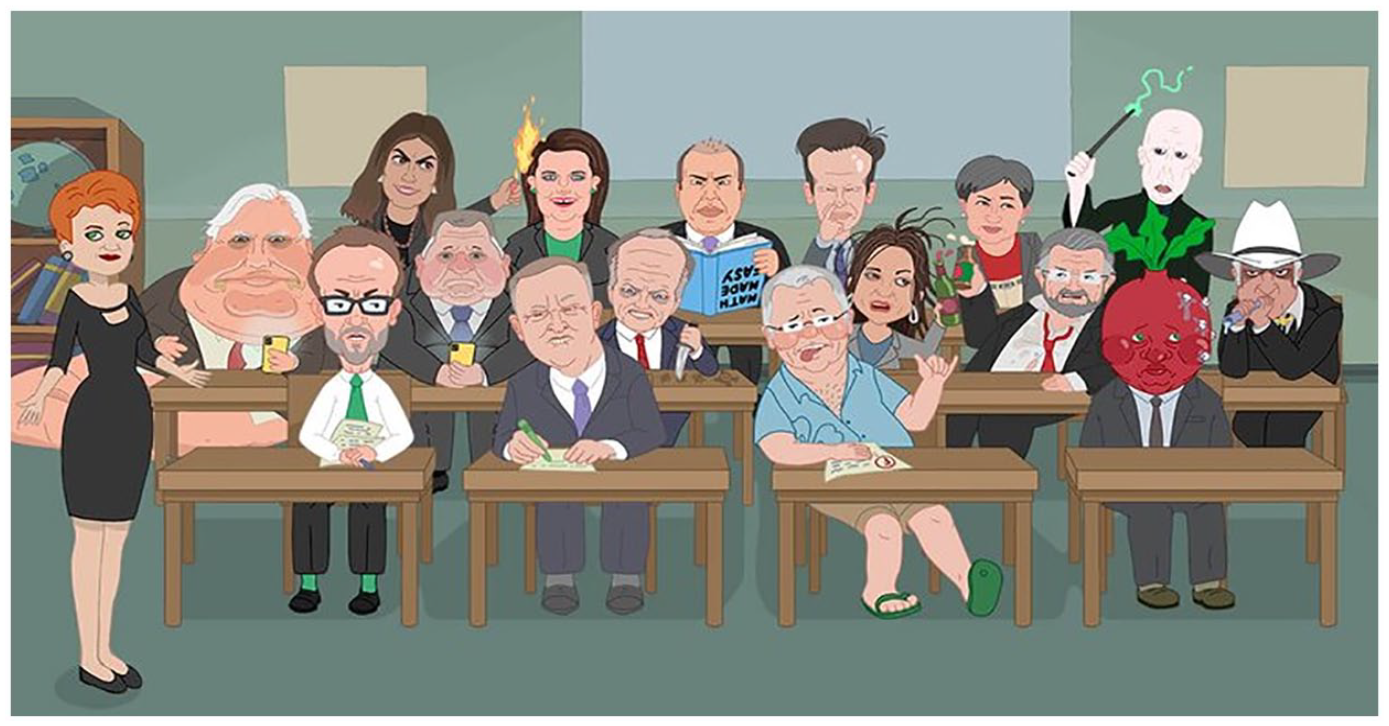
A classroom photo of the characters from Please Explain, with PHON Senator Pauline Hanson as the teacher.
The series ran from November 2021 to June 2022, with episodes released throughout the 2022 Australian federal election. According to the party, the aim of the series was to “deliver a humorous yet sobering glimpse into the Australian political arena” (PHON 2023a). Pitched as a “satirical, animated series that was partly educational, and a whole lot of fun” (PHON 2022), Please Explain was designed to appeal to younger and politically disengaged voters, and draws on South Park, which it mimics in style and tone (Quinn 2021). This influence is important in situating the Please Explain series as PHON conceives it: first and foremost an exercise in political humor, rather than explicitly ideological or exclusionary content (even as much of the humor may be straightforwardly racist, sexist, or queerphobic). This forms part of a long tail of deflections from Hanson and PHON, repeatedly claiming to be “not racist” (AAP 2011; Maiden 2022). The animators share this sentiment. In an interview about the initial reaction to the series, Stepmates Animations co-owners Sebastian Peart and Mark Nicholson defended Please Explain, saying that the creators were “not drawing anything racist” and that “these are the same jokes that the left are making anyway” (Michaelides (2021 [04:45-05:02]).
Indeed, PHON has made a concerted effort to try and stay within the boundaries of the acceptable, with Hanson distancing herself and the party from the most egregious and crude examples of exclusionary speech. For example, Hanson condemned a racist speech given by former PHON Senator Fraser Anning, describing it as “straight from Goebbels’ handbook from Nazi Germany” (in Owens 2018), and distanced the party from graphic homophobic comments made by Mark Latham, the leader of the New South Wales state branch of PHON, labeling the comments “disgusting” and calling on Latham to publicly apologize (Smith 2023). The Please Explain series must be read in this context of sustained denials of racism and bigotry by Hanson and PHON.
Reportedly commissioned by PHON for a “six-figure sum” (Wilson 2021), the series is a substantial investment of resources for a minor political party during an election year. In December 2022, PHON began raising funds with a view to commission a second series of Please Explain in 2023. As an online animated series, Please Explain was disseminated primarily via social media on PHON’s Facebook, YouTube, TikTok, and Twitter profiles, as well as the party website. The series initially received millions of views, with the first episode viewed over 500,000 times (Wilson 2021). However, the episodes were at some point pulled and then re-uploaded to YouTube several months later, and so now show far fewer views than they originally received. Upon its initial release, Please Explain drew substantial coverage in traditional media outlets. Several articles were critical of Please Explain. The Guardian for example: “Pauline Hanson’s version of South Park doesn’t fool anyone—a vote for her remains a vote for xenophobia” (van Laer 2021). Other outlets were more positive, praising the novelty of the series as a form of political advertising. For example, Sky News (2022) described the series as an “effective” media strategy, while in the Sydney Morning Herald it was suggested that “these cartoons could be the future” of political campaigning (Quinn 2021). Overall, Please Explain represents an unorthodox and creative communications strategy for an Australian political party, indicative of the innovative way the contemporary far right pursues its communication strategy.
Indeed, right-wing comedy has become a serious and significant cultural force. As Sienkiewicz and Marx (2022) illustrate, right-wing comedy in the United States has become a “robust, financially lucrative, and politically impactful” industry (p. 4). However, there is an important difference here between the commercially orientated right-wing comedy industry mapped in Sienkiewicz and Marx and the Please Explain series examined in this paper. Whether it is major corporations like Fox News, YouTube personalities like Ben Shapiro or Stephen Crowder, or niche podcasts like the neo-Nazi Daily Shoah, they are, according to Sienkiewicz and Marx, motivated by economics first, and politics second (2022). By contrast, Please Explain is not a commercial product, nor can it be said to be part of a broader complex of comedy businesses in any straightforward sense. Please Explain was commissioned by a political party for the purposes of political advertising and campaigning. This is made explicit at the end of each episode, with the final five seconds used to display the legally mandated authorization for political advertising in Australia. Of course, PHON may benefit financially from the series, using it as a means for fundraising by incorporating it into wider party merchandising to sell special Please Explain collector’s edition rum (AU$100.00, or $150.00 for the “Directors Batch”), posters (AU$50.00), and other PHON paraphernalia (PHON 2023b). However, as a political party whose first order of business is to contest elections and get members elected, PHON’s motivations for creating Please Explain are first and foremost political.
Media, Communication, and the Contemporary Far Right
There is a strong affinity between communication and media on the one hand, and far-right populist movements on the other. Populists—and far-right populists in particular—are savvy media performers adept at exploiting the communicative opportunities of the contemporary political landscape (Wodak 2021). To this end, far-right communication tends to employ a range of direct and indirect strategies to conceal the exclusionary nature of their messages and bolster mainstream acceptability. As noted by Wodak (2021), the far right employ “a range of coded and explicit discursive practices that seem to test the stability/flexibility of conventional norms, oscillating between the sayable and the unsayable” (p. 68).
As a result, the ongoing processes of mediatization (Esser and Strömbäck 2014) and the centrality of media and communication in the political process has “played into the hands of populists” (de Jonge 2019, 193). A key reason for this is the alignment between the commercial logics that govern most mass-media and the antagonistic, conflict-centered communication style of contemporary far-right populist actors, which provides controversial and newsworthy content (Manucci 2017). This alignment has resulted in media savvy far-right figures being given disproportionate coverage because of their capacity to deliver controversy, scandal, and headlines (Mudde 2019). To this end, far-right actors employ a range of communication strategies, including political stunts and deliberately provocative commentary (Sengul 2022), to attract and sustain media attention—what Wodak (2021) calls the far-right populist perpetuum mobile. As such, the media has become a key driver of the mainstreaming of the far-right in the twenty-first century (Mudde 2019) by providing “validation, momentum, and legitimacy” (Ellinas 2018, 395).
Concurrently, the contemporary far-right have proven to be effective users of the internet, and in particular, social media platforms. The specific design and policies of a platform play a central role in how racism and other forms of exclusionary and supremacist politics are articulated online (Matamoros-Fernández and Farkas 2021). There is an “elective affinity” between social media and far-right populism (Gerbaudo 2018), with social media algorithms rewarding the affective nature of populist communication style (Hopster 2021). Engagement metrics award racist and other exclusionary discourses with a degree of legitimacy, influencing how such content is ranked by a platform’s recommendations algorithm (Matamoros-Fernández 2017). The interactive and connective architecture of social media has been used by Australian far-right parties to share Islamophobic and racist content (McSwiney 2021). Crucially, social media allows far-right populists to speak directly to supporters, effectively circumventing the gatekeeping and mediating role of traditional media (Engesser et al. 2017).
“It’s Just a Joke”: The Deniability of Exclusionary Humor
Humor and laughter have powerful social functions. Through sharing a joke, humor can positively impact social cohesion, by generating feelings of enjoyment through shared laughter (Meyer 2000). It engenders group cohesion and solidarity in a manner that is fun and playful (Ziv 2010). As a form of affective rhetoric, humor can persuade or align (Billig 2005), facilitating social cooperation by uniting interlocutors (Meyer 2000; Pérez 2017).
But humor can also be used to divide and marginalize, constructing and maintaining social distance and inequalities (Matamoros-Fernández et al. 2022; Meyer 2000). In the form of ridicule, humor serves to “target, discipline, marginalize, and alienate groups and individuals who are othered” (Pérez 2017, 985; see also: Billig 2005). Humor can therefore be both pro- and anti-social: one can “laugh with others and at others” (Pérez 2022, 27). In doing so, humor may simultaneously foster greater social affiliation with the in-group and greater social distance against out-groups (Pérez 2017), and so plays an active role in boundary maintenance (Meyer 2000). Through negative portrayals of the Other, casting them as buffoonish, dangerous, inferior, and the like, exclusionary humor reproduces and normalizes social hierarchies (Pérez 2022; Weaver 2011). Such joking works to support exclusionary notions and structures regardless of the intention of the joke teller (Hall 2000). In a settler-colonial society such as Australia, where historic and ongoing inequalities stem from systematic racial and gender hierarchies, exclusionary humor along such lines naturalizes these unequal social relations.
The use of humor—and entertainment more generally—is not new in far-right communication. However, the far right’s use of humor has been seen as increasingly prominent, and as being leveraged in new ways by the proliferation of digital media technologies. Much has been written for example on the far-right’s use of internet memes, and the role of humor within them (e.g., Askanius 2021; Greene 2019). Here, humor helps the far right to soften their ideological content, deactivating social boundaries and making their materials more palpable to non-far-right audiences (McSwiney et al. 2021). Exclusionary humor can also facilitate and structure social interactions among and between members of the far right, helping to sustain a shared sense of identity within the movement (Windisch and Simi 2023).
This exclusionary and supremacist humor is situated within a meta-discourse which justifies and excuses such content as “just a joke” (Billig 2001). Exclusionary and supremacist materials such as racist jokes are recast as merely (or at least primarily) a means of enjoyment. This ironic distance is an attempt to shield the joke teller from accusations of racism, deflecting critics as humorless, and enabling individuals to say things that would otherwise be considered inappropriate (Pérez 2013). It allows the joke teller to test the waters of the acceptability of exclusionary and supremacist sentiments in a manner that presents as unserious (Pérez 2022). At the same time, it serves to normalize such sentiments by signaling to audiences that such expressions are acceptable (Pérez 2022).
Importantly, exclusionary humor is not limited to the far right. Rather, it is part of the everyday construction and maintenance of social inequalities. Racist joking has, for example, been extensively documented among law enforcement (Pérez 2022; Pérez and Ward 2019). The continued circulation of racist cartoons in Australian newspapers (Cunneen and Russell 2017) and racial minstrelsy (Sharpe and Hynes 2016) further underscore the enduring legacy of racism and racist humor in a liberal-multicultural society like Australia. The circulation of exclusionary humor beyond the confines of the far right reinforces the plausible deniability of “just a joke” and legitimizes the far right’s exclusionary humor. It also highlights the contingent nature of the far right and “mainstream,” with the relationship between them constantly shifting (Brown et al. 2023).
Research Approach
To analyze how far-right exclusionary and supremacist discourses are constructed and articulated through humor, we adopted a critical discourse-oriented research approach (Wodak and Meyer 2009). Specifically, we draw on multimodal critical discourse analysis (Machin and Mayr 2012) and thematic analysis (Clarke and Braun 2017) to analyze the Please Explain animated miniseries in terms of audio, text, and visuals.
Critical discourse analysis (CDA) is concerned with “the way social-power abuse and inequality are enacted, reproduced, legitimated and resisted by text and talk in the social and political context” (van Dijk 2015, 466). It is particularly useful for the study due to its capacity to “expose strategies that appear normal or neutral on the surface, but which may, in fact, be ideological and seek to shape the representation of events and persons for particular ends” (Machin and Mayr 2012, 5). Given the nature of the text, we adopted a multimodal approach to CDA. Multimodal critical discourse analysis is underpinned by the belief that “meaning is generally communicated not only through language but also through other semiotic modes” (Machin and Mayr 2012, 6). This research is therefore situated within a growing body of scholarship which recognizes the key functions visuals play in the political communication and democratic process “in a world of fragmented and ubiquitous media” (Veneti et al. 2019, 6).
We combined CDA with thematic analysis (TA), which was used to identify key themes and patterns within the data (Clarke and Braun 2017). The utility of thematic analysis in this research came not only from its flexibility in identifying patterns within and across data, but in its capacity to be “used within a ‘critical framework’ to interrogate patterns within personal or social meaning around a topic, and to ask questions about the implications of these” (Clarke and Braun 2017, 297).
All videos from season one of Please Explain were included in our sample (n = 33) with the exception of the episode “Voter Fraud”, which was removed from social media in April 2022 at the request of the Australian Electoral Commission. The videos were accessed via the @PaulineHansonsPleaseExplain YouTube channel, the official YouTube channel of Senator Pauline Hanson. The runtime of the videos varied depending on the topic, with each video between two and five minutes in length.
We analyzed the series recursively. This allowed us to identify a range of discursive strategies, semiotic choices, intertextual, thematic, rhetorical, and linguistic devices used throughout the videos. We used TA initially to identify the broad themes contained in each episode (e.g., anti-feminism), which we then followed with a deeper critical discourse analysis. Both CDA and TA were employed in the analysis phase to identify patterns within the data as well as dominant and latent discourses, and the overall communicative and discursive strategies used. In addition to the textual analysis, we employed multimodal CDA to analyze the visual, audio, and spatial dimensions of the series including character design, the use of gestures, placement and position of characters, vocal and tonal characteristics assigned to the characters, set design, and the use of props.
Finally, like Billig (2001) we approach “humor” and “jokes” as social constructs “indicated by the claims of the participants, not the preferences of the analyst” (p. 272). In this respect, because PHON claims that Please Explain is “humorous” (2023a) and “satirical” (2022), we treat the series as an instance of political humor.
Findings
Through a thematic analysis and multimodal critical discourse analysis of PHON’s Please Explain animated miniseries, we identified three dominant exclusionary discourses present throughout the series: racist, misogynistic, and anti-LGBTIQA+. We found that these discourses were highly contingent, interdiscursive, intertextual, and embedded in the humorous references contained in the series. Moreover, they manifested discursively across a range of semiotic modalities. The discourses were often articulated together, demonstrating the intersectional nature of far-right exclusionary rhetoric (e.g., racialized misogyny). We have elected not to include visual examples from the series to minimize the reproduction of far-right content, and any potential harm such reproduction may entail (Askanius 2021; McSwiney et al. 2021).
Racist Humor
Anti-Indigenous racism is especially prevalent throughout Please Explain, and speaks to Hanson’s long-running anti-Aboriginal and Torres Strait Islander politics (Mondon 2013). Throughout the series, Acknowledgments of Country—statements that acknowledge the Traditional Custodians of the land and their long and continuing relationship with it—are repeatedly mocked. For example, in the first episode the character of Greens leader Adam Bandt responds to the class roll with an Acknowledgement of Country. He is quickly cut off by his peers, who boo and jeer, before an exasperated Hanson states that “it’s just the roll Adam” (“Schools in Session,” 00:35–00:45). In the bonus episode “How can we Reward Pensioners who want to Work,” Hanson subverts a typical beginning of an Acknowledgment of Country to mock Bandt and then-Greens Senator Lidia Thorpe, who is an Aboriginal woman. The “joke” being that Bandt and Thorpe are primarily interested in performative acts of respect for Aboriginal and Torres Strait Islander people, rather than the needs of “ordinary” (i.e., white) Australians:
“I just want to start by paying my respects to the Elders”
[excitedly] “It’s the Welcome to Country!”
“I’m talking about our Aussie pensioners! It’s not a Welcome to Country, it’s a thank you from country.” [00:01–00:10]
The 2008 Apology to Australia’s Indigenous Peoples 1 is similarly trivialized. In episode 16 “The Progressive Dream,” during a dream sequence where ALP leader Anthony Albanese and Bandt are responsible for governing Australia, the cartoon reframes the need to redress historical and ongoing injustices perpetrated against Aboriginal and Torres Strait Islander peoples as a daily humiliation for (white) Australia. As with the above excerpt, the intended joke is that Bandt, and by extension the Greens party, is focused primarily on performative acts of acknowledgment:
“Well, the apology to the Aboriginals.”
“I thought [former ALP Prime Minister] Kevin [Rudd] already did that?”
“No! The daily apology to the Aboriginals, you silly billy.” [00:30–00:37]
Throughout the series there is also the implication that minority and especially Aboriginal and Torres Strait Islander votes can be “bought” through symbolic gestures, implying a lack of political agency within these communities. Most notably, in episode 11 “Australia Day Celebrations,” the character of PM Scott Morrison states that “I’ve just bought the Aboriginal flag and a bunch of votes” [00:09–00:12].
The intersection of anti-Indigenous racism and misogyny is especially strong in the depiction of First Nations women, namely in the characterization of Green’s Senator Thorpe, whose anti-colonial and anti-racist rhetoric is a frequent target of ridicule in the series. Thorpe, who was a leading figure in the party’s “Blak Greens” First Nations network, is depicted throughout the series as angry, erratic, dangerous, and destructive. For example, in episode 9 “Immigration Numbers,” Thorpe is shown wielding a flamethrower and laughing maniacally as she burns the building down (01:04–01:10)—a play on a since-deleted tweet where Thorpe stated in reference to a fire at Old Parliament House that “the colonial system is burning down” (Latimore 2022). Such characterizations lean heavily on the racist “angry Black woman” trope (Ashley 2014).
Alongside the persistent anti-Indigenous racism is PHON’s characteristic anti-immigrant and anti-Asian (specifically anti-Chinese) messaging. Playing to PHON’s claim that Australia will be “swamped” by migrants (Sengul 2020), immigrants are depicted trying to get “free tickets” into Australia, with the ALP, Greens, and governing Liberal-National Coalition outbidding each other in the number of free tickets they are willing to “give away” (“Immigration Numbers,” 00:22–00:56). Other instances include stoking fears over Chinese investors pricing (white) Australians out of home ownership in a game of Monopoly (“The Great Aussie Dream” 01:12–01:22), and echoes of the Trump-esque “China virus” (“How to Pass the Buck” 00:04–00:06). The anti-Chinese and anti-Aboriginal discourses are brought together in a discussion between Bandt and Albanese on Australian security. The intended reading being that reparations and land rights for Aboriginal and Torres Strait Islander peoples are useless, ridiculing the important connections between Indigenous people and the land by suggesting it would be immediately sold to China:
“But what if China attacks?”
“They’re not going to attack something that’s already theirs”
“But I thought we just gave it [Australia] back to Lidia Thorpe?”
“Who then sold it to China. C’mon Albo, keep up!” [“Progressive Dream, 01:05-01:12].
While many of the above examples may appear straightforward in their racism, other instances of racist humor are more subtle, and provide a greater degree of plausible deniability. For example, in one episode, Albanese asks Malaysian-Australian ALP Senator Penny Wong, in a mock-Asian accent “what’s Wong Penny?” (“How Bills are Passed,” 01:07–01:09). In another, the character of Liberal Treasurer Josh Frydenberg, who is Jewish, is cast in the role of greedy banker in a game of Monopoly (“The Great Aussie Dream,” 00:48–00:58). Such utterances play to racist ques: disparaging accents and alternative pronunciations for English second language speakers in the case of the Wong joke; antisemitic tropes of Jewish usury in the case of Frydenberg. Nevertheless, both provide a significant degree of plausible deniability. If confronted with charges of racism, fans and the creators of the series can fall back on the logic of the “just a joke” meta-discourse; deflecting such criticism by maintaining that some audience members simply lack the necessary sense of humor to appreciate Please Explain.
Misogynist Humor
Throughout the series women politicians, with exception of Hanson herself, are persistently ridiculed as disheveled, drunk, hysterical, irrational, and/or mindless. For example, in episode 20 “Presidential Politics,” three prominent ALP politicians Katie Gallagher, Tanya Plibersek, and Penny Wong, cheer as if on command at inane statements from Albanese (00:01–00:20). Newly elected “Teal” Independents Zoe Daniel, Monique Ryan, Sophie Scamps, and Allegra Spender are cast as near-copies of each other, their only distinguishing feature the color and style of their hair. The four are referred to only as “soccer mums,” who exclaim that they are busy “going for charcuterie boards” after the election and depicted drinking wine while driving (“The Aftermath,” 01:13–01:24). Thorpe is, as discussed above, depicted as an “angry Black woman” (Ashley 2014), though on occasion the series also depicts her as submissive to Bandt, going as far as to call him “master” in one episode (“Australia Day Celebrations,” 00:48–00:51).
Tasmanian Senator Jackie Lambie is the most frequent target of the Please Explain’s misogynist ire. Lambie is cast as a disheveled drunkard, unable to control her impulses and frequently unable to communicate by more than grunts and handwaving. Lambie’s crass demeanor, and by implication her inadequacy to sit in parliament, is exemplified in one exchange with Hanson on the significance of January 26, Australia’s national day and a date that marks the start of British colonization of Australia.
“I’m gonna be drinking and passed out on the lawn by 9am.”
“Is that really how you’re going to spend Australia Day?”
“Australia Day? I thought it was a Wednesday.” (“Australia Day Celebrations,” 00:26-00:38)
The characterization of women characters starkly contrasts the casting of Hanson’s own character: articulate, informed, patient, and responsible, as well as neatly groomed. This in itself is deeply ironic, given Hanson’s practice of political stunts (Sengul 2022), and her distinctive halting speaking style.
Women are also subjected to the most extreme forms of violence throughout the series. Penny Wong is stabbed to death in Episode 7 “How Bills are Passed” (01:55–01:58). Jackie Lambie faces the brunt of violence by male characters in the series. She is assaulted by Santa Claus in episode 8 “The Christmas Episode” (01:25–01:29) and bonus episode 2 “Behind the Scenes of Please Explain” (00:50–00:55). She is later hog-tied, barbequed, and eaten alive by her former party leader, Clive Palmer, who is cast in a parody of Star Wars’ slug-like alien Jabba the Hut (“Australia Day Celebrations,” 00:54–01:05).
Anti-LGBTIQA+ Humor
One of the series’ running jokes is the suggestion that ALP leader Anthony Albanese and Greens leader Adam Bandt—both straight, cis-gender men—are involved in a homosexual relationship. In the second episode “Preferences,” which focuses on deals between political parties to direct voter preferences, the character of PM Scott Morrison compares the exchange of preferences between the two parties to gay sex. Morrison mockingly asks Albanese whether he and Bandt are “sharing preferences, just like you share bodily fluids,” to which Albanese responds “yes” (“Preferences,” 00:40–00:45).
Likewise, episode 16, “The Progressive Dream” opens with a visual gag where Albanese awakens one morning to find himself Prime Minister and, to his shock, topless in bed with Bandt. The episode is structured as Albanese’s daydream, in which the pair live and work together as a couple over the period of a day, leaving Australia a flaming ruin in the process (01:37–01:40). In the episode’s closing scene, a distressed Albanese wakes up, realizing that “thank God! It was just a dream” (01:54–02:04). The camera cuts to Bandt, still in bed with Albanese, who offers to console him as the two snuggle into a hug. These jokes are structured around the casting of Bandt in the series, whose characterization incorporates several gay stereotypes, such as a higher-pitched voice, lisp, and effeminate behavior. Trans and gender nonconforming people, and gender-neutral language, is likewise ridiculed throughout the series (e.g., “Political Campaigning,” 00:45–00:57; “Presidential Election,” 01:35–01:43; “Keyboard Warriors,” 01:16–01:36).
Analysis and Discussion
Our findings suggest that the Please Explain online animated series serves as a humorous way to disseminate highly ideological and exclusionary far-right populist content. Through our thematic analysis and multimodal discourse analysis, we found that exclusionary and supremacist discourses manifested multimodally throughout the series, making effective use of the online animation genre. This affirms that discrimination is often promulgated discursively across a variety of semiotic modalities (Matamoros-Fernández et al. 2022; Richardson and Wodak 2009).
The articulation of far-right messaging through political satire and parody represents a novel form of digital advertising and campaigning in the Australian political context. As part of PHON’s hybrid media strategy, the series was highly successful in generating traditional media coverage and online traction. As noted above, Please Explain received extensive coverage in the mainstream press, and millions of views across PHON’s social media accounts, with mostly favorable comments from supporters. Thus, we see Please Explain as indicative of the innovative communication strategies and tactics employed by the contemporary far right.
More importantly, we see the series as evidence of the far-right’s broader project of mainstreaming and normalizing racist, misogynistic and anti-LGBTIQA+ politics. Please Explain corresponds with Wodak’s point that by employing genres such as cartoons and caricatures, far-right populist parties “cleverly play with the fictionalization of politics” (2021, 25) to convey exclusionary and supremacist messages. Moreover, the fictionalized and playful nature of the cartoon genre allows the far-right to minimize accusations of racism, sexism, and homophobia with claims that it is “just a joke” (Pérez 2022). This fictionalization, we argue, is one of the key strategic functions of the animated series in allowing PHON to ridicule and denigrate their political enemies with highly ideological content in a playful manner.
Our analysis revealed that racist, misogynistic, and anti-LGBTIQA+ discourses feature heavily throughout the series. In particular, we found a significant degree of anti-Indigenous racism and Sinophobia present throughout Please Explain, underpinned by PHON’s nativist politics. The Please Explain animated series thus presented an opportunity to ridicule and stereotype the negatively racialized and marginalized people that have been defined by PHON as Other. As noted by Pérez (2022), ridicule serves as “a powerful form of social humor and communication that is used to target, humiliate, discipline, mock, and alienate groups and individuals who are ‘marginalised’ in some way” (p. 27). For example, the First Nations Senator Lidia Thorpe was racially caricatured throughout the series as violent, dangerous, and destructive. Here we observe the racist “angry Black woman” trope (Ashley 2014) used to discipline and mock Thorpe, and undermine her anti-colonial political agenda. Also present in the episodes were references to the Donald Trump inspired “China virus” rhetoric. Importantly, these exclusionary utterances and visuals are book-ended by non-exclusionary (if crude) jokes. For example, toilet humor features extensively throughout the series as a play on a viral rumor about PM Scott Morrison and a toilet at a local McDonald’s fast-food restaurant (Storie 2021). This serves to soften the seriousness of the extensive racist, misogynist, and anti-LGBTIQA+ content by following it with something clearly ridiculous and light-hearted—such as the PM soiling himself.
Importantly, while overtly racist, misogynist, and anti-LGBTIQA+ discourses were present throughout the series, they were also deployed in more subtle, coded, and indirect ways. This is a particularly salient point on how the contemporary far-right attempts to maintain a veneer of mainstream respectability through skirting the boundaries of the sayable and unsayable. Indeed, despite the mainstreaming normalization of the far-right in recent times, overt expressions of racism, sexism, and homophobia remain (largely) taboo in Australian political discourse. The far-right tends to employ coded and ambiguous communicative and discursive strategies in their exclusionary text and talk to minimize criticism. This can be understood as the discursive strategy of calculated ambivalence (Engel and Wodak 2013, 13) or doublespeak (Feldman and Jackson 2014), whereby an utterance contains multiple contradictory messages which address different audiences. This discursive strategy is frequently used by the far-right to appeal to a broader audience while at the same time addressing their base and maintaining plausible deniability if charges of racism are made.
This strategy of calculated ambivalence is used throughout the series, including the aforementioned examples of Malaysian-Australian Senator Penny Wong being asked “what’s Wong Penny?” (“How Bills are Passed,” 01:07–01:09), as well as in the characterization of former Treasurer Josh Frydenberg, who is Jewish, as the greedy banker in a game of Monopoly (“The Great Aussie Dream,” 00:48–00:58). We observed both as clear examples of anti-Asian racism and antisemitism respectively; however both have an element of plausible deniability and are open to multiple interpretations. To some, “what’s Wong Penny?” may be seen as a harmless and playful pun on Senator Wong’s surname, whereas others may interpret it as anti-Asian ridicule. Likewise, against charges of antisemitism, PHON may argue that Frydenberg was characterized as the greedy banker due to his portfolio responsibilities as Treasurer, not because he is Jewish. This presence of doubt and ambiguity has utility for the far-right in appealing to their base while broadening their mainstream appeal and acceptability.
At the same time, the humorous and fictionalized nature of Please Explain extends the boundaries of the sayable, “by cueing participants that it is okay to express contempt and hostility towards ridiculed out-groups” (Pérez 2022, 96). In this way, we see the animated series as performing a similar function to far-right memes in its softening ideological content through irony and humor (McSwiney et al. 2021). The animated cartoon genre and fictionalization of politics inherent to Please Explain affords the series an ironic distance which allowed PHON to say things that would otherwise not be permissible via serious programing. For example, the overt homophobic references throughout the series would typically attract significant political and media criticism if made through a political speech or interview. However, the comedic distance afforded by the frivolity and irony of the genre tempers the exclusionary nature of the content. By framing exclusionary and supremacist discourses as “just a joke,” Please Explain serves to simultaneously mitigate accusations of discrimination while expanding the boundaries of “acceptable” exclusionary rhetoric.
The implication of this is the furthering of what Krzyżanowski et al. (2023, 2) refer to as the “new normal” of anti-and post-democratic action, characterized by the “dismantling or at least profound undermining of the core ideas of democratically-funded, inclusive community and liberal democracy.” Right-wing humor serves an important strategic and ideological function in the ongoing processes of normalizing far-right politics and ideologies by expanding their appeal to audiences typically not receptive to far-right messaging. Moreover, right-wing comedy also serves an important affective function. While research has extensively noted the role of fear and anger in far-right populist communication (e.g., Wodak 2021) as cogently noted by Bauer (2023, 1069), “right-wing populists aren’t mad all the time. . .[and] their feelings of racial and ideological superiority are often experienced as pleasure, joy, or levity.” For a party like PHON with a well-documented history of appealing to fear and hatred (Sengul 2020), the use of humor adds another affective dimension to their communicative arsenal. Thus, we see the series as complementing the far-right’s broader political project of mainstreaming and normalizing racism, misogyny, and queerphobia in Australia.
Conclusion
Our aim in this paper was to critically explore the use of exclusionary and supremacist humor by the far right through a case study of the Please Explain online animated series, commissioned by the Australian far-right populist party Pauline Hanson’s One Nation. Drawing on a critical qualitative research approach, we aimed to broaden our empirical understanding of how members of the far right deploy humor and ridicule as part of their hybrid media strategy. Through a critical discourse analysis and thematic analysis of Please Explain, we identified a range of exclusionary discourses embedded in the series. Most notably, we found racist, misogynist, and anti-LGBTIQA+ humor is pervasive throughout the series, and manifests through a variety of communicative modalities including text, audio, and visuals.
Unlike more extreme examples of far-right and white supremacist humor, our research found that the exclusionary and supremacist discourses contained in Please Explain were often more subtle and coded in nature. This is consistent with the communicative practices of the contemporary far right who employ deliberate discursive strategies to moderate their racialized, gendered, and anti-LGBTIQA+ rhetoric to enhance mainstream acceptability. Through the plausible deniability humor and the meta-discourse of “just a joke” provides, Please Explain allows PHON to produce content satisfying to their far-right base, further solidifying it through the affective pleasure of laughter, while also making content that is accessible to more apolitical or mainstream audiences. By tempering the ideological and exclusionary nature of their content, humor helps the far right to extend the boundaries of the sayable (Wodak 2021), working to normalize discourses generally frowned upon in Australian political discourse. Further, the strategic use of humor also helps the far right to present racism, misogyny, and anti-LGBTIQA+ politics as “a joke,” and topics appropriate to joke about. This, we suggest, makes humor a powerful tool in the communicative arsenal of the contemporary far right and the advancement of their supremacist political project. As such, the strategic deployment of humor by far-right actors, movements, and parties must be a critical site of scholarly inquiry. While there is a tendency to dismiss humorous internet products like memes, animations, and other forms of far-right media as frivolous and unserious, we argue that their significance to the success of the far-right political project should not be understated or ignored.
Footnotes
Acknowledgements
The authors would like to thank the anonymous reviewers for their constructive and supportive feedback. We would also like to thank colleagues at the Centre for Research on Extremism (C-REX) at the University of Oslo for their attentive reading and suggestions on an earlier version of this article.
Declaration of Conflicting Interests
The author(s) declared no potential conflicts of interest with respect to the research, authorship, and/or publication of this article.
Funding
The author(s) received no financial support for the research, authorship, and/or publication of this article.
