




Abstract
This paper analyses how immigrants are understood by Swedish alternative media and the role that Islamophobia plays, if at all, in these representations. What is remarkable is that although all articles were sampled explicitly to discuss Ukraine, the analysis showed that Muslim immigrants figured with unexpected frequency throughout. The value of these two immigrant groups were antagonistically contrasted through arguments of alleged differences in culture and geographical origin, perceived legitimacy as asylum seekers, and in terms gratitude and supposed level of threat to Swedish society. With this, the unity that is formed around Islamophobia trumps any nationalist views of the Swedish nation state as particularly superior or white and the social and economic consequences which are usually believed to be at risk due to immigration. By extension, the war in Ukraine is articulated as a matter of whiteness and works to exploit war for strengthening the transnational far right.
Keywords
Introduction
With portrayals of nations under acute threat, far-right forces throughout Europe, and in Sweden especially, have sought to capitalise on the so-called ‘refugee crisis’ of 2015 to spread anti-immigrant ideas, attract sympathisers, and foster distrust in established politics and legacy news media (Åkerlund, 2023). Islamophobic depictions of immigrants have been found to play an especially important role in far-right representations of a post-refugee crisis Sweden (Thorleifsson, 2019; Titley, 2019). Not the least through the perpetual amplification of an ever-growing Swedish fauna of ‘alternative media’ – digital far-right outlets which disseminate anti-immigration, reactive, and news-like content presented as an alternative to mainstream news media (Figenschou and Ihlebæk, 2019; Holt, 2018; Nygaard, 2019; Theorin and Strömbäck, 2018).
However, on February 24, 2022, something happened which challenges the far-right view which equates ‘refugees’ to ‘Muslims’ (see Merrill and Åkerlund, 2018) as Russia began an armed military invasion of Ukraine; an invasion which would come to be the beginning of the most large-scale war in Europe since the World War II. As of May 2023, more than 24,000 civilians had been hurt or killed in Ukraine, and over 8.2 million Ukrainians had been forced to flee abroad (UNHCR, 2023; United Nations, 2023). With many Ukrainians turning to Sweden for shelter and protection, the question of refugee reception has once again been raised in the country on an acute and large scale.
This time, however, the Swedish far right cannot draw on the same Islamophobic tropes upon which it has usually so stringently relied. To complicate things further, the then Swedish prime minister was early to declare that Sweden will be restrictive in its reception of Ukrainian asylum seekers, thus robbing the far right of an otherwise obvious antagonist in the battle for decreased immigration. And while Sweden has seen influxes of immigrants from within Europe before, this has not happened since the 1990s – a time before the emergence and large-scale impact of digital, far-rightist alternative news and information providers, and when the focus of the far-right immigration debate had not yet centred on Muslims. As a consequence, there lacks a contemporary, pre-made frame for the Swedish far right to understand Ukrainian refugees in the context of Russia’s war on Ukraine.
Against this backdrop, this paper aims to analyse the reporting on immigration by Swedish alternative news media during Russia’s invasion of Ukraine in 2022. In particular, it seeks to explore how immigrants are discursively constructed by these far-right sources and the role that Islamophobia plays, if at all, in these representations. To do so, it uses critical discourse analysis to study a number of alternative news articles published in the initial phase of Russians invasion of Ukraine, when the far right was first forced to make sense of this ‘new’ group of refugees.
The analysis of these articles shows how alternative media rely heavily on Islamophobic tropes and place substantial focus on comparing Muslim and Ukrainian immigrants. In short, these arguments are largely based on alleged differences in culture and geographical origin, perceived legitimacy as asylum seekers, and in terms gratitude and believed threat to Swedish society. Overall, Ukrainians are constructed as refugees in a way that is fully dependent on their contrast to the believed ‘out-group’ that is the Muslim immigrant.
A far-right sense of community
Central to far-right ideology, it has often been argued, are the notions of nationalism, xenophobia, welfare chauvinism and authoritarianism. More concretely, it is characterised by the aspiration for a homogenous and mono-cultural society within the state (nationalism). Anything that deviates from this homogeneity is considered a threat (xenophobia). Consequently, welfare policies should put the native, homogenous ‘people’ first (welfare chauvinism), and the legal system should work to protect the nation and its ‘people’ against perceived internal and external threats and enemies (authoritarianism) (Mudde, 2000; see also Hainsworth, 2000; Herman and Muldoon, 2019; Rydgren, 2018).
In particular, Muslims have lately come to constitute the main external threat for the far right in recent years. While the perceived threat of Islam and the ‘Orient’ can be traced all the way back to medieval times (Said, 1978), as a consequence of 9/11, Islamophobia has surged throughout the United States and Europe in the last decades (Allen, 2010; Sheridan, 2006) to become one of the central elements of far-right discourse (e.g., Awan, 2014, 2016; Ekman, 2015; Vieten, 2016). These Islamophobic far-right expressions, independently of where they are expressed, have tended to depict Islam as an anti-democratic and non-progressive opposite to ‘the West’ wherein Muslims are portrayed as an external, incompatible danger to Western culture, values, traditions and heritage (Cammaerts, 2018; Feldman and Jackson, 2014; Mondon and Winter, 2017; Oboler, 2016; Yakushko, 2009). Muslim men in particular, are thought to also pose a threat to native people, especially women, due to their believed inherently violent and overly sexual nature (Horsti, 2017; Sakki and Pettersson, 2016).
However, the division between ‘the people’ of a nation and those perceived as ‘others’ is not fixed or natural. The nation can be thought of as ‘an imagined community’ which fosters a wide-spread sense of exaggerated national community – regardless of the actual differences within what is perceived as the in-group, and without people being aware of all other fellow members – as well as attitudes towards the cultures and histories of other national societies. This emotional division reinforces attitudes of ‘us’ versus ‘them’ wherein positive feelings towards the in-group as well as negative perceptions about the out-group are collectively shared and understood (Anderson, 2006; Wodak, 2015).
While differing in terms of country-specific details, far-right groups tend to focus on protecting and increasing the influence of a supposed common and uniform national culture (Wodak, 2015). The goal for the Swedish far right has often been to get back to a time before immigration, which is understood as (an incoherent mishmash of) idealised ‘golden ages’ in Swedish history – spanning from the perceived pinnacle of social cohesion and welfare during the mid-20th century ‘folkhem’ (‘people’s home’) all the way back to the Viking age (Merrill, 2020; Schroeder, 2019). These depictions portray Sweden as something socially and culturally homogenous, but also as a masculine and white nation (Horsti, 2017).
Whiteness has played a particularly important role in Swedish far-right constructions of an ‘us’ versus ‘them’ due to Sweden’s particular historic relation to whiteness. The close interwovenness of whiteness and Swedishness originate in longstanding ideas about ‘the Swede’ as in every way racially superior, not just compared to non-white persons, but as a purer and whiter ‘people’ than any other (Hübinette and Lundström, 2014; Kjellman, 2013). This does not, however, mean that all non-Swedes are seen as out-groups by the Swedish far right. In fact, transnational far-right networks have been found to unite in their common hostility towards the supposed threat of Islam (Bangstad, 2022; Hafez, 2014).
Consequently, it is not entirely intuitive if a ‘new’ immigrant group would come to be understood by the contemporary Swedish far right as a threat to Swedish culture, values and traditions, or if it would be understood as part of the in-group in the larger battle against Islam.
The power of (alternative) news media
It is well-documented that news media play a central role in the formation of public opinion through their impact on what should issues be included on the agenda and how they should be presented (McCombs and Shaw, 1972; Strömbäck, 2004). Even though alternative news outlets reach fewer readers, this does not mean they are of no significance as agenda setters. On the contrary, research has shown that alternative news media can influence legacy news reporting, and that in particular, less extremist alternative actors have an ability to provoke reactions from mainstream media (Haller et al., 2019). As alternative media have become increasingly visible through digital mediation, and acknowledged by mainstream media and society at large, their opportunities and power to influence the general discourse concurrently grows (Haller and Holt, 2019).
Alternative media often see themselves as necessary alternatives to the supposedly corrupt legacy news media (Haller and Holt, 2019), and as representatives of political perspectives which are not being fairly represented by mainstream news sources. Their oppositional relationship to mainstream media has rendered a view of alternative media as reactive (Haller et al., 2019). By positioning themselves as media critics, alternative media sources strive to gain trust among their audiences by undermining established journalism (Ihlebæk and Figenschou, 2018). To do this, previous research shows that alternative media can be selective and angled in their reporting (Haanshuus and Ihlebæk, 2021), sometimes rendering it difficult to determine what is true, what is modified truth, and what is pure fiction. Considering that over time, the appearances of these sites have grown increasingly professional-looking (Figenschou and Ihlebæk, 2019) and that the digital setting in which these news outlets operate, allow them to bypass the journalistic and press ethical standards of legacy news media, they risk posing a harmful role in the media landscape (Schroeder, 2020). Consequently, alternative media have sometimes been described as a cross between journalism and political activism (Mayerhöffer and Heft, 2022).
The fact that right-wing alternative immigration-critical media has been shown to foster negative attitudes towards immigrants (Theorin and Strömbäck, 2018) and make people more conspiratorial (Strömbäck et al., 2022) is concerning in itself. However, with previous research showing that the prevalence of digital far-right alternative media is higher in Sweden than in other parts of northern and central Europe (Schulze, 2020), and potentially likely to only keep growing as the 2022 general election rendered the far-rightist Sweden Democrats Sweden’s the second largest party, alternative media’s reporting is perhaps of particular importance in a Swedish context.
Data collection and analysis method
This paper analyses 20 editorials and news articles published by some of the most prominent far-right Swedish alternative news sites Samnytt, Nordfront, and Nya Tider (see Appendix 1 for a list of all sampled articles) – sources that the Swedish Defence Research Agency have defined broadly as far-right ‘alternative media’, and fronted in investigations of radical nationalism in Swedish digital environments (Kaati et al., 2017).
Any news item published during the period February 24, 2022, when Russia launched the invasion of Ukraine, to March 30, 2022, at the time of data collection, were saved if they were longer than 150 words and contained the keywords ‘Ukraine’, ‘refugee’ and ‘immigrant*’ and either ‘Sweden’ or ‘Swedish’ (translated from Swedish by the authors).
To explore how alternative media portray Ukrainian refugees, this paper draws on the critical discourse analysis (CDA) approach of Norman Fairclough. In particular, the analysis approaches CDA according to Fairclough’s (1995) three dimensions of discourse: text, discursive practice and social practice. First, in the textual dimension, which emphasises linguistic features like grammar and vocabulary, we focus specifically on the classification of different groups. That is, on the choice of words used to describe people, objects, or other entities, which work to differentiate these from others, in turn affecting how they are perceived (Fairclough, 2003).
On the second level of discursive practice, which focuses on how producers and consumers of text rely on existing ways of representing (discourses) and ways of acting (genres) (Fairclough, 1995, 2010), we focus particularly on the notions of assumptions. Concretely, we analysed that which is taken for granted in the texts which may be tied to one particular discourse or act as a link between several discourses, and work as a form of ideological work where what is implied is expected to be interpreted as truth by the reader (Fairclough, 2003).
On the third and final level of social practice, which concerns the direct situational contexts of a text as well as its broader relation to institutions or society itself (Fairclough, 1995), we focus especially on order of discourse. Theoretically, an order of discourse is the sum of the genres and discourses used in a specific social field which informs about the ideological perspective of the texts (Fairclough, 1995), and is operationalised in this paper in terms of alternative media’s combined representation of refugees in the context of Russia’s invasion of Ukraine and therein alternative media’s overall ideological viewpoints on this issue.
Practically, each text was read multiple times while we systematically identified the prevalence of the above-mentioned discursive dimensions throughout the sampled texts.
Refugees versus ‘refugees’
The analysis of the articles shows that antagonism is at the very centre of alternative media’s reporting on the Russian war in Ukraine. What is remarkable is that although all articles were sampled to explicitly discuss Ukraine, another group figures with unexpected frequency throughout the dataset. Who these ‘other’ immigrants are is assumed to be known to the readers as these are seldom described with any detail. However, when these ‘foreign ethnic groups’ (Article 20) are occasionally named, it is with terms like ‘MENA’ (Middle East and Northern Africa), ‘MEA’ (Middle East and Africa), ‘Middle Eastern’, ‘Syrian’, ‘Iraqi’, ‘Afghani’, ‘Somali’, ‘non-Western’, ‘non-European’ or ‘third-world’ immigrants. Consequently, it is evident that Swedish alternative media reduce heterogeneous places, people and experiences to a believed common denominator – Islam (see also Merrill and Åkerlund, 2018).
Instead of concentrating on the refugee situation at hand as it pertains to Russia’s war in Ukraine and eventual Ukrainian asylum seekers, much focus is instead spent on positioning Ukrainians as a ‘new’ group of refugees in relation to the established Islamophobic discursive immigration template. While there are instances of pro-Russian rhetoric in places, by describing the situation in Ukraine in terms of ‘humanitarian crisis’ (Article 18) where people ‘flee for their lives’ (Article 19) from ‘Putin’s bombs’ (Article 17), where ‘cities are bombed to the ground’ (Article 18) and ‘genuine refugees of war are in need of help’ (Article 20), alternative media also make clear the validity of the situation in Ukraine; notably, in ways that are seldom seen in reference to crisis in what they perceive to be Muslim parts of the world. As noted in article 4: ‘This is probably the first time in living memory that Sweden, or for that matter Western Europe, see real refugees’ (our emphasis). In fact, the expression real refugee(s) is mentioned no less than 15 times in the 20 sampled articles.
At the core of this antagonism is the notion that ‘not all immigration is the same’ (Article 4): Immigration and immigration do not have to be the same thing. In fact, it often means radically different things. (Article 16) The phenomenon of not seeing the difference between immigration and immigration is not new for left-liberal journalists, or for that matter left-liberals in general. (Article 16) . . . there is a difference between real refugees from Sweden’s immediate area and economic migrants from the other side of the world. (Article 17)
This supposed difference between real immigrants and ‘immigrants’ and real refugees and ‘refugees’ is identified throughout the analysis as highly laden with Islamophobic sentiment. While previous research shows that far-right alternative media are largely negative about immigration in general (Haller et al., 2019), and while there is fear of asylum reception failing as it did in 2015, Ukrainian refugees are nevertheless generally reported as a more worthy refugee group compared vaguely to the ‘other migrant groups that come to Sweden’ (Article 9). The following analysis sections discuss how these groups are understood and compared in relation to three overarching discursive themes: Cultural and geographical (in)adjacency; Asylum seekers’ (il)legitimacy; Perceived (in)gratitude and (un)threatening presence.
Cultural and geographical (in)adjacency
Across the sampled sources, Ukrainian refugees are contrasted to Muslim immigrants through the degrees to which they are of geographically and culturally close to Sweden and Swedes. Ukraine is here described as a ‘neighbouring country’ and due to its position in Europe, something which is for Sweden to concern itself about: . . . this takes place in our relative vicinity. Ukraine is certainly not a neighbouring country, but it is relatively close with only one European country between us and them (Poland). This is the definition of helping those in our immediate area, a motto [Sweden Democrats] has long insisted upon. Sweden also has historical ties with Ukraine. (Article 4). Sweden has a moral and security political responsibility and interest for Ukrainians. (Article 9)
Alternative media’s arguments for welcoming Ukrainian refugees are not just tied to the country’s close geographical proximity but in terms of ‘similar cultures and values’ (Article 5). One of alternative media’s most central points is to emphasise that Ukrainians are more culturally compatible with Swedish culture than Muslim immigrants: All cultures are not the same. People want to be with those who are like themselves. (Article 4) In Gothenburg, the Social Democrats equate the reception of refugees and migrants from culturally distant and incompatible countries in the Middle East and North Africa with Ukrainians. (Article 13) it is no wonder that Swedes prefer Ukrainians. It is completely natural. (Article 16) that there is a difference between having and not having values that are compatible with those of the recipient country. (Article 17)
What constitutes this cultural and value-based closeness, however, is less clear. The potential differences between Ukrainians and Swedes are downplayed in favour of metaphorical descriptions of close familial ties to ‘cousin folk’ (Article 19) and ‘brothers and neighbours’ (Article 5) (our emphasis). At one point however, the perceived closeness of Ukrainians is spelled out plainly: ‘. . . they are white Europeans and solidarity between the peoples of Europe is good’ (Article 20).
While it is unsurprising that whiteness plays a role in the view of these different immigrant groups’ believed proximity to ‘Swedes’, this bluntness tends to be less common. As colourblind and post-racial racism has surged (Bonilla-Silva, 2015, 2022) the use of the terms like ‘culture’ tend to be preferred over explanations associated with race and religion in the public debate (Ouis and Roald, 2003). What is happening here is that the perceived whiteness of Ukrainians trumps any distinct cultural or biological differences of Swedes (see Garner, 2014). Instead, Ukraine and Sweden are united in a homogenously imagined European community. This imagined likeness is reinforced by the fear of the strangers (Cesari, 2021) that Muslims are positioned to be. Racist, Islamophobic expressions of Muslim immigrants as a homogenous group of ‘uneducated illiterates’ and ‘jealous welfare migrants’ (Article 17) work to devaluate Muslim immigrants as inferior to an imagined ‘real’ or ‘pure’ Swede (Merrill and Åkerlund, 2018). Muslim immigrants, contrary to Ukrainian immigrants are though to pose a real threat to Sweden and its homogeneity: By accepting the ‘equal children play best’ principle, you can minimise conflicts. This is why a homogeneous nation state works best for organising a society. A high degree of homogeneity lays the foundation for reduced conflicts and an efficient society. (Article 4) Is it unreasonable that Swedes prefer better immigration to worse? Is it unreasonable that Swedes prefer gratitude, assimilation, real refugees who are culturally closer? Is it unreasonable that Swedes are tired of violence, chaos, ingratitude, and peculiar cultural phenomena? (Article 16) . . . these teeth-gnashing jeremiads, despite decades in Sweden, still obviously do not identify themselves as Swedes. It seems rather that they see themselves as a different species than we pure Swedes do. (Article 17)
The distinctness of Swedes, it is argued, needs to be protected so that future (Swedish) children can growing up in a ‘Swedish Sweden’ (Article 18). In the above examples, connections are established between the nationalist and immigration-critical discourse that pervades alternative media’s reporting (Haller et al., 2019). Expressions like ‘nation state’, ‘Swedish people’ and ‘pure Swedes’ signify nationalism, while ‘minority of Swedes’, ‘Swedes prefer gratitude, assimilation’ and ‘have not embraced Swedish culture’ in these contexts convey xenophobic and simplified view of complex and heterogeneous immigration. These assumptions can be seen as a type of ideological work, that is, an attempt by alternative media to win ‘supporters’ with the help of the immigration-critical arguments for the nationalist ideology they want to advocate.
Asylum seekers’ (il)legitimacy
An important part in distinguishing Ukrainian and Muslim immigrants is also done through comparing the legitimacy and worthiness of respective groups as asylum seekers. Throughout the dataset it is implied that Muslims immigrants are always grown men (see also Merrill and Åkerlund, 2018; Sakki and Pettersson, 2016), and these are placed into direct opposition to the realness of the deserving and vulnerable women and children who flee Russia’s war on Ukraine: In contrast to the so-called ‘unaccompanied refugee children’ who over a long period of time arrived in Sweden in large numbers mainly from Afghanistan and who, in contrast to the misleading designation, were predominantly adult men, in this case it is about real children who have documented either lack parents or come from broken home conditions and therefore placed in orphanages. (Article 1, our emphasis) that there is a difference between 25-year-old ‘unaccompanied refugee children’ and real children. (Article 4, our emphasis) . . . this time it is about real refugees with preferably women and children and not economic migrants in the form of young men in search of a more comfortable existence and that have similar cultures and values, which makes it easier for all parties. (Article 5, our emphasis) Ukrainian children. Real children, that is . . . (Article 10, our emphasis) The contrast has caused many to be reminded of the ‘unaccompanied refugee children’ hoax and now comparisons are flowing between the real children we see in the reports from Ukraine. (Article 4, our emphasis)
In a derogatory and xenophobic manner, Muslim (male) immigrants are discredited and assumed to be dishonest about their reasons to migrate to Sweden – described, among other things, as ‘Afghani men without reasons for asylum’, and ‘male immigrants who claim to have fled war’ – while the motives of Ukrainians are taken for truth. This despite few examples in the articles where actual Ukrainian asylum seekers were interviewed. It can also be noted here that although the above excerpt from article 1 is taken from an article titled ‘80 Ukrainian orphanage children on their way to Sweden’ there is a comparison to unaccompanied refugee children from Afghanistan as early as around 100 words into the article.
To further contrast the vulnerability of Ukrainian refugees, alternative media uses a number of metaphors to depict Muslim immigrants: . . . hordes of young, angry men are flocking to Europe, leaving their wives and children behind in the alleged ‘war zones’. (Article 16, our emphasis) . . . the stream of mainly young men from dysfunctional countries and cultures who often have no real need for protection, and the real refugees consisting of mostly women and children from a geographically and culturally close country who now need protection. (Article 7, our emphasis) . . . unlike the waves of economic migrants from the Middle East and Africa, it is almost exclusively women, children and the elderly who flee. (Article 19, our emphasis)
By describing Muslim immigrants as forces of nature, alternative media’s reporting works to dehumanise them. Beyond this, this a choice of wording also denotes a lack of control over Muslim immigration – as with natural phenomena – that makes it even more threatening and unpredictable.
Some articles also draw on notions of heterosexual, cis family and gender roles. These question why Muslim men left their wives and children in the countries they fled from to immigrate to Sweden by themselves. In contrast, the sampled articles highlight the superiority of (‘Western’ and ‘traditional’) Ukrainian men who act as ‘real’ men should: They are real children. It’s women. It is precisely the individuals that normally functioning societies and cultures protect first. The men put their family in safety. No one has sent their children and their wives away unless it was a real war. This is the classic, the normal for those who have a western, traditional view of how things should work. ‘Women and children first’ is a classic motto. (Article 4) . . . Sweden must help the Ukrainian women and children who are now fleeing Putin’s bombs while the men stay behind and fight for their country. (Article 17) . . . there is a difference between armed Ukrainian men who stay and fight for their country and Afghan ditto who can’t even go home and pick up a rifle when the Taliban take over their country. (Article 17)
While Muslim men tend to be represented by the far right in sexualised and violent manners (Åkerlund, 2022; Horsti, 2017) thus arguably hyper-masculinised sometimes to the point of being animal-like, the male attributes associated with Muslims here are selfishness and cowardice. Concretely, when alternative media write about women and children, there are implicit assumptions that Sweden should help these refugees just because of their status as women and children. Correspondingly, men should perform their duty to their nation by defending it in war. Ukrainian men are described as heroes who keep the family safe and fight for their country. Alternative news media promote stereotypically conservative (anti-feminist) gender roles amplifying the ‘benevolent sexism’ (Mudde, 2019) of the far right more generally (Blee, 2020; Walton, 2012).
Perceived (in)gratitude and (un)threatening presence
Finally, Ukrainian immigrants are understood through their perceived gratitude and in terms of whether and to what extent they pose a threat to Swedish society. Notably, Ukrainian refugees are portrayed as ‘[s]o grateful for all the help’ (Article 8) they are receiving from Sweden. In contrast, racialised Muslim immigrants are portrayed the as disgruntled, jealous and ungrateful: The behaviour of the MENA immigration to Sweden together with the behaviour once they entered the country (criminality, constant demands, ungratefulness, reluctance to assimilate, etc.) has of course created an aversion to that immigration under the surface. (Article 4) Would a real refugee really be jealous of war-affected children? (Article 10) We see through the hordes of young, angry men who flock to Europe . . . and thank us with dole dependency, violence and ingratitude. The conservatives see this. But at the same time we also see when real refugees arrive . . . We also see the gratitude of those we help. (Article 16)
These descriptions are then also paired with intertextual references to specific tweets criticising the favourable reception of the Ukrainian refugees compared to non-white and ‘Syrian’ refugees (see Figure 1).
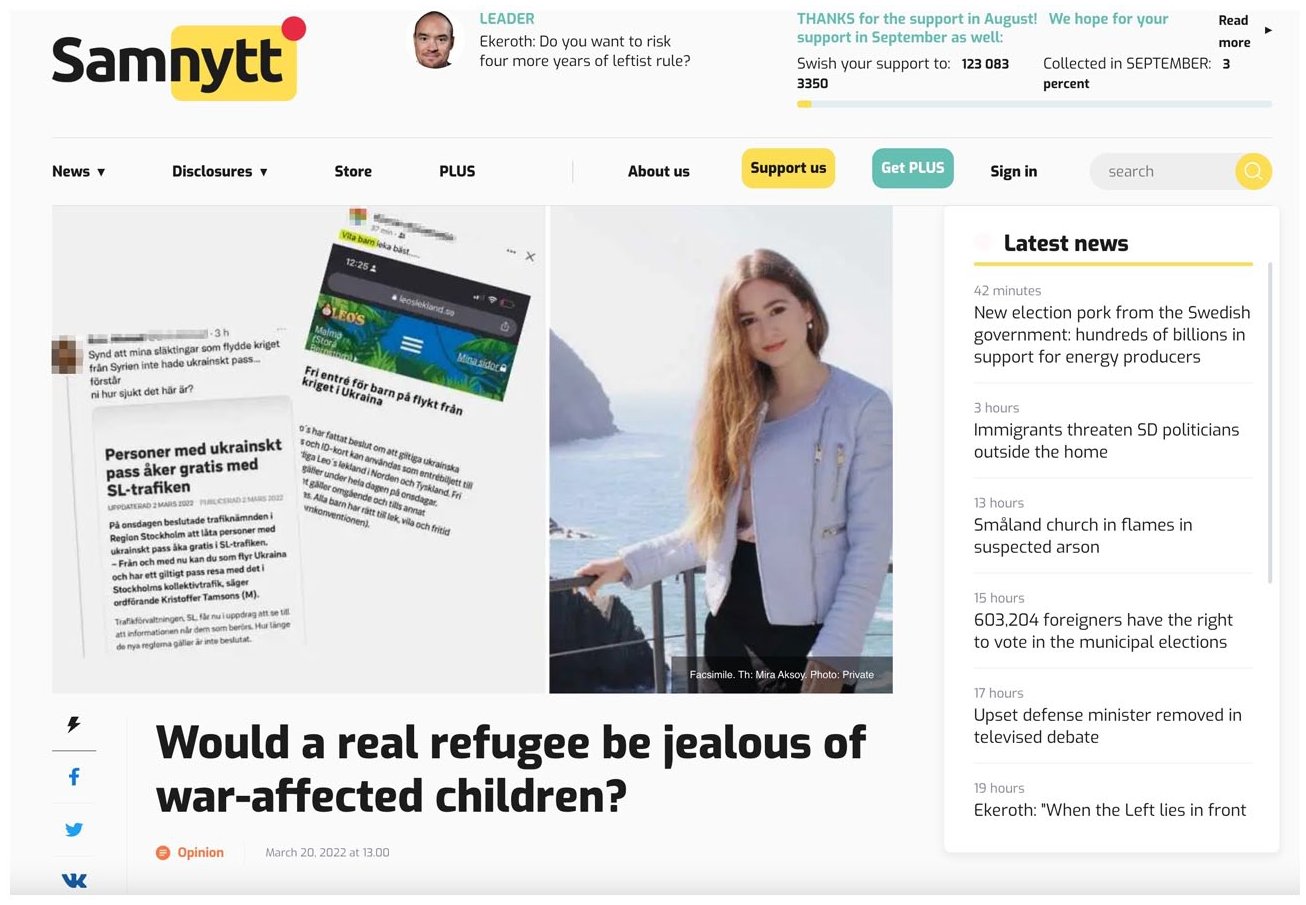
Translated screenshot from article ten in Samnytt.
By contrasting Ukrainians and ‘others’ in terms of gratitude and jealousy, alternative media construct a bleak reality wherein what is done for Muslim immigrants will never be enough, as they will never be satisfied. This feeds into the reverse victimisation experienced by ‘real’ Swedes who argue that the establishment favours immigrants over the legitimate native people (Krämer, 2017; Merrill and Åkerlund, 2018)
Relatedly, alternative media use legacy news media to carry out ideological work – connecting Muslim immigrant illegitimacy to conspiracy theories about the establishment’s preference for (specific groups of) immigrants: On social media, several viewers have reacted to the fact that state television has never before asked such a question to male immigrants who claim to have fled war. (Article 11) After decades of avoiding the topics of immigration and costs, except when it was claimed that it would be profitable, [legacy media source] now goes out and warns that Ukrainians fleeing Putin’s bombs and coming to Sweden ‘could cost the Swedish public economy tens of billions of kronor’. (Article 12) No matter how you twist the statistics, there is no getting away from it: [Sweden’s Minister for Justice and Home Affairs] is lying and Sweden has a massive population exchange and a demographic change that no country in world history has probably ever had. (Article 14)
With this, Muslim immigrants are positioned as loyal to the political parties and legacy media that, according to alternative media, are part of the ‘establishment’. This is evident by how Muslim immigrants are categorised as ‘the left’s new protection group’ (Article 14) and ‘imported voting cattle’ without whom the ‘socialists and mass immigration crazes’ likely would not have stood a chance in the last election (Article 17). Accordingly, alternative media positions Muslims immigrants as a passive group of leftist allies without any ability to themselves make informed political decisions. Moreover, by positioning Muslim immigrants on the side of the establishment, they are automatically positioned as in opposition to ‘real’ Swedes (Åkerlund, 2022; Sakki and Pettersson, 2016). There is no factual basis for these assumptions presented in the articles, and they are not perceived to be open to questioning. In sharp contrast, Ukrainian refugees are not thought to pose the same threat to Sweden nor its welfare: The Ukrainians who are now fleeing here are not a leftist immigrant group. They are not uneducated illiterates and have not travelled here with the intention of staying and systematically robbing Swedish society of as many welfare benefits as possible. They have their sights set on returning home as soon as possible. If there are any left, they are those who have found a place in Swedish society and are independent. (Article 17)
Furthermore, unlike how refugee reception has been handled previously, there is a belief in alternative media that Ukrainian immigrants, for the reasons discussed in the above sections, are of interest and concern to Swedes. While there are discussions and worries of a situation like 2015, which is one that is often cited here and elsewhere among the far right as a major failure (Thorleifsson, 2019), there is an assumption that Ukrainian immigrants would not settle in Sweden permanently: The refugees from Ukraine show the difference between popularly rooted refugee immigration and elite-imposed mass immigration. (Article 4) there is a difference between getting temporary protection from war and then returning compared to abusing the right to asylum for permanent immigration in the enjoyment of benefits without a further time limit. (Article 17)
By minimising the threat of Ukrainian immigration to Sweden, and by highlighting the worthiness of Ukrainians as asylum seekers, they are framed as a reflection of the in-group of Swedes as being worthy, genuine and seeking to do what is right and expected of them. Muslim immigrants on the other hand, are named and classified with significantly more distance.
Discussion
Against the backdrop that Ukrainian asylum seekers constitute a ‘new’ group of immigrants to Sweden around which there lacks a contemporary far-right frame of understanding, this paper aimed to explore the reporting on immigration by Swedish alternative news media during the initial phases of Russia’s invasion of Ukraine in 2022. In particular, the paper sought to analyse how immigrants are discursively understood by these far-right sources and the role that Islamophobia – as the conventional far-right immigration frame – plays in these representations.
To summarise, despite sampling articles about Ukraine, the analysis showed that alternative media relied heavily on Islamophobic expressions to demonstrate that Muslim immigrants are a subordinate group, while at the same time demonstrate the similarities of Ukrainians to ‘real’ Swedes. The analysis identified how Swedish alternative media rank the value of Ukrainian and Muslim immigrants through antagonistically contrasting them. Primarily, we identified that these arguments are largely based on alleged differences in culture and geographical origin, perceived legitimacy as asylum seeker, and in terms gratitude and believed threat to Swedish society. Particularly noteworthy is how alternative media creates an imagined community of ‘us’ and a ‘them’ where Ukrainians are not racialised, but instead articulated as part of the in-group, as part of what is ‘normal’, and where Muslim immigrants are positioned as an ‘other’ which in different ways is strange, dangerous and incompatible to the in-group. Ukrainian refugees are generally described in a favourable and affirming way in alternative media while Muslim immigrants on the other hand, are named and classified with significantly more distance and negatively charged wording.
These finding have make several contributions. Importantly, the unique situation that is Russia’s war on Ukraine has allowed us to scrutinise far right discourse in a ‘new’ immigration context. While there is an abundance of research which has stressed the importance of ‘us’ versus a ‘them’ or ‘in-group versus ‘out-group(s)’ for the far right before (e.g., Berger, 2017; Hameleers and Schmuck, 2017; Meddaugh and Kay, 2009; Merrill and Åkerlund, 2018; Sakki and Pettersson, 2016), this study showcases the prevalence of Islamophobia in these practices also beyond explicit Muslim-related topics.
Concretely, this study shows how Islamophobia plays an outstandingly important role in understanding and positioning Ukrainians as asylum seekers. Ukrainians are constructed as refugees in a way that is fully dependent not on how European immigrants to Sweden have been seen before, but in contrast to Muslim immigrants. Beyond the findings of previous research which has shown how the native group – in this case ‘real’ Swedes – is contrasted to the Muslim out-group (Allen, 2010; Bangstad, 2022; Cesari, 2021; Horsti, 2017), Islamophobia is used in these representations to justify the value and worthiness of another immigrant group. With this, we have shown how the unity that is formed around Islamophobia trumps any nationalist views of the Swedish nation-state as particularly superior or white (Ericsson, 2021; Kjellman, 2013) and any potential social and economic consequences which are usually believed to be at risk due to immigration. By extension, we argue that the articulation of the war in Ukraine, as a matter of whiteness, can work as a means to exploit a tragic war for strengthening of the transnational far right.
Relatedly, this paper contributes new knowledge to the field of media studies by showcasing how alternative media promote ideologically driven far-right world views, rather than functioning as a form of corrective source of information. While this is not in itself a new discovery (e.g., Figenschou and Ihlebæk, 2019; Haanshuus and Ihlebæk, 2021; Mayerhöffer and Heft, 2022; Nygaard, 2019; Schroeder, 2020), the reliance on Islamophobia specifically, no matter the relevance to the topic of reporting, is however a new finding. In highlighting this, the current paper exposes the extents to which far alternative media are willing to exploit a topic to promote an ideological position beyond what has been previously identified. In a time where alternative media have become increasingly professionalised – draping themselves in cloaks of legitimacy that mimic established news media in both aesthetics and article structure, despite their rejection of the ethical and editorial standards adhered to by legacy news media organisations (Figenschou and Ihlebæk, 2019; see also Schroeder, 2019, 2020) – this finding should not be taken lightly.
Finally, this paper also has societal implications. Against the backdrop that the prevalence of alternative media is comparably high in Sweden (Schulze, 2020), and that their opportunities and power to influence the general discourse grows (Haller and Holt, 2019), the disproportional reliance on Islamophobia by these outlets could potentially, at least in part, be connected to indications of overall increasing levels of Islamophobia in Sweden (Poljarević et al., 2022). With immigration-critical media like the alternative media explored in this study, having such potential to influence their readers towards more negative attitudes about immigration (Theorin and Strömbäck, 2018), and against the background that there is an ongoing public debate regarding the legitimacy of alternative media sources and consequently, their potential right to public funding in Sweden (Admund Funck, 2023; Wåg, 2021), the findings of this paper should strengthen notions of these outlets as activist sources rather than news sites.
Limitations and future research
The sampling of the dataset meant a focus on how refugees are portrayed by alternative news media. Future research within the subject might want to compare the findings of this study to that of a widened geographical perspective. The representation of specific marginalised groups, such as LGBTQI+ people, in the context of these issues did however not fit within the scope of this paper. Future studies should do well in adopting an intersectional perspective in the construction of ‘new’ immigrant groups. As the sampling of the dataset took place in the very early stages of the war, it is possible that the discourse might develop over time, for instance in relation to how many asylum seekers might venture to Sweden. Further research exploring longitudinal discursive changes might provide valuable insight into far-right understandings of crisis and war. Finally, we have not taken a comparative approach to study the differences in representation of this issue across the Swedish alternative media ecosystem. Future research is needed to detail how differences in representation of immigration and immigrants might take shape, impact audiences and spread online and offline.
Footnotes
Appendix
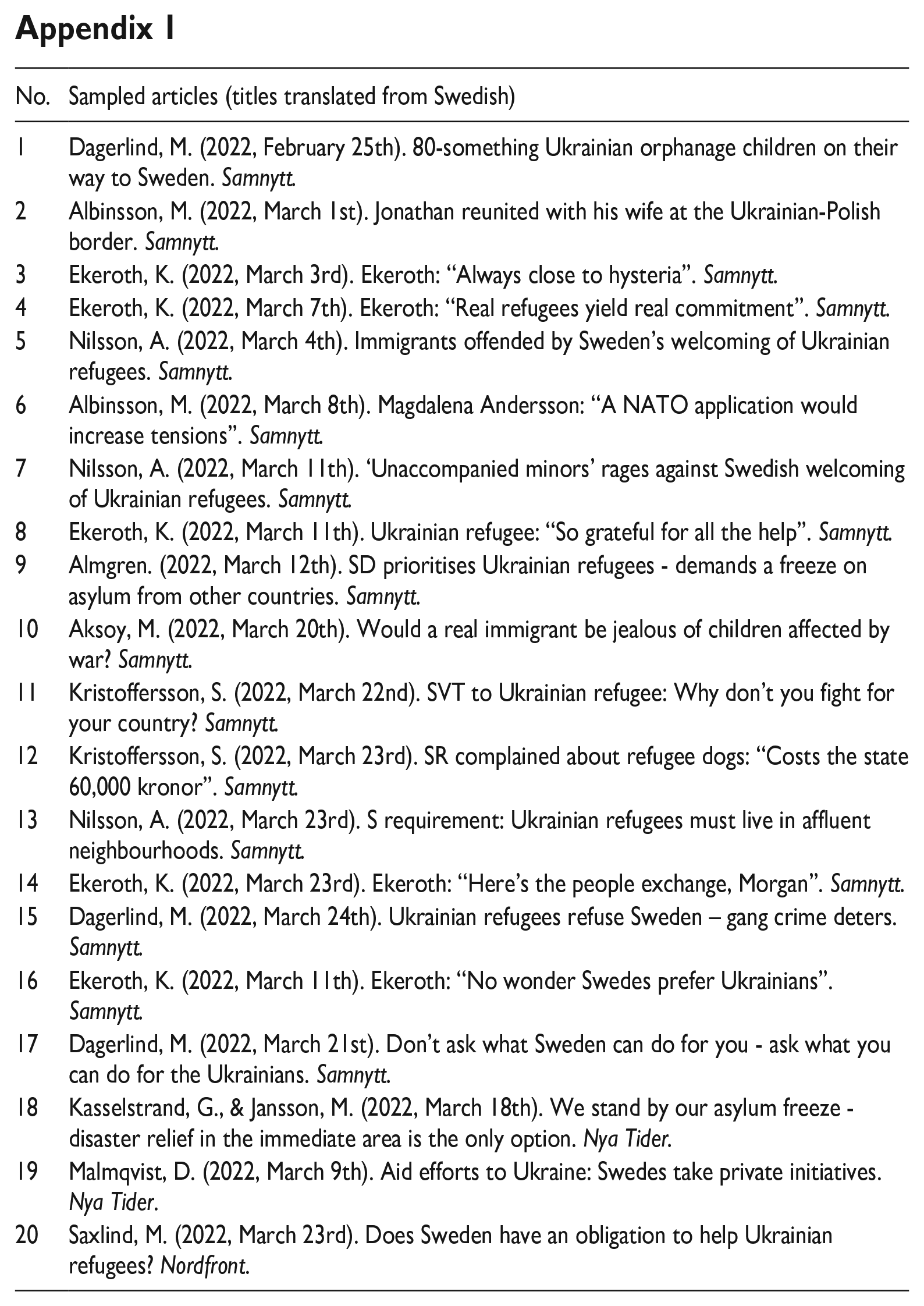
| No. | Sampled articles (titles translated from Swedish) |
|---|---|
| 1 | Dagerlind, M. (2022, February 25th). 80-something Ukrainian orphanage children on their way to Sweden. Samnytt. |
| 2 | Albinsson, M. (2022, March 1st). Jonathan reunited with his wife at the Ukrainian-Polish border. Samnytt. |
| 3 | Ekeroth, K. (2022, March 3rd). Ekeroth: “Always close to hysteria”. Samnytt. |
| 4 | Ekeroth, K. (2022, March 7th). Ekeroth: “Real refugees yield real commitment”. Samnytt. |
| 5 | Nilsson, A. (2022, March 4th). Immigrants offended by Sweden’s welcoming of Ukrainian refugees. Samnytt. |
| 6 | Albinsson, M. (2022, March 8th). Magdalena Andersson: “A NATO application would increase tensions”. Samnytt. |
| 7 | Nilsson, A. (2022, March 11th). ‘Unaccompanied minors’ rages against Swedish welcoming of Ukrainian refugees. Samnytt. |
| 8 | Ekeroth, K. (2022, March 11th). Ukrainian refugee: “So grateful for all the help”. Samnytt. |
| 9 | Almgren. (2022, March 12th). SD prioritises Ukrainian refugees - demands a freeze on asylum from other countries. Samnytt. |
| 10 | Aksoy, M. (2022, March 20th). Would a real immigrant be jealous of children affected by war? Samnytt. |
| 11 | Kristoffersson, S. (2022, March 22nd). SVT to Ukrainian refugee: Why don’t you fight for your country? Samnytt. |
| 12 | Kristoffersson, S. (2022, March 23rd). SR complained about refugee dogs: “Costs the state 60,000 kronor”. Samnytt. |
| 13 | Nilsson, A. (2022, March 23rd). S requirement: Ukrainian refugees must live in affluent neighbourhoods. Samnytt. |
| 14 | Ekeroth, K. (2022, March 23rd). Ekeroth: “Here’s the people exchange, Morgan”. Samnytt. |
| 15 | Dagerlind, M. (2022, March 24th). Ukrainian refugees refuse Sweden – gang crime deters. Samnytt. |
| 16 | Ekeroth, K. (2022, March 11th). Ekeroth: “No wonder Swedes prefer Ukrainians”. Samnytt. |
| 17 | Dagerlind, M. (2022, March 21st). Don’t ask what Sweden can do for you - ask what you can do for the Ukrainians. Samnytt. |
| 18 | Kasselstrand, G., & Jansson, M. (2022, March 18th). We stand by our asylum freeze - disaster relief in the immediate area is the only option. Nya Tider. |
| 19 | Malmqvist, D. (2022, March 9th). Aid efforts to Ukraine: Swedes take private initiatives. Nya Tider. |
| 20 | Saxlind, M. (2022, March 23rd). Does Sweden have an obligation to help Ukrainian refugees? Nordfront. |
Funding
The author(s) received no financial support for the research, authorship, and/or publication of this article.
