



Abstract
The socio-technological affordances of Twitter have steadily enabled audiences of reality television shows to form virtual communities through the use of hashtags to organize and share commentary about their favorite shows. Although the communication activities around hashtag communities are becoming more apparent, research on mapping their online cultures remains underappreciated. Scholarly work is needed that makes the links between culture and communication more apparent, thereby enhancing our understanding of virtual communities formed around interest in reality television. Using a small-scale sample of tweets (n = 203) from season eight of the reality dating show Date My Family, I explore what the cultural expressions of the South African #Datemyfamily virtual community entail. A thematic analysis suggests that values, norms, beliefs, attitudes, and behaviors constitute a strong cultural part of what is communicated by the #Datemyfamily community. Ultimately, the virtual culture of this online group places emphasis on solidifying the community’s imagined collective consciousness.
Introduction
Since its meteoric rise in the early 2000s, reality television (RTV) has changed the television landscape globally (Deller 2020). From production to participation and consumption, RTV challenges the cultural artifact of television (Ouellette 2014). Quick production times ultimately translate to content that can be produced consistently without much of the hindrance of traditional television programing (Deery 2015). Its reliance on non-professional actors as participants as well as relative ease in location as well as limited scripting also means that RTV can be produced with a relatively modest budget while being in the position to potentially make huge returns (Essany 2013).
Reality TV’s popularity has been assured by a constant and rising viewership that is ready to engage with the content with a fever that gives evidence to its cultural appeal to audiences worldwide (Hill 2020b). Reality television seems to find its relevance through the need for individual existential anchoring and the need for inclusion in contemporary society that is exacerbated by ever-increasing dialectical uncertainties (Bauman 2010). In the end, reality TV also rides on the back of a society in which self-mass communication has become the norm with the help of social media (Deery 2015).
Although reality TV’s rise to power has inevitably drawn the interest of many scholars from various disciplines (Deller 2016; Ouellette 2014; Tavernaro-Haidarian 2020; Vertoont 2018), there remains much to be done in terms of investigating the gap between RTV and the culture of engagement through social media. Indeed, audiences have found social media such as Twitter to be an excellent venue through which to interact with RTV content as a second screen (Deery 2015; Harrington et al. 2013; Ngcongo and Fekisi 2019). The use of Twitter by reality television audiences to gather before, during, and after their favorite shows to engage about the content, presents an interesting place to study the intersections of communication and culture (Buschow et al. 2014). Reality TV audiences often tag and reply to each other because of their shared interest in a certain reality show, ultimately forming virtual communities that are held together through communication (Bruns and Burgess 2011). Researchers have only begun to scratch the surface of how these hashtag communities communicate based on their interest in different television shows and events, as well as utilizing Twitter as a backchannel or second screen (Harrington et al. 2013). Although significant studies do exist which have investigated the importance of audience social engagement about reality shows such as Master Chef (Hill 2020a), Idols, X-Factor, the Voice and Got Talent (Keinonen et al. 2018), not much is known regarding the cultures of these reality television virtual communities. This study proposes a deeper level of analysis to unravel what these communication activities can teach us about the virtual culture(s) that results from them to fill this gap in the research (Sheldon et al. 2020).
This is especially true for reality dating shows, which have managed to form strong virtual communities such as the “Bachelor nation.” Although the different types of engagement of these virtual communities through the use of a Twitter # are becoming a popular area of study, this paper moves beyond the engagement inventory itself and looks at the culture inherent in the engagement (Sheldon et al. 2020). To do this, I borrow from a South African virtual community around a popular dating show Date My Family because, amongst the more popular RTV formats, dating shows have proven to be the favorite choice in South Africa (Smit and Bosch 2020).
This Study
Date my Family (Mzansi Magic 2015) has attracted one of the widest audience engagements on Twitter during and after its airing on Sunday nights in South Africa as evidenced by having one of the top trending hashtags on Twitter on Sundays. The show sees one singleton have supper with three families of each potential date to decide who to go out on an actual date with based simply on their interaction with the respective families. The show has its conventions and rituals, including a cutaway to on-camera confessionals about how the evening is going by different participants on the dinner dates. It is the performance of the participants as well as the overall production of the show then that the Twitter community engages with through the #Datemyfamily.
Not much is known about the rituals and conventions that users on Twitter employ to engage with the show through the #. Previous research on Date My Family has mainly focused on the performance of family identity (Sithole and Falkof 2019) as well as sexual identity (Mntungwa and Ngema 2018) by the participants in the show. This study proposes that a culture-centric analysis of the Twitter engagement by viewers with the show can unravel some of the taken-for-granted conventions and norms about how audiences mediate their engagements with RTV in a South African context. Indeed, the premise that culture is communication and communication is culture (Carey 2009) can shed light on the rituals, norms, and conventions with which viewers of the RTV dating show Date My Family engage communally with the content through Twitter. In what follows I outline the main characteristics of Twitter that promote the existence of virtual communities, I sketch out some key components in the elements of culture that are of interest in this study before presenting a discussion of the findings and offering some key insights in the conclusion.
Literature
Twitter and Hashtagging
Since its inception in 2006, Twitter has grown to become a pervasive global social media giant. It was originally conceived of as a 140-character microblogging social media platform in which registered users post on their handle by answering the question “what’s happening?” (Bruns and Moe 2014), whose response is accessible to the follower networks established by each user. However, its founder has reiterated that Twitter was meant to be more than a microblogging tool. It was meant to create a network of users who are connected by shared space, the “Twittersphere.” From this conceptualization then, the three main functions of retweeting, @ mentions to reply to tweets, and the use of # the organize information as well as topics, all work together to create the technological affordances for the audience to be immersed in a collective social environment.
The different technological functions on Twitter allow us to map three different levels of communication through the platform: micro, meso as well as macro level engagement (Bruns and Moe 2014). The micro level of communication is deeply embedded in Twitter and is achieved through targeting a tweet to any specific user by using the “@” symbol followed by the intended username. This is often an attempt to strike up an interpersonal conversation with another user. Although not all @ mentions can be seen as an attempt to initiate a conversation, they do highlight the interpersonal nature of this communicative act. The second meso level of communication on Twitter is achieved when one user follows the account of another user to receive access to the stream of tweets from the account being followed. Although users do not always follow each other, once an account has accumulated followers, it achieves an imagined public audience for the one being followed. The user is then able to interact with their private public through their tweets. Lastly, the macro level of communication on Twitter is facilitated using hashtags in order to bring a group of users together around a topical issue or event. Through the use of the # symbol, topics can be grouped together and users can take part in a collective conversation by tagging their tweets with the hashtag or replying directly to tweets under the hashtag. It is at this level where most research on Twitter engagements with live events and current affairs has taken place (Bruns and Moe 2014). My current interest in Twitter communities and reality television in South Africa consequently falls within this macro level of communication.
At the macro level then we see the creation of different publics on Twitter through the use of the hashtag (Bruns and Burgess 2011). This is because according to the original proponent of hashtags Chris Messina (Factory City 2007): Rather than trying to ping-pong discussion between one or more individuals with daisy-chained @replies, using a simple #reply means that people not in the @reply queue will be able to follow along, [and] topics that enter into existing channels will become visible to those who have previously joined in the discussion.
In other words, the nature of hashtags themselves being bottom-up user creations free from Twitter control allow for the creation of groups of interest based on any # they decide to converge around. These publics often take the form of post hoc publics, which materialize following an event or incident to create commentary and information around it. The public can also be ad hoc by arising as the event or noteworthy topic happens, creating parallel commentary (Bruns and Burgess 2011). The main characteristic of these publics though is that they are inherently ephemeral, but as they solidify and become more stable, they morph into virtual communities (Wood and Smith 2005).
Hashtag Communities and Virtual Culture
Since virtual communities are distinct mediated groups bound by the commonality of interest (Lull 2001; Sköld 2015), it makes sense why the hashtag would be used as a point of convergence for Twitter communities (Zappavigna 2015). The key characteristic of a hashtag virtual Twitter community is the high number of interactions among those contributing to the hashtag itself through replying to tweets (Bruns and Burgess 2011, 5). Although this does not necessarily establish a sense of community for all participants, it does have the potential to help us understand more about online communities and how technological affordances facilitate their existence (Ryan et al. 2017). In this vein, the #Datemyfamily would conform to the basic tenants of a hashtag community built around interest in a reality dating show.
Researchers have begun to scratch the surface of how these hashtag communities communicate based on their interest in different television shows and events, utilizing Twitter as a backchannel or second screen (Harrington et al. 2013). Deller (2011) for instance studied how hashtag communities form around news events, sports, and reality television. The communicative pattern around reality shows specifically showed that communities discuss praise and criticism for the program content, promote the program to other users, encourage them to watch, as well as engage in commentary on the events or participants in the show, comment or ask questions on the film-making and technical aspects through humor. Buschow et al. (2014) on the other hand found four main communication activities that occur through Twitter hashtag communities during the broadcast of reality shows, sports shows, and news programs. These Twitter hashtag communities expressed; (1) their evaluation of the shows and actors, (2) emotions, (3) abstraction by placing themselves in the scenario of the show, and (4) connecting with the community (Buschow et al. 2014). As useful as the research on cataloging the communication activities of Twitter hashtag communities have been, a deeper level of analysis is needed to unravel what these communication activities can teach us about the virtual culture(s) that results from them (Sheldon et al. 2020).
The Concept of Culture
I should hasten to clarify that I am in no way suggesting that the culture that can result from the convergence of a Twitter community around a hashtag is a direct equivalent of offline cultures seen in geographic communities. Indeed, the extent to which online communication activities reflect the offline world is a contested area (Fuchs 2017). What complicates this debate ultimately is that there remains a lot that is unsaid through virtual communities that makes it hard to grasp the full implications for virtual culture (Lull 2001). But investigating some of the elements of offline culture as manifested in Twitter communities can give us some clues about the patterns of virtual cultures in contemporary society.
The discussion is further complicated by the contested and continually evolving notion of what constitutes culture. Etymologically, the concept of culture can be traced back to its Latin roots of colere and cultura, which mean to nurture growth (Hammersley 2019). In this sense then, culture came to be associated with fostering human development. This earliest conception of culture developed in the two notions of culture as singular and static. The first involved the growth of Culture, while the second involved the ethical and esthetic cultivation of the human. The more recent two conceptions of culture however are more plural in nature (Hammersley 2019). These involve cultures as ways of life and cultures as meaning-making processes.
Both sociology and more recently Cultural Studies have popularized the plural conceptions of culture (Pitout 2007). Within cultural studies, culture is seen as a non-static process that helps humans make sense of the world. Consequently, all kinds of cultural practices that construct everyday lives are of primary concern. This paper takes a similar view in the everyday and ordinary processes of a virtual community interested in a reality dating show being seen as an important aspect of a cultural process. In particular, an understanding of cultural studies regarding audiences as active participants in creating their own meanings within powerful institutions is poignant (Pitout 2007, 275).
However, cultural studies’ focus on everyday and ordinary cultural processes may lead to difficulty in understanding what exactly constitutes culture. This has often resulted in the mixing of cultural studies with the other conceptions of culture discussed above or indeed alongside other material aspects of culture (Hammersley 2019). This is not surprising given the fact that cultural studies is not one single monolithic theory, but draws on many approaches such as Marxism, structuralism and postmodernism to name a few (Pitout 2007). The influences of these various approaches often coalesce to form a composite understanding of culture. This composite aspect of culture within cultural studies has exposed the conception to contrasts and complications that such an amalgamation brings.
For instance, there are contradictions with how culture is often used within cultural studies with other established concepts such as society. In other words, it is often difficult to distinguish how the conceptualization of culture is different from the concept of society (Hammersley 2019). Another contradiction that exists is how this notion of culture is applied inconsistently to understandings of multiculturalism or even the notion of digital culture (Hammersley 2019). Therefore, it is important to appreciate this complexity when undertaking such an ambitious project as cataloging the culture of a virtual community of interest.
What the complexity highlights is that the coalescing interests of cultural studies are not antithetical to helping us appreciate the link between culture and communication. Consequently, this link is itself the premise of understanding the cultural expressions of a virtual community. Since cultural expression can be thought of as discourses that communicate something about a given culture, it is possible to argue that culture reflects communication and communication reflects cultural processes (Pitout 2007). This is not to suggest a deterministic transmission of culture but considers the dynamic forms of expression, as well as what is expressed and why it is expressed.
The question then is what types of cultural expressions can be seen in a virtual community whose interest is to communicate about a reality dating show. An inventory might sound fixed but may help us trace the evolution of cultural expression to make sense of what types of cultural expressions are most prevalent within the context of creating meaning that stands in stark contrast to the intents of powerful media institutions. The virtual community then is conceptualized as being active participants in their meaning-making processes through communication (Pitout 2007).
To explore the manifestation of a virtual culture, I focus on key elements of culture that have been observed in an offline context to investigate whether parts of these elements may be observed through the cultural expressions of the #DateMyFamily virtual community. In other words, if Twitter users come into the hashtag community with some working knowledge of culture it may be possible to observe similar elements manifesting themselves in this virtual space through their communication. It is arguably difficult to give an exhaustive account of the elements that make up any given culture, in part due to the dynamic and non-static nature of culture. Although a distinction exists in the literature between material and non-material aspects of these elements of culture (Inglis 2005), cataloging what each entails is beyond the scope of this paper. My focus is on the non-material aspects of cultural expression since those are more observable in virtual communities. I use this material/non-material binary with the provision that it is in reality difficult to have such a separation of culture. To simplify the discussion I have nonetheless borrowed this very contentious binary.
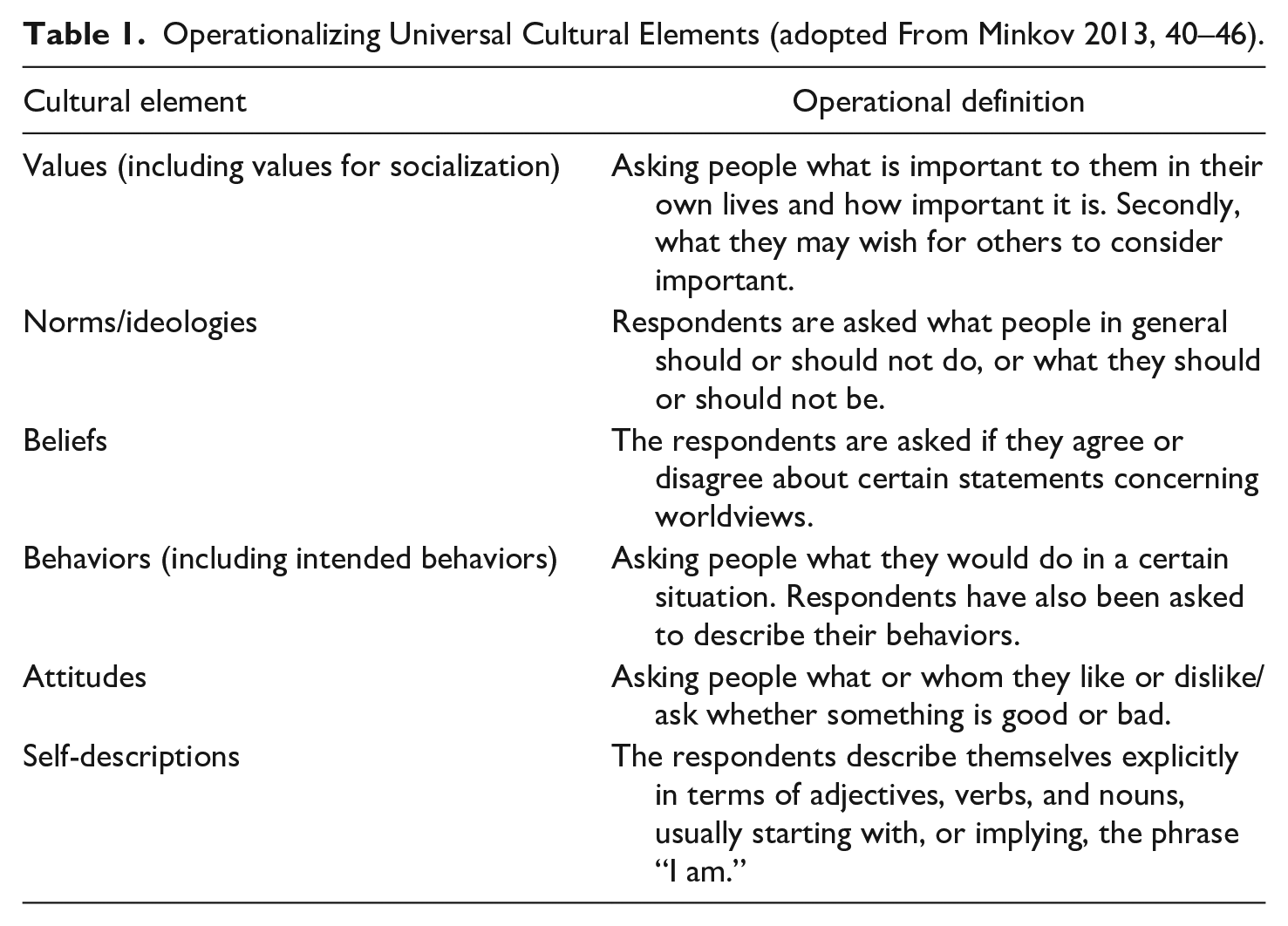
I specifically borrow from Minkov’s (2013) list of universal elements of culture that are extrapolated from worldwide aggregated empirical self-reported accounts. Although this list seems rigid and static, it is applied in the study in an explorative manner rather than a prescriptive fashion. Some of the elements in question may not appear in the expressions of the virtual community, while other, unexplored expressions may become apparent. Minkov’s approach is also not within a cultural studies approach, however, in approaching the virtual community as active meaning-makers rather than having a non-changing culture makes the inventory a decent starting point for understanding forms of non-material cultural expression. For Minkov (2013, 40–46), cultural elements can be summed up as values, norms/ideologies, beliefs, behaviors, attitudes as well as self-descriptions. The Table 1 summarizes the operational definitions used to investigate if and how these cultural elements manifest themselves in the #Datemyfamily virtual community.
Operationalizing Universal Cultural Elements (adopted From Minkov 2013, 40–46).
Methods
I employed a small-scale online data mining approach in the sampling and collection of the tweets from the official @Date My family ZA Twitter account that collates high engagement tweets from the #DateMyFamily for season 8. Given the limitations of time and space, it would not be possible to do justice to all eight seasons, and I, therefore, chose the most current season to illustrate the virtual culture that the #DateMyFamily affords. The season ran from mid-2020 through to 2021, but the tweets sampled were primarily from engagement about 2020 episodes. The result was a total of 203 primary tweets which were all from the 2020 episodes during which the data collection period fell. The tweets decided on had to conform to all the characteristics that make up a virtual community (Bruns and Burgess 2011). In addition to this, the other inclusion criteria were that the tweets had to contain the #Datemyfamily and fall within the specified dates of the first part of season 8 in 2020.
I adapted the three-step thematic analysis process that is associated with Charmaz (1995, 37–45) for the purposes of this study which, in short, relies on a bundle of “specific techniques in flexible and different ways, to generate theoretical insights from qualitative data” (Bloor and Wood 2006, 95). This is because I sought to go beyond simple categories and make theoretical contributions through the analysis of Twitter engagements. As stated earlier, the exploratory nature of the study created the possibility of theorizing on virtual cultures and possibly overturning some of the taken-for-granted assumptions about Twitter engagement informed by a South African perspective.
Steps in the Analytic Process
First, I coded the data, that is, the first major analytic phase of the research process, employing thematic analysis sensitized by concepts from the universal cultural elements by Minkov (2013). In short, the coding process defined the scope and content of the data. This first step involved going through the tweets line-by-line and creating short descriptive words based on the data. The tweets were mostly coded in vivo, taking exact phrases from the data to make up the code; and there were open codes that encapsulate the idea of the content of the data. By studying the data, there was interaction with it and questions asked of it. An important consideration in this process was not to force the data to conform to preconceived codes. This meant a delicate balance between intuition and rigorous conceptual and objective data analysis. Following the steps in the thematic process strictly ensured that intuition did not slip into unconscious bias.
Secondly, I moved on to do focused coding, which involved taking earlier codes in the tweets that continually reappeared in the initial line-by-line coding and using those codes to sift through large amounts of data. Thus, focused coding was less open-ended and more directed than line-by-line coding. It was also considerably more selective and conceptual. In this step, I compared the data with the codes and the interconnections and divergences in the codes themselves to draw out patterns that emerged. This meant that the codes that emerged went through a rigorous process of being objectively evaluated to determine their validity. Focused coding also allowed me to create and try out categories for capturing data. By categorizing, certain codes were selected as having overriding significance in explicating events or processes in the data. Defining the categories was made possible through memo writing, which helped in looking at coding as process to explore, rather than solely as a means to sort data into topics. Writing memos essentially meant taking the categories apart by breaking them into their components.
The final step involved developing themes from the data (Kelle 2014). I used computer-assisted qualitative analysis software (CAQDAS) in the form of Atlas.ti™ in order to ensure an efficient yet reliable procedure in the three steps mentioned above. In addition, Atlas.ti™ is good for mechanical research tasks, such as storing and organizing data, coding, searching and retrieving, annotating data, and displaying data in a variety of formats, including graphical displays. It was relatively effective in supporting the exploration of virtual communities, although it did not substitute for thinking, judging, deciding and interpreting, which were still best done by me (Daymon and Holloway 2002, 244).
Findings
Theme 1: Values
To arrive at this theme, the three-step analytic process synthesized forty-two primary codes from the tweets, followed by grouping those codes into six categorical communication activities and lastly extrapolating values from the categories by asking what they reveal about what the virtual community members communicate as being important for them about the participants and Date My Family. The data suggests that the #Datemyfamily Twitter virtual community values the seriousness of participants in pursuing love and protecting what they perceive as authentic performance. In other words, the virtual culture of this community values love and authenticity of self for the participants in the show.
When I refer to seriousness in issues of love what I mean is that as much as DMF is a reality dating show, a great amount of investment in the process of attaining love and courtship is still expected from the participants. Not only is the importance of valuing love expected from the singles in the show but from the families representing the potential dates as well. The singles are expected to value love by knowing what they want and making good choices at the end of the three dates with the families. The families are expected to value love by being good hosts during the dinner dates, and not showing a combative or disagreeable spirit. We could say that the valuing of love by this virtual culture seems to subsume the translation of this value in actionable behaviors, such as agreeableness, good decision making and courteousness. Below are some tweets posted during the airing of the specific episode on Sunday expressing support for the seriousness of the singles making a good choice but chastising the families who were disagreeable through the process of the dinner dates: @username1 May 24 Alarm bells were ringing for all of us my brother with that money conversation! You did well to run away. #DateMyFamily @username2 Mar 29 Good choice @username3 Mar 29 Personally I don’t understand why judge someone for being 35 and staying at a back room at home. Honestly, life doesn’t work out at the same age for everyone #DateMyFamily [162 Comments 1300 Retweets] Makoti @username4 May 24 How can you get offended because a stranger doesn't eat meat mara#DateMyFamily
A large number of replies and retweets point to micro engagements among the community members as well as in agreement with the values. Although the community did chastise families that were seen as unreasonable in the dinner dating process, those that displayed exemplary as well as authentic behavior in the value of courtship and love were commended.
Theme 2: Norms/ideologies
To arrive at this theme, the three-step analytic process yielded thirty-nine primary codes from the tweets, followed by grouping those codes into four categorical communication activities and lastly inferring norms from the categories by asking what they reveal about what the virtual community members communicate as being appropriate things that the participants on Date My Family should or should not do. I further reflected on what the categories reveal about what the community members think participants should or should not be. In some sense, the previous theme on values already hints at normative behavior and character associated with showing the importance of love. This section deals with specific norms that are more apparent in the communicative activities through the #DateMyfamily. The tweets suggest that the community sees not being rude, a liar, overconfident and materialistic as acceptable norms for the participants in the show. The tweets below posted during the airing of the specific episode on Sunday summarize these norms succinctly: @username5 May 24 Replying to @SAIdolsFans_ gold digger, liar and hypocrite! @username6 Mar 29 I like his honesty #DateMyFamily @username7 Apr 26 These ones are after money & material things. . . next #DateMyFamily @username8 Mar 29 This girl is too full of herself and it’s a big, big big turn off #DateMyFamily @username9 Mar 29 #DateMyFamily man Stacey is a nice lady So mature, humble & intelligent
The tweets suggest that participants on the show are expected to conform to the norms of non-materialism by not asking about finance-related issues as a focal point, to be humble in their expectations of who they expect to meet as well as their estimations of themselves and to tell the truth through full disclosure. As the show is based on the singles having to choose between three potential date options, the community sees this as an advantage that should be used wisely and in the best way possible. In other words, although the singles have the advantage, they should still be humble in their conduct while being truthful. Families are also expected not to interrogate the singles about financial issues. Underlying the norms seems to be a strongly held sense of beliefs about how the world works.
Theme 3: Beliefs
To arrive at this theme, the three-step analytic process resulted in thirty-nine primary codes from the tweets, followed by grouping those codes into four categorical communication activities and lastly, extrapolating beliefs from the categories by analyzing if the categories show agreement and/or disagreement with certain worldviews. To locate beliefs of the DMF virtual community I further distilled worldviews into the observable traits in communication that suggest abstract notions of what people hold about how the world is or how it should be; characterized by assumptions, beliefs and understandings about reality (Ngcongo et al. 2020). There was a slight relationship with norms which only apply to beliefs about expected human behavior compared to beliefs which apply to assumptions about the world or society in general.
It is important to note here that members of the #Datemyfamily community did not directly refer to portions of their communication as expressed beliefs. However, they did convey certain world views that they seem to agree or disagree with and this was given credence by the likes and comments in those particular tweets. The worldviews pertained to which types of participants were believed to be more intelligent in the show and a belief that singles had more of a prerogative to interrogate the family during the dinner date than the other way around. Put it another way, the community has worldviews about the intelligence levels of the participants as well as beliefs about prerogatives of power dynamics in the show. The tweets below were posted during the airing of the episode on the specified dates below the tweets.
@username10 May 24 Gauteng used to give us influ[e]ncers, Limpopo is giving us academics #DateMyFamily @username11 May 24 Limpopo is a province of academics. “Bo Mma” ba rutega! #DateMyFamily @username12 Mar 29 Stacy Lee is Leadership "do you have a roof over your head?, do I pay for it?, why should I have an opinion???"#DateMyFamily
The tweets above give succinct evidence to implicitly held beliefs by members of the DMF virtual community about intelligence and power. The high engagements shown by the likes and retweets express approval for the beliefs being communicated. This gives credence that the community shares similar ideas on these notions overall. Ultimately, the data suggest that beliefs are also part of this virtual community’s cultural elements.
Theme 4: Behaviors
To arrive at this theme, the three-step analytic followed firstly produced fourteen primary codes from the tweets, followed by grouping those codes into three categorical communication activities and lastly extrapolating what virtual above community members would do in a certain situation and how communication was used to describe their behaviors. This means that the communication had to be both reflective of abstraction through community members putting themselves in the participant’s shoes as well as being self-attributive. The self-attributive behavior was very ritualistic and seems to be widely understood as customary by the virtual community. Two rituals were prominent in the tweets; creating anticipation for and about the upcoming episode as well as engaging in surveillance to authenticate the participant’s performance on the show. The tweets below give a snapshot of the rituals already mentioned. They were posted before, during and after the airing of the episode on the specified dates above the tweets: @username12 May 3 Marking the register, who's also watching #DateMyFamily? @username13 May 24 #datemyfamily can't wait for tonight show @username14 Apr 11 (day before the episode broadcast) The next episode of #DateMyFamily is fire {} moes! I saw a snippet, I'm not missing this one. "Why your family can't thank my family for raising me" Date My Family SA @DateMyFamilyZA May 31 Thabang said he does not drink but what is this #datemyfamily 20 Comments 37 Retweets 121 Likes @username15 Jun 7 If Pithizela [busy] was a person, from Single and Mingle to Date my family #DateMyFamilly 24 Comments 39 Retweets 240 Likes
The behaviors most prevalent in the abstracted communication focused on how the virtual community members affirmed that they would behave in the same way that the participants behaved in the dating process. The data suggests two abstractions; how the community members would also behave the same way as the participants during the dinner dates and what dating strategy they would use in choosing the right mate. Abstractions for behaviors during the dinner dates were aligned mostly with participants that conformed to the expected norms of taking the process of the courtship format in the show seriously in the pursuit of love as the following tweets posted during the airing of the episode on the specified dates above the tweets illustrate: @username16 May 24 Yes same here ga ke je red meat [I don’t eat red meat] #DateMyFamily @username17 Apr 12 I can handle 2kids HAIBO! #DateMyFamily @username18 May 24 Guys, please stop asking us what do we do for a living. After that guy said his in between, his confidence changed @username19 May 3 Stay away from God fearing people #DateMyFamily @username20 March 29 Personally I don’t understand why judge someone for being 35 and staying at a back room at home. Honestly, life doesn’t work out at the same age for everyone #DateMyFamily
These rituals and abstractions can be thought of as a way that the virtual community directly engages in collaborative behavior that sustains the imagined consciousness of the virtual culture. Although the tweets do not describe the behaviors they are certainly indicative of the behaviors taking place, often in real-time as the show is airing. In other words, there is a consistent cultural flow of rituals before, during, and after the show.
Theme 5: Attitudes
The three-step analytic processes followed in developing this theme resulted in fifty-two primary codes from the tweets, followed by grouping those codes into six categorical communication activities and lastly analyzing if members in the #Datemyfamily virtual community showed a negative or positive attitude toward participants and abstractions in the show. This was achieved by looking at the data to determine if the community members communicate an affinity or disdain toward certain participants as well as whether they express certain things as good or bad in the show. The data suggest an overwhelmingly positive sentiment toward participants who showed decorum during the show as well as those who possessed qualities of physical attractiveness. In other words, there is a positive attitude toward participants who make effort to be palatable as well as those who are seen as beautiful/handsome. These two preferences were not necessarily related to the need for them to be displayed by the same participant in the show. The tweets below were posted during the airing of the episode on the specified dates above the tweets.
@username21 Apr 12 Family number 3 apartment, maturity and behavior is Top Notch. . . well-done Majita [guys], well-represented #DateMyFamily @username22 Apr 26 Why it is this family only asking questions pertaining to money? #DateMyFamily @username23 May 24 The third family Why do the ladies feel so entitled to the money they didn't even work for?#DateMyFamily @username24 Apr 12 Damn can I have his handle #DateMyFamily @username25 Apr 5 Hit a like if you think she is beautiful. #DateMyFamilly #DateMyFamily
The second part of the data suggests that comments that are positive in their sentiment are seen as being good and held in high regard. Attitudes of this virtual community then suggest a culture of positivity and overall camaraderie. The opposite was true for the first quality in that community members had a negative attitude toward participants who were judged to be unpalatable through a lack of decorum. The foremost disapproval was toward those participants who were perceived as being rude and behaving inappropriately. In other words, the backslash in attitudes displayed to those participants seen as reprehensible may be used as a kind of sanction for such behavior. However, the data does not indicate a focus on the community having attitudes toward abstractions. The focus of the communication thus is on the performativity of the participants in the show.
Theme 6: Self-descriptions
To arrive at this theme, seventy-seven primary codes from the tweets were synthesized in the first step of the three-step analytic process, followed by grouping those codes into four categorical communication activities and lastly analyzing if members in the virtual community describe themselves explicitly in terms of adjectives, verbs, and nouns, usually starting with, or implying, the phrase “I am.” Although the cultural elements already discussed contain indirect references by #Datemyfamily community members about themselves, here I am focusing on direct statements to the self. The use of self-descriptions according to the data seems to be both used largely in reflecting on poignant and humorous moments in the show as well as minimally in an instrumental manner to call upon some action from the community members. In other words, self-descriptions are mainly phatic than instrumental forms of using language. The tweets below were posted during the airing of the episode on the specified dates in the tweets.
@username26 Apr 12 Replying to @username27_ and @username28 I was smiling the whole time @username29 Jun 7 I like this guy. But like he'd make a good friend. I like his personality he reminds me so much of Roux. #DateMyFamily @username30 May 24 I’m loving the IPCC uniform #DateMyFamily
It is interesting to note that self-descriptions appeared far less than the other elements of the virtual culture around this hashtag community. The more prominent pronouns used were plural rather than direct self-referents such as “I” or “me.” The appearance of more plural pronouns such as “us” and “we” seems more in line with an emphasis on the imagined community rather than the promotion or emphasis on the individual. This gives some evidence that members see themselves as belonging to a collective consciousness through participation in the hashtag rather than as mere individual Twitter users.
Discussion
The study set out to investigate how the #Datemyfamily virtual community on Twitter confirms the existence of virtual cultural elements through communicative activities under their chosen hashtag. I borrowed from Minkov’s (2013) classification of six universal cultural elements; values, norms, beliefs, behaviors, attitudes, and self-descriptions by using the operational definitions to extrapolate the elements from the tweets. The premise was that since culture is transmitted through communication and communication gives evidence of culture (Carey 2009) that it would be possible to see virtual cultural elements at work through the tweets linked to the #Datemyfamily. To this end, I found strong evidence of the cultural elements of values, norms, behaviors, attitudes, and beliefs. The cultural element of self-descriptions was not as prominent as the other five cultural elements. This suggests the strong presence of a stable virtual culture that accompanies the formation of a reality dating show hash tag community, in particular the #Datemyfamily virtual community.
The first virtual cultural element that emerged from the data was values. The #Datemyfamily community communicated the cultural value of investing in love and conscientiousness through expressing strong opinions about what they think are important qualities for the participants in the show to possess. The participants were expected to show that they see love as an important pursuit by asking the right questions during the dinner dates and making good decisions at the end about who to take on an actual date. Conscientiousness was expected specifically from the families who were hosting the suitors by being polite and agreeable. In this way, the values were ideal but were expected to show themselves in real-world actions. Thus, we see a link between values and norms since norms are expected behaviors that have underlying values and beliefs that accompany them (Minkov 2013). Indeed, love is an important value in the African context (Thomas and Cole 2009) and even finds its virtual expression through a hashtag community (Lull 2001).
The #Datemyfamily community expected a display of certain normative behaviors and character traits from the participants in the show. This constitutes the cultural element of norms for others. Although it was not clear if virtual community members expect the specific norms for themselves as well, the data suggests an expectation that the participants in the dating show tell the truth and be polite. In addition to this, they expect the participants to be humble and non-materialistic. These norms should be read alongside the pursuit of the ultimate ideal of love. In other words, the norms can be seen as enabling the actualization of the value of love. Thus we see once more the link between the cultural element of values and norms within this virtual community (Minkov 2013).
The third virtual cultural element that emerged from the #Datemyfamily tweets was linked to an expressed agreement and/or disagreement with certain worldviews that helps us to locate community beliefs. Although the community members did not explicitly refer to their tweets as beliefs, it was possible to infer beliefs by analyzing the underlying worldviews implicit in the tweets. The tweets suggested that community members have strong beliefs about who they think makes the most intelligent participants and which participants should hold the most power in the dynamic of the dating show. In other words, the virtual community holds worldviews related to intelligence and power. Although those with power are not necessarily the ones who may be ascribed with intelligence, sometimes they are the same participants. The idea of power is very important when it comes to interpersonal relationships (Foucault 1975) and it is poignant to note that virtual community members also see power as being a prominent dynamic in this reality dating show.
The cultural element of behaviors entailed analyzing the tweets to infer what the community members say they would do in a certain situation and how their communication was used to describe their behaviors. The data suggests minimal use of abstractions to describe what community members would do in a situation and a leaning toward collaborative-ritualistic behaviors that serve as customs of the #Datemyfamily virtual community. This may be linked to a strong affinity in the African cultural context toward communitarian behavior rather than individualism (Eze 2008; Gyekye 2003; Ngcongo and Fekisi 2019). Therefore, virtual communities may avoid abstractions because they put more emphasis on the individual communicator rather than the collective consciousness.
The fifth cultural element that was prominent in the data set was that of strongly held attitudes by the #DateMyfamily community toward the personality traits of participants in the show. Overall, communicative activities seem to suggest a positive attitude in the tweets. Because the attitudes of the community members are mainly held toward participants in the show rather than objects, a humanizing aspect to the virtual community is created by having a more human-centered focus. It is also important to note that these attitudes were more often harmonious than showing a tone of baseless and judgmental criticism. Thus, the virtual culture emphasizes harmony and positivity rather than the often cliché assumption that Twitter is overwhelmingly a toxic space (Molefe and Ngcongo 2021).
Lastly, the data suggests that the cultural element of self-descriptions, where the community members refer to themselves in personal pronouns, was not as prominent as the worldwide self-reports suggest (Minkov 2013). Instead, more plural pronouns were used in the tweets by the #Datemyfamily community members. This suggests a move toward a collective consciousness (Lull 2001) that seeks to emphasize community rather than a personal agenda. The self is downplayed so that the community may flourish within this context. This pattern seems conversant with the moral ethic of “otherness” espoused in most African and Southern African societies known as Ubuntu (Mboti 2015; Metz 2007; Metz and Gaie 2010; Molefe and Ngcongo 2021; Sesanti 2010). The value of Ubuntu is usually summed up in the phrase “I am because you are,” and is commonly associated with an emphasis on the communal taking precedence over the individual. This is also given credence to how abstraction was not as prominent when community members were communicating how they would behave if they were in a similar situation as the participants in the show. Another aspect that supports the emphasis of the virtual community on fostering a collective consciousness is how self-descriptions were also hardly visible in the other cultural elements.
Therefore, we see through the data an inexorable link between all the six cultural elements (Minkov 2013) through the #Datemyfamily virtual community. Values seem to translate to normative expectations for behavior in others. That is, a link between what is held as important for others exists in tandem with an expectation for that value to be translated into norms. There is also a link for example, between the expression of attitudes about behavior as well as self-descriptive language to do so. All in all, there is a relationship between the virtual cultural elements and no one element exists in isolation. Although I should hasten to clarify that I am in no way suggesting that the cultural elements play out in the same way online as they do in an offline context (Fuchs 2017), their existence online does point to how the need for virtual communities has been entrenched and indeed enabled by the socio-technological affordances of Twitter (Bruns and Burgees 2011). What the data does help us to appreciate is the move from simply analyzing communication activities in virtual hashtag communities to begin the work of cataloging the culture of these virtual communities. In doing so, deep analytical work of mapping out the links between culture and mediated communication can receive much-needed attention.
Conclusion
Given the small nature of the sample used by focusing only on the data from season eight of DMF, some limitations are worth noting. Firstly, it is difficult to generalize all dating reality television shows’ virtual culture simply from the mapping of the #Datemyfamily community. More extensive mapping of different reality dating shows would have to be done to afford a comparative analysis of the manifestations of cultural elements formed by each virtual community on Twitter. Secondly, the focus on a South African reality dating show might mean possible differences with international audiences of non-South African reality dating shows. Another comparative analysis would have to be done to unearth possible differences between South African and international virtual communities. Lastly, the qualitative, small-scale nature of this study might be seen to go against the grain of the growing popularity of using big data samples to map out echo chambers and filter bubbles. Extensive and collaborative efforts are needed to translate the work of cataloging virtual culture into reality show online communities effectively in a quantitative context.
Despite these minor limitations, the study has demonstrated the possibility of mapping out virtual culture in online hashtag communities that converge around the common interest of reality television. In doing so, the link between culture and mediated communication has become more apparent by analyzing online communication to extrapolate the cultural elements contained in communicative activities. The impetus for virtual communities on Twitter is given credence by the emergence of a consistent cultural pattern that emerges through the tweets of this community. Therefore, virtual communities can form and sustain cultures both through communication and the communication of culture.
Footnotes
Declaration of Conflicting Interests
The author declared no potential conflicts of interest with respect to the research, authorship, and/or publication of this article.
Funding
The author(s) disclosed receipt of the following financial support for the research, authorship, and/or publication of this article: The author received financial support from the National Research Foundation’s BAAP grant for this research.