




Abstract
Johnny Depp’s contentious return to the red carpet at the 2023 Cannes Film Festival sparked fervent debate online about domestic abuse, believability, #MeToo and the rehabilitation of men accused of abuse. In this article, we analyse two oppositional hashtags that became central to this discussion on Twitter: #CannesYouNot, created by supporters of Depp’s ex-wife Amber Heard; and #YesYouCannes, the response offered by Depp’s supporters. Drawing on a dataset of 18,000 tweets, we combine a network analysis with a qualitative analysis of the top tweets using each hashtag in order to understand how the hashtags circulated, their affective orientations and the evidence they use to support their positions. Our findings show that networked media allow the (re)construction of existing hierarchies of power; thus, we argue that although these appear to be straightforwardly oppositional hashtags, they operate asymmetrically in ways that have implications for our understandings of issue publics as well as ramifications for feminist digital activism.
Introduction
In May 2023, Jeanne du Barry (Maïwenn, 2023) premiered at Cannes, receiving a 7-minute standing ovation for the film’s actor-director Maïwenn and her American co-star Johnny Depp. The Cannes premiere was widely presented as Depp’s return to movie-making after the fall out from the end of his marriage to Amber Heard and – briefly – became a flashpoint for broader discussions about domestic abuse, believability, #MeToo and the rehabilitation of men accused of abuse. Prior to the premiere, Heard’s supporters organised around the hashtag #CannesYouNot to call out the festival – and the film industry more broadly – for their support of Depp and other men accused or convicted of abusing women. Depp supporters responded with #YesYouCannes.
To understand these oppositional hashtags, some background on the Depp/Heard case – and mediated responses to it – is required. The couple met in 2009, married in 2015 and were divorced 15 months later. Depp is more than 20 years older than Heard and, at the time they met, had almost 30 years experience in the film industry, enjoying both critical and commercial success. Heard had had some success in genre film and on television, as well as a model, but had nothing like Depp’s profile or status.
Reports of Depp’s abuse of Heard first emerged in 2016 when Heard was granted a restraining order. The backlash against Heard from Depp’s fans was immediate and intense (Robinson and Yoshida, 2023). In April 2018, the UK tabloid the Sun ran an article referring to Depp as a ‘wife beater’ and Depp sued for libel. Later that year Heard (2018) wrote an Op-Ed for the Washington Post describing the backlash she had received for speaking out. Although he was not named in the article, Depp responded by bringing a defamation suit against Heard.
In 2020, Depp lost the Sun libel case, a judge deciding that the Sun’s description of him as a ‘wife-beater’ was ‘substantially true’ (Wallis, 2023: 171). Depp fans maintained a very visible and vocal presence outside the court and online and Heard, who gave evidence for the Sun, was the target of persistent misogynist attacks (Robinson and Yoshida, 2023: 297–305).
The US defamation trial took place in Virginia in 2022, lasting 6 weeks. It was live streamed by Court TV with 3.5 million people tuning in watch the verdict live on YouTube (Penney & Associates, 2022). While in criminal cases, testimony relating to sexual violence cannot be televised, defamation cases provide no such protection and Heard’s testimony was not only televised but widely reproduced, mocked and memeified (Robinson and Yoshida, 2023). Indeed, the trial attracted unprecedented – and very asymmetrical – engagement on social media. For instance, NPR reported that during the trial #IStandWithAmberHeard had around 8.2 million views on TikTok, while #JusticeForJohnnyDepp had 15 billion (Tsioulcas and Rascoe, 2022). Controversially, the jury were not sequestered during the trial. The jury found mostly in favour of Depp; however, Depp was also found to have defamed Heard when one of his lawyers referred to an allegation as a ‘hoax’.
Depp’s Cannes comeback took place a year after the defamation trial in a film entirely in French. This alignment of Depp with the French film industry is neither new nor, in the post-#MeToo era, is it surprising. Depp has strong connections with France, having lived in the south for some time with Vanessa Paradis and their children. In 1999, he was awarded one of the French film industry’s highest honours, the César d’honneur, which was presented to him by Roman Polanski, the convicted-rapist-director who has been strongly aligned to the French film industry since he fled the United States in 1977 to escape a custodial sentence for statutory rape. Depp has been a vocal supporter of Polanski (Independent, 2010), and Polanski – and the film industry more generally – has remained a lightning rod for debates about sexual violence, sexuality and gender relations in France. In the wake of #MeToo, for example, 100 prominent French women signed an open letter hostile to #MeToo which was instructive of how Americanness is viewed as opposite to French norms of gender and sexuality. The idea that France is culturally exceptional – particularly in its attitude to sexuality – remains prevalent in and outside the country, although this does not go uncontested (Flynn, 2024). In 2020, Polanski’s Best Director award at the Césars prompted considerable protest, led by women in the French film industry (Despentes, 2020). On the day of the Jeanne du Barry premiere, a collective of 123 actors published another open letter protesting Cannes’ platforming of abusers (including, but not restricted to, Depp) stating that the festival was sending out the message that, in France, you can commit violence with impunity (Collectif d’actrices et d’acteurs, 2023). Interestingly, though, the Cannes letter did not offer a gendered analysis, instead referring to the festival ‘rolling out the red carpet to men and women who assault’.
In this article, we are interested in how the Cannes hashtags engage with the contested questions around believability, responsibility and the cultural norms of the film industry outlined here. We focus on a dataset of 18,000 tweets using #CannesYouNot/#YesYouCannes and combine network analysis with a qualitative analysis of the top tweets using each hashtag in order to understand how the hashtags circulated, their affective orientations and the evidence they use to support their positions.
In examining these oppositional hashtags, this article builds on Sarah Banet-Weiser’s (2018) identification of the coexistence of popular feminism and popular misogyny in the contemporary moment, recognising both the possibilities and limitations of social media as a space for activism (e.g. Jackson et al., 2020; Mendes et al., 2019). In relation to gender-based violence specifically, while the affordances of social media have allowed for a proliferation of survivor-speech unprecedented in its scale (e.g. Boyle, forthcoming), the technology has also facilitated new forms of gender-based violence and surveillance (e.g. Henry et al., 2020; McGlynn et al., 2017) and supported the growth and coordination of anti-feminist activities (e.g. Ging, 2017, 2024). Although the original reports of domestic abuse in the Depp/Heard case predated Alyssa Milano’s #MeToo tweet, the meaning of the case has been worked through in its aftermath and the verdict in the defamation case was widely reported as the end of #MeToo (e.g. Boyle, forthcoming). A fascination with feminism’s ‘end’ is hardly new however (e.g. McRobbie, 2009), and instead it is the coexistence of feminism and anti-feminism which concerns us here. Our central argument is that although #CannesYouNot and #YesYouCannes appear to be straightforwardly oppositional hashtags, they operate asymmetrically in ways that have implications for our understandings of issue publics as well as ramifications for feminist digital activism against sexual and other forms of gender-based violence.
Method
We collected two datasets using the search terms #CannesYouNot (n = 10,000) and #YesYouCannes (n = 8088) over a 7-day period from the day of the Jeanne Du Barry premiere on 16 May, using Netlytic, which uses the Twitter REST API v1.1 search/tweets endpoint. Data were gathered through the standard API access option embedded within Netlytic, which allows collection of time-sensitive data as topics gain momentum on Twitter. Samples collected through this approach cover a period of 14 days up to the point of data collection. Gathering data covering the 7-day period mentioned above allowed us to obtain a sample that represents the selected issue publics that gained momentum within this period. The sample was collected prior to Elon Musk’s full termination of the API and the launch of API V.2.
Two network datasets were constructed for each hashtag: retweet and quote networks; and reply and mention networks. Separation of retweets and quote tweets from replies and mentions is crucial as these two categories indicate different user orientations (Rathnayake and Suthers, 2023). In retweet/quote tweet networks, directed edges were drawn between senders of retweets and the source of the message being retweeted (i.e. arrows pointed at the sources of messages). In reply/mention networks, edges were drawn to indicate sources and targets of replies and mentions (i.e. arrows point towards users who are replied-to or mentioned by others). Each network was visualised using the Gephi Force Atlas 2 layout algorithm. Indegree values (i.e. the number of incoming links per node) were calculated to identify top actors in each network. In retweet/quote tweet networks, indegree indicates the extent to which tweets posted by a given actor are retweeted by other users. In reply/mention networks, indegree shows the total number of replies received by a given actor and the number of times they are mentioned by other users. Therefore, indegree can be used to examine how top actors mobilise Twitter activity within a given issue public. Both retweet and reply-mention networks were partitioned using the ‘Louvain method’ (Blondel et al., 2008) to identify clusters that emerge from retweeting and reply-mention activity. Four networks were created using the two datasets. For the retweet/quote networks, the #CannesYouNot network has 2389 nodes (i.e. users) and 4052 edges (i.e. retweet or reply/mention activity); the #YesYouCannes network has 1665 nodes and 3526 edges. For the reply-mention networks: #CannesYouNot has 539 nodes and 472 edges, and #YesYouCannes has 386 nodes and 539 edges.
The network analysis allowed us to identify broad retweet and reply patterns in the datasets, but we were also interested in how the tweets – and users – engaged with the issues. We did some further computational analysis, focusing on word frequencies and emoji use in both messages and user profiles. Retweets and stopwords were removed from both datasets before calculating term frequencies. Having identified broad patterns, we then manually read and analysed tweets and profiles in order to extend our analysis beyond data which can be captured computationally. We did this first by focusing on the top actors in each network, focusing on profile pictures, bios, length of time on the platform and follower counts. Second, we organised the datasets according to the most liked and most retweeted posts in the two datasets. As there was a high degree of overlap between likes and retweets, we concentrated our analysis on tweets with 100 likes: this gave us 90 #CannesYouNot and 121 #YesYouCannes tweets. When these tweets were manually checked, 12 #CannesYouNot and 6 #YesYouCannes had been removed from Twitter and were therefore excluded from our analysis, leaving us with a total of 193 tweets. As with the profiles, manual checking allowed us to see not only the text but – importantly – accompanying images (of which there were many) and links to external sources.
Before we present our analysis, a note on ethical considerations is required. As we have previously argued (Boyle and Rathnayake, 2020), there are ethical considerations for researchers identifying individual social media accounts in research of this kind, given both the potential for personalised backlash (particularly acute in the Depp/Heard case) and the control users retain over their content. While in our previous work we took the decision not to name individuals with unverified accounts posting in a personal capacity, this approach is complicated here by the changes to verification since Elon Musk’s takeover of Twitter/X, and, more significantly, by the nature of the content shared. In this article, we have used usernames unless they are associated with private individuals with less than 10,000 followers, a threshold level used by other social media researchers to differentiate between influencers with a relatively limited follower base and those users who have larger outreach (Sicilia and López, 2023). We think this provides a good balance between accountability where the poster would have a reasonable expectation of long-term ‘publicness’ (some of the fan accounts have tens of thousands of followers, as we will see) and ethical concerns about exposing private individuals to non-consensual scrutiny and giving their social media posts a degree of permanence they may not have intended – particularly where this relates to their experiences of, or attitudes towards, gender-based violence. In assigning pseudonyms to users, we have first identified them as belonging to either the #CannesYouNot (CYN) or #YesYouCannes (YYC) dataset, and then assigned numbers to each anonymised user (e.g. CYN01). Where we quote from anonymised accounts, we have also lightly edited the text – while retaining the original meaning – so it is not searchable.
In what follows we first describe the networks, noting differences in their organisation suggestive of differing political and affective mobilisations. The qualitative analysis of the top tweets in each network which then follows allows us to explore how these groups grapple with believability, responsibility and the cultural norms of the film industry.
Oppositional but asymmetrical issue publics
Focusing first on the retweet-quote networks (Figure 1), the #CannesYouNot dataset is characterised by relatively discreet areas of activity. Partly this is a result of the fact that the #CannesYouNot dataset includes multiple languages. The strongest connections between the actors are concentrated around fan-oriented accounts @lemon_tea_1224, @leaveheardalone and the anonymised @CYN02. Notably, the Amber Heard fan accounts are relatively new to the platform: both @lemon_tea_1224 and @leaveheardalone were set up after Depp launched his defamation suit and while they had substantial followings (10.7k and 12.2k, respectively) this paled next to the top actors in the #YesYouCannes network. Indeed, four of the top accounts in this network were anonymised (meaning they had fewer than 10k followers); in contrast, only one account in the #YesYouCannes network visualisation had to be anonymised.
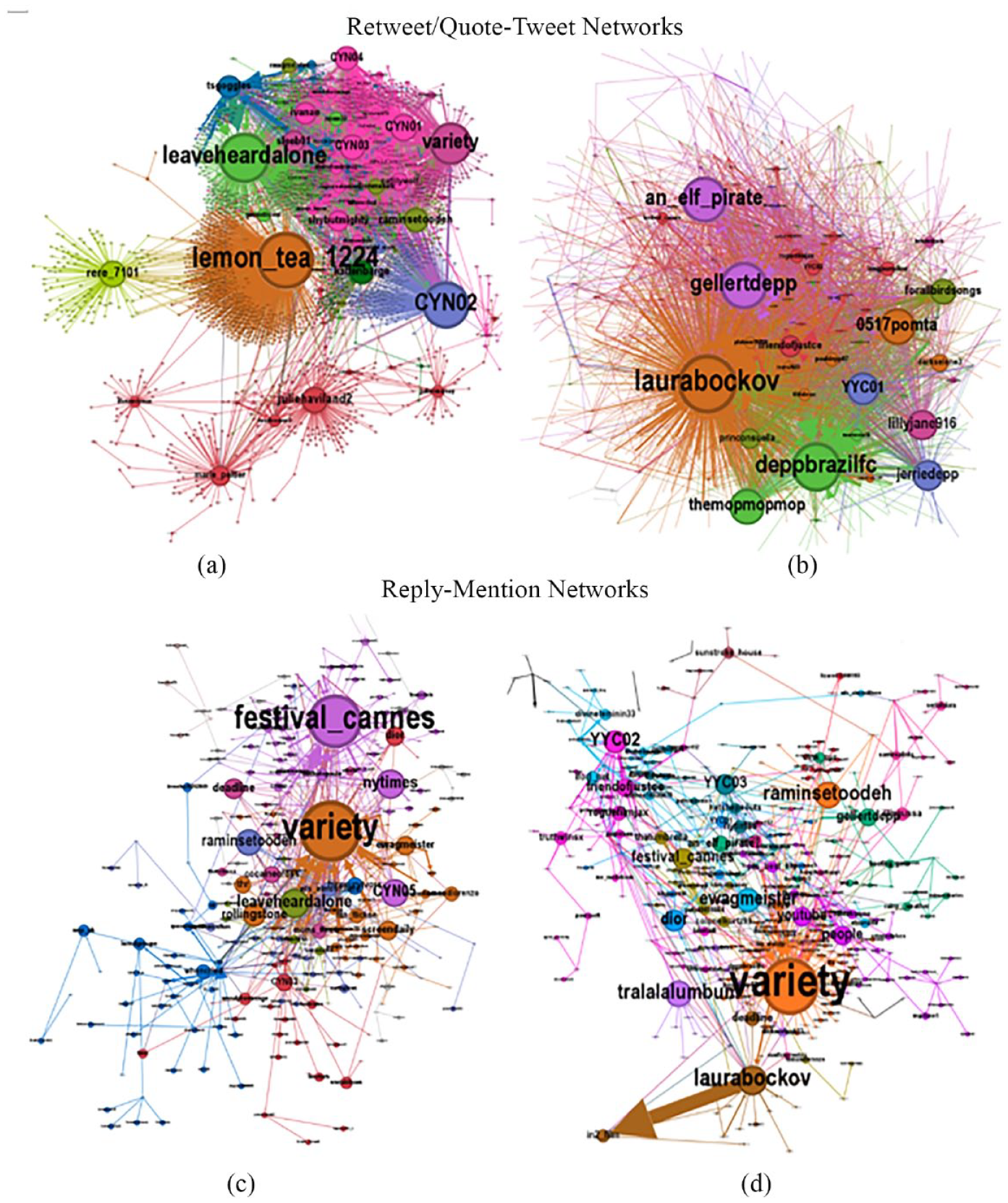
Network visualisations. Retweet/Quote-Tweet Networks: (a) #CannesYouNot and (b) #YesYouCannes. Reply-Mention Networks: (c) #CannesYouNot and (d) #YesYouCannes.
Interestingly, with the exception of @leaveheardalone, the Heard-oriented accounts do not post exclusively about Heard. The dominant actor in the #CannesYouNot network is the Korean fan account @lemon_tea_1224, an account primarily, but not solely, focused on Heard, additionally posting on other female actors and singers, including Margot Robbie, Ariana Grande and Taylor Swift. There is a second Korean account (
The #YesYouCannes dataset looks very different, centring on a large cluster (Figure 1 (b)). It is much denser in terms of concentration of a significant number of actors. The dominant actors in the network are (or have become) Johnny Depp fan accounts, with significant followings, all of whom were active long before the defamation suit: @laurabockov (84.1k followers), @deppbrazilfc (17.5k), @gellertdepp (57.7k) and @an_elf_pirate (13.6k). Existing scholarship has tended to focus on issue publics as quite short-lived affiliations concentrated around particular hashtags (Bruns and Burgess, 2011). This view acknowledges that digital publics form, re-form and are coordinated via dynamic networks organised around issues or events as opposed to pre-existing collective formations (Bruns and Burgess, 2015). More recent work also suggests that interaction related to social and political issues takes the form of ‘public spherules’, structures with a general theme, greater longevity and a larger participant base, which consist of connected issue publics (Bruns, 2023). In focusing on a time-limited and event-oriented dataset, we might expect to see a similar pattern, as, indeed, is the case with our #CannesYouNot dataset. However, #YesYouCannes aligns more closely with Rathnayake and Suthers’ (2019) argument that pre-existing political affiliations and fandom can create the conditions for issue publics to emerge. In considering these notionally oppositional hashtags together, we can see how dynamic issue publics are: they are not necessarily ad hoc, but there can be some ad hoc engagement with the issue. The parallel formation of these two hashtags shows how antagonistic, yet related, issue publics form within digital public spherules (Bruns, 2023). This also shows how Twitter has ‘matured’ as a platform that allows formation of relatively long-term publics from which momentary issue publics can emerge. Such long-term publics also reflect the networking of political power and cultural capital that characterise the transformation of the platform from Twitter to X.
From a feminist perspective concerned with the ‘issue’ – in this case, the platforming of (alleged) abusers at Cannes – this is a somewhat frustrating finding, as it makes it more challenging to counteract the backlash, both because the #YesYouCannes dataset is such a self-contained, pre-existing network and because its effective and affective organisation finds no equivalent within the #CannesYouNot dataset. While the time-limited dataset does not allow us to explore this in detail, it is an important consideration for future work on social media engagements with the Depp/Heard case and, indeed, on online feminism and misogyny more broadly.
Returning to #YesYouCannes, the dominant actor in the network – @TheRealLauraB (Laura Bockov) – merits comment in this respect. Bockov is a long-time Depp supporter and fan who gained prominence during the US defamation trial for her sharing of sealed transcripts. Bockov positions herself as a ‘truth seeker’ operating in opposition to mainstream media. Sarah Banet-Weiser and Kathryn Claire Higgins’ (2023) discussion of the simultaneity of the explosion of discourse on sexual violence with the heightened visibility of ‘post truth’ narratives is called to mind in the way claims about ‘truth’ are mobilised here. As we will see, contradiction is inherent to the work of #YesYouCannes and Depp’s star persona enables users to hold these contradictions in place: in the funhouse mirror of Depp-supporting social media, contradictions become evidence of constancy and credibility.
We also calculated the frequency of emojis used in profile descriptions to understand affective framing of digital selves. In #CannesYouNot user profiles the most frequently used emoji included rainbows, a white flag, heart signs in different colours and the solidarity emoji. These emojis link their users to causes (such as LGBT pride) and suggest an orientation towards others (love, solidarity). Conversely, the most frequently used emojis in the #YesYouCannes profiles were all linked to Johnny Depp fandom, most obviously his role as Captain Jack Sparrow (e.g. black heart, black flag, skull and cross bones). This reinforces the sense that the two publics are differently constituted in relation to the issue (#CannesYouNot) and the individual (#YesYouCannes).
The asymmetrical nature of the two datasets is also evidenced through a word frequency analysis of messages and profiles. In keeping with the stated intention of the creators of #CannesYouNot, the word frequencies in the messages suggest attempts to shape the discourse surrounding the Cannes film festival itself (cannes/festival/film/festivalcannes/cannesfilmfestival), specifically targeting their celebration of Depp and attempting to reorient the celebratory celebrity discourse by reminding users that #JohnnyDeppIsAWifeBeater/#JohnnyDeppIsAnAbuser. Notably, these hashtags suggest categorical statements, positioning Depp as a particular kind of person (wife beater, abuser). Moreover, using the language at stake in the Sun libel case suggests an alignment with the judgement of the English courts and with a tabloid hardly known for its progressive views on women. It is also notable that there is an emphasis on physical abuse: abuse, violence, victim, beater, wifebeater and rape all feature in the word frequency analysis. Alongside this, and mirroring the use of emojis of solidarity, is the prominence of hashtags like #MeToo, #IStandWithAmberHeard and #AmberIsWorthIt. While the first two directly position the user in the statement, #AmberIsWorthIt seeks to address the beauty company L’Oreal, playing on one of their best-known slogans (‘because you’re worth it’). This flips the orientation of the original ads which use celebrities to assert the value of the ordinary consumer; instead seeking to mobilise consumer ‘power’ to assert the value of the celebrity. Activism here is inextricably linked to consumerism.
The most repeated words in the #YesYouCannes dataset had far higher frequencies than those in #CannesYouNot, again suggesting the greater consistency within that dataset. There is a positive affective orientation towards Depp which highlights his agency: he can(nes), he keeps winning, he rises. There are statements of solidarity too, such as #IStandWithJohnnyDepp and categorical statements which emphasise Depp’s exceptionalism (#JohnnyDeppIsALegend) and, in the hashtag #JohnnyDeppIsASurvivor, both his reported experience of being abused and his status as a survivor within the industry. The film’s title, Depp’s character and the film’s director are also prominent, suggesting that the fans are positioning themselves as part of the promotional discourse around the premiere. Finally, the positive affective orientation is highlighted in the repeated use of ‘love’, ‘beautiful’ and heart emojis.
#CannesYouNot: media as target and weapon
In this section, we use tweets with more than 100 likes (n = 90) from the #CannesYouNot dataset to explore some of the issues raised by our computational analysis. We consider how #CannesYouNot users oriented their protest towards Cannes Film Festival, at the same time revealing an ambivalent orientation towards mainstream media industries more broadly. This leads to a discussion of the nature of evidence used within this dataset.
The most retweeted post in this dataset is from the Korean-language fan account @lemon_tea_1224. It is a collage of four images, all using a black background and featuring #CannesYouNot in gold and white lettering. The top two images are headed by the Cannes logo in gold: The text reads,
Hollywood predators don’t fear consequences because festivals like Cannes support them. Cannes has repeatedly honored abusers. When will it support survivors?
The bottom two images feature photographs of Depp: in the first he is placed in a line-up of filmmakers who have reportedly abused women: Roman Polanski, Harvey Weinstein, Woody Allen, Gérard Depardieu and Luc Besson. In the second, a black-and-white image of Depp is used under the text ‘If you support Cannes you support predators’. The Google translation of the Korean tweet reads:
There is an online protest against the selection of Johnny Depp’s film as the opening film at this year’s Cannes Film Festival. Please join us using the hashtag below. #CannesYouNot.
This tweet thus clearly targets Cannes, juxtaposing its ‘quality’ branding (Golden Palm, black, white and gold colour scheme) with the stark written message of the protest. Depp’s premiere may be the trigger event, but the generic, categorical terms (predators, abusers) and the images of other well-known men who have been platformed by Cannes despite reports of abuse makes it clear that this is not a protest against an individual but against a system. The tweet is addressed to a general audience, asking others to join the protest and challenging filmgoers with their own potential complicity.
Johnny Depp’s 2023 Cannes film was funded by Saudi Arabia’s Mohammed bin Salman. If you’re not deeply disturbed by that, then you’re not paying attention. #CannesYouNot #JohnnyDeppIsAWifeBeater
We found repeated use of both mainstream media and court proceedings as evidence to support the #CannesYouNot protest. As we have noted, #JohnnyDeppIsAWifeBeater refers back to the Sun case: indeed, one of the most retweeted tweets in this dataset includes a photograph of a double-page spread in the Sun, dominated by an image of Depp flanked by photographers at Cannes emblazoned with the headline ‘Cannes rolls out red carpet for violent “wife-beater” Depp . . . is it any wonder women don’t speak out’ (Jonsson, 2023: 28–29). Interestingly, the article is written by celebrity-columnist Ulrika Jonsson who has herself spoken out about her experience of physical abuse from her former partner, footballer Stan Collymore (which is also mentioned in this article). The article itself is somewhat contradictory from a feminist perspective. In her attention to Cannes’ role in Depp’s rehabilitation, Jonsson highlights the difficulties women face in speaking out and being believed, linking Depp to a much longer ‘list of men who have succeeded in recovering their careers after claims of abuse, violence and drug-taking’ and stating ‘Women don’t speak out because the patriarchy is still very much alive and kicking’ (Jonsson, 2023: 28–29). However, the sensationalist language of the headline, the emphasis on physical violence throughout and the choice of inset images of female celebrity ‘supporters’ of Depp (Naomi Campbell and Uma Thurman) recalls feminist critiques of tabloid campaigns against domestic abuse (Boyle, 2005). That the (outdated, sensationalist) term ‘wife-beater’ is widely used in the #CannesYouNot dataset suggests a need on the behalf of Heard supporters to assert a truth they believe has been obscured in the later American defamation trial, but also betrays a reliance on legal judgement and places a clear emphasis on evidence of physical (visible) abuse. This mirrors the social media reaction to the 2022 trial, where Heard supporters would combine old interview footage and news headlines, together with first-person narratives, as a means to evidence Depp’s history of physical violence and aggression – which included linking back to the Sun’s headline. 1
The emphasis on mainstream media in the #CannesYouNot dataset – nearly a third of the top tweets link to a media source – is indicative of an uneasy relationship. Users rely on mainstream media sources like Variety and the Sun to give weight to their arguments about Depp, while directing ire at other media industries. For instance, quoting a video in which Depp arrives late to a press conference to applause, @CYN07 asks ‘Why are so many of you still bending over BACKWARDS to support this abuser?’ Here, we see the challenge to audience members: it is the applauding audience, as well as Depp himself, who are the site of critique.
On the other hand, tweets in the #CannesYouNot dataset that feature positive affect are more keenly targeted at individuals or small groups. The team of Le Ravissement (Iris Kaltenbäck, 2023), who wore t-shirts featuring Heard’s face, attract particularly positive attention. Their support of Heard is described as ‘beautiful’ and ‘brave’. Users write of ‘tearing up’ at the spectacle and describe the filmmakers’ gesture as worthy of ‘HONNEUR’ (
#YesYouCannes: the cultural value of abuse for fans
In this section, we turn to the #YesYouCannes dataset which, we will argue, operates quite differently to #CannesYouNot. This dataset does not respond to #CannesYouNot on the terms set by that protest – which, as we have seen, sought to position Depp within a wider context – but rather is overwhelmingly focused on Depp himself. Interestingly, in its orientation towards Depp and Depp fans, the #YesYouCannes dataset uses mainstream media very differently and its ‘evidence’ in support of Depp is strongly affective.
One of the most obvious differences between the two datasets is the overwhelmingly visual nature of #YesYouCannes. The @lemon_tea_1224 tweet discussed above is unusual within the #CannesYouNot dataset in making use of multiple images. In contrast, tweets in the #YesYouCannes dataset are routinely accompanied by multiple images of Depp taken from the premiere or from other promotional events. For instance, @LauraBockov’s dominance is largely based on a series of tweets of screenshots (some including video) of different moments from the premiere. The text accompanying these images is very minimal and often directly repeated between tweets, and Bockov makes use of multiple hashtags to insert these images into a flow of content about Depp, about Cannes and about Jeanne du Barry. There is a sense here of the fan-as-collector and promoter, curating and sharing images, videos and reviews with other fans. These are tweets designed to take up space, to repeat the same messages over-and-over again so that these, in themselves, become evidence of Depp’s value. Notably, although some popular tweets do include links to mainstream media articles (primarily those discussing the film’s enthusiastic reception at Cannes), this is much less common than in the #CannesYouNot dataset and the most active actors in the network appear committed to offering an alternative to what they present as the ‘bias’ of mainstream media against Depp. There is a far greater emphasis placed on media produced by fans – collages of screen grabs; video extracts or compilations; memes – though it is worth noting that this content typically repurposes material produced by entertainment media outlets (including Cannes’ own live stream), exposing some of the contradictions in their ‘bias’ framework. This reinforces our argument above that the #YesYouCannes dataset is characterised by a strongly connected network dominated by a few ‘super fans’ whose primary address is to other fans and who position themselves as advocates for Depp. In doing so, many of these accounts assert a proximity to, or intimacy with, Depp himself, for instance through the repeated tagging of @In.2, an entertainment company described on its Twitter profile as providing ‘European sensibility combined with American accessibility. Founded in 2021 by Johnny Depp’ (
The #YesYouCannes dataset demonstrates the apparently contradictory orientations towards gender-based violence which are inherent in Depp’s contemporary star image. In our brief account of Depp’s career above, we suggested that Depp has been able to position himself as an outlier, his well-crafted bad-boy image representing a rejection of a puritanical American culture from which he has supposedly been expelled. At the same time, Depp’s success has long hinged on his ‘bad boy’ reputation, cemented through his most commercially successful roles as Captain Jack Sparrow in the Disney’s Pirates of the Caribbean and Gellert Grindlewald in the first films of the Fantastic Beasts franchise.
Sparrow is a highly visible presence in our dataset, referenced repeatedly in the use of emojis, usernames and photographs. Depp has suggested he based his portrayal of Sparrow on the English rockstar Keith Richards, of the Rolling Stones, and the lustful French skunk and Loony Toons character Pepé Le Pew (Petersen, 2007). Sparrow is a figure of excess and deviance: his clothes are soiled, his teeth are rotting or replaced by gold fillings, his hair is rat-tailed and ‘if one looks closely, what appears to be the sign of venereal disease marks his right jaw’ (Petersen, 2007: 74). Yet, despite these sordid characterisations, both Depp and Sparrow are redeemed by their association with the ‘family friendly’ and quintessentially American Disney brand: Sparrow’s selfish and illegal behaviour, as well as his abuse of alcohol and mistreatment of women, is played for laughs. As Boyle (2019) points out, the importance of the potential for violence is baked into the construction of Depp’s sexual appeal not only through his fictional roles – another of his most lauded performances is of the serial killer Sweeney Todd: The Demon Barber of Fleet Street (Tim Burton, 2007) – but also in his ‘wild at heart’ ads for Dior’s Sauvage which ran throughout his so-called wilderness years following the reporting of his abuse of Heard. His most recent campaign for the brand foregrounds his association with Richards-esque musical excess: billboards feature Depp with a guitar slung over his shoulder; video spots accompanied by the free form twang of electric guitar have Depp voice poetry about the wilderness over landscapes which are strongly redolent of classic Hollywood Westerns. Dior describes the brand as ‘raw’, ‘powerful’, ‘noble’, ‘rare’, ‘intoxicating’ and exuding ‘animal charm’. 2
Our point here is that the domestic abuse allegations are not entirely at odds with Depp’s existing star persona which already held contradictions in place: an exile in Europe who is nonetheless quintessentially American; an excessive drinker and womaniser who does not succumb to the moral pressures of contemporary America but harkens back to a simpler time. For fans, then, it seems that one way of dealing with the challenge posed by #CannesYouNot is to insist on the cultural value of those qualities Heard spoke out against, reinserting the domestic abuser into the iconography of a swashbuckling family adventure. In the #YesYouCannes dataset, the emphasis is not necessarily on disputing Heard’s allegations – although claims of lying and truth seeking are certainly present – but rather on asserting Depp’s credibility and importance. As Deborah Tuerkheimer (2021) argues, credibility in sexual assault cases is popularly configured not only through the ‘he said/she said contest’ in which women’s credibility is directly attacked. Men’s credibility can also be boosted ‘in the realm of blame (it wasn’t his fault) and care (he matters too much to suffer consequences for his actions)’ (p. 12). Here, Sparrow, Richards and Depp’s own well-documented problems with drugs and alcohol function both to disavow responsibility (even if it did happen he can’t be held responsible) and to assert Depp’s vulnerability and the importance of fans’ own reparative actions of care, juxtaposed with Heard’s culpability. The logic here appears to be that given Depp is explicit about who he is, if he did assault Heard it is evidence of her failure to protect and care for him: his abuse of her is evidence of his vulnerability. Interestingly, this allows fans to construct Depp’s volatile behaviour as evidence of his consistency and loyalty: he is the same Captain Jack Sparrow and they remain loyal to him (and each other). Double standards are painfully evident here, as any and every inconsistency in Heard’s account and self-presentation damages her credibility. This is consistent with long-standing feminist critiques of the ‘credibility conundrum’ faced by victim/survivors where the very fact of speaking publicly about something popularly constructed as the worst possible thing that can happen to a woman, renders her speech inherently unbelievable (Jordan, 2004). If she’s able to talk about it, if she’s able to still go about her daily life, to make movies and attend public events, then it can’t really have been that bad.
If Sparrow provides fans with a means of speaking back to Depp’s critics by referencing his (American) ‘golden age’ and the (family) values associated with his greatest commercial success, Depp’s present-day appearance at Cannes offers an older, more vulnerable version of Sparrow: marrying the iconography of Sparrow with other aspects long-associated with Depp’s star persona – the gentleness and kindness of the ‘god dad’, a term of endearment coined by one of our Depp fan accounts as a symbol of his status as a role model and father figure. It may seem contradictory that Depp’s stardom depends both on the antisocial amorality of Sparrow and these more positive qualities, but part of what is at stake here is their orientation. So Depp/Sparrow can be abusive to or dismissive of (some) women, but Depp/god dad is kind and solicitous to his fans, as well as to members of the establishment.
This solicitous version of Depp is highly visible in the #YesYouCannes dataset and much is made of the enthusiastic response he received from fans outside the theatre and critics inside it. For instance, the ‘explosive’ 7-minute standing ovation is repeatedly mentioned and the presence of ‘crowds’ of fans who ‘swarmed’ the actor provide further evidence that, yes, he could and did. The emotion of these moments is repeatedly emphasised with one user (
Depp is also frequently described as ‘gorgeous’ and ‘beautiful’ – a point reiterated through the accumulation of images from the red carpet and press calls. It is worth noting here how Depp’s styling for these events refers back to Sparrow (e.g. through eye-liner, jewellery) while establishing his difference from his most famous role, most notably through couture (clothing by Dior) and his alignment with the establishment (repeated images of him embracing and being embraced by luminaries from the film world, facing flanks of photographers, interviewers and fans). For instance, in a video collage by @YYC01, Depp is pictured from behind, in a side embrace with Pierre Richard – the elderly French actor and film director – and is described as helping Richard down the stairs. In another collage of still images, Depp is pictured bowing and kissing the hands of French actor Catherine Deneuve in images suggestive of the chivalry Deneuve and others defended in the open letter criticising #MeToo which we referred to in our introduction. Another tweet uses two pictures of Johnny Depp and Mads Mikkelsen. The moments these photos capture – from 2018 to 2023 – are taken on either side of the Depp/Heard trials and function as a sort-of ‘before and after’ which is suggestive of the cost to Depp of Heard’s words (Mikkelsen took over Depp’s role in the Fantastic Beasts franchise). However, the affective similarity of the images again suggests Depp’s constancy in a changing world. In the 2023 Cannes’ image, Mikkelsen is leaning over a cinema chair towards Depp who is leaning into him; in the 2018 photograph, Mikkelsen is smiling warmly at a shy-looking Depp who is staring at the ground. All these images work to establish Depp’s vulnerability and sensitivity, again highlighting his somewhat contradictory public persona.
Depp’s relationship with director Maïwenn (another outspoken critic of #MeToo) is also a recurring focus of fan posts, with emphasis placed on their physical closeness and affection. For instance, a video of the two walking hand-in-hand appears in a number of fan edits, with one screenshotting the moment and inserting a heart around their hands. Depp is seen winking at Maïwenn who is smiling broadly at him. In a video compilation by @YYC05, emphasis is put on the crowds of fans surrounding Depp and the various Cannes elite who greet him. @YYC05 specifically highlights Thierry Frémaux (director of the Cannes Festival) ‘dancing on top of the steps & embracing Johnny’.
Another common focus of the images and videos in the #YesYouCannes dataset is the focus on Depp’s status as a survivor. In a photograph collage video of images of Depp from the Cannes carpet posted by @LauraBockov, the song ‘This is Me’ by Kesha – herself a survivor of sexual violence – plays in the background. The song is described as being about ‘overcoming trauma’ (Fredette, 2017), with Bockov riffing off the refrain from the chorus, ‘HE IS BRAVE! HE IS WHO HE’S MEANT TO BE!’. In a different video collage by fan @YYC06, the song ‘I’m Still Here’ by Sia – another anthem about overcoming ‘hardship and trauma’ (Kreps, 2018) – is accompanied by the caption, ‘He’s still here and he’s starting to heal’.
The contradictions in Depp’s persona are exploited here to suggest that Depp is an incredible abuser at least in part because he is a credible old-style (troubled) film star. As Richard Dyer’s (1979) foundational work on stars suggests, stardom involves an interplay of the extraordinary and ordinary: for Depp fans, Depp’s ‘ordinary’ struggles with alcohol, drugs and relationships legitimate their fan practices in protecting and asserting his extraordinary talent. Visibility functions as an alibi of sorts: because Depp’s struggles are so visible they demand care and attention, not blame.
Conclusion
#CannesYouNot was a short-lived hashtag responding to a moment in the long-running Depp/Heard story which generated an ostensibly oppositional response from Depp fans using the hashtag #YesYouCannes. In analysing the way these hashtags circulated and were used, we have not been interested in the truth – or otherwise – of any of the statements made by or about Depp or Heard. Rather, we have been interested in what these hashtags can tell us both about how oppositional hashtags can function and about competing notions of believability.
#CannesYouNot and #YesYouCannes are exemplary of Sarah Banet-Weiser’s (2018) observations about the way popular feminism and popular misogyny have become intertwined in media culture. Digital issue publics around feminism and misogyny are not merely ad hoc collective phenomena that emerge in response to issues. While some hashtags can emerge and mobilise users on an ad hoc basis, some others may emerge from pre-existing publics (networked publics organised around celebrities in this case) to form momentary reactions. In terms of our dataset relating to Depp at Cannes, this means that the arguments for and against his presence are constructed in very different ways.
#CannesYouNot is largely text-based and is in conversation with mainstream media outlets and organisations. In attempting to hold those organisations to account, users challenge the gloss of the premiere and the festival itself with written assertions of Depp’s abuse of Heard, deploying the visceral language legitimated by the Sun’s legal victory. #CannesYouNot is inserted into the flow of Internet discussions about Cannes and although Depp’s film is its hook – and Heard fans among its users – it is not solely focused on individuals, either Depp or Heard.
There is similar ambivalence in #YesYouCannes’ relationship to mainstream media, with users positioning themselves as an alternative to a media they construct as anti-Depp, while simultaneously using content produced by and for mainstream media and cultural organisations to support their position. The starkest difference between the two datasets, however, is #YesYouCannes’ strongly visual character: the dataset is characterised by repetition, excess and an emphasis on visual pleasure. Yet interestingly, we found very few memes in either dataset, with both operating primarily in a register of sincerity which is, in many ways, at odds with the social media activity which surrounded the 2022 defamation trial.
Arguably, these competing datasets demonstrate what is at stake in debates about credibility in the age of #MeToo. Survivor speech has been centred in the long #MeToo moment 3 and ‘breaking the silence’ about sexual harassment and assault has been central to a renewed popular feminism. Although Banet-Weiser argues, convincingly, that both popular feminism and its correlate popular misogyny exist in an economy where visibility is what matters most, our discussion complicates this slightly by suggesting that speech and visibility are not entirely interchangeable but fulfil different functions in what Banet-Weiser and Higgins (2023) call the ‘economy of believability’. As a response to a hashtag focused on challenging the film industry’s complicity in men’s violence against women, #YesYouCannes does not, on the whole, engage with the credibility of the accusations against Depp. While we would certainly not want to suggest that this is representative of pro-Depp social media more broadly (see Robinson and Yoshida, 2023), here we have highlighted that the contradictions inherent in Depp’s star persona – and warmly embraced and reasserted by fans – work to sideline the relevance of the allegations themselves. As Tuerkheimer (2021) argues, the credibility of an account of an incident – or series of incidents – is only partly how the credibility of sexual assault is determined. An account can be deemed credible but still discounted because of the mitigation of blame (it wasn’t his fault) or prior determination of cultural value (he is too important for this to matter). In the #YesYouCannes dataset, the credibility boosting of Depp is largely aesthetic and tied to visual pleasure. While prior work on media representations of male abusers has pointed to aesthetic otherness as a means of ascertaining guilt (e.g. Boyle, 2019), the ways in which credibility is positively linked not only to beauty (which operates in contradictory ways for men and women) but also to the visual pleasure of fans is less well acknowledged.
#MeToo serves as a device that assembles dispersed crowds that engage with the issue of sexual violence and has gained agency as a digital entity with which users can identify and engage. In the current case, however, users tend to identify with actors who possess power, which may show a lack of strategy from the perspective of political activism and engagement. This works in favour of those who possess networked cultural capital: in this case, Depp’s long-term committed ‘fan public’ is able to respond momentarily as issues emerge. Heard does not have the same longevity or organised digital fan base and so is at a disadvantage. Networked media allow the (re)construction of existing hierarchies of power. In some ways, this demonstrates what Banet-Weiser and Higgins (2023) describe as the ‘futility’ of using evidence in discussions of sexual violence online, particularly when focused on celebrities. For Depp fans, their emotional investment and Depp’s cultural value are repetitively stated to construct what Banet-Weiser and Higgins call a ‘felt’ believability which is impervious to contra-evidence. This demonstrates both the limitations of an individualistic approach to discussing gender-based violence online and the importance of the collectivist ethos of hashtags like #MeToo.
Footnotes
Data availability statement
Data sharing is not applicable to this article as no datasets were generated or analysed during the current study.
Declaration of conflicting interests
The author(s) declared no potential conflicts of interest with respect to the research, authorship and/or publication of this article.
Funding
The author(s) received no financial support for the research, authorship and/or publication of this article.
