



Abstract
Evidence suggests that Major League Soccer's designated player (DP) rule increased match-day attendance in its inaugural season leading to expansion of this policy. However, there is a need to examine whether these findings are robust. Therefore, this paper uses the DP rule as a natural experiment to identify its effect on match-day attendance using a difference-in-difference estimation strategy. In contrast to existing research, when using a difference-in-difference estimator, the statistically significant effect of DPs on attendance vanishes but may be recovered when omitting domestic DPs from the set of DPs.
Introduction
In 2007, Major League Soccer (MLS) introduced the designated player (DP) rule to attract star talent to the league 1 . The policy permitted MLS clubs to top-up the salaries of DPs from their own funds, on top of the salary cap (paid by MLS), in order to pay the market wage rate for talent that was otherwise unaffordable.
The MLS salary cap was put in place to avoid the financial problems that plagued the North American Soccer League (NASL), which arose due to the acquisitions of high-profile players on excessive salaries (Watanabe, 2019). Therefore, in order for the DP rule to be successful, MLS would desire that these DPs would increase league revenues. As 80% of MLS revenue occurs on the match-day (Bradbury, 2020), increasing match-day attendance would be a key channel in which to raise income. This would ensure that MLS remained financially sustainable.
The current evidence finds this policy successfully increased attendance (DeSchriver, 2007; Jewell, 2017; Lawson et al., 2008; Shapiro et al., 2017). However, the robustness of these claims requires further study. Therefore, this paper examines whether DPs increased match-day attendance, using a difference-in-difference estimation strategy. In doing so, it accounts for the fact that DPs may be selected in games that are expected to have higher attendances, thus it should avoid biased estimates.
In contrast to the prior findings, using a traditional difference-in-difference estimator, the statistically significant effect of DPs on attendance vanishes. Demonstrating the importance of our estimation strategy, we find that when using traditional modelling techniques, the DP policy increased match-day attendance by 17% overall and 23.5% away from home. This work is important for policymakers as it shows that the empirical strategy used to estimate this relationship is critical to avoid misleading and over-optimistic policy advice.
In addition, we find that the positive and significant relationship between DPs and attendance is recovered when we focus only on the subset of international DPs. Recent evidence by Rewilak and Watanabe (2022) shows that there is a saturation point for DPs, where signing additional DPs no longer increases attendance. With MLS considering reducing its number of DPs per club from three to two, the evidence from this paper, suggests MLS should carefully consider who to assign DP status too, if its main goal is to maximize attendance.
That being said, some franchises may care about winning and signing DPs may assist in accomplishing this goal. The evidence does refute this claim, as DP renumeration is found to be based upon their popularity rather than their historical performances (Scarfe et al., 2021). Signing DPs on high salaries to win is a risky strategy, and with only one winner every season, if multiple clubs engage in signing DPs, all trying to outperform one another, it could lead to financial fragility. In this case, MLS would be wise to correct this problem and avoid repeating the failings of the NASL.
Literature Review
Superstars exist in small numbers, yet are compensated with large salaries (Rosen, 1981). Thus, to attract the best talent to MLS, the DP rule permitted US clubs to compete financially for a player's services. 2 Unlike movies or songs, live soccer matches cannot be replayed (Lucifora & Simmons, 2003) and each game is different. Therefore, as consumers enjoy choice and variety, it implies that fans may watch a DP perform numerous times over a season, rather than in a one-off game.
The theory that consumers like choice further suggests that fans would like to watch a number of different DPs over the course of a season. Whilst consumers in Los Angeles may be happy to watch their own DP every week, they may be even happier to watch other DPs when they visit with their respective sides. Therefore, DPs should also increase attendance when they play away from home.
Superstar effects are just one of many factors that may influence attendance. Borland and Macdonald (2003), propose that five factors may determine demand, including consumer preferences, economic factors, viewing quality, the sporting contest and supply constraints.
DPs may impact the sporting contest via the quality channel. As fans are attracted to high quality displays, and as a DP's talent typically exceeds the average, it should increase on-field quality and attendance. This is empirically proven by Franck and Nuesch (2012) who show that superstars may increase a team's winning probability.
However, there is an equity trade-off to consider. Whilst a DP may improve team quality, if this results in a one-sided contest, it may detract fan interest and actually reduce attendance (Ferguson & Lakhani, 2021; Schreyer & Torgler, 2018).
There is a further issue to consider that could indirectly lead to a deterioration of on-field performance that could impact attendance demand. As DPs command high wages, it may result in increasing wage inequality at a club. Given that Coates et al. (2016) find a negative relationship between salary inequality and team success, this is a further way DPs may reduce attendance demand.
Apart from increasing on-field quality, there are also commercial incentives to sign a DP. A player's popularity or their novelty effect may be a further method to increase gate numbers, (Adler, 1985; Love et al., 2013). 3 Therefore, even if a DP is performing poorly, attendance may still increase as fans will want to watch them play.
Noll (1974) finds that superstars increase home match-day attendance in several US sports. Confirming this finding in basketball, Hausman and Leonard (1997) discovered that both Larry Bird and Michael Jordan increased match day attendance when they played. Home attendance was 50% higher during the Larry Bird period for the Boston Celtics and Michael Jordan doubled home attendance at the Chicago Bulls. 4 Extending the literature, the authors find that both players also managed to increase attendance when playing away from home.
In Major League Baseball (MLB) the superstar effect on attendance has mixed findings. Mullin and Dunn (2002) suggest that a 10% increase in team quality may increase attendance demand by 0.7%. Therefore, if superstars increase team quality, they may increase attendance. However, when classifying superstars by the number of votes they received in either the Cy Young Awards or the Most Valuable Player Awards in MLB, Rivers and DeSchriver (2002) find that they had no effect on attendance.
DPs may increase attendance either through the productivity or popularity channels (Berri & Schmidt, 2006). In their study, the authors find that the productivity channel was stronger in increasing attendance in comparison to the popularity channel. An additional all-star vote increased attendance by 0.0005 fans, compared with an additional team win that attracted a further 1,011 spectators. This suggests that a strategy of signing DPs due to their popularity alone may not have the intended outcomes on attendance that team owners may anticipate. A better strategy would be to sign DPs who are in their prime and contribute to on-field success, regardless if they are the most prominent name.
Nevertheless, the popularity channel may still attract fans into stadiums. In comparison to Berri and Schmidt (2006), Jane (2016) finds that all-star players can increase attendance. Furthermore, Ormiston (2014) examines a pitcher's star power in MLB, finding that legends – those who have the highest star power – increase attendance by 8–9%, where superstars, the echelon below legends, increase attendance by 3–4%. Recent studies further confirm this superstar effect, and show that star players may increase attendance beyond their performance ratings (Chmait et al., 2020; Humphreys & Johnson, 2020). Recently Scarfe et al. (2021) found that in US soccer, the compensation superstars receive are not based upon their previous performance, but their popularity. Therefore, this suggests that if compensation is linked to marginal revenue product, the popularity channel may matter more in MLS.
The superstar effect in US soccer is under-researched compared to other sports. This is understandable as MLS is young in comparison to other major sports leagues in America. A key study on superstars and match-day attendance in US soccer focuses on Freddy Adu (DeSchriver, 2007). Adu, a teenage superstar and the youngest player to play in the MLS was found to increase match-day attendance by an additional 10,958 spectators when he played, showcasing a large superstar effect in US soccer.
It has also been shown that when David Beckham played, the very first DP in MLS, match-day attendance increased by 24.3 percentage points of total stadium capacity (Lawson et al., 2008). Extending this research, Jewell (2017) finds that whilst David Beckham increased attendance by 20% during his MLS career, his attendance effect was 10 times stronger in his first season compared to his penultimate season. This finding transcends to other DPs and the attendance effect for all players was greater in magnitude away from home (Jewell, 2017).
The evidence as to whether DPs increase attendance more at home or on the road is mixed. Alongside investigating the impact of expansion teams in MLS, DeSchriver et al. (2016) found that home team DPs increased match-day attendance by 2,500 spectators, whilst each additional away team DP attracted only an additional 600 fans. Therefore, what appears to boost attendance is just the presence of a DP, although the magnitude may differ whether they play for the home or visiting team.
Recently, Rewilak and Watanabe (2022) have shown that DPs exhibit saturation effects. An explanation for their findings is that the typical DP in MLS is different to when the rule was first established. MLS was said to have been a retirement home, where many older stars went to finish their careers (Blumberg & Markovits, 2021), but now is a league that develops and sells young players to European teams. Nevertheless, the presence of DPs still can increase matchday attendance.
The Australian A-League is another closed soccer competition similar to MLS, which also operates with a DP rule (Glascott et al., 2018). When examining the DP effect on attendance, Glascott et al. (2018) find that DPs increased overall attendance by 4% and home attendance by 5.6%. In comparison to other studies, the authors find no away team DP effect. The study also finds that when classifying DP as international or local, the former increased attendance by a greater magnitude than the latter, and that superstars (popular players) increase attendance, but performance players don't, complementing Jane (2016).
Methodology
The Model
Equation (1) shows that attendance demand (Y) is a function of several variables, labelled (X), and the DP term (M).




The methodology uses repeated cross-sections, and using traditional standard errors may underestimate the standard deviation of our (β2) coefficient, which may arise due to serial correlation, (Bertrand et al., 2004). Therefore, we cluster our standard errors by fixture to ensure robust inference when estimating Equations (3) and (4). We can cluster the standard errors by fixture because we stack games played in 2006 with the same game in 2007. Therefore, we have “N” games or observations and “N/2” fixtures.
By stacking games to create fixtures, it permits us to easily identify a treatment and control group. The treated group contains fixtures where a DP participated in. As DPs played in games in 2007, this means that the corresponding game in 2006 is also in the treated group. Therefore, the control group includes all other games where a DP did not play. As we rely in differences between fixtures, singleton observations are dropped from the sample, thus the control group only contains games where a DP did not participate in both 2006 and 2007.
A Tobit estimator was considered to overcome censoring bias, as a sell-out crowd has attendance constrained at stadium capacity, where real match-day attendance would be higher, if the constraint was not binding. In the sample, over 90% of our games are far from capacity. 5 As a result, the censoring problem is not a concern.
The difference-in-difference estimator requires that the parallel paths assumption is met. This posits that the average change in the control group represents the counterfactual change in the treatment group in the absence of treatment. As in Card and Kruger (1994), we implicitly assume parallel trends. We believe that the parallel trends assumption will hold as Bradbury (2020) states, during the first decade of operation, MLS attendance was relatively stagnant. Graphing the trends over time is problematic given the number of clubs that entered, relocated and exited the league. However, the trends were graphed from 2005–2007 and provide evidence the assumption holds. In addition, we test whether the pre-treatment group trended at a different rate to the control group, of which the results suggest that they trended at the same rate. Table E and Figure 1 presents this evidence in the online Appendix.
Recently, the two-way fixed effects (TWFE), difference-in-differences literature has highlighted potential problems with the estimation technique, in particular when some weights attached to the treatment are negative (de Chaisemartin & D’Haultfoeuille, 2020). These problems are most common when treatment is staggered and heterogenous according to Baker et al. (2022). However, with a single treatment period, even with dynamic effects, or a staggered treatment with homogenous effects, difference-in-difference estimates can be unbiased. This suggests that in correct applications, the TWFE-DID can be a powerful tool to establish a causal interpretation. This is why we proceed with the two-group and two-period set-up.
The Data
The summary statistics are presented in Table 1. 6 The data spans two periods, 2006 and 2007, and we drop all singleton observations. This means that in total there are 330 observations (games) with 165 fixtures (N/2). Therefore, the difference-in-difference set up is the basic type. Updating the sample after 2007 would lead to modelling problems.
Summary Statistics in MLS for the 2006 and 2007 Seasons.
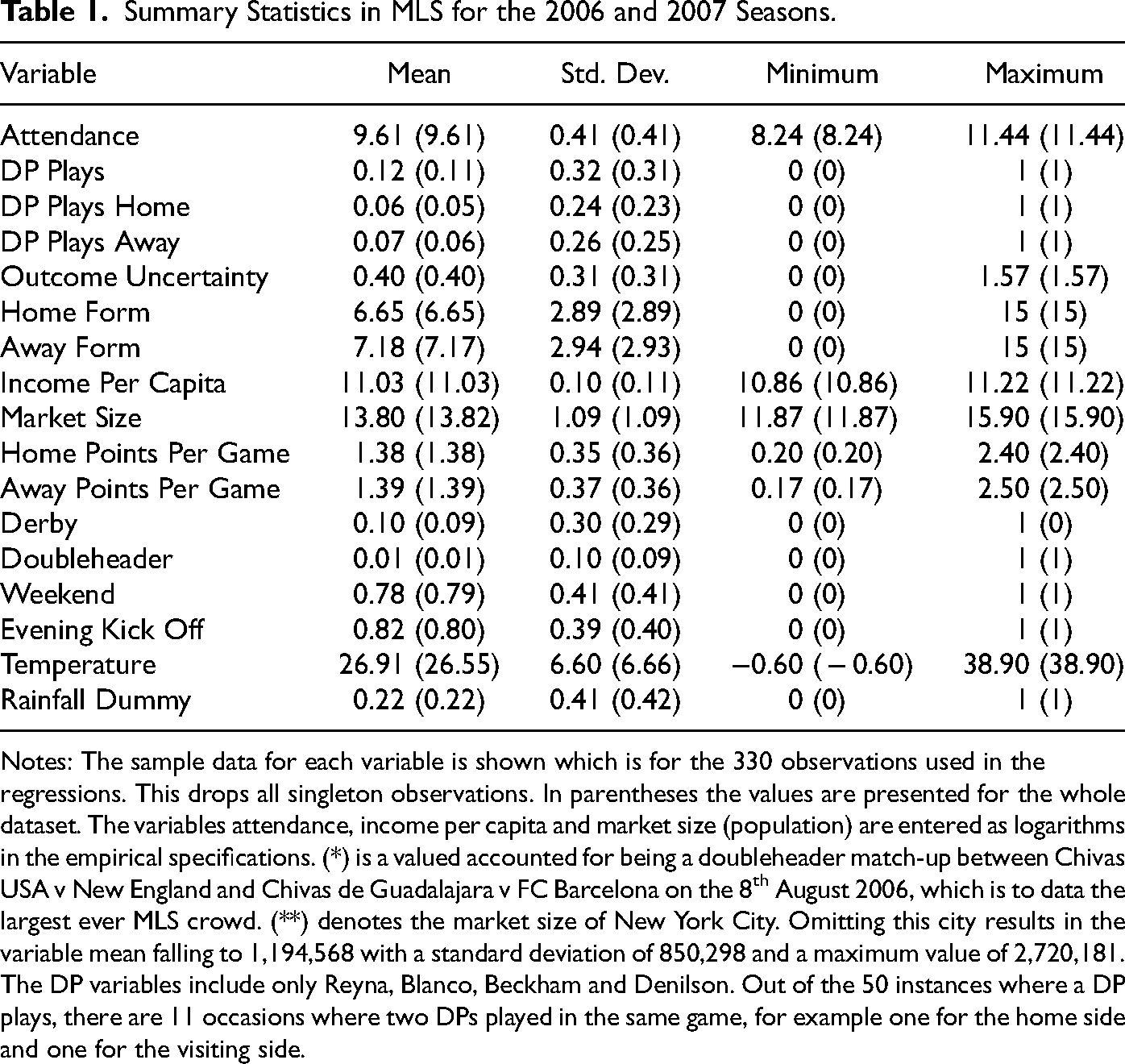
Notes: The sample data for each variable is shown which is for the 330 observations used in the regressions. This drops all singleton observations. In parentheses the values are presented for the whole dataset. The variables attendance, income per capita and market size (population) are entered as logarithms in the empirical specifications. (*) is a valued accounted for being a doubleheader match-up between Chivas USA v New England and Chivas de Guadalajara v FC Barcelona on the 8th August 2006, which is to data the largest ever MLS crowd. (**) denotes the market size of New York City. Omitting this city results in the variable mean falling to 1,194,568 with a standard deviation of 850,298 and a maximum value of 2,720,181. The DP variables include only Reyna, Blanco, Beckham and Denilson. Out of the 50 instances where a DP plays, there are 11 occasions where two DPs played in the same game, for example one for the home side and one for the visiting side.
First, the DP rule has been altered multiple times since 2007 and the introduction of targeted and general allocation money makes it difficult to identify which players were signed as DPs. Second, as fan interest in MLS increased over time, so did televised broadcasts of matches. Extending the sample would confound the results via substitution effects from television demand, harming the study. Finally, with certain DP roster spots filled in 2007, there would be potential selectivity bias when using a longer time series. This is because the policy only allowed one DP per club, unless a DP roster spot was traded, to allow a maximum of two DPs per club. Therefore, players entering MLS after the 2007 season could only join teams with a vacant DP slot. In other words, they would self-select into the pool of clubs that had space for DPs.
Furthermore, by extending the data it may violate the estimator assumptions that the treatment may influence the control variables. It may be likely that in subsequent seasons, given the success of the policy, that games featuring DPs are scheduled on specific dates and times to maximise attendance. 7 In addition, as de Chaisemartin and D’Haultfoeuille (2020) show, the TWFE-DID estimation method may be biased under heterogenous treatment timings, which would be the case if the data was extended.
Given that using the difference-in-difference estimation strategy is a key contribution of this paper, a longer time series is inappropriate in this context. However, as Jewell (2017) finds that the DP effect is strongest in its first year, we may view our results as upper bound estimates, and we anticipate that the impact in our study would also dissipate over time.
The dependent variable is the natural logarithm of the regular season match-day attendance because it is more normally distributed than its level term.8,9 There are five occasions attendance is greater than four standard deviations from the mean. These games include two doubleheaders in 2006 featuring FC Barcelona, a game prior to New York Red Bull's exhibition fixture versus Bayern Munich in May 2006, a game between New York and New England played at a neutral venue in September 2006 and David Beckham's debut in 2007.
The sample contains four DPs: David Beckham, Cuauhtemoc Blanco, Denilson and Claudio Reyna, all identified via the MLS website. In robustness testing, Guillermo Barros Schelotto is further allocated as a DP, and the total number of games DPs played at home, on the road, and overall, in 2007 is shown in Table 2. When examining the correlations between the DPs and the team (fixture) fixed effects the correlations were typically low. The highest correlation for the team (fixture) fixed effects and the treatment values were 0.31 (0.19).
List of Designated Players in 2007 and Their Total Number of Appearances Both at Home and on the Road.
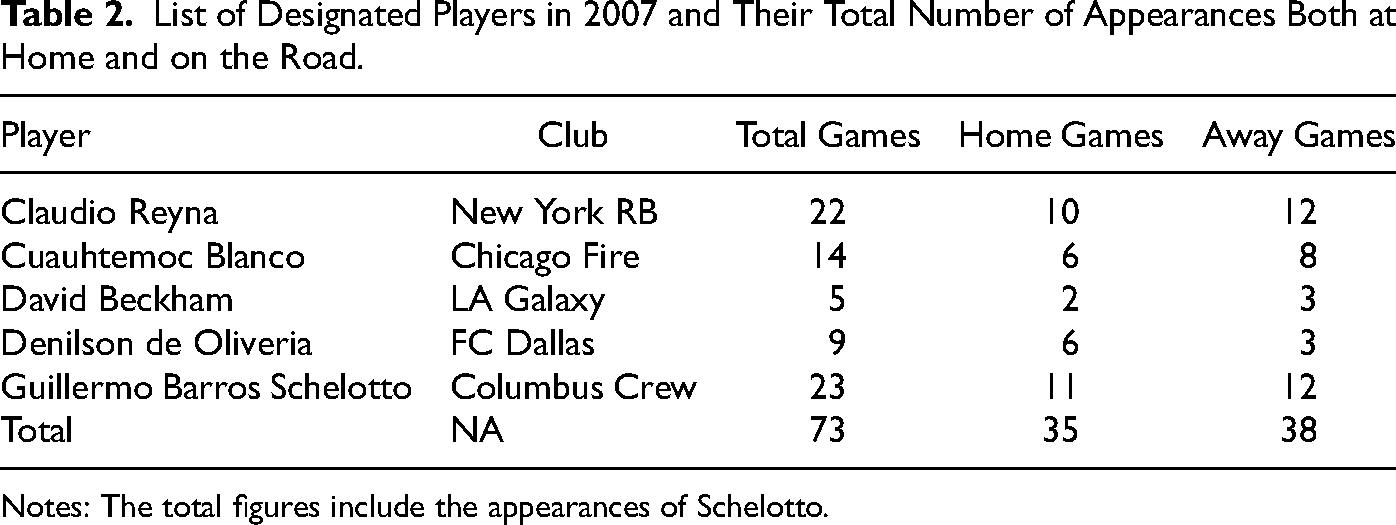
Notes: The total figures include the appearances of Schelotto.
Table 2 shows that summing up the appearances by Beckham, Blanco, Denilson and Reyna, DPs made a total of 50 appearances and participate in 12% of matches as shown in Table 1. This is because in total, there were only 39 different games that contained a DP, as in 11 games, two DPs played, one for the home team and one from the visiting team. Given the frequency of two DPs playing in the same game is limited therefore, we do not consider these effects, but we examine home and away effects. Glascott et al. (2018) differentiate between domestic and international DPs in their study. In this paper, only one DP is domestic, therefore we first focus our analysis on the overall effect and then examine the impact of each player individually. However, as opposed to examining each player in turn, which would be problematic given the small number of observations, we drop a player from the treated sample, keeping the control sample unchanged. This enables us to see whether a certain player is driving either the magnitude or statistical significance of the overall DP effect.
The control variables in this study follow the existing literature. We use two sets of controls, a concise set to estimate the DP effect more precisely and a full set. In the concise set, the model includes a measure of outcome uncertainty, and a variable that captures home form and then a further variable that captures away form. These variables are seen to be the most relevant and related to the variable of interest, whether a DP plays in a game. This is because if a DP's talent is greater than the average, we would anticipate that they make the difference in close contests.
In the full specification, to further control for the sporting contest we include home and away team quality. Further conditioning variables include, a dummy equal to one if a game was a doubleheader and zero otherwise. These are omitted in our sensitivity analysis. To control for fixture timing, dummy variables are used. These include: whether a game is played at the weekend or not, and if the game has a late kick-off. To control for seasonality, we use month dummies and in supplementary regressions full day of the week dummies were included replacing the weekend kick-off variable. To control for the weather, we include measures of precipitation and temperature. Precipitation is a dummy variable equal to one if it rains the day of a game and zero otherwise. Temperature is measured in degrees centigrade and its squared term is included. Finally, we control for market demand using a city's population size and income per capita. However, as these variables may be highly correlated with the fixed effects, we alter the specification in the sensitivity analysis to remove either one or both of these variables, and/or the fixed effects.
Due to data availability, ticket prices are not included as a covariate and we acknowledge that this may be a limitation of the research. Even when ticket price data was disclosed, this was typically not at the fixture level and would require certain assumptions to use this data in the model. For example, ticket prices had high variability depending on stadium location and it would be assumed they would be priced equally for every fixture. For further detailed information regarding these variables and the justification for their inclusion is available in the online Appendix alongside the data sources.
Threats to Identification
The empirical strategy relies on the assumption of conditional independence. This assumes that a DP participating in a match is independent of that fixture's attendance. This assumption should hold as the analysis is at the match-day level, where numerous factors may determine whether a DP will play in that game. These may be random because of injury or suspension, or due to managerial decisions arising because of player form or tactics.
It is possible that a DP may sign for a club and inform the management that they will only play several games a season. The manager may then only select this player in the larger games. However, the likelihood of this is minimal and the evidence proposes that most DPs participated in most of the games they were available.
A threat to identification may be that marquee players may self-select into large markets, and we would expect larger market clubs to have higher attendance figures. To overcome this argument, a number of robustness tests are included to mitigate these concerns, such as the inclusion of Schelotto as a DP and the use of coarsened matching (Iacus et al., 2012), of which the results are available in the online Appendix.
Coarsened matching attempts to find observations that may act as good controls, that can be used as a comparison to the treatment group, in order to estimate the DP effect. In this context, it will look to find observations from large rich markets where a DP does not play, and use those as controls to the treated observations. 10
A further risk in identifying a true DP effect is that both Eddie Johnson and Landon Donovan already played in MLS prior to the DP rule earning salaries above the cap and were grandfathered into the league. However, both players were regular starters and played in nearly every regular season game in 2006 and 2007. Therefore, it is unlikely that these players will influence the findings.
Results
Primary Findings
Table 3 presents the benchmark findings. Columns 1–3 show the results using club fixed effects and a time trend, whereas columns 4–6 show the results using fixture fixed effects and the absence of a time trend. In four of the six specifications the DP effect is statistically significant. This is the overall impact, and when a DP plays on the road. In all four cases, DPs have a positive effect on match-day attendance.
Baseline Regression Model Estimates for Attendance in MLS Over 2006 and 2007.
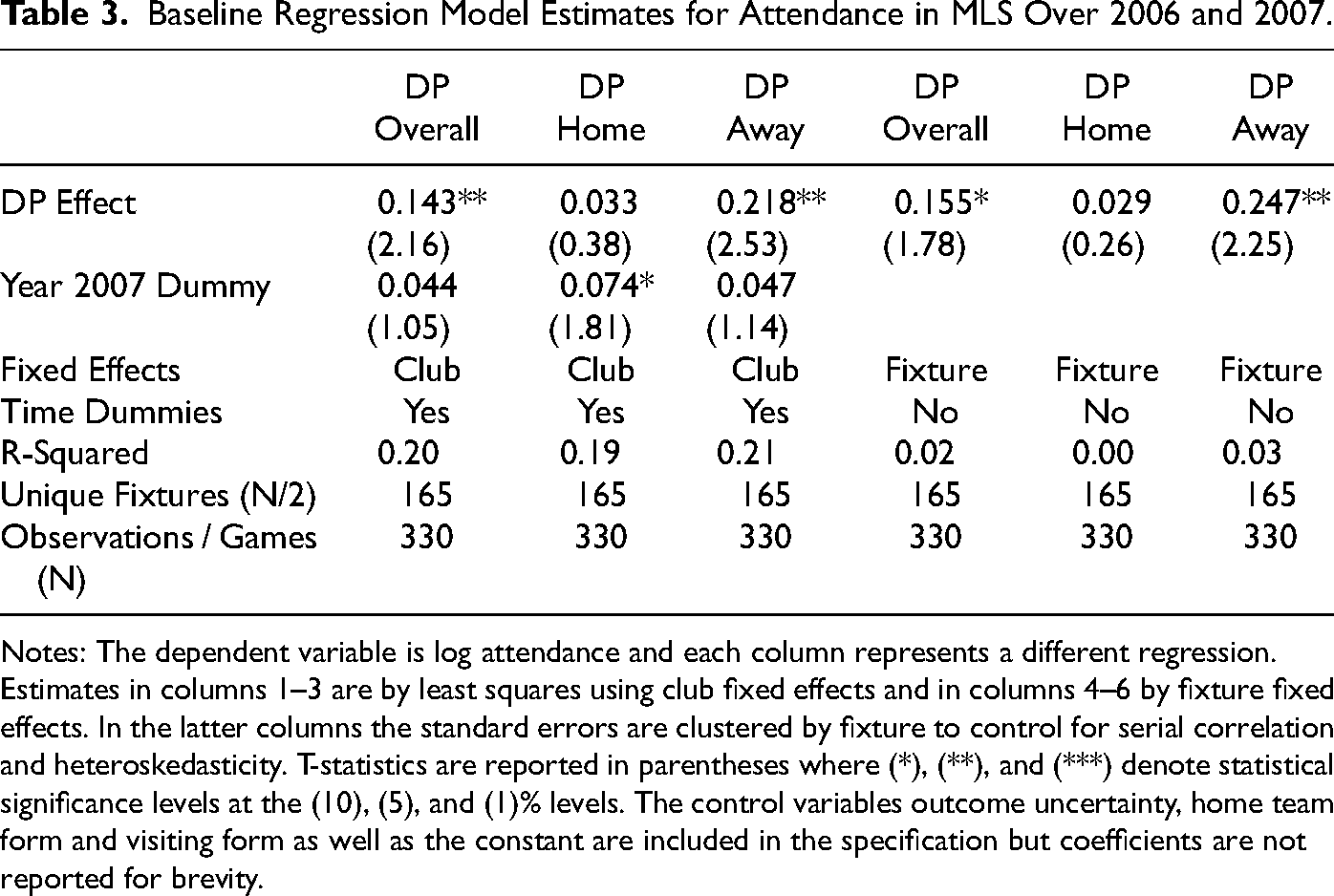
Notes: The dependent variable is log attendance and each column represents a different regression. Estimates in columns 1–3 are by least squares using club fixed effects and in columns 4–6 by fixture fixed effects. In the latter columns the standard errors are clustered by fixture to control for serial correlation and heteroskedasticity. T-statistics are reported in parentheses where (*), (**), and (***) denote statistical significance levels at the (10), (5), and (1)% levels. The control variables outcome uncertainty, home team form and visiting form as well as the constant are included in the specification but coefficients are not reported for brevity.
Interestingly, the point estimates of the coefficients in columns 1 and 4, and then 3 and 6 are similar, and you cannot reject the null hypothesis that they are equal. Thus, in Table 3, it appears that DPs may increase overall attendance by on average 16.7% and when a DP plays on the road, attendance may increase by approximately 26%. These preliminary findings conform with the previous literature and suggest that DPs do increase match-day attendance.
However, the purpose of Table 3 is to show how the findings may differ between the traditional and difference-in-difference estimators using a like-for-like dataset. This highlights the importance of controlling for fixture fixed-effects, absent in columns 1–3 and controlling for time fixed effects, absent in columns 4–6 of Table 2. Including both is important, because DPs may just play in fixtures that traditionally have larger attendances. Alternatively, it is possible that the popularity of MLS increased from 2006 to 2007, coinciding with the introduction of the DP rule, convincing a number of DPs to join the league. This is plausible given that the unconditional mean attendance in 2006 was 15,871 and in 2007 it rose to 16,757. Therefore, Table 4 uses a difference-in-difference estimation strategy to ensure we do not have spurious findings.
Difference-in-Difference Regression Model Estimates for Attendance in MLS Over 2006 and 2007.
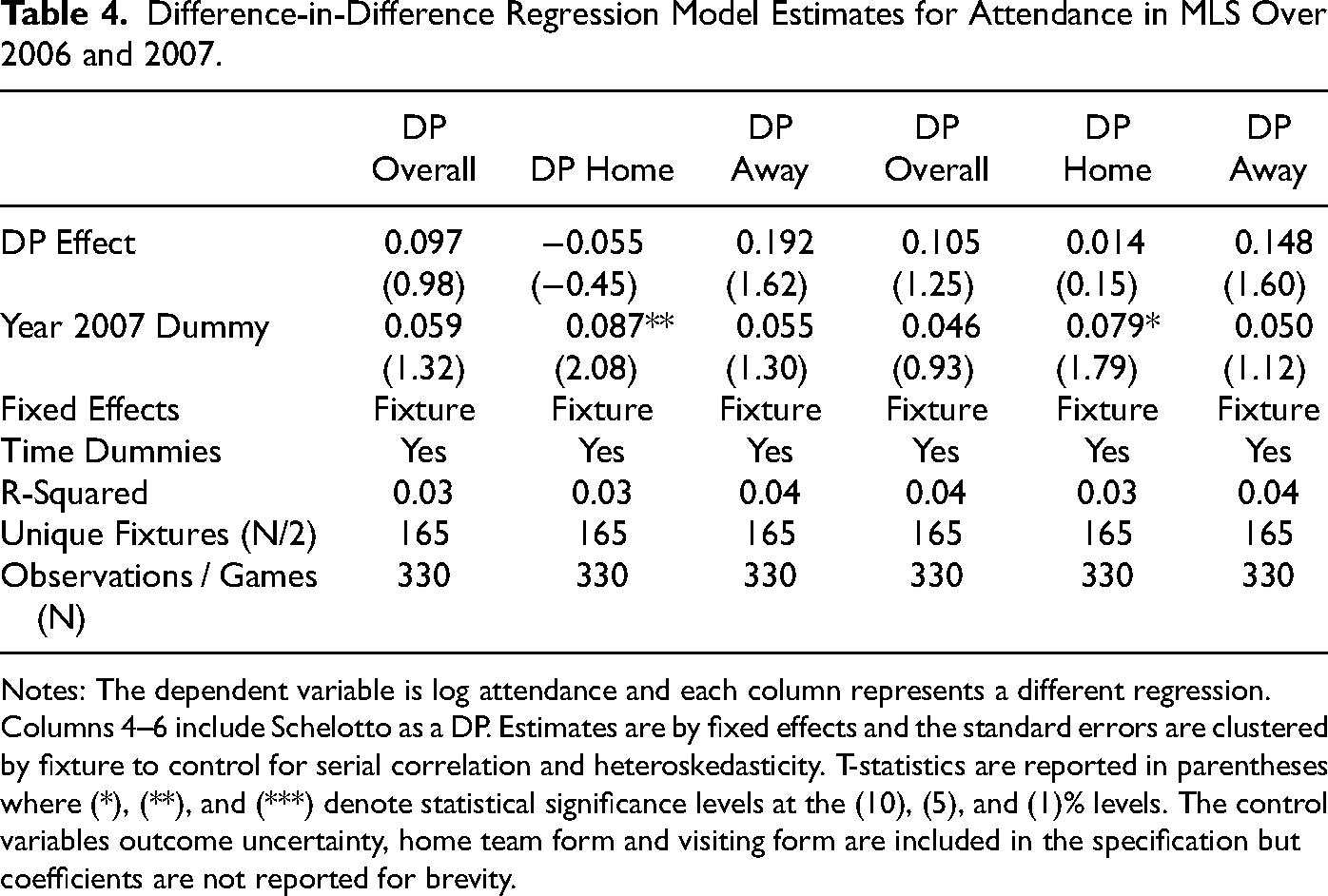
Notes: The dependent variable is log attendance and each column represents a different regression. Columns 4–6 include Schelotto as a DP. Estimates are by fixed effects and the standard errors are clustered by fixture to control for serial correlation and heteroskedasticity. T-statistics are reported in parentheses where (*), (**), and (***) denote statistical significance levels at the (10), (5), and (1)% levels. The control variables outcome uncertainty, home team form and visiting form are included in the specification but coefficients are not reported for brevity.
Table 4 presents the difference-in-difference results where six regressions are reported. The first three show the preferred findings. The subsequent three columns add Barros Schelotto as a DP, to ensure the results are not driven by a DP's decision to play for clubs in large markets.
In comparison to Table 3 and previous empirical research, DPs are shown to have no impact on attendance in any of the six columns. This is an important finding, because the DP rule was altered in 2010 and 2012 that permitted clubs to purchase multiple DPs. If these players had no impact on matchday attendance, a significant revenue generator for the league, then it appears that it may have been a poor decision. This might be why MLS has had discussions recently to reduce the number of DPs a club may sign from three to two. Nevertheless, given the positive impact of DPs on attendance that Table 3 shows, and the insignificant effect Table 4 produces, creates a dilemma about which results to trust.
The recent literature on TWFE-DID models has shown that under staggered treatments and when the treatment does not have a homogenous effect, these estimates may be biased (Baker et al., 2022). However, Jakiela (2021) shows a method to check if the weights on the treated units are positive or negative. When this procedure was carried out, all treatment weights were positive which would be anticipated given the two-group two-period design.
Given that the difference-in-difference model does not suffer from the negative weighting bias it may be that this model is superior to those in Table 3 and DPs had no impact on match-day attendance in aggregate. However, it is plausible that the appeal of these DPs may not have been equal. Given the small sample size, separating their impact may not provide robust results, therefore to check for heterogenous effects, we removed one of the DPs from the set-in turn to examine if the positive coefficient on DPs from Table 3 may be recovered.
Supplementary Findings
Table 5 examines the heterogeneous impact of DPs. Four panels are reported each omitting a different DP from the treatment group. In each panel the overall, home and away effect are estimated.
Difference-in-Difference Regression Model Estimates That Isolate the DP Effect for Attendance in MLS in 2006 and 2007.
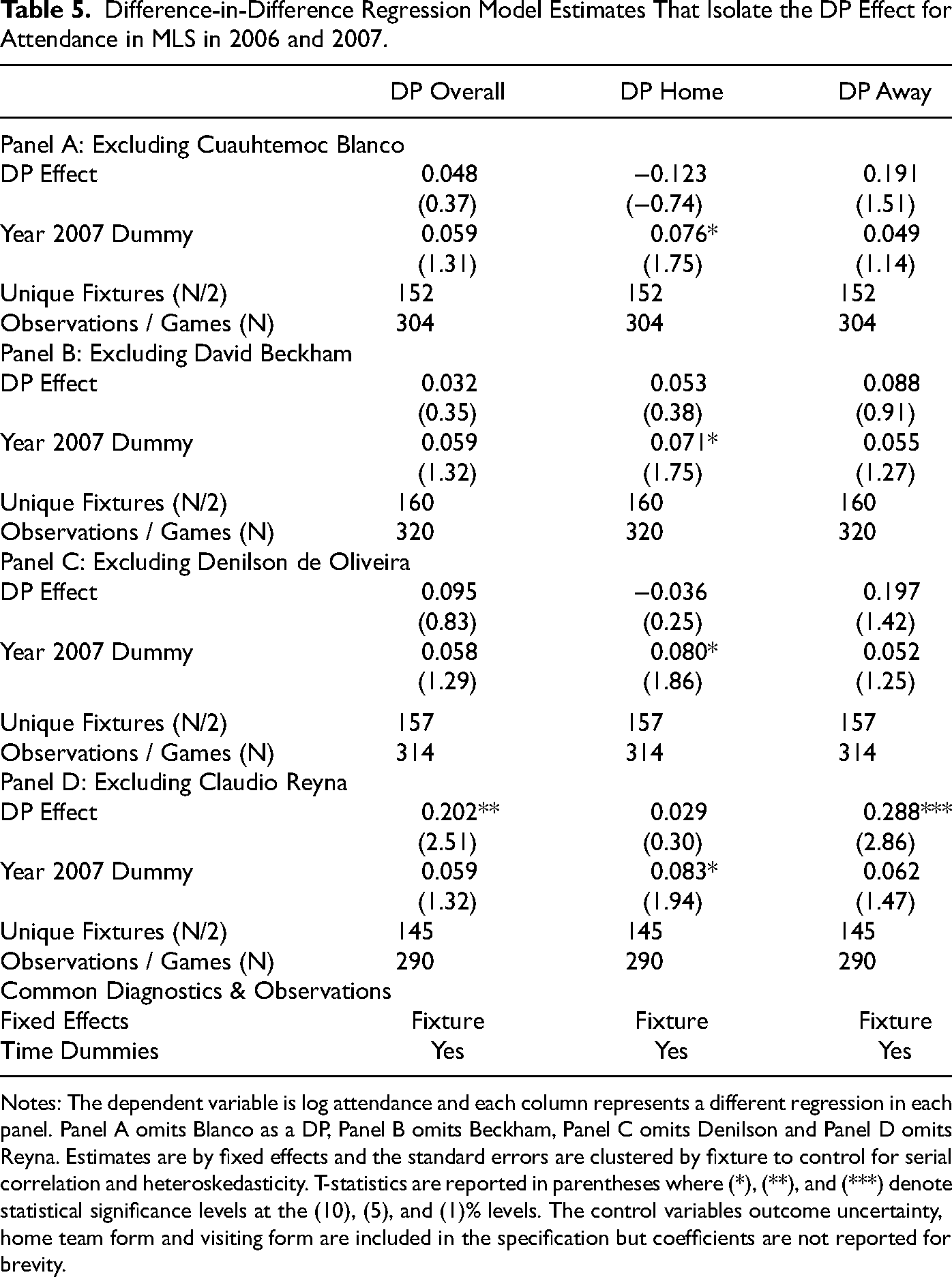
Notes: The dependent variable is log attendance and each column represents a different regression in each panel. Panel A omits Blanco as a DP, Panel B omits Beckham, Panel C omits Denilson and Panel D omits Reyna. Estimates are by fixed effects and the standard errors are clustered by fixture to control for serial correlation and heteroskedasticity. T-statistics are reported in parentheses where (*), (**), and (***) denote statistical significance levels at the (10), (5), and (1)% levels. The control variables outcome uncertainty, home team form and visiting form are included in the specification but coefficients are not reported for brevity.
In panel A, when excluding Blanco, the statistically insignificant result holds and DPs have no impact on match-day attendance using a difference-in-difference design. The same result holds in panel B, where the excluded DP is David Beckham. Panel C then reports the findings when omitting Denilson from the list of DPs. Similar to the previous findings, there is a statistically insignificant effect. However, in panel D, when the omitted DP is Reyna, a positive and statistically significant finding is recovered.
This is interesting as Reyna was the only domestic DP, whereas Blanco, Beckham and Denilson were all non-US players. This may relate to a paper by Bryson et al. (2014) who show it's the novelty factor of South American superstars that affects attendance, as opposed to the local players who are superstars in their own but different right. The impact in panel D suggests that DPs may increase match-day attendance overall by approximately 22% and on the road by 33%. These are economically large findings. In comparison to the existing literature, our estimates are slightly more conservative. For example, when Lawson et al. (2008) examined the Beckham effect, they found that he doubled attendance and Shapiro et al. (2017) find he increased attendance by approximately 300%. Likewise, Jewell (2017) finds Beckham increased attendance in 2007 by 107% and Blanco increased attendance in 2007 by 21% overall, both at home and on the road. The findings are most similar to DeSchriver et al. (2016) yet still offer some subtle differences. For example, the DP effect found focusing on these three international players exceeds 2,500 spectators, and whereas DeSchriver et al. (2016) show the away impact to be smaller than the overall impact, these findings offer the reverse conclusions.
Sensitivity Analysis
To ensure the accuracy of our findings, we implement a series of robustness tests. We begin by altering the variables in our specification. First, we removed any fixtures that were doubleheaders. The results remained consistent to the main findings. Next, we inserted a non-contender dummy into the specification to capture the attendance effect of a home team that no longer can achieve a play-off place. The results show that being a non-contender reduces attendance by approximately 22%. A non-competitive dummy was also inserted for home teams that had already achieved a play-off place, but this variable was statistically insignificant. In further robustness tests, we altered how certain variables were measured. Initially, we replaced the dependent variable from its natural logarithm to its level term where the results remained quantitatively similar and then we altered how outcome uncertainty was measured using fixed betting odds. The outcome uncertainty variable remained statistically insignificant.
The next series of robustness tests examined whether substitution effects confounded our results. A dummy variable equal to one if a game clashed with a televised European fixture was entered into the specification. It entered with a negative and significant sign and was similar in magnitude to the non-contender dummy. We also controlled for televised MLS fixtures and local MLB games. 11 They had no impact on the findings and the variables were statistically insignificant.
As DPs may be attracted to large markets, in addition to our findings being conditional on market size and its income, we introduced a lagged dependent variable into the specification as a further robustness test. This is because market size should be persistent over time and control for large market effects, not picked up by the fixture fixed effects. The inclusion of this variable did not alter the main findings. In addition, to control for large market effects, we confirmed the results using coarsened matching, which are available in the online Appendix, and limited the sample to contain observations only from large market teams.
In addition, spillover effects may exist where clubs that sign a DP may receive a higher attendance even in games where a DP does not play. This might bias the magnitude of the DP downwards. As a result, fixtures from the control group of franchises that contained a DP, where they did not play, were dropped from the estimation sample. However, there is a trade-off to consider. When dropping these control fixtures, it may introduce large-market effect bias into the dataset, if one believes DPs selected into large markets, because large market counterfactuals are dropped from the sample. Therefore, the findings need to be interpreted with caution. Only away from home, was a statistically significant effect found, albeit at the 10% level, however, when omitting special events from the sample, this statistical significance disappears, supporting the prior evidence.
As a further sensitivity test, given that both income and population exhibit very limited within variation and would be highly correlated with the fixed effects, we run further models where we replace the fixed effects with population and income. The results remained largely unchanged to those previously reported.
In addition, to ensure that our difference-in-difference findings did not face any biases attributing to the negative weighing problem, the weights on the treated observations were checked using the procedure suggested by Jakiela (2021). Whereas our setup consisted of the basic difference-in-difference design and there was no staggered treatment, we anticipated that this issue would not arise. This assumption was supported and all treated observations had positive weights, outlining that in certain settings, the TWFE-DID technique should not always be dismissed by default and is still useful in the correct settings.
Finally, a placebo test was carried out to test the difference-in-difference assumption of equal trends. To create the placebo, we allocated a number of random fixtures to contain international DPs and re-ran the estimations. In comparison to panel D in Table 5, the results became statistically insignificant and are available in the online Appendix in Table H.
Discussion
The results show that when using traditional estimation techniques, if a game contains a DP, attendance may increase by approximately 16%. If the DP plays on the road attendance may increase by 26%. This would support the view that the DP policy was successful in increasing match-day attendance in MLS. However, when using a difference-in-difference estimator, this result vanishes and a DP playing in a game has no impact on match-day attendance.
This has significant implications because it may suggest that previous studies may have captured something else that was driving increases in attendance and not the DP effect. For example, MLS popularity may have increased, which attracted DPs to the league, and simultaneously increased match-day attendance. Placing this study among the literature, Bradbury (2020) is only one of the few studies that also find that DPs had no impact on both home or away attendance.
Jewell (2017) proposes that individual DPs have a heterogeneous impact on match-day attendance. When we disaggregate their impact, we find that only when Claudio Reyna is omitted from the set of DPs, is there a positive and significant effect on attendance. Interestingly, Claudio Reyna was the only US DP, which may highlight the appetite for the novelty or curiosity aspect of DPs which may possibly be manifesting itself via nationality.
The findings propose DPs had a smaller impact on attendance than what has been previously found in the literature (DeSchriver, 2007; Jewell, 2017; Lawson et al., 2008). In addition, DeSchriver et al. (2016) who find that DPs (excluding Beckham) increased attendance by 15% at home and 3.5% away. We challenge these findings as when we omit David Beckham from the set of DPs we find no impact on attendance.
As Jewell (2017) further shows that the effect dissipates over time, it is plausible that had this study been over a longer time-frame, we would have found a similar impact. 12 Therefore, it questions whether or not the introduction of DPs made financial sense for MLS.
Policy Implications
The introduction of the DP rule distorted a labour market. If the main objective of this policy was to attract more fans into stadiums, then its success may be questioned. In 2016, 80% of total MLS revenue came from the match-day (Bradbury, 2020). Therefore, in terms of league profitability and sustainability, it is particularly important for MLS to recoup the costs of these DPs, as the acquisitions of high-profile players on excessive salaries contributed to the financial difficulties of the NASL.
Whilst we cannot be certain if this policy was profitable, as financial information from MLS is publicly unavailable – including ticket price data by fixture, and the additional match-day and commercial income that these players contributed – we can estimate how much each additional spectator was required to have spent for this policy to have been cost neutral. However, without this detailed information we do acknowledge that these calculations are estimates and a limitation of this research.
During the study period, average attendance in MLS was approximately 16,000. In total, the compensation that was paid to Blanco, Beckham, and Denilson was $10.1 m, and this subset of players increased attendance by approximately 4,500 fans. Assuming these DPs brought in no commercial income, each of these additional fans would have been required to spend over $2,000 each for the policy to break even. 13 Examining, the cost of season tickets in 2007, Chivas USA and DC United charged under $1,000 for the most prestigious seats, which suggests that this policy may have been loss making.
Contrary to the above, recent actions by MLS and other leagues have carried on promoting DPs. This is because MLS has increased the number of permitted DPs and the Australian A-League has replicated the MLS model.
In terms of policy implications for individual team owners, the results show that the DP effect is strongest away from home. This implies that clubs have an incentive to free-ride from their rivals. Clubs who do not sign a DP, save on salary costs, whilst reap the benefits via higher attendance when playing against teams who sign a DP. Therefore, teams pursing profit maximization as opposed to win maximization, have no incentive to sign DPs.
That being said, it is possible that marquee signings may increase on-field performance. MLS teams that pursue a strategy of hiring DPs incur the higher wage costs associated with them, but may generate higher revenues by winning. However, it is interesting that during this sample period, the majority of the clubs that signed a DP had relatively unchanged win percentages. Furthermore, Scarfe et al. (2021) show that it was the popularity channel rather than the productivity channel of superstars that influenced their compensation, which seems to support the fact that performance of DP clubs did not increase. A further interesting result is when the impact of DPs is separated, only the international players showcased an impact on attendance. For robust conclusions a vigorous study in this topic would be required, but it may lead to interesting conclusions about the types of DPs, in addition to perhaps offensive or defensive, that generate the greatest gains in attendance.
As MLS operates as a single entity, has a revenue sharing policy, and all the franchise owners are partners of the league, it is unsurprising that most MLS clubs now have DPs on their rosters. However, MLS is considering reducing the total number of DPs a club may sign. Given this research, only international DPs had any impact on attendance. Therefore, if MLS do reduce the number of DPs permitted in the league, they need to think about which ones to retain, if maximizing attendance is an MLS priority.
Conclusion
This paper examines if the DP rule increased MLS attendance the year it was initiated, using a difference-in-difference estimation strategy. It further tests whether DPs had a differential impact on attendance when playing at home or away.
Using traditional estimation strategies, the policy shows that DPs increased matchday attendance with the greatest impact away from home. However, using a difference-in-difference strategy this effect vanishes, and is only recovered when focusing on the subset of international players. This demonstrates that DPs generate a positive externality in MLS, as clubs who cannot afford DPs may still benefit from their presence. This is consistent with the sports economics theory that output (revenue) is jointly determined by both individual and rival inputs.
In total, international DPs increased attendance by approximately 28% but this came at a high cost of $10.1 m. This is an economically significant finding and focusing on it is important, to ensure the policy was successful. This is because the acquisition of star players on excessive salaries is why the NASL dissolved. As in MLS, 80% of total revenue occurs on the match-day (Bradbury, 2020), it is important that these players increased match-day attendance, to maximise league revenues and ensure that MLS remained financially sustainable.
Since the DP rule was introduced, the number of DPs in MLS have increased and this policy has resulted in other leagues pursing similar strategies, notably the Australian A-League. Recently, MLS is looking to further revise its policy and reduce the number of DPs permitted on a club's roster. Therefore, this research offers a platform to further study what types of DPs maximize match-day attendance given the findings that only the subset of international DPs had a positive and significant effect on attendance.
Supplemental Material
sj-docx-1-jse-10.1177_15270025221134234 - Supplemental material for The Designated Player Policy Rule and Attendance Demand in Major League Soccer
Supplemental material, sj-docx-1-jse-10.1177_15270025221134234 for The Designated Player Policy Rule and Attendance Demand in Major League Soccer by Johan Rewilak in Journal of Sports Economics
Footnotes
Declaration of Conflicting Interests
The author(s) declared no potential conflicts of interest with respect to the research, authorship, and/or publication of this article.
Funding
The author(s) received no financial support for the research, authorship, and/or publication of this article.

Supplemental Material
Supplemental material for this article is available online.
Notes
Author Biography
References
Supplementary Material
Please find the following supplemental material available below.
For Open Access articles published under a Creative Commons License, all supplemental material carries the same license as the article it is associated with.
For non-Open Access articles published, all supplemental material carries a non-exclusive license, and permission requests for re-use of supplemental material or any part of supplemental material shall be sent directly to the copyright owner as specified in the copyright notice associated with the article.
