



Abstract
Because maximizing stadium attendance demand is of utmost importance, for both sports economists and sport management researchers, understanding the potential determinants of such demand better has become a priority in the last decades. Here, conducting a systematic scoping review, we map this previous research in terms of its characteristics, its nature, and its volume, thus offering a concise perspective on what has been previously explored, and, more importantly, what remains to be analyzed in the future. Intriguingly, we observe a lack of studies exploring data generated in both niche and women’s sports, as well as in most emerging markets. Further, the field has not yet established the use of disaggregated stadium attendance data, despite notable potential methodological pitfalls.
Keywords
For executives operating in the field of professional sports, maximizing stadium attendance demand is of utmost importance. On the one hand, generating revenue from ticket sales and subsequent catering and parking fees contributes to the financial resources necessary for investing in talent and, thus, keeping up with the competition. For major European professional football clubs, for instance, matchday income still corresponds to roughly 15% of the clubs’ total annual turnover (Deloitte, 2021), despite an increasingly important role of media income. 1 On the other hand, as stadium spectators, applauding, booing, and chanting, are an integral part of the product offered to other customers (cf., Morrow, 1999), a high(er) number of stadium attendances caters to the direct needs of a sporting club’s many external stakeholders, including broadcasters, corporate sponsors, and also those customers in the hospitality section, all of whom benefit from an enhanced stadium atmosphere (e.g., McDonald, 2010). Similarly, an underutilized stadium is likely to reduce future visiting intentions among potential spectators, watching a match from their home (e.g., Oh et al., 2017). On the field, maximizing the number of attending home fans, in turn, might help the host to generate a significant home advantage (e.g., Reade et al., 2020a). Further, off the field, an underutilized stadium might not only lead to inefficient staffing but also to lower merchandising sales. As football clubs are increasingly interested in diversifying their income sources (cf., Schmidt & Holzmayer, 2018), some clubs might also benefit from auxiliary revenues generated through, for example, hotel stays, museum visits, and stadium tour bookings if attendance demand increases. Therefore, it is not surprising that information on stadium attendance demand is considered an approximation for a sporting club’s reputation by investors, thus influencing the club’s stock market price (e.g., Gimet & Montchaud, 2016).
For both sports economists and sport management researchers, understanding the potential determinants of stadium attendance demand better has, therefore, become a priority in the last decade(s). Rottenberg (1956), in his pioneering article on the baseball players’ labor market, was first to offer a detailed demand specification (cf., Fort, 2005), including already factors as diverse as the ticket price, potential substitutes, and, perhaps most controversially, competitive balance and the resulting match outcome uncertainty. Since then, sports economists, in particular, have extended and tested this original demand specification in various markets, and, as a consequence, today, there already exists a massive, continuously growing body of empirical literature on those factors potentially shaping consumer interest in professional sports. Somewhat surprisingly, though, there has been made no recent attempt to survey this previous work.
Here, conducting a systematic scoping review, we map this previous empirical research on stadium attendance demand in terms of its characteristics, nature, and volume (cf., Arksey & O’Malley, 2005), thus offering a concise perspective on what has been previously explored, and, more importantly, what remains to be analyzed in the future. While there already exist important literature reviews on the determinants of stadium attendance demand (e.g., Borland & Macdonald, 2003; Cairns et al., 1986; Downward et al., 2009), to the best of our knowledge, the last comprehensive review was published over a decade ago (e.g., Villar & Guerrero, 2009). Further, these early reviews, despite their evident merits, have all been limited in scope, as they typically tend to focus on summarizing the robustness of some previously observed effects rather than to present a more holistic overview across the two disciplines. Intriguingly, conducting such a scoping review is still relatively rare in sports economics and/or management research (e.g., Dowling et al., 2018), despite its growth in popularity in loosely related fields such as public health and health care services research. 2
In sum, we observe that most authors, concentrating primarily on established sports such as baseball and football, have so far refrained from exploring numerous sporting environments, perhaps most notable niche and women’s sports, both of which are likely to benefit significantly from understanding those factors shaping stadium attendance demand better. Further, we find that the field has not yet established the use of disaggregated stadium attendance data, despite potential methodological pitfalls (cf., Forrest et al., 2005). We believe that addressing these important issues offers an exciting path for future research exploring the robustness of previous findings across alternative settings.
Methodological Approach
In emerging research fields such as the economics of sports, conducting a scoping review is helpful in identifying, locating, and, then, synthesizing the existing knowledge (e.g., McKinstry et al., 2014; Tricco et al., 2016, 2018). In line with most such previous reviews, here, our objective is not only to explore the extent, range, and characteristics of the existing literature, thus presenting a concise overview of current key themes, but, more importantly though, to also identify the remaining knowledge gaps within. In contrast, and somewhat different to systematic literature reviews, we refrain from assessing research quality per se (cf., Dowling et al., 2018).
The broader empirical stadium attendance literature is quite heterogeneous. That is, not only in terms of the many objects under investigation, that is, the many sports in the various markets, and the thematic themes in focus during these investigations, but also the different methodological approaches.
To map the resulting stadium attendance demand research landscape, here, we conduct a scoping review by loosely adopting to the well-established Preferred Reporting Items for Systematic reviews and Meta-Analyses extension for Scoping Reviews (PRISMA-ScR) approach developed by Tricco et al. (2018). More specifically, in the following, we, first, clarify our search approach; second, present our eligibility criteria; third, explain our study selection; and, forth, give an overview on both our data charting process, as well as the resulting data items.
Information Sources and Search
To identify an eligible set of articles on stadium attendance demand, on January 20, 2020, we conducted a search in three multidisciplinary databases, the Web of Science (WoS), Scopus, and SPORTDiscus. We derived our search string primarily based on our previous reading of the existing stadium attendance demand research. 3 Then, we performed a search on manuscript title, abstract, and, where existing, author keywords. Initially, this resulted in a total of 1,015 documents: 222 in the WoS, 416 in Scopus, and another 377 in SPORTDiscus. We extracted these results and compiled a Microsoft Excel spreadsheet, where we, using an existing function, removed 262 duplicates. Because we had chosen a relatively broad search string, we then conducted a systematic screening of both the titles and the abstracts of all the remaining 753 manuscripts, thereby eliminating literature that was obviously not focusing on stadium attendance demand research. After this step, our data set contained 277 manuscripts, that is, we had excluded 476 documents.
Eligibility Criteria and Study Selection
In an initial screening round of these 277 manuscripts, we excluded 19 items. More specifically, we excluded nine manuscripts because they were missing/not available to us, seven articles because they were conference proceedings, and three articles because they were not written in the English language.
We, then, screened the remaining 258 manuscripts according to three exclusion criteria intended to help us identify those empirical studies modeling the stadium attendance demand on matchday. First, as the use of survey data is often criticized for lacking explanatory power of actual behavior (e.g., Katz et al., 2019), we not only excluded 16 studies without an empirical contribution but also those 109 studies based on either qualitative interviews or employing survey data modeling various dependent variables including season ticket holder retention intention (e.g., Lee et al., 2020), spectator preferences (e.g., Wang et al., 2018) or sport event attendance motives (e.g., Funk et al., 2009). Second, to ensure that those studies in our data set were highly comparable, we only considered contributions from authors who proxied stadium attendance demand using the number of tickets distributed by a professional sporting club, 4 thus excluding more recent attempts to move towards behavioral stadium attendance demand by exploring, for example, data on stadium admission (e.g., Sacheti et al., 2016; Schreyer et al., 2016, 2018) or spectator no-show behavior (e.g., Frevel & Schreyer, 2020; Schreyer, 2019; Schreyer et al., 2019). 5 Similarly, we also excluded studies exploring the descendants of stadium attendances such as the potential economic impact (e.g., Roberts et al., 2016), the home advantage (e.g., Harris & Roebber, 2019), the willingness-to-pay (e.g., Sanford & Scott, 2016), and studies examining alternative proxies for demand such as TV audiences (e.g., Caruso et al., 2019; Humphreys & Perez, 2019; Schreyer et al., 2017). In sum, in this second step, we excluded another 33 manuscripts. Third, to further increase study design conformity, we excluded all 24 studies that were not modeling matchday demand. 6 As such, after the exclusion of a total of 182 manuscripts, our temporary data set contained 76 studies modeling stadium attendance demand on the primary market as proxied by behavioral intentions to attend a particular match; that is, by analyzing stated rather than revealed preferences (e.g., Singleton et al., 2021).
Then, to not ignore any relevant literature, we performed both backward and forward citation search, thus screening both citations and reference lists of those 76 articles and identified 88 additional peer-reviewed articles that would fit our eligibility criteria. While the number of additional references seems rather high and, thus, might cast doubt on our initial identification strategy, there’s an easy explanation for that. That is, in fact, we would have been able to identify a fair share of these 88 manuscripts while using “attendance” as a keyword in our initial search but refrained from doing so, as this would also have given back an almost unmanageable amount of unrelated publications referring to, for example, church attendance (e.g., Azzi & Ehrenberg, 1975), student attendance (e.g., Epstein & Sheldon, 2002), and, perhaps most prominently, work/employee attendance (e.g., Steers & Rhodes, 1978).
Finally, we cross-checked our already comprehensive data set against the prominent earlier literature reviews from Borland and Macdonald (2003), Cairns et al. (1986), Downward et al. (2009), and Villar and Guerrero (2009), and also against a short, more recent book chapter on the economics of attendance published in the SAGE Handbook of Sports Economics (cf., Rodríguez, 2019). In this last step, we found six additional manuscripts that met our selection criteria and, then, also scanned available Google scholar profiles of the most active authors in our temporary sample (cf., Table 1), 7 identifying another 10 articles. Further, we added five either rather recent or surprisingly little cited studies, Cairns (1984), Feng et al. (2018), Gitter (2017), Goller and Krumer (2020), and Krumer (2020), that we were aware of from previous research projects, but that, for some reasons, did not emerge from our exhaustive identification approach. Because a quick keyword screening in the Journal of Sports Economics (JSE), the International Journal of Sports Finance (IJSF), Applied Economics (AE), Applied Economics Letters (AEL), European Sport Management Quarterly (ESMQ), Managerial and Decision Economics (MDE), and Sport, Business and Management (SBM), the seven international, peer-reviewed journals with the highest share of manuscripts in our temporary sample, did only result in the addition of ten more manuscripts, four of which were published online first after our initial search (i.e., Gasparetto & Barajas, 2020; Jung et al., 2020; Kelley, 2020; Mueller, 2020), we decided to end the identification process in early August 2020.
Most Productive Authors in Our Sample.
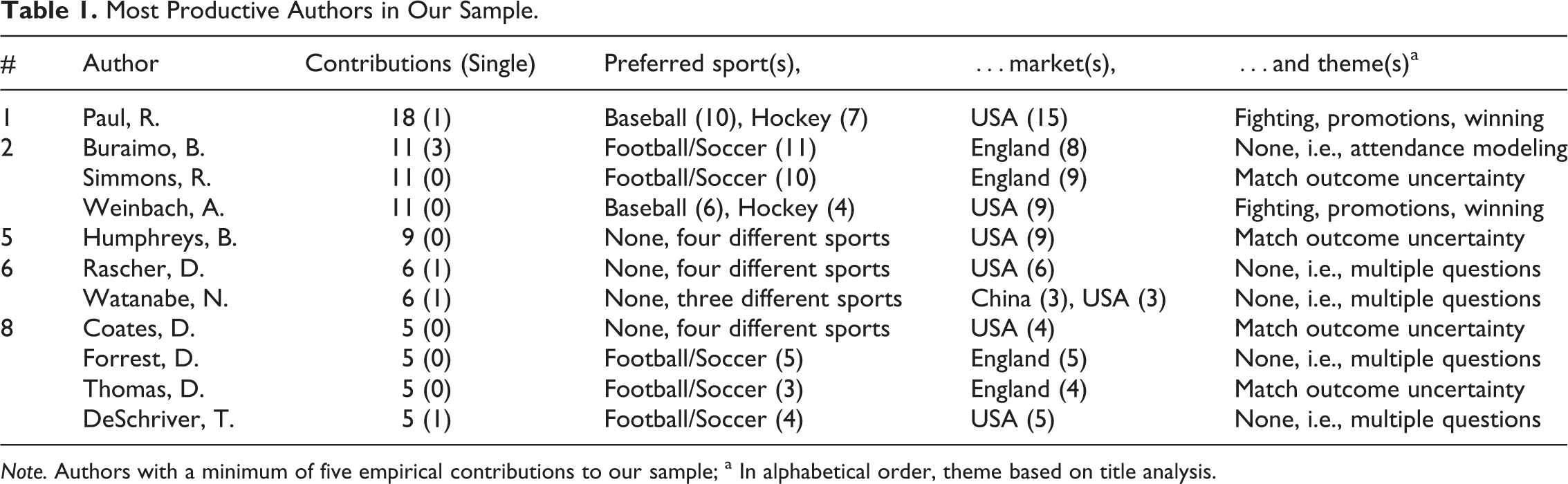
Note. Authors with a minimum of five empirical contributions to our sample; a In alphabetical order, theme based on title analysis.
In sum, our data set contains 195 published manuscripts on 2,918 pages. 8 However, as some authors (e.g., Paul et al., 2016; Pawlowski & Nalbantis, 2015; Tyler et al., 2017), modeled the attendances of more than one league, 9 we decided to include these studies separately if authors had made separate regressions available for these different leagues. Therefore, to be more precise, our final data set contains 235 empirical contributions/studies in 195 manuscripts. 10 In Figure 1, we summarize our complete search process by providing a detailed flow chart.
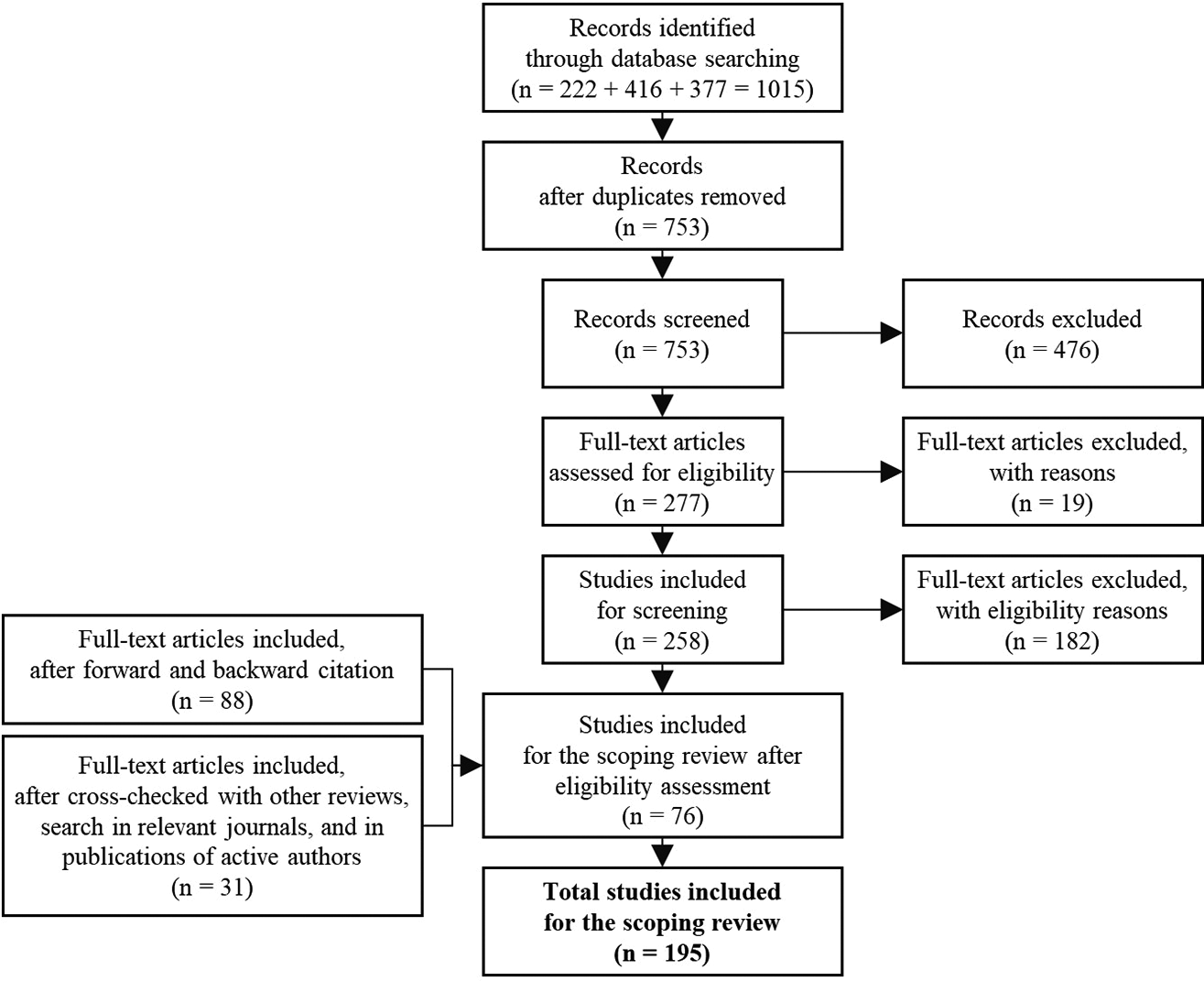
Flow diagram of the systematic literature search process.
Data Collection Process, Resulting Data Items and Synthesis of Results
For all these 195 manuscripts, we read the title, the abstract, and the methodological section in the necessary detail and extracted several data points. In addition, as we will describe below, in all these manuscripts, we ran multiple searches for a wide range of specific keywords.
In sum, we initially extracted 13 different data points, which we grouped as follows: First, the number, names and gender of all authors as mentioned on the title page; 11 second, the title of the manuscript; third, the name of the journal that had published the manuscript, including the year of publication in print; 12 fourth, the sport(s), league(s), and market(s) explored by the authors; 13 fifth, the observation period, including the total number of matches/observations; sixth, the page count; and seventh, whether the manuscript’s title page offered author keywords.
In addition, at a later stage of the data collection process, we also extracted more detailed methodological information. Primarily, we collected information on the dependent variable(s), including information on its composition, for example, whether the authors discussed and/or addressed limitations arising from the distribution of free and/or season tickets, and also the methodological approach. More specifically, we were interested in whether, and if so how, the authors addressed the problem of capacity constraints in markets where demand frequently (or occasionally) exceeds supply.
After this initial data collection process, we added only few supplementary information to the data set. First, for all manuscripts exploring European football, for instance, we added information on whether a study explored cup or league football, along with the respective information on the observed level of the football pyramid. Here, those studies exploring English Premier League data, for example, were labeled as “football league” on level “1” of the English football pyramid. In this respect, Spanish La Liga, German Bundesliga, Italian Serie A and French Ligue 1 are all coded the same, while a study analyzing stadium attendance demand for English Championship football would be labeled as “football league” on level “2”. In contrast, those manuscripts exploring data from either domestic or international tournaments were not coded as analyzing a football league. Second, to gain an understanding on the most influential manuscripts, we also added information of the total accumulated citation as of August 31, 2020, using Google Scholar.
Results and Discussion
Influential Authors, Well-Cited Manuscripts, and Potential Target Journals: A Matthews Effect? 14
In Table 1, we first provide an overview of the 11 most productive authors operating in the field of stadium attendance research, that is, according to our scope. In sum, our database contains 297 different authors, most of which, about 80%, however only contributed one manuscript to this particular literature stream. Interestingly, as can also be seen from this table, most of these authors seem to have developed both a specific profile, that is, an interest in some key sports and markets, sometimes even particular research questions, and, not shown in the table, an established set of natural co-authors over time (e.g., Paul/Weinbach: 11; Buraimo/Simmons: 6; Watanabe/Soebbing: 4).
Intriguingly, these 11 authors contributed to 64 different manuscripts and, thus, generated a total of 3,577 citations. As such, these highly productive authors, being responsible for about one third of all manuscripts in our sample, account for roughly 35% of all accumulated citations. It is, however, worth noting that only about 11 out of the 25 most-cited manuscripts stem from this particular group of authors, most probably because a fair share of 17 of these 64 contributions were published rather recently, that is, between 2016 and 2020. In fact, as can be seen from Table 2, among the most frequently cited publications in our data set, only two manuscripts were published later than in 2010 (Coates et al., 2014; Pawlowski & Anders, 2012), while eleven, that is, almost half of them, were published before the year 2000. 15
Most Frequently Cited Manuscripts in Our Database.
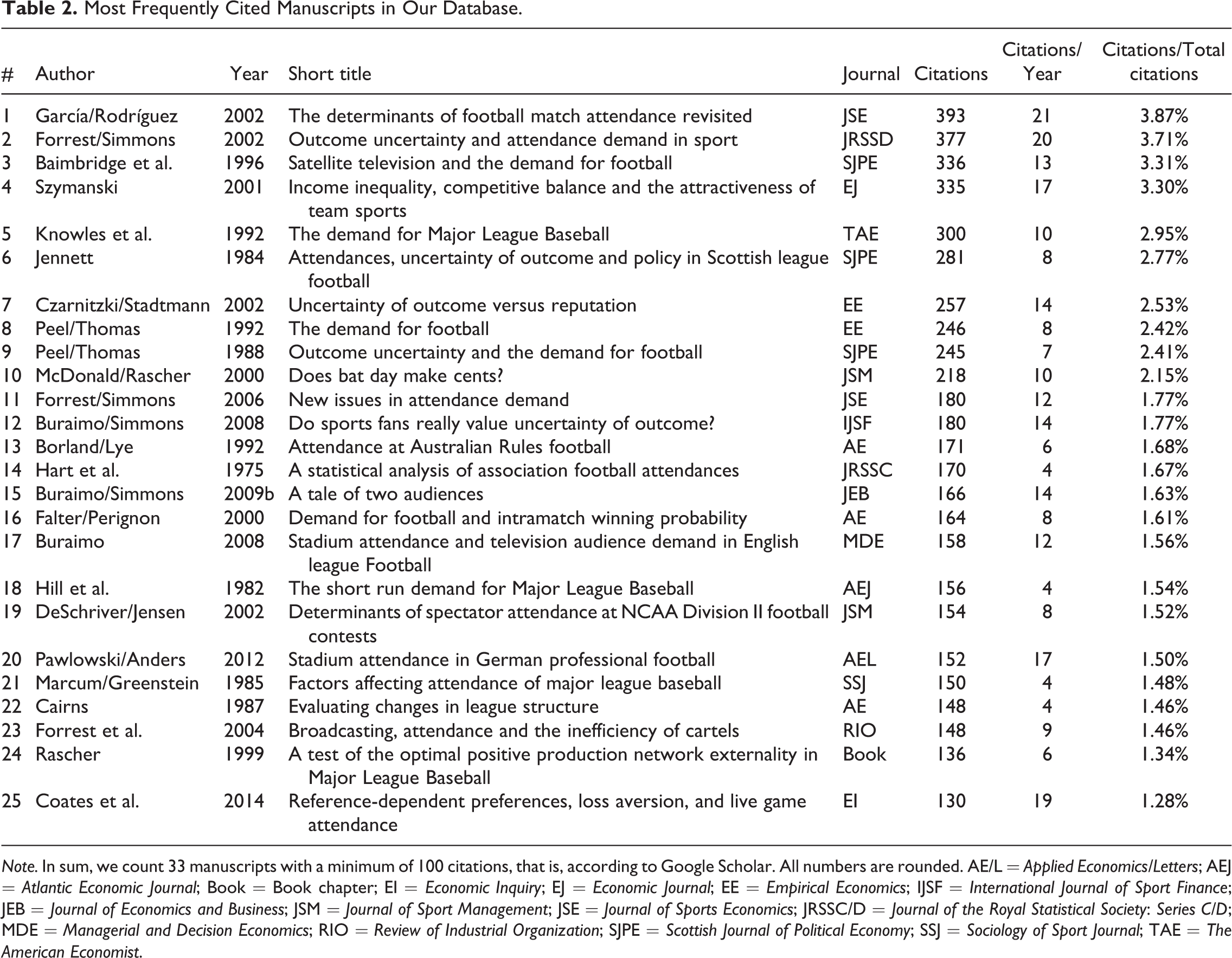
Note. In sum, we count 33 manuscripts with a minimum of 100 citations, that is, according to Google Scholar. All numbers are rounded. AE/L = Applied Economics/Letters; AEJ = Atlantic Economic Journal; Book = Book chapter; EI = Economic Inquiry; EJ = Economic Journal; EE = Empirical Economics; IJSF = International Journal of Sport Finance; JEB = Journal of Economics and Business; JSM = Journal of Sport Management; JSE = Journal of Sports Economics; JRSSC/D = Journal of the Royal Statistical Society: Series C/D; MDE = Managerial and Decision Economics; RIO = Review of Industrial Organization; SJPE = Scottish Journal of Political Economy; SSJ = Sociology of Sport Journal; TAE = The American Economist.
What is more, we observe a notable absence of female authors from this group of highly productive authors. Somewhat similarly, broadening our scope beyond this particular group, only roughly 15% of all those authors included in our data set are female, most of which, 40 out of 44, have only contributed to the literature once. As such, the vast majority of all 195 contributions, about 78%, lack a female contribution, some might even argue perspective, which, at least to a certain degree, might help to understand the somewhat limited scope in the previous research better. 16
In Table 2, we present an overview of the most frequently cited publications in our data set. Intriguingly, these 25 publications alone account for about 53% of all counted citations. In fact, we observe that there seem to exist a few, apparently well-known manuscripts that are, on average, cited much more frequently than others. That is, while all 195 manuscripts in our database were, on average, cited about four times per year, the work of six author teams accumulated, on average, more than 15 citations per year (e.g., García & Rodríguez, 2002; Forrest & Simmons, 2002; Cox, 2018; Coates et al., 2014; Pawlowski & Anders, 2012; Szymanski, 2001), three of them for a period of about 20 years. 17 In contrast, we count a total of 47 manuscripts, roughly a quarter of all manuscripts, that were, on average, cited once per year at most since their publication in print.
As indicated earlier, for those authors exploring the potential determinants of stadium attendance demand there seem to exist a handful of preferred publication outlets. In fact, we observe that 75 out of all 195 manuscripts, that is, about 38% of our sample, were published in only four journals: The JSE (31 manuscripts) and the IJSF (18), that is, the two journals dedicated to publishing research in the field of sports economics, AE (15), and AEL (11). Further, we observe that a significant number of manuscripts were published in ESMQ (6), MDE (6), and, somewhat surprisingly, also in the form of a book chapter (9; e.g., Buraimo, 2014). Two dedicated sport management journals, SBM (5) and the Journal of Sport Management (5), take the next two places. 18 In all 76 different outlets, 19 the average page count was 15 pages, though this is naturally also dependent on journal formatting. In this regard, we observe no significant trend in the number of pages per contribution per year, recently; that is, even when excluding the one journal, AEL, exclusively publishing short letters.
Dominant and Emerging Markets of Investigation: European Football Dominates Our Sample, No Previous Interest in Modeling Niche Sport Demand
In Figure 2, we present an overview of the development of stadium attendance demand publications over time. As can be easily seen from that figure, research interest in empirical studies analyzing matchday demand has gradually increased in recent years.
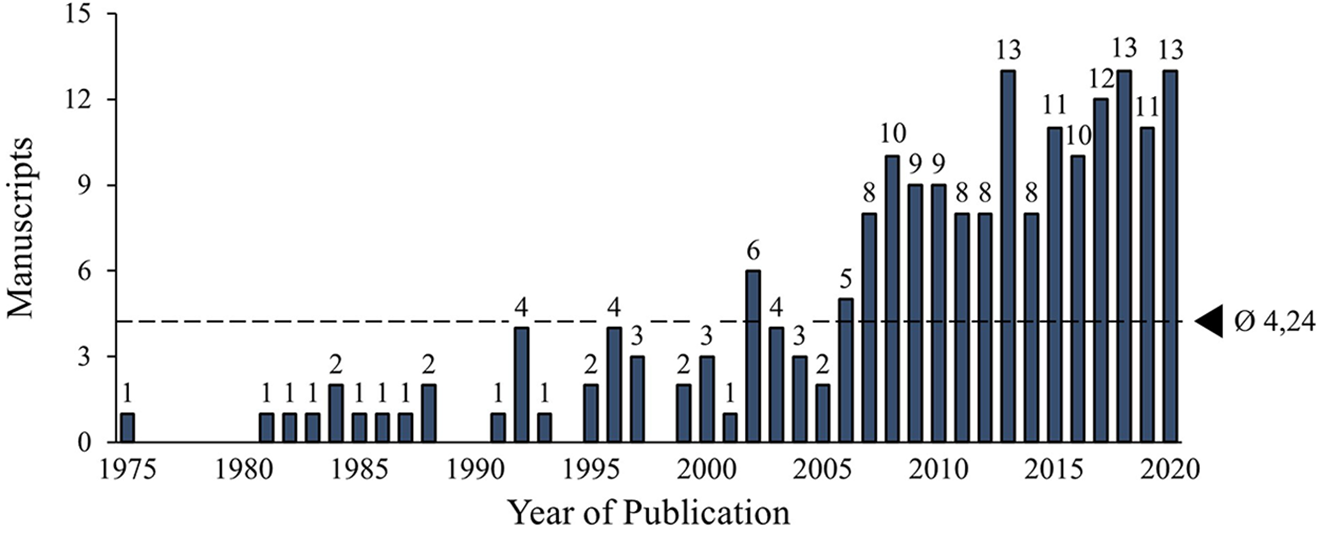
Development of study frequency over time.
Naturally, as can be inferred from Figure 2, this gradual increase in the number of publications on stadium attendance demand research is closely associated with the foundation of the JSE in 2000, which, over time, became a natural home for authors exploring the determinants of stadium attendance demand. In fact, according to our database, since 2006, the journal has had at least one such manuscript in print per year, sometimes even three (e.g., in 2012: Beckmann et al., 2012; Coates & Humphreys, 2012; Leeds & Sakata, 2012) or more (e.g., in 2018: Cox, 2018; Gropper & Anderson, 2018; Lewis & Yoon, 2018; Martins & Cró, 2018). Accordingly, between 2000 and August 2020, about every fifth empirical study modeling stadium attendance demand was published in the JSE.
Interestingly, the authors of roughly every second study explored spectator demand in the US market (112), followed by the United Kingdom (47), Germany (8), Australia, France, and Scotland (6). In addition, 22 countries are represented at least once, while we also observe four manuscripts featuring data from international tournaments (e.g., Chiang & Jane, 2013; Krumer, 2020; Valenti et al., 2020), and one manuscript in which the authors analyzed aggregated data generated in multiple countries/leagues (Serrano et al., 2015).
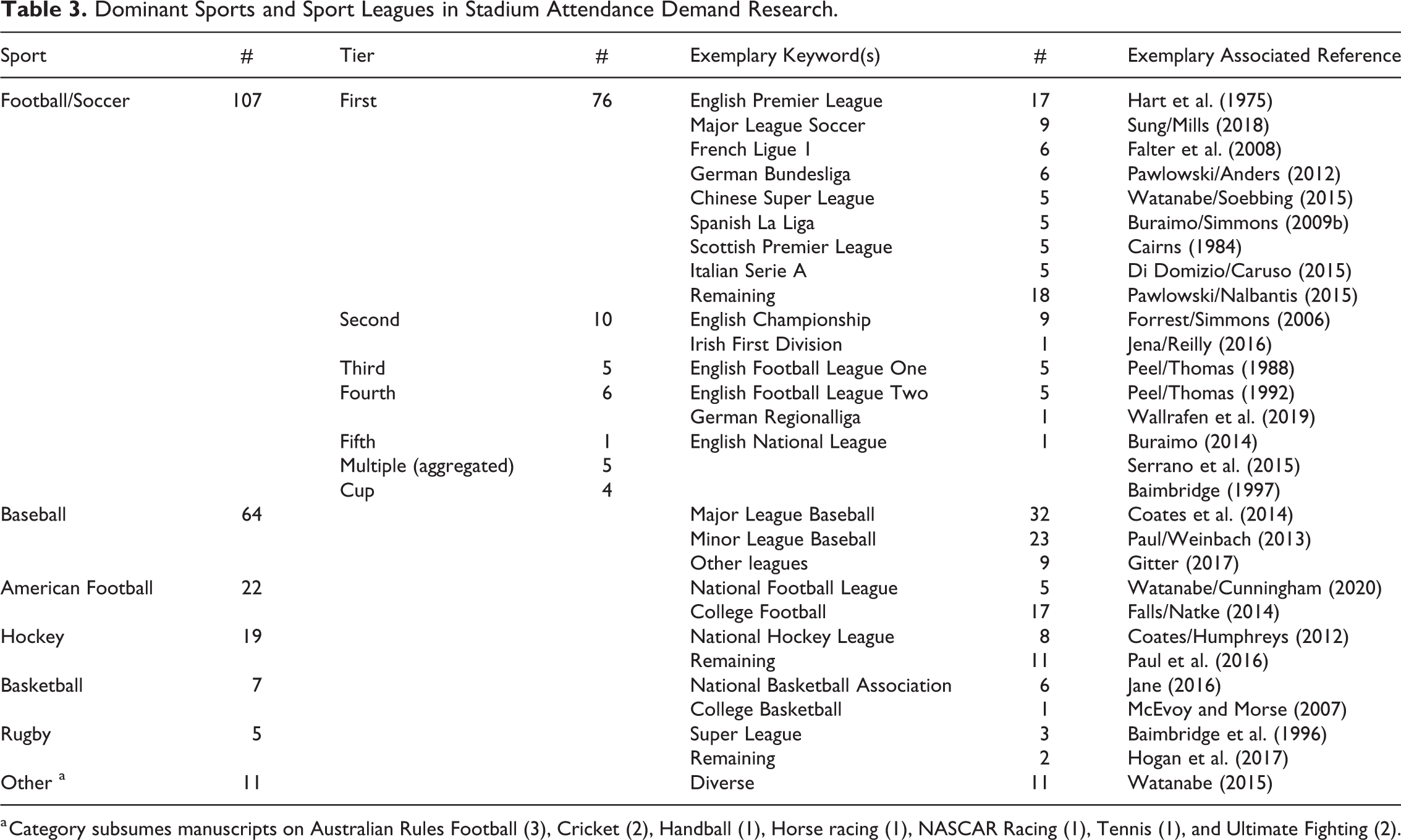
In Table 3, we present a concise overview of all competitions in our data set. In sum, we note 195 manuscripts featuring a total of 235 studies on competitions in 13 different sports, including Hockey (e.g., Coates & Humphreys, 2012), Ultimate Fighting (e.g., Watanabe, 2015), Handball (Storm et al., 2018), NASCAR racing (Berkowitz et al., 2011) and Tennis (Chmait et al., 2020), amongst others. Despite this apparent diversity, it is, however, interesting that there seems still to exist no manuscript exploring the spectator demand for such otherwise popular sports as Athletics, Badminton, Boxing, Cycling, Golf, Field hockey, Formula 1 racing, Gymnastics, Skiing, Snooker, Swimming, and Volleyball. 20 As most of those associations managing the aforementioned sports are still heavily dependent on generating matchday income, this observation is not only a bit surprising but it also offers an interesting path for future stadium attendance demand research. Further, to the best of our knowledge, there as yet exists no study on stadium, or perhaps better hall/venue, attendance demand for electronic sports, including League of Legends, Defense of the Ancients (Dota) 2, and Counter-Strike: Global Offensive, despite an increasing global interest in these emerging sports, in particular among the youth.
Dominant Sports and Sport Leagues in Stadium Attendance Demand Research.
a Category subsumes manuscripts on Australian Rules Football (3), Cricket (2), Handball (1), Horse racing (1), NASCAR Racing (1), Tennis (1), and Ultimate Fighting (2).
As can be easily seen from that table, about half of all 235 studies centered on stadium attendance demand for European football. Only three more sports, Baseball (64) and, already far behind, American Football (22) and Hockey (19), attracted notable interest from the group of authors analyzing stadium attendance demand. Apparently, as we show in Figure 3, this gap is likely to widen in the future, as the field’s interest in studying football stadium attendances appears to be increasing successively, and has only peaked recently; that is, in 2018.
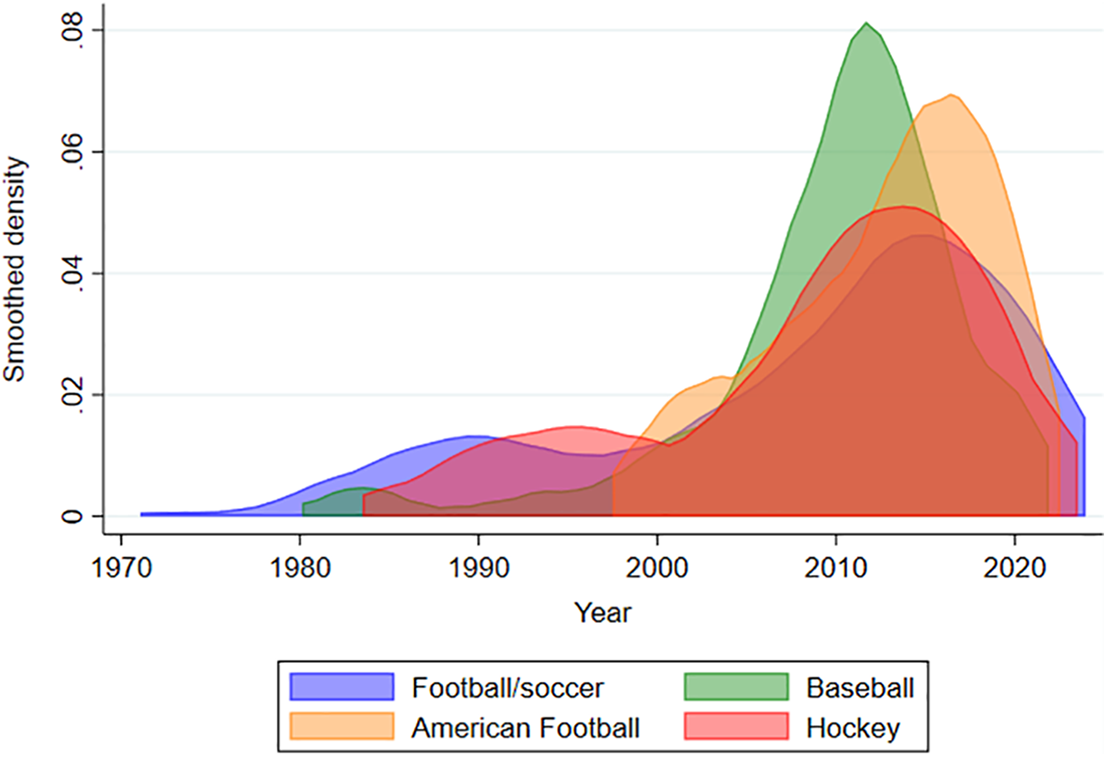
Development of study frequency by sport over time.
Interestingly, in European football, most authors have chosen to explore English football data. More specifically, we counted a total of 42 studies, 21 most of which used data generated in either the English Premier League (17 studies), including its predecessors, or the English Football League (EFL) Championship (9). In contrast, only a few authors explored data from the EFL One (5), the EFL Two (5) or even the National League (1). It is worth noting, however, that these three lower-tier leagues never rise beyond a mere supporting role in those manuscripts featuring them, as they are, without any exception, merely added as a supplement to the initial analysis of the two top-tier leagues in the country. Further, in this particular environment, manuscripts that center around domestic (1; Szymanski, 2001) or international tournaments (1; Baimbridge, 1997) are still scarce, as are manuscripts exploring women’s football demand (0).
Surprisingly, the narrow analytical interest of those authors modeling English football stadium attendance demand (e.g., Cox, 2018; Jewell, 2011; Walker, 1986) is largely representative for what we observe among the work of those authors analyzing the remaining football markets. That is, in all football markets represented in our sample, we note a lack of studies modeling spectator demand for domestic cup competitions, lower-tier football, including amateur football, women’s sports, and also youth football. 22 Here, Wallrafen et al. (2019), modeling fourth-tier stadium attendances in Germany, as well as both Meier et al. (2016) and LeFeuvre et al. (2013), modeling stadium attendance demand for women’s football in Germany and France, respectively, are notable exceptions that all prove this rule.
While most authors have explored English Premier League data, in general, we observe a keen interest in European first-tier football leagues, as well as in both Major League Soccer (MLS) and the Chinese Super League. More specifically, we note a strong interest in analyzing stadium attendance demand for the MLS (9 manuscripts), the German Bundesliga and the French Ligue 1 (6), the Chinese Super League, the Italian Serie A, the Scottish Premier League, and the Spanish La Liga (5). Further, reflecting the many different facets of the previous research, there already exist empirical studies on markets as diverse as Austria (Pawlowski & Nalbantis, 2015), Brazil (e.g., Madalozzo & Berber Villar, 2009), Denmark (Nielsen et al., 2019), Finland (Iho & Heikkilä, 2010), Malaysia (Wilson & Sim, 1995), Peru (Buraimo et al., 2018), and Russia (Coates et al., 2017). In contrast, evidence from emerging football markets such as Colombia, Egypt, India, Indonesia, Morocco and the Philippines are currently largely missing from the English-language literature. 23 Also, there’s still no manuscript on football stadium attendance demand in smaller European markets such as Czechia, Hungary, Poland, Portugal and Romania, and also on future FIFA World Cup hosts such as Qatar, Mexico and Canada.
Dominant and Emerging Manuscript Themes: Outcome Uncertainty, Star Power, and…Air Pollution
To understand the existence of both dominant and emerging themes in the already rich stadium attendance demand literature better, we performed a systematic manuscript title analysis. More specifically, we first went through all 195 manuscript titles and, based on the information presented in these titles, decided whether (or not) authors of a given manuscript were focusing on one or more specific determinant(s). 24 Then, second, whenever we observed such an author focus, we extracted the appropriate keywords. This somewhat cumbersome procedure was necessary because the use of keywords is a relatively recent development, the JSE, for example, only introduced the use of keywords in 2003, and even today, still not all publishers have decided to implement them. Having extracted a total of 189 keywords, we categorized all of them based on whether the determinants were proxying consumer preferences (e.g., club characteristics, habit persistence, and exogenous shocks such as a public health crisis), economic factors (e.g., macroeconomic factors, market characteristics, and the ticket price), the quality of viewing (e.g., promotions, quality of seating and the timing of the contest), or the sporting contest (i.e., the quality of the contest and, in particular, the role of competitive balance and the resulting match outcome uncertainty) – as such, here, our approach closely resembles that of Borland and Macdonald (2003). Further, to increase the robustness of the chosen approach, in Figure 4, we also provide two word-clouds generated from both the title and the abstract of the 195 manuscripts in our data set.
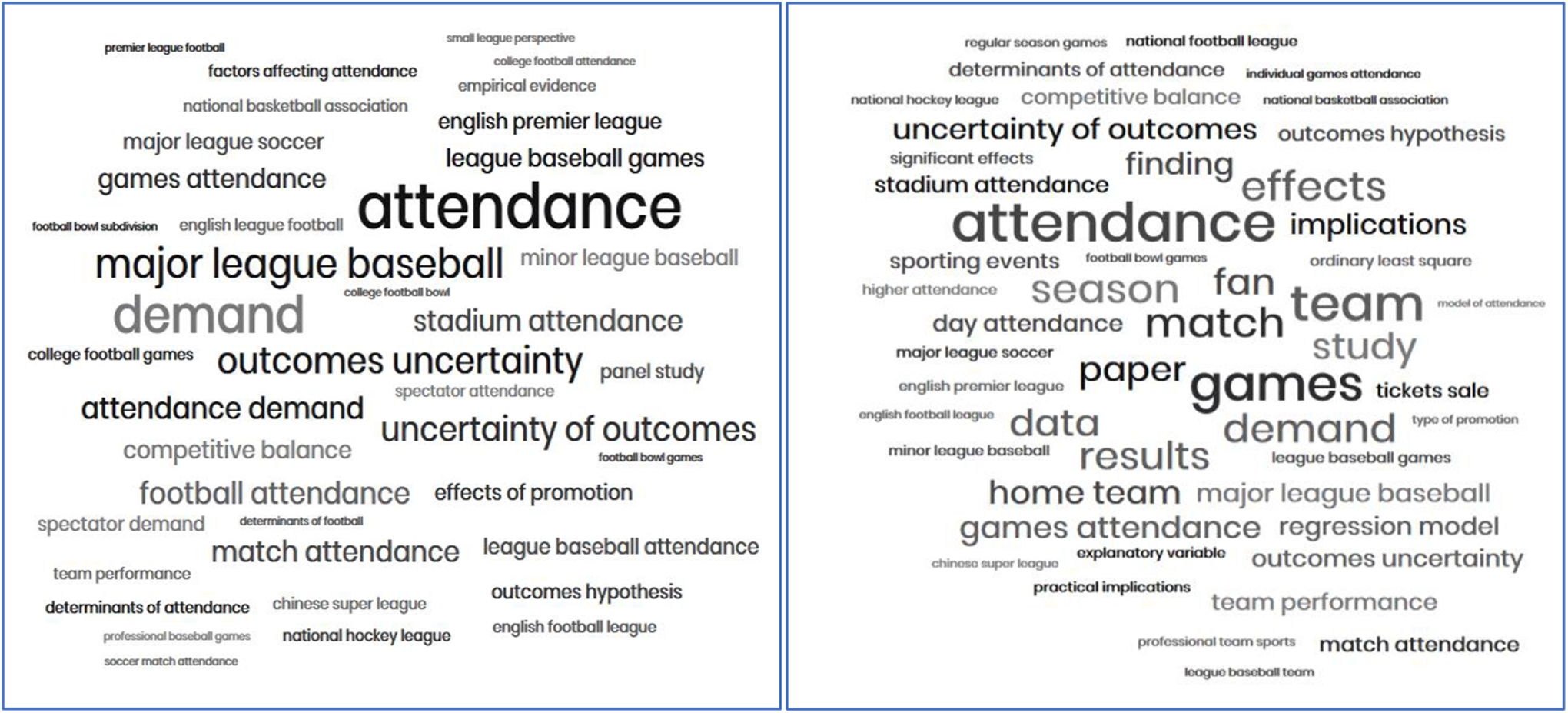
Dominant themes in stadium attendance demand research. Note. We generated these two word-clouds from the title (left) and the abstract (right) of the 195 manuscripts in our data set using the services from monkeylearn.com because it automatically detects multiword keywords. Here, string size corresponds to string frequency.
In Table 4, we present both the descriptive information on the distribution of the extracted keywords and illustrative examples. Interestingly, we observe that the authors of about three out of four studies seem to have drafted their manuscripts with a specific theme in mind. More specifically, most authors focused on the potential role of the sporting contest characteristics, most notably match outcome uncertainty, in shaping stadium attendance demand. That is, we observe that the titles of roughly every fourth study include a reference to the concept of competitive balance and the resulting match outcome uncertainty. Interestingly enough, these references are surprisingly diverse, and include, for example, championship uncertainty (e.g., Pawlowski & Nalbantis, 2015), competitive intensity (e.g., Bond & Addesa, 2020), loss aversion (e.g., Besters et al., 2019), outcome uncertainty (e.g., Martins & Cró, 2018), uncertainty (e.g., Serrano et al., 2015), uncertainty of outcome (e.g., Hogan et al., 2017), and uncertainty of results (e.g., Cox, 2018). 25 Further, as the debate on the validity of Rottenberg’s (1956) so-called uncertainty of outcome hypothesis has not yet been laid to a final rest, we note a relatively consistent output of such studies in the last decade; that is, in 2010 (3), 2011 (1), 2012 (4), 2013 (4), 2014 (2), 2015 (4), 2016 (2), 2017 (1), 2018 (4), 2019 (2), and 2020 (3). Somewhat similarly, we observe a continuous interest in the potential role of stars, including, for example, local heroes (Yamamura, 2011), marquee players (Jewell, 2017), star pitchers (Ormiston, 2014), and top-drafted rookies (Kelley, 2020), in modeling stadium attendance demand. In contrast, we only count a few studies that concentrate on team success (e.g., Paul et al., 2019; Pinnuck & Potter, 2006; Watanabe & Soebbing, 2017) and contest significance.
Dominant Themes in Stadium Attendance Demand Research.
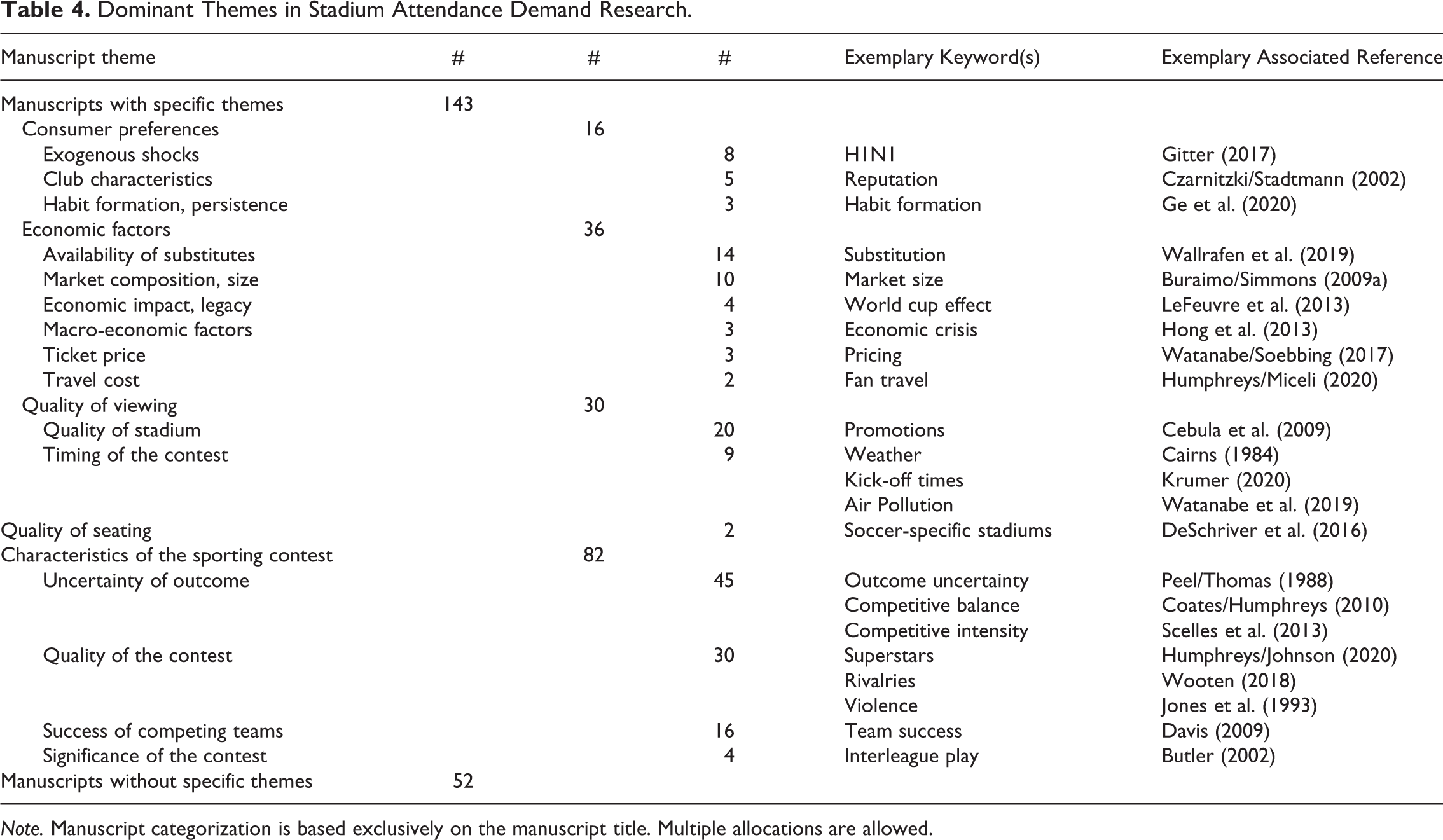
Note. Manuscript categorization is based exclusively on the manuscript title. Multiple allocations are allowed.
Although most authors centered their manuscripts around sporting event characteristics, some authors have emphasized the potential role of economic factors, the quality of viewing, and also emerging consumer preferences in explaining the variance in stadium attendance demand. As such, there already exists a significant body of literature on the question of whether television broadcasts serve as a substitute for stadium attendance (e.g., S. Allan, 2004; Baimbridge et al., 1996; Barajas et al., 2019; Kringstad et al., 2018; Nielsen et al., 2019), whether promotions such as bobblehead giveaways, fireworks, and even marching bands, are effective in increasing stadium attendance demand (e.g., Boyd & Krehbiel, 2003; Kappe et al., 2014; McDonald & Rascher, 2000; Natke & Thomas, 2019; Paul et al., 2013), and whether consumer preferences alter in the aftermath of exogenous shocks as diverse as a corruption scandal (Buraimo et al., 2016), an influenza virus outbreak (Gitter, 2017), college football player protests (Watanabe et al., 2019), increasing terror alert levels (Kalist, 2010), or the announcement of performance-enhancing drug violations (Cisyk & Courty, 2017). Interestingly, though frequently included as control variables, only a few authors have centered their study on the potential effects of match fixtures/scheduling (Goller & Krumer, 2020; Krumer, 2020; Paul et al., 2004) or both environmental effects and the weather (e.g., Cairns, 1984; Ge et al., 2020; Ito et al., 2016). Among the latter, Watanabe et al. (2019), for instance, explored the potential role of air pollution in shaping stadium attendance demand in the Chinese Super League, thus paving an interesting new way towards a better understanding of how spectators respond to potential health threats on matchday – a theme that will certainly gain more importance in the future (e.g., Reade et al., 2020b).
Methodological Challenges: A Logarithmic, Aggregated Dependent Variable and Tobit Models
As is evident in the literature, those authors modeling stadium attendance demand face several methodological challenges. Forrest et al. (2005), for example, noted two such challenges potentially leading to biased estimates: first, the existence of capacity constraints in leagues that are permanent in high demand, such as the English Premier League, and, second, the use of aggregated data across different spectator groups (e.g., matchday ticket holders and season ticket holders; Dobson & Goddard, 2011). However, these aggregated data typically subsume two different subsequent decisions from multiple stakeholder groups, including not only paying customers but also owners of free tickets, whose determinants might differ significantly: first, an individual’s decision whether to accept/purchase a ticket for a match; and second, the ticket holder’s subsequent decision whether to attend this particular match (e.g., Schreyer et al., 2016). 26 Below, we summarize how previous authors have addressed these two potential limitations.
In general, most authors explored aggregated attendance data, preferably in log form (e.g., Chupp et al., 2007; Martins & Cró, 2018; Storm et al., 2018; Watanabe & Soebbing, 2015; Yamamura, 2011). In fact, only a few authors were primarily interested in analyzing alternative attendance demand proxies such as the stadium utilization (i.e., the ratio of distributed tickets to the existing stadium capacity; e.g. Hong et al., 2013; Jane, 2016; Lawson et al., 2008) or a rather simple sellout-dummy (e.g., Brandes et al., 2013), although some authors used the former information to present an additional robustness check (e.g., Paul et al., 2016).
Despite the early criticism from Forrest et al. (2005), only a few authors have explored disaggregated attendance information. In fact, somewhat surprisingly, the authors of only about 30 manuscripts discussed, often briefly, the potential limitations that may arise from the use of such data generated across both matchday ticket holders and season ticket holders (e.g., Barajas et al., 2019; Buraimo et al., 2018; Paul et al., 2019). As such, it is perhaps not surprising that the authors of only about a handful of manuscripts explicitly explored the behavioral intentions of matchday ticket holders (e.g., Allan & Roy, 2008; Benz et al., 2009; Bond & Addesa, 2020), that is, by analyzing attendance data after having subtracted season ticket holder data, or added such season ticket holder data as an explanatory variable (e.g., Chmait et al., 2020). 27 Perhaps one potential reason for this is that most authors still wrongly consider season ticket holders to be behavioral loyal (e.g., Schreyer et al., 2018). Somewhat similarly, only a few authors either have excluded (e.g., Chmait et al., 2020) or added information on free tickets (e.g., Anthony et al., 2014), and even fewer considered this a limitation of their study (e.g., Besters et al., 2019).
In this particular context, it is interesting to see that there seems to exist only very little research modeling the stadium attendance demand for different stadium sections (e.g., Dobson & Goddard, 1992), including, for example, home and away sections and, economically more important, also business seats in the hospitality sections; that is, those seats that, at least in European professional football, currently account for about 62% of the ticket revenues (ESSMA, 2019). While such disaggregated data, that is, information on the number of season ticket holders, the distribution of free/complimentary tickets, and/or sectoral differences, are, and will still be, usually hard to obtain (e.g., Kringstad et al., 2018), we believe that the field would benefit from a more detailed discussion of both the nature of the dependent variable, typically proxying behavioral intentions to attend, and its potential limitations in the future.
While only a few authors have explored disaggregated data, most authors explicitly addressed (and discussed) the potential problems arising from stadium capacity constraints. 28 More precisely, we count that about 60% of all authors/author teams addressed this important methodological issue, some even although it is, according to their own statement, not an urgent issue in their specific environment (e.g., Forrest & Simmons, 2006; Reilly, 2015; Watanabe, 2015); for example, because frequent sellouts are less likely in developing markets and lower tiers. Those authors that, however, observed a fair share of right-censored observations typically employ a tobit model (e.g., Besters et al., 2019; Bond & Addesa, 2020; Cox, 2018), either primarily or as an additional robustness check, although we also observe an increasing use of censored regression (e.g., Hong et al., 2013; Meehan et al., 2007; Ormiston, 2014), or the exclusion of potentially truncated cases (e.g., Denaux et al., 2011), among others. In fact, only a few authors discussed capacity constraints as a limitation without taking any methodological action against it.
On a side note, it is, perhaps, interesting that the explored period of investigation has significantly increased over time, most likely due to improved data availability. In this context, we observe, on average, a period of investigation of about 5.50 seasons/years per study, ranging from a minimum of one (e.g., Hill et al., 1982) to a maximum of 48 (Fullerton & Miller, 2017). However, about 80% of all manuscripts in our data set feature a study exploring data of a maximum of five years/seasons, most of them, about 43%, even of only one. On the other hand, we only count ten manuscripts exploring data sets containing 20 or more years/seasons. Further, and perhaps unsurprisingly, we observe a strong, positive and significant correlation between the period of observation and the number of total, that is, aggregated, analyzed matches in the data. In general, authors explored data sets containing, on average, roughly 3,619 matches, though this mean is somewhat artificially inflated by those authors exploring data generated in the two rather long league tournaments, that is, in Major League Baseball (M = 11,077, SD = 17,694) and in the NBA (M = 14,065, SD = 16,349). It is, therefore, not surprising that the former competition is the focus of the manuscript with the largest data set, an ultimate sample size of 88,825 matches (c.f., Ormiston, 2014), in our sample. 29
A Note on Stadium Attendance Demand Research in the Journal of Sports Economics
As a cornerstone of the more recent stadium attendance demand research, the JSE, according to our data, has published a total of 31 manuscripts modeling stadium attendances. In general, and perhaps not surprisingly, these articles are largely reflective of the discipline’s scope, as indicated above. For instance, we observe a strong tendency to explore empirical data generated in the US market (18; e.g., Berkowitz et al., 2011; Butler, 2002; Humphreys & Johnson, 2020), and also Europe (10; e.g., Falter et al., 2008, García & Rodríguez, 2002; Martins & Cró, 2018), but almost no evidence from Africa, Asia, or South America. Somewhat similarly, about 84% of all manuscripts, analyzed data from baseball and football/soccer (13 manuscripts each), with only a handful of manuscripts exploring other sports; for instance, basketball (e.g., Jane, 2016), hockey (Coates & Humphreys, 2012), and racing (Berkowitz et al., 2011). As such, currently, about every third stadium attendance demand study published in the JSE marks an exploration of the US baseball market (e.g., Ge et al., 2020; Lemke & Tlhokwane, 2010; Ormiston, 2014).
Despite the apparent preference for analyzing MLB attendances, it is, however, important to note that JSE has continuously published manuscripts broadening the discipline’s previous scope. For instance, according to our sample, LeFeuvre et al. (2013), analyzing the potential effect of the 2011 FIFA Women’s World Cup on Women’s Professional Soccer attendance, were the first to explore stadium attendance demand for women’s football. Wallrafen et al. (2019), primarily interested in understanding substitution effects in sports better, were among the few authors modeling stadium attendance demand for amateur football and the first to do so outside of the English football market. In fact, many football markets, including Brazil (Madalozzo & Berber Villar, 2009), Finland (Iho & Heikkila, 2010), and Portugal (Martins & Cró, 2018), in particular, were explored first in the JSE.
In terms of dominant themes, we note that most JSE authors, roughly three out of four, seem to have drafted their manuscript with a specific theme in mind, a third of them explicitly referring to the concept of competitive balance/intensity and the resulting match outcome uncertainty (e.g., Andreff & Scelles, 2015; Cox, 2018; Meehan et al., 2007). Therefore, it is perhaps not surprising that most manuscripts published in the JSE center around the effect of sporting characteristics on spectator interest, with only a few manuscript titles explicitly referring to consumer preferences (e.g., Cisyk & Courty, 2017), economic factors (e.g., Wallrafen et al., 2019), and the quality of viewing (e.g., Ge et al., 2020).
Methodologically, in the JSE, we observe a similar preference for exploring aggregated attendance data across different spectator groups, preferably in the log form. As such, only a handful of authors excluded season tickets from their sample (e.g., Bond & Addesa, 2020; Falter et al., 2008; García & Rodríguez, 2002), while the potential existence of complementary/free tickets is typically not discussed. In contrast, and once more in line with the field’s general scope, the vast majority of all authors discussed (and addressed) the potential problems arising from stadium capacity constraints.
Conclusions, Limitations, and Potential Future Research Avenues
Throughout our analysis of the empirical literature modeling the behavioral intentions to attend a sporting event in a stadium (or a hall/venue), we have noted several emerging patterns that may serve as a starting point for future stadium attendance research. Below we summarize these patterns.
First, we observed that, despite an already rich and continually growing body of empirical literature modeling the determinants of stadium attendance research, there are numerous sports that, for unclear reason(s), have so far been neglected from a proper analysis. That is, while most authors have explored data generated in American football, baseball, European football and hockey, there as yet exists no research on regional quite popular niche sports, including badminton, field hockey, and volleyball. Further, perhaps due to data availability issues, our understanding of what shapes the interest for such popular sporting events as cycling (e.g., the Tour de France), golf (e.g., the PGA tour) and Formula 1 racing is literally non-existent in the literature, as it is the case for emerging sports such as the increasingly popular Kabaddi, Lacrosse, and also electronic sports that regularly attract large crowds. 30
For those sports that have, however, previously generated the field’s regular attention, our understanding of the overall robustness of the observed effects is rather limited, as previous research has primarily explored only a few domestic competitions, typically top-tier leagues, within only a few markets. As such, we believe that future stadium attendance demand research should profit tremendously from widening its narrow focus to consider a significantly more diverse set of objects of investigation. In particular, this is true for studies exploring data generated in both domestic and international cup competitions (e.g., the UEFA Champions League), lower-tier competitions, and, last but by no means least, women’s sports, despite some notable first attempts (e.g., Valenti et al., 2020). Naturally, it would, for instance, be highly interesting to see whether there are significant differences between the effectiveness of certain determinants (e.g., match outcome uncertainty, player talent/stars, and the weather) across not only men’s and women’s sports but also across different tournament formats.
On a related note, we believe it’s about time to explore African, Asian, and South American competitions in more detail. While exploring these environments can certainly help us improving our understanding of the robustness of previously explored determinants, thus increasing confidence in the generalizability of mechanisms across different cultures, analyzing such alternative markets might also help mitigate the methodological problems discussed earlier. Accordingly, few authors have already begun exploring data from South American leagues, which, unlike their European counterparts, often still refrain from distributing season tickets to fans (e.g., Buraimo et al., 2018; cf. section 3.4). However, analyzing the stadium attendance demand in leagues with frequently altering calendars and/or league formats such as the Argentine Primera División over time might also offer additional insights for questions relating to effective tournament design.
Second, concerning the manuscript focus, we noted a strong interest on studies exploring the specific characteristics of the sporting events, particularly the role of varying competitive balance and the resulting match outcome uncertainty. In contrast, only a few manuscripts centered around exogenous shocks (e.g., health emergencies, terrorism), macroeconomic factors, and, somewhat surprisingly, also the ticket price (e.g., Watanabe & Soebbing, 2017). While the former aspects are typically rare and only offer limited managerial implications for the top management, 31 the latter, in particular, might become more prominent as disaggregated, that is, individual, data become available in the future. In fact, although we observe several notable attempts to approximate the ticket price in the literature (e.g., revenue divided by attendance), endogeneity concerns still remain, among others, which, in turn, ultimately affect our understanding of the price elasticity of stadium attendance demand. 32 Somewhat similarly, employing such individual data seems imperative to correctly estimate the effect of such standard attendance explanatory variables as income in the future, which has previously often been approximated by employing annual data, despite some notable exceptions (c.f., Hong et al., 2013).
Third, we observed that the field has previously refrained from exploring disaggregated data, despite the early criticism from Forrest et al. (2005). While this practice is not only common in the literature, and primarily driven by limited data availability, but also historically grown, we believe that future research might profit from excluding season ticket holder information and, perhaps even the number of free tickets, from the dependent variable while discussing the potential pitfalls in more detail if the former is not possible. Alternatively, as technological progress allows for generating better information, exploring behavioral stadium attendance demand, that is, the actual matchday turnout, might be a profitable approach (e.g., Schreyer et al., 2016; Schreyer & Torgler, 2021).
While we believe that our systematic approach, that is, excluding both those manuscripts whose authors explored behavioral data and data containing annual/average information, as well as survey data, results in a comprehensive scoping of the existing literature modeling behavioral intentions to attend a sporting event, naturally, there are a number of limitations to our approach. For example, although we have taken great care while selecting the 195 manuscripts in our data set, the sheer volume of the existing literature in combination with our manual approach might lead to the omission of a few manuscripts; for example, those that, in abstract, keywords or the title, are not explicitly linked to stadium attendance research. However, while such a potential omission might slightly alter the effective results provided above, we believe that our comprehensive approach allows summarizing key tendencies, nevertheless. Further, as discussed earlier in this section, our self-limitation on those studies modeling matchday demand might, to some degree, underestimate the field’s interest in factors that are stable across one or multiple season(s) and, therefore, more likely to be explored using annual attendance data (e.g., the stadium quality). Finally, as it is common when conducting scoping reviews, we largely refrain from an in-depth analysis of all effect sizes and preferably present existing (and emerging) themes. As such, future research might benefit from additional literature reviews focusing on specific aspects in stadium attendance research, for example, the relationship between the football interest and the weather, or even meta-analyses.
Footnotes
Author’s Note
Payam Ansari is now affiliated with DCU Business School, Dublin City University, Dublin, Ireland.
Declaration of Conflicting Interests
The author(s) declared no potential conflicts of interest with respect to the research, authorship, and/or publication of this article.
Funding
The author(s) received no financial support for the research, authorship, and/or publication of this article.
