



Abstract
We investigate the risk-taking behavior of women and men in high-stakes jumping competitions. Results indicated that female and male athletes differ in the timing and extent of their reactions to an increase in the risk of failure. Male competitors increased risk-taking in the more risky environment immediately after the changes. Female athletes, however, increased risk-taking two years after the rule change. Over time, female athletes revert to pre-reform risk-taking levels, and male athletes’ continued to make more risky decisions in the new environment. We attribute our findings to gender differences in competitiveness and risk preferences.
Introduction
Economists explain gender gaps with a variety of models and recent contributions stress the role of gender differences in risk preferences, willingness to compete and also confidence (Cozzi et al., 2018; Bertrand et al., 2010). Most evidence on gender differences in competitiveness and risk-taking is derived from laboratory experiments (Eckel & Grossman, 2008; Croson & Gneezy, 2009; Niederle & Vesterlund, 2011), where the selection of participants into different payment schemes is used as a measure for competitiveness. These results show male participants as more competitive than female ones (Niederle & Vesterlund, 2007; Buser et al., 2014). It is challenging to study differences in competitiveness in the field as field data typically lack information on the set of available options that people have, the associated risk-levels or their costs or benefits. 1 However, evidence from the field is important as results from experimental studies might be driven by an experiment’s design (Filippin & Crosetto, 2016).
Data from sport competitions provide an excellent opportunity to investigate competitiveness and risk-taking decisions as sports have clear incentive structures, rewards are linked to performances, and performance is precisely monitored and reported (Böheim et al., 2017). We use data from 91 major sports events such as the Olympic Games or the World Championships, 1988 to 2012, to analyze the effect of a more risky environment on the risk-taking of female and male athletes. We use the reform of the pole vault regulations in 2003 to identify the causal effect of the more risky environment on risk-taking. The reform made it more difficult to clear any height with a non-optimal attempt. We follow Böheim and Lackner (2015) and interpret passing a height as a risky strategy. The causal effect of the reform on risk-taking is estimated using a difference-in-differences estimation where we compare the risk-taking of pole vault jumpers to the risk-taking of high jumpers who were not subject to the reform.
The reactions of athletes to the reform provide valuable information on risk-taking preference and competitiveness. The previous literature using sports data presents empirical evidence on gender differences in risk-taking. Gerdes and Gränsmark (2010), for example, analyze professional chess competitions and find that female players are more risk averse than male players. Using data from professional basketball, Böheim et al. (2016) find a significant gender gap in risk-taking in crucial game situations. Böheim and Lackner (2015) find that female athletes take less risk than male athletes in jumping competitions. Results from sports data on the gender gap in competitiveness, however, is mixed. Frick (2010) analyzes long distance running competitions and find female contests to be less competitive. Booth and Yamamura (2018) confirm a gap in competitiveness and performance in speedboat races when women compete in mix-gender environments. In contrast, Pikos and Straub (2019) find no gender gap in competitiveness.
Several contributions focus on the effect of the competitors’ gender on risk-taking. For example, Gerdes and Gränsmark (2010) find that male professional chess players play more aggressively (i.e., they take more risk) when the opponent is female. Lindquist and Säve-Söderbergh (2011) find female contestants reduce risk-taking when competing against male competitors. Similarly, using a closely related setting, Säve-Söderbergh and Sjögren Lindquist (2017) find that girls wager less when competing with boys. In contrast, Jetter and Walker (2018) find that the gender gap in risk-taking disappears when women compete among men. Booth and Nolen (2012) and Booth et al. (2014) provide evidence that women take more risk in single-sex than in mixed-sex settings. We investigate risk-taking decisions in single-sex settings only.
We contribute to the literature by investigating how the gender gap in risk-taking is affected by changes in the likelihood of a negative outcome. Most analyzes of non-experimental data focus on more or less static settings, or face difficulties to precisely measure changes of risk. We provide an estimate of the effect of an exogenous change in the riskiness of decisions on risk-taking of women and men. By focusing on two very similar types of competitions (the pole vault and the high jump), we contrast the induced behavioral changes to a plausible control group and interpret our results as causal. Our analysis is relevant for a number of settings where the overall risk of failure is subject to changes over time (e.g., financial markets and the gender gap in investment risk; Barber & Odean, 2001; Eckel & Füllbrunn, 2015).
In 2003, the International Association of Athletics Federation (IAAF) made several significant changes to the pole vault regulations. The main objective of the reform was to make competitions more attractive to watch. The new rules made the sport more difficult and changed the benefits of risk-taking. Consequently, the incentives for competitors should change in accordance to their risk-taking preferences. Lobinger et al. (2010) provide a qualitative analysis of twelve German pole vault athletes’ risk preferences and their subjective evaluation of the reform. Overall, the athletes were concerned that the reform would lower their performance as the new rules made success more difficult. However, Lobinger et al. (2010) did not find a relation between an athlete’s subjective assessment of risk and their objective performance. We do indeed find that the reform made the pole vault more difficult and the share of failed attempts increased significantly after the reform.
The (experimental) literature typically finds that the gender gap in risk-taking is larger in mixed-sex than in single-sex environments (e.g., Booth et al., 2014). We contribute to the literature by studying the reaction of the gender gap in risk-taking to a change in the riskiness of decisions.
We estimate that, as a reaction to the reform, both female and male athletes increased risk-taking. The effect of the reform on male athletes is large and of similar magnitude in the nine post-reform years that we analzse. For female athletes, however, we find that risk-taking increased only two years after the reform and reverted to pre-reform levels five years after the reform. We estimate that increased risk-taking after the reform has no direct effect on the chances of failing an attempt, which suggests that the results are not due to men’s overconfidence.
Our results document that even subtle changes in a specific task can have sizable consequences for the gender gap in risk-taking. Günther et al. (2010), Dreber et al. (2014), and Filippin and Crosetto (2016) also find that tasks play an important role for the gender gap in risk-taking.
Background
The pole vault and the high jump are two Olympic events with a long tradition. In high jump competitions, athletes have to jump over a bar at a certain height. After a short inrun, the athlete has to push herself by the use of one leg only over the bar. The pole vault is a similar sport with almost identical rules where athletes use a pole to propel themselves over the bar. Both sports require similar physical attributes and share a similar set of regulations and settings. 2
An athlete has a maximum of three attempts to clear a height. If she jumps over the bar, the athlete advances to the next height. If the bar does not remain on the finger pads or the inrun time is exceeded, the athlete fails at the attempt. Three consecutive fails disqualify an athlete in a competition. The athlete who clears the highest height wins. In the case of a tie, the athlete with fewer attempts at the last height wins. If this does not break the tie, there will be a head-to-head jump-off competition. In case there are more than two competitors, this is repeated until there is an obvious ranking.
Jumping over the bar requires practice, talent, and energy, which are limited at the date of the competition. Each attempt depletes the available energy and athletes may pass a height to preserve effort or to reduce the risk from injury. In this case, the athlete sits out for one height. Athletes may pass multiple heights in a row, but they may not attempt lower heights once they declared a pass. Athletes may also pass heights strategically in order to have a low number of attempts, which could determine a tie-break.
Passing provides an athlete with recovery time, but for the final ranking in a competition it is the highest cleared height which counts. Each pass, however, invariably makes the next attempt more difficult since difficulty increases monotonically with height, a higher height is never easier to clear than a lower height. We follow Böheim and Lackner (2015) and interpret passing a height as a risky strategy.
In 2003, the IAAF introduced significant changes in the rules for pole vault competitions. The new rules specify shorter finger pads on which the bar is positioned, from 75 to 55mm, and “Hungarian” bars, which have an oval rather than a square profile. The changes intended to improve safety standards through larger jumping mats and to increase the spectators’ value of the sport through a tightened procedure and a shorter inrun time (Lobinger et al., 2010).
The changes made by the 2003 reform significantly changed the consequences of touching the bar, making dislodgment more likely. Consequently, it is more difficult to clear a certain height with a badly executed attempt. If athletes do not change their behavior after the reform, more attempts should result in fails as the jumps became more difficult. An individual athlete, however, may react to the reform by passing more or less often. Competitive athletes will increase risk-taking in more risky situations, that is, pass more often, as they will consider this to help them gain an advantage over their competitors. In contrast, less competitive athletes may reduce passes to avoid dropping out of the contest, at the costs of more overall attempts and spent energy.
Athletes who are more confident will pass more often than athletes who are less confident. As summarized by Niederle and Vesterlund (2011), women are typically found to be less confident than men. Consequently, following the existing evidence on gender differences, we expect to see any gender gap in risk-taking widen after the reform. This is consistent with Lobinger et al. (2010) who find that male pole vault competitors did in fact welcome the reform while female athletes were sceptical.
The tradeoff between risk-taking and the difficulty of jumps has potential consequences for our analysis. Athletes who are more willing to increase their risk-taking to lower the number of attempts might have a lower share of failed attempts after the reform. In contrast, athletes who are less likely to increase risk-taking might be observed as having a greater share of failed attempts due to their overall greater number of attempts.
Data and Estimation Strategy
We use data from jumping competitions to identify the causal effect of the 2003 reform on risk-taking behavior. The data are from 91 contests for women and 94 contests for men. They are from the final rounds of major sport events such as the Olympic Games, the World Championships (in- and outdoors), the European Championships (in- and outdoors), and IAAF Diamond League competitions, where both high jump and pole vault competitions were held. The data cover the time from 1997 through 2012 and contain information on 278 female and 330 male athletes. We analyze only attempts from the first to the tenth height of competitions.
The sample consists of 15,579 attempts which are either a successful clearing of a height, a failed attempt or a pass. For the first part of our analysis, we exclude athletes first attempts after sitting out. 3 The sample size for these analyzes is 12,618 observations. For the second part of our analysis, we exclude all passes from the sample, which leaves 14,700 observations.
Figure 1 shows the distributions of cleared heights for female and male athletes. The average cleared height (standard deviation) for female high jumpers is 194.2 cm (5.7) and 451.8 cm (18.8) for female pole vault athletes. Male high jumpers reach on average 228.0 cm (4.8) and pole vault athletes 566.7 cm (16.7). Male athletes perform on average better than female athletes due to differences in physical strength. Female and male athletes fail heights in similar patterns during high jump competitions. In pole vault competitions, male athletes are more likely to fail earlier than women. (Figure A.1 in the Appendix presents survival graphs.) Below, we focus on the stage of the progression rather than the actual height (e.g., in centimeters).
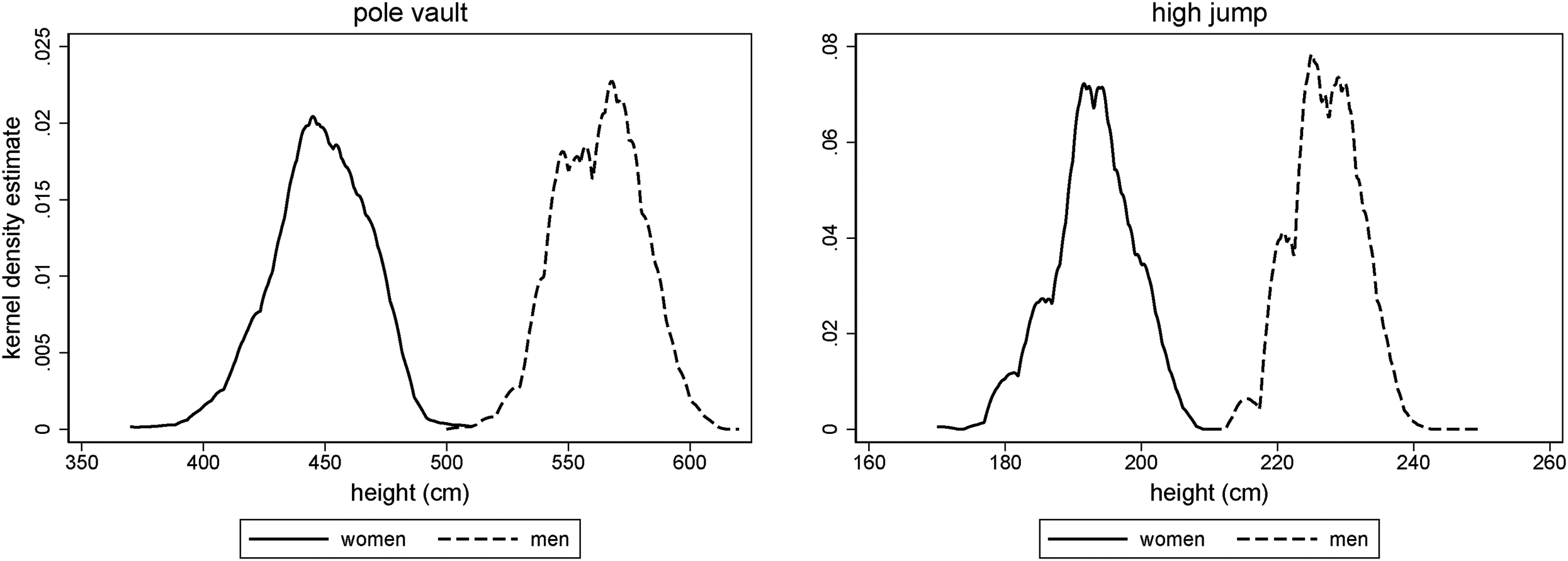
Kernel density estimates for recorded maximum height, by gender, and discipline.
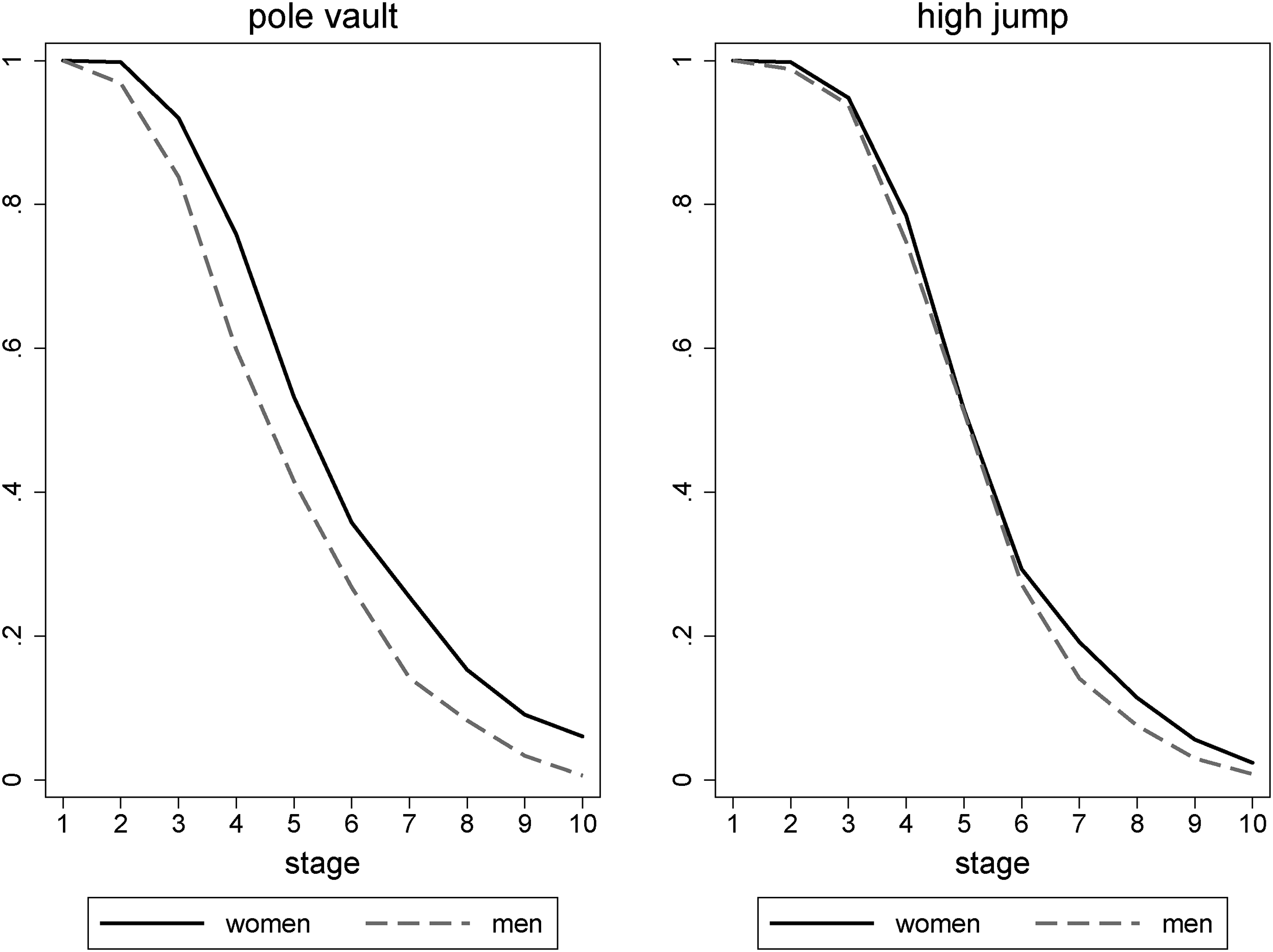
Survival graphs by gender and discipline.
About half of the attempts or passes, 49.2%, are from female athletes. About 18.2% of all observations are pre-reform. Of all attempts, about 7% are passes (a total of 879 observations). The first descriptive evidence for our data is presented in Figure 2. The graph shows that, for each gender, risk-taking levels in high jump and pole vault were almost identical before the reform. This is not surprising, as both forms of competitions are highly similar in terms of procedure and their prestige in athletics competitions. Risk taking in the pole vault increased after the reform. However, this increase was only temporary for female athletes, while male athletes appear to have permanently increased risk taking. Table A.1 presents more detailed descriptive statistics.
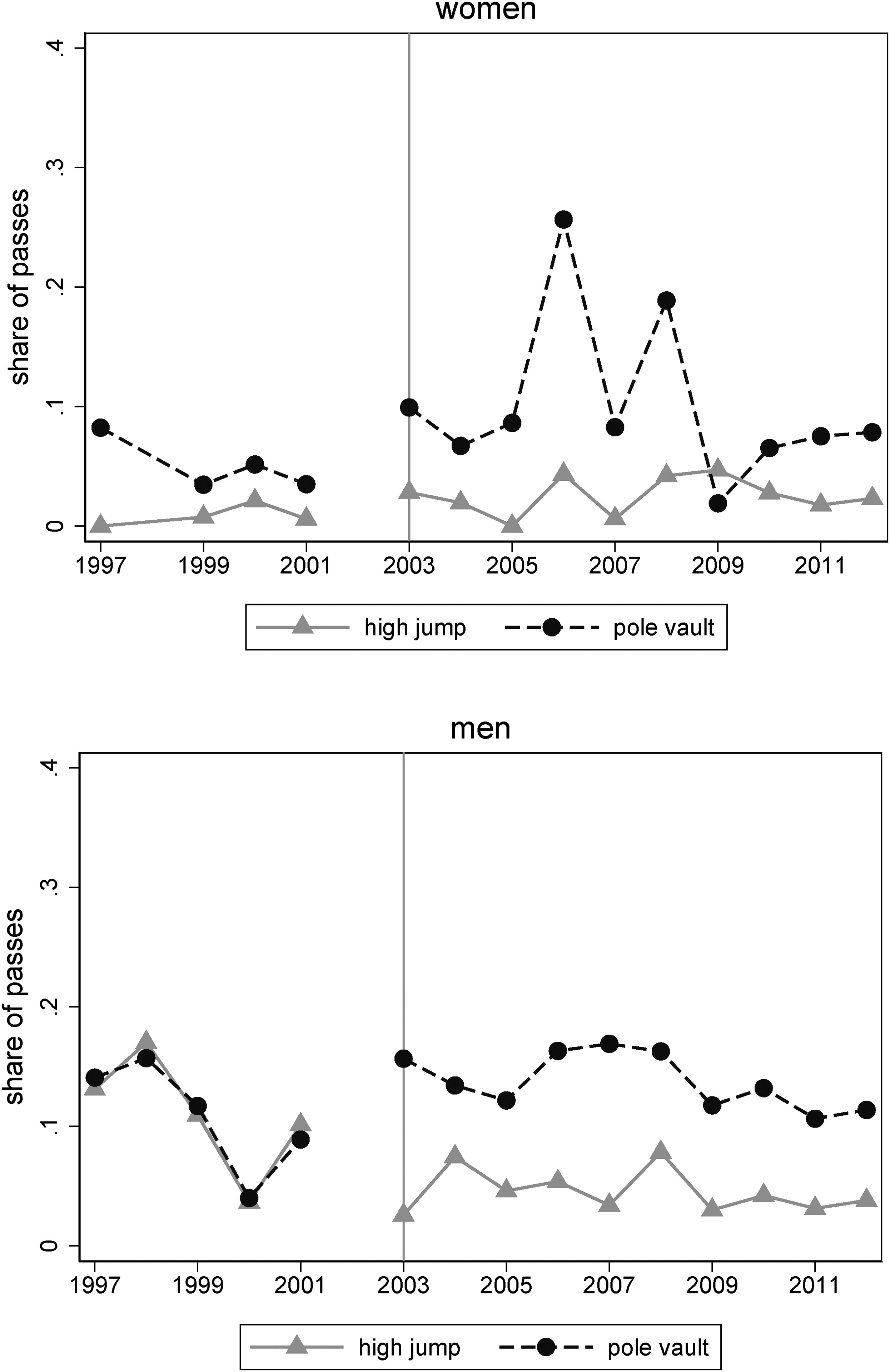
Risk-taking before and after the 2003 reform, by gender.
The central assumption for our empirical approach is the assumption that the risk-taking of athletes in the pole vault (treatment group) and in the control group (high jump) is similar in the absence of the reform (“parallel trends”). In addition to the graphical evidence presented in Figure 2, we estimate an empirical model that includes a trend, similar to an event-study specification. The results are presented in Table A.2. The estimates for the two pre-trend coefficients
We estimate the following difference-in-difference model:

Results
Table 1 presents the results for estimating equation (1) using different samples, stratified by gender, and discipline. 4 Using a full set of controls, we estimate an average treatment effect of an about 6.4 percentage points greater incidence of risk-taking due to the reform. Note that the mean of the dependent variable is about 7%, i.e., this is a large effect. The results of the specifications with and without controls do not differ qualitatively. If we estimate the equation separately for female and male athletes, we estimate an ATE of 3.5 percentage points for female and of 8.8 percentage points for male athletes. The difference between the point estimates for women and men is significant at the 10% (reduced model) and 5% (full model) level.
Estimated Effect of the Reform on Risk-Taking.
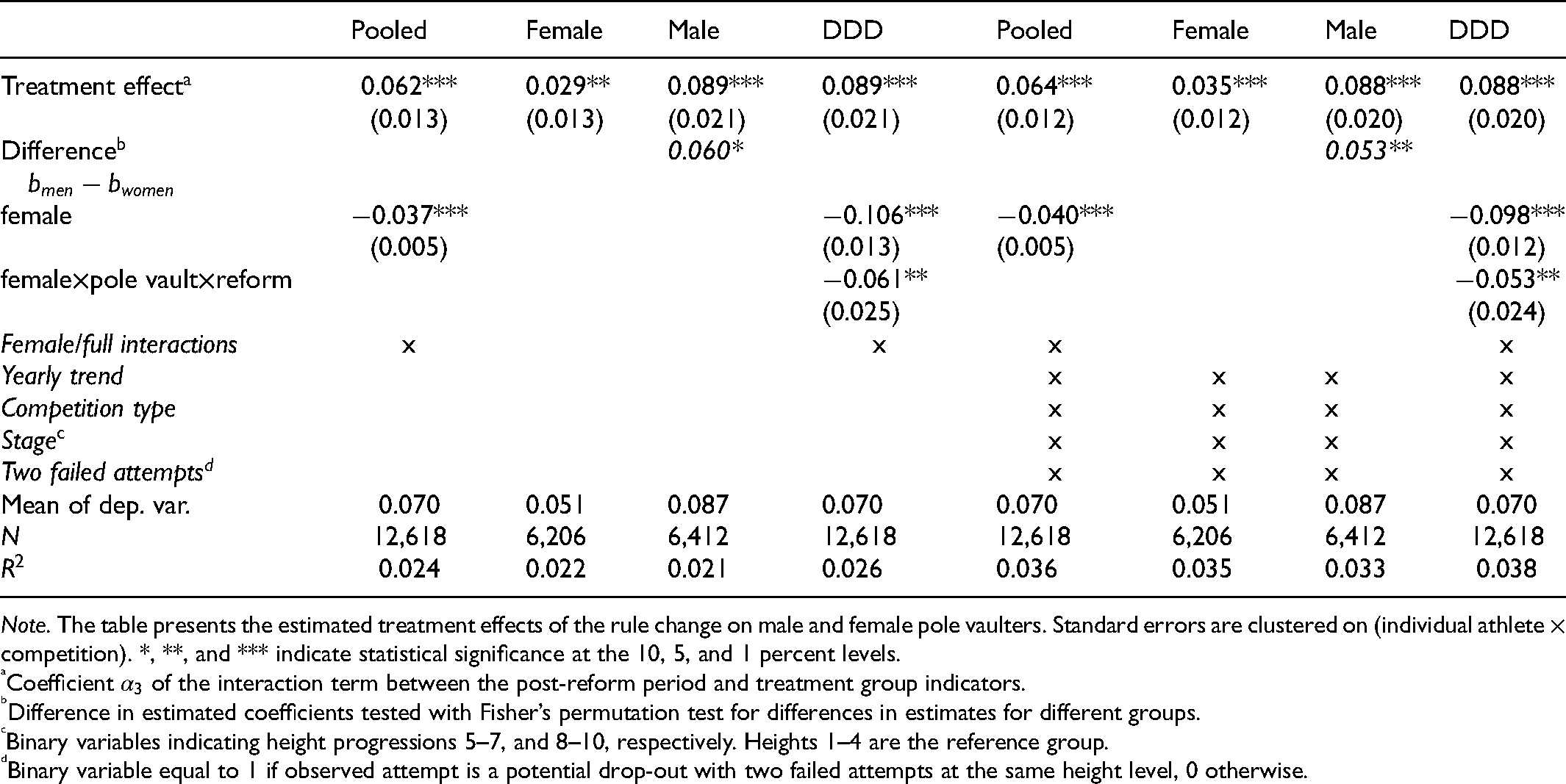
Note. The table presents the estimated treatment effects of the rule change on male and female pole vaulters. Standard errors are clustered on (individual athlete
Coefficient
Difference in estimated coefficients tested with Fisher’s permutation test for differences in estimates for different groups.
Binary variables indicating height progressions 5–7, and 8–10, respectively. Heights 1–4 are the reference group.
Binary variable equal to 1 if observed attempt is a potential drop-out with two failed attempts at the same height level, 0 otherwise.
In order to quantify the difference in the reaction to the reform of female and male athletes, we estimate two specifications where we pool the data on men and women (“difference-in-differences-in-differeces”). The pooled specifications include an interaction of three binary indicators, “DDD-interaction”, the interaction of the indicator of whether or not the observation is post-reform or not, is from the treated group (pole vault) or not, and if it is from a women or not. The coefficient on the DDD-interaction provides an estimate of the difference in risk-taking by female athletes in pole jumps that was induced by the reform. The results are presented in columns (4) and (8) of Table 1. For the full model specification (column (8)), we estimate a negative coefficient of
To analyze the dynamic effects over time for different periods after the reform, we use an alternative specification of equation (1), where we replace the post-treatment indicator with several indicators to distinguish between immediate, short-term, and mid-term effects. We use different indicators for the years 2003 and 2004 (
Estimated Post-Reform Effects.
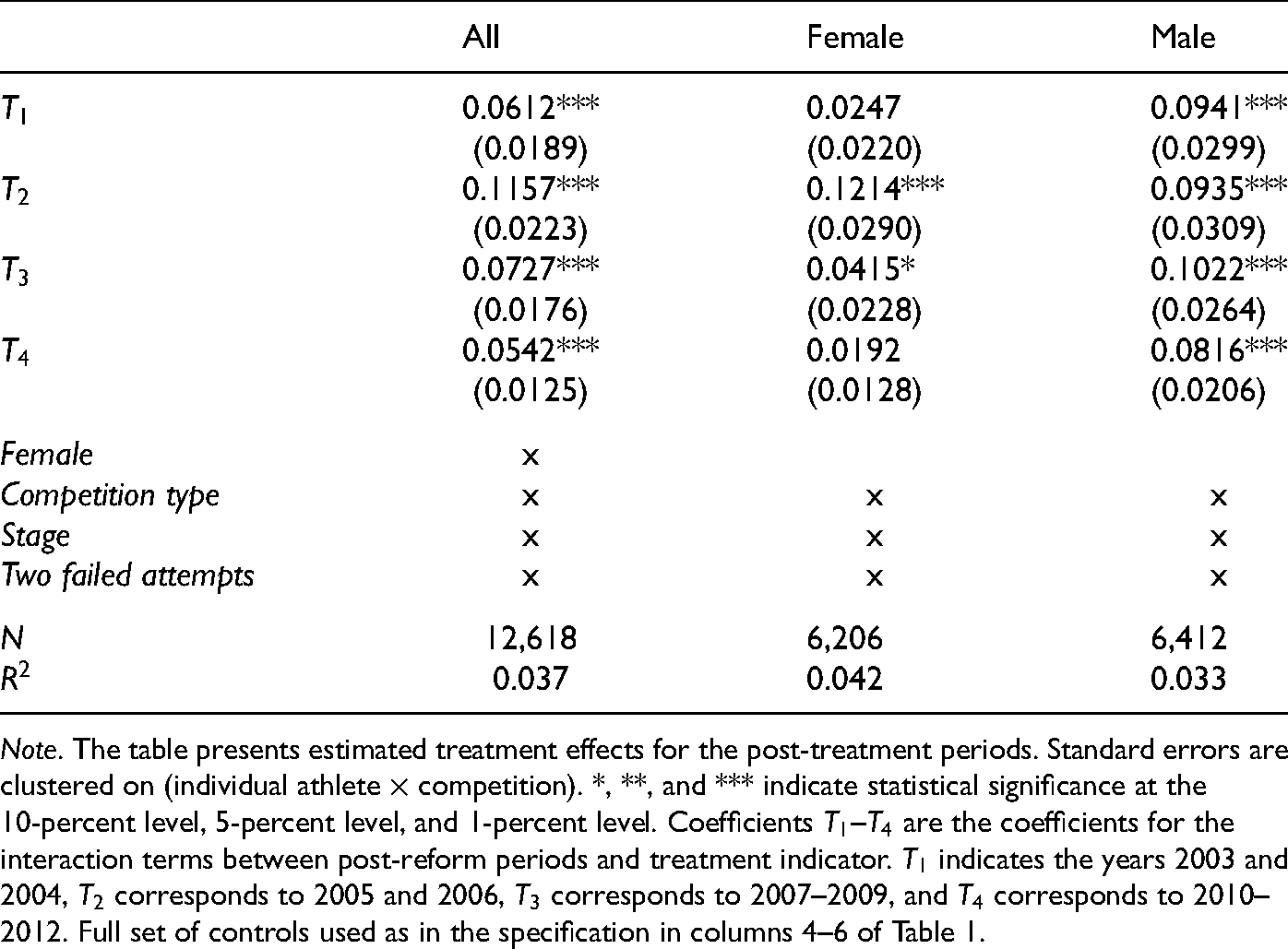
Note. The table presents estimated treatment effects for the post-treatment periods. Standard errors are clustered on (individual athlete
When we split the sample by gender, we obtain a different pattern for men and women. Female athletes did not initially (
Performance
In the first part of our empirical analysis, we presented evidence in favor of an increase in risk-taking due to the 2003 reform. However, we know little about the effects of the reform—and the resulting increase in risk-taking—on overall success. The empirical literature on gender differences in risk-taking or competitiveness typically raises interest in the consequences of gender differences in preferences or beliefs. For example, Barber and Odean (2001) stress that excessive risk-taking by men harms their overall performance. Also, Niederle and Vesterlund (2007) conclude that men compete too much. One problem of studies that use field data to study this relationship is the difficulty of establishing a link between risk-taking decisions and subsequent success. Our setting provides an ideal opportunity to analyze the consequences of risk-taking on success.
We demonstrate this by an analysis of the athletes’ performances distinguishing between failed and successful attempts. For this second part of our analysis, we use all attempts and exclude all passes. This leaves us with a total of 14,700 attempts that either result in a fail or clear. Figure A.2 in the Appendix illustrates the evolution of failed attempts over time for high jump and pole vault competitions and both genders. Figure A.2 suggests that the relative share of failures in pole vault competitions increased after the reform, for both men and women, while the relative share of failed attempts remained fairly constant in high jump competitions. We estimate a modified version of equation (1) where we use a binary dependent variable which has a value of 1 if the observed attempt is a fail, 0 if it is a success. We include an interaction term of the treatment effect and a binary indicator for attempts that directly follow a pass, after pass:
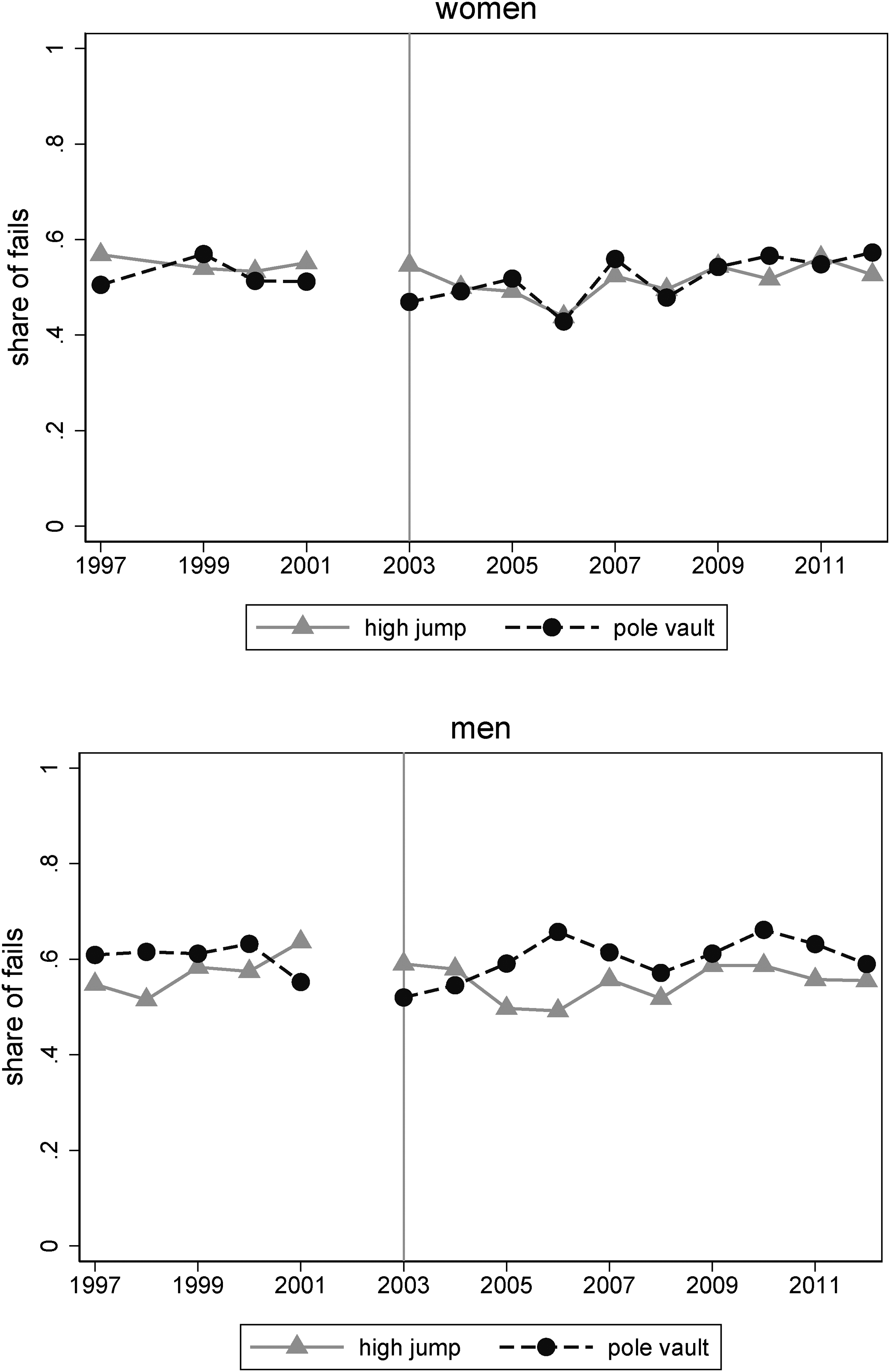
Fails after passes before and after the 2003 reform.
Effect of the Reform on Failed Attempts.
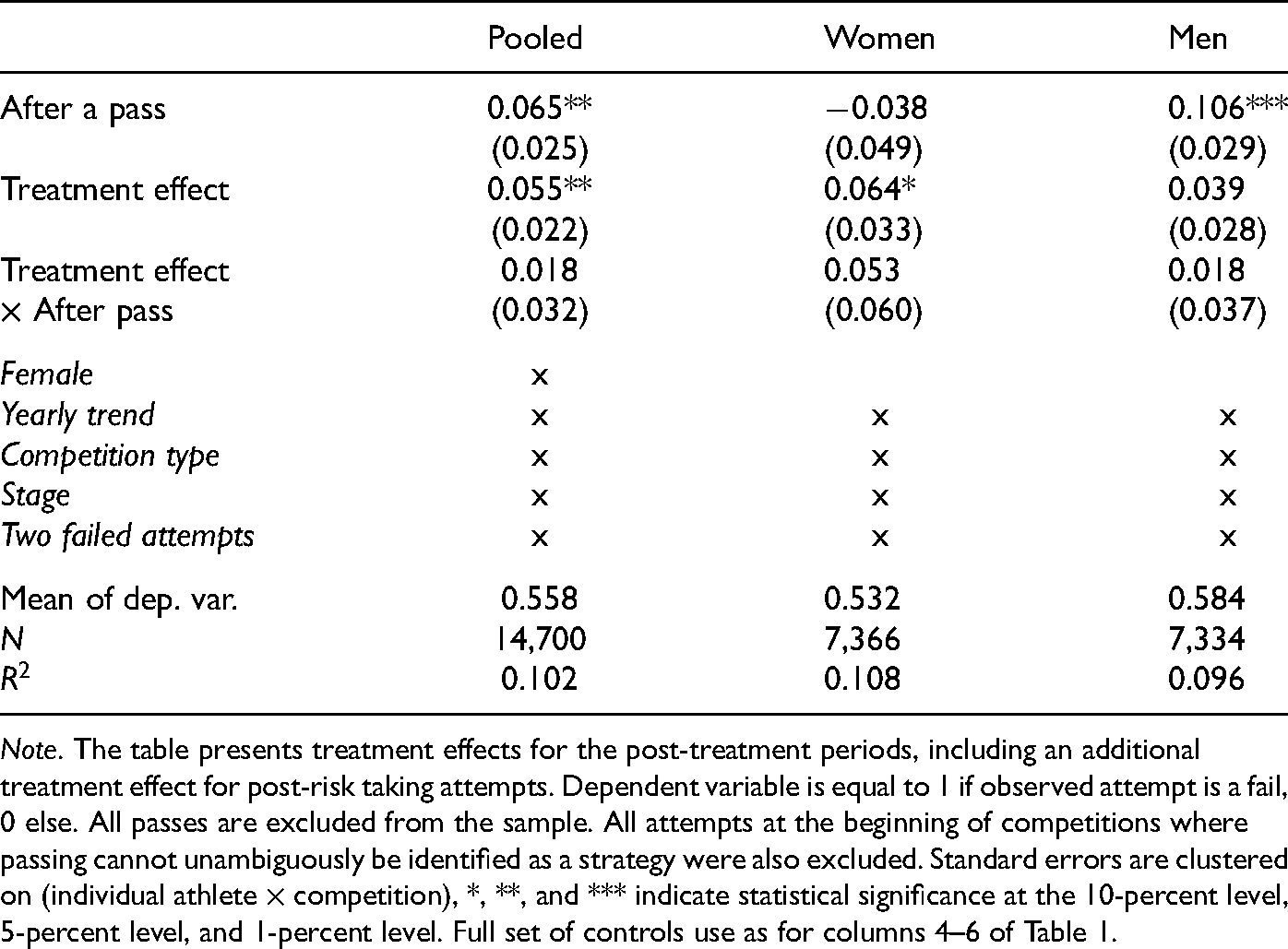
Note. The table presents treatment effects for the post-treatment periods, including an additional treatment effect for post-risk taking attempts. Dependent variable is equal to 1 if observed attempt is a fail, 0 else. All passes are excluded from the sample. All attempts at the beginning of competitions where passing cannot unambiguously be identified as a strategy were also excluded. Standard errors are clustered on (individual athlete
We estimate that men in general seem to perform worse on attempts directly following a risky pass, which can be interpreted as excessive risk-taking or overconfidence (Moore & Healy, 2008; Grieco & Hogarth, 2009; Fellner & Krügel, 2012; Krawczyk, 2012). This is not the case for female athletes.
The coefficient on the interaction between the treatment variable
Since the reform did not increase fails after passes for women, but increased fails overall, they could have lowered the number of attempts (and the number of fails) by taking by passing more often. In contrast, mens fail rates did not change due to the reform. The results presented in Table 3 suggest that women’s performance in the post-reform period did not improve. The estimated coefficients of a specification similar to the one presented in Table 2, but where we use failures as the dependent variables and interactions of period indicators and the treatment indicator yields insignificant coefficients for
Conclusion
We analyze the reactions of top-level athletes in high-stakes competitions to an exogenous shock in the incentive structure. A rule change for the pole vault in 2003 made clearing any height more difficult. We interpret a pass as a risky strategy and estimate the reactions of male and female athletes to this change. As the pole vault and the high jump are almost identical in terms of formats and the set of possible strategies, we use attempts in height jump competitions as control observations for attempts in pole vault competitions.
The 2003 reform influenced the incentives for choosing risky strategies. In particular, the probability of fails increased, which increased the incentive to reduce risk-taking. In contrast, the incentive to lower the number of attempts increased, making risk-taking more valuable. This is due to the fact that a slightly flawed attempt will be more likely to result in a fail after the reform. Consequently, athletes feel a more pronounced tradeoff between the greater difficulty of an attempt and the incentive to lower the number of attempts by passing on certain heights.
Using a difference-in-differences approach, we find that male professional athletes changed their risk-taking behavior. After the reform, male pole vault athletes increased risk-taking and continue to take more risk in the following years. We estimate that the probability of a fail after a pass did not change for male athletes after the reform. This suggests that although male athletes overall increased risk-taking, their risk-taking is not due to male overconfidence. The robustness of these results is demonstrated by a DDD-approach which indicates similar differences between male and female athletes.
In contrast, female athletes increased risk-taking after the reform only for a short period, starting about two years after the reform. After this temporary increase, risk-taking returned to pre-reform levels. We estimate that the reform resulted in a greater probability of a failed attempt for female athletes. We interpret this last result as the consequence of female athletes not avoiding the more difficult attempts by passing more often. The probability of a failed attempt did not change for male athletes who did increase risk-taking after the reform.
Our results suggest that the gender gap in risk-taking increases in the riskiness of decisions. This has strong implications for a multitude of different settings. In a corporate environment, we might expect that male employes will permanently increase risk-taking if associated incentive structures for risk-taking are changed. In an investment firm, for example, male traders could permanently increase risk-taking if their compensation is linked to their performance relative to co-workers. According to our results, we do not expect such a change from female traders.
An unobserved factor which could be important for the athletes’s decisions is the gender of the coach. Coaches could have a crucial influence on the risk-taking decision. As most coaches in the pole vault are men, the estimated effect for female athletes is an upper bound. Controlling for the coach’s sex should lead to lower estimates if risk and the coaches’s sex are positively correlated.
We estimate an average gender gap in risk-taking which is about twice as large as the effect estimated by Böheim and Lackner (2015). We explain this larger gender gap by the different periods and the different types of competitions which were used for the construction of their sample.
Footnotes
Acknowledgments
We are grateful for funding by the Austrian National Bank, project number 16242. Thanks to Alexander Ahammer, Dominik Grübl, Simone Häckl, Rudolf Winter-Ebmer, Christine Zulehner, Matthias Fahn, participants of the NOeG 2017 and ESPE 2017 conferences, as well as two anonymous referees for valuable comments.
Declaration of Conflicting Interests
The authors declared no potential conflicts of interest with respect to the research, authorship, and/or publication of this article.
Funding
The authors declared the following potential conflicts of interest with respect to the research, authorship, and/or publication of this article: This work was funded by the Austrian National Bank, project number 16242.
