



Abstract
While COVID-19 has disproportionately affected U.S. Hispanic/Latino communities, research on the impacts of the pandemic is complicated by multiple systemic, historical, and individual-level factors that suppress these groups’ participation and response rates. COVID-19 vaccination is one public health tool available to mitigate the health risks, yet vaccination rates are lower than desired, prompting a critical need to understand perceptions related to COVID-19 vaccines. We report on recruitment approaches used within a larger community initiative to understand the local Hispanic population’s perceptions of COVID-19 vaccines and how these can inform health message design. Based on the PEN-3 model, and communication infrastructure theory focused on engaging Hispanic individuals for health-related research, our team enacted a multifaceted strategy to recruit participants for focus groups and a larger-scale survey to explore beliefs, attitudes, values, and perceptions of the COVID-19 vaccines as well as test vaccination messages. Meso-level agents such as community partners served as enablers in recruiting participants and offered us spaces to interact with potential participants, thus serving as communication hotspots. Micro-level agents played a key role of positive nurturers in helping participants navigate the survey by providing digital literacy support. We report on specific strategies used and challenges faced in the recruitment process. Theoretical and practical implications are discussed.
Keywords
Since 2020, COVID-19 has claimed over a million lives in the United States, with a disproportionate impact on racially and ethnically minoritized groups. Vaccinations are a centerpiece of public health strategies against COVID-19 in the United States, and significant resources are allocated to boosting vaccination rates. During the early pandemic (2020–mid-2021), lower vaccination rates in Hispanic communities led to higher COVID-19 infection, hospitalization, and mortality rates compared with Whites across the United States. In Texas, Hispanics comprise about 40% of the population; COVID-19 morbidity was high. Hispanics were 1.8 times more likely to be hospitalized and 1.7 times more likely to die from COVID-19 than non-Hispanic Whites (Centers for Disease Control and Prevention [CDC], 2020).
Lower vaccination rates among racial and ethnic minority groups are attributed to a combination of structural barriers and vaccine hesitancy (Nan et al., 2022). Social and cultural determinants of health, including barriers to health care, a lack of timely and accurate health information, systemic economic and social exclusion, plus cultural mismatches in public health campaigns, play a role in exacerbating the pandemic’s impacts on Hispanic communities (Salgado de Snyder et al., 2021).
Project Overview
This 3-year project was designed to mobilize partners and collaborators to advance health equity and address social determinants of health related to COVID-19 health disparities among Hispanic populations in an urban county in Texas. The goal was to boost adherence to public health measures—including vaccination—by building community trust through targeted messaging and the involvement of community partners with strong bonds to the Hispanic population.
We explored population-level attitudes and beliefs about COVID-19 within Tarrant County’s Hispanic community. We first conducted focus groups, allowing us to identify constructs for surveys tracking participants’ exposure to vaccine-related information, reaction to campaign messages, knowledge, perceptions, attitude toward vaccines, and vaccination decisions. The project, identified as a “community project” under CDC funding categories, was deemed exempt by the Institutional Review Board (IRB).
Theoretical Frameworks Used for Community Health Interventions
To center culture in our recruitment we considered the PEN-3 cultural model (Airhihenbuwa et al., 2020) along with communication infrastructure theory (CIT; Ball-Rokeach et al., 2001). These frameworks informed our understanding of the impact of the local communication context driving health knowledge, attitudes, behaviors, and cultural perspectives regarding COVID-19 vaccinations.
The PEN-3 Model
The PEN-3 model is used in the design, implementation, and evaluation of culturally tailored public health interventions, including HIV/AIDS prevention (Orrego Dunleavy et al., 2018), HPV vaccination campaigns (Iwelunmor et al., 2014), and developing COVID-19 prevention interventions (Zhou et al., 2022). The model consists of three dimensions, each encompassing three factors: cultural identity (person, extended family, neighborhood); relationships and expectations (perceptions, enablers, nurturers); and cultural empowerment (positive, existential, negative).
In PEN-3, cultural identity is the social contract or logic guiding people’s perception of risk, decision-making, and behavior (Airhihenbuwa et al., 2020). During the COVID-19 emergency in the United States, the individual perception of risk was privileged over community risk, whereas, in China, both individual and community risk were managed with a range of quarantine practices (Airhihenbuwa et al., 2020). Cultural identity facilitates the location of entry points of intervention in a community; we employed this concept to locate culturally relevant physical and digital spaces to recruit participants. Relationships and expectations include perceptions, attitudes, social and societal resources, as well as family influence on health behavior. Identifying enablers (community and structural factors) and nurturers (factors in one’s social network that reinforce health behavior) may aid in promoting equity in a community (Airhihenbuwa et al., 2020). Cultural empowerment encompasses positive, negative, and existential beliefs and practices related to an intervention (Iwelunmor et al., 2014).
Factors Affecting Latino Recruitment
The relationships and expectations dimension of the PEN-3 model allows accounting for attitudes, social resources, and influences of family in promoting or discouraging participation. The cultural dispositions of familismo and personalismo are inhibitors or potential boosters of Hispanics’ participation and retention in research and health interventions (Davis et al., 2011; García et al., 2017). Familismo is conceptualized and measured in various ways, including family solidarity, family integration, and intergenerational solidarity (Adames et al., 2014; Moyce et al., 2022). A study found Hispanic immigrants in rural areas relied on family and friends over professional help for mental health support (Moyce et al., 2022). Personalismo emphasizes interpersonal bonds, with informal, supportive interactions favored over formal and professional interactions (Davis et al., 2019; Kelley et al., 2020). Higher personalismo is observed in female Latino participants, regardless of age (Davis et al., 2011).
CIT
CIT posits community members rely on communication systems to meet information needs, with residents of communities reporting more robust communication infrastructures having more positive social outcomes and improved health behaviors (Wilkin, 2013; Wilkin et al., 2015). Infrastructures consist of storytelling systems and the communication action context in which these operate. Storytelling systems include micro-, meso-, and macro-level agents, which produce and disseminate information (Wilkin et al., 2011). Micro-level agents operate along interpersonal networks, meso-level agents are community-based media and organizations, and macro-level agents include larger institutions and organizations with the “capacity” to tell stories to broader audiences. The communication action context comprises features of residential environments which may facilitate (or hinder) access to communication resources (Wilkin et al., 2011).
Public spaces play an important role in communication infrastructures. Latina women reported discussing health issues in parks, restaurants/coffee places, businesses, and churches (Burgess et al., 2021; Moran et al., 2016). These places are comfort zones where people feel closely connected (Wilkin et al., 2011) and are communication hotspots for interaction and information exchanges. The micro-, meso-, and macro-level agents in a storytelling system serve as conduits for social resources, shaping individual and community perceptions of health beliefs and intervention participation. Familiarity with the local communication action context facilitates the identification of enablers (structural and community factors) of recruitment (Wilkin et al., 2011). Recruitment strategies failing to account for cultural characteristics like personalismo and familismo, alongside general study exclusion criteria, result in lower than desirable minority participation in health-related research (Kelley et al., 2020). Aiming to address a lack of comparative studies among different engagement strategies among ethnic minorities (Wieland et al., 2021), our goal is to examine and reflect upon different engagement strategies used in our project by posing the following research questions:
RQ1: How do cultural identity, relationships and expectations, and cultural empowerment play a role in (a) focus group and (b) survey recruitment strategies for COVID-19 communication research in Hispanic populations?
RQ2: In what ways can micro-, meso-, and macro-level agents help in (a) focus group and (b) survey recruitment strategies for COVID-19 communication research in Hispanic populations?
Methods of Recruitment Strategies
Reflexivity and Inclusivity
Two of the authors and the trained student assistants are bilingual English Spanish speakers who identify as Hispanic and can culturally relate to the perspectives of some participants.
Focus Groups
We recruited participants at a community event sponsored by a large Hispanic-owned retail business, located in a Latino shopping mall. The company reflects a strong Hispanic cultural disposition in its branding and community relations; it distributes Spanish-language marketing materials and engages extensively with Latino community organizations. During the recruitment period (fall 2021), Spanish-speaking faculty and trained student assistants wearing university-branded shirts approached visitors during a holiday giveaway event and invited them to participate in the focus groups. Team members shared information including the topic (perceptions of COVID-19 vaccines), the location (nearby furniture store with a primarily Hispanic and immigrant customer base) and compensation ($25 gift card for participation). Participants could attend one of six 1-hour focus groups during a 1-week timeframe and received copies of the informed consent document in their preferred language (English or Spanish).
Survey
The second stage of the project consisted of an online survey. People who identified as Hispanic or Latino, were older than 18 years of age, and stated that they live or work in the metropolitan Texas county under study were eligible to participate. The survey was offered in both English and Spanish.
To recruit, the team (including faculty and student assistants) conducted outreach through four channels: offline flyers, community events, community organizations, and interpersonal connections. These correspond to the relationships and expectations dimensions of the PEN-3 model, comprising social and community resources (Iwelunmor et al., 2014). Spanish and English-language flyers were created with a focus on short phrasing, not requiring advanced reading levels, a visually appealing design (García et al., 2017) and included survey URL and QR codes. Spanish-speaking student assistants canvassed the county, posting more than 400 flyers in communication hotspots including restaurants, laundromats, hair salons, grocery stores, libraries, clinics, and churches. Locations were selected based on team members’ lived experiences, the 2020 U.S. Census Bureau’s (2020 Census Demographic Data Map Viewer, n.d.) interactive data map viewer, and extant research.
Second, the project team joined community events (e.g., a continued entry point). The events, hosted by local businesses and organizations, included health fairs in apartment complexes, community events in malls and large-scale Independence Day celebration that hosted more than 35,000 visitors. The project team provided iPads for on-site survey completion; participants could also use their phones. Participants received a physical gift card on-site or could take a flyer (in Spanish or English) to complete the survey later and receive the gift card via text/email.
Third, we directly reached out to businesses and community organizations to ask for help distributing survey information. Participating organizations included the retail store, a health care provider, a local chamber of commerce, and a Hispanic real estate broker association. Community partners used online and offline means to disseminate survey information, including mentioning the survey to clients and posting the survey information in their online newsletter or social media, thus serving as enablers of recruitment (Iwelunmor et al., 2014). One local business allowed us to place survey flyers in free back-to-school community distributions. These types of social network interventions deployed via meso-level agents show promise in promoting health behaviors and outcomes (Hunter et al., 2019).
Fourth, we employed student assistants to reach out to qualified participants via their personal connections, including their families, peers, and colleagues (García et al., 2017), who served as nurturers of participation. We tracked the reach of the different recruitment channels using custom QR codes in flyers.
Results
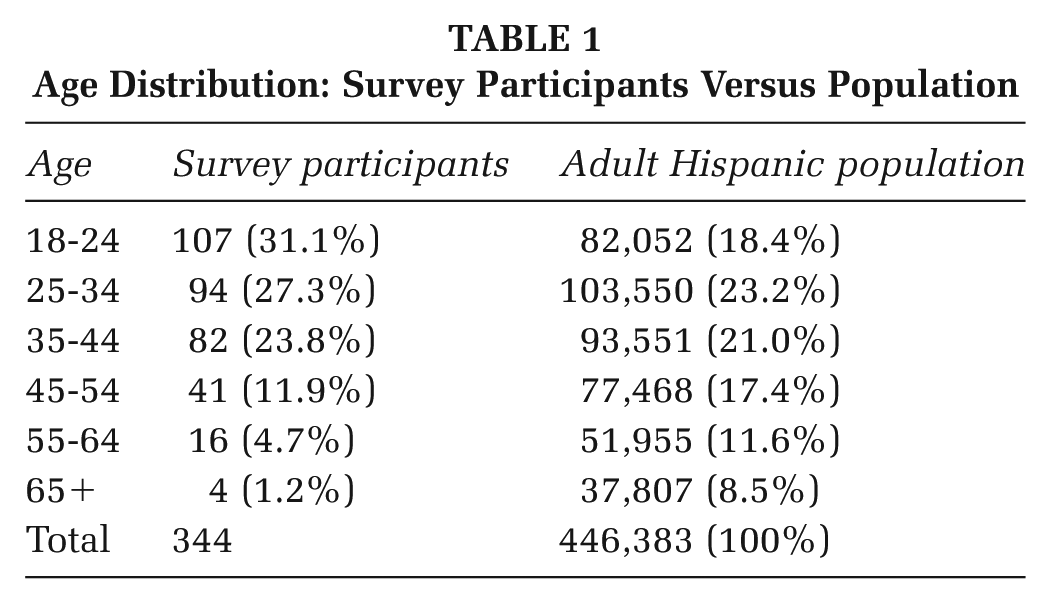
RQ1 and RQ2 examined the PEN-3 model concepts and micro-, meso-, and macro-level agents’ roles in focus group and survey recruitment. The large business served as a positive enabler by allowing us to recruit face-to-face for the focus groups resulting in 68 participants signing up. Direct follow-up via phone calls and text messaging helped remind participants, although only 32 participants completed the focus groups (eight male; 24 female). The online survey received 584 responses. Among them, 74 were identified as spam entries (mostly from outside the United States) and excluded from analyses. The remaining 510 entries formed the basis of our analysis. With 344 completed the survey, the completion rate is 67.5%. Among respondents of completed surveys, 76% indicated they had received at least one dose of COVID-19 vaccine. Among those who started the survey and provided vaccination information but did not follow through, 75% reported having received at least one dose of COVID-19 vaccine. Comparing with the adult Hispanic population in the Texas county under study (U.S. Census Bureau, 2022), survey participants included a larger portion of young people (age 18–24) (See Table 1). The gender ratio of the studied population was more balanced (49.5% females, 50.4% males) than that of the survey participants (74.4% females, 24.7% males).
Age Distribution: Survey Participants Versus Population
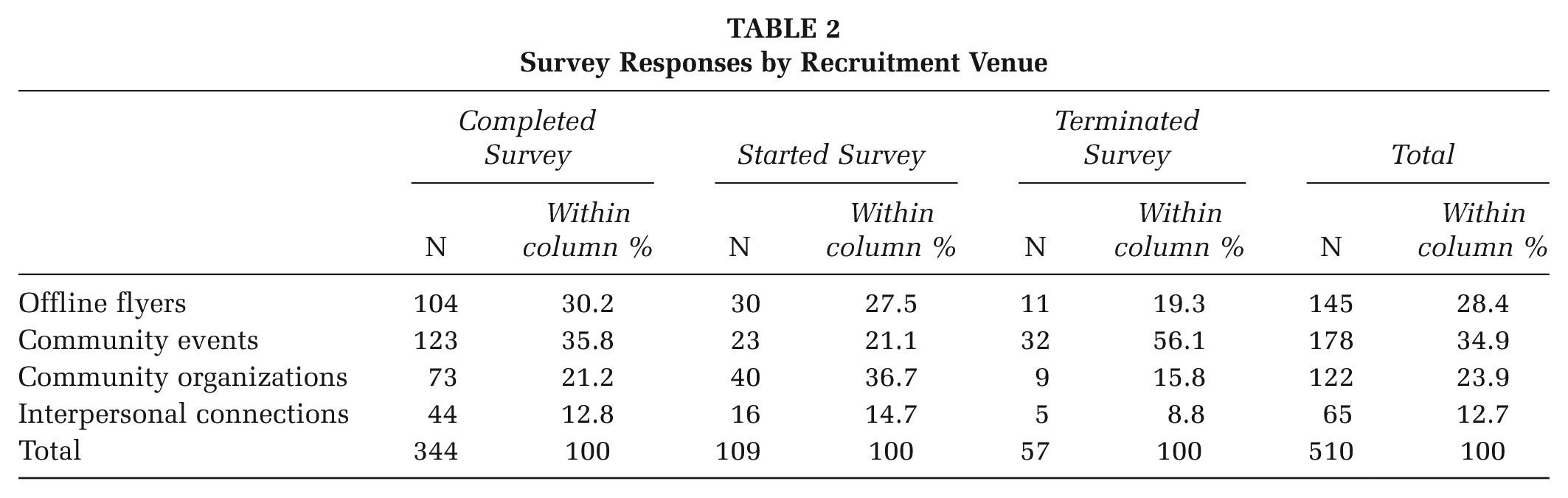
Both dimensions of the PEN-3 model, and members of the local storytelling networks were helpful in recruiting participants. Survey responses by recruitment venues are presented in Table 2, which suggests meso agents like businesses and groups who allowed flyer posting, community events, and direct outreach from community partners served as enablers for the recruitment. Interpersonal connections, as micro-level agents, served as positive nurturers and accounted for the remainder of the recruitment.
Survey Responses by Recruitment Venue
There were notable gender differences in survey participation. Among completed surveys (N = 344), 74.4% (n = 256) were from female participants and 24.7% (n = 85) from males. The remaining 0.9% (n = 3) of completed surveys were participants identifying as transgender or who chose to not identify. The recruitment venue breakdown by gender is reported in Table 3.
Completed Survey: Recruitment Venue by Gender (N = 344)
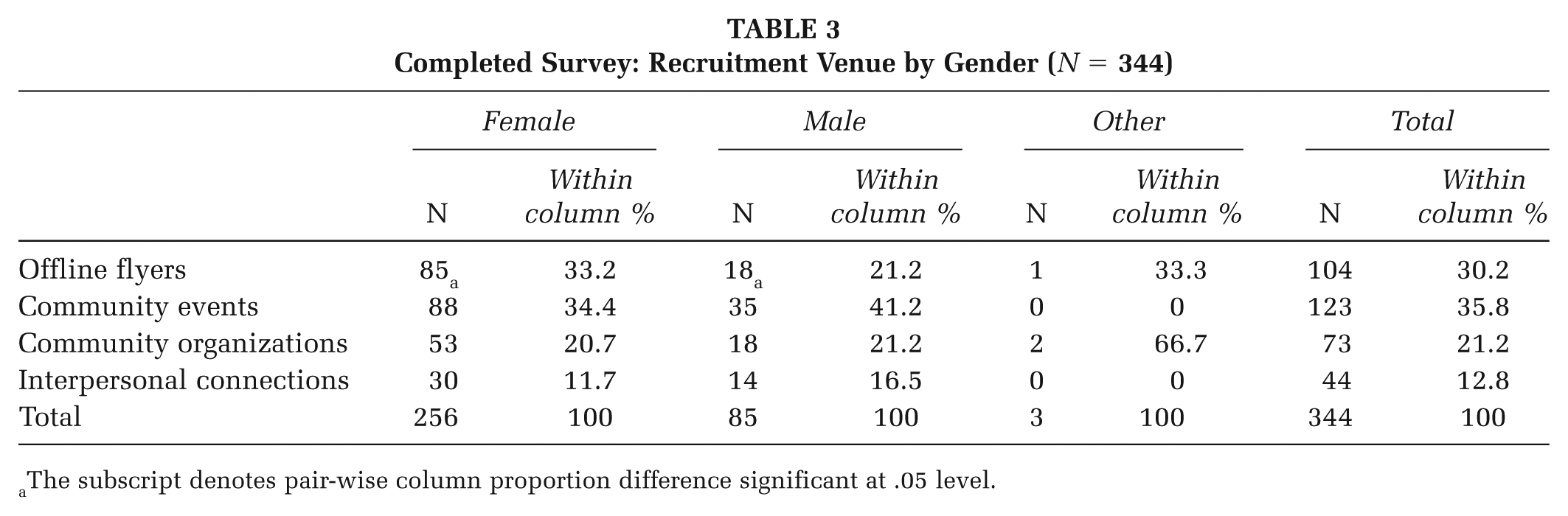
The subscript denotes pair-wise column proportion difference significant at .05 level.
Pair-wise column proportion z-tests show statistically significant proportion differences in female and male participants’ responses to offline flyers. Compared with surveys from male participants, a larger portion of female-completed surveys could be traced back to offline flyers.
Discussion
Recruitment Efforts for Focus Groups
Positive Enablers Serving as Communication Hotspots
Initial focus group recruitment efforts were achieved at the individual (interpersonal) level at a large retail center known for its involvement in the Hispanic community. Although 68 individuals initially signed up, less than 50% of potential participants eventually took part in the focus groups. Given the attrition rate we were able to recruit participants on-the-spot to increase numbers. This was a personnel-intensive practice to recruit on a conversation-by-conversation basis, as noted previously (García et al., 2017).
Focus groups were held at a dining set in the furniture store, a familiar community hotspot known for hosting community engagement activities such as turkey drives, vaccine clinics, and backpack giveaways. Our findings support previous observations of how retail centers, as communication hotspots, may facilitate information-sharing activities potentially influencing people’s health (Burgess et al., 2021; Moran et al., 2016).
Barriers Posed by Negative Perceptions
We struggled to retain some participants when providing the consent form before the focus groups. The forms, translated by the university translation center, used the Spanish term “experimentaría” which was intended to refer to experiencing everyday activities. Participants responded negatively, interpreting “experimentaría” as experimenting (on) and not experiencing. Understanding negative perceptions of a word choice is part of the cultural empowerment dimension of PEN-3 and must be addressed in future studies. Student assistants, who conducted the focus groups in Spanish, diligently explained that no shots would be given—which was a voiced concern—and that the study was not an experiment. Ultimately, three individuals refused to participate due to this word choice. These challenges are not unheard of (Grady, 2015); those engaging in community-focused initiatives should be cognizant about the feelings of institutional distrust among Hispanic populations and refine the language in documentation to ensure cultural understanding.
Recruitment Efforts for Surveys
Barriers and Facilitators of the Communication Action Context
Echoing previous research, direct recruitment efforts in community events were the most productive in boosting the number of surveys (Kelley et al., 2020), with over a third of completed surveys coming from this type of outreach (n = 123). The effectiveness of each event varied, with scale and physical environments as decisive factors. Some events were held indoors, in small areas with little room for participants to sit at an iPad station and take the survey. Other events had distractions (e.g., high levels of noise, being in the presence of friends, having children present). Some participants faced struggles such as a lack of understanding of survey questions, difficulty navigating iPads, and a reluctance to seek help. At least one member of the team was available to help participants overcome technical issues and misunderstandings as they completed the questionnaires; the project team members served as positive nurturers of survey participation. These issues are reflective of the impacts of communication action contexts, that is, environmental features that hinder or facilitate access to communication resources (Wilkin et al., 2011).
Team members observed participants struggling with survey navigation, suggesting limitations in digital literacy among our participant group. Digital literacy, the ability to use technology to understand and communicate information, is crucial for eHealth literacy—the skills to find, evaluate, and apply electronic health information (Chesser et al., 2016). Factors such as age, education, income, and culture contribute to low eHealth literacy, especially in underserved populations (Chesser et al., 2016). Limited digital literacy may serve as a negative enabler by keeping these communities from engaging in health research and policy development via electronic tools.
As in research informed by CIT (Wilkin et al., 2011) and the PEN-3 model (White et al., 2012), community organizations acted as primary storytellers, sharing information about our project to local networks through both interpersonal and mediated channels. Events like back-to-school giveaways and health fairs helped directly engage with participants; our most successful recruitment occurred at a large-scale Mexican Independence Day celebration. Positioned in a high-traffic, limited-distraction area near one of the mall entrances, we set up seven branded iPad stations and engaged passersby, who responded positively to our university affiliation as a Hispanic-Serving Institution. We provided water and snacks, allowing children to sit nearby while parents completed the survey. Community events also brought in more than half of disqualified participants (n = 32). As the project team participated in various events, the flyers were continually updated (e.g., different verbiage, various designs) to reduce eligibility criteria misunderstandings. Clearer signage on qualification criteria may help reduce eligibility-related attrition.
After community events, offline flyers posted in communication hotspots were the second most effective way to recruit survey participants (n = 104). They had long lasting effects, contrasting previous research on Latino fathers’ involvement in child health studies (Lindsay et al., 2021). The latest survey entries from offline flyers were received up to 4 months after the flyers were posted indicating print media is a potent conduit for neighborhood storytelling. Data revealed a gender gap; a higher portion of female participants recruited through offline flyers compared with male participants. Two factors might contribute to this disparity. First, some flyer locations, such as hair salons, possibly see more female patrons. Second, Hispanic women might pay more attention to flyers than their male counterparts, as reported in a study on Hispanic men’s perspectives on weight management (Garcia et al., 2017). Future research could benefit from posting flyers in places with a larger proportion of Hispanic male visitors. Since women in Hispanic communities are gatekeepers of culture and tradition within their families (Fernández et al., 2020), future female participants should be encouraged to pass research information to male relatives.
As positive enablers of survey participation, local organizations and businesses helped recruit more than a one fifth (n = 73) of participants completing the survey; their outreach was done through online and offline channels (including staff referrals and outreach activities). A fraction (four of the 73 completions) was traced back to flyers on local organizations’ Facebook pages or electronic newsletters. Posts on two large-size, public-accessible Facebook groups resulted in a heavy volume of spam entries; social media did not serve as an enabler for recruiting participants for our project.
The role of gender and relative lack of participation from Hispanic men warrant attention. A female Hispanic student and a male Hispanic faculty member recruiting at large community events observed difficulties initiating discussions with men. If they were alongside their female partners, the women seemed to talk their husbands or boyfriends into taking the survey. When women agreed to participate, men were more likely to follow their female partner’s decisions and participate, thus serving as positive nurturers. The faculty member also noted that women had a higher tendency to seek the approval of their partner before agreeing to participate in the survey. This seemed to illustrate the impact of familismo on participation, as family members helped encourage each other to participate.
Implications for Research
Our project highlights the effectiveness of applying best practices from the PEN-3 model and CIT to engage Spanish-dominant Hispanic communities in an ethnically diverse metro area with unequal access to health care and health information (see Figure 1). Using these frameworks, we examined community-wide engagement in COVID-19 vaccination initiatives by tailoring recruitment strategies to PEN-3 dimensions and leveraging local storytelling networks. By integrating the PEN-3 model and CIT, we identified the importance of positive enablers like cultural capital (e.g., technological skills), micro-level community agents as nurturers, and meso-level agents and communication hubs (e.g., community agencies) in fostering participation in vaccination promotion efforts.
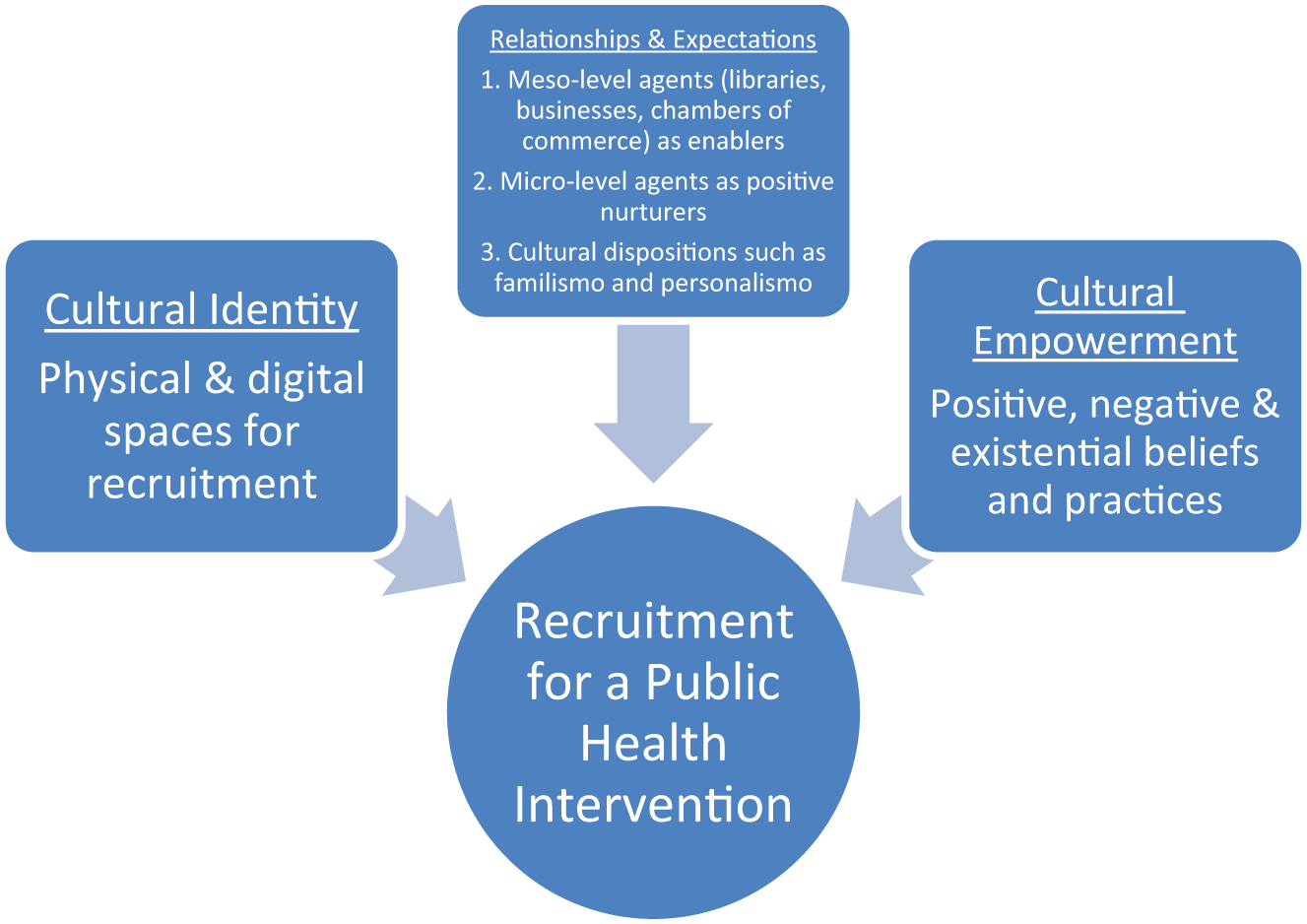
Theoretical Underpinnings of the Project
Implication for Practice
The study has two practical considerations. First, in keeping with observations of the importance of interpersonal interactions and the cultural value of personalismo (Adames et al., 2014), the use of face-to-face recruitment in a low-stakes setting is effective. Micro-level agents served as positive nurturers and played a seminal role in recruiting participants for both focus groups and surveys, including answering numerous questions about the project, the data, and the institutions participating in the study; this was critical in interactions with Spanish monolingual and middle-aged and older respondents. The presence of familismo also illustrated the importance of recruitment at community events attended by families and friend groups, given the role of close social networks in decision-making. Having Spanish-speaking student assistants and faculty members was key to navigating the nuances of the interpersonal interactions; micro-level agents played a pivotal role in aiding people with lower digital and health skills.
Second, building relationships with meso-level agents with a history of engagement with the target community—such as local businesses, libraries, and churches—is vital to spreading awareness and recruiting for community projects. Through these relationships, we were able to access local communication hotspots where our micro-level agents were able to operate. Beyond the physical infrastructure of the meeting place and the established credibility with the community, these agents also provide access to literacy resources (e.g., back-to-school backpacks). Partnering to improve digital literacy and health literacy specific to health issues like COVID-19 vaccinations are valuable endeavors.
Limitations
As noted previously, the focus group consent form contained a word that was confusing for participants. While the document was originally provided by the translation center at the university, and reviewed by bilingual faculty members, future research should also test such documents with a subsample of the population of interest. In addition, it is possible partners or family members of a household may have participated in the survey, therefore, we cannot make claims about independent observations. Other limitations of this study include the time and involvement from multiple parties, involving many hours in recruitment, transcription, coding, and interpreting. Similarly, given the specific context of our study, replication may be more challenging. Future research projects should consider how best to manage time, involvement, and replication.
Conclusion
On the ground, interpersonal and micro-level efforts in community hotspots were the most productive initiatives to recruit participants for focus groups and surveys. These efforts were valuable, given the boost in responses based on the work of dual-language student assistants. Our findings emphasize the critical importance of respecting and incorporating cultural needs, values, and practices in participant recruitment for community-based health projects.
Footnotes
Authors’ Note:
This project was supported by funds made available from the Centers for Disease Control and Prevention, Center for State, Tribal, Local and Territorial Support, under CDC-RFA-OT21-2103 National Initiative to Address COVID-19 Health Disparities Among Populations at High-Risk and Underserved, Including Racial and Ethnic Minority, 1 NH75OT000054-01-99.
Author Contributions
All authors contributed to the material preparation, data collection, and original draft editing. All authors read and approved the final manuscript.
ORCID iDs

Data Availability Statements
The datasets generated during and/or analyzed during the current study are not publicly available due to privacy concerns, but the deidentified data are available from the corresponding author on reasonable request.