



Abstract
The use of images of persons in a pornographic context (without the prior consent of the person concerned) on the internet is an increasingly widespread infringement. Unlawful activities carried out with the use of generated images and artificial intelligence are a variant of this phenomenon. “Revenge porn” and “deepfake porn” illustrate the inadequacy of legal systems vis a vis the fast-changing reality. Using the comparative law method, a comparison was made between the current laws of nine EU Member States to create a map of protection for victims of revenge porn. As the results showed, in three of the studied countries there is a separate incrimination of revenge porn; however, the conceptual scope of its definition is significantly different and it is these differences that determine the legal way for the victims to assert their rights. This article is a comparison of the current legal regulations of selected European Union countries and the means of legal protection used by the victims. The text presents the differences occurring in the legal systems adopted in the countries subject to analysis, as well as an assessment of possible solutions at the legal and technological level to face the existing problem.
Keywords
Introduction
Starting the analysis of legal provisions in the context of “revenge porn” and “deepfake porn,” it is necessary to mention the complexities of its terminological nature (McGlynn & Rackley, 2017a, 2017b). The term “revenge porn” is a term that refers to the abuse of rights in the form of non-consensual intimate image dissemination. In the literature on the subject, an in-depth analysis of the phenomenon can be found, indicating that the term “revenge porn” is categorized as one of the many forms of sexual abuse, which is a “continuum of image-based sexual abuse” (McGlynn et al., 2017). The element “revenge” itself is only a mental shortcut showing the current motivation of violators publishing the content without the consent of the interested parties (McGlynn & Rackley, 2017a, 2017b). The term is narrow in scope, literally referring to a violation of the law motivated by the original revenge. However, it should be emphasized that any violation of the law in the form of sharing nude or sexual image content is an action that should be considered criminally reprehensible, regardless of the motivational factor. Image-based sexual abuse refers to the creation, as well as distribution, and threat of it of someone’s sexual or naked image (Henry & Powell, 2018; Henry et al., 2019).
The term “deepfake porn” originated from Reddit forums (Wang & Kim, 2022). However, scientific literature distinguishes two contexts in which deepfake technology appears: technological (Nguyen et al., 2019) and content (Westerlund, 2019). The first is focused on the implementation of the machine learning and AI algorithms used to enhance deepfake videos (Bates, 2018; Kietzmann et al., 2020). The second is assessing the type of videos, often pornographic (Fletcher, 2018). In general, deepfake videos are materials that usually use artificial intelligence to superimpose one person’s face on another person’s body. They can be used for many purposes, including non-consensual pornography.
The problem of “deepfake porn” gained publicity and great public attention for the first time when in 2017 the American media became excited by the high-profile case of making public the image of the actress Gal Gadot whose face was superimposed on the body image of a porn actress. 1 By then, cases of similar violations had already occurred, but the selected case of a public figure initiated a nationwide, public debate. 2 More and more women began to report violations of the law, and grassroots community initiatives highlighted weaknesses in the legal system. 3
Access to technology is a determining factor on the rise in deepfaked pornography. The ability to download free computer programs and pornography allows trouble-free access to the content necessary to create deepfake materials. In addition, activity on social media and sharing the image in the form of publishing photos allow perpetrators to obtain the necessary materials (Karasavva & Noorbhai, 2021). The Revenge Porn Helpline (the U.K. governmental service for adults experiencing intimate image abuse) reported an 87% increase in cases in 2020 (in comparison with the previous year). 4 The report also shows that women are much more likely to be victims of intimate image abuse, as 75% of submissions to The Revenge Porn Helpline in 2021 came from them. 5 The latter is mainly due to the lack of laws that explicitly criminalize such phenomena and the difficulty in asserting one’s rights resulting from the need to interpret the existing law (Campbell et al., 2020). According to the DeepTrance (an Amsterdam-based cybersecurity company) report “The state of deepfakes: Landscape, threats, and impact” published in September 2019, there were 7,964 “deepfake porn” videos online in December of the previous year, while in July 2019 this number had risen to 14,678. 6
The topic of “deepfake porn” is also particularly relevant in the era of the ongoing COVID-19 pandemic (Brown & Fleming, 2020). A worrying upward trend in “revenge porn” incidents has been noted by The Revenge Porn Helpline, run by charity SWGfL since 2015, part of the U.K. Safer Internet Centre (UK SIC). 7 According to the published data, a 98% increase in reported cases was seen in April 2020 compared to April 2019. A negative trend was also noticed in the HateAid report “Boundless hate on the internet—Dramatic situation across Europe,” which showed that in the period studied (Sept to Oct 2021) the fear of having faked nude pictures stolen or published online reaches 30% of the women surveyed. 8 The trend is likely to continue, as lower levels of social contact encourage online activity and the transfer of aggression to the digital sphere. If such trends are evident within “revenge porn,” it can be presumed that instances of “deepfake porn” will also increase (Adams, 2021; Maddocks, 2020; Maras & Alexandrou, 2019).
It is also worrying that the phenomenon of “deepfake porn” predominantly affects women (Kaye, 2021). The DeepTrance report shows that 99% of the victims are female, although non-pornographic deepfake videos (e.g., published on YouTube) are also present online, and affect men, spreading misinformation or cyberbullying.
The topic of “deepfake porn” and its penalization was initiated in the United States. According to the aforementioned DeepTrance report, 41% of websites containing “deepfake porn” content are located in the United States, 25% in South Korea, 12% in the United Kingdom, 6% in Canada, 3% in India, and 13% in other countries (in total). It is in America that the process of criminalizing a related infringement—“revenge porn,” which refers to the sharing of an image without the consent of the victim in a pornographic context began. This is not the same as “deepfake porn,” which uses elements of artificial intelligence superimposing an image of the victim’s face onto the body of a porn actor/actress, but the pornographic context is just as present and just as damaging to the victims’ personal rights, image, and privacy, hence the analogies present (Westerlund, 2019). Importantly, porn actors/actresses also become victims of a precedent they did not consent to.
As reform within the criminalization of “revenge porn” has passed across the U.S. in waves, leading to the current situation where 46 states and the District of Columbia have laws dedicated to this violation, it can be presumed that one day the same will be true for “deepfake porn” laws. 9 On the American map, there are already some positive examples coming from the states of California and New York. In 2019, California Governor Gavin Newsom signed a bill establishing sanctions for the publication of “deepfake porn” content. The bill (Assembly Bill 602) targets not only individuals but also companies that create and distribute infringing material without consent within the state. 10 AB 602 is the first legislative initiative of its kind to directly address “deepfake porn” and provide victims with a remedy in the form of compensation and redress. 11 It also explicitly requires meaningful, upfront consent for online pornography and nudity. 12 A related amendment was also carried out in New York State, where on November 30, 2020 Governor Andrew Cuomo signed new state legislation protecting against commercial exploitation or unauthorized use of a dead person’s name, picture, voice, or signature, giving only the families of such people the right to use them. Among the legislation were provisions directly addressing “revenge porn” and “deepfake porn” (The Bill S5959-d/A.5605-c). 13 The legislation focuses on providing remedies to victims of the practice. The new law states that anyone who publishes pornographic material of another person, real or simulated, without that person’s consent may be targeted with a claim for damages. 14
The California and New York examples show that it is not impossible to create effective tools to combat “deepfake porn” incidents. American legislative initiatives are likely to follow the same pattern as in the case of “revenge porn,” where successive states introduced legislation to criminalize the infringement. Initiatives from overseas have not gone unnoticed in continental law and the European Union (Coletti, 2017). As of 2014, more European countries have been introducing standards regulating “revenge porn” (Pegg, 2018). In the following section, I shall review the current state of criminalization of “revenge porn” in the European Union.
Having statistical information on the growing number of violations of the law within the studied phenomena and observing the lowered threshold for the availability of tools to facilitate them, it is necessary to consider what kind of reactions should be undertaken to preventively or reactively deal with the law abuses. This article aims to show the current legal regulations in selected EU countries and systemically prepared solutions that are either dedicated to given phenomena or allow for the interpretation of existing regulations. By making such an analysis, you can get to know the current state but also react to the system’s maladjustment to social realities.
“Deepfake Porn” and “Revenge Porn” in European Union
Consideration of the European state of legislation concerning “revenge porn” and “deepfake porn” should begin by highlighting the differences between the common law and constitutional law systems (Helmholz, 1990; Mania, 2020). The American system has a high level of sensitivity to social grassroots initiatives, hence it is not uncommon for changes in the law to result from social pressure, first manifesting itself in the amendment of state laws, and possibly later finding its way into federal regulations (Amundsen, 2019; Rowland et al., 2012). The American system has the peculiarity of different state regulations (often extremely different from one state to another state), which find a common denominator when federal regulations are adopted (Goldberg, 2000; Tamanaha, 2011).
Currently, all countries of the European Union, and thus its 27 Member States, belong to the continental system. While harmonizing laws that are exclusive or shared competencies of the European Union in selected areas, the EU system of law based on the autonomy of law-making by the Member States means that enormous differences in approach to identical subject matter can be observed between countries (Barber, 2006; Garrett, 1995; Neris et al., 2015). A sort of remedy for privacy and personal data disputes (which includes the “revenge porn” context) was supposed to be the General Data Protection Regulation (GDPR) reform firmly placing the possibility of enforcement in the hands of those concerned (Goddard, 2017; Voigt & Von dem Bussche, 2017). 15 However, 5 years after the legislation came into force, it can be concluded that for victims of “revenge porn,” it has not become effective. The onus is on users to pursue their private images online, contact individual data controllers, and convince reluctant platforms to remove them, a tedious and often inefficient process. These actions ceded to lawyers are costly and time-consuming, discouraging victims from asserting their rights. Additionally, the right to erasure is extremely difficult to assert, as the procedure is costly, time-consuming and the victim will not necessarily achieve the desired success (Politou et al., 2018; Tsesis, 2014). The extraterritoriality of breaches does not help either, as the different interpretations of the GDPR in each Member State mean that victims often run into the problem of law enforcement jurisdiction (Tesfay et al., 2018). Hence, as regards EU-level protection apart from the GDPR, one can assert their rights under the 2000 e-Commerce Directive, intended to regulate the responsibility of certain platforms for the uploaded content (De Gregorio, 2019; Vander Maelen, 2020). 16
The Audiovisual Media Services Directive obliges video-sharing platforms to take measures to protect the public from certain content whose dissemination constitutes a criminal offence under EU law. 17 A European remedy to online privacy problems may be the draft legislation the Digital Services Act (DSA), imposing obligations and responsibilities on intermediaries in a single market, across borders, while ensuring a high level of protection for users regardless of their place of residence in the EU (Weinzierl, 2019). 18 Consequently, the DSA will bring some order in terms of content moderation, advertisement selection or content recommendation by algorithms. It will harmonize the obligations of online platforms and information service providers to combat illegal content distributed by users and to protect fundamental rights. Moreover, Article 24b of the proposed act directly addresses online platforms primarily used for the dissemination of user-generated pornographic content, imposing on them a number of organizational and technical requirements. On January 20, 2022, the European Parliament approved the DSA. The final text will be directly applicable throughout the European Union. 19
In the absence of the GDPR’s protective shield against the phenomena in question, the burden of responsibility is shifted to national legislations (Yar & Drew, 2019). Therefore, when analyzing the map of the Union in terms of legislative solutions for “revenge porn” and “deepfake porn,” one should first examine whether any of the Member States has decided to criminalize them and, if not, what provisions are applied in the case of the assertion of rights by their victims. In the latter case, I predominantly refer to the “revenge porn” and non-consensual dissemination of intimate images (NCII) laws, which form the legal basis for the settlement of “deepfake porn” cases (Kelly et al., 2020).
Method
This article involves two research methods: an integrative literature review using the triangulation method and the comparative method (Shuck, 2011). The former allowed for an in-depth analysis of academic literature on “revenge porn” and “deepfake porn.” Further on, the methodological construction of comparative legal research made it possible to realize the primary aim of the research, which was to learn about the current legal regulations in the selected subject area in selected countries, to compare them and to assess their impact on the development of new regulations (Brand, 2006). The Kotz and Zweigert’s model was used, and all its stages were implemented, that is, identification of research questions, selection of research material, analysis of legal regulations, the postulation of changes, and critical evaluation (Stebek, 2008; Whytock, 2009). The functionalist approach made it possible to make comparisons as well as put forward proposed remedies that go beyond mere legislative changes (Zweigert et al., 1998).
Integrative Literature Review
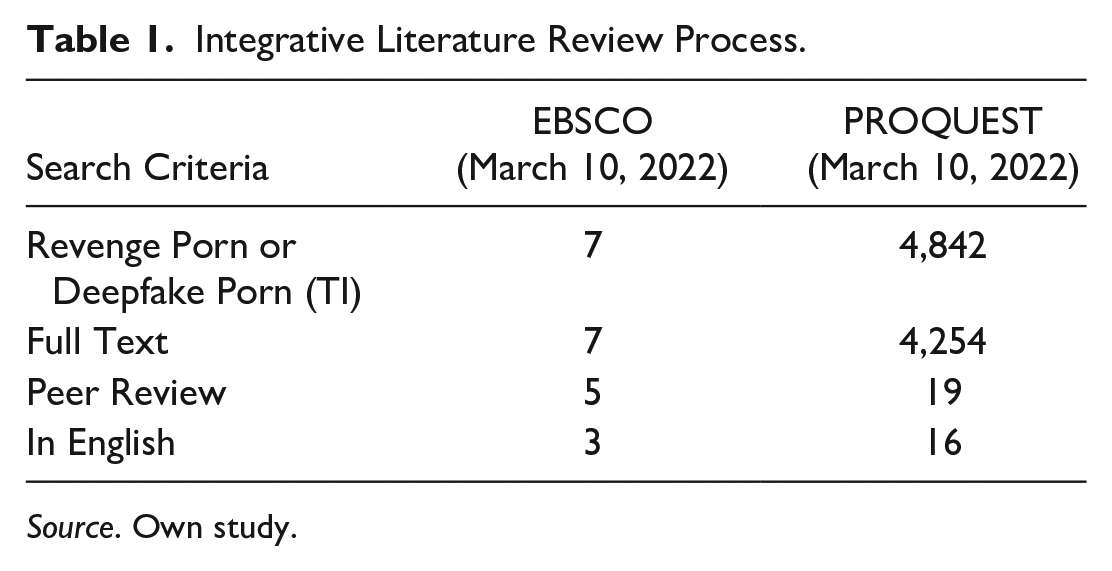
Table 1 below shows the process of literature review in the EBSCO and ProQuest databases, which made it possible to select 19 sources, from which, after elimination of non-English articles and duplicates, 15 items remained.
Integrative Literature Review Process.
Source. Own study.
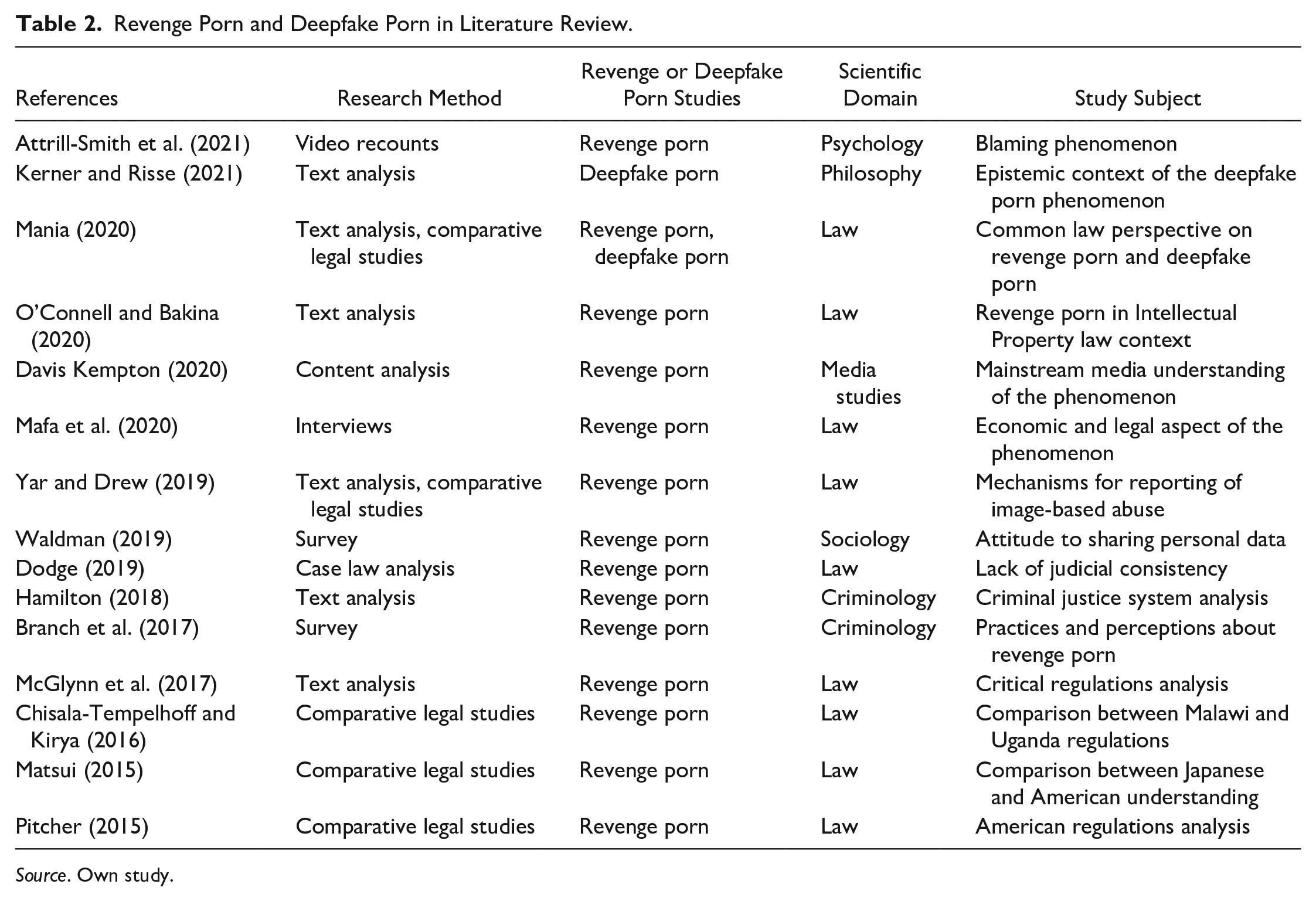
Thanks to the review, it was possible to analyze current academic literature on “revenge porn” and “deepfake porn.” The following conclusions can be drawn from this part of the research: the dominant field of science analyzing the phenomena in question is legal science; however, they are also the subject of interest of sciences such as psychology, sociology, or media sciences; these phenomena are relatively new, as publications on them began to appear in 2015, with a predominance of texts devoted to “revenge porn,” yet since 2020 onwards there has been a growing interest in “deepfake porn”; due to the main context of legal research the dominant research method is a textual analysis and comparative studies, but there are also texts using empirical research, but focused on other humanities or social sciences. The summary of the analyzed literature is shown in Table 2.
Revenge Porn and Deepfake Porn in Literature Review.
Source. Own study.
The review allows us to gain knowledge about the existing gaps. Although there exist texts on comparative studies, there is no publication analyzing the discussed phenomenon from the perspective of regulations in the European Union. The available publications mainly analyze American regulations or case law, or selectively examine individual national regulations. However, there is no overview showing the current state of legal protection of victims within the EU Member States. This gap is filled by this text and the analysis that follows.
Mapping the European “Revenge Porn” Context
At the level of the European Union, there are no provisions explicitly addressing the phenomenon of “deepfake porn.” Below, I present the results of a comparative law study, which allows for the creation of a list of legislative solutions in nine selected Member States, discussed in alphabetical order. 20
Belgium
On July 1, 2020, Belgium introduced new legislation directly addressing the circumstances of “revenge porn.” 21 The legislation provides for a fine of between EUR 200 and EUR 15,000, as well as a possible prison sentence of between 6 months and 5 years. The amendment also introduced provisions allowing for the removal of images from the web in cases where the infringer is under Belgian jurisdiction. In cases where the owner of the portal is outside of it, the legislation allows Belgian internet service providers to prevent access to the images, based on a court judgment or a decision by the public prosecutor (Beyens & Lievens, 2016).
Denmark
Danish legal solutions allow for two legal bases in the case of uploading or publishing sexually offensive content, and thus situations involving “revenge porn.” In the Penal Code, paragraph 264d criminalizes the publication of images related to private aspects of life (disseminating someone’s private material) (Vansweevelt & Bubalo, 2019). Additionally, paragraph 232 covers cases of “indecent exposure” and paragraph 235 criminalizes the distribution or possession of pornographic images or videos of persons under the age of 18 (child pornography). Since April 15, 2018, online crimes of a sexual nature are punishable by imprisonment of up to 3 years, while the fine for indecent exposure will increase to 5,000 kroner (670 euro) or 7,500 kroner under aggravated circumstances. 22 Civil claims are mainly based on the Act on Processing of Personal Data (Persondataloven - Act n. 429/2000) (Bindesbøl Holm Johansen et al., 2019).
France
In 2016, France adopted the Digital Republic Law, providing a basis for protection and objection in situations of use of personal data. 23 That time a new Article 226-2-1 was introduced in the Penal Code to tackle the issue of “revenge porn.” 24 Article 226-2-1 punishes ‘the fact, in the absence of the person’s consent for the dissemination, to bring to the knowledge of the public or of a third party any recording or document relating to words or images of a sexual nature, obtained with the express or presumed consent of the person or by the person herself’ (McGlynn et al., 2017). 25 The legislation introduced a prison sentence of up to 2 years or a fine of up to 60,000 euro. Article 226-2 of the French Penal Code (2018) was placed in the chapter dedicated to crimes against privacy.
Article 67 of Law n° 2016-1321 of October 7, 2016 Loi pour une République numérique (eng. Law No 2016-1321 of October 7, 2016 for a digital republic) provides that if the offences referred to in Articles 226-1 and 226-2 involve words or images of a sexual nature made in a public or private place, the penalty increases to 2 years’ imprisonment and a fine of 60,000 euro. 26 The same punishment is imposed on the perpetrator in case of the absence of a person’s consent to dissemination, or drawing the attention of the public or a third party to any recording or any document relating to words or images of a sexual nature, obtained with the express or implied consent of the person or by oneself, by means of one of the acts provided for in Article 226-1 (Langlois & Slane, 2017). In the case of violations by legal persons, the principal penalty is very high, as it is a fine equal to five times the fine incurred by natural persons for the same offences (Hamilton, 2018). 27
Germany
Germany has opted for a strategy of dealing with NCII based on existing legislation, which mainly includes criminal or privacy and intimacy laws (Hall & Hearn, 2017). Thus, there is no legislation literally addressing “revenge porn” or “deepfake porn” (Benedick, 2018). However, a wealth of case law allows the current legislation to be applied to each of these cases (Franks, 2017). 28
Due to the weight of German case law and the importance of its impact, the interpretation proposed by the German Federal Court is still relevant. In 2015, the judgment of the German Federal Court of Justice (Bundesgerichtshof) of October 13, 2015 ruled that photographs of a former partner must be removed at the partner’s request. 29 The adopted criminalization of acts that “violate intimate privacy by taking pictures” allows victims’ rights to be asserted in situations of illegal dissemination of photos to third parties, even in situations of consent at the time of recording, an act of violation of privacy. The reasons for the judgment were based on Articles 823 and 1004 of the German Civil Code (BGB), with regard to compensation for damages, and on Article 2, Abs 1, Art 1, Abs 1 of the German Constitution concerning the protection of privacy and personal rights. 30
The criminal liability for ‘revenge porn’ infringement derives from Article 201a (violation of intimate privacy by taking photographs) of the German Criminal Code providing for the punishment in the form of imprisonment of up to 2 years and a fine of up to 60,000 euro (Brady, 2017). Due to the location of the provisions within Chapter XV (Violation of privacy), the German Criminal Code classifies the offence in question as a privacy violation crime.
The civil provisions offering protection in the cases in question derive from the GDPR and copyright law (Section 22, Art Copyright Law) under which everyone also has the right to object to the unauthorized dissemination or public display of her/his photographs (Lee, 2019).
Italy
On July 17, 2019, a law was passed in Italy introducing the criminalization of “revenge porn” (the Red Code bill), with reference to Article 612 of the Italian Criminal Code. The law provides for imprisonment of 1 to 6 years and a fine of between 5,000 euro and 15,000 euro for “anyone who sends, delivers, gives, publishes, or disseminates images or videos of sexual organs or sexually explicit content, intended to remain private, without the consent of the persons represented” (Santiago, 2020). 31 The same penalty applies to anyone who contributes to the dissemination of material with the aim of causing harm, while if the offence is committed by a spouse, even if separated or divorced, or a relative, the penalty increases (Iacobucci et al., 2021). 32
Malta
Malta’s Criminal Code was amended in 2016 (McGlynn et al., 2017). The wording of Article 208E (Maltese Criminal Code) refers to ‘revenge porn’: “(1) Whosoever, with an intent to cause distress, emotional harm or harm of any nature, discloses a private sexual photograph or film without the consent of the person or persons displayed or depicted in such photograph or film shall on conviction be liable to imprisonment for a term of up to 2 years or to a fine of not less than 3,000 euro and not more than 5,000 euro, or to both such imprisonment and fine.” 33
The Netherlands
As of 2019, the Dutch Criminal Code (DCC) contains a provision that criminalizes “revenge pornography” in Article 139h DCC (Pahigian, 2017).
Article 139h DCC relates to non-consensual pornography in tree aspects. Firstly, the deliberate creation of a sexual image of a person without the knowledge or consent of the portrayed person is criminalized in Article 139h(1)(a) DCC. Article 139h(1)(b) DCC criminalizes the possession of such a sexual image, when the holder of these images knew or reasonably should have known that that image was created deliberately and without the knowledge or consent of the portrayed person. Lastly, Article 139h(2)(a) DCC criminalizes the publishing of an image that is created in a deliberate and unlawful manner, such as described in Article 139h(1)(a) DCC. Article 139h(2)(b) DCC penalizes the publishing of a sexual image of a person, while the person who published the image was aware that the publishing could be harmful for the portrayed person (Arora & Scheiber, 2017; Gotkovič et al., 2020). 34
Portugal
In Portugal, there is no legislation literally referring to “revenge porn.” However, victims can exercise their rights in civil proceedings by obtaining compensation according to Article 486 of the Portuguese Civil Code and in criminal proceedings by depriving the perpetrator/s of their liberty (prison sentence varies from 1 month to 1 year, or a fine on the basis of cyber fraud laws for the creation of the fake profile (Cybercrime law, art. 3) and for the intrusion of privacy on the disclosure of the images (art. 192, Criminal Code) (Magalhães et al., 2019; Robert, 2018). 35
Spain
In July 2015, a reform of Article 197 par. 7 of the Spanish Penal Code (SPC) (Ley Organica 10/1995) introduced legislation making the unauthorized distribution of privately made images to third parties punishable (Idoiaga Mondragon et al., 2020). 36 Article 197 SPC reads: “If an individual, without the authorization of the person concerned, disseminates, discloses or transfers to third parties images or audiovisual recordings of the person concerned that have been obtained with the consent of the person at the place of residence or any other place away from the sight of others, he shall be punished with imprisonment of 3 months to 1 year or a fine of 6 to 12 months, when the disclosure would seriously undermine the personal privacy of that person. The penalty shall be imposed in the upper half when the acts were committed by the spouse or a person who is or has been connected to the person concerned by an intimate relationship even when there was no cohabitation, when the victim was a minor or a person with disability in need of special protection or when the acts have been committed with a motive of profit.” As in France, Article 197 SPC is framed as an offence against privacy in Chapter X entitled: “Rights against Personal Dignity.”
Civil actions are based on the Organic Law 3/2018 on the Protection of Personal Data and the Guarantee of Digital Rights (Castilla, 2019; Waldman, 2019). 37 The legislation gives the possibility to request the removal of intimate content if it is inadequate or excessive. 38 The Spanish Agency of Data Protection has the power to request the removal of content from European websites, having the ability to block selected content within Spain (Rodríguez-Rodríguez & Heras-González, 2020).
Results of Comparative Legal Research
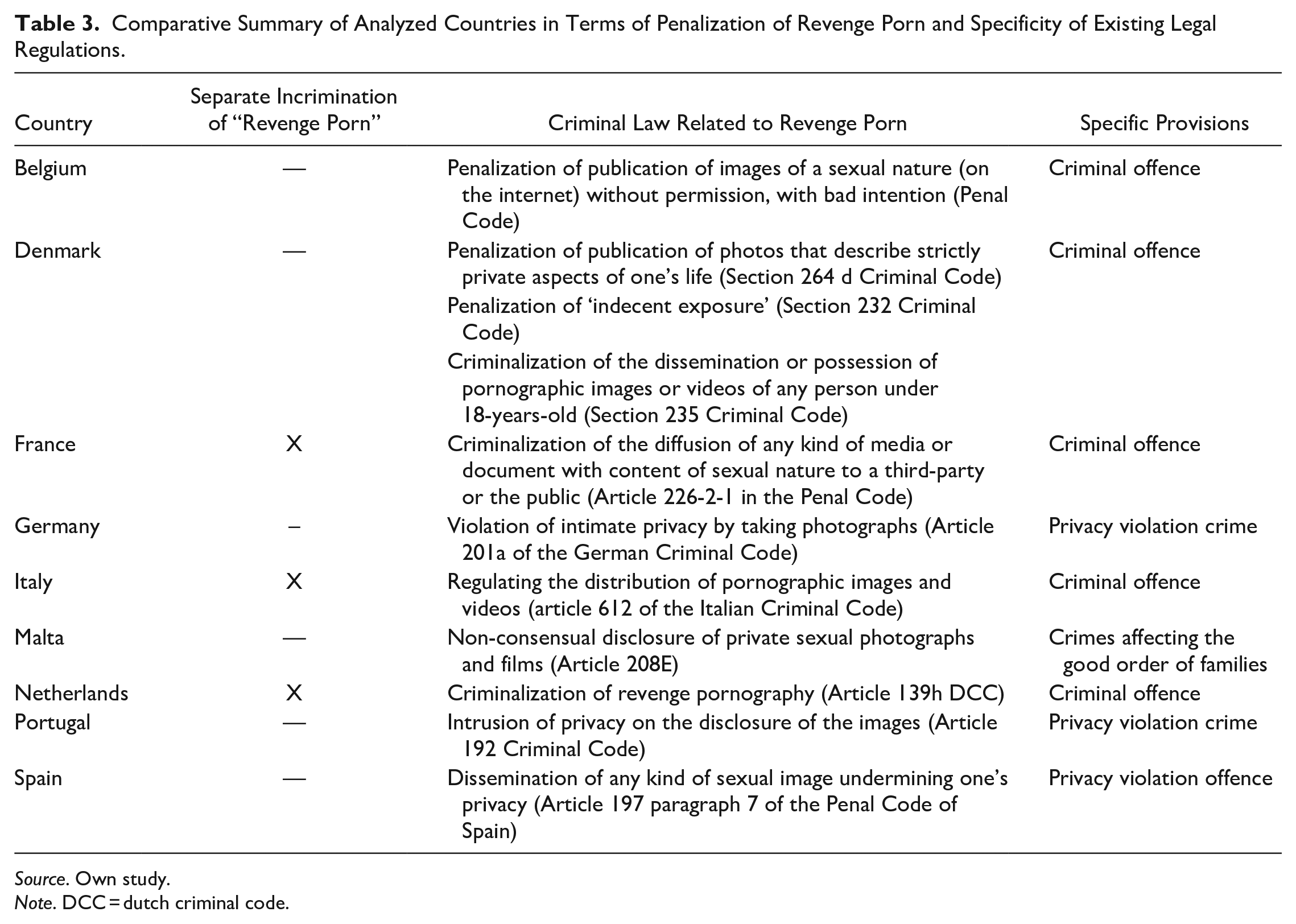
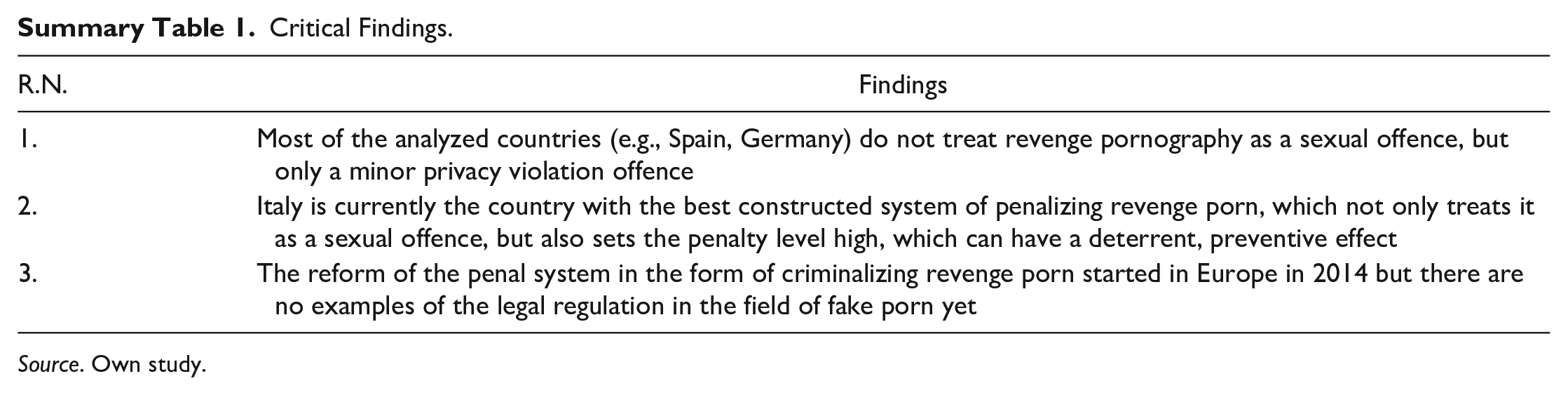
A comparative analysis of the current laws of the selected countries revealed a number of important elements. Most countries (e.g., Spain, Germany) do not treat “revenge pornography” as a sexual offence, but only a minor privacy violation offence. This directly affects the level of punishment and gives unnecessary leniency to offenders and a negative signal to society. Italy is currently the country with the best constructed system of penalizing “revenge porn,” which not only treats it as a sexual offence, but also sets the penalty level high, which can have a deterrent, preventive effect. The table below (Table 3) shows the different approach of the analyzed national legislations to the penalization of “revenge porn” as well as the markedly varied qualification of such violations: from privacy violation crime to criminal offence.
Comparative Summary of Analyzed Countries in Terms of Penalization of Revenge Porn and Specificity of Existing Legal Regulations.
Source. Own study.
Note. DCC = dutch criminal code.
Differences between the laws of individual countries are inevitable. It will be no different in the subject matter under study. When trying to find a solution, one should look for system solutions at the level of the European Union, which has the tools to influence the largest online platforms. In the European Union, there is no law requiring the removal of films or images uploaded to pornographic platforms without the consent of their operators. Initiatives such as The DSA are an attempt to exert pressure. However, in terms of “revenge porn” and related phenomena, the directive is still not adequate, as evidenced by the discussion in Article 24b. It’s a negative signal, especially for women and girls in Europe (van der Sloot & Wagensveld, 2022).
Remedy
In the search for a remedy to the existing problem of easy access to the creation and dissemination of pornographic content without prior consent (“revenge porn” and “deepfake porn”), two types of responses can be found: legal or technological.
Legal
The legal responses to this growing problem are two-fold. Firstly, individual countries (or to be more precise, their governments) noticing the seriousness of the situation should react, if only preventively, by implementing appropriately formulated regulations, tailored to the diverse nature of the content of online infringements. Amending the existing regulations, especially within the existing legal codes, does not require an extremely broad reform, but allows to prepare for the upcoming increase in the number of court cases of this nature. Another, ad hoc option is to apply existing laws in given cases, but each country must review and answer the question of whether current laws give victims of “revenge porn” and “deepfake porn” violations the tools to assert their rights. If not, the call for such solutions to be introduced into the system should be revisited.
Apart from systemic changes, another legal solution is the internal regulations of particular online platforms. Although addressed solely to their users, such regulations may have a much greater practical impact because changes are not conditioned by the need to go through a long, national legislative procedure, which is typical for amendments to regulations. 39
The solutions implemented by The Audiovisual Media Services Directive, obliging video-sharing platforms to take measures to protect the public against certain content the distribution of which constitutes a crime under Union law, should be considered positive manifestations at the European level. 40 However, the solutions to be adopted by the DSA will make it possible to harmonize the rules imposing legal liability on online platforms and Internet service providers, which will ensure an effective tool in responding to infringements.
Technological
The creation of new policies is very important, especially if these laws affect millions of their users (Vallina et al., 2019). It is a positive practice to promote and popularize the topic with instructions for victims to help them go through the technical requirements of the breach notification process addressed to platforms. 41 In 2022, we are already much more experienced and we know that regulations, even if best constructed can sometimes be ineffective in asserting rights and combating infringements in earnest. This is where technology needs to be harnessed. Already in September 2019 Facebook announced that it was preparing the creation of its own deepfake videos, which will be used on the portal to create a dataset. 42 The company hopes that people in the artificial intelligence community will use it, which will also include source footage and photos of actors, to come up with new ways of detecting technologically manipulated online videos, thereby stopping them from being made public any further.
On September 5, 2019, Facebook announced the Deepfake Detection Challenge designed to reward AI researchers who find an effective solution to a pressing problem. 43
Foresightedly (albeit rather late in the context of the U.S. presidential election), on January 6, 2020 Facebook announced a new policy prohibiting the manipulation of artificial intelligence videos that may give viewers the impression that someone “said words that they did not actually say. 44 ” The policy introduced (covering Facebook and Instagram) mainly addressed the phenomenon of disinformation, which includes “deepfake porn,” but the main intention was to limit content intended to influence the political choices of Americans.
Closing Remarks
A positive example comes from the state of New York, where on November 30, 2020 Governor Andrew Cuomo signed new state legislation protecting against commercial exploitation or unauthorized use of a dead person’s name, picture, voice, or signature, giving only the families of such people the right to use them. The legislation includes provisions on “revenge porn”and “deepfake porn” (the bill S5959-d /A.5605-c). 45 The legislation focuses on providing legal remedies to victims of the practice. The new law states that anyone who publishes pornographic material of another person, real or simulated, without that person’s consent, may be subject to a claim for damages.
The New York example shows that it is not impossible to define by-law situations that allow legal protection for both “revenge porn” and “deepfake porn” violations. The dynamic reform of the penal system in the form of criminalizing “revenge porn” in the vast majority of North American states is a positive example of action on a large scale. European countries that have followed these developments, starting in 2014 are (slowly) amending current laws and bringing legislation in line with reality. Should the same wave of changes not extend also to infringements that use software to produce content, using artificial intelligence? The phenomenon of “deepfake porn” has clear pornographic connotations, making it relatively easy to impose criminal laws. However, should we not anticipate the facts and start working today on the introduction of regulations protecting personal data, privacy, or image of citizens who are at risk of being violated as a result of the actions of the perpetrator (which, incidentally, could be any one of us, after reaching for free and widely available software circulating on the web and a few selfie photos published on social media)?
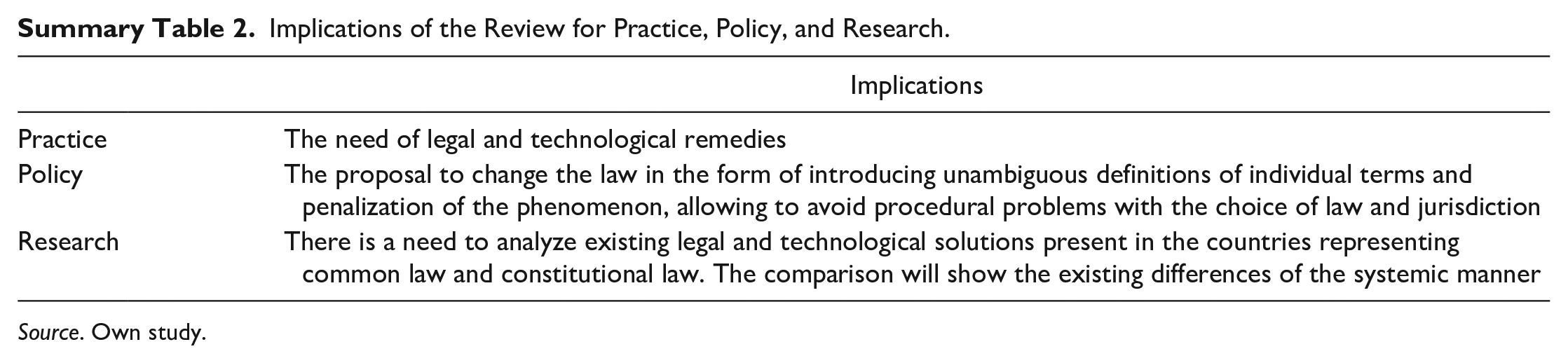
This analysis allowed us to examine the current state of regulations in selected countries of the European Union concerning the phenomenon of “revenge porn” noticed by the law. The lack of criminalization of computer-generated pornography, and therefore without the consent of interested entities, creates significant judicial problems and causes a different level of protection, which differs in each country. The article discusses the pornographic context of using an image or video but even the lack of this context may result in abuse of the law, such as violation of the right to privacy, using someone else’s image. Importantly, European regulations seem to be quite conservative and much less reactive to the social problem than American solutions. This, in turn, proves that European law should be carefully followed and that bottom-up initiatives may become the most effective driver of legislative changes. Critical findings and implications for practice, policy, and research are presented in summary Tables 1 and 2.
Critical Findings.
Source. Own study.
Implications of the Review for Practice, Policy, and Research.
Source. Own study.
Footnotes
Declaration of Conflicting Interests
The author declared no potential conflicts of interest with respect to the research, authorship, and/or publication of this article.
Funding
The author disclosed receipt of the following financial support for the research, authorship, and/or publication of this article: The publication has been supported by a grant from the Priority Research Area (name of the PRA) under the Strategic Programme Excellence Initiative at the Jagiellonian University.
