



Abstract
Unwanted pregnancy is a major public health concern with biological, psychological, and social consequences. While high-income countries mitigate its impact through government support, low-income countries (LICs) require cost-effective interventions to drive sustainable behavioral change. Social Marketing (SM) has emerged as a promising strategy to modify behaviors and reduce healthcare costs linked to unintended pregnancies. However, most research focuses on high-income settings, leaving a gap in understanding its effectiveness in LICs. This review examines the role of SM interventions in reducing unwanted pregnancies in LICs and provides evidence to inform more effective reproductive health policies.
Methods
The review includes articles searched on mass behavioural interventions in all reproductive age aiming to prevent unwanted pregnancies in LIC published in English, Portuguese, and Spanish between 2007 and 2022.
Results
The analysis showed various interventions with multiple outcomes in sexual abstention, reduction of unwanted pregnancies, increased contraception knowledge, use of emergency pill in the last intercourse, and standard day method used in physical and electronic media. In LICs, concise and high-quality educational programs transmitted by radio commenced at early ages, achieved higher exposition, and had a better recall in populations. Mass contraception community-based distribution model is effective and pharmacies are key part of family planning and sexual health education in societies.
Conclusion
Social marketing is a cost-effective strategy for reducing unwanted pregnancies and sexually transmitted diseases (STDs) while promoting positive sexual behaviors, especially in underserved populations. By driving sustainable behavioral change and improving access to reproductive health resources, it can alleviate healthcare costs and enhance public health outcomes.
Introduction
Unwanted pregnancy refers to any pregnancy that is unplanned or mistimed (Moore et al., 1995). It is a significant public health concern with serious biological, social, and psychological consequences, leading to increased healthcare costs across all income levels. According to the Centers for Disease Control and Prevention (CDC), between 2015 and 2019, approximately 121 million pregnancies were unintended, with 61% ending in abortion. In the United States, nearly half of all pregnancies are unintended, costing the healthcare system an estimated $12.6 billion annually (Yusof et al., 2018). In high-income countries (HICs), government subsidies and social policies help mitigate some of the negative effects of unintended pregnancies. However, as global populations rise and healthcare costs escalate, the burden of unattended health issues increases significantly (Omrani-Khoo et al., 2013). This highlights the urgent need for policymakers to allocate healthcare resources effectively to maximize coverage without compromising quality and effectiveness.
The consequences of unintended pregnancies extend beyond economics and healthcare; they also impact social and psychological well-being (Wakhisi Simiyu et al., 2011). In low- and middle-income countries, maternal and childbirth complications are the leading cause of death among teenage girls (Unicef, 2017). Moreover, children born to adolescent mothers face higher risks of mental and psychological health complications, leading to stigma, domestic violence, and school dropout, which further perpetuate the poverty cycle (Rodríguez & Hopenhayn, 2007). Cases of newborn abandonment, such as a baby found in a garbage can in Buenos Aires on April 8, 2022, illustrate the extreme consequences of this crisis, particularly in low-income settings (Tiempo, 2022).
Various pregnancy prevention programs have been implemented, but many are costly and ineffective, with effects that tend to fade over time (Moore et al., 1995). That is why, since the 1970s, there has been a growing investment in Social Marketing Interventions (SMIs), which have been shown to promote long-term behavioral change in targeted populations (Quinn et al., 2010). Traditional commercial marketing techniques effectively influence consumer behavior for profit. However, when adapted for public health purposes, similar strategies—analysis, planning, execution, and evaluation—can be used to modify behaviors among at-risk populations, making social marketing a powerful tool for fostering positive community-wide changes.
A successful SMI requires a clear objective and prior consumer research to determine the best approach for influencing behavior. The “Four Ps” of Marketing provide a strategic framework: Product addresses a specific need or solution, Price represents the cost or effort required, Place refers to distribution channels, and Promotion involves communication strategies to drive behavioral change (P. Kotler & Lee, 2005). Over the years, SMIs have effectively influenced public health behaviors, increasing seatbelt use, reducing smoking rates, enhancing sidewalk safety, and promoting physical activity (Akhtar & Bhattacharjee, 2013).
More recently, Carter et al. (2017) found that social marketing is an effective tool for reducing teenage pregnancies, influencing behaviors through educational interventions. A systematic review of 53 randomized controlled trials involving 105,368 adolescents also concluded that combining educational and contraceptive-promotion programs is a cost-effective strategy in high-income countries (Wakhisi Simiyu et al., 2011). However, there is a gap in the literature regarding the impact of mass behavioral interventions on unintended pregnancies in low-income countries, as most systematic reviews focus on high-income settings, highlighting the need for updated research (Firestone et al., 2019).
Therefore, this systematic literature review aims to fill this gap by analyzing the effectiveness of social marketing interventions in reducing unintended pregnancies in low-income countries. The findings will contribute to health policy development and implementation in these vulnerable regions.
Objectives
Primary Objective
(1) To determine the effectiveness of social marketing in preventing unwanted pregnancies in LICs, through a systematic review.
Secondary Objectives
(1) To identify social marketing strategies used to prevent unintended pregnancies in LICs (2) To assess the impact of SM strategies on unintended pregnancies in LICs.
Methods
This review was undertaken from November 2021 to March 2022 searching for papers indexed in PubMed, Embase, Medline, PsycINFO, CINAHL and Web of Science. Key words and their synonyms were used to perform an extensive search including additional studies. The search words used included “Social Marketing” OR “Social Marketing Theory”, “Pregnancy” OR “Pregnant” AND “Reproduction”, “Undesired” AND “Unwanted” OR “Unplanned”, “Anticonception” OR “Anticonceptives” OR “Contraception” AND “Family planning”, “Low Income Countries” OR “developing nations” OR “underdeveloped nations”, “Effectiveness” “Effect” OR “Cost Effectiveness” OR “Rate of Pregnancy” OR “Social improvement” OR “Decision Making”. The bibliographies and reference lists of all articles identified were also used to perform additional searches for relevant papers. The full text of articles meeting the inclusion criteria were downloaded for data synthesis. The flow chart (Figure 1) summarizes this process. Flow diagram on the review process.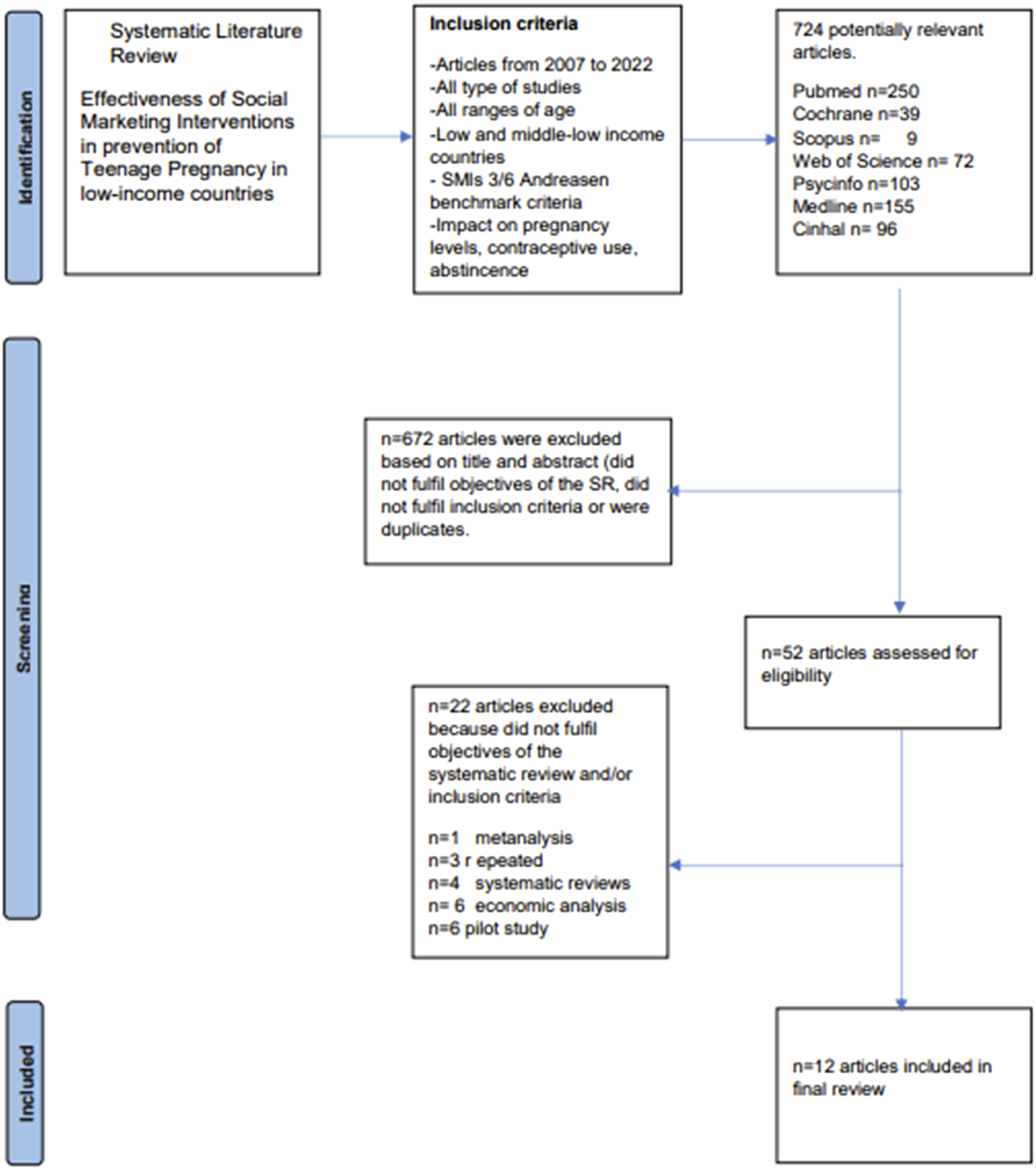
Search Limitations and Recommendations for Future Investigations
For future investigations, besides using the key terms in this research, we encourage scholars to include a broader range of terms such as “behaviour change” or “social and behaviour change communications” or “SBCC”, to retrieve other relevant articles and studies, that could have been omitted for this systematic review.
Inclusion and Exclusion Criteria
The review was limited to papers with full text published in English, Spanish and Portuguese published from January 2007 to January 2022. Anecdotal information, expert opinions, commentaries, editorials, and all studies that did not did not use social marketing approach in preventing unintended pregnancies were excluded. Population of interest, intervention, Comparator and Outcome (PICO) framework was used to inform the search strategy.
Population of Interest: Low Income Countries. Noteworthy, some relevant studies were found in countries that were previously considered LICs, but their status changed later e.g. Cambodia, Zambia, and Tanzania (WBG, 2020).
Intervention of interest: Social Marketing interventions to prevent unwanted pregnancy with at least 3/6 Andreasen Benchmark criteria: Consumer research, Specific behaviour change goal, Segmentation and Targeting, Marketing mix, Exchange, and Competition (Andreasen, 2002).
Comparator: Where applicable, interventions with comparison groups.
Outcome of interest: Unintended pregnancies, delay in sexual initiation or abstinence, use of contraceptives, knowledge of contraception and reproductive health and self-efficacy on sexual activity.
Results
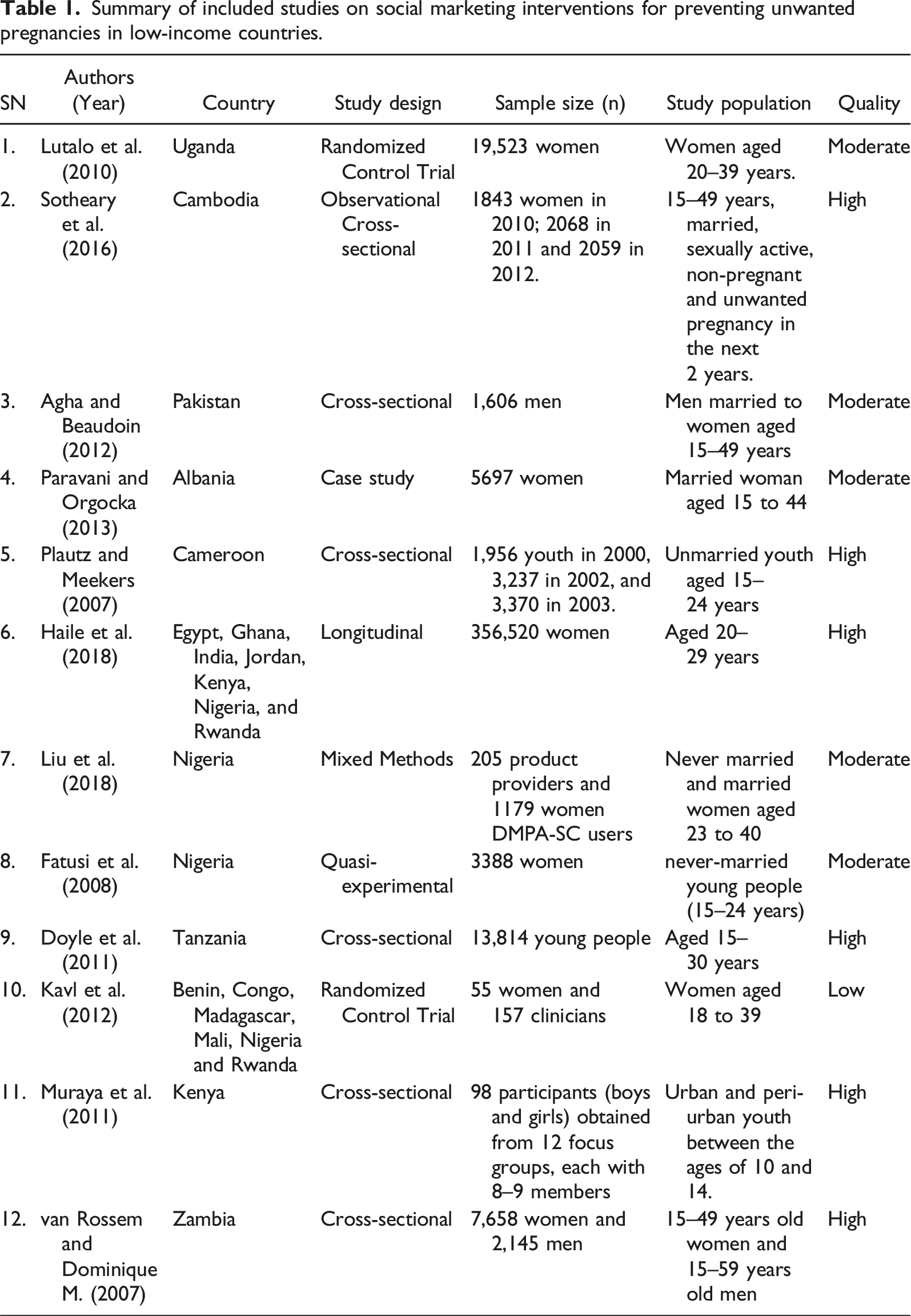
Summary of included studies on social marketing interventions for preventing unwanted pregnancies in low-income countries.
Description of social marketing interventions, theoretical frameworks, and reported outcomes.

Discussion
Unintended pregnancies pose a major public health challenge, making Social Marketing Interventions (SMIs) a crucial tool for promoting contraceptive use and informed decision-making. Many of these interventions are guided by behavioural theories that explain how individuals perceive risks, respond to social influences, and adopt preventive measures. Strategies such as mass media campaigns, community engagement, and digital tools have been effective in increasing contraceptive awareness and accessibility. While approaches emphasizing condoms, injectables, and mobile health solutions have shown strong results, abstinence-focused interventions have struggled to drive long-term behavioural change. This discussion explores the role of SMIs in reducing unintended pregnancies, highlighting both successes and ongoing challenges.
Theoretical Frameworks in Social Marketing Interventions (SMIs)
The Health Belief Model (HBM), Social Cognitive Theory (SCT), and Social Learning Theory (SLT) emerged as the most frequently applied frameworks in the reviewed studies, serving as a foundation for designing and implementing Social Marketing Interventions (SMIs). These theories were employed in eight out of twelve studies, underscoring their critical role in influencing behavioral change.
The Health Belief Model emphasizes that individuals adopt specific behaviors to prevent undesirable outcomes based on their perceptions of threats—such as sexually transmitted diseases (STDs) or unintended pregnancies—and the perceived effectiveness of preventive actions. This belief-driven approach significantly increases the likelihood of behavior adoption. Social Cognitive Theory, in contrast, highlights self-efficacy and the influence of environmental and peer factors, demonstrating how individuals both influence and are influenced by their surroundings. This theory proved particularly effective in mass media interventions, including radio broadcasts, television programs, dramatizations, workshops, and billboards, which promoted various contraceptive methods to prevent STDs and unintended pregnancies. For example, studies by Lutalo et al. (2010)and Liu et al. (2018) and demonstrated the impact of community leaders in promoting injectable contraceptives, illustrating how influential figures facilitate behavioral change. Social Learning Theory further reinforced this approach by emphasizing learning through observation, where individuals model behaviors demonstrated by others (Evans, 2008).
Other theoretical frameworks were also applied in select studies. The Theory of Reasoned Action (TRA), employed in studies byHaile et al. (2018) and Plautz and Meekers (2007)posits that a person’s health behavior is determined by their intention, attitude, and the influence of subjective norms (Hale et al., 2012). These studies effectively used multicomponent infrastructures, such as the CycleBeads app and the 100% Le Jeune program, to frame desired behaviors as socially acceptable, ensuring that individual intentions aligned with societal norms. Similarly, the Information, Motivation, and Behavior Model (IMB), implemented in Nigeria’s Zip-Up! campaign by Fatusi et al.(2007), emphasized the role of knowledge, motivation, and behavioral skills in achieving behavioral change (Fisher et al., 2009). This campaign successfully increased awareness of delayed sexual activity by leveraging public figures and targeted communication strategies.
Finally, the Exchange Theory, applied in Kavle et al. (2012) study, demonstrated how behavioral change occurs when perceived benefits outweigh associated costs (Delamater, 2006). This principle was exemplified by the successful adoption of CycleBeads, a low-cost, portable, and user-friendly contraceptive tool supporting the Standard Days Method, illustrating how accessible and cost-effective interventions can drive widespread behavioral change.
Effectiveness of Contraceptive Methods in SMIs
The studies demonstrated that preventing unwanted pregnancies was most effectively achieved through interventions focused on contraceptive methods that were easy to use, free from significant side effects, widely accessible, and affordable. For instance, Studies 3, 5, and 12 successfully utilized condom promotion to convey prevention messages and achieve their objectives, while studies 6 and 10 showed positive outcomes through the use of visual and interactive contraceptive tools. Among these interventions, those promoting condoms as the primary contraceptive method proved most effective in reducing unintended pregnancies.
A notable example is a high-intensity advertising campaign in Pakistan for Touch condoms (Agha & Beaudoin, 2012), which significantly increased condom use and the adoption of other contraceptive methods, even among first-time users. Additionally, the campaign reduced the stigma associated with purchasing and negotiating condom use, with radio advertisements proving more effective than television in disseminating messages. Similarly, in Zambia (Van Rossem & Meekers, 2007), social marketing (SM) programs aimed at reducing HIV incidence and unintended pregnancies had a significant impact. The campaigns reached a substantial portion of the population, leading to a marked increase in condom use, particularly during last intercourse. The effects were more pronounced among men than women, and as observed in Pakistan, radio proved to be a more effective medium for message diffusion and campaign recall.
Studies by Lutalo et al. (2010)and Liu et al. (2018) employed similar strategies, though Liu’s intervention yielded greater success. While Lutalo’s study focused on DMPA-SC distribution, Liu’s approach integrated pills, injectables, condoms, and comprehensive family planning education, leading to a significant increase in hormonal contraceptive use and a reduction in pregnancy rates in intervention communities compared to control groups. A key factor in Liu’s success was the involvement of community-based reproductive agents, who effectively delivered contraceptives to underserved populations. However, high costs related to logistics, supervision, and provider training, coupled with high turnover rates, posed challenges for long-term sustainability.
Another exemplary case is the NESMARK initiative (Paravani & Orgocka, 2013), which, under the supervision of its executive director, has promoted, distributed, and sold subsidized contraceptives for over 15 years through targeted mass media campaigns. This program not only influenced government contraceptive policies but also contributed to lower fertility rates, increased modern contraceptive use, and a societal shift away from withdrawal as the preferred contraceptive method.
In Cambodia, a social marketing initiative was launched to distribute Medabon through public-sector pharmacies and hospitals to expand access to emergency contraception and reduce unsafe abortions (Sotheary et al., 2017). While the overall abortion rate did not decline, the initiative significantly reduced unsafe abortions, underscoring the critical need for affordable and safe abortion services. This is particularly important for low-income women, who are often forced to resort to unsafe procedures performed by unqualified practitioners.
Among the most impactful studies in this review were those conducted by Kavle et al. (2012) and Haile et al. (2018), both focused on the Standard Days Method. Kavle’s study introduced CycleBeads as a tangible contraceptive tool, achieving high compliance rates due to its clear instructional inserts. This study also highlighted the essential role of pharmacies as a primary source of contraceptives in African populations. Haile, in contrast, employed an Android app to promote the same method, integrating reminders to enhance compliance. The success of this electronic intervention has since inspired the development of new apps tailored to users with varying cycle lengths, featuring pop-up reminders to improve sexual and reproductive health education.
Conversely, Studies 1, 2, and 7 faced significant challenges due to the complexity of the contraceptive methods used, side effects, and lack of affordability. These barriers likely contributed to premature discontinuation of contraceptive use and a decline in positive outcomes after the interventions ended, emphasizing the importance of ensuring accessible, user-friendly, and cost-effective family planning solutions.
Challenges with Sexual Delay and Abstinence Campaigns
Campaigns promoting sexual delay and abstinence as a Social Marketing (SM) approach were the least effective in preventing unwanted pregnancies, encouraging contraceptive use, or achieving lasting recall among target populations. Even when designed using the Four Ps of Social Marketing (Product, Price, Place, Promotion), Studies 8 and 11 demonstrated limited acceptance, particularly among youth audiences. These findings highlight the shortcomings of abstinence-focused approaches and emphasize the need for realistic, accessible, and evidence-based sexual health interventions that align with the needs of the target demographic.
The review revealed that large-scale media campaigns promoting abstinence had minimal impact on youth decisions regarding sexual activity delay. One major factor contributing to their low success rate was the lack of target population involvement in campaign design, coupled with contradictory messaging. For instance, the Nimechill campaign in Kenya achieved an impressive 85% recall rate, yet data showed an increase in youth sexual activity during the campaign period, prompting further studies to investigate its shortcomings (Muraya et al., 2011). Similarly, in Nigeria, the Zip-Up! Campaign attained a 29% recall rate, but those who recalled the campaign were primarily urban, educated, and older individuals, whereas a significant portion of Nigeria’s population—over 40%—lives below the poverty line. While the campaign incorporated market research before its launch and led to more positive perceptions of abstinence among exposed youth, its overall impact remained limited (Fatusi et al., 2007).
The MEMA kwa Vijana (MkV) primary school intervention in Tanzania produced mixed results (Doyle et al., 2011). The campaign’s abstinence component failed to reduce the number of sexual partners among participants, with an increase in sexual partners observed among the youngest age group. However, the intervention successfully improved sexual and reproductive health knowledge, increased contraceptive use, and led to a decrease in pregnancy rates. Notably, the most significant benefits were seen in groups that received longer exposure to the intervention. Despite its achievements, the program faced financial challenges, primarily due to the high costs of teacher supervision and training, limiting its scalability.
In Cameroon, the 100% Le Jeune campaign sought to prevent unwanted pregnancies and STDs through abstinence promotion and additional strategies (Plautz & Meekers, 2007). While the campaign did not succeed in reducing sexual activity or the number of sexual partners, it reached one-fourth of the target population and achieved a higher recall rate compared to other reproductive health programs in the country. Additionally, it significantly increased predictors of condom use among both male and female participants, leading to greater condom adoption with regular and casual partners.
Finally, the introduction of the long-acting injectable contraceptive DMPA-SC in Nigeria through a large-scale, multi-component SM campaign encountered significant challenges (Liu et al., 2018). Although the first injection was provided for free, and a Community-Based Distribution Model (CBDM) was developed to ensure wider access, the intervention proved financially unsustainable. Additionally, only 50% of users returned for a second injection, citing side effects and high costs as primary deterrents. Nevertheless, the CBDM successfully expanded access to rural communities, encouraging users to adopt and switch contraceptive methods, despite the program’s long-term sustainability concerns.
Conclusion
Social Marketing (SM) has proven to be a valuable strategy for optimizing health resources in low-income countries, yet significant gaps persist in its application to prevent unwanted pregnancies. Interventions promoting sexual abstinence have shown limited efficacy, often yielding insignificant or counterproductive outcomes. In the digital age, with widespread access to hypersexualized content, SMIs should focus on promoting safer sexual practices, comprehensive sexual health education, and contraceptive use as central components of their strategies. These programs should address the biological, psychological, and social implications of sexual relationships while ensuring accessibility to reproductive health resources.
From a public health perspective, while injectable contraceptives and pills are cost-effective for reducing unwanted pregnancies, they fail to address the prevention of sexually transmitted diseases (STDs), highlighting the need for broader strategies. Annual condom-focused campaigns, supported by family planning education and delivered through diverse communication channels like radio and mobile platforms, have shown to be more effective, particularly in reaching rural and younger populations.
Significant barriers remain in accessing contraceptives, particularly for women and girls in developing nations. Community-based distribution models and integration with pharmacies can improve access, but these efforts must include training for pharmacists and clear instructional materials for end-users. Social media platforms have also emerged as powerful tools for engaging younger demographics, with campaigns on TikTok and Instagram effectively raising awareness and changing behaviors. Influencer-driven initiatives further emphasize the potential of peer-to-peer networks to promote safe sexual practices and contraceptive use (Bull et al., 2012).
While challenges such as limited academic infrastructure and high costs of implementation persist in emerging countries, sustained investment and innovative approaches can enable SMIs to revolutionize sexual and reproductive health, addressing critical needs in underserved populations globally.
Footnotes
Declaration of Conflicting Interests
The author(s) declared no potential conflicts of interest with respect to the research, authorship, and/or publication of this article.
Funding
The author(s) received no financial support for the research, authorship, and/or publication of this article.
