



Abstract
Background
Digital technologies are important touchpoints to stimulate marketing audiences. In the field of social marketing, digital marketing is considered important, but has been mainly used to raise awareness of social causes.
Focus of the Article
This paper considers the conceptualization of a model to conduct the conversion of behavior change, using both offline and digital marketing techniques.
Research Question
The paper seeks to investigate existing research on how digital marketing concepts can be integrated into a social marketing strategy.
Approach
The proposed conceptual model follows the process of the stages of change and considers the theoretical social marketing frameworks, applying the assumptions of citizens’ journey and the use of adequate digital and physical touchpoints to convert behavior.
Importance to the Social Marketing Field
The model offers theoretical advances for social marketing, going beyond the stage of raising awareness of social causes in social networks, and integrates the assumptions of an omnichannel strategy for social marketing interventions focused on behavior change conversion.
Methods
The paper follows the benchmark method of theories to build a conceptual model.
Results
The Omnichannel Social Marketing Model Through Stages of Change presents adequate digital and physical marketing techniques for the different stages of the social change process.
Recommendations for Research or Practice
The model can be used in future research to measure the effectiveness of social marketing, considering the inclusion of digital technologies and marketing techniques in social marketing strategy. The model also guides social marketing managers in using both digital and offline marketing techniques in an integrated and strategic manner for effective and long-term conversion of change. Future research can apply the model to social marketing cases to generalize its application.
Limitations
The conceptual model is designed in a bottom-up approach, based on the literature review.
Introduction
The contemporary challenges of the digital era have forced organizations to transform their marketing approach by considering the intertwined connections of both offline and online environments (Kumar, 2018). This is no less true in the field of social marketing, given the opportunities to target citizens for attitude and behavior change through the use of digital technologies (Evans et al., 2022).
Social marketing literature evidences cases of activities that integrate digital marketing techniques, particularly campaigns of cause awareness through social networks (Shawky et al., 2019). Social media has allowed social marketers to engage audiences to trigger attitudinal and behavioral change (Thackeray et al., 2012), elicit feelings (Gomes & Casais, 2018) and advocacy of causes (Guidry et al., 2014). However, the state of the art shows that the use of digital marketing in this field is still largely confined to the purpose of raising awareness of problems and fails to follow user experience until achieving the conversion of change as a goal (Shawky et al., 2019).
Given the importance of incorporating digital marketing techniques in the practice of social marketing, and considering the research agenda in this field pointed out in previous literature (Evans et al., 2022), this paper builds on extant research and proposes a strategic framework that integrates the concepts of digital marketing strategy in the existing offline frameworks to promote behavioral change. In particular, and considering that social marketing requires a strategic planning to achieve change (French & Russell-Bennett, 2015), this paper presents a transposition of the digital marketing strategic models by Järvinen & Taiminen (2016) and the hierarchy of effects (Fortenberry-Jr. & McGoldrick, 2020) to the Transtheoretical Model Stages of Change (Prochaska et al., 1992), consistent with other behavioral theories that influence social marketing (Davis et al., 2015; Luca & Suggs, 2013).
The designed strategic model interconnects digital media and digital techniques with the offline social marketing techniques used in the process of behavioral stages of change, in an integrated logic of outbound and inbound marketing (Bleoju et al., 2016; Dakouan et al., 2019). The proposed model can be useful for advances in social marketing theories by making use of an omnichannel strategy to attract citizens, convert and evaluate sustained behavioral change. The model is intended to become a guide for social marketing managers to interact with citizens through an omnichannel perspective by involving the interconnection of both digital and offline environments.
Conceptual Background
Social Marketing and the Stages of Social Change
Social marketing is a subdiscipline of marketing that aims to influence attitudes and behaviors for the social good (Saunders et al., 2015). There are many theories that fit into social marketing, particularly connected to public policy, behavioral and sociological assumptions (Davis et al., 2015; Luca & Suggs, 2013; Rundle-Thiele et al., 2019). The contemporary thought led to a macro perspective of systems integration (Flaherty et al., 2020; Kennedy, 2016; Truong et al., 2019) to achieve social good. Social marketing interventions can be developed at the upstream, midstream or downstream level (Key & Czaplewski, 2017), either via more voluntary and conscious tactics, or via involuntary and unconscious tactics, such as nudging tactics in social marketing (Spotswood et al., 2012).
Although the different theories applied to social marketing implicate persuasive stimuli to overcome the barriers to behavior change, the Transtheoretical Model of Stages of Change (TTM) (Prochaska et al., 1992) posits that change takes place in different stages: pre-contemplation, contemplation, preparation, action and maintenance — a process that restarts in times of relapse. This model assumes that change does not occur immediately after a single stimulus, but requires continuous interventions throughout the stages until a behavioral goal is successfully achieved (Andreasen, 2003; Hastings & Saren, 2003; Rundle-Thiele et al., 2019). This process requires communication to achieve different outcomes, in parallel with the assumptions of the levels of the hierarchy of effects (Bleoju et al., 2016). Furthermore, the whole process requires different marketing techniques to reinforce the social benefit of change, minimizing barriers and ensuring accessible conditions for change (Issock Issock et al., 2021).
The application of the TTM to social marketing strategy proposes that social marketers should go beyond the disclosure of information messages by also focusing on other marketing techniques to achieve the conversion of behavior change (Levit et al., 2016). In social marketing, this conversion perspective assumes major relevance, given the lack of attention to social marketing techniques besides communication (Issock Issock et al., 2021). In fact, commitment and loyalty are needed to achieve sustained behavior change (Hjelmar, 2005) in order to realize the expected return on social good from the social marketing investment (Dann, 2010; Nicholls, 2017). However, the stage of sustaining behavior is sometimes ignored in the practice of social marketing (Akdaş & Cismaru, 2021).
The TTM harmonizes with other behavioral theories that influence social marketing. Following the ATRN model (Awareness → Trial → Reinforcement and Nudging) (Barnard & Ehrenberg, 1997), the maintenance stage should consider both the communication approach focused on the continuous activation of the importance of social behaviors and assurance of its accessibility through conditions to social change — e.g., as it has been continuously recommended in the case of the COVID-19 prevention measures, such as the massive use of facial masks, washing the hands and using disinfectants, social distancing and its operationalization in access to services, massive vaccination and testing. However, this last stage should also involve new social norms and rules (in a nudging perspective), as is the case of the vaccination certificate and the SARS-COV-2 negative test to access social life and citizenship rights (Sasaki et al., 2022).
Change is facilitated if properly coupled with compliance with social norms and standards (Burchell et al., 2013). This is why education and law are relevant pieces of the social marketing system (Wymer, 2011). Supported by social identity and prototype theories (Davis et al., 2015; Luca & Suggs, 2013; Rundle-Thiele et al., 2019), as well as by the social-ecological model, which reinforces the multiple levels of influence for behavior change (Wood, 2016), peer influence — endorsement by celebrities, for example (Casais & Proença, 2012) — can assume a relevant role. The potential of digital influencers as key agents in social marketing interventions is also claimed to address social good (Hudders et al., 2021). Peer influence in social marketing is also enhanced by the importance of community-based interventions (Haldeman & Turner, 2009) and the creation of virtual communities to share beliefs and fight against misconceptions (Biroscak et al., 2019; Calderon et al., 2021). Social influence theories in the virtual community have been increasingly explored in social marketing (Calderon et al., 2021; Davis et al., 2015; Luca & Suggs, 2013), claiming digital innovation interventions to generate engagement and foster change (Kubacki et al., 2015).
Furthermore, the TTM allows understanding that different segments in different stages require different social marketing approaches. However, it is not clear how the segments are triggered through the different stages. This issue has been raised by other social marketing theories, as the theory of reasoned action/theory of planned behavior, among others (Davis et al., 2015; Luca & Suggs, 2013; Rundle-Thiele et al., 2019).
The use of technologies in social marketing has already been addressed as key drivers of behavior change (Evans et al., 2022; Flaherty et al., 2021; Mehmet et al., 2020), although the literature fails to integrate such insights in a consistent framework for social marketing strategy. Considering that the social marketing debate includes insights from the commercial marketing postulations and raises its own particularities (Dann, 2010; Hastings & Saren, 2003), the following sections briefly systematize the emerging technologies that can be used in social marketing, the adaptation of social marketing strategy to the digital era and to the omnichannel context and explore how social marketing integrates such assumptions to target its own audiences for the social good.
Emerging Technologies Serving Social Marketing
As digital natives, Generations Y (Millennials) and Z evaluate and share resources and experiences with other consumers through the permanent interconnection of smart digital devices. The development of the Internet of Things (IoT) generates a wide experience in the digital environment by integrating and permanently connecting smart devices, with the ability of customization to personal needs (Ng & Wakenshaw, 2017). The IoT facilitates the automation of procedures and the generation of big data. Also, the advances in Artificial Intelligence, facial recognition and geofencing technologies are becoming increasingly promising tools for marketing relationships, research methods and real-time evaluation of results (Crittenden et al., 2019; Kumar, 2018). Mobile technologies allow the interaction between digital and physical environments (Muzellec & O'Raghallaigh, 2018), and people increasingly expect to have experiences via interconnected channels, which entails media integration (Verhoef et al., 2015) in both physical and digital environments. Technological development provides marketing with a potential edge that goes beyond the simple presence of organizations on the web, the management of social networks or e-commerce stores. The omnichannel experience is being increasingly optimized through technologies that involve contactless communication among devices and the much-desired interconnectivity of smart things – e.g., RFID technology, bluetooth beacons, and Near-Field Communication (NFC) technology (Chen & Chang, 2013). Moreover, the development of Virtual and Augmented Reality (Hilken et al., 2018), geolocation or QR codes generalization (Yaoyuneyong et al., 2016) allow immediate interconnection of physical and digital media and consolidate the importance of integrated communication of both online and offline media (Vernuccio & Ceccotti, 2015).
This is no less true in the case of social marketing, because immersive technologies have been reported as important tools to achieve behavioral changes (Frechette et al., 2023), although its strategic integration is still unresearched.
The Application of Digital Marketing to Social Marketing
Marketing is witnessing a major transformation driven by technological advances, the digitalization of society, as well as the emergence of changes in attitudes and behaviors to achieve sustainability (Kumar, 2018). Social marketing plays a central role in the context of emergency of social change we are living nowadays (Kennedy, 2016). Digital marketing, in turn, allows organizations to make use of the most innovative technologies to boost communication with their target audiences, to foster a customized relationship and to monitor conversion and loyalty in real time (Kannan & Li, 2017). Thus, the integration of articulated digital marketing techniques with the existing ones to conceive a social change strategy can facilitate the management of social marketing programs (Evans, 2022; Shawky et al., 2019).
Digital marketing has been seen since its inception as a very promising tool in the management of non-profit organizations (NPOs) (Pinho & Macedo, 2006), namely in the use of social networks to generate visibility, raising awareness and involvement (Nelson, 2019; Smith, 2018). The management of social networks must be adapted to the different organizational goals and governance models (Felix et al., 2017), not only involving the transmission of messages, but also monitoring and evaluating relevant insights to support the decision-making process (Parsons & Lepkowska-White, 2018). NPOs foster an emotional relationship that facilitates the involvement of target audience on social networks (Bernritter et al., 2016) by activating the expression of feelings related to social problems (Gomes & Casais, 2018).
The social marketing literature reports the use of mobile text messages, websites, video marketing, online games and ads, blogs, email marketing, Virtual and Augmented Reality, as well as mobile apps to provide personalized content, incentivize shared collaboration and co-creation (Flaherty et al., 2021). A recent study has highlighted the importance of immersive technologies, such as 360-degree videos and Virtual Reality as social marketing tools (Frechette et al., 2023). Successful case studies have also been reported regarding the use of wearables and smart devices to incentivize healthy lifestyles and monitor the population’s physical condition and health (Lehrer et al., 2021; Polo-Peña et al., 2021; Spotswood et al., 2020). For example, social fitness mobile apps have become important drivers of behavior change retention via their ability to categorize, reward and materialize the physical activity effort (Spotswood et al., 2020). This is a good example of how social marketing can incorporate the interconnection potential of devices that communicate with these apps – e.g., smart weight balances or training equipment, Artificial Intelligence voice assistants– to optimize all the stages of the process of behavior change, with particular emphasis on the maintenance stage, as it is the most difficult and undervalued one (Akdaş & Cismaru, 2021).
Although the literature reports opportunities in the use of digital technologies and marketing techniques in social marketing (Evans et al., 2022; Flaherty et al., 2021; Mehmet et al., 2020), its incorporation into frameworks of social marketing strategy is limited to the purpose of raising awareness to changing behaviors and attitudes (Shawky et al., 2019), or to the understanding of community preferences and attitudes towards social marketing policies, based on comments on digital channels (Mehmet & Simmons, 2019).
Social Marketing in the Omnichannel Era
The journey is an interactive and dynamic process, passing through digital and physical touchpoints at different stages of the decision-making process (Lemon & Verhoef, 2016). This phenomenon requires an omnichannel marketing response that integrates both online and offline media and plays out throughout the audience journey and offering a unique and integrated experience that comprises physical and digital touchpoints (Barwitz & Maas, 2018; Cummins et al., 2016). In this sense, the omnichannel marketing approach considers that both the physical and digital interventions are required to target audiences, and so the integration of both offline and digital media should follow the flow of the users’ journey by providing information, entertainment and calls for immersive experiences (Nguyen et al., 2022).
The strategic recommendations for digital marketing are anchored in targeting by interacting with a wide variety of digital media. Mass communication techniques, such as advertising, are used to amplify the message in combination with attraction techniques such as QR codes, NFC or RFID technologies (Yaoyuneyong et al., 2016), SEO techniques, Search Engine Marketing (SEM), mobile geolocation, and sponsored content management on social networks. Conversion and engagement require further email marketing automation, mobile applications, social networks featuring relationship content, and the interconnection of artificial intelligence devices, such as IoT-based chatbots or smart devices (Bleoju et al., 2016; Hollebeek & Macky, 2019; Verhoef et al., 2017).
Given the current positive incentives for technology acceptance (Jahanmir & Cavadas, 2018), there is great potential for incorporating digital marketing techniques in integrated social marketing programs (Mehmet et al., 2020). In the health sector, for example, the interconnection of smart mobile health devices through the IoT is being increasingly used for both disease management and monitoring (Kim & Kim, 2018), and the implementation of personalized healthcare systems (Qi et al., 2017). These technologies allow us to recognize the effects of achieving change via real-time digital data monitoring (digital analytics), which contributes for social marketing effectiveness and both digital and offline interventions (Akdaş & Cismaru, 2021).
In this sense, more than incorporating digital marketing techniques in social marketing strategy, social marketers must adapt to the expectations of the audiences in the omnichannel environment by making use of digital technologies to communicate and elicit behavior change (Evans et al., 2022), interacting with other physical social marketing approaches.
The Hierarchy of Effects
The AIDA’s hierarchy of effects model comprises the cognitive, affective and behavioral dimensions and has been a dominant approach in marketing communication, particularly in advertising. It seeks to inform the consumer, capture their attention; arouse their interest; help them to take decisions, and prompt them to purchasing actions. The retention component has been recently added to the model to activate the post-purchase phase of the consumer journey, which comprises the long-term perspective of marketing based on loyalty, thus becoming the AIDAR model (Fortenberry-Jr. & McGoldrick, 2020).
This hierarchy of effects model is based on unsolicited push notifications targeting audiences in advertising or direct marketing, comprising an outbound perspective of marketing (Bleoju et al., 2016). However, given the digital consumer’s active posture in seeking online solutions (Ruyter et al., 2018), investment on digital content capable of attracting strangers, via organic or sponsored channels, has been allowing the development of relationships with very segmented individuals with potential interest in the content (prospects).
From Outbound to Inbound Marketing
Parallel to outbound marketing, which focuses on amplifying messages through various mass media, the method of inbound marketing consists in developing relevant digital content capable of attracting and promoting interaction with the audience, involving and enhancing relationships of loyalty and recommendation through a word-of-mouth effect. Based on inbound methods, we have witnessed both digital marketing content featuring a close targeted approach and niche digital content that make use of search engine optimization (SEO) techniques, mobile geolocation, social network management, or activation of blogs (Lopes & Casais, 2022). These techniques facilitate the attraction of the right audiences who are looking for specific content based on keywords, location proximity or previous interaction on social networks. This phenomenon activates the role of digital influencers, who are no longer necessarily widely known celebrities, thus allowing the emergence of micro-influencers on social networks and blogs that can be recognized as opinion leaders in the context of smaller communities (Casaló et al., 2020). These content marketing techniques are used to attract potential customers, raise qualified leads, nurture and convert those leads into prospects, and engage the customers via loyalty-oriented interactions (Dakouan et al., 2019), all of which comprise the stages of the inbound model of content marketing.
The inbound-outbound marketing dichotomy has been criticized for the simplistic view that is assigned to marketing strategy. Given the advantage of interconnectedness, organizations must adapt to both the complexity of the users’ journey and their omnichannel experience by balancing the two techniques and even by developing hybrid techniques (Bleoju et al., 2016).
The Contribution of Digital Technologies to Social Marketing Value Co-Creation
The plethora of available and continually evolving technologies poses major creativity challenges for organizations to interact with their audiences throughout their experience, but it also requires strategic thinking (Leeflang et al., 2014; Lemon & Verhoef, 2016) to claim value co-creation via such interactivity (Cui et al., 2022). In fact, value co-creation is a major outcome of the digital marketing process, both through feedback in online reviews and customer-to-customer interaction on social media and virtual communities. This is no less important for the social marketing process of change (Flaherty et al., 2021), given the consumer-dominant social marketing logic and civic activism as human capital in response to social issues (Anker et al., 2022). In this sense, interactivity of citizens making use of digital technologies in virtual communities can be important to optimize the process of change, as is the case of the above-mentioned example of social fitness apps, which allows individuals to be recognized by their physical activity achievements (Spotswood et al., 2020), or cause advocacy on social networks (Jackson et al., 2021).
A Proposal of a Behavioral Change Funnel Model
Implementing a marketing strategy requires identifying strategic goals for the different stages of the conversion funnel. The conversion funnel considers that the marketing strategy should act in a first stage by targeting the individuals who are aware of the object of the marketing activity, according to an outbound marketing strategy whose purpose is raising awareness through mass communication techniques (Bleoju et al., 2016; Dakouan, et al., 2019). Then, in an inbound process, the marketing strategy should deliver content for those individuals who show potential interest and, consequently, those who require further information (qualified leads). Such content should make use of appropriate digital technologies as touchpoints to target the key individuals (Kannan & Li, 2017). Finally, it is important to develop a relationship with these individuals by nurturing leads in order to attract them to the desired goal and ensure loyalty and recommendation to others. This goal is achieved by using analytic techniques, which consist of monitoring and evaluation of Key Performance Indicators (KPIs) on the different media: KPIs inform about the achievement of strategic objectives and return on marketing investment (Järvinen & Karjaluoto, 2015). The potential of digital media for monitoring and evaluation if the fact that digital analytics is achieved in real-time, with benefits to decision support and marketing automation. In the field of commercial marketing, this process is called the sales funnel, which is shown in Figure 1. The marketing strategy is expected to interact with the audience in a omnichannel way throughout the different stages and as automated as possible (Järvinen & Taiminen, 2016), monitoring key performance indicators (KPIs) to generate actionable insights for decision-making (Järvinen & Karjaluoto, 2015). Sales Funnel Model. Source: Järvinen and Taiminen (2016).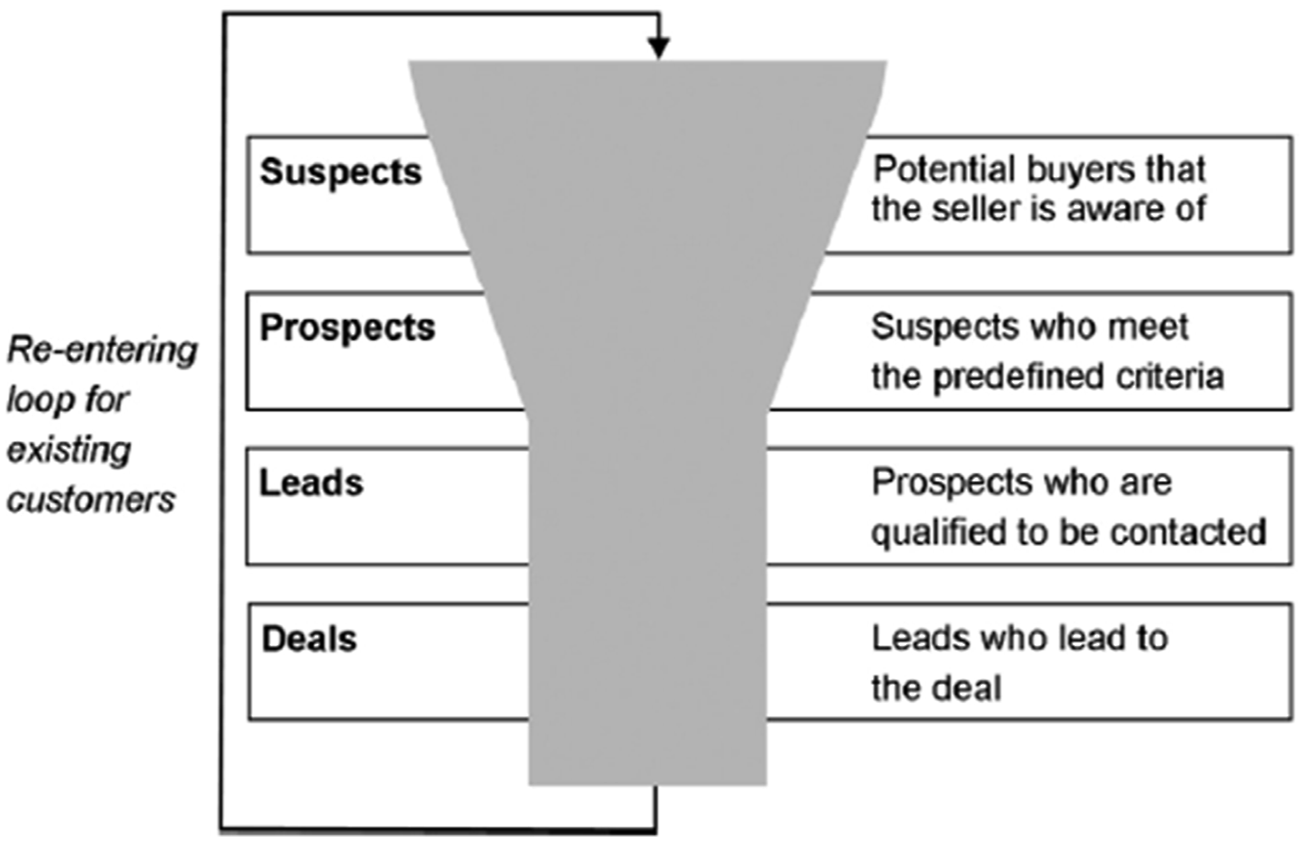
Considering that in the case of social marketing there is a behavior funnel rather than a sales funnel, we propose to adapt this model to the stages of the aforementioned TTM. In this sense, the proposed behavioral change funnel (Figure 2) considers the action through pre-contemplators in a first stage; and subsequently towards contemplators who are thinking about the possibility of changing; those who are prepared to change and are only waiting for a call to action; and those who are actively changing their attitudes and behaviors, which that requires social marketing actions to maintain the desired behavior (loyalty); and to recover those who have relapsed into undesired behaviors. In this model, the AIDAR and the inbound marketing assumptions are included to show the typology of content that should be accordingly delivered in the social marketing strategy. Behavioural Change Funnel Model. Source: Author Own Elaboration.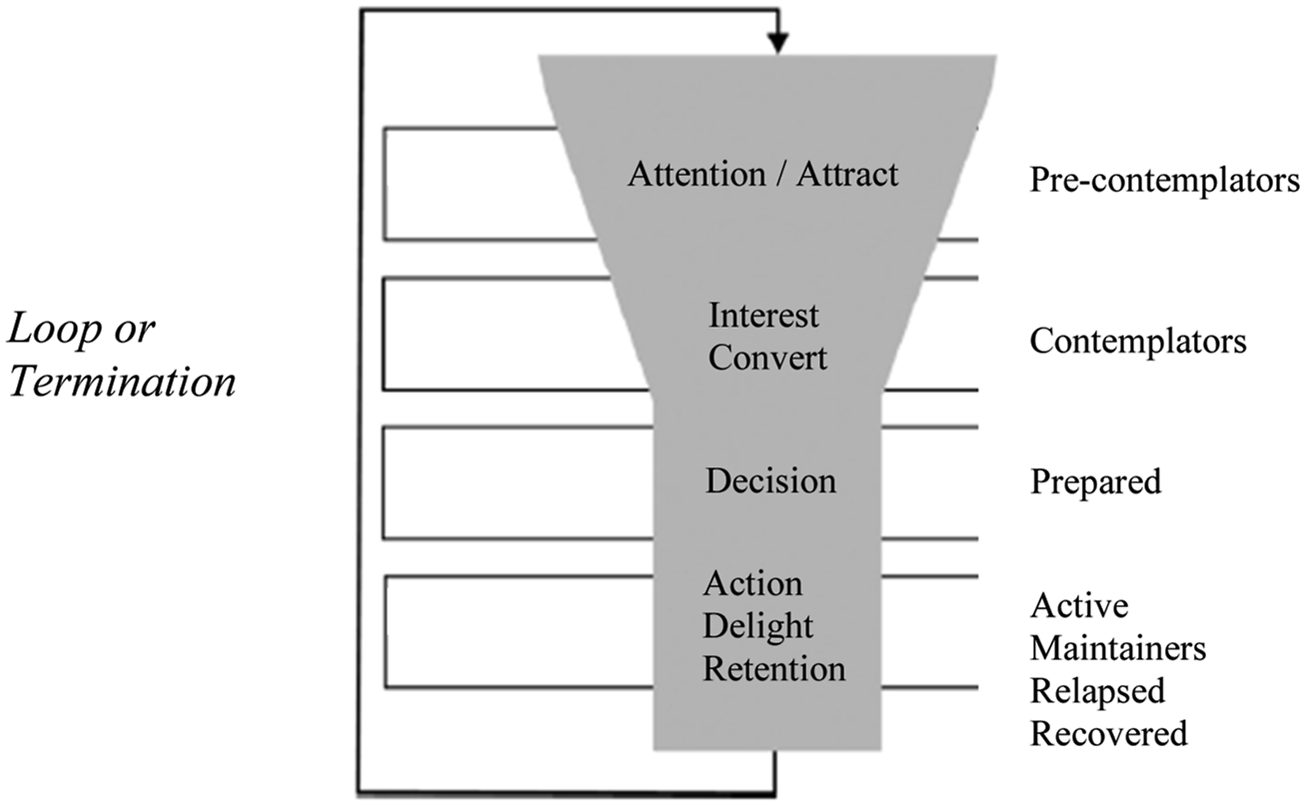
The proposed Behavioral Change Funnel Model consists in the first contribution of the present paper by adapting the theory of sales journey to the process of behavior change, based on the TTM. By understanding that at each stage a different marketing approach is needed allows social marketing to design the behavior change journey of the audience and consider the adequate omnichannel touchpoints to be targeted. In this sense, it is proposed a Conceptual Model for an Omnichannel Strategy to Social Change.
A Conceptual Model for an Omnichannel Strategy to Social Change
Although segmented social marketing interventions can follow the model of the stages of behavior change (Issock Issock et al., 2021), the campaigns tend to ignore the maintenance stage of TTM (Akdaş & Cismaru, 2021), thus requiring a more robust focus on retention and loyalty to achieve the desired attitudinal and behavioral changes. The incorporation of digital marketing in the social marketing strategy allows, in this sense, the use of real time digital analytics, which can be an advantage for that purpose. Furthermore, the literature suggests the potential of digital technologies in social marketing interventions (Flaherty et al., 2021). A gap was identified in social marketing literature regarding the lack of strategic incorporation of digital marketing integrated with offline interventions aimed at sustainable change of attitudes and behaviors. The digital marketing actions used in social marketing reflected in the literature are limited to raising awareness of causes (Shawky et al., 2019), therefore following an outbound approach.
This paper conceptualizes a strategic model of omnichannel intervention for social marketing by integrating digital marketing guidance in the offline strategy, based on the assumptions derived from consumer journey studies (Järvinen & Taiminen, 2016; Lemon & Verhoef, 2016) and the potential of digital technologies for marketing (Kannan & Li, 2017), but adapted to the process of social change stages (Prochaska et al., 1992). It proposes the feasibility of integrating the AIDAR hierarchy of effects model, the inbound-outbound marketing models, and the ATRN model (Awareness → Trial → Reinforcement and Nudging) into the TTM process of social change stages in the context of social marketing.
The integration of digital technologies in social marketing strategy can become effective (Mehmet et al., 2020) by facilitating research, segmentation, collaboration and co-creation (Flaherty et al., 2021). In fact, considering that co-design is a major challenge in social marketing (Schmidtke et al., 2021), the proposed social marketing approach, aligned in an omnichannel flow through the stages of social change, provides an important contribution to the field.
Figure 3 shows the proposed conceptual model of Omnichannel Social Marketing Through the Stages of Change by integrating the said models and assuming both the contagion effect and the incorporation of change in social norms (Burchell et al., 2013), thus leading to a nudge outcome in the long term (Barnard & Ehrenberg, 1997). Omnichannel Social Marketing Through Stages of Change. Source: Author Own Elaboration Based on TTM Model (Prochaska et al., 1992), AIDAR model (Fortenberry-Jr. & McGoldrick, 2020), ATRN model (Barnard & Ehrenberg, 1997), Inbound-Outbound Model (Bleoju et al., 2016) and Sales Funnel Model (Järvinen & Taiminen, 2016).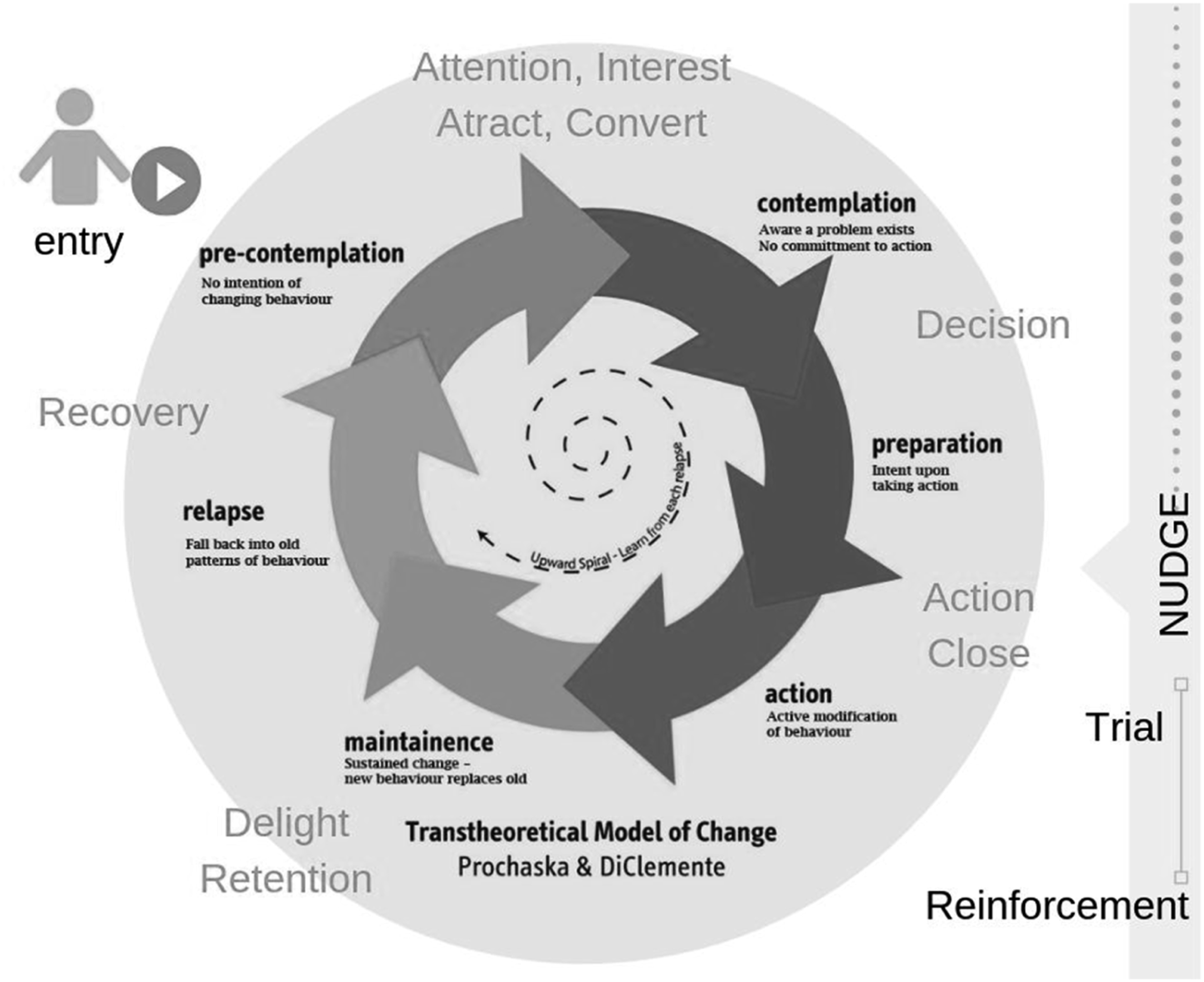
The proposed model considers the basis of the TTM (Prochaska et al., 1992), which organizes the stages of change in five steps: (1) pre-contemplation, the stage of no intention of changing behavior; (2) contemplation, the stage where the audience is aware that a certain problem exists, but there is not yet any commitment to take action; (3) preparation, the stage where there is an intention to take action in the future; (4) action, when attitude or behavior change occurs; and (5) maintenance, when change becomes an habit. However, if a sustained behavior does not occur, there is a risk of relapsing, when the individual, for any given reason, falls back into his old attitude/behavior. This relapse should be anticipated via a social marketing intervention, with a focus on the maintenance stage. In fact, a failed attempt disincentivizes a new try because of its effect on perceived self-efficacy. This is an important variable of the health belief theory in social marketing (Rosenstock, 1974), a model that considers the motivation to behavior change, based on the analysis of benefits and barriers, susceptibility and severity and perceived risks, perceived behavior change efficacy and self-efficacy to change. However, the upward spiral theory of lifestyle change (Van Cappellen et al., 2018) proposes that re-entering the process is positively affected by prior learning in each relapse, and continuous spirals can result in long-term adherence to the desired behavior.
Conducting a social marketing intervention through the stages of change should involve the 4 Ps of the marketing mix, although promotion is the most used technique, especially in the pre-action stages (Issock Issock et al., 2021). This model proposes the traditional outbound techniques to draw attention to the social problem and raise interest on how to conduct behavior change. These actions can be implemented via mass media communication interventions, such as social advertising (Casais & Proença, 2018). However, the interest developed should be complemented with information in digital media, such as websites, mobile apps and social media, besides a full intervention in SEO, with adequate keywording on websites to attract those who are looking for information about the topic (contemplators), as well as sponsored digital communication through SEM to attract those contemplators through the right keywording during their online experience. This can be exemplified with a correct SEO and SEM intervention with adequate associated keywording for websites, mobile apps or social media pages — e.g., about quitting smoking, about the benefits of vaccination, or about recycling issues —, by anticipating the searching expressions of online users that look for such type of information. Attraction campaigns to websites, mobile apps or podcasts should allow the conversion of interest into a decision, or the conversion of contemplators into citizens prepared for attitudinal/behavioral change. Levit et al. (2016) and Akdaş and Cismaru (2021) highlight, among other techniques, the availability of self-evaluation features or symptoms checklists, which can also be based on chatbots powered with algorithms. Then, the challenge consists in converting such process into a decision to change, which can involve nurturing qualified leads. This can occur through online touchpoints, such as personalized email marketing automation, personal assistance through chat, personalized or through a bot, or social media engagement; and offline channels, such as personalized meetings or counseling. In this process, peer reinforcement is crucial. This same process occurs with social fitness mobile apps, as is the case of Strava for physical activity (Spotswood et al., 2020). Besides offline local communities and upstream regulations for social change (Haldeman & Turner, 2009), virtual communities in forums and on social media groups become critically important (Biroscak et al., 2019; Calderon et al., 2021). Social influencers, either social media stars, including YouTubers, bloggers, caregivers or other peers of virtual communities should be recruited to influence the decision to adopt attitude/behavior change and to provide adequate reinforcement regarding its maintenance (Hudders et al., 2021).
This last stage of the TTM model requires the retention of changed behaviors to achieve loyalty, which can be reinforced via digital engagement on social media, the call for user-generated content, personal feedback about the process of change, peer mentoring, and the continuous monitoring of achievements via digital devices, such as remote-controlled wearables and mobile apps, making use of geolocation systems, as well as Bluetooth and RFID technologies, or NFC interconnectivity and the possibility of sharing such achievements for peer recognition and reinforcement on social networks (Lehrer et al., 2021; Mehmet et al., 2020; Polo-Peña et al., 2021; Spotswood et al., 2020). Such reinforcement can also be promoted by praising people for their efforts and successes. This can be done via digital rewards in mobile apps that recommend sports activity or healthy habits, for example. These rewards are recognized and valued by the virtual community using those apps and by social media. The rewards can also consist in measuring the benefits of change (e.g., by materializing the number of calories lost in a given physical activity).
While Levit et al. (2016) and Akdaş and Cismaru (2021) developed a framework for the identification of TTM in websites applied to mental health, this paper takes a step forward by conceptualizing a framework for both offline and digital social marketing interventions that can be adapted to a variety of media and technologies, via a funnel perspective of converting prospects into long-term social decisions and actions. Following the above-mentioned assumptions, this paper proposes Inbound-Outbound interconnected models of communication (Bleoju et al., 2016) and the sales funnel model (Järvinen & Taiminen, 2016) adapted to a behavioral change funnel model, which is also proposed as a novelty in this paper.
Contribution, Recommendations and Implications
If social marketing was initially conceptualized as the adaptation of marketing techniques to change attitudes and behaviors, specialized research in this area has led to the development of its own theories (Wymer, 2011). In this sense, the development of a strategic model of digital marketing applied to the assumptions of the theory of stages of change in social marketing allows making theoretical advances regarding the scope and proceed to theoretical derivations from the management of the citizens’ journey. This paper contributes with the proposal of a behavior change funnel adapted to the behavioral change journey and by identifying the target audience of each stage of change. This process allows the identification of digital media and techniques best suited to each stage of change by considering their particular goals. Furthermore, by integrating different models collected from the conceptual background, the paper proposes an omnichannel model for social marketing through the stages of change, duly illustrated with practical examples.
The proposed model provides strategic guidance for social marketing managers, suggesting guidelines to enhance their effectiveness in using integrated digital techniques, from awareness to change to maintenance of change, following a funnel perspective that can actually be adopted as a spiral, in case of relapse.
A strategic model as the one proposed here allows the establishment of measurable goals, with KPIs being measured in all the stages of change. The use of digital analytics has benefits for real time measurement and complements the evaluation of offline interventions. In this sense, the proposed model intends to support the conversion of awareness into effective change, thus assessing the measurement of social return on investment (SROI) (Nicholls, 2017). If we consider that SROI can be of central importance in the near future in the evaluation of social marketing programs and that the criteria for allocating funding for social marketing to public and non-governmental organizations can be made not according to the number of awareness raising actions, but rather according to their effectiveness in bringing change, then the proposed conversion, retention and monitoring techniques may prove to be decisive to overcome the identified weakness of action in the maintenance stage of change (Akdaş & Cismaru, 2021). Providing managers with the skills to manage the digital transformation of organizations and implement metrics to monitor strategic actions is, in fact, a challenge identified and recommended to all sectors of activity (Leeflang et al., 2014), and social marketing is not an exception, given its systemic approach (Flaherty et al., 2020; Truong et al., 2019). The proposed model allows the stakeholder value co-creation to social marketing interventions (Anker et al., 2020) by considering the bidirectionality of digital communication technologies (Schmidtke et al., 2021), and pursues a first approach to an omnichannel perspective in social marketing, where both interaction, personalization and experience are considered to address social change.
Limitations and Future Research
The operationalization of the framework conceptualized in this paper requires the consideration of the usability variable of the Technology Acceptance Model (TAM). This is still a challenge, given the low level of digital literacy of some vulnerable populations, who are the specific target audiences of social marketing interventions, as well as disability conditions — i.e., among the elderly population, whose personal restrictions can constrain the use of such technologies, such as wearables and mobile apps to incentivize and control health issues among the senior population (Chawla et al., 2021; Guzman et al., 2021).
In order to strengthen the assumptions of the proposed model, which are predicated upon a critical conceptual background discussion, future research should explore the framework via empirical research, both by interviewing individuals who have gone through the process of change by using digital marketing techniques and by analyzing social marketing cases that encompass all the postulations of the framework and may serve as an illustration of the present contribution.
Finally, to overcome the above-mentioned limitation, future research can also analyze adapted questionnaires of both the Technology Adoption Model and the Theory of Planned Behavior to identify the potential of the omnichannel marketing model in converting the target audience to social change after the social marketing interventions.
Footnotes
Declaration of Conflicting Interests
The author(s) declared no potential conflicts of interest with respect to the research, authorship, and/or publication of this article.
Funding
The author(s) disclosed receipt of the following financial support for the research, authorship, and/or publication of this article: This work is financed by national funds through FCT - Foundation for Science and Technology, I.P., within the scope of the project « UIDB/04647/2020» of CICS. NOVA – Interdisciplinary Centre of Social Sciences of Universidade Nova de Lisboa.
