



Abstract
The importance of close social contacts in the educational process has been widely documented, but mainly for the school sector. The present article examines the importance of close relationships on university students’ dropout tendencies. Using longitudinal panel data collected at a medium-sized German university, students (N = 7,169) were surveyed in four waves. The authors investigate how the family situation, partnerships and relations to peers correspond with students’ dropout intentions. Data analyses revealed three main findings: First, parental educational aspirations negatively influence the tendency to dropout. Second, students living in partnerships display lower dropout intentions; however, a new partnership favors the tendency to drop out. Third, while close friends decrease students’ dropout intentions, having a high proportion of friends from non-university life domains increases them.
Over the past decades a persistently high number of university dropouts in the countries of the Organization for Economic Co-operation and Development (OECD) has been observed (OECD, 2019) 1 . Despite great efforts, about one in three students in Germany drops out without graduating (Heublein & Schmelzer, 2018), with dropouts mostly occurring in the first two semesters (Heublein et al., 2017). Therefore, the need for empirical analyses has increased, particularly in higher education planning in order to identify and develop accurate measures for prevention and intervention. As a consequence, many theoretical models have been developed for explaining academic success or student dropout (Bean, 1980; Bean & Eaton, 2000; Blüthmann, 2012; Heublein, 2014; Isleib et al., 2019; Larsen et al., 2013; Spady, 1970; Tinto, 1975; Ulriksen et al., 2010). The explanatory focus of the theoretical models is mostly on characteristics of the study program, on the students themselves with their specific social and personal characteristics, on their cognitive and motivational prerequisites, as well as on their social and academic integration (Isleib et al., 2019; Isleib & Heublein, 2016; Larsen et al., 2013; Tinto, 2006). Considerable knowledge has already been generated in this field of research. However, conceivable influences from other life domains, for example students’ living arrangements and their relations to their parents, partners or friends, are mostly neglected (Larsen et al., 2013).
This observation is rather surprising, because, first, a huge volume of theoretical and empirical literature from life course research has shown that life domains are mutually dependent and that social relationships play a crucial role for educational and occupational trajectories (Cheng & Starks, 2002; Grunau, 2017; Huinink & Feldhaus, 2009; Maaz, 2006; Mayer, 2004; Seginer & Vermulst, 2002; Sewell et al., 1969; Sewell et al., 1970; Whiston & Keller, 2004). Second, previous studies on educational attainment provide convincing empirical evidence for the connection between parents’ educational aspirations, parental involvement, parent-child relations and children's school attainment (Neugebauer et al., 2013; Ross, 2016; Stocké, 2013). Therefore, it does not seem convincing that parents reduce their commitment just at the time when their offspring enter university. In particular, previous research has demonstrated that parents often provide monetary support to help finance their children's studies (Steelman & Powell, 1991; Turley & Desmond, 2011). Third, the influence of intimate partnerships on student success has been analyzed only to a very limited extent (Manning et al., 2010; Schmidt & Lockwood, 2017). Finally, in terms of peer influence, other researchers have shown that friendships with peers who had positive attitudes toward school and learning had a positive effect on academic achievement (Buchmann & Dalton, 2002, Buote et al., 2007; Poldin et al., 2016; Stewart, 2008). Therefore, relationships with parents and friends as well as with an intimate partner (or relationship status) are assumed to be further influencing or associated factors for academic success.
The students whose courses of study are analyzed in this article are at the beginning of their tertiary education, which is, unlike in other countries, usually free. In Germany, the first phase of the studies regularly lasts three years and ends with a bachelor's degree. 2 In the present study, the authors aim to analyze the influence of close relationships (parents, partner, friends) on these students’ dropout intentions
Parental Influences on the Course of Studies
Looking at empirical findings, several studies are concerned with the question of how parents influence or support their offspring during their time at university (Bean, 1982; Blüthmann et al., 2011; Cutrona et al., 1994; Dixon Rayle et al., 2006; Flaster, 2018; Hamilton, 2013; Hoffman et al., 1992; Pipp et al., 1985; Whiston & Keller, 2004). (1) The results show that parents have a great influence on whether their children study and, to some extent, what subject and at which university they study. The closer the relationship between parents and child, the more likely it is that the parents have a significant influence on the study decisions (Broekemier & Seshadri, 2000; Hossler et al., 1999). Also, early findings indicate that family approval of the selected institution increases the student's certainty of choice and is negatively linked with early breakoffs (Bean, 1982). (2) Empirical analyses on the influence of parent-child relations on academic success are extremely scarce. Cutrona et al. (1994) conclude from their cross-sectional survey that social support (including guidance, reliance, and attachment, among other things) from parents, but not from friends or intimate partners, positively correlates with academic success. Weak connections between parental social support and academic persistence could also be confirmed by Dixon Rayle et al. (2006). (3) Further determinants of young adults’ university enrolment and their academic success are the willingness and the ability of parents to provide financial support. If parents plan to (at least partly) finance their offspring's studies, the likelihood of their children entering university rises (Flaster, 2018). Moreover, higher financial support during time at university is positively correlated with graduation (Hamilton, 2013). (4) Previous findings have shown that parental involvement increases their offspring's commitment to their studies, a factor that in turn is associated with a positive effect on academic success and a negative effect on dropout tendencies (Blüthmann, 2012; Schiefele & Jacob-Ebbinghaus, 2006). (5) Further researchers assume that parental effects are rather indirect: For example, family burdens, family care, negative relationships with parents, or financial hardship can adversely affect students’ well-being and therefore impair their academic success (Blüthmann et al., 2011; Bornhorst et al., 2020). Overall, it is assumed that parents’ attitudes toward studying as well as their involvement in the academic performance of their children are related to student dropout behavior. It is hypothesized that the higher the parental aspirations, and the parental involvement, the lower the dropout intentions of their offspring (RQ1).
The Role of Intimate Partners in Educational Processes
Similar to parent-child relations, the role of intimate partners on the academic performance of university students has not been analyzed in detail up to now: (1) Manning et al. (2010) underline that, overall, partnerships can have both negative and positive influences on educational goals. On the one hand, partnerships can compete with studies with regard to the investment of time resources, but on the other hand, intimate partners can also be a strong motivator, especially if the partners themselves have high educational aspirations. (2) With regard to academic success, Schmidt and Lockwood (2017) find that students who are in a partnership are less likely to attend classes, but this does not have a negative impact on their academic performance. (3) Looking at social support, Cutrona et al. (1994) do not find a positive effect of intimate relationships on academic performance. (4) Findings regarding changes in partnership status indicate that a separation from a partner has a negative effect on academic performance, because separation is associated with increased stress, depression and anxiety (Field et al., 2009; Field et al., 2013). Following the theoretical assumption of the partner as a motivator for studying, it is assumed that the presence of a partner is negatively associated with dropout intentions (RQ2), and while breaking up is associated with lower academic motivation, entering a new relationship may be associated with higher well-being and thus lower dropout tendencies (RQ3).
Peer Effects on Academic Performance
In addition, the peer group grows in importance for young adults as a frame of reference for many personal and life course related questions. (1) Peer integration and support from friends is well-documented to increase success in school (Powers et al., 2005; Wentzel et al., 2004). Similar effects have been found in higher education, particularly with a focus on students’ relationships. Many empirical findings provide evidence that the social integration of students has a positive effect on their academic success, because students help and support each other, exchange materials, learn and spend time together (Davidson & Wilson, 2014; Tinto, 2006). (2) Furthermore, researchers have shown that university friends are very important for social and academic integration, particularly for those who still live together with their parents (Buote et al., 2007; Jagešić, 2015; Pokorny et al., 2017; Poldin et al., 2016). (3) Less is known about possible effects of friends from outside the university context. Here, institutional differences exist between the American and German higher education systems. In Germany, only about every fifth student (19.6% in 2018) lives in residence halls, and every third (32.5%) does not live at their place of study (Berghoff & Hachmeister, 2019). According to Tinto (1987), dropouts can be explained mainly by the fact that students do not separate from their previous social environment, which is why the transition fails and new values are hardly adopted.
It is conceivable that non-university friends, especially if they do not study themselves, show negative attitudes towards studying, or they may point to alternative career paths, which often go hand in hand with earlier financial independence. This could reduce the commitment to studying. In general, more frequent contact to non-academic peers could presumably mean spending less time with fellow students, especially if there is little or no overlap between friends from inside and outside the university context. This might further hinder social integration into the student body. In this regard it is assumed that positive integration (peers’ aspirations and involvement) into a student peer group should be accompanied by a negative effect on student dropout tendencies (RQ4), but that a high number of non-university friends has a positive impact on dropout tendencies (RQ5).
Further Influences on Students’ Dropout Intentions
The focus of this article's analysis is on the influence of social relations on dropout tendencies. Accordingly, information about the impact of other contexts or dimensions (such as university parameters, individual dispositions) on students’ dropout intentions is not included here in full detail. But, nevertheless, it is necessary to include some well-known influences from the extensive previous findings in higher education research as control variables. (1) Contact with other students and lecturers at the university have been identified as important influencing factors, as numerous findings on the effects of social integration show (cf. Heublein, 2014; Tinto, 1975): The frequency and quality of contacts with fellow students and lecturers showed a positive effect on remaining at university. Therefore, the analysis controls for the level of social integration. (2) Previous findings show that especially families with a higher social status or a higher educational level have a greater interest in motivating their children to pursue higher education in order to avoid downward mobility (Barone et al., 2018; Daniel & Watermann, 2018; Stocké, 2007). Therefore, it is controlled for parents’ educational attainment (Janke et al., 2017; Larsen et al., 2013; Müller & Schneider, 2013). (3) Furthermore, research findings indicate that the student's health is an important influencing factor for academic success and that a deteriorating state of health can essentially increase the tendency to drop out (Eisenberg et al., 2009, Lipson & Eisenberg, 2018; Wyatt & Oswalt, 2013). Thus, a combined measure for students’ physical and mental health problems is included. (4) Findings on the influence of students’ employment status vary. While some researchers confirm a positive effect on the propensity to drop out, others find no effect at all (Choi, 2018; Dundes & Marx, 2006; Heublein et al., 2010; Hovdhaugen, 2015; Ishitani & DesJardins, 2002; Larsen et al., 2013). To control for this, students’ employment status is included. (5) Another central parameter which influences social and academic integration is the student's housing situation (Feldhaus, 2020; Heublein et al., 2017; Larsen et al., 2013; Simpson & Burnett, 2019). Tinto (1987) argues that living in the hometown makes it more difficult for students to socially integrate at university. In Germany, students often live in shared apartments with other students; in 2018, the share was 40.9% (Berghoff & Hachmeister, 2019). It could therefore become relevant whether students live in a shared apartment. For this reason, it is also controlled for living arrangements. (6) Moreover, results indicate that being a parent is associated with greater difficulties in reconciling family and studying, especially due to the time demands of childcare (Heublein et al. 2017; Hovdhaugen & Aamodt, 2009). (7) Furthermore, it is controlled for students’ gender and migration status. While women are more likely to complete their studies successfully, a migration background is likely to raise barriers which increases the propensity to drop out (Heublein et al., 2010; Heublein et al., 2017; Mishra & Müller, 2021). (8) The school leaving grade has also emerged as a significant predictor (Robbins et al., 2004). (9) Finally, it is controlled for the students’ age, a factor that numerous studies have proved to be important (Larsen et al., 2013).
Research Purpose
To summarize, the research purpose of the present study is to investigate the influences of close relationships (parents, partner, friends) on university students’ dropout intentions. The influence of close social contacts on educational trajectories has been highlighted many times, but hardly at all for the context of higher education. Specifically, the analyses were guided by the following five research questions:
Do parents’ educational aspirations and involvement in student affairs influence their children's dropout intentions?
Are university students’ dropout intentions affected by their relationship status?
Do changes in one's relationship status such as entering a new partnership significantly influence university students’ dropout intentions?
Is a positive integration into a student peer group, represented by high peer aspirations and involvement, negatively linked to university students’ dropout intentions?
Does a high number of friends outside the university context increase university students’ dropout intentions?
Method
Data Collection
Data are drawn from the panel study “Life Course Perspective and Dropout from Higher Education (LAST)”, which began in the winter semester 2017/18 at the Carl von Ossietzky University of Oldenburg (LAST, 2017). This project applied a life course approach to develop a heuristic model of university students’ academic success and dropout intentions. Besides testing the well-documented effects of individual dispositions and factors related to the study program, a special focus was placed on possible impacts of further life contexts, particularly in regard to the importance of close relationships. To this end, undergraduate students were recruited at a medium-sized German university and surveyed over two years in a total of four waves (N = 7,169 observations). The sample was restricted to students aged 39 years or younger. Due to the small number of cases, we also excluded participants who gave their gender as non-binary and participants who provided diverging information about their gender. The number of cases thereafter amounted to 7,006.
Participants in the original sample were mainly first- or third-semester students. In total, 4,046 different respondents were part of the panel. 44% of the participants are panel cases, which means that the respondents took part in at least two panel waves. The response rate among all registered first- and third-semester students of the university was 38%, a share similar to other comparable German panel surveys such as pairfam (’Panel Analysis of Intimate Relationships and Family Dynamics’) or the NEPS (’National Educational Panel Study’) (Steinwede & Aust, 2012; Suckow & Schneekloth, n. d.). Data from all four waves were used in the present analysis. The analytical sample was restricted by only considering respondents with full information on all the variables included (listwise deletion). Therefore, the final pooled sample comprises N = 4,699 (cases). For the longitudinal analysis, only respondents taking part in more than one wave were included. Consequently, the analytic sample for the fixed effects models was reduced to a size of N = 3,049 (cases). As this survey is also confronted with missing values, sensitivity checks were performed using multiple imputation.
Participants
As it is shown in Table 1, participants were mainly female (72.04%), non-migrant (89.43%), and first-generation (56.72%) undergraduate students which are employed in a side job (58.29%). Their average age is 22.59. One of two respondents is living in a committed relationship (52.94%). Dropout intentions are fairly low with a mean of 1.44 on a 4-point-scale. Educational aspirations of reference persons are generally very high (all significantly above 4 on a 5-point scale), while the romantic partner is the person most involved in student affairs.
Descriptive Statistics of the Sample (Full Sample: N = 4,699; Sample Solely with Students in Partnership: N = 2,489)
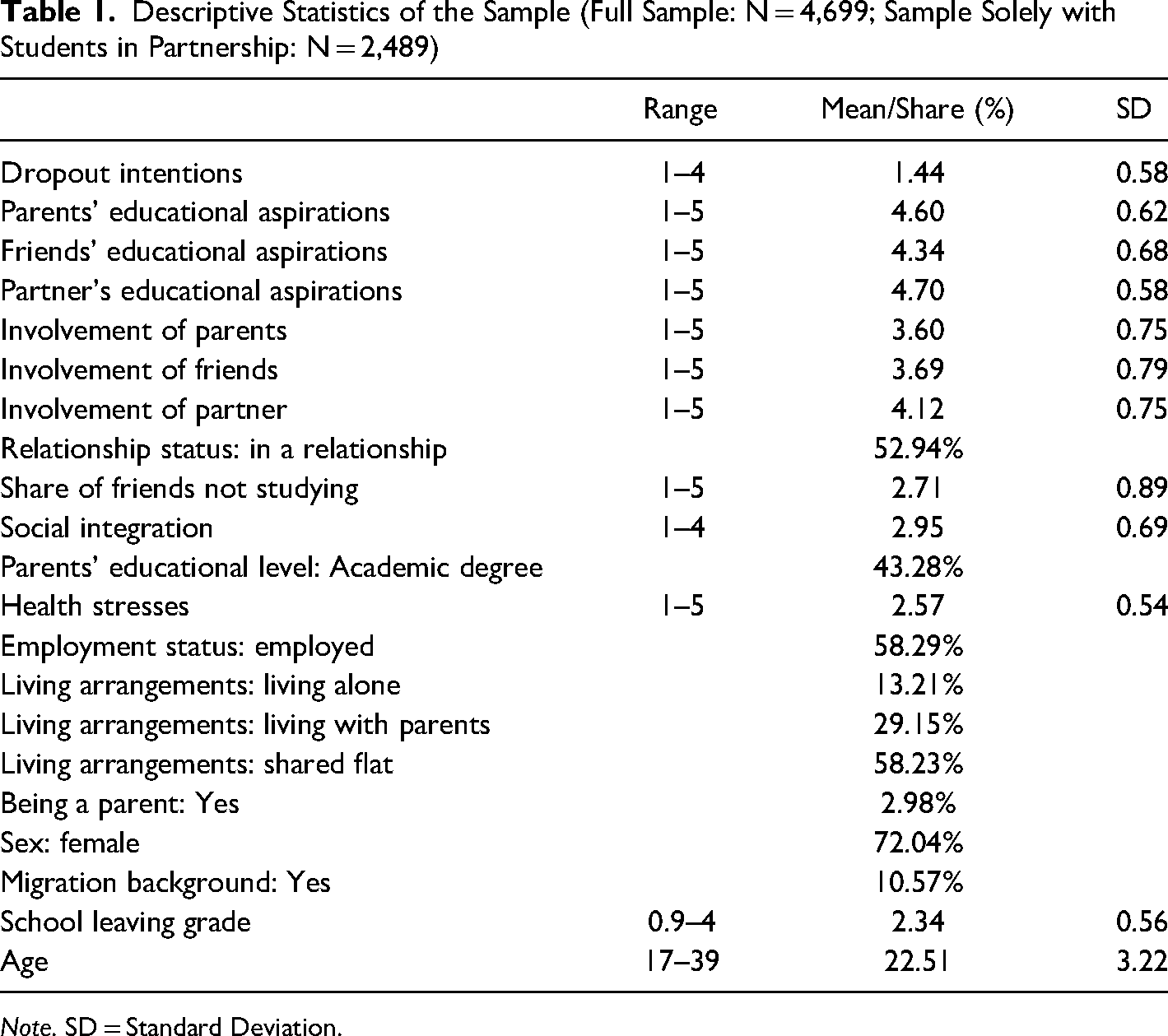
Note. SD = Standard Deviation.
Analytic Approach
Data were analyzed with the free software R (version 4.0.3). Methodologically, this article is divided into cross-sectional and longitudinal analyses. Research questions 1, 4, and 5 were examined both cross-sectionally and longitudinally. RQ2 was solely addressed by cross-sectional research, RQ3 was addressed by longitudinal research. On a cross-sectional level, ordinary least squares regressions (OLS) were performed on the pooled sample. Robust standard errors were applied since the observations are not independent from each other. In-depth analyses (presented in the appendix) solely target those respondents who are in a relationship. This methodological approach allows to examine the potential influences of partnership characteristics and to check whether the relationship with the partner alters the influences of the other reference persons (in this case: those of parents and friends).
The longitudinal data are analyzed using fixed effects (FE) regressions. FE examine intraindividual changes over time by uncovering possible effects of changes in the independent variables on changes in the dependent variable (Brüderl, 2010). FE can only consider time-variant variables which eliminates unobserved between-person heterogeneity (Allison, 2009; Wooldridge, 2010). As in the case of the OLS models, a separate model for students in a relationship is presented in the appendix. The structure of all regression models is hierarchical. Firstly, the effects of the main independent variables are demonstrated, ordered by the different close relationships. Secondly, the central control variables are added. And thirdly, an overall regression model is calculated displaying the effects of the independent variables while at the same time controlling for the influences of the control variables.
Measures
Dependent Variable
Dropout Intentions
Students’ tendency to leave university prematurely, which means without attaining their degree. This tendency is measured as a mean score of three items (α = 0,79) following Trautwein et al. (2007). An example from the items is: ‘I am seriously thinking of giving up studying’. Answer options range from 1 (does not apply at all), to 5 (applies fully).
Independent Variables
Educational Aspirations (Held by Parents, Friends, and Partner)
Educational aspirations reflect a reference person's expectations of the student, i.e., how likely they think it is that the student will successfully complete their degree. This level of conviction is measured by a single item: ‘My [reference person] is convinced that I will successfully complete my studies’. If both are available, information about the mother and the father are aggregated in a parent index. Otherwise, the available information from the respective parent is used. Answer options range from 1 (does not apply at all) to 5 (applies fully).
Involvement (of Parents, Friends, and Partner)
The frequency of conversations with reference persons about studying in general. As in the case of educational aspirations, information for mother and father are reported as a mean score or as a single item value, depending on whether information is available for both parents. Answers range from 1 (never) to 5 (very often).
Share of Friends not Studying
The share of the respondents’ friends that is not currently studying. This one item measure ranges from 1 (no one) to 5 (all of them).
Relationship Status
Participants were asked whether they are currently in an intimate relationship (0, 1 = yes).
Start of a new Partnership
Based on the variable indicating the student's relationship status, a further variable has been created for the longitudinal analysis. This dummy variable refers to relationship development occurring during the course of the panel survey. Students who were single in the previous wave but stated that they were in a relationship in the subsequent wave were labeled as 1 (in relationship, otherwise = 0).
Control Variables
Social Integration
Participants’ social integration into the student body has been measured by three items based on the Social Integration Scale developed by Schiefele et al. (2002). This scale asks for frequency and quality of interactions with fellow students. One of the items is: ‘I have many contacts with students in my cohort.’ Answers range from 1 (does not apply at all) to 4 (applies fully).
Parents’ Educational Level
Detailed information about the parents’ educational level has been collected. This information has been transformed into a dummy variable provided that the respondent gave a valid answer for at least one parent. If one or both parents graduated from a higher education institution, the respondent's home is considered as an academic household, others represent the reference category (0, 1 = academic degree).
Health Stresses
The subjective state of health was measured by eleven items from the Short Form Survey (SF-12) (Ware et al., 1993) that were constructed as a mean score. Responses for physical and mental health were combined into one overall health score. Answers to the question how often the respondents have experienced various health stresses in the past four weeks, range from 1 (never) to 5 (always). An example item is: ‘During this time, how often did you find yourself feeling down and gloomy?’
Employment Status
Respondents were asked whether they had a job alongside studying. A dummy variable with employed students (regardless of whether the job is during the semester or during the semester break) as one category (1) and non-employed students as the reference category (0) has been created.
Living Arrangements
The participants were asked to provide information on their current living situation. For the following analysis, the information on their main residence was used. Three categories of living arrangements were provided: shared flat (with a partner or other persons), living alone or living with parents.
Being a Parent
Respondents were asked to provide information about whether they have children. This was measured as a dummy variable (0, 1 = yes).
Sex
A dummy variable was created (0, 1 = female).
Migration Background
The participants were asked to state their mother's and father's country of birth. If at least one parent was born in a foreign country, the respondent is considered as a person with migration background (0, 1 = migration background).
School Leaving Grade
The school leaving grade has been included as proxy information for the participants’ cognitive abilities that also provides information about motivational characteristics (Trapmann et al., 2007). It ranges from 0.9 to 4, with higher values indicating poorer average grades.
Age
The respondent's age in years.
Results
Cross-Sectional Findings
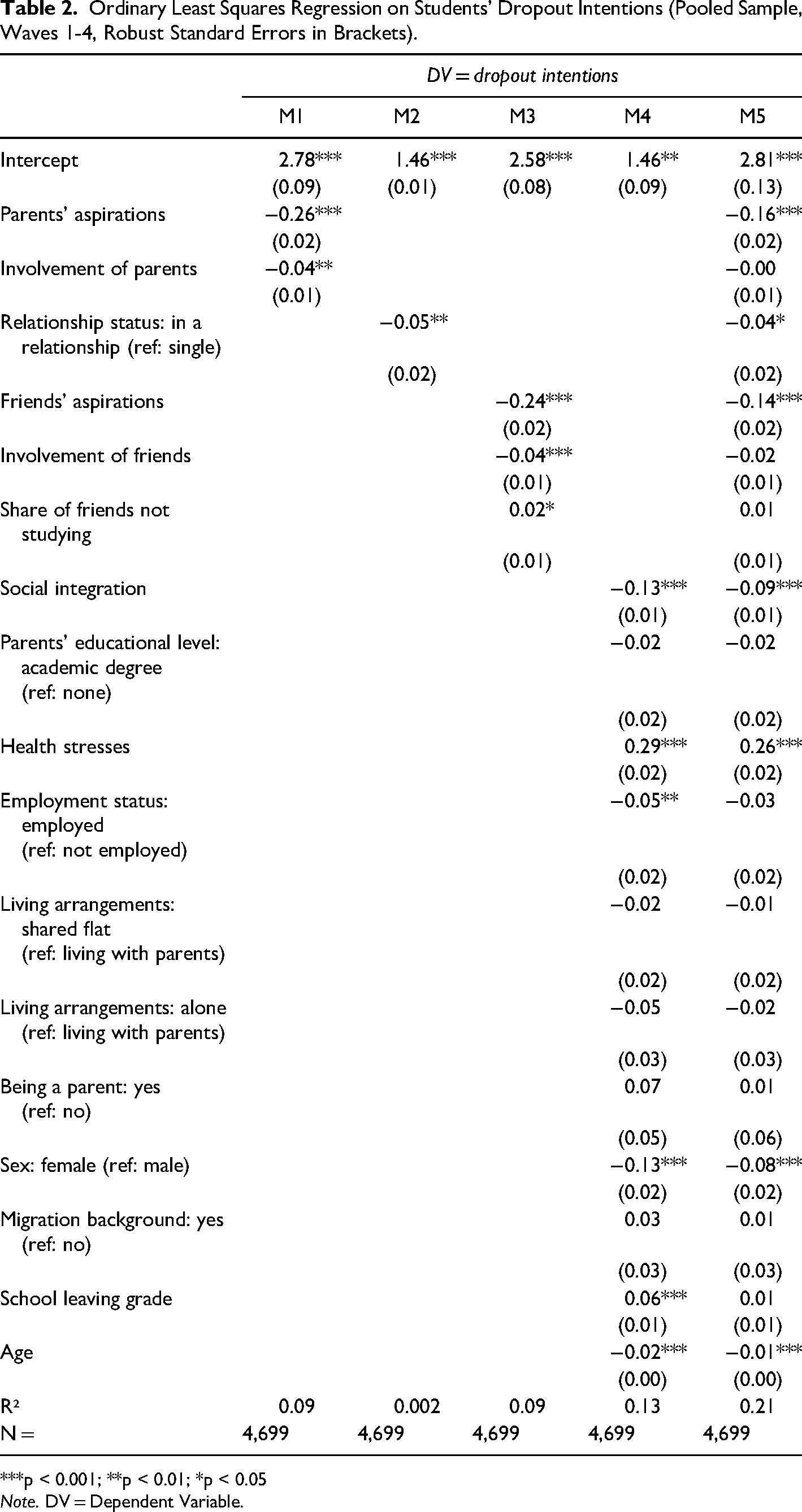
The results of the OLS models on the pooled sample will be presented first. In RQ1, it was hypothesized that the higher the perceived parental educational aspirations and their involvement regarding the academic success of their offspring, the lower the dropout intentions. Looking at the results from the linear regression (Table 2, Model 1), parents’ aspirations and parental involvement both reduce students’ dropout intentions significantly. Every scale unit of the parents’ aspirations decreases the dropout propensity by –0.26 (p < 0.001), every more unit of parental involvement decreases it by –0.04 (p < 0.01). The impact of parental educational aspirations is still significant even if we control for well-known control variables (Table 2, Model 5). RQ2 investigates the impact of partnership status. It is argued that the presence of a partner is negatively associated with dropout intentions. This assumption is also confirmed by the cross-sectional findings (Table 2, Model 2 and Model 5). Even under inclusion of several control variables, being in a committed partnership reduces the dropout intention by –0.04 scale points (p < 0.05). In Table A (in the Appendix) a model solely for students in an intimate partnership has been run. This allowed for the inclusion of the partner's perceived educational aspirations as well as their involvement in the student's affairs. Similar to findings on parents, partner's educational aspirations significantly decrease students’ dropout intentions by –0.30 scale points (p < 0.001). However, neither the involvement of the partner nor the involvement of the parents has a significant influence.
Ordinary Least Squares Regression on Students’ Dropout Intentions (Pooled Sample, Waves 1-4, Robust Standard Errors in Brackets).
***p < 0.001; **p < 0.01; *p < 0.05
Note. DV = Dependent Variable.
Furthermore, it was hypothesized (similar to parents and a partner) that perceived educational aspirations of friends as well as their involvement is also influential on a student's dropout intentions (RQ4), which is partly confirmed too (Table 2, Model 3). Friends’ aspirations decrease dropout propensity about –0.24 scale points per unit (p < 0.001), involvement about –0.04 (p < 0.001). However, the effect of the latter becomes insignificant when several control variables are included. In addition, the assumption that a higher share of non-university friends is positively linked with students’ dropout intentions is also confirmed (RQ5).
Looking at the results for the control variables (Table 2, Model 4) we see that, as expected, women exhibit a lower tendency to drop out compared to men (β = –0.14, p < 0.001). We also see that with each additional year of life the dropout intentions decline by –0.02 scale points (p < 0.001). And as stated by previous research, the lower the cognitive skills, measured by school leaving grade, the higher the dropout intentions (β = 0.06, p < 0.001). Furthermore, greater health problems (β = 0.29, p < 0.001) and poorer social integration (β = –0.13, p < 0.001) into the student body are linked with higher dropout intentions. Finally, it becomes apparent that being employed is negatively associated with dropout intentions. Being employed is linked with a –0.05 scale points lower dropout propensity in contrast to full-time students. Migration background and parental educational attainment do not show any significant effect.
Longitudinal Findings
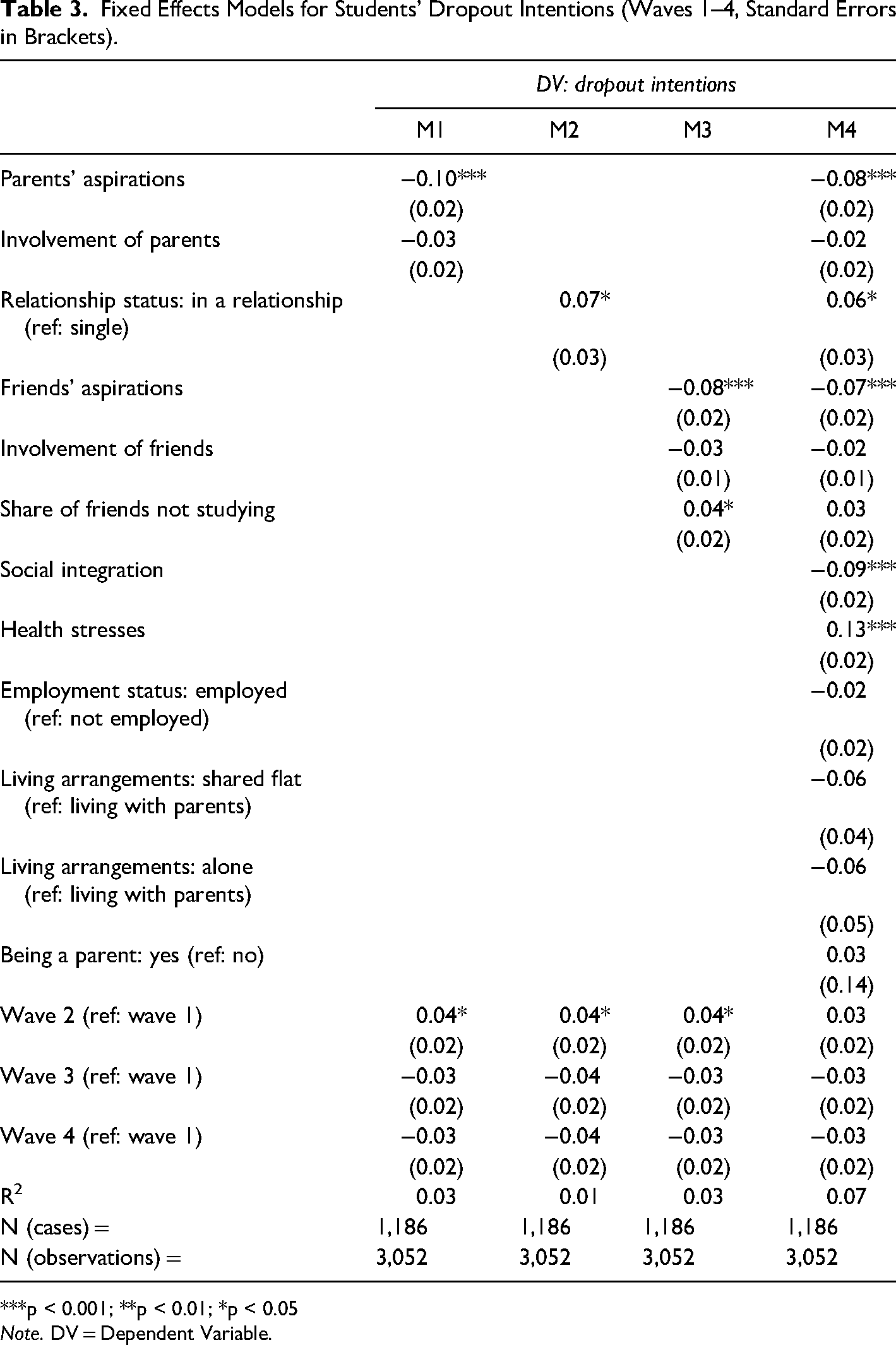
Looking at the longitudinal analysis, it can be seen that parents’ and friends’ aspirations still exert a significant influence. It is important to note that these influences now represent within-person changes and not a comparison between groups, as in the case of pooled OLS regressions. This means that if students increasingly perceive that their parents or friends are convinced that they will successfully complete their degree, they are less likely to seriously consider an early breakoff (Table 3, Model 4). Increases in parents’ aspirations decrease one's dropout intentions with –0.08 scale points (p < 0.001) slightly stronger than friends’ aspirations (β = –0.07, p < 0.001). The same association can be found with regard to increases in the partner's aspirations (see Table B in the Appendix). Moreover, it was hypothesized that a change in partnership status from "single" to "in a relationship" would be associated with a higher sense of well-being and thus lower dropout tendencies (RQ3). However, the longitudinal analysis shows the opposite effect (Table 3, Model 2 and Model 4). Entering a new partnership increases students’ dropout intentions by 0.07 or 0.06 (p < 0.05) scale units respectively, dependent on which control variables are applied in the model. Furthermore, an increasing amount of non-university friends leads to higher dropout intentions (β = 0.04, p < 0.05). The longitudinal results also confirmed previous findings in regard to the control variables, as it can be observed that the higher the social integration over the time, the lower the dropout rate (β = –0.09, p < 0.001), while increasing health problems increase the tendency to dropout (β = 0.13, p < 0.001).
Fixed Effects Models for Students’ Dropout Intentions (Waves 1–4, Standard Errors in Brackets).
***p < 0.001; **p < 0.01; *p < 0.05
Note. DV = Dependent Variable.
Discussion
The purpose of this paper was to examine the influence of close relationships on students’ dropout tendencies. Special focus was placed on the aspirations and involvement of parents, partners and friends. In general, the findings confirm the authors' assumption that a student's social relationships outside the university context are predictive for their dropout intentions, which supports the assumption of the interdependencies between life domains in life course research (Bernardi et al., 2019; Mayer, 2004).
The analyses confirm that the perception of parental educational aspirations is negatively associated with a propensity to drop out. This effect is also confirmed by the fixed effects model in the longitudinal analysis. Parental involvement in a student's affairs is significant in the linear regression model, but not in the panel analysis. The analyses thus confirm the expectation as well as earlier findings that parents continue to have a significant influence on the educational success of their children in this phase of education (Cutrona et al., 1994; Neugebauer et al., 2013; Ross, 2016; Stocké, 2013; Whiston & Keller, 2004).
The analysis of relationship status or partner influences yielded remarkable effects: Students in a relationship display significantly lower dropout tendencies compared to those without a partner. However, entering into a new relationship is associated with higher dropout tendencies, as shown by the longitudinal analysis. The present analyses do not allow any conclusions to be drawn about the underlying mechanisms, as in the case of Manning et al. (2010). It can be assumed that capacities that previously were available for studying are now invested in the new relationship. This interpretation is supported by Schmidt and Lockwood (2017) who show that students who are in a partnership are less likely to attend classes. Brömmelhaus and Preetz (2020) also see in their empirical findings a change in the subjective importance of the different areas of life as a possible reason for the fact that subjective study success increases after a separation. Further analyses, conducted solely on students in relationships, provide clear evidence that an increase in the partner's educational aspirations leads to a reduction in dropout tendencies (see Table B in the Appendix).
Looking at peer relationships similar results compared to parents and intimate relationships can be found. The perceived educational aspirations of friends exert a significant negative effect in the linear regression with the pooled dataset, as well as in the longitudinal models. Therefore, a similar effect of decreasing dropout tendencies has been revealed if the perceived educational aspirations of any of the people in close relationships with students increase. Furthermore, an increasing share of non-university friends is positively linked with students’ dropout intentions. These impacts are substantial even if it is controlled for well-known effects on dropout intentions, such as social integration, health status, migration, employment status, parental education, and school leaving grades. This result underlines that it is important not only to consider characteristics of the university context but also from surrounding life domains.
Whether parents hold an academic degree has no significant influence on students’ academic success. In contrast to existing results (Barone et al., 2018; Daniel & Watermann, 2018; Stocké, 2007), no correlation can be found between a higher level of parental education and lower dropout tendencies. In terms of migration background, it was assumed that it could raise barriers which increase the propensity to drop out (Mishra & Müller, 2021). While the present results reveal no relationship between a family migration background and higher dropout tendencies, bivariate analyses display a significant correlation.
With regard to student employment, findings show that students who are employed have lower dropout tendencies (see Table 2). The present results suggest that employment is not automatically associated with fewer time resources or with exhaustion. It is also convincing that students who are employed tend to complete their studies more quickly (Feldhaus, 2020). However, findings with regard to students’ employment status vary and the underlying mechanism is still not quite clear (Choi, 2018; Dundes & Marx, 2006; Heublein et al., 2010; Hovdhaugen, 2015; Ishitani & DesJardins, 2002; Larsen et al., 2013).
Looking at other key control variables, the present results confirm the findings of earlier studies in both cross-sectional and longitudinal settings. As has been shown many times, higher social integration is associated with a lower tendency to drop out (Davidson & Wilson, 2014; Tinto, 2006), whereas health problems can increase the tendency to drop out (Eisenberg et al., 2009, Lipson & Eisenberg, 2018; Wyatt & Oswalt, 2013). Also, this study confirms previous results that the intention to drop out is lower among female students than among male students (Larsen et al., 2013).
Limitations of the Study
However, this study is subject to some limitations. One is the subjectivity of the evaluation of others’ educational aspirations. The aspirations held by parents, peers, or the partner were measured as subjective assessments by the respondents. Although this procedure can be found in educational research (e. g. Roth, 2017; Sewell et al., 1969), it must be mentioned that this assessment could possibly inadequately reflect the true aspirations and it may be better to ask the persons directly. This might be another approach for future research. However, what guides an individual's actions is that person's subjective perception of the expectations they perceive in others (Ditton, 2013). Another limitation of this research paper is that it solely focused on students’ dropout intentions. Actual dropouts could not be considered. Nevertheless, previous research has demonstrated a substantial correlation between dropout intentions and actual dropouts (Gold, 1988; Meyer et al., 1999). Another limitation is the high rate of panel attrition. To check the robustness of the results, multiple imputation was performed additionally. The results basically confirm the findings. Differences were found with regard to partnership status, which no longer shows a significant effect, whereas a higher involvement of friends is associated with a reduction in the intention to drop out. An increasing share of friends who are not studying also shows a significant positive influence in the fourth model.
Practical Implications
A better understanding of the mechanisms of emerging thoughts about dropping out of university can provide valuable information for developing prevention and intervention measures since dropout intentions refer to a time when students are having serious doubts, but are still enrolled – and thus can still be reached by appropriate measures. Three measures can be derived from the reported results: First, student counselling centers should take the educational aspirations of close social contacts into account. If a student's social environment is not convinced that they will graduate, their confidence and academic self-efficacy can be severely impaired. Intervention measures could work towards building up a more autonomous self-perception as well as towards establishing contacts that are perceived as more supportive. Second, counselling services should also broach the issue of whether a partnership offers a supportive environment for the student's academic success, especially during study-related personal crises. It has been demonstrated that especially entering a new partnership negatively influences the course of studies, which is why targeted assistance in building up new structures that combine partnership and studying could be an effective intervention measure. Taken these two implications together, counseling staff need to be properly trained in the areas of social-emotional intelligence and empathy, and reinterpret their role more in the direction of personalized counseling or even as a form of life coaching. Third, as a general prevention measure, events and meeting places that enable or facilitate the students to socialize with other fellow students should be further encouraged and broadened since our results underscore the importance of making friends inside the university context. For this purpose, further on-campus institutions such as contact offices could be established or expanded, if already existing. Cafes or other meeting points located directly on campus, that are explicitly planned as contact exchange between students, offer easily accessible, low-threshold opportunities for socializing. Buddy programs such as those already in use for international students could especially help new students to adapt to the academic habitus and to build up a student network (Naidoo et al., 2021). In German higher education, some of these measures are already applied, but majorly focus on the orientation week for freshmen. However, meeting spaces and social events should be fostered not only in the first week, but also during semester.
Nevertheless, it has to be considered that applying these measures may not reach every student to the same degree as it could be assumed that extroverted students would probably take advantage of those offers far more often and regularly than their socially reserved, shy fellow students. However, the latter are the ones who would benefit the most from these offers, since extroverted students find social integration easier anyway. This potential selection bias has to be considered for the planning of these institutions, places, programs, and events.
Conclusion
All in all, this article exposed the importance of central reference persons on university students’ dropout intentions. Especially the aspirations held by people in the student's close social environment have proved to be a significant predictor for developing thoughts about leaving university prematurely. The present results expanded the list of factors influencing student dropout intentions to include adjacent areas of students’ lives without disregarding central predictors from higher education research. Results suggest that prevention and intervention measures should target the development of strong and supportive relationships both inside and outside the university context. This knowledge can help counseling centers and other on-campus institutions to broaden their perspective on students’ study success, to be sensitized for the high importance of close reference persons and to help and encourage students to make new and positive contacts.
Supplemental Material
sj-docx-1-csr-10.1177_15210251221133374 - Supplemental material for The Impact of Parents, Intimate Relationships, and Friends on Students’ Dropout Intentions
Supplemental material, sj-docx-1-csr-10.1177_15210251221133374 for The Impact of Parents, Intimate Relationships, and Friends on Students’ Dropout Intentions by Tim Baalmann, Ana Brömmelhaus, Julika Hülsemann, Michael Feldhaus, and Karsten Speck in Journal of College Student Retention: Research, Theory & Practice
Footnotes
Declaration of Conflicting Interests
The author(s) declared no potential conflicts of interest with respect to the research, authorship, and/or publication of this article.
Funding
The author(s) disclosed receipt of the following financial support for the research, authorship and/or publication of this article: This work was supported by the German Federal Ministry of Education and Research (BMBF) within the program ‘Study Success and Study Breakdown’ [grant number 01PX16017]

Supplemental Material
Supplemental material for this paper is available online.
Notes
Author Biographies
References
Supplementary Material
Please find the following supplemental material available below.
For Open Access articles published under a Creative Commons License, all supplemental material carries the same license as the article it is associated with.
For non-Open Access articles published, all supplemental material carries a non-exclusive license, and permission requests for re-use of supplemental material or any part of supplemental material shall be sent directly to the copyright owner as specified in the copyright notice associated with the article.
