



Abstract
High university dropout rates have negative outcomes for both students and society. Supportive student cooperation may play an important role in preventing intentions to quit by promoting engagement and reducing loneliness among students. There is a need for more knowledge about the association of student cooperation, academic engagement, loneliness, and intentions to quit. This study, therefore, examined the association between student cooperation and intentions to quit via emotional and behavioral engagement and loneliness. These associations were tested by using latent structural equation modelling with data from a survey conducted among 356 first-year students. The results indicated two separate paths from student cooperation to intentions to quit, one via emotional engagement and the other via loneliness. The findings thus suggest that facilitating cooperation may prevent students’ intentions to quit by enhancing emotional engagement and reducing feelings of loneliness.
Low completion rates are an increasing source of concern for higher education institutions in many countries worldwide. Early dropout can significantly impact students’ current and future quality of life and employment opportunities (Vossensteyn et al., 2018). In Norway, nearly 40% of young people enter higher education, with approximately 50% of these completing a bachelor's degree within the standard timeframe (Haugen et al., 2024). Numerous students drop out of their programs, with most doing so during the first year (Andresen & Lervåg, 2022; Delnoij et al., 2020). Students’ intentions to quit higher education constitute a warning sign for actual dropout (Veliz & Ortega, 2023). The process of dropping out is likely to encompass intentional thoughts and decisions regarding the discontinuation of one's studies (Mashburn, 2000). This notion is supported by previous research, which suggests that student dropout is often characterized by a prolonged decision-making process, with intentions to quit serving as a critical indicator (Bäulke et al., 2022).
Students’ intentions to quit may be linked to dissatisfactory experiences associated with poor social integration in the learning environment (Abualrub et al., 2013). The focus of this study is on the role of student cooperation in mitigating intentions to leave higher education by enhancing academic engagement and reducing feelings of loneliness. The study's primary objective is therefore to investigate how student cooperation is associated with intentions to quit, via loneliness, and behavioral and emotional academic engagement, using structural equation modelling.
Student Cooperation, Academic Engagement, and Intentions to Quit
Successful cooperation, scholars argue, is dependent on several factors, including group constellations (Andersen & Korpås, 2022), and concerns how students work together to understand and create interactions that foster positive social interdependence within an educational context (Herrmann, 2013). Social interdependence encourages students to establish common goals and facilitates efforts to complete these goals (Boddy, 2020; Johnson & Johnson, 2009). Moreover, this includes students exploring and applying learning materials through discussions and activities (Smith & MacGregor, 1992), as well as sharing knowledge, which may subsequently result in the exchange of experiences within the social learning environment (Laal & Laal, 2012). This may, in turn, shape their broader perception of the learning process and is likely to contribute to academic and social support, as well as accountability for academic tasks (Yusof et al., 2020), in addition to promoting positive learning experiences and fostering interest in studies (Mebert et al., 2020). Such experiences may enhance students’ sense of competence and relatedness to their peers and study programs, thereby further bolstering their academic motivation (Niemiec & Ryan, 2009; Wang et al., 2024) and potentially preventing intentions to quit higher education.
Academic engagement is a key aspect of motivation, referring to “the quality of a student's connection or involvement with the endeavor of schooling” (Skinner et al., 2008, p. 494). Academic engagement in this study will focus on the emotional and behavioral aspects that involve students’ positive experiences with and involvement in academic activities (Fredricks et al., 2019). These are considered core components of academic engagement. Emotional engagement refers to students’ values, purpose, and interest in their study program (Skinner et al., 2008). Students who are highly emotionally invested may attribute sufficient value, purpose, and interest to their studies (Wigfield & Eccles, 2000), motivating them to persevere in completing their program. Behavioral engagement refers to students’ investment of effort and active participation (Skinner et al., 2008). Together, these two aspects of engagement—emotional and behavioral—enable students to maintain their interest and effort, ensuring that they are less likely to consider leaving their study program. However, academic engagement is inherently contextual and dynamic, and students often explain it in relation to the social context (Kahu et al., 2020; Trowler et al., 2022).
In support of this notion, a link is suggested between student cooperation and academic engagement (Mebert et al., 2020; O'Regan et al., 2023; Tadesse et al., 2024). This is likely because supportive cooperation enables students to feel a sense of belonging within the educational community (Ryan & Deci, 2020) and to generally perceive themselves as valued by their peers (Tinto, 2017). When supporting needs for relatedness, students may be more motivated to engage with their learning environment (Wang et al., 2019), aligning with previous research suggesting that relatedness need satisfaction fuels intrinsic motivation and is associated with higher engagement (Ganotice et al., 2024). Students who cooperate are likely to share resources and knowledge transfer systems. Such activities also reinforce students’ commitment to curricular activities and enrich the learning environment (Qureshi et al., 2023).
Previous research has also demonstrated a link between insufficient academic engagement and intentions to quit higher education (Truta et al., 2018). To account for this relationship, some research results have attributed poor academic performance to low involvement, commitment, and behavioral effort in studies (Álvarez-Pérez et al., 2024). Intention to quit is frequently tied to students’ perceptions of themselves as being on the wrong path or their desire to change their course of study (Bäulke et al., 2022), possibly indicating low emotional engagement. On the other hand, strong academic (behavioral and emotional) engagement may be an indicator of academic well-being, which is related to positive academic results and mitigates intentions to quit (Álvarez-Pérez et al., 2024). The role of behavioral and emotional engagement as operationalized in this study has, to our knowledge, not been specifically studied in relation to dropout intentions in higher education, but it has been emphasized in research on school dropout (Archambault et al., 2022). However, Bargmann et al. (2022) found that effort and interest value, which are central components in our approach to behavioral and emotional engagement, are related to intentions to quit higher education.
Loneliness, Cooperation and Intentions to Quit
Loneliness in the context of higher education is a growing concern (Diehl et al., 2018; Mazzoni et al., 2025; Ousman & Nazir, 2023; Sivertsen & Johansen, 2022). Research has indicated that almost a third of higher education students in Norway experience feelings of loneliness (Sivertsen & Johansen, 2022). Such findings have also been discovered in other European countries, and a recent German study found that loneliness affects one-third of the students (Ellard et al., 2023).
The perception of oneself as lonely indicates a gap between desired and actual social relationships (Ellard et al., 2023; Perlman & Peplau, 1981). Loneliness is likely to arise from the need to belong (Lim et al., 2021). In academic settings, it may manifest as the perceptions of having no one to talk to, being without friends, or struggling to be included in cooperative work activities. The ensuing sense of membership or belonging aligns with the principles of social integration (Allen et al., 2024; Tinto, 1993). Social integration is likely to prevent perceived loneliness, thereby decreasing intentions to quit (Alkan, 2014; Ekornes, 2022). Such findings are corroborated by research demonstrating that students’ loneliness is associated with intentions to quit higher education (Boddy, 2020) and predicts actual failure to complete high school (Tvedt & Bru, 2023).
Previous empirical research in higher education settings has primarily focused on the general concept of social integration (both within and outside the academic context) and its relationship with student retention (Abdul-Rahaman et al., 2023). To our knowledge, very few studies—if any—have explored the role that student cooperation may have in preventing loneliness and thereby possibly reducing students’ intentions to quit. Notably, strengthening social integration through peer cooperation may help prevent students’ intentions to quit by reducing perceived loneliness.
Furthermore, low levels of loneliness are less likely to be related to students’ academic engagement. This is based on former empirical indications that low loneliness among students correlates with health-related aspects, such as well-being, rather than academic engagement (Stoliker & Lafreniere, 2015). Loneliness and engagement are therefore expected to be part of separate paths that are related to intentions to quit.
The Current Study
The main aim of this study is to provide a better understanding of how student cooperation is related to intentions to quit, loneliness, and academic engagement (behavioral and emotional). Drawing on previous research about when students first contemplate leaving their studies, for example, Boddy (2020), this study focuses on first-semester students in higher education and explores two research questions along with their corresponding hypotheses:
RQ1: How and to what extent is student cooperation associated with academic engagement (emotional and behavioral), and thereby indirectly with students’ intentions to quit higher education?
RQ2: To what extent is student cooperation associated with loneliness and thereby indirectly with students’ intentions to quit?
Based on the theoretical underpinnings and empirical findings presented above, student cooperation is expected to be directly and positively associated with behavioral engagement (Hypothesis 1a) and emotional engagement (Hypothesis 2a) and indirectly negatively associated with intentions to quit via behavioral engagement (Hypothesis 1b) and emotional engagement (Hypothesis 2b). Moreover, in view of the role that satisfaction of basic psychological needs for relatedness (Ryan & Deci, 2020) plays in promoting belongingness and the principles of social integration (Tinto, 1980), student cooperation is further expected to be directly and negatively associated with loneliness (Hypothesis 3a) and negatively, indirectly via loneliness with students’ intentions to quit higher education (Hypothesis 3b). Below, we propose a conceptual model (Figure 1) that, in accordance with the proposed hypotheses (H), illustrates the underlying assumptions that behavioral and emotional academic engagement, as well as loneliness, are related to intentions to quit.
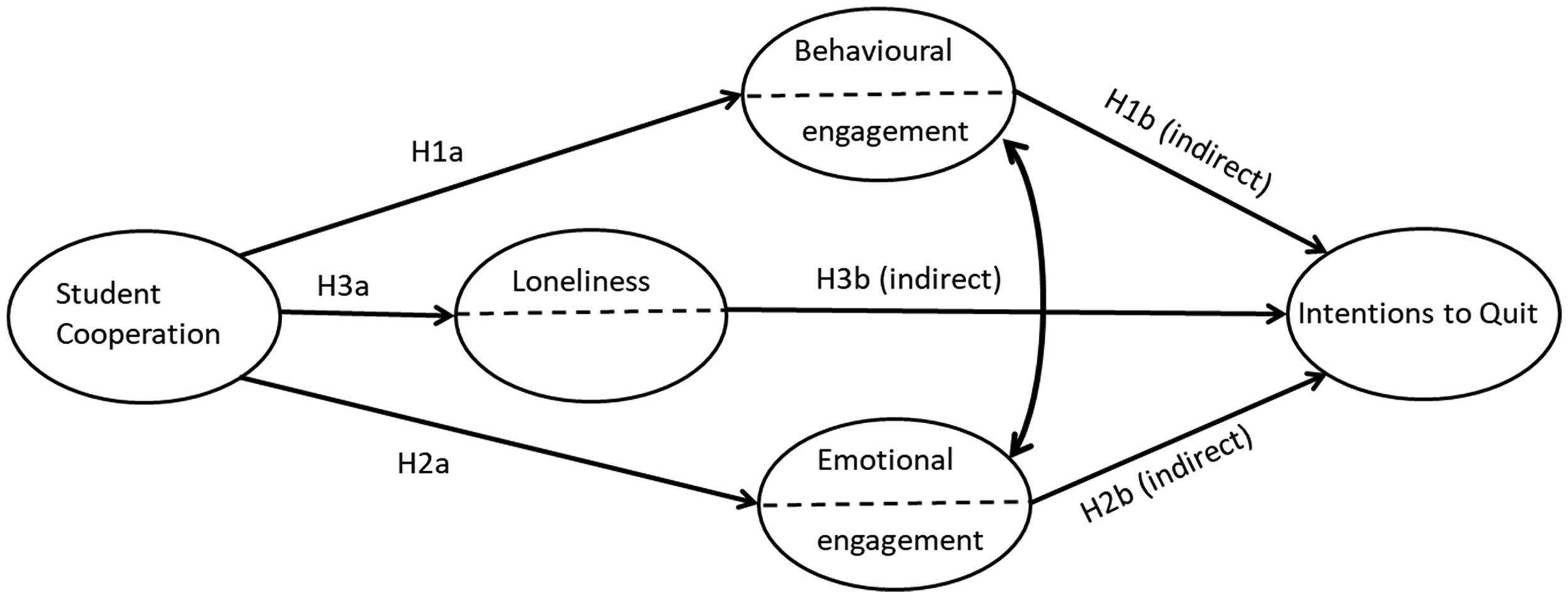
Hypothesized model.
Method
Sample and Procedure
This cross-sectional study was a part of a wider research project entitled MoveMe, aimed at investigating the psychosocial learning environment factors that have the potential to support completion in higher education. The sample consisted of a total of N = 356 first-year students enrolled in three different faculties at the University of Stavanger: the Faculty of Health Sciences, the Faculty of Arts and Education, and the School of Business and Law. Of these, 61.2% were women and 36.3% men, with the remaining 2.5% declining to state their gender. A digital survey was sent to students via an email link at the end of the first semester in the autumn of 2023. The students were also given time during a lecture to complete the survey. The data collection procedure complied with the ethical standards (National Committee for Research Ethics in the Social Sciences and the Humanities, 2023) and was approved by the Norwegian Agency for Shared Services in Education and Research (Sikt) (approval number 568317).
In Norway, there is no tuition fee for attending higher education, and students also get a government-issued loan to cover a part of the cost of living while studying. Some of this loan is converted into a scholarship upon completing the study program. This makes higher education accessible to students of all social backgrounds. Even though socioeconomic status (SES) relates to participation in Norwegian higher education, students in Norway are still relatively diverse regarding SES (Korseberg et al., 2023). SES is often related to students’ academic achievements in earlier stages of their education (OECD, 2023). These factors are often related to students’ academic achievements in earlier stages of their education (OECD, 2023). Because of this, students’ high school grades can, to some extent, serve as an indicator of SES-related differences within the student sample. This is described in the measurements section presenting the control variable.
Analytic Strategy
Confirmatory factor analysis (CFA) was used to ensure internal discriminative and convergent validity for the study variables. Following the procedure suggested by Jöreskog (1993), each variable was initially estimated separately. The variables were thereafter included in a measurement model stepwise. First, the independent variable was inspected to ensure an acceptable model fit. Then, the intermediary variables were included. Finally, an overall measurement model including all latent variables was estimated to ensure that each construct aligned with its designated factor. Mplus version 8.11 was used to conduct the analyses. To evaluate the model fit, recommendations by Hu and Bentler (1998) were used, in which a standardized root-mean-squared residual (SRMR) of less than 0.08 and the Tucker-Lewis Index (TLI) (Tucker & Lewis, 1973) and comparative fit index (CFI) should ideally approach 0.95. Additionally, the root-mean-square error of approximation (RMSEA) was considered good if it was below 0.06 and acceptable if it was below 0.08, accompanied by a 90% confidence interval (CI) (Hu & Bentler, 1998). An overview of the model fit is provided in the Appendix.
Descriptive analyses, including means and standard deviations (Table 1), were conducted for all variables. An analysis of the bivariate correlations between the study's latent variables (Table 2) was then conducted before moving to the next step.
A latent structural equation modelling (SEM) with sequenced intermediate variables was applied to estimate relationships between constructs. Intentions to quit were treated as the latent dependent variable while student cooperation was used as the independent variable. Loneliness and academic engagement were regarded as intermediate variables. A robust maximum likelihood estimator was used to adjust standard errors (Finney et al., 2017). To assess the indirect effects, a data resampling procedure was conducted to examine indirect associations, including 95% bias-corrected confidence intervals (CI) (MacKinnon et al., 2004; Preacher & Hayes, 2008). Due to low missingness in data (5%), and the assumption of missing at random was met, the full information maximum likelihood (FIML) procedure was implemented to handle the missingness.
Measurements
The measurements for the variables used in this study are presented below. Most of the study variables were scored according to the following options: (1) completely disagree, (2) disagree, (3) slightly disagree, (4) slightly agree, (5) agree, and (6) completely agree. Differing scoring options will be noted below in the presentation of the variable. The variables’ reliability was evaluated using McDonald's Omega (ω) (McDonald, 1999) due to its increased accuracy when the assumption of tau-equivalence is violated. The items’ wording and factor loadings may be found in the Appendix along with an overview of the variables’ model fit.
Student Cooperation
Student cooperation was measured using four items that evaluated the extent to which students cooperate with peers in the academic context, for example: “I have cooperated with fellow students to understand the learning material”. The scale was derived from Vestad et al. (2022). Unlike the other variables, this was scored from (1) very rarely to (6) very often. The scale had acceptable model fit [χ2 (DF): 5.41(2); P = .067; RMSEA (90% CI): 0.07 (0.00–0.14); CFI: 0.99; TLI: 0.98; SRMR: 0.01] and high reliability (ω = 0.91).
Loneliness
Loneliness refers to students’ self-perceived loneliness within the context of the study program. The five-item scale has its roots in the Social Dissatisfaction Questionnaire (Asher & Wheeler, 1985), which was modified by Valås (1999). The scale has previously been applied in the Norwegian educational context in a modified form—for example, by Frostad et al. (2015) and Tvedt et al. (2021b)–and has shown good validity. In this study, the items’ endings were changed to fit the higher education context—for example, “I feel lonely at my school” was adjusted to “I feel lonely in my study program”. The measurement model yielded acceptable results [χ2 (DF): 12.25 (5); P = .032; RMSEA (90% CI): 0.06 (0.02–0.11); CFI: 0.99; TLI: 0.98; SRMR: 0.01]. Reliability was high (ω = 0.93).
Academic Engagement
Academic engagement was measured in relation to the two constructs of behavioral and emotional engagement. Behavioral engagement denotes an exertion of efforts, academic behavior, and participation, whereas emotional engagement concerns interest, enjoyment, and enthusiasm in the educational context (Skinner et al., 2008). The scales are derived from Skinner et al. (2008) and were adapted to fit the higher education context. Four items were used to measure behavioral engagement (see Appendix for full-item wording), for example, “I have put a lot of effort into doing well in my studies”. The model fit was good [χ2 (DF): 2.43(2); P = .297; RMSEA (90% CI): 0.03 (0.00–0.11); CFI: 1.00; TLI: 0.99; SRMR: 0.02], and the reliability was acceptable (ω = 0.75).
Emotional engagement was measured using four items whose wording was adjusted: for example, “The subjects are interesting” was changed to “the subjects in the study program are meaningful”. Two of the items’ error terms were allowed to correlate to achieve a good model fit. These items were “the subjects we have had are useful for my future profession” and “the subjects in the study program are meaningful”. The items are likely to additionally measure a sense of meaning and purpose in working with the learning material. Allowing these two error terms to correlate provided a good model fit [χ2 (DF): 0.65 (1) P = .422; RMSEA (90% CI): 0.00 (0.00–0.13); CFI: 1.00; TLI: 1.00; SRMR: 0.01]. The reliability was also good (ω = 0.88).
Intentions to Quit
The variable assessing intentions to quit concerned students’ thoughts about leaving higher education and was derived from Vallerand et al. (1997). Frostad et al. (2015) and Tvedt, Bru and Idsøe (2021) have previously modified the scale for use in the Norwegian high school context. The scale used in this study was adjusted to the higher educational context and contained items such as “I often think that I want to quit the study program”. The four-item scale measured the extent to which students report contemplating leaving university. The measurement model fit was good [χ2 (DF): 5.01 (2) P = .082; RMSEA (90% CI): 0.07 (0.00–0.14); CFI: 0.98; TLI: 0.94; SRMR: 0.03], and the reliability was also good (ω = 0.82).
Controlling for Previous Academic Achievements
Prior research has indicated that dropout from higher education is more prevalent among students with poor previous academic achievements (Hovdhaugen, 2019). Studies have also identified a moderately strong association between prior academic achievements and engagement (Lei et al., 2018). To mitigate the potential impact of high school grades on academic engagement and intentions to quit, students’ self-reported grades (1–6) in the main subjects from high school—English, mathematics, and Norwegian—were applied as a control variable. Moreover, previous academic achievements are related to studentś socioeconomic status (SES) (OECD, 2023), and SES to the likelihood of loneliness (Luhmann et al., 2023). A relationship between SES and intentions to quit has also been identified previously (Mtshweni, 2022). Controlling for previous academic achievements may therefore, to some extent, adjust for a potential spurious relationship between loneliness and intentions to quit higher education due to SES.
Results
Descriptive Statistics
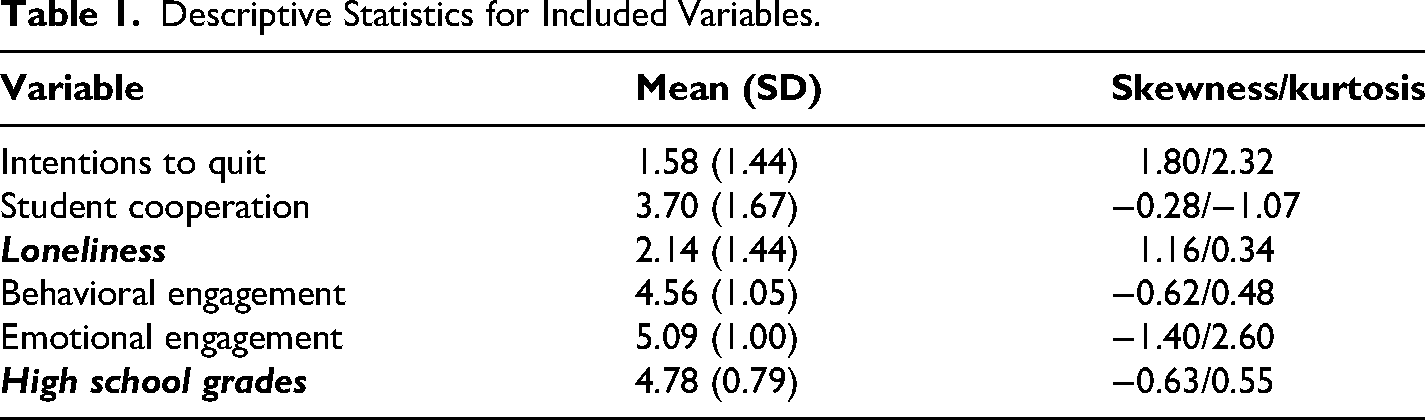
The descriptive statistics for the study variables, including mean, standard deviation, and normal distribution, are presented in Table 1.
Descriptive Statistics for Included Variables.
Correlations Between Latent Study Variables.
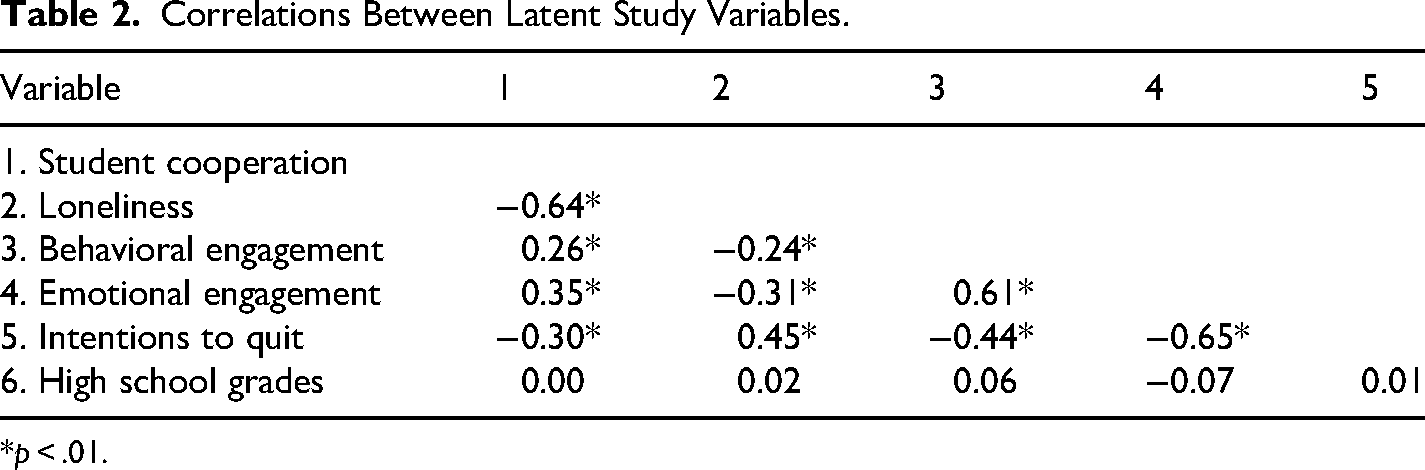
*p < .01.
Structural Equation Model
A structural equation model was estimated to address research questions 1 and 2 concerning the associations between students’ cooperation, loneliness, academic engagement, and intentions to quit. The model yielded good measurement fit [χ2 (DF): 342.44 (194) P = .00; RMSEA (90% CI): 0.05 (0.04–0.05); CFI: 0.96; TLI: 0.95; SRMR: 0.05]. The results showed significant—albeit weak to moderate—paths from student cooperation to the engagement variables (emotional and behavioral), thus supporting hypotheses 1a and 2a, respectively. While emotional engagement was strongly negatively linked to intentions to quit, behavioral engagement did not show a significant path.
In alignment with the expectation of hypothesis 3a, a strong negative path was observed from student cooperation to loneliness. Moreover, as expected, loneliness had non-significant multivariate associations with the academic engagement variables. However, a strong bivariate association between the engagement variables was observed in the model. Loneliness had a relatively strong and direct path to intentions to quit, aligning with the expectations of hypothesis 3b (Figure 2).
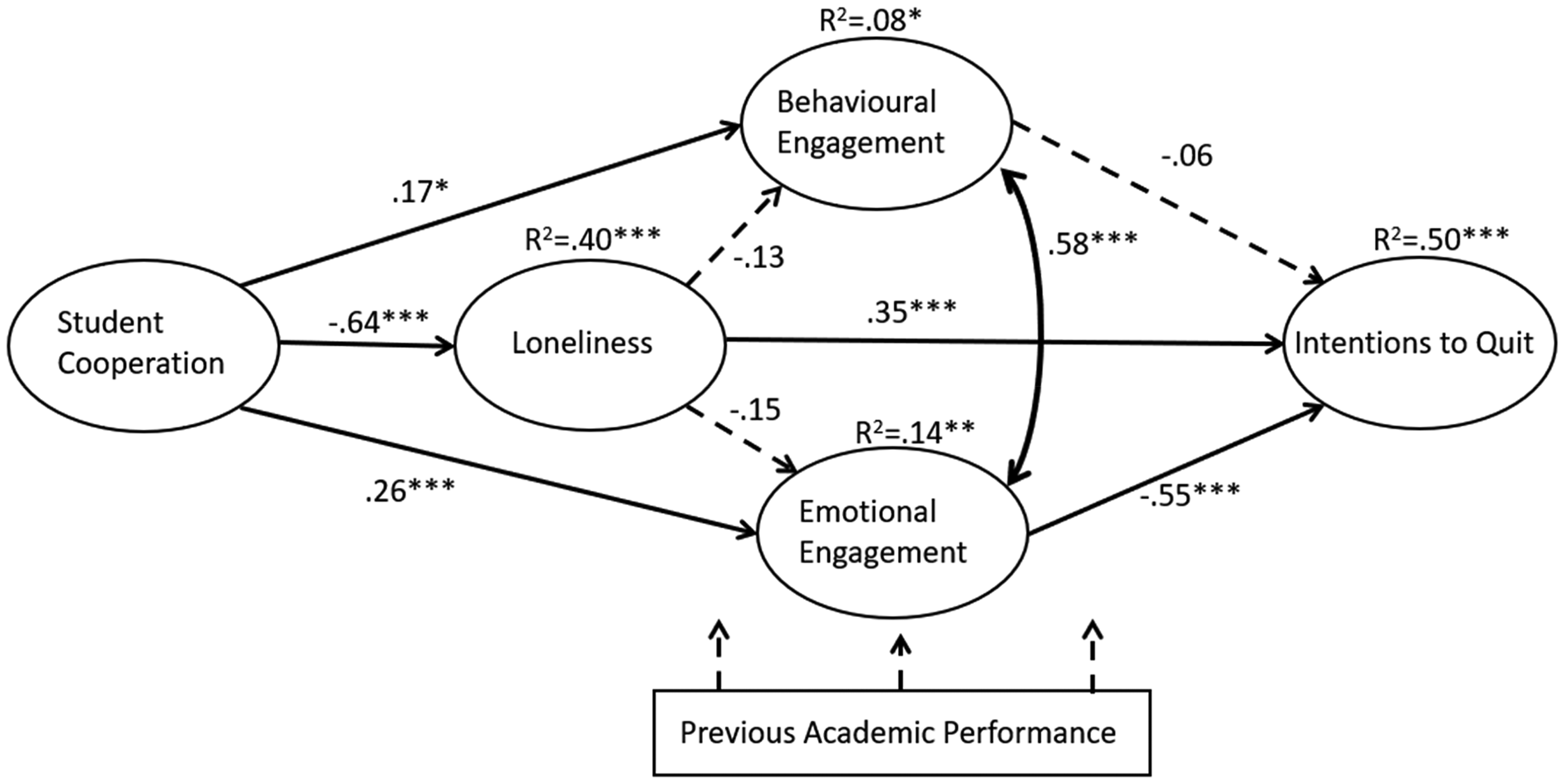
Structural equation model.
Indirect Associations
Continuing to address the study's research questions and associated hypotheses, the results showed two distinct negative and indirect paths from student cooperation to intentions to quit (Table 3). With respect to hypothesis 1b, the indirect path via behavioral engagement was not significant, likely due to the absence of any direct paths between this variable and intentions to quit. The indirect path from student cooperation to intentions to quit via emotional engagement was negative and significant, in line with hypothesis 2b. The strongest indirect path was via loneliness, in line with the expectations of hypothesis 3b.
Indirect Associations Between Student Cooperation and Intentions to Quit.
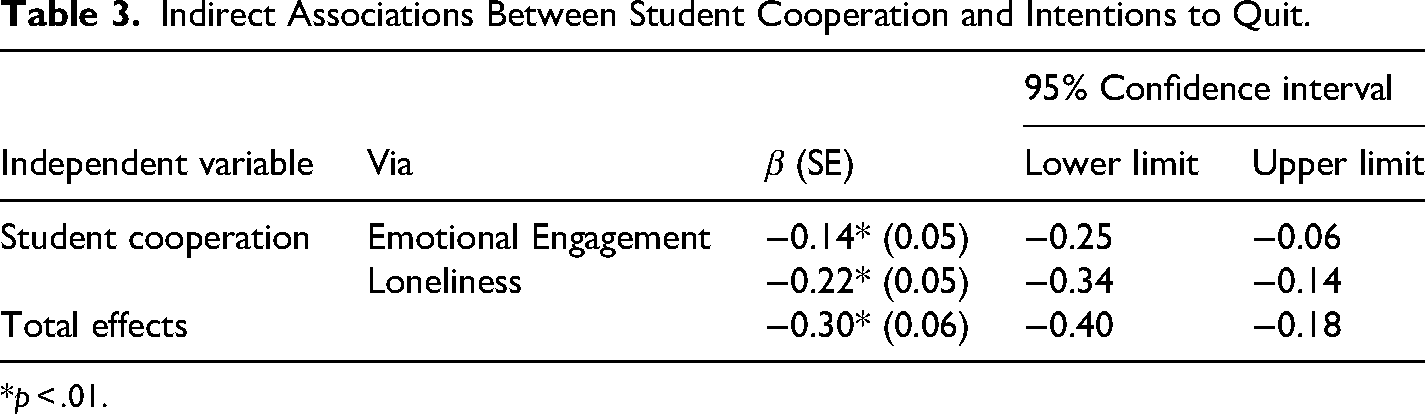
*p < .01.
Discussion
High dropout rates are a concern for Norwegian higher education institutions, and intentions to quit indicate a significant risk of dropping out. Therefore, it is important to determine how and to what extent learning environment factors are associated with students’ intentions to quit higher education. This study employed a latent SEM approach to investigate how intentions to quit are associated with student cooperation, loneliness, and academic engagement. Loneliness and academic engagement were employed as intermediary variables between student cooperation and intentions to quit. The results concerning the research questions and their corresponding hypotheses are discussed below.
Cooperation, Academic Engagement, and Intentions to Quit
The first research question (RQ1) concerned how and to what extent student cooperation is associated with academic engagement and indirectly with intentions to quit. Self-determination theory (SDT) asserts that perceived relatedness and competence stimulate motivation and engagement (Ryan & Deci, 2020). Student cooperation may serve as a key source of relatedness for students in higher education while also providing academic assistance which supports their basic psychological need for competence, thereby promoting academic engagement. In accordance with this, student cooperation yielded a significant path to emotional engagement (H2a) and a more moderate—albeit statistically significant—path to behavioral engagement (H1a). SDT emphasizes the importance of intrinsic or autonomous motivation, which is more evident in emotional than behavioral engagement (Lei et al., 2018). The stronger association between student cooperation and emotional engagement may thus affirm previous findings suggesting that student cooperation has the potential to make learning a more positive experience (Mebert et al., 2020), while also helping students to internalize goals and value the purpose of learning (Mendo-Lázaro et al., 2022).
Academic engagement is likely to be related to reduced intentions to quit. This was substantiated by Hovdhaugen (2009), whose study concluded that interest and effort are linked to lower dropout rates. Truta et al. (2018) found similarly that students who were more emotionally invested in their studies were less likely to contemplate dropping out. Hypothesis 2b stated that student cooperation would be indirectly negatively associated with intentions to quit via emotional engagement. This path was positive and significant, thus supporting hypothesis 2b. Emotional engagement involves both positive feelings towards learning and interest in learning tasks. Therefore, emotional engagement may capture how students’ values and interests align with the content of the study program to a greater extent than behavioral engagement. The findings suggest that student cooperation may help prevent intentions to quit by enhancing emotional involvement and interest in the study program. This reaffirms the importance of emphasizing personal values of motivation and persistence in learning, as well as how social contexts can act as supportive factors in students’ perceptions of learning tasks (Eccles & Wigfield, 2020).
Academic effort has also previously been linked to reduced dropout intentions (Bargmann et al., 2022). However, dropout or transfer may not be the result of either background or goals and motives, but rather may constitute the effects of the student's own perception of education. The quality of student effort is related to both persistence and personal growth and development (Pascarella & Terenzini, 1991; Tinto, 2000). However, the effort that students invest in their studies is likely to be partly affected by their motivation for that particular program. Therefore, we expected that students who adopted a more active approach towards their education would be less likely to exhibit dropout intentions (H1b). On the other hand, the indirect path from student cooperation to intentions to quit via behavioral engagement did not reach statistical significance and hypothesis 1b was therefore not supported. This was mainly because behavioral engagement showed a non-significant multivariate association with intentions to quit. Thus, our findings are not in accordance with prior studies that have linked behavioral efforts to lower rates of dropout from higher education (Hovdhaugen, 2009). However, it should be noted that behavioral and emotional engagement were strongly correlated in this study. Behavioral engagement showed strong bivariate correlations with intentions to quit, whereas the multivariate association between behavioral engagement and intentions was non-significant. This was mainly due to emotional engagement being included in the path analysis. It is likely that poor behavioral engagement is involved at some point in the dropout decision-making process. The students in the present study were in their first semester of university studies, and it could be that students with intentions to quit have not yet decided whether to stay or leave and therefore maintain their effort. Behavioral and emotional engagement are also strongly associated, and it may be difficult to disentangle their roles in intentions to quit in a cross-sectional study. A longitudinal study is better suited for this. Still, the present study suggests that emotional engagement is the primary driver of intentions to quit, while behavioral engagement plays a minor role in students’ intentions to quit.
Loneliness and Intentions to Quit
In addressing the second research question (RQ2), the associations between student cooperation and loneliness, and thereby indirectly with intentions to quit, were investigated. The finding that there is a direct negative path between student cooperation and loneliness supported hypothesis 3a. Loneliness among higher education students is a global challenge, and the present findings support the notion that cooperation among students works to prevent perceived loneliness (Ellard et al., 2023). Students who cooperate with their peers typically engage in positive social interactions that include a shared interest in relevant learning material, which, in turn, is likely to foster a sense of belonging by fulfilling the basic psychological need for relatedness (Niemiec & Ryan, 2009). This further indicates that student cooperation can help bridge the social and academic aspects of student life, thereby supporting social integration in the study program (Tinto, 2000). Initiating and organizing activities in which students can cooperate may therefore be beneficial in promoting a sense of belonging and in preventing loneliness (Abdul-Rahaman, 2023).
An indirect strong and negative path via loneliness to intentions to quit aligned with the expectations of hypothesis 3b. The fully indirect path is likely to concern successful student cooperation, which not only reduces perceived loneliness but also promotes a sense of belonging in the educational context, potentially counteracting intentions to quit. Quite contrary to this, owing to the gap between their desired and actual social interactions, students who do not perceive optimal cooperation with peers may perceive themselves as unable to connect, reinforcing their perceptions of themselves as lonely (Lemay et al., 2019). This may prompt them to contemplate leaving their study program and impede their ability to persist (Tinto, 1993). Successful student cooperation is thus indicated to be crucial for students’ social integration, and by preventing loneliness, it diminishes the likelihood that the student will develop intentions to quit their study program.
However, based on this study's cross-sectional design, the results of indirect associations may likewise suggest that students who do not perceive cooperation with fellow students as satisfying may be at greater risk of loneliness, which, in turn, increases the likelihood that the student will develop intentions to quit. Interestingly, the link between loneliness and intentions to quit is independent of academic engagement, suggesting that loneliness is a separate risk factor for intentions to quit and that, possibly, with time, this may lead to actual dropout. In line with this, loneliness was previously found to predict actual dropout in high school (Tvedt & Bru, 2023). However, less information appears to be available regarding the predictive role of loneliness in higher education dropout rates.
In the broader context, it may also be the case that students who feel lonely—for example, those who have no one to talk to and who spend considerable periods of time alone—are more reluctant to take the initiative to establish contact with their fellow students. These students may also set high standards for peer cooperation and, as a result, report lower scores. Prior research has identified associations between loneliness and social perfectionism (Harper et al., 2020), suggesting that students who perceive themselves as lonely may have particularly high expectations for social interactions.
Based on these assumptions, the relationship between student cooperation and loneliness may also be bidirectional, suggesting that perceived cooperation with peers is related to loneliness, and that loneliness is also related to the perception of peer cooperative work. Thus, the suggested iterative nature must be taken into consideration when interpreting the results.
Methodological Considerations and Limitations
This study adopts a latent SEM approach for the main analytic work. Analysis of this nature minimizes errors and yields more precise estimates. The use of intermediate variables is based on Hayes’ theoretical assumption of mechanisms rather than causality, which are kept in analytic work by using a bias-corrected bootstrap procedure. Although the sample size is sufficient, a larger sample size would provide greater precision and should be taken into consideration when reading the results.
The cross-sectional design employed in this study inhibits inference of directionality or causality of the results, and any suggestions of this are based on theory. Longitudinal studies are needed to make valid empirical assessments of the directionality of the paths presented in the present study.
This study theorized behavioral and emotional engagement as two separate and parallel paths from student cooperation towards intentions to quit. Based on somewhat inconsistent past empirical findings regarding the association between these two engagement variables, for example, Lei et al. (2018), it may be the case that emotional engagement functions as an internal motivational aspect that fuels behavioral engagement.
Data on students’ socioeconomic status (SES) were not available for this study. SES is related to previous academic performance, and controlling for high school grades only partially controls for this possible source of error due to the lack of student SES as a covariate in the SEM model.
Further Research
Future research should test larger and more diverse samples by including students from additional study programs and universities, as well as students with diverse international backgrounds, to further evaluate the findings’ generalizability and thereby facilitate stronger inferences. Longitudinal studies may enhance our understanding of the relationship between emotional and behavioral engagement by investigating the degree to which university students sustain their efforts when their interest in the study program decreases. Longitudinal studies are also needed to clarify the relationship between student cooperation and loneliness, and to further establish their temporal ordering. Finally, while intentions to quit may serve as an early warning of potential dropout (Tinto, 2017; Veliz & Ortega, 2023), they do not directly translate to actual dropout. Future research should examine whether this study's findings may be replicated when actual dropout is applied as the dependent variable. This would increase our understanding of the role that learning environment factors may play in preventing dropout.
Conclusion
This study's findings support the assumption that cooperation with peers has the potential to prevent intentions to quit higher education. The results suggest that student cooperation's preventive property operates according to two distinct mechanisms. First, student cooperation may prevent loneliness in the context of the study program, which was strongly related to intentions to quit. The association between cooperation and loneliness was strong and negative, suggesting that facilitating student cooperation is a key measure for promoting students’ social inclusion in the community, thereby aligning with Tinto's model of student persistence. The other suggested mechanism is one whereby cooperation stimulates emotional engagement, which exhibited the strongest association with intentions to quit. Emotional engagement is likely to represent students’ personal involvement and interest in the study program.
Of the aspects studied, personal interest, in terms of emotional engagement, in one's study program, appeared to be the most important factor for preventing intentions to quit. The path between cooperation and emotional engagement was more moderate in strength, which suggests the need to seek other supplementary aspects of the learning environment that enhance students’ emotional engagement in their study programs. Although research is needed to identify causal relations, student cooperation in higher education emerges as a learning environment factor that has the potential to support improved completion rates. Therefore, educators working in higher education should encourage and facilitate both formal and informal cooperation between students.
Footnotes

Funding
The authors received no financial support for the research, authorship, and/or publication of this article.
Declaration of Conflicting Interests
The authors declared no potential conflicts of interest with respect to the research, authorship, and/or publication of this article.
Author Biographies
Appendix
Measurement model fit for (a) separate latent variable and (b) overall measurement models. Testing was conducted in accordance with the stepwise approach recommended by Jöreskog (1993, p. 313). Factor loadings are given by standardized coefficients.