




Abstract
More research is needed to understand the relationships between imposter syndrome, perfection, and stress, as well as how they might be similar or different among first- and continuing-generation college students. This research study examines the relationships among imposter syndrome, perfectionism, and stress among first- and continuing-generation college students. Participants included 388 college students, including 184 (47.4%) first-generation students. Results indicate levels of imposter syndrome and stress are similar between first- and continuing-generation students. Levels of socially prescribed perfectionism are significantly correlated with imposter syndrome and stress for both groups; however, imposter syndrome is more strongly associated with stress among first-generation students. Implications for college student mental health and retention are discussed.
Keywords
Imposter syndrome was first identified by Clance and Imes (1978) in a study of high achieving women in academia, which included undergraduate students, graduate students, and faculty members (Ramsey & Brown, 2018). Imposter Syndrome describes an individual who is high achieving yet fails to recognize their success as being earned, but instead attributes it to external factors such as networking, luck, timing, lowering standards, and their charm (Bravata et al., 2020; Parkman, 2016). Sometimes referred to as imposter phenomenon, fraud syndrome, perceived fraudulence, or imposter experience, these high achieving individuals also fear being found out to be a fraud and having their achievements taken from them due to their inability to internalize their accomplishments. Their lack of self-confidence feeds stress, which individuals then try to minimize by seeking perfection and working longer and harder, which can ultimately lead to burnout (Parkman, 2016). On the flip side, a person might underperform because they assume they will fail anyway (Ramsey & Brown, 2018).
Imposter syndrome has been well documented in higher education and has been found in a variety of student groups, including non-traditional students, ethnic minority students, and first-generation students (Harvey & Katz, 1985; Parkman, 2016; Ramsey & Brown, 2018). Furthermore, research on college students has found imposter syndrome to be a predictor of mental health concerns, including anxiety, depression, psychological distress, and reduced confidence in their own intelligence (Parkman, 2016, Peteet et al., 2015).
First-Generation Students
First-generation college students are individuals who are the first in their family to go to college. These students are more likely to be of racial/ethnic minorities and from lower income families; have lower standardized test scores; and rely on grants, scholarships, and loans. In addition, first-generation students may struggle academically because of having to work part-time or full time during college (Gibbons et al., 2019). Studies have suggested these characteristics put first-generation college students at an academic disadvantage, making them less likely to obtain their degree (Gibbons et al., 2019; Sy et al., 2011). First-generation college students have also reported difficulties with time management skills, effective study skills, and achieving a work-life balance (Gibbons et al., 2019). Research has found first-generation college students are also more likely to experience imposter syndrome than other students, and since their families do not have a full understanding of the demands of higher education, they may not benefit from strong family emotional support (Peteet et al., 2015). They may also experience distress due to balancing expectations of reaching graduation as the first in the family to attend; managing peer/familial conflict by those who feel the student is being selfish, fake, or disloyal by leaving home to go to college or trying to better themselves; and feeling a lack of support in the college atmosphere (Peteet et al., 2015). In fact, participants in a study by Gibbons et al. (2019) reported family to be a barrier to attending college, resulting in taking semesters off and even quitting altogether. In addition, first-generation students have reported a diminished sense of belonging, as compared to their continuing-generation peers (Le, 2019).
Perfectionism
Perfectionism is considered to be a personality trait that makes people more likely to experience imposter syndrome (Wang et al., 2019). Hewitt and Flett (1990) discussed three dimensions of perfectionism, all which are interrelated: self-oriented perfectionism (placing high standards on self), other-oriented perfectionism (placing high standards on others), and socially prescribed perfectionism (perception that others have placed high and unrealistic expectations on oneself; J. Klibert et al., 2014).
Some aspects of perfectionism may have more damaging effects on one’s mental health than others, though it may not always be associated with negative outcomes (J. J. Klibert et al., 2005). For “normal” perfectionists, striving for perfection brings satisfaction, which then enhances self-worth and self-esteem, rendering them best able to meet demands of coursework and extracurricular activities in college and ultimately earn higher grades (Newman et al., 2019). “Neurotic” perfectionists, on the other hand, feel like they never do things well enough, and are more likely to experience anxiety, depression, and low self-esteem and more likely to engage in non-suicidal self-injury and eating disorders (J. J. Klibert et al., 2005; Newman et al., 2019).
Stress
An increase in the frequency and severity of mental health symptoms in college students has been documented, with stress ranked in 2009 as the number one health issue that negatively affected students’ academic performance (Ratanasiripong et al., 2012). Le (2019) found first-generation students reported feeling more stress than continuing-generation students. Sy et al. (2011) also found that first-generation students experienced less emotional support from their parents when compared to continuing-generation students contributing to increased levels of stress; which may then also contribute to lower retention rates, especially among females. Research studies have suggested that stress may be associated with the extent to which an individual feels themselves to be a perfectionist, while the college environment induces stress with both implicit and explicit performance demands (J. J. Klibert et al., 2005). High-achieving students are thus at risk for increased feelings of being a fraud in the college environment (Cokley et al., 2018).
The Present Study
The primary aim of this study is to examine the roles perfectionism and stress play on imposter syndrome in first-generation and continuing-generation college students. Prior research has established stress and perfectionism coincide with imposter syndrome, and that imposter syndrome is found in those who are the first in the family to exceed norms. However, more research is needed to look at imposter syndrome in first-generation college students and compare their experiences to those of continuing-generation college students (Campbell & Narayan, 2017; Peteet et al., 2015).
Method
Research Questions
The authors seek to answer six research questions. First, is there a difference in level of imposter syndrome reported by first-generation college students versus continuing-generation college students? Second, is there a difference in level of stress reported by first-generation college students versus continuing-generation college students? Third, what is the nature of the relationship between levels of perfectionism and imposter syndrome among first-generation and continuing-generation college students? Fourth, what is the nature of the relationship between stress and imposter syndrome among first-generation and continuing-generation college students? Fifth, what is the nature of the relationship between levels of perfectionism and stress among first-generation and continuing-generation college students? Finally, does student generation status moderate the relationship between socially prescribed perfectionism and imposter syndrome?
Participants
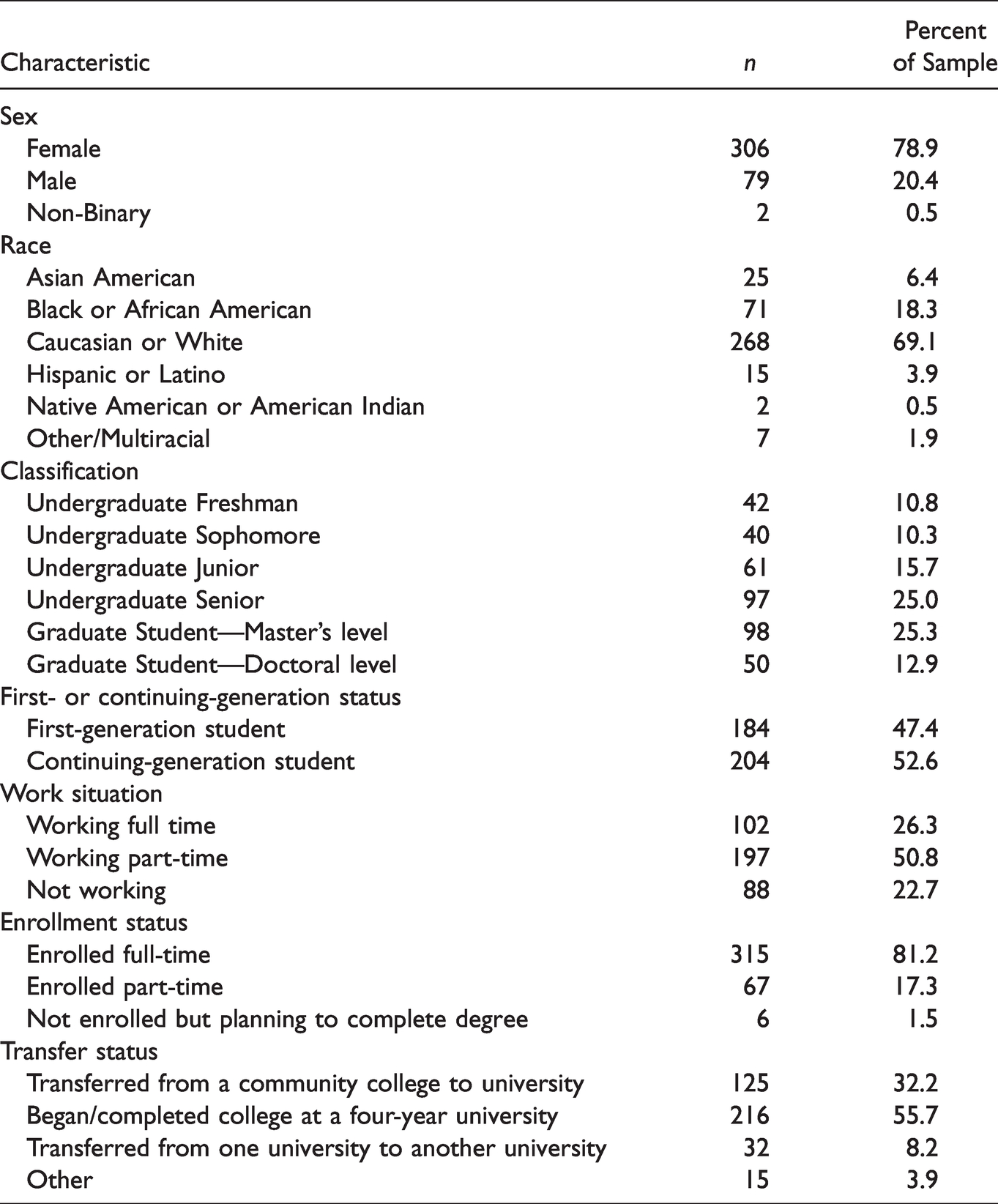
Participants included 388 college students in the process of completing an undergraduate or graduate degree. The majority of students were undergraduates (240; 62%) enrolled full-time (315; 81.2%) at a four-year university (384; 99%) who did not attend a community college before enrolling at their university (216; 55.5%). Most participants were female (306; 78.9%), Caucasian (268; 69.1%), and working part-time while completing their degree (197; 50.8%). Ages ranged from 18 to 72 with a mean age of 27.14 (SD = 10.14). Nearly half of the sample reported being a first-generation college student (184; 47.4%). Grade point averages (GPA) ranged from 1.60 to 4.00 with a mean GPA of 3.52 (SD = .49). Eighty-four participants (21.6%) reported being a parent of one or more children, and participants lived in 22 different states across the United States. Additional demographic information can be found in Table 1.
Demographic Characteristics of Participants.
Procedure
Participants were recruited from a southeastern university using Facebook posts, advertisements on television monitors in the building in which the authors’ department was housed, and advertisements on a campus-wide weekly informational e-mail sent to students. Advertisements included the QR code and web link to an online questionnaire distributed via Qualtrics research platform. Students could scan the QR code or click the link to view the informed consent for the questionnaire. After indicating that they were 18 years of age or older and giving informed consent, participants could proceed to the survey questions. After completing the survey, participants were given the option to provide an e-mail address following the survey in order to enter to win one of four $25 Amazon gift cards.
Instruments
Demographics
Participants completed a series of demographic questions including age, race, sex, classification, type of institution attended, first- or continuing-generation student status, enrollment status, GPA, state in which they lived, whether or not they had any children, and employment status.
Imposterism Scale
To measure level of imposter syndrome, participants completed the Imposterism Scale (Leary et al., 2000). The Imposterism Scale is a self-report scale with seven questions, each answered on a five-point Likert-type scale (1 = Not at all characteristic of me to 5 = Extremely characteristic of me). Participants are asked to indicate the number of the scale that is most characteristic of themselves. A sample item is, “I'm afraid people important to me may find out that I'm not as capable as they think I am” (Leary et al., 2000). Cronbach’s alpha coefficient for this study was .93.
Multidimensional Perfectionism Scale
Perfectionism was measured using the Multidimensional Perfectionism Scale (MPS; Hewitt & Flett, 1990). The MPS is a 45-item instrument with subscales identifying three dimensions of perfectionism: Self-Oriented, Socially Prescribed, and Others-Oriented. Participants were asked to respond to statements of personal characteristics and traits (e.g., “It is very important that I am perfect in everything I attempt”) on a seven-point Likert-type scale from 1 (strongly disagree) to 7 (strongly agree). Scores on each subscale range from 15 to 105, with higher scores indicating greater levels of the corresponding dimension of perfectionism endorsed (Hewitt & Flett, 1990). Reliability coefficient alphas for this study were .88 for Self-Oriented Perfectionism, .85 for Socially Prescribed Perfectionism, and .79 for Others-Oriented Perfectionism.
Perceived Stress Scale
Stress was measured using the Perceived Stress Scale (PSS; S. Cohen et al., 1983). The PSS is a 10-item measure of global stress wherein participants are asked to consider how often they felt or thought a certain way over the last month. Participants rate their responses to statements (e.g., In the last month, how often have you felt that you were unable to control the important things in your life?) on a five-point Likert-type scale from 1 (never) to 5 (very often). Scores on the PSS range from 10 to 50 with higher scores indicating greater levels of stress endorsed (S. Cohen et al., 1983). The alpha coefficient for the PSS in this study was .88.
Statistical Analyses
Data were analyzed using SPSS Version 26.0. Independent samples t-tests were used to answer research questions 1 and 2, with a priori power analysis indicating a total sample of 176 needed for .95 power to detect a medium effect size. Research questions 3, 4, and 5 were answered using Pearson’s correlations, with a priori power analysis indicating a total sample of 138 needed for .95 power to detect a medium effect size. Research question 6 was answered using a hierarchical linear regression, with a priori power analysis indicating a sample of 119 needed for .95 power to detect a medium effect size. Alpha levels were set at .05 for all analyses.
Results
Data Cleaning
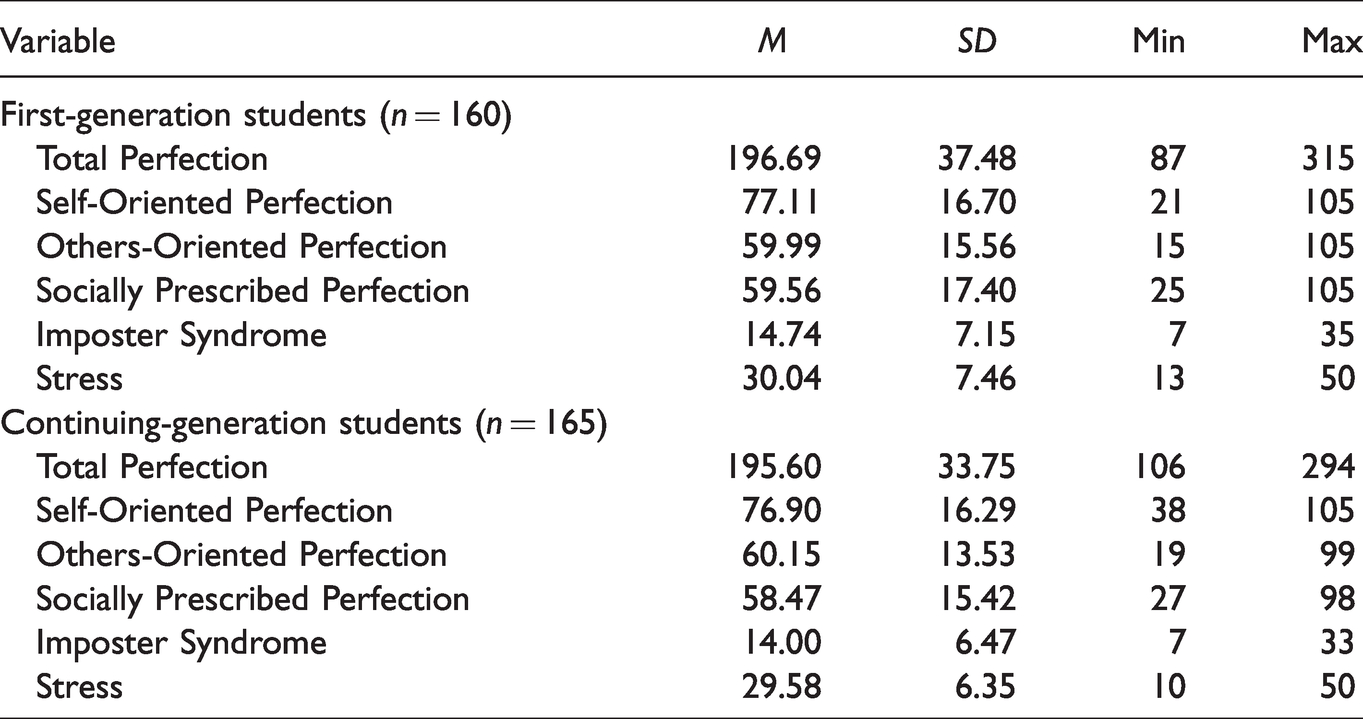
A total of 475 participants responded to the Qualtrics survey. Seventy (15%) were excluded from analysis due to completing only the demographic questions and no survey instruments. Fourteen (3%) were excluded due to self-reporting that they were not a college student. Three cases (0.6%) were identified as multivariate outliers according to Mahalanobis’ distance (a = .005; Jennings & Young, 1988) and therefore were excluded from analysis. Cook’s distance showed no cases with undue influence on the data set. After this cleaning process, 388 (82%) participants were included in data analysis. However, 63 (13%) participants completed the Imposterism Scale and PSS but did not complete the MPS and therefore were not included in any analyses involving perfectionism, leaving a total sample of 325 (68%) for the perfection analyses. Descriptive statistics on imposter syndrome, stress, and perfectionism variables by group are provided in Table 2.
Descriptive Statistics for Perfection, Imposter Syndrome, and Stress by Group.
Research Question 1
Is there a difference in level of imposter syndrome reported by first-generation college students versus continuing-generation college students? All assumptions (e.g., no outliers, approximately normal distribution, homogeneity of variances) were met for the data set. No statistically significant difference was found in level of imposter syndrome between first-generation and second-generation college students, t(386) = 1.084, p = .279.
Research Question 2
Is there a difference in level of stress reported by first-generation college students versus continuing-generation college students? All assumptions were met for the data set. No statistically significant difference was found in level of stress between first-generation and second-generation college students, t(386) = .663, p = .508.
Research Question 3
What is the nature of the relationship between levels of perfectionism and imposter syndrome among first-generation and continuing-generation college students? All assumptions (e.g., linearity, no outliers, approximately normal distribution) were met for the data set. Pearson’s correlations for imposter syndrome and self-oriented perfectionism were not statistically significant for either group. Pearson’s correlations for imposter syndrome and others-oriented perfectionism were not statistically significant for either group. However, Pearson’s correlations for imposter syndrome and socially prescribed perfectionism were statistically significant for each group, with results for both first-generation students (r = .451, p < .001) and second-generation students (r = .445, p < .001), indicating medium effect sizes (J. Cohen, 1988). See Table 3 for more information on correlated relationships among all variables.
Correlations between Perfection, Imposter Syndrome, and Stress by Group.
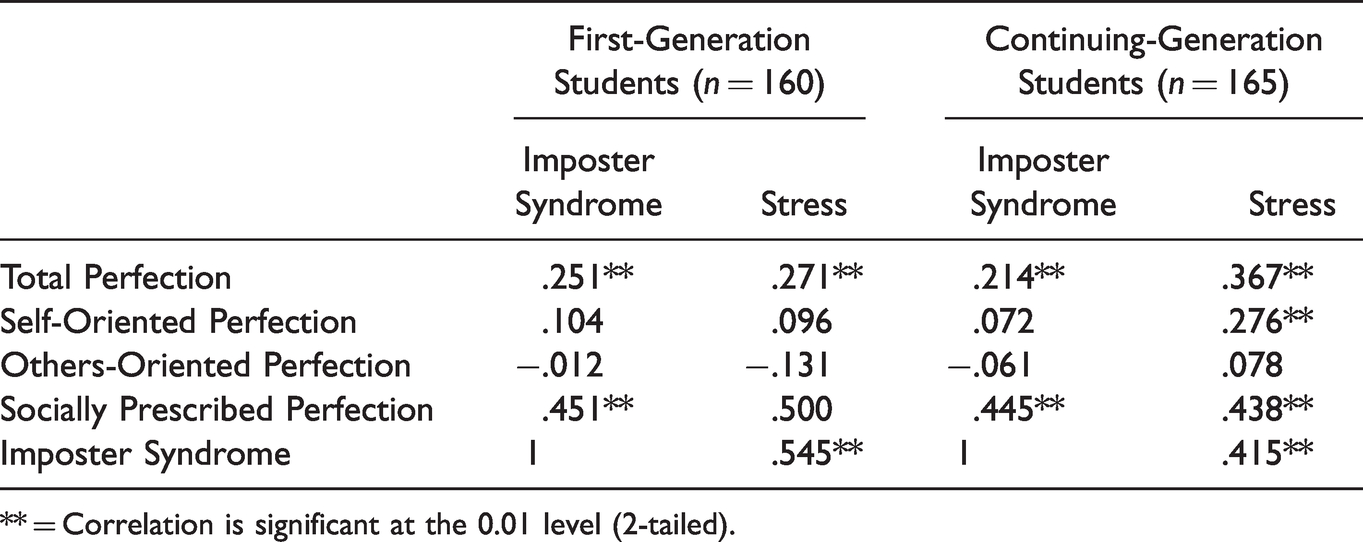
** = Correlation is significant at the 0.01 level (2-tailed).
Research Question 4
What is the nature of the relationship between stress and imposter syndrome among first-generation and continuing-generation college students? All assumptions were met for the data set. A Pearson’s correlation was completed for each group; results indicate that stress is statistically significantly correlated with imposter syndrome for first-generation students (r = .545, p < .001), indicating a large effect size (J. Cohen, 1988). Additionally, stress is statistically significantly correlated with imposter syndrome among second-generation students (r = .415, p < .001), indicating a medium effect size (J. Cohen, 1988).
Research Question 5
What is the nature of the relationship between levels of perfectionism and stress among first-generation and continuing-generation college students? All assumptions were met for the data set. Pearson’s correlations for stress and others-oriented perfectionism were not statistically significant for either group. However, Pearson’s correlations for stress and socially prescribed perfectionism were significant for first-generation students (r = .500, p < .001) and continuing-generation students (r = .438, p < .001). Additionally, Pearson’s correlation between stress and self-oriented perfection was statistically significant for continuing-generation students (r = .276, p < .001) but not for first-generation students (r = .096, p = .231).
Research Question 6
Does student generation status moderate the relationship between socially prescribed perfectionism and imposter syndrome? All assumptions (e.g., normality, linearity, homoscedasticity, no multicollinearity) for hierarchical linear regression were met for the data set. In the first step, two variables were included: student generation status and socially prescribed perfection. These variables accounted for a significant amount of variance in imposter syndrome, F(2, 322) = 40.981, p < .001, with an R2 of .203, an adjusted R2 of .198, and f2 of .254, a medium effect size according to J. Cohen (1988). Next, the interaction term between student generation status and socially prescribed perfection was added to the regression model. The interaction effect did not account for a significant proportion of the variance in imposter syndrome, ΔR2 < .000, ΔF(1, 321) = 0.003, p = .956. Therefore, student generation status does not evidence a statistically significant moderating effect on the relationship between socially prescribed perfection and imposter syndrome.
Discussion
The current study examined four research questions related to imposter syndrome, stress, and perfectionism between and among first-generation and continuing-generation college students. There were no statistically significant differences in levels of imposter syndrome or stress between first-generation and continuing-generation college students. This finding is significant, as imposter syndrome is often found to be more prevalent in first-generation students, who tend to be characterized as more susceptible to imposter syndrome (Harvey & Katz, 1985; Parkman, 2016; Peteet et al., 2015; Ramsey & Brown, 2018). In addition, stress has historically been found to be a more prevalent experience for first-generation students, with less emotional support from their families considered a contributing factor to their increased levels of stress. The current study, however, suggests that first-generation and continuing-generation students experience comparable levels of both imposter syndrome and stress.
Stress was found to be significantly, positively correlated with imposter syndrome in both first-generation and continuing-generation college students, though a stronger relationship was evident in first-generation college students. These findings support prior research indicating a connection between the lack of confidence imposter syndrome may elicit and reported stress levels (Parkman, 2016). Further, as first-generation students are typically considered more prone to experiencing imposter syndrome, it is logical that a larger effect size between stress and imposter syndrome was revealed for first-generation college students, as compared to the medium effect size revealed for continuing-generation college students (Peteet et al., 2015).
Stress was found to be significantly, positively correlated with socially prescribed perfectionism for both first-generation and continuing-generation college students. This finding coincides with the reality that the college environment induces stress through both implicit and explicit demands (J. J. Klibert et al., 2005). This suggests that both first-generation and continuing-generation students perceive that high expectations and demands are being placed on them throughout their college experience, regardless of their generation status.
Stress and self-perfection, however, were found to be significantly, positively correlated only for continuing-generation students. This could possibly result from continuing-generation students feeling freer from the burden of “being the first” in a family to attend college and seek a degree. Perhaps their successes in college can be seen as stemming from a more individualistic perspective, which would fit with self-perfection’s focus on high standards set by the individual. They may place an undue burden on themselves that they must continue their family’s legacy of academic success and attainment.
When investigating the relationship between levels of perfectionism and imposter syndrome among first-generation and continuing-generation college students, only socially prescribed perfectionism was found to be significantly related to imposter syndrome among both groups, with students’ generation status having no moderating effect on the relationships between socially prescribed perfection and imposter syndrome. For first generation students, perhaps this suggests that the awareness of “being the first” in a family to attend college carries with it the burden of others’ expectations for success, regardless of the lack of understanding and awareness for all that will be required and needed to attain that. In essence, a first-generation student is seeking to not only be successful for him/herself but as a representative of all those who were denied or rejected the opportunity to attempt a college degree for themselves. As these expectations increase, so, too, do the feelings that they may be incapable or unworthy of actually meeting those expectations. For continuing-generation students, it is possible that socially-prescribed perfectionism plays out through the expectation of a continued legacy. While first-generation students may battle the expectations of others that they will be the first to “succeed”, continuing-generation students may battle the expectations of others they could be the first to not succeed. This expectation may coincide with feelings that, perhaps, they are not as well-suited to meet those demands as the family members who came before them.
One limitation of the study relates to the recruitment pool of participants. Selecting participants exclusively from one university campus could produce findings reflective of factors for that one environment that may not be representative of student experiences across college campuses. In addition, the vast majority of included participants were female (78.9%) and working either part-time or full-time while enrolled (87.3%), both factors associated with higher levels of imposter syndrome and stress. The racial make-up was comprised of majority Caucasian participants (69.1%) and, therefore, may not have been as reflective of the minority student’s experience, which tends to be more correlated with the factors investigated in the current study. Learning to cope with stress is an important part of academic success. College campuses that take a proactive stance on stress reduction and educate students in how to address their own mental health play an important role in students’ current and future quality of life by educating students with important life skills that facilitate resilience in both their academic work and later life experiences. Further, when college campuses create a culture of emotional and mental wellness, they promote retention of current students and may combat the attrition effects of stress and imposter syndrome. In addition, doing so can foster an institutional reputation that recruits prospective students, both of which pay off financially for college campuses (Kognito, 2017). It is estimated that, for every 100 college students treated for depression, six dropouts are prevented, saving the college approximately $2,40,000 in tuition and fees (Eisenberg & Lipson, 2014).
Services such as same-day therapy appointments for students, mindfulness activities, review of academic policies, and including faculty in discussions and trainings related to student mental health can create a campus culture of confidence in supports and resources available to students (Anderson, 2019). College campuses that have, heretofore, focused such stress relieving activities for key times in the semester such as the final exam period should consider the benefits of offering them regularly across the semester to offset the build-up of stress for students and, instead, arm students with the skills to recognize their stressors and address them appropriately.
In addition, college mental health services could offer informational sessions on imposter syndrome and stress, normalizing those feelings and doubts of “Do I belong here?’ for both first-generation and continuing-generation students, as the current study suggests the experience of both extend across student generation status. Offering students a time to share their experiences of self-doubt, lack of confidence, and their need for more emotional supports could bridge any perceived gaps between first-generation and continuing-generation students and allow them to focus on shared experiences, sharing strategies for success and, thereby, forging their own support systems.
Footnotes
Declaration of Conflicting Interests
The authors declared no potential conflicts of interest with respect to the research, authorship, and/or publication of this article.
Funding
The authors received no financial support for the research, authorship, and/or publication of this article.
