




Abstract
Objective:
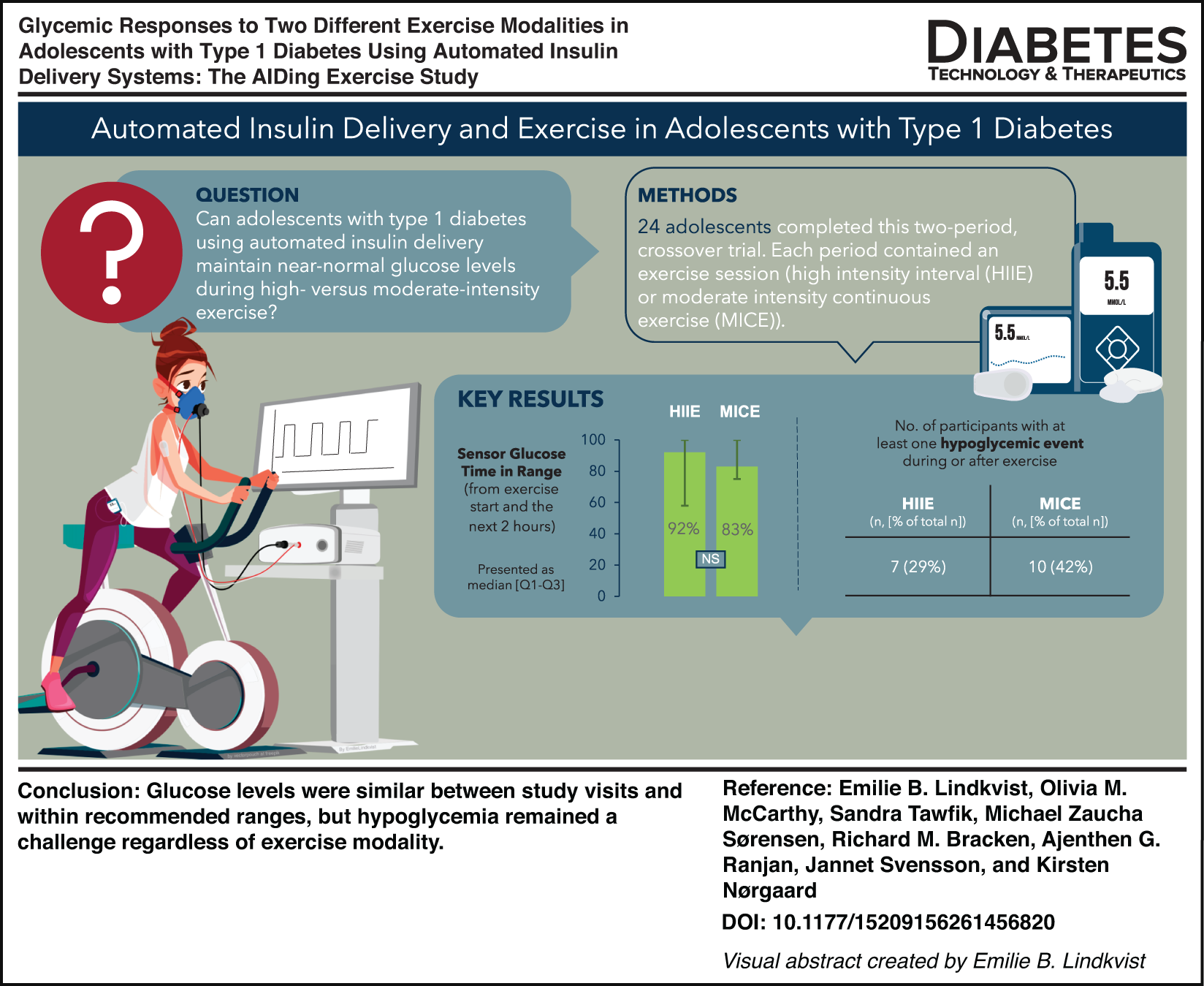
To examine the glycemic responses to two exercise modalities—high-intensity interval exercise (HIIE) and moderate-intensity continuous exercise (MICE)—when applying consensus guideline preexercise preparatory measures in adolescents with type 1 diabetes using automated insulin delivery (AID) systems.
Research Design and Methods:
In a two-period, crossover trial, 24 individuals (12 using MiniMed™ 780G and 12 using Tandem Control-IQ™) completed two experimental study days involving HIIE and MICE sessions. Participants were matched on age, sex, and total daily dose across AID systems. Continuous glucose monitoring (CGM) and insulin pump data were collected from participants’ AID systems. Plasma glucose (PG) was measured throughout the study days. Exercise was announced 60 min before MICE initiation, but not before HIIE.
Results:
No significant difference was observed for the primary outcome, CGM-derived time in range (TIRCGM: 3.9–10.0 mmol/L [70–180 mg/dL]), between study visits (HIIE: 91.7 [58.3–100.0] % vs. MICE: 83.3 [75.0–100.0] %, P = 0.261). Participants developed hypoglycemia during both visits (HIIE: 8 vs. MICE 11). When analyzed by the AID system, TIRPG (PG: 3.9–10.0 mmol/L [70–180 mg/dL]) was higher during MICE in the MiniMed™ 780G group, with no difference in the number of participants experiencing hypoglycemia at either visit.
Conclusions:
When applying consensus guideline preexercise recommendations, both exercise modalities achieved generally stable glycemic outcomes; however, hypoglycemia remained a challenge across study visits. These findings highlight that current AID systems still fall short of ensuring safe glycemic responses during exercise.
Graphical abstract
Keywords
Get full access to this article
View all access options for this article.
References
Supplementary Material
Please find the following supplemental material available below.
For Open Access articles published under a Creative Commons License, all supplemental material carries the same license as the article it is associated with.
For non-Open Access articles published, all supplemental material carries a non-exclusive license, and permission requests for re-use of supplemental material or any part of supplemental material shall be sent directly to the copyright owner as specified in the copyright notice associated with the article.
