




Abstract
This is a retrospective analysis of data in which we explored the association between energy expenditure (EE) and lung function in patients with chronic obstructive pulmonary disease (COPD). A total of 36 participants ( 20 males; forced expiratory volume in 1 second (FEV1) of 48 ± 15% predicted) underwent measures of indirect calorimetry whilst performing five simple activities of daily living. Maximal voluntary ventilation was the only lung function parameter associated with EE. These data highlight the limited extent to which the FEV1 is related to the functional performance of patients with COPD.
Keywords
In patients with chronic obstructive pulmonary disease (COPD), the relationship between energy expenditure (EE) and measures of lung function has attracted attention. 1,2 Specifically, Pitta et al. 3 demonstrated weak-to-moderate associations between the measures of respiratory muscle strength, maximal voluntary ventilation (MVV), inspiratory capacity and forced expiratory volume in 1 second (FEV1) with EE measured over a 12-hour period in a group of people with COPD. However, as people with COPD are known to be very inactive, 4 it is possible that the measure of EE in this previous study 3 largely reflected resting EE, rather than EE related to specific activities of daily living (ADLs). Therefore, we sought to explore the relationships between measures of lung function and respiratory muscle strength with EE elicited during ADLs, to ascertain which, if any, measurement influences the patient’s performance of everyday tasks.
We conducted a novel retrospective analysis of previously published data.
5
The protocol required people with COPD to complete five different tasks that replicated ADLs: walking, walking carrying a backpack, standing from a chair and sitting in another chair, walking up and down stairs as well as moving an object in and out of a shelf. Tasks were 1 minute in duration, performed in random order at a self-selected pace. Measures of EE (kcal) were derived from the rate of oxygen uptake (ml/kg/min), which was measured continuously via indirect calorimetry. Between tasks, participants rested until such time when heart rate and oxygen consumption (V
Regarding the performance of each task, the distance covered during the walking and walking carrying a backpack activities were similar (48 ± 9 m and 47 ± 9 m, respectively (p = 0.33)). Participants completed 13 ± 3 transitions between the two chairs, walked up and down 63 ± 18 stairs and moved objects in and out of a shelf 14 ± 3 times. The average EE for all the five tasks ranged between 3.7 ± 1.4 kcal (moving objects between shelves) and 4.9 ± 1.7 kcal (walking up and down stairs).
The MVV correlated with EE measured during every task as well as the total EE over the five tasks (0.39 < r < 0.54, p < 0.05; Table 1). The only other significant (although weak) association demonstrated was between FEV1 and EE, which was measured during walking up and down the stairs (r = 0.34; p = 0.04). Forced vital capacity (FVC), MIP and MEP were not associated with any measure of EE. Our data demonstrates that MVV provided more information regarding EE elicited during simple ADLs than FEV1, FVC and measures of respiratory muscle strength. These results suggest that MVV may constitute a surrogate marker of EE elicited during ADLs. When measured in clinical practice, MVV may provide insight regarding those people with COPD who are at greatest risk of a sedentary lifestyle.
Pearson’s correlation coefficients (r values) between measures of respiratory function and EE (kcal) elicited during ADLs
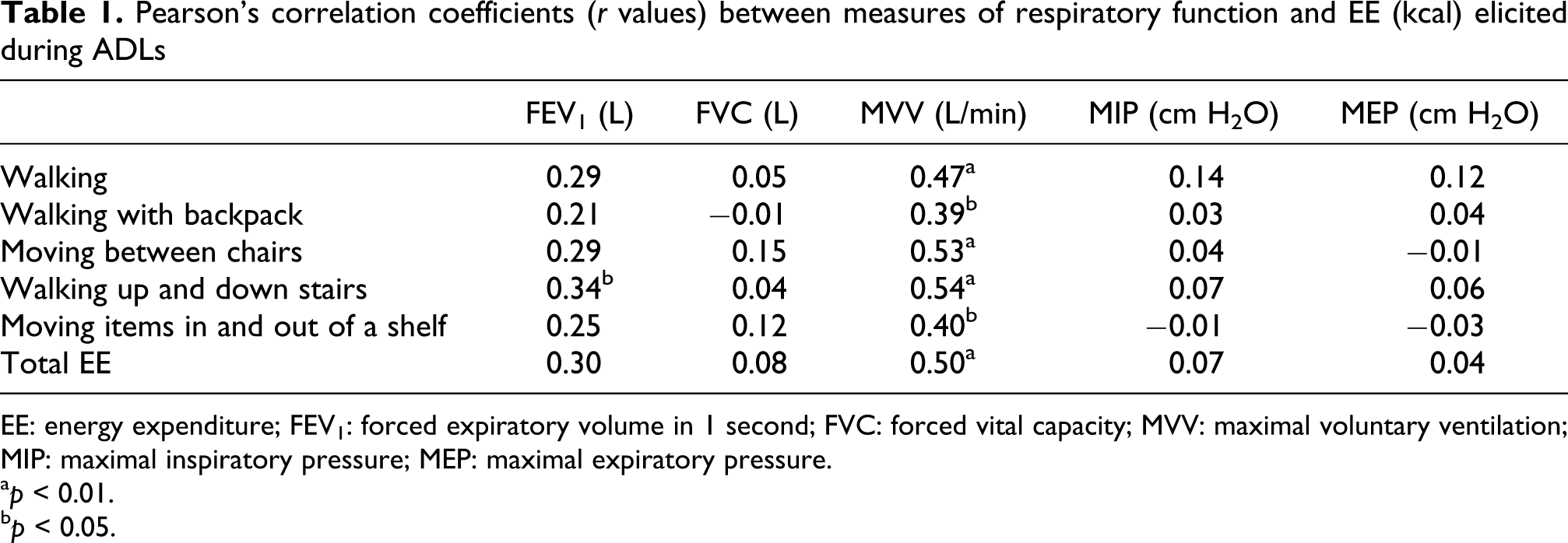
EE: energy expenditure; FEV1: forced expiratory volume in 1 second; FVC: forced vital capacity; MVV: maximal voluntary ventilation; MIP: maximal inspiratory pressure; MEP: maximal expiratory pressure.
a p < 0.01.
b p < 0.05.
Footnotes
Conflict of interest
The authors declared no conflicts of interest.
Funding
This research received no specific grant from any funding agency in the public, commercial, or not-for-profit sectors.