




Abstract
Both the peroxisome proliferator-activated receptor delta gene (PPARD) and malondialdehyde plasma concentrations may play a role in impaired glucose metabolism. The aim of this work was to determine whether PPARD is a candidate gene for impaired fasting glucose or type 2 diabetes and whether a particular genetic variant shows association with plasma malondialdehyde levels. Among the 10 single-nucleotide polymorphisms that were most strongly associated with malondialdehyde, the rs7770619 polymorphism in PPARD was analysed in 1798 subjects with normal fasting glucose, impaired fasting glucose and newly diagnosed type 2 diabetes. Our data demonstrate that the CT genotype of the rs7770619 is associated with a lower risk of impaired fasting glucose or type 2 diabetes together with lower plasma levels of malondialdehyde in both groups (p < 0.05). Glucose levels and the rs7770619 are significantly associated in individuals with normal fasting glucose, and a trend towards an association between glucose levels and rs7770619 is also observed in individuals with impaired fasting glucose or type 2 diabetes. In conclusion, PPARD rs7770619 is a novel candidate variant for impaired fasting glucose and type 2 diabetes and shows association with malondialdehyde levels. Future work is required to understand the mechanisms for these associations and the clinical implications of our findings.
Introduction
Hyperglycaemia generates reactive oxygen species, which in turn damage cells in many ways. 1 Lipids are a primary target of reactive oxygen species. Peroxidation of lipids produces highly reactive aldehydes including malondialdehyde (MDA). MDA has been reported as a primary biomarker of free-radical-mediated lipid damage and oxidative stress. 2 Increased MDA levels in plasma, serum, and many other tissues have been reported in diabetic patients.3,4 Increased lipid peroxidation presents a close relationship with the high glycaemic levels and oxidative stress observed in patients with diabetes mellitus.3,5
The peroxisome proliferator-activated receptor delta gene (PPARD) might be an important candidate gene for type 2 diabetes (T2D). 6 The association among PPARD variation, the risk of T2D, and related traits has been previously investigated. Although no association between the variants of PPARD and T2D was observed in a Korean population, several positive associations of polymorphisms with fasting plasma glucose and body mass index (BMI) were found in non-diabetic subjects. 7 Due to the close relationship observed between glucose in controls and MDA levels in hyperglycaemic subjects,1,4 a single-nucleotide polymorphism (SNP) associated with plasma MDA that was identified using the Korean Chip (K-CHIP) could also be a novel SNP associated with impaired fasting glucose (IFG) or T2D risk. Therefore, the objective of this study was to determine whether PPARD is a candidate gene for T2D by identifying an association between PPARD and the MDA level, which is considerably increased in hyperglycaemic patients. 4
Methods
Study population
A total of 2167 study participants with normal fasting glucose (NFG), IFG or newly diagnosed T2D were recruited from the National Health Insurance Corporation Ilsan Hospital in Goyang, Korea (January 2010–March 2015). The diagnosis of diabetes and IFG was based on the fasting plasma glucose level (⩾ 126 mg/dL and 100–125 mg/dL, respectively). All participants provided written informed consent, and the Institutional Review Board of Yonsei University and the National Health Insurance Corporation Ilsan Hospital approved the study protocol, which complied with the Declaration of Helsinki.
Laboratory experiments and SNP selection
Anthropometric measurements were performed on all participants. For clinical chemistry assays, blood samples were obtained from each participant after a minimum fasting period of 12 h and were stored at −70°C until analysis was performed. As described in detail previously, 8 the levels of fasting glucose, glucose-related markers, lipid profile, and high-sensitivity C-reactive protein (hs-CRP) were measured. A total of 2167 samples were genotyped using the Axiom® 2.0 Reagent Kit and samples which unsatisfied the quality control were excluded from the study (Supplementary Data 1).
Statistical analysis
Overall tests were performed using SPSS version 23.0 (IBM, Chicago, IL, USA) including an independent t-test, Mann–Whitney U-test, chi-square test, and logistic regression, and a two-tailed value of p < 0.05 was considered statistically significant. The Hardy–Weinberg equilibrium (HWE) and the association between genotypes and MDA levels was evaluated using a linear regression analysis via PLINK version 1.07.
Results
The clinical and biochemical characteristics of the NFG controls (n = 1210) and IFG or newly diagnosed T2D patients (n = 588) are shown in Supplementary Data 2. A total of 395,787 SNPs and 1845 samples were used in subsequent analyses. The SNPs with the strongest associations with MDA were determined, and one SNP was analysed in the PPARD (p = 1.43E–07); therefore, we conducted an association analysis of rs7770619 in the PPARD.
Distribution of the PPARD rs7770619 C>T polymorphism
The observed and expected frequencies of the rs7770619 were in HWE among the entire population. The relative frequencies of rs7770619 genotypes in IFG + T2D patients significantly differed from those of the controls (Supplementary Data 2). No homozygous mutation TT genotype was found in either the control or case groups. The frequency of the T allele of the rs7770619 in the case patients (0.006) was significantly lower than that in the controls (0.034; p < 0.001; Supplementary Data 2). The presence of the CT genotype was associated with a decreased risk of IFG + T2D [odds ratio (OR) = 0.164, p < 0.001; Supplementary Data 3]. The significance of the association remained after adjusting for age, sex, BMI, smoking, and drinking status (OR = 0.168, p < 0.001).
Association of plasma MDA and serum glucose with the PPARD rs7770619 C>T polymorphism
A significant association was observed between plasma MDA levels and rs7770619 in the controls (CC: 8.30 ± 0.07 nmol/mL; CT: 7.23 ± 0.20 nmol/mL; p < 0.001) and IFG + T2D patients (CC: 10.9 ± 0.24 nmol/mL; CT: 7.14 ± 1.26 nmol/mL; p = 0.020; Figure 1). Subjects with the CT genotype had significantly lower MDA levels than subjects with the CC genotype among both the controls and IFG + T2D patients. The serum glucose level and the rs7770619 were significantly associated in the controls (CC: 87.1 ± 0.22 mg/dL; CT: 83.9 ± 0.75 mg/dL; p < 0.001), and a trend towards an association between serum glucose and the rs7770619 was observed in IFG + T2D cases (CC: 118.3 ± 1.02 mg/dL; CT: 106.3 ± 2.03 mg/dL; p = 0.088). Subjects with a CT genotype showed significantly lower serum glucose levels than subjects with a CC genotype in the controls (Figure 1).
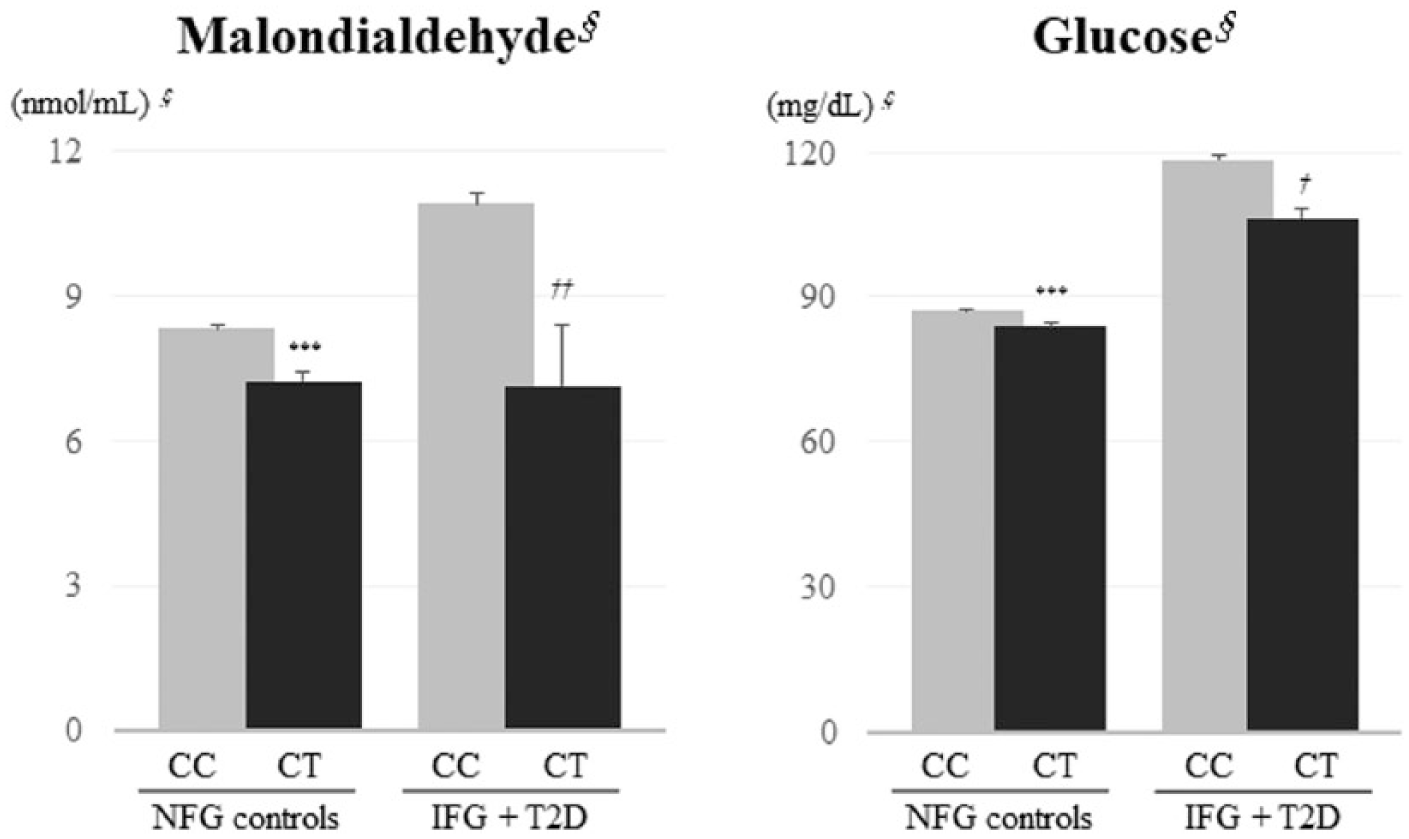
Relationship between PPARD rs7770619 and plasma MDA and between PPARD rs7770619 and serum glucose in NFG controls and IFG + T2D patients.
Discussion
The polymorphism of genes related to plasma MDA might influence the susceptibility to T2D due to the relationship between glucose and MDA levels.1,4 In this study, we discussed the potential relationship between the PPARD rs7770619 polymorphism and T2D susceptibility in Korean populations. The major finding is that the frequency of the PPARD rs7770619 CT genotype was significantly lower in IFG + T2D patients than in the controls, suggesting an association between the PPARD rs7770619 polymorphism and IFG or T2D. This observation is consistent with the recent finding that the PPARD polymorphism has emerged as a key player in the development of T2D. 9 The rs7770619 is considered to be functional because serum glucose levels and the rs7770619 were significantly associated with the controls in this study. The significance of the present observations is underscored by the association of PPARD locus polymorphism with altered glucose and plasma MDA, which is a reliable oxidative stress marker during hyperglycaemia. 1
PPARs are transcription factors that belong to the ligand-activated nuclear receptor superfamily. 10 The activation of PPARδ alleviates dyslipidaemia, hyperglycaemia and insulin resistance (IR) in diabetes and obesity. 11 PPARδ extensively expressed in organs and tissues, particularly within the pancreatic islets, also, stimulates the proliferation of pancreatic β-cells and insulin secretion in mice, thereby pancreatic β-cells can be protected from damage of free fatty acids. 10 However, the underlying mechanisms for the association between PPARD rs7770619 and T2D still remain to be elucidated. PPARδ regulates glucose homeostasis and insulin signalling in various tissues as well as improves hepatic and peripheral glucose metabolism and insulin sensitivity. 12 Nevertheless, we failed to provide evidence for the association between rs7770619 and the homeostasis model assessment–estimated insulin resistance (HOMA-IR); only the serum glucose level was demonstrated to be significantly different between genotypes. Moreover, the evidence from an in vitro study indicated that the PPARδ agonist directly improves glucose metabolism via an insulin-independent mechanism with phosphorylation of AMP-activated protein kinase (AMPK) and p38 mitogen-activated protein kinase (MAPK). 13
Hyperglycaemia generates reactive oxygen species.1,4 The increase in plasma MDA levels indicated that any sufficiently incurred oxidative stress could cause free-radical-mediated peroxidation of lipid components in the cell membrane; thus, MDA is a good indicator for evaluating oxidative stress in degenerative diseases such as T2D. 3 The association between PPARD rs7770619 and MDA levels observed in this study could be derived from the role of PPARδ in transcriptional regulation of endogenous antioxidants. In a short-term PPARδ knockout in the adult mouse heart, attenuation of expression in Cu/Zn superoxide dismutase and manganese superoxide dismutase and following oxidative damage to the heart were observed. 14 Since these endogenous antioxidants are crucial in maintaining cellular redox balance, disturbing this balance may increase oxidative stress in subjects with rs7770619 CC genotype, resulting in increased MDA levels than subjects with CT genotype. PPARδ also has protective effect against fatty acid–induced oxidative stress and lipid peroxidation by affecting expression of the gene encoding angiopoietin-like protein (Angptl) 4, a circulating inhibitor of lipoprotein lipase. 15 Therefore, PPARD rs7770619 and MDA levels may be connected by regulating the effects of PPARδ on Angptl4. However, exact mechanisms of the association between PPARD rs7770619 and MDA levels through endogenous antioxidants or Angptl4 need to be further investigated. In this study, the patients with IFG or newly diagnosed T2D exhibited a higher concentration of plasma MDA than the controls. Subjects with the rs7770619 CT genotype showed significantly lower fasting glucose levels than those with the CC genotype in the control group. In addition, the IFG + T2D patients with the CT genotype showed a decreased tendency in serum glucose levels compared with those with the CC genotype. Furthermore, the significantly lower concentration of plasma MDA in subjects carrying the CT genotype compared to those with the CC genotype in both groups could potentially explain the apparently lower risk of IFG or T2D associated with the rs7770619 CT genotype. Therefore, this study suggests that the PPARD rs7770619 polymorphism is a candidate gene for IFG or T2D because of the association between PPARD and MDA, which is the primary biomarker of free-radical-mediated lipid damage and oxidative stress. 2
The strengths of this study include an association between the PPARD rs7770619 polymorphism and T2D, which is combined with oxidative stress. Moreover, this study is the first to report the association between PPARD SNPs and oxidative stress markers. In summary, our results show an intriguing association between the rs7770619 CT genotype and a decreased risk of IFG or T2D as well as reduced levels of oxidative stress. This result could suggest that the PPARD rs7770619 polymorphism is a novel candidate gene for IFG or T2D through the association of PPARD and MDA, which is a reliable biomarker of oxidative stress and hyperglycaemia.
Supplemental Material
dvdres-oct-2017-00156-File003 – Supplemental material for PPARD rs7770619 polymorphism in a Korean population: Association with plasma malondialdehyde and impaired fasting glucose or newly diagnosed type 2 diabetes
Supplemental material, dvdres-oct-2017-00156-File003 for PPARD rs7770619 polymorphism in a Korean population: Association with plasma malondialdehyde and impaired fasting glucose or newly diagnosed type 2 diabetes by Minjoo Kim, Minkyung Kim, Hye Jin Yoo, Yao Sun, Sang-Hyun Lee and Jong Ho Lee in Diabetes & Vascular Disease Research
Footnotes
Acknowledgements
The genotype data were produced using the Korean Chip (K-CHIP), which is available through the K-CHIP consortium. The K-CHIP was designed by the Center for Genome Science at the Korea National Institute of Health, Korea (4845-301, 3000-3031).
Declaration of conflicting interests
The author(s) declared no potential conflicts of interest with respect to the research, authorship and/or publication of this article.
Funding
This study was funded, in part, by the Bio-Synergy Research Project (NRF-2012M3A9C4048762) and the Mid-career Researcher Program (NRF-2016R1A2B4011662) of the Ministry of Science, ICT and Future Planning through the National Research Foundation, Republic of Korea.
References
Supplementary Material
Please find the following supplemental material available below.
For Open Access articles published under a Creative Commons License, all supplemental material carries the same license as the article it is associated with.
For non-Open Access articles published, all supplemental material carries a non-exclusive license, and permission requests for re-use of supplemental material or any part of supplemental material shall be sent directly to the copyright owner as specified in the copyright notice associated with the article.
