




Abstract
The publication is a polemical response to reports that present data that diabetes reduces the risk of rupture of abdominal aortic aneurysm (AAA). The study analyzed all cases of developing AAA in patients with and without diabetes in 2012 in Poland. Data for the analysis were obtained with a unique and complete resources of the National Health Fund (NFZ) and population data from the Central Statistical Office (GUS). In Poland during 2012 2,227,453 patients with diabetes were treated, 975,364 males and 1,252,089 females. The incidence of AAA without rupture in patients without diabetes calculated per 100,000 of the non-diabetes general population was 25.0 +/– 9.0 in males and 5.6 +/– 2.3 in females. The incidence of ruptured AAA in the general population without diabetes was 3.6 +/– 0.9 in males, and 0.6 +/– 0.3 in females calculated per 100,000 of inhabitants without diabetes. The incidence of AAA without rupture in patients with diabetes was 184.897 +/– 70.653 in males and 35.364 +/– 24.925 in females calculated per 100,000 of patients diagnosed with diabetes. The incidence of ruptured AAA in patients with diabetes was 21.090 +/– 6.050 in males and 5.170 +/– 3.053 in females calculated per 100,000 of patients diagnosed with diabetes. The incidence rate for ruptured AAA in 2012 in Poland is statistically higher both in females and males in the population with diabetes. The incidence rate for AAA without rupture in 2012 in Poland is statistically higher in patients diagnosed with diabetes.
Keywords
According to some reports, diabetes mellitus decreases the risk of abdominal aortic aneurysms.1,2 In contrast, Czeleko et al. 3 reported that the incidence of abdominal aortic aneurysms is higher in the population of diabetes patients. Takagi and Umemoto 4 reported a meta-analysis of ruptured abdominal aortic aneurysms which indicated that rates are lower in diabetes compared to non-diabetes subjects.
In this analysis, we use a unique and complete data set of the National Health Fund (NFZ) on patients with diabetes and patients with an abdominal aortic aneurysm. In Poland, in 2012, a total of 2,227,453 diabetes patients including 975,364 male and 1,252,089 female patients were diagnosed. In 2012, the Polish population according to the data of the Central Statistical Office (GUS) included 38,533,784 persons, of which 18,651,441 were males and 19,882,343 females. The population without diabetes in 2012 comprised 36,306,331 persons, of which 17,676,077 were males and 18,633,254 were females. For the analysis, we enrolled (1) 2388 diabetes patients with abdominal aortic aneurysm without rupture (n = 1915 males and 473 females), (2) 5844 patients with abdominal aortic aneurysm without rupture and without diabetes (n = 4679 males and 1165 females), (3) 282 diabetes patients diagnosed with rupture of an abdominal aortic aneurysm (n = 213 males and 69 females) and (4) 779 patients with ruptured abdominal aortic aneurysm and without diabetes (n = 649 males and 130 females).
Data were prepared with the statistical software of Statistica (independent t-test). Differences were considered to be significant at the significance level of 95% (p < 0.05).
The average age of men with diabetes, without rupture of abdominal aortic aneurysm, was 71.4 ± 8.9 years and the average age of men with diabetes diagnosed with rupture of an abdominal aortic aneurysm was 72.6 ± 5.2 years (p = 0.003). The average age of women with diabetes, without rupture of abdominal aortic aneurysm, was 73.2 ± 8.9 years and the average age of women with diabetes diagnosed with rupture of an abdominal aortic aneurysm was 77.1 ± 9.4 years (p = 0.001). Women with ruptured abdominal aortic aneurysm were significantly older (p = 0.001).
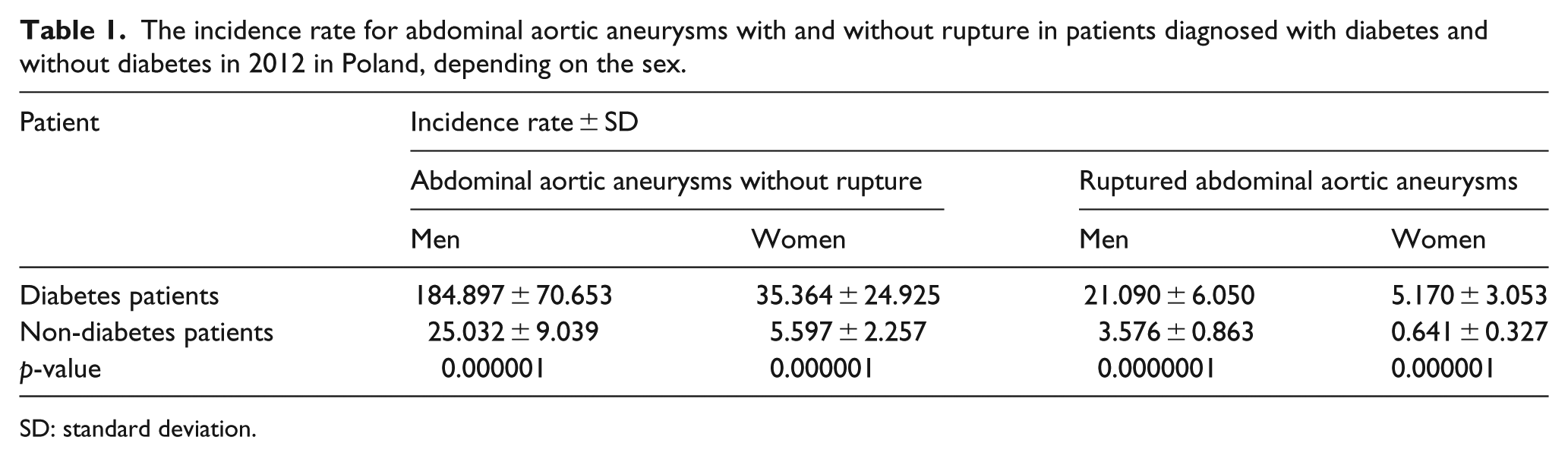
The incidence of abdominal aortic aneurysms without rupture in patients without diabetes in Poland in 2012 calculated per 100,000 of the non-diabetes general population was 25.0 ± 9.0 in males and 5.6 ± 2.3 in females. The incidence of ruptured abdominal aortic aneurysms in the general population without diabetes was 3.6 ± 0.9 in males and 0.6 ± 0.3 in females calculated per 100,000 inhabitants without diabetes (Table 1).
The incidence rate for abdominal aortic aneurysms with and without rupture in patients diagnosed with diabetes and without diabetes in 2012 in Poland, depending on the sex.
SD: standard deviation.
The incidence of abdominal aortic aneurysms without rupture in patients with diabetes in Poland in 2012 was 184.897 ± 70.653 in males and 35.364 ± 24.925 in females calculated per 100,000 of patients diagnosed with diabetes. The incidence of ruptured abdominal aortic aneurysms in patients with diabetes was 21.090 ± 6.050 in males and 5.170 ± 3.053 in females calculated per 100,000 of patients diagnosed with diabetes. The incidence rate for abdominal aortic aneurysms without rupture in diabetes patients was significantly higher compared to the incidence rate in non-diabetes patients at p = 0.000001 in males and at p = 0.000001 in females. The incidence rate for abdominal aortic aneurysms with rupture in diabetes patients was significantly higher compared to the incidence rate in non-diabetes patients at p = 0.0000001 in males and at p = 0.00001 in females.
The incidence rate for ruptured abdominal aortic aneurysms in 2012 in Poland is statistically significantly higher both in females and males in the population with diabetes. The incidence rate for abdominal aortic aneurysms without rupture in 2012 in Poland is statistically significantly higher in patients diagnosed with diabetes.
Footnotes
Declaration of conflicting interests
The author(s) declared no potential conflicts of interest with respect to the research, authorship and/or publication of this article.
Funding
The author(s) received no financial support for the research, authorship and/or publication of this article.