




Abstract
This study investigated the effects of sedentary occupations on type 2 diabetes and hypertension in different ethnic groups in North West China. All subjects were civil servants who received health examinations in the First Affiliated Hospital of Xinjiang Medical University from October 2010 to March 2014. A total of 46,612 participants (39,120 Han, 4148 Uygur, 2098 Hui, 877 Kazak and 369 other ethnicities) completed the examination. Overall, 16.4% of the Han, 14.4% of the Uygur, 15.9% of the Hui, 20.6% of the Kazak and 16.0% of other ethnicities had hypertension. Diabetes was found in 7.6% of the Han, 8.5% of the Uygur, 9.2% of the Hui, 7.4% of the Kazak, and 3.3% of other ethnicities. There was a significant difference between men and women in the prevalence of diabetes (4.3% in women vs 9.7% in men, p < 0.001) and hypertension (9.7% in women vs 21.0% in men, p < 0.001). Our results indicate that both diabetes and hypertension are highly prevalent in individuals with sedentary occupations.
Background
Both type 2 diabetes mellitus (T2DM) and hypertension are global health problems which cause death and disability, mainly through cardiovascular disease and stroke.1,2 Previous studies have suggested that there are more than 16 million patients with hypertension and 14 million patients with diabetes in China. 3 Xinjiang is a province of China, in which more than 13 ethnic groups are found. According to Yang et al., 4 in Xinjiang, the prevalence of diabetes has increased to 9.26% in Han, 6.23% in Uygur and 3.65% in Kazak. Liu et al. 5 also reported that the prevalence of hypertension was 25%–33% in this region. However, the participants included in these studies aged 35–101 years and the occupations varied.
Previous studies suggested that sedentary behaviour may be associated with an increased risk of medical disorders, including both cardiovascular disease and diabetes. Most civil servants have sedentary occupations; however, the prevalence of hypertension and diabetes in this population remains unclear.
Methods
Ethics statement
This study was conducted in accordance with the Declaration of Helsinki, and written informed consent was obtained from each individual according to the protocol approved by the Ethics Committee of the First Affiliated Hospital of Xinjiang Medical University.
Subjects
All subjects were civil servants who underwent a health examination in the First Affiliated Hospital of Xinjiang Medical University between October 2010 and March 2014. A total of 46,612 participants, including 39,120 Han, 4148 Uygur, 2098 Hui, 877 Kazak and 369 of other ethnicities, completed the examination. Diabetes was defined by the American Diabetes Association 2009 criteria [fasting plasma glucose >7.0 mmol/L (>126 mg/dL)] or self-reported current diabetes treatment in the survey. 6 Hypertension was defined as an average systolic blood pressure (SBP) ⩾140 mm Hg, an average diastolic blood pressure (DBP) ⩾90 mm Hg and/or self-reported current treatment for hypertension with antihypertensive medication. 7 Sedentary behaviour was defined by waking energy expenditure ⩽1.5 metabolic equivalents (METs) while in a sitting or reclining posture. 1
At the time of interview, 5 mL of fasting blood samples (fasting for at least 8 h) were collected in an EDTA (ethylenediaminetetraacetic acid) vacutainer tube for the assay of glucose and other indices. Fasting glucose was measured (Dimension AR/AVL Clinical Chemistry System, Newark, NJ, USA) in the Clinical Laboratory Department of the First Affiliated Hospital of Xinjiang Medical University.
Statistical analyses
All questionnaire data were double-entered and cross-validated using EpiData version 3.1 (EpiData Association, Odense, Denmark). Statistical analyses were performed in SPSS version 17.0 (SPSS Institute, Chicago, IL, USA). Continuous variables were expressed as mean or median, and categorical variables were expressed as percentage. Chi-square (χ2) test was used to explore the association in categorical data. Student’s t-test was utilized to compare two means in numerical data. Two-tailed tests were performed with the significance level set as 0.05.
Results
Characteristics of the participants
Table 1 shows the characteristics of the study participants. There were significant differences in age, triglyceride (TG), total cholesterol (TC), alanine transaminase (ALT), waist circumference, DBP, low-density lipoprotein (LDL) and high-density lipoprotein (HDL) cholesterol, serum glucose (GLU), uric acid (UA), weight and body mass index (BMI) between different ethnic groups (All ps < 0.05). DBP, LDL, weight and BMI were significantly higher in the Kazak population compared to other ethnicity (ps < 0.05); however, the mean age in this population was higher which might account for some of these differences.
Characteristics of the participants.
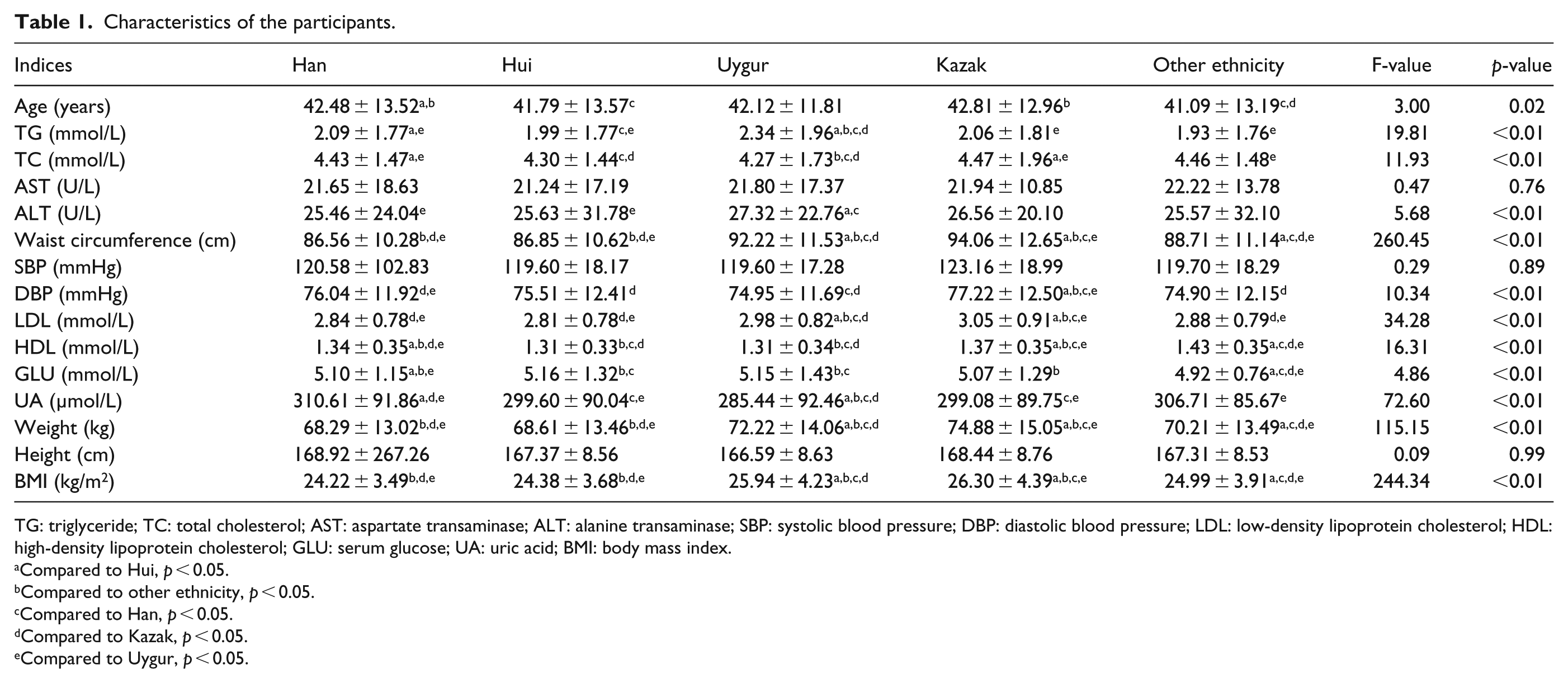
TG: triglyceride; TC: total cholesterol; AST: aspartate transaminase; ALT: alanine transaminase; SBP: systolic blood pressure; DBP: diastolic blood pressure; LDL: low-density lipoprotein cholesterol; HDL: high-density lipoprotein cholesterol; GLU: serum glucose; UA: uric acid; BMI: body mass index.
Compared to Hui, p < 0.05.
Compared to other ethnicity, p < 0.05.
Compared to Han, p < 0.05.
Compared to Kazak, p < 0.05.
Compared to Uygur, p < 0.05.
Sedentary occupations, and type 2 diabetes and hypertension
Overall, 16.4% of the Han, 14.4% of the Uygur, 15.9% of the Hui, 20.6% of the Kazak and 16.0% of other ethnicities had hypertension. Diabetes occurred with a prevalence of 7.6% in Han, 8.5% in Uygur, 9.2% in Hui, 7.4% in Kazak and 3.3% in other ethnicities. There were significant differences between men and women in the prevalence of diabetes (4.3% in women vs 9.7% in men, p < 0.001) and hypertension (9.7% in women vs 21.0% in men, p < 0.001). The overall prevalence of T2DM was highest in Hui (9.2%) and lowest in other ethnicities. The overall prevalence of hypertension was highest in Kazak (20.6%) and lowest in Uygur (14.4%). In each ethnic group, the overall prevalence of both T2DM and hypertension was higher among men than women. The prevalence of both hypertension and diabetes increased with age in both men and women (data not shown).
Discussion
In this study, we reported the prevalence of diabetes and hypertension in civil servants with sedentary occupations. We found there was a significant difference in the prevalence of diabetes and hypertension both among different ethnic groups and between men and women.
Sedentary behaviour has recently been identified as a significant public health issue. Several epidemiologic studies have suggested a relationship between sedentary behaviour and diabetes and cardiovascular disease.8,9 Many civil servants spend approximately a half of their workday in a seated position10,11 and spend hours of leisure time on activities such as watching TV, using computers, participating in screen-based recreation and driving. Although the mechanisms underlying the relationship between sedentary occupations and diabetes and hypertension remains unclear, replacement of physical activity by sedentary behaviour, thus reducing energy expenditure, may attribute to the positive association of sitting time and diabetes and hypertension. 12 Several previous studies reported that sedentary behaviour might be a significant factor in the increase of diabetes. Therefore, moving or standing within the workplace may be important, as it could both increase energy expenditure and may reduce the risk of diabetes.
Our study indicated that sedentary occupations are associated with higher prevalence of diabetes and hypertension. A recent study from Australia reported that adults spend 57% of their working hours in sedentary activity and another reported that US adults spend 7.3–7.9 h/day in sedentary behaviour. Sedentary occupations have been increasingly recognized as a public health risk and further studies on the relationship between sedentary behaviour and hypertension and diabetes are warranted.
Our study had several limitations. This work was based on cross-sectional data and further study of risk factors for incident diabetes and hypertension was not possible. We did not analyse related economic factors such as household income and social data about people’s knowledge, attitudes and belief about factors contributing to health and disease. This limited further exploration of possible mechanisms linking the differences in the prevalence of diabetes and hypertension between different ethnicities.
Hence, our study indicates that both diabetes and hypertension are highly prevalent in subjects with sedentary occupations. Screening for the presence of diabetes and hypertension in high-risk groups and the implementation of exercise programmes are warranted.
Footnotes
Acknowledgements
Y.G. and X.X. contributed to this work equally.
Declaration of conflicting interests
The author(s) declared no potential conflicts of interest with respect to the research, authorship and/or publication of this article.
Funding
The author(s) disclosed receipt of the following financial support for the research, authorship, and/or publication of this article: This work was supported financially by grants from Xinjiang Uygur Autonomous Region Scientific and Technological Plan Project (2016E0274).