




Abstract
Although many obese people successfully lose weight by dieting and/or behavioural therapy, most of them subsequently regain the lost weight. Thus, new therapeutic strategies are required to maintain weight loss. We report a woman with type 2 diabetes and moderate obesity who succeeded in achieving good glycaemic control and long-term weight loss with weaning from insulin therapy, while charting her weight four times daily. This charting method might be useful for long-term maintenance of weight reduction in obese diabetic patients. Obese patients can monitor their irregular weight fluctuations produced by overeating and correct both their food intake and their lifestyle. Further studies, including randomized control trials, will be needed to confirm the efficacy of this approach in patients with type 2 diabetes.
Introduction
Obesity has rapidly become a worldwide epidemic, 1 and it is a major risk factor for various disorders. 2 Both obesity and type 2 diabetes increase the risk of cardiovascular disease and other co-morbidities, 3 while moderate weight loss can improve many aspects of type 2 diabetes, including insulin resistance/glycaemic control, hypertension and dyslipidemia. 4 Although many obese people successfully lose weight by dieting and/or behavioural therapy, most of them subsequently regain the lost weight. Accordingly, new strategies are required to maintain weight loss. Bariatric surgery can be a highly effective option for achieving weight loss and improvement of co-morbidities, but such surgery carries considerable risks and is only applicable to selected patients with type 2 diabetes. 3
We report a woman with type 2 diabetes and moderate obesity who succeeded in achieving good glycaemic control and long-term weight loss with weaning from insulin therapy while charting her weight four times a day. This report introduces charting body weight multiple times daily 5 as a potentially effective behavioural approach to the problems of obesity and maintaining weight loss in patients with type 2 diabetes.
Case report
In October 2009, a 54-year-old woman with type 2 diabetes and poor glycaemic control was admitted to our hospital with malaise. Diabetes had been diagnosed at age 44, and she had started insulin and metformin therapy. However, she gradually gained weight (20 kg over 10 years) because of overeating and chronic poor glycaemic control (HbA1c of 10%–12%) despite insulin therapy (40 units/day). On admission, her HbA1c was 12.9%, plasma glucose was 309 mg/dL and body mass index (BMI) was 38.2 kg/m2 (height: 158.7 cm; weight: 96.3 kg). There were no signs of diabetic ketoacidosis, serious diabetic complication or any cardiovascular disease. She was started on a diet at 1400 kcal/day (25 kcal/kg of ideal body weight), and her insulin dose was adjusted. She also weighed herself four times daily (immediately after waking, immediately after breakfast, immediately after dinner and immediately before going to bed) and charted the data on a weekly graph (Figure 1). On day 11, the insulin dose reached a maximum of 71 units, after which it decreased markedly. On day 29, glycaemic control was improved sufficiently, and she was discharged.
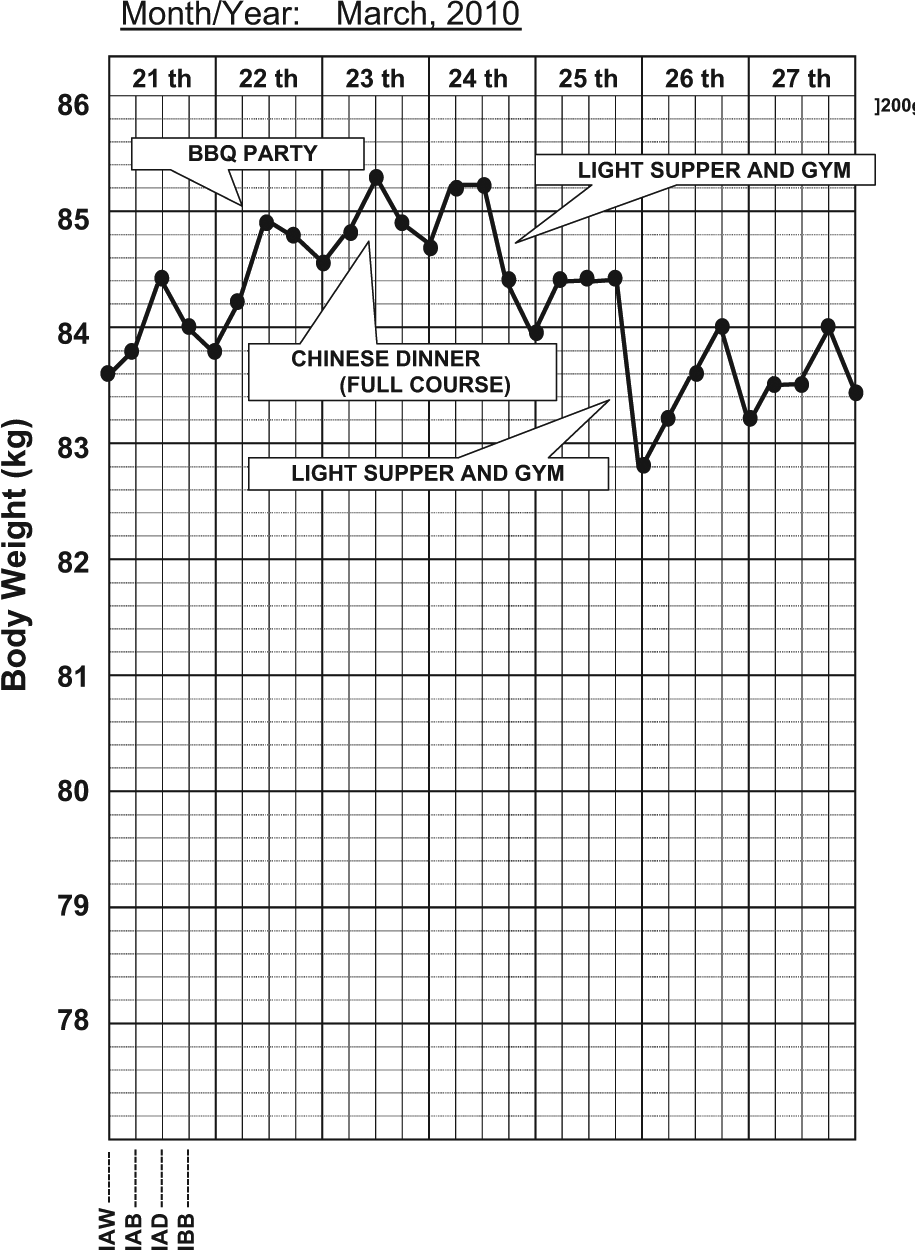
Chart of daily weight pattern.
After discharge from hospital, she continued to follow the reduced calorie diet and increased her level of physical activity by attending a gym three times per week. She also continued to chart her weight four times daily. After 6 months, she was able to stop insulin therapy (HbA1c: 6.1% and fasting plasma glucose: 110 mg/dL, while taking metformin). Her weight decreased from 96.3 to 82 kg, and she maintained this lower weight and glycaemic control for over 1 year, with no progression of diabetic complications or cardiovascular events.
Discussion
The benefit of charting the daily weight pattern was first reported by Fujimoto et al. 6 in 1992. They divided 72 obese women into two groups with or without daily weight charting and demonstrated that charting appeared to assist obese patients to maintain weight loss.
Frequent self-weighing has been suggested to promote behavioural self-regulation. 7 It probably assists in maintaining weight loss because daily charting of weight fluctuations reveals the irregular intake of food and fluid that reflects distorted feeding patterns and other behavioural abnormalities. Once these irregularities become apparent to patients, they tend to improve their eating habits and/or lifestyle, which assists their progress with weight reduction and can therefore be an important therapeutic milestone. 8
Little is known about the frequency and duration of self-weighing that confers the maximum benefit for most people. 9 In the general population, Linde et al. 10 found that participants who self-weighed daily lost significantly more weight than participants who self-weighed weekly, monthly, bi-monthly or never. However, evidence about the effect of frequent weighing (four times per day) has been very limited, and little research has been done in diabetic populations. Although Raynor et al. 11 reported that self-weighing more than once per week was related to a lower BMI, it has not been determined whether self-weighing more than once daily, as in this case, achieves greater weight loss in patients with type 2 diabetes.
In addition, some researchers and physicians have urged caution with regard to frequent self-weighing throughout the day, because it is believed to have negative psychological effects such as causing depression, anxiety or stress due to an unhealthy preoccupation with weight. 12
Interestingly, our case suggests that the opposite effect can occur. This might have been because our patient was used to a highly scheduled life before she started charting her weight, since she had to take medications regularly (e.g. insulin injection, other drugs at mealtimes).
In conclusion, this weight charting method might be useful for long-term maintenance of weight reduction in obese diabetic patients. Obese patients can monitor their irregular weight pattern produced by overeating and correct both their food intake and their lifestyle. However, we acknowledge the limitations of this case study, which assessed one individual who provided self-reported data in unrestricted living conditions and was potentially influenced by other behavioural factors (e.g. diet and exercise). Further studies, including well-designed randomized controlled trials, will be required to confirm the efficacy of this approach. Weight reduction and maintenance of weight loss are important in the management of diabetes, especially in view of the rapid increase in its prevalence.
Footnotes
Acknowledgements
T.Y., Y.K., M.N. and S.Y. contributed to the discussion. T.Y. wrote manuscript.
Declaration of conflicting interests
No potential conflicts of interest relevant to this article were reported. Dr Tomohide Yamada is the guarantor of this work and, as such, had full access to all the data in the study and takes responsibility for the integrity of the data and the accuracy of the data analysis.
Funding
This research received no specific grant from any funding agency in the public, commercial or not-for-profit sectors.