



Abstract
Since the advent of mass media, ‘going public’ has been a key tool in the strategic inventory of presidents seeking to promote their policies to politicians and the public. Over the last decade, social media has offered presidents and their office with a new platform to address the nation directly without relying on traditional media gatekeepers. Nevertheless, both ‘going public’ strategies and presidents’ use of social media have almost exclusively been researched in the context of the presidential systems. The aim of this article is to extend research and offer the first systematic study of presidential Twitter use in European semi-presidential systems. We conceptualise presidential Twitter use as a form of presidential activism that is complementary to the use of formal powers or informal attempts to influence policy. Whereas the latter are driven by institutional or partisan conflict, going public strategies and presidential Twitter use primarily address societal concerns and, hence, are motivated by contextual factors outside the core realm of party politics. Instead, we should expect social conflict and societal grievances to determine demand and supply of presidential Twitter use. We test our propositions using a new dataset of tweets by presidents in European semi-presidential systems 2010–2020.
Introduction
Semi-presidentialism is characterised by the often-conflictual relationship between presidents and prime ministers. Unlike parliamentarism, semi-presidential regimes feature a directly elected president with their own democratic mandate who is able to rival the prime minister and their cabinet (cf. Yan, 2021: 285; Elgie, 1999). This creates an inherent tension. Political competition with governments and prime ministers becomes almost inevitable (Protsyk, 2005; Sedelius and Mashtaler, 2013; Yan, 2021), even in countries where presidents’ formal powers or public role are limited (cf. Feijó, 2021; Krašovec and Lajh, 2013; Tavits, 2009). Presidents’ actions intended to gain (and maintain) influence over political processes and outcomes are usually seen as the key factor in understanding the functioning of semi-presidential regimes. Hence, the question of what drives presidential activism and can explain variations therein is of central importance to all studies of semi-presidential regimes, irrespective of their substantive focus (cf. Åberg and Sedelius, 2020). However, analyses of presidential activism in semi-presidential regimes are – both conceptually and empirically – often confined to explaining the use of individual constitutional prerogatives (e.g. legislative vetoes; Cholova, 2013; Köker, 2017) or examining discrete domains of presidential influence (e.g. foreign policy; Raunio and Sedelius, 2020). Consequently, other aspects of presidential activity, which have been thoroughly examined within presidential regimes, remain significantly underexplored.
The use of social media by presidents has been primarily studied in the context of presidential systems (e.g. Díaz-Campo et al., 2015; Waisbord and Amado, 2017); however, it is undeniably an important and powerful tool for presidents and other politicians in many other political systems as well. It offers presidents and political leaders a low-cost, highly flexible tool for sending targeted messages to citizens and voters. This can be used to influence public opinion or policy, or to quickly disseminate essential information during crises (such as the COVID-19 pandemic; cf. Haman, 2020). By doing so, presidents can bypass traditional gatekeepers in the news media and directly reach their supporters without intermediaries (Jost, 2022). However, since presidents’ statements on social media often receive extensive coverage and commentary, their messages are likely to have an impact beyond the social media sphere (Oschatz et al., 2022).
Building on research about political leaders’ use of social media and presidents’ ‘going public’ strategies, this article aims to position presidential social media usage within the broader context of existing studies on presidential activism in semi-presidential systems. We argue that presidents must navigate a dual role: one as the (partisan) politician promoting the interests of their constituents, and one as the guarantor of national unity and representative of the nation as a whole. As partisan politicians, presidents use their constitutional powers to enact or prevent policy change. Their activism through these channels is, therefore, motivated by institutional or ideological conflict. However, when presidents want to fulfil their role as a ‘pouvoir neutre’ above party politics, they not only choose different means to become active, but their activism is also driven by other concerns. We argue that because presidents must be responsive to the population at large, they use social media as a means of ‘going public’ (Eshbaugh-Soha, 2016; Kernell, 2007; Sedelius, 2021). Furthermore, their activism through social media should primarily be driven by factors outside the core realm of party politics. Instead, we expect social conflict and societal grievances to drive the supply and demand of presidential Twitter use.
The aim of this article is to offer the first comparative study of presidential Twitter use and its determinants in European semi-presidential democracies. We formulate a theoretical framework and test our propositions utilising an original dataset of Twitter activity by 42 presidents in 15 European semi-presidential democracies between 2010 and 2020. Using descriptive and inferential statistics we show that, contrary to our initial expectations, presidential activism is negatively associated with both a high level of social conflict and a high level of constitutional presidential power. Interestingly, we find no influence of partisan conflict, such as cohabitation, on presidents’ social media activity. We conclude by discussing the implication of our findings and further avenues of research. Our study contributes to the literature on presidential ‘going public’ strategies in non-presidential systems and research on the use of social media by political actors.
Presidents and Politics on Social Media
Over the past two decades, the use of social media by presidents and other politicians as a means of communicating with the public has become a ubiquitous phenomenon. Although the gradual development of traditional mass media throughout the twentieth century allowed politicians to reach an ever-growing audience, journalists still acted as gatekeepers and controlled the messages that reached the public (cf. Shoemaker and Vos, 2009). Social media, however, allow politicians to bypass the gatekeepers of traditional channels of political communication and address both the general public and specific groups of (potential) voters directly and without any intermediaries (Jost, 2022). However, given the extensive coverage and commentary that presidents’ social media statements attract, their messages also have an impact beyond the confines of social media (Wells et al., 2020). These developments have led to a large number of studies across political science and neighbouring disciplines (for an overview, see, for example, Bruns et al., 2017 [2016]; Harvey, 2013; Persily and Tucker, 2020). In doing so, scholars have paid particular attention to the social media strategies of political actors in the context of electoral campaigns (e.g. Jungherr, 2016; Stier et al., 2018; Vergeer, 2015) or as part of legislators’ activity (Haman et al., 2023), as well as to the use of social media by populists and its potentially harmful consequences for democracy (e.g. Alonso-Muñoz, 2020; Ernst et al., 2017; Jacobs and Spierings, 2019). The field has thereby not only benefitted from the relative ease with which social media data could be accessed by researchers, but also from projects that have assembled cross-country lists of accounts used by politicians (e.g. Haman and Školník, 2021).
Presidents and their use of social media have received particular public and scholarly attention since Barack Obama’s election to the US-presidency in 2008 following a campaign that relied heavily on social networks to mobilise voters (see, for example, Harfoush, 2009; Hendricks and Denton, 2010; Katz et al., 2013). However, it was undoubtedly his successor, Donald Trump, and his controversial use of Twitter to attack political opponents and institutions, that shifted the research focus towards the content and style of social media communication and its effects (e.g. Kromphardt and Salamone, 2021; Ott and Dickinson, 2019; Ouyang and Waterman, 2020; Schneiker, 2019). Nevertheless, the use of Twitter accounts has not been exclusive to US presidents. Research on presidents in other countries has primarily focused on the populist appeals of heads of state in presidential systems. Waisbord and Amado (2017), for example, examine whether Twitter has changed the communication style of presidents in Latin America. They find that populist presidents only differ little from their non-populist counterparts in using it as a means of one-way communication, yet do so with greater hostility towards their opponents. In contrast, Díaz-Campo et al.’s (2015) analysis of Latin American presidents’ responses to scandals finds no clear evidence for a consistent strategy of Twitter use, with the only discernible pattern being a preference for personal self-promotion rather than disseminating information about their policies.
Unfortunately, there has been little research that has theorised or examined the determinants of (variations within) presidential Twitter use, particularly from a comparative perspective. The vast majority of studies still provide largely descriptive accounts of Twitter use, mostly related to the COVID-19 pandemic (Adikpo, 2022; Haman, 2020; Rufai and Bunce, 2020; the survey by Haman et al. (2023) on social media use among members of the European parliament presents a notable exception). Despite more advanced studies examining the adoption and use of social media by political leaders around the world, they do not always distinguish between the positions of a president and a prime minister. Hence, findings by Barberá and Zeitzoff (2018) and Barberá et al. (2021) that social media use is strongly correlated with higher levels of democratisation and social pressure provide promising starting points, but fall short of a comprehensive explanation of when and why presidents choose to ‘go public’ through social media. The next section formulates a more general theoretical framework by situating presidential social media use within the wider scholarship on presidential activism.
Going Public, Going Social: Explaining Presidential Activism Through Social Media
When and why do presidents ‘go public’ using social media? While studies have already provided important insights on how presidents use new means of communication, less is known about the determinants of presidents’ activity. The aim of this section is to provide a theoretical framework that serves as a first basis for an empirical test and building block for future studies. To do so, it builds on previous work on presidential activism and its determinants. As most definitions of the term ‘presidential activism’ are either plagued by normative connotations or focus on constitutional powers alone (cf. Köker, 2017: 4–6), we thereby follow Raunio and Sedelius’ (2020: 35) broader conceptualisation of presidential activism as ‘presidents’ use of their formal powers and their attempts to influence politics through informal channels’. Furthermore, we distinguish between presidential activism based on its expression along two dimensions – formal versus informal and public versus non-public. Finally, our approach follows a presidency-centred logic, that is, we assume that presidents are rational actors and generally ‘behave similarly in similar situations’ (Hager and Sullivan, 1994: 1081). This does not mean that presidents’ personal characteristics do not matter, but that they primarily respond to institutional incentives and political opportunities that allow them to do influence policy (cf. Köker, 2017; Raunio and Sedelius, 2020; Tavits, 2009).
Presidents – especially in presidentialism and semi-presidentialism – must navigate a dual role: one as the (partisan) politician promoting the interests of their constituents, and one as the guarantor of national unity and representative of the nation as a whole (cf. Linz, 1990: 53). This has consequences for how (or by which means) they become active – and how we can explain presidential activism, as presidents can only ever serve to fulfil the expectations towards one of these roles and the actions required to do so are mutually exclusive. The use of formal constitutional powers is thereby primarily linked to presidents’ role as partisan politicians. Through the use of executive decrees, vetoes or appointments, presidents implement their policy programme or prevent other actors from moving the political status further away from their ideal point. Hereby, the literature has identified cohabitation (or divided government) and the weakness of (minority) governments as well as institutional arrangements that favour the president (most notably, presidents’ constitutional power) as key predictors of formal-public presidential activism across political systems (see Bucur and Cheibub, 2017; Köker, 2017; Pereira et al., 2005; Protsyk, 2004; Schleiter and Morgan-Jones, 2009, 2010; Semenova and Dowding, 2021; Tavits, 2009). Even in semi-presidential regimes, where presidents are usually not the key executive actor and do not have their own comprehensive policy programme to implement, they regularly engage in formal–public activism to implement their policy objectives (Köker, 2017).
In seeking to fulfil their role of guarantors of national unity and representatives of the nation as a whole, presidents must stand above partisan conflict (Kujanen et al., 2023). They must be responsive to the concerns and issues of society and choose means to become active that do not primarily address other politicians, but the citizenry at large. For this purpose, social media presents a particularly suitable tool. It presents presidents with a direct and low-cost tool to engage with the public and even the opportunity to interact with and reply to voters (Díaz-Campo et al., 2015). Given the important constitutional role of presidents, their followers include more than just their own supporters – even beyond their own country. As, for example, embedding Twitter messages in journalistic reporting has become a routine practice, social media is likely to reach recipients beyond the social media sphere (Oschatz et al., 2022). Moreover, the wider audience increases incentives for presidents to behave in a more statespersonlike manner and be less confrontational (cf. Kujanen et al., 2023). In this sense, social media use presents a special case of ‘going public’ strategies through which president ‘attempt to influence the decisions, actions, and opinions of others through speechmaking and other public engagement’ (Eshbaugh-Soha, 2016: 1). Nevertheless, given the wide reach of social media, presidents should primarily use it in response to societal pressure and not for partisan political reasons. This should be particularly true for semi-presidential regimes, where presidents must share executive power and their role as arbiter and ‘pouvoir neutre’ is more pronounced.
Societal conflict has already been discussed in the context of formal–public presidential activism. Several studies have highlighted that determinants related to the state of the economy and wealth distribution create opportunities and demand for activism (cf. Deen and Arnold, 2002; Pereira et al., 2005). Research has also reported that higher levels of societal pressure and democratisation are positively associated with the adoption and use of social media by world leaders (Barberá et al., 2021; Barberá and Zeitzoff, 2018). While major crises such as the COVID-19 pandemic or other national tragedies are likely to lead to temporary spikes in activism, they cannot necessarily explain broader cross-national patterns. More generally, it should be in times of political and economic uncertainty that voters are likely to look to the president for guidance – especially as presidents in semi-presidential regimes are not necessarily the dominant executive actor but are seen as moral authority figures (cf. Grimaldi, 2021). This then creates a demand and opportunity for presidents to go public through social media.
Presidents, in turn, must be responsive to such shifts in social sentiment and will use this opportunity to fulfil their role as representatives of the entire nation. Of course, activism can have the secondary benefit of enhancing electoral prospects by allowing presidents to criticise unpopular governments or policies without incurring significant costs. Nevertheless, as the audience for their activism here extends beyond their base of potential supporters, statespersonlike behaviour is likely to dominate. In sum, we can expect that high levels of social conflict increase the demand and opportunity for presidential engagement with voters and the public. Therefore, the key hypotheses to be tested in this article read:
H1. The greater the level of social conflict, the higher the overall level of presidential activism in the form of going public.
H2. The greater the level of social conflict, the higher the overall engagement with forms of presidential activism.
Note that we formulate two hypotheses for the sake of clarity as the two key dependent variables are different; however, the theoretical reasoning behind the two hypotheses is fundamentally similar. Given the limitations of previous scholarship regarding systematic explanations of presidents’ informal–public activism through social media, the above considerations can naturally only provide a general framework for analysis. Despite these limitations, the hypotheses present important trends that should be found on a comparative scale. In the remainder of this article, we put our arguments to the test and examine the use of Twitter by presidents in 15 European democracies.
Data and Methods
Scholarship on presidential activism, regardless of its specific form, is often limited by the fact that appropriate data are only rarely available (cf. Köker, 2017). To answer the question of when presidents ‘go public’ through social media, this article, therefore, relies on an original dataset on the use of Twitter by presidents in 15 European semi-presidential democracies, 2010–2020 (Raunio et al., 2020–2024). Presidents and their offices often use two accounts – an institutional account run by the presidency’s press department and a personal account that can (and is) accessed by officeholders themselves (cf. Köker, 2013). Given that we want to capture activism of officeholders themselves, and because institutional accounts do not habitually interact with users, we focus our attention on presidents’ personal accounts (see Table 1). Based on these accounts, we define the following two dependent variables for our analysis to capture presidents’ informal–public activism through social media: (1) the total number of tweets per month and (2) the interactiveness of the account, calculated as the ratio of total likes and the total number of tweets.
Twitter Adoption by Popularly Elected Presidents in Europe.
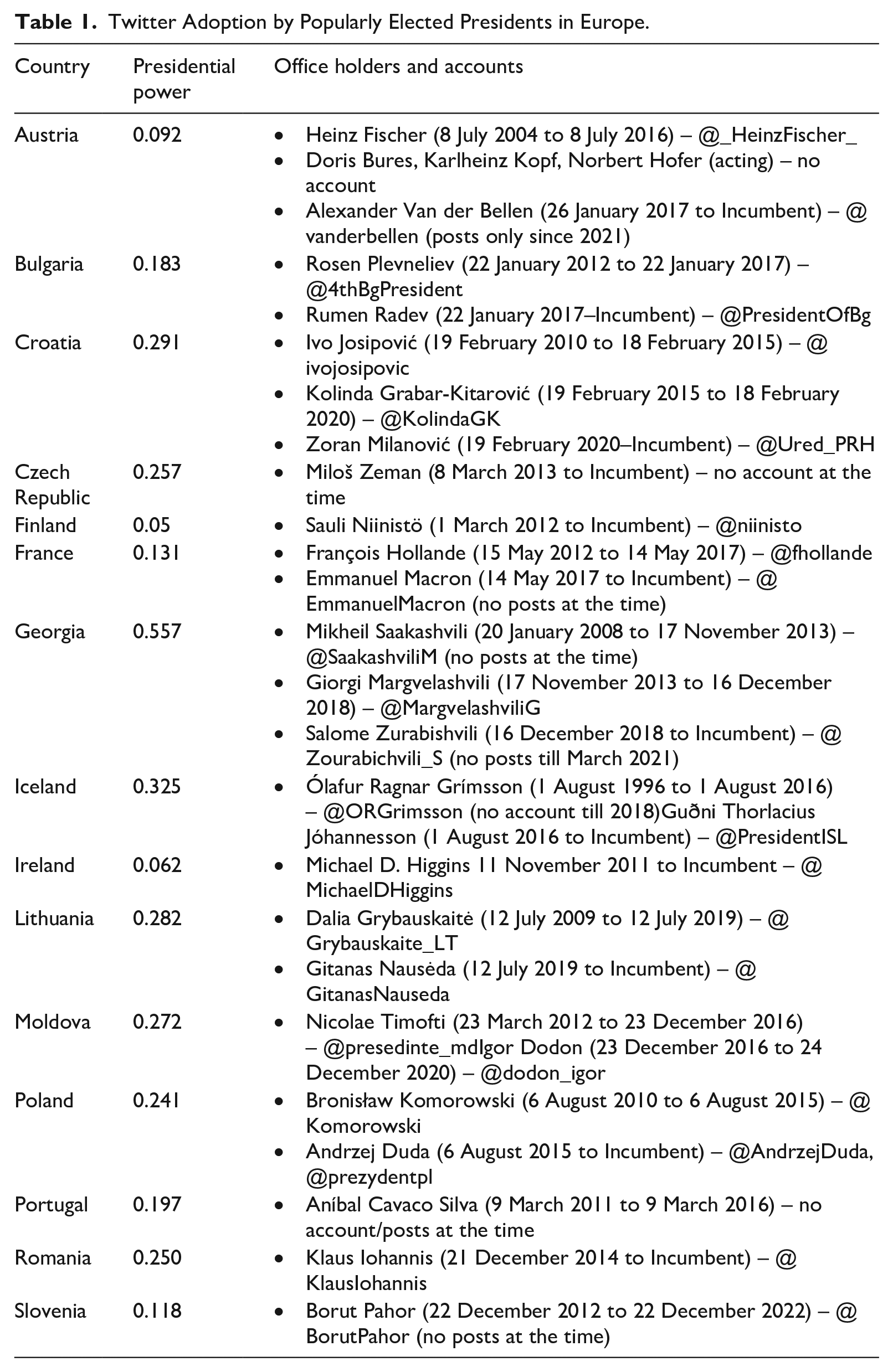
Our key explanatory variable is the level of social conflict. Given that we use monthly observations for our dependent variable, it is difficult to find an appropriate and equally fine-grained measure. We use the occurrence of a protest event (Clarke and Regan, 2016) as a proxy for social conflict and pressure here, yet are fully aware that this comes with certain limitations. We furthermore include a number of control variables, that is, particularly those that have been found to be important predictors of other forms of presidential activism (see above). However, given limited previous research and our assumption that presidential social media use is primarily driven by other factors, we remain agnostic as to their expected direction of effect. First, we control for the influence of presidents’ constitutional power. Where presidents have been granted a more prominent role in day-to-day politics, voters could reasonably be assumed to be more attentive and receptive to their message, which – in turn – could prompt greater and more frequent activism. At the same time, greater power may also go hand-in-hand with greater responsibilities and less time to engage in communication through social media. To test for the influence of presidential power and differences in presidents’ constitutional position (and resulting societal expectations/preoccupation with other matters), we rely on the prespow measure by Doyle and Elgie (2016). This presents a standardised measure of presidential power based on 28 different indices that include a wide range of indicators, making it a broad yet highly appropriate measure for our purposes.
Second, we include a dichotomous measure to capture cohabitation, defined as a situation where the presidents’ party is not part of the government or the president is non-partisan. Cohabitation has been shown to trigger and catalyse intra-executive conflict (see, for example, Protsyk, 2005; Sedelius and Mashtaler, 2013; Yan, 2021). Nevertheless, partisan or ideological conflicts between presidents and other actors are addressed through other channels. Thus, while it makes sense to control for cohabitation as part of our somewhat more exploratory analysis, it is unlikely that it affects presidents’ ‘going public’ strategies. Third, we control for the experience of a respective president as party leader, assuming he or she might have different informal channels within the party to make himself/herself heard. In addition, we also added the existence of a minority cabinet as a control variable, as the insecurity of this political arrangement might provide an incentive for the president ‘to go public’. Where adequate data were available, we furthermore control for the level of policy enforcement (proxied by the net approval rating of the government) and presidents’ net approval rating. Finally, we divide our sample into three geographical categories (north/west/east) to control for regional effect and president-fixed effects because the results could be driven by individual presidents and their personality traits as well as time-fixed effects (Table 2).
Summary Statistics.
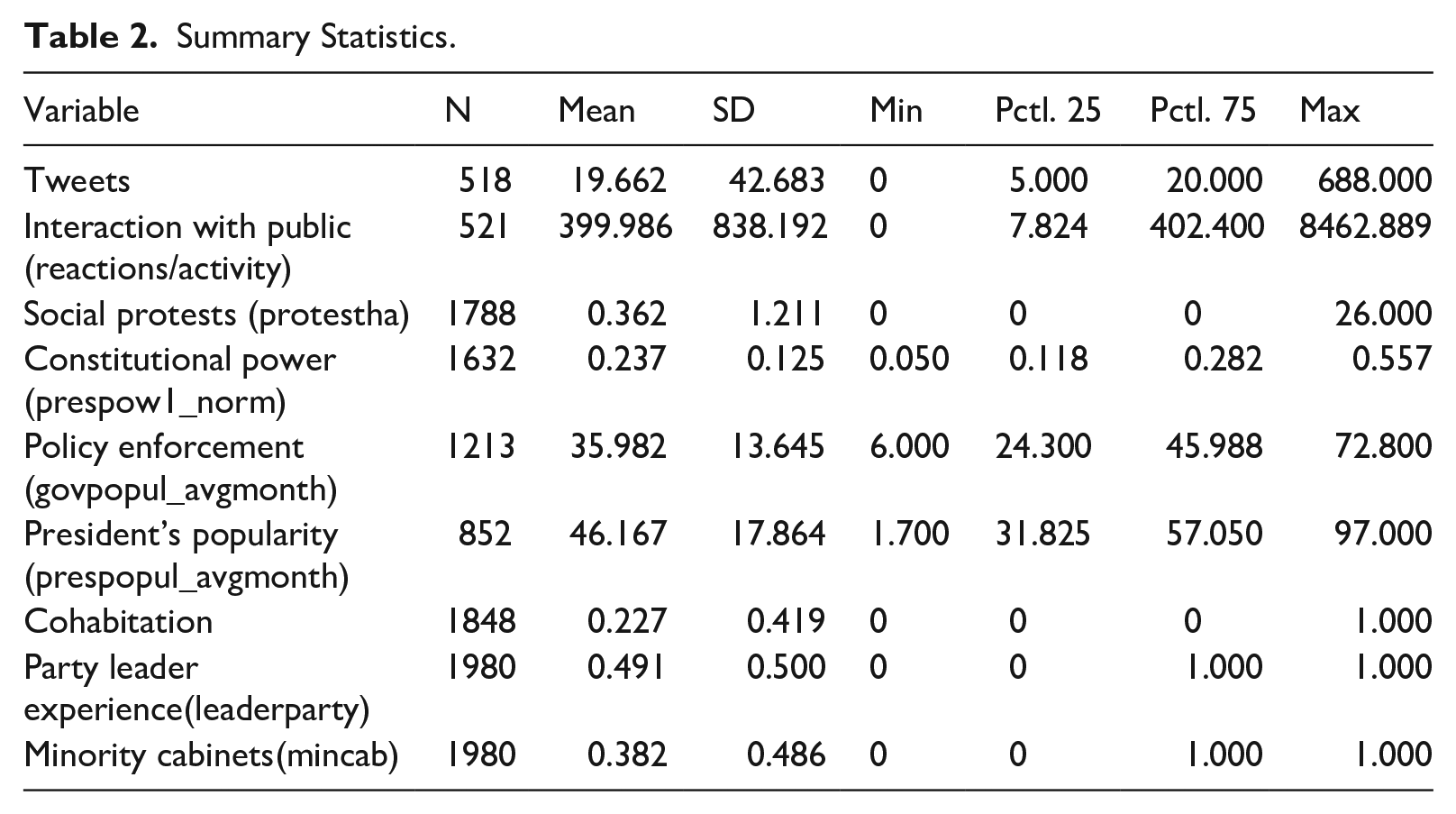
As detailed in the summary statistics the sample sizes (N) vary. This variation can be attributed to the specific characteristics of certain variables. This variation arises from various factors such as missing data (e.g. lack of tweets or likes due to the absence of an account during that period) or the periodic nature of variables like constitutional power (prespow1_norm), which have repeated values for certain time periods. Consequently, when conducting analyses, the software utilised listwise deletion, which involves removing entire rows (cases) from the dataset if they contain missing values in any variable. As a result, the sample size has been reduced, reflecting the elimination of cases with missing data.
Analysis
Most presidents in European semi-presidential democracies are now on Twitter (see Table 1). Nevertheless, they exhibit remarkable differences in their use of the platform in quantity, consistency, and content. Most notably, and very much in contrast to their counterparts in the Americas, European presidents only showed very limited activity on their personal accounts before 2015. Followership is also much more limited in comparison. Among the presidents in our sample, Emmanuel Macron stands out with just over 9 million followers – the second most followed president, Polish president Andrzej Duda, has only 1.8 million to show for. During the 2010–2020 period, the top contender for the most tweets published in a single month was former Polish President Bronislaw Komorowski (2010–2015) – his Twitter activity reached an all-time high in the 6 months before his ultimately unsuccessful re-election campaign 2015. His successor, incumbent Andrzej Duda (2015 to present), showed a similarly active presence, albeit less clearly aligned with the election cycle. However, followership is only partly related to activity on the platform and consistent activity is not restricted to any one country. The consistently most active Twitter users were – in addition to Komorowski and Duda–Sauli Niinistö (Finland), Klaus Iohannis (Romania), Nicolae Timofti (Moldova), Dalia Grybauskaitė (Lithuania), Giorgi Margvelashvili (Georgia), Rumen Radev and Rosen Plevneliev (Bulgaria), and Kolinda Grabar-Kitarović (Croatia).
Variation could also be seen in the content of tweets. Although not the primary focus of our analysis, we illustrate this here using word clouds of tweets by Bronisław Komorowski (Poland) and Sauli Niinistö (Finland; Figure 1(a) and (b)). Komorowski clearly focussed on domestic politics with terms such as Poland, work, and family appearing as frequently used key terms. Furthermore, most of his tweets relate to Poland as a free and democratic country that belongs to the Western world. Although the international arena is mentioned, domestic issues and interests occupy most of his tweets. In addition, the majority of content posted on his account is dedicated to the election campaign of 2015, including his campaign promises for the next term (e.g. pro-family policy, programmes for young people). In contrast, Niinistö’s tweets provide a much broader perspective as indicated by frequently used terms such as climate, change, and UNGA (United Nations General Assembly). As for content of tweets, Niinistö touches on a great variety of topics – most of them related closely to Finland’s foreign and security policy, meetings with presidents of other countries and organisations (e.g. the UN and its bodies), international sport, climate change and international conflicts.
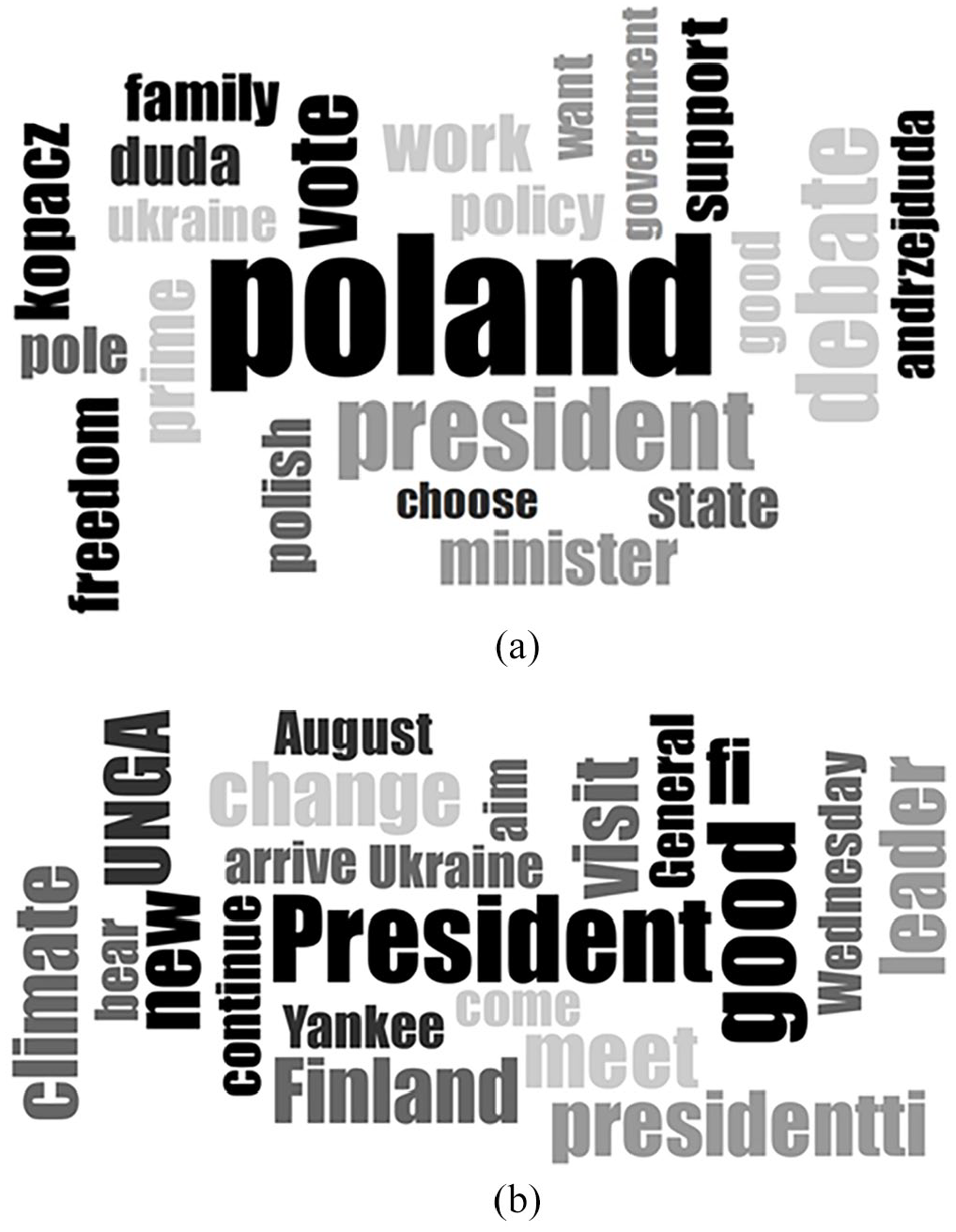
(a) Word Cloud of Tweets by Polish President Bronislaw Komorowski (2015–2020). (b) Word Cloud of Tweets by Finnish President Sauli Niinistö (2012–2020).
To test our hypotheses regarding the effect of social conflict on presidents’ choice to ‘go public’ on social media, we estimate several linear regression models using presidential activity on Twitter as our dependent variables. Thereby, we estimate the effects of our predictors on the level of presidential Twitter use both in terms of engagement with the public (DV 1) as well as direct outreach (DV 2). Given limited data availability for some of our control variables, we run separate models to maximise the use of our dataset. All correlations between any explanatory and control variables are well below the level at which multicollinearity would become problematic.
Our regression models of presidential engagement show a significant effect of our main variable of interest – social conflict, measured as the occurrence of social protests and demonstrations in a respective month. We had argued that social conflict would increase demand for presidents to ‘go public’ and actively use social media; and indeed, for every increase in the number of protest events, the score of engagement with presidential tweets is predicted to be higher by more than 300 units (i.e. likes on tweets). Hence, it appears that during periods of high social conflict, voters do look to the president for guidance. The positive effect of policy enforcement (proxied by monthly averages of the government’s popularity in the country) on the engagement with presidents’ tweets lends credence to this interpretation. Contrary to our expectations, we find no effect of social conflict on overall Twitter use, that is, the number of tweets, by presidents. This is surprising insofar as other studies of presidential activism have shown significant associations between economic factors and presidential activism. Nevertheless, this may also indicate that ‘going public’ is determined by yet another set of predictors (Table 3).
Regression Models of Presidential Twitter Use in European Democracies.
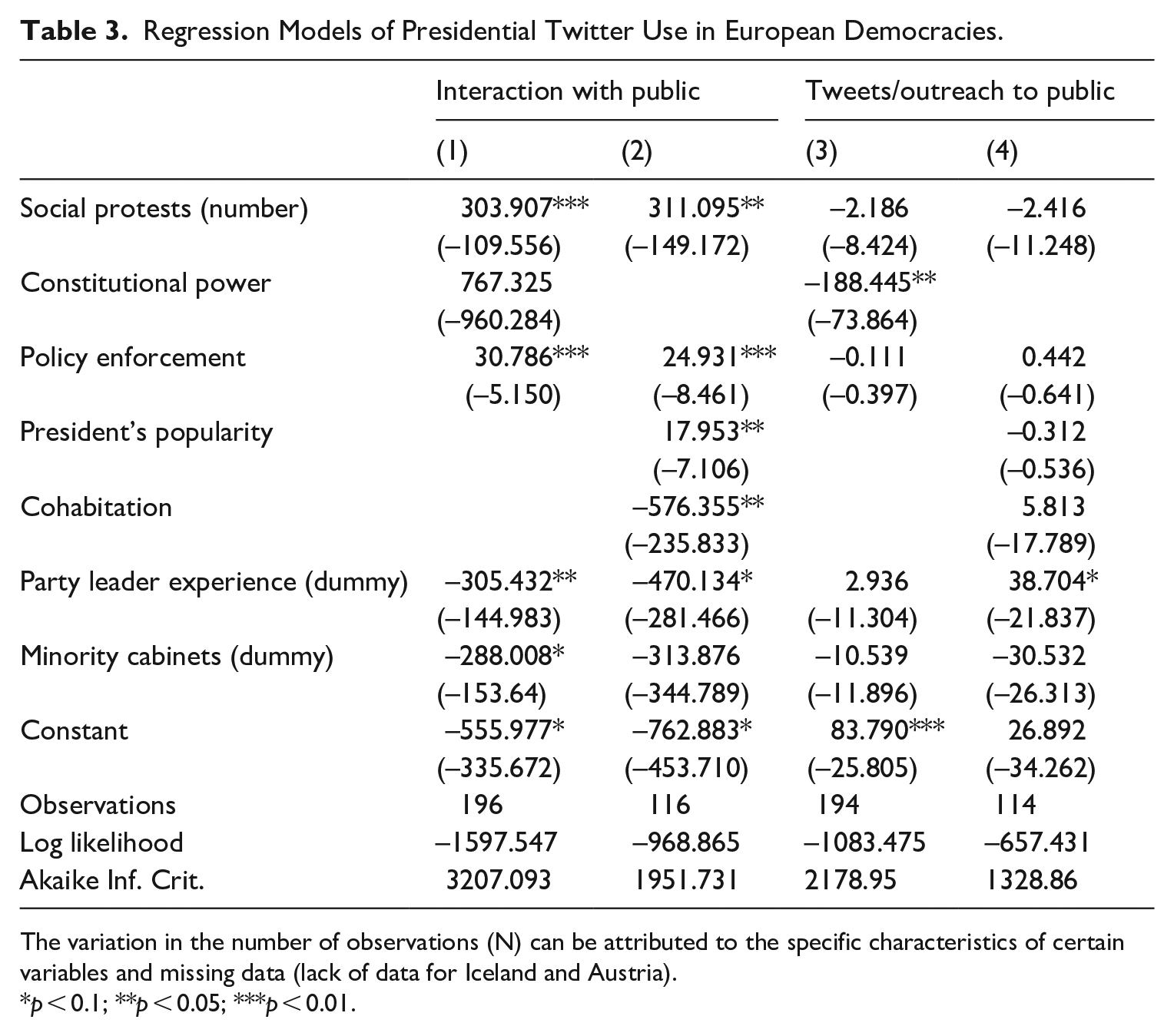
The variation in the number of observations (N) can be attributed to the specific characteristics of certain variables and missing data (lack of data for Iceland and Austria).
p < 0.1; **p < 0.05; ***p < 0.01.
Among our control variables, presidents’ constitutional power as measured by Doyle and Elgie’s (2016) prespow measure emerges as a significant predictor of the number of tweets per month. Less powerful presidents post, on average, more tweets than their more powerful counterparts. As we indicated earlier, this may be due to the fact that greater power is associated with a greater number of responsibilities that restricts time, and maybe necessity, for (personal) Twitter use. While more powers could theoretically also provide for greater opportunity to ‘go public’, more powerful presidents may also enjoy greater media attention and do not necessarily benefit from the (additional) use of social media. Notably, public attention to tweets appears to be unrelated to presidents’ constitutional power. Finally, we conduct several tests to determine whether our main explanatory and control variables have a different effect depending on the region, the time and whether individual presidential behaviour might drive the overall result. We see that individual presidents certainly have a higher tendency to tweet under certain conditions. Presidents-fixed effects capture any unobserved characteristics specific to each president that may influence tweet behaviour but remain constant over time. In other words, they control for the unique tweeting styles or tendencies of each president. The significant coefficient suggests that there are indeed systematic differences in tweet behaviour across presidents, in particular for Bronislaw Komorowski and Michael D Higgins. Similarly, time-fixed effects allow us to control for any time-varying factors that may influence tweet behaviour across all presidents and after accounting for differences across presidents. We see that most coefficients for number of tweets are positive and significant to the reference period and this indicates an increase in tweet activity across all presidents. Due to the natural increase of social media use over time, we do not find this particularly surprising.
What is important is that some control variables show how different their effect is when we account for differences between individual presidents. Similar to the standard regression, we see that social conflict has an equally strong impact on engagement but no influence on the number of tweets. It would be reasonable to assume that while social conflict can influence the content and engagement of tweets, the total number of tweets per month remain unaffected due to pre-existing high levels of activity, strategic communication approaches, and the multifaceted nature of how information is disseminated during such times. The impact of the experience of the president as party leader or the existence of minority government is no longer strongly significant. The experience as a party leader has a positive effect on their engagement but not on public outreach (Table 4). One could assume that as a head of the party, a president was used to frequently interact with party members, retweeting their posts, responding to their queries, and acknowledging their contributions. However, a minority cabinet often means that the government needs to negotiate and communicate more frequently to garner support from other parties but also the increased need to manage public perception. This might lead to more frequent updates and statements on Twitter. The differences between impact of social conflict on engagement compared to that of more ‘traditional’ institutionalist variables on the number of tweets highlight the complexity of social media dynamics, where the quality and focus of communication might change more noticeably than the quantity. We assume that this is primarily based on a strategic decision on how to communicate during these times of high tension. One could assume that during those times, communication is more tightly controlled and discussed, focussing on less, yet well-crafted, messages. In addition, it might be a strategy to not engage to not increase possible tension.
Regression Models with President-Fixed Effects and Time-Fixed Effects.
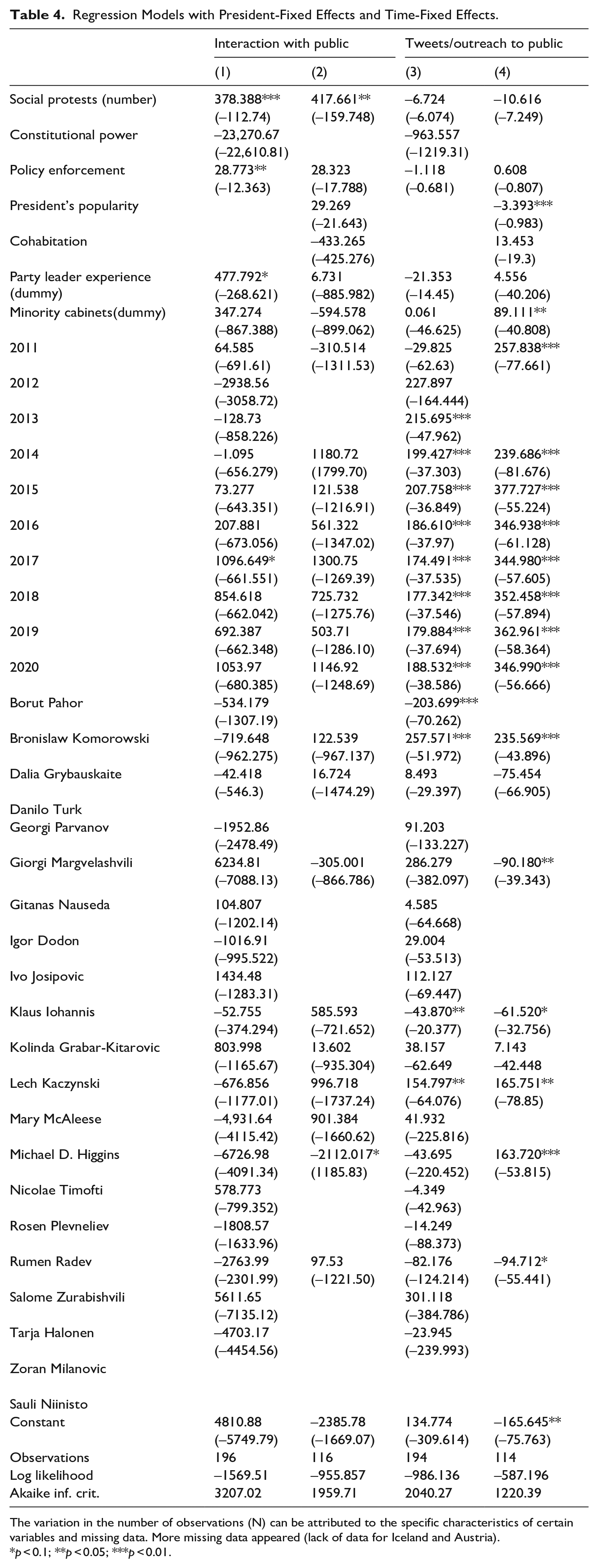
The variation in the number of observations (N) can be attributed to the specific characteristics of certain variables and missing data. More missing data appeared (lack of data for Iceland and Austria).
p < 0.1; **p < 0.05; ***p < 0.01.
Discussion and Conclusion
Social media accounts now belong to the arsenal of nearly every elected head of state. Until now, we know too little about how presidents use these tools to ‘go public’ – particularly from a comparative perspective. In this article, we have sought to address this lacuna in research by studying the Twitter use of presidents in European semi-presidential democracies from 2010 to 2020. Previous research has primarily focussed on presidential regimes and not sought to link their analyses to extant research on presidential activism. We have argued that presidential Twitter use presents a form of ‘going public’ that should be conceptualised as a form of ‘informal public activism’. Rather than responding to the same opportunity structure as the use of formal powers, we posited that ‘going public’ under semi-presidentialism should primarily address societal concerns and, therefore, be driven by contextual factors outside the core realm of party politics. In our analyses, we tested this argument using a novel dataset of Twitter use by 15 European presidents. Our key explanatory variable, social conflict (operationalised as the occurrence of protest events and demonstrations) showed a significant association with the level of engagement with presidents’ Twitter account during times of social turmoil, presidents are indeed the identification figures we assumed them to be based on our theoretical framework. Furthermore, presidential power as one of our key control variables was negatively associated with presidential Twitter use, potentially indicating that more powerful presidents do not require the (additional) clout of social media.
Still, presidential ‘going public’ strategies in non-presidential systems and comparative research on the use of social media by heads of state and governments present a largely under-researched field of inquiry. In this context, the results of our analysis – even if contrary to our expectations – have important implications for future research. In particular, the results underline our argument that presidents’ use of social media as a means of ‘going public’ is not only conceptually but also empirically different from the use of other (constitutional) powers. Yet, cohabitation – a central variable in studies of semi-presidentialism – provides a statistically significant coefficient estimate in our models. Hence, future research should pursue this line of argument and identify other factors beyond the realm of day-to-day political quarrels that have the potential to be predictors of presidential Twitter use. A further line of inquiry could focus on the social media activity of other actors (e.g. governments, prime ministers, MPs) relative to the president in order to establish a clearer context of presidential ‘going public’ strategies in particular countries or time periods. Finally, Twitter as the most common form of social media adopted by elected heads of state offers a number of methodological advantages over others. Nevertheless, it remains to be seen whether recent changes to the platform and emerging rivals change how presidents ‘go public’ in their tweets. We also would like to acknowledge that our data are limited to a certain extent and we face several endogeneity issues. Some of the political events could simultaneously affect social conflict and social media activity and the models could also suffer from some omitted variables. Nevertheless, our findings provide important starting points for further inquiry. Future research should, therefore, extend its comparative dimension not only to different types of political systems as we have done in this article, but also consider differences and similarities across various (social) media platforms.
Footnotes
Acknowledgements
The authors thank Tapio Raunio, Thomas Sedelius and the participants of the 2022 Workshop on Presidential Activism, hosted by the University of Tampere, Finland, for their comments on a previous version of the paper. The authors also thank the insightful recommendations made by the two anonymous reviewers.
Declaration of conflicting interests
The author(s) declared no potential conflicts of interest with respect to the research, authorship, and/or publication of this article.
Funding
The author(s) received no financial support for the research, authorship, and/or publication of this article.
