



Abstract
Presidents can use public speeches for a variety of purposes from rallying support for their initiatives to attacking their opponents or building societal consensus. Contrary to general expectations regarding dual executive systems, this article suggests that presidents in semi-presidential regimes can benefit politically and in terms of popularity from ‘statespersonlike’ behaviour, and thus, they should generally refrain from negative and contentious statements. Examining the tone and content of formal speeches and informal messages of Finnish and French presidents from 2000 to 2020, the study shows that under varying constitutional frameworks and general practical expectations, the presidents in both countries by and large employ a ‘statespersonlike’ style in their speeches. Presidential speeches primarily express a positive tone, and they contain few references to other state institutions and economy and other governmental domains. Instead, presidents typically seek to portray themselves as guardians of national interest, with foreign policy and national unity emphasized in the speeches.
Introduction
Presidential speeches range from official addresses to the public, diplomats and foreign leaders to more informal speeches, interviews and press releases. For presidents, speeches and interviews are often ‘part of the job’, but at the same time there is no such thing as an unimportant speech: media coverage is guaranteed, and therefore presidents must always pay attention to what they say. Simultaneously, the broad exposure offers presidents a powerful lever for exerting political pressure and influence, making speeches important parts of the presidential ‘toolbox’ and a central topic of inquiry in all political regimes that include a directly elected president.
In semi-presidential regimes there is ‘both a directly elected fixed-term president and a prime minister and cabinet who are collectively responsible to the legislature’ (Elgie, 2011: 3). It is the most common regime type in Europe, with over 20 European countries having semi-presidential constitutions (Anckar, 2022). These include ‘western’ countries such as France, Portugal, Finland and Iceland, and the regime type is particularly common among the post-communist Central and Eastern European countries that became democratic after the fall of the Soviet Union. Research on semi-presidentialism has made great strides forward ever since the concept was originally coined by Duverger (1980). It has typically approached semi-presidentialism as a conflict-prone regime type, and scholars have devoted considerable space to uncovering factors that shape intra-executive relations from constitutional powers to party politics and various contextual variables (Åberg and Sedelius, 2020; Elgie, 2016).
Constitutionally often weaker but more popular than the prime ministers, presidents in semi-presidential regimes can use speeches for raising their own profile, addressing their favourite themes, or for questioning the competence of the government. Scholarly knowledge of presidential speeches in semi-presidential systems is very limited, as previously presidents’ ‘going public’ strategies have mainly been studied in the United States and in Latin American countries (Eshbaugh-Soha, 2016; Kernell, 2007). However, the literature on the post-communist semi-presidential countries does provide plenty of examples of presidents utilizing such ‘going public’ strategies for attacking the prime minister. For example, in Lithuania presidents have on several occasions used televised speeches for discrediting the prime minister or other senior politicians (e.g. Pukelis and Jastramskis, 2021; Raunio and Sedelius, 2020).
However, especially in more stable semi-presidential countries presidents can lean more towards ‘statespersonship’, avoiding divisive messages while guiding the nation towards a better future. This tradition is connected to the Bayeux speech delivered by Charles De Gaulle in 1946. In his speech De Gaulle, who later became the French president, outlined his vision for a strong executive invested in the presidency standing above the parties and safeguarding national unity. Here, presidents represent the entire country while parliaments and governments are fragmented, and political parties defend the interests of their specific electorates. In the ‘statesperson’ tradition, it is thus part of the president’s job to focus on uniting the nation and avoiding divisive messages. Presidents are, after all, heads of state and not heads of government. Statespersonship is particularly linked to foreign and security policy, where it broadly speaking denotes successful defence of national interests and conduct of foreign affairs while upholding national cohesion or unity. As defined by Beardsworth (2017: 114): The statesperson upholds first the ‘common good’ of the state by not allowing any one particular interest to dominate it internally. Political philosophy and political theory have always been clear, from Plato and Aristotle onwards, that statecraft requires such balancing of interests within the state so that it remains a polity for all its citizens. Good states persons are those who achieve that balance.
This study contributes to the literature through emphasizing ‘statespersonlike’ presidential behaviour. This is important given the dominance of the ‘conflict narrative’ in the study of semi-presidentialism. It therefore moves the debate forward through offering a more nuanced or even alternative view of how presidents operate. More precisely, our basic premise that we elaborate below is that in more consolidated democracies where the rights and obligations of political actors are well defined and respected presidents can benefit, both in terms of popularity and policy influence, from cautious or uplifting terminology and avoidance of public conflict with the government. Studying presidential speeches in semi-presidential countries from this perspective offers an important, a more general and balanced understanding of presidential behaviour and strategies, as previous research has very much focused on intra-executive conflicts.
We test our argument through analysing a wide range of public speeches and messages delivered by Finnish and French presidents between 2000 and 2020. Our main research question is, does the content and the tone of presidential speeches and messages reflect more confrontational or ‘statespersonlike’ behaviour of the presidents in semi-presidential regimes? The rationale for our case selection is twofold. First, we acknowledge and address the potential impact of varying presidential powers that is typical for semi-presidential regimes by analysing cases where president’s formal and political role clearly varies. In France the president is the de jure and de facto chief executive, while in Finland the period of constitutional reform, culminating in the new constitution that entered into force in 2000, reduced presidential powers, so that the government is responsible for domestic and European Union (EU) policies, while foreign policy is co-directed between the president and the government. Given these differences in formal powers and practical expectations, similar findings in both countries would support our central argument about the pre-eminence of presidents’ ‘statespersonlike’ behaviour. Second, our case selection that only focuses on advanced, consolidated, and stable regimes also controls for variation stemming from countries’ socio-economic development and institutional stability. An additional reason for case selection is that the websites and online archives of the Finnish and French presidents enabled us to compile reliable and comparable data for our analysis.
Our data set covers both formal speeches and more informal messages. The extensive corpus of 3472 presidential speeches includes more speeches and a more diverse range of speech categories compared with earlier studies on speeches of European presidents. The reason for our extensive coverage has to do with the ubiquitous nature of modern presidency, where leaders have multiple avenues for reaching out to the public and making their opinions known (Scacco and Coe, 2021). Methodologically, we employ both sentiment and thematic analysis to cover our two dependent variables: tone and content. Sentiment analysis allows us to investigate positive and negative tones in presidential speeches. It is a dictionary-based method invented for analysing emotions in different texts, suitable for political speeches as well. In terms of thematic analysis, we pay specific attention to four different themes in presidential speeches: appeals to national unity and references to economic policy, political institutions and foreign affairs. Relying on dictionaries designed for these thematic categories, we aim to capture presidents’ intentions towards key policy areas and the nation as a whole. The approach is novel and represents a robust way of analysing the content of presidents’ speeches and messages.
The next section briefly provides contextual information about our cases, to further justify our case selection. In the theoretical section, we discuss presidential incentives for making public statements and formulate two general hypotheses guiding our analysis. After that we explain our data and methods. The empirical section presents our main findings, which underline the ‘statespersonlike’ conduct of both Finnish and French presidents. The concluding section returns to our main theoretical argument and discusses the multiple functions of presidential speeches.
Case Selection
We compare presidential speeches in two stable and affluent semi-presidential democracies, Finland and France. Classifying semi-presidential systems in terms of presidential powers, Duverger (1980) ranked both countries to the top of his list, but since then the presidencies in Finland and France have evolved in opposite directions. This development provides the rationale for our case selection.
Following the country’s pragmatist tradition that builds on its geopolitical and economical ‘realities’, in 1919 the interests of the combating parties of the Finnish civil war (1918) were fitted into a new constitution that established a semi-presidential regime where the strong (presumably left-leaning) parliament was to be monitored by a strong (presumably right-leaning) president. The president’s significant formal powers included the right to appoint governments and dissolve the parliament, a suspensive veto, extensive decree rights, and leading foreign and security policy, but until the Second World War the president’s role was nonetheless rather limited. After the war, President Urho Kekkonen (1956–1981) used his personal ties to the Soviet Union and role as the guarantor of Finland’s neutrality to extend presidential dominance over domestic politics that suffered from a strongly polarized and fragmented party system.
In the early 1980s, the exit of Kekkonen and de-polarization of inter-party relations begun to pave way for a more parliamentary practice. The process began during President Mauno Koivisto’s term (1982–1994), and a new constitution, based on a broad consensus among the political elite, entered into force in 2000. Since 1994 presidents have been directly elected (until then the election was carried out by an electoral college chosen by voters), and in the early 1990s, also term limits were imposed so that the president can serve two consecutive 6-year terms. Under the new constitution, the president co-directs foreign policy with the government and is the commander-in-chief of the defence forces, but the government bears all formal rights to direct domestic and EU policies. Notwithstanding a few public quarrels over jurisdictional issues, mainly related to EU policymaking, the presidency adapted rapidly to the government-driven and consensual system of governance. Still, presidents have also enjoyed much higher popularity ratings than ‘party politicians’ (Arter, 1999; Arter and Widfeldt, 2010; Hallberg et al., 2009; Karvonen et al., 2016; Raunio and Sedelius, 2020).
In France, President De Gaulle established the president-centred Fifth Republic in 1958 to overcome the governing problems of the parliament- and party-driven Fourth Republic. Duverger (1980) ranked France second in president’s constitutional powers (after Finland) and first in president’s de facto powers. Subsequent measures of presidential constitutional powers gave the countries almost an equal ranking, placing France a little above Finland (Metcalf, 2000; Roper, 2002; Siaroff, 2003). According to the most recent measures, which also consider constitutional changes enacted after the turn of the millennium, the French presidency is now clearly stronger than the Finnish one (Doyle and Elgie, 2016).
In France the president enjoys significant formal powers that extend to domestic politics including the capacity to dissolve the lower house of the legislature, chair cabinet meetings, and enact governmental ordinances and constitutional review, and the president is also the guarantor of territorial integrity and the commander-in-chief of the army. President’s capacity to use these powers depended on whether the president governed with a prime minister of the same party, or a different party (a situation termed as ‘cohabitation’). However, while cohabitations occurred frequently, the system has predominantly operated without major impasse. Early 2000s brought two significant revisions. First, presidential term was shortened from 7 to 5 years to parallel the length of legislative term, and the schedules of presidential and parliamentary elections were aligned so that the latter take place right after the former. Since then, no cohabitations have occurred. In 2008, the president’s powers relative to government were further strengthened, with the constitutional amendments also stipulating that the president can only serve two consecutive terms. The president has also been empowered informally by his strong public appeal (Cole, 2017; Guinaudeau and Persico, 2021; Lazardeux, 2015).
Overall, in both countries certain customs, conventions and practices have evolved over the decades, and presidential influence cannot be simply gleaned from de jure formal powers. Yet, during our period of analysis, the first two decades of the twenty-first century, the Finnish and the French presidencies have developed in different directions. The Finnish president operates in the shadow of the government, while the French counterpart has arguably become even more powerful due to constitutional amendments and the re-scheduling of the electoral calendar whereby the presidents have ruled with the support of friendly parliamentary majorities. Naturally, even contemporary Finnish and French presidencies are not entirely different, of course. In both countries, presidents lead foreign policies, and they are markedly associated especially with issues of national sovereignty and security.
Theorizing Presidential Speeches in Semi-Presidential Regimes
Existing research on semi-presidential regimes has emphasized president’s proactive and assertive role resulting in intra-executive conflicts. Here, we argue why, both in terms of popularity and policy influence, the head of state is incentivized to use ‘statespersonlike’ terminology and style. The theoretical framework focuses on stable semi-presidential regimes and elaborates why it should be beneficial for the presidents to avoid conflicts and discuss how this non-confrontational approach should manifest itself in the content and tone of the speeches of Finnish and French presidents. As a result, the theoretical discussion leaves out the potential impact of various party-political factors, not least cohabitation, that have been linked with intra-executive conflicts.
The great majority of research on presidential speeches has dealt with presidential regimes, where presidents can use public speeches for winning public support for their initiatives, support which can be crucial in swinging the mood in the legislature (Kernell, 2007). However, even in presidential systems it might not be a wise strategy for the president to attack electoral competitors all the time, as such behaviour might lead to problems in other arenas, resulting, for example, in legislative or budgetary deadlocks. Aggressive vocabulary might backfire also in terms of presidential popularity, as presidents would thereby probably alienate large sections of the electorate – including those citizens located towards the political centre. In line with our ‘statespersonlike’ behaviour argument, too harsh language and critique of the opponents could be seen as ‘unstatespersonlike’ conduct not appropriate for the head of state that are expected to unite, not divide, countries. This expectation has received some empirical support. For example, presidential addresses in the United States have become part of the ‘permanent campaign’ and contain more references to the people and national unity (e.g. Coe, 2017; Eshbaugh-Soha, 2006; Hoffman and Howard, 2006; Lim, 2002; Teten, 2003). Overall, even in full presidential systems where presidents hold absolute executive power and are expected to drive policymaking they can be incentivized towards less contentious and more cooperative behaviour.
In most semi-presidential countries, the constitutional prerogatives of the president are substantially weaker than those of the government, but the presidents are also typically more popular, and thus theorizing presidential behaviour typically rests on this premise (Åberg and Sedelius, 2020). The central intuition here is that the president is incentivized to compensate her or his weakness through alternative routes such as publicity (Raunio and Sedelius, 2020). Usually, presidents lead or at least have representative functions in foreign and security policy, but the government is responsible for domestic matters and initiatives, with the president’s formal powers often limited to potential conditional veto power in legislation. How this ‘underdog’ situation impacts speeches is not self-evident. In countries characterized by political instability, the president might use the public podium for unleashing explicit attacks on political opponents, particularly under cohabitation and when the popularity of the government is low, for creating pressure to advance her or his political initiatives or to bolster her or his popularity. Such dynamic found support in a rare empirical study. In his topic model analysis of Slovak presidents’ speeches, Ovádek (2021) showed that the Slovak presidents essentially conformed with the ‘popular tribune’ model, where presidents use the speeches for mobilizing the public against the government.
However, while presidents may well benefit from such a confrontational approach in less stable regimes where political gains are won through ad hoc battles, we argue that the logic is different especially in more consolidated and stable semi-presidential countries where institutionalized procedures exist for regulating intra-executive relations (Raunio and Sedelius, 2020). Under such conditions, both in terms of popularity and policy influence presidents as heads of state should benefit from avoiding divisive language and staying above party-political disputes. Not only are presidents expected to represent the entire nation, but they are also expected not to exacerbate any existing cleavages among the political elite. Because of this mediating role, presidents are incentivized to repress bad feelings towards opponents in public. Presidents are naturally expected to comment on topical matters, especially in interviews, but even then, cautiousness and optimistic tone would be more in line with ‘statespersonlike’ leadership. In addition to cultural norms, public criticism of the government could also be limited by president’s desire to uphold influence in intra-executive decision-making, which essentially rests on ongoing and often also formalized cooperation with the government. In typical situations, that is, where presidency is the weaker executive office like in Finland, president’s confrontational public strategy easily frustrates the government that can ‘pay back’ by limiting president’s role in the dual executive’s internal policy processes. Even in president-centred stable semi-presidential systems like France presidents have good political reasons to avoid antagonizing governments publicly. Besides being the responsible for the executive’s overall performance, presidents’ vast powers over government formation and survival increase the probability that the president governs with a ‘friendly’ cabinet.
The few studies on presidents’ public behaviour in semi-presidential democracies support this line of thinking. For example, in Baltic countries particularly recent officeholders have evoked the national spirit and a common political past and future, ‘denoting the unity of people and the state repeatedly throughout the speeches’ (Romāne-Kalniņa, 2022: 206). Labbé and Savoy (2021: 161) in turn report an increasing use of we-pronoun by French presidents while showing that they employ the I-words (I, me, mine) more often than U.S. presidents. The latter, however, use we-words (we, us, ours) four times more frequently, striving to establish a dialogue with the public opinion. Between the French presidents, Macron exhibits a clear increase in the use of we-words, but his density is still three times lower than Trump’s usage.
Of course, here lies the possibility that such ’statespersonlike’ style only applies to formal speeches. To control this potential bias, we also analyse informal messages of the presidents.
For these reasons we believe that in stable semi-presidential regimes presidents do not generally criticize the government publicly. Should they do so, it would probably harm their ‘statesperson’ status and/or result in loss of trust between the two executives that would in turn impact negatively on the president’s behind-the-scenes influence and/or general leadership role. In stable semi-presidential regimes intra-executive coordination is typically well-established, but public feuds could impact even most institutionalized forms of interaction. In terms of popularity, divisive and aggressive terminology might also alienate voters. Moreover, policy influence and popularity are related: especially when the constitutional powers of the president are limited, low popularity would only undermine her or his already weak bargaining position.
Overall, we expect that in both countries studied, presidents predominantly behave like ‘statespersons’, meaning that their addresses mainly concern issues that are neutral in party-political terms and positive in tone. We perceive a negative tone to reflect president’s criticism of the government or concern with the ‘state of the affairs’, even when the president does not directly refer to any politician or institutions such as the parliament or the government. A positive tone is instead interpreted as reflecting the presidents’ mediating function as the head of state and is associated with the president instilling hope in the nation, especially during hard times. This leads to our first hypothesis:
H1: The overall tone of presidential speeches and messages is more positive than negative.
Regarding the thematic categories, appeals to national unity relate directly to the role of the president as the head of state, with presidents emphasizing societal cohesion, at the level of both the public and the elites. Foreign policy category is included because the share of speeches not devoted to foreign affairs suggests the amount of space presidents give to domestic policies – areas that either belong to the competence of the government (Finland) or where the president shares power with the government (France). Direct references to economy, in turn, indicate presidential intervention in a key area of domestic policy. The category of political institutions is included because any reference to other domestic institutions, particularly the government and key ministers, indicates that the president in some way – either negatively, neutrally or positively – comments on the work of these actors. Combined, the breadth of speech types and measures further increases the robustness of our findings and, significantly, makes it possible to establish whether the tone and content of public presidential statements in general differs across stable semi-presidential regimes. This leads to our second hypothesis:
H2: Presidential speeches and messages predominantly reflect general and non-confrontational themes (foreign policy, national unity).
As explained in the previous section, our two cases differ in terms of constitutional framework and political custom. In France the president is the chief executive, while in Finland the formal presidential prerogatives and president’s de facto leader role are considerably more limited. Thus, we reason that similar findings in both countries underline the explanatory weight of the ‘statespersonlike’ behaviour argument. At the same time, within that overall framework of positivity and (party-political) neutrality, we recognize that the tone and content of the speeches may vary to some extent between different speech types and depending on situational changes in the political environment. To account for these factors we include in our analysis various control variables.
Methods and Data
Our analysis of the presidential speeches consists of several phases. We first use a dictionary-based approach to produce our dependent variables. We employ sentiment analysis to capture the general tone of the speeches and thematic analysis with four thematic dictionaries to analyse the content of the speeches. We also combine these measures to capture the tone of the content in each thematic category. To combine analytical depth and robustness, we move from descriptive figures and mean comparisons to ordinary least squares (OLS) regression that assesses country differences by controlling for the effects of different situational contextual factors. We compare Finnish and French presidents’ formal speeches and informal messages without concentrating on variation between individual officeholders.
Before moving to the description of the methodology, we introduce the corpus and the dictionaries for sentiment and thematic analysis. For the purposes of this study, we collected a large corpus of Finnish and French presidents’ formal speeches and informal messages in original languages given between years 2000 and 2020. All speeches were collected from presidents’ official and archived websites. The corpus contains altogether 3472 speeches – 949 from Finland and 2523 from France (Table 1). The length of the speeches varies from around 30 (e.g. brief statements) to over 16,000 words (e.g. long diplomacy speeches). The corpus includes presidents’ New Year’s addresses, speeches during visits abroad, diplomacy speeches to international guests, statements, interviews and other speeches. 1 We treat the first three as formal speeches and the other three as informal messages. To mention some examples, speeches during visits abroad include all official addresses during state visits, working visits and other formal occasions such as the United Nations General Assembly or security conferences. Diplomatic speeches to international guests include all speeches at the ‘home ground’, for example, during other countries’ delegates’ official visits. Interviews can be any interviews by the media published on the presidential website and statements are mostly press releases, for example, about topical matters. Finally, other speeches include all other speeches and messages given in various unofficial domestic occasions from local events and ceremonies to meetings with interest groups. Since we rely on presidential websites, we do not include, for example, presidents’ tweets or comments in the media in the corpus. While such additional sources are certainly relevant, we believe that if presidents want to get their message across, they will probably use other channels too, and not just, for example, Twitter. We acknowledge that particularly the official speeches in both countries may have been drafted by presidential office staff but believe that they capture presidents’ intentions as presidents approve the speeches and are obviously held responsible for them.
Summary of the Corpus.
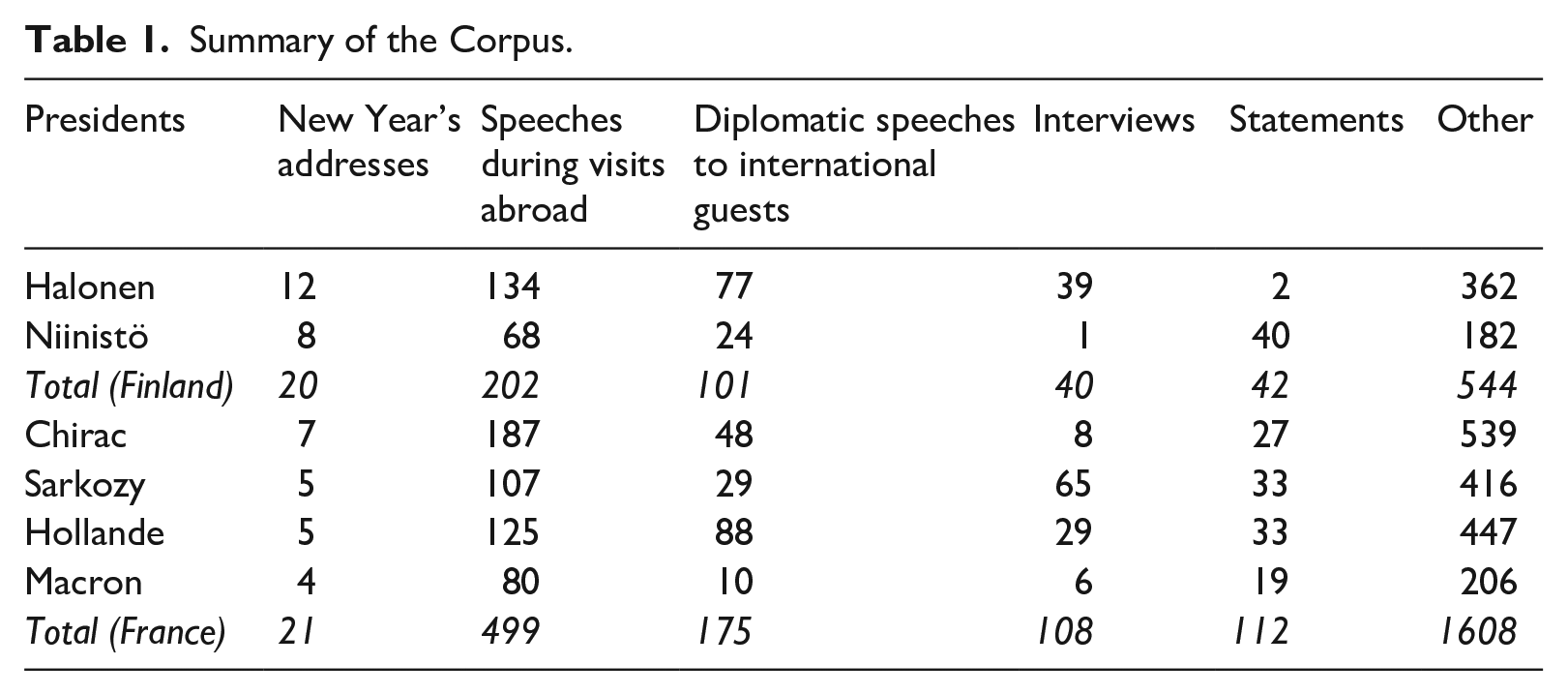
All preparations of the corpus were carried out with the Quantitative Analysis of Textual Data (Quanteda) package in RStudio. First, all speeches from the corpus were tokenized into separate words. After that all special characters, including numbers, symbols, punctuations, and separators, as well as all common stop words were removed from the texts. The tokenized speeches were used for both the thematic and sentiment analysis.
For the sentiment analysis, we rely on the Lexicoder Sentiment Dictionary (LSD) by Young and Soroka (2012). There are various dictionaries with lists of positive and negative words, as well as specific emotions such as anger and fear, yet we use the LSD since it is primarily intended for analysing political texts. In their study of automatic coding of sentiment in political news, Young and Soroka (2012) found that the LSD performed better than other dictionaries when compared with results by human coders. The original English language LSD contains 1709 positive and 2858 negative words, of which we use the automatically translated versions by Proksch et al. (2019). Of course, another option would have been to translate the full corpus of speeches and use the original English-language dictionary, yet according to Proksch et al. (2019), the translated LSD dictionaries should work rather well even when compared with hand-coded results. For robustness, we tested the original English language LSD on five randomly picked Finnish presidents’ speeches translated into English 2 and compared the results with the automatically translated dictionaries and the original-language speeches. The shares of positive and negative sentiments changed slightly yet the general direction in terms of positivity versus negativity in each speech remained the same.
For the thematic analysis, we utilize four categories: foreign policy, economy, political institutions, and national unity. The words referring to the thematic categories were selected by the authors. The lists of words referring to each category were formed in Finnish and then translated to French. The lists include only words the authors believe are essential in each category, and words that would likely be used in multiple policy areas were not included. For example, ‘crisis’ was left out from the foreign policy dictionary since it could appear in many other contexts as well. In addition, we did not include words that are likely more common in Finnish discourse compared with French and vice versa. The number of words per category varies from 23 to 90. Examples of the words are presented in Table 2.
Thematic Dictionaries with Examples.
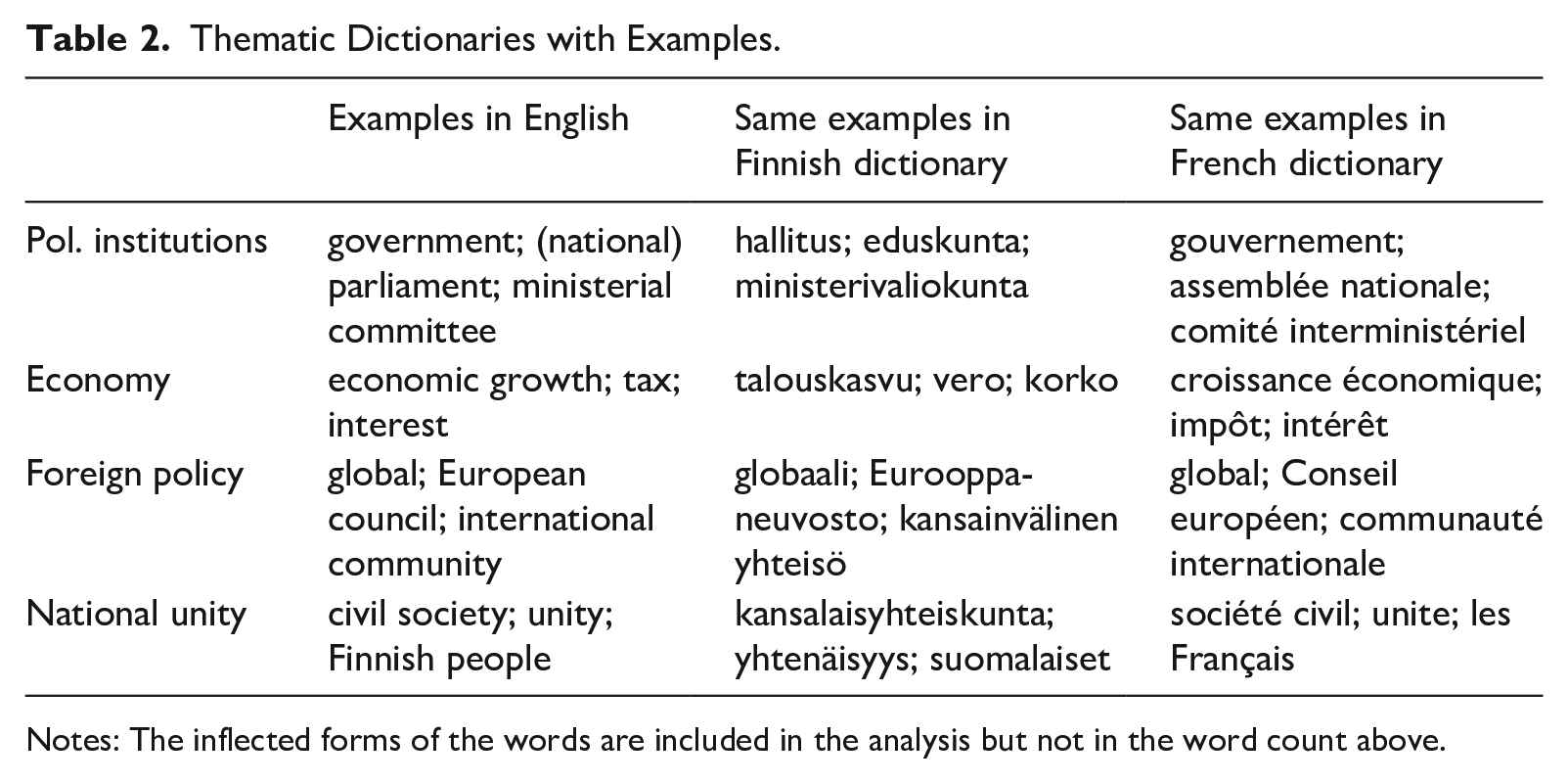
Notes: The inflected forms of the words are included in the analysis but not in the word count above.
The thematic analysis seeks to identify the level of references in different categories by matching the tokenized corpus speeches with the thematic dictionaries. By doing this, we get reference scores for each individual speech. This approach differs from topic modelling, a common tool for text analysis, as instead of grouping the speeches into different topics, we focus on more specific dictionaries that should represent presidents’ intentions towards key policy areas or the nation as a whole. This is also the reason why we do not include all possible words related to the predefined categories. The length of each speech might slightly affect the comparison as the calculation method (number of references/all words) treats all speeches the same, and we cannot, for example, weight the speeches by their length since different speeches have different purposes and both short and long messages can be equally relevant.
After identifying the share of positive and negative words and number of references to each thematic category in Finnish and French formal and informal presidential speeches, we compare their mean values to investigate whether the tone and thematic references differ between the countries and/or between the speech types. In these descriptive analyses we present the shares of words in each category based on raw word counts. Per our hypotheses, we expect presidential speeches to be more positive than negative in tone and to contain more references to national unity and foreign policy (key areas of the presidency) than to economy or other political institutions. If the results are similar in both Finland and France, it supports our argument about presidents’ ‘statespersonlike’ behaviour in stable semi-presidential regimes. To increase the accuracy and robustness of these comparisons, we next submit the factors into OLS regression models that also consider the impact of relevant situational factors.
For these analyses we produced compound measures that capture the measured qualities in more unidimensional fashion. Following the example of Proksch et al. (2019) and Lowe et al. (2011), we calculate our first dependent variable, the tone of the speeches, as the logged ratio of the relative share of positive and negative counts in each speech. The only difference is that while these scholars use the logged ratio of positive sentiment on negative sentiment, we turn the equation other way around and calculate the logged ratio of negative sentiment on positive sentiment as we are particularly interested in the negativity of the speech. Another strategy, used, for example, by Young and Soroka (2012), would be to simply calculate the difference between the share of positive words and the share of negative words, yet it does not take into account the relative difference between the counts, or in other words, it only considers the direction of the positivity or negativity and not the actual level of the sentiments compared with the share of neutrality. Also following Proksch et al. (2019) and Lowe et al. (2011), we add 0.5 to both positive and negative scores to reduce bias which might occur when dealing with small counts. Thus, the equation is
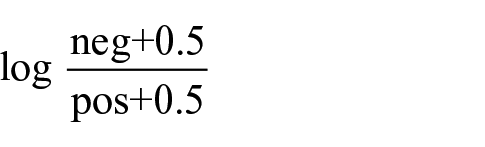
Our second dependent variable, the thematic content of the speeches, is measured as the relative difference of between clearly ‘political’ references (economy, other political institutions) and less confrontational themes (foreign policy, national unity). With this method, we aim to capture the relative differences in presidents’ thematic priorities. Besides observing country differences, we examine whether the select contextual factors increase the volume of references to domestic policy at the expense of other, less confrontational themes. If our ‘statespersonlike’ behaviour argument holds, even the contextual variables should not boost presidents’ confrontational language. For each speech, the score is calculated as follows:
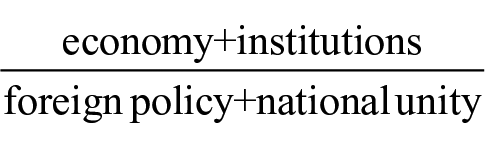
Regarding explanatory factors, we concentrate on changes that may actualize latent powers and tensions, including changes in the national economy, societal crises, changing popularity of the executive offices, and the passage of time. These factors were selected as they reflect changes in the national political atmosphere that might change the president’s public behaviour. Even a weak president may be tempted to get involved if a country’s economic conditions falter. From several potential nation-wide crises we only modelled the impact of the COVID-19 pandemic, which most clearly involved both of the executives and was equally important in both Finland and France. Even though we do not expect the presidents in general to intervene in government’s work, they might decide to act if the government is weak or unpopular. For example, Tavits (2009) and Köker (2017), among others, have argued that presidents benefit from their position above the turbulence of daily politics. We lean on Ponder’s (2018) concept of presidential leverage, which measures the president’s political capital by comparing presidential approval to general trust in government. According to Ponder what counts is the relative popularity of the president, with the president having more leverage when the approval ratings of the government are low.
From the independent variables, presidential leverage is measured as the difference between presidential popularity and government popularity (share of presidential popularity % – share of government popularity %), and unemployment rate and inflation rate as continuous variables. COVID-19 pandemic from the beginning of March 2020 until the end of December 2020 is measured as a dummy variable (1 = 03/2020–12/2020, 0 = all other dates). In addition, we control the country-effect, different speech categories, and the passage of time in office. The latter is measured as months spent in office as a continuous variable and the first two as dummy variables (1 = France, 0 = Finland; 1 = informal messages, 0 = formal speeches).
Results
We start by presenting descriptive statistics of both sentiment and thematic analysis. Figure 1 shows the general tone of the Finnish and the French presidents in their formal speeches and informal messages. We consider positive tone reflecting the ‘statespersonlike’ behaviour of the presidents, and negative tone to work against it. As expected, the tone of the speeches is significantly more positive than negative in both countries and in both speech categories, although the total share of positive and negative words from all words varies between the countries. Intuitively, the tone is more positive in formal speeches than in informal messages, and presidents express negative sentiments more in the latter speech type. However, the less positive sentiment of the informal speeches can probably be explained with the generally ceremonial nature of the formal speeches, instead of a more aggressive behaviour by the presidents in informal occasions. Moreover, often presidents speak simply because it is part of their job – for example, in connection with international visits or hosting foreign leaders or when delivering annual New Year’s addresses. Informal messages have fewer such constraints, and thereby offer the president more freedom to express her or his views. Nonetheless, as our results show, even in these speeches presidents more typically resort to a rather positive tone.
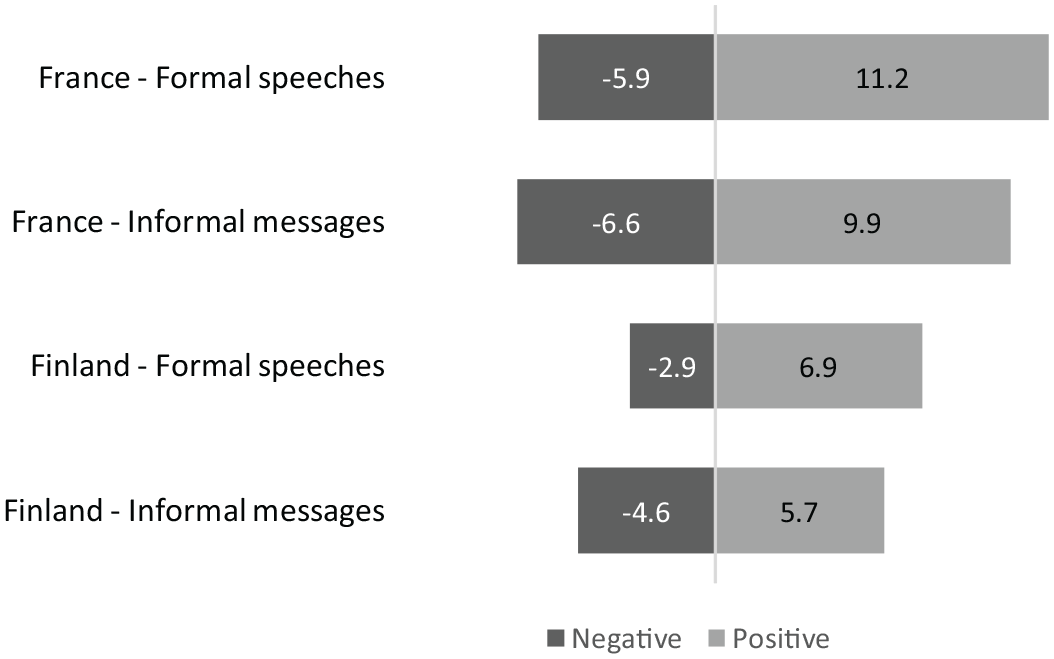
Negative and Positive Sentiments in Finnish and French Presidents’ Formal Speeches and Informal Messages. Average Shares (%).
Figure 2 shows the average shares of references to political institutions, economy, national unity, and foreign policy in presidential speeches. In general, the presidents predominantly refer to national unity and foreign policy and pay less attention to economy and institutions, as we expected. This difference is statistically significant in both countries and in both speech categories. Both Finnish and French presidents lead their countries’ foreign and security policies, and hence it is only logical that foreign policy features prominently in all types of speeches and messages, reflecting presidents’ ‘ownership’ of these issues. More surprising is that the level of references to economy and institutions, compared with foreign policy and national unity, is quite moderate in both countries. Even the French presidents, who are responsible for the domestic policy issues as well, do not seem to address more economic issues or other institutions in their speeches and messages than the Finnish presidents, whose constitutional powers are confined to foreign policy issues. As with the tone of the speeches, the total volume of words captured by the dictionaries is again different between the countries, Finland receiving higher scores in all categories. Yet, the relative magnitudes of the thematic categories (vis-à-vis each other) is very similar. In both countries, the presidents clearly concentrate more on traditional general areas of the presidency than on domestic policy issues that might result in conflicts with the government. These findings indicate a general leaning towards ‘statespersonlike’ behaviour of the presidents.
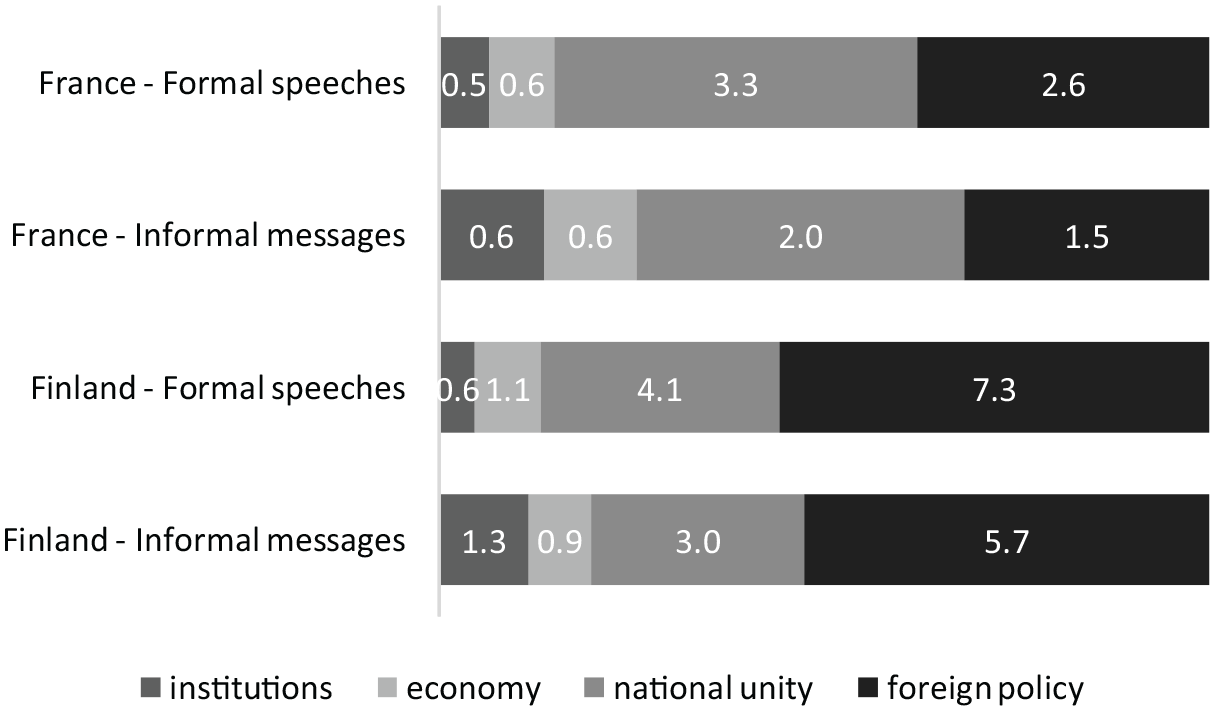
Thematic Contents of the Finnish and French Presidents’ Formal Speeches and Informal Messages. Average Shares (%).
Figures 3 and 4 show the average share of positive and negative words in each thematic category. Instead of the division to formal speeches and informal messages, the figures include both speech categories since comparison of them did not produce substantial differences. In general, the references to each category are expressed with more positive than negative tone in both countries. The differences between the thematic categories are generally quite moderate yet appeals to national unity are the most positive while the category of foreign policy, where presidents are expected to take stands, receives more negative words than any other category. Even references to economy are not substantially more negative than references to foreign policy or appeals to national unity, and references to national institutions are expressed with a relatively neutral tone, both findings reflecting the non-conflictual behaviour of the presidents.
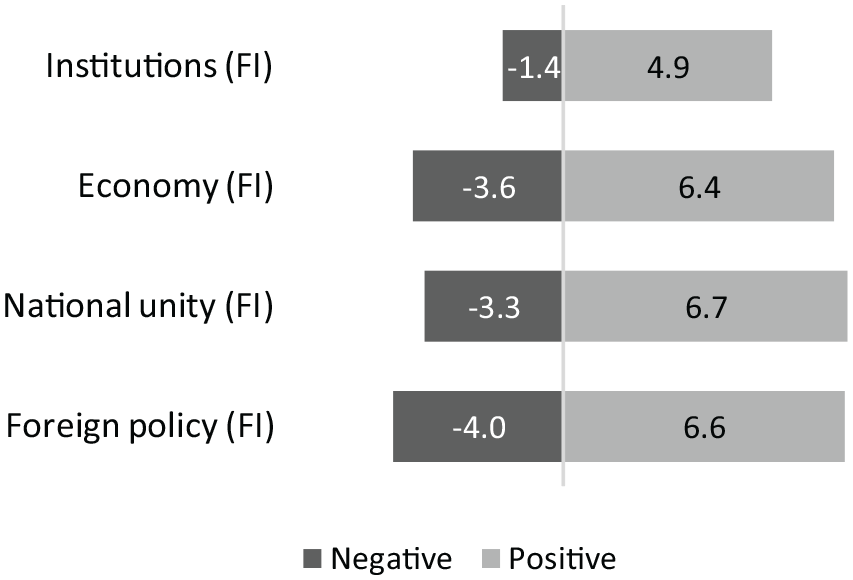
Tone of the References, Finnish Presidents’ Speeches and Messages, Average Shares (%).
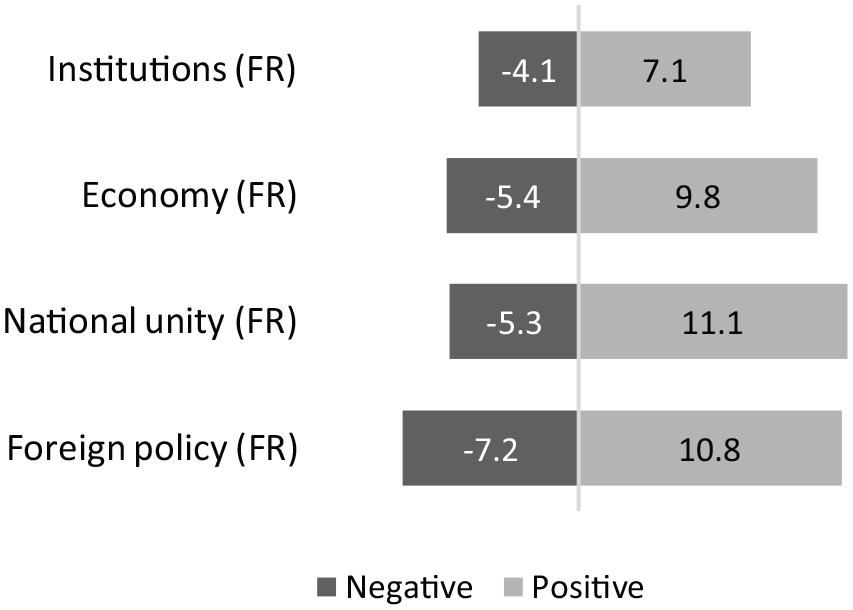
Tone of the References, French Presidents’ Speeches and Messages, Average Shares (%).
Turning to the results of the regression analysis, Table 3 shows the relationship of country effects, speech categories and selected contextual variables on the tone and content of Finnish and French presidential speeches. Countries and speech categories enter the models as dummy variables to control for the possibility that some of the variation in the tone of the speeches might be related to country-specific factors or the level of formality of the speech. Regarding tone, in controlled comparison the French presidents were slightly more negative than their Finnish counterparts. This means that the ratio of negative words to positive words was higher in France, yet as the descriptive analysis above showed, also the French presidents used systematically more positive than negative words in their speeches. However, no statistically significant difference was found between the countries in terms of the share of references to economy and institutions in relation to more general and non-confrontational themes, that is, foreign policy and national unity.
Contextual Effects on the Tone and Content of Finnish and French Presidents’ Formal Speeches and Informal Messages, OLS Regression Coefficients.
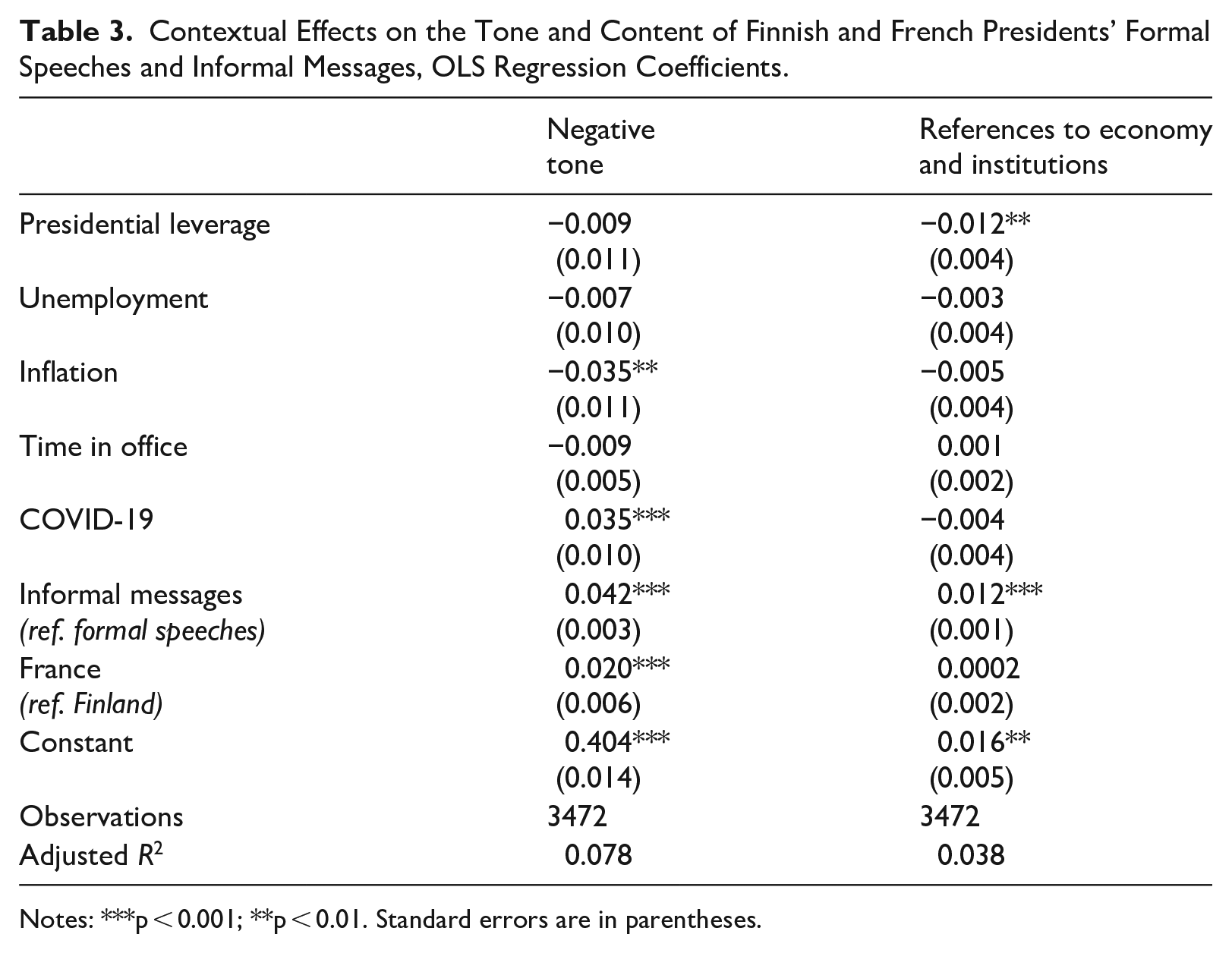
Notes: ***p < 0.001; **p < 0.01. Standard errors are in parentheses.
There are various reasons why the presidents in Finland and France behave so similarly. In France, presidents are largely responsible for agenda-setting and have since the electoral reform of early 2000s ruled with the support of friendly parliamentary majorities, and this further reduces the need and incentives for the president to attack enemies. Moreover, given that the French president is responsible for domestic policy issues, why would he publicly express concerns about the poor health of the economy? For example, from the government-opposition point of view, Proksch et al. (2019) found that governing parties tend to be more positive in parliamentary debates than opposition as they need to defend their track record. In line with the statespersonlike behaviour thesis, Finnish presidents should in turn respect jurisdictional boundaries and stay clear of matters falling in the competence of the government. Should the Finnish president intervene in the government’s work, it would most likely result in tensions that could reduce the president’s already limited influence.
Regarding the speech categories, informal messages were slightly more negative and contained more references to economy and institutions than formal speeches, which is understandable considering the official nature of the speech type. Furthermore, presidents have good reasons to be concerned about world affairs, but formal speeches are not the right occasions for predicting gloomy times ahead. Instead, reflecting the ‘statespersonlike’ style, presidents should use them for instilling hope or acknowledging the general importance of bilateral or multilateral ties. Neutral or positive tone is also related to the ‘ceremonial’ side of the speeches, while the presidents have more room for manoeuvre in informal messages. At the same time, it does not seem that the presidents would use these informal channels that much for policy purposes. Instead, they seem to behave more like statespersons.
The results also show that in most cases contextual factors do not explain variation neither in the tone nor the content of the presidential speeches very well, as reflected in the low r-square values and the (in)significance of the results regarding most of the variables. Only higher level of inflation and the first year of COVID-19 had statistically significant, yet rather moderate, impact on the tone of the speeches. The results might indicate that presidents do not try to use their speeches for policy purposes even under worsening economic situation, as the negative tone even decreases in such situations, and during the early stages of the pandemic the presidents probably emphasized the seriousness of the crisis, which might explain the increase in negative tone. Regarding the thematic categories, presidents do not seem to focus on addressing more political topics (economy, institutions) even during worsening economic situation or when they have more ‘capital’ in terms of popularity. In fact, references to these categories seem to even decrease when the presidents are more popular in relation to the governments.
In sum, the results showed that both Finnish and French presidents tend to favour more positive than negative tone in both formal speeches and informal messages and they mainly focus on questions related to foreign policy and national unity instead of addressing economic issues or other political institutions. Differences between the countries were minor. In addition, the tone and the content of the presidential speeches do not seem to react that much to contextual factors such as the economy, presidential (popular) leverage or the time spent in office. These findings clearly show that neither the Finnish nor the French presidents are confrontational in their public speeches and statements, confirming our two main hypotheses.
Concluding Discussion
This article has examined overall patterns of tone and content in the speeches of Finnish and French presidents. Our starting point was different from most previous research on semi-presidentialism, as we argued that instead of seeking an assertive and contentious position presidents benefit from ‘statespersonlike’ public role that positions her or him ‘above political parties’. The findings support these expectations. In both Finland and France, the overall tone of presidential speeches was more positive than negative, and both the formal speeches and the informal messages of the presidents contained systematically more references to national unity and foreign policy than to economy or political institutions.
Our choice to increase the robustness of the analysis with various measures and speech types naturally produced some differences between the two countries, but they were quite small and the variation in the content and the tone of the speeches was not significantly impacted by select contextual factors ranging from the state of economy to the popularity of the executive offices. Despite different constitutional settings, both the Finnish and the French presidents mostly rely on non-confrontational style in their public speeches and messages. At the same time, we must note that this article examined overall trends, not specific incidents. We cannot thus rule out the possibility of even Finnish and French president occasionally taking ‘calculated risks’, and publicly questioning the policies or legitimacy of the government. However, our data suggests that even in such cases the critique is subtle and implicit rather than aggressive and explicit.
Empirical studies on presidential speeches have arguably suffered from overemphasis on official acts. In this study, the inclusion of more informal messages, brief statements, press releases, or interviews, brought added value by expanding the presidents’ public forum. We reasoned that when presidents criticize their opponents, they do so mainly in such informal messages where the expectations about ‘statespersonlike’ behaviour are less present. Although we found a minor statistically significant difference between the speech categories, in the big picture the presidents speak rather similarly in both arenas. Thus, future research on semi-presidentialism should heed the main results of our analysis: by and large presidents ‘stand above parties’ and present themselves as guardians of national unity, regardless of their powers – in part such positivity is explained by the nature of the presidency as an institution, but surely it is also a strategy whereby presidents aim at increasing their popularity and policy influence.
However, in this article we specifically focused on stable semi-presidential regimes, and scholars should therefore compare presidential speech patterns in more unstable countries, such as those in Central and Eastern Europe, which have demonstrated more intra-executive turbulence (e.g. Sedelius and Mashtaler, 2013). We encourage scholars to go beyond official speeches and to utilize diverse material, including interviews and social media posts. Future research should also adopt longer timespans, thus making it possible to address the explanatory weight of presidency-centred versus president-centred approaches (Hager and Sullivan, 1994). At the same time, there is room for more in-depth studies. For example, in Iceland the leadership styles of successive presidents Vigdis Finnbogadóttir (more ceremonial) and Ólafur Ragnar Grímsson (more assertive) were clearly different, while subsequent analyses should pay attention to how factors such as presidents’ background (partisan vs non-partisan officeholders), the calendars of both presidential and parliamentary elections, or the exact size and composition of governments influence presidential communication and behaviour.
Finally, the main limitation of our study, which future studies on presidential speeches should especially try to tackle, are the dictionary-based dependent measures. While we believe that our measures tapped aspects of speeches that are universally important, dictionary-based measures capture only limited part of the texts. With different dictionaries or more sophisticated approaches, such as the ones relying on machine-learning (or alternatively, human-coders), it could be possible to reach even more detailed aspects of the tone and the content of the presidential speeches. Nonetheless, our novel approach successfully established and explored this under-investigated area, revealing new aspects about the public behaviour of the presidents in stable semi-presidential regimes.
Footnotes
Acknowledgements
The authors thank Aino Myllymäki, a research assistant who helped them with collecting and analysing the extensive speech corpus.
Declaration of conflicting interests
The author(s) declared no potential conflicts of interest with respect to the research, authorship and/or publication of this article.
Funding
The research has received funding from the Academy of Finland, grant number 333013.
