



Abstract
The Scottish independence movement and its leadership have claimed ‘time is on our side’, citing the increased support for independence among younger citizens as evidence a future referendum would be more likely to deliver a ‘Yes’ result. Even amid protracted crises and tumultuous leadership changes within the Scottish National Party, observers still point to robust support for independence among younger voters as evidence of future change. Assessing this claim is important because it clarifies the role of different cleavages in Scottish and British politics and it helps us understand the motivations on both sides for trying to control the timing of any future independence referendum. In this research note, we assess the claim that time sides with the pro-independence movement, using data from the Scottish Social Attitudes Surveys and the Scottish Election Study from 1999 to 2021. Overall, we find limited support for the claim that generational replacement will help the pro-independence movement. Based on data from 1999 to 2021, the most appropriate interpretation is that time will neither help nor hurt the independence movement. Therefore, we need to treat claims on this topic from political actors with caution.
Introduction
Is Scottish independence more likely in the future? The question is an important one, with implications for the future of Scotland and the United Kingdom (UK) of which it is currently a part, as well as for the European Union (EU), which an independent Scotland aspires to join. Increasing attention has been given to the issue ever since the Brexit referendum of June 2016, which seems to have re-activated the issue’s salience. While the electoral fortunes of the ruling Scottish National Party (SNP) have come and gone in the intervening years, support for independence remains high and the constitutional debate remains a live issue in UK politics. One reason that independence remains an active issue in spite of constitutional and political roadblocks is the assumption that time is on the side of independence. In response to the UK government’s refusal to countenance a second referendum post-Brexit, then-First Minister Nicola Sturgeon argued this would not dent the cause, since strong support among younger Scottish citizens showed that time ultimately favoured independence.
The claim that time favours independence is an important one since it influences the strategic calculus of both sides on the constitutional question. Yet we need to be cautious about taking such claims at face value. First, they may be politically self-serving and as such may seek to misrepresent underlying demographic drivers. Claiming independence in the future may act as a rallying cry for shoring up support or may work as a delaying strategy, allowing leaders to punt costly decisions into the long grass. Second, age effects are complex. Observed effects may be indicative either of cohort, life-cycle or period effects, each of which has distinct dynamics, while positive age effects may either be too slow to make much of a difference or counter-balanced by negative age effects. Third, claims regarding strategic timing have not always been vindicated in the past. In Quebec, often treated as a case where broadly similar dynamics can be observed, support for independence decreased in the years following the 1995 referendum after which similar pronouncements of future support were made.
Given the stakes of independence are so high, and time is a crucial factor mentioned by both sides, it is helpful to assess the validity of the claim that time sides with independence. In this research note, we analyse the temporal effects of age-based variation in support for Scottish independence. Drawing on data from the Scottish Social Attitudes Survey and the Scottish Electoral Study covering a substantial time span (1999–2021), we find no evidence to suggest that generational replacement will help the pro-independence cause. First, we show that support for independence has increased among young people since the 2014 referendum, but only slightly, and that this increase is cancelled out by a more substantial decrease among older citizens. Second, we use age-period-cohort (APC) models to take into account age effects. Overall, we find limited support for the rationale that generational replacement will help the pro-independence movement. These findings are important for several reasons. First, they improve our understanding of citizens’ positions on independence (Henderson et al., 2022a). Second, they help us make sense of the agenda of the Scottish Government when it comes to the timing of a second independence referendum, despite the demographic balance of support. Third, they support calls for greater nuance regarding some of the key assumptions of the ‘Yes’ campaign in recent years.
Scottish Independence, Referendums and the Role of Timing
The SNP scored a major victory in obtaining the UK government’s support for an independence referendum in 2014. While the referendum itself produced a victory for the Unionist ‘No’ campaign (55.3%–44.7%), it failed to put the independence issue to rest. Instead, it has established new political identities around the ‘Yes’ and ‘No’ outcomes, boosting support for the pro-independence SNP, mobilising sections of the electorate and providing information to citizens on the independence offering (Bennie et al., 2021: 1187; Mitchell and Henderson, 2020: 145). Two years later, the Brexit referendum in 2016 further destabilised the status quo in Scotland, motivating pro-independence politicians to call for a second independence referendum on the basis that the Brexit vote represented the material change in circumstances required for a successive effort to alter the status quo.
Brexit had a significant impact on Scottish politics (Fieldhouse et al., 2021). The nation’s preferences – 62% of Scottish citizens voted Remain (BBC News, 2016) – were not captured separately in the design of the referendum and Scottish ministers were given little influence over the withdrawal negotiations (McEwen, 2022: 7) with Holyrood’s designs for a differentiated Brexit rejected out of hand by the UK government (Wincott et al., 2021: 1533). British withdrawal from the EU also undermined the political and regulatory status quo, which some scholars have argued has contributed to rise of a more ‘muscular’ unionism in Westminster (Keating, 2022; Kenny and Sheldon, 2021). Moreover, the Brexit vote precipitated political change, with a slow up-tick in support for independence, the rise of a new narrative linking Brexit and support for independence, and vote switching as the SNP exchanged pro-Brexit independence supporters for Remain supporters (Curtice, 2020: 228; Johns, 2021: 493, 495).
While Brexit brought about significant change to the Scottish political landscape and animated calls for a second independence referendum, the UK government refused to countenance a further challenge to the constitutional status quo, claiming that ‘now is not the time’ (Brusenbauch Meislová, 2022). Responding in October 2021 to perceived delaying tactics in Westminster, First Minister Nicola Sturgeon argued: ‘if they think it’s about playing a waiting game, I’ve probably got time on my side as well’ (The Scotsman, 2021a). The leaders of the pro-independence Scottish Green Party supported Sturgeon’s claims, contending that while the First Minister’s comments about future generations were indeed correct, this should not be allowed to undermine the immediate need for an independence referendum. The claim that time is on the side of the independence movement is based on the fact that younger citizens are regularly more favourable towards independence than older citizens, and thus, it is assumed that the gradual replacement of older citizens by younger ones will slowly tilt overall support for independence over the 50% threshold, around which it has been hovering since the 2014 referendum (McCrone and Keating, 2021: 19; Sobolewska and Ford, 2020: 259). The claim is intuitive, and opposition parties did not challenge Sturgeon’s claims but rather criticised what they regarded as the macabre claim from Sturgeon that the country should wait for unionist supporters to die out (The Scotsman, 2021b).
In addition to the costs of governing catching up with the SNP, the party also experienced internal turmoil in 2023. Sturgeon’s unexpected resignation in March 2023 precipitated a leadership contest won by Humza Yousaf, who took office just as a Police Scotland investigation into the SNP finances engulfed the party. In his first major speech on 24 June 2023, Yousaf committed to making the 2024 general election platform a referendum on independence, but refused to countenance non-constitutional means and toned down the need for immediacy, noting the party needed first to ‘continue building support for independence’ (Scottish National Party, 2023). Yousaf’s caution differed from his predecessor’s commitment to hold a second referendum by October 2023 (Scottish National Party, 2022) and reflected the party’s internal woes as well as foot-dragging by Westminster on the offer of a second referendum (Brusenbauch Meislová, 2022). The collapse of the SNP-Green power-sharing agreement in May 2024 led to Yousaf’s resignation and his replacement, unchallenged, by John Swinney, a veteran SNP politician who has struck a similarly cautious note with respect to the timing of a second independence referendum.
Yet the claim that time favours Scottish independence has not retreated. Moreover, the more cautious tone struck by Sturgeon’s successors is indicative of a longer-term strategy which is compatible with – and may indeed actively assume – increasing support for independence among citizens in the long run. Given the impact which any purported future increase in support for Scottish independence would have for UK politics and for the strategies adopted by both sides in the constitutional question, it is imperative to assess the veracity of the claim itself. This can also help us to understand the politics of timing more generally too, since temporal questions are often at the forefront of scholarly research: Politicians routinely clash over the timing and sequencing of elections (Smith, 2003) and demographic change is widely regarded as ‘one of the most important drivers of social and political change’ (Van der Brug and Franklin, 2018: 429).
Assessing the Timing Claim
The claim that time sides with independence should be treated with caution. For one thing, it is potentially self-serving, since politicians have a strategic interest in signalling an increased likelihood of future electoral success. Such a claim can encourage optimism among supporters (e.g. Judis and Teixeira, 2004) and increase mobilisation by signalling a greater likelihood of victory (Hodgson and Maloney, 2013; Morton et al., 2015). Such a claim can also help override prior referendum results by suggesting that societal preferences have been subject to considerable change, rendering previous mandates unrepresentative and thus illegitimate. Furthermore, the veracity of such claims is not backed up by the experience of comparative examples of secessionist movements. The Quebecois Prime Minister Bernard Landry, for example, made similar claims about time after the second (unsuccessful) independence referendum in 1995, but these claims never materialised and support for independence has in fact decreased in the intervening years. 1 And since the Quebec case is a common comparator with the Scottish one, this experience – while not determinative – should offer pause for thought.
Although age-related effects are intuitive and are consistent with our knowledge that generational replacement is a key driver of long-term social and political trends (e.g. Abramson, 2015; Van der Brug and Franklin, 2018 429), they are also complex and can be difficult to disentangle. While we know that young people are more supportive of independence (Schneider, 2014), it is uncertain whether this translates into an increased likelihood of a ‘Yes’ vote over time as generational replacement occurs. What matters is whether differences in cohorts’ attitudes are the product of deeper shifts in attitudes between generations that will not be cancelled out by ‘period’ or ‘life’ effects. 2 While cohort effects refer to a group of individuals born during the same time period (e.g. people born between 1946 and 1955 can form a cohort), life effects refer to the simple fact of ageing (regardless of one’s cohort), and period effects refer to influences of factors that are external to cohorts and affect all individuals simultaneously, regardless of their cohort.
In Scotland, it is well documented that the 2014 referendum campaign generated a period effect by boosting overall support for independence (Brie and Dufresne, 2020; Henderson et al., 2022a). Yet age-based mechanisms can go in any direction and can cancel each other out. Overall, if younger citizens are increasingly likely to support independence, and if the same applies to the generation following them, then we would expect change to occur (Schneider, 2014: 58). Yet there may also be life effects that work against support for independence, including the well-documented tendency for citizens to become more risk averse as they get older (Albert and Duffy, 2012; Bélanger et al., 2022; Liñeira and Henderson, 2021; Morisi, 2018; Nadeau et al., 1999). Where such effects are at work, we would expect little change to occur as generational replacement takes place.
Existing data are insufficient to provide a clear picture as to which effects are operating and to what extent. 3 Much of the available data on age effects are static, showing only that support for independence varies by age groups at a given data point (i.e. one snapshot of public opinion across age groups), which is insufficient to establish generational or life-cycle effects (e.g. Sobolewska and Ford, 2020: 260). More specifically, a cross-sectional survey (i.e. a snapshot) cannot be used to separate the effects of age, period and cohort because individuals of different ages are considered at the same point in time. It is thus impossible to analyse how a given outcome changes with age, across periods and between cohorts. To do so, one needs to use data that were collected at different data points. In the words of Smets and Neundorf (2014: 43): ‘it is essential to use repeated cross-sectional data, which allows to observe people from the same cohort as they grow older and at different points in time’. As the rationale is to examine a given outcome across cohorts as they grow older and at different points in time, however, one cannot simply look at a bivariate figure plotting an outcome for every cohort over time, since this strategy does not control for life and period effects. Rather, one needs to implement a (mixed) regression model that includes age, cohort and period, using data that offers variance on the period variable; that is, data coming from different years.
Data and Indicators
In this research note, we use an APC model to assess the claim that younger citizens become more favourable to independence over time and that older ones remain at least stable over time, which would translate into higher overall support for this option in a future referendum. More precisely, we test the following hypothesis which comes from the conventional wisdom reviewed previously: younger cohorts are, after controlling for life and period effects, more pro-independence. To do so, we leverage data from the Scottish Social Attitudes Survey and the Scottish Election Study (SES) from 1999 to 2021.
Our data come from two sources. First, we use the Scottish Social Attitudes Surveys (SSAS) conducted in 1999 and 2003. These are cross-sectional post-election surveys with a nationally representative sample of Scottish citizens interviewed face-to-face. Second, we use the survey data collected by the SES in 2007, 2011, 2014, 2016 and 2021 (Henderson et al., 2019, 2022b) These are all election studies, with the exception of 2014 which is a post-referendum study, based on representative samples of Scottish citizens collected online by YouGov. The number of observations ranges from about 1100 to 2300, with details for each survey being specified in Table A1 of the Appendix. One of the key merits of our analysis is that we cover the whole period from the very first substate election in 1999–2021.
In both the SSAS of 1999 and 2003 and the SES of 2007, respondents were asked about their constitutional preferences. The 2011, 2016 and 2021 SES rounds included a question about voting behaviour if there was a referendum on independence. The second wave of the 2014 SES asked a question about citizens’ voting behaviour during the referendum held that same year. Response categories (e.g. Yes, No) were clear and again allowed us to clearly identify respondents who are for or against independence. Overall, the response categories clearly tapped into either remaining in the UK (with different options including no change and more devolution) or becoming independent (e.g. Scotland should become independent, separate from the UK). It was therefore straightforward to code respondents as being clearly for or against Scottish independence. That said, we should note that this operationalisation of the variable relies on the assumption that we can infer respondents’ views about independence when they are asked slightly different forms of the question. For example, it requires assuming that respondents in 2016 who answered that they would vote ‘Yes to independence’ in a referendum share that same constitutional preference as respondents who took the survey in 1999 and answered ‘Make Scotland an independent state within the European Union’ in 2011. We believe that our assumption is reasonable and very likely hold, but we should note that future survey data should strive to use identical questions to provide an ideal setting for comparisons over time. Full question wording and answer choices can be found in Table A1 of the Appendix.
The level of support for independence over time when pooling all responses is shown in Figure A1 of the Appendix. However, our puzzle does not relate to the aggregate-level support for independence but rather to heterogeneous support across age cohorts, so we refrain from discussing in detail the baselines and/or the trends in this research note. That said, we should note that the data for 2021, suggesting an overall level of support for independence of around 39%, is slightly off compared with poll aggregators which placed independence closer to 44% during the time period of the data collection of the SES 2021 (i.e. 8 April to 5 May 2021). It is very much in line with the other estimates provided by YouGov (39% of support on 16–20 April; 41% of support on 2–4 May), but there is still a 5 percentage point gap points between the estimate of the SES 2021 and the average of the polls. We do not know whether younger cohorts would be disproportionately represented among this 5%. Overall, even if the average of the polls would be more accurate compared with YouGov’s estimates, we believe that a 5 percentage point gap in 1 data point over time and across the 7 datasets combined is unlikely to bias our test (in one direction or the other).
To estimate the APC models, we use a question ascertaining citizens’ age to generate a linear variable (mean = 50 years old) as well as a categorical variable identifying the cohort of the respondents. The cohorts include respondents born in the following years: 1916–1925, 1926–1935, 1946–1955, 1956–1965, 1966–1975, 1976–1985, 1986–1995 and 1996–2005. On average, there are about 1300 respondents per cohort, but there is considerable variance within this, which is displayed in Figure A2 of the Appendix. As age is causally prior to other attitudes that might be correlated to both age and opinion on independence, we do not need to control for these (Miller et al., 1996). Age is also necessarily exogenous to attitudes towards independence, so we can perform a clean analysis focusing solely on these two variables. Controlling for other factors like education or gender could lead to biased estimates, as these would constitute ‘bad control’ variables (Carlson and Wu, 2012; Keele et al., 2020). We come back to this point in a robustness check, but at this stage, it is worth simply mentioning that controlling for these factors does not affect our main findings.
Findings
If time sides with the independence movement, we should expect that younger generations will become more supportive of independence over time and that older generations will remain at least as supportive. Before presenting the APC model, we provide a thorough description of levels of support for independence across all the cohorts and all the data point over time from 1999 to 2021. Figure 1 shows the results below. Clearly, an important period effect has taken place, and the year of 2014 – when the referendum was held – was also very important (see Henderson et al., 2022a).
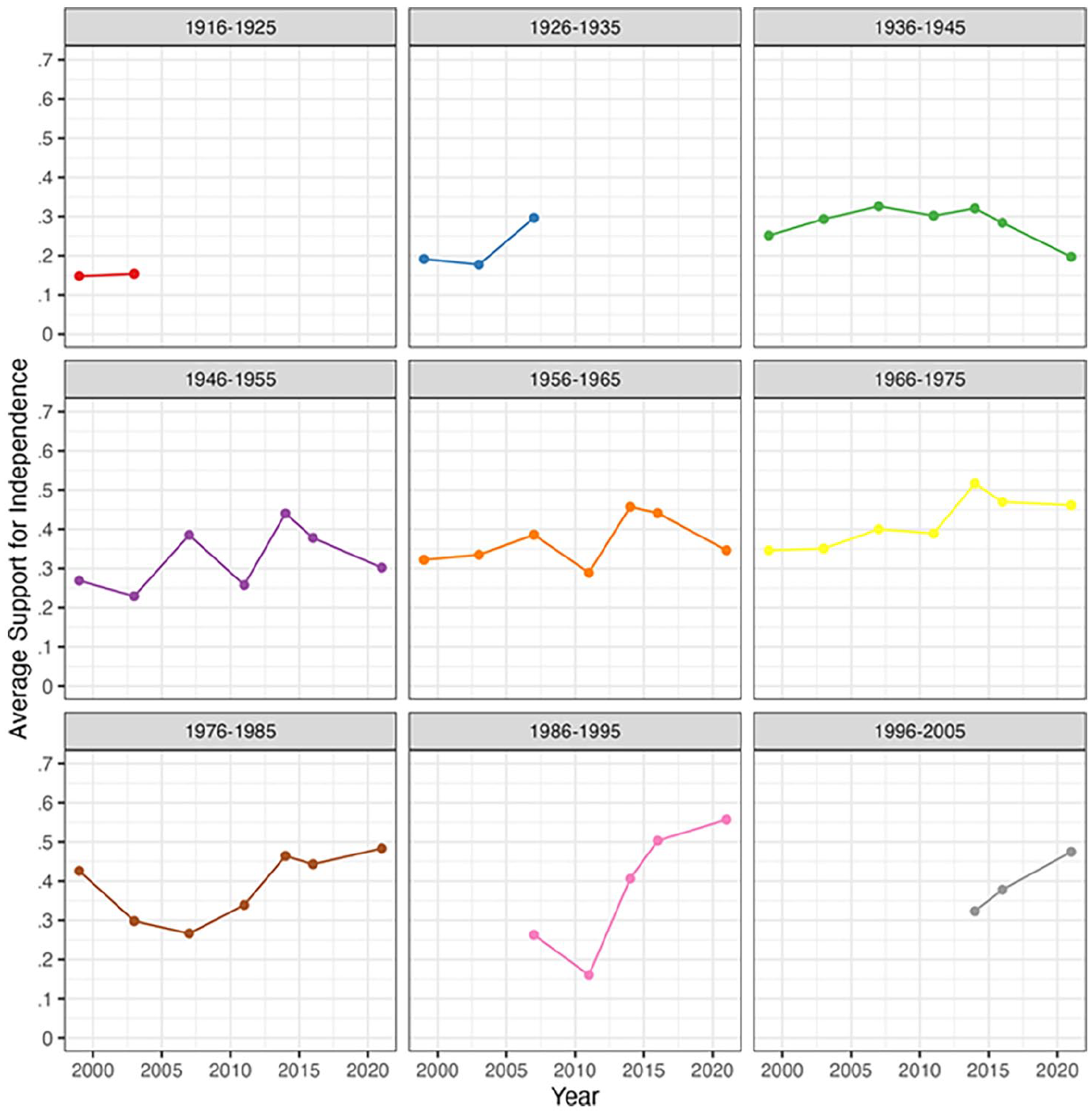
Support for Independence Across Cohorts and Over Time.
Support for independence is lower across all age groups when we compare the first half of the time period covered in Figure 1 (i.e. 1999–2011) to the second one (2014–2021), with the exception of the 1936–1945 cohort who seems to have peaked around 2007 and might have lost further interest in independence after 2007. The proportion of citizens favourable to independence has clearly increased since the first Scottish election in 1999, the largest increase being between 2011 and 2014, which is consistent with Henderson et al. (2022a) and Fieldhouse et al. (2021) and in line with lay assessments of the effectiveness of the pro-independence campaign during the 2014 referendum (e.g. Brie and Dufresne, 2020).
Moreover, all cohorts who are covered across the full the 1999–2021 timeline display increased levels of support for independence when compared with the first data point from 1999 to 2014. However, the older cohort among the ones included in the full time period, that is 1936–1945, 1946–1955 and 1956–1965, peaked in 2014 and their support decreased after 2014 as they aged. The only exception is the 1966–1975 cohort that remained quite stable after 2014 despite ageing. In other words, this cohort is, compared with the general population, quite supportive of independence and seems to have remained so despite ageing. However, to model APC effects we fit an APC model using a cross-classified multilevel model strategy.
This approach, which has been increasingly leveraged in recent political science research, models a hierarchical structure for multiple cross-sectional studies that are pooled within a single dataset, just as our data is (Dassonneville et al., 2012; Ho et al., 2015; Wong et al., 2017; Yang and Land, 2013). Within this multilevel design, the first level consists of individual characteristics including attributes such as age, which are treated as fixed effects. In addition, respondents are nested in a second level, where they are cross-classified according to their cohorts and the year of the different survey-year, both of which are considered random effects (Ho et al., 2015). This design, therefore, takes into account the multicollinearity among individuals from the same birth cohort, as well as the interdependence of respondents within the same survey year. 4 From this model, we computed the cohorts’ random effects on support for independence with their 95% confidence intervals and plotted them in Figure 2.
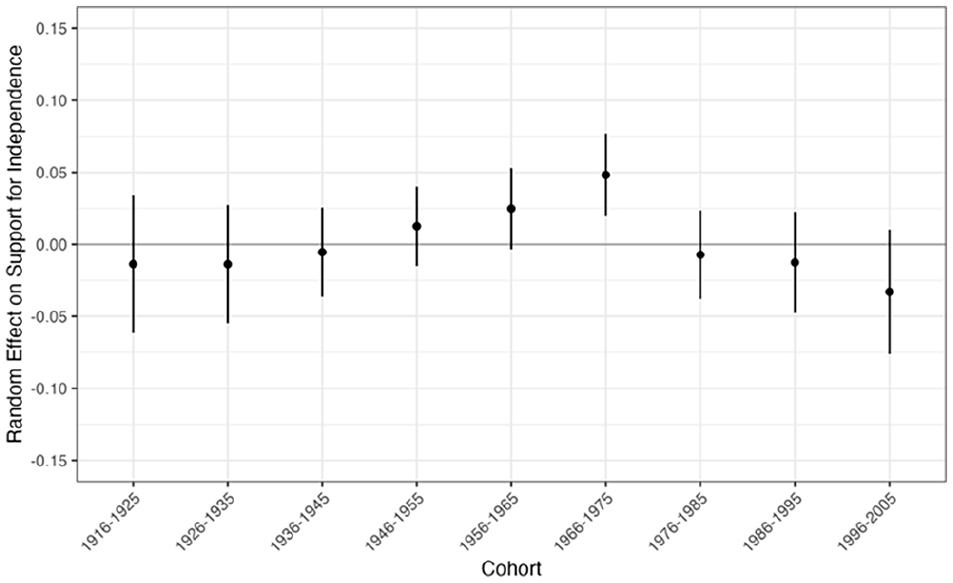
Random Effects of Cohorts on Support for Independence, 1999–2021.
Overall, the random effects are all quite close to zero, with only modest variance across cohorts. In every cohort except one, the level of support for Scottish independence among all other cohorts is not statistically different from the average levels of support identified across all cohorts, which is shown by the 95% confidence intervals overlapping with 0 in all cases except the 1966–1975 cohort. Even for the respondents born within this decade, the impact is relatively small at +0.05. In other words, this cohort only appears to be slightly more likely to support Scottish independence. Furthermore, the cohorts identified as representative of younger generations, specifically those spanning the years 1986–1995 and 1996–2005, do not exhibit attitudes that significantly deviate from the average in relation to support for independence.
Our hypothesis is that younger cohorts are, after controlling for life and period effects, more pro-independence. The expectation is thus that Figure 2 should display more positive effects where the cohort is a younger one. This is not the case. Indeed, all cohorts after 1966–1975 display negative (and non-statistically significant) effects. Our findings pertaining to cohort effects therefore do not support the hypothesis that time sides with pro-independence supporters. However, it is important to note that, in line with the rationale behind the null hypothesis, we do not claim to find evidence against the narrative of the pro-independence movement claiming that time is on its side. What we find, using the most appropriate data in Scottish electoral politics, is limited support for this claim.
Our main conclusion is not impacted by the methodological choices that we had to make, as shown by the robustness checks we conducted. First, we argued that one should not necessarily control for other sociodemographic variables. However, controlling for gender and education does not alter our conclusions, as shown in Figure A3 of the Appendix. Moreover, one might wonder whether the use of two different data sources (SSAS then SES) is driving our findings. We replicated our main findings by excluding 1999 and 2003 to focus on the SES data and our findings remain substantially identical. (see Figure A4 of the Appendix).
Discussion and Implications
The idea that time is on the side of Scottish independence has been frequently aired in UK politics. Yet the claim itself should not be taken at face value. Not only is it politically self-serving, it also jars with the empirical experience of other secessionist movements (e.g. Quebec) where support has gradually fizzled out. Assessing the validity of the claim is complex and requires distinguishing cohort effects from life effects. In this research note, we have attempted to do this leveraging data from 1999 to 2021.
Our findings show limited support for the idea that public opinion on constitutional questions between different age groups will bring about increased support for independence in the future. We conclude that the claim that ‘time is on our side’ voiced by SNP actors is not nuanced enough. This key finding is insightful in uncovering the political dynamics involved in bringing the ‘shadow of the future’ into constitutional debates and helps us to explain why it may be beneficial for pro-independence actors to push for a referendum sooner rather than later – especially where support crosses the majority threshold – since it is not guaranteed that predicted future support will materialise. While the refusal of the UK Government to countenance a second referendum has forced the SNP to adopt a more cautious position, this may harm the longer-term prospects for independence if an increase in future support is not guaranteed.
Finally, we managed to leverage much of the variance regarding the period studied, but as time goes by more studies will be needed to re-assess how age-based effects evolve. Life, period and cohort effects are all interesting to examine, but we believe that assessing the effects of the 1966–1975 cohort will be particularly insightful, not least because their risk aversion should increase as these people age, notably when they retire (relatively soon) from the labour market. Moreover, future research will benefit from more variance over time from the 1986–1995 and the 1996–2005 cohorts, which are important to study because their relative weight within the electorate will keep growing and their support for independence is quite high (e.g. the 1986–1995 cohort displayed a majority in favour of independence in both 2016 and 2021). Regarding period effects, the UK general election held in July 2024 and the next Scottish Parliament elections due in 2026, will be important events that might also affect overall support for independence and will thus be important to analyse.
Supplemental Material
sj-docx-1-psw-10.1177_14789299241266198 – Supplemental material for Time on Our Side: Is Scottish Independence More Likely in the Future?
Supplemental material, sj-docx-1-psw-10.1177_14789299241266198 for Time on Our Side: Is Scottish Independence More Likely in the Future? by Jean-François Daoust, Alan Convery and Benjamin Martill in Political Studies Review
Footnotes
Declaration of conflicting interests
The author(s) declared no potential conflicts of interest with respect to the research, authorship and/or publication of this article.
Funding
The author(s) received no financial support for the research, authorship and/or publication of this article.

Supplemental material
Additional supplementary information may be found with the online version of this article.
Table A1. Measures of Support for Independence. Figure A1. Support for Independence Over Time (1999-2021). Figure A2. Number of Observations for Every Cohort. Table A2. APC Model Results (1999-2021). Figure A3. Random Effects for Cohorts, Controlling Gender and Education. Figure A4. Random Effects for Cohorts, Excluding 1999 and 2003.
Notes
Author Biographies
References
Supplementary Material
Please find the following supplemental material available below.
For Open Access articles published under a Creative Commons License, all supplemental material carries the same license as the article it is associated with.
For non-Open Access articles published, all supplemental material carries a non-exclusive license, and permission requests for re-use of supplemental material or any part of supplemental material shall be sent directly to the copyright owner as specified in the copyright notice associated with the article.
