




Abstract
Following the 2017 UK general election, there was much debate about the so-called ‘youthquake’, or increase in youth turnout (YouGov). Some journalists claimed it was the ‘. . . memes wot won it’. This article seeks to understand the role of memes during political campaigns. Combining meta-data and content analysis, this article aims to answer three questions. First, who creates political memes? Second, what is the level of engagement with political memes and who engages with them? Finally, can any meaningful political information be derived from memes? The findings here suggest that by far the most common producers of memes were citizens suggesting that memes may be a form of citizen-initiated political participation. There was a high level of engagement with memes with almost half a million shares in our sample. However, the level of policy information in memes was low suggesting they are unlikely to increase political knowledge.
Introduction
The word ‘meme’ was first introduced by evolutionary biologist, Richard Dawkins, in 1989 in his book The Selfish Gene (Dawkins, 1989). Dawkins was attempting to make sense of seemingly nonsensical behaviours that are nonetheless common across various separate societies. Dawkins described memes as a form of cultural propagation, whereby people might wish to transmit shared social memories or cultural ideas among one another.
Memes became a standard form of expression on early Internet messaging boards, although they were often nonsensical to outsiders, which was often the point. However, as social media has become mainstream, so too have memes, with most social media users now being able to comprehend the most common meme formats at least. While Dawkins definition is useful for explaining how cultural ideas spread (not a media form), these newer forms of Internet memes have distinct properties. The speed of their transition, ever adapting visual forms, alongside the accessibility to adapt them to a user’s own perspective are some of the many features which makes memes unique. However, their adaptability has made creating a single definition troublesome. As such, here we employ the definition by Shifman (2013), that an Internet meme can be generally understood as a collection of user-generated content (typically images or video) which share some form or common characteristics within its content.
As Internet memes have become more and more common as a means of online expression, it was only a matter of time before those wishing to express political opinions would start to employ memes to convey potentially complex points into simple images. This has proved to be the case, with political memes proliferating online in recent years.
With this in mind, this article seeks to understand how memes are being used for political purposes, specifically during election campaigns. It does so by using the 2017 UK general election as a case study. The analysis here is based on 378 memes, which directly referenced the 2017 UK general election. The dataset here selected memes posted during the campaign period on popular meme-curation pages on Facebook. Meta-data about the memes, in terms of views, likes and shares, were synthesised to ascertain reach and engagement levels. Furthermore, the content of the memes, in terms of political leaning, central figure and policy information was coded and analysed. This enables us to answer important questions about the role of memes during election campaigns, in terms of their likely audience, who is being reached by them and what information may be disseminated via them.
Youth disengagement and online political expression
There is much research focussed on ways in which online communication could potentially increase youth participation and engagement in politics (Bakker and de Vreese, 2011; Boulianne, 2009; Buckingham and Willet, 2006). While memes may leave many adults bemused, Cortesi and Gasser (2015) have argued that for many young people, this type of content may be an important part of a digital system of political content, presenting as they do serious matters in a way that may be more interesting and engaging than the usual channels of political information.
The decline in political efficacy among young people is of great concern to scholars of political engagement and participation (Dalton, 2006; DeBardeleben and Pammett, 2009). A lack of informational resources have been at the heart of many explanations. Verba et al.’s model of participation (time, skill and money) has been used to show that this decline may be attributed to a lack of resources available to young people which would allow them to feel informed enough to vote (LeDuc et al., 2008; Verba et al., 1978). Similarly, Dalgreen (2000) identified that political knowledge was one of the prerequisites to civic engagement and suggested that younger citizens do not feel politically informed enough to be interested and/or able to participate in politics. Putnam (2000) theorised a link between the decrease in current affairs consumption and the decline of political participation. Indeed, Saunders (2009: 226) suggest that political content is where many citizens learn the ‘maps and scripts of citizenship’, the routines of democracy and lessons in participation.
Similarly, part of the blame has been attributed to the way the media presents politics to younger people. Buckingham (2000) found that young people were frustrated with the way political content was shown to them, in terms of how young people were talked about and the lack of relevance it had for them. To this end, Saunders (2009) found that young people were more receptive to, and learnt more about, politics from comedy television above all other sources tested. Furthermore, the Internet has provided younger people with news in a more informal format (Livingstone, 2007). Therefore, political content packaged in a vernacular that young people are already accustomed is potentially one way to engage younger voters. However, the quality of information needs to be considered (Allcott and Gentkow, 2017; Lewis et al., 200). If memes are found to contain policy information or policy stances, it might be argued that their appeal to young Internet users could have the potential to increase political knowledge among a traditionally low-information, disengaged group.
E-participation
Much has been written about the role of the Internet in increasing political participation (Boulianne, 2015, 2018, 2019). Academics have long argued about what actually constitutes political participation (Brady et al., 1995) with several schema being put forward in the classical literature (Parry et al., 1992). However, more recently, scholars have started to argue in favour of broadening the scope of this definition to include political activism (Whitely and Seyd, 1996), protest (Dalton, 2008) and ‘buycotting’ (Zukin et al., 2006). There has long been talk of ‘expressive’ political participation, used to capture a broad range of ‘soft’ types of political engagement such as wearing buttons, displaying bumper stickers or casually discussing politics (Endersby and Towle, 1996). It has also long been noted that there has been a change in the way citizens prefer to articulate their preferred modes of participation, with a move away from formal political acts to more expressive modes (Dalton, 2008). Relatedly, scholars have argued that the definition of political participation should be expanded to include ‘e-participation’ (Gibson and Cantijoch, 2013). Some have argued that it should include even small acts of online political behaviour such as views, ‘likes’ and the sharing of posts, and these behaviours have been termed variously ‘low-threshold’ (Vaccari et al., 2015), ‘low cost’ (Theocharis, 2015) and ‘tiny acts’ (Margetts et al., 2015). It has been found that low-cost political behaviours online can stimulate those who would usually be uninterested in participating to do so, leading Bode (2017: 1) to assert that these small acts may work as a ‘gateway’ to more significant political behaviours. Dennis (2018: 71) goes further, asserting that such acts matter as a form of participation in and of themselves and to this end forwards what he terms a ‘continuum of participations’, which he argues should include politically motivated likes and shares on social media.
To this end, many recent studies have included elements of e-participation within their border schema of political participation. These have included posting political Facebook messages (Theocharis and Quintelier, 2016), sharing political posts (Keating and Melis, 2017) and commenting on political posts (Bode, 2017). Furthermore, certain scholars have made the case for the creation of political memes being an important part of online political participation, maybe even constituting a new means of it located between wasteful online play, political expression and cultural evolution (Seiffert-Brockmann et al., 2018). As Lilleker and Jackson (2010) point out, social media makes it easier than ever for citizens to become creators of political content, rather than the passive consumers of content produced by political elites. This could be a blog post, tweet or indeed meme and the architecture of social media means this could be seen far beyond the original poster’s immediate friends group. In light of this, we maintain view in this work that views, likes and shares of memes are a form of ‘low-threshold’ online engagement rather than participation. However, we assert that a citizen creating their own political meme is a form of participation in and of itself.
Building on this, several papers have found that online participation can boost offline engagement. Cantijoch et al. (2016: 32) suggest that the Internet can produce a more mobilised citizenry but that the relationship is indirect, instead taking the form of incremental steps up a ‘participatory ladder’ from low intensity and passive forms of online engagement to more active forms over time. Several studies (Bode, 2016; Theocharis and Quintelier, 2014; Valeriani and Vaccari, 2016) have found that social media has the potential to increase an individual’s ‘incidental exposure’ to political content via friends’ posts. In turn, this may increase knowledge, interest or even social pressure to participate. There is some empirical evidence for this. Bond et al. (2012) conducted a randomised control trial and found that when citizens had been exposed to posts from their friends saying they had voted, they were more likely to go on to seek out election-related information. Building on this, certain political science scholars asserted the need to expand the scope of how digital politics is studied, to take account of the ‘memeification’ of politics (Dean, 2018). Dean (2018: 3) further argues for a shift in the way social media is framed in political research. He calls for a move away from seeing it in terms of its impact on politics, and instead viewing it as ‘in and of itself, constitutive of the texture and practice of politics’, reconstructing political social media activity as a form of political participation.
This is something this article is explicitly concerned with, assessing from whom memes tended to originate, who saw them, what these memes contained in terms of message and furthermore the levels of engagement with them, measured in terms of views, ‘likes’ and shares. When someone shares a post on Facebook, a portion of their friends will have it appear in their feed (indeed under the current Facebook algorithm, even ‘liking’ a post will show up in a portion of one’s friends feeds). This means many people who might not engage at all with political content otherwise could see it. This will exist alongside updates from friends and family, entertainment news and other sources of information from pages the user will have opted into. This has been referred to by Chadick (2009) as ‘information exuberance’ meaning that political information appears among the miasma of other posts, bringing that information to the attention of those who would not otherwise seek it out. Gil de Zúñiga and Valenzuela (2011) demonstrated that social media could not only expose users to more diverse political information but also that when that information came from someone they know, they were more receptive to that information. In this way, seeing that one of your friends has shared or ‘liked’ a meme (and particularly if that meme contains policy or other political information) may expose one to a source of information that one would not otherwise have seen and which one might feel a higher level of trust towards than if a stranger posted it. For these reasons, it is important to study the potential reach and furthermore the content of political memes during an election campaign, to assess what kinds of information are being disseminated via this medium.
Memes and UK politics: The story so far
Internet memes related to UK general elections and their subsequent campaigns are not a wholly new occurrence, although they tended to emerge sporadically. One of the earliest examples of customisable memes being deployed in an UK general election campaign was the doctoring of a 2010 Conservative campaign poster with facetious slogans (MyDavidCameron.com, 2010). The original slogan was replaced with a series of exaggerated claims or sarcastic fake campaign promises along with derision of David Cameron’s airbrushed appearance. This was undoubtedly aided by social media sites, with 2010 being the first election where Twitter existed and with politicians not quite understanding the ‘rules’ of these platforms as yet (Southern, 2015). The 2015 general election expanded the number of memes that found widespread Internet recognition. For example, when Ed Miliband launched his infamous ‘Ed Stone’ (Molloy, 2015) in the final days of an ailing Labour campaign, where he revealed several key promises etched into a large stone, he also unwittingly launched a thousand memes, with Internet wags replacing the promises with their own text. However, not all memes during elections are necessarily critical. Another example from 2015 was the ‘Milifandom’, an online Ed Miliband fandom consisting of mostly young girls. These young women deployed ‘Milibae’ memes via social media, such as Photoshopping flower-crowns onto him or praising his ‘sassy’ attitude to proclaim their affection for the Labour leader (Wheaton, 2015; Figure 1).
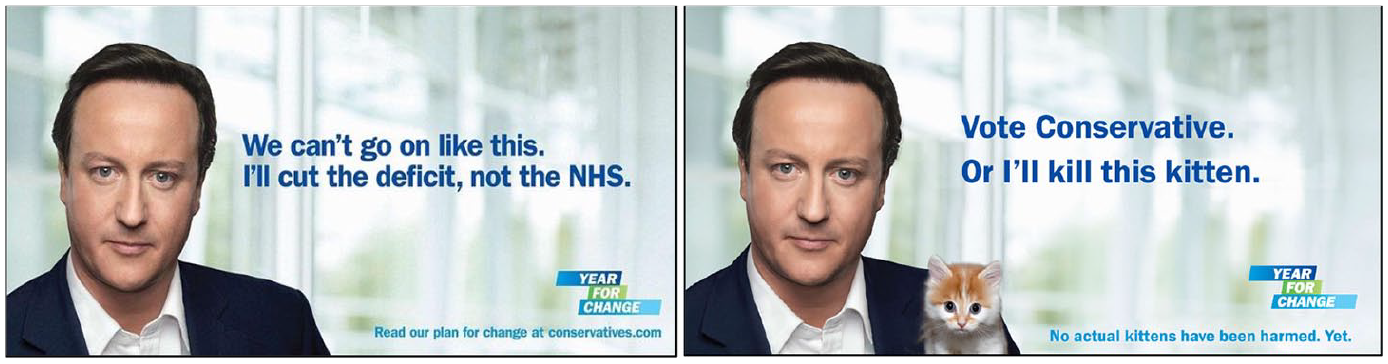
An example from MyDavidCameron.com (right) alongside the original (left) – one of the earliest election-based Internet memes.
In the run-up to 2017 general election, however, memes had become mainstream and frequent in political discussion online, being produced in one form or another for even minor political events. Political gaffes or media statements often resulted in a slew of Internet memes. Memes based on Theresa May’s tautological ‘Brexit means Brexit’ slogan, her laughing performatively in the House of Commons, or even Michael Gove clapping oddly at the Conservative Party conference made regular appearances on various social media (Hayson, 2017; Mann, 2012). By 2017, it appears that memes had become well established as a form of online political commentary. Indeed, in the wake of the 2017 election, mainstream commentators began to pay attention to memes as a central form of online political communication, with The Guardian asking, ‘Was it the memes wot won it?’ (The Guardian, 9 June 2017), and The Metro publishing a piece titled, ‘The memes that decided the outcome of the general election’ (White, 2017). Several scholars pointed to the likely significant role social media had played in the 2017 campaign. Dutceac Segesten and Boretta (2017) pointed to the exuberant and engaging use of social media by Jeremy Corbyn’s loyal band of online supporters. Margetts (2017: 386) stated that ‘2017 may well be remembered as the first election where it seems to have been the social media campaigns that really made a difference’. This echoes earlier sentiments on the Internet and politics, as talk of the ‘first Internet election’ occurred as early as the 1997 general election campaign (Gibson and Ward, 1998). However, with some evidence that the shock hung parliament result may have been the results of a ‘youthquake’ (YouGov; Sloam et al., 2018), and despite some later refuting that there had been a youthquake (Fieldhouse et al. 2017), here the suggestion seemed more plausible than at previous elections.
Current research on memes during election campaigns
There is a limited amount of research into the use of memes during election campaigns, and they have mainly been done in the US context, but considering the rapid rise of political memes, they remain under-researched. Some authors have argued that memes are nonsensical or meaningless to observers and therefore have little value as a research artefact in the broader political context (Katz and Shifman, 2017; Shifman, 2013). While others have argued that memes are actually an important part of online political expression (Seiffert-Brockmann et al., 2018). In particular, it allows younger generations to talk about issues that matter to them in a more agreeable way than the options available to them prior previously (Seiffert-Brockmann et al., 2018).
Scholars and commentators have highlighted the impact memes can have for a candidate. Mitt Romney’s unfortunately phrased defence of his policy on gender equality, where he referred to ‘binders full of women’, was roundly mocked online (Rentschler and Thrift, 2015). Ted Cruz, a 2016 Republican Presidential candidate, was subjected to the Ted Cruz-Zodiac Killer meme whereby social media users jokingly speculated that he was a serial killer that was never caught. This was thought to have damaged his campaign (Stuart, 2016), although in the 2018 midterm elections he reclaimed the meme on his own Twitter feed, to mixed reception (Santus, 2018). Similarly, the widely shared and subsequently memed video of Jeb Bush, instructing the audience at a campaign event to ‘please clap’, seemingly consolidated the idea that there was little enthusiasm for his candidacy, even among those who ostensibly supported him (Gilmer, 2016). Perhaps exemplifying political memes in the United States is the repurposing of the popular ‘Pepe the frog’ meme character as a Trump supporter by the Alt-Right, mobilising certain sectors of the online population (Milner and Phillips, 2016). Some scholars (Nagle, 2017) have argued that the ability of these niches, often fringe online communities to shape broader discourse and facilitate the current debates raging over the ‘culture war’, should not be underestimated.
With each election campaign, the importance of the visual communication within memes and the often-subversive messages they contain have grown. Indeed, memes have become an important aspect of online political culture and their use by certain demographics, particularly the youth, is deserving of more study. As demonstrated above, previous literature clearly establishes the positive implications of political information being framed in a way that appeals to younger people in order to engage them, and the significance of ‘small acts’, incidental exposure, softer or more expressive forms of participation and the way these can create a pathway to real-world participation. Assessing the way memes are used during election campaigns will provide a timely update on these literatures. Although we do not directly assess the impact of memes on votes here (and question whether this would even be possible), assessing the extent that they were seen and engaged with, and the messages that were contained within them, can give us important insights into this new form of political expression and participation. Furthermore, all of the studies cited here come from US campaigns. This is the first study that focuses on the use of memes at a UK general election, extending the current scope of knowledge about memes and election campaigns beyond the US context.
All of this, then, leads to several key questions. First, it is important to assess the overall level of engagement with memes in terms of views, likes and shares. This establishes whether they are merely a niche form of communication or have broader appeal and reach. Second, it is important to consider who is making them. Finding largely elite-made memes would reveal a different pattern of participation than if more citizen-made memes were more common. Third, it is also important to assess whether the engagement largely came from audiences one might expect to be already politically engaged or whether they might be reaching audiences outside of this milieu. Finally, it is important to measure whether there is any meaningful political information contained in memes to assess whether they may help to increase political knowledge and understanding. This leads to the following four research questions:
Methodology
The Internet is a fragmented and disparate space, which makes capturing online artefacts on a specific topic challenging. Memes often originate on ordinary people’s social media accounts, only to be shared, re-appropriated or stolen, which has been termed ‘imperfect information copying’ (Ademic et al., 2016). Due to these factors, analysis of the memes posted during this election poses a number of methodological challenges specific to research on Internet images. These issues have been summarised by Hand (2017). These issues can be broadly categories as (1) the sheer number of images posted onto social media, (2) inconsistent circulation of images on differing social media sites and devices and (3) the lack of associated context in which the images are posted (Hand, 2017: 305). There are also additional concerns. In particular is the issue of attribution of creator, as many Internet images obscure the original source. For example, corporate social news pages often repost images created by citizens. Furthermore, assessing the reach of content is complex. While there are statistics on how many people may have liked or shared a specific image, there is no way of knowing who saw the same image in a different online space; therefore, many more people may have seen the image than can be accounted for. There is furthermore no insight into the specific demographics of those who saw the image (Shifman, 2013).
Previous studies of memes in a political context can be found to take one of two approaches (Katz and Shifman, 2017). The first utilises meta-data on who, when and how the meme was posted. This approach can be seen in the Observatory on Social Media’s study of memes and meme trends (Davis et al., 2016; OSoMe, 2011). One issue with this approach is that it focuses mostly on the data surrounding the meme image, rather than the meme itself (Hand, 2017). The second commonly used approach is using discourse analysis, whereby images are researched in the context or systems of which specific images are part (Penn, 2000). One such example can be found in case studies looking at the development and evolution of the ‘Obama Hope Meme’, ‘Donald Trump Signs Executive order meme’ and ‘Paul Ryan AHCA MEME’ (Seiffert-Brockmann et al., 2018). Another use of this method is the feminist study of the ‘Binders full of women’ meme and the surrounding discourse that surround it (Rentschler and Thrift, 2015). This study broadly combines these two approaches, so that the level of engagement with memes during the election can be assessed but also the content of them.
A different method was deployed here. First, we aimed to select a sample of what had likely been the most popular and most viewed memes to circulate during the election. We then recorded meta-data about the memes and furthermore applied content analysis. To select our sample, it was useful to exploit established social media architecture. Certain social pages are ‘content curators’ and therefore spend time trawling multiple social media platforms, including Reddit, Twitter and Instagram to select and share the most popular online content. These sites are particularly popular on Facebook. With this in mind, we opted to select memes from a number of Facebook pages that matched specific criteria. First, three types of Facebook pages were selected:
Popular pages: We utilised the online social media analytics service provided by SocialBakers to find the top 10 ‘social news’ pages based on the number of UK users.
UK-based meme pages: Facebook pages whose main subject are memes based on the UK or UK culture. This was through a Facebook search for pages titled ‘UK Memes’, ‘GB Memes’ and various similar phrases. We limited our search to pages with audiences of 5000 or more.
Meme pages related to UK politics or the election: We conducted a search for pages related to memes and UK politics, or to the election.
In total, we selected 18 pages on these criteria (see Appendix 1 for the full list, including the followers of the pages and number of memes taken from each). We selected all posts related to the general election from 18 April, the day the election was called, to Election Day (8 June). The memes were considered to be related to the general election if there was a manifest or explicit reference to the election, a UK party, party leader or other MP. Applying this method, and due to the process described above, whereby these sites often curate and share the most popular content from the whole of the Web, it is likely that the memes selected here were to some extent representative of the most-seen election-related memes during the campaign. This is due to the fact that page editors will want to incorporate the most popular content on their pages to attract the highest amount of views, likes and shares. Although a classic understanding of an online meme often refers to a still image with text added, here we selected a broader range of content, including posts featuring GIFs and short videos. In total, 378 memes were collected.
First, the meta-data were recorded, capturing the reach of the memes in terms of likes and shares and views for videos. Second, as this study is concerned with memes as a form of political participation, we recorded who had created the meme. Memes with no manifest identifiable author, such as a brand stamp, were coded as citizen-created, based on previous research on meme origins (Hand, 2017; Shifman, 2013). If they had a party, organisation or page watermark or other branding sign, these were categorised accordingly. Although on occasion it has been known that content curation pages pass off citizen-made content as their own by adding a watermark (ibid., 2013), we coded it by the manifest content in the meme. So, if there was a watermark from a page or other organisation present, we categorised it as being created by that page or organisation. In this way, we could make an empirical distinction between what we term here ‘citizen-made’ memes (those with no manifest watermark or other identifying imprint) and those which we term here ‘elite-made’ – those clearly authored by the pages themselves, parties or party-affiliated organisations. In this way, we can ascertain whether memes were a form of participation for citizens in that they actively produced their own content or whether the sharing of more top-down produced content was more in evidence, in line with our research questions.
Content analysis was then applied, due to being a well-established method for creating an understanding of the underlying meanings of texts (Berelson, 1952). In the first instance, we coded them for what we termed the subject or primary focus of the meme. After an initial pilot, we identified five categories of meme. These were (1) memes that focussed on a particular person or persons and were personal and personality focussed, (2) those arising as a reaction to certain specific events (such as the debates), (3) those which riffed on certain policies announced by parties, (4) those concerned more generally with how the campaign was unfolding (process) and finally (5) those which were concerned with politics in general. There were a small number which did not fit into any category and so were added to a miscellaneous category. Many of the memes simply focussed on one politician and some aspect of their personality or other personal feature. For instance, memes pointing out that Theresa May is ‘uncool’ or memes joking about Diane Abbot’s gaffe over police funding (Harmer and Southern, 2018) which often called into question her arithmetic. Occasionally, more than one of these types of content was present in the meme. For instance, jokes about a certain politician’s personality might have been based on a policy recently announced. In these instances, a judgement was made about what was the main focus of the meme overall. Furthermore, whether the meme was pro- or anti-, a certain party (including being pro- or anti- their leaders) was recorded. For most memes, this was obvious, but where it was neutral or unclear, these were not coded. If the meme was pro one party and anti another, this was coded for both categories. Finally, whether the memes contained any information about an actual policy advanced by any of the parties (even if this was not the main focus of the meme) or any attempt to mobilise voters was recorded as a binary. A fifth of the sample was coded by both coders, and then inter-coder reliability tests performed on these data. All the Krippendorff’s alpha scores were above 0.80, which is considered a satisfactory degree of reliability (Krippendorff, 2004).
Findings
What was the level of engagement with memes?
One of the most important aspects to understand was the potential reach of memes. From our sample, we found 378 separate memes. A total of 348 static images, and 30 videos (three of which were short GIFs) made up the sample. Between them, there were 6,245,066 likes, 468,916 shares and 45,360,066 video views. This alone demonstrates the huge reach of this content as well as the high levels of engagement in terms of likes and shares (Table 1). The number of views for static memes is not known, but considering the large number of likes and shares is likely to be very high. These figures suggest that memes were a widely used conduit for political messages during the election. Many of the pages assessed here were politically focussed, and therefore, we would expect much of the audience for these pages to be politically engaged. But, as we also selected memes for general ‘social news’ and general memes pages, meaning that the audience here was not specifically seeking out political content, there was a high degree of incidental exposure in evidence too.
Overall engagement figures for memes in the sample.
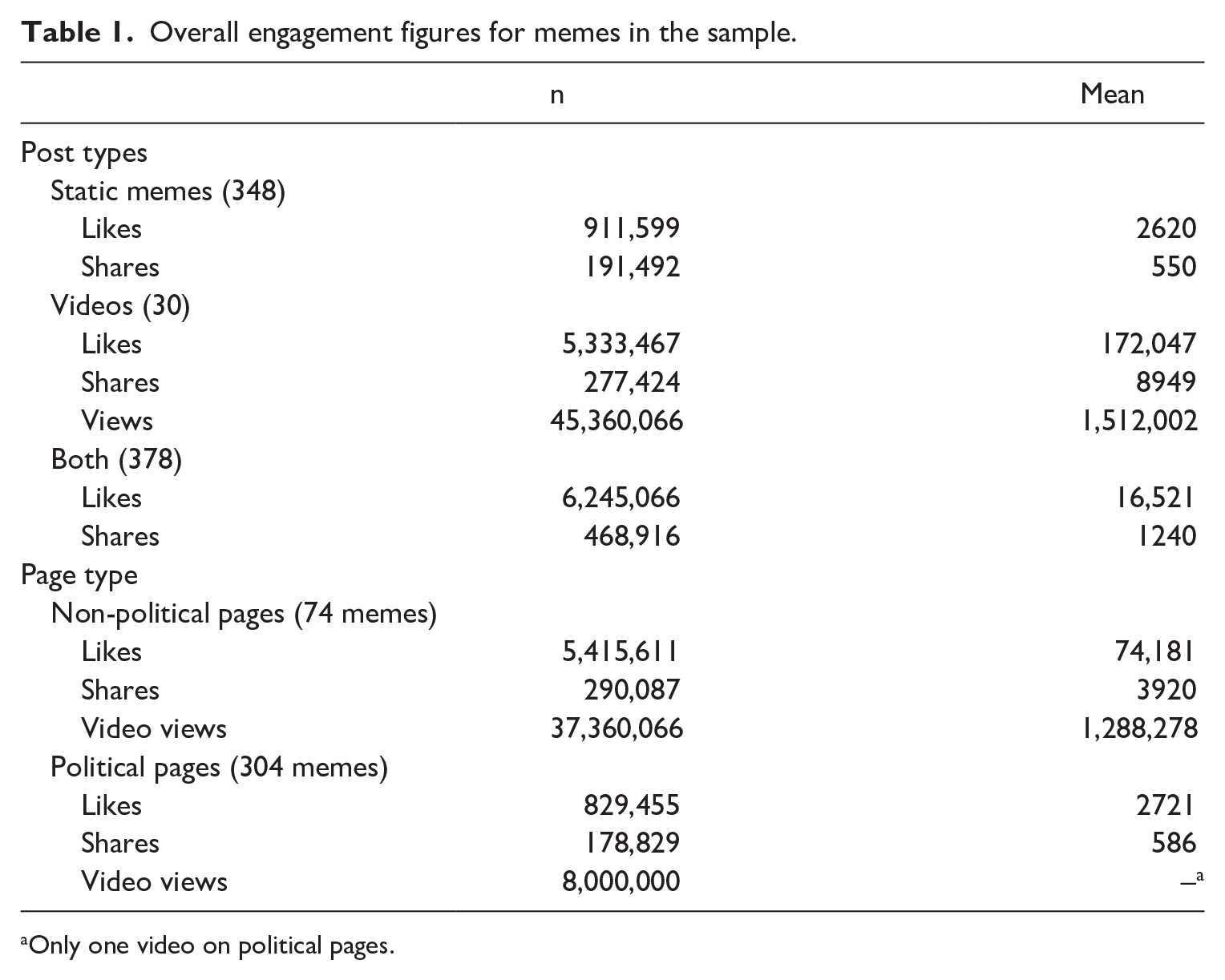
Only one video on political pages.
There was a huge level of low-threshold engagement with the memes in our sample, in answer to Research Question 1. For just the 30 videos in the sample, there were over 45 million views. These videos were also ‘liked’ over 5 million times and shared over a quarter of a million times. There was less engagement for static memes although it was still extensive with over 900,000 likes and 200,000 shares across 348 memes. Overall, the memes (static and moving) in our sample were liked an average of 16,521 times and shared an average of 1240 times. The most liked meme in our sample was a video of Corbyn saying to the camera he was ‘. . . back and ready for it all over again’ with a caption stating, ‘when you walk back into the sesh (slang for night out) after throwing up’. This had 2.6 million likes. The most shared post was Corbyn super-imposed over popular grime artist Stormzy in his ‘Shut Up’ video with a speech Corbyn had recently made re-mixed in grime style. This was shared over a 100,000 times and viewed nearly 9 million.
There were only 74 election-related memes on the Facebook pages categorised as ‘non-political’. This is compared to 304 on the politically focussed meme pages, a much higher number, as one would expect. However, the level of engagement with memes on the non-political pages was much higher. There were over 5 million likes for the memes on the non-political pages (with a mean of over 74,000) and almost 300,000 shares. Views of election-related videos posted to non-political pages topped 37 million. This compared to around 800,000 likes, 178,000 shares and 8 million video views on the politically focussed memes pages. This shows that, in line with Research Question 3, political memes were bringing political content to audiences that might not necessarily have had a prior interest in politics. This is significant from the standpoint of incidental exposure (Bode, 2016; Valeriani & Vaccari, 2015). We would expect that people who had joined or ‘liked’ a page dedicated to political memes would likely already have an interest in politics. However, those users who ‘like’ or join non-political social news/meme pages will not necessarily have a prior interest in politics. Yet, there was a huge amount of engagement with political memes via these pages. People who saw such memes did not just scroll past them with little interest, but millions of people who did not necessarily select into political content liked them and hundreds of thousands of people shared them.
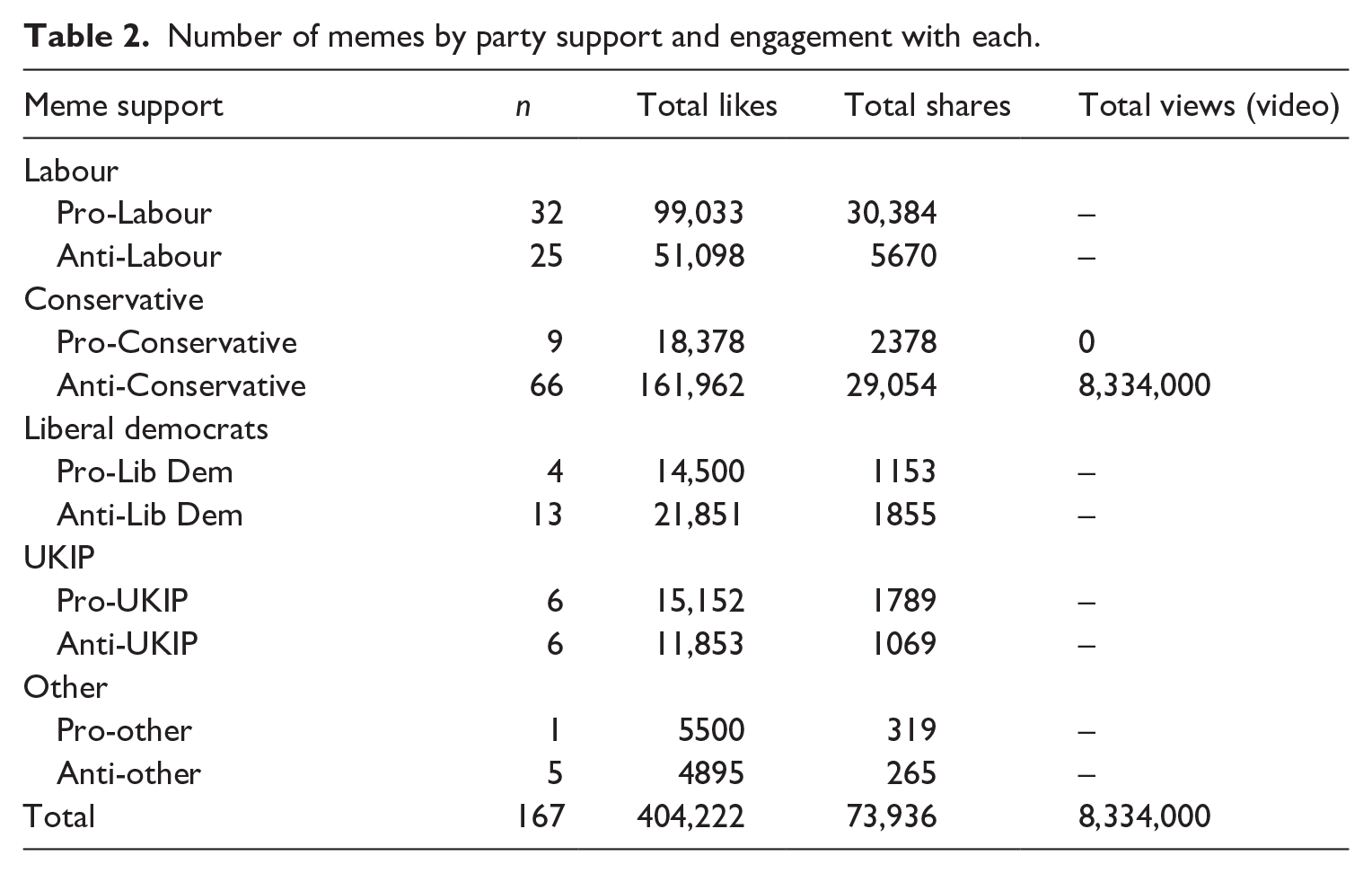
The majority of memes were partisan in some way. Only 61 (16.1%) memes had no clear partisan leaning. In terms of party support, memes leaned against the Conservative party. Other parties were also portrayed negatively but not nearly to the extent faced by the Conservatives (Table 2). In terms of personal support for or against leaders, the majority focussed on either Corbyn or May, with a large amount of memes showing some sentiment against Theresa May (111 memes against and 2 in support), while Corbyn got more support (27 against and 52 in support). This result was somewhat expected as the Labour campaign team had significantly better online engagement, especially geared towards young people (Chadick, 2017; Segesten and Bossetta, 2017); Labour-affiliated groups like Momentum had specifically attempted to generate such content (Dommett and Temple, 2018); and young people overwhelmingly supported Labour during the campaign (Fieldhouse et al. 2017). Regarding engagement, memes that had pro-Corbyn sentiments had a disproportionate amount of engagement/shares compared to all other types of memes. This follows the findings from the UK election analysis that showed that Labour was able to garner much more support than the Conservatives online (Walsh, 2017).
Number of memes by party support and engagement with each.
When were memes posted?
The number of memes posted started off with a spike at the initial announcement of the election, before levelling off (Figure 2). There were smaller spikes based on news stories or important dates. Two examples of which was the increase of Get Out And Vote (GOAV) messages posted during 21 and 22 May before the voter registration deadline. A second increase in memes followed the ‘fields of wheat’ comments by Theresa May on 5 June. This is where on camera May had made a statement where she claimed the naughtiest thing she had ever done was to run through a field of wheat, which was quickly met by ridicule and Internet memes (ITV, 2017). A more general increase in memes could be found as the date became closer to the election, which could be attributable to the increased media presence of the campaign. Therefore, it might be argued that meme activity is related to news coverage. This fits with research that suggests a link between social media activity and news reported. Whereby rather than replacing the news, Twitter was found to supplement news stories with social commentary or a ‘virtual lounge room’ for related discussion (Harrington et al., 2013). This result would therefore suggest similar that memes are used as a reaction to political events and traditional news stories (Figure 2).
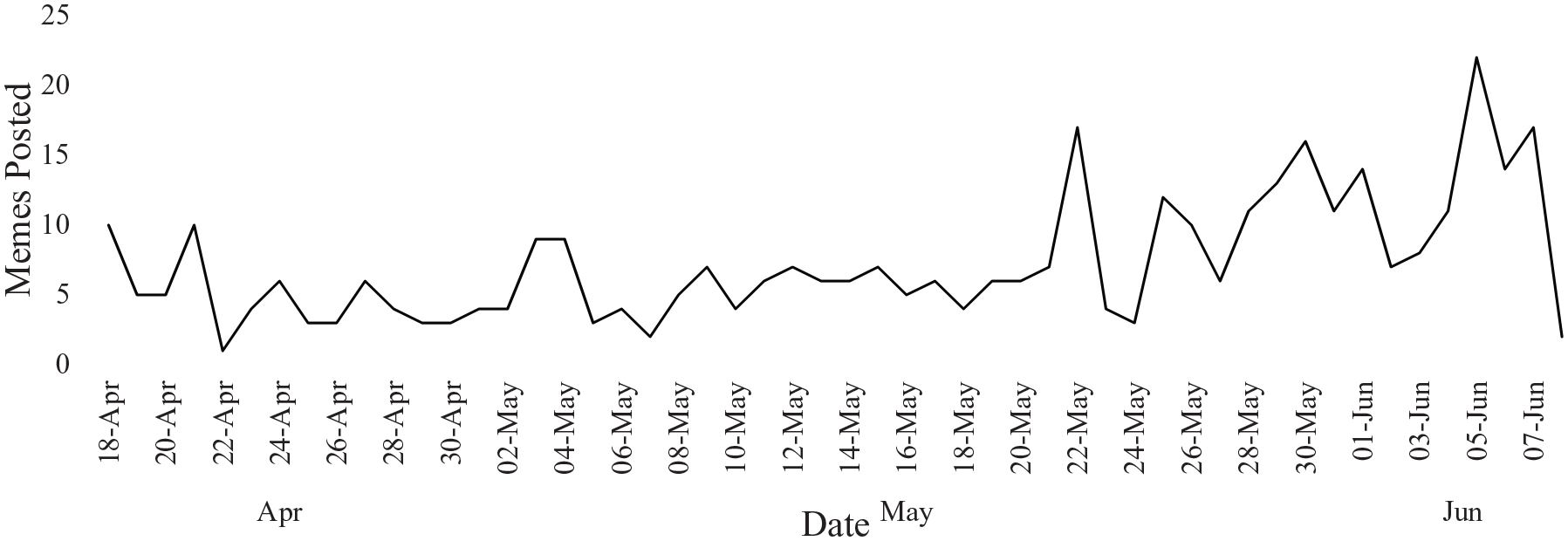
Memes over time during the campaign.
Who makes political memes?
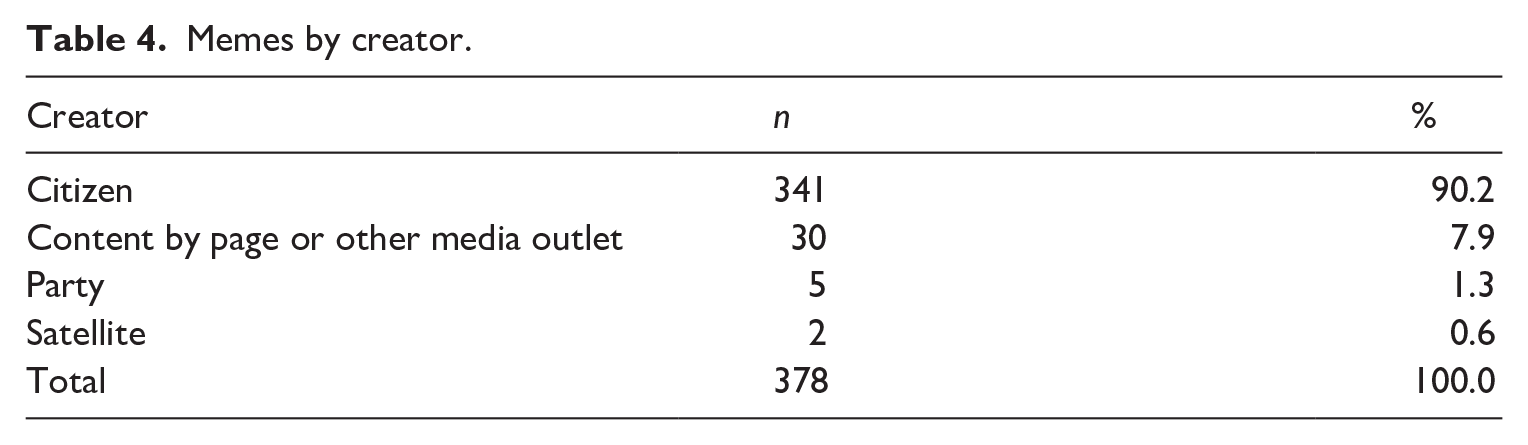
Few of the memes found were produced by the pages themselves. Joe.co.uk, a popular social news site, posted most of this type of content, creating videos with a high rate of engagement, such as the aforementioned video of a Corbyn speech mixed over the top of a Stormzy video, or a Thor:Ragnarok parody with May cast as Hela, the Goddess of Death, and Corbyn as Thor. However, these were relatively rare, with only 8% of all memes found being original content produced by the pages themselves or other online media outlets. However, the top 5 posts within the dataset in terms of engagement were content created by the pages themselves (Table 3). The Facebook page which posted the most memes – Political Bible – largely reposted what was popular elsewhere, reposting citizen-produced memes which had already gone viral. Very few memes were shared from either the parties or political satellite organisations. Of the two shared from satellite organisations, both were from the pro-Corbyn group Momentum. The majority (90.2%) of memes came from citizens themselves. In answer to Research Question 2, this suggests that creating memes is a form of political participation largely carried out by citizens rather than elites and so arguably could be considered a new form of e-participation. As Lilleker and Jackson (2010) have pointed out, the Internet makes it easier than ever before for individuals to produce user-generated content which they suggest could increase participation by citizens who would not otherwise engage with politics.
Number of memes and engagement by top-5 most featured politicians.
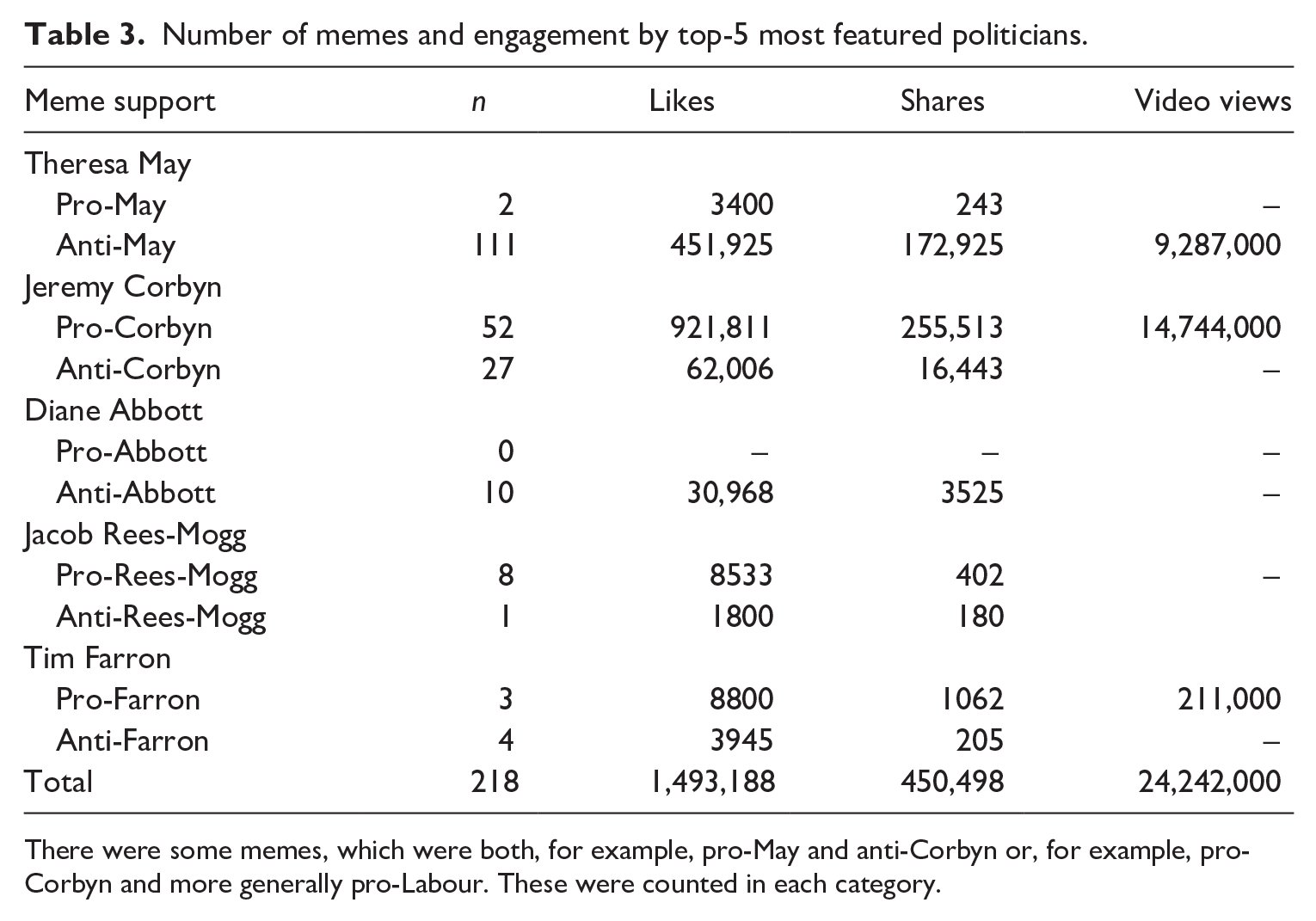
There were some memes, which were both, for example, pro-May and anti-Corbyn or, for example, pro-Corbyn and more generally pro-Labour. These were counted in each category.
It is important to assess the content of the memes. If memes are largely unserious content based on politicians’ personalities or nonsensical jokes, then it cannot be said that they are likely to increase political knowledge (although it could be argued they could increase political interest). However, if there is a degree of real policy information contained within memes, even if presented in a jovial manner, then memes could be contributing to an increase in political knowledge, however small.
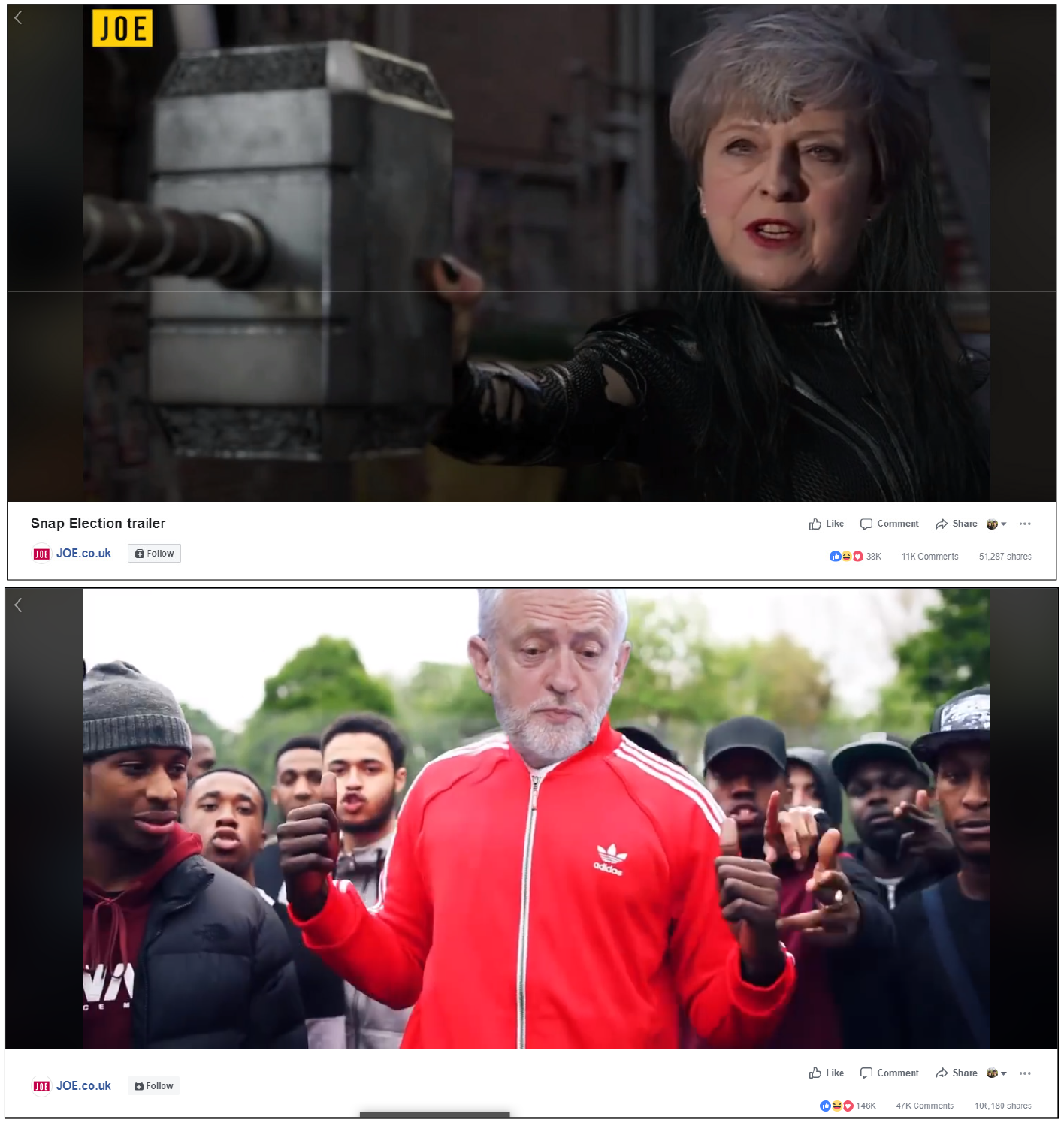
Original viral videos posted by Joe.co.uk. These videos received around 12.4 million views.a
The focus of memes
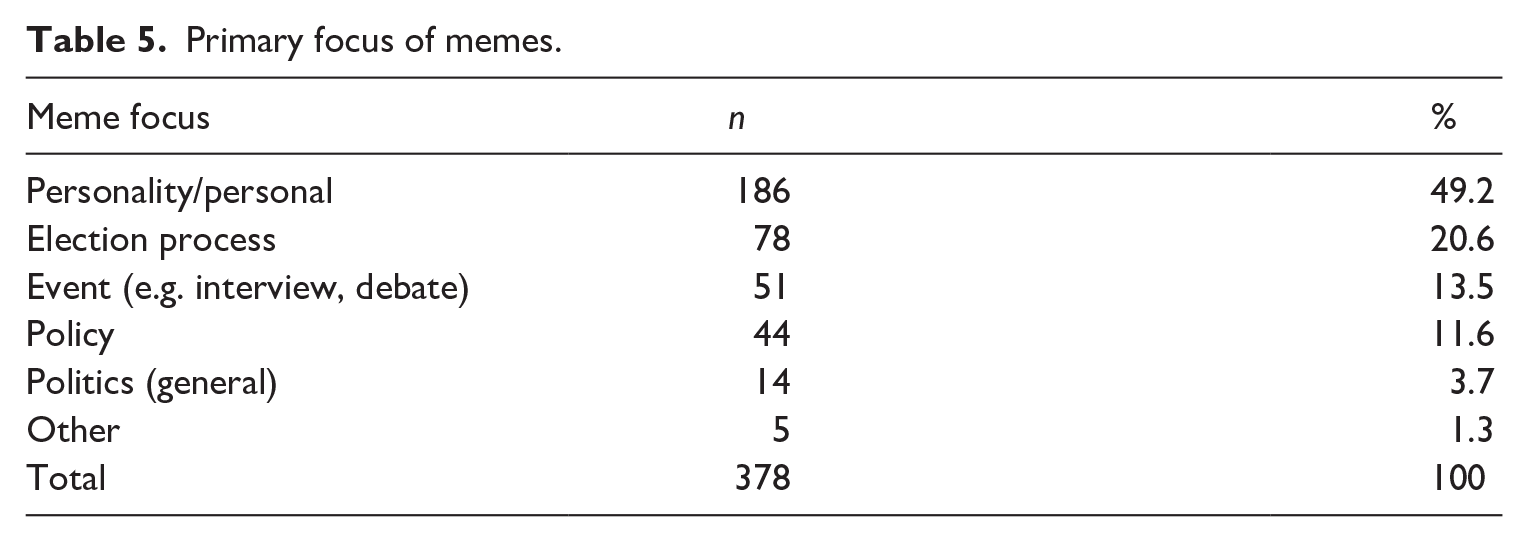
To find out what memes tended to focus on, we coded each meme by primary focus. Several of the memes had elements, which fell under two categories, but in this case, a judgement call was made about which category it best matched. As political knowledge and mobilisation via memes is a key concern of this article, whether the meme contained any policy information (even if it was not the primary focus of the meme) or mobilising GOAT elements was also coded separately. The memes in the sample were largely personalised with almost half focussing on politicians’ personalities (real or imagined) and other personal traits. This is no surprise as other research has noted the rise of personality politics in recent times (Lobo and Curtice, 2015). Suggesting that even though memes are a new way of presenting politics, they are still susceptible to the same communication factors as other mediums.
There were several highlighting May’s ‘square’ or ‘robotic’ personality. This was particularly in evidence after an interview where she was asked what the naughtiest thing she had ever done was and she replied ‘me and my friends used to run through the fields of wheat’. Indeed, these comments sparked some of the most popular memes of the whole election, cementing the idea that May was guarded, rote or even boring. Nine memes in our sample referenced the fields of wheat comment and seven the ‘Maybot’. Continuing this theme, 15 memes riffed on May’s oft repeated ‘Strong and stable’ slogan and many of them used it to further suggest she was robotic. This was in contrast to many memes showing Corbyn as ‘cool’, often with a rap theme echoing the support he received from the ‘grime4corbyn’ movement (The Guardian, 13 July 2018), or as someone who was authentic and genuine which was often the reason grime artists gave for their support of Corbyn. Furthermore, grime-related videos and memes often had policy-related content in them, with the widely viewed ‘Shut Up’ parody containing policy speech excerpts and a video with artist JME containing policy discussion. Dianne Abbott was the third most featured politician in our sample, and 8 out of 10 memes which featured her referenced her police funding figures gaffe.
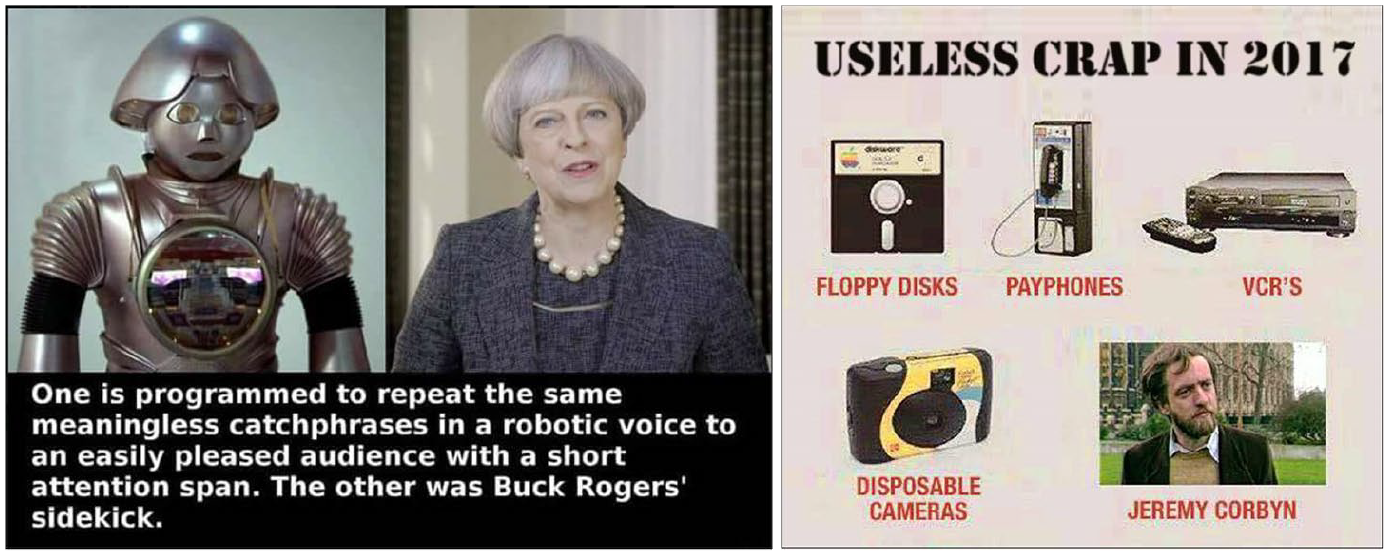
Anti-May and anti-Corbyn memes.
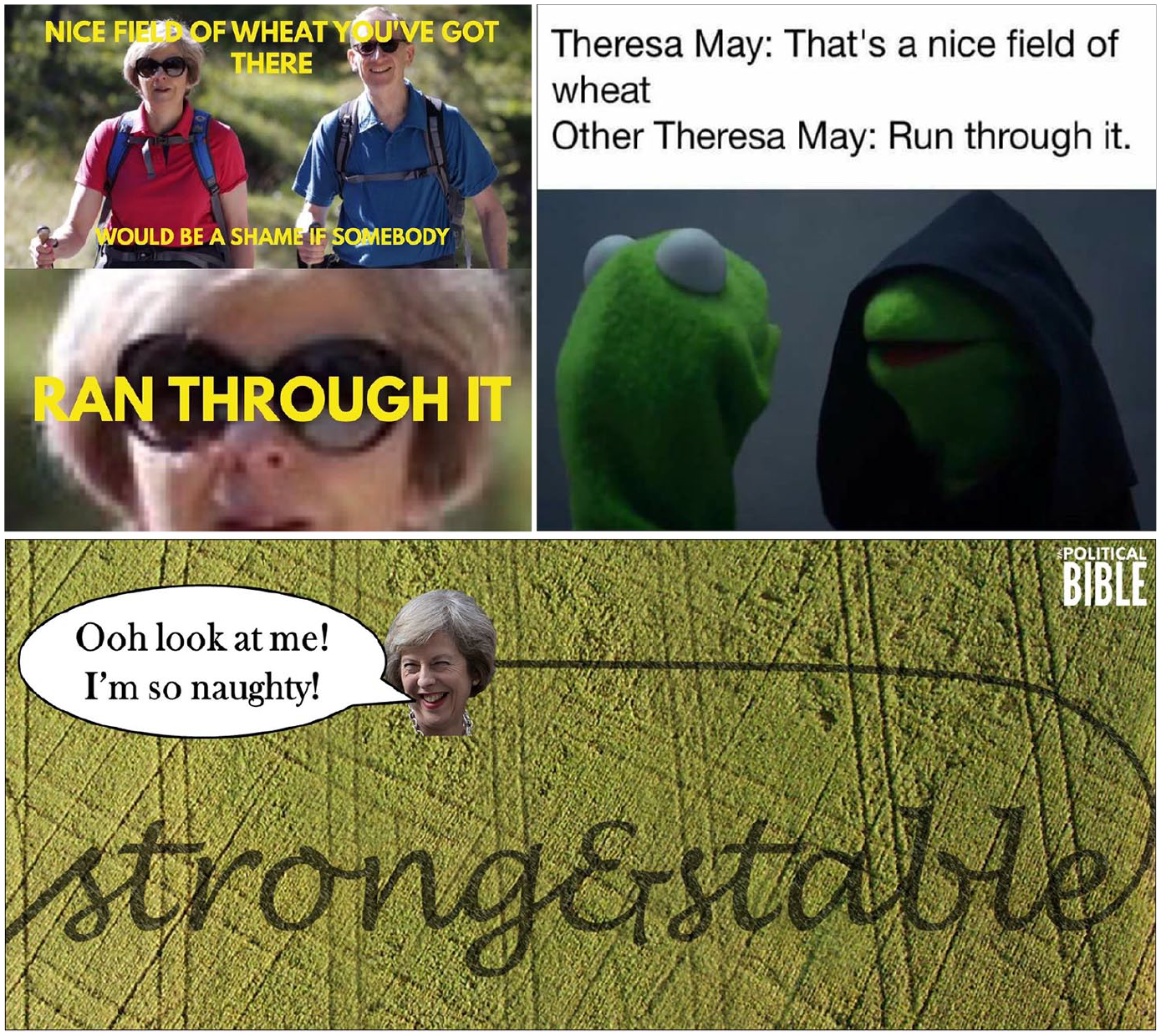
Selection of memes which referenced May’s ‘fields of wheat’ comments.
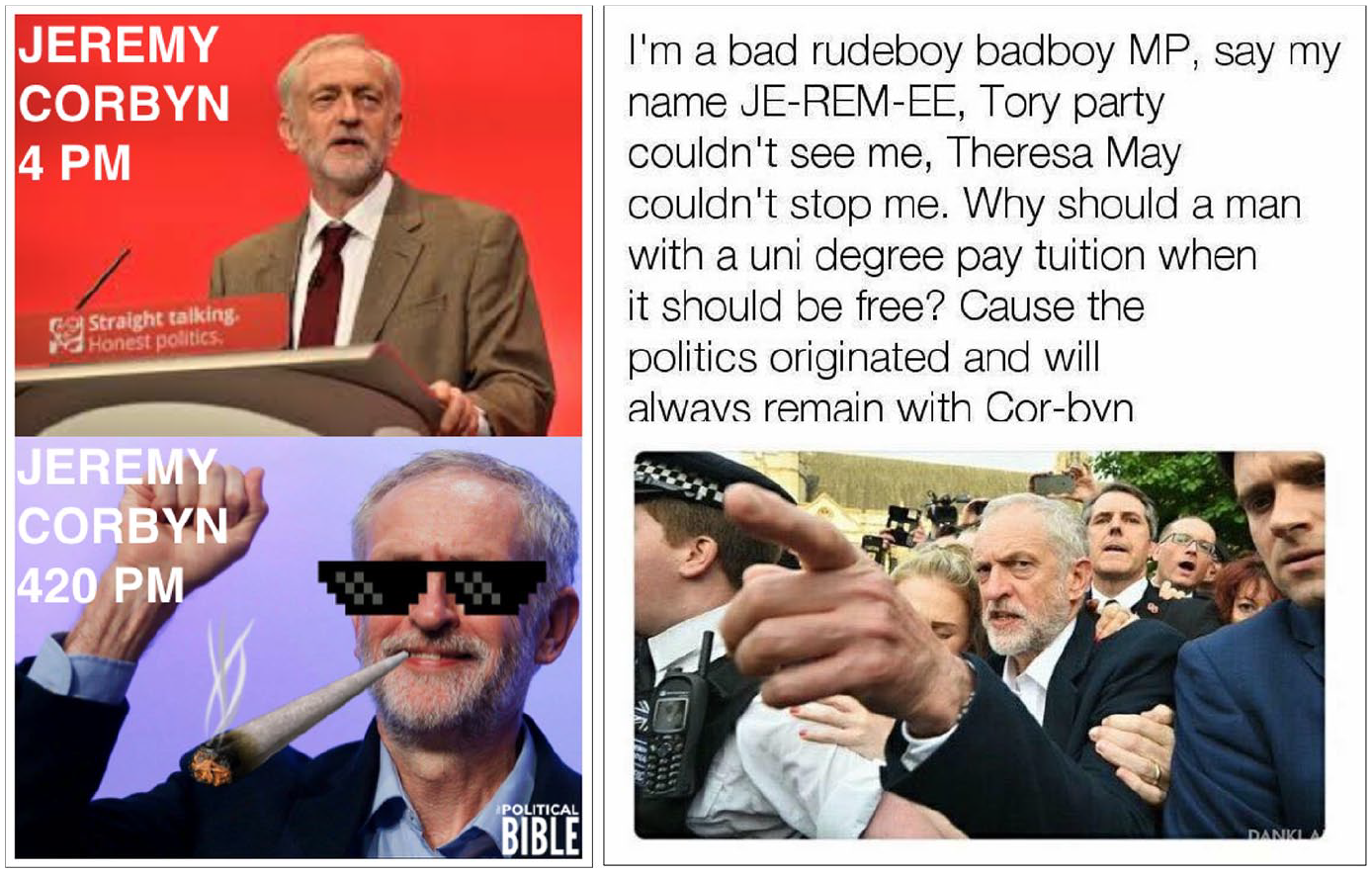
Memes suggesting Jeremy Corbyn is ‘cool’.
Studies of election coverage (Deacon et al., 2017) show that election news content largely focuses on electoral process and primarily features party leaders. This is also largely true within our meme dataset, with personalised content being the primary focus of almost half of the memes. However, and in direct reference to Research Question 4, although policy often was not the primary focus of the memes in the sample, many did contain policy information in some way. Overall, 78 memes (21%) contained reference to a policy which was actually being offered by parties at this election. Popular policies featured included Labour’s announcement of four extra Bank Holidays and the Conservatives so-called ‘dementia tax’. Furthermore, 11 (3%) urged people to vote. Memes with policy information received 159,513 shares throughout the campaign and 353,730 likes. Memes urging people to register to vote or to vote received 14,203 shares and 47,588 likes. One of these was an original video featuring rapper JME where he urged young viewers to vote, and it was viewed a million times before the election. These latter two types of post should not be written off lightly, due to the large numbers of people who likely saw this content. This could be important if we consider the work on low-information voters (Popkin, 1995) who typically rely on simple heuristics to inform themselves about politics. For these voters, even a small amount of political policy content can be significant in their decisions and seeing a meme that contained a real policy, particularly one shared by a friend, may facilitate an increase in their political knowledge, however small. The posts encouraging voting are significant when we consider the Bond et al. (2012) study which found that exposure to a Facebook post encouraging one to vote did increase a person’s propensity to engage politically.
However, overall, it must be noted that if one takes Seiffert-Brockmann et al.’s (2018) description of political memes as participation falling between ‘wasteful online play, political expression and cultural evolution’, wasteful online play is mostly in evidence here. Although difficult to measure, the vast majority of memes contained some element of humour and a large amount fell into the (again hard to measure) category of ‘shitposting’ – which can be thought of as ironically poor quality content (Griffin, 2016). Many young citizens who otherwise might have seen little political content may well have seen a little more due to the memes shared here, but they were fairly unlikely to have been any more informed about concrete policy from viewing them (Figure 7).
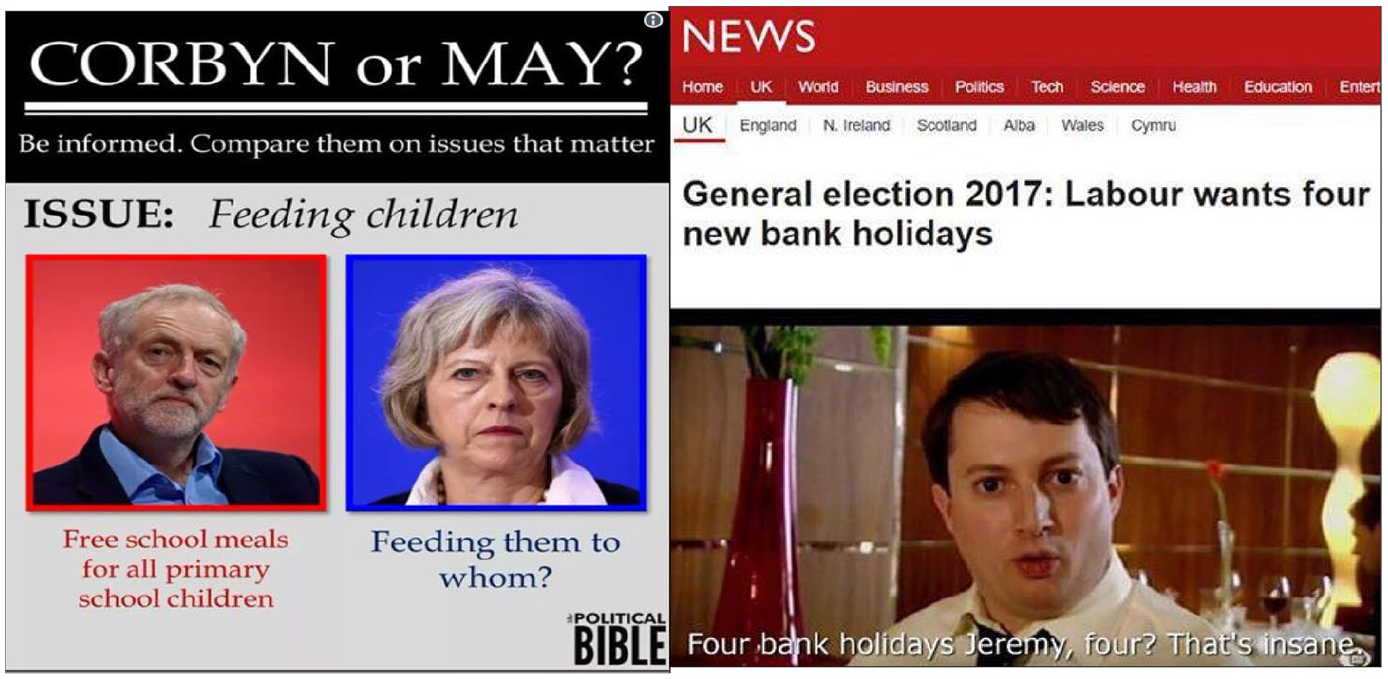
Two memes containing references to real party policies.
Discussion and conclusion
This article posed four research questions:
Regarding the first, the evidence here suggests that there was a high level of engagement with political memes during the campaign period. Thirty non-static memes (those based on videos or GIFs) received over 45 million views during the election. Altogether, the memes in this sample received over 6 million likes and almost half a million shares. For the static memes, it is hard to make estimates about how many people may have seen them, but it is likely, from assessing the video data here, that up to 10 times more people may have seen them than liked them. In answer to the first research question, then, there was indeed a high level of ‘low-threshold’ political engagement with political memes during the election period. If we take the broad definition that Dennis (2018) applies to e-participation, which would include liking and sharing online political content, it can be argued from the evidence here that memes precipitated a significant amount of extra e-participation here.
To answer Research Question 2, assessing who creates political memes as a specific type of e-participation, the vast majority of memes were citizen produced as we define it here. This does suggest that political memes are indeed a method via which citizens can participate in the political process in new ways. However, those produced by the pages themselves, or other media outlets or organisations (i.e. Momentum) received much higher levels of engagement overall. The memes with the highest amount of engagement were generally ‘elite’ made, with the highest viewed and shared content tending to be content produced by the social news pages themselves, rather than citizen-made content shared by them.
Still, because the memes here were overwhelmingly citizen-made, this is clearly one new way for citizens to express themselves politically and is seemingly a somewhat common outlet for political expression. To tie this back to the literature, this may well be a continuation of and an update to the ‘soft’ form of participation Endersby and Towle (1996) spoke of. However, it is hard to know the motives behind the creation of these memes. Are creators attempting to persuade voters, merely express their own views to their friends, or is tapping into a national event an attempt to go viral? More research is needed here with qualitative or survey research one way to assess these motivations. However, from one of the memes, it is clear that certain meme makers saw their role as persuading voters. In one meme, a stock picture of a diver on a boat trying to claw his way into the hull but being pulled back by an octopus. The diver was labelled with the caption ‘Tories’ the hull with the caption ‘election victory’ and the octopus with the caption ‘memes’. The clear implication here is that memes had hamstrung the Conservatives in the polls, at least in the opinion of the person who posted this meme, suggesting that at least some people posting political memes were motivated by trying to affect the outcome of the election.
Memes by creator.
In relation to Research Question 3, assessing whether memes can bring political content to those who might not otherwise have seen any, as pointed out above, the vast majority of these likes and shares came from people who had not opted into viewing political content by joining political memes pages but were those who had signed up for more general social news or non-political meme-based content. There were over 5 million likes and over a quarter of a million shares of political memes posted by non-political pages. There were over 37 million views of the election-related videos posted by these pages. More research is needed here to ascertain whether incidental exposure to such content has any impact on citizen’s viewpoints or whether viewers simply laugh, then carry on scrolling. However, the large amount of people who shared political memes from non-political Facebook pages suggests that this is not the case in a significant number of instances. In addition, with earlier research suggesting that small, passive, online actions (of which, sharing a political meme with friends can certainly be considered one) can lead eventually to more active types of participation (Cantijoch et al., 2016). The large amount of shares here from people who potentially had little prior interest in politics could have been the first step onto the ‘ladder’ for many young voters who otherwise might not have come into contact with much, if any, political content during the election. This also adds to the growing body of work on incidental exposure (Bode, 2016; Theocharis and Quintelier, 2014; Valeriani and Vaccari, 2015), providing an important counter-narrative to the echo-chamber narrative (Garrett, 2009) often applied to social media and politics. It is very likely from the evidence here that many Facebook users would have seen political content without opting into it, which is a significant finding.
In answer to Research Question 4, whether memes may increase political knowledge via content containing policy, humorous takes on politicians’ individual personalities or general comment on the election were more common as a primary focus of the memes than anything containing actual policy (Table 5). Nonetheless, around a fifth of memes did include reference in some way to a policy on offer at the election, and memes urging viewers to vote were shared almost 160,000 times. As one of the most common reasons a person votes is still simply that someone prompts them to do so (Brady et al., 1995), and as Aldrich et al. (2016) found that social media contact was an important mobiliser of turnout, particularly among young people, this latter figure is significant. Furthermore, any increase in political knowledge should not be dismissed, and as pointed out above, low-information voters often use heuristics when deciding who to vote for (Popkin, 1995), so this may have been an important resource for certain voters. Overall, however, the memes captured here were not substantively informative on policy.
Primary focus of memes.
Considering broader questions, there have been many studies recently suggesting an increase in political polarisation and furthermore an increase in emotion-driven politics (Abramowitz and Webster, 2016; Pattie and Johnston, 2016). On the evidence here, it may well be that memes are feeding into these trends. Only 16% here were non-partisan in their political leanings and some of them were highly personally condemnatory, including referring to the figures in them as ‘robots’, ‘useless crap’ and even one calling Jacob Rees-Mogg a ‘nonce’ – slang for stupid or worthless, in some instances related to the subject being a sexual predator. Recently concerns have been raised around social media and its impact on the tone of political debate (Papacharissi, 2015; Sunstein, 2018) and, although many memes were light-hearted and humorous, there may well be inducements for creators of memes to be more emotive and partisan, as literature suggests these are more likely to go viral (De Choudhury et al., 2012). This may well feed polarisation and affective politics.
There are also implications for parties here. Certain commentators have claimed that politics now often takes the form of a ‘networked revolt’ in which a loose assemblage of key figures and activists energetically shares posts on social media (O’Hara, 2016). Organisations such as Momentum have already successfully harnessed this new language of viral content into their campaigning activity (Chadwick, 2017), with most Momentum memes and videos urge viewers to ‘like and share’ (Lilleker, 2017). If parties could incorporate more of these elements into their own communications, they could perhaps attract the attention of younger viewers who, from the evidence here, are not averse to sharing political content they like. If parties could find clever ways to team up with social news pages, they could find new ways to reach and engage audiences. With the shock hung parliament result being attributed in some quarters to a ‘youthquake’ (YouGov; Sloam et al., 2018), coupled with the high number of views, shares and likes for these memes and the overwhelming anti-May leaning seen in the content here, memes, and the new patterns and textures of political engagement they produce, should not be overlooked going forward.
Footnotes
Appendix 1
Facebook pages these data were drawn from.
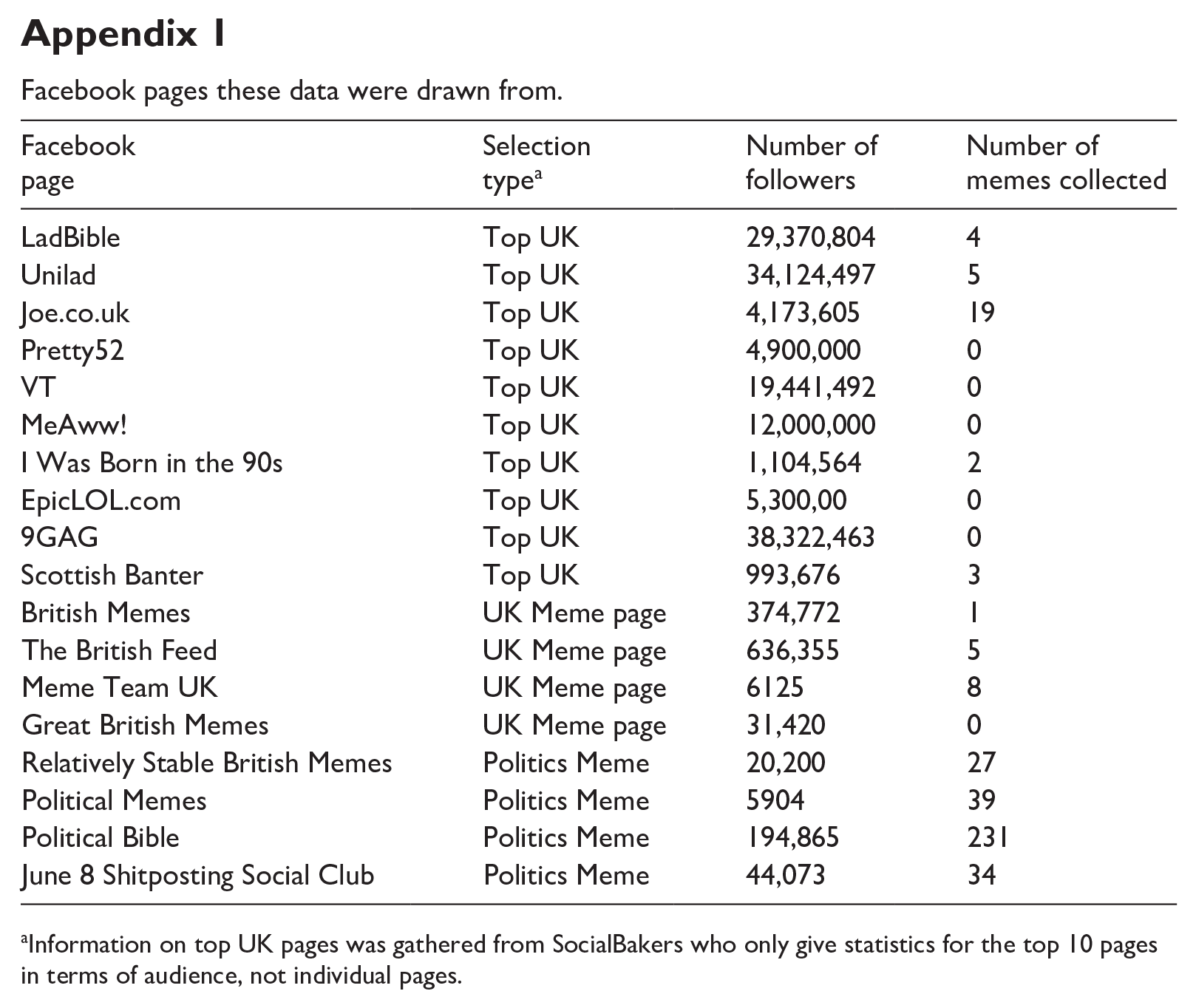
| Facebook page | Selection typea | Number of followers | Number of memes collected |
|---|---|---|---|
| LadBible | Top UK | 29,370,804 | 4 |
| Unilad | Top UK | 34,124,497 | 5 |
| Joe.co.uk | Top UK | 4,173,605 | 19 |
| Pretty52 | Top UK | 4,900,000 | 0 |
| VT | Top UK | 19,441,492 | 0 |
| MeAww! | Top UK | 12,000,000 | 0 |
| I Was Born in the 90s | Top UK | 1,104,564 | 2 |
| EpicLOL.com | Top UK | 5,300,00 | 0 |
| 9GAG | Top UK | 38,322,463 | 0 |
| Scottish Banter | Top UK | 993,676 | 3 |
| British Memes | UK Meme page | 374,772 | 1 |
| The British Feed | UK Meme page | 636,355 | 5 |
| Meme Team UK | UK Meme page | 6125 | 8 |
| Great British Memes | UK Meme page | 31,420 | 0 |
| Relatively Stable British Memes | Politics Meme | 20,200 | 27 |
| Political Memes | Politics Meme | 5904 | 39 |
| Political Bible | Politics Meme | 194,865 | 231 |
| June 8 Shitposting Social Club | Politics Meme | 44,073 | 34 |
Information on top UK pages was gathered from SocialBakers who only give statistics for the top 10 pages in terms of audience, not individual pages.
Funding
The author(s) received no financial support for the research, authorship, and/or publication of this article.
