




Abstract
Diplomacy is often presented as subordinated to politics as if it merely received politically willed ‘inputs’ to produce politically structured ‘outputs’. However, diplomacy often deviates from political instructions. It can even operate almost without any political considerations whatsoever. This observation gives rise to a sense that politics and diplomacy operate as two separate systems that are mutually dependent and yet simultaneously independent from each other. To illuminate this relationship, the present paper draws from Modern Systems Theory (especially Parsons and Luhmann) to argue that politics and diplomacy engage in double interchanges: (1) they stimulate each other through premises for actions like ‘foreign policy goals’, and (2) they implement each other such that diplomatic happenings can be booked as political successes and vice versa. The discussion section outlines how the autonomy of the two systems varies empirically – such as in the case of politically appointed diplomats – and how extreme cases of autonomous operations (apolitical diplomacy or adiplomatic politics) face negative sanctions.
Introduction
Imagine a Slovenian ambassador residing in Vanuatu for many years as part of their official diplomatic service. While the two countries lack even a minimum linkage – they are spatially distant from each other, no mutual trade ties exist and no compelling strategic rationale can be imputed behind Slovenia investing diplomatic resources into Vanuatu – it is not impossible to flesh out an imagined plot of diplomatic activities the Slovenian ambassador stationed in Port Vila, Vanuatu’s capital, will engage in across 4 or 5 years. She or he will likely request and receive official accreditation from Vanuatu’s Head of State (Vienna Convention on Diplomatic Relations [VCDR], 1961: Article 4). She or he will set up the official premises and register them at the local Ministry of Foreign Affairs (MOFA) in exchange for diplomatic inviolability (VCDR, 1961: Article 22). She or he will get to know the host state’s officials, socialize with the diplomatic corps, stay current with the local events and report back to their home MOFA (Jönsson and Hall, 2005: 73–75). The ambassador will attempt at projecting a good image of Slovenia (Melissen, 2005), perhaps organize an art exhibition with artworks from Ljubljana (Bleiker and Butler, 2016; Giustino, 2010), throw a reception party on the national holiday of Slovenia (Neumann, 2012: 18), take ‘selfies’ with various citizens whose language he or she learns (Saunders and Vessels, 2019: 437) and send out Tweets about these and other happenings through official social media channels (Duncombe, 2019; Haman et al., 2022).
Usually, the literature of International Relations (IR) foregrounds politics while invisibilizing diplomacy. The thought experiment does the opposite. It shows diplomacy while politics remains invisibilized. Both societal systems share a foundational commonality – a reliance on accumulated capacities of physical violence as segmented in ‘sovereign’ states. Politics centralizes power capacities to enforce collectively binding decisions. It does so not in a single world government but rather in a plurality of polities. As these polities need to interact, the system of diplomacy steps in with the function to minimize the risk of plural power capacities getting mobilized against each other. Politics would be impossible without the amassment of physical violence, while diplomacy would lose relevance in the absence of plural polities (Sharp, 2009). This common foundation renders it difficult to regard the two as distinct systems.
This difficulty is aggravated by the fact that neither can be imagined without the other; they seem ‘hopelessly interpenetrated’ (Gourevitch, 1978: 908). On the one hand, politics needs diplomacy. A modern polity is merely one among many equivalent entities. An international community that coordinates cross-border issues like rail transport, postal services, scientific collaboration, communication technologies and so on would not be possible without diplomatically negotiated treaties (e.g. Ayhan et al., 2022; Millwood, 2021; Pavlićević and Kratz, 2018; Sly, 1927). No state can totally shut its borders (Krasner, 2001), but every polity depends on a minimal degree of diplomacy if it wishes to thrive and survive. Even breakaway territories that lack legal recognition of their de facto statehood functionally engage in such external relations (McConnell et al., 2012). On the other hand, neither could diplomacy exist without politics – interstate interactions depend on politically centralized capacities of physical violence, for without the possibility of enforcing decisions, negotiations would be futile (Frazer and Hutchings, 2011; Hoffman, 2003). Power, the medium of politics, is a prerequisite for peace, the medium of diplomacy.
Given the difficulty in differentiating politics and diplomacy, much of IR does not treat the two as equally autonomous systems. A semantics that degrades diplomacy to a mere subpart of politics (‘international politics’) attests to this de-differentiating perspective (Waltz, 1996). 1 The default assumption is that states enact their external behaviour based on structural constraints – like military capabilities in theories of a balance of power (Mearsheimer, 2001), economic or other ‘rationalist’ cost–benefit calculations in explanations of interstate cooperation and war (Fearon, 1995; Krasner, 1976) or the distribution of an ideational friends/foe-distinction in constructivist thinking (Wendt, 1999). Such IR theories do not see a need to treat diplomacy as an autonomous variable. To them, ‘peace is fragile’, since ‘the politics of power turns on the diplomacy by which alliances are made, maintained, and disrupted’ (Waltz, 1988: 620). Other approaches add an intermediary between the structural variable and an observable outcome, usually in the form of national governments and other domestic players (Milner, 1997; Moravcsik, 1997) or in the form of a transcendental reason as enacted in a global public sphere (Mitzen, 2005). They may then analytically discover the existence of a MOFA, but they continue to devalue it to the mere application of political instructions. Diplomacy then serves as the subordinated ‘agent’ to the superior ‘principal’ of politics (Biedenkopf and Petri, 2019). And if diplomacy deviates, if external actors fail to linearly follow political variables, if a MOFA lacks ‘political loyalty and fealty’ (Loh, 2019: 12) – even then does the literature interpret the deviation as an outcome of a given polity’s internal dynamics. In effect, the source of non-linearity allegedly lies in the political system itself, the irritation is a corrupted politics, but politics nevertheless. Whatever the reasoning, the deviation will be attributed to a factor internal to political mechanisms, political organizations and political actors (e.g. Arel-Bundock et al., 2015; Chappell and Guerrina, 2020; Kesgin, 2020; Skovgaard Poulsen, 2014; Yarhi-Milo, 2018) and not to the autonomous dynamics within a system of diplomacy that operates separately from the logic of politics.
Diplomacy, thus, is merely squeezed within a scheme of a before-and-after, between a politically determined will in the ex ante and a politically constrained outcome in the ex post. The in-between, which is diplomacy, remains muted. Whatever diplomacy ought to achieve is then not interpreted as the result of diplomacy itself but rather as the result of something external to it – be it a hegemon, be it an economic benefit or be it a national coalition of specific interests (e.g. Bermeo, 2017; De Mesquita and Smith, 2009). The usual IR lens thereby implies a conceptual dominance of politics in the international realm where diplomacy is silenced such that it poses mere irrelevant ‘noise’ in the in-between of a political input and a political output. Our ambassador in Vanuatu resides in a blind spot.
However, evidence that the in-between irritates has mounted greatly with recent scholarly trends (cf. Froitzheim et al., 2022). Politics forms a will, articulates a foreign policy goal, elevates it into a national interest and issues an instruction – but diplomacy deviates from it. Such deviations may sometimes grow into spectacular episodes that fundamentally question the political system’s ability to steer its personnel of external statecraft. In times of interstate tensions, the political target may be to fuel the animosities further, but diplomatic intermediaries will secretly negotiate rapprochements to the detriment of their home governments’ official policies. Examples include the Habsburg empire’s ‘Sixtus Affair’ during the First World War when the confidents of Emperor Charles I. of Austria-Hungary secretly negotiated a peace agreement without the knowledge of the competent ministers at both home and in allied Germany (Hopwood, 1968). Another reflection of this dynamic is visible in Henry Kissinger’s covert visits to the People’s Republic of China, during a period when it seemed unthinkable that the United States would establish official ties with a Communist country. These were highly ‘dramatic event[s]’ of diplomacy that, for politics, ‘occurred in near obscurity’ so as to avoid controversies among the elite circle of policymakers (Kissinger, 2012: 236). Diplomacy almost seems to subvert political goals (Wiseman, 2022), and while such episodes may seem like mere accidents that can be repaired quickly, such as through tighter political controls over the diplomatic apparatus (Neumann, 2012: 110–111), the invisibilized in-between has already made itself visible.
And a heterogeneous literature has come to focus precisely on this invisibilized-but-visible in-between, on how diplomatic encounters comprise self-organizing dynamics that, if noticed by the political system, present themselves as unplanned irritations, as ‘agency against the odds’ (Hendrickx, 2021: 1809). Studies in the European Union’s multi-state and multilevel governance attest to that (Adler-Nissen, 2014; Wright and Guerrina, 2020) because the process of ‘Europeanization’ is puzzling to the default understanding of states wanting nothing but to preserve sovereignty at all costs. European Union (EU) bodies often reach binding agreements even in issues where multiple parties see their ‘national interest’ threatened, with diplomats not vetoing even if they thereby violate official guidance (cf. a case study on the EU’s Local Elections Directive by Lewis, 1998). Investigations of micro-level interactions have uncovered how diplomats secretly deviate from their MOFA’s instructions when they prefer their personal view of inter-state peace to the official policy of power-assertion (cf. the case of a French Consul General in Jerusalem indulging into illegal activities with the goal to enact more amical relations with Israel, by Abramson et al., 2022). Or they highlight how multilateral settings follow self-reinforcing mechanisms beyond political control (Pouliot, 2016). Or they foreground how ambassadors yield social media accounts to contact thousands of followers directly (see a case study of the influencer-ambassador Michael McFaul by Cooper and Cornut, 2019) to the suspicion of their home MOFAs (Adler-Nissen and Eggeling, 2022: 655). Even aggregate data show seemingly ‘irrational’ patterns of embassy ties hint at a certain autonomy of diplomacy – that is, ‘irrational’ from a political, power-oriented viewpoint (Duque, 2018; Kinne, 2014). These studies all show that ‘diplomacy is a socially emergent phenomenon and as such it produces effects of its own on world politics’ (Sending et al., 2015: 17). They demonstrate how diplomats follow a rationality that differs from the rationality of national politicians (Putnam, 1988: 460), how they follow background ideas that are to be distinguished from the ones of policy entrepreneurs (Kornprobst, 2019), how they follow not a raison d’état but a raison de système (Sharp, 2009: 10). ‘Diplomats have, after all, a responsibility to the international order as a whole as well as to the particular states they serve’ (Sharp, 1995: 829). The literature thus gives rise to a sense that instead of one, there are two rationalities (and not: a single political rationality that is merely corrupted sometimes), that instead of one (political) system, we may be dealing with two separate (a political and a diplomatic) systems. 2
The fictitious case of the Slovenian ambassador in Vanuatu likewise hints at the autonomy of diplomacy, if merely in the form of a thought experiment. There is no hegemony involved there, no foreign power to be balanced against, no economic variables that seem worthwhile to consider, no concrete instructions that the principal-government sends out to the agent-ambassador, no convincing semantics of a passionate inter-state amity – nothing that might explain why Slovenia invests so many diplomatic resources into Vanuatu. And yet, even in the absence of any imminent political variables, there is ‘diplomacy’ taking place – even for many years. The thought experiment tells us that ‘diplomacy works in the absence of domestic audiences [and other political variables]. It works precisely because it is so valuable’ of its own (Sartori, 2002: 122). Does it mean that diplomacy, which is fundamentally dependent on politics, can actually operate without politics?
The present article tackles the paradoxical observation of the mutual dependence and independence between politics and diplomacy. It does so by drawing from the modern systems theoretical concept of a ‘double interchange’ (Luhmann, 1999: 154–172; Parsons, 1967), arguing that two lanes of exchange couple politics and diplomacy together so that they can build up mutual autonomy. The following outlines the systems theoretical premises before the section thereafter presents the ‘double interchange’ between politics and diplomacy. Finally, the concluding section discusses the degree to which mutual independence holds in reality (such as with regard to politically appointed ambassadors, or with regard to the international recognition of national governments), and how and why the two systems tend to invisibilize their mutual autonomy.
Two Mutually Dependent and Independent Systems
Basic Premises
Modern systems theory (Luhmann, 1995, 2012) premises that society is differentiated into various sub-systems – such as economics, education, religion, law or, to name the focus of this paper, politics and diplomacy (Buzan and Albert, 2010). They are defined by their respective function and medium. The political system carries the function to enforce collectively binding decisions and does so by enacting communications under the medium of power, while the diplomatic one has the function to mitigate the risks of war given the plurality of multiple power centres, and it achieves this function by communicating under the medium of peace. The system’s media (power and peace) are operationalized in binary codes; that is, politics differentiates the world along the code of powerful/powerless, while diplomacy does so along the code of peaceful/non-peaceful.
Function, medium and binary code – these are the three prerequisites with which systems operate autopoietically based on the system/environment distinction in a circular structure of self-reference. In other words, a political operation is a response only to a political operation, and will, in turn, prompt a further political operation – while diplomatic peace communications follow other peace-mediated communications so that diplomacy does nothing but enacting an endless chain of peace-communications. ”It cannot import any operations from its environment” (Luhmann 2013: 77). For instance, a bilateral negotiation (in the medium of peace) is followed by a state visit (in the medium of peace) where a state award is gifted (in the medium of peace), which is reported in official social media and press releases (in the medium of peace). As an autopoietic system, diplomacy “continuously generates and specifies its own organization through its operation as a system of production of its own components, and does this in an endless turnover of compoennts under conditions of continuous perturbations” (Maturana and Varela, 1980: 79). The basis of this is the systems/environment-distinction, meaning that diplomacy observes happenings in the external environment (negotiations, visits, award bestowals, press releases) and imbues them with system-internal dynamics (the medium of peace, the binary code of peaceful/unpeaceful).In the extreme, systems would form self-referential tautologies. They would observe the environment symmetrically in the sense that the system treats every single happening in the environment as internally relevant. But if everything in the complex, noisy environment is relevant, then, given a system-internal event, the next, subsequent event would be completely unpredictable – and if everything is fully unexpected, the system suffers from entropy (Shannon, 1951). As a safeguard against this entropy, systems build up structures to direct their attention only to specific environmental cues, to generate different degrees of expectancies and to become indifferent against much of the noise in the environment. In other words, systems create asymmetry (Luhmann, 1995: 192) to deal only with selected signals from the outside so that observers know that an election is ‘political’, a press conference by a party leader is ‘political’, the new bill to be passed through parliament is ‘political’, a protest movement against the planned construction of a nuclear reactor is ‘political’ – but the choice of my spread for tomorrow’s breakfast is most likely not a topic for ‘political’ communication (and a diplomat tying their shoes usually does not engage in a ‘diplomatic’ communication thereby; cf. Adler-Nissen and Eggeling, 2022: 643). A system (here: the political system) structures the relevance of environmental happenings based on its internal logic, thereby lowering its entropy and mobilizing itself towards asymmetry and negentropy.
Structural Couplings
One technique with which systems asymmetrize themselves involves the creation of ‘structural couplings’ (Luhmann, 2012: 54) to other systems in their environment. A structural coupling offers an institutionalized channel between two systems, a channel so highly focused that the systems can afford greater indifferences towards each other in all other settings other than that structural coupling. By default, systems are autonomous as indicated by their indifference towards their environment. Systems cope with environmental complexity by filtering out much of it as irrelevant noise. For instance, diplomacy does not need to accept political strategies as a premise for its internal communications. Instead, it can allow states to interact with each other without basing these interactions on any political power considerations (Faizullaev, 2013). As the tale of the Slovenian ambassador in Vanuatu illustrates, diplomacy inherently transcends the political system’s code of powerful/powerless (Luhmann, 2010: 301–313). But a structural coupling can generate a highly specified inter-system focus, allowing permanent mutual influences between two systems.
Some examples of structural couplings between politics and other societal systems have already been outlined in the systems-theoretical literature (King and Thornhill, 2003: 44–45; Luhmann, 2002: 373). An obvious case is the political system’s coupling to the legal system: politics uses political institutions following political elections and political deliberations so as to generate laws which are then further processed not within politics, but now within the legal system. Courts then issue judgements according to the legal system’s internal code of lawful/unlawful, and not under the political medium of powerful/powerless, despite the laws’ origin in the political system. At the same time, political activities see themselves bound by the very laws they created – and if they deviate from the ‘rule of law’, politicians have to subordinate themselves to the consequences of constitutional violations, such as the nullification of legal statutes, or the impeachment of a President. In other words, there are specific legal consequences, alongside political ones, suggesting an interplay of two distinct (but deeply intertwined) systems. Other examples of structural couplings include taxes (coupling politics together with economy), high-level press conferences (coupling politics together with the system of mass media), or expert commissions and think tanks (coupling politics together with the system of science).
What is less explicated is the structural inter-system link between politics and diplomacy. One may assume that the ‘foreign policy goal’ offers such a structural coupling. The political system formulates foreign policy goals and passes them on to the diplomatic system. Thereby, the political system irritates diplomacy which, in turn, transforms this external irritation into system-internal information (energy) so as to stimulate itself towards negative entropy. Diplomacy can thereby afford greater indifference towards everything else political: a diplomatic apparatus does not have to react to every local election in the home country, does not have to respond to a speech on educational measures by an opposition politician and does not have to mobilize resources when people set up protests against a new dam. Diplomacy can safely ignore them, it does not have to suffer from constant irritation from politics, as long as it focuses on the structural coupling of institutionalized foreign policy goals. Diplomacy ‘cares about the domestic [political] system insofar as it is useful for [its own] purpose’, but most of the time politics is an ‘irrelevant [variable]’ (Gourevitch, 1978: 881). It only becomes more vigilant towards politics when new information is passed along the channel of the structural coupling – that is, via foreign policy goals. 3
Towards Double Interchanges
However, the linkage between the two autonomous systems is not unidirectional, as in the sense that diplomacy would be the mere implementation of politics. Such a view would not capture the full dynamics of the complex intersystem relationship, and it would render diplomacy hierarchically subordinate, implying that politically generated meanings pass on to diplomacy without any distortions. Instead, as Talcott Parsons (1967: 260) mused in his theory of society, the couplings between two systems tend to be bidirectional. Across systems, he conceptualized two lanes of exchanges or a ‘double interchange’ in the sense of a reciprocal movement of inputs and outputs. Luhmann (1999: 167–169) generalized this proposition by stating that systems mutually asymmetrize and implement each other. There are, thus, two different systems that generate their own meanings regarding external phenomena based on their respective internal structures. If the concept of the double interchange applies to the present context as well, then what is it that is being exchanged between politics and diplomacy?
The Double Interchange between Diplomacy and Politics
The present premise, to repeat, is that without politics (and other systems which the present analysis blends out), diplomacy would simply be tautological, self-referential and inefficient. And without diplomacy (and other systems which the present analysis blends out), politics would senselessly centralize physical violence without guidance as to when and how to use it. Both systems would expose their mere self-referentiality, gradually moving towards a state of entropy in which every element would be equally symmetrical without any structured channellings. Selectively generated irritations (internally transformed into information) allow systems to asymmetrize themselves so as to escape their fundamental self-referentiality. These structural couplings consist of two lanes of exchange, or a double interchange with which politics and diplomacy mutually stimulate and implement each other (cf. Figure 1). But what is it that is being exchanged across the two systems?
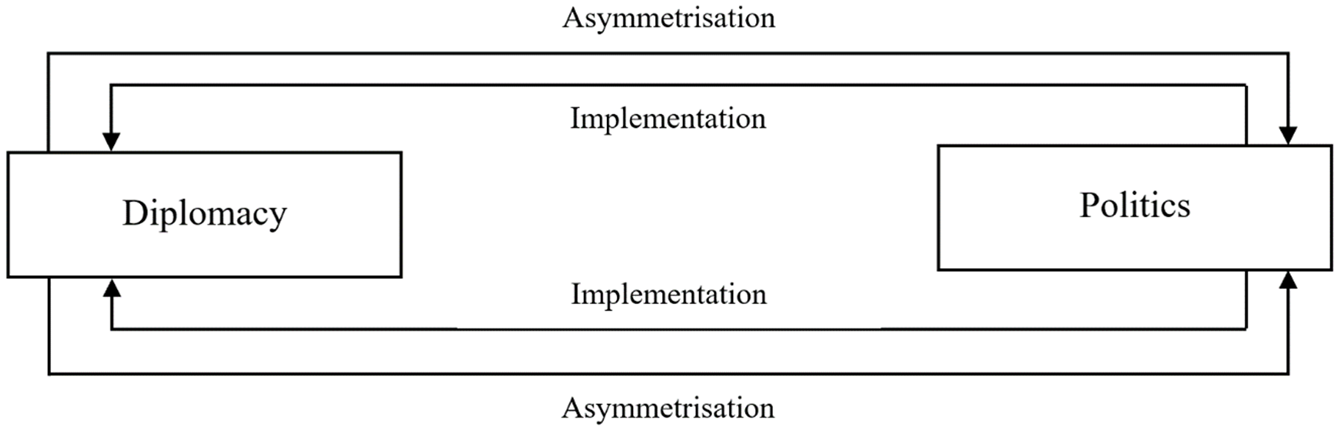
A Schematic View of the ‘Double Interchange’ between the Diplomatic and the Political System. They Mutually Stimulate (Asymmetrize) and Implement Each Other.
First, politics asymmetrizes diplomacy. It does so in the form of (political) premises for (diplomatic) actions or ‘foreign policy goals’. They may be visible as situationally concrete instructions or as broad strategies of a ‘national interest’. With the foreign policy goal, politics irritates diplomacy which, in turn, transforms this external irritation into internal information. But the system of diplomacy processes this information according to its own rationality – it may reinterpret political instructions in a diplomatically feasible manner. The foreign policy goal may have been formulated with the political code of powerful/powerlessness or government/opposition in internal struggles among national parties – but diplomacy cleanses the foreign policy goal from all these political correlates and instead imbues it with its own internal codes (such as peaceful/non-peaceful, amity/enmity or sovereign/non-sovereign).
In exchange for this asymmetrization, the diplomatic system allows itself to be observed as the implementation of politics. Anything diplomacy does can be booked as a political success. Diplomacy is thus the realization of political power. Whatever the diplomatic happening, observers may infer that politics had activated its power resources, had formulated a foreign policy goal that was behind that diplomatic happening, upholding the political fiction of an omnipotent decision behind every single event. Every diplomatic happening can then be treated as a political success, as politically directed, as politically willed. This is even true if diplomacy acted without any foreign policy goal whatsoever. For instance, the (diplomatic!) ambassador in Vanuatu may initiate an art exhibition based on her sole idea, and yet, a (political!) Minister at home who had no actual knowledge about that art exhibition can later claim this to have been done under his reign. The politician receives applause for a diplomatic happening because the systems allow diplomacy in its totality to be depicted as the application of political instructions.
The second lane of exchange exhibits an inverse dynamic. Diplomacy asymmetrizes politics in the form of premises for the activation of political structures. Politics then reacts to diplomatic outcomes, such as by ratifying a diplomatically negotiated treaty, by accrediting a foreign ambassador or by ‘borrowing’ leading politicians for high-level summits. Phenomena may again change their meaning when they pass across the systems. While diplomacy may regard a treaty as a symbol of inter-state peace, the political system may imbue that same phenomenon along its internal code of government/opposition – such as when opposition politicians accuse the government’s treaty negotiator of having been influenced by corrupt lobbyists. Whatever the specific issue, politics accepts an external (diplomatic) premise for internal (political) action, thereby enabling itself to be asymmetrized for further operations.
In exchange, politics implements diplomacy. It does so by lending to diplomacy the political medium of power, or the capacity of enforcement. When a ‘president threatens countersanctions or [when he or she] promises increases in foreign assistance’ (i.e. a diplomatic communication), then these threats or promises ‘require legislation’ (i.e. a political implementation) (Martin, 1993: 412). Diplomacy obtains credibility through the political medium of power, without which inter-state negotiations would be futile as every diplomatic occurrence would be nothing but non-enforceable ‘cheap talk’. 4 But diplomacy is indeed enforceable – an enforceability that operates via political structures: ‘the aim of peace [cannot] be enforced . . . without the threat of war’ (Hippler and Vec, 2015: 15). And it is because of this that not only can diplomacy be presented as the implementation of politics, but also vice versa, politics as the implementation of diplomacy.
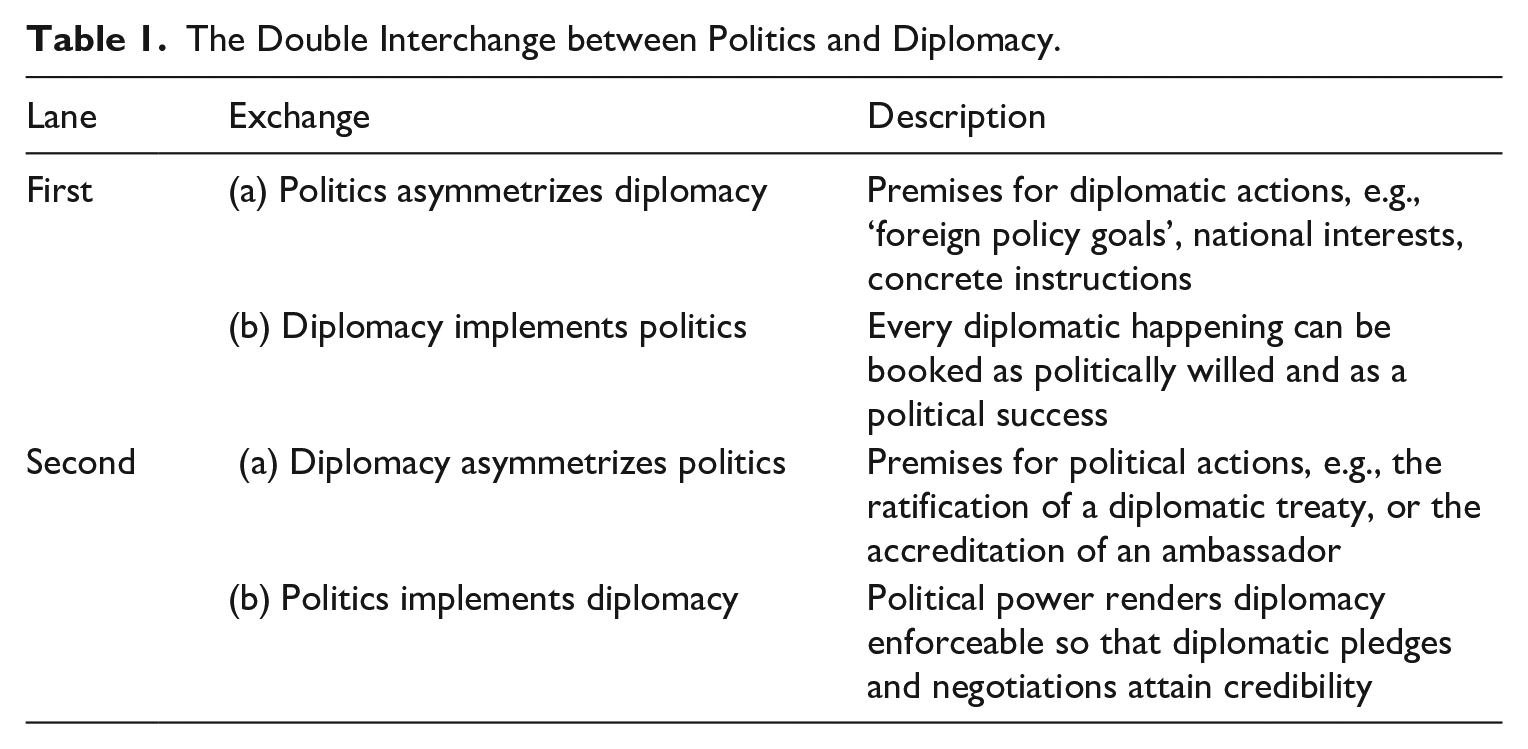
One may exemplify the double interchange (cf. Table 1) by extending the fictitious case of the Slovenian ambassador in Vanuatu:
(1a) Politics asymmetrizes diplomacy: Based on a newly formulated ‘national interest’, the Slovenian parliament asks the national government to engage in public diplomacy among Pacific islands, demanding that there be a Slovenian ambassador in Vanuatu.
(1b) Diplomacy implements politics: Diplomacy obeys and sends an Ambassador to Vanuatu. There, she engages in cultural diplomatic activities, such as by pledging to grant an annual stipend for three students from Vanuatu to study in Slovenia.
(2a) Diplomacy asymmetrizes politics: The draft bilateral treaty establishing the annual student exchange between Vanuatu and Slovenia is processed through the competent Ministries and sent to the Slovenian parliament for ratification.
(2b) Politics implements diplomacy: Politics budgets the annual stipend for the two exchange students and tasks an official agency to implement this new bilateral student exchange programme under the supervision of the Ministry of Education. The diplomatic communication of the ambassador in Vanuatu was therefore backed up with political capacities for enforcement. – In the end, the diplomatic promise was fulfilled through political implementation.
In sum, the conceptual lens of double interchange allows one to see how diplomacy and politics both mutually asymmetrize (de-tautologize, energize, stimulate, irritate) and implement each other. It refutes the lens of a hierarchical subordination whereby diplomacy merely applies political instructions, or whereby politics consists of purely reactive impulses to international structures. The systems-theoretical lens analytically upholds the mutual dependence of diplomacy and politics by acknowledging their common foundation – the existence of plural power-backed polities – while simultaneously underlining how the systems autonomously generate their own meanings vis-à-vis the same phenomena.
The Double Interchange between Politics and Diplomacy.
Discussion
This article started with the observation that diplomacy and politics are not to be described in terms of identity but in terms of a difference. Diplomacy is not merely a receiver of politically commanded inputs for which it linearly produces a politically willed output. Instead, as the thought experiment of a Slovenian ambassador in Vanuatu illustrated, diplomacy can operate largely independent of politics. The two realms form separate systems that are mutually independent (because they process internal meanings based on their own respective structure) and yet dependent (they could not exist without each other). In its autonomous operations, diplomacy is thus not hierarchically subordinated to politics but a system that can be analytically treated on an equal level like politics. The Parsonian concept of ‘double interchange’ indicated how one may think of the relationship between the two systems: politics and diplomacy mutually energize each other, in exchange for which they allow themselves to be seen as implementing each other’s commands. Crucially, this relation is bidirectional: not only does politics stimulate diplomatic actions (through foreign policy goals and other instructions) but so does diplomacy channel communicative flows through political structures (such as when a diplomatically negotiated treaty calls for ratification through political bodies). And not only does diplomacy implement politics (so that any diplomatic occurrence may be treated as a politically willed outcome) but so does politics implement diplomacy (in the sense that political power always backs up the enforceability of diplomatic promises).
This article thus translated the self-referential dynamics of diplomacy, as demonstrated by much of the ‘practice turn’ and related strands of the IR literature, into a systems theoretical terminology. The ‘principals’ of diplomacy are political bodies and actors outside of diplomacy (Youssef, 2020: 305). And not only do politicians demand specific performances from diplomacy, but also vice versa so that diplomacy may likewise be regarded as a ‘principal’ to politics. The finding also resonates with the field-centric literature as ‘power’ is understood not in the traditional hierarchical constellation from a ‘top’ to ‘bottom’ anymore (with politics at the peak and diplomacy at the subordinate) but that it is rather processed in two different systems based on autonomous, system-internal logics (Adler-Nissen, 2013; Pouliot, 2016).
This article’s theoretical approach premised a certain purity in the differentiation between politics and diplomacy. One could certainly extend this premise to further analyses, such as regarding the semantic distinctions between hard power (politics?) versus soft power (diplomacy?), between costly signals (politics?) versus cheap talk (diplomacy?), or between internal sovereignty (politics?) versus external sovereignty (diplomacy?) – and the paradoxes inherent to each distinction (e.g. Bially Mattern, 2005) could be unfolded via the differentiation between politics and diplomacy.
However, perhaps the differentiation is not as pure in reality as it is in theory. Instead, mutually differentiated systems may harbour residual legacies from an undifferentiated past. For instance, diplomacy’s usual logic is to condition actorness on the recognition of each other’s external sovereignty (the diplomatic level) and not on the international recognition of specific governments (the political level). ‘Diplomats will represent whatever is there and in need of representation’ (Sharp, 1999: 54). However, there are instances when diplomacy deviates from this normal pattern – such as when states refuse to communicate with the Taliban government in Afghanistan (Grant, 1999) or when European countries enacted sanctions against Austria’s right-wing coalition in 2000 (Merlingen et al., 2001).
A related issue that exhibits a de-differentiating dynamic is politically appointed ambassadors. The default expectation is that diplomatic bodies recruit members and decide on their careers autonomously based on internal procedures (Heilbronn and Lequesne, 2012). However, many countries still allow political executives to appoint non-professionals to ambassadorial posts (Erlandsen et al., 2022). In the United States, for instance, ‘the allocation of ambassadorships has fluctuated around 65% careerists and 35% political appointees’ since 1960 (Haglund, 2015: 658). Other rulers, like Suharto in Indonesia, deploy small elite networks of confidents to conduct far-reaching diplomatic initiatives, thereby circumventing the formal structure of the MOFA (Nair, 2022; cf. Süleymanoğlu-Kürüm, 2021). But this ‘political capture’ seems antithetical to a key principle of diplomacy, namely the principle that ‘[t]he career diplomat is supposed to serve the state before serving a ruling party’ (Lequesne, 2021: 2). In both instances, in both the international recognition of governments (rather than sovereign states) and the politically appointed (rather than internally recruited) diplomats, observers treat these issues with a certain hesitation, doubt and uneasiness (Hollibaugh, 2015: 449; Malis, 2021; Peterson, 1983). And this uneasiness may further indicate society’s tendency towards differentiating politics and diplomacy.
The hesitating doubt that accompanies de-differentiated phenomena may inspire further research. For instance, one could investigate the extent to which the mutual dependency of politics and diplomacy is institutionalized, or – from another perspective – the extent to which their mutual independence is invisibilized. The tale of the Slovenian ambassador in Vanuatu is not impossible but unplausible and therefore improbable (cf. Teo and Koga, 2022). The thought experiment forms an extreme case of an autonomous operation of diplomacy, a case that is so apolitically power-free that it might even face adverse consequences. When diplomacy operates almost without politics, observers may raise mistrust against that bilateral post. This mistrust would be even more pronounced if the sending country would not be small Slovenia but rather a rising power like China. 5 Suspicions about covert uses of that implausible embassy, such as for military strategies or intelligence-gathering, may be a likely consequence. It is not impossible to believe that accusations against Confucius Institutes and ‘panda diplomacy’ (Hartig, 2013; Huang and Wang, 2020; Huang and Xiang, 2019) can be rooted in this systems-theoretical concept. 6 And if this holds true, then Ramy Youssef’s (2020: 272) proposition of a system of world politics internally differentiated into the three realms of diplomacy, military and intelligence may find empirical positivization in this mistrust. The activation of (espionage- or security-related) mistrust might prevent diplomacy from deviating too much from power-political considerations – which further reduces contingency (and thus, entropy). What is more, diplomacy may in itself harbour internal mechanisms for sanctioning ‘power-free’ activities, such as by regulating the careers of diplomats so that the ones who are politically most astute are promised more prestigious posts (again, this is merely a hypothesis which asks for empirical validation in future research).
In turn, one may assume that politics likewise faces mistrust and sanctions when it fails to adhere to diplomatic demands. Polities that renounce diplomacy risk retaliations and isolation. North Korea presents an example (Kim, 2014); and it might explain why de facto states like Transnistria still seek active cooptation of external partners despite their lack of recognized sovereignty (Pacher, 2020). If Slovenia, for instance (to pick up the thought experiment from earlier in this paper), did not implement the diplomatic pledge of the annual stipend for three students from Vanuatu, then Vanuatu may withhold its support for Slovenian initiatives in international organizations. In more salient cases, the repudiation of diplomatic pledges may spawn further negative sanctions as channelled through bottom-up activist pressures (Keck and Sikkink, 2014), through legal proceedings against sovereign polities and their leaders (Glasius, 2006), or through conflictual reprisals from other polities confronting the norm-transgressor, if not through outright war. In brief, the hypothesis is that apolitical diplomacy raises mistrust, but adiplomatic politics does too.
This observation raises the question: if diplomacy and politics form autonomous systems, then why do they institutionalize adverse consequences when their mutual independence becomes too visible? One may tentatively assume that this negative sanction invisibilizes the central paradox of the systems’ relation, namely the paradox of the simultaneous dependence and independence, the paradox of diplomatically constituted politics that in turn constitutes a politically constituted diplomacy (Wendt, 2015: 260). The concept of the double interchange aids in making this ‘peace-and-power-paradox’ (Nishikawa-Pacher, 2021) visible – and it unfolds the paradoxical relation by differentiating it into mutual exchanges between two autopoietic systems.
Footnotes
Declaration of conflicting interests
The author(s) declared no potential conflicts of interest with respect to the research, authorship and/or publication of this article.
Funding
The author(s) disclosed receipt of the following financial support for the research, authorship, and/or publication of this article: This work was supported by a DOC Fellowship of the Austrian Academy of Sciences. In addition, Open Access funding was provided by University of Vienna.
Notes
Author Biography
 .
.