




Abstract
If a diplomatic cocktail party lasts two hours, does it equal the duration of peace? Or are there less simplistic conceptualizations of ‘peace’ and ‘time’ for the theorization of diplomatic practices? This article draws on a concept of temporality based on an irreversible before/after distinction, and combines it with the modern systems theoretical premise that every event within the diplomatic system occurs under the medium of peace, finding that: (a) peace is not a state of affairs, but a medium of communication; (b) peace has no chronometric duration, but it is temporally minimal, vanishing as soon as it appears; (c) peace needs constant reproduction, i.e. the system of diplomacy regenerates itself by continuously triggering further peace-mediated events; and (d) peace is both negative and positive, as it denotes a restraint of violent capacities but needs active communication. These insights offer a universal concept of ‘peace’ that is abstract enough to cover every interpolity tie. They also suggest further research opportunities, including into what the rapid acceleration of society means for the proliferation of ever-quicker, ever-more-trivial diplomatic practices.
Introduction
When is peace? Or what is time and what is peace? In international relations, time is usually treated as a duration, meaning that temporality is measurable with clocks and calendars in a linear regularity of hours, years or decades (e.g. Drezner, 2021). But is this chronometric understanding helpful for approaching practices of peace, that is, for approaching diplomatic happenings? How useful is it to know that an average diplomatic cocktail party lasts two and a half hours? And if diplomatic practices signal a commitment to restrain violent forces – or, in other words, if peace is enacted practically (Adler-Nissen and Pouliot, 2014; Richmond, 2009; Sending et al., 2015) – then can one say that the world indulged in interstate peace for two and a half hours during that cocktail party? Is this the temporality of peace?
Or is peace not a practice but rather an objectively ascertainable state of affairs? Peace then would not be instantiated by a diplomatic cocktail party just to vanish thereafter. Instead, it would indeed exhibit a duration measurable with clocks, regardless of the number of diplomatic parties that take place.
This understanding of peace as a state of affairs is the default one in international relations – be it in a ‘negative’ approach denoting nothing but the factual absence of violent conflicts (Richmond, 2020: 15), or in a ‘positive peace’ definition (Galtung, 1969) 1 that additionally demands qualifying criteria such as democratic institutions (Lederach, 1996), gender-equality values (Davies et al., 2017) or policies aiming at environmental sustainability (Simangan et al., 2021).
This article proposes a view of peace not as a state of affairs but as a medium of communication that immediately vanishes as soon as it appears. As such, it is temporarily minimal because it is constituted as a single happening, regardless of whether it chronometrically took place within a nanosecond or lasted over years (Wendt, 2015: 194). Peace thus requires constant reproduction, and it is meaningful only in a system-internal (diplomacy-internal) sequence of ‘before’ and ‘after’, only in the eigenzeit of the diplomatic system that is not synchronous with the time of other systems. Peace is non-ontic but communicated-into-being, has no objective durational length and needs constant reproduction through self-perpetuating (autopoietic) dynamics of the diplomatic system. As a corollary arises the insight that peace should be defined both negatively and positively (Sharp, 2020: 125): while peace implies the negative component of restraining force mobilizations, it requires active communication. In other words, non-communicated peace is non-peace.
These abstract notions will be outlined in more detail throughout the article. One implication of this approach is a deeper appreciation of ‘uneventful and mundane’ (Pouliot, 2016: 9) happenings in diplomacy. Seemingly trivial practices – like congratulatory tweets by foreign ministries on another country’s national holiday, or ‘ritualistic’ state visits – perpetuate interpolity relations via repeated assurances of peace.
Another significance of this conceptualization is that it allows for a universal application of peace to any interstate dyad, which stands in contrast to a prevailing understanding of ‘peace’ in international relations. So far, studies of peace and conflicts have explicitly limited their scope by stripping the concept of peace from generalizable universality. On the one hand, they refrain from applying this concept to country dyads that lack ‘political relevance’ (Diehl et al., 2021: 606) – such as the bilateral tie between Bhutan and Bolivia (an example taken from Owsiak et al., 2017: 177) or between the Central African Republic and Vanuatu (an example taken from Kasten, 2017: 36). But it remains unclear when the threshold of ‘significant’ relations (Kasten, 2017: 36) is achieved. Are the relations between Liechtenstein and Luxembourg ‘significant’ enough that they warrant an analysis of their mutual peace? What about Liechtenstein and Suriname, Suriname and Morocco, Morocco and Laos or Laos and Abkhazia? Again, when is peace? Was there peace in 1981 when diplomats from the Central African Republic supported the admission of Vanuatu to membership in the UN (United Nations, 1981), or in 1990 when they jointly asked for international assistance while facing grave economic difficulties (United Nations, 1990)? And can one not imagine that an honorary consul for Vanuatu throws a diplomatic cocktail party and invites their counterpart from the Central African Republic? If such an event indeed occurs once – or even several times a year, dozens of times a decade – then why should international relations research be discouraged from analysing their ties with reference to peace and diplomacy? Why is a narrative about ‘peace’ between the Central African Republic and Vanuatu not meaningful? Simply because the country tie seems ‘insignificant’ to some observers, because they do not yet pose ‘post-conflict settings’ (Goertz, 2020: 202), because armed conflicts seem currently ‘unthinkable’ among a dyad (Mahoney and Goertz, 2004) or because the practice of a cocktail party seems ‘trivial’ to them (Banks, 2019: 550)? Would such a dismissal not render invisible a large part of diplomatic occurrences into a theoretical blind spot based on an underestimation of social contingency?
A second self-limiting factor in the ‘positive peace’ tradition is its assumption that peace in one region is not comparable to peace in another region (Kasten, 2017: 28). One example states that ‘[t]he idea that the Korean peninsula and the Iranian–Israeli relationship are just as “peaceful” as contemporary French–German or United States–Canadian relations defies common sense’ (Diehl, 2016: 2), and that ‘the peace in Sri Lanka is evidently different from the peace in South Africa or the peace in Cambodia’ (Olivius and Åkebo, 2021: 3). If there is no concept of peace abstract enough to cover all regions and all interstate ties, then international relations theory would require 40,000 different peace conceptualizations for each of the potential 200 × 200 country dyads (given that these dyads are deemed ‘significant’). How many peaces does this world harbour? How many concepts of peace does one need for its proper theorizing?
And yet, on an abstract level, the same single term of ‘peace’ is used to denote all kinds of intersovereign relations. 2 If this semantics of a unified wording is not erroneous but reflects an underlying societal structure, then there must be a stable core inherent in that term common to every interstate dyad in an equal fashion. Indeed, modern systems theory would argue that there is only one world society (Luhmann, 1982) with one single diplomatic system spanning the globe, with this world system of diplomacy being defined by its societal function to achieve the non-activation of power, i.e. peace, among power-holding entities (Albert, 2016: 99–107; Youssef, 2020: 240). And if diplomacy often involves seemingly trivial practices like state award bestowals (Nishikawa-Pacher, 2021) or the official loan of cute animals (Leira and Neumann, 2017), then how do such seeming trivialities contribute to achieving ‘peace’ within world society? And if such happenings – say, an interstate visit involving a small diplomatic gift – potentially occur in every bilateral tie, then why should it not be possible to use a concept of peace so abstract that it finds instantiation in a gift from Vanuatu to the Central African Republic as well as in a gift from the USA to Japan (Kohiyama, 2019) or in a gift from an Ottoman ruler to a sultanate in northeastern Nigeria (Tremml-Werner et al., 2020: 190)? In other words, the lack of a universal concept of peace that is generalizable enough to find application in every potential country dyad is a lack that points towards a theoretical failure – namely the failure to make visible the unity of diplomacy across world society.
To reconceptualize peace in a way that it finds universal application in every relationship between centralized power-holders, the article draws from a modern systems theoretical understanding of diplomacy, 3 in particular the notion of a radical temporality of a system’s elements (Luhmann, 2012: 65). This requires a non-chronometric understanding of time, one that was first formulated scientifically with the second law of thermodynamics, one that stresses system-internal (rather than ‘objective’) temporalities (Prigogine, 1973). This concept of time is simply that of an irreversible prior/posterior distinction (Callender, 2023). It radically minimizes the temporal duration of every single system-internal event to a minimum.
The following section outlines this thermodynamic and modern systems theoretical understanding of time (the radical temporality of systemic elements) and peace (as a medium of communication) in detail. The subsequent section combines these concepts to argue that an abstract understanding of peace necessitates a minimum temporality. Implications include a deeper appreciation of seemingly ‘banal’ happenings in diplomacy: such ‘trivialities’ serve to perpetuate interpolity relations via repeated assurances of peace (Nair, 2019). Even if they seem minor, they do fulfil a societally significant function. The discussion section then reflects upon various consequences of this new understanding, including the universality of this temporalized peace concept that is now applicable to any – however improbable – interstate dyad; the simultaneity of diplomacy and war and the distinction between peaceful and unpeaceful events; the increasing pace of modern society with its subsequent threat of an inflation of peace or diplomatic fatigue; and, finally, techniques with which the diplomatic system artificially runs itself short of time so as to guarantee its own regeneration.
Theoretical framework: Temporality and medium
System-internal temporality
Recent treatments of time foreground a threefold typology of chronos, kairos and aion. Chronic time is the default understanding, noting a linear passing of empty moments countable with the rhythm of clocks. Its indifference to happenings stands in contrast to kairotic moments, or instances of potentialities that condense forcefully into an opportunity to control the unfolding of events into specific directions (Hutchings, 2008: 4–9). Time is said to be kairos if this potentiality is successfully activated, and it turns to aion if the opportunity lingers on for a seeming eternity, creating situations that desire a yet-unfulfilled redirection of ambiguous happenings (Deleuze, 1990: 162–168; Hom, 2020: 214–215). One could also claim that all three concepts are bound by the political practice of ‘timing’ whereby power centres impose (narrative) connections upon non-spontaneous relations (Hom, 2018: 73; Lundborg, 2016). ‘Timing’ intentionally maps a particular understanding of (dis)continuities onto collectives, as exemplified in Crimea’s time zone change to synchronize its clocks with those of Russia after its contested reunification in 2014 (Hom, 2018: 69). Kairos and aion destabilize the dominant understanding of time as a reified sequence of indifferent moments (Hom, 2020: 209, 214), while the concept of (here: political) ‘timing’ suggests how timebound narratives are socially constructed, constituting time as a reality only within a specific (political) system.
The systems specificity of time may not necessarily be confined to politics. If one may assume that ‘timing’ itself is a practice that takes time to be enacted – i.e. if timing occurs within time – then there seems to be a phenomenon of passing moments that is more fundamental than politics. It suggests a concept of time distinguishing a prior and a posterior in a given system, and this formulation seems abstract enough to be applicable to all kinds of systems even outside political (and generally social) ones. It does not rely on historically ascertainable ‘timing’ practices imposed upon a collective through centralized power, but should also be valid for psychic, biological or physical systems (Von Bertalanffy, 1950). This understanding of time was first achieved via a key insight in post-Newtonian physics, namely entropy (Eddington, 1948).
Entropy, or the so-called second law of thermodynamics, states that in closed systems, energy becomes less with every measurement. The initial conditions of an observed system may carry a high amount of energy, but with the second observation the system already has less energy than it had before. And with each subsequent observation, the system reaches greater entropy, until its molecules reside in a final state of low energy. The coffee, initially hot, has become cold. The parameters behind the final equilibrium (e.g. the ultimate, cool temperature) can be predicted beforehand; but as soon as that equilibrium is reached, the former states of the system cannot be retrospectively reconstructed anymore (Prigogine and Stengers, 1984: 228).
Entropy thus implies a conceptualization of time not only based on irreversibility – energy becomes less and less with each observation and cannot be regenerated anymore – but also a notion of temporality that is constituted only in reference to a specific system. That is, time is not an objective regularity that progresses in an unconcerned transcendency. Instead, a system-internal sequence of observed events forms the temporal analysis. An observation of a system at time t0 differs from that in t1 and t2 and tn in an irreversible manner, and it is this chain of prior/posterior distinctions that is constitutive of the systemic developments across multiple moments. In other words, ‘[t]he only temporal relation there is the symmetrical relation of before/after’ (Wendt, 2015: 127).
If inherent in every system is its own consecutive distinctions of its internal pasts and futures (Luhmann, 1976: 134–135), then every system carries its own time, or eigenzeit, that is not synchronous with the times of other systems (cf. the notion of heterotemporality in Hutchings, 2008). In contrast, a chronometric understanding of time as documented by synchronized clocks and calendars in terms of ‘hours’ or ‘years’ only serves as a secondary vehicle for the coordination across various mutually separated systems (Luhmann, 1976: 147).
A purely observer-dependent epistemology could thus state that ‘the past consists of a discontinuous series of events when measurements have taken place, with nothing happening in the intervals between these measurements’ (Feinberg et al., 1992: 638). In other words, every observation and every description of any system premises a radically temporalized notion of events (Allport, 1954). Events are communicatively constituted as momentary points without durations, and the in-between of two events is nothing but uncertainty (Schrödinger, 1935). And if the system of reference is not a physical or organic one but a social one – like diplomacy – and if social systems reproduce themselves through communicated practices, then these elementary operations they communicate into being (Bjola and Kornprobst, 2013: 202) are but temporally minimal events that disappear as soon as they appear (Luhmann, 1976: 133).
Applying these notions to the system of diplomacy, one may hold that its practices – the state visit, the bilateral negotiation, the exchange of diplomatic gifts, the signing of a treaty, the press release from the foreign ministry – are nothing but temporally minimal events. Events are the atomic (indivisible) elements of the system. As an illustration, imagine that the ambassador of Country
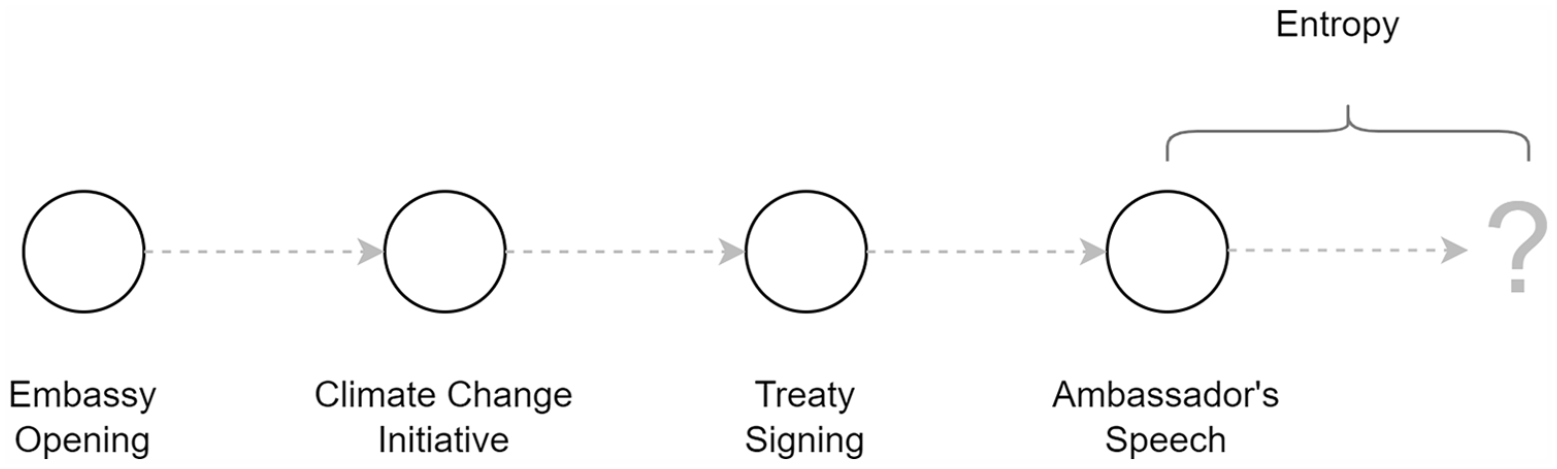
An exemplary sequence of events constituted by a bilateral diplomatic system; the next element is yet uncertain (the system is entropic).
The in-between is void, similar to the void that occurs after the fourth event, after the ambassador’s speech, as it will be followed by an uncertainty of the next event (i.e. entropy). The last event is ‘a nexus between the stored-away past and an unknown [. . .] future’ (Folkers, 2019: 494). Entropy is present precisely because the elements are temporally minimal, because they come and go, because they vanish as soon as they appear. It pushes the system to produce a subsequent event, a further continuation, an ‘and-so-on’ of its internal happenings (Stichweh, 2000: 33), lest the system decays. And it is of less relevance when the next event happens (in a chronometrically ascertainable date and time) and how long it will last (in a chronometrically measurable duration) than the mere fact that the system continues operating by producing interconnected events autopoietically.
Peace as a medium of communication
The thesis of temporally minimal elements raises a second question: given that many events happen in this world at every moment, how is it possible that systems hold themselves stable within a complex environment? In other words, with myriad social systems, and each one producing its respective interlinked chain of events, how can the events be assigned to a specific system? How does one know that a seemingly random event – say, a group of people attending a cocktail party – pertains to the diplomatic system, and not (or not only) to a system of a private friendship, or of cinematic art, or of higher education?
To answer this question, one may introduce an admittedly simplified conceptualization of the modern systems theoretical distinction between ‘medium’ and ‘form’ (for a more profound treatment, see Luhmann, 1987, 1999). According to modern systems theory, ‘society’ denotes the totality of all communications, and society is internally differentiated into various (sub)systems. Some of these systems have attained such a globally important societal function that they monopolize specific ‘symbolically generalized media of communication’ for themselves (Luhmann, 2012: 225; Parsons, 1963a; Turner, 1968). It is through these symbolically generalized media of communication – or through a ‘medium’, in short – that one can recognize whether an event pertains to, say, the system of economics (via the medium of money), or to the system of science (the medium of truth), or to the system of law (the medium of legality). Every communication in the medium of money (e.g. payments) reproduces the economic system; every communication in the medium of truth (e.g. academic publications) reproduces the scientific system; every communication in the medium of legality (e.g. court decisions) reproduces the legal system. The medium may thus serve as a symbol of the unity of a system. But what is a medium?
One may infer from these examples a definition of ‘medium’ as (1) something abstract, (2) that is available in plurality, (3) so that it can attach itself onto concrete forms, (4) without depleting. For instance, air and light are media of perception with regards to audible noises and visual forms; and language is a medium of communication allowing verbalized utterances. Due to their abstraction, neither air nor light nor language (langue) can be perceived directly. It is only in concrete forms (or paroles) that they become perceptible. One cannot hear the language, but only its instantiations in specific words and expressions (De Saussure, 2011; Luhmann, 2012: 116). Furthermore, the media are available in plurality and never deplete – albeit the term ‘availability’ should not suggest that the medium ‘exists’ somewhere as an objective, ontic being (instead, it is constituted only within and through a system’s operation). The medium could be understood as a potentiality (like langue) that finds actualization (in the parole) without getting used up. Seeing more and more does not exhaust light, hearing more and more does not exhaust noise, just as the use of specific words does not diminish the total stock of a language’s vocabulary (Luhmann, 2012: 117).
The symbolically generalized media of communication likewise bear this character of an abstract, imperceptible plurality that never depletes. For instance, money as such cannot be seen; it is only in the concrete forms of a banknote, price or credit that money becomes visible. None of which diminishes the abstract medium of money. Similarly, the medium of power, as amassed by political entities, is not visible as such, but only becomes visible and makes itself felt in the forms of centralized forces and tanks, weapons, armies, police, laws or bureaucracies – and their activation does not deplete the abstract medium of power.
With regards to the system of diplomacy, one may label its symbolically generalized medium of communication – the medium that attaches itself to every single form, to every single practice, to every single event that is communicated into being by the diplomatic system without ever depleting – as peace. The term is deliberately abstract due to its function as a generalized medium, but its semantic content may be defined as a commitment to restrain centralized capacities of violent force within interpolity relations. A panda bear whose deployment is observed as a diplomatic event is therefore a form of peace, signalling a commitment to a restraint of power (on China’s panda diplomacy, see Hartig, 2013). A minister’s official visit to another state can be a form of peace as well as an embassy building or an official tweet. The medium of peace as such cannot be seen, but its various forms render the presence of peace appreciable. 4
The symbolically generalized media of communication are both universalism and specificity (Luhmann, 2012: 225). There is universalism because the systems monopolize specific media of communication for themselves; and there is specificity because every medium of communication only serves to fulfil a specific societal function. Thus, whatever is communicated in the medium of peace becomes an element of the diplomatic system – this is the universalism of diplomatic peace. And whatever is communicated in the medium of peace carries the specific function of avoiding wars – this is the specificity of diplomatic peace.
Universalism and specificity do not suggest that an event cannot be observed in multiple systems at once. 5 For example, if a bilateral treaty promising health-related aid from country A to country B is observed as a diplomatic event, then it is a form of peace that continues the autopoiesis of diplomacy with the societal function to further deactivate centralized power capacities. It can be an event of other systems as well, but in these other systems the event follows distinct (system-specific) logics and is embedded in a distinct (system-specific) past and a distinct (system-specific) future. In other systems, the event is a form of a medium other than peace, carrying a function other than that of avoiding wars. The treaty may be an event, for example, of the legal system – i.e. a form in the medium of legality – whose ultimate function is not to avoid war but rather to corroborate normative expectations (Baxter, 2013; Teubner, 1987). In this form, the treaty fosters the autopoiesis of the system of law, and its system-internal future may be constituted by a court decision (as a further form of legality), while in the system of diplomacy, the treaty’s system-internal future may be constituted by a meritorious state award (as a further form of peace). Whatever the internal sequences within the system of law, the diplomatic system remains indifferent to them and continues its internal operations in autopoietic sequences of peace-mediated, eventful forms. An analysis should thus always specify the systems reference from whose viewpoint events are observed, for distinct systems references imply distinct temporalities, distinct functions, distinct media, distinct logics – not least due to the symbolically generalized media’s universalism and specificity.
To name another example, the panda bear may be observed not only as a form of peace, but also as a form of power. This power-mediated panda would then be seen as perpetuating a relationship of subordination and dependence, or, in Galtungian terms, as prolonging structural violence so that the animal cannot be said to serve (positive) peace (Galtung, 1969). 6 But this lens of viewing communications as power-mediated attributes them to the political system. The panda may then indeed signify sovereign power (forming one part in a chain of political communications), but it can, at the same time, also signify peace (forming one part in a chain of diplomatic communications). In addition, the panda could also be regarded as a property generating monetary profits (forming one part in a chain of economic communications), or as an animal carrying illnesses and thus awaiting a diagnosis (forming one part in a chain of health-providing communications). It depends on the systems reference used by the observer – the panda can be a form of peace, power, property or diagnosis, all at the same time, but each systems reference (diplomacy, politics, economy, health provision) will lead to different responses with distinct functions and varying temporalities, or distinct pasts and distinct futures. Thus, whereas a Galtungian lens may deny the peaceful character of the panda bear, a systems theoretical lens would opt for the possibility of multiple system references and thus enable the panda bear to be regarded as a form of both peace and of power. 7
Two concepts were introduced in this section. First, a system’s elements are nothing but temporally minimal events, or practices that are communicated into being and disappear immediately, leaving behind an uncertainty of the next event until that subsequent event happens (entropy). Second, all the events and practices within the diplomatic system are various forms of the same medium of peace whose ultimate societal function lies in the restraint of violent capacities of force. What would a combination of these two concepts yield as a result for the theorization of diplomatic peace?
Result: The temporality of peace
Given, on the one hand, the radical temporality of events within a system and, on the other, the premise that the system of diplomacy universally monopolizes the medium of peace, four theoretical consequences follow: (1) peace is not an objective state of affairs; (2) peace is temporally minimal; (3) peace needs constant reproduction; (4) peace should be defined both negatively and positively.
Peace is not a state of affairs
First, as peace is a medium of communication, it is generated communicatively, which suggests that peace is not a state of affairs. Given the ‘eventness of peace’ (Väyrynen, 2019b: 150), peace is not an ‘outcome’ of communications; the world does not contain an objective state of peace in its full onticity (Agathangelou and Killian, 2016). There is no ‘one-to-one correspondence’ between the invocation of peace and the environment (Wagner-Pacifici, 2017: 153). Peace only arises within a system which in turn exists only via communications. If there is no communication about peace, there also is no peace; it simply cannot exist outside society (Der Derian and Wendt, 2020: 48; Pan, 2020: 27; Wendt, 2015: 184).
Peace is a medium that is instantiated in momentary forms, communicated as practices; and if peace is constituted in (fleeting, non-lasting) practices, then it does not have an existence independent of event-producing systems.
Peace is temporally minimal
Second, as communications are temporally minimal, and as peace is a medium of communication, peace itself is temporally minimal. Peace vanishes as soon as it appears. Communication couples the medium and the form together and immediately uncouples them again (Luhmann, 2012: 119). It is but a momentary integration whereby peace cannot endure, has no duration, occupies no temporal length.
Imagine a thought experiment in which country A bestows a state award upon someone from country B. What happens after the state award bestowal? 8 One cannot know with absolute certainty. But the contemporary repertoire of diplomatic practices would suggest various options (see Goddard et al., 2019; Shih, 2020: 179). For instance, B might reciprocate by conferring an Order of Merit upon someone from A, or B publicizes the event through digital channels in a ‘Twiplomatic’ fashion, or B finally concludes a long-due treaty with A, or B sends a minister on an official visit to A. These are various options that remain mere potentialities until they ‘collapse into time’ (Wendt, 2015: 66). And once a potentiality is enacted, it opens up yet another space of contingency in which a further event is warranted – an ‘and-so-on’ (Stichweh, 2000: 33) of further potentialities which reproduces the diplomatic system between A and B in a sequence of peace events (Figure 2). The potentialities are highly heterogeneous; one option seems rather ritualistic (the reciprocal state award bestowal), another smacks of strategic communication (Twiplomacy), the third poses a legal act (signing of a treaty). But whatever the next step, whatever the practice that follows, whatever the degree of heterogeneity carried by the various options, they can all be unified under a single medium: ‘peace’. They are various forms of peace, forms of a medium which aids observers in attributing the practices to the system of diplomacy. And these peace forms are nothing but fleeting events; they happen and end immediately. Seen from an abstract level – from the level of the abstract medium and not of concrete forms – diplomacy consists of nothing but an autopoietic sequence of peace-mediated events. Peace after peace after peace gets enacted in various forms, all of them nodes in an infinite chain of the bilateral amity between A and B.
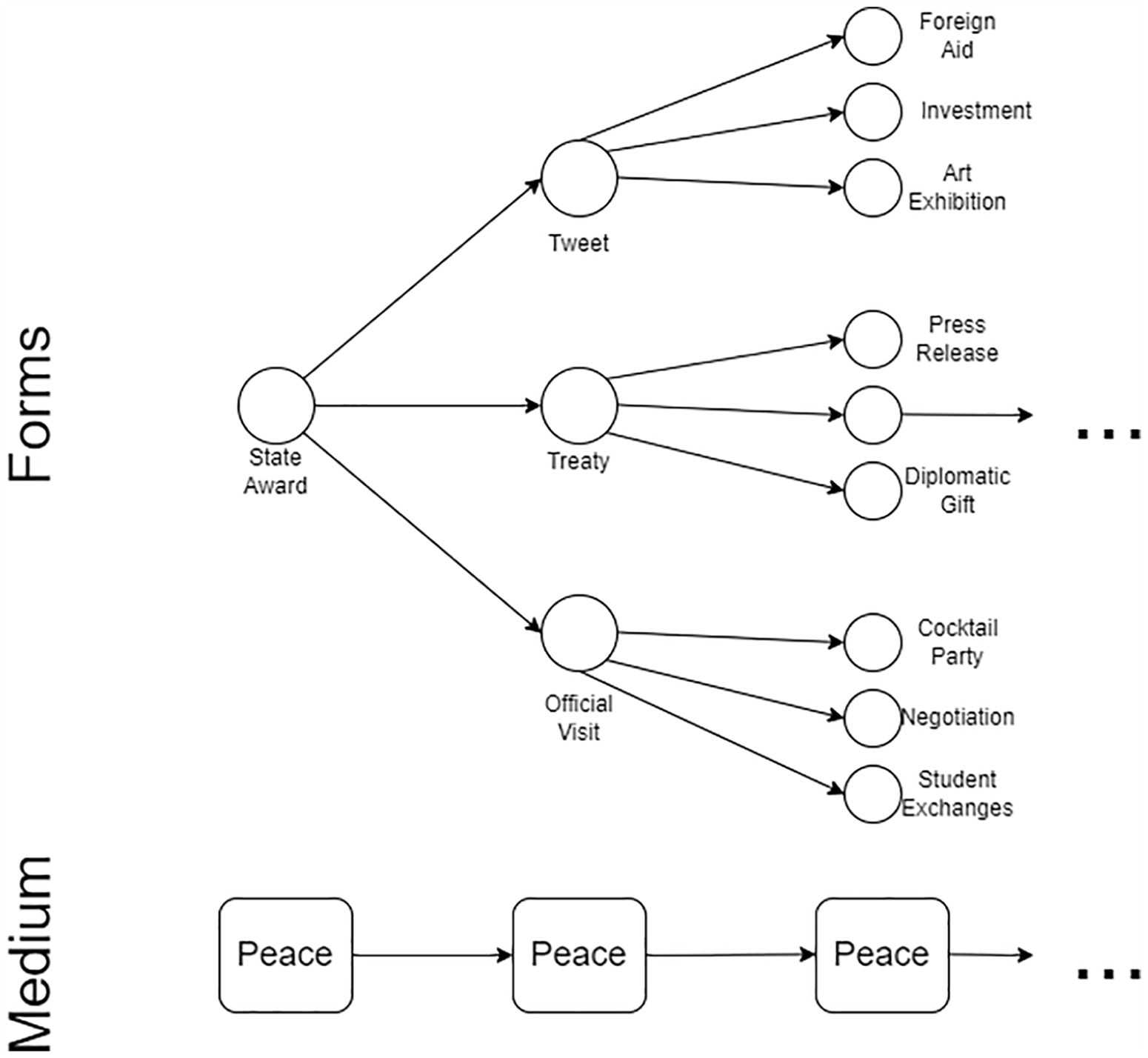
Diplomacy reproduces itself in various forms of the medium of peace. On an abstract level, diplomacy is merely a sequence of peaceful events.
Society thereby contains diplomacy-internal prior/posterior patterns – the (peace-mediated) press release follows the (peace-mediated) award conferral which follows the (peace-mediated) state visit. This endless before-and-after pattern constitutes the eigenzeit of diplomacy that occurs in a different tempo and rhythm than the temporality of, say, political elections, of economic payments, of scientific findings or of the educational upbringing of young people.
Peace needs constant reproduction
Third, and following from the ephemerality of the medium, peace needs constant reproduction. Peace is formed not only temporally, but also repeatedly. It needs reproduction. It carries a ‘directedness into the future’ (Behr, 2018: 340). Due to the immediate vanishing of peace, the system of diplomacy needs structures to constantly re-enact peace events – otherwise the system decays entropically. It needs a ‘temporal order in which possibilities are maintained [. . .] and events [. . .] remain accessible’ (Wolff, 2021: 80, 83) – otherwise peace happens but vanishes immediately.
The ephemeral fleetingness of communication may explain why diplomacy consists of seemingly trivial, ‘cheap’ practices that are quick and costless to enact. But more importantly, the momentariness of peace becomes stretched once material carriers (such as written documents or embassy buildings) come into play (Khurana, 2004: 116–119; Youssef, 2020: 387). Material forms allow a repeated re-experiencing of communicative enactments; the information of a peace medium becomes rereadable and reactualizable, reaches larger audiences and passes wider distances, generating an overall redundancy of peace. It renders the comprehension of a peace event free from personal interaction, delays its actualization, enacts it repeatedly so that the constitutive part of communicated peace does not have to occur in the immediate ‘here and now’ of the information expression. But the constitutive part of communication is still that of comprehension: if thousands see a building and do not see an ‘embassy’ (i.e. not a form of peace), then peace was not enacted; but if they do, then they comprehend the information expression in the medium of peace and the diplomatic system is thereby regenerated. It is thus through material infrastructures that peace gets reproduced.
Peace is both negative and positive
Fourth, since peace is not an objective state, it is not a purely negative phenomenon. Instead, it requires positive communication. The term peace is to be defined both negatively and positively (Boulding, 1977: 78).
To continue the thought experiment from above, imagine that countries A and B sign a bilateral treaty – but afterwards, nothing happens. For decades. For centuries. Is there ‘peace’ between A and B? Or, similarly, imagine that Slovakia recalls its ambassador from Austria, expels all Austrian diplomats, cuts all bilateral communication channels, cancels every hitherto routine working visit. Austrian diplomats, politicians and bureaucrats send enquiries to their Slovakian counterparts, but they get ignored. There is no war, no mobilization of force, no activation of physical violence – but is there ‘peace’ between Austria and Slovakia?
These thought experiments suggest that if peace is not communicated repeatedly, then the countries do not ‘have’ peace. The trace of a past peace (Franz, 2022: 777) is not sufficient, and neither is an endless future ‘of hope and waiting’ (Altan-Olcay, 2022: 387); instead, peace needs to continue being always imminent and reactualized (cf. McIntosh, 2022). Peace does involve a negative component, namely a political commitment to restrain violent capacities against the addressee; but this negative commitment needs positive communication. It would thus be analytically incorrect to say that El Salvador and Japan had ‘peace’ for thousands of years, since this statement captures a long era where no diplomatic communication (and thus no communicated peace events) occurred between the two (Buzan and Little, 2000: 80). The mere negativity – the lack of a mutually hostile activation of centralized violence – is not sufficient in constituting peace. In a paradoxical wording, therefore, non-communicated peace is non-peace.
Discussion
Using the modern systems theoretical concepts of radically temporal events and that of system-internal media, this article has argued that peace is not a state of affairs, but the diplomatic system’s symbolically generalized medium of communication. Peace thus appears communicatively in the form of events and vanishes immediately. It comes into being in a radical temporality which can only find meaningful analysis in terms of system-internal prior/posterior patterns, and not in an objective chronometric duration. It needs constant reproduction and cannot be purely negative, but requires positive communication-into-being.
This understanding offers a generalized concept of peace, stimulating new venues of research for diplomatic studies. This section will briefly provide three examples: the universality of peace; the negation of peace as un-peace; and the acceleration of diplomacy.
The universality of peace
The peace concept presented in this article is highly generalized as it is agnostic to specific political contexts. This contrasts with much of the relevant literature which first demands an evaluation of a given relation’s political ‘relevance’ before applying the concept of peace to it. Seemingly non-‘significant’ settings, such as the relation between Bhutan and Bolivia, were thus disregarded. But if peace is a medium of communication, and if Bolivia can indeed communicate with Bhutan through diplomatic channels, then Bolivia does extend peace-mediated communications to Bhutan. The lens that distinguishes ‘significant’ country ties from ‘insignificant’ ones would disagree and thereby place most interpolity relations into a theoretical margin. The present theory, in contrast, seeks universal application, emphasizing that diplomacy can indeed be conducted between any two polities, between any two holders of centralized capacities of violence because they do pose abstract threats to each other, and they are in need of mutual peace – even if the actualization of the underlying threat seems improbable. 9
If the mobilization of abstract threats seems improbable, but not impossible, then this is just another way of formulating the contingency of international politics. What the alleged threshold between ‘significant’ and ‘insignificant’ interstate relations does is to deny this contingency. One may hypothesize that the negation of this contingency generally devalues diplomatic happenings. Diplomacy is then invisibilized as ‘trivial’ and ‘uneventful’ (Pouliot, 2016: 9). But if diplomacy is full of seemingly ‘insignificant’ events, then this distinction of significant/insignificant or trivial/non-trivial is likely not fundamental to the diplomatic system, but an external lens nourished by a political – i.e. power-based – observation rather than a diplomatic – i.e. peace-based – one (Gauslå Engell and Lindskov Jacobsen, 2019). The systems reference of the observation differs; while the events may not be trivial from the viewpoint of diplomatic peace, they do seem irrelevant with regards to political power rationalities. The two systems are simply separate, following different rationalities with different pasts and different futures, carrying different functions and different media, and if one is not aware of the distinction between politics and diplomacy (Nishikawa-Pacher, 2023), then one may easily fall prey to the diplomacy-devaluing (peace-devaluing) narratives inherent in political (power-mediated) observations.
The negation of peace
It is worthwhile pondering the separateness not only of politics and diplomacy, but also of war and diplomacy. A further consequence of this article would state that the absence of war is not the presence of peace. Instead, both can be absent simultaneously – or be present simultaneously (Neumann, 2021: 2). The chronological sequence inherent in ‘assumptions that locate peace temporally after war’ (Olivius and Åkebo, 2021: 4) is too undifferentiated. The diplomatic system and its reproduction of peace can operate alongside the military system and its reproduction of war – which, in turn, can operate alongside the economic system, the health-care system, the legal system, the system of education etc. They are all but separate systems within world society. Thus, at the same time as tanks and soldiers fight on the battlefield (the enactment of war), legates may negotiate a possible ceasefire (the enactment of peace). In other words, the ‘negativity’ of peace, the notion of deactivating power forces, is a reality only within the diplomatic system; it may go unnoticed in the systems of war and politics which may actually mobilize forces at the same time as diplomacy communicates peace (for empirical evidence on the simultaneity of cooperation and conflict in interpolity ties, see, inter alia, Campbell et al., 2017).
While such insights into the simultaneity of peace and war are not necessarily new (Kessler, 2012; Peña and Davies, 2022; Stetter, 2014), it follows from this observation that the negation of peace is not war, but rather un-peace. Like every medium of communication, peace can undergo a binary coding (Luhmann, 2012: 215–227) so as to exhibit a positive and a negative side, with the positive side denoting a communicatively accepted peace (which ensures a smooth continuation of the diplomatic system reproducing further peace events), and the negative side denoting a communicatively rejected un-peace (which sparks reflexive consequences such as normative legal claims or a system-wide learning).
A murder in a diplomatically protected premise on a foreign terrain (Milanovic, 2020) can be regarded as un-peace – that is, it comes in the medium of peace (as it is ‘diplomatic’) but it is rejected as such. A ritual faux pas, symbolized by an empty chair during a planned summit meeting (Ludlow, 1999; Wong, 2021), or conveyances of interpolity dissatisfaction like the declaration of a foreign persona non grata, may likewise be seen as (diplomacy-internal) communications of un-peace despite the fact that they are forms in the medium of peace. The sharpest example may be a war-threatening ultimatum – the ultimatum is still a communication ‘short of war’ (Kennan, 1946), still a diplomatic event, still a peace-mediated signal, in spite of observers negating its peacefulness and thus coding it as un-peace. In brief, the communications are diplomatic and yet unpeaceful – but their unpeacefulness can only be detected precisely because they come in the medium of peace to begin with.
This negative value of un-peace indicates the possibility of diplomacy-internal conflicts (George, 1991), or chains of reciprocally rejected peace communications (Luhmann, 1995: 357–404; Wæver and Bramsen, 2019). They are conflicts within the diplomatic system without yet activating other systems, especially war. Diplomacy thus handles large masses of potential conflicts autonomously to filter them out from the rest of society. They may, however, be passed on to other systems, such as the legal system, for further processing (Denza, 2008). 10
Diplomacy’s capacity to handle internal conflicts and its ability to negate its medium of peace to transform it into un-peace is an evolutionary achievement of society that strengthens the system’s resilience. It prevents spillovers to the military or war system where the conflict would parasitically suck up energies from society at large, hindering the autopoiesis of many other societal systems (student exchanges would be cancelled, the health system would be overburdened, the economic system would suffer from boycotts and damages, etc.). While a further elaboration of this topic is outside this article’s scope, there is enough modern systems theoretical and empirical material to pave the way for more detailed research regarding unpeaceful diplomacy-internal conflicts.
The rapid acceleration of peace
There are two further speculations with regards to the temporality of peace that could be picked up by further analyses. One pertains to the acceleration of contemporary society, while the second involves diplomatic techniques of handling time.
First, given the radical temporality of peace, and given the system’s impetus to constantly reproduce peace events, one may speculate that with technological change, the speed of diplomacy could accelerate such that the system risks losing the capacity to handle its own complexity (Der Derian, 1990). ‘Under the condition of high complexity, time becomes scarce’ (Luhmann, 1976: 142); that is, strands of new peace-mediated communications may arise that are never continued because the diplomatic apparatus lacks resources for overseeing them (Amoureux, 2020: 175). On a fundamental level, the problem that arises from an ever speedier and ever abundant, ever cheaper and ever quicker diplomacy is entropy – or an increasing uncertainty over the next event because expected responses may fail to arise (Kessler and Lenglet, 2020; cf. Surowiec and Long, 2020). And greater systemic velocity may be accompanied by new repertoires of quick and cheap practices. 11 Variations of ‘digital embassies’ may attest to this new abundance (Bengtsson, 2011; Tammpuu and Masso, 2018). This rapid proliferation, in turn, could result in diplomatic fatigue (Eggeling and Adler-Nissen, 2021: 5) and an ‘inflation’ of peace (Parsons, 1963b). The rapid pattering of digital peace signals hardly reaches the emotional intensity that could be achieved through immersive rituals of diplomatic peace (Collins, 2004). Embassy-based celebrations of national holidays, or splendid conferrals of precious state awards, or the solemn unveiling of a monument amidst a multiday state visit are just a few examples of grand interaction rituals (Pacher, 2018) that can linger on for so long that these peace events even become a ‘chronic’ condition to some of their participants (Palestrino, 2022). Replacing grand ceremonies with Tweets or video calls ‘de-energize[s]’ diplomacy (Wæver and Bramsen, 2019: 11), as they lack ‘simultaneousness, immediacy, and inclusiveness’ (Vadrot and Ruiz Rodríguez, 2022: 10). This change highlights the need for international relations theory to consider the (dis)embodied experience of peace (Eggeling and Versloot, 2023; Väyrynen, 2019a) – for, with diplomatic rituals going digital and thus emotionally bland, will there not be a ‘missing sense of peace’ (Bramsen and Hagemann, 2021: 539)?
In light of this ‘accelerationism’ (Hom, 2020: 217), a final venue that can be explored is how diplomacy uses techniques with which it artificially runs itself short of time, thereby countering its own entropy. Diplomacy generates internal timelines that guarantee a future reactivation of peace. Some of the temporal techniques with which diplomacy generates ‘negentropy’ (negative entropy) seem to be legal ‘sunset clauses’ in bilateral treaties, annual schedules for high-level meetings in international organizations, congratulatory telegrams on national holidays, regular major events on a global scale, etc.
Thus, the simple conceptual statement that peace is radically temporal points to diverse venues for further developments in the theoretical study of diplomacy: the abstract universality of peace covering seemingly improbable and insignificant interstate ties; the resilience of diplomacy in its ability to harbour conflicts without activating physical violence; the rapidity of society and its subsequent danger of diplomatic entropy and peace inflation; and the way the system of diplomacy internally copes with the societal acceleration of communication. A few premises of modern systems theory allow one to see that there is yet much to explore within the hitherto blind spots of international relations theory.
Conclusion
When is peace? Peace is the abstract medium behind diplomatic events that are communicated into being. It vanishes as soon as the communication is finished, as soon as the event is over. Since events are elementary, peace decays instantly from a systemic viewpoint, thus requiring constant renewal: one peace event requires a further peace event requiring yet another peace event. This sequential renewal of peace-mediated events is the autopoiesis of the diplomatic system.
Footnotes
Acknowledgements
The author thanks Markus Kornprobst, Milos Vec, Chih-yu Shih, Amelie Herzog and Stefan Auer for comments on an earlier draft of this article.
Funding
The author disclosed receipt of the following financial support for the research, authorship, and/or publication of this article: This work was supported by a DOC Fellowship of the Austrian Academy of Sciences. In addition, Open Access funding was provided by the University of Vienna.
