



Abstract
Almost every polity uses state awards as diplomatic tools. Their global spread, however, cannot be explained by dominant theories of International Relations (which focus on military or economic rationales) or of diplomatic practices (which lack criteria for what constitutes a functionally suitable practice). The success of such seemingly non-instrumental tools may be better explained with a combination of Modern Systems Theory with the evolutionary scheme of variation/selection/re-stabilization: the diplomatic system generates a variation of practices, enacts selection through the structural medium of peace, and stabilises the selected variant through legal formalization and global diffusion. Using this framework, this paper finds that state awards found worldwide ubiquity for two reasons: First, they satisfy the diplomatic system’s societal function related to peace and power, that is, the foregrounding of peace-and-amity while invisibilizing power-and-enmity. Second, state awards exhibit a high degree of generalizability, meaning that they are so flexible that any state can use them towards any other states for any reasons at any time. This paper carries implications for understanding seemingly trivial, noninstrumental features of diplomacy, and, more generally, for the value of Modern Systems Theory and evolutionary perspectives in International Relations.
Introduction
State awards – or honorific decorations bestowed by the highest organ of a polity to recognize contributions serving the state – are a truly universal tool of diplomacy. Just as all states possess constitutions, flags, and anthems, they also make use of state awards on a global scale. In almost every country, the Head of State bestows these meritorious medals upon large numbers of domestic and foreign citizens – and in the latter case, the state award becomes a diplomatic tool. The global spread of diplomatically used decorations suggests that there are systemic and evolutionary conditions allowing this tool to thrive across the world, thus raising the question: What is it about state awards that the diplomatic system’s internal evolution selected them to diffuse across the world (cf. Adler, 2019: 243)? Or – to generalize beyond state awards – how does diplomacy’s evolution operate, what criteria does it use to propel specific practices into the global repertoire of statecraft?
A response to this question is not obvious due to two issues. The first one pertains to the basic conceptual (ir-)relevance of state awards within International Relations (IR). Traditional IR theories, rooted in the primacy of military power (Mearsheimer, 2001; Waltz, 1979), cannot but regard state awards as external to interstate relations. Awards are no armaments, and thus outside the scope of interest. Adding economic factors as alleged determinants of international behaviour would likewise find no direct explanation for the use of honorific orders. State awards are legally barred from market exchanges so that they are economically valueless (Nishikawa-Pacher, 2021: 178; but see Frey and Gallus, 2017). Diplomacy may comprise an abundance of ritualistic gestures and ceremonies involving gifts, awards, and artworks (Benabdallah, 2022; Sowerby, 2016), but a conceptual lens focusing on coercive military and economic power must dismiss these phenomena as external to the domain of interstate relations.
Recent approaches in IR might offer more suitable analytical lenses to integrate state awards into world politics. For instance, they extend the concept of power so as to cover seemingly apolitical trivialities, proposing that diplomatic rituals are, ultimately, reflective of coercive capabilities and authority (Kustermans, 2019; Sending et al., 2015: 21). Artworks and awards are then arms in disguise. With semantic modifications, state awards are ‘soft power’ rather than brute power (Nye, 2004), they are ‘positive sanctions’ rather than negative ones (Baldwin, 1971) – but, fundamentally, they still supposedly signify power and sanctions. By equating harmless tools with hard power resources, however, these approaches ultimately deny an autonomous role to diplomatic encounters, devaluing them to mere accidents of an actual substance of politics. Another recent approach, that of practice theory (Adler and Pouliot, 2011; Neumann, 2002), observes ‘practices’ as the ‘main units of analysis’ (Pouliot and Cornut, 2015: 300) and argues that whatever field-specific practitioners deem relevant must form an integral part of the given societal realm (Frost and Lechner, 2018). Since practitioners of diplomacy indeed confer awards regularly, this approach likewise allows one to establish the state award as a relevant aspect of analysis in IR.
As soon as the principal relevance of state awards in IR is established, a second hindrance arises. None of the approaches provide an explanation as to which tools or practices prevail (cf. Pouliot, 2020). A practice enacted at one moment does not determine the next practice at the subsequent moment but rather creates a space of contingency that opens up endless possibilities (Kornprobst, 2011). Selection must occur; but what will be selected is not deterministically fixed. Not every peace treaty leads to a mutual bestowal of state awards between the signing parties. The signing ceremony of a peace treaty could also be followed by an other-praising Tweet (Duncombe, 2019), by a joint golf game among the signing parties (Nair, 2020), or by the setting up of a new choir where the ministers of both involved governments participate. The latter has never happened, but it is not impossible, and it is this negation of both impossibility and necessity that denotes the contingency of practices (Luhmann, 1995: 106). Every diplomatic communication reopens a moment of contingency, and yet, some generalized types of practices exhibit a higher probability of a selection (e.g. a state award bestowal), while other practices seem improbable (e.g. setting up a joint choir on a ministerial level). But how to explain the varying probabilities (Gould, 1980: 39) – why do some practices diffuse across the globe, while others are rejected?
Theories of institutional diffusion likewise ask why the world’s polities experience ‘an inexorable push towards homogenization’ (DiMaggio and Powell, 1983: 148). They identify various mechanisms – including a ‘coercive isomorphism’ via legal mandates (Meyer and Rowan, 1977: 347), or a ‘mimetic isomorphism’ (DiMaggio and Powell, 1983: 151) based on normative standards considered ‘proper, adequate, rational, and necessary’ (Meyer and Rowan, 1977: 345). They thereby trace how ritualistic artefacts spread globally – but they do not answer why there are legal mandates about these (and not other) institutions in the first place, or why societally accepted standards of these (and not other) institutions arise: why are tools like state awards subject to a worldwide isomorphism while others are not? The theories simply re-articulate the puzzle in different terms.
This is a fate also shared by practice-based approaches. They may argue that the practices surrounding state awards have proliferated because they heighten the diplomatic ‘capital’ of some actors (Kuus, 2015), or because they have become a ‘habit’ to the practitioners socialized therein (Hopf, 2010), or because they form part of a ‘nomos’ (Kornprobst and Senn, 2016), or because they are conducive to a sense of ‘ontological security’ (Mitzen, 2006). Such assumptions, however, merely shift the question to why and how those practices (and not others) increase one’s ‘symbolic capital’, enter a systemic ‘habit’, constitute a ‘nomos’, or induce a sense of ‘ontological security’.
Other explanations of diffusion seem outright implausible in the present case. One would, for instance, hardly assume that transnational networks of intellectuals exerted pressure onto governments as ‘norm entrepreneurs’ with regards to state awards (Linde, 2014: 553; Strang and Meyer, 1993: 494; Winston, 2018: 647). And theories located in Marxist and Bourdieusian traditions may sense agonistic ‘struggles for domination’ (Wang, 2016: 349) whereby elite interests pressured the world to use state awards globally – but these vocabularies seem too tense to accord to the reality of this tool. Most importantly, again, they do not explain why that particular tool (and not other ones) were lobbied for – they do not solve, but only shift the puzzle.
State awards are thus a demanding case – their global career seems improbable, or otherwise difficult to explain. Its diffusion does not seem random, but neither does it embody an inevitable path towards societal progress. An intent behind its worldwide spread cannot be pinpointed (Adler, 2019), and there is no one to be identified who steered that outcome (Luhmann, 1997).
This unplanned improbability of a widespread phenomenon is precisely what an evolutionary lens would zoom into. Evolutionary accounts usually do so in a tripartite terminology (Pigliucci and Kaplan, 2006), sensing a variation of diplomatic practices, whereby some of them are selected such that they find worldwide ubiquity and get stabilized (or retained) through measures guaranteeing their repeated use. The stabilized selections then enter the structure of the diplomatic system so that states expect them to be part of what ‘ought’ to be done. Global institutions of diplomacy – such as Foreign Ministries, the permanently residing ambassador, an official presence on Twitter, and, well, the use of state awards – exemplify some of these evolutionary achievements of diplomacy.
These concepts premise a relatively stable social realm called ‘diplomacy’ that dynamically instantiates itself from moment to moment via practices (Adler, 2019: 32) – in other words, a system. Practices can be attributed to the diplomatic system when they serve that system’s societal function, namely the function of having polities refrain from using centralized capacities of violent forces in relations with each other. In other words, diplomacy operates in the medium of ‘peace’. By serving as forms of ‘peace’, state award bestowals become interconnected with other peace-mediated communications like state visits or inter-polity negotiations. It is such that a system’s function and medium maintain the identity of a system over time.
All these premises fulfil key assumptions of Modern Systems Theory (MST), a theory that has already proven itself to be compatible with evolutionary theory (Luhmann, 1982: 255–270) – for without an underlying system, the evolutionary concepts of variation (of a system’s elements), selection (through a system’s structure) and re-stabilization (of the overall system) would lack a reference. In contrast to other theories, MST’s analytical distinction between elements (here: diplomatic practices), structure (diplomacy’s function and peace-medium), and the overall system (of diplomacy) offers a tripartite conceptual scheme that is compatible with the evolutionary triad of variation, selection, and re-stabilization (Luhmann, 2012: 300–305). Combining MST with evolutionary theory allows one to regard change and diffusion neither as random, nor as a pre-determined tendency towards power-maximization, but rather as a system-internal interplay of three distinct evolutionary mechanisms based on functional dynamics (Deakin and Markou, 2021: 685–696).
In applying this theoretical framework to the question at hand, this paper argues that diplomacy’s practices serve as a source of variation, while the structural medium of peace facilitates the selection of certain variants, whereupon the system re-stabilizes itself through institutionalization of the selected tool. And if the latter occurs globally, one may label that practice an evolutionary achievement of the diplomatic system. This framework thus contributes to the understanding of seemingly trivial, non-instrumental and yet ubiquitous aspects of international relations (Faizullaev, 2013; McConnell, 2018; Musgrave and Nexon, 2018; Sowerby and Hennings, 2019), and it can be extended to other instruments of statecraft so as to analyse why some practices succeed on a global scale (e.g. digital diplomacy) while others lose their system-specific function (e.g. inter-dynastic marriages), whereas again others are only prevalent in specific regions.
The following outlines the systemic-evolutionary framework in greater detail. The section thereafter applies it onto the global diffusion of honorific orders and argues that state awards have become an evolutionary achievement of the diplomatic system due to two characteristics. First, they incite positive emotions to signal peace-and-amity while invisibilizing sovereign power-and-enmity, thus efficiently fulfilling the diplomatic system’s core function (functional suitability). Second, state awards are so flexible that any polity can use them towards any other polity at any time for any reason (generalizability). The discussion section offers a cursory application of the framework onto other diplomatic practices to probe its external validity, outlines key differences between historical and evolutionary studies, and calls for the further development of MST in IR.
Theoretical framework: the evolution of the system of diplomacy
Drawing from MST’s inherent evolutionary scheme, this section argues that a system enacts ‘variation’ through its elements (that can be observed as practices), then exercises ‘selection’ through its medium (in diplomacy, that medium is peace) after which it ‘re-stabilises’ itself and the selected variant (which, in diplomacy, equals legal institutionalization). Once this re-stabilization occurs on a global scale, the retained phenomena can be deemed as evolutionary achievements within the diplomatic system.
Variation in the system’s elements
Society is internally differentiated into various sub-systems, each of which is equipped, or carries a ‘function’, to solve a specific ‘problem’ (Luhmann, 2012). For example, facing state awards, the system of arts may refer to the ‘problem’ of aesthetic innovation despite an officially regulated state iconography, and thus observe how state awards are ‘functionally’ equipped to solve that ‘problem’. The system of historiographical sciences, in contrast, may observe state awards as artefacts that allow inferences about past happenings, or as ‘functionally’ equipped to solve the ‘problem’ of discovering truth about temporally prior occurrences. Each system-reference thus points to a distinct ‘function’ of a given phenomenon as responding to distinct ‘problems’.
From this function/problem-distinction follows the possibility to explore functional equivalents, or to compare highly heterogeneous phenomena under a single reference point. For, a system may respond to a problem not with one, but with many different solutions. Take, for instance, the problem of enforcing decisions among large groups of people. Society internally differentiated a political system that gradually emerged as a response to this problem, and that system did so by centralizing vast capacities of physical force. But this concentration of power came in multiple forms, such as the disarmament of nobility, the establishment of a hierarchically organized bureaucracy, the collection of nation-wide statistics in censuses, and so forth (Tilly, 1995). All these measures, while heterogeneous, are functionally equivalent as they try to solve the same problem.
Politics, therefore, emerged as a response to the problem of enforcing collectively binding decisions, but it did so by generating yet another problem. It addresses the societal problem by amassing large capacities of violent force not within a single centre of power but rather by setting up a plurality of such force-centres (called ‘states’). Each of these states then claimed sovereignty, or exclusive authority over a given territory (Bartelson, 1995: 30). As the system-internal semantics of sovereignty did not allow for overlapping territories (Branch, 2016), it followed that communications attributed to sovereign states always inhered a risk, a threat, and a sense of enmity (Johnson and Toft, 2014). The co-presence of multiple polities with high capacities of physical force rendered effective inter-state communication highly improbable – for any state-attributed communication must spark the threat of deception (Jervis, 1976) and structural mistrust (Waltz, 1979).
It is in response to this political problem that the system of diplomacy developed (Sharp, 2009). In carrying the function of enabling peaceful communication between power-centres, diplomacy came to be tasked with a fundamental paradox – that of developing devices to credibly signal the restraint of power despite the presence of power (Ikenberry, 2001). While the political system operates through the medium of power to foreground a semantics of sovereignty, threat, and enmity, the diplomatic system operates through the medium of peace to highlight the opposite semantics of reassurance, non-threat, and amity (Bjola, 2013; more on the concept of ‘medium’ will follow below); cf. Table 1.
Problem and function from the viewpoint of the diplomatic system.
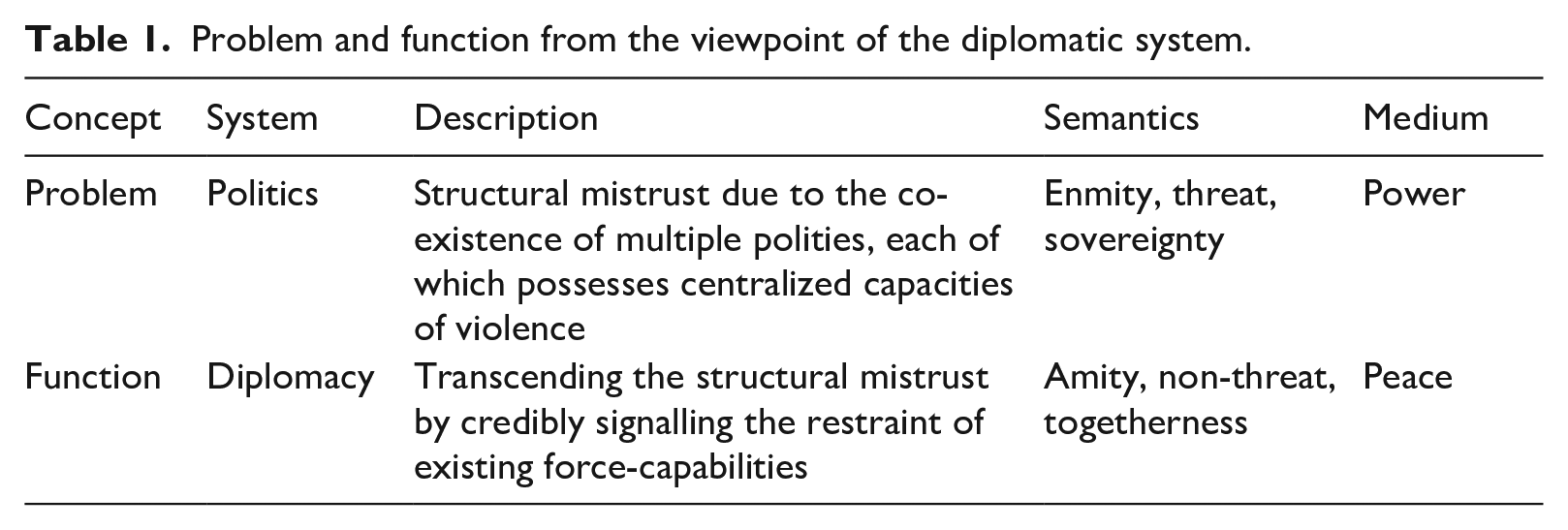
It follows that all elements within the diplomatic system are equivalents in functionally attaining ‘peace’. Elements are temporally minimal events with which the system reproduces itself. An observer can regard them as ‘practices’. During an international negotiation, a state could offer a compromise (Kornprobst, 2019); at the next moment, the opposing party accepts that offer; afterwards, there is a signing ceremony of a bilateral treaty; thereafter, the involved parties mutually bestow high-level state awards to each other’s leaders; a diplomat then sends out a Tweet praising that event; and so on. Every single of these elements (practices) serves as functional equivalents, even seemingly trivial ones (Constantinou, 1996: 104; Der Derian, 1987: 114), since they all aim at decreasing structural mistrust among plural power-holders.
On an abstract level, each peace-affirming element follows a preceding peace-affirming element while asking for another subsequent peace-affirming element – asking for yet another Tweet, for yet another invitation to a state visit, for yet another cocktail party in an embassy and so on. It is thus that the diplomatic system autopoietically reproduces itself without an end-goal, without a telos that, once attained, would end all diplomacy (Constantinou, 1996: 38; Wendt, 2015: 140).
One can here find a link to the evolutionary scheme of variation/selection/re-stabilization, for all the (functionally equivalent) elements pose a system-generated variation. The system constantly produces practices, with each one posing a unique, momentary novelty. And some of these elements deviate so much from the structural traditions (Modelski, 1996: 335–336) that they can be observed as novel variants that offer themselves for generalization and further re-use, that is, for selection (Rosert, 2019: 1106).
Selection through the medium of peace
Selection means that a system-specific suitability correlates with an element’s reproduction and spread (Lewontin, 1970). Every element exhibits a different efficiency, whereby each new element ‘brings with it unforeseen consequences which appear as new problems on different system levels’ (Bednarz, 1984: 349). For example, the political system’s use of algorithms to oversee large populations might solve the problem of enforcing decisions on a grand scale – but it simultaneously produces new problems, such as regarding data protection (Amicelle et al., 2015). A system may try out a variety of solutions, whereby only those with ‘the fewest dysfunctional consequences’ (Bednarz, 1984: 350) eventually survive through positive selection.
While variation is ‘blind’ (Campbell, 1960) because the factual triggers behind a variant’s rise is irrelevant, selection is not. Instead, the criteria behind a system’s selections do not change with each instantiation but rather remain stable. Biologists may label that criterion ‘fitness for survival’, but with regards to social systems, it is the concept of medium which occupies an analogous position (Parsons, 1963).
Like the physical media of light or air, the media of social systems are imperceptible and abstract, and they attach themselves onto a plurality of visible and concrete forms (Luhmann, 2012: 113). The economic system uses the generalized medium of money visible in the ‘forms’ of currencies or payments. The political system’s medium of power becomes visible in the ‘form’ of military tanks, in the ‘form’ of police, in the ‘form’ of bureaucracies. A second characteristic of the systems-theoretical concept of medium is that it transforms improbabilities into probabilities. Without the medium of light, our ability to see objects would be improbable (Luhmann, 2012: 117); without the medium of money, the modern institution of employment would be improbable; and without the medium of power, mass obedience to regulations would be improbable.
These general principles behind the concept of ‘medium’ apply to peace as well: First, while peace itself is imperceptible, it becomes visible in various forms. For instance, in panda diplomacy (Hartig, 2013) – whereby China leases panda bears to other states in whose zoos they serve as attractors – one can ‘see’ China’s diplomatic peace-signal in form of the animal (Leira and Neumann, 2017). Second, peace transforms the improbability of amical linkages between power-laden sovereign entities into such a probability that society can take diplomatic relations for granted. Without the medium of peace, a political leader would hardly ever visit another polity’s territory; without the medium of peace, sovereign states would not grant far-reaching privileges to foreign officials who reside in their lands for many years; and without the medium of peace, states would not allow their citizens to accept foreign honorific orders.
The modus operandi of peace is to invisibilize the diplomatic system’s fundamental paradox. As alluded to above, diplomacy operates not only through peace, but also through the (opposing) medium of power (cf. Albert, 2016: 92; Hoffman, 2003), as peace only developed secondarily after power (Leira, 2019: 194; cf. Tang, 2010). The panda is not just a form of peace, but also of China’s power (Huang and Wang, 2020). Diplomatic gifts in general (of which the panda can be deemed a sub-case) embody both peace and power – they may not just exhilarate their recipients, but also fuel political scandals (Urakova et al., 2023). Even international aid is regularly greeted with mistrust (Gazzotti, 2022); and historians have highlighted how recipients of diplomatic offerings ‘carefully calculated their physical interaction with the gift or the rhetoric thy used when discussing it’ (Sowerby, 2021: 732). While early modern instructional handbooks admonish ambassadors not to accept foreign gifts (Jansson, 2005: 368), the rejection of a gift seems ‘tantamount to declaring war’ (Mauss, 2000: 13). This again suggests that the simultaneous presence of peace and power is paradoxical, for peace signals a generalized commitment to the non-use of power in inter-polity relations.
One may illustrate this peace-and-power paradox 1 with overlapping sovereignties: Every diplomatic communication involves the deployment of a semiotic signifier of a sovereign entity into another sovereign’s territory. This ‘semiotic invasion’ (Lotman, 2005: 215) in the name of peace just adds to diplomacy’s improbability, as sovereignty supposes the fiction of contiguous territories (Branch, 2016). The peace-and-power paradox and the improbability of overlapping sovereignties may explain why there is structural mistrust behind even seemingly harmless instantiations of diplomacy (Sievers, 2021); there will always be structural mistrust against the panda bear, as it semiotically signifies a sovereign, powerful China (Baudrillard, 1983).
To overcome this mistrust, diplomacy’s medium of peace stresses togetherness (not sovereignty), trustworthiness (not threat), amity (not enmity) in order to succeed. When diplomacy utilizes vague terms of friendship (Devere et al., 2011), when it activates positive emotions (Kopper, 2021), and when it immerses participants into ostentatious rituals where no one can do ‘wrong’ (Aalberts et al., 2020), then this is where the medium of peace becomes visible – in the form of friendly wordings, positive emotions, and stately rituals. They all serve to foreground ‘peace’ while invisibilising ‘power’ so as to lower the improbability of overlapping sovereignties. A final characteristic of the medium of peace is its high generalizability. Peace is so abstract that it inheres no topical limitation. Peace can thus be attached to every system-internal observation. The embassy building is as much ‘peace’ as the containment of an imminent international crisis (Haugevik and Neumann, 2021), crowds greeting a foreign delegate are as much ‘peace’ (Keys and Yorke, 2019: 1242) as the earnest offer to settle territorial disputes (Wiegand, 2011). The generalizability of peace enables the diplomatic system to hold a repertoire of various peace-forms available for society to mobilize in any case, tools that are so contingent that any state can use them towards any other state at any time for any reason.
To integrate the concept of medium with the evolutionary framework, one may hold that it is through the medium of peace that the evolutionary selection process within the diplomatic system takes place (Luhmann, 2012: 284). There are two criteria at play. First, given a novel variant, diplomacy asks: Does this novelty serve ‘peace’, can it be justified by ‘amity’ without facing implausibility? This is the first criterion – functional suitability. Furthermore, is the given variant so flexible that it can be activated at any moment for any reason in any inter-polity relation? This is the second criterion – generalizability. If the responses to the two questions are to the affirmative – that is, if there is both functional suitability and generalizability – then there is a higher probability for the new practice’s selection. 2
Re-stabilization through institutionalization
Having seen the variation of a system’s elements and their subsequent selection through the system’s medium, one can now speculate how retention or re-stabilization takes place. With this final evolutionary step, the system enacts further measures to render the selected practice’s re-use more likely.
In the diplomatic system, re-stabilization can be equated with a formal institutionalization which guarantees the repeated re-activation of a practice (Ben-Josef Hirsch and Dixon, 2021). And if it does so not only in one or two countries, but across the whole globe spanning two hundred states, then one may call that practice an evolutionary achievement of the diplomatic system.
There can be various levels of formalization. The strongest would be legalization – be it international, national, or intra-organizational. Prominent examples of international legal codifications are the ones regulating diplomatic interactions in the Final Act of the Congress of Vienna 1815 or in the Vienna Convention on Diplomatic Relations 1961. But beyond international treaties, one can also think of national laws, such as constitutions or legal acts that regulate the workings of Foreign Ministries. In addition, legalization may also take the form of internal regulations of an official entity, as in the case of a Foreign Ministry’s organigram – for instance, ‘digital diplomacy’ can stabilize into the diplomatic system when ministries around the world establish units responsible for their Twitter accounts (Manor and Segev, 2020).
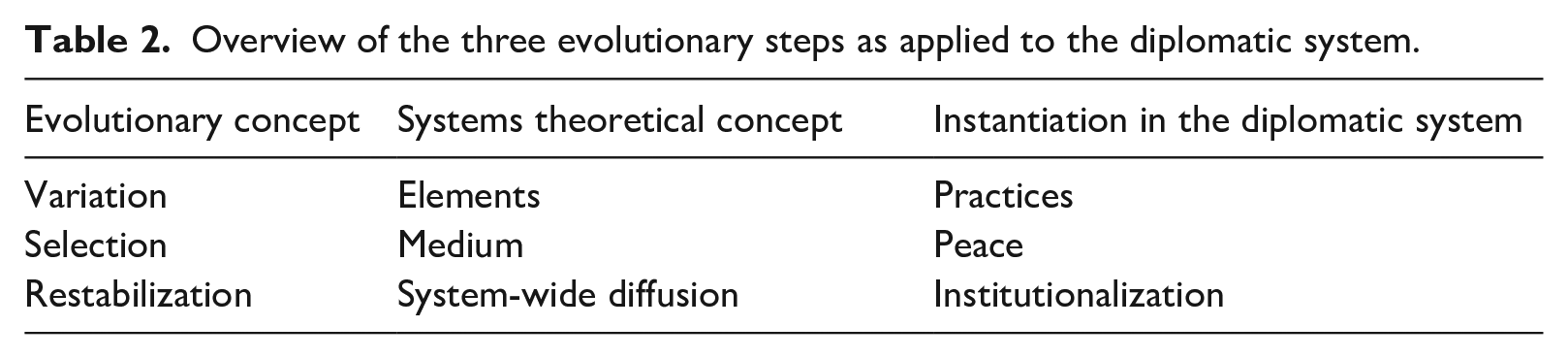
To summarize the evolutionary-systemic framework outlined above, diplomacy’s evolution occurs in three analytically separate steps (Table 2). Variation is visible in the system’s elements, all of which are functional equivalents to each other as they seek to attain the same function, namely the function of restraining sovereign polities’ force-capabilities. The selection of the elements operates through the medium of peace, meaning that practices are likelier to be reproduced if (1) they are attuned to the function of the diplomatic system of foregrounding ‘peace’ and ‘amity’ while invisibilizing ‘power’ and ‘enmity’, and (2) if they are so generalizable that any polity can use that practice towards any other polities at any time for any reason. Finally, the re-stabilization of these practices is indicated through institutionalizations and legal enshrinements.
Overview of the three evolutionary steps as applied to the diplomatic system.
Excursion: separateness between diplomacy and politics
The theoretical framework introduced so far revolves around the system of diplomacy, and not of politics. The term ‘peace’ is thus used in a diplomatic sense, denoting the restraint of power among multiple power-centres (Sharp, 2009), and not within a single polity. Since a separateness between politics and diplomacy is seldomly formulated in IR (but see Constantinou, 1996; Der Derian, 1987; Youssef, 2020; Nishikawa-Pacher, 2023), it may be useful to briefly digress on this premise before the section thereafter applies the evolutionary-systemic framework onto state awards.
As a point of departure, MST identifies only one single function to each society-spanning system such as law, economics, politics, family, or religion (Luhmann, 1995: 52–53). Two system functions would thus imply two distinct systems. This is the case here – politics bears the function to enforce collectively binding decisions (via the medium of power), while diplomacy carries the function to restrain the activation of coercive capacities among plural polities (via the medium of peace). A political event follows another political (power-mediated) event, whereas a diplomatic event follows another diplomatic (peace-mediated) event, giving rise to two distinct temporalities, to two different before-and-after-patterns, two different pasts and futures, two distinct chains of elements – again, two different systems.
There are nevertheless clear interdependencies between politics and diplomacy: For instance, politics regularly passes on a domestically formulated ‘national interest’ that diplomacy must ‘implement’. However, diplomacy’s implementation of politics does not follow political rationales, but rather its own logic. Diplomats use specific narratives and exhibit different behavioural norms than the ones that prevail in domestic politics; as an example, the antagonism between government anod opposition (Luhmann, 1990: 47) may carry significant weight for politicians, but is hardly a dominant concern to diplomats. The fact that the two systems regulate their own personnel, respectively, professionalizes this trend. Politically appointed ambassadors are seen as anomalies, requiring special justification (Arias and Smith, 2018) – a further sign of the systems’ separateness. Diplomacy is thus not simply an input–output machine for politics, but it translates political (external!) signals into diplomatic (internal!) plans for action – oftentimes steering itself into a tension ‘between serving the Prince and serving Peace’ (Sharp, 2009: 45). And in resolving that tension, diplomats regularly deviate from political guidance (Lindsey, 2023), 3 ultimately serving as ‘policy resisters’ (Wiseman, 2022: 128). They uphold the raison de système rather than the raison d’état (Sharp, 2009: 10).
Diplomacy does not even have to ‘resist’ politics to assert its autonomy. Its self-referentiality already becomes visible in less dramatic moments, namely when one observes diplomacy without finding any political rationale whatsoever – in fact, many ‘everyday’ operations of diplomacy seem to be utterly apolitical. Slovenia could bestow a high-level state award to an artist from, say, Vanuatu, even though there are no meaningful political (power-oriented) ties between the two countries. Numerous inter-polity relations are indeed filled with an endless wealth of diplomatic yet apolitical activities.
In conspicuous cases, however, politics does intervene, demanding ‘foreign policy goals’ to be considered in diplomacy. This applies to state awards as well. The political strategy of energy security may lead a country (like South Korea) to bestow its highest diplomatic medal (the Order of Mugunghwa) only to important energy suppliers. Or Nelson Mandela may have sought to reach strategic political goals when he conferred South Africa’s highest honorific medal upon Libya’s leader Muammar Qaddafi amid the Lockerbie negotiations in 1997 (Boyd-Judson, 2005). In such cases, a diplomatic tool is steered by rationalities of political power – albeit too much of a steering would be lamented as a ‘politicisation’ in t of diplomacy (Lequesne, 2021: 788, who also speaks of a ‘political capture’).
A single event can thus be attributed to multiple systems. This is nothing unusual: a marriage is an event in both the system of family and of law; passing a legal statute is an event in both law and politics; and so on. Politics and diplomacy are usually co-present in a given event, but they nevertheless remain mutually autonomous: politics imbues the event with a different meaning (namely as power-oriented) than diplomacy (which regards it as peace-oriented), and politics gives rise to a different system-internal future (the domestic opposition may criticize that event and offer alternative paths) than diplomacy (there will be other bilateral peace-signals following that state award bestowal). The functions, media, logic, episodes, histories and futures (Kessler, 2012) of diplomacy are decoupled from political functions, media, rationalities, episodes, temporalities – despite momentary co-incidences that lead to a peace-and-power paradox.
Thus, diplomacy can be power-oriented when it translates political goals into its internal operations. But more importantly, it also can be not power-oriented. What diplomacy cannot be is to be not peace-oriented. Even a declaration of war, a joint military drill, or the building of international coalitions in preparation of an upcoming conflict is a peaceful exercise since they still restrain the full-scale activation of violent power forces. To hint at a deeper understanding of this seeming contradiction, MST regards media as coded into binary terms that comprise a positive and a negative value (Luhmann, 2012: 214–235). Peace would be coded as peaceful/unpeaceful. The enemy can thus negate the medium of peace (a negation which is only possible because there was peace in the first place!), interpreting specific events as un-peaceful, and responding to them with further un-peaceful practices. It negates peace which remains present precisely in this negation – the event’s money-ness or power-ness are not negated, only its peace-ness. This chain of successive unpeacefulnesses constitutes diplomatic conflicts – but not (yet) war. As long as full-scale power capacities are not activated, diplomacy’s generation of (negated!) peace-events succeeds in momentarily avoiding the mobilization of political power-capacities. Even a war-threatening ultimatum is thus a diplomatic event in the medium of peace.
These were just a few superficially outlined premises that may corroborate the (unconventional) assumption of a fundamental difference between politics and diplomacy. A detailed discussion lies outside the scope of this paper, since the main theory revolves around the evolutionary concepts of variation, selection and re-stabilization – and these are the notions that the following section will apply to the case of state awards.
The state award as an evolutionary achievement
An application of the evolutionary-systemic framework does not necessarily have to follow the analytical sequence of variation, selection, and re-stabilization. Rather, it can focus on the most problematic of these three steps. In the present case, the system-wide re-stabilization of a specific variant of state award seems less problematic (because they can be posited simply by ascertaining their formalized existence). What is more puzzling is the extensive selection of that tool (because of its seeming triviality that cannot be plausibly explained as an intentional power-extension by hegemons etc.). This section will thus briefly outline the re-stabilization and its preceding variation before delving deeper into the evolutionary reasons behind that practice’s worldwide selection.
Re-stabilization
Almost all states and jurisdictions possess the tool of state award today. A superficial survey of legal and other official documents suggests that at least 196 out of a sample of 204 polities (or 96 %) utilize such high-level honours (Figure 1). They are mentioned in 133 constitutions, one can find legal acts on state awards from 40 further countries, while an additional 23 countries offer other official sources indicating the existence and use of state awards (for details on the underlying data, see Supplemental Appendix).
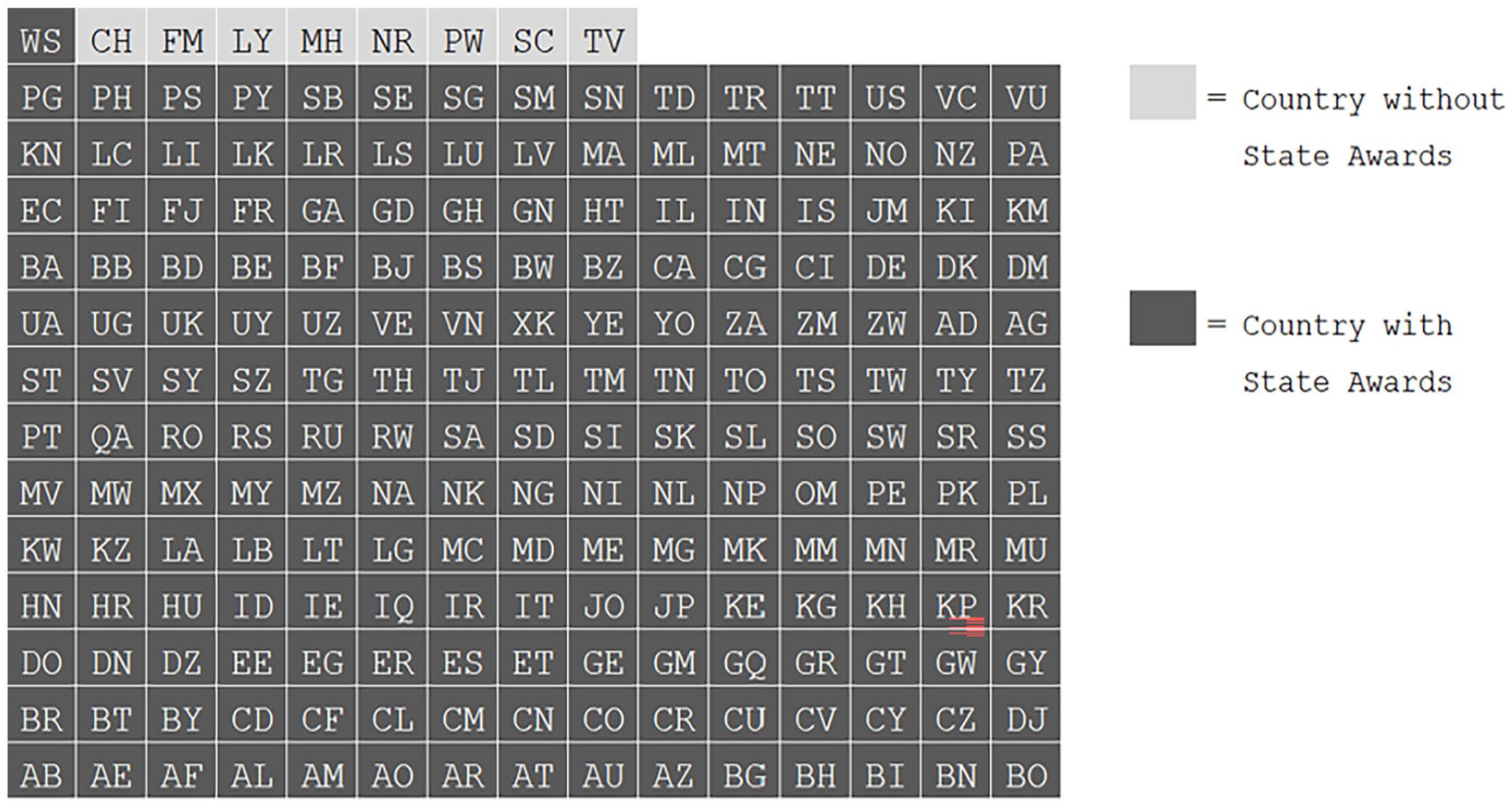
Waffle chart of 204 states and jurisdictions, 196 of which possess state awards, that is, all but Switzerland (CH), Micronesia (FM), Libya (LY), Marshall Islands (MH), Nauru (NR), Palau (PW), Seychelles (SC), and Tuvalu (TV). – The abbreviations are the two-letter country codes according to ISO 3166-1 alpha-2 standards.
Other than the state award’s formalization in national legal documents, it has become so commonplace to use state awards in diplomatic rituals that many foreign ministries have expressly dedicated their internal protocollary unit to deal with that purpose. Ambassadors who leave their post in a foreign country are usually granted a high-level state award out of courtesy, often in a reciprocal, bilateral exchange of such meritorious bestowals. In addition, when state awards are conferred upon foreigners, the giving state first involves the foreign ministry of the recipient’s country as a diplomatic usance. The state award is thus not only enshrined in constitutions and legal acts but also in internal regulations of foreign ministries.
The extensive legalization of state awards does not amount to dead letters. On the contrary, states make intense use of that tool with high numbers of bestowals every year. For instance, in 2019, Italy conferred official awards upon 5249 recipients from around the world, 4 Germany’s Federal President bestowed its Verdienstorden on 1354 individuals, 5 the Austrian Head of State did so to 1254 people, 6 while Japan’s Foreign Ministry lists 280 foreigners among the ones decorated by the Emperor. 7 While aggregate cross-country data are lacking, these numbers alone suggest that across the world, probably tens of thousands of people receive state awards each year.
With the state award institutionalized in internal organigrams of foreign ministries, formalized in legal acts, and even enshrined in the high-level constitutions of 133 countries, the tool’s system-wide re-stabilization seems more than manifest.
Variation
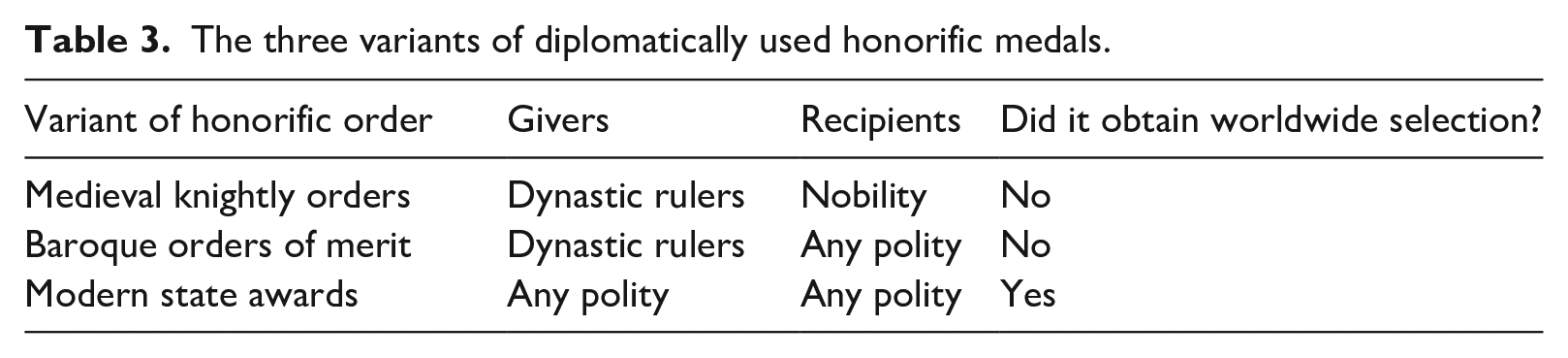
Before investigating the selection criteria that led to the state award’s global diffusion, one may look at the characteristics of the particular variant that received institutionalization across the diplomatic system. Starting with the Late Medieval era, one can discern three variants of diplomatically used honorific medals: (1) Medieval knightly Orders; (2) Baroque Orders of Merit; and (3) modern state awards (cf. Table 3).
The three variants of diplomatically used honorific medals.
Before outlining each of these variants, one may note that the starting point of the Late Medieval era conforms to a key premise of MST. For it was by then that society developed from a stratified differentiation towards a modern, functional differentiation. Stratification primarily privileges an upper stratum of nobility across every societal domain, while a primacy of functional differentiation generates functionally defined sub-systems, each of which operates autonomously from each other. In a stratified society, therefore, diplomacy lacked autonomy; it recruited its personnel mainly from nobility, was dependent on external triggers for ad hoc activation, ended episodically after having attained (or failed) a pre-formulated telos, and remained anchored in religious rites or political expediencies. But in the Late Medieval and Early Modern period, diplomacy started its fledgling career towards closure and autopoiesis, most prominently illustrated in the institution of the permanently residing ambassador (Lazzarini, 2015; Mattingly, 2009).
It was at that time of the Late Middle Ages that dynastic rulers started to set up a predecessor of the modern state award, namely secular, knightly Orders (D’Arcy Boulton, 1987; the following paragraphs build largely upon this source). They drew from a tradition of monastic and chivalric Orders that had previously sprung up as sacred societies where members submitted themselves under divine rules and life-transforming vows, such as that of chastity. These monastic and chivalric Orders, however, had been rooted in a religious ground to such a degree that one may hardly impute them to bear a diplomatic function of restraining centralized capacities of power. But in the late Middle Ages, secular rulers in Europe started to instal their own Orders to bind noblemen (from nearby lands) into an amical community centred around their dynasty, thereby adding new ties of loyalty beyond feudal fealty. First visible with the Hungarian Order of Saint George (established 1326), it soon found imitation across the rest of the continent. The Order of the Garter (founded 1348) and the Order of the Golden Fleece (ordained 1430) are but two of the most famous examples (Waddington, 1993).
A second variant are the Baroque Orders of Merit. With the transition from a feudal society towards one with bureaucratized, territorialized states came the creation of new honorific medals. They differed from the Medieval knightly ones in two ways. First, they were not reserved to hereditary nobility anymore. And second, these Orders did not primarily guide the members’ future behaviour, but rather accentuated their past deeds. Membership to the Orders thus widened considerably in terms of social class. For instance, the French Military Order of St. Louis (founded 1693) targeted any officer of Catholic faith regardless of their family background – even non-noble mortals could receive the grace of membership. The Austrian Military Order of Maria Theresia (established 1757) went even further, as it would be the first one that could be conferred upon anyone exhibiting fortitude, without any limitations pertaining to the decorated person’s social or religious background.
However, neither of the first two variants – neither the Medieval knightly Orders nor the Baroque ones – found global ubiquity in the contemporary system of diplomacy. The reason is that they still reflected the structure of a stratified society, as they privileged a higher stratum of nobility as defined by the external environment. Their stratified structure was visible in their narrow membership criteria or in their centeredness on dynasties.
The variant that eventually found global diffusion in the modern diplomatic system are neither the Medieval nor the Baroque Orders, but rather honorific medals that gradually emerged since the middle of the 18th century– and it is this modern artefact that this study calls ‘state awards’. This new variant finally reflects not a stratified society, but a functionally autonomous diplomatic system because it nominates both the givers and recipients independently from the wider society (without external constraints arising out of a concept of nobility, for example). Any actor as defined by the diplomatic system itself, that is, any polity can use the state award towards any other polities’ members based on any diplomatic peace-rationales. The Prussian Order Pour le Mérite (founded 1740) was the first to exhibit a stately iconography rather than a dynastic one. The fons honoris (fountain of honour) thus gradually shifted from a noble, monarchical ruler to a constitutionally governed office. Even republics without ruling dynasties can use state awards now; any polity can, including supranational organizations such as the European Union (Foret and Calligaro, 2019) and unrecognized de facto states such as Transnistria (Pacher, 2019), as long as they functionally operate in the system of diplomacy. And not only does this liberation of the state award from a stratified structure pertain to the giver, but also to the recipient side – anyone could receive the honorific medal as long as the Head of State deemed it proper; nobility by birth or a specific religious affiliation ceased to be a structurally constraining requirement. In brief, the modern state award developed such that any polity could confer it, and anyone could receive it.
With colonialization and globalization, this modern state award started its diffusion bit by bit in the 19th century (cf. Bull and Watson, 1984). In 1806, for instance, Argentina founded an honorific Order, 8 followed by Chile 1817, with other Latin American countries imitating them in the 1820s and thereafter. The United States first created an official meritorious medal in 1847. Asian countries followed suit, such as Thailand (1873) or Japan (1875), similar to Oceanian polities like Tonga (1875) and New Zealand (1881). In Africa, Benin established an Order in 1892, South Africa did so in 1896. The trend continued after the turn of the century, with accelerations amid the era of decolonization and after the Cold War. Even today, new state awards continue to be created. While the lack of an authoritative data set does not permit one to trace minute historical pathways, fragmentary glimpses suggest that hardly a year passes by without witnessing the establishment of new state awards in multiple continents (cf. Figure 2). Nowadays, their cumulative count even nears the number of 3.000 (cf. Figure 3).
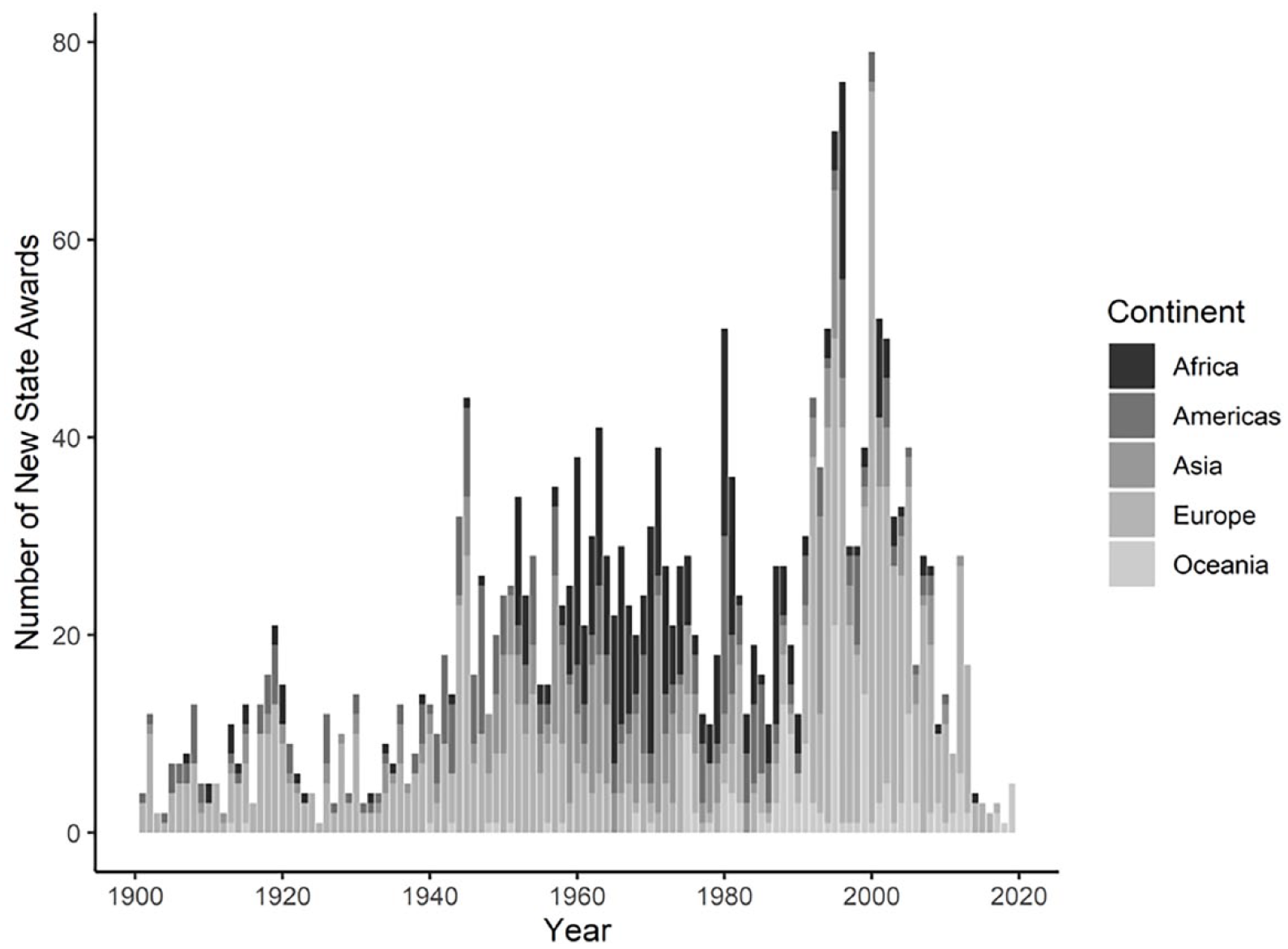
Number of newly established state awards by continent since 1900.
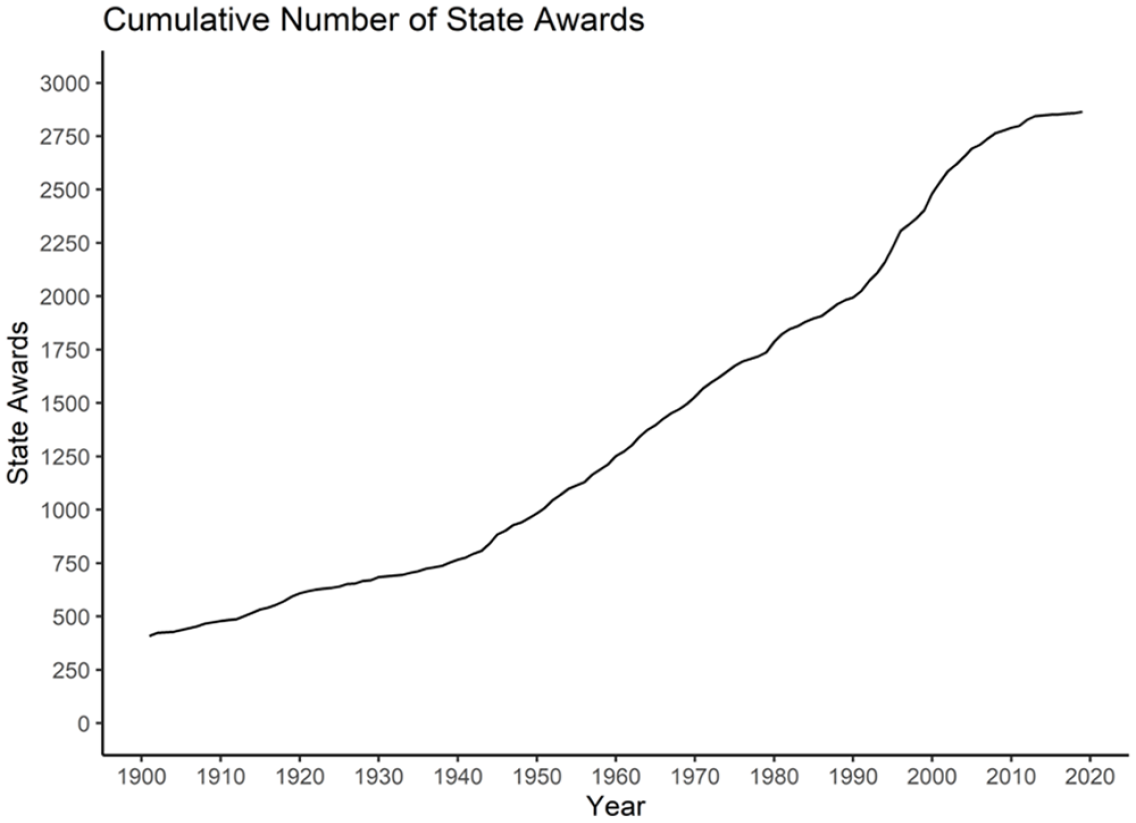
Cumulative count of state awards over time.
Once a religious-dynastic Order of an old, hereditary, European nobility, the modern state award has reached almost all polities across the globe. The formerly dynastic Grand Master transformed into the constitutionally governed Head of State, and the royal chancelleries of feudal times were supplanted by modern parliaments passing bills that regulate the use of state awards. And it is in this form that the state award diffused across the world.
The global diffusion of state awards is not self-explanatory; there is nothing compelling or indispensable about their ubiquitous spread. There must be a deeper structure underlying the diplomatic system that was conducive to adding that seemingly harmless tool into the global repertoire of statecraft (Goddard et al., 2019). But what is it that led to the state award’s evolutionary selection?
Selection
The paragraphs above demonstrated how a particular variant of state award re-stabilized across the system of diplomacy on a global scale. But why is that so? This question targets the evolutionary selection of the practice surrounding state awards. The framework above identified two selection criteria: The first one pertains to the medium of peace (functional suitability), while the second one denotes a given practice’s flexibility (generalizability). This section will look at the state award through the lens of these two criteria.
First, functional suitability means that when facing a novel variant, the diplomatic system assesses its global enforceability by asking whether it suits the medium of peace: does it effectively invisibilize power and enmity while foregrounding a semantics of peace and amity? Does it ensure a self-restraint of power-constituted polities regarding violent force capabilities? And if it achieves this effectively, then the diplomatic system will likely select that tool to facilitate its later stabilization as a re-utilizable technique.
State awards perfectly embody this notion of peace. They signal that the highest authority of a polity has looked into a foreigner’s deeds, deemed them meritorious, and decided to officially elevate them with a prestigious decoration. The recipient enters a solemn ritual in governmental palaces, receives a laudatio praising them, shakes hands with high officials, and immerses into intense and memorable moments. Such grand ceremonies are likely to elicit positive emotions by fulfilling a human desire for honour and status (Anderson et al., 2015). Nothing exudes a sense of inter-state amity as much as when a state pays another state’s citizens its homage.
It is through this ritualistic-emotional venue that the state award can break the fundamental improbability of diplomacy. From the system’s viewpoint, the bestowal of a state award upon a foreigner means that a semiotic signifier of a sovereign power enters another sovereign’s territory. It thereby structurally elicits mistrust, and paradoxically conveys an overlap of multiple sovereignties. By foregrounding a semantics of peace and shared values, however, the state award invisibilizes this component of sovereign power, thereby transcending the concept of contiguous territories. It awakes positive emotions to de-activate structural mistrust, thus enabling the semiotic intrusion of a sovereign power into another sovereign’s territory 9 – a highly improbable achievement! With its rituals and emotions, the peace component of state awards (with its notions of harmlessness, amity, togetherness, and respect) is so prominent that it easily conceals any aspect of power (with its notions of threat, harm, enmity, sovereignty, and intrusion) despite its ineradicable presence in the system. The state award thus perfectly attains the function of the diplomatic system, the function of invisibilizing power while foregrounding peace.
However, functional suitability alone is not sufficient to explain the worldwide spread of a diplomatic tool. Take the panda bear as an example – similar to the state award, the panda is not just a ‘powerful’ but also a ‘peaceful’ asset (from the viewpoint of the diplomatic system). If functional suitability was sufficient, every country would enact ‘panda diplomacy’ (at the giving, not the receiving side). But not every polity can do so, as there are external restrictions – pandas simply do not inhabit every country. Likewise, not every state can pursue an ‘exchange diplomacy’ with generous scholarships for international students (Byrne, 2021), or ‘energy diplomacy’ by distributing energy resources cheaply (Lee, 2019) etc. To attain the improbable achievement of a global spread, therefore, a diplomatic instrument needs to fulfil a further condition.
And this second condition is generalizability: To find global ubiquity, the variant under question should be a tool so universal and flexible that any polity can use it towards any other polities at any time according to any needs.
State awards are indeed a tool of statecraft with great flexibility. There are no meaningful restrictions to their use, neither substantially, nor socially, nor temporally. First, substantially, state awards are generalizable because they do not inhere any topical limitation. A foreign policy goal could steer the state award to address only Heads of States of major energy partners; or to address only the rulers of countries that have recognized one’s sovereignty (Pacher, 2020); or to address only large-scale investors; or to address only victims of another country’s aggression. It is even possible that the state award simply follows the autopoiesis of the diplomatic system without any foreign policy goal whatsoever, that is, in a seemingly random pattern of bestowals. In short, a state award can be used strategically or without any external rationales, and it can address individuals of any societal sector, be they clerics, politicians, military personnel, artists, scientists, household helpers in local embassy buildings, or victims of crime. – Second, socially, generalizability refers to the ability of any single polity to use the tool in both an active and a passive role, or both as giver and recipient. This social generalizability is likewise limitless, for there is no country-dyad in which a circulation of state awards was impossible. The deployment of an award is not dependent on any local circumstances, which renders it distinct from panda or energy diplomacy; not every country has a panda bear and not every country possesses vast energy resources. State awards, in contrast, are so general that every single polity can use them – even unrecognized breakaway territories, sub-national polities, or supranational entities (Cornago, 2010; Foret and Calligaro, 2019; Lequesne and Paquin, 2017). And it is not only the giver, but also the recipients of state awards who can belong to any polity without any limitations. – And third, there is also generalizability in the temporal dimension (Luhmann, 1976): Award bestowals do not require an immediate prior/posterior-pattern within a constraining timeframe, but they can target any action located on both sides of the past/future-distinction (Wendt, 2015: 127) and claim them as merits worthy of official decoration. The reason for the bestowal may be a communication from a hundred years ago or of 10 days ago, or even an expectation nourished for the next 2 years in the future. There are no temporal restrictions for honouring a deed.
In brief, the state award not only succeeds in emphasizing the semantics of peace and amity while concealing the semantics of sovereign power and enmity, but it is also a tool so universal and contingent that it can be used by any polity towards any other polities at any time according to any strategies or even without any strategy at all. It can be activated in any country-dyad without suffering implausibility about its use (when it doubt, one can always justify it with ‘amity’; Berenskoetter, 2007), be it in the bilateral ties of United States–Russia, Nauru–Abkhazia, Peru–South Korea, or Botswana–Iceland. This immense generalizability renders the tool perfect for diplomacy as an autonomous, autopoietic system, as the state award can be kept in an arsenal of practices to be activated at any time when needed.
Discussion
State awards are an evolutionary achievement of the diplomatic system which has gained worldwide spread because (1) they effectively foreground a peace-semantics while invisibilizing the semantics of power and sovereignty (i.e. functional suitability), and because (2) they are so flexible that they can be used by any state towards recipients of any other state at any time for any reason (i.e. generalizability).
This finding drew from a central tenet of evolutionary explanations – namely the emphasis on unplanned, un-steerable dynamics of a given system (Luhmann, 1997) leading to emergent properties that can be traced with the mechanisms of variation, selection, and re-stabilization. It therefore did not need to overstretch the concept of power by equating the state award with an embodiment of brute force. It did not uncover a hegemonial elite control behind that instrument – otherwise, the Baroque Orders targeting only societally high-standing people may have been a better candidate for evolutionary selection. By focusing on the function of the diplomatic system, the epistemological problem of identifying relevant ‘practitioners’ and their untransparent intents was likewise avoided (Sundaram and Thakur, 2021). The state award’s high ‘diffusion potential’ was also not based on inexplicable ‘notions of efficiency or justice or progress’ (Strang and Meyer, 1993: 497); nor was it about a ‘fitness for survival’ denoting a tautological adaptation to its environment. Instead, it is solely the diplomatic system itself with its recursive reproduction of practices and structural stability that favoured a tool, having arisen in seeming randomness, an instrument that happened to be so suited in attaining the system’s function while being generalizable enough to be used regardless of social, spatial, temporal, and topical constraints.
Given the premise that all diplomatic institutions are functional equivalents to state awards, one can assume that the argument (of functional suitability and generalizability favouring evolutionary achievements) analogously holds for other practices in the global repertoire of diplomacy. Examples comprise state visits, permanently residing ambassadors, Ministries of Foreign Affairs, or, more recently, the use of virtual platforms for inter-state negotiations (Barberá and Zeitzoff, 2018; Cornut et al., 2022). The present framework would suggest that they all have in common their functional suitability (i.e. the ability to foreground peace while invisibilizing power) and generalizability (i.e. the ability to be used by any polity towards any other polity at any time for any reason), rendering them evolutionary achievements of the diplomatic system. There are, on the contrary, historical institutions of diplomacy that may have lost their functional suitability or generalizability over time. Examples include dynastic marriages or rules of diplomatic precedence based on the glory of sovereigns (Roosen, 1980) due to the decreasing number of monarchies. An almost unlimited immunity conferred upon diplomats and their households (Barker, 1995) likewise seems to have suffered a ‘norm regress’ (McKeown, 2009) – perhaps because it incentivized numerous abuses of law so that its functional suitability became fragile.
Empirical studies with a qualitative, often historical focus might shed greater light on such dynamics. This paper drew from historical data only cursorily because the focus was an evolutionary one that differs from historical IR (Neumann, 2021: 4). An evolutionary analysis does not highlight the detailed happenings surrounding a unique situational context. It is rather about an abstract scheme of a ‘variation’ that cannot be decoupled from its subsequent ‘selection’ and later ‘re-stabilization’. While a historical approach would unveil the concrete settings in which a variant arose, such specific triggers are irrelevant to an evolutionary study. It is in this sense that variation can be deemed ‘blind’ (Campbell, 1960). For instance, historians have traced in minute details the rational strategies behind the honorific Order of Bath (Hanham, 2016), and one could similarly speculate about the motives surrounding other state awards to see how they shaped an outcome of world politics. But while these historical contexts have vanished, the state awards have remained – and the interest of an evolutionary analysis lies not in the thousands of specific situations that led to the establishment of every single state award, but rather in the systemic structure underlying the tool’s global proliferation. This is not to deny that evolutionary investigations should seek complementary evidence through historical data to flesh out the analytically important tipping points (Neumann, 2021). The data in Figure 1 above, for example, hinted at the fact that Pacific micro-states tend to not use honorific orders – why is that so? A response to this question should invite historical case studies; and the more detailed the historical evidence, the more plausible will be the evolutionary analysis (cf. de Carvalho et al., 2021). But regardless of the unique triggers behind each variant, the worldwide diffusion of a diplomatic practice is structural (thus inviting an evolutionary analysis), not elementary (which would be the focus of historical studies).
For further research venues, this paper suggests the overall usefulness not only of evolutionary theory but also of MST for understanding the structural conditions behind seemingly trivial phenomena of world politics (Albert et al., 2008; Peña and Davies, 2022; Youssef, 2020). In much of IR theory, the actual workings of diplomacy remain invisibilized as the liminal between a political will (which is prior to diplomacy) and an international outcome (which comers after diplomacy). Perhaps the blindness of the academic discipline of IR towards much of diplomacy is due to the latter’s wealth of seemingly non-instrumental rituals, emotions, and ‘cheap talk’ (Joseph, 2020). But MST directs its questions precisely onto these happenings in the in-between by premising them as functionally essential for the underlying system, and thus for society at large. It would be unjust to devalue them to mere reflections of rational power strategies; diplomacy is not just an extension of politics, but an autopoietic system of its own with a certain autonomy vis-à-vis politics. A deeper engagement with MST could add conceptual depth to these assumptions, and aid in producing a general theory that would unearth the paradoxical unity of the politically ‘significant’ and the apolitically ‘trivial’ that is so inherent to diplomacy. The heydays of system theories in IR may thus not be over yet (Albert, 2016: 72) but merely in need for an update.
Supplemental Material
sj-docx-1-ejt-10.1177_13540661231186740 – Supplemental material for How diplomacy evolves: the global spread of honorific state awards
Supplemental material, sj-docx-1-ejt-10.1177_13540661231186740 for How diplomacy evolves: the global spread of honorific state awards by Andreas Nishikawa-Pacher in European Journal of International Relations
Footnotes
Acknowledgements
The author thanks Markus Kornprobst and Colin Hendrickx for their comments on previous versions of this paper.
Funding
The author(s) disclosed receipt of the following financial support for the research, authorship, and/or publication of this article: This work was supported by a DOC Fellowship of the Austrian Academy of Sciences. In addition, Open Access funding was provided by University of Vienna.

Supplemental material
Supplemental material for this article is available online.
Notes
Author biography
References
Supplementary Material
Please find the following supplemental material available below.
For Open Access articles published under a Creative Commons License, all supplemental material carries the same license as the article it is associated with.
For non-Open Access articles published, all supplemental material carries a non-exclusive license, and permission requests for re-use of supplemental material or any part of supplemental material shall be sent directly to the copyright owner as specified in the copyright notice associated with the article.
