




Abstract
For decades, scholars, non-governmental organisations and observers have expressed concern about the use of sensationalised images of people in the developing world in non-governmental organisation fundraising advertisements. They fear that these negative messages, often known as ‘poverty porn’, lead to a perception of people in developing countries as helpless and lacking in agency. Despite this ongoing concern, there has been no empirical assessment of the effect of exposure to these negative messages on the perceptions of people living in poverty in developing countries. Our research employs an online experiment of 450 UK respondents to address this gap. It examines how watching charity advertisements affects people’s perceptions of the agency of those in poverty in developing countries. We find that those who viewed negative portrayals of those in poverty were more likely to rate people in poverty lower on measures of agency. This empirically validates the criticisms of these types of negative advertisements.
Introduction
The purposefully shocking use of images of people in poverty in the developing world, particularly sick and starving children, has been the subject of controversy since the early 1980s, when Lissner (1981) famously compared such images with pornography due to their intimate, personal nature. In the ensuing 40 years, the use of such images has been critiqued by post-colonial scholars (Bleiker and Kay, 2007; Hutchison, 2014; Lidchi, 1999) as well as being subject to ongoing critiques in the media (Editorial Board, 2021). These images can have powerful impacts on how those in the developing world are viewed by those in the developed world, leading to paternalistic attitudes and a possible ‘white saviour’ understanding of these countries. ‘Recognition of the importance of the negative effects these ads can have led to the General Assembly of European NGOs adopting in 2007 a code of conduct that called on all international development NGOs and journalists to refrain from using ‘pathetic images’ that stereotype and sensationalise in their depiction of developing countries (CONCORD, 2012). This asserted that all future communications by international development NGOs must be based on the core values of human dignity, respect and truthfulness (CONCORD, 2012).
However, the use of negative imagery has persisted, 1 and continues to be the subject of debate in the sector, exemplified by the ‘Rusty Radiator’ awards for poor practice in this area (SAIH, 2017). The continued use of these images is no doubt driven in part by the widespread belief that they increase fundraising for these worthy causes. This belief has been supported by considerable empirical evidence from scholars in communications and fundraising which shows that these kinds of images increase financial giving in response to fundraising calls (e.g. Breeze and Dean, 2012; Das et al., 2008) or support for foreign aid (Bayram and Holmes, 2021). Given the considerable financial pressure on non-governmental organisations (NGOs), it is understandable that they would continue to make use of advertising techniques that make use of these images.
While the positive financial impacts have been repeatedly experimentally tested and affirmed, the claim that these negative images lead to paternalistic attitudes towards those in developing countries has been widely asserted but with almost no experimental evidence. This tension between the empirically tested positive results of these images for fundraising and the asserted negative impacts of these images on paternalistic attitudes towards those in the developing world makes it important to strengthen the empirical evidence for their negative effects. We know from experimental studies of attitudes towards people in poverty in developed countries that these attitudes can be strong affected by the way their images are presented and framed (e.g. Blair et al., 2014; Cozzarelli et al., 2001; Hall et al., 2014; Iyengar, 1990; Noone et al., 2012; Richey Smith et al., 2016). The only study of the impacts of negative imagery on paternalistic views towards those in the developing world is Baker (2015); in this article, he explores the effects of race on paternalistic attitudes towards those in developing countries, but takes as given that these types of advertisements lead to paternalistic attitudes towards those in the developing world in general.
We address this significant gap by conducting an online experiment of 450 people in the UK, using the platform Prolific Academic. We use a 3-factorial experimental design to look at the impact of two television adverts from Save the Children, one using positive and one negative messaging, versus a control condition in which the ad is not shown.We examine whether this affects paternalistic attitudes, specifically the extent to which those in developing countries are perceived as lacking in agency. We find that the advertising which uses negative messaging has a statistically significant effect on the respondents’ perceptions of the agency of those in the developing world. This is especially remarkable given the relatively short period of the experimental stimulus.
The article starts by describing what we mean by positive and negative messages in international development NGO adverts. It then discusses the literature around perceptions of agency, our main dependent variable, across a range of disciplines and articulates our hypotheses. The subsequent sections discuss the experiment we ran and the analyses we performed on our results. Finally, we discuss our results and the implications for the aid sector.
Messages in International Development NGO Adverts
Messages being given to those in the developed world about people living in poverty in the developing world can be seen as lying on a spectrum between perceptions of them as powerless recipients of charity at one end (negative messages) and as active participants in promoting solutions to their poverty at the other (positive messages). Negative messages focus on people’s suffering and portray the subjects as helpless, exemplified by clichéd images of ‘flies in their eyes’ or ‘starving children’ and contain language which portrays the viewer as ‘saving’ those who are pictured. The seminal article ‘Merchants of Misery’ published in 1981 (Lissner) was the first to describe images used by international development NGOs as ‘pornography’. Lissner argued that suffering was as personal and intimate as sexuality. Since then, there have been a number of reasons put forward as to why these kinds of images may be even more damaging. First, a lack of context in imagery encourages the reduction of people in poverty to mere stereotypes (Dóchas, 2014). This portrayal can have a real effect on decisions about who is involved in policies to tackle poverty since as the CEO of a sub-Saharan African development NGO pointed out, ‘people don’t ask victims for solutions’ (Sowa, quoted in Lentfer, 2018). Furthermore, a presentation of individuals isolated from any social or historical context gives what has been described as a ‘racist distortion’, which penetrates people’s conception of the developing world (Hilary, 2014). Thus, the advertisements can perpetuate what Roenigk (2014) called ‘dangerous ideologies . . . that do more harm than good’. A key example of this is the concept of a ‘white savior . . . complex’ (Cole, 2012), or a conception of a ‘natural . . . hierarch[y] of power’ (Glennie et al., 2012: 15) whereby individuals in developed countries are seen as superior to those in developing countries. Second, oversimplified portrayals of the situation of people in poverty ignore the complexity of both its causes and solutions; in other words, a focus on the need for money can fail to recognise structural problems in the system (Dóchas, 2014). Third, even when focussing on individuals, simplistic solutions often overlook the lived experiences of people in poverty. For example, the well-off in developed countries tend to define poverty by a lack of material resources, while those in poverty in developing countries are more likely to define their condition psychologically and emotionally, using words such as ‘shame’, ‘inferiority’, ‘powerlessness’ and ‘voicelessness’ (Corbett and Fikkert, 2014). Once again, this may mean that policies are not focussed on the aims and priorities of those in poverty and thus cannot ever have the ability to truly succeed, or worse may do more harm than good when they are devised solely by people in developed countries with no experience of the true feeling of living in poverty.
Meanwhile, others suggest that the corollary of this effect is also true, in that positive messages can have a positive effect on perceptions of poverty. For example, Van Heerde and Hudson (2009) found that greater information from sources with a more positive and in-depth examination of the issue, such as from schools, charities and books, was correlated with greater concern for poverty. As Lentfer (2014) argues in her guide to communication about global poverty, ‘the more communicators can convey that people are people and that we all want to better our lives, the easier it is for viewers and readers to feel connected and included, rather than sadness, guilt, pity, or shame’.
While most of the above pieces have argued that negative images and language can, and will, have a negative effect on people’s perceptions of those in poverty, Baker (2015) is the only research we have found that experimentally examines the empirical effects of exposure to negative imagery on how people in poverty in the developing world are perceived. This work takes as given the idea that viewing negative images will result in more paternalistic attitudes towards those in the developing world, and further examines the effect of the racial characteristics of the people in aid advertisements on respondents’ feelings of paternalism. His findings conclude that while white Americans are more supportive of aid programmes directed to those of African descent than white European heritage, this lies ‘not in the estimations of recipient’s material deprivation but in perceptions of the foreign poor’s agency’ (Baker, 2015: 94). The repercussions of this attitude can be severe as he links these feelings of paternalism to the restriction of choice for the beneficiaries of aid in terms of their ability to use what they receive on the things that would benefit them the most. Consequently, this can have a tangible negative effect on policy and spending, which rather than being the most effective for those in need are in fact just the most popular with the Western public.
NGO Fundraising and Objectives
Despite concerns regarding the impact of negative messaging on perceptions of those in poverty in the developing world, there is evidence that negative messaging can increase fundraising (Burt and Strongman, 2005; Eayrs and Ellis, 1990). While donations clearly help international development NGOs carry out their important work, there is an argument that these kinds of images are inherently in opposition to their aims and objectives. The way in which people in the developing world are seen is one significant part of what many development NGOs are trying to address as part of their work. In fact, in every mission statement, core aims and key values across the 14 current members of the Disasters Emergency Committee (DEC), language concerning the import of agency is repeated over and over again. This includes, to mention just a few examples: ‘influence’ (Oxfam), ‘participation’ (Save the Children), ‘empowered’ (UNICEF; Concern Worldwide; Islamic Relief), ‘voices’ (Christian Aid; Care International; Islamic Relief; Tearfund), ‘provide for themselves’ (Action Against Hunger), ‘power’ (Action Aid), ‘dignity’ (Age International, n.d.; CAFOD, n.d.; Concern Worldwide, n.d.) and ‘contribution’ (World Vision). There is also, in the language of many of the value statements of these organisations, a recognition of the need to address the complex structural causes of poverty, for example, in terms such as ‘structures’ (Christian Aid; CAFOD), ‘systems’ (Christian Aid), ‘power’ (Christian Aid) ‘long-term change’ (Action Against Hunger), ‘transformation’ (Care International) and ‘root causes’ (Islamic Relief); these all suggest a concern not to seek the type of over-simplistic solutions described above, and instead advocating holistic structural long-term change.
Paternalistic Attitudes and Perceptions of Agency
A key aspect of paternalistic attitudes towards others is believing that they lack agency over their own lives (Baker, 2015). Social psychologists have found that, in general, perception of agency is one of the two main dimensions on which people evaluate one another. They identify ‘agentic qualities’ as individualistic qualities such as the ability to initiate action, goal orientation, competence, autonomy and power (Abele and Wojciszke, 2007; Abele and Wojciszke, 2014). Ascribing agency to others is fundamental to the process of mentalisation, that is, the process of believing that others have a mind (Waytz et al., 2010). Dementalisation is when people or objects are understood to lack mental and human capacities. When people are perceived as experiencing hardship, others are more likely to dementalise them (Kozak et al., 2006). This phenomenon is largely attributed to just world theory. According to the just world theory, people are motivated to believe that those who experience hard times are doing so because they deserve it; this helps people negotiate a world in which they encounter innocent people suffering (Lerner, 1980). Seeing others experience hardship leads people to think of them less positively, and consequently to attribute tehm with less agency (Kozak et al., 2006). The type of ‘poverty porn’ messaging discussed above clearly fits this narrative: the subjects of these messages are described as victims suffering from misfortunes of poverty. The application of the just world theory to dementalisation therefore suggests that engaging with ‘poverty porn’ style messaging will lead to viewing those in poverty as having less agency. However, there is also evidence that changing the narrative around peoples’ circumstances can shift the degree to which they are attributed with agency. Recently, Sim and Hugenberg (2022) found that counternarratives can help counter the process of dementalisation. They examine mentalisation in the context of physically disabled people and find that the powerful narrative of physically disabled people overcoming adversity actually leads people to describe them with even more agency, a process Sim and Hugenberg refer to as hypermentalisation. In the context of our project, this suggests that coordinated use of different narratives about those living in poverty in developing countries could actually enhance perceptions of their agency.
This process of mentalisation, or perceiving others as possessing agency, has serious effects on how people are treated. Perceiving people of possessing agency increases the level of respect shown towards those people (Wojciszke et al., 2009). Conversely, research suggests that a perceived lack of agency can dehumanise those individuals seen to be lacking in it. Formanowicz et al., (2018) demonstrated the importance of the perception of agency and competence in (de)humanisation, finding that even objects whose behaviour conveyed agentic qualities are more likely to be perceived as human. Dehumanisation can, in turn, have such detrimental effects as decreasing willingness to help (Cuddy et al., 2007) and decreased support for policies to support those who have been dehumanised (Costello and Hodson, 2011). These findings reinforce the concerns expressed by advocates for those in developing countries of the negative impact of images that show people living in poverty in disempowering ways.
Hypotheses
Our main hypothesis is:
Hypothesis 1: Watching development aid advertisements that portray people in developing countries as being victims of misfortune will have a negative impact on respondent’s perceptions of the agency of people in developing countries.
We are also interested in whether more positive portrayals of people in developing countries, showing them overcoming misfortune, can have the opposite effect, increasing the viewer’s perception of agency. We therefore propose a second hypothesis:
Hypothesis 2: Watching development aid advertisements that portray people in developing countries as overcoming misfortune will have a positive impact on respondent’s perceptions of the agency of people in developing countries.
Method
This study employed an online experiment to examine whether negative and positive advertisements used by aid and development charities have an effect in predicting perceptions of agency and helplessness of people in the developing world by the people watching the adverts in the UK. The experiment was disseminated through Prolific, a dedicated platform for running experiments that is similar to MTurk (Palan and Schitter, 2018; Peer et al., 2017). We ran the experiment on 5 February, 2019, approximately 3:30–5 in the afternoon. We used Prolific’s pre-screening questionnaire to limit our sample to UK residents, and excluded self-identified students from our sample in order to avoid the likely overrepresentation of this group. We also limited our sample to people who had answered a number of pre-screening questions, but we did not select on the basis of their responses. This left us with a pool of 5513 participants. Our sample size was 450, divided over three groups as outlined below. The sample comprised simply the first 450 individuals who responded to the survey; the individuals were randomly assigned to a group using Qualtrics. Each respondent was paid £1.50 for their participation. We ran the experiment using Qualtrics, and the videos were embedded using YouTube. Respondents could not move on to the next question after the video until an appropriate period of time for watching it had elapsed. We then asked respondents to name one thing the neutral advertisements had in common, in order to try to exclude those who had not watched the videos; 2 this helped improve the internal validity of the experiment by ensuring respondents had engaged with the experimental stimulus.
The experiment consisted of three treatment conditions: respondents were divided equally into three groups, selected randomly by Qualtrics. One group viewed the negative advertisement, one the positive advertisement and the third group was a control who were not shown a charity advertisement at all.
As stimulus, the experiment used two contrasting charity advertisements, both originally created and uploaded to YouTube by Save the Children. 3 We chose videos from Save the Children in order to use positive and negative videos from the same organisation; these videos are typical of the type used across the international development sector. Using television advertisements let us assess an overall message examining the imagery, language and narrative of the adverts. We chose to look at the overall message, rather than simply the imagery, because these elements are generally presented as a coherent whole; isolating just the imagery might have allowed us to understand how this specific element works, but using the messages as they are deployed increases the external validity of our experiment and thus its usefulness in understanding the effects of these types of advertisements as they are used in the real world. The criteria for choosing the negative and positive messages were based on the CONCORD (2012) – the European Confederation of Relief and Development NGOs – Code of Conduct on Images and Messages, as well as a helpful detailed guide to this code, produced by Dóchas (2014) and used by CONCORD. The Code of Conduct calls for communications to ‘portray the reality of the lives of people with sensitivity and respect for their dignity’ (CONCORD, 2012). Specifically, this includes recommendations to: avoid focussing on an individual’s suffering or emphasising their vulnerability (Dóchas, 2014: 22–23); ‘avoid using slogans which make false generalisations like “Save a child’s life”’ (Dóchas, 2014: 14); ‘avoid using language and images which are paternalistic, based on the idea of “us” giving to “them”’ (Dóchas, 2014: 8); ‘ensure those whose situation is being represented have the opportunity to communicate their stories themselves’ (CONCORD, 2012); and ‘promote the ability of people and communities to transform their own lives’ (Dóchas, 2014: 8).
The negative video we use opens with a close-up on the face of a toddler who is clearly very ill. As the video continues, we see an emaciated child who is assisted to roll towards the camera by an anonymous adult hand, and a close-up of her face, followed by shots of another emaciated child. The advert then changes in tone as we see a child eating and pull back to see a woman, presumably the child’s mother; they smile at each other. The video returns to an emaciated child before ending on a close-up of another child turning towards the camera.
There is a voice-over throughout. The language in the advert – ‘all Ferdowsi wants is someone to help’, ‘a sick and hungry child needs you right now simply to stay alive’, ‘save Ferdowsi’, ‘help save a child’s life today’ – is focussed on the helplessness of the participants, while the images show them all as passive recipients. None of the participants in the video speak, and the voice-over is spoken in an English accent. Thus, the participants are, literally, not given a voice. The viewer is left to infer the cause of the family’s misfortune; just world theory (Lerner, 1980), discussed above, suggests that the viewer will perceive the family’s misfortune as being their own fault.
The positive video we use opens with shots of a child on a beach, then moves to another sitting on some steps, and several children playing on the beach. All these children look healthy. Text appears on the screen: ‘you can be part of the solution’. A voice-over starts, and the camera cuts to the speaker, who does not have a British accent. There follows a number of different clips of local health workers explaining what they do, followed by a clip of a mother explaining that her child had been very sick and her concerns that the child might die. Text on the screen explains that a ‘Save the Children-trained health worker diagnosed her’, and we then cut to a health worker (presumably the one who did the diagnosis) speaking. The video continues with voice-over with a non-British accent talking about projects that ‘we’ work on, with images of normal life: animals, people cooking, children playing and eating. It ends with a local worker declaring ‘I believe it is very important to . . . help [children] grow into their full potential’, over images of children learning and playing. By showing people in developing countries overcoming their problems, this video voices some of the empowering counternarratives that Sim and Hugenberg (2022) found effective for leading people to ascribe additional agency to people with physical disabilities.
Both videos focus primarily on children. Children are often used in advertisements for international development NGOs, due in large part to their status as ‘ideal victims’ – ‘helpless, in need of protection, innocent and blameless’ (Bruna Seu, 2015: 657). Note that the appearance of children in advertisements can reinforce the agency assigned to adults in them: for example, in the positive video we used, the mother is interviewed about what happened, and stands holding her healthy child, while in the negative one the parents are mostly absent when we see the sick child, and the mother’s only role is to sit watching her child eat.
We took steps to minimise the likelihood of other, spurious, variables within the videos affecting the results. First, we minimised as far as possible any other differences in the content of the advertisements: in particular, both advertisements focussed on children and opened with a focus on an individual child, who was of similar visible ethnicity in each video. Second, we ensured the form of the two advertisements was as similar as possible: as well as using advertisements from the same organisation so that the style would be similar, the positive video was cut slightly to be the same length as the negative video. However, while using actual NGO advertisements maximised the authenticity of the experience for the experiment participants, it did create limitations: in particular, the positive video goes on to include individuals of other visible ethnicities, and it does not contain a fundraising ask. To increase external validity, we showed two other, neutral, advertisements, identical for each group, on either side of the charity video (or in the case of the control, as the only videos). This also helped both to reduce priming – where respondents would be paying more attention to poverty issues as a result of our video – and also to disguise exactly what we were testing for, so that respondents were less likely to be able to second guess this and amend their responses accordingly. The rest of the survey was identical for each group. 4 It should be noted that while we used videos that were as similar as possible to one another, our results do not depend on these differences as we compare each experimental condition to the control.
Variables
Our main dependent variable is perceptions of the agency of people in developing countries. Returning to Baker’s (2015) study, he measured perceptions of agency by using a set of three statements with Likert-type scales for responses (with slight variations in one iteration of his experiment):
Because of difficult economic circumstances, people in poor countries are unable to help themselves get richer.
There is little that people in poor countries can do by themselves to improve their livelihoods.
The only way poor countries could grow richer is with financial help from rich countries.
While these three statements all pick up on the qualities of individual power and competence identified as important by social psychologists, all three statements that he uses to measure perceptions of agency focus on the material aspects of people’s lives, referring to livelihoods and the ability to get richer. In addition, all of Baker’s measures use a negative phrasing. Given that survey respondents are more likely to choose ‘agree’ responses when presented with a Likert-type scale, Baker’s measures present the risk of eliciting only negative responses. For these reasons, we thought it was important to develop an additional three statements/Likert-type scales that encompass Sen’s (1999) multi-dimensional approach and the ‘agentic qualities’ identified by social psychologists. We capture these highly individual qualities by asking about perceptions of ‘personal capacity’, ‘helplessness’ and ‘ability to adapt’:
People in poverty in poor countries can adapt to their situation.
People in poverty in poor countries are helpless to change their situation.
People in poverty in poor countries have the personal capacity to make decisions about their future.
We also measured for a number of control variables; these questions were asked before the videos were shown. The literature on attitudes towards aid recipients identified people’s moral commitment to aid and the personal commitments they had made to addressing issues of poverty in the developing world as important factors affecting their attitudes towards aid recipients (Bond, 2016; van Heerde and Hudson, 2009). Using three questions taken from the Aid Attitude Tracker (AAT), a long-term study of the UK public’s attitudes to international aid and development (Bond, 2016), we asked respondents questions about whether they viewed poverty as a moral issue. We also asked about two areas of involvement with international poverty issues: whether they had volunteered for one, and whether they had shared an article on development issues; again, we used questions originally used in the AAT. These questions may have primed respondents to think about development issues before watching the advertisements, but we do not believe they will have triggered them to think about issues of agency specifically.
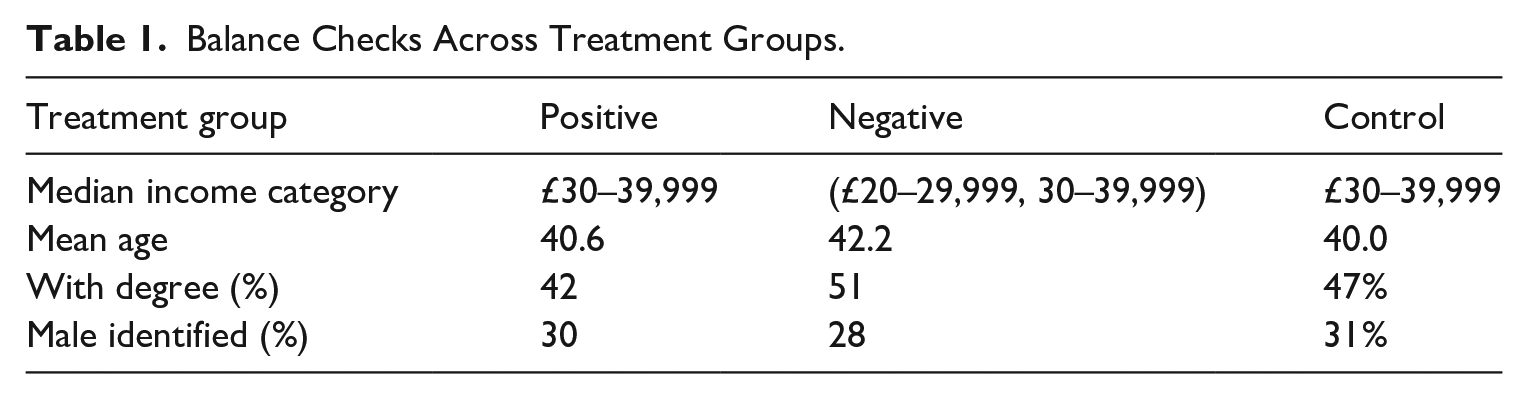
Our experiment meets the criteria for a clean experiment laid out in Mutz et al., (2019): randomisation occurred, treatments were delivered and there is no evidence that differential attrition occurred. We did not have manual attrition from our study, as four manipulation checks, discussed below, showed that all respondents watched the video; therefore, we did not need to remove any responses. Of the 472 respondents who started the survey, 17 dropped out along the way, and an additional 5 timed out. The 17 respondents who dropped out had not reached the treatment when they left; of the 5 who timed out, 3 were in the positive treatment, and 2 were in the control. Prolific automatically replaces respondents who have dropped out. Unfortunately, the demographic data on the respondents who dropped out is unavailable, making it impossible to tell if there is some systematic bias there; however, the relatively small numbers suggest this was unlikely to have an effect on randomisation. This makes it unnecessary to do randomisation or balance checks; indeed, Mutz et al. (2019) argue that the model adjustments made after doing balance checks of clean data can lead to erroneous or fraudulent conclusions. However, to provide assurances to readers that the treatment groups were similar, we have provided statistics comparing the three groups on basic demographic variables in Table 1. These show that the treatment groups were very similar in their composition.
Balance Checks Across Treatment Groups.
Limitations
It is important to recognise that the method employed here does have some limitations. First, our sample was not a random or representative one. In particular, because participants in Prolific surveys are paid for their participation, we were concerned that the sample might contain a higher proportion of low-income individuals. However, on several important demographic indicators, especially of social class, our sample was quite similar to the UK population: first, median age in our sample was 40, the same as the median age in the UK as a whole. 5 Second, the percentage of our sample having a post-secondary degree was 49.5%, and the percentage of 24–64-year-olds in the UK having a post-secondary degree was 50.1% in 2020. 6 Third, the median category for household income in our sample was £30,000–39,999, which is comparable to the median UK disposable income of £29,600 in 2019. 7
Another possible limitation is that our experiments look at the effects of the negative and positive framings in comparison to the control, but do not examine the effects of combining negative and positive framings. In the real world, respondents may be presented with different messages at different times. There is certainly a sense among observers that negative framings dominate, as outlined earlier in our article. It would be a useful area for further study to examine how often ads with negative framing are used in contemporary media settings.
Results
Effects of Treatment on Perceptions of Agency
We begin by examining the impact of the treatment on the individual measures of perception of agency. The impacts of the adverts on each of these six individual measures are presented in Figure 1: on the left side are the measures used by Baker (2015), on the right are the measures we added to capture a more holistic concept of agency. The measures on the left side of the figure show very little difference between the treatment groups: using the chi-square values for the equivalent cross-tabs showed significance levels of between 0.21 and 0.98. These measures, which focus explicitly on the ability of poor people to improve their economic circumstances, tend to elicit overall agreement from respondents. This is particularly true of the statement ‘Because of difficult economic circumstances, people in poor countries are unable to help themselves get richer’, where 77% of respondents overall agreed or strongly agreed with the statement.
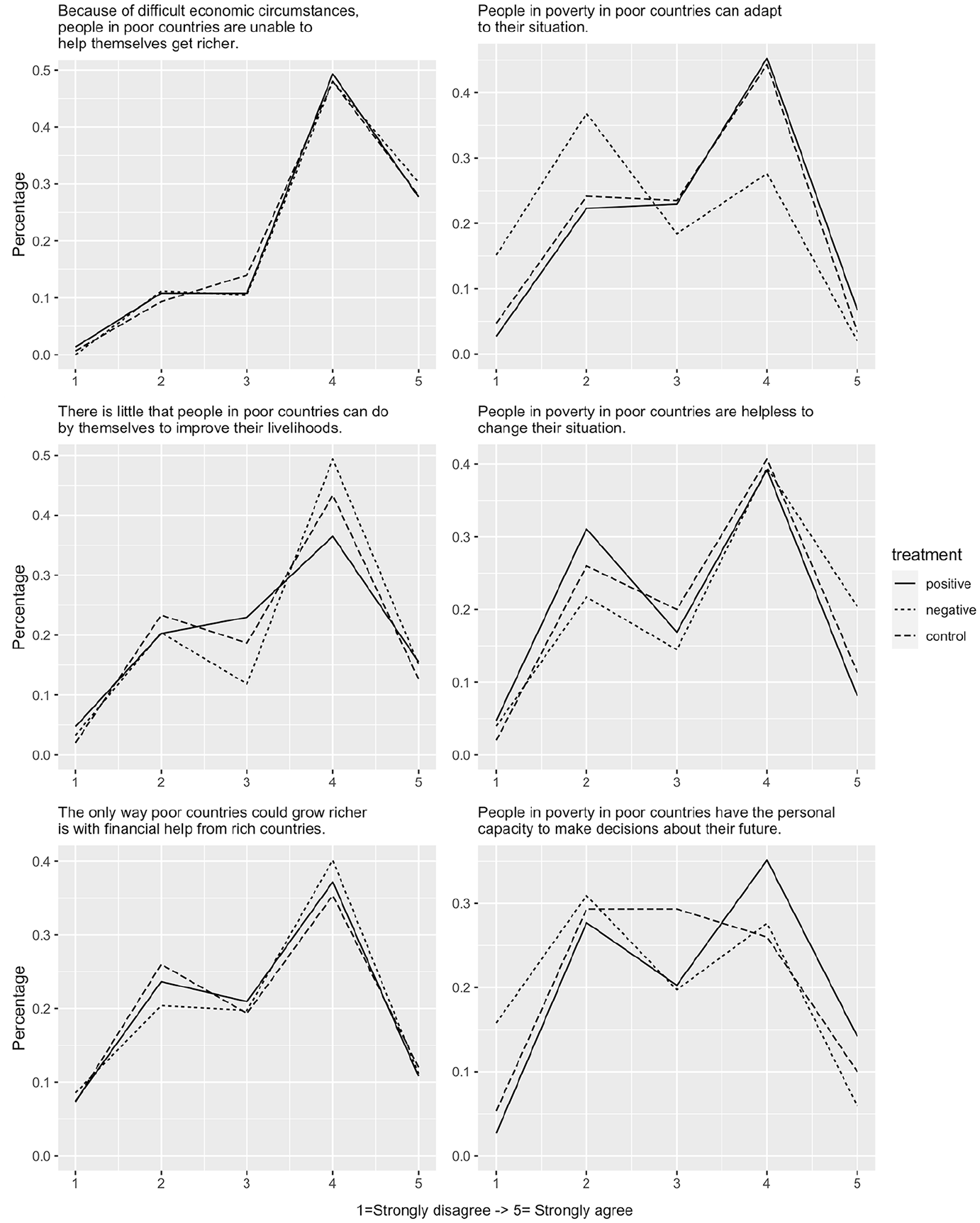
Perceptions of Agency by Treatment.
The graphs on the right side show a different pattern. For these questions, the chi-square values for the equivalent cross-tabs showed significance levels of 0.05 or better, excepting the middle graph where the chi-square showed a significance level of 0.06. In the first graph, we present the distribution for respondents’ belief that ‘People in poor countries can adapt to their situation’ over the three treatment conditions. In this case, the positive treatment looks quite similar to the control group; however those in the negative treatment were far more likely to disagree with the statement. Overall, 52% of people who saw the positive treatment and 48% of people who saw the control treatment strongly agreed or agreed with the statement. By contrast, only 30% of people who saw the negative treatment agreed with the statement. Only 25% of people who saw the positive treatment and 29% of people who saw the control treatment strongly disagreed or disagreed with the statement; while 52% of people who saw the negative treatment strongly disagreed or disagreed with the statement. In other words, the difference between the positive/control and negative treatments around perceptions of adaptability was a factor of almost two.
The second graph on the right side shows the distribution of respondents’ belief that ‘People in poverty in poor countries are helpless to change their situation’ over the three treatment conditions. In this case, the difference between the positive and negative treatments was much smaller, and the control group was in between these two. Overall, 47% of people who saw the positive treatment strongly agreed or agreed that people in poverty in poor countries were helpless to change their situation, while 60% of people who saw the negative treatment strongly agreed or agreed with the statement. On the other side, 36% of people who saw the positive treatment strongly disagree or disagreed with the statement, while 26% of people who saw the negative treatment strongly disagreed or disagreed. In both cases, the control group was very close to the centre point. This difference of 10%–13% is smaller than in the previous question, and notably it does not appear to be the result of either the negative or positive treatments being hugely different from the control group.
The third graph on the right side of Figure 1 shows the distribution of respondents’ beliefs that ‘People in poverty in poor countries have the personal capacity to make decisions’ over the three treatment conditions. Here, the respondents who watched the more positive video were more likely to agree or strongly agree with the statement than those who watched the negative video: 49% of the respondents who watched the positive video strongly agreed or agreed with the statement, while 34% of those who watched the negative treatment did. On the other side, 30% of respondents who watched the positive video disagreed or strongly disagreed with the statement, while 47% of people who watched the negative video did so. In this case, it appears that the videos had a polarising effect: those who watched either the positive or negative videos were far less likely to choose ‘neither agree nor disagree’. Furthermore, those who watched the positive video were far more likely to choose ‘strongly agree’ than those who watched the negative video, and those who watched the negative video were more likely to choose ‘strongly disagree’ than those who watched the positive video.
Overall, the questions that did not focus solely on respondents’ ability to deal with their finances were affected more by the experimental treatments than those that did not. Specifically, the two questions that used the word ‘richer’ show no impact at all from either treatment. The idea of ‘getting rich’ may be seen as too strong an ambition for those living in poverty in poor countries, while respondents still respond to more moderately stated ambitions about improving their livelihoods or changing their situation.
Regression Results
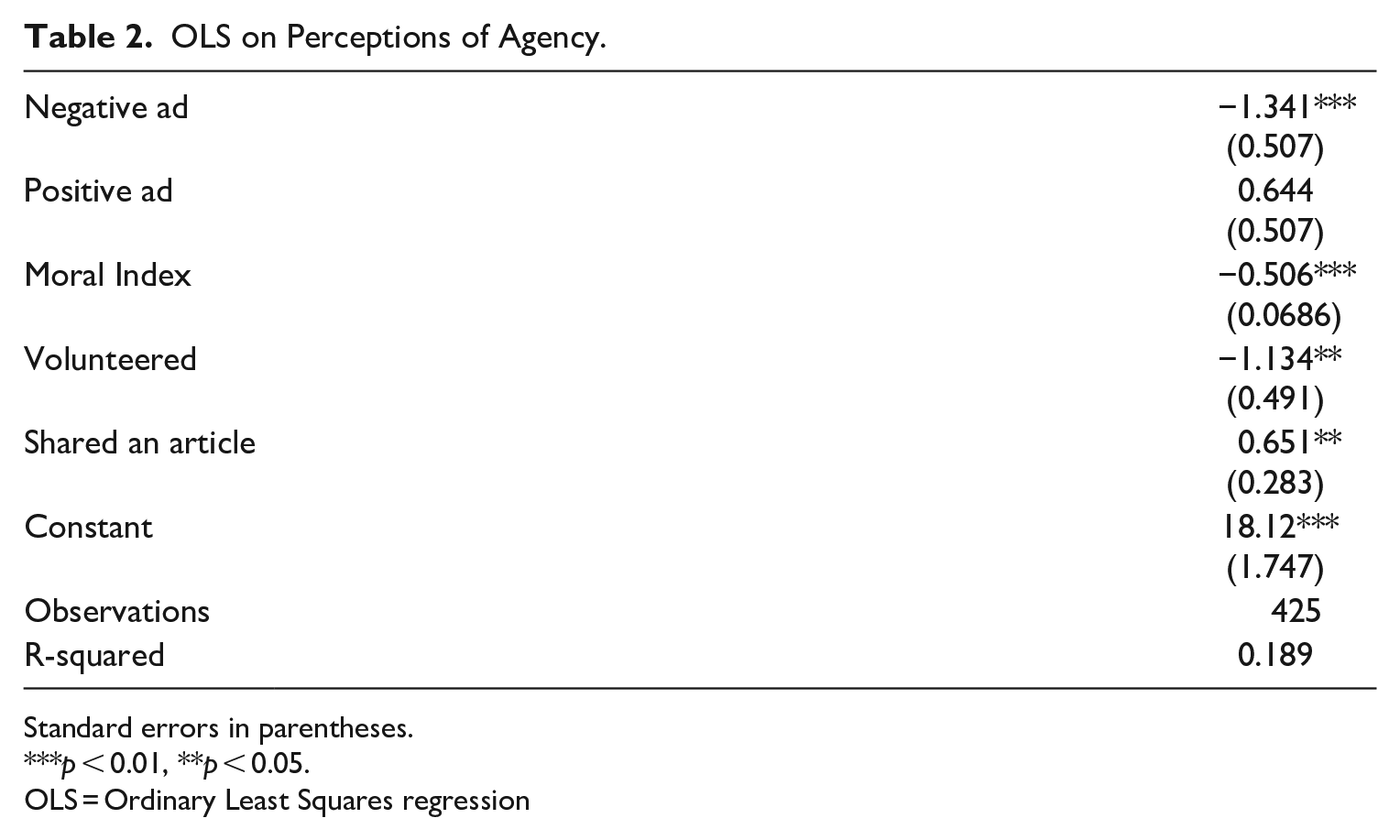
To test the influence of watching positive or negative adverts on respondent’s perceptions of agency more precisely, we ran a regression analysis to examine the impact of our experimental conditions while controlling for other factors. To do this, we created an index of agency to use as the dependent variable. While there is some variation in how the questions regarding perceptions of agency are worded, a factor analysis showed that the first dimensions accounted for almost all the variation in the six questions. 8 Since the variables all had such high loadings on the first dimension, we used a simple additive index. Before doing so, we recoded the individual measures so that the higher values indicated a stronger belief in the agency of people in developing countries. These results are presented in Table 2. We created simple dummy variables for whether the respondent was in the positive or negative treatment group; the control group acts as the excluded third category. Because we anticipated that experiences and attitudes might influence someone’s perceptions of the agency of people in developing countries, we included three control variables: the index of whether you have a moral commitment to aid, whether you have volunteered for an organisation working on development, and whether you have shared an article or information on development with another person.
OLS on Perceptions of Agency.
Standard errors in parentheses.
p < 0.01, **p < 0.05.
OLS = Ordinary Least Squares regression
The results from our regression demonstrate support for Hypothesis 1, but not Hypothesis 2. Those who watched the negative advertisement were 1.3 lower on the 25-point scale of agency than those who watched the control. However, the positive advert did not have a statistically significant effect. It appears that watching the positive advertisement does not have the equivalent effect in the opposite direction as watching the negative advertisement.
We also find that viewing poverty as a ‘moral issue’ has a negative impact on both perceptions of financial and personal agency; in other words, the more a person views aid as a moral decision, the less likely they are to view people in developing countries as having either personal or material agency. This suggests that a moral commitment to aid has a complex impact: while van Heerde and Hudson (2009) find that it can increase commitment to aid and likelihood of donations, we find that it may decrease perceptions of the agency of people in developing countries. This could be an interesting avenue for further research. It may be, for instance, that for many people a moral commitment to aid is premised on an understanding of those in developing countries as helpless victims.
We also examined the effects of two areas of involvement with issues surrounding international poverty and development: volunteering and sharing an article. Volunteering is an activity with relatively high time investment, and one that suggests the respondent has some level of commitment to and knowledge of issues related to development aid. Sharing an article is more ambivalent. The person who shares an article is clearly engaged with media coverage of aid to developing countries, but may or may not feel sympathetic towards individuals in developing countries. These variables are both coded on a three-point scale, with lower numbers indicating less likelihood of sharing/volunteering. 9 The coefficient for volunteering is negative, indicating that those who spend time volunteering are more likely to believe in the agency of people in developing countries. Those who spend time volunteering may know more about people in developing countries before getting involved, or may have received training as part of their volunteer role that educates them about people in developing countries. Interestingly, the coefficient for sharing an article runs the opposite way: those who share an article are more likely to see people in developing countries as lacking in agency. We see two possible explanations for this: the first is that those who share an article are more negatively disposed towards people in developing countries and thus more likely to see them as lacking in agency. The second is that those who share articles are presumably being exposed to the media on people in developing countries, and this media may be more likely to portray those in developing countries as lacking in material agency. Unfortunately, we do not have the data necessary to determine which of these is most likely, but it would make an interesting avenue for future research.
Likelihood of Donation
One of the ways NGOs justify the use of negative imagery is that it is supposed to increase donations. While it is not the primary focus of this article, we were curious about whether viewing the adverts would be more likely to increase the likelihood of donation. We therefore asked respondents if they would donate the money they earned for taking part in the survey to Save the Children. In Table 3, we present the cross-tab of the treatment with people’s willingness to donate. We find no difference between any of the treatments; the χ2 indicates p = 0.7. In other words, it does not appear that either advert for Save the Children has had an effect on the respondent’s likelihood of giving. While these results are intriguing, we urge caution in their interpretation for two reasons. First, it is difficult to draw strong conclusions from null results with such a small sample. We conducted a power analysis to ascertain what size sample would have been necessary to see statistically significant differences between these groups. We based our power analysis on the proportions of respondents who answered ‘no’ in response to this question. To find a statistically significant (0.05) difference between proportions of 0.09 and 0.13, as found in our control and negative experimental treatment, we would have to have a sample of 960 per group; this was calculated using Stata’s power calculator. Since our sample was only 150, we urge caution in drawing too strong a conclusion based on these results. Second, respondents join Prolific specifically with the intention of making money. It is possible that this is because they perceive the need for the additional money more acutely than the average population. Interestingly, Prolific used to offer users the ability to donate their survey earnings to Save the Children but removed this feature after uptake was considerably less than they expected or hoped for (Damer, 2018). However, we think the subject deserves further examination.
Willingness to Donate to Save the Children.
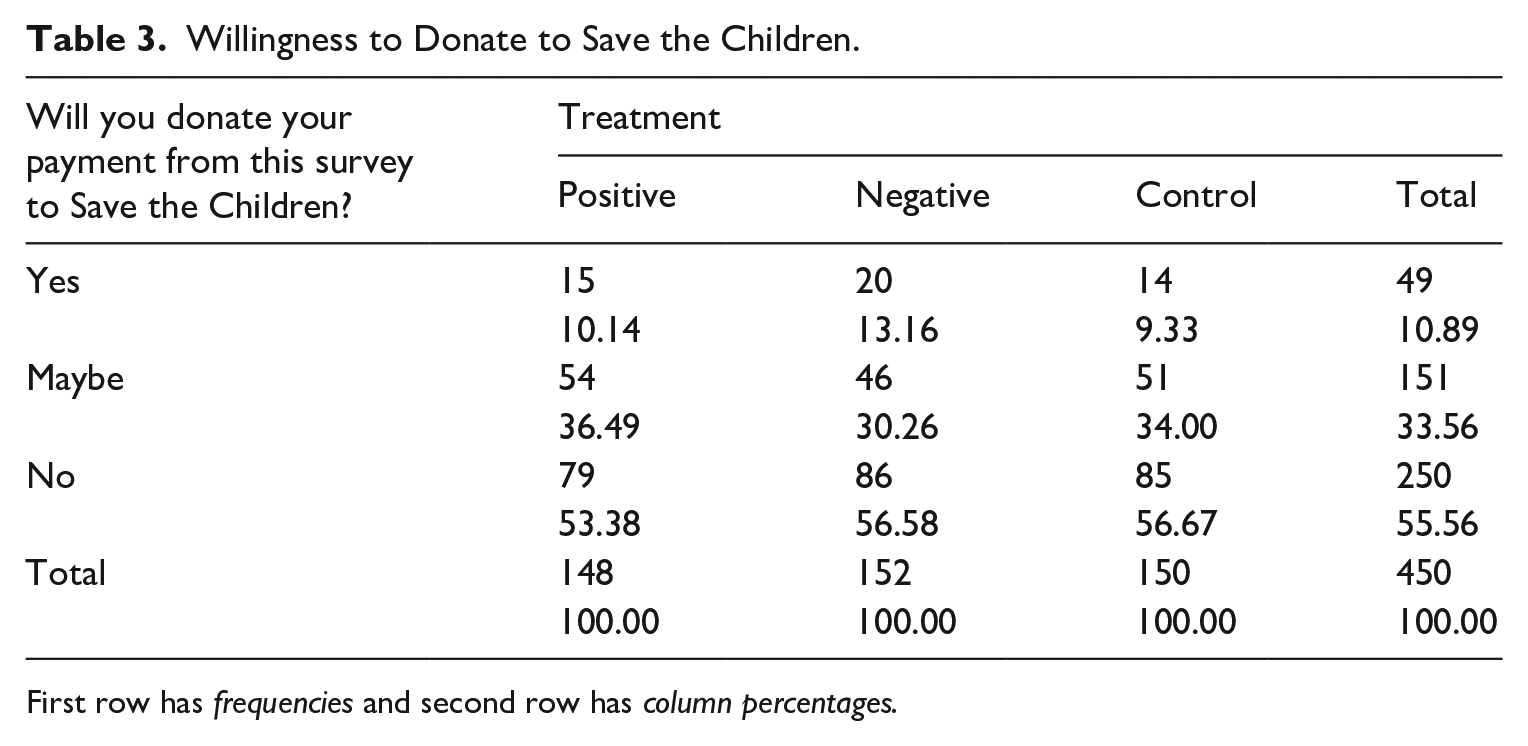
First row has frequencies and second row has column percentages.
Discussion and Conclusion
Our regression results demonstrate that seeing the negative messaging in international development NGO adverts decreases respondents’ belief in the agency of those in developing countries. This affects not only how those individuals are viewed more generally but also whether support is offered to resolve their situation and the form this support takes. Social psychologists have found that perceiving people as lacking in agency decreases the willingness to help those individuals, either personally or through policies to support them (Costello and Hodson, 2011; Cuddy et al., 2007). Baker’s (2015) examination of the role of race in perceptions of agency concludes that perceiving people as lacking agency leads to the provision of types of aid and support that give recipients far less say over how funds are used. As Theo Sowa, CEO of the pan-African organisation the African Women’s Development Fund, said, ‘When people portray us as victims, they don’t want to ask about solutions. Because people don’t ask victims for solutions’ (Sowa, quoted in Lentfer, 2018).
The effects of these kinds of negative advertisements run counter to the aims and objectives of many NGOs. Many international development NGOs emphasise the importance of the ‘dignity’ of aid recipients in their strategies or values and missions statements (e.g. Age International, n.d.; CAFOD, n.d.; Care, n.d.; Christian Aid, n.d.; Concern Worldwide, n.d.). As discussed earlier, social psychologists have demonstrated that being perceived as lacking in agency can lead to dehumanisation of individuals (Formanowicz et al., 2018), which clearly undermines their dignity. In their 2019–2021 strategy, Save the Children UK (n.d.) state that one of their organisational priorities is: ‘To inspire the public to act for our cause, the power and potential of children will be at the heart of all of our communications’. It is clear from this that Save the Children UK aim to encourage their supporters to recognise the agency of children in the developing world. Given our results, we would argue that they and other international development NGOs should recognise that advertisements with negative messages work against their goals.
While the regression results demonstrate the overall impact, there are some interesting things to be learned by examining the impact on the individual measures of perception of agency. Those measures that focused on the ability of poor people to ‘get richer’, such as those in Baker’s (2015) work, were generally unaffected by the treatments. As scholars turn their attention to understanding the effects of these types of advertisements on perceptions of agency, our work demonstrates the importance of using multi-dimensional measures of perceptions of agency of those in the developing world.
Rather than just focusing on the effects of negative messaging, our research also provides a path to potential solutions through the use of the positive messaging by NGOs. It is worth considering the lack of impact of the positive advertisement on overall perceptions of agency in light of Sim and Hugenberg’s (2022) finding that empowering messaging can lead to greater attributions of agency. In the narrative they discuss, the focus is on the ability of physically disabled individuals to overcome their circumstances as individuals, as opposed to as part of their community; in the positive video we use, the focus is more on the community, which may account for why there is less of an effect. Similarly, in their work on the effects of negative images on support for foreign aid, Bayram and Holmes (2021) claim that negative images are effective because of the identifiable victim effect. NGOs should consider whether messaging that, for instance, allows individuals to explain how they have contributed personally to overcoming the hardships they’ve faced could be useful in presenting people in lower income countries.
Overall, our study provides clear evidence of the harm done by the kind of messaging so frequently used by development NGOs and others to describe those living in poverty in low-income countries, as well as some interesting avenues for further research in the area. The mixed results showing possible positive effects of more empowering messaging provides some guidance for NGOs to think about how to shift their messaging in the future.
Footnotes
Declaration of conflicting interests
The author(s) declared no potential conflicts of interest with respect to the research, authorship and/or publication of this article.
Funding
The author(s) received no financial support for the research, authorship and/or publication of this article.
