



Abstract
Is there a rural–urban divide in citizens’ views on European Union agricultural policy? We argue that the place of residence influences a person’s attitude toward agricultural policy issues. More precisely, we postulate that rural populations are less likely to view environmental and climate action, and sustainable food production as key objectives of agricultural policy; instead, we hypothesize they are more likely to indicate job growth in rural areas and ensuring a fair standard of living for farmers as key objectives. We analyze data from a Special Eurobarometer survey fielded in 2020 for 24,328 individuals living in 27 European Union member states. Multilevel mixed-effect logit models reveal the place of residence (urban–peri-urban–rural) as a significant predictor of the respondents’ attitudes for almost all dimensions of agricultural policy. The differences are most striking for environmental and climate-related aspects of agricultural policy, as well as for its goal of generating economic growth and jobs in rural areas. From this, we conclude there is a rural–urban divide concerning agricultural policy, which policymakers should be aware of and attempt to address.
Introduction
The ability of democratic governments to respond to the preferences of their citizens by proposing and adopting public policies is a central requirement for ensuring their legitimacy (Huber and Powell, 1994). In this context, Stecker and Tausendpfund (2016) contend that for a more complete understanding of how governments gain public support, we need to account for the fact that public policies have multiple dimensions. To assess their argument, the authors concentrate on the citizen–government policy congruence in different policy issue areas, ranging from European integration and redistribution to social lifestyle, immigration, and environmental protection. In this study, we pick up the argument put forth by Stecker and Tausendpfund, but strive to offer a more refined understanding of the multi-dimensionality of public policies and how this is reflected in the preferences of citizens.
Scholars in the field of policy studies have argued that we can conceive of public policies as sets of policies—so-called policy mixes (Howlett and Rayner, 2007). Each element of a policy mix comes with its respective “goals, tools, rules and target populations” (Schneider and Ingram, 1993: 334). The literature on public policy has assessed how policy mixes can be best designed (in terms of tools, rules, and target groups) to achieve their goals, which includes facilitating smooth implementation (see, e.g. Mavrot et al., 2019). However, it has paid scant attention to how the different elements of policy mixes are perceived by their target groups, that is, the individuals or groups whose behavior and well-being public policies seek to affect (Schneider and Ingram, 1993). We contend that citizens’ attitudes toward different elements of policy mixes can be expected to vary depending on the anticipated costs and benefits for the different target groups (see, e.g. Anzia et al., 2022).
The European Union’s (EU) agricultural policy has evolved as a policy mix comprising diverse policy elements and therefore should demonstrate a differentiated empirical picture regarding citizens’ policy attitudes. For many decades, the main goal of EU agricultural policy was to support farm income and stimulate sector productivity (Skogstad, 1998). Developments, such as the increased salience of environmental degradation and climate change, have resulted in the original agricultural policy mix expanding to accommodate “green” elements (Daugbjerg and Feindt, 2017; Gómez-Limón et al., 2012; Howley et al., 2014). Adding “green” elements to agricultural policy not only increases costs, first and foremost for farmers, but also potentially reduces the benefits for rural communities. In marked contrast, urban communities are not directly affected by these changes since agricultural activities mostly take place in rural areas. These characteristics of agricultural policies suggest that their effects and impacts are “place-based” (Barca et al., 2012).
In this study, we postulate that the place-based characteristics of agricultural policies result in differences in how rural and urban communities perceive individual policy elements of the EU’s agricultural policy mix, and that these differences result from whether the residents of each place perceive themselves as winners or losers of the respective policies. More poignantly, we ask: Is there a rural–urban divide in citizens’ views on the different elements of EU agricultural policy?
One of the few data sources that captures the public’s view on different elements of the EU’s agricultural policy mix is a Special Eurobarometer published in 2020. It includes information on citizens’ attitudes toward farm income stability and productivity, while gauging the level of importance that Europeans assign to tackling the environmental and climate impacts of agriculture, having safe, healthy and sustainable food, and preserving the affordability of food (European Commission, 2020). We fit multilevel logit models of citizen responses with the area of residence as the focal explanatory variable, and use a whole battery of individual and state-level variables as controls to assess this research question.
On this empirical basis, we are able to demonstrate a rural–urban divide in the respondents’ attitudes captured by our dataset. The urban–rural divide is particularly strong for two dimensions: whether the goal of agricultural policy should be to stimulate growth and the creation of jobs, or to ensure it tackles environmental degradation and climate change. Rural communities are significantly more likely to prefer the first set of goals for agricultural policy, whereas they are less likely to stress that agricultural policy should become “greener.” These findings contribute to the literature not only by confirming the existence of a urban–rural divide in citizens’ attitudes toward agricultural policy (e.g. Howley et al., 2014), but by showing that this divide holds true across a large number of countries, even when controlling for several individual-level variables. In practical terms, these results call on policymakers to be aware of the varying perceptions of policy mix elements; it may be that more “place-based” (Barca et al., 2012) communication strategies increase acceptance among target groups.
The remainder of this study unfolds as follows. We first present our theoretical framework and derive hypotheses for explaining citizen perceptions on a set of agricultural policies. Then, we provide clarifications on the operationalization of the variables and the research design. Subsequently, we present our findings, discuss them, and offer some concluding remarks.
Analytical Framework and Hypotheses
There is a growing literature that draws attention to the urban–rural divide in attitudes, usually political attitudes, such as support for far-right or right-wing populist parties or “new” left parties. Most of this literature studies individual countries (Bornschier et al., 2021; Jennings and Stoker, 2016; Maxwell, 2020), but comparative research has also demonstrated the increased importance of places of residence for explaining political attitudes (Kenny and Luca, 2021).
The most straightforward theoretical angle for explaining an expected urban–rural divide in political attitudes is social cleavage theory. Taking the industrial revolution of the 18th and 19th centuries as the key historical event, Lipset and Rokkan (1967), the founders of this perspective, recognized the political divide in the interests of people living in rural areas and engaged in agricultural production versus those living in (large) cities and working in manufacturing. As a consequence, agrarian parties emerged, of which some continue to exist today, often with an updated profile that embraces right-wing populism (e.g. Mamonova and Franquesa, 2020).
In the second half of the 20th century, the urban–rural cleavage was mostly replaced by the cleavage in labor and capital, and the question of the role of the state in society (Kenny and Luca, 2021). However, globalization has revigorated the urban–rural cleavage, which eminent scholars in the field, such as Iversen and Soskice (2019), associate with a constellation in which highly educated people with green and progressive views live in cities, while people with conservative views live in rural areas. A further indication on the enduring relevance of this cleavage is the reflection of electoral districts’ geographical characteristics in legislator behavior (Papp, 2021).
The literature on the urban–rural divide of political attitudes stresses three individual-level factors that explain why the place of residence could matter. The first, which is also part of the argument put forth by Iversen and Soskice (2019), is education. The second one is social class, which approximates whether one feels like a “winner” or “loser” in a globalized economy (Kriesi et al., 2006) or in a knowledge-based economy (Ford and Jennings, 2020; Rodríguez-Pose, 2018). The third factor is ideology, which can be conceptualized in different ways. A frequent conceptualization refers to the green–alternative–left versus traditional–authoritarian–nationalist dimension (Hooghe et al., 2002), which resonates with the “new” cleavage perspective conceived by Inglehart (1977) and differentiates between materialism and post-materialism.
Other work has argued that the place of residence can also matter at the group level. For example, drawing on social psychology and ethnographic research, Bornschier et al. (2021) contend that group membership and the corresponding collective identity produce collective feelings, such as resentment (toward groups or political decisions) and deservingness (who should be given support and who not). This reasoning resonates with the empirical findings reported by Cramer (2016: 6), which indicate “multifaceted resentment against cities” among members of rural communities in the United States. Cramer explains this finding with reference to the existence of a rural consciousness. Lunz Trujillo (2022), similarly, argues that the rural psychological identification explains anti-intellectual attitudes in the United States. The author also contends that it is the affective dimension of rural psychological attachment, rather than simply living in rural areas, which drives attitudes.
With the above literature, it is worth stressing that most of them concentrate on political attitudes and therefore investigate phenomena, such as attitudes toward the political system or support for certain ideologies, political parties, or societal groups. Our research focus deviates from previous perspectives in two ways. First, we are interested in how policies, which affect the behavior and well-being of individuals, are perceived. Second, our research interest reflects the fact that policies do not comprise individual measures but rather come in mixes, and that the different elements of these policy mixes can be perceived differently by their target groups.
Further literature has examined the relationship between policies and public attitude toward them, mostly focusing on welfare policies and welfare reforms (e.g. Jordan, 2013). This literature builds on the policy feedback framework put forth by Pierson (1993), which emphasizes the distributive consequences of policies. Some groups benefit from the policy status quo whereas others bear the associated costs. A change in policy is associated with a change in the cost–benefit distribution among different groups. Those who feel that the new policy may shift the equilibrium, incurring costs for themselves, are likely to disapprove the change and support the policy status quo. The policy feedback approach underlies the empirical study by Anzia et al. (2022), who show that individuals benefitting from US agricultural support programs are more likely to support them.
While Anzia et al. (2022) contribute to the literature by arguing and showing that there is a policy feedback effect at the individual level, we contend that the place of residence, which we refer to as the “collective level,” matters for attitudes toward agricultural policy since it is “place-based” (Barca et al., 2012) in terms of who benefits. That place matters is, for example, demonstrated by Dasgupta and Ramirez (2020), who state that communities living in areas with strong agribusiness presence are more likely to oppose government regulation while supporting pro-business tax and spending policies. The authors explain this finding by referring to the long-term political legacy of the technological shock that restructured agriculture in the United States during the post-war period, and made it more capital-intensive and productive, thereby creating right-wing rural populations.
Turning to our specific research interest, rural communities have benefited from the EU agricultural policy’s focus on raising productivity, increasing farm-level income and creating jobs in rural areas. Many of them have experienced increased employment, economic growth, and a reduction of poverty rates (Grodzicki and Jankiewicz, 2022). Evidently, not all individuals in rural areas are employed in the agricultural sector, meaning they are not directly affected by agricultural policy. However, we contend that individuals use easily accessible information, and that their views are influenced by context, in this case mainly their area of residence, which suggests they are rationally bounded rather than perfectly rational (Shafir, 2013).
Consequently, even individuals who do not depend directly on agriculture will have a sense of the sector’s importance for rural communities and its concerns through social interactions or the reporting of these by local news media. This should make them more likely to support protecting farmers and their income and ensuring sector viability by stimulating rural development (Howley et al., 2014), which is captured by our first two hypotheses. All hypotheses differentiate between rural, peri-urban and urban areas to reflect the finding reported by Kenny and Luca (2021) that the rural–urban divide should be thought of as a continuum rather than a dichotomy.
H1: Persons living in rural areas are more likely to indicate a fair standard of living as a priority of agricultural policy.
H2: Persons living in rural areas are more likely to indicate growth and job creation in rural areas as a priority of agricultural policy.
Conversely, we expect rural populations to be more hesitant to call for agricultural policy to address environmental degradation and climate change. “Green” measures can be perceived as reducing the economic growth potential of rural areas, given the financial investments needed for their implementation, and therefore as having negative impacts on rural communities at large (Cramer, 2016; Daugbjerg, 2018).
H3: Persons living in rural areas are less likely to indicate environmental protection and climate change as a priority of agricultural policy.
H4: Persons living in rural areas are less likely to indicate sustainable food production as a priority of agricultural policy.
While for the first four elements of EU agricultural policy, we expect the perception of benefits and costs to be placed-based, we argue that there are also elements of the agricultural policy mix on which rural populations do not have attitudes that are different from those in urban areas. More precisely, we do not expect to see divergent views between citizens in different communities regarding safe and healthy food, stable supply of food and food prices, since everyone should benefit equally from the goals of these policy elements.
H5: There should be no difference in the likelihood of persons living in rural, peri-urban or urban areas to indicate safe and healthy food as a priority of agricultural policy.
H6: There should be no difference in the likelihood of persons living in rural, peri-urban or urban areas to indicate a stable supply of food as a priority of agricultural policy.
H7: There should be no difference in the likelihood of persons living in rural, peri-urban or urban areas to indicate reasonable food prices as a priority of agricultural policy.
Research Design
Dataset
We analyze cross-sectional, individual-level data from the Special Eurobarometer 504 on “Europeans, Agriculture and the CAP,” which includes responses from 27,237 EU citizens, 24,328 of whom offer complete responses for the constructs of interest here (European Commission, 2020). The fieldwork was carried out in August and September 2020, and consisted of face-to-face interviews at the homes of interviewees in their native language. The survey was commissioned by the European Commission, but administered by the polling company Kantar. The survey data contain information on citizen attitudes toward agricultural policy, as well as characteristics of participating individuals, which assist us in explaining response variations between citizens.
Operationalization of the Variables
We investigate a set of seven outcome variables, with each representing a response category for the question of what should be a main objective of EU agricultural and rural development policy. The pertinent item battery also includes two residual categories (“Other” and “Don’t know”), which we have omitted on substantive grounds and because they were chosen by very few respondents: “Other” by 0.08% and “Don’t know” by 0.55%. This leaves us with the following substantive categories, which are all binary outcome variables that take the value 1 if the respondent agrees and 0 otherwise:
Ensuring a fair standard of living for farmers.
Creating growth and jobs in rural areas.
Protecting the environment and tackling climate change.
Ensuring a sustainable way to produce food.
Providing safe, healthy food of high quality.
Securing a stable supply of food in the EU.
Ensuring reasonable food prices for consumers.
While we chose this item battery because it aligns with our research interest on how different elements of policy mixes are perceived, this operationalization also has the advantage of being more relatable to respondents, since it consists of concrete questions, rather than merely asking them about agricultural policy as a whole. While this does not eliminate the risk that respondents answer questions which they do not understand or on which they have no opinion, it certainly reduces it. The very low number of “Don’t know” responses supports our view.
Turning to the focal explanatory variable, we rely on Place of Residence, which indicates whether a respondent replied that she/he is based in a rural (response option: rural area or village), peri-urban (response option: small or middle-sized town), or urban area (response option: large town). The data for this and the additional individual-level variables included in the analysis come from the same Eurobarometer dataset. Our operationalization is less granular than that by Kenny and Luca (2021), for example, but the addition of peri-urban areas allows it to move beyond a fully dichotomous measurement.
The analysis includes a whole battery of control variables at the individual and the member-state levels. The first control variable, Ideology, captures the ideological self-placement of individuals on a 10-point scale ranging from 1 (left) to 10 (right). This variable resonates with the logic of social cleavage theory, and enables us to assess whether it is the individual political ideology that determines citizen attitudes on agriculture rather than the place of residence and the associated collective identity. Empirical findings, such as those by Lusk (2012), suggest ideology is a key driver of attitudes on agriculture and food.
Age captures all sorts of potentially intervening factors, such as interest for agri-food issues and professional status (Mostafa, 2013).
Gender is included to control for potential gender effects, which have been reported widely in the literature. Women tend to be more aware of sustainability issues (Lazaric et al., 2020; Mostafa, 2013).
Income is a classic variable associated with attitudes toward sustainability (Lazaric et al., 2020), but it also aligns with the socio-economic divisions in society associated with social cleavages. Here, we are able to use an innovative measurement of income offered by the Eurobarometer data, namely, whether respondents had difficulties paying their bills (Difficulties Paying Bills) during the last year. Likewise, the dataset offers information on respondents’ self-assignment to a Social Class, which resonates with cleavage theory.
Another control variable refers to respondents’ Education, which has been identified as an important factor for explaining sustainable attitudes and behavior (Lazaric et al., 2020).
The variable Children is binary and indicates whether children younger than 10 years old live in a respondent’s household. We consider it important to control for this factor, since research on organic food preferences has shown that parents with small children tend to pay more attention to how food is produced (e.g. Gómez-Limón et al., 2012).
In addition to the individual-level variables, we control for the share of agriculture in a member state’s gross domestic product (GDP), Agriculture (% GDP), as reported by the World Development Indicators, and for the organic crop area in a member state as a percentage share of agricultural land in 2020, Organic Area (in %), as reported by Eurostat. The share of agriculture gauges the economic importance of agriculture, which could also impact citizens’ attitudes. Organic crop area is an indicator for assessing how important environmental and sustainability considerations are in the agri-food systems of individual member states, which could also affect citizen attitudes.
Table 1 presents the percentage of respondents for each of the categorical variables, as well as the minimum, median, mean, maximum, and standard deviation for the continuous variables. The table also reports the missing information for the individual variables. With the exception of Ideology, the share of missing values is very low.
Descriptive Statistics.
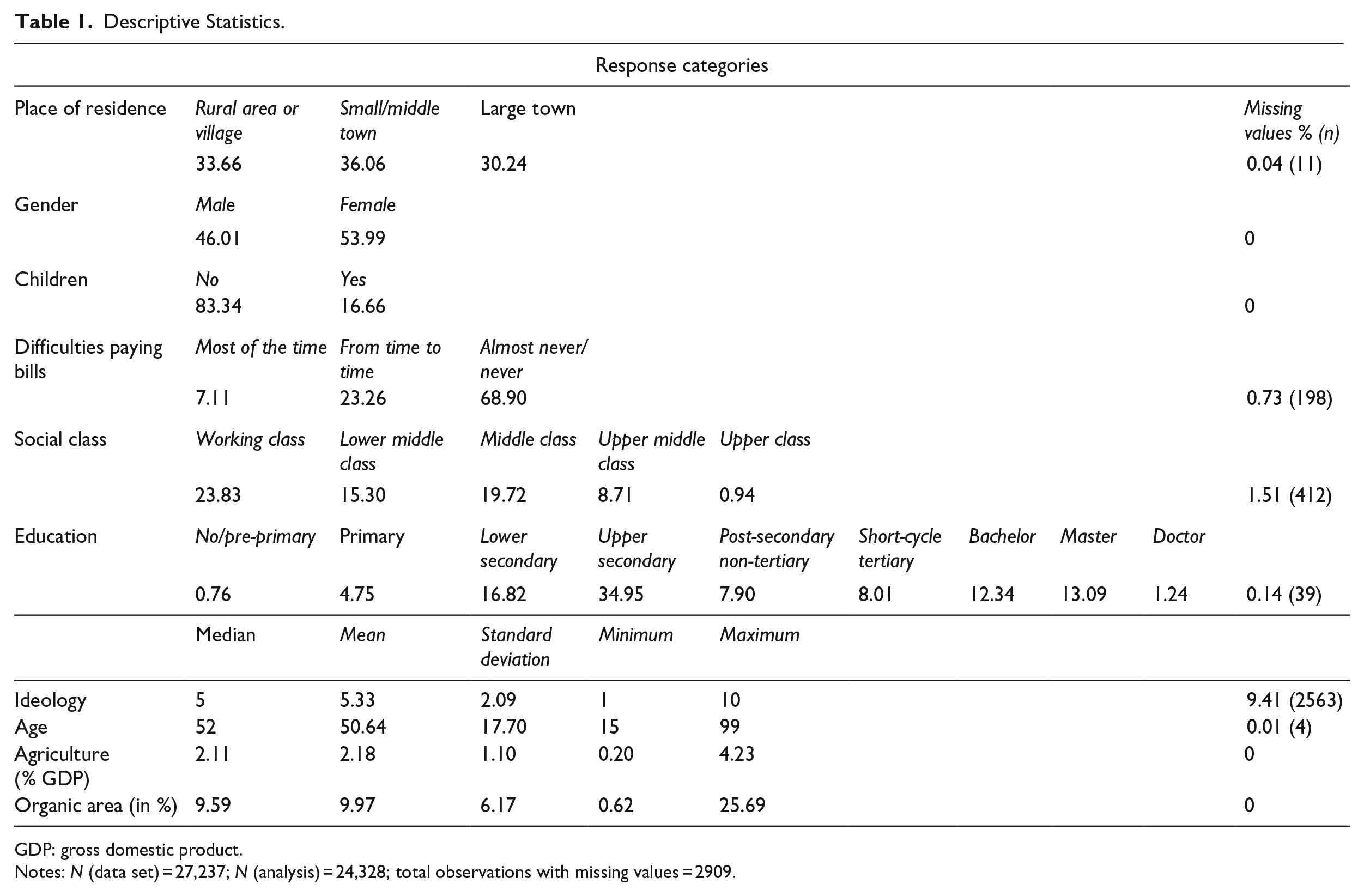
GDP: gross domestic product.
Notes: N (data set) = 27,237; N (analysis) = 24,328; total observations with missing values = 2909.
Estimation Strategy
All seven outcome variables are binary, which led us to conduct multilevel mixed-effects logistic regression models, in which the odds of the outcomes are modeled as a linear combination of the predictor variables with both fixed and random effects. We computed for all model specifications several multicollinearity diagnostics, which were all below the critical threshold. We did not apply sampling weights, since we are interested in associations between the variables and not in the prevalence of certain attitudes. 1
Descriptive Findings
Figure 1 presents the collective data for the seven outcome variables in a bar graph broken down by place of residence. Figure 1 is instructive, as it shows that providing safe and healthy food stands out as the main issue respondents associate with agricultural policy, which holds true for individuals living either in rural or (peri-)urban areas. While all respondents agree on the importance of high-quality food, the response pattern for the subsequent outcome variables show differences between rural residents and people living in (semi-)urban areas, which we consider a first hint that our overarching expectation concerning a rural–urban divide could be substantiated.
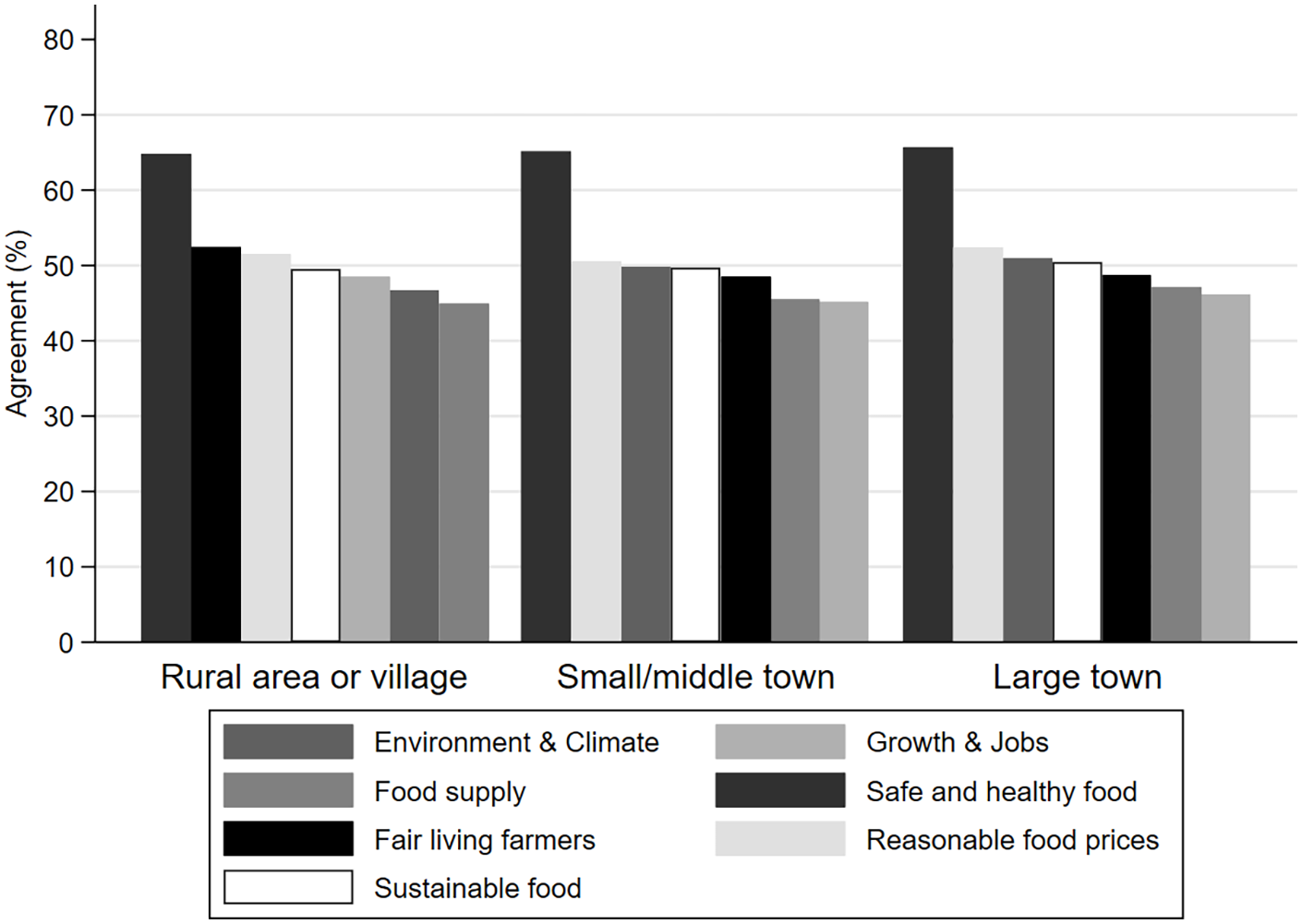
Response Patterns by Place of Residence.
We can see that among people living in (peri-)urban areas, the second highest agreement rates concern reasonable food prices, whereas individuals living in rural areas indicate fair living conditions for farmers. An agricultural policy that addresses environmental degradation and climate change ranks third among (peri-)urban respondents, followed by sustainable food, fair living standards for farmers, food supply, and finally, rural development. The response patterns for individuals living in peri-urban and urban areas are remarkably similar, which supports our reasoning to contrast rural communities against peri-urban communities. In the literature, rural and small- and medium-town dwellers are sometimes treated as one category (for a discussion, see Kenny and Luca, 2021). The descriptive analysis shows that it is more reasonable to treat rural dwellers only as the reference category.
The ranking of agricultural policy goals is markedly different by individuals in rural areas. While a detailed picture can be obtained from inspecting Figure 1, it is worth highlighting that goals related to environment and climate are indicated less frequently by these respondents, placing this goal in the penultimate rank.
Presentation and Discussion of the Analytical Findings
Tables 2 and 3 present the odds ratios of the multilevel mixed-effects logistic regression models for citizens’ priorities for the different elements of the EU’s agricultural policy mix. Odds ratios greater than 1 indicate that an increase in a covariate’s value increases the odds of agreement with a given response option, whereas odds ratios smaller than 1 indicate a decrease in the odds.
Results of Multilevel Mixed-Effects Models of Policy Objectives of EU’s Agricultural Policy (Hypotheses H1 – H4).
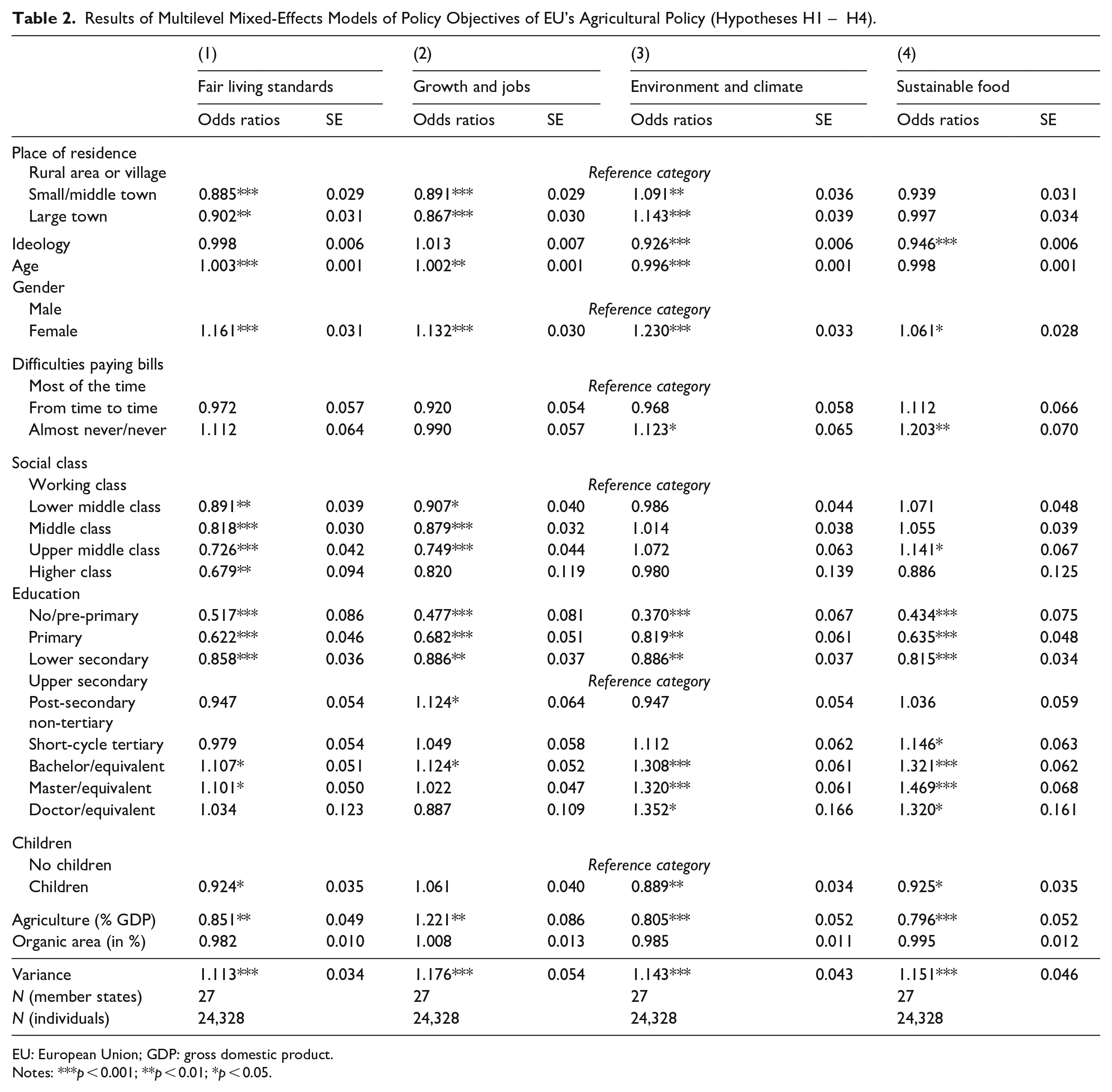
EU: European Union; GDP: gross domestic product.
Notes: ***p < 0.001; **p < 0.01; *p < 0.05.
Results of Multilevel Mixed-Effects Models of Policy Objectives of the EU’s Agricultural Policy (Hypotheses H5 – H7).
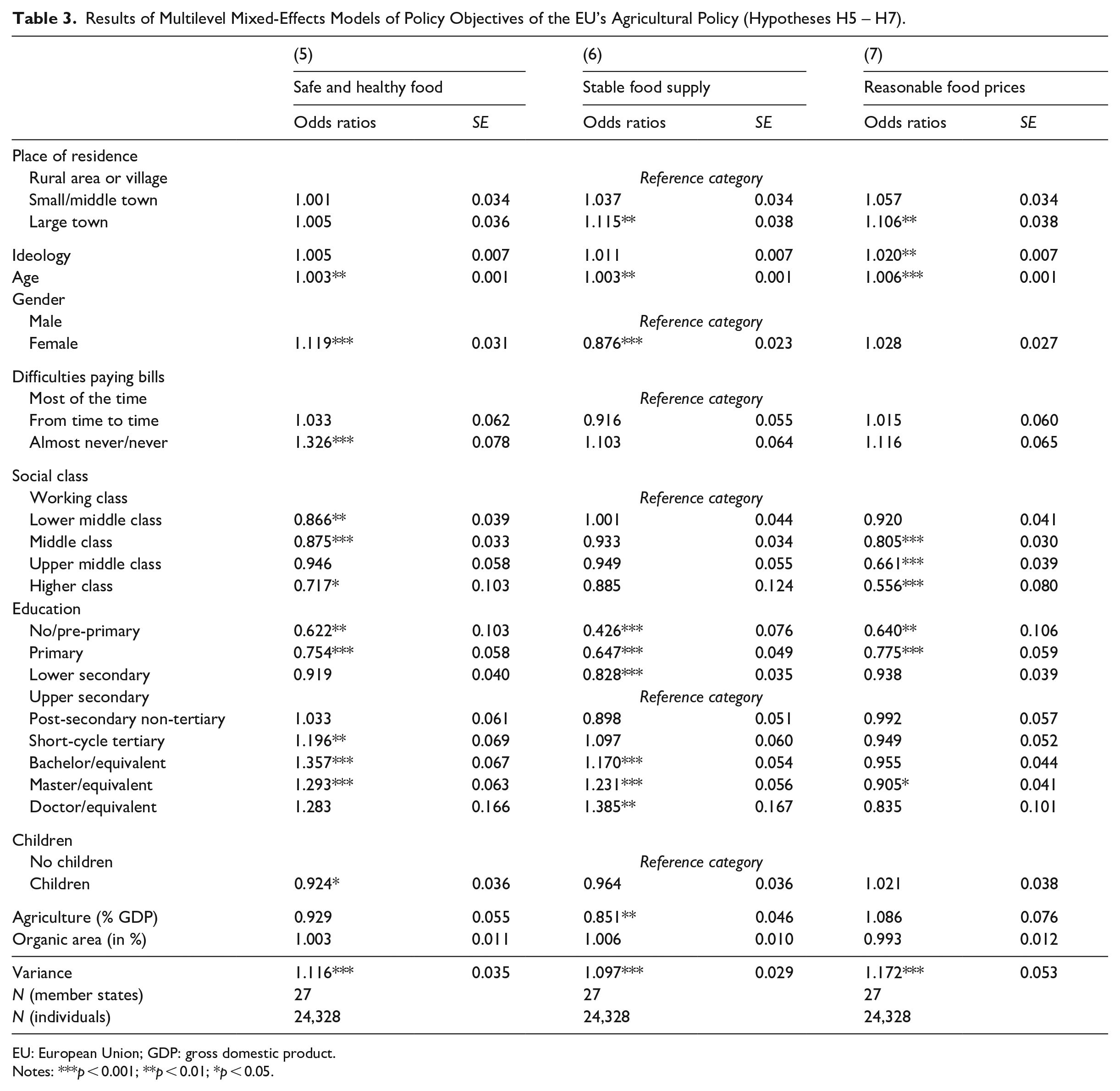
EU: European Union; GDP: gross domestic product.
Notes: ***p < 0.001; **p < 0.01; *p < 0.05.
We begin the discussion with the odds ratios presented in Table 2 and concentrate on the focal explanatory variables, which capture whether respondents live in a rural, peri-urban or urban area. As postulated by H1, compared to people living in rural areas, those living in (peri-)urban areas have odds ratios lower than 1, indicating they have lower odds of agreeing that agricultural policy should pursue fair living standards for farmers. Likewise, compared to rural residents, respondents living in large or middle-sized towns have lower odds of indicating that agricultural policy should stimulate economic growth and create jobs, which supports the reasoning underlying H2. As anticipated by H3, individuals living in (peri-)urban areas have greater odds than rural residents of listing the tackling of environmental degradation and climate change as a priority in agricultural policy. H4 postulated that compared to rural residents, people living in peri-urban and urban communities would have greater odds of indicating that agricultural policy should support sustainable food production. However, the odds ratios presented in Model 4 reveal that urbanized populations have lower odds of naming sustainability issues as a priority of the EU’s agricultural policy compared to rural populations. In fact, the odds differences between rural and (peri-)urban areas are statistically non-significant, suggesting that place of residence does not matter for indicating sustainable food as a main policy objective, rebutting H4.
Turning to the control variables, the statistical significance of the effects varies across the four models. However, we obtain robust findings for three covariates. Females have significant odds ratios greater than 1 in all model specifications, which shows they have greater odds than males of agreeing that these areas should be addressed by the EU’s agricultural policy. There is also a significant education effect across all models, indicating that people with a lower level of education rate these four objectives as less important than those with a higher level of education. The third covariate with a robust effect refers to the economic importance of agriculture in the individual member states. The odds ratios are significant and smaller than 1 in Models 1, 3, and 4. In Model 2, the odds ratio is significant but greater than 1, which indicates that in member states where agriculture contributes more to the GDP, individuals have greater odds of agreeing that agricultural policy should ensure sector growth and create employment. It came as a surprise to us that the odds ratios were smaller than 1 for predicting whether respondents indicate farmers should have a fair income in EU member states with a strong agricultural sector. However, for the other outcome variables, we found the direction of the effects convincing.
Turning to the testing of hypotheses H5, H6 and H7, Table 3 reveals statistically non-significant odds ratios, which suggests that place of residence does not matter for agreeing on safe and healthy food as an important policy objective. We postulated this null effect for place of residence in H5, which we can herewith support. However, for the remaining two outcome variables, the models produce significant odds ratios for individuals living in urban communities. People living in urban communities have greater odds than those living in rural areas of favoring an agricultural policy that ensures a stable supply of food. Likewise, urban dwellers have greater odds than people living in rural areas of demanding reasonable food prices. These findings challenge hypotheses H6 and H7.
Of the control variables, two produce significant odds ratios across all models. People of higher age have greater odds of agreeing that the EU’s agricultural policy should tackle these three issues. Another variable that affects response behavior is level of education, which we also found to be a robust explanatory variable in the previous set of models presented in Table 2.
Since ideological differences are a frequent explanation for cases of urban–rural divide (Kenny and Luca, 2021; Lusk, 2012; Mamonova and Franquesa, 2020), we expected ideology to perform better for explaining differences in citizens’ attitudes. However, ideology produced significant odds ratios in three models only. One of the reasons for this could be that this variable has a high share of missing data (see Table 1). To ensure that our findings are not affected by these lacunae, we replicated the analysis and report the findings in Tables A3 and A4 in the Supplementary Information. Our findings for the focal explanatory variables do not change substantially, with the exception of the odds ratios for peri-urban areas in Model 7, which are greater than 1 and significant at the 5% level.
Given that the dataset contained information on individuals living in 27 EU member states, in Table A5 in the Supplementary Information, we report the odds ratios obtained for the focal explanatory variables by estimating country-specific logistic regression models. The table is worth consulting, because it reveals for which countries the findings concur with those presented in Tables 2 and 3 and for which they deviate. When inspecting Table A5 in the Supplementary Information, one should bear in mind that these models exclude the two macro-level variables.
To summarize, the empirical results support hypotheses H1, H2, H3, and H5 but not H4, H6, and H7. Our findings align with those reported, for example, by Gómez-Limón et al. (2012) and Howley et al. (2014), who have investigated public attitudes on different elements of agricultural policy in Castile and Leon (Spain) and Ireland, respectively. We go beyond the existing findings in the literature since we utilized data on individuals living in 27 EU member states. We also go beyond country-comparative analyses that offered descriptive insights into citizens’ views on European agricultural policy (see Ahtiainen et al., 2015).
The findings show that place of residence matters for citizens’ opinions on agricultural policy, and for more elements of the policy mix than we originally hypothesized. There exist several potential explanations for why place of residence produced significant odds for stable food supply and reasonable food prices. With regard to our theoretical argument, one could argue that our hypotheses neglected how polarized the perceived costs and benefits of the elements of agricultural policy are. In other words, the argument we put forth could have been formulated more poignantly, postulating that the rural–urban divide goes as far as affecting attitudes on food supply and prices.
Conclusion
In this study, we addressed one overarching research question, namely, whether there is a rural–urban divide in citizens’ views on the different elements of EU agricultural policy. We motivated our research question by referring to an established insight provided by policy studies—that public policies come in mixes and different elements of these policy mixes can be perceived differently by their target populations. We expected such a differentiated perception of the individual policy elements, since they vary in the costs and benefits they entail for target populations. Along these lines, we argued that in the case of place-based policies, such as agricultural policies, these cost–benefit considerations should depend on a person’s place of residency.
Our empirical analysis revealed that place-based differences existed for five out of seven elements of the EU’s agricultural policy mix. In line with research based on data for the United States (e.g. Cramer, 2016; Dasgupta and Ramirez, 2020), we could show that Europeans living in rural areas are more likely than those living in (peri-)urban areas to support agricultural policies that aim to provide farmers with a fair living standard and to stimulate growth and jobs. Conversely, compared to people living in urban and peri-urban areas, rural dwellers are less likely to support agricultural policies that tackle environmental degradation and climate change. Compared to individuals living in rural areas, those living in urban areas are more likely to demand agricultural policy that ensures stable food supply and reasonable prices. The latter we did not anticipate, since our theoretical considerations stressed the importance of cost and benefit perceptions formed in light of easily accessible information. In this context, we argued that people living in rural areas have access to other information than those living in urban areas.
Other studies have also shown that the perceived costs and benefits of agricultural policies are important for explaining individuals’ attitudes toward them (e.g. Anzia et al., 2022), and therefore place of residence matters (e.g. Howley et al., 2014). However, we could show that this effect still holds when pooling data from respondents based in different countries. This was possible because of the data collected and provided by the Special Eurobarometer. This data source facilitated a systematic—albeit not causal in the strict sense—analysis of agricultural policy preferences across respondents in the EU. Furthermore, we provided a differentiated picture for the different elements of agricultural policy. Most importantly, we could see that the public’s views on whether agricultural policy should tackle environmental degradation and climate change differ between rural and (peri-)urban populations.
This finding resonates with the empirical reality in Europe, which has shown that not only farmers but also rural populations have opposed political attempts to “green” farming practices. A case in point is the Dutch political party Farmer–Citizen Movement, which in its electoral campaign has focused on issues important to agrarian and rural voters (Otjes, 2021).
Our study is not without its limitations. One limitation of the Eurobarometer data was the categorical measurement of place of residence, as opposed to the gradient measurement implemented in other studies (see Kenny and Luca, 2021). Another limitation is that we could not directly capture the cost–benefit considerations of respondents. Likewise, the dataset is limited concerning the possibility to test other compelling theoretical arguments related to rural and urban communities, such as that of collective identity (see Bornschier et al., 2021). From this follows that future research could replicate our empirical analysis and test what role rural and urban collective identities play for explaining attitudes on different elements of the agricultural policy mix.
In all circumstances, this study has shown that the policy attitudes of rural communities need to be taken into consideration by broader society. This holds true for public policies more generally, but especially for ambitious reform projects, such as the European Green Deal, which has many direct and indirect spatial consequences (see Barca et al., 2012). Rural communities are too important to be left out of consideration when attempting to deliver such ambitious reform and transformation agendas as the European Green Deal. This holds true from a democratic-theoretical perspective (in terms of whose voice shapes public policy), as well as in terms of functionalist considerations (how a given problem can be resolved).
Supplemental Material
sj-docx-1-psw-10.1177_14789299221149505 – Supplemental material for Europeans’ Attitudes Toward the Goals of Agricultural Policy: A Case of Rural–Urban Divide?
Supplemental material, sj-docx-1-psw-10.1177_14789299221149505 for Europeans’ Attitudes Toward the Goals of Agricultural Policy: A Case of Rural–Urban Divide? by Jale Tosun, Simon Schaub and Charlene Marek in Political Studies Review
Footnotes
Acknowledgements
The authors thank Berkay Alıca, Laurence Crumbie, Alejandro Ecker, Peter Feindt, Paola Mattei, Martin Okolikj, Alessandro Olper, Arjan Schakel, Colette Vogeler, and Alexander Verdoes as well as two anonymous reviewers for their constructive comments on previous versions of this manuscript.
Declaration of conflicting interests
The author(s) declared no potential conflicts of interest with respect to the research, authorship, and/or publication of this article.
Funding
The author(s) disclosed receipt of the following financial support for the research, authorship, and/or publication of this article: They acknowledge funding by the Ministry of Science, Research and the Arts of Baden-Wuerttemberg (AgroBioDiv).

Supplementary Information
Additional supplementary information may be found with the online version of this article.
Contents
Table A1. Results of Multilevel Mixed-Effects Models of Policy Objectives of EU Agricultural Policy (Hypotheses H1, H4), With Weights.
Table A2. Results of Multilevel Mixed-Effects Models of Policy Objectives of EU Agricultural Policy (Hypotheses H5, H7), With Weights.
Table A3. Results of Multilevel Mixed-Effects Models of Policy Objectives of EU Agricultural Policy (Hypotheses H1, H4), Without Ideology.
Table A4. Results of Multilevel Mixed-Effects Models of Policy Objectives of EU Agricultural Policy (Hypotheses H5, H7), Without Ideology.
Table A5. Results of Logistic Regression Models for the Focal Explanatory Variables, Broken Down by EU Member State.
Notes
Author Biographies
References
Supplementary Material
Please find the following supplemental material available below.
For Open Access articles published under a Creative Commons License, all supplemental material carries the same license as the article it is associated with.
For non-Open Access articles published, all supplemental material carries a non-exclusive license, and permission requests for re-use of supplemental material or any part of supplemental material shall be sent directly to the copyright owner as specified in the copyright notice associated with the article.
