



Abstract
Domestic policy responses to COVID-19 were remarkably consistent during the early days of the pandemic. What explains this policy convergence? Our formal model suggests that the novel character of COVID-19 produced a period of maximum policy uncertainty, incentivizing political actors to converge on a common set of policies to minimize their exposure to electoral punishment. This convergence is likely to break down as policy feedback produces opinion divergence among experts and the public and as politicians recalculate the costs and benefits of various policy responses and under some conditions facing incentives to adopt extreme policies.
Introduction
The COVID-19 pandemic generated remarkable consensus among politicians and voters in its early months (Hale et al., 2020, 2021). In Canada, for instance, the prime minister, leader of the opposition, and other party leaders broadly agreed on measures to control the spread of the virus by limiting individual mobility and shutting down much of the economy. To mitigate the economic consequences of these policies, they agreed on extraordinary subsidies to individuals, voluntary organizations, and corporations costing more than C$300 billion (Breton and Tabbara, 2020; Kennedy et al., 2021: 3; Merkley et al., 2020). In other countries, political leaders also converged around particular public policies early in the pandemic in hopes of limiting its spread and impact (Bol et al., 2021; Sager and Mavrot, 2020; Schraff, 2020). We model the effect of Knight’s (1921) insight regarding true uncertainty to motivate this early exploration of endogenous policy convergence (Mukand and Rodrik, 2005). Our model shows that convergence is a rational response to a situation in which vote-seeking politicians do not have access to reliable information on the effects of various policy choices. When uncertainty is removed, policies diverge as politicians gain access to new information and feel confident enough to compete for electoral support.
We posit an initial model in which politicians choose policies when the relative value of interventions is unknown, modeled as a lack of coherence in expert advice on the best course of action (Heinzel and Liese, 2021). This base model shows that politicians face incentives to converge on a policy position so long as it attracts sufficient public support (Weaver, 1986). Intuitively, this is consistent with the radical ratcheting of both mobility limitations and spending programs by governments as fear of the pandemic grew. A second model relaxes the uncertainty assumption to explore what happens when politicians have access to expert advice on different possible courses of action. The model predicts that once politicians believe that experts can assign costs and benefits to various policy options (radical uncertainty has ended), their policy choices diverge as they seek public support. This divergence directly depends on a complicated balancing of both public and expert opinion (Skogstad, 2003). The model suggests that even in majoritarian systems there exist conditions under which some politicians are incentivized to favor policies, perhaps extreme, that attract little support.
Theoretical Considerations
Conventional theories of decision-making would explain convergence by emphasizing the importance of political and economic contexts, the nature of policy networks and policy communities, the strength of interest groups and lobbying, the nature of institutions related to policymaking, and the activities of various types of entrepreneurs, among other factors (Baumgartner and Jones, 1993; Bennett and Howlett, 1992; Kingdon, 2010; Sabatier, 1998). These approaches capture the normal range of democratic policymaking in which a broad range of exogenous and endogenous factors shape how political parties and leaders compete by assessing and balancing relative policy risks, and then offering different policies in response to those assessments. Risk-averse politicians who are concerned with maximizing their chances of re-election seek to balance the costs and benefits of various policy choices and decision-making mechanisms (Alesina and Tabellini, 2005; Bendor et al., 1987). They do so on the advice of policy and political experts who use both formal and informal models of “known chance, or measurable probability” (Rakow, 2010: 458).
Our approach here is to reframe the early stages of the COVID-19 pandemic as a rare instance of what Knight (1921) conceptualized as a time of maximum uncertainty, or “unmeasurable probability, or indeterminable chance” (Rakow, 2010: 458) that removed many of the factors that usually shape policy choice. Analyses of the early days of the pandemic (e.g. March to June 2020) have found that uncertainty was the scenario facing policymakers across most democratic countries. Altiparmakis et al. (2021: 1159–1160) observe how “elites of democratic societies had to take quick measures” and that “citizens have been unable to rely on past experiences, accumulated knowledge and the usual information sources—mass media, social media, trusted experts, social circles, etc.—to form coherent preferences on the proper remedies.” Uncertainty of this order undercuts the usual calculation of policy and political costs and benefits.
Politicians wish to offer voters certainty yet know they may be rewarded for good policies and punished for bad (Christensen, 2021; Epstein, 1999; Wright and Goldberg, 1985: 3–4). They also know that voters are more sensitive to real and potential losses as opposed to gains (Weaver, 1986), and that electoral reward/punishment is a function of how voters assign responsibility for policy decisions (Kennedy et al., 2021). Under conditions of extreme uncertainty where policy choice is difficult and blurring the lines of responsibility may have benefits, politicians are encouraged to surrender policy discretion even when it offers potential credit-claiming opportunities (Tversky and Kahneman, 1991; Weaver, 1986: 371). Traditionally, turning to expert advice and adopting a common position reduce relative risk in just this way (Brauninger and Giger, 2018; Callander, 2008: 130; Alesina and Tabellini, 2005). Unfortunately, experts had very little authoritative advice to offer as the pandemic first spread (e.g. should citizens wear masks?). While they invoked expert advice, politicians reasonably feared having to bear responsibility for choosing policies of uncertain value and so they sought to avoid this outcome. As the effects and trade-offs of government policy work themselves out, we would expect the parameters upholding a convergence equilibrium to shift.
The Model
Here, we set out a formal model of political choice given uncertainty. We embrace a simple simultaneous move game over a more complicated sequential move game with parameters for beliefs about the world. Our preference for simplicity of structure allows us to focus on critical assumptions. We model politicians’ choice over two policies given two observables: the level of public support for a policy choice and the level of expert support for a policy choice. In the base case, we model Knightian uncertainty where policy choices are effectively indistinguishable and expert opinion provides no relevant information about policy costs. In the second model, we relax those assumptions to reflect when expert opinion is informative about policy costs and benefits.
Base Model
Let politicians have a choice over advocating two policies, To or Fro, over which public opinion is split, with a proportion p of public opinion in favor of To. We denote the politician’s choice of action via an indicator variable Iki = {T,F} such that ITi = 1 indicates that the politician chooses To. It follows that IT = 1−IF.
Each action provides politician i with reward (Rk ⩾ 0) and punishment (Pk ⩾ 0) where k = {T,F}. In this base model, we assume that costs and benefits are equal across actions (i.e. RT = RF and PT = PF). This assumption comports with situations where politicians do not know enough about policies in the real world, and abandon the task of doing the impossible, or where policies are indistinguishable from one another. We assume that costs and benefits are diluted by the number of politicians taking the same action. That is, if only one politician supports a given policy, they obtain all the reward due to that policy but also bear all the punishment.
Let q equal the proportion of expert opinion in favor of To. Let
The politician’s utility function is thus

where
Three-Player Example.
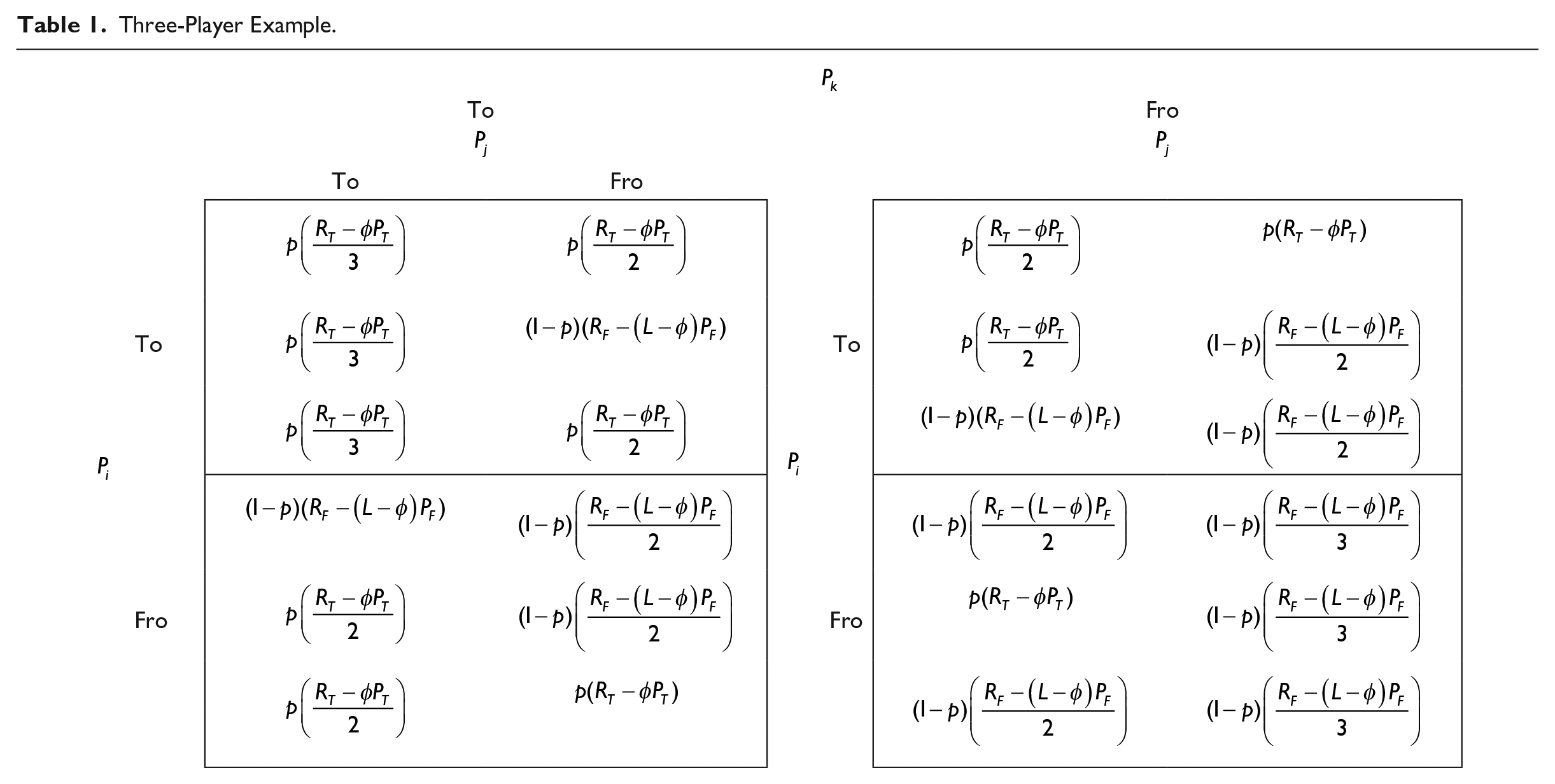
Under what conditions do politicians i, j, and k coordinate on the same policy? Consider the situation where politicians

Since in times of maximum expert uncertainty
The symmetry of the players’ payoffs implies that the same condition applies to j and k. When a sufficient proportion of public opinion is aligned behind one option, all politicians coordinate on the same policy. More generally, in an
Neither the reward nor the punishment that politicians derive from their policy choices directly affects their strategic choices. That is solely a function of the variation in public opinion (p) relative to the number of politicians taking up a similar policy position (i.e.
Nonetheless, the general point is that only when public opinion is sufficiently divided will at least one politician benefit by advocating an alternative policy. To put this in terms of the finite example in Table 1, politicians will coordinate on To or Fro when
Relaxing the Assumption that Policies Are Indistinguishable
The base model above predicts that, though rare, when politicians assume policies are indistinguishable over time, they will converge on a significantly popular policy option. However, when experts begin to offer reliable advice and the assumption of policy interchangeability no longer makes sense, the conditions favoring convergence may degrade.
Let us assume politicians are rewarded simply for implementing a policy, but that experts believe To is better than Fro
As in the base case, in a three-player game a politician will be indifferent to To and Fro iff



Compare this result to the one above where player
In Figure 1, we set
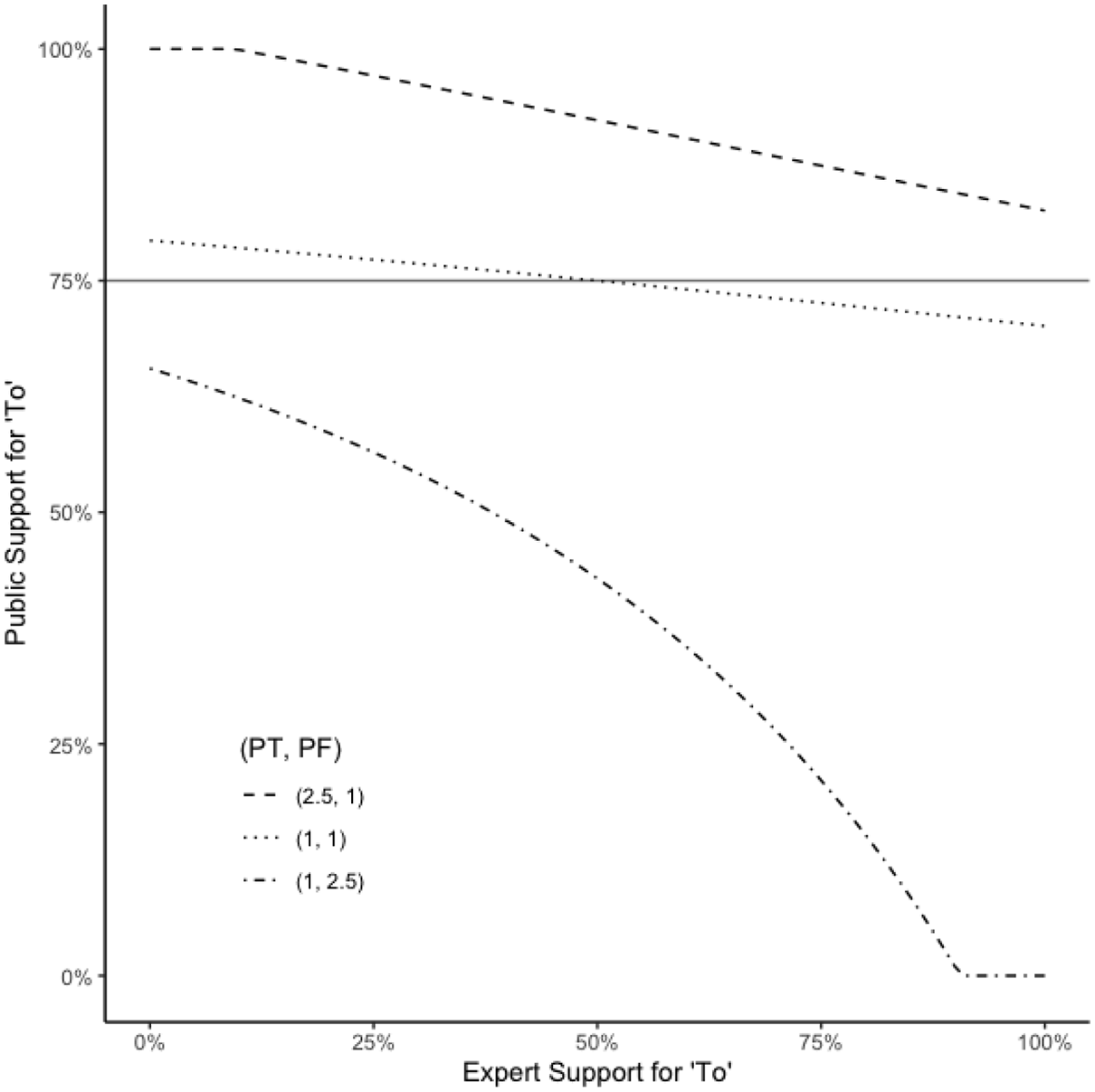
Indifference Curves for the Three-Player Game.
Similarly, on the other side of the ledger, when the punishment for Fro is much larger than the punishment for To, considerably less public support is required to induce politicians to choose To. When experts are nearly unanimous in their support for To and punishments for Fro are much bigger than the punishment for To, there is no amount of public support for Fro that would make choosing Fro a rational decision.
Going back to our utility function above, we can define a public support for To such that politicians are indifferent between To and Fro as (acknowledging for simplicity that

Using the same general settings as above, we could consider the indifference curves as
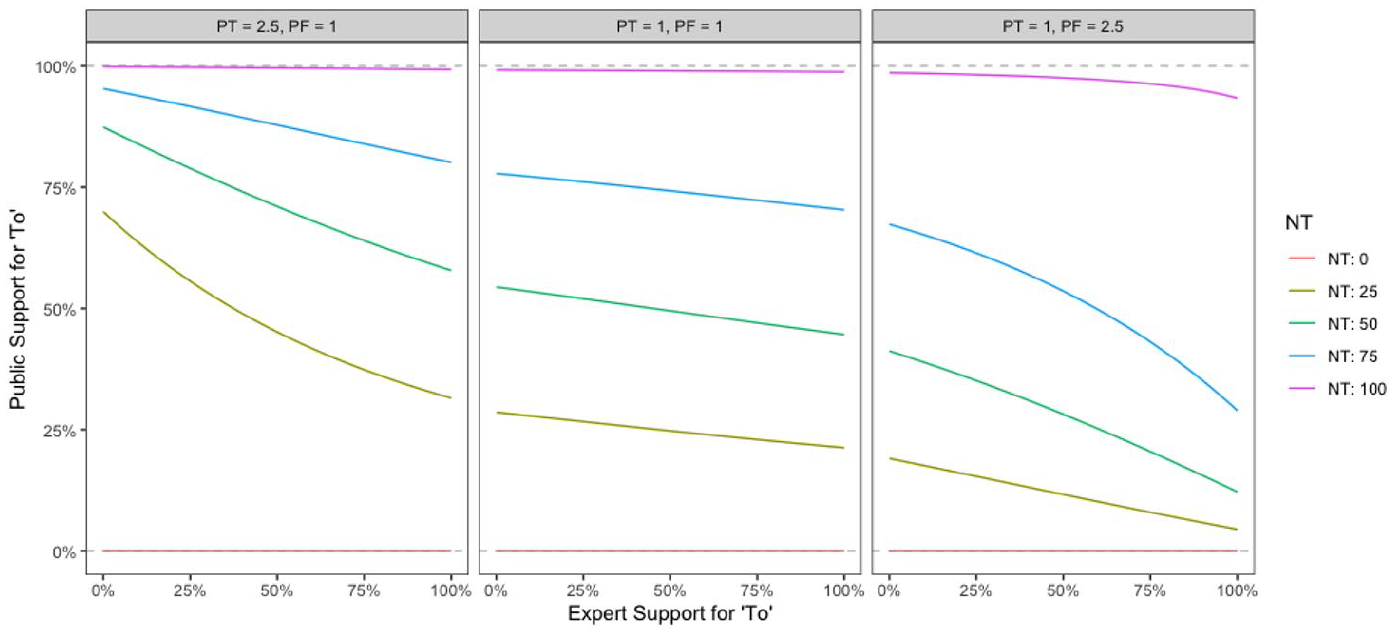
Indifference Curves for the N-player Game.
Conclusion
The simple formal model presented here theorizes policy convergence and divergence during times of maximum uncertainty, a situation not dealt with in existing models (see Bennett, 1991). Most models rely on principal–agent assumptions to theorize how politicians rely on expert advice and calculable costs and benefits when making policy choices (Callander, 2008; Callander and Krehbiel, 2014; Dunlop and James, 2007). These approaches are not very useful for explaining policy convergence during the early days of the pandemic because they do not consider the dynamic interplay between politicians, technocratic experts, and public opinion in the presence of Knightian uncertainty. Our initial model suggests that under these conditions politicians prefer to mimic each other and share the costs and benefits of policy choices to avoid blame for political failure. The presence of uncalculable policy risk and unavoidable electoral judgment creates a herding effect (see Parker and Prechter, 2005).
Our second model indicates that as experts generate knowledge of the virus and voters begin to generate policy preferences, the politics of electoral competition reassert themselves. The model suggests some novel, non-intuitive incentives, particularly for majoritarian settings, as politicians seek to calculate and balance the costs and benefits of various policy choices. For instance, if expert and public opinion are divided but reasonably balanced, and experts suggest little difference in the risk of political punishment among the available policy choices, our model suggests the increased political appeal of catering to a small, extreme, and anti-expert minority, just as we have seen as the pandemic has unfolded in Canada. The likelihood that this scenario will occur increases along with the number of politicians.
For tractability, our model is restricted to Canadian politics. Yet uncertainty appears to have constrained policy responses everywhere (Boin et al., 2020; Capano et al., 2020; Comfort, 2022; Comfort et al., 2020). This is true across the European Union (EU) despite the absence of formal coordination mechanisms and in the presence of distinctive administrative traditions and national infrastructural endowments (see Bouckaert et al., 2020: 772; on the importance of infrastructural endowments for policy responses, see Sayers et al., 2022). Idiosyncratic views of the COVID-19 challenge were key to Sweden’s divergent policy choices and to some of the confusion in the US response (Kapucu and Moynihan, 2021; Pierre, 2020). Politicians were deeply concerned that the wrong policy choices made with limited information would diminish public trust and their electoral fortunes (Chatzopoulou and Exadaktylos, 2021; Zahariadis et al., 2022). In contrast, policymakers insulated from electoral uncertainty enjoyed greater policy freedom (see Cai et al., 2021). Understanding how problem definition, policy options, and political calculations (Kingdon, 2010) inform policy outcomes requires that we include those cases where we know little or nothing of value on some or all these dimensions. 5
We hope our article is a catalyst for future research that theoretically and empirically examines decision-making in periods of Knightian uncertainty and helps refine our understanding of policy convergence and divergence. It is a first step toward contributing to this larger research agenda, and we look forward to seeing research that tests the bounds and utility of our model. We also hope researchers will build on our work by asking the following questions: To what extent does our model accurately describe decision-making in the early days of the pandemic? Under what conditions does our model break down? To what extent do conventional theories provide a stronger account or a better basis for developing new explanations of policy responses during periods where probability is unmeasurable?
Footnotes
Declaration of conflicting interests
The author(s) declared no potential conflicts of interest with respect to the research, authorship, and/or publication of this article.
Funding
The author(s) disclosed receipt of the following financial support for the research, authorship, and/or publication of this article: The authors acknowledge the financial support of SSHRC grant number (#435-2019-0964).
