




Abstract
Due to a lack of data, quantitative analysis of integration policy trends during the past decade has received limited attention. This research note presents newly collected data from the Migrant Integration Policy Index, which includes information on several different policy areas related to migrant integration in 36 EU and OECD countries between 2010 and 2019. Employing a wide set of methods, we investigate whether migrant integration policies have become more liberal or restrictive and whether they have converged across these countries during this period. We find that overall these policies have become more liberal, except in non-EU countries as well as in the areas of family reunion and permanent residence. However, the magnitude of these changes is rather small. We also show that there has been a trend of convergence in integration policy, which varies in intensity across policy areas. We conclude that while migrants’ rights have been extended, long-term settlement has been limited. The popular idea that this decade, marked by crises, has triggered a comprehensive restrictive backlash in migrant integration policies is refuted.
Introduction
Integration policies influence migrants’ ability to remain in the country and their quality of life (Garcés-Mascareñas and Penninx 2016). They may also have broader implications as they can affect the way the host society perceives migrants (De Coninck et al. 2021). Furthermore, these regulations might make a country more or less attractive, thereby affecting the number of migrants (Fitzgerald, Leblang and Teets 2014; Beverelli 2021). In short, integration policies can have a major impact on the social cohesion and composition of a country, making them an important subject to study.
We contribute to the study of migrant integration policies by exploring how they have evolved in liberal democracies over the last decade. Have they become more or less inclusive? And have they become more similar? Overall, many observers argue that — after having become more liberal over several decades (Joppke 1998, 2010, 2017; Koopmans, Michalowski and Waibel 2012) — democratic migration-related policymaking, including migrant integration, has undergone a fundamental transformation in the past decade. Three views on the nature of this transformation can be distinguished. First, a widespread idea in popular discourse as well as in some scholarly contributions is that multiple crises, most crucially the so-called refugee crisis, have led to an illiberal backlash in all immigration-related policies (e.g., Norris and Inglehart 2019; Chin 2022; Hadj-Abdou 2022). Second, many scholars argue that immigration regulations have become neo-liberal: access to long-term residence, rights and citizenship has generally been constrained (Gest and Boucher 2018) or facilitated for a select few while being restricted to most others (Shachar, 2018; Joppke 2021). Third, some observers argue that democracies are still on the same path towards transformation as in the past decades as they can either open immigration while restricting integration or resolve the resulting liberal paradox by combining more open immigration with more inclusive integration (Hollifield 2021). The latter view is the only one that suggests that integration policies could have become more liberal as part of a gradual dissolution of the liberal paradox. As the liberal paradox may continue to manifest in certain countries, however, this last view is also the only one that suggests that these policies are not converging strongly. Overall, the literature therefore largely suggests that migrant integration policies have undergone a process of restrictive convergence over the past decade.
In this research note, we put this assumption to the test by drawing on new data from the Migrant Integration Policy Index (MIPEX, see: Solano and Huddleston 2020) for 36 EU and OECD countries between 2010 and 2019. We focus on national-level migrant integration policies in seven policy areas: labor market mobility, family reunification, education, political participation, permanent residence, citizenship, and anti-discrimination. 1 We aim to analyze whether integration policies have become more liberal or restrictive and whether they have converged — that is, whether they have become more similar in their level of inclusion — across EU and OECD countries during the past decade. Our analysis therefore extends the existing empirical literature on migration-related policy trends and convergence, which is based (with few exceptions) on datasets that do not (fully) cover the past decade (e.g., Koopmans, Michalowski and Waibel 2012; Banting and Kymlicka 2013; De Haas, Natter and Vezzoli 2018). Besides this unique temporal scope, we also innovate by applying a wide set of quantitative methods to examine a variety of integration policy areas, which allows us to draw a robust and more detailed picture. This study thus offers the first comprehensive trend and convergence analysis of migrant integration policies of the last decade. This also demonstrates the potential of the new MIPEX data and how it can help address crucial analytical questions in the literature on migration and migrant integration policies.
We find that these policies have become generally more liberal, except across non-EU OECD countries as well as in the fields of family reunion and permanent residence. We also show that there is a tendency of convergence in the integration policy field that varies in intensity across policy areas. We conclude that while migrants’ rights have been extended, long-term settlement has been limited. Therefore, the three existing views in the literature only apply to certain countries and policy areas. The popular idea that this decade, marked by crises, has triggered a comprehensive restrictive backlash in integration policies is refuted.
This research note proceeds as follows. First, we review the relevant literature on integration policy trends and their (expected) evolution during the past decade. Second, we describe the data and methods we use. Third, using various descriptive methods including a descriptive use of regression analysis, we analyze policy trends between 2010 and 2019. Fourth, we investigate policy convergence for the same period. Finally, we shortly discuss the results and conclude.
State of the Art
Policy Trends
A long-standing assumption in the literature on migrant integration policies has been that they have become increasingly liberal across Western democracies. Three prominent and broad assessments of this assumption can be identified. The first is put forward by Koopmans, Michalowski and Waibel (2012). Using the Indicators of Citizenship Rights for Immigrants (ICRI), which covers 10 Western European countries across four cross-sections from 1980 to 2008, they find that most integration policies became more liberal until 2002 but stagnated in their levels of inclusiveness afterwards. This holds for most countries as well as for both underlying dimensions of this data: policies regulating the extent of individual equality and policies regulating the extent of cultural difference, such as the religious rights of migrant groups. The only exceptions to this liberal trend are Denmark as well as policies regulating marriage migration, which have become more restrictive.
The second assessment is made by Banting and Kymlicka (2013). They use the Multiculturalism Policy Index (MCP), which covers 21 Western European and non-European democracies in 1980, 2000, and 2010. They show that 10 countries in Western Europe have adopted more multicultural policies, while five others have remained stable or have restricted rights for migrants. Non-European countries are not included in this study, but that data is available online. 2 They show that multiculturalism has mostly been expanded also beyond Europe. The latest version of the MCP (Wallace, Tolley and Vonk 2021), which covers the same 21 countries, shows that multicultural policies have continued to be expanded until 2020.
The third broad assessment comes from De Haas, Natter and Vezzoli (2018). Using the DEMIG database, they find that in 45 countries (including some non-Western countries) most policy changes in integration policies from 1945 to 2014 went in a liberal direction. However, while most migration policies regulating the entry and stay of migrants have also been liberalized, policies regulating family reunification have been restricted. De Haas, Natter and Vezzoli (2018) also find that the liberalization since 1945 has decelerated over time, and — like Koopmans, Michalowski and Waibel (2012) — they identify a stagnation of the liberal shift since 9/11.
Yet, we also know that different policies can move in different directions and follow distinct logics. The literature on migration-related policy trade-offs has shown that many regulations aim to make migration more difficult in some areas but not in others. States might implement policies to select specific groups of migrants, which are then treated more generously once they have crossed the border (Ruhs 2013). Other studies offer partial evidence that can be related to migrant integration policy trends. Helbling and Kalkum (2018) focus on immigration policy trends across 33 OECD countries from 1980 to 2010. They found that family reunification policies — which can be conceptualized as an immigration policy (e.g., De Haas, Natter and Vezzoli 2018) or as a right of a migrant resident (e.g., Koopmans, Michalowski and Waibel 2012) — became more liberal between 1980 and 2010. Studies on citizenship policies show that there has been both a liberalizing trend in birth right conditions, residence conditions, and dual citizenship tolerance (Howard 2009; Schmid 2021) and a restrictive trend in civic integration requirements (Goodman 2014) and other integration conditions such as economic requirements (Stadlmair 2018) across Western European democracies from 1980 to 2010. In addition, similar to the above-mentioned analyses, the study on trends in citizenship policies across 23 OECD countries from 1980 to 2019 by Schmid (2021) identified 2003 as a turning point after which liberalization has stagnated on aggregate.
As it emerges from the above-mentioned literature, most existing datasets and analyses on migrant integration policies either do not go beyond 2010 or do not offer continuous coverage after 2010. Due to this lack of up-to-date data, we do not know much about developments during the past decade, and it is not clear to what extent the mostly stagnant liberal trajectory of the previous decade (2000–2010) has continued also in the next one (2010–2020). This empirical research gap has emerged alongside sweeping diagnoses about the evolution and alleged transformation in migration-related policies in recent times. As indicated in the introduction, we can distinguish three views here.
The first is that of an illiberal backlash due to multiple crises. It reflects a popular assumption but is also formulated in academic discourse (e.g., Norris and Inglehart 2019; Chin 2022; Hadj-Abdou 2022). The idea is that, in the wake of the financial crisis and the Great Recession, the “refugee crisis” of 2015 as well as the surge of right-wing populist parties may have led not to further stagnation of the liberalization of migrant integration policies but to an outright backfiring into a restrictive direction in most policies.
The second view, popular among many academics, proposes that migrant integration policies have become stratified and more restrictive for most migrants as part of a broader neo-liberalization of immigration-related policies (e.g., Gest and Boucher 2018; Joppke 2021). Some have argued that we have seen a shift from the “liberal model” to the “market model” (Gest and Boucher 2018), in which immigration becomes more selective and temporary. Policies are geared to attract desirable migrants (such as high-skilled talents) and deter undesirable ones (such as low-skilled refugees). In addition, migrant integration in the form of access to long-term residence, rights and citizenship has generally been constrained (Gest and Boucher 2018) to circumscribe rights and support to those who are economically more beneficial for the host country (Shachar 2020; Joppke 2021).
The third view holds that we do not see a transcendence of liberalism — neither by illiberalism nor by neo-liberalism — but instead can see the liberal paradox still being at work. Namely Hollifield (2004, 2021) maintains that, far from abandoning liberalism, democracies continued to face two basic options also during this decade of crises: they can either open immigration while restricting integration or resolve this liberal paradox by combining more open immigration with more inclusive integration policies.
Thus, while these three views assume that different developments have taken place in immigration policy, only the latter possibility mentioned by the last view — the resolution of the liberal paradox — assumes that migrant integration policy have become more liberal in the past decade. In contrast, as part of a larger transformation of immigration-related politics, conventional wisdom and most academics assume that migrant integration has become more restrictive. Considering this dominant view as well as the fact that the previous empirical literature has shown that there as a stagnation in the liberalization of integration policies up to 2010, we formulate our first hypothesis as follows:
H1. Integration policies became more restrictive in their level of inclusion between 2010 and 2019.
Policy Convergence
Scholars also routinely investigate to what extent policies become similar across countries. This process of convergence can be defined as “any increase in similarity between one or more characteristics of a certain policy … across a given set of political jurisdictions … over a given period of time” (Knill 2005, 768), which may work through various mechanisms, such as imposition, international harmonization, regulatory competition and transnational communication (Holzinger and Knill 2005). Questions of convergence play a particularly relevant role in the field of migrant integration as they touch upon issues of national sovereignty. For a long time, since Brubaker’s (1992) landmark book, it has been debated to what extent national citizenship regimes reflect distinguishable traditions or models of nationhood. The classical assumption is that different understandings of what constitutes a nation should lead to persistently divergent ways to integrate newcomers. The usual contrast to this path dependency perspective has been the argument that the diffusion of international human right norms makes national migrant integration policies converge (Soysal 1994; Jacobson 1997). This may also happen in the absence of supra- or transnational integration policy regulations, as the existence of norms of human rights and equal treatment might still affect the way migrants are treated (Maas 2016). Europeanisation constitutes a widely researched form of convergence, which reflects an increase of similarity among EU member states (Vink and Graziano 2008). Furthermore, convergence patterns may not only differ across certain political units but also across policy areas because they may be unevenly shaped by different factors, such as international economic trends, national labor markets, migration history, and migration demographics.
Several studies on migrant integration policies investigate convergence. While the study by De Haas, Natter and Vezzoli (2018) cannot assess convergence because the DEMIG database only codes policy changes rather than absolute and relative levels of restrictiveness, both Koopmans, Michalowski and Waibel (2012) and Banting and Kymlicka (2013) examine the standard deviation of aggregate policy scores. Koopmans, Michalowski and Waibel (2012) show that, overall, there has been no substantial convergence in migrant rights. Rights concerning cultural difference have even diverged. Banting and Kymlicka (2013) also find that multicultural rights diverged across Europe from 1980 to 2010. This suggests that nation-states do not only continue to differ in their regulations of cultural difference but even differ more now than they did in the past.
Meanwhile, Schmid (2021) has offered a more focused perspective, showing that convergence in citizenship policies can only be detected from 1980 to 2019. Hence, in contrast to multicultural policies, the domain of citizenship in which the classical path dependency perspective has been theorized originally (Brubaker 1992, see above) appears to be more prone to policy convergence over the long run. Finally, Helbling and Kalkum (2018) provide insights on the convergence and Europeanisation trends in immigration policies. In their analysis of 33 OECD countries from 1980 to 2010, they conclude that family reunification (and other) policies exhibit convergence. However, they find only weak evidence of Europeanisation effects because policies developed very similarly within and outside the EU. Therefore, the available evidence — mainly from before 2010 — suggests that various migrant integration policy areas differ regarding their similarity in the level of inclusion: they can show patterns of divergence (migrant rights related to cultural difference), non-convergence (migrant rights as a whole), and convergence (family reunion and citizenship).
Among the three views that we have introduced in the previous subsection, the illiberal backlash and neo-liberalization views point in the direction of restrictive convergence in integration policies after 2010, at least in certain areas. There is already some evidence for restrictive trends in related policy areas. For example, asylum policy studies investigated to what extent we observe a race to the bottom (Hatton 2004; Toshkov and de Haan 2013). To avoid a high number of refugees, states adopted restrictive policies, especially after the so-called refugee crisis in 2015, as shown by Hagelund (2020) and Hernes (2018) for Scandinavian countries, which are among the countries with more inclusive integration policies. Therefore, following the dominant view in the literature as well as the most relevant previous findings from the past decade (e.g., Schmid 2021 on citizenship), we formulate our second hypothesis as follows:
H2. Integration policies became more similar in their level of inclusion from 2010 to 2019.
Data
This article is based on research activities and analyses conducted in the framework of the EU-funded Horizon2020 project HumMingBird—Enhanced migration measures from amultidimensional perspective (Grant agreement ID: 870661). Data on integration policies were collected in the context of the 2015 and 2020 editions of the MIPEX project. MIPEX measures national-level integration policies (Huddleston et al. 2015; Solano and Huddleston 2020). Data encompass the following policy areas of migrant integration policy: labor market mobility, family reunification, education, political participation, permanent residence, citizenship, and anti-discrimination. 3 This allows us to examine a variety of integration policies, provide a more detailed picture on the changing nature of integration policies, and test our arguments also separately for each policy area.
MIPEX addresses the extent to which policies offer migrants equal access to rights and opportunities. At the same time, MIPEX considers the existence of targeted measures to support migrants’ inclusion (e.g., specific measures to favor migrants’ integration in the labor market). Furthermore, MIPEX looks also at the conditions required to become and remain part of a specific society, for instance in terms of long-term settlement and citizenship. While family reunification can be seen as both an issue of equality of all residents (citizens and non-citizens) in a state and an immigration policy, the other policy areas in MIPEX are separate from the policy domain of immigration. As we will discuss at the end, however, the access to permanent residence may also be in a grey area between integration and immigration as it regulates long-term settlement. Hence, we do not aim to assess developments in areas such as asylum and refugee admissions and other immigration policies. Accordingly, MIPEX also does not cover policies that directly and uniquely target beneficiaries of international protection and asylum seekers. Instead, the various policy areas of MIPEX focus on up to three types of migrants: residents on temporary work permits (excluding seasonal workers), residents on family reunion permits, and permanent residents.
MIPEX scores are based on a set of indicators that vary between zero and 100. Higher values stand for policies that meet higher standards for equal treatment (equal rights and opportunities compared to non-migrants). In other words, MIPEX measures the level of inclusion. We define a liberal change in integration policy as one that introduces additional rights or opportunities for migrants (at least on paper) compared to the previous situation; it increases inclusion. On the contrary, a restrictive change is when the change(s) in laws and policies limit rights and opportunities for migrants; it decreases inclusion. While liberal changes are unambiguously liberal, one could characterize restrictive changes as either illiberal or neo-liberal, as suggested by our discussion of the literature. This is why we use the more general and neutral term restrictive to describe a decrease in the level of inclusion. For each policy area, the respective indicators are averaged to build specific indices. The average of all seven policy area indices represents the overall score and level of inclusion for each country in each year.
To collect the data, the project prepared a standardized questionnaire consisting of 58 questions (which in the end reflect individual indicators). In each country, one or more experts completed the questionnaire by carrying out desk research and, when necessary, conducting interviews with practitioners. The central research team of MIPEX checked all the information against reports and other policy analyses, assessing the reliability of the answers and, when necessary, returned to the experts for further clarifications.
The most recent MIPEX dataset covers 36 OECD countries (including 27 EU member states) in the Global North with continuous annual policy data from 2010 to 2019. This includes Eastern European (EU12) countries, which are often not included in other datasets. Although MIPEX data are also available for the period 2007–2009 for some countries, we decided to use data starting from 2010 for our analyses for three reasons. First, the 2007 data do not cover the following six non-European countries: Australia, Japan, Korea, New Zealand, Turkey, and the USA. Second, the MIPEX data before 2010 do not cover the area of education policy, which is highly relevant and often overlooked. Third, as the literature review has shown, we already know much about trends before 2010. Therefore, focusing on the understudied period 2010–2019 allows us to include more countries and policy areas.
To compare policy developments in different regions, we distinguish between EU countries (including the UK), the EU15 (EU countries that joined the European Union before the 2004 enlargement), the EU12 (countries that joined the EU during or after the 2004 enlargement), and non-EU OECD countries (see Supplemental Appendix — Section A for the complete list of countries included in each group). As Norway and Switzerland have many similarities with EU/EU-15 countries — among other things, they are included in the Schengen and Dublin agreements and implement many EU directives — , we also conducted robustness checks that assign Norway and Switzerland to the group of Western European countries, thus having the following groups: European countries (EU countries and Norway and Switzerland), Western European countries (EU15 countries and Norway and Switzerland), and non-European countries (Australia, Canada, Japan, Korea, New Zealand, Turkey, USA).
Policy Trends
We start our analysis by investigating to what extent migrant integration policies have become more liberal or more restrictive over the last decade. To analyze these policy trends, we employ several methods. First, we test whether the differences of the median country scores between 2010 and 2019 are significant by means of the Wilcoxon matched-pairs signed-ranks test (a non-parametric bivariate test). We decided to employ median values rather than mean values because they are less sensitive to extreme scores/outliers than mean values. Second, we use descriptive regression analyses to summarize the average linear time trend in these median values and assess its statistical significance. These analyses also distinguish between different groups of countries (Table 1 and Figure 1a) and policy areas (Table 2 and Figure 1b). Finally, we add visual evidence and illustrations from specific countries.
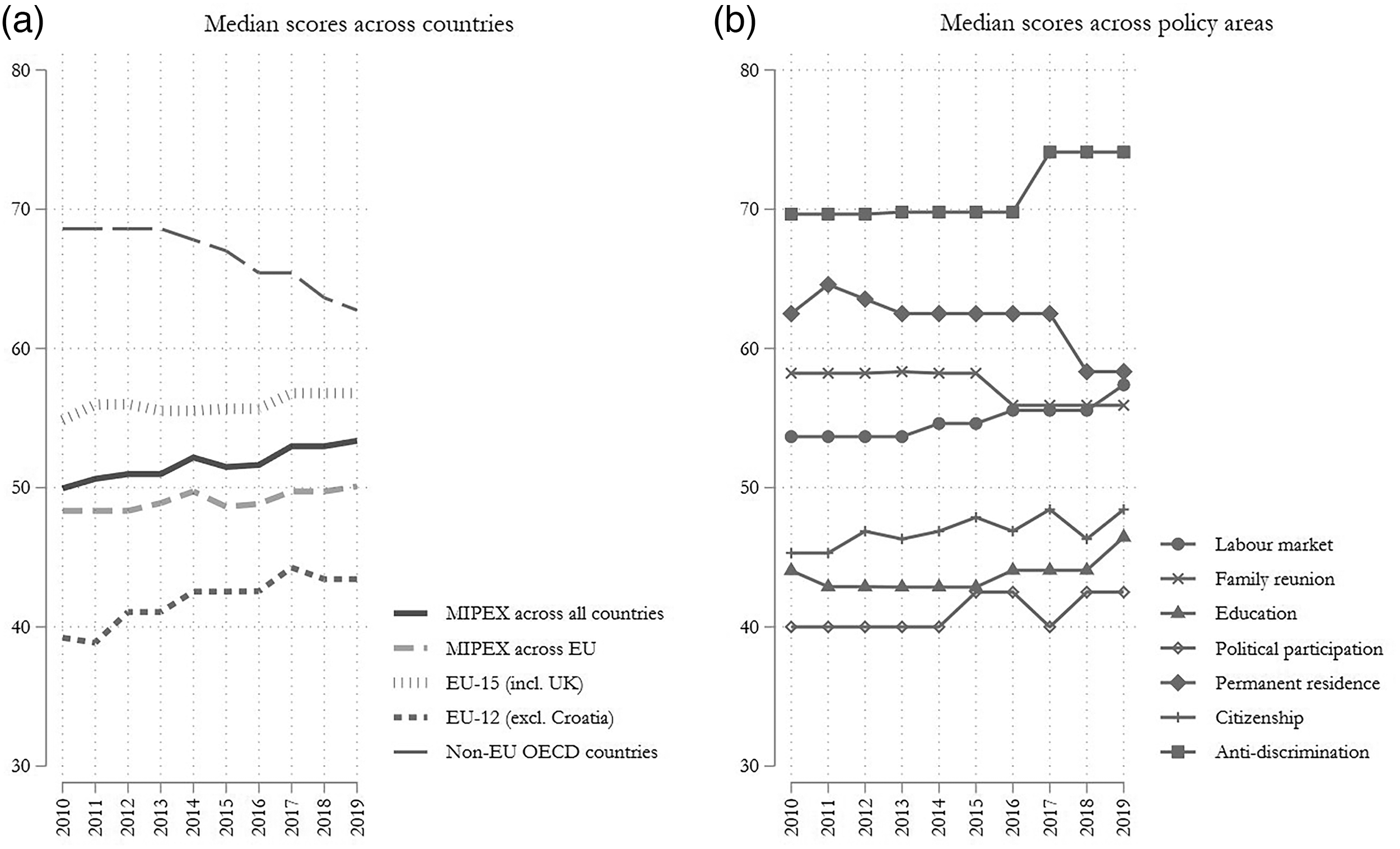
Development of migrant integration policies (2010–2019).
MIPEX Median Scores in 2010 and 2019 by Country Groups.
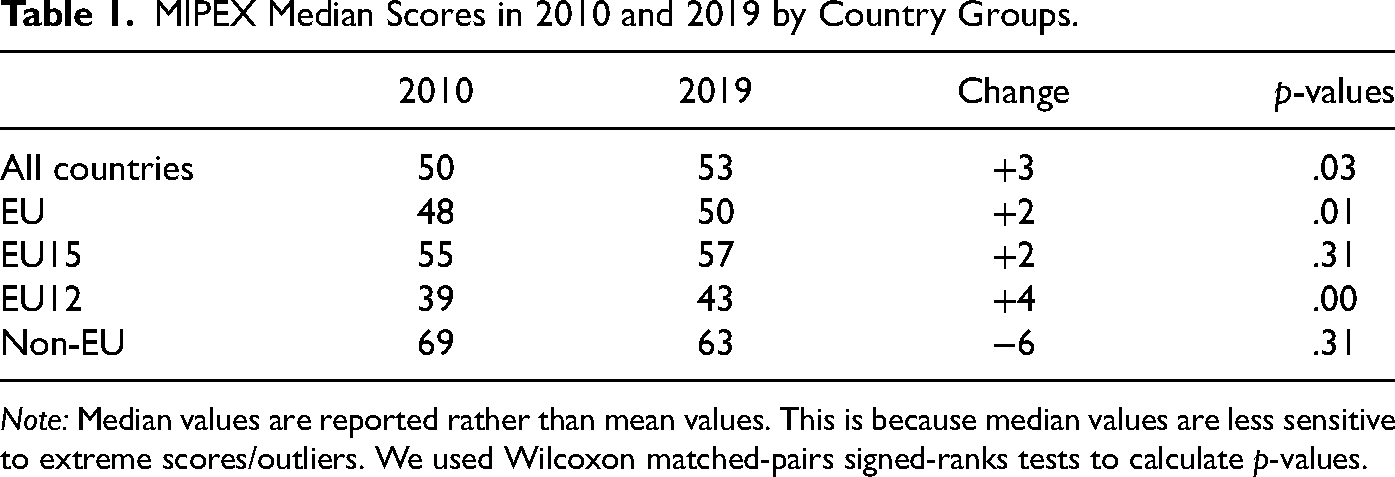
Note: Median values are reported rather than mean values. This is because median values are less sensitive to extreme scores/outliers. We used Wilcoxon matched-pairs signed-ranks tests to calculate p-values.
MIPEX Median Scores in 2010 and 2019 by Policy Areas.
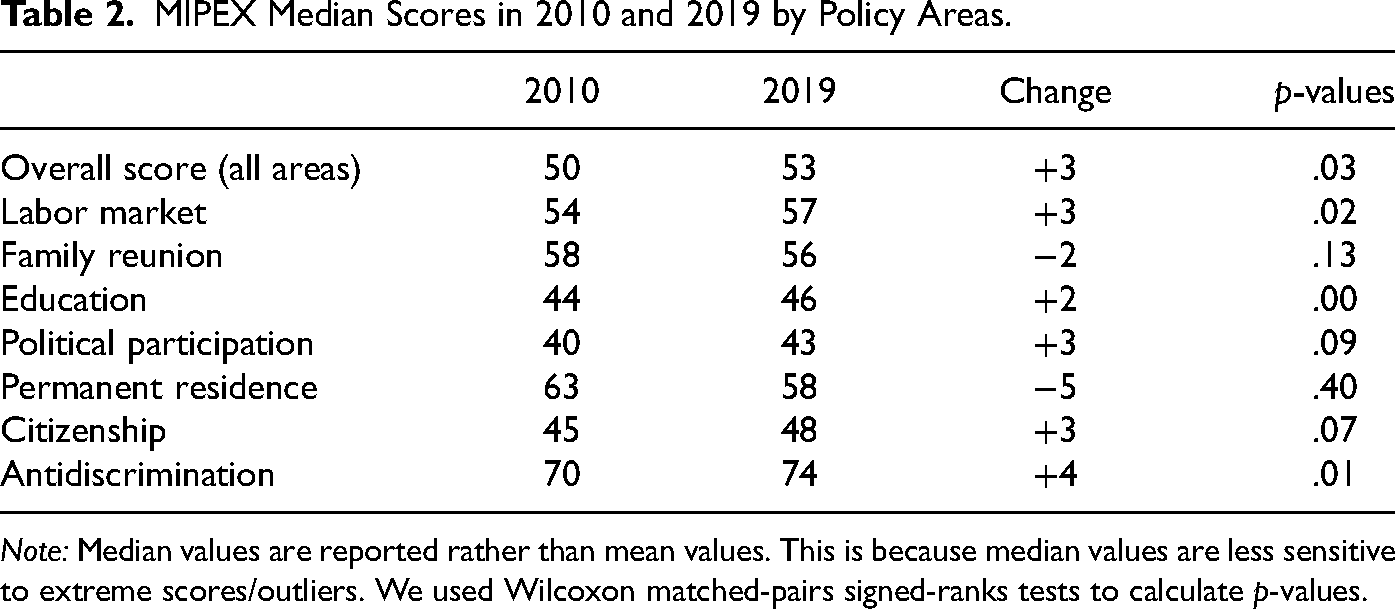
Note: Median values are reported rather than mean values. This is because median values are less sensitive to extreme scores/outliers. We used Wilcoxon matched-pairs signed-ranks tests to calculate p-values.
As we see in Table 1, integration policies have become more liberal across the whole sample — the median value of the index increased from 50 to 53 (see also Supplemental Appendix — Section B). While it is impossible to strictly compare aggregate indices based on different conceptualizations and numbers of indicators, this shift appears smaller than the changes that were documented by the most similar study by Koopmans, Michalowski and Waibel (2012) in previous decades. Yet, the Wilcoxon test shows that this difference is statistically significant. This result is confirmed by a regression analysis which displays a positive and significant linear effect of time (using the variable year) on the overall score (b = 0.35, p = .000; see Supplemental Appendix — Section E).
This increase by 3 points in the overall MIPEX score can be due to either few changes in several policy areas or key changes in one policy area. For example, score for France changed from 52 to 55 between 2010 and 2019 thanks to changes in several policy areas. The country has removed pre-departure language and integration requirements for family-reunited migrants, and they can also benefit from better and longer post-arrival language support. In addition, France has launched several targeted programs to facilitate migrants’ access to higher education (e.g., by providing language and social orientation courses as well as mentoring support). An example of increasing the score by introducing major changes in one area only is Latvia (changed from 35 to 38). The country has modified its citizenship policy by adopting an unconditional form of jus soli (those born to non-Latvians in Latvia are entitled to receive citizenship automatically) as well as dual citizenship tolerance for migrants from certain countries.
This aggregate liberal trend is not so pronounced, also because different groups of countries have moved in different directions (see Table 1 and Supplemental Appendix — Sections B and E). Policies in all EU members have become more liberal (+2 points), but this trend is stronger in EU12 countries (+4 points) than in EU15 countries (+2). By contrast, policies in non-EU OECD countries have become, on average, more restrictive (−6 points). Overall, evidence for significant differences is always present in at least one method we use to assess the statistical significance of the change (the Wilcoxon matched-pairs signed-ranks tests or the estimated yearly linear trends in the regression models).
As illustrated in Figure 1 (see also Supplemental Appendix — Section B for yearly scores), in the EU, policies became more liberal until 2014 (+2 points) and slightly more restrictive in the period 2014–2016 (−1). They started again to become more liberal in 2017 (+1 compared to 2016), but then the upward liberalization trend almost stopped. However, a different pattern emerges comparing EU15 and EU12 countries. EU15 experienced no restrictive change between 2014 and 2016, while EU12 countries made their policies more liberal until 2017 (+5 points), followed by a small restrictive change in the period 2018–2019 (−1 compared to 2017). In the non-EU countries, we observe a linear trend towards more restrictive policies between 2013 and 2019.
Different patterns of changes can also be observed within the specific groups of countries (see Supplemental Appendix — Section B for country-by-country scores for each year and policy area). The non-EU OECD countries’ restrictive trend was driven particularly by restrictions in Australia, Canada, Korea, New Zealand, Norway, and the USA while Turkey, Japan, and Switzerland did not make their policies more restrictive. Similarly, among the EU15, there were a few increasingly restrictive countries (Belgium, Greece, the Netherlands, and the United Kingdom). It is striking that Greece is the only Southern European country that shows an aggregate restrictive change (−3). This is because we would expect those countries to be especially affected by the so-called refugee crisis. However, this might also be linked to the fact that MIPEX does not focus on policies directly targeting beneficiaries of international protection and/or asylum seekers. By contrast, EU12 countries also display similar patterns of change, as all the countries introduced liberal changes in their integration policies.
We also conducted the same analysis on European and Western European countries (Switzerland and Norway combined with EU/EU15 countries) instead of EU/EU15 countries. The aggregate results did not change (see Supplemental Appendix — Sections B and E). However, note that Norway followed the paths of (some) non-EU countries and significantly restricted its policies (−5), while Switzerland did not change its policies by and large.
The development of integration policies as a whole may hide opposing trends across policy areas. Figure 1b and Table 2 show us how important it is to distinguish between these areas. Integration policies have become more liberal in all policy areas, except for family reunion (−2) and permanent residence (−4). Therefore, the component of integration policies that relates to long-term settlement as it stipulates conditions and criteria for entering and staying in a country (family reunion and permanent residence) have become less liberal, except for citizenship (which transforms migrants into members and can thus be related to both integration in the narrower sense as well as long-term settlement). By contrast, more liberal conditions and mechanisms have been introduced to support migrant integration in different areas. Therefore, states have become more generous with migrants residing in their territory but have also started to exercise more control over who benefits from this (more generous) integration support. Note that while the Wilcoxon matched-pairs signed-ranks tests indicate non-significance for the differences in family reunion, permanent residence, and political participation, the estimated yearly linear trends are statistically significant for all policy areas.
We also observe diverging patterns within the different groups of countries (see Supplemental Appendix — Section C for a more detailed analysis of the trends). Changes in EU15/Western European countries were not similar across most policy areas. Also, no common sub-regional patterns seem to emerge within EU15/Western European countries. For instance, no common pattern of changes emerged among Scandinavian countries or Central European countries. And while Southern European countries followed similar trends only in naturalization policies, as they made their policies on this issue more inclusive (except for Greece), no other common change pattern emerged in this group of countries either.
Contrary to the other groups of European countries, EU12 countries clearly show a similar pattern. Changes mostly happened in the fields of labor market and education, which was one of the least inclusive policy areas. Among non-EU/non-European countries, restrictive changes concentrated mostly in family reunion and permanent residence policies, showing a similar pattern of restriction. Australia, Canada, Korea, New Zealand, and the USA restricted their family reunion policies. Australia, Korea, Norway, and the USA introduced additional restrictive changes in permanent residence, too. However, EU12 countries and EU15/Western European countries share the restrictive trend in these areas, particularly concerning family reunion.
In conclusion, these findings invalidate Hypothesis 1, which states that integration policies became more restrictive in their level of inclusion from 2010 to 2019 across the board. This restrictive trajectory is manifest only in a limited number of countries (mainly in non-EU/non-European OECD countries) and in the policy areas of family reunion and permanent residence.
Policy Convergence
To see whether policies have converged over the last decade, we conduct two kinds of analyses. We first measure the change in standard deviation values over time (sigma convergence). A decreasing standard deviation between 2010 and 2019 would support the convergence hypothesis. Next, we conduct beta-convergence tests. This approach allows for the analysis of another kind of statistical estimation of convergence trends that mainly captures processes in which policy laggards catch up to policy leaders (Plümper and Schneider 2009). The beta-convergence test is conducted through a lagged dependent variable (indicating the policy level in the first period under observation). If there is beta-convergence, we should observe a negative coefficient of the lagged variable of interest. In our case, the policy change between 2010 and 2019 was regressed on the initial 2010 values.
Our analysis reveals a decreasing standard deviation between 2010 and 2019, which supports the convergence hypothesis. Table 3 (sigma convergence) and Figure 2a show that, overall, integration policies have converged in our sample (see also Supplemental Appendix — Section D). This result is confirmed by a descriptive regression analysis which retrieves a statistically significant negative linear yearly trend (b = −0.22, p = .000; see also Supplemental Appendix — Table E4).
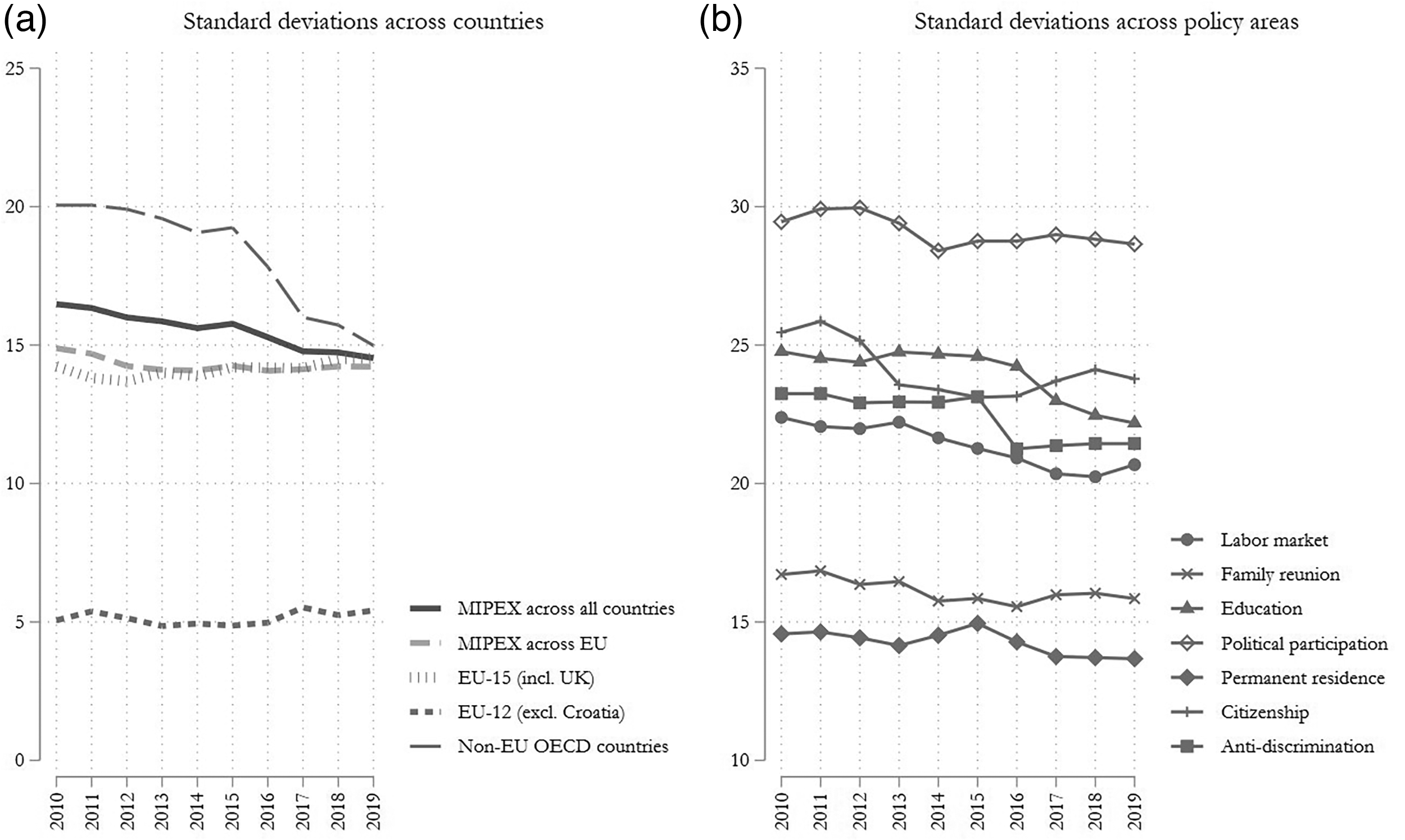
Convergence of migrant integration policies (standard deviations) between 2010 and 2019.
Sigma Convergence of Migrant Integration Policies (Standard Deviations) by Country Groups.
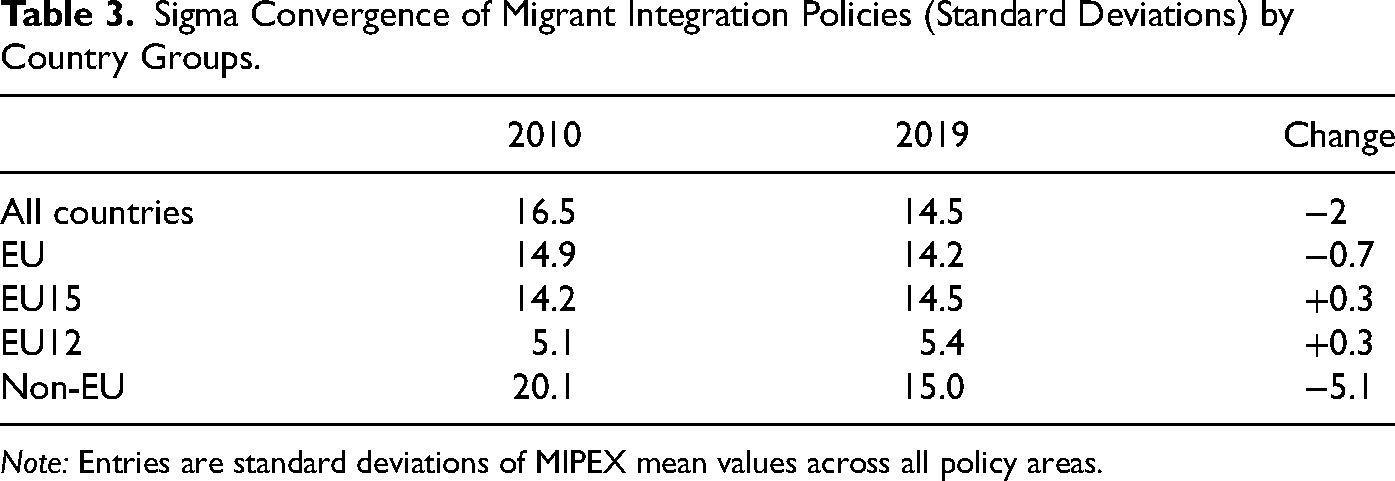
Note: Entries are standard deviations of MIPEX mean values across all policy areas.
This result is a consequence of two parallel developments. First, EU countries have converged towards more liberal integration policies. This does not hold within the EU15 and EU12; the standard deviations for both country groups have even increased slightly. This suggests that there has been a convergence between EU15 and EU12. This is because, as we have seen in Figure 1, policies have changed to a smaller extent in the EU15 but have become more liberal in the EU12. We can therefore conclude that the new member states have moved towards the more liberal old member states. These patterns of sigma convergence are robust to an alternative categorization of Switzerland and Norway as European (rather than non-EU) countries (see Supplemental Appendix — Section D). Second, non-EU OECD countries — which have shown a restrictive trend — have converged most strongly. Additionally, non-EU countries and EU countries have moved towards similar levels of inclusion. However, non-EU countries are still much more liberal in their migrant integration policies than EU countries in 2019. The disaggregated data show (Supplemental Appendix — Section B) that this is mainly due to the traditionally more inclusive Anglo-Saxon settler states in our sample.
In addition, we conduct the beta-convergence test, displayed in Table 4. We first calculate the model for the overall MIPEX scores. The negative effect of the policy level in 2010 confirms that there was significant policy convergence in the period 2010–2019 (Model 1). In Model 2, we include a dummy variable for EU countries and interact it with the 2010 policy level. Although only weakly significant, the positive value of the interaction term shows that within the EU countries have been catching up less strongly than within the group of non-EU countries. In Model 3, we restrict the sample to EU countries to explore the difference between EU-15 and EU-12 countries. The non-significant coefficient of the interaction term shows that the beta-convergence process did not differ much; as shown above, there is no within-beta-convergence in these groups of countries. These patterns of beta-convergence are robust to an alternative categorization of Switzerland and Norway as European (rather than non-EU) countries (see Table 4).
Sigma Convergence of Migrant Integration Policies (Standard Deviations) by Policy Areas.
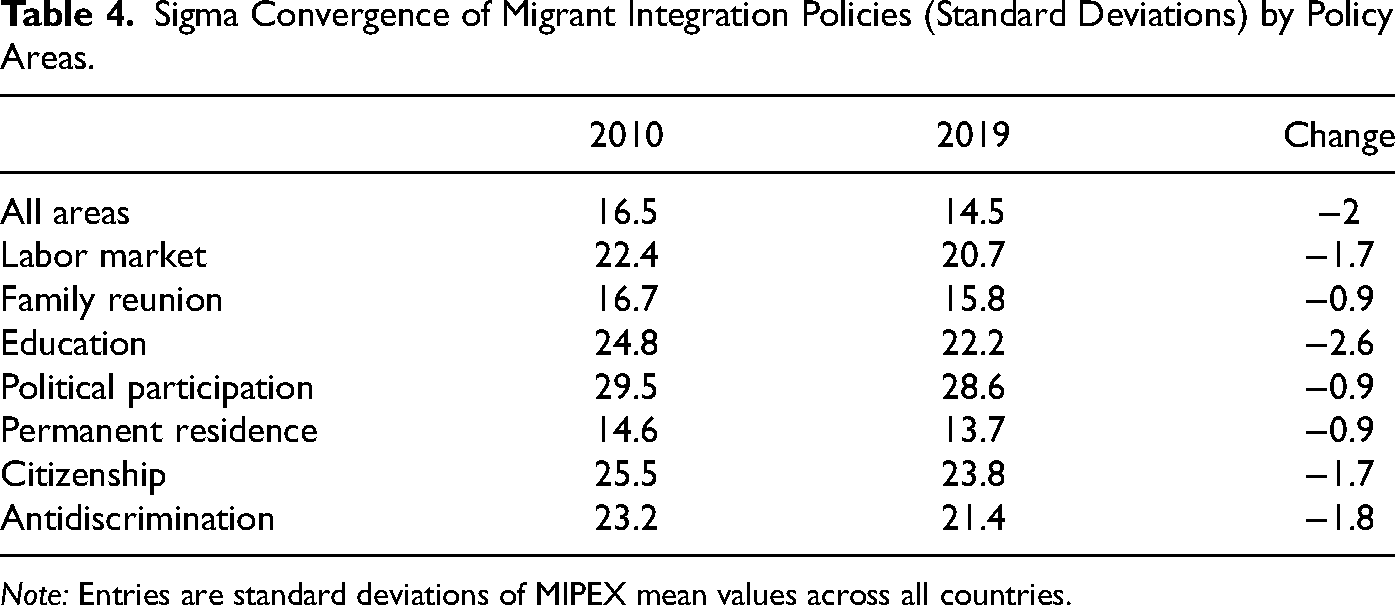
Note: Entries are standard deviations of MIPEX mean values across all countries.
This convergence pattern holds across the different policy areas (see Table 5 and Figure 2b; see also Supplemental Appendix — Sections D). Permanent residence and family reunion are the areas where policies converge the most, as they have the lowest standard deviation among the policy areas. However, they are not among the most strongly converging areas as the changes in standard deviations are lower than in other policy areas (e.g., education and antidiscrimination). Integration policies in general (i.e., the overall policy score) are the policies that converged the most between 2010 and 2019. These results are also confirmed by descriptive regression analyses; each policy area shows a statistically significant negative yearly linear trend in standard deviations (see Supplemental Appendix — Section E, Tables E2 and E3).
Regression Results on Beta Convergence by Country Groups (DV: Policy2019-Policy2010).
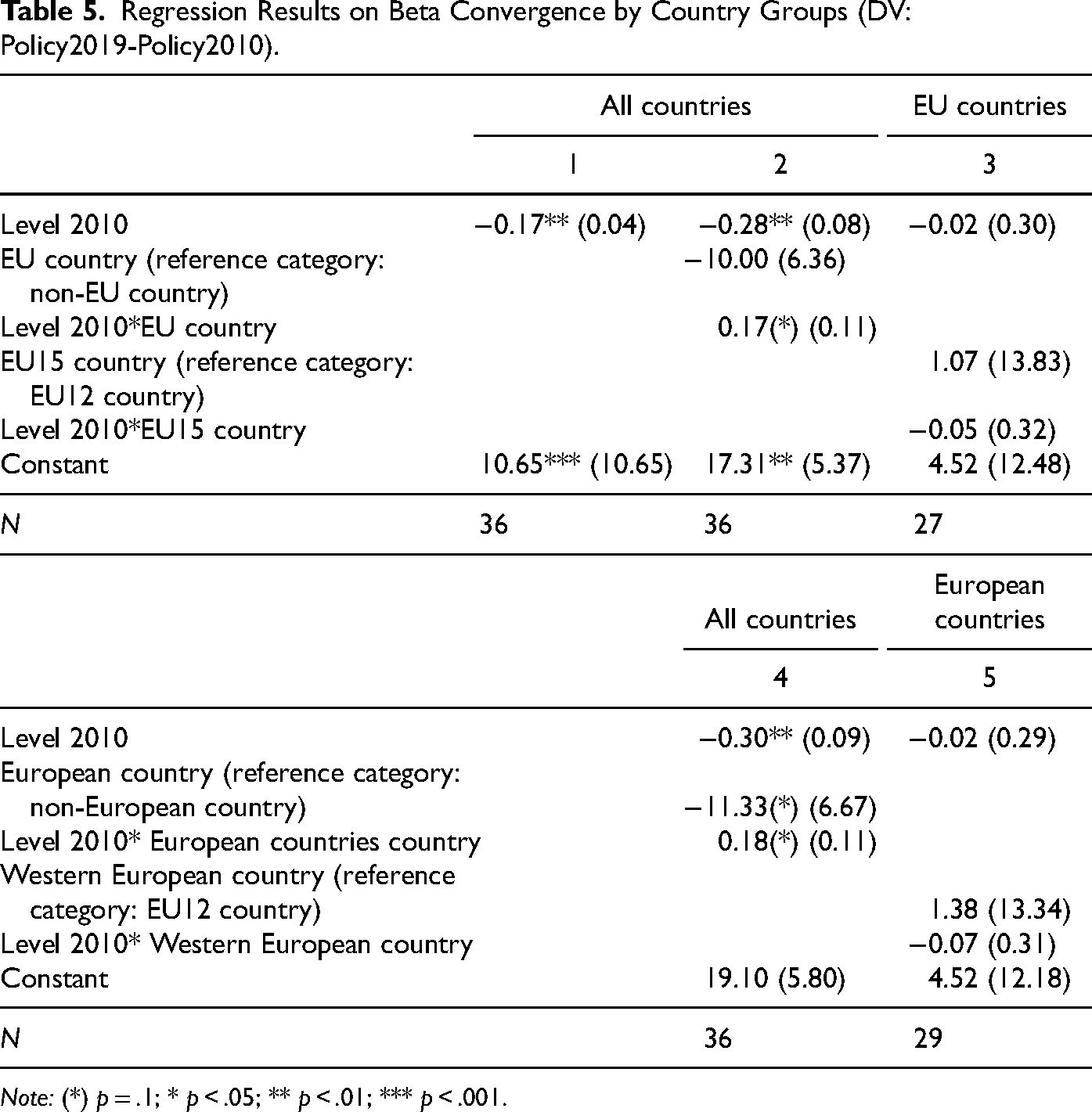
Note: (*) p = .1; * p < .05; ** p < .01; *** p < .001.
In addition, Table 6 provides evidence for beta-convergence across all individual policy areas except for political participation. Looking at the effect size (the beta value), the results complement the sigma convergence findings: the strongest convergence can be observed for the overall policy score as well as in the policy areas family reunion and permanent residence, the two areas in which there has been a restrictive trend, especially in non-EU countries. This shows that for the overall policy as well as these two specific areas the speed of convergence was highest for those countries that had markedly different levels of inclusion in 2010. Therefore, while the sigma convergence shows that countries have converged less strongly in family reunion and permanent residence overall, the beta-convergence results show that countries that had been much less restrictive in these policy areas significantly caught up with those that had already been more restrictive.
Regression Results on Beta Convergence by Policy Areas.
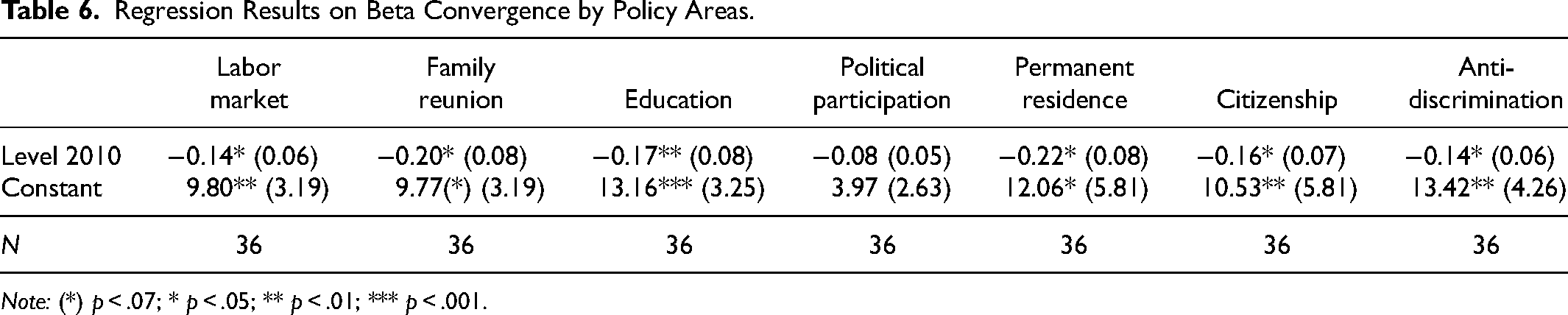
Note: (*) p < .07; * p < .05; ** p < .01; *** p < .001.
In conclusion, our findings support Hypothesis 2, which states that integration policies became more similar from 2010 to 2019. Albeit with a different degree of intensity, this concerned both the overall policy framework and specific policy areas.
Discussion and Conclusion
In this research note, we explored the new MIPEX dataset that covers the period 2010–2019 to investigate integration policy trends in various areas across 36 OECD and EU countries. The findings indicate that overall integration policies have become more liberal since 2010, except across non-EU OECD countries. The biggest change took place in the EU12 countries, where policies in 2010 were more restrictive than in the other EU/European countries. Furthermore, policies have converged, both in EU/European countries — between but not within EU15/Western European and EU12 countries — and, to a greater extent, in non-EU/non-European countries. Therefore, our main finding points to the convergence of integration policies across the past decade and to the absence of a comprehensive restrictive turn. This contrasts with Hypothesis 1, which stated that integration policies became more restrictive from 2010 to 2019, and supports Hypothesis 2, which expected that integration policies became more similar from 2010 to 2019. This invalidates the dominant idea that there has been a general restrictive convergence in integration policy as part of a broader transformation of immigration-related policies during the past decade.
However, thanks to the detailed data, the results can be used to paint a complex picture of the integration policy landscape (see Table 7 for a summary of the results). While in other areas integration was liberalized, policies that are related to both immigration and integration — family reunion and permanent residence — were restricted. Thus, states have mainly restricted migrants’ access to legal and long-term settlement, while rights and opportunities for social and political inclusion have been extended (e.g., concerning the labor market, education, political participation, and anti-discrimination). In other words, states have become more generous with migrants residing in their territory but have also started to exercise more control over who benefits from this (more generous) integration support. These findings corroborate the hypothesis that immigration rights (permanent residence and family reunion in our case) trade off with the extent of other migrant rights (e.g., Ruhs 2013). Further research is necessary to determine whether these aggregate patterns also hold across and within individual countries. We know from previous research, for instance, that the same data can show overall liberalizing aggregate trends in migration and integration (De Haas, Natter and Vezzoli 2018) while within country trade-offs can still emerge between them (Natter et al. 2020).
Summary of Patterns Across Country Groups and Policy Areas.
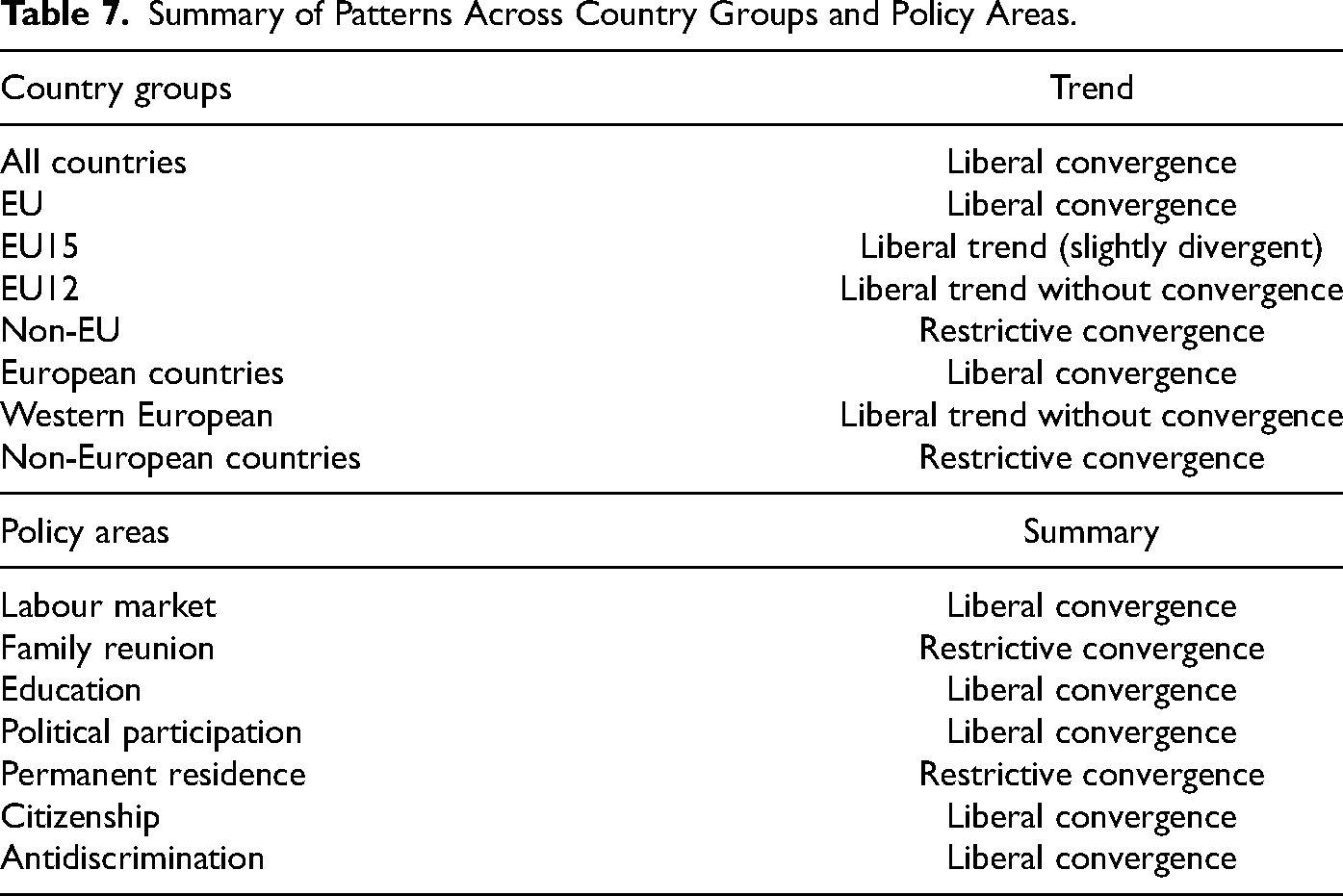
In addition, there is a certain degree of geographical disparity in how policies have changed since 2010. We find that European countries have adopted more inclusive policies overall. However, this liberal shift was more pronounced in Eastern Europe and does not apply to the areas of family reunion and permanent residence, which were restricted also in Europe. This points to a process of Europeanisation and is in line with the literature on migration policies that found that EU legislation made legal standards for migrants more inclusive (Kaunert and Leonard 2012; Roos and Zaun 2014). However, this finding only partly contradicts classical assumptions of persistent path dependency in integration policies (Brubaker 1992; Koopmans, Michalowski and Waibel 2012), as it applies to the EU as a whole but not to Eastern and Western Europe specifically. Non-EU OECD countries show an opposing pattern. Here, we can observe restrictive convergence overall, but it is mainly driven by the limitation of family reunion and permanent residence. In addition, all policy areas appear to converge. We speculate that non-EU countries may have become more exclusive because they lack strong and supranational external border control (as the EU has fortified its external borders). If this is true, it would point to another potential trade-off between the extent of fortified borders and migrant rights. It would be interesting to further investigate how these trade-off plays out (e.g., in Eastern European countries) by means of future research.
We conclude that each of the three views on the potential transformation of immigration-related policymaking in recent times has limited applicability. The illiberal backlash view (e.g., Norris and Inglehart 2019), the neo-liberal view (e.g., Gest and Boucher 2018; Joppke 2021) and the view that the liberal paradox continues to manifest (Hollifield 2021) mainly apply to the restrictive changes in family reunion and permanent residence and occur most strongly in non-European countries. The view that the liberal paradox can also be resolved (Hollifield 2004, 2021)mainly applies to the liberal changes in various aspects of social and political inclusion and holds most strongly in European countries. Finally, these findings suggest that the stagnated liberalization of migrant rights since 9/11 — as diagnosed by earlier studies (Koopmans, Michalowski and Waibel 2012; De Haas, Natter and Vezzoli 2018) — was superseded by a period of both liberal changes in rights and restrictive changes in long-term settlement. The restrictive convergence in family reunion policies is especially striking as it points to a reversal in the liberalizing policy trend until 2010 (Helbling and Kalkum 2018). By contrast, existing findings on citizenship policy trends from 2010 until 2019 are similar but also remind us that the liberal changes are small in nature (Schmid 2021). Overall, we must keep in mind that no integration policy area has seen change and convergence to an extent that warrants its characterization as transformative, thus contradicting the fundamental premise of the various assumptions on migration-related policy-making in the past decade.
This paper aimed to present the newly collected MIPEX dataset and provide first descriptive empirical findings to explore its research potential. We have shown that it provides a highly relevant resource for research on migrant integration policies. However, we analyzed only one part of the picture, as we focused only on the national level. Scholarship has extensively documented flourishing policy-making activism of municipalities and regions, who do not only implement national policies, but increasingly also formulate their own integration policies (Caponio and Borkert 2010; Zapata-Barrero et al., 2017; Manatschal, Wisthaler and Zuber 2020; Pasetti et al. 2022). Additional studies should look at the change in sub-national policies, also in relation to the national level (e.g., how subnational dynamics are shaping or re-shaping national policy making). Besides, as indicated above, the supranational level could be relevant to further explain and contextualize differences between EU and non-EU countries (Helbling and Kalkum 2018). Future research should also explore in detail the role of crises, such as the European refugee crisis and COVID-19, by using MIPEX data as part of more complex and sophisticated research designs and analyses. As MIPEX does not focus on policies directly targeting beneficiaries of international protection and asylum seekers, a way to address the effect of migration/refugee crisis would be to analyze policies targeting these two categories of migrants — as done, for example, by Pasetti and Conte (2021). Similarly, as MIPEX does not feature many indicators on multicultural rights, it is unclear whether the patterns we found also hold in this policy area. In addition, expanding the temporal scope of the analysis would help obtain a more complete picture of integration policy trends and explore the effect of the COVID-19 pandemic. In addition, this paper suggests a potential trade-off between the extent of fortified borders and migrant rights. In future research, it would be interesting to further investigate how these trade-off plays out (e.g., in Eastern European countries). Finally, our paper — and many others on integration policies — focus on the Western world, typically OECD countries. This is a clear limitation of our paper and the entire field (Gest et al. 2014; Solano and Huddleston 2021), as non-Western countries might display different trends. Therefore, especially studies on migrant integration policies in the so-called Global South are much needed.
Supplemental Material
sj-pdf-1-mrx-10.1177_01979183231172102 - Supplemental material for Extending Migrants’ Rights but Limiting Long-Term Settlement. Migrant Integration Policy Trends in EU and OECD Countries Between 2010 and 2019
Supplemental material, sj-pdf-1-mrx-10.1177_01979183231172102 for Extending Migrants’ Rights but Limiting Long-Term Settlement. Migrant Integration Policy Trends in EU and OECD Countries Between 2010 and 2019 by Giacomo Solano, Samuel David Schmid, and Marc Helbling in International Migration Review
Footnotes
Declaration of Conflicting Interests
The author(s) declared no potential conflicts of interest with respect to the research, authorship, and/or publication of this article.
Funding
The author(s) disclosed receipt of the following financial support for the research, authorship,and/or publication of this article: This work was supported by funding from the European Union’s Horizon2020 Research and Innovation Programme [grant agreement No. 870661] (HumMingBird - Enhanced migration measures from amultidimensional perspective).

Supplemental Material
Supplemental material for this article is available online.
Notes
References
Supplementary Material
Please find the following supplemental material available below.
For Open Access articles published under a Creative Commons License, all supplemental material carries the same license as the article it is associated with.
For non-Open Access articles published, all supplemental material carries a non-exclusive license, and permission requests for re-use of supplemental material or any part of supplemental material shall be sent directly to the copyright owner as specified in the copyright notice associated with the article.
