




Abstract
Evidence indicates that citizens widely regard politicians as untrustworthy. But do low levels of trust affect politicians’ behaviour? In this article, we draw on interviews conducted with UK political elites to understand: (a) whether they recognise a lack of public trust; (b) what they perceive as its causes and present as solutions; (c) how it affects the decision-making process; and (d) whether they feel it undermines their sense of legitimacy. While we find that UK political elites do acknowledge low levels of trust, they reveal that this has only modest effects on their activities, and the legitimacy to take major decisions is undented. Low trust offers political opportunities as well as threats. Low trust places few constraints on politicians’ ability to wield power. As a result, leading politicians may lack the motivation to take meaningful action to arrest low levels of citizens’ trust.
Introduction
For elected representatives not to be trusted by the citizens that elect them might be considered the definition of an existential crisis, an inner conflict about their identity and the meaning of their role. For an elected politician with an executive role charged with complex tasks of governing, an absence of public trust might be additionally concerning since trust is of ‘great benefit’ for executives, providing ‘more leeway to govern effectively’ (Hetherington, 1998: 803). Trust facilitates citizens’ support for more ambitious policy programmes such as redistribution or adopting large-scale measures to tackle climate change. As Hetherington and Husser (2012: 312) put it; ‘people need to trust the government to support more government’. Trust is also connected to citizens’ compliance with laws (Marien and Hooghe, 2011) and acquiescence to major behavioural changes demanded by government, as illustrated by a strong relationship between trust and adhering to lockdowns and getting vaccinated during the Covid-19 pandemic (Jennings et al., 2023). There are then good reasons for a politician (especially one with responsibility for policy decisions) to want to be trusted.
Yet there is considerable evidence to indicate that politicians are not trusted. Measuring trust in government and politicians presents a number of challenges, but a recent study using data for 143 countries and advanced Bayesian methods (Valgarðsson et al., forthcoming) demonstrates a global trend that trust in representative institutions (parliaments, governments and political parties) has generally been declining in recent decades, whereas trust in ‘implementing’ institutions (civil service, legal system and police) has been stable or rising. The UK case provides a good exemplar of these trends. A nationally representative survey fielded in 2023 (Office for National Statistics, 2024) revealed modest levels of trust on average in the courts and judicial system (with 62% indicating a score of 6 to 10 on an 11-point scale where 0 ‘is not at all’ and 10 is ‘completely’), the police (56%) and the national civil service (45%). In contrast, there was a substantially lower level of public trust in national government (35%), parliament (24%), and political parties (12%). The British Social Attitudes surveys have revealed that an increasing proportion of the public almost never trust governments of any party to place the needs of the nation above the interests of their own political party (National Centre for Social Research, 2024). As Figure 1 shows, in 1986, just 12% of people expressed that view, but this number has increased over time – with some notable fluctuations: sharp rises in the mid-1990s under the scandal-riven Major government and during the parliamentary expenses scandal of 2009, falls during the honeymoon of the Blair government (1997) and at the height of the pandemic ‘rally-round-the-flag’ in 2020, before surging to an all-time high of 45% in 2023.
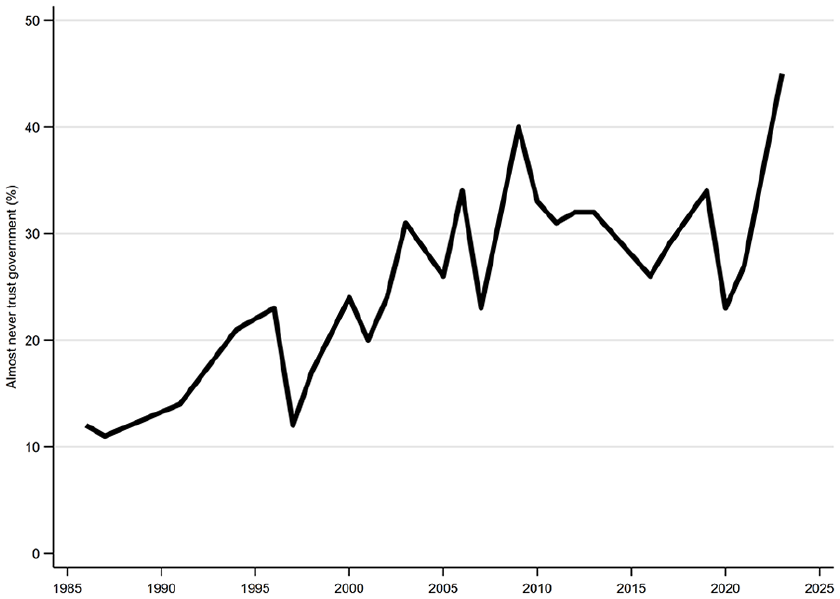
Percentage of Britons Indicating That They Almost Never Trust the Government to Place Needs of the Nation above the Interests of Their Own Party.
The UK case therefore suggests that any benefits to politicians from being trusted by the public are increasingly likely to be absent. Global trends in political trust suggest that the British case is more likely an exemplar rather than an outlier (Valgarðsson et al., forthcoming). We offer some empirical insights regarding how political elites judge the impact of the presence or absence of public trust. The experiences of British politicians and their advisors may well reflect those of other countries. However, our contribution is conceptual as well as empirical. We identify a series of questions connecting trust and policymaking. Do politicians consider they lack public trust? If so, why? Does this impact their behaviour or feelings of legitimacy? In addition, we develop a framework for analysing the responses to these questions. This exploratory study should encourage other investigations into what is an emerging dilemma for politicians who need public trust to act but often find themselves governing in a world of low political trust.
Whereas previous studies into political elites’ perceptions of political trust (Coller et al., 2020; Esaiasson and Holmberg, 1996: 120–122; Weinberg, 2023a, 2023b) have surveyed the perceptions of elected officials at various levels, we focus on those who have served in government executives either as ministers or as special advisors. Our concern is to understand the impact that lack of trust has on those tasked with initiating, designing and implementing governmental tasks rather than the broader category of, for example, elected representatives. Those who wield executive power have a greater capacity to affect political trust and it is their actions who are most likely to be affected by levels of political trust. Of course, it is perhaps impossible to isolate the direct causal effects of low and declining political trust on policymakers’ actions. We can never know for certain how governments might have approached issues differently had levels of political trust been different.
Our desire to explore political elites’ understanding of the issues created by lack of trust led us to adopt the method of semi-structured interviews undertaken by the research team. We supplemented this with an analysis of relevant secondary data. Both the Institute for Government (IfG) and the ESRC’s UK in a Changing Europe (UKICE) have archival collections of recorded long interviews with ministers and advisers that give insight into their decision-making and coincidently the role of trust in that process. We use relevant material from these resources (offering a combined total of nearly 200 interviews) to supplement our own interviews (16 in total) and argue that they represent an underused but vital resource for future research. As such we combine the use of primary and
One reasonable reflection, given the perceived relevance of public trust to effective governance, is that political elites would be intensely aware of low trust and extremely concerned to address the issue. This reflection provides the starting point for our investigation into the extent to which elites recognise a lack of trust in politics among the public. The nature of any response to this first question is likely to reflect an understanding of its causes, hence our second question asked interviewees to explain the causes of lack of trust and identify solutions. After exploring how the issue is understood we move directly to its impact on behaviour. Does lack of trust change their policy choices? Does it present opportunities for political gain and not just a threat? Does it constrain their legitimacy to make major decisions?
We first present findings from our own interviews in response to the framework outlined above. We follow that with a supplementary analysis of the IfG and UKICE interviews. We conclude by noting how lack of public trust is recognised but that the most favoured proposed solutions are about managing and lowering expectations. Low trust has only modest impact on the behaviour of senior politicians and their advisers. It can limit their willingness to tackle some demanding issues but does not constrain their sense of legitimacy in exercising power, and occasionally provides an opportunity to exploit, if lack of trust can be focused on an opponent. Trust from their party, parliamentary colleagues, or other elite players such as the civil service, is a more valuable resource for getting things done than the trust of the public. Furthermore, UK politicians’ sense of legitimacy is buoyed by the positive reception they perceive from their constituents and the relative democratic stability of the UK. These results demonstrate the need for future comparative research to explore whether politicians in systems without a constituency link or in more unstable systems also use motivated reasoning to reconcile themselves to operating with low political trust.
Responding to Low Public Trust Environment
Research on political trust is overwhelmingly (and understandably) focused on studies of citizens’ attitudes and reasoning about the issue. Neither of the two recent state-of-the-art handbooks dealing with political and social trust (Uslaner, 2018; Zmerli and Van der Meer, 2017) include chapters that deal directly with the topic of elites’ responses to working in a low trust (or indeed high trust) environment. There is a growing literature looking at public officials’ trust in citizens, particularly in relation to how this affects their preferences for citizen participation policy programmes (Moyson et al., 2016; Yang, 2005), and how it affects the extent to which public officials promote such programmes to elected officials (Liao and Schachter, 2018). However, public officials themselves have less agency to initiate widespread citizen participation policy initiatives than executive-level decision-makers. Furthermore, greater citizen involvement in policy initiatives is merely one of many commonly suggested solutions for restoring higher levels of political trust.
The small existing literature on political elites’ responses to low levels of political trust has largely focused on politicians’ perceptions of the causes and possible responses (Coller et al., 2020; Esaiasson and Holmberg, 1996; Weinberg, 2023a, 2023b), rather than its wider impact on their behaviours. We are interested in why those with the power to improve levels of political trust seem to be unable or unwilling to do so, given that levels of trust have been low and declining in Britain for several decades (Figure 1). This leads us to ask a wider set of questions than those covered in the small body of research that has previously looked at politicians’ or public officials’ perceptions of trust, in order to explore not only how low and declining trust is perceived and understood, but how it impacts on the behaviour of elites. There are fragments from existing research that can provide at least a starting point for our investigation.
The broad expectations highlighted by our review of evidence and arguments from earlier studies are captured in Table 1 below and provide themes that we expect to emerge in the analysis. We distinguish between primary and secondary themes, with the assumption that the former will be more readily expressed. Our four questions for investigation are:
Is low trust recognised as an issue?
How is it understood and what solutions are proposed?
What is the impact on decision-making?
What is the impact on elites’ sense of legitimacy?
Senior Political Elites’ Responses to Low Trust Environment: Expected Themes.
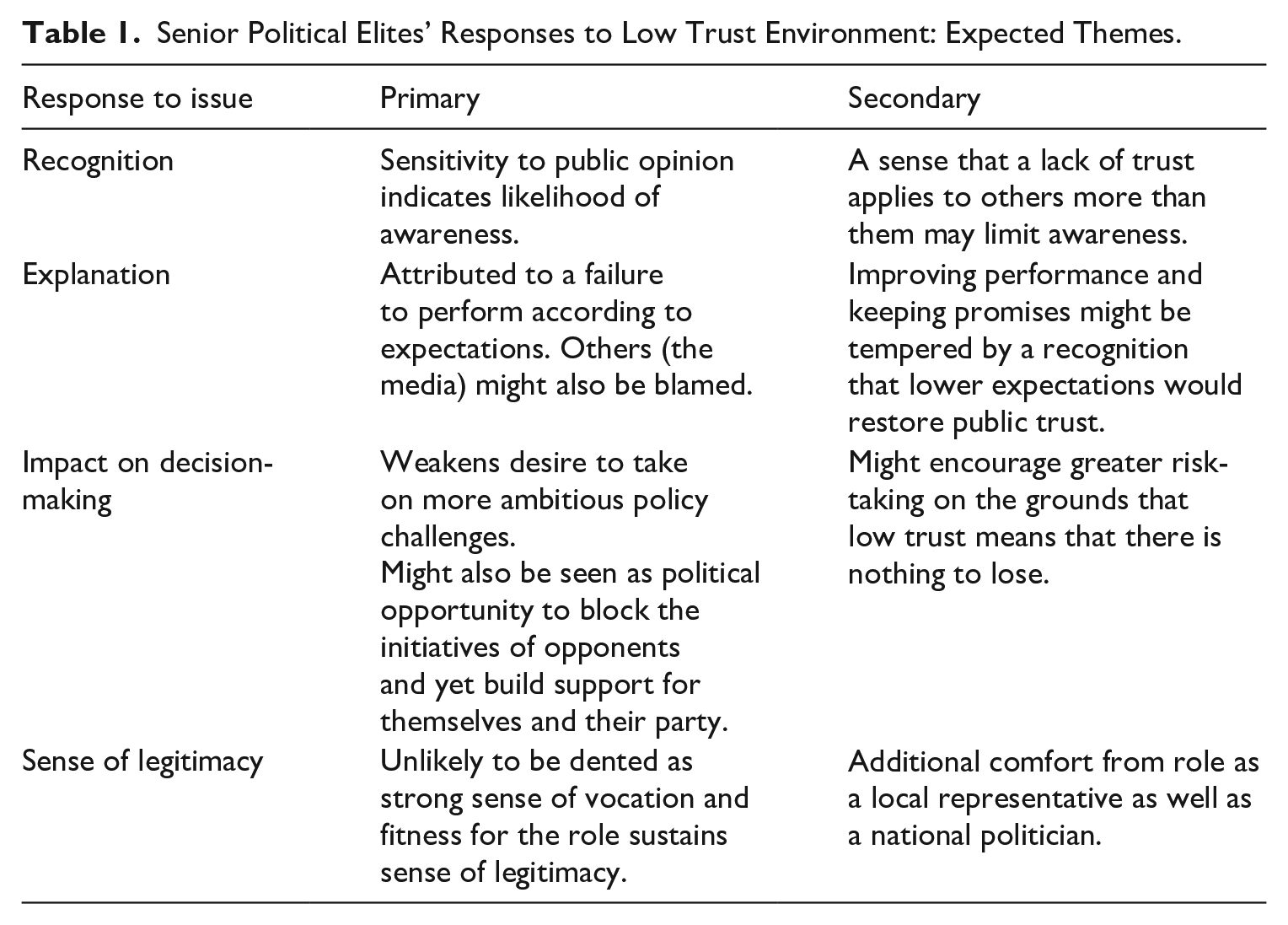
These four questions capture a logic about the stages required to explore how political elites respond to operating in a low trust environment. To address an issue, step 1 is awareness, while step 2 requires some explanation of its dynamics that in turn should drive ideas about solutions. To understand the impact on behaviour we suggest a focus on two core functions of political elites: the making of decisions and the claim to rule with legitimacy. ‘To govern is to choose’ argued Pierre Mendes-France when Prime Minister of France in 1954-5. Political elites live by this maxim whether they wish to or not. Their role is to decide and to claim that they have the right to decide.
Step 1 in understanding the impact of low trust on elite behaviour is to judge whether they are aware of the issue. Recent studies have shown that political elites are poor at precisely estimating public opinion, but tend to be aware of majority sentiment (Walgrave et al., 2023). While it might be assumed to be an essential activity for politicians’ to stay abreast of public opinion, many politicians do not put great efforts into this activity (Soontjens and Walgrave, 2021). Soontjens (2022) shows that many members of parliament do believe that voters are aware of what they do and that their behaviour may be taken into account by them at election time, especially in more candidate-focused electoral systems; an argument that might apply to the constituency-based electoral system of the UK.
Moreover, research on citizens who lack trust (Valgarðsson et al., 2022) suggests that those actors are less likely to engage in voting and formal political participation, such as contacting an MP. So in their constituency work politicians may meet a skewed sample of the public who are more generally trusting and more politically engaged. This context may explain both why politicians wrongly anticipate that voters are more likely to agree with them (Pereira, 2021; Sevenans et al., 2023) and why they are more likely to believe that voters would speak openly to, seek help from or even vote for them than is the case in reality (Weinberg, 2022). An early study found that a majority of Swedish politicians correctly identified that levels of public trust had fallen in the preceding decades (Esaiasson and Holmberg, 1996), but a more recent Spanish study found that Conservative or longer-serving politicians were less likely to acknowledge a crisis (Coller et al., 2020). In short, the evidence suggests that it would be reasonable to expect politicians to be aware of the general lack of public trust in them and in government and politics generally, but that their understanding might be tempered by a lack of concern about the issue or a sense that it might apply to some politicians but not to them.
Step 2 in exploring the impact of low trust is to explore how elites understand and seek to respond to the issue. A Spanish case study (Coller et al., 2020) uncovered several factors identified by politicians that may be case-specific such as corruption by MPs or the natural evolution of politics in a relatively new democracy, but also causes such as media negativity and a lack of responsiveness to citizens’ concerns. Weinberg’s (2023a) cross-national study which asked politicians to reflect on what they themselves could do to build and sustain trust uncovered two main proposals – increased personal contact with voters and more authentic communication. However, despite the prompt for self-focus, politicians in that study also identified several solutions unrelated to their own behaviour, such as improving political education or reducing misinformation online.
Given their position of accountability, politicians are likely to view trust through a standard evaluative lens; you are trusted or not depending on your performance. Research into how politicians evaluate public opinion has found that they anticipate electoral accountability on the outcomes produced by policy decisions (Butler and Vis, 2023). In doing so they are following ‘most empirically-minded scholars in defining political trust as the ratio of people’s evaluation of government performance relative to their normative expectations of how government ought to perform’ (Hetherington and Husser, 2012: 313). Trust is a relationship built on expectations to deliver: X trusts Y to do Z. If trust from voters is missing, it is likely that political elites will identify the solution of improving performance. The caveat here is that to improve the evaluation of performance might also involve a lowering of expectations on the part of the public. A standard formula in seeking to influence levels of satisfaction within accountable relationships is to manage expectations (Busuioc and Lodge, 2017); and politicians regularly attempt to argue they should be judged against a particular set of criteria. However, managing expectations in relation to public service performance (James, 2009, 2011); is not an easy task as citizens’ normative expectations are difficult to change and the information provided by politicians (or their public servants) is not automatically trusted.
Step 3 moves focus directly to the impact of lack of trust on elite decision-making. Research suggests that impact of low trust on decision-making is likely to be negative in a variety of ways by leading elites to fail to tackle challenging issues, to behave irresponsibly, or simply to use low trust to justify a politics of blame and unwillingness to compromise. The dominant theme from research is that lack of trust dissuades politicians from tackling more tricky or challenging issues, if the public ‘trust government – the entity that produces and administers public policies – they ought to be more likely to support more government involvement; if not, then less’ (Hetherington and Husser, 2012: 313). Low levels of political trust have been associated with lower willingness to support environmental policies (Fairbrother, 2019), policies that benefit minorities (Hetherington, 2005), or welfare reform (Gabriel and Trüdinger, 2011; Goubin and Kumlin, 2022). Trust is seen as an important ingredient in persuading people to back longer-term commitments related to issues such as climate change (Jacobs, 2016: 440). The reasoning here is that if citizens lack trust then elites will be unwilling to risk seeking their support for measures that may bring short-term costs in return for long-term benefits. Jacobs and Matthews (2012) report from survey experiments that uncertainty about long-run policy commitments can substantially depress trust in those commitments and so undermine the support for long-term policymaking. However, in experiments with politicians, Weinberg (2023b) finds that politicians who perceived higher levels of political trust are more drawn to cautious decision-making, which he theorises is because they are conscious of the risks of losing their good-standing. Conversely, low levels of political trust thus may lead to politicians taking greater risks.
Low trust may not just change risk calculations but might also encourage reassessments of strategic advantages and political positions. Where there is polarisation of trust the calculation for party leaders about how to operate can be shaped by the differential distribution of low trust. If partisan supporters are more trusting of their leaders and their party (Hetherington and Rudolph, 2020) and if that is matched by a sustained and entrenched lack of trust in other parties the calculation for party leaders becomes different. As Hetherington and Rudolph (2018: 594) explain, when ‘partisans deeply distrust the government run by the other party, they do not really want their party’s representatives to work with the other side’. This in turn enables opposition party leaders to block initiatives if they can and to behave in a way that focuses on the interests of their party rather than the general good. Gridlock and a negative politics of blame is more likely to emerge as a result.
Stage 4 turns the focus from decision-making to the impact of low trust on the sense of legitimacy that is central to their role. It would be a telling impact of low trust if political elites felt their right as elected leaders was diminished by low trust. Yet there are good reasons why any impact on self-belief systems is likely to be modest. Politicians according to Weinberg’s (2020) research come into office with value systems that are focused on helping others over themselves. Although many citizens may fail to perceive the virtue that politicians see as embedded in their behaviour this does not necessarily undermine their claim to virtue and therefore legitimacy. Furthermore, while politicians nationally may not be supported, their local role as a constituency representative may bring far more positive feedback. Indeed, previous surveys of MPs have found that they derive satisfaction from acting as a local representative (Norris, 1997), and increasingly perceive this as the most important aspect of their role (Campbell and Lovenduski, 2015; Radice et al., 1987; Rosenblatt, 2006). Hence there is no strong reason to suppose that a lack of expressed public trust in politics will lead politicians to the judgement that their role lacks legitimacy.
Research Design
To identify what category of elite is most relevant to the research question in focus we draw on Kertzer and Renshon’s (2022) categorisation of occupational elites which defines a political elite according to the proximity of their access to decision-making power in government. This speaks aptly to the theoretical concerns at hand. Our aim is to understand how those ‘in government’ with the potential capacity to affect levels of trust respond to this environment. That requires connecting with those who have had direct experience of initiating, directing and implementing government action, including secretaries of state, ministers and of course prime ministers but also those who have worked alongside these politicians in an advisory role not as permanent civil servants but as political advisors. Our interest is primarily in those who govern, rather than those who represent (though these categories overlap, of course). While advisers themselves do not face the existential angst of low political trust undermining their sense of democratic legitimacy, they are involved in the governing process alongside ministers and are thus similarly potentially affected by low political trust limiting their ability to pursue certain policies (or, when in opposition, expanding their ability to attack their opponents). Furthermore, advisers who do not go on to seek elected office have less incentive to portray themselves, or the administration they served, in a positive light unlike politicians who are more motivated to protect their legacy (Farrall et al., 2020).
Hence we sought the perspectives of those who had been at the heart of decision-making. Our initial list of interviewees to approach were individuals who had served either as Prime Minister, Deputy Prime Minister, one of the ‘great’ Secretaries of State (Chancellor, Home Secretary, Foreign Secretary) or as Chief Whip in government at some point between the first Blair government in 1997 and the May government that fell in 2019, and an additional smaller list of individuals who served as Special Advisers to Prime Ministers in the same period. We did not approach individuals in the Johnson, Truss or Sunak governments (which were in office at the time of our fieldwork) due to the difficulties in accessing elites currently in office. We did not attempt a representative sample, but one that was politically and gender balanced; the former in case of clear differences between different parties’ perspectives on these matters and the latter since previous scholarship has argued that male and female politicians may differ in their support for the current practice of politics (Lovenduski, 2005). Where our initial enquiries proved less fruitful for some administrations, particularly in terms of female Cabinet Ministers or advisers, we widened our net and approached other Cabinet Ministers or Ministers of State from that administration.
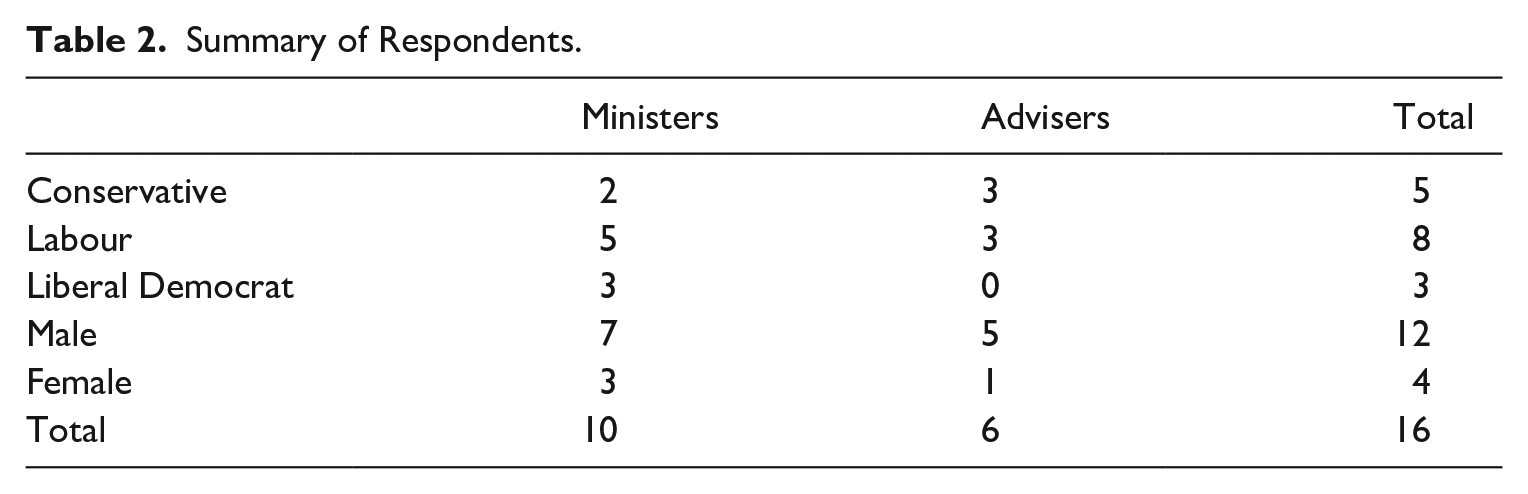
In total, we approached 76 UK political elites between February 2022 and January 2023, some multiple times. Potential interviewees were emailed an invitation to participate in a 20-30 minute online interview as part of the TrustGov project, emphasising our desire to understand the perspectives of those who had served in government. We spoke to 16 participants, a 21% success rate. Table 2 summarises our respondents by party, role and gender. We generally had greater success accessing Labour rather than Conservative interviewees.
Summary of Respondents.
There are limits to the representativeness of our sample. Although the response rate is similar to other general studies of UK political elites (e.g. Rose et al., 2020; see also Campbell and Lovenduski, 2015), we are conscious that political elites who accept an invitation to talk about political trust are more likely to have an interest in the topic. Nevertheless, we spoke to a broad mix of personnel who have served in various UK administrations in the last quarter of a century. Some had lost elections when standing as incumbent MPs, others had lost office when in executive positions, some had even been forced to resign from Cabinet. Many had spent decades working in politics.
Interviews were conducted online and followed a semi-structured format. In January 2022 we carried out a pilot interview with a former Labour Cabinet Minister, followed by a discussion between the interviewee and the authors. Subsequently, we refined our six questions which related to political elites’ understanding of the concept and levels of political trust, whether they felt that levels of political trust were important, if they could recall any examples of levels of political trust affecting their decisions, how they would propose restoring levels of political trust, and why they believed the topic was not discussed more in the House of Commons. The interview script can be found in Supplemental Appendix I. The use of online interviews offers the benefits of making it easier to access such elites who frequently have to rearrange appointments at the last minute and reducing some potential for positional imbalance between interviewer and interviewee in terms of the interview location (Vaagland, 2024). On the other hand, interviews conducted online may reduce the opportunity for ‘rapport’ to be built (Harvey, 2011) although we speculate that this has become less of an issue given the prevalence of online meetings since the Covid-19 pandemic. The length of our interviews varied from 25 minutes to over an hour and our reflection is that participants were generally strongly engaged and undistracted during the interviews.
Interviewees were given the opportunity to review transcripts of the conservations. We subsequently undertook a thematic analysis (Neuendorf, 2019) of our data. For each of our four research questions, we started with a codebook of the themes outlined in Table 1. However, given the relative lack of existing empirical work in this area, we inductively developed this codebook to include codes for themes where politicians’ responses overlapped. Two authors separately coded themes from the interviews before comparing codebooks and agreeing on a final version (see Supplemental Appendix II). This inductive approach, following Nowell et al.’s (2017) guidelines on how to establish trustworthiness in thematic analysis allowed us to identify key themes that were not uncovered by the small body of previous work in this area. Subsequently, we calculated how many of our interviewees mentioned each of these themes, and whether, for example, women, Conservatives or Special Advisers were more or less likely to identify particular issues. We provide this information in Supplemental Appendix II.
Given the aforementioned limits to the representativeness of our sample, we later supplemented this data with an analysis of 143 interviews undertaken by the IfG with former Ministers (Institute for Government, 2023) and 38 interviews with elite UK political actors conducted by UKICE (UK in a Changing Europe, 2023). The first group forms the ‘Ministers Reflect’ series whereby former Ministers are asked about ‘the realities of the role and how to be effective in government’ (Institute for Government, 2023). The content of these interviews is thus appropriate for understanding how perceived levels of political trust impact executive behaviour. These interviews were conducted between June 2015 and August 2023 with those who had served in the UK government but also with some ministers from the UK’s devolved administrations. The second smaller group of interviews focused on providing a contemporary account of the process of the UK’s withdrawal from the European Union, a period of political turbulence that affected levels of political trust differently among different groups (Jennings et al., 2022). This potentially reveals how political elites deal with operating in a low-trust environment when taking decisions on a highly salient case. We searched these texts for mentions of the terms ‘trust’ or ‘confidence’, and then narrowed this data to excerpts where mentions of these terms referred to political trust. Two researchers then undertook a separate thematic analysis of this data, inductively developing ‘themes’ to describe the context in which trust was mentioned in these interviews, before again agreeing on a final set of themes. The results of this analysis are presented after the interviews conducted by the team.
There are potential pitfalls to relying on data from interviews, such as the possibility of participants misremembering or falsely reporting their behaviour during their time in office (Seldon, 1988). In this instance, since our research is focused on general themes rather than specific events, there is less incentive for political elites to oversell their own confidence or to provide a false narrative about decisions they were involved in taking. The focus of the interviews on general themes rather than specific incidents also reduces the potential problem of elites potentially falsely recalling either details or their thinking at the time. Since 9 of our 16 interviewees are still directly ‘active’ in politics as either MPs, members of the House of Lords or political consultants, and several served in local government earlier in their careers, when reflecting on the causes of and antidotes to declining trust our interviewees drew on reflections from across their careers rather than just on their experience of executive office. Of course, when asking our respondents to recall examples of how levels of political trust affected their decision-making in office, it is possible that they fail to recall examples of this, particularly where their experience of office finished some time before the interview took place (20 years prior in our most extreme case).
Our interviews were clearly affected by the political circumstances of the time. Conversations that took place in early 2022 did so in the context of the Russian invasion of Ukraine and ‘Partygate’, the latter of which clearly negatively impacted trust in then Prime Minister Boris Johnson, if not in politics more widely (Hayton, 2022). In the autumn of 2022 perceptions were likely to have been affected by the disastrous ‘Trussonomics’ experiment (Jeffery et al., 2023). Where participants acknowledged that such events had affected their thinking, we mention these when presenting the results. Generally however, participants’ reflections on levels of political trust and their importance drew on their experience of participating in politics over a long period of time, rather than fixating on the immediate circumstances.
Results
Recognition
All politicians and advisers we interviewed acknowledged that levels of political trust in general were low. Politicians we spoke to were able to identify interactions with constituents that demonstrated this, highlighting the role of constituency representation in their awareness of public opinion (Soontjens and Walgrave, 2021). To give one example:
You find people who say that they’re not voting or not interested in politics who you really wouldn’t expect to have those views. I can remember bumping into a couple of teachers during an election campaign, and them saying they weren’t bothering to vote, and that is probably not representative, but it’s not what you want to hear from people with that kind of status and importance in society (Male Liberal Democrat politician).
For most, there was also a shared sense that low trust mattered. Common themes that emerged were the risk of disgruntled voters supporting populist parties and the perceived effect low trust had on governments’ ability to tackle difficult issues like climate change. In the words of one male Labour politician:
It’s very difficult to see how any of those can be resolved in a society that is both divided and where many, many people don’t feel well represented. Because all of those require a level of cohesion, and, if you like, willingness to work together for the common good, which is almost impossible to create if people don’t feel they’re properly represented within the system.
That said, not all respondents were equally concerned. One male Liberal Democrat politician estimated his level of concern as being ‘six or seven’ on a 1 to 10 scale where 10 was ‘worry a lot’, while six others queried that it was any worse than it had ever been. One reason for this complacency may be well summarised by the words of a male Labour adviser, ‘What difference would it actually make if they really did trust politicians? What would actually be different?’
Explanation
Several patterns of note emerged when analysing respondents’ reflections on why levels of trust were low and what the solutions might be. Three politicians, all relatively older, perceived that the advent of a 24 hour news cycle combined with a gradual loss of deference from both media and citizens has led to greater transparency of government, warts and all, and a subsequent loss of trust. Furthermore, some argued that it had led to a politics focused more on messaging than delivery:
Announcements became announcements for the media. It wasn’t just in this country . . . Whoever’s managing the media is the person shaping how things are announced. And of course, if you’re shaping how things are announced, you’re shaping how things are thought about and then it’s very short-term thinking, very media driven, shallower, and more for manipulation rather than for sincere consideration and announcement (Female Labour politician).
This manifested itself in several ways. Two Cabinet Ministers from the Blair government felt that their party had not been electorally rewarded for announcements of extra investments in healthcare and education because such announcements raised false hope about service delivery and people on the ground experienced the effects of policies differently to how they were perceived in Westminster. One former Conservative adviser also raised a recent tendency for politicians to hastily respond to constituents’ demands online which ended up backing them into corners. Several interviewees lamented parties’ habit of over-promising and under-delivering, or performing U-turns on their previous pronouncements. Unsurprisingly, Liberal Democrat politicians in particular were aware of this given the electoral punishment they had received for U-turning on several notable policies when in coalition (Dommett, 2013). This led seven politicians and former advisers to propose that one solution to increase political trust was for parties to be more realistic in their promises so that they could more clearly demonstrate to voters that they had kept their promises. In the words of one Liberal Democrat politician:
The levelling-up agenda [is] a massively bold policy area. But actually, there’s not been a lot of detail behind it and maybe not enough policy volume to really make a difference. Cameron’s ‘Big Society’ would be another example of sort of a nice idea that didn’t have much policy beef behind it. I think politicians have got to make sure that behind their policies and their rhetoric is enough meat to show the public that they can deliver, and that political promises are not just things that are made at election time and forgotten afterwards.
11 of our 16 respondents identified a general failure of parties and politicians to effectively communicate with voters, either by reminding them of their successes or by explaining their thinking. Two politicians contrasted what they saw as their successful approaches to communicating with constituents along these lines in contrast to more wider failures of parties. One female adviser from the Cameron years admitted that they ran into difficulties over their healthcare reforms (Timmins, 2012) because they had not communicated them in advance to voters. One male Conservative political adviser proposed:
I think the only way out of it now is almost a new type of populism, a sort of anti-populist populism which is sort of ‘These guys are promising you the world, it’s all rubbish, I’m going to give it to you straight’.
There were differences of perspective over whether greater responsiveness to public opinion would restore levels of political trust. Some felt that responding to voters in the short-term sometimes led to long-term problems in terms of policy-making and thus political trust. On the other hand, one male Labour politician recalled the government partially responding to tabloid newspaper campaigns over sex offenders in a way that ‘adapted what they were saying to an acceptable and practical policy’, so ‘that you weren’t just going to say ‘we’re not doing anything’ because we’re not interested or because it’s difficult’, highlighting it as an example of how to retain public trust.
A different concept of responsiveness was raised by an interviewee who recalled that Tony Blair had lost support due to voters’ perceptions that his government had not paid sufficient attention to the issues that mattered to voters. Relatedly, two politicians highlighted the increasing importance of identity issues, and the greater need for mainstream politicians to respond to such issues, while seven respondents raised their (collective) failure to tackle big decisions:
It’s the politicians’ tendency over a long time not to do those things, not to have those conversations, to put stuff off, to pretend things are ok when they’re not, that has created the low levels of trust. I think for me that’s the direction that causality works in. Politicians should have been doing bold things, they should have been having serious conversations. There’s been so much sticking plaster (interview with male Labour adviser).
Four interviewees identified that politicians had less power to affect change than previously, either because of the power of financial markets, or because of delegating power to quangos or privatised companies, although the latter is the direct result of a series of decisions taken by UK politicians (Coxall et al., 2003: Chapter 19).
A simpler explanation offered by six respondents was that trust had fallen simply because governments and politicians hadn’t been doing their jobs effectively, whether that be the MPs’ expenses scandal, or the failure to deliver economic goods to voters. One male Conservative politician, generally dismissive of the idea of a crisis of trust, summed it thus; ‘Broadly speaking, if people think things are going well for them and the people that they know and the country, they will be pretty approving of the elected people’.
A perhaps more unexpected ailment identified by six respondents was the quality of the personnel in office. Unsurprisingly, respondents of all parties raised Boris Johnson’s personal conduct when musing on the state of political trust in the UK. However, several respondents pondered whether previous generations of politicians were better suited to their roles, while another queried the British system of ‘generalism’ involving both Ministers and Civil Servants shuffling around between departments. Given that our respondents were generally successful in terms of the heights they reached in their political careers, such thoughts are unlikely to be sour grapes, although of course they were more likely to identify mistakes made by others. In the words of one Conservative adviser, ‘The problem is that through, I think, probably about three parts inevitability and seven parts the actions of politicians, those waves [of trust/optimism] come crashing down pretty damn quickly’.
Three of our four female interviewees emphasised the need for more descriptively representative decision-makers but also for a less absolutist form of politics that allowed for more dissent. Female elites were also more likely to advocate allowing politicians to express themselves more freely from the party line to engender greater trust in what politicians say.
Several respondents mentioned the need for politicians to seek a common ground and attempt to lead the whole country rather than focusing on maximising the reward for their party. Liberal Democrats identified this as a feature of the UK’s first-past-the-post voting system, while most Labour politicians advocated for a different sort of constitutional reform; devolution. However, one male Labour politician acknowledged the tension between a theoretical desire to devolve power and a practical desire when in government to maximise control over decision-making, due to a lack of trust that others would execute the policy as well as you would:
Trust in your direction and what you were saying would be eroded if you messed it up. It led us to be slightly more diktat than we would have wished. It led us to be much more hands-on with co-ordinators in each locality ensuring that people were doing something than we would otherwise have wanted.
In sum, there was some acknowledgement of general and individual failings by the political class which have led to a loss of trust. Common themes were policy failures, under-delivering compared to the expectations that had been raised by campaigns and communications, and individual failings by others. Some proposed dealing with this problem by promising less, some by communicating more, and others raised commonly cited solutions to trust in the UK such as electoral reform, devolution, or better citizenship education.
Impact on Policy
When asked whether levels of political trust had ever influenced policy decisions, most respondents drew on examples of what they felt were successful initiatives they had been involved with that had secured trust from voters, including New Labour’s raising of national insurance (Tempest, 2002), introducing bans on smoking indoors (Cairney, 2007), blunting the success of the BNP (Copsey, 2012), retaining public confidence after the financial crash, introducing austerity or implementing Covid-19 lockdowns.
When pushed as to whether low levels of political trust had ever led them or their party to duck a decision, interviewees recalled examples such as reforms to party political funding, social care and healthcare, all of which are long-running unresolved issues. Respondents reported that trust affects different parties’ ability to tackle different issues. Multiple Conservatives mentioned their party’s lack of trust from voters to tackle healthcare reform, whereas Labour respondents recalled a common fear that voters would not trust them to raise taxes and spend money. In an example of such a view, one interviewee reflected:
When trust goes and the public think that all politicians are the same, that they’re all in it for themselves . . . that belief tends to have worse consequences for the left, because they tend to believe in government, that government is a good thing. So, the more the public lose trust in government and think ‘It’s all a load of nonsense. They’re all in it for themselves’, then you may as well have a government that does as little as possible.
Low levels of political trust were also seen to impact general strategy rather than isolated decisions or issues. One former Conservative Party adviser offered the example of the strategy of the then Sunak government:
I think the thinking behind those [Sunak’s] five promises is absolutely right, which is that we only get a hearing from the public if we show delivery first. And so that is a response to a world of very, very low political trust. If you respond to that and start promising the world, then it ain’t gonna change anyone’s mind. If you show it through delivery, that is the best and only route to try and turn them around.
It was widely acknowledged that low trust in incumbent governments created opportunities for opposition parties. Aside from obvious opportunities such as attacking Boris Johnson over trust, one former Conservative adviser recalled the case of the Conservative Party attacking Labour during the 2015 general election campaign for likely having to form a coalition with the SNP. For them, this warning that parties would ditch their policies in backroom deals was explicitly about trust. Five participants agreed that low trust offered partisan opportunities and this helped to prevent cross-party working on the issue of political trust since in the words of one male Labour politician, ‘they think they’re the answer. You think that it will be alright if you’re in power’.
Our interviewees did not mention or recall parties monitoring trust levels in British politics generally, but representatives of both main parties revealed that they polled levels of trust in party leaders. Voters’ trust in leaders was perceived as another aspect of how trust affected policy decisions. For example, a former Labour adviser highlighted how Ed Miliband’s proposed energy price cap polled well in isolation, but due to misgivings about his character voters did not trust his ability to deliver it. One Conservative MP, speaking in the context of partygate, highlighted that the main way a party could improve its trust rating from voters was by choosing a leader whom voters trusted.
Sense of Legitimacy
When reflecting on why politicians don’t work together more to address concerns around a lack of trust, one veteran politician commented that individuals were only concerned about trust in so far as it affected them personally. Another former politician recalled how parties are concerned with getting enough votes to win and therefore disregard non-voters, rather than putting effort into tackling disengagement.
Three reasons were frequently mentioned when respondents were asked to reflect on why there is less political impetus to tackle the trust challenge. First, that a lack of trust does not adversely affect individuals’ ability to get things done on a day-to-day basis (six mentions). Second, a perception that if their party gets into power and performs well, that would increase overall levels of trust (five mentions). Third, individual MPs’ perspectives are influenced by the relatively higher esteem in which they are held by their own constituents (eight mentions).
One former MP starkly pointed out that governments need parliamentary approval but rarely popular trust in order to implement a policy. This also highlights that collectively, there is little reflection in Parliament on the impact individual decisions have on political trust. At a more individual level, politicians highlighted that whether as a Minister, Select Committee Chair or backbencher, trust from fellow Parliamentarians is more important than trust from voters in terms of achieving policy goals. Since low levels of political trust do not affect the ability of individuals in Westminster to get things done, tackling it is less of a priority. Related to this, five respondents highlighted examples of foreign countries where they thought levels of trust were more seriously affecting the practice of government, such as levels of affective polarisation in the USA, the size of far-right populist parties’ parliamentary presence across Europe, the perceived lack of debate and policy change in countries like Germany where governments are always coalitions or Presidents in the USA and Brazil being reluctant to cede power.
For some respondents, there was a reluctance to think about ways in which parties could address the issue of lack of trust specifically. Instead, in the words of one male Conservative politician, ‘Everything you do implicitly is designed to increase trust in your party. And when you do that, then the general level of political trust goes up as well’. This summed up a common sentiment that if parties were successful in achieving their office and policy goals by getting elected and then successfully convincing voters that they had kept their promises, trust would increase as a by-product.
Those who had served as MPs tended to highlight the positive reception they received in their constituency, and felt that many good-minded colleagues would pick up on similar sentiments, providing a juxtaposition with their awareness of a lack of trust in politics generally. One male Liberal Democrat politician summed it thus:
As long as people get returned to office, and they return their parliamentary seats, I think what tends to happen is that people distinguish between their own experience as individuals, and the kind of collective sense. Although we have all these public discussions about how politicians are despised and have lost faith, a lot of individuals at a constituency level find that they are actually quite liked and respected if they’ve worked hard and done the right things. The outpouring of good feeling around the two British MPs, one Labour, one Conservative who were assassinated, I think that speaks to a somewhat different perception of politicians.
Another frequently cited reason for inertia was simply that the Westminster model is too institutionalised. Several respondents who did not express a preference for electoral reform highlighted that the adversarial nature of UK politics stunts cross-party collaboration on such issues. One former adviser to Gordon Brown at the time of the expenses scandal, when asked to reflect on why there was not more cross-party collaboration on tackling the issue, commented:
Whilst everybody had mud flung at them by the expenses scandal – all parties and MPs from all parties – each of them nonetheless could have had in mind the 2010 election because it was going to be a competitive election. So, they each had partisan considerations. And whilst that didn’t extend, I don’t think, to trying to discredit particular individuals, I think it did extend to a lack of trust in the negotiations. Because of wariness about the forthcoming election, were people using this to position themselves in partisan terms?
Supplementary Analysis
We now turn to our analysis of the text of 154 interviews with Ministers conducted by the IfG and 38 interviews conducted with senior politicians or advisers by UKICE. The focus of both of these sets of interviews were not on trust and there are next to no questions about it. Thus, we do not expect to find many reflections on explanations for levels of political trust. However, this data is appropriate for answering two main questions related to our themes of interest. First, related to recognition – how frequently do interviewees mention political trust? Second, related to impact and sense of legitimacy – how does trust matter to their work?
To answer these questions, we searched the texts for mentions of the words ‘trust’ or ‘confidence’ and then undertook a thematic analysis of those sections of text to identify the context in which political elites talk about ‘trust’ when reflecting on their experiences. The results of this analysis are provided in Supplemental Appendix III. First, we find that political trust is not a common feature of political elites’ recollections in these interviews. There are just six reflections on political trust in the 143 IfG interviews, and four among the 38 UKICE interviews. Within the IfG interviews, most reflections on political trust related to wanting to honour the sense of trust placed in a new government (two mentions), or in a new devolved institution (three mentions). For example, former Labour Cabinet Minister Hazel Blears offered this reflection on New Labour’s task after having come into office at the 1997 General Election:
This was a chance, having been out of office for so long, actually to do some stuff and make a difference. And if we didn’t step up and do it well, and make sure that it really did make a difference, then in some ways we were betraying the trust of all those people who had said they wanted change (Hazel Blears).
On a similar theme, Former First Minister of Wales Carywn Jones spoke about the risks of the public losing faith in the newly-devolved Welsh government during the 2001 ‘foot and mouth’ crisis:
There were two things that I remember thinking: that if this goes wrong you’re finished and that’s it, you’re done in politics, and that this would be a test of devolution. If you can sound credible, and the Assembly as it was then can sound credible, it will mean that that people will have confidence in us and we’ll be able to deal with the crisis (Carwyn Jones).
Within the UKICE data, the references to political trust were arguments that Brexit had led to a decline in political trust, but from different perspectives – either that voters were mis-sold Brexit or that voters were promised that the referendum result would be respected but Parliament was perceived to be blocking this. These echoed the findings from our own interviews that political elites perceive that political trust is lowered by a mismatch between expectations and delivery. An example of this is offered by former Labour MP Caroline Flint, a critic of her party’s post-referendum Brexit position:
Every time there was a vote in Parliament, every time there was another clever little tactic, my email box would be full of people saying ‘We know what they’re up to, we know what they’re doing’. And again, it came back to trust which was being eroded day by day (Caroline Flint).
The one deviation from these patterns are the reflections of Nick Hurd on dealing with the aftermath of the Grenfell disaster. 1 While acknowledging the abyss of political trust in the aftermath of such an event, the interview does not go into detailed reflection on how they overcame this.
Our analysis uncovered a further 19 mentions of trust in the UKICE interviews and 122 in the IfG interviews. 14 of these related to ‘partisan trust’, i.e. voters’ trust in the competence of particular parties, party leaders, or as constituency MPs. This reflects that political elites conceive of trust in them from voters related to levels of electoral support. For example, a former adviser to Theresa May commented on the need for May to secure trust from supporters of Brexit:
We were very much in the post-referendum period, and I think we were incredibly conscious that Theresa [May] had campaigned for Remain, and so there was also a trust issue around actually delivering the outcomes that people had voted for (Joanna Penn).
Ten mentions of trust, mainly from the IfG interviews, referred to trust from interest groups or key stakeholders. One example of this comes from David Willetts, the former Minister for Universities and Science reflecting on his need for trust from stakeholders when overseeing a comprehensive spending review (CSR) during a period of severe austerity:
I’m not a scientist and I’d not shadowed it for so long – I’d had off and on responsibility for it. I hadn’t stuck with it for as long as I had with HE. So [I needed to] gain the confidence of the community when I was not a scientist and that related to the very tricky issue of the CSR and how we handled the CSR.
The remaining references to trust refer to trust between colleagues. This may refer to trust among parliamentary or party colleagues, between devolved institutions and Westminster, or between advisers and Ministers. One example from the UKICE interviews relates to trust between the leadership of the Labour and Conservative Parties when tentatively discussing cross-party working during the Parliamentary impasse over Brexit:
That was part of the problem with Theresa May’s position, in that she, to a certain extent, she bore the imprint of the last group that sat upon her. As a result of that, you couldn’t really have much confidence in whatever she came up with, or delivering it for that matter (John McDonnell).
In the IfG interviews, the concept of trust most commonly related to trust from the Prime Minister in Cabinet colleagues, trust between the Cabinet Minister and Junior Ministers or the need for Ministers to have a mutually trusting relationship with civil servants. For example, former Conservative Minister of State Sayeeda Warsi spoke about how Prime Minister David Cameron ‘was known to be quite trusting and would let you get on with things’.
Cumulatively, analysis of this supplementary data reveal that trust is a concept that matters to Ministers and Parliamentarians on a day-to-day basis, but it is trust between colleagues or from stakeholders such as interest groups rather than trust from voters that matters. There are no references to levels of political trust acting as a constraint, with the exception of the reflections on reacting to the Grenfell disaster. Within the UKICE interviews there were a handful of reflections on how there were incentives to resolve Brexit in a particular way to combat declining political trust. However, there were no reflections on how low levels of political trust may affect long-term policymaking, demonstrating how far from the front of political elites’ minds dealing with the challenge of low political trust is.
Conclusion
Given the long-term decline in political trust in the UK and elsewhere, and its potential ramifications for policy-making and support for mainstream parties, the question of how political elites operate with regards to trust is fundamental to many areas in the study of politics and international relations. In particular, how does this environment affect multi-faceted long-term policy challenges like tackling climate change? As such our findings should be relevant to researchers working in many fields seeking to understand the behaviour and motivations of political elites in a time of strain for liberal democracies.
Our research focused on four aspects of dealing with this environment – whether political elites recognised the lack of trust, their explanations for the phenomenon, and their perceptions of its impact on policy-making and their sense of legitimacy. In contrast to Coller et al. (2020), we do find that the overwhelming majority of UK elites from all parties recognise that voters don’t have high trust in politicians, but there is some doubt over its significance. This finding is in line with our expectations that politicians would be aware of low trust given their sensitivity to public opinion, but that they may not be particularly concerned given the stability of the UK’s political system. The crude challenge posed by one adviser of whether the operation of government would be any different if voters had higher trust exposes a truth that UK political elites are able to go about their daily business and affect political change without high levels of public trust in politicians and political institutions. They merely need a parliamentary majority. Some of the under-perception of the scale of the trust problem may arise as a result of what Fenno (1977) termed the ‘paradox of Congressional Support’ – that voters like their own representative but have a highly negative perception of politicians in general. Since politicians pick up on this positive local sentiment, this may lead to an under-estimation of the wider problem. However, most interviewees shared a despondence at the lack of trust in UK elected representatives.
Regarding explanations for the lack of trust, not all interviewees acknowledged the political class’s failure to perform according to expectations, although some did cite a lack of responsiveness to voters’ preferences or mentioned specific policy failures, and some even raised the lack of calibre of their political rivals. When asked to reflect on solutions however, very few of our sample recommended better performance. Instead, many interviewees identified the need for improved communication from parties to better manage voters’ expectations around performance. In other words, if parties offered less to voters they would be more likely to satisfy their expectations. The inherent danger in such a suggestion is that parties’ promises do not merely become more realistic, but less ambitious. In an economy with negligible real wage growth in 15 years (Bell and Blanchflower, 2020), productivity stifled by lack of investment (Goodridge et al., 2018), and oncoming climate crisis, this may not be the most ideal solution. For politicians then, it appears that the factors they perceive that drive trust are sustaining positive relationships, communicating effectively and avoiding blame. Trust is about managing the multiple accountabilities they face in an appropriate manner. Maintaining trust with colleagues might in this light be a higher focus of attention than sustaining trust among the public.
On the impact of trust on policy-making, there was some acknowledgement that this made it more difficult to tackle neglected issues, but a greater recognition of the opportunity it provided in the game of party advantage. While it is possible that those we interviewed failed to remember how low political trust dissuaded their parties from undertaking long-term policymaking, the lack of mentions of this point in the IfG interviews – which are generally conducted much sooner after Ministers have served – give us confidence that our methods are not the reason why we observe few instances of political elites identifying the link between political trust and long-term decision-making. Instead, this reflects either a lack of concern about the UK’s long-term policymaking or that they attribute other reasons for this failure (Richards et al., 2023).
Most strikingly, despite the broad acknowledgement of low trust from voters, it has seemingly had only a limited impact on politicians’ sense of legitimacy. Several of our interviewees had been involved in policies over several decades, and while acknowledging the increased cynicism and hostility from voters in general, none reflected that this had adversely affected their motivation. However, none of the politicians we spoke to had voluntarily left politics mid-career, an event that is becoming increasingly common among UK MPs (Butler et al., 2021). It is feasible that there is a link between the lack of trust and this growing trend. MPs have reported quitting in recent Parliaments due to the level of abuse received, particularly on social media (Collignon et al., 2022). However, we did not uncover any evidence of low trust affecting politicians’ self-esteem in the IfG or UKICE data, even from the Minister dealing with the traumatic aftermath of the Grenfell disaster.
These results demonstrate the need for future comparative research to explore whether politicians in systems without a constituency link, or where extremist and populist parties have achieved more success, might so easily reconcile themselves to operating with low political trust. In all, our interviews reveal that for politicians, politics is about power and lack of trust appears to be not so much a block as an opportunity and in so far as solutions are required it is about performance and presentation. If lack of trust is undermining democracy, as many commentators claim, then political elites are not likely to be strong champions of tackling that concern given their understanding of the issues, as revealed by our research.
Supplemental Material
sj-docx-1-psx-10.1177_00323217241310945 – Supplemental material for How Do UK Political Elites Reconcile With a Low Trust Environment?
Supplemental material, sj-docx-1-psx-10.1177_00323217241310945 for How Do UK Political Elites Reconcile With a Low Trust Environment? by Chris Butler, Will Jennings and Gerry Stoker in Political Studies
Supplemental Material
sj-docx-2-psx-10.1177_00323217241310945 – Supplemental material for How Do UK Political Elites Reconcile With a Low Trust Environment?
Supplemental material, sj-docx-2-psx-10.1177_00323217241310945 for How Do UK Political Elites Reconcile With a Low Trust Environment? by Chris Butler, Will Jennings and Gerry Stoker in Political Studies
Supplemental Material
sj-docx-3-psx-10.1177_00323217241310945 – Supplemental material for How Do UK Political Elites Reconcile With a Low Trust Environment?
Supplemental material, sj-docx-3-psx-10.1177_00323217241310945 for How Do UK Political Elites Reconcile With a Low Trust Environment? by Chris Butler, Will Jennings and Gerry Stoker in Political Studies
Footnotes
Declaration of Conflicting Interests
The author(s) declared no potential conflicts of interest with respect to the research, authorship and/or publication of this article.
Funding
The author(s) disclosed receipt of the following financial support for the research, authorship and/or publication of this article: This research was conducted as part of the Trust and Trustworthiness in National and Global Governance (TrustGov) project, supported by the Economic and Social Research Council (ESRC) under grant ES/S009809/1.
Ethical Review
This study was approved by the Faculty of Social Sciences Research Ethics Committee at the University of Southampton (Ethics/ERGO Number: 57244).

Supplementary Information
Additional Supplementary Information may be found with the online version of this article.
Appendix I: Script for conducting interviews with UK governing elites on political trust.
Appendix II: Codebook and quantitative thematic analysis.
Appendix III: Mentions of ‘trust’ or ‘confidence’ within ‘Ministers Reflect’ interviews conducted by the Institute for Government up to August 2023.
Notes
Author Biographies
References
Supplementary Material
Please find the following supplemental material available below.
For Open Access articles published under a Creative Commons License, all supplemental material carries the same license as the article it is associated with.
For non-Open Access articles published, all supplemental material carries a non-exclusive license, and permission requests for re-use of supplemental material or any part of supplemental material shall be sent directly to the copyright owner as specified in the copyright notice associated with the article.
