




Abstract
This article addresses a gap in the Eurocrisis literature by investigating the role of important socio-economic actors, such as representatives from organised business and labour, as well as parliamentarians in determining governmental preferences on the European Stability Mechanism during the Eurocrisis and in more recent discussions on the future of the European Stability Mechanism. It is argued that the study of the roles of key interest groups, parliaments and public opinion adds important weight to existing studies and frameworks. It speaks particularly of studies which suggest that governments enjoyed important leeway in forming their preferences on the European Stability Mechanism and were driven predominantly by internal technocratic advice and their integration into EU-level structures of bureaucratic cooperation. The findings show that initial governmental preferences were not challenged by important interest groups and that where they were challenged by parliamentary actors, concessions did not affect the original principles of the European Stability Mechanism design.
Keywords
Introduction
As the first permanent macroeconomic stabilisation device the European Stability Mechanism (ESM) marks a turning point in Eurozone governance. It is based on an international treaty outside EU law. 1 The ESM’s political relevance is not only determined by its start-up costs and the resulting financial liabilities but also by its hard-hitting conditionality, which is attached to its financial support schemes. This article joins Smeets et al. (2019) in noting that while the ESM features in many reviews of Eurocrisis politics, there is a lack of empirical research on decision-making surrounding its original creation. Smeets et al. show the importance of executive cooperation at the EU level across different institutions and hierarchical levels. Their account is in line with earlier research by Csehi and Puetter (2018), which finds that member state governments, the Commission and the European Central Bank (ECB) formed their preferences on the ESM mainly through their own interactions within the relevant committees, the Eurogroup, the Council and the European Council, leaving citizens and parliamentarians aside.
Yet, such findings do not chime with the ESM’s potential to provoke political conflict. The mechanism’s macroeconomic relevance and its burden-sharing implications may lead to the expectation that decision-making became exposed and influenced by societal interests, parliamentary actors and public opinion. For example, some may see the ESM as a vital stabilisation device, which can protect the Eurozone against external shocks. Opponents of financial transfers may lament that the ESM removes pressure to pursue reforms while making better-off member states liable for potential credit losses. Pensioners and trade unions may oppose hard ESM conditionality, which typically involves demands for cutting social expenditures while receiving Eurozone assistance. The ESM thus reflects what model of social solidarity the Eurozone adopts (Hall, 2012). The financial industry may take different views, depending on the degree of financial exposure to indebted Eurozone governments (Târlea et al., 2019). Public opinion may diverge in debtor and creditor countries, thus constituting pressure on Eurozone governments who come to back a common position on the ESM (Kuhn and Stoeckel, 2014). Indeed, the creation of the ESM sparked political and legal disputes, which could have, but ultimately did not, halt the creation of the ESM. For example, in Ireland the parliamentarian Thomas Pringle challenged the ESM as an unlawful arrangement beyond the powers of the EU treaties (de Witte and Beukers, 2013). This view was rejected in a preliminary ruling by the European Court of Justice (Case C-370/12). Similarly, the German Bundesverfassungsgericht refuted complaints by several politicians after a long dispute in March 2014 (Bundesverfassungsgericht, 2014).
Like the other contributions to this special issue, this article seeks to deepen insights into processes of governmental preference formation during the Eurocrisis. This article seeks to address gaps in the Eurocrisis literature by investigating the role of important socio-economic actors, such as representatives from organised business and labour as well as parliamentarians, in determining governmental preferences on the ESM during the Eurocrisis and in more recent reform debates. It is argued that the study of the roles of societal interests, parliaments and public opinion adds important weight to existing studies and frameworks. It speaks particularly of studies which suggest that governments enjoyed important leeway in forming their preferences on the ESM and that they were driven predominantly by internal technocratic advice and their integration into EU-level structures of bureaucratic cooperation. The findings show that initial governmental preferences were not challenged by important societal interest groups and that where they were challenged by parliamentary actors, concessions did not affect the original principles of ESM design. The analysis is based on a new EU-wide dataset on political influence in Eurocrisis decision-making, 36 in-depth interviews with non-governmental socio-economic actors and government officials in nine Eurozone countries and data on the role of parliamentary actors from the ‘Constitutional Change through Euro Crisis Law’ (CCECL) project (Beukers et al., 2017).
The article is divided into three sections. The first section reviews the Eurocrisis literature for assumptions about how non-executive actors may have influenced governmental preference formation regarding the ESM and outlines four hypotheses. The second section reviews new empirical data on the role of organised business and labour in relation to the ESM. The third section looks at whether and how parliamentary interventions and public opinion impacted on governmental preference formation. The final section discusses the findings in the light of ongoing debates in the Eurocrisis literature on preference formation.
Governmental Preference Formation in the Eurocrisis and the ESM
As acknowledged in the previous section, research on ESM related decision-making remains scarce. Instead, broader theoretical accounts on the Eurocrisis need to provide the starting point for identifying claims about what patterns of governmental preference formation may have prevailed in relation to the creation of the ESM. While preference formation is a key term in EU studies, many contributions on the Eurocrisis do not make direct reference to it (cf. however, Târlea et al., 2019). Nevertheless, it is possible to infer guiding assumptions on how governments may have formed their preferences in relation to the ESM from the Eurocrisis literature (Csehi and Puetter, 2017). Schimmelfennig (2015) projects a liberal intergovernmentalist interpretation onto the Eurocrisis and highlights that government preferences were determined by a ‘common interest in the survival of the euro’ while ‘conflicting preferences on the distribution of the burdens of adjustment’ (Schimmelfennig, 2015: 181) prevailed. In their neofunctionalist analysis, Niemann and Ioannou (2015) emphasise the notion of functional spillover as informing governmental preferences and argue that ‘[f]unctional dynamics are only as strong as they are perceived by (key) actors’ (Niemann and Ioannou, 2015: 200). The authors identify meetings of the European Council and the interplay of executive actors from different EU institutions as instances when policymakers understood functional interdependencies and formed their opinion on policy responses. New intergovernmentalism sees preference formation in EU economic governance being centred on highly institutionalised processes of interaction. Member state executives and representatives of EU institutions were engaged in an enduring process of consensus-seeking at different hierarchical levels of government throughout the Eurocrisis (Hodson and Puetter, 2016; Puetter, 2014). Historical institutionalists point to the path-dependent course, on which governments were sailing, when agreeing on the ESM. Earlier decisions, which were made under time pressure and had established the ESM’s predecessor, the European Financial Stability Facility (EFSF), meant that the main features of the ESM’s institutional design were predetermined (Gocaj and Meunier, 2013: 248–250).
Although the above approaches have been used to support diverging interpretations of the outcome of Eurocrisis decision-making (cf. Bauer and Becker, 2014; Bressanelli and Chelotti, 2016), they converge in one crucial aspect. None of them sees an important role of non-executive actors in preference formation. Rothacher (2015) and Schäfer (2016) are among the few authors who investigate the domestic element of liberal intergovernmentalism’s theory of preference formation. Their respective studies on France and Germany, however, lead to conflicting results. While Rothacher attributes some relevance to the influence of French bankers on governmental preference formation, Schäfer rejects the notion that the preference of Germany’s government on banking union can be explained by the sectoral interests of the financial industry. Another set of contributions considers the role of national parliaments in influencing governmental preferences in the Eurocrisis. Auel and Höing (2014, 2015) do not situate themselves in any of the above theoretical perspectives; instead they reveal that the influence of parliaments varied between countries and over time while executive actors played a prominent role, as in EU politics more generally. With regard to the role of national parliaments in governing the ESM after its initial establishment, Höing (2015: vi) finds ‘that countries adopted firm ESM parliamentary prerogatives when they were in a favourable macro-economic situation (as of 2012) and simultaneously possessed strong formal powers in EU affairs’. However, it remains to be seen whether and how parliaments influenced governmental preference formation at the time of ESM creation. Puntscher Riekmann and Wydra (2013: 579) conclude that while the Eurocrisis meant that national parliaments became aware of the implications of EU policies more than ever before, they generally endorsed governmental preferences and failed to ‘influence the European Council as a collective’.
Outside of the above perspectives the Eurocrisis literature lacks specific theorising of the role of societal interests in Eurozone politics. This issue assumed more prominence in the first two decades of Eurozone integration. The Economic and Monetary Union (EMU) was considered to provide room for a particular model of institutionalised discussions about economic governance between executive actors and organised business and labour, for example, in the context of the Macroeconomic Dialogue (Dyson, 2002). Such a model of interest mediation through tripartite dialogue promised enhanced democratic legitimacy. Yet, confidence in it had faded before the crisis (Smismans, 2008). In their review of political economy perspectives on the Eurocrisis, Frieden and Walter (2017: 384) see many indications that influential societal groups succeeded in resisting crisis management politics, in particular, structural reforms and internal adjustments. The ESM with its built-in conditionality mechanism could thus be considered as a plausible target for affected societal interests. In more recent theorising of the interlinkages between governmental preference formation and societal interests, some scholars have become increasingly sceptical as to how far politicians can generate popular legitimacy when they make decisions related to EU affairs. Hooghe and Marks (2009, 2018) generally expect politicians to be challenged in their decisions on Europe as the question of integration is at the centre of a new cleavage in European party politics. Postfunctionalism, however, refrains to predict how exactly so-called challenger parties and Euroscepticism affect the preferences of pro-EU governments. New intergovernmentalism sees previously existing patterns of domestic preference formation to be disrupted in post-Maastricht EU politics as representative democracy faces crises not merely at the European but also at the national level (Bickerton et al., 2015: 710). Hodson and Puetter (2019) emphasise that elites preferred to push on with integration in the context of the Eurocrisis, regardless of waning popular support for integration. New intergovernmentalism thus sees policymakers as being aware of fading legitimacy but not overly impressed by it. Another indication of how difficult the impact of negative public opinion on preference formation is to assess is provided by Kuhn und Stoeckel (2014), who find popular support for European integration declining greatly during the Eurocrisis while citizens still supported EU economic governance.
The review above informs four hypotheses which guide the following empirical analysis. All four hypotheses are understood here as tentative answers (Brady and Collier, 2010: 331) to the question of what informed governmental preference formation regarding the creation of the ESM. The most prominent contributions to the Eurocrisis literature either implicitly or explicitly assign executive actors a central role in the process surrounding the creation of the ESM, yet the literature presents little empirical evidence with regard to the relative importance of other actors. As Eurocrisis management in general is associated with resistance to austerity and structural reforms, the role of non-governmental actors deserves closer inspection. The first hypothesis is that the influence of non-executive actors in governmental preference formation is limited to the extent that they cannot divert or revoke governmental preferences which were formed in relation to and conjunction with other member states and EU institutions. Second, of all non-executive actors organised business and labour are expected to be the least influential. If they do play some role in preference formation it is expected to relate to ESM conditionality. Third, the role of national parliaments in governmental preference formation, even though generally limited, is expected to be more pronounced at most in relation to some budgetary aspects of ESM politics, yet it is likely to vary over time and in relation to the macroeconomic position and the formal parliamentary powers in the EU affairs of a given country. Fourth, decision-makers are expected to be concerned by public discontent regarding the creation of the ESM, yet there are no indications for a straightforward pattern of how discontent affects governments’ preferences.
The subsequent empirical analysis makes use of and triangulates data from three main resources. First, it relies on the EMU Choices project’s EMU Formation dataset. These data were jointly generated with our collaborators in the EMU Choices project and contains unique peer rankings of actor influence on selected decisions during the Eurocrisis by over 140 interviewees from all 28 EU member states. Interviewees were selected based on their intimate knowledge of Eurocrisis decision-making in their respective member state. Next to the influence scores the dataset contains answers to open-ended questions on actor influence. Reference to these answers is made using the interview code format ‘ABC01’, where the first letters refer to the team of interviewers and the last two digits to the individual interviewee. All scores and open answers are accessible online. 2 The second resource of the preceding analysis is 36 semi-structured interviews with representatives from interest groups and government in nine Eurozone countries, as well as from umbrella organisations at the EU level and the European Commission, on the role that interest groups played in relation to governmental preference formation regarding the ESM (see online Appendix for full list of interviews). These interviews complement the EMU Formation dataset in an important way as they provided the authors with the possibility to investigate in greater detail preference formation in relation to the case of the ESM. The sample of nine Eurozone countries was chosen pragmatically, so as to balance resource considerations, the ambition to conduct in-depth interviewing and problems in accessing qualified interviewees in relevant positions. The sample covers a diversity of cases, including three countries which were in dire financial straits during the crisis and received a bailout (Spain, Portugal, Ireland), four fiscally conservative countries (Austria, Netherlands, Finland, Estonia), one open small economy with a vulnerable banking sector (Slovenia) and one member state which had seen its government collapse on the issue of the ESM’s predecessor, the EFSF (Slovakia). The third source is the country reports from the CCECL project, 3 which render comprehensive summaries of the political context, parliamentary discussions and contestations leading to the ratification of the ESM treaty. These reports were written by national legal experts, draw on parliamentary records, official documents and media articles and record domestic political difficulties in individual member states during the negotiation, ratification and application of the ESM treaty. The following analysis focuses on the creation of the ESM during the years 2010–2012 and the later debate on ESM reform in 2017 and 2018.
The Absence of Interest Group Pressure
The role of interest groups is first investigated using the EMU Formation dataset. Among the surveyed decisions is the question of the original size of the ESM, which we here use as a proxy for the decision to create the ESM as a permanent rescue mechanism for the Eurozone with a substantial lending capacity. Interviewees were asked how they would rate the respective influence of important political actors regarding this decision on a scale from 0 to 100. The scores are not relational. For example, interviewees could assign the notion of decisive influence as expressed by a very high score, to several actors of a total of 23 listed actors. All interviewees in the sample are treated as one EU-wide group as the small number of respondents per country makes it difficult to account for national differences. The average rating for interest groups representing the banking sector is 26 while organised business and labour are rated 23 and 22, respectively. These scores are the lowest in the entire sample. Only the European Parliament receives a similar rating. Most importantly, core executive actors in the Eurocrisis were assigned the highest scores in the sample ranging from 89 to 68. This group includes the heads of state and government, finance ministries, the Eurogroup and the EU-level expert committees. The latter comprise senior representatives of the finance ministers, the Commission and the ECB. Next to the ratings our dataset also contains responses to open questions on actor influence. Regarding the creation of the ESM 66 of the over 140 interviewees provided comments. Not one of them identified interest groups as relevant actors. Instead, 36 interviewees emphasised the lead roles of the head of state or government and the national finance ministry in forming the government’s position on the ESM.
This finding is further verified by the in-depth interviews in nine Eurozone countries which provide evidence on concrete interest group engagement related to the ESM. As regards the positioning of interest groups in relation to their respective governments, different attitudes across groups and countries were recorded. Representatives from business interest groups in Austria (AT_IG_01, AT_IG_02) agree with the government regarding the ESM and see no need for further reforms. In a similar vein the interviewees from Spanish and Portuguese interest groups (ES_IG_01, ES_IG_02, PT_IG_01) share their government’s position, yet for deepening the ESM. Such a step is considered as a pro-European reform: ‘if Europe moves forward, that is good for Spain’ (ES_IG_02). Mirroring these responses, a Spanish government official emphasises that ‘overall, the government has the same view as the social partners on this: more risk sharing, deeper EMU, and nobody wants sovereign debt restructuring’ (ES_GOV_01).
In contrast, an interviewee from a Finnish interest group expresses dissatisfaction with the government during the crisis and says, recently ‘I would say that the government’s official position has been quite conservative. It’s not really reflecting, even in confidential discussions, our positions’ (FI _IG_01). In the Netherlands, the opinions of organised business and labour on the ESM differed radically when the ESM was created and it was hard for them to articulate a common position towards the government, as one interviewee from a Dutch interest group stresses (NL_IG_01). This interviewee also thinks that the government wanted to avoid a broader debate on the ESM. In relation to more recent debates about the reform of the ESM the social partners are considered not to be interested in the discussion at all. According to a Dutch government official the government does not have regular contact with them on ESM reform (NL_GOV_01). In Ireland, interest groups showed more interest in contributing to discussions on the ESM during the peak period of the Eurocrisis when ‘it was felt that Ireland may need a second bailout and the ESM was the only show in town’ (IR_IG_01) than more recently. Interviewees from Slovak, Slovenian and Estonian interest groups report that the ESM was never an important issue on their agenda. It was even difficult to discern whether these groups had formulated a position on the ESM internally. For example, an Estonian interest group representative explains that ‘we have had so much going on domestically that our attention hasn’t been on the ESM’ (ET_IG_01). Other explanations of why these interest groups chose not to get involved with the issue of the ESM were lacking relevance for their membership (SI_IG_01) and the absence of expertise (IE_IG_02).
Regarding the question of what activities interest groups were engaged in, the interviewees noted the absence of detailed opinions on ESM creation and reform. Instead, publications referred to the ESM in general terms and stressed broader aspects of EMU reform (AT_IG_01, AT_IG_02, AT_IG_03, FI_IG_01, ES_IG_01). In Austria, an interest group published a position paper in response to Commission president Juncker’s discussion of the so-called Future of Europe scenarios (European Commission, 2017). In this article only a small section was devoted to the ESM (AT_IG_01). Another Austrian interest group has only recently included an opinion on the ESM in their position papers, as one interviewee highlights: ‘A concrete involvement in the founding of the ESM or its reform did not exist until now’ (AT_IG_03). Similarly, a Finnish interview says that their group ‘tried to stick to more general principles and to how the EU should function’ (FI_IG_01).
In our sample, only Finnish interest groups were invited to contribute to debates in the parliament (FI_IT_01, FI_IT_02, FI_GOV_01). Yet, as one representative explains their group developed its position only because it was invited to participate: We don’t have an official point of view in the sense that we did discuss this at the very top level, like the board. But we have been asked to comment on the proposals and the Finnish government’s line in public hearings in the Finnish parliament (FI_IT_01).
A government representative explains that in these hearings the government regularly explains what is going on in the EU and the interest groups can ask questions (FI_GOV_01). Yet, interest groups were not involved in the process when the government prepared its position on the ESM (FI_GOV_01). This aspect is also stressed by interviewees from Slovenia (SI_IG_01, SI_IG_02). Venues in which the ESM was discussed at least sporadically with interest groups were national tripartite consultative bodies representing employers, trade unions and experts (NL_IG_01, SI_IG_01, ES_IG_01) and the European Economic and Social Committee (ES_IG_01). Yet, these hearings were said to have occurred at a time when governments had already formed their opinions on the ESM.
Participation in public debates is another type of advocacy activity mentioned by interviewees (ES_IT_02, NL_IT_01, FI_IT_02). However, according to a Finnish interviewee, the opinion, which was presented in such a debate, was not coordinated at the board level and was not an official position (FI_IT_01). Similarly, a Spanish interest group representative stresses that ‘in general, yes, we are for more Europe but there is no resolution of the executive committee about the ESM’ (ES_IT_02). The interviews also could not generate evidence of coalition building among different interest groups (AT_IG_01, NL_IG_01). Moreover, interviewees acknowledge that the media was not interested in their opinion on the ESM while groups did not reach out to the media either (AT_IG_02, AT_IG_03, ES_IG_01, SI_IG_02).
The composition of the sample of interviewees also accounts for the possibility that interest groups kept a low profile domestically because lobbying efforts were concentrated at their EU-level umbrella organisations. A representative of an EU banking association explained that the ESM was ‘too macro’ for them (EU_IG_02). In contrast, cross-sector confederations representing business and labour circulated position papers on EMU reform and expressed themselves in direct meetings with senior members of the Commission (EU_IG_01). Yet, the interviewee explains: ‘The Juncker Commission is consulting us, they ask questions but [they are] not negotiating with us’ (EU_IG_01). EU-level confederations also sought to encourage their members to become active, yet without success, as the interviewee explains: ‘We are sending letters to our affiliates for them to forward to their governments. Sometimes they [the letters] are not even translated’ (EU_IG_01). Despite the meetings with members of the Juncker Commission, officials from the responsible Directorate General for Economic and Financial Affairs do not see relevant interest group input into the discussion on ESM reform (EU_COM_01, EU_COM_02, EU_COM_03, EU_COM_04, EU_COM_05). As one of them puts it: ‘Our main stakeholders here are the ministry officials [from member states]’ (EU_COM_03).
Overall, the in-depth interviews confirm the broad trends which were identified in the EMU Formation dataset. In general, the interviewees acknowledge the strong leadership exercised by executive actors and, specifically, the finance ministries and see these actors to have been in full control of defining the policy stance on the ESM. The wording ‘it was a top-down process’ was used repeatedly (SI_IG_01, ET_GOV_01, ES_GOV_01, AT_IG_01). An Austrian interest group representative explained that the Federal Ministry of Finance was eager not to get too many reactions from other actors outside government: ‘They [the ministry] do things themselves, more or less, and do not ask others how they should do it’ (AT_IT_01). In the Netherlands, the finance ministry is also said to have had the most important role, and the process is described as one of an interaction between the civil servants and the minister who sets the political line (NL_GOV_01). In Slovakia, next to the finance ministry, the foreign ministry is mentioned to be closely involved in the process (SK_GOV_01).
The Role of Parliamentary Interventions and Negative Public Opinion
As in the previous section, the influence ratings in the EMU Formation dataset provide an initial indication as to how influential parliaments were in relation to governments. We recorded influence ratings for three different types of parliamentary actors – the opposition, the majority and the relevant committee – across all EU member states. The opposition ranks close to the interest groups at the lower end of our scale. The parliamentary majority and the responsible parliamentary committee for the ESM, however, are assigned higher influence ratings of 40 and 39, respectively. This places them still considerably below all executive actors and much below the top-rated four lead executive actors, including the finance ministries, the heads of state or government and the EU’s coordination forums, which chiefly dealt with the creation of the ESM (see previous section). There is a gap of 30–50 points between the key parliamentary actors and the top executive players. Interviewee responses to open questions in the EMU Formation dataset confirm the scores. While interest groups were absent from the narratives on preference formation during the crisis, parliamentary actors are the only group next to the core executive actors which are mentioned more often, even if considerably less so than the former group. An important insight from the responses is that parliaments only entered the debate after agreement was reached between executive actors on the institutional design and the lending capacity of the ESM in EU-level negotiation forums. Parliamentarians are considered not to have had influence regarding the negotiation of the ESM treaty. National parliaments exerted greater influence only in rare instances, such as in Finland. Here the parliament’s Grand Committee issues a mandate to the government in EU affairs. Otherwise, parliaments became only active during the ratification of the ESM treaty and the related amendment of Article 136, TFEU Lisbon. When it comes to the reasons behind the low engagement of parliaments with the substance of the ESM agreement, lack of technical expertise and other capacity constraints are frequently mentioned (AUT02, ITA04, STO13, STO22, STO23, BUD05, BUD16, CYP01, CYP02, CYP03, CYP04).
These findings are backed up by our in-depth interviews in nine Eurozone countries. Looking at the decision on the creation of the ESM, most interviewees do not identify parliamentary actors as influential in relation to governmental preference formation. We locate this process of preference formation mainly in relation to a set of key decisions on the architecture and size of the ESM, which were made among executive actors between mid-2010 and mid-2011 (cf. timeline Bundesfinanzministerium, 2019). In the context of the Van Rompuy Task Force, the European Council president and EU finance ministers had concluded in Fall 2010 that the Eurozone required a permanent stabilisation mechanism. The group’s recommendations were further discussed and endorsed by the European Council at its October and December meetings in the same year. An agreement on the ESM’s concrete set-up and its capital base of €700 billion was reached among Eurozone finance ministers at their Eurogroup meeting in March 2011. In June 2011, the ECOFIN Council of all EU finance ministers agreed on a draft of the later ESM treaty in the form of an international agreement. In the sample of in-depth interviews from nine Eurozone countries, parliamentary actors are reported to have entered the political process only in relation to the ratification of the ESM treaty, which was ultimately signed in February 2012.
In the Netherlands, attempts by opposition politician Geert Wilders to delegitimize the government’s position on the ESM failed (NL_IG_01) and the issue was passed by parliament with a two-third majority. The Estonian parliament is seen to ‘have had some influence, probably, but didn’t change the fundamental results’ (EE_GOV_01). The coalition government, which had pushed the country towards Euro adoption by January 2011, is described as having been ‘committed to the European cause’ and because of that ‘you had to do what you had to do’ (EE_GOV_01). In Slovakia, the government was ‘free to adopt positions on the ESM’ without testing them in parliament (SK_GOV_01). Instead, key EU discussion forums are pointed out as venues where the respective governmental experts and political leaders had developed and tested their own views in relation to other member states (NL_GOV_01, FI_GOV_01, AU_GOV_01). Finland and Austria are the only two cases in our sample where parliaments were singled out as important actors. In Austria, the parliament strengthened its participation rights regarding ESM decision-making after the government took part in intensive discussions in committees and with the opposition (AU_GOV_01). However, this decision did not change the EU-level agreements on the ESM into which the government had already entered. Finland is the only country in the sample of in-depth interviews for which a more significant interaction between the government and parliament can be traced for the whole period of decision-making on the ESM. Here, the ESM is reported to have been a heavily politicised issue (FI_GOV_01) and parliament is seen as an important venue in which the government had to present its positions on the ESM already long before the ratification period. For example, an interviewee pointed out that the unanimity requirement in ESM decision-making ‘was a constitutional matter’ and that the government was subjected to ‘long hearings in the constitutional committee of the parliament’ (FI_GOV_01).
Government officials in the sample of interviewees were also asked how far they felt pressured by public opinion. Several officials rate the influence of public opinion on ESM related decision-making as high. Especially the initial experience of the Greek crisis, at the outset of a series of EU interventions to stabilise the Eurozone, is considered to have led to a politicisation of the ESM debate and brought it to the attention of the general public. This was especially important in member states that were not in financial difficulties and whose publics were generally more sceptical towards rescue programmes (SK_GOV_01, EE_GOV_02, NL_GOV_01). In some cases, this led governments to develop a public discourse aimed at devolving tensions surrounding the creation of the ESM: ‘We have to some extent taken into account the concerns of parliamentary actors and the public, but mostly it creates the pressure to communicate’ (EE_GOV_01). Given the heightened media attention for the budgetary implications of the Eurocrisis, executive actors were wary of potential negative public reactions. Policymakers are said to have been involved in intensified public communication in response to these concerns (EE_GOV_01, ES_GOV_01, FI_GOV_01): ‘It seemed that every time there was a big problem, they [the Eurosceptic parties] were always getting more percentage points. That was one reason why there was so much public debate about these issues’ (FI_GOV_01). One Spanish official recalls what he considers were successful efforts to convince the public that establishing the ESM and agreeing on an assistance programme to restructure the country’s banking sector was in the best interest of the Spanish people: It was made clear that the loan is only for stabilizing the banking sector, and the conditionality is only for the banking sector. It was also made clear that it is about saving depositors, not bankers. This was accepted by the audience [. . .] (ES_GOV_01).
To further validate these findings, qualitative country data collected in the CCECL project and in the EMU Formation dataset were reviewed. Table 1 presents an overview of the parliamentary participation and public mobilisation regarding the ESM. More intense parliamentary activity is recorded in those countries with already strong parliamentary powers in EU affairs (Auel and Höing, (2014: 386): Austria, Estonia, Finland and the Netherlands. Yet, in all but one member state in the sample, Finland, there was no evidence that parliamentary actors exerted substantial influence during the period when governments formed their preferences on the ESM and sought initial agreement among them. Those parliaments which were able to secure concessions from governments did so in relation to controlling future ESM activities. Public attention is considered to have been lower in countries which were potential ESM beneficiaries than in those member states with stronger fiscal positions.
Activities of Parliamentary Actors and Perceived Public Attention in Relation to the ESM 2010–2012.
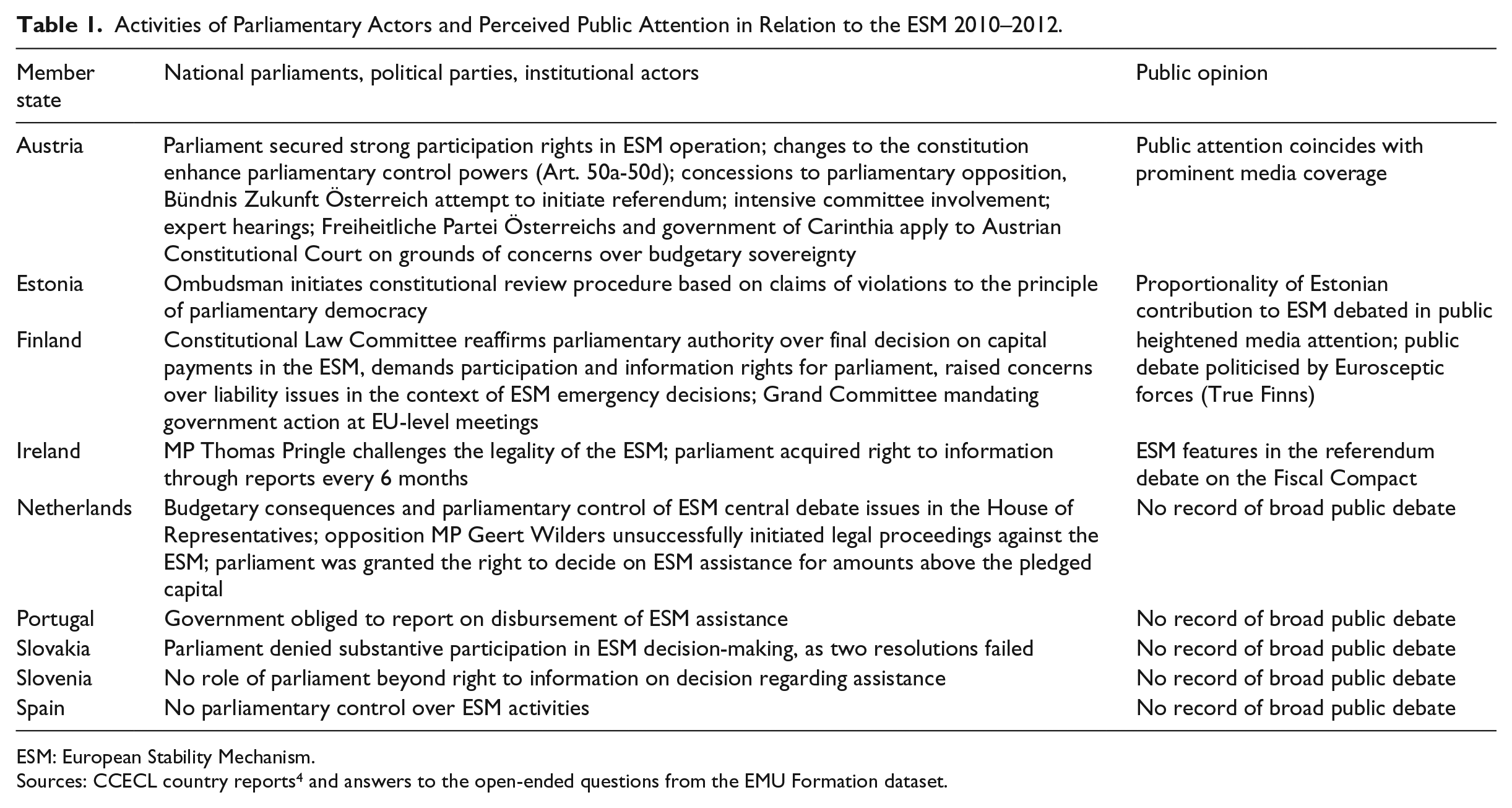
ESM: European Stability Mechanism.
Sources: CCECL country reports 4 and answers to the open-ended questions from the EMU Formation dataset.
In the context of more recent debates on reforming the ESM in 2017–2018, a prevalent impression among the interviewees is that political actors and the public alike have lost interest in the issue as the Eurocrisis has been waning (AT_GOV_01, EE_GOV_01, FI_GOV_01, NL_GOV_01, ES_GOV_01, SK_GOV_01, SI_GOV_01). Besides being overshadowed by other policy issues such as the migration crisis, the technical character of current discussions on ESM reform is considered not to be conducive to politicising the issue. Some government officials even consider the reform debate as simply being not controversial enough (AT_GOV_01, EE_GOV_01). As one official put it: My impression is that political parties in Austria have pretty much lost interest in the ESM. When we created this, they were very interested, and they wanted a lot of rights in connection with the ESM, but once we had the first meeting of the parliamentary ESM sub-committee, they realized that the matters discussed there are not really matters that they can use to either leak to domestic press or to pretend that there is a scandal somewhere where billions are lost (AT_GOV_01).
Yet, as one Estonian government official describes it, political and legal backlash following initial Eurocrisis decision-making on the ESM is on the mind of decision-makers now: ‘When we started out, in the very beginning, the government was quite naïve. In a sense, we were ready to do more than what we are ready to do at the moment’ (EE_GOV_01). A Dutch official describes a similar pattern: People in the Netherlands have become a little bit critical towards what happened during the crisis. From that perspective a lot of issues that happened back then still resonate nowadays in the discussions on the future of the ESM. It [public opinion] is still very important (NL_GOV_01).
However, it is also apparent that governments lack specific societal inputs into the ESM reform debate. For the current period, none of the interviewees could recall instances in which either interest groups or parliamentarians were involved in substantial discussions on ESM reform. This lack of concrete demands is also reflected in a joint statement from March 2018 by the finance ministers of eight smaller, fiscally conservative countries, which are dubbed the ‘new Hanseatic League’. 5 They suggest that in reforming EMU ‘we should focus on initiatives that have public support in Member States’ (Government Offices of Sweden, 2018). Rather than endorsing specific societal demands, governments seem to simply acknowledge that citizens currently express comparatively little or no appetite for more economic coordination within the Eurozone. While on average 67% of Eurozone citizens think that there should be more coordination, endorsement is much lower in Estonia (34%), Finland (35%), Ireland (42%) and the Netherlands (51%) (Eurobarometer, 2017).
Conclusion
This article offers important insights into governmental preference formation at the domestic level in relation to the creation of the ESM and more recent reform debates. The findings show how little direct influence non-executive actors could exercise and actually sought to have in relation to member state governments, as the latter embarked on a major reform of EMU’s institutional architecture. The empirical analysis confirms the first hypothesis that the role of non-executive actors in governmental preference formation in relation to the creation of the ESM was generally limited. While the vast majority of contributions to the Eurocrisis literature focus on decision-making among the EU’s top executives – albeit from different perspectives – most existing accounts do not verify this view in relation to other potentially important actors. This article does so in several ways. The influence scores from the EMU Formation dataset reveal how large the gap is between executive actors, on the one hand, and non-executive actors, on the other hand. The heads of state and government, finance ministries and the EU-level coordination forums, which comprise these actors as members, lead the process on ESM decision-making. The answers to open-ended questions and the in-depth research interviews with executive and non-executive actors in nine Eurozone countries confirm this pattern. Most importantly, even where non-executive actors feature more visibly their interventions are not seen by the interviewees as having revoked or diverted governmental preferences. The combination of EU-28 data and in-depth interviews from a sample of nine Eurozone countries adds strong plausibility to these findings. Although alternative country cases may reveal variations, this article provides important insights into processes of domestic preference formation in relation to the Eurocrisis. The empirical findings also confirm the second hypothesis. Organised business and labour receive the lowest influence ratings. Even banking sector organisations, which have been investigated as potentially important interest groups in the Eurocrisis literature (Rothacher, 2015; Schäfer, 2016), are considered to be marginal actors. The in-depth interviews reveal how little they did to proactively influence governmental preferences on ESM creation or more recent reform. Although the Commission still holds consultations with the EU-level umbrella organisations, there is no evidence of any meaningful tripartite interest mediation. However, there is only limited evidence that one can map interventions from organised business and labour as being linked to ESM conditionality. While in the Netherlands the social partners are indeed seen in opposition to each other, they are in alignment with each other and the governments in Austria and Spain. In Central and Eastern Europe, the ESM does not at all trigger interventions.
The third hypothesis was derived from a specialised literature on the role of national parliaments during the Eurocrisis. This literature either investigates the role of parliaments in ESM governance (Auel and Höing, 2014, 2015; Höing, 2015), or views national parliaments to follow consensus politics among EU executives (Puntscher Riekmann and Wydra, 2013). The findings in the previous section complement this literature in important ways. While governments depended on parliaments to ratify the ESM treaty, the latter were not considered to have been in a position to divert or revoke initial governmental preferences on the ESM’s institutional design. Finland is the only country for which noteworthy parliamentary interventions are detected during the initial phase when governments formed their preferences in conjunction with and in relation to their EU partners. Parliaments in countries with strong formal powers rather use these powers in relation to executive actors for securing procedural rights in future ESM-related decision-making. However, more recent debates on further ESM reform show that these powers are not necessarily being used.
The in-depth interviews also provide support for the fourth hypothesis. Policymakers have been worried about negative public opinion in relation to their preferences regarding the ESM, yet they do not suggest how this affects these preferences other than that policymakers are determined to carry on. The quoted statement from the Hanseatic League reflects this very well and so does the notion that negative public opinion increases the pressure to communicate (EE_GOV_01). In conclusion, governmental preference formation appears to be insulated from potentially important non-executive actors at the domestic level. This has two major implications for ongoing debates between different perspectives in the integration theory. For liberal intergovernmentalist explanations, it implies that the domestic element of the theory may be of limited use in relation to some key episodes of the Eurocrisis. Similarly, neofunctionalist explanations would concentrate on the moments when politicians came to understand functional interdependencies rather than on mobilisation by transnational interest groups. The claim by new intergovernmentalism that domestic preference formation is crucially driven by EU-level consensus-seeking among governing elites from the member states and the EU institutions is a plausible explanation for the strong influence scores of both domestic executive actors and the EU-level forums in which these actors meet. Postfunctionalism and new intergovernmentalism provide important arguments for understanding why policymakers express concern about negative public opinion towards Eurozone policies and EU integration. When rescuing the Euro by creating the ESM as a permanent stabilisation instrument, policymakers preferred prior agreement among themselves over listening to important societal interests. Their agreement enabled them to pursue further integration but left them in uncertainty regarding the domestic endorsement of their policy choices.
Supplemental Material
PSW868663_Supplemental_material – Supplemental material for The European Stability Mechanism and Domestic Preference Formation During the Eurocrisis: The Role of Non-Governmental Actors
Supplemental material, PSW868663_Supplemental_material for The European Stability Mechanism and Domestic Preference Formation During the Eurocrisis: The Role of Non-Governmental Actors by Jakov Bojovic, Mario Munta and Uwe Puetter in Political Studies Review
Footnotes
Funding
The author(s) disclosed receipt of the following financial support for the research, authorship and/or publication of this article: The research in connection with this article was carried out under the EMU Choices project (emuchoices.eu). This project received funding from the European Union’s Horizon 2020 research and innovation programme under grant agreement No. 649532.

Supplemental Material
Supplemental material for this article is available online.
Notes
Author Biographies
References
Supplementary Material
Please find the following supplemental material available below.
For Open Access articles published under a Creative Commons License, all supplemental material carries the same license as the article it is associated with.
For non-Open Access articles published, all supplemental material carries a non-exclusive license, and permission requests for re-use of supplemental material or any part of supplemental material shall be sent directly to the copyright owner as specified in the copyright notice associated with the article.
