




Abstract
The apparent ubiquity of protest in recent years and the rise of Occupy movements across the world have fuelled claims that a new style of mobilisation is emerging which is markedly different from previous social movements. Analysing a series of original survey data, this article engages with this debate by providing a panoramic account of how the anti-austerity movement evolved in Greece, comparing the drivers of protest in three distinct protest waves. Contrary to expectations, the rise of the Greek version of the Indignados during 2011 did not decisively transform the anti-austerity movement that emerged in 2010, which mainly displayed characteristics typically associated with ‘old’ social movements. However, elements of the ‘new social movements’ approach featured more prominently in the third wave of protest, beginning in mid-2012 and culminating in January 2015 with victory for SYRIZA, the party which channelled the anti-austerity movement into the political scene. The model developed to study protest in non-electoral arenas also performs well to explain the success of SYRIZA in the electoral arena, highlighting the reciprocal but understudied relationship between mobilisation and electoral politics.
Anti-austerity movements have emerged in many European countries since 2010, with major differences in the experience of individual countries in terms of their strength, their style and their impact on party politics and electoral outcomes (Pianta and Gerbaudo, 2015). The rise of opposition against austerity in Southern Europe coincided also with major protest in other parts of the world, including the ‘Arab Spring’ and the Occupy movement in the US. This apparent ubiquity of protest in the early 2010s has led some to conceive it as a new global movement phenomenon (Castells, 2012; Gerbaudo, 2012; Mason, 2013), classified as ‘occupy social movements’ (Tejerina et al., 2013) or ‘new new social movements’ (Langman, 2013). The question that arises is how different these types of recent movements really are from previous mobilisations.
A prototype example of such a movement emerged in Spain after mass demonstrations on 15 May 2011, stimulating also the rise of similar ones in Greece, Portugal and elsewhere. Inspired by Stéphane Hessel’s essay Indignez-vous! (Hessel, 2010) – published in English as Time for Outrage (Hessel, 2011) – the so-called 15M or Indignados movement in Spain attracted mainly young people not connected with any of the established political actors, such as parties of the left and trade unions, but mobilised instead through informal networks (Anduiza et al., 2014). The Spanish Indignados certainly seem to fit the idea of new movements as a form of ‘connective action’ (Bennett and Segerberg, 2013), mainly driven by young, politically alienated and unattached people, networking through social media (Castells, 2012).
However, alternative accounts of movement mobilisation elsewhere contradict or at least shed doubt on the empirical usefulness of this framework. Comparative studies of anti-austerity protest suggest that, in many cases, traditional left-wing political parties and trade unions are still prominently involved (Peterson et al., 2015). In Portugal, for instance, Accornero and Ramos Pinto (2015) found that labour unions were the most important factor in anti-austerity protest from 2010 to 2013. Similarly, anti-austerity mobilisation in Greece during 2010 did not fit this new model, mobilising instead a broad range of people with protest experience, not just the young or the politically detached (Rüdig and Karyotis, 2014).
Greece, a country severely hit by the economic crisis and experiencing mass protest against unpopular austerity measures, offers an ideal setting to explore how movements evolve and how people mobilise in light of the above debates and of empirical developments. Anti-austerity mobilisation can be found at various stages between 2010 and 2015. To analyse the development of protest movements over time, the concepts of ‘waves’ and ‘cycles’ are frequently used in the literature. However, the concept of a ‘cycle’ implies an element of a standard sequence of events which we think is not appropriate here (see Koopmans, 2004: 21; McAdam et al., 2001: 66–67). We therefore propose to distinguish between three distinct ‘waves’ of anti-austerity protest in Greece which involve different mobilisation patterns.
The first wave consists of the anti-austerity mass protest that emerged during 2010 and intensified after the bailout agreement in May (Rüdig and Karyotis, 2014). The second wave of protest occurred in 2011 and saw not only a further increase in participation (Diani and Kousis, 2014) but also an expansion of its activities, notably with the occupation of central squares by an Indignados-inspired new movement called the AγανακτισμένOι [Aganaktismeni] (Mavrommatis, 2015; Simiti, 2014; Sotirakopoulos and Sotiropoulos, 2013). A third wave of mobilisation, from mid-2012 onwards, coincided with a partial shift of focus from the streets to the electoral arena, with a previously marginal party, the Coalition of the Radical Left (SYRIZA), establishing itself as the main party of the movement (Aslanidis and Marantzidis, 2016).
This article seeks to analyse these developments in Greece, drawing on a series of original general public attitude telephone surveys conducted by Kapa Research between 2010 and 2015. 1 A first representative survey of the adult Greek population was conducted in December 2010. A stratified quota sample was used as the selection method, with one interview per household and quotas defined according to census data for gender, age and region. Telephone codes corresponding to each region in relation to its population size were selected, with the remaining dialling digits generated randomly with the aid of computer software and producing a dataset with 1014 valid responses. In December 2011, 511 of those respondents were re-interviewed. Despite the rather large degree of survey attrition, analyses of the background of respondents compared with non-respondents do not reveal any significant non-response bias. A new representative survey was carried out in February 2015, following the same process as the first one and resulting in 1019 valid responses.
The timing of these surveys and the consistent use of identical questions administered to both participants and non-participants in demonstrations provide a unique opportunity to study how the anti-austerity movement evolved over time. More specifically, the aims of this article are twofold: first, to explore the extent to which the emergence of the Greek Indignados and the rise of an anti-austerity party changed the nature of anti-austerity mobilisation in Greece compared to 2010; second, to investigate any links that might exist between a protest movement and electoral politics by analysing the extent to which participation in anti-austerity demonstrations was a factor in SYRIZA’s eventual victory in the January 2015 elections. Before discussing our empirical results and their broader theoretical and empirical implications, the article starts with a closer look at the specific context of the three waves of anti-austerity protest in Greece.
Anti-Austerity Mobilisation in Greece, 2010–2015
Social movements seek to shape their political and institutional context but they are also themselves a product of that same context. As Charles Tilly (1979: 131) noted, the array of collective actions, or ‘protest repertoires’, which are available to them are determined and limited by the particular time, place and population of a specific socio-political and historical context. The first wave of anti-austerity mobilisation in Greece was a direct response to the introduction of austerity measures in 2010 (Psimitis, 2011). New official police data, first presented here (see Figure 1), demonstrate the high frequency of protest events (7123) that accelerated after the first bailout agreement was signed in May 2010. Rather than representing a particular sector of society, protesters crossed through all ideological divides, professional backgrounds and age cohorts. Most crucially, in this first phase, factors such as the degree of relative deprivation were a significant predictor of opposition to austerity and potential protest but were not conducive to explaining who actually took to the streets. Instead, the most important factor was socialisation into protest through prior participation before the economic crisis (Rüdig and Karyotis, 2014).
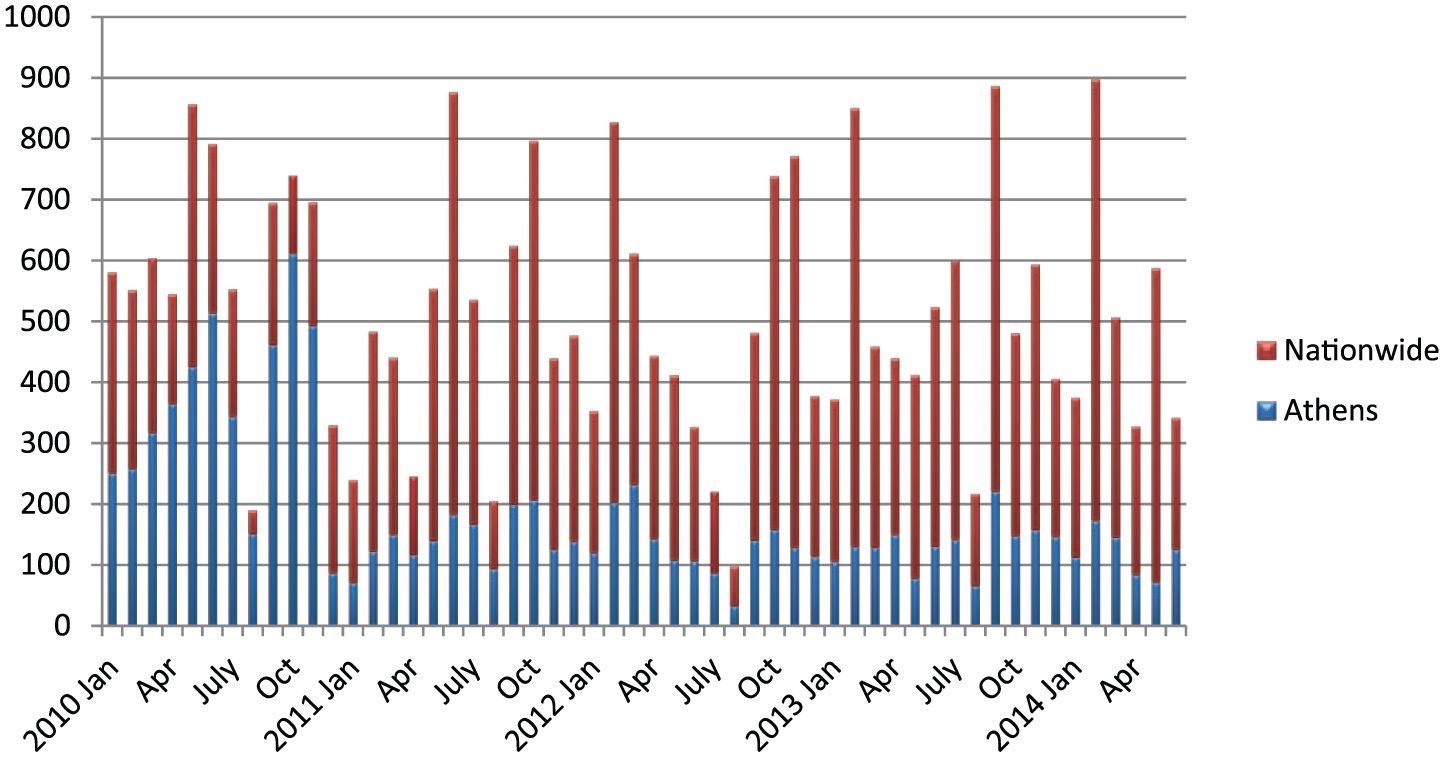
Monthly Number of Protest Events, January 2010 to June 2014.
The rise of anti-austerity protest in 2010 did thus mainly reflect Greece’s strong and idiosyncratic ‘protest culture’, a historically romanticised and glorified view of contentious politics, largely rooted in the successful struggle against the military junta in the 1970s (Andronikidou and Kovras, 2012). The comparatively frequent and intense protest actions in Greece is organisationally linked to a number of resilient extra-parliamentary leftist groups (Kassimeris, 2005), as well as trade unions and parliamentary parties of the left, giving it an ‘old politics’ flavour. On the whole, the high share of the population with experience of protest activity meant that a large reservoir of individuals existed who could re-mobilise in the anti-austerity movement of 2010 and subsequently. Indeed, according to our first survey fielded in December 2010, 23% of the adult population claimed to have participated in anti-austerity demonstrations earlier in the year.
Anti-austerity protest in Greece seemed to evolve further during 2011, bringing the percentage of people claiming to have taken part in a demonstration up to 36%, when our second survey was fielded in December 2011. A key feature of this second wave of mobilisation was the rise of the Aganaktismeni movement, inspired by the occupation of Tahrir Square in Cairo and the 15M movement in Spain. Also referred to as the ‘movement of squares’ (Diani and Kousis, 2014; Kaika and Karaliotas, 2014), this phenomenon added a new protest mode to strikes and demonstrations used in 2010, focusing on the occupation of public spaces, most visibly in Syntagma Square in front of the Greek Parliament, from 25 May until 7 August 2011, with further isolated events after the summer (Aslanidis and Marantzidis, 2016: 132). The protesters’ main call was for more accountable and direct models of democracy and for an end to austerity (Diani and Kousis, 2014; Sotirakopoulos and Sotiropoulos, 2013). Such grassroots, self-organised assemblies in central squares are defined by their inclusive and diverse nature, their fluid and leaderless structure and their use of and mobilisation via digital media (Castells, 2012).
Previous analyses have identified various new aspects of the Aganaktismeni movement, as compared with the first wave of protest in Greece: its extensive use of social media (Theocharis, 2016), its ‘apartisan and peaceful character’ (García-Albacete and Theocharis, 2014: 127), its ‘performative and theatrical aspects’ (Tsaliki, 2012: 6) and the diversity of views it represented, stretching across the political spectrum, including the far right (Kaika and Karaliotas, 2014; Simiti, 2014). Clearly, the dominant perception is that the Aganaktismeni added a new, unique dimension to Greek anti-austerity protest. In Spain, this form of protest attracted younger, more educated and less politically involved participants than other movements (Anduiza et al., 2014). Our data allow us to have a closer look at the socio-political profile of the ‘Greek indignados’ to assess the extent to which their emergence facilitated a substantial step-change in the nature of the anti-austerity movement in Greece.
A third wave of mobilisation began in the run-up to the May/June 2012 Parliamentary elections. Coordinated Large Protest Events (LPEs), with over 5000 participants and synchronised actions across the country, declined significantly after March 2012, following a peak in the previous period (Diani and Kousis, 2014; Kanellopoulos et al., 2016). However, the absolute number of marches and demonstrations recorded in the police data remained high, with 5654 protest events taking place in 2012, 6231 in 2013 and 3032 in the first 6 months of 2014. Admittedly, such protest event data are not issue-specific and lack details on their size, networks and claims, which a systematic study of LPEs can more reliably provide. It does, however, indicate continuing levels of decentralised yet widespread ‘everyday forms of resistance’ (Scott, 1985), which are typically not captured by mainstream newspaper reports (see Mueller, 1997). In the absence of any other major social movement organising protests at that time, it does not seem unreasonable to hypothesise that most of these protests targeted austerity. Such an interpretation would certainly be consistent with our survey findings. In our third survey fielded in February 2015, 28% of our respondents said they had participated in anti-austerity protests after June 2012. Thus, from our attitude data, a picture develops of protest emerging strongly in 2010 and rising further in 2011, before tailing off but maintaining a very high level between 2012 and 2015.
Beyond the question of how later protest participants compared with those involved at the high time of mobilisation in the previous two waves of protest, the 2012–2015 phase is of particular interest because of its relation to party politics. Crucially for this third wave, opponents to austerity found new opportunities to express their discontent in the electoral arena. The radical-left SYRIZA emerged as the main political force against austerity, increasing its share of the popular vote from 4.6% in October 2009 to 26.9% in June 2012, before eventually winning the elections of January 2015 with 36.3% of the vote. In the next section, we propose a model which we apply to analyse not just protest behaviour across the three waves but also the drivers of voting for SYRIZA in 2015.
Dissecting the Drivers of Protest
The above narrative reveals the complex, multi-dimensional and dynamic nature of the anti-austerity movement in Greece. To analyse the drivers of participating in demonstrations in each of the three waves identified, we propose two models. The first model offers a synthesis of variables from a range of protest theories and traditions. Membership in trade unions, left-wing ideology and male gender are typical characteristics of ‘old’ social movements (Walgrave and Van Aelst, 2001). A high level of formal education, strong political interest and post-materialism (Barnes et al., 1979) were seen as indicative of participation in ‘new social movements’ (NSM), along with ‘social capital’ explanations such as membership in voluntary organisations and a high level of interpersonal trust (Benson and Rochon, 2004; Kaase, 1999). Variables associated with ‘new new social movements’ and the notion of ‘connective action’ (Langman, 2013) complete the model, namely, engagement with social media and detachment from political parties, which featured in the Spanish indignados case (Anduiza et al., 2014).
Our second model considers issue and context-specific variables as additional controls, in line with Rüdig and Karyotis (2014). Controlling for opposition to austerity, support for the notion that people should protest against the measures and place of residence is designed to tease out which variables distinguish between potential and actual protesters. Prior socialisation into protest before 2010 will account for the contextual influence of the Greek ‘protest culture’. The results are presented in Table 1.
Three Protest Waves Compared (Binary Logit Regressions).
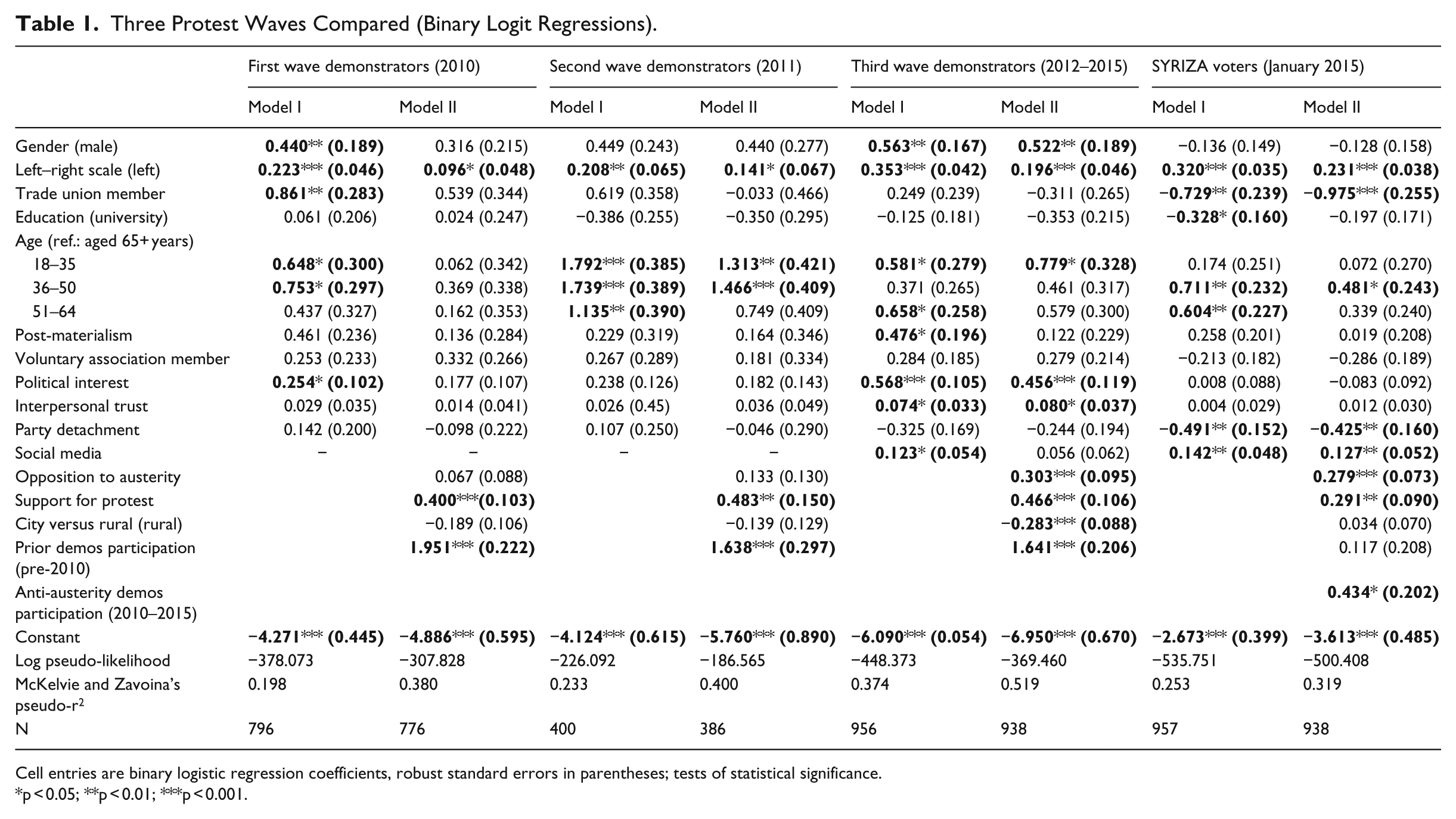
Cell entries are binary logistic regression coefficients, robust standard errors in parentheses; tests of statistical significance.
p < 0.05; **p < 0.01; ***p < 0.001.
Our analysis of the first wave of mobilisation during 2010 reveals, rather emphatically, that it fits more closely to the profile of ‘old’ social movements. Being male, left-wing and a member of a trade union all feature as significant predictors. Beyond these, people under 50 years who are interested in politics are more likely to take part in demonstrations, but other NSM variables do not make a difference. Once we apply the controls of our second model, only left-wing self-positioning remains a statistically significant predictor. This resonates with previous studies which found that in 2010, the anti-austerity movement in Greece was largely dominated by the ‘usual suspects’, who already had experience in taking part in demonstrations (Rüdig and Karyotis, 2013, 2014).
The second wave of protest during 2011 is marked by the emergence of the Aganaktismeni, which may have substantially altered the characteristics of the anti-austerity movement in Greece. Our first model suggests that the movement at that time mainly mobilised the under 65s on the left of the political spectrum, but none of the other variables associated with ‘old’ or ‘new’ social movements figure as statistically significant predictors. Once the controls are applied, the profile of 2011 demonstrators is rather similar to those from the earlier wave, with the exception of younger age groups coming in as significant predictors. Anti-austerity demonstrations in 2011 attracted a somewhat younger group of people but otherwise, against our expectations, the second protest phase did not lead to a greater importance of predictors associated with the NSM model. What appears to have happened is that as popular mobilisation increased to unprecedented levels, a more varied group of people was attracted to participate in protest activities, which did not fit the usual pattern. This does tally with the qualitative accounts of the Aganaktismeni, which emphasised the larger variety, both socially and politically, of those participating in protest events during 2011 (see, for example, Simiti, 2014).
Our data also allow us to have a closer look at the Aganaktismeni phenomenon. In our December 2011 survey, we asked about participation in demonstrations against austerity, but separately, respondents were also asked whether they had personally taken part in ‘the protest movement of “Aganaktismen” in the central squares of Greece’. 36% of our sample declared having taken part in anti-austerity demonstrations and 29% in the Aganaktismeni. 2 A total of 43% claimed to have participated in either demonstrations or Aganaktismeni, representing quite a remarkable mobilisation of the Greek population against austerity. However, perhaps surprisingly, the two groups only partially overlapped. More than 70% of protesters had engaged in both types of protest, but about a fifth had only taken part in demonstrations, and 1 in 10 had only participated in the Aganaktismeni but not in anti-austerity demonstrations.
A more detailed comparison of these three groups (results not shown) suggests that the Aganaktismeni participants who apparently did not perceive their actions as being part of an anti-austerity demonstration are markedly different from the other two groups and from 2011 demonstrators as a whole. They are older, less likely to be members of voluntary organisations and have a lower degree of interpersonal trust. This combination of predictors suggests that a theory of political alienation – which, so far, has not been used for the explanation of anti-austerity protest – might be relevant here: the Aganaktismeni touched, at least marginally, on a group of people who are not part of the usual Greek protest culture but clearly do not fit a ‘new social movement’ profile either.
A more drastic transformation of the anti-austerity movement in Greece manifests itself during the third wave of protest, after the June 2012 elections. Contrary to the earlier waves, there is a larger dominance of variables associated with the NSM approach during this period. Interpersonal trust, political interest and post-materialism are all significant predictors of taking part in demonstrations, in addition to left–right positioning. The result is even stronger in favour of the NSM framework, once we include the control variables: not only do interpersonal trust and political interest remain statistically significant, but also being under 35 years. Membership of trade unions is now negatively associated with taking part (but not statistically significant), indicating overall quite a shift from an ‘old’ to a ‘new’ social movement basis.
The 2015 survey also allows us to examine the effect of social media. At the bivariate level, we find that demonstrators follow politics via social media very frequently (40%), as opposed to 28% of non-demonstrators. Even once we control for age, gender, education and political interest, high use of social media, such as Twitter and Facebook, does come out as a statistically significant predictor of protest participation. However, once we include the austerity-related variables and prior demonstration experience as controls in our second model, the logit coefficient for social media remains positive but not statistically significant. This finding could be interpreted both in contextual and substantive terms. Social media was certainly frequently used by the organisers of Aganaktismeni events, but it may be doubtful whether it was an important mobilisation tool. According to Yannis Theocharis et al. (2015), Twitter was far less important for mobilisation purposes to the Aganaktismeni than to the Spanish Indignados or the Occupy movement in the US. More fundamentally, the idea that social media plays a key role for protest mobilisation in general has been disputed or qualified by various studies (e.g. Brym et al., 2014; Lee and Chan, 2016). Indeed, our data suggest that while social media may have played a role in protest organisation in Greece, and a vital one in the case of the Aganaktismeni according to journalistic accounts (Theocharis, 2016), virtual support for the anti-austerity movement does not necessarily translate into actual protest.
Mobilisation and Electoral Politics
The analysis has so far focused on demonstrators. In the third wave, however, protest is also partially displaced from the streets to the electoral arena, with SYRIZA emerging as the main political opponent to austerity through conventional channels. Strategically revamping its discourse ‘to align itself closely with the populist Zeitgeist of the indignados’, SYRIZA developed an ‘osmotic relationship’ with protesters and progressively attracted the support of many voters who rejected not only austerity but also the (perceived to be) corrupt old political establishment (Aslanidis and Marantzidis, 2016: 148–149; Stavrakakis and Katsambekis, 2014). After the June 2012 elections, in particular, SYRIZA ‘tried to bring together diverse groups by re-affirming the same antagonistic frontier established by the aganaktismenoi’ (Prentoulis and Thomassen, 2014: 228). These observations offer an opportunity to explore one aspect of the understudied association between social movements and elections (McAdam and Tarrow, 2013). Would our model drawn from protest theories also help explain SYRIZA’s victory in the January 2015 elections?
The results of our analyses, presented in the last two columns of Table 1, reveal not only significant similarities but also differences between the drivers of demonstrating and voting. With SYRIZA presenting itself as a party committed to rolling back austerity, it cannot be a surprise that its voters share with demonstrators opposition to austerity, support for protest and left-wing ideology. Crucially, including participation in any anti-austerity demonstrations in our full model, we find that it is positively associated with voting for SYRIZA. Over half (54%) of those who demonstrated against austerity between 2010 and 2015 voted for SYRIZA in the January 2015 elections. This underlines the intrinsic relationship between electoral and non-electoral arenas and the effects of protest on party politics, clearly an area that merits further investigation in comparative settings.
There are also some other noteworthy and counter-intuitive findings. Social media has a statistically significant and positive effect on voting for SYRIZA in 2015. This result tallies with analyses of SYRIZA’s election campaign, which was carefully crafted to counter its perceived exclusion from pro-establishment traditional media. This helped SYRIZA dislocate the dominant narrative that there was no alternative to austerity (Common Space, 2015; Tsakatika and Eleftheriou, 2013). The negative effect of union membership on the SYRIZA vote on the other hand indicates that it failed to strengthen its ties with trade unions, which have historically been dominated by the Socialist PASOK and the Communist Party of Greece (KKE), and where, pre-crisis, it had no real militant tradition or base (Tsakatika and Eleftheriou, 2013).
Beyond voting for SYRIZA, demonstrators have also developed a fairly high level of party identification with the party. 36% of demonstrators did not feel close to any party, but 39% felt ‘close’ to SYRIZA in 2015. This is quite a change from the beginning of the movement. Back in 2010, 60% of anti-austerity demonstrators did not feel close to any party. SYRIZA was a small left-wing party, with which only 3% of demonstrators identified. In our models of participation in demonstrations, the variable indicating a lack of party identification is negative (but not statistically significant) across all three waves. The implication is that protesters in Greece, unlike the Spanish indignados, are not radically detached from political parties, and in fact increasingly identified with SYRIZA over time, which contributed to its electoral success.
Conclusion
The results of our analysis of anti-austerity protest in Greece based on surveys covering a period of more than 5 years reveal many distinct elements of continuity and change. Contrary to expectations, the rise of the Greek version of the Indignados during 2011 did not decisively transform the anti-austerity movement in the way that ‘Occupy social movements’ did in other countries. Our data show that the social background of anti-austerity demonstrators in 2011 was very similar to 2010, although younger people, as well as some who showed signs of not just political but also social alienation, featured more prominently. There is, however, clearer evidence of the movement’s evolution during its third wave of mobilisation, after 2012, with elements of the ‘new’ social movement’ approach complementing its earlier ‘old social movement’ characteristics, such as left-wing ideology and prior socialisation into protest. Age, which is not a factor during the first wave, becomes statistically significant for those under 50 years in the second wave and is further narrowed down to the under 35s during the third wave. In this third wave, interpersonal trust and political interest are positively associated with protest, but education, post-materialism and membership of voluntary associations do not feature.
The pattern of mobilisation which we identify, thus, does not easily fit into an ‘old’ versus ‘new’/‘new new’ movement distinction. Further analysis may reveal several distinct paths towards protest participation. We also have to note that in concentrating on the social background of demonstrators, we had to ignore other variables which may play an important role in shaping the movement, for example, the degree of economic deprivation, blame attribution or ‘rational choice’ type considerations. One notable advantage of our approach is that we are able to compare protesters with non-protesters, while similar studies elsewhere rely on surveys of demonstrators alone (e.g. Anduiza et al., 2014; Grasso and Giugni, 2015; Peterson et al., 2015). For future work, exploring in greater depth the causes of the changes in the movement which we document should be of particular interest. Further analysis is needed on whether this is based on personal changes among demonstrators or reflects the pattern of mobilisation and demobilisation of veteran and new protest participants.
Finally, our article underlines the links between electoral and non-electoral arenas. A particularly interesting feature of the change over time is the emergence of SYRIZA as the party which a substantial share of demonstrators identify with. A relatively high level of party identification may normally be a promising basis for future electoral success. However, given that SYRIZA was unable to fulfil most of its election promises on the end of austerity in Greece and now faces the daunting task of implementing a new austerity programme it signed up to in July 2015, it will be interesting to see to what extent it can maintain its electoral support base or face a new wave of anti-austerity protest.
Footnotes
Acknowledgements
Previous versions of this article were presented at conferences in Glasgow and Prague. The authors are most grateful to conference and survey participants, as well as to Stratos Patrikios, Niccole Pamphillis, Susannah Verney, Robert Thomson, Sarah Birch, Rene Bailey and the journal’s editors and referees for their support and insightful comments.
Funding
The author(s) disclosed receipt of the following financial support for the research, authorship, and/or publication of this article: Data collection for the first wave was financially supported by the British Academy (SG 2009-10 Round 2/100212) under its small grants programme; Georgios Karyotis was the principal investigator. The University of Strathclyde (Research Development Fund) and the University of Glasgow (Research Incentivisation Fund) provided financial support for the data collection of waves 2 and 3. We are very grateful for their financial support.