




Abstract
New migrant movements increasingly rely on unconventional forms of protest, which they strategically frame in rational terms, rather than as ‘acts of desperation’ that dominate public representations. This article demonstrates this empirically through a prototypical case of new migrant activism, employing discourse analysis to explore the collective framing of a hunger strike involving irregular migrants in Greece, which was, however, contested by other protest users. Drawing on rare and pertinent data collected through face-to-face interviews with hunger strikers, we find that the strategic or rationalist framing of the hunger strike, promoted by its leaders, was largely shared with individual protesters at the basis of the mobilisation, contrary to the publicly proliferated affective frames. Using quantitative methods, we show, for the first time, that the degree of frame alignment is not only important for the legitimacy of a movement but is also a significant predictor of future remobilisation in radical types of protest activity.
Introduction
Participation in protest by undocumented migrants is considered improbable. This is not only because of their limited resources and networks, but also because of their perceived inability to constitute a ‘community’ and construct a positive identity that could form the basis for the emergence of a protest movement (Siméant, 1994). When irregular migrants do mobilise, political and media discourses tend to depict such actions as acts of desperation. In this reading, destitute and powerless individuals resort to protest, overrun by their negative emotions about their predicament. This is especially applicable to non-Western migrants and to more radical forms of protest. Headlines like The Mirror’s (2016) ‘Desperate migrants sew their mouths together in protest at Calais Jungle’ serve as a frequent reminder of the perceived affective and spontaneous reaction of migrants to their harsh living conditions and destitution. This arbitrary interpretation adopts a particular ‘Orientalist’ frame (Said, 1978), which seems to have captured the imagination of Western societies that host such migrants.
The characteristics, frequency and salience of political mobilisations over the last decade by refugees and irregular migrants in Europe and beyond question the validity of this narrative (Ataç et al., 2016), leading some to describe this as a ‘new era’ of migrant or refugee protest (Ataç et al., 2015: 5). Migrant activists increasingly react against detention, deportation and dispersal policies, and mobilise in favour of human rights, freedom of movement, as well as access to asylum procedures and labour markets (Oliveri, 2016). In July 2019, around 700 undocumented African migrants – self-labelled as the ‘Black Vests’ movement in reference to the recent ‘Yellow Vests’ anti-government protests – stormed the Pantheon Mausoleum in Paris calling for the right to stay in France. Other prominent recent examples include the 2010 riots in Rosarno, Southern Italy, the 2012 occupation of Oranienplatz square in Berlin, Germany, the march of hundreds of Syrian refugees towards Turkey’s land border with Greece in 2015, and several hunger strikes across Europe. These ‘new migrant movements’ appear to be strategic in how they project their voices, whom they connect with and what repertoires of action they employ (Oliveri, 2016). Specifically, they challenge depictions of irregular migrants and refugees as either criminals or victims that lack political agency and are driven to protest by their emotions alone. Instead, their ‘strategic framing’ (Schön and Rein, 1994) draws attention to an alternative consideration: a common ground that migrants/refugees share with citizens in terms of core moral values, experiences of injustice and calls for structural changes that would be mutually beneficial (Oliveri, 2016).
Nevertheless, the more interweaved structures and communicative frames characterising new migrant movements leave them exposed to attacks about their integrity and representativeness. For one, due to the unequal distribution of scarce and valuable mobilisation resources among the multiple actors that comprise them, quite often natives tend to assume dominant positions in managing how the legal and cultural claims of immigrants are framed in the public sphere (Della Porta, 2018: 14). For another, the frames promoted by protest organisers and leaders may not be representative of the views among movement participants. Prior studies have found that the claims put forward by movement grassroots, as opposed to movement leaders, tend to be more ‘existential’ – promoting individual gains – rather than political – promoting systemic change (Chimienti and Solomos, 2011). These provide fertile ground for opponents to question the independent organisation of new migrant movements and adopt affective and restrictionist frames, which aim to nullify the protesting ‘Other’ and contest the legitimacy of the movement’s motives and claims (Rosenberger, 2018: 10). The extent to which there is ‘frame alignment’ between protest organisers and individual participants in a movement has been shown to have significant implications for both its internal cohesion and external standing, yet it has rarely been studied empirically and never in relation to new migrant movements (Ketelaars et al., 2014: 3–4; Opp, 2009).
This article seeks to address this gap through an empirical assessment of an early instance of ‘new’ migrant activism in Greece, which represents a ‘prototypical’ case (Rose and Mackenzie, 1991). In January 2011, about 300 irregular migrants originating from the Maghreb countries and residing illegally in Crete travelled to the two major Greek cities, Athens and Thessaloniki, and commenced a hunger strike that lasted for 44 days. Protesters sought to bring attention to their living conditions, exacerbated by the country’s economic crisis and restrictive immigration policies (Karyotis, 2012; Triandafyllidou, 2009), achieving some limited concessions from the state. The whole episode, although highly politicised and even exploited by political parties, was depicted uniformly in public debates as an ‘act of desperation’. How did the protesters themselves, in their own voice, collectively project their hunger strike? To what extent did individual protesters’ rationales converge with this collective image? How did this affect their overall commitment to the broader movement and predisposition for future activism? The article utilises mixed methods to engage with these questions, and, in doing so, contributes to our understanding of new migrant movements and protest behaviour more broadly.
First, we employ discourse analysis of all public statements issued by the hunger strikers through their collective body, and contrast this with frames promoted by other stakeholders, opposing or supporting the action. This demonstrates that the official discourse of the ‘300’ rejected the notion that their struggle was primarily motivated by desperation and, instead, defended its independence and rationality. Second, drawing on set of rare and pertinent data collected through face-to-face interviews with 52 of the hunger strikers, we empirically test the degree to which individual protesters were aligned with this official, but publicly contested frame. Results show that protesters were indeed highly aligned with the official rationalist or strategic frame promoted by their collective body. In the final part of our study, we explore quantitatively whether congruence with organisational frames has implications for the future remobilisation of participants, a question that, to our knowledge, has not been studied previously. This may be important to explore in this context, not only because socialisation into a protest activity significantly reduces the barriers for participants to take part in future protest as well (Rüdig and Karyotis, 2014), but also because protesters’ ability to make sense of their previous experience, particularly in situations of backlash, is crucial for long-term activism and remobilisation (Bunnage, 2014). Opportunities to refuel mobilisations of movements by minority or disenfranchised groups that rely on protest to gain public support are likely to increase once social distancing rules ease, following the unprecedented decline in all protest activities across the world during the COVID-19 pandemic (Metternich, 2020).
The article proceeds as follows. The first section explores the protest repertoires, communicative frames and organisational traits of new migrant movements. The Greek case-study is introduced next, along with data collection details. The third section explores how migrant protesters projected themselves strategically as self-efficacious political agents and engaged in framing contests with other stakeholders. The final section analyses primary data from our structured interviews with hunger strikers. We find that the congruence of the hunger strikers with the strategic or rationalist frame influences their willingness for future participation in radical protest. By contrast, affective factors, such as the degree of desperation, anger or (un)happiness of migrants, which received much public attention and were core elements of the externally promoted frames (by opponents and supporters alike), do not impact on remobilisation. Taken together, our findings question the legitimacy of the dominant public discourse on migrant protest, which draws disproportionally and without reference to robust empirical evidence, on affective explanations of protest psychology.
Understanding ‘new’ migrant movements
The array of collective actions, or ‘protest repertoires’, in each mobilisation instance depends largely on and is limited by the particular time, place and population of a specific socio-political and historical context (Tilly, 1979: 131). Early migrant activism in the 1960s and 1970s, typically in the form of demonstrations and strikes (Castells, 1975), concerned industrial and agricultural production claims. It became more common with the gradual tightening of migration and asylum policies across the West (McLaren, 2015). From the 1980s onwards, church asylum, airport blockades, No Border camps, mega marches, anti-deportation and anti-detention campaigns and hunger strikes made their appearance across Europe and North America (Ataç et al., 2015: 6). Despite this, most studies ‘largely disregarded the political activity of migrants’ until recently, as the latter were seen to be lacking the required organisational and communication structures, as well as any interest ‘in altering political conditions in the country in which they worked’ (Goeke, 2014: 163).
Over the last decade, the frequency, nature and salience of migrant protest in Europe and beyond have marked a ‘new era of protest’ (Ataç et al., 2015: 5). This has revitalised academic interest, by enriching our understanding of the characteristics and drivers of migrant protest (e.g. Chimienti, 2011; Chimienti and Solomos, 2011; Ellermann, 2010). It has also attracted significant media and public attention. To a degree, the success of these new mobilisations in attracting interest reflects their chosen protest repertoires. These include increasingly radical forms of collective action that put migrant and refugee bodies and lives on the line. In a notable case in Vienna, Austria, what started as a 10-hour march of refugees and supporters in November 2012, turned into a public occupation and erection of a Refugee Protest Camp in Sigmund Freud Park, before escalating into a hunger strike. Since 2012, such hunger strikes have become a regular feature in refugee protests, including in Denmark, Bulgaria, France, Austria, the Netherlands, but also beyond Europe, such as in California and in Australia’s offshore detention facility on Manus Island (Gržinić and Tatlić, 2014: 104).
A first distinctive characteristic of new migrant movements, therefore, concerns the increased frequency of more radical forms of protest – the most socially disruptive and uncommon actions – compared to conventional collective actions of the past, which conformed to the norms of the existing social system (see Martin, 1986). Hunger strikes, unlike demonstrations or marches, are a radical form of collective action. They hold an invaluable symbolic meaning, as they exemplify martyrdom and self-sacrifice (Tarrow, 1998). No other radical form of collective action involves the potential self-destruction of the body. In this regard, hunger strikes may constitute a means of last resort that manifests the gravity of protesters’ aims, as well as the perceived ineffectiveness of other means of protest (Scanlan et al., 2008: 277).
The second key characteristic of new migrant movements has to do with how they are framed by the protesters themselves. Framing refers to the process of ‘selecting and highlighting some aspects of a perceived reality, and enhancing the salience of an interpretation and evaluation of that reality’ (Entman, 2004: 26). Framing effects are demonstrated in issue frames, where ‘by emphasizing a subset of potentially relevant considerations, a speaker leads individuals to focus on these considerations when constructing their opinions’ (Druckman, 2004: 672). Developing a narrative for the issues at stake is a key challenge for any social movement. Particularly for migrants and refugees, the need to reverse a negative into a positive collective identity, as well as to politicise the issues at stake (e.g. social, political and economic inclusion) is an essential precondition for mobilisation (Della Porta, 2018: 5). Frames – diagnostic, prognostic and a ‘call to arms’ – have to be convincing for a number of different stakeholders, including potential participants, friends and enemies of the mobilisation (Snow and Benford, 1988). This is a process in which both rational and emotional mechanisms are connected to frame the movement (Della Porta, 2018: 5).
New migrant movements attempt to construct a collective identity, either by challenging mainstream definitions of migrants/refugees as victims or criminals, or by demonstrating identification with the core normative and moral values of the host nation. Irregular migrants, as the most stigmatised group, tend to resort to radical framing, which embraces discourses of inherent inequalities in the economic order and universalist claims for the rights for all people, irrespective of their cultural attributes and national backgrounds (Della Porta, 2018: 22). Their message emphatically rejects the exclusive categorisation of their movement based on traditional binaries (e.g. citizen/non-citizen, voter/non-voter, employed/unemployed, migrant/refugee, legal/illegal migrant). On the contrary, their discourse merges diverse struggles; for instance, those over labour, gentrification and the right to the city, with those of irregular migrants’ and refugees’ right to remain, freedom of movement, and social and political participation (Ataç et al., 2015: 8). Overall, new migrant movements do not only ‘define their situation as unjust and subject to change through group action’ (McAdam, 1982: 51). They also designate enemies and friends and often seek to provoke hope and enthusiasm for an alternative social order (Benford and Snow, 2000).
A third distinctive feature of recent migrant mobilisations concerns their organisational traits and networks (Ataç et al., 2015). Despite their limited formal organisation, new migrant movements invest in building alliances, domestic and transnational, much more than early migrant activism (Gržinić and Tatlić, 2014). Their precarious lack of material and symbolic resources renders the support of broad networks of actors essential (Della Porta, 2018: 11). Migrant/refugee protesters need allies that will help them maximise support from migrants with varying legal statuses and opportunities, as well as ‘generate the levels of cultural and symbolic capital needed to cleanse stigma attached to foreigners and transform them into sympathetic and rights-deserving beings’ (Nicholls, 2013: 92). Thus, they rely heavily on vertical solidarity networks (Della Porta and Diani, 2006: 15) which consist of both citizens and non-citizens who organise collective activities and push the state to change migration policies and/or their implementation (Rosenberger, 2018: 10). The ‘plurality of subjectivities’ in new migrant/refugee movements include workers, the unemployed, different migrant categories, trade unions, non-governmental organisations (NGOs), and social movement organisations and political parties of the left-libertarian family, to name a few (Ataç et al., 2015: 8; Della Porta, 2018: 12).
While these more complex organisational structures and communicative frames have enabled new migrant movements to attract more support and attention to their grievances, they have also provoked criticisms about their authenticity and integrity. We seek to contribute to these debates by empirically studying the extent to which individual protesters’ rationales (‘the micro level of protest participation’) converge with the movement’s collective framing (‘the meso level of protest organisation’), and the implications of this. In doing so, our article challenges the ‘tendency to focus on the framings of movement elites to the neglect of rank-and-file participants, potential recruits, bystanders, and others’ (Benford, 1997: 421). Instead, we follow the pioneering work of Ketelaars et al. (2014) and simultaneously investigate frames at both micro and meso levels of a movement, as well as the frames by other ‘users of protest’, who are also active participants in the framing contests. Frame alignment affects not only the internal cohesion and (contested) legitimacy of the movement but also the impact of the protest itself (Snow et al., 1986). While we know, for instance, that framing matters for recruiting new members (Mika, 2006), we do not know the extent to which alignment with the movement’s official discourse affects the future political behaviour of veteran protest participants. This is a highly pertinent issue in our case, as the hunger strike of the ‘300’ was the second instance of the same type of protest, organised in the same city and by the same actors in a period of less than three years. 1 Due to the repeated opportunities for migrant protest that have increasingly emerged over the last decade, it is important to understand whether the alignment of individual protesters with either the movement’s own frame or the frames of other ‘users of protest’ increases their propensity to participate in future movement activities, and particularly in radical protest, which has become more common in new migrant movements.
Background and data collection
The Greek case represents one of the prototypical examples of ‘new’ migrant protests. We study the case in the surrounding context of mass mobilisations that marked the year 2010 in Greece, where nearly one-third of the Greek population participated in anti-austerity protests (Rüdig and Karyotis, 2014), and in the ‘Arab Spring’ wave in North Africa and the Middle East. The hunger strike that is the focus of our analysis represents a revival of an old repertoire of action that had been used extensively by undocumented migrants in France from the 1970s to the 1990s (Siméant, 1998), but which has re-emerged as a feature of new migrant protests across Europe. 2
Contrary to popular and media accounts, the hunger strike of the ‘300’ was not a spontaneous act but a carefully planned one. 3 A total of 287 people took part, with 237 of them protesting in an occupied building of the Athens Law School and a further 50 in the Labour Centre in Thessaloniki. Support came from migrant groups and networks, NGOs, antiracist and university student bodies, labour associations, neighbourhood initiatives, anarchist collectives, and political parties, particularly those to the left of the ideological spectrum. Some of these joined forces to create the ‘Initiative for Solidarity’ (IfS), which, among others, organised demonstrations in support of the hunger strikers. The migrant protesters themselves formed their own collective body, the ‘Assembly of Migrant Hunger Strikers’ (AMHS). These bodies each held daily meetings, separately, but also communicated with each other and across the two cities through webcams. Like other ‘new’ migrant/refugee movements, participants independently projected their grievances, promoting diagnostic and prognostic frames on their predicament through press conferences and collective statements issued through their Assembly.
State representatives refused to meet with the protesters’ representatives until the later stages of the hunger strike. Eventually, on 9 March 2011, a deal was brokered to end the protest in return for some changes to the participants’ legal status. The Greek state rejected the strikers’ demand for full regularisation. Instead, the strikers received a biannually renewable status of ‘indefinite tolerance’, permission to visit their home countries and a promise to receive work permits. In a symbolic move, the government also agreed to regularise all migrants who could prove their continuous residence in Greece for at least 10 years. We note here that irregular migrants would be unlikely to be able to provide the required supporting documentation (Fakiolas, 2003).
To analyse this case, we rely on mixed-methods. We employ discourse analysis to study the framing of the action by protest organisers, as well as by external supporters and opponents. In total, the AMHS issued 15 public statements during the hunger strike. This represents the best and most direct source of information of the collective frames promoted by the protesters themselves. We connect these frames with individual-level data, collected through face-to-face interviews with hunger strikers in July 2012, which allow a closer look at the composition and motivations of the hunger strikers. Of the 287 participants, 100–120 had permanently left Greece and a further 40–50 were temporarily abroad at the time the interviews were held. About 20 individuals refused the invitation to participate. In total, 52 interviews with protesters that participated in the hunger strike were conducted, each lasting approximately 30 minutes.
All respondents were Maghreb country nationals: forty-eight Moroccans, two Algerians and two Tunisians. Almost all of them belonged to the grassroots of the movement, except two, who acted as spokespersons at different stages of the hunger strike. Nine out of ten were in their mid-to-late twenties and never married. Seven out of ten respondents stated that they had been residing in Greece for more than five years. Only two had used a legal channel (a student or tourist visa) to first enter Greece. The rest disclosed that they had arrived irregularly through either the sea (70%) or land border with Turkey (21%). Using the country as a transit to another the European Union (EU) member-state (69%), pursuing better living conditions (64%) and finding employment (62%) were listed as the top three factors that influenced their decision to migrate to Greece.
At the time of the survey, 77% were in some form of employment, either full-time (40%) or part-time (37%), while about one out of five were unemployed. The majority of those in employment reported a job in the construction sector, followed by the tourist industry and agriculture. Almost all respondents identified scarcity of jobs as their main problem, followed by rising racism and anti-immigration discourses in the public sphere. About one in two (46%) reported a first-person verbal and/or physical abuse experience in Greece. Overall, the limited concessions offered by the state and its unmet promises for further liberalisation of immigration policy were highlighted by the migrant protesters. On a 0–10 scale, where 0 meant that the goals of the hunger strike were ‘not at all’ met and 10 meant that the goals were ‘absolutely’ met, the mean response was just 3.1, a testament to their disappointment about its outcomes. Nearly all participants (90%) remained dissatisfied with the Greek state’s immigration policy (81% very dissatisfied) and with their access to the labour market (89%, with 77% very dissatisfied). In the end, the protest did not provoke any significant structural changes in Greece’s immigration policy in the short term, as is commonly the fate of protests by irregular migrants (e.g. Chimienti and Solomos, 2011).
Strategic framing of the hunger strike
In their first public statement on 23 January 2011, the protesters introduced themselves to the public as ‘migrant men and women, refugees from all over Greece [. . .] [who] came here to escape poverty, unemployment, wars and dictatorships’ (AMHS, 2011e). As our survey evidence demonstrates, the hunger strikers were in fact only male migrants residing in Crete, not women, or recognised refugees. Indeed, only 8% of our respondents listed fear of prosecution in their home country as a factor that influenced their decision to come to Greece. As noted, participants were exclusively from Maghreb countries and predominantly from Morocco. They already had an established identity, as an ethnic group with strong social ties after many years of residing and working in Crete. This, however, had to be re-imagined and reconstructed for the migrant protest movement to increase its appeal (Brubaker and Cooper, 2000). The purpose of their opening statement was, thus, for the migrant movement to adopt an all-encompassing identity that would be appealing to the more than a million migrants and refugees across Greece.
The protesters claimed that they were not driven by individualistic motives but acted on behalf and in the interest of all migrant groups in the country. This contrasts, at least at the discursive level, common representations of hunger strikes as associated with demands that relate to self, or an indication of underlying psychological conditions (Fazel and Silove, 2006; McGregor, 2011; Silove et al., 2000; Siméant, 1998). The main aim of the hunger strike as collectively framed by the movement was the regularisation of all undocumented migrants in Greece (AMHS, 2011e). However, only eight out of our 52 interviewees mentioned this, raising doubts as to whether the collective frame represented individual motivations, in line with previous studies (Chimienti and Solomos, 2011). Furthermore, the protesters claimed that their participation in the strike was a conscious decision: ‘[W]e are not mentally disordered. We started a fight through our own conscious processes. Our morale is very high and we don’t need any kind of psychological support’ (AMHS, 2011c).
The protesters were apparently fully aware of the risks they were taking. They repeatedly stated that ‘[w]e risk our lives because, either way, there is no dignity in our living conditions’ and ‘[w]e would rather die here than allow our children to suffer what we have been through’ (AMHS, 2011e). Conviction that their struggle is a just one is omnipresent in their discourse and a potential source of commitment, self-legitimacy and even pride. They presented the hunger strike as their last resort in the pursuit of justice and a better life: ‘[w]e do not have any other way to make our voices heard, to raise awareness of our rights’ (AMHS, 2011e). In deliberately emotive tones, the hunger strikers expressed their determination to ‘exit this building either as winners or dead’, a signal of the intensity of their commitment and sense of moral righteousness that aimed to raise emotional awareness and empathy, and, by extension, support for their cause. Indeed, passion and emotion are distinctive characteristics of hunger strikes, which aim to strengthen the emotional ties of community (Dingley and Mollica, 2007: 466).
The emphasis in framing a collective identity primarily as workers, irrespective of ethnicity or legal status, is also strategic and typical of new migrant movements. The participants underlined that their struggle sought to ‘send a message to every Greek and foreign worker to rise up [. . .] This strike belongs to all of us’ (AMHS, 2011a). Their illegal status, which was a central aspect of their opponents’ framing, was not hidden, although attention was shifted away from it. The strikers noted that ‘[w]hether by regular or irregular entry, we came to Greece and are working to support ourselves and our families. We live without dignity, in the dark shadow of illegality’ (AMHS, 2011e). Projecting an image of themselves as suffering workers, who do their best to provide for their families, could also be an attempt to humanise their struggle and generate sympathy among Greek citizens, who were themselves experiencing relatable economic hardship (Rüdig and Karyotis, 2014).
The framing of the hunger strike as a labour movement was designed to appeal to left-wing audiences in particular. The protesters accused ‘the West’, and ‘multinational companies and their political servants’ as being responsible for the economic crisis, echoing in this manner the discourse of left-wing parties (AMHS, 2011e). They rejected the scapegoating of migrants for domestic economic problems and criticised restrictive migration policies. The strikers claimed that their vulnerable position as undocumented migrants enabled employers and state agencies to benefit from the ‘harsh exploitation’ of their labour. Yet, they argued, this applied to migrants and citizens alike and thus made a plea to ‘our Greek fellow workers, everyone suffering exploitation, to stand with us’ (AMHS, 2011e).
Hunger strikers also eagerly defended the independence and rationality of their actions against criticism that it was a by-product of political manipulation, or, by extension, of their victimhood. They underlined that they were not victims and should not be portrayed as such: ‘[w]e are not those piteous, destitute migrants, deprived of housing, work and clothes that the media are describing’. Instead, they portrayed themselves as active political agents who ‘came to fight, for as long as our bodies will allow us, for our rights and for a life with dignity’ (AMHS, 2011d). They noted that ‘[w]e take our decisions by ourselves during the assemblies we hold, and we do not get influenced by external factors’ (AMHS, 2011d), reiterating in their follow-up statement that they themselves ‘took the initiative for that kind of struggle, without the intervention of political parties, organizations and individuals’ (AMHS, 2011b). Indeed, as mentioned earlier, they held their meetings separately from those of the IfS to signal their independent decision-making. Nevertheless, participants informally acknowledged the involvement of certain political parties, groups and individuals particularly in the planning stages of the strike, as well as in the later stage of negotiations with the government.
The discourse of the supporters of the hunger strikers was generally, but not completely, in alignment with that of the protesters, and particularly with the framing of the movement as a labour one. The IfS referred to the strike as ‘a struggle in the name of all workers’, noting that it was ‘in everyone’s common interest (natives’ and migrants’) to get out of the grey zone. It’s the only way to fight against undeclared employment, exclusion and every form of exploitation’ (IfS, 2011a). Similarly, the Union of Salaried Technicians (2011) argued that ‘the migrants’ struggle is interrelated with our own struggle for the cancellation of the policy that takes away workers’ rights and grants profits to Capital. It is a struggle against exploitation and oppression’. The perceived exploitation of the working class was a device used to unite citizens and migrants to a common cause. Supporters, thus, used the same frame as the migrants against binary dichotomies of ‘us’ versus ‘them’, arguing that ‘[t]he destitution of one segment of society signals the upcoming destitution of the rest’ (IfS, 2011a).
The humanitarian element, a key aspect of the liberal framing of migration (Ellermann, 2010), was quite prevalent in the discourse of supporters. Many (e.g. the Green Ecologists political party) discussed the conditions of social exclusion, prosecution and rising racism faced by migrants in Greece. To generate mass empathy and relate to the socio-historical context, the ‘Migratory Alliance’ (2011) also stressed the similarities between the migrants’ circumstances and the suffering experienced by Greeks ‘in the not so distant past’, when the latter were forced to emigrate ‘in search for a better future, leaving behind their loved ones’. Synaspismos (2011), the main component of the SYRIZA partisan coalition, concluded that the hunger strike was a ‘cry of desperation’, while the IfS (2011b) saw in it ‘a cry for dignity and humanity’. This humanitarian and affective frame, a common and useful dramatic device in left-wing partisan rhetoric, was remarkably understated in the protesters’ own rhetoric.
Many were very critical of the strike. Their discourse emphasised a different set of considerations, informed by the realist, restrictive frame on migration (see Karyotis, 2012). A key focus was on the migrants’ irregular status, as well as the illegality of their occupations, described by a member of the parliament (MP) for the centre-right New Democracy party as an ‘invasion’ and by the Socialist Minister of Health as a ‘real bomb of infections’ (Vima, 2011). Taking it a step further, the neo-Nazi Golden Dawn claimed that the occupied buildings had become ‘a hotel for illegal migrants’, and that if ‘the “antiracists” really believe in what they preach, they should host the foreigners in their own homes’ (Golden Dawn, 2011).
Another central theme in the adversaries’ discourse was the representation of the hunger strikers as powerless victims incapable of political agency and exploited by some of their supporters to serve ulterior political interests. Indicatively, the Minister of Education argued that these ‘unfortunate people that are in the Law School [building], did not find themselves there by chance. They were led and guided there’. She continued that the fact ‘that political forces provocatively exploit human agony, in order to serve party interests . . . is frustrating’ (Ministry of Education, 2011). Such frames from opponents served two main purposes: first, they undermined the legitimacy of the movement by questioning the self-efficacy of protesters and second, they drew attention to affective considerations, not to sensitise public opinion as the supporters did, but to pre-emptively diffuse blame in the event of the death of a hunger striker.
Our analysis so far illustrates the importance of framing battles that typically surround a (migrant) protest action. For the protesters, the challenge was to project a collective identity with the greatest possible appeal, re-interpreting their existing identity as a predominantly ethnic community residing in Crete. Their decision to underplay humanitarian considerations and affective depictions of their action as desperate and, instead, to present themselves as independent political agents that are part of a broader labour movement, was designed to attract support and sympathy from other sections of society, particularly those in the left. 4 A by-product of this framing, however, was that the migrant protesters exposed themselves to criticisms about the legitimacy and autonomy of their action. Frame alignment theory enables us to explore, in what follows, the extent to which individual participants in the hunger strike aligned with the primarily strategic collective framing of the ‘300’, which is characteristic of new migrant movements.
Frame alignment and future remobilisation
The involvement of several local actors in supporting the action renders the study of public statements attributed to the protesters themselves problematic. In terms of measurement validity, the statements are likely to reflect the considerations and purposes of these other actors, including NGOs and parties that were centrally involved in the organisation of the hunger strike. Alternatively, the statements may reflect the intentions of only a smaller group of protesters, who were not necessarily representative of the ‘300’, but who might had emerged as leaders of the action, raising questions about the degree of frame alignment and congruence between participants and organisers.
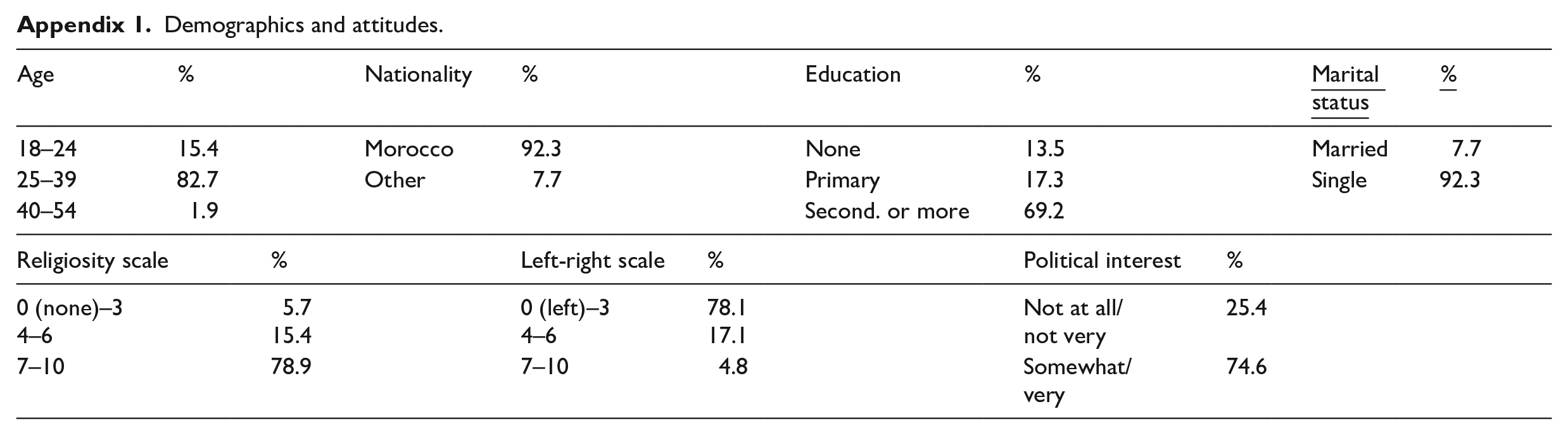
To overcome these doubts, we conducted face-to-face interviews with hunger strikers. Appendix 1 gives details of the demographic and value profile of our small (N = 52), male sample, which is a relatively homogeneous one. As discussed, the ‘300’ collectively privileged strategic arguments, which stressed the rationality of activism, whereby self-interested actors calculate the costs and benefits of participation and, accordingly, become mobilised based on incentives, not anger, pride, fear, righteous indignation or desperation (Benski and Langman, 2013). People are generally more likely to get involved in social movements when they believe this will help to put their grievances right at affordable costs (Klandermans, 1997), a process that describes an instrumental pathway to movement participation (Simon et al., 1998). The main element for this process is efficacy, that is ‘an individual’s expectation that collective action participation can make a difference and bring about the desired change; [. . .] the more effective an individual believes collective action participation to be, the more likely the person is to participate’ (Klandermans et al., 2008: 994). Do hunger-strikers themselves align with the movement’s predominantly rationalist frame?
Individual protesters in our survey tend to share the key elements of the movement’s official frame (see Figure 1). About nine out of ten participants recognise the costs of participating in radical action, agreeing with the statement that taking part in a hunger strike could put their life at risk. An overwhelming majority also exhibits high levels of political efficacy, with approximately seven out of ten participants agreeing that their involvement in politics can have a real influence, and that being active in politics could result in personal benefits.
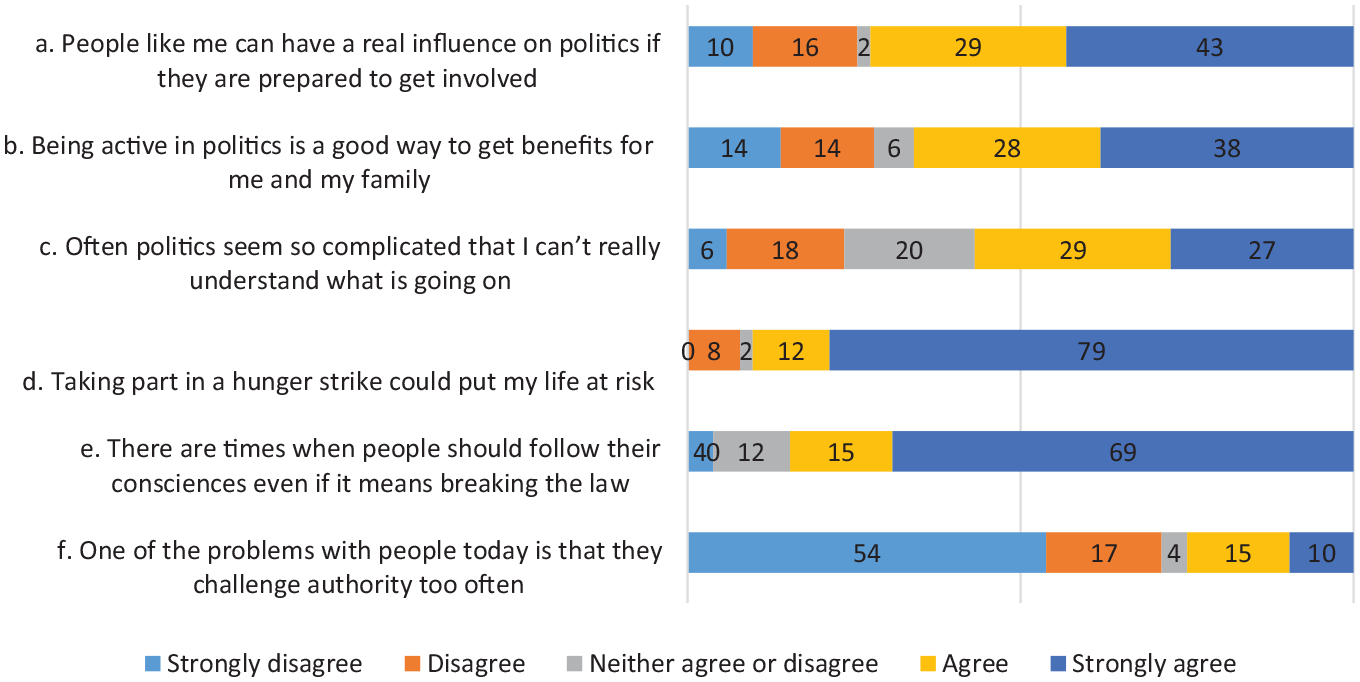
Political values of hunger strikers (in %).
Contrary to this picture, opponents and most supporters – for different reasons and contrary to the movement’s own discourse – promoted affective rationales, which became the dominant political and media frames to explain this radical protest action. Emotions, as part of our moral reasoning, provide fundamental stances to the world and enhance protest potential and action readiness to participate in social movements (Marcus et al., 2000; Stürmer and Simon, 2009). Emotions are also generated or reinforced through participation in protest events, in a relational way with other fellow protesters, which can inform subsequent evaluations and information processing, as well as future political behaviour and choices for those socialised into protest (Benski, 2011; Jasper, 2011).
Negative emotions, like anger, indignation, fear or desperation, particularly when combined with the sense of powerlessness typically attributed to irregular migrants, may motivate people ‘to claim or reclaim agency by joining/creating networks where alternative visions can be negotiated’ (Benski et al., 2013: 545; Ellermann, 2010). Positive emotions, like happiness, pride or loyalty can have a similar effect, with protesters seeking to gain a sense of belonging, a higher public standing or a sense of empowerment, through protest participation (Kemper, 2001). Involvement in collective action and social movements is more commonly triggered by negative emotions, which, however, are often overtaken by “collective enthusiasm and joy derived from the experience of ‘being together”’ with others in a similar predicament (Perugorría and Tejerina, 2013: 437). In fact, Sabucedo and Vilas (2014) have shown that negative and positive emotions are significantly and positively correlated with each other in protest models.
While there is a wealth of theoretical and empirical research on the link between emotions and protest, the emotion of ‘desperation’, which features prominently in the Greek case and in media portrayals of other minority group mobilisations, is largely absent from the literature, perhaps because it is difficult to pinpoint. Gentry and Whitworth (2011: 674), drawing on Blum (1996), argue that it is evoked by ‘panic’, whereby abnormal circumstances induce ‘feelings of possible entrapment, perception of limited or closing exits, an ambiguous present threat, a precipitating factor, fear, hysterical belief and mobilization for flight’. The implication is that desperation is understood abstractly as a form of ‘hysteria’, which arises when all hope or ability to reach a goal is almost lost, inducing actors to try anything, as a last resort, to still achieve it. When invoked as a discursive frame in public debates about a political grievance or a social movement, as in the case of Chechen political violence, it may thus serve to delegitimise these phenomena and reduce them to an irrational act (Gentry and Whitworth, 2011).
To map the emotions of participants in our study, we asked them to select up to four from a list of eight randomly circulated emotions, which they recalled having at the start of their hunger strike. The interviews took place nearly eighteen months later, so a more reliable measurement of their emotions deriving from their participation comes from the follow-up question on how they felt about their involvement at the time of interview, in July 2012 (see Figure 2). A first observation is that hope (69%) and fear (44%) were the two strongest (recalled) emotions prior to participation, while only 8% of participants mentioned despair. Reflecting on their experience after the protest action, happiness increases to 48%, but so does anger (44%) and desperation (42%). Despite the temporal distance from the strike period, this might imply that desperation, which was a dominant frame promoted by opponents and sympathisers but rejected by the strikers’ own discourse, was not a key driver of participation in the hunger strike but an emotion emerging from its limited success.
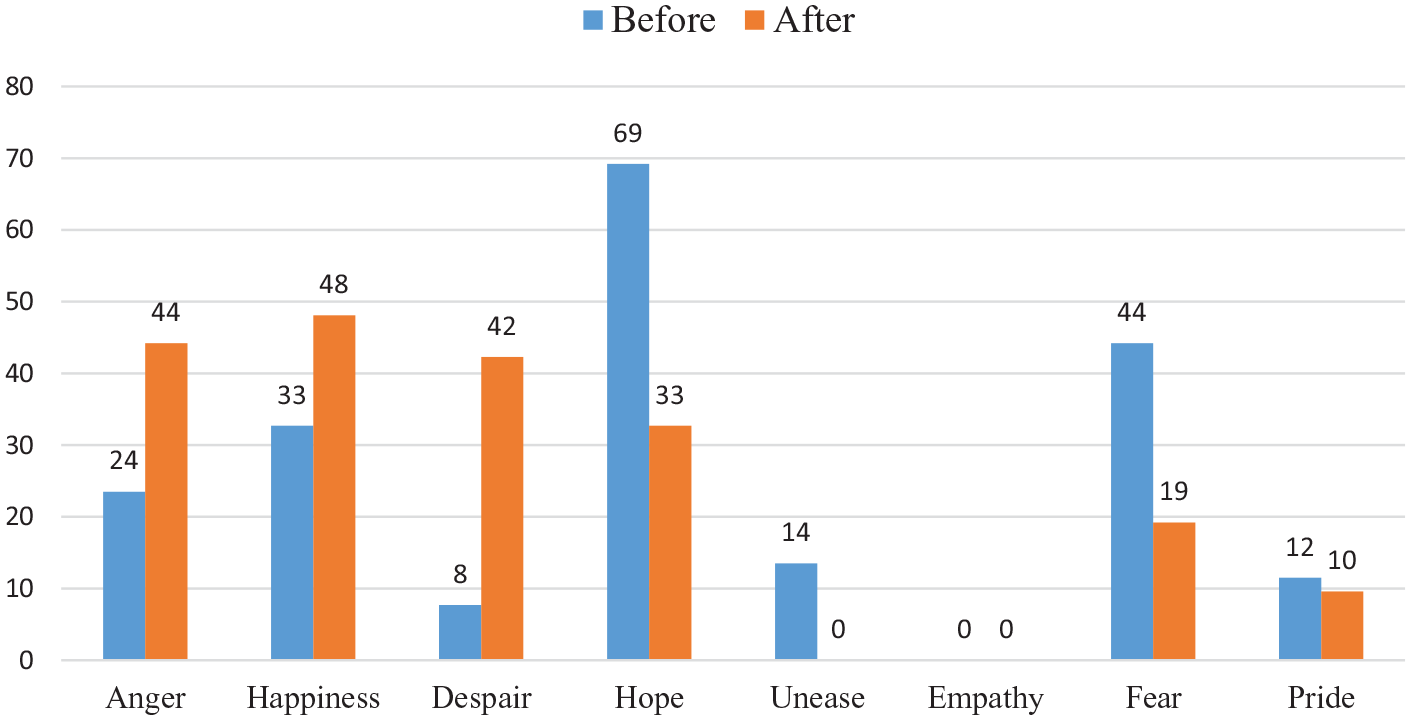
Emotions before and after the 2011 hunger strike (%).
In the final step of our quantitative analysis, we examine frame alignment and its impact on future mobilisation among sampled protesters. To simplify our comparisons, Table 1 presents descriptive statistics of the main survey questions used in this analysis to examine individual (protester) alignment with the two competing frames. The top three rows in Table 1 map respondents’ agreement with statements that encompass the strategic frame promoted by the ‘300’, while the bottom three rows indicate the extent to which respondents align with the affective frame, promoted by external protest ‘users’. Although elements of both issue frames are indeed present, it is clear that the rationalist frame is present in protesters’ responses to a greater extent than the affective one. We interpret this as evidence of the alignment of individual protesters with the strategic/rationalist frame promoted by their collective body.
Competing frame alignment among protesters.
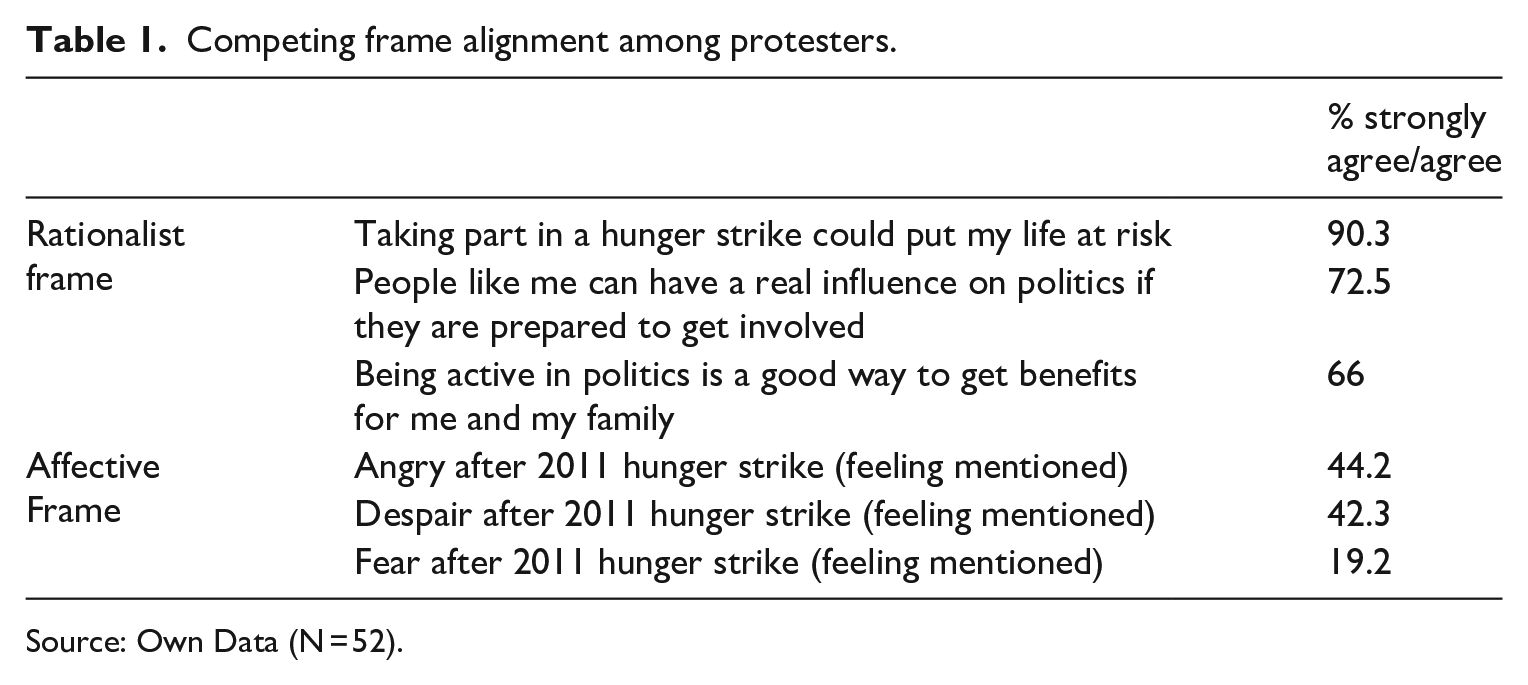
Source: Own Data (N = 52).
To examine whether frame alignment influences remobilisation, that is, the individual likelihood to participate in political action of different degrees of intensity, we created an intensity scale. The scale combines responses regarding participation intentions in the migrant sample, specifically referring to seven types of activity (all questions inviting dichotomous responses); willingness to take part in the future in a demonstration, strike, radical protest, join a political party, trade union, community or neighbourhood group, and participate in a migrant group. Using these seven variables, we built a summary scale that allocated the fifty-two respondents to the following three groups:
‘Disillusioned’ group (0): Those not reporting any intention to future action measured by any of the variables (n = 5).
‘Core’ group (1): Those not reporting an intention to take part in radical protest, but that do intend to take part in at least one activity measured by the remaining variables (n = 36).
‘Hard-core’ group (2): Those reporting an intention to take part in radical protest, as we consider this the most intense type of activity; in other words, these respondents are the only ones that report this intention (n = 11).
We are interested in the relationship between this progressive categorisation of future remobilisation intentions and individual alignment with the two competing frames that were documented by our discourse analysis. In this direction, the first column in Table 2 presents correlation coefficients between the frame-alignment variables appearing in Table 1 and the summary intensity of future protest (remobilisation) scale. For comparison, the second column in Table 2 presents the relationship between the variables appearing in Table 1 and only the radical-protest remobilisation variable, since this type of extreme activity is of particular interest to our study.
Correlations.
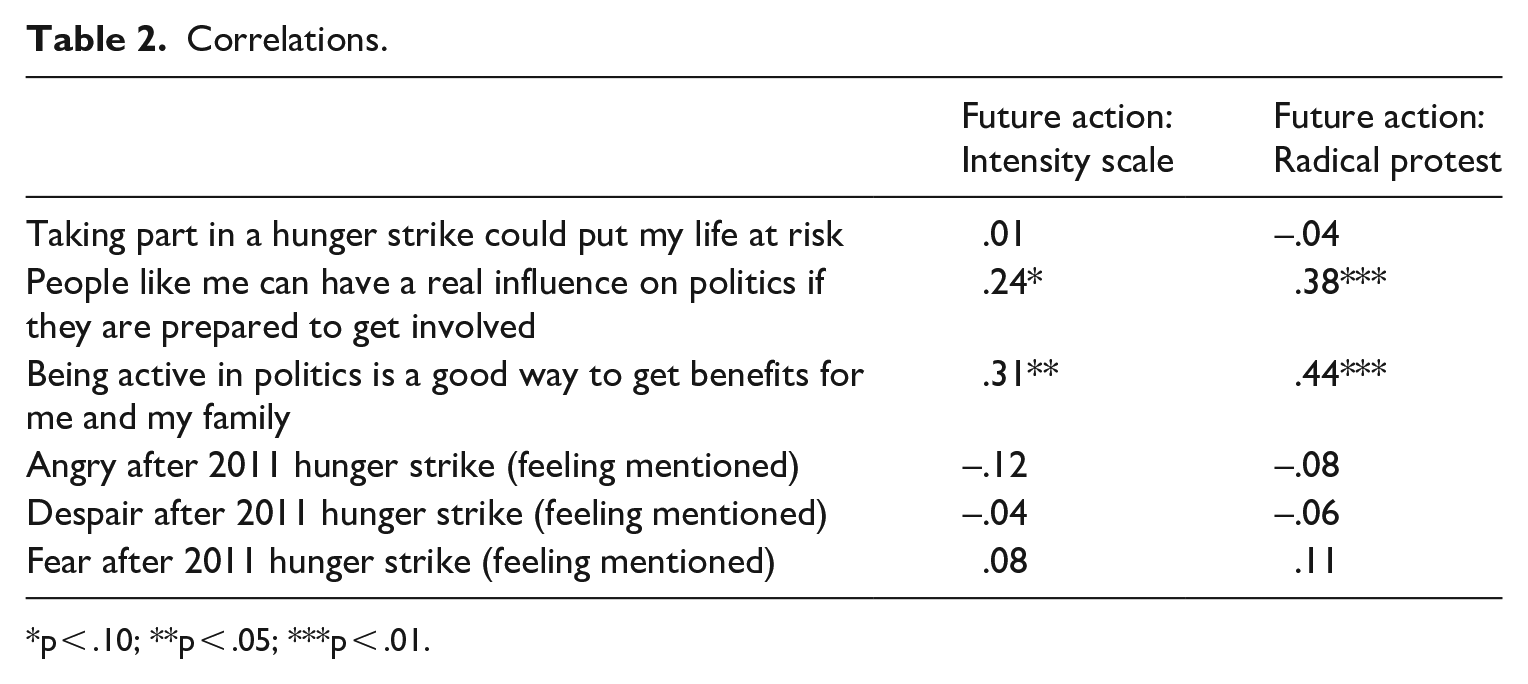
p < .10; **p < .05; ***p < .01.
The significant (positive) coefficients for the ‘rational’ statements in Table 2 reveal that alignment with the rationalist frame is indeed connected with the intensity of future action (from no intended action at all to most radical type of action). The ‘risk’ variable is an exception (insignificant coefficient). Overall, agreement with the ‘rational’ statements, that is, alignment with the strikers’ collective framing, relates to greater intensity of future remobilisation. However, reporting feelings of anger, despair and fear in connection with the hunger-strike experience has no effect on respondents’ intentions. We interpret this as evidence that alignment with the affective frame cannot explain the intensity of future remobilisation intentions.
Two regression models reinforce the above impression. The size of our sample allows us to run these models, which specify only two regressors (see, for example, Miller and Kunce, 1973). Table 3 reports results from two models that employ as dependent variables the two column variables from Table 2, respectively (intentions to participate in future political action). Model I in Table 3 uses the intensity scale and presents unstandardised odds least square (OLS) coefficients. Model II uses the dichotomous question on intentions to take part in radical protest and presents log-odds estimates. The homogeneous nature of our sample means that we do not have to control for a range of standard sociodemographics variables (also see Appendix 1).
Strategic-framing alignment and future remobilisation.
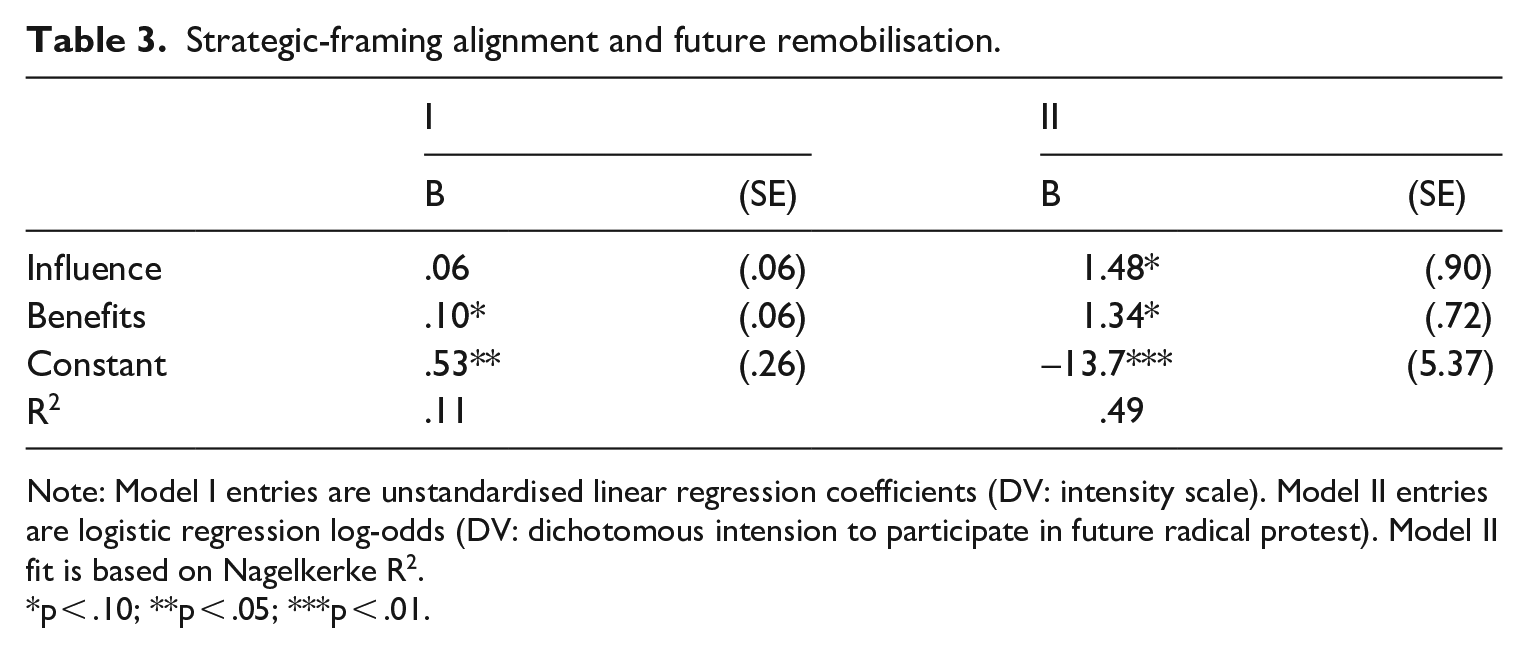
Note: Model I entries are unstandardised linear regression coefficients (DV: intensity scale). Model II entries are logistic regression log-odds (DV: dichotomous intension to participate in future radical protest). Model II fit is based on Nagelkerke R2.
p < .10; **p < .05; ***p < .01.
The regression models return mostly significant (positive) coefficients. These results confirm that strategic-framing alignment by protesters (measured as agreement to the ‘influence’ and ‘benefits’ statements) is a significant predictor of the intensity of future mobilisation (measured as an intensity scale and as participation in radical protest). Of the two independent variables used in this analysis to capture respondents’ alignment with the rationalist frame, the one that links political action to concrete benefits seems to be consistently important for future intensions. This happens to be the most explicitly ‘rational’ statement in our survey. Specifically, when accounting for both variables in the same model (Table 3, Model I), the apparent (bivariate) effect of the ‘influence’ statement that was documented in Table 2 disappears. It is plausible that feelings of efficacy (influence/means), as measured by the influence statement, have a lot to do with the gains one expects from political participation (benefits/ends).
Overall, our analysis produces evidence of the alignment of protesters with the movement’s own strategic or rationalist frame rather than the affective frame promoted by external supporters and opponents. This alignment, which approaches the strike as primarily a rational act, is a significant predictor of future participation in radical types of protest activity that fall outside the normal repertoire of political action.
Conclusion
The increased frequency and salience of migrant protest movements and the ongoing transformations of their organisational, communicational and tactical characteristics make it necessary to revisit questions about the nature of ‘new’ migrant activism. In this article, we employed mixed-methods to explore the framing battles surrounding a prototypical radical protest held in Greece by irregular migrants in early 2011, and the degree of frame alignment between protest participants, organisers, sympathisers and opponents. We find that a range of networks, including NGOs and political parties of the left that played a crucial role in the organisation and facilitation of the hunger strike, prioritising affective explanations of the action, a frame also shared, paradoxically, with movement opponents. Supporters invoked an affective frame to elicit sympathy for the cause, while opponents used the same frame to undermine the legitimacy of the movement as a whole. On the contrary, the migrant protesters defended the autonomy and rationality of their action, strategically framing the movement as a labour one that transcended citizen-migrant dichotomies, and emphatically rejecting depictions of their hunger strike as driven by desperation.
Our empirical analysis demonstrates that the strategic or rationalist frame, promoted by movement leaders, was accepted by individual protesters to a greater extent than the affective frame promoted by external stakeholders. This is not to suggest that emotions are irrational or disconnected from cognitive processing, although the exact pathways through which they influence behaviour remain under-explored. After all, neuroscientists have shown through brain scans and functional imaging that social cognition and moral judgement activate the same cortical parts of the brain, suggesting that higher order cognitive operations are highly interdependent with emotional responses to stimuli (Forbes and Grafman, 2010; Wood and Grafman, 2003). What the Greek case does emphatically show is that, at the time of the survey, there was strong frame alignment between hunger-strikers (the micro level of protest participation) and their leaders (the meso level of protest organisation), without however being able to determine whether this pre-existed and was thus a driver of protest or whether it emerged from the socialisation process of protest participation.
Our findings provide evidence for the internal legitimacy of a new migrant movement with its grassroots, which is frequently questioned in public debates, including in the Greek case. What is more, we argue, the degree of frame alignment between protesters and organisers also has previously unexplored implications for the propensity of participants to engage in future protest of varying degrees of intensity. In this regard, our analysis finds evidence that individual congruence with the movement’s predominantly rationalist frame has implications for participation intentions in radical types of protest activity that fall outside the normal repertoire of political action. Nevertheless, while the Greek case shows that frame alignment has tangible implications for future remobilisation, our small and homogeneous sample cannot address all the nuances, causal relations and pathways through which frames, emotions and rational choice considerations interact to shape protest behaviour. Future empirical studies can determine more conclusively if the presence and extent of frame alignment depends on contextual features, such as the degree of polarisation surrounding a movement, the opportunities for political inputs provided by the host political system, the media landscape and the attributes of movement participants (e.g. gender, nationality, race, religion). Scholars in security studies may also fruitfully explore the extent to which new migrant movements may play a role in contesting and countering the securitisation of migration, which has produced hostile environments for all type of migrants in receiving states (Karyotis, 2012).
Finally, a broader reading of our findings could sustain a critique of Western understandings of non-Western populations, which, may even apply to mobilisations and grievances expressed by other minority groups as well, not just migrants (see Gentry and Whitworth, 2011). This is not of mere academic interest. In recent years, members of non-Western populations have been prominent actors, collectively or individually, in the Western public square, through conventional or unconventional action. To frame all public behaviour by migrants arbitrarily and without a solid empirical basis as a matter of individual pathology, an irrational and desperate act of last resort, when it may not necessarily be so, reveals biased Western projections, which tend to homogenise, de-politicise and even trivialise underlying causes. More importantly, this provides the wrong basis for beginning to address the multiple challenges that these complex public reactions pose in security, welfare, equality, representation and cultural terms.
Footnotes
Appendix
Demographics and attitudes.
| Age | % | Nationality | % | Education | % |
|
|
||||
|---|---|---|---|---|---|---|---|---|---|---|---|
| 18–24 | 15.4 | Morocco | 92.3 | None | 13.5 | Married | 7.7 | ||||
| 25–39 | 82.7 | Other | 7.7 | Primary | 17.3 | Single | 92.3 | ||||
| 40–54 | 1.9 | Second. or more | 69.2 | ||||||||
| Religiosity scale | % | Left-right scale | % | Political interest | % | ||||||
| 0 (none)–3 |
5.7 |
0 (left)–3 |
78.1 |
Not at all/ |
25.4 | ||||||
| 7–10 | 78.9 | 7–10 | 4.8 | Somewhat/ |
74.6 | ||||||
Funding
The author(s) disclosed receipt of the following financial support for the research, authorship, and/or publication of this article: This work was supported by the Carnegie Trust, Small Research Grant, 2012-13, PI: Karyotis. It was first presented at the Workshop ‘‘Immigrants in Europe: Between the Eurozone Crisis and the Arab Spring’, University of Westminster, London, 9 Nov 2012. We are very grateful to survey participants and for feedback received on earlier versions of this article and, in particular, to the journal’s anonymous reviewers who helped us refine our analysis.
