




Abstract
The vote NO (a defeat for the proponents) of the 2016 Italian referendum has been broadly attributed to a wave of protest politics sweeping Western democracies. Given that the government of Matteo Renzi proposed and supported the referendum, the resulting vote against government interests raises a crucial theoretical question: to what extent does the referendum vote reflect the characteristics of a protest vote? To disentangle the meaning and impact of protest, we distinguish two dimensions: the ‘system discontent’ and the ‘elite discontent’, referring to both general and focalized images: general sentiments towards the representational aspects of political institutions as compared to focused sentiments towards government performances. The circumstances surrounding the referendum provide a crucial test for whether these two forms of protest can be at odds with one another. We expect and find that elite discontented voters tend to reject this referendum. Vice versa, system discontent increased support for the referendum, as it would reform political institutions to which voters had negative sentiments. Findings suggest that analyses of political psychology and behaviour identify the conceptual foundations for protest and ask whether forms of protest work in parallel or at odds. Protest attitudes and their effects should be thought of as multidimensional.
On 4 December 2016, Italians were asked to vote on a Constitutional Referendum proposed by the centre-left government of Matteo Renzi that would have altered one-third of the articles of the constitution, ushering in a ‘Third Republic’ (Draege and Dennison, 2018: 403). Constitutional revisions included an end to bicameralism by downgrading the role of the Senate in confidence and legislative matters, decreasing the number of Senators and making the body appointed instead of elected, abolishing concurrent powers of central and regional governments in several jurisdictions, eliminating the provinces – a second-tier level of government, and abolishing the National Council for Economics and Labour that brought together economic, social, and legal experts from both private- and public-sector organizations. In toto, these reforms would have streamlined decision making by reducing the costs of politics, centralized decision-making power in the executive, transitioned Italy from a consensual to a majoritarian democracy, and transformed the federal nature of the Italian state also in favour of the central government (Ceccarini and Bordignon, 2017). Although initial polling suggested greater than 60% support for the referendum, after Prime Minister Renzi personalized the campaign and pledged to step down if the referendum failed, support fell to only 40% by the time of voting.
This level of partisan involvement suggests that voting outcomes were determined by aspects ‘far beyond the substance of the proposed reforms’ (Ceccarini and Bordignon, 2017: 281) with voter opinions following along party lines in a campaign characterized by high levels of bitter political conflict. As the reforms would weaken the role of opposition and minor parties, the governing Democratic Party, Prime Minister Renzi, and New Centre-Right coalition partner supported the reforms, while smaller and opposition parties all rallied against it: the populist 5-Star Movement, centre-right Forza Italia, nationalist Northern League, Brothers of Italy, and smaller communist and green parties.
While a party-based vote may sound compelling, the highly personalized campaign by a political incumbent (Pasquino and Valbruzzi, 2017) could have also incited protest behaviours. The turnout was higher than any previous constitutional referendum, reaching a level approaching that of a national election, as political interest (Bergman, 2019b) and knowledge of the referendum components (Bergman, 2019a) was high. In particular, we argue that voting in the referendum provided an opportunity to express one’s discontent with the political system. On one hand, the referendum could provide an opportunity to express one’s ‘elite discontent’: a focused negative sentiment towards governing elites and the economic direction of the country (Leininger, 2019). On the other hand, the referendum allowed those expressing high levels of ‘system discontent’ – generalized negative sentiments towards the representational aspects of political institutions – to have a role in the transformation of the system to one that was more preferable. The circumstances surrounding the 2016 Italian constitutional referendum thus provide a crucial test for whether these two forms of protest can be at odds with one another, leading voter behaviour in opposite directions.
In the light of the 4 December 2016 electoral results, with 41% voting in favour of the reforms, it is then interesting to identify who the voters were that supported the referendum. Were voters expressing ‘elite discontent’ beyond the geographic, socio-demographic, and partisan explanations offered by previous scholars? Furthermore, did ‘system discontent’ work to bolster support for the reforms? After reviewing the literature on the rise of non-partisan protest voting and differentiating hypotheses into system and elite components, we analyse the impact of these dimensions on the support for the referendum. Including these dimensions of protest increases the explanatory power beyond geographic, socio-demographic, and partisan explanations by 60% and improves estimates of predicted votes by an additional 5%. How these findings further the understandings of protest voting and referendum behaviour is discussed in the ‘Discussion and conclusion: Conflicting dimensions of protest’ section. Our analysis demonstrates that protest attitudes, and their effects, ought to be thought of as multidimensional concepts.
Dealignment and protest voting
The literature on protest voting has grown in the last decades, as the weakening of party linkages that started in the 1960s has continued to progress further. The process of loosening party–voter linkage arose through several processes: declining party membership, ideological moderation, and reduced electoral turnout, political involvement, and trust in political parties (Dalton and Wattenberg, 2000; Dalton, 1996). Although with different intensity and timing across countries, those trends were detectable in almost all West European countries, in Latin America (Carreras, 2012), and in the post-communist new democracies (Van Biezen, 2003). These changes have in any case influenced patterns in voter behaviour. As claimed by Dalton and Wattenberg (2000), there has been a process of partisan dealignment, whereby voters abandon their previous allegiances in a context of generalized weakened party identification. Centralized, professionalized parties with short time horizons have replaced the ideologically driven mass parties in advanced industrial democracies. Then the so-called silent-counter revolution saw the rise of parties of the new extreme right (Lubbers M et al., 2002) coupled with the general discontent towards parties and politics as a whole (Ignazi, 1992). In this context, even democracy itself has been challenged with protest and mistrust.
New voting heuristics arose related to leadership and candidates features, electoral campaign issues and themes, and economic voting replacing long-term and ideological frames (Bellucci et al., 2012; Rabinowitz and MacDonald, 1989). In this new schema of electoral behaviour, the vote became more and more for or against the incumbent governments and the political parties’ ruling classes. Short-term variables like economic performance (Lewis-Beck and Paldam, 2000; Bartels, 2014) imply that voters consider support or criticism of the elite on the basis of what they do instead of the ideologies a ruling party represents (Lerner et al., 1998). Furthermore, the role of the candidate has also increased its relevance, whereby the elites are assessed on who they are; the personalization of politics represents another new heuristic of voters’ behaviour (Passarelli, 2015; Poguntke and Webb, 2005).
Protest voting is not in itself an apathetic behaviour, as it assumes an electoral act as an expression of disaffection against the established (De Luca, 1995; Passarelli and Tuorto, 2014). Voters intend to express a message (Brennan and Lomasky, 1993) of political distrust to the mainstream parties (Bergh, 2004: 376; Bélanger, 2004; Belanger and Nadeau, 2005). Protest voting is a vote against the political elite, resounding the ‘we vs them’ dichotomy stressed by populist protest parties (Rooduijn et al., 2014). Supporting minor parties or switching their choice from their preferred one is an exercise of using their voice (Hirschman, 1970); however, this is itself cannot be interpreted as an expression of discontent as even small parties can be ‘mainstream’ through their participation in coalition government and enacting their ideological agenda.
The Italian case fits particularly well with the trends related to the changes in party–voter relationships and voters’ behaviours (Bellucci and Segatti, 2008; Bellucci, 2007; 2012). In particular, there are several examples of growing electoral protest movements. The Northern League (Passarelli and Tuorto, 2012) founded in 1991, Forza Italia (Hopkin and Paolucci, 1999) in 1994, and the Five Star Movement (Bordignon and Ceccarini, 2013; Conti and Memoli, 2015; Tronconi, 2015) in 2009 are the largest of the political movements characterized by their populist opposition to traditional partisan politics (Mudde, 2007).
In sum, protest voting is associated with the intrinsic idea of ‘sending a message’ to the elite: a negative message expression of discontent. This latter implies that voters – in line with the dealignment theory – choose if and how to cast their vote basing their decision on contemporary evaluations of what the incumbent government has done (Norris, 1999). A crucial distinction remains, however: differentiating protest, and in particular by protest voting, vis-à-vis other possible conceptual overlaps related to ideological or personal affinity with protest parties.
Two forms of protest: Elite and systemic
Although the ‘protest vote’ is generally defined as a vote primarily cast contra the elite, the fact that political attitudes are expected to be of minor importance (Van Der Brug et al., 2000) need not be ignored. It is possible to detect in the literature two main kinds of protest, beyond the classic definition as unconventional, anomic or non-standard mobilization (Almond and Powell, 1966; Barnes et al., 1979). Objects of protest can be the regime, the political community, the system, the policies, or the political parties. It is possible then to indicate two main arenas on which ‘protest’ can be measured: (1) a vote against the establishment and (2) a vote unconnected to policy preferences. In particular, Bergh (2004) has divided political protest into two distinct dimensions: ‘elite discontent’ and ‘system discontent’. The first – elite discontent – concerns the incumbent government and the parties supporting it, as well as the executive performance. The second – system discontent – refers to democratic elements of politics such as parties, politicians, institutions, and the functioning of democracy. On this line of research, Bergh found that protest voting mainly reflected a reaction against political elites, rather than against the political system itself (Bergh, 2004: 386). Here, we examine these distinct dimensions of protest in referendum voting decisions.
In order to detect the main features of protest voting, it is possible to measure voters’ behaviour and party’s characteristics. In the latter case, there is the risk of considering something that could be tautological, that is, ‘voters vote for a protest party’. In fact, as some authors claim, there is the high possibility of having a charge of ‘circularity of identifying certain parties as protest parties’ (Van Der Brug et al., 2000: 82; Fennema, 1997). A voter may vote for a protest party and not have protest attitudes, or he or she can vote a mainstream party and have protest attitudes. Protest voting and protest parties can be detected on both sides of the ideological spectrum from the extreme right to the far left. In both cases, the common trait seems to be the distrust of political institutions as well as of incumbent parties (Norris, 2005: 157).
Beyond a focus on vote choice, one can focus on the measurement of voters’ protest ‘attitudes’. Retrospective voting is one of the bases of the protest vote. From this perspective, voters intend to ‘evaluate’ and sanction the performance of the current government. As Bowler and Lanoue indicate, voters tend to cast a protest voting when they are ‘convinced that the government’s policies have had an adverse impact on their own lives’ (Bowler and Lanoue, 1992: 491). With weakened party or ideological loyalty (Brennan and Hamlin, 1998), here, voters are expressing a negative evaluation of the incumbent government and seek to sanction its leadership. Specifically, then, aspects of elite discontent include retrospective and prospective economic considerations and evaluations of government policy performance and political leaders (Passarelli and Tuorto, 2018).
On the contrary, voters can ‘demonstrate rejection of all other parties’ (Van Der Brug et al., 2000: 82) and send a message to ‘punish other parties’ than those supported in the past (Pop-Eleches, 2010: 223). Instead of any specific policies or parties, here voter motivation includes anti-systemic attitudes (Sartori, 1976), including discontent with the domestic and international economic (Kriesi, 2012; Kriesi and Pappas, 2015) and political order: having a general mistrust for politics in general, and, for example, the European Union. For example, as Figure 1 demonstrates, while the number of Italians identifying with a European identity has only decreased by about 10% in the past 30 years, those who support the European Union institutionally have nearly halved, dropping by 35%. In other words, attitudes towards political institutions are distinct from other socio-political opinions. A systemic discontent concerns the democratic elements of politics such as political efficacy (Karp and Banducci, 2008), trust, and the functioning of parties, politicians, and institutions (Passarelli and Tuorto, 2018).
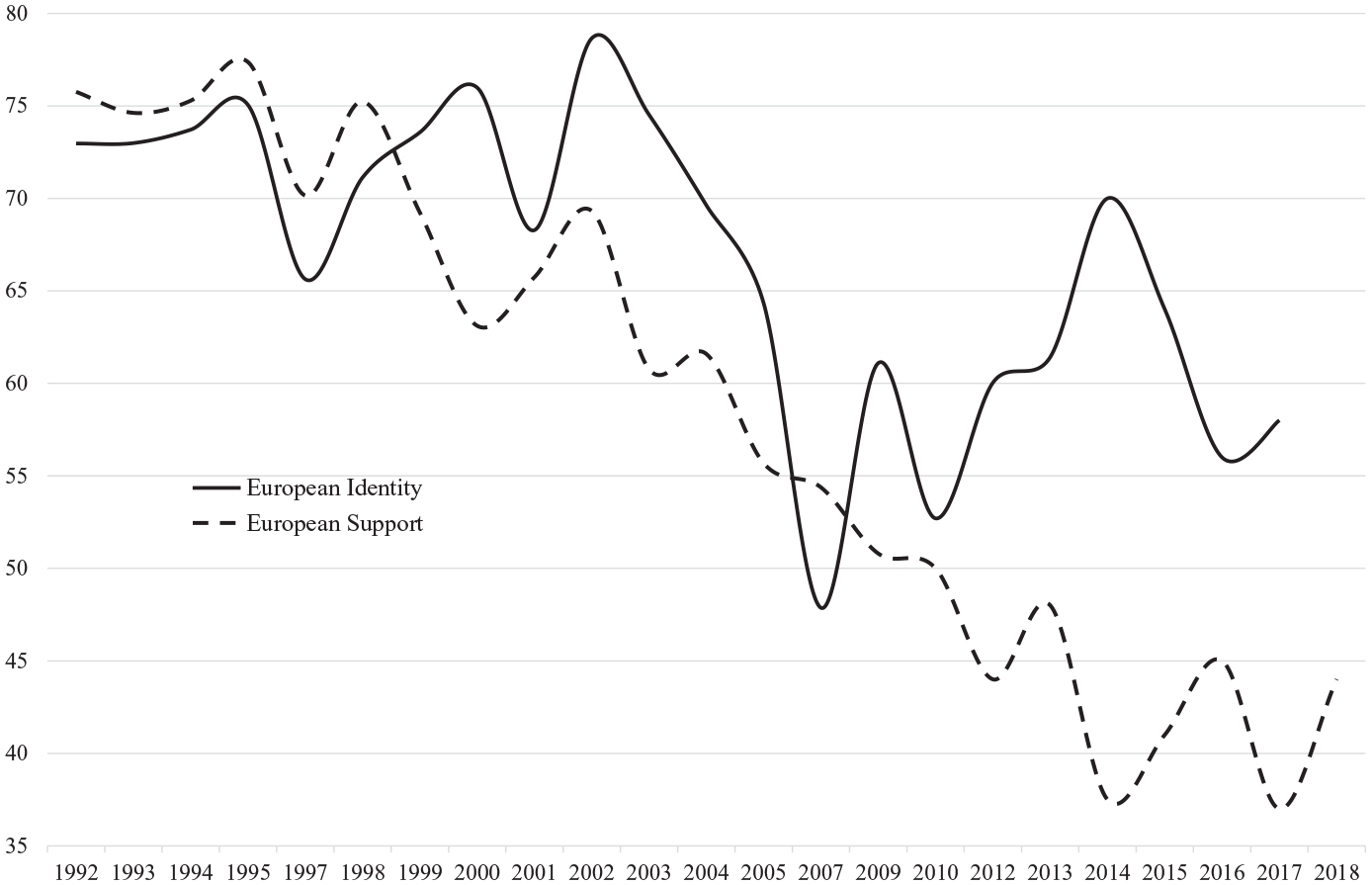
Europeanism across time (Italy, %).
Connecting discontent to referendum behaviour
While most studies of protest voting are in the context of legislative or executive elections, the Italian case presents the case of a referendum that would restructure the political system. Protest voting is both an ‘expression of disaffection with particular parties and their policies’ and ‘with politicians as a class and political institutions more generally’ (Birch and Dennison, 2019: 112; Kang, 2004; Karyotis and Rudig, 2015). Evidence of both has been found in a party vote for the 5-Star Movement (Passarelli and Tuorto, 2018), but the concepts have not yet been applied to other forms of political behaviour.
These two types of discontent would conflict in the minds of voters when evaluating a referendum that would structure institutional change; the 2016 Italian referendum represents a crucial test, both theoretically and empirically. In fact, before Election Day, Italian society experienced many elements typical of possible protest voting behaviour: the government was directly involved in the reform, it supported the policies contained in the referendum, and in particular the Prime Minister engaged himself in the electoral campaign, by linking his political career and future to the electoral outcome. Specifically, in the Italian case of 2016, as the constitutional reform was proposed and prominently associated with Prime Minister Renzi, dissatisfaction with the government should have led to a ‘NO’ vote on the referendum. The Prime Minister’s government directly called the referendum and Renzi stated that if he had lost the referendum then he would resign. In this way, the Renzi government pushed all political opponents and adversaries to unite in campaigning in favour of NO. In this case, the communication strategies of the government drove protest voting through political leaders’ use of media and ground campaigns (Birch and Dennison, 2019: 212). Indeed, greater interest and knowledge of the referendum seem to suggest less overall support for the referendum (Bergman, 2019a). Strategic voters could have recognized the opportunity to remove an incumbent early (Greene et al., 2018) and potentially punish for a poor economic situation (Leininger, 2019). Those expressing feelings of discontent with the current government should then have reduced their support for the referendum, even beyond their partisan attachments.
In contrast, dissatisfaction with the system should have led to a ‘YES’ vote because the referendum was supposed to increase the efficiency of the political system. The referendum was a chance for voters to correct the inadequacies with the way democracy worked in Italy. For example, the referendum would streamline decision making and decrease state expenditures by reducing the role and number of senators and abolishing the administrative provinces and National Council for Economics and Labour. Figure 2 presents the opinions of these state reforms by referendum vote choice as reported in by the Italian National Election Survey (ITANES): the interquartile range is presented with the median highlighted. 1 Of particular note is that those who voted yes in the referendum also more positively favoured these systemic reforms. As such, we would expect that those expressing discontent with the current functioning of democracy in Italy would also be more in favour of the referendum.
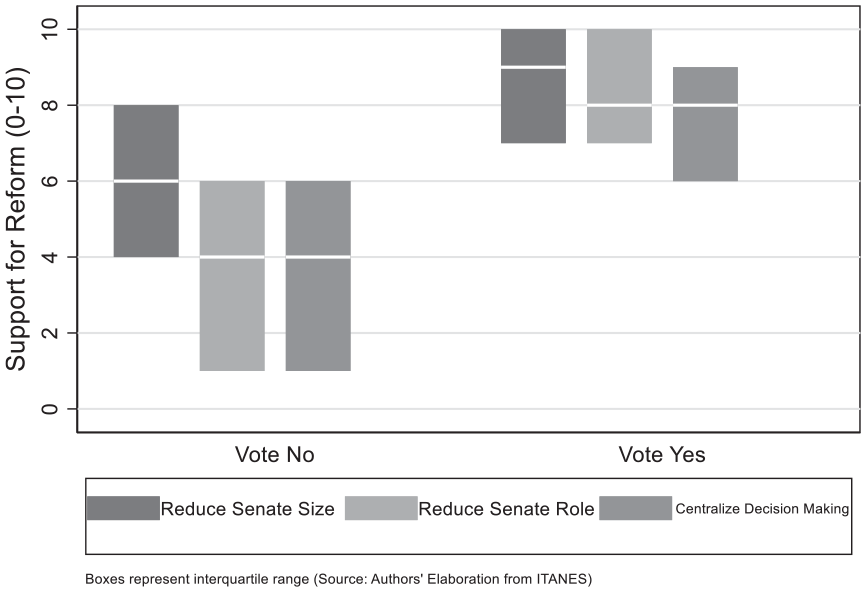
Support for reform by referendum vote.
Data and method
To test for the presence of elite discontent and systemic discontent in voter’s choice in the Italian Referendum, we use ITANES. Italians were polled in a representative sample. Our dependent variable is referendum vote: whether a respondent voted for the referendum (vote Yes), against the referendum, abstained, or spoilt their ballot. As we focus on a dichotomous dependent variable, a logistic regression is used.
Previous research on Italian politics and the referendum in particular guides the selection of control variables. Truglia and Zeli (2019) suggest geographical, economical, and educational components of the vote. As such, we include a variable for (zone) dividing the regions into North-West, North-East, Centre, South, and Islands. Those without a job are coded as Non-employed. Those with a tertiary education or above are coded as College. Bergman (2019b) finds that the North-East, South, and Islands had decreased support for the referendum along with younger voters. Respondents were grouped by their ages (Age-group) into categories of 18–24, 25–34, 35–44, 45–54, 55–64, and 65+.
We are particularly interested in demonstrating that a protest explanation adds predictive value over one based off ideology or partisanship. As such, we must also control for Left–Right, whereby voters were asked to place themselves on a left–right scale from 0 to 10. Voters were asked which party they feel closest to. We construct indictor variables for those who identified the governing Democratic Party (PD), and main opposition parties as identified above as having populist characteristics: Forza Italia (FI), Lega Nord (LN), and Five Star Movement (M5S). These parties make up more than 80% of the Italian electorate.
As argued above, the concept of ‘elite discontent’ expresses a disagreement with the current government’s performance and the belief that current policies are adversely affecting one’s life. We use variables that measure opinions of the current government and economic performance. On a scale from much better (1) to much worse (5), respondents were asked about the economic situation in Italy as whole (Econ_Sociotropic), for their family (Econ_Family), and prospectively for the coming year (Econ_Prospective). Leininger (2019) and Bergman (2019a, 2019b) also included these measures to assess the role of economic voting in the referendum. Respondents were also asked their judgement on a 0–10 scale of the current government, of Prime Minister Renzi, and former Deputy Prime Minister Alfano who was serving as Minister of the Interior and leader of the New-Centre-Right junior coalition partner during the referendum. Previous studies of voting behaviour in Italy have used these assessments of leaders as measures to analyse the perceived competence of elites on voting behaviour (Bellucci, 2007, 2012; Bergman, 2020). Passarelli and Tuorto’s (2018) analysis of elite discontent in the 2013 election also included these economic, government performance, and party leader ratings. These judgements were reversed from completely positive (0) to completely negative (10) to create the scales of Government_Eval, Renzi_Eval, and Alfano_Eval. These six items have a standardized Cronbach’s alpha reliability coefficient of 0.827. Factor analysis suggests a single underlying dimensionality to these items with an eigenvalue of 2.8 that accounts for 94% of the variance. Factor loadings are presented in Table 1. The variable Elite Discontent is produced using the regression scoring coefficients, also listed in Table 1. The scoring coefficients note that this measure is weighted in favour of the opinion of Renzi and his government’s performance, especially on its economic impact on the country.
Factor loadings and scoring coefficients for discontent variables.
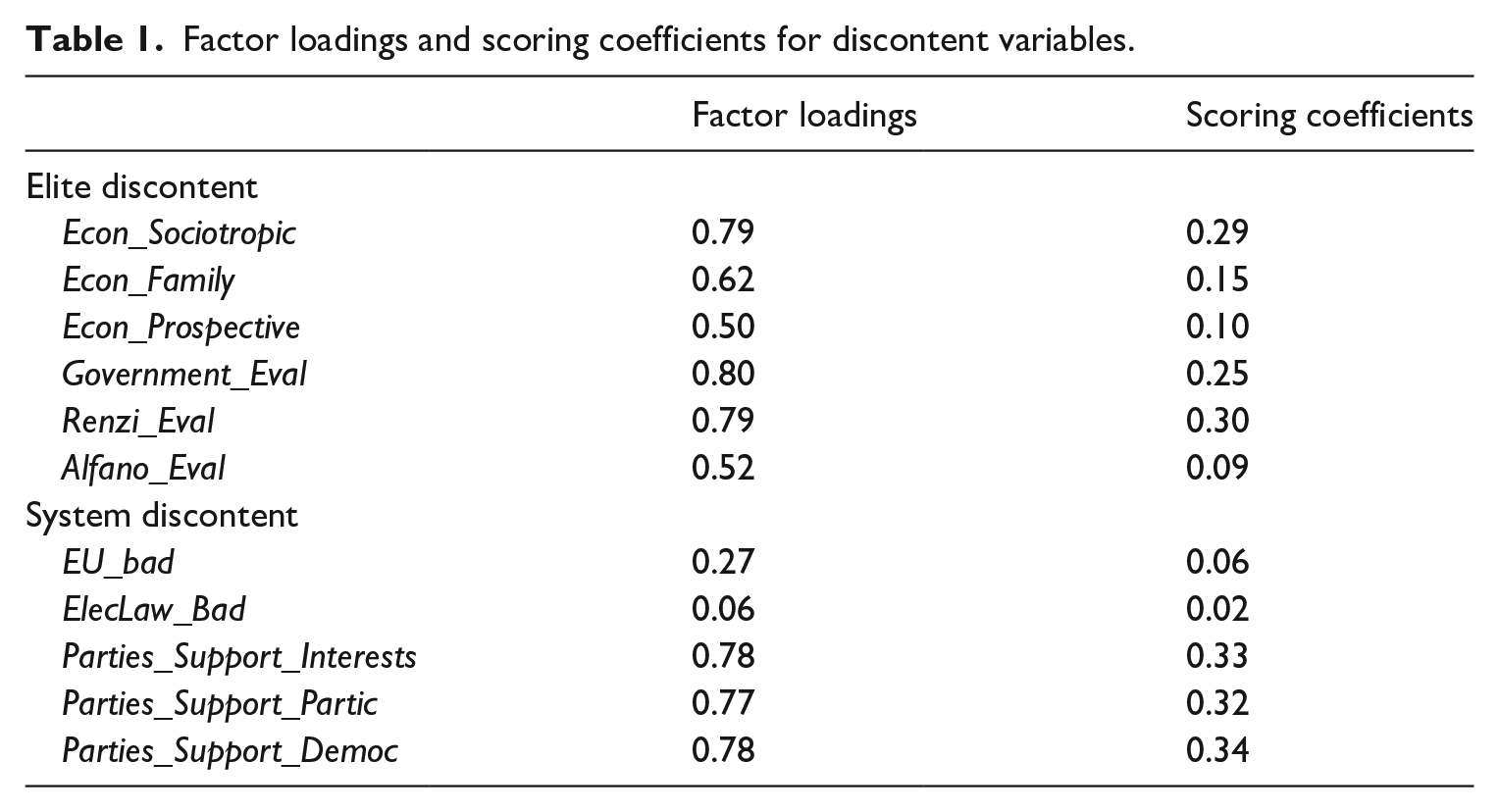
System discontent expresses displeasure with the current operation of the political system, including the behaviours of parties, institutions, and the function of democracy. We operationalize this as encompassing beliefs on the necessity of parties, the European Union, and the electoral system. As used by Passarelli and Tuorto (2018) for their measures of system discontent, respondents were asked on a 1–10 scale if parties are necessary to protect the interests of different groups and social classes, parties allow citizens to participate in political life, and if without parties democracy would not exist. Reversing each of these (Parties_Support_Interests, Party_Support_Partic, Party_Support_Democ) provides measure of discontent with the systemic use of parties. Respondents were also asked whether the European Union was good, bad, or neither. EU_bad rescales this to 3 meaning bad and 1 meaning good. Previous empirical work has found that negative opinions of the EU were associated with voting against the referendum (Bergman, 2019a). Finally, voters were also asked whether they had a favourable opinion of the electoral system (ElecLaw_Bad), as approved in July 2015, on a scale from very favourable (1) to very disfavorable (4). These five items have a standardized Cronbach’s alpha reliability coefficient of 0.773. Factor analysis suggests a single underlying dimensionality to these items with an eigenvalue of 1.9. Factor loadings are presented in Table 1. The variable System Discontent is produced using the regression scoring coefficients, also listed in Table 1. The scoring coefficients note that this measure is heavily weighted in favour of the beliefs in the party system, over that of the electoral law and the European Union.
Before proceeding to descriptive and inferential analysis, we first wanted to confirm the underlying dimensionality of our measures of discontent. Table S1 of the Supplemental Material presents the factor loadings of all of the discontent variables subjected to a maximum likelihood factor analysis. Two factors had an eigenvalue of above 1, the first having an eigenvalue of 3.87 and the second with an eigenvalue of 1.51. This suggests that our underlying discontent variables can be empirically reduced to two factors. Factor loadings above 0.5 are highlighted for ease of interpretation. The first factor conforms to a dimension encompassing many of the elite discontent variables. The second factor conforms to a dimension encompassing discontent with the party system variables that are included in the system discontent measure. 2 Note that on this second factor, many of the loadings for the elite discontent variables are negative, which suggests that these constructs need not necessarily be strongly correlated and do not conform to a single dimension of protest. The pairwise correlation between Elite Discontent and System Discontent is 0.38.
Descriptive statistics
Table 2 provides the means for each of the variables discussed above. It also isolates the subsample out those who voted in favour of the referendum. The mean levels of both types of discontent are lower for those in the subsample that voted YES. While this would be expected for elite discontent, the expectation was that system discontent would lead those to favour the referendum. These results are potentially confounded by the partisan explanations, for which we later employ regression analysis to estimate the effects of; 27% of the sample identifies with the Democratic Party, falling between the party’s 41% of the vote during the 2014 European Parliament Elections and 19% at the 2019 national parliamentary elections. This group makes up just over half of those who voted yes, though leaving 45% of voters left to be accounted for beyond just a partisan vote.
Summary statistics for sample included in regression models.
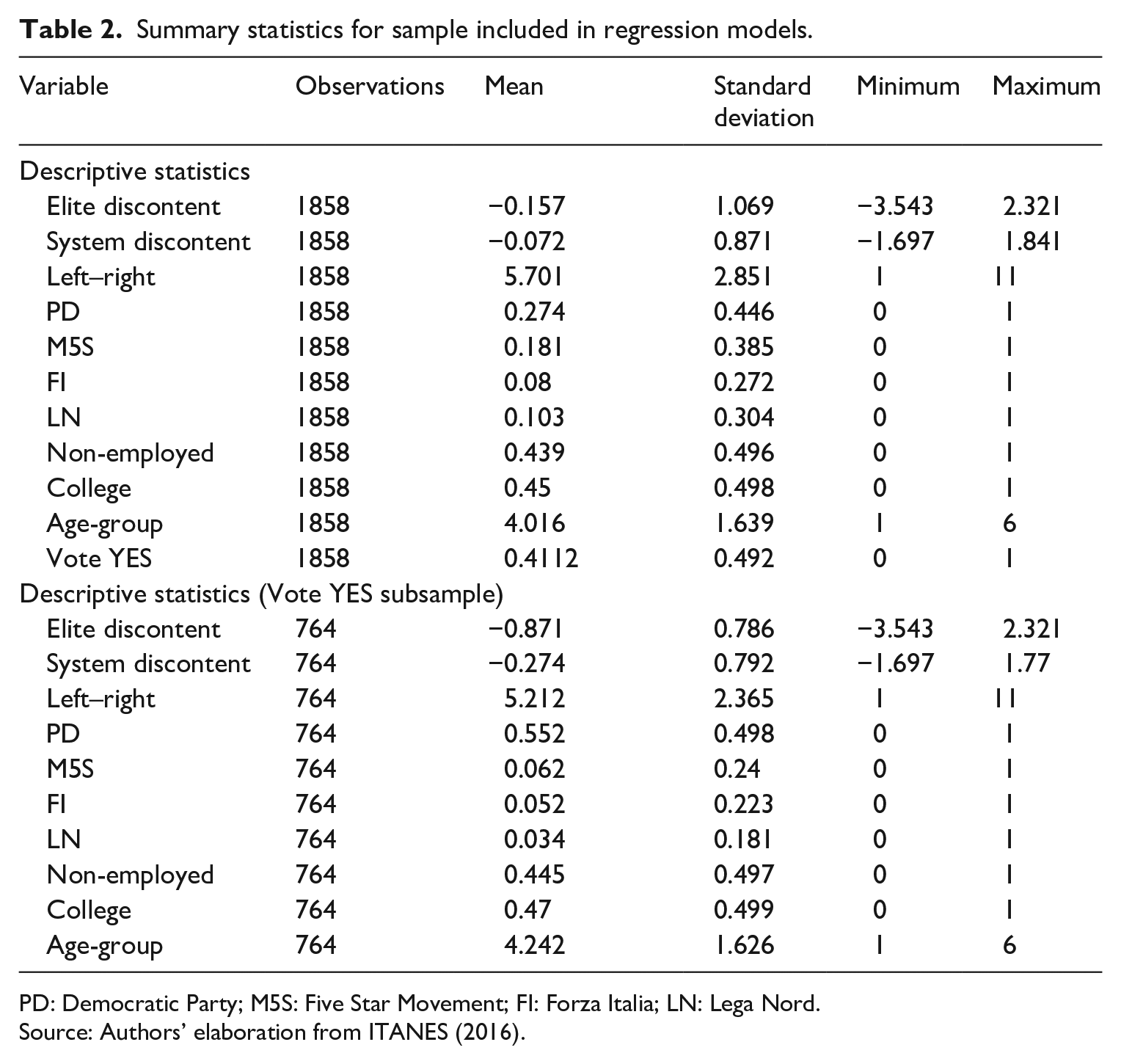
PD: Democratic Party; M5S: Five Star Movement; FI: Forza Italia; LN: Lega Nord.
Source: Authors’ elaboration from ITANES (2016).
Partisan identification with the opposition follows similarly expected patterns. 5-Star Movement identifiers count for 18% of the sample while receiving 21% at the previous European Parliament elections. Forza Italia identifiers count for 8% of the sample, similar to their showing in the 2019 European Parliament elections. Lega Nord identifies account for 10% of the sample, between their 6% showing in the 2019 European Parliament elections and their 17% showing at the 2018 national parliament elections. Each of these opposition party identifiers make up a smaller proportion of those who supported the referendum. In the sample, 41% voted in favour of the referendum; 40.88% of ballots were in favour of the 2016 constitutional referendum as reported by the Department of the Interior.
Figure 3 displays the comparative averages for the sub-components of the measures for elite and system discontent. The first six markers are solid and depict the components of elite discontent. The latter five are hollow and depict the components of system discontent. The original scaling of the measures is also identified on the figure. On the 1–5 scale of negative economic feelings, those not voting yes had higher means on their worry about the economy as a whole than those who supported the referendum. Differences on worrying about familial economic concerns and the future outlook for Italy were in a similar direction, though less drastic a difference. In their evaluations of the government and party leaders on the 0–10 scale, the greatest difference between those supporting the referendum and those not is in their rating of government performance. All Italians, even those supporting the referendum, had the greatest negative evaluation of Alfano, the junior coalition partner. Those voting YES, on average, had a positive evaluation of Renzi, while those not voting YES evaluated Renzi only slightly more favourably than Alfano. Each of these sub-components are suggestive that elite discontent drove voters away from supporting the referendum. The means for each component of system discontent are lower for those who supported the referendum. These differences, however, are not as great as those for elite discontent. While the bivariate correlation between disapproval of the EU, the electoral law, and all three measures of the role of parties is suggestive that those with higher levels of systemic discontent voted against the referendum, our empirical strategy will examine whether these are aspects associated with the partisan aspects of the vote or indeed are evidence against the second hypothesis presented above.
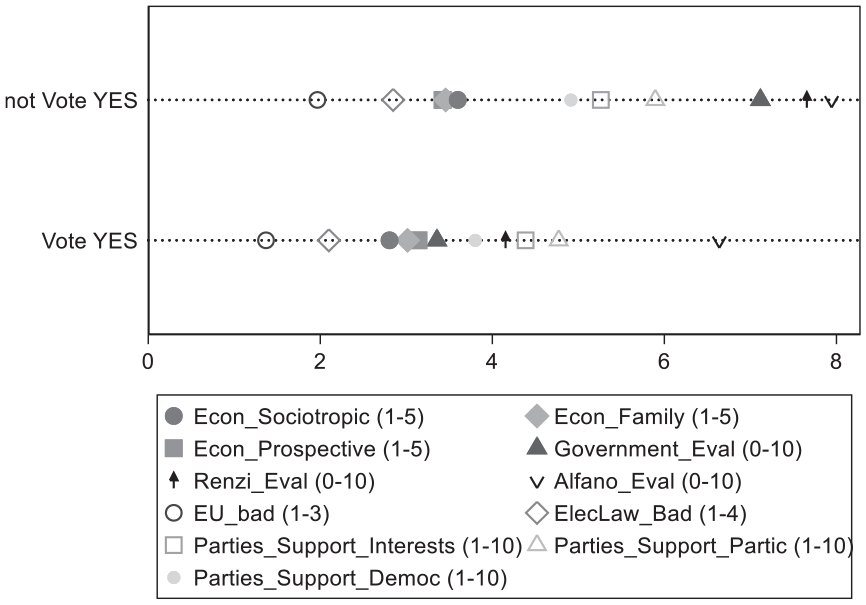
Averages for protest sub-component by voting decision.
Regression analysis
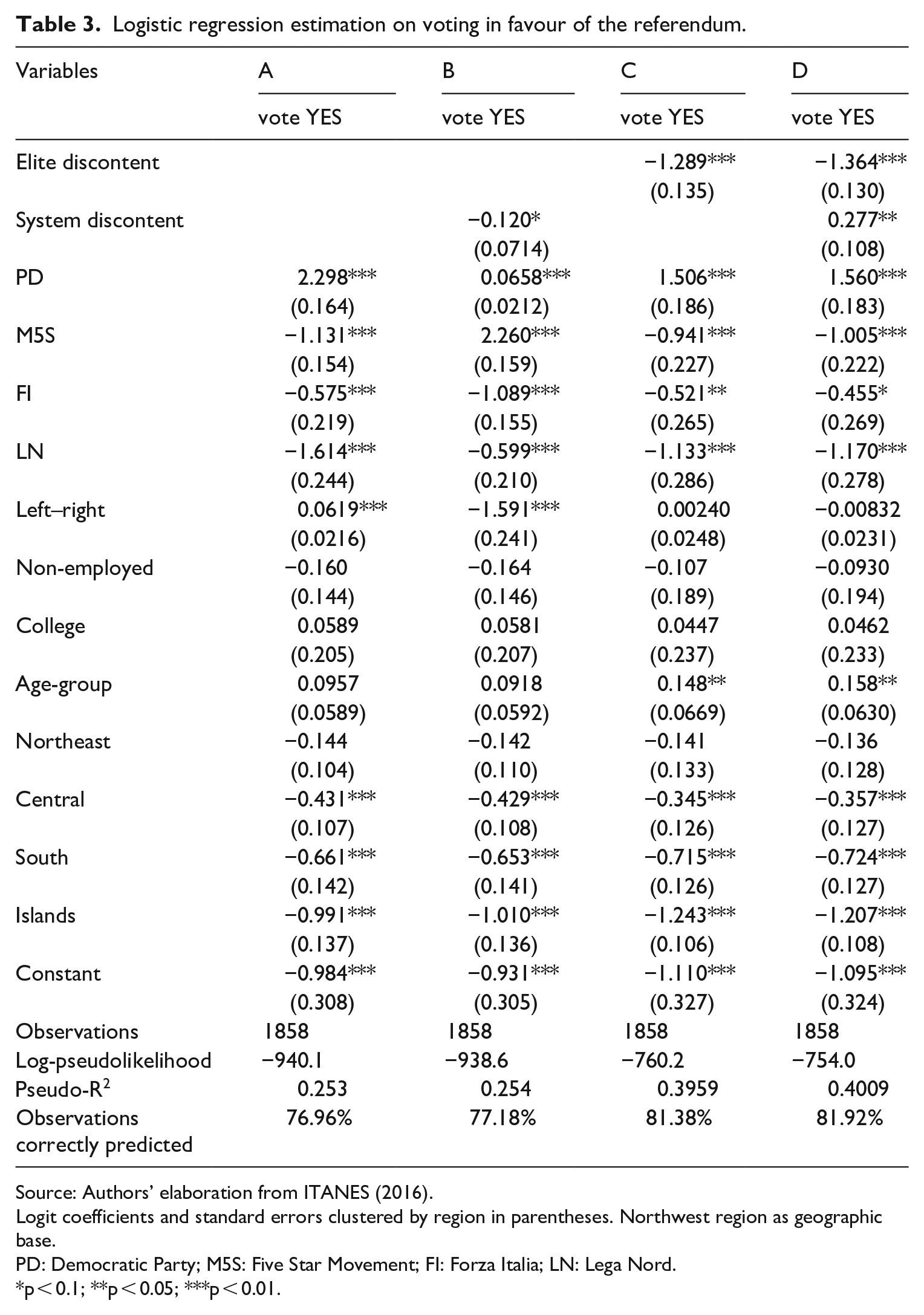
Table 3 presents the logistic regression results with the dependent variable of Voting YES in the referendum, supporting the position of the Renzi government. Column ‘A’ presents results from geographic and partisan models. As expected, those who identify with the Democratic Party – that of the Renzi government – were more likely to support the referendum. Those identifying with the 5-Star Movement, Forza Italia, and Lega Nord opposition were less likely to support the referendum. The geographic regions away from the north were also the least supportive (Bergman, 2019b). Column ‘B’ introduces the System Discontent variable into the analysis. In examining the model fit statistics, it is clear that this variable on its own adds little explanatory value. Only four more of the observations are now correctly predicted. The System Discontent variable itself also does not reach standard accepted values of statistical significance. The coefficients for M5S and PD partisanship also shift drastically, which is to be expected as these variables are the most strongly correlated with System Discontent. In short, the addition of this variable simply shifts some of the partisanship explanations of Column ‘A’ into the System Discontent variable.
Logistic regression estimation on voting in favour of the referendum.
Source: Authors’ elaboration from ITANES (2016).
Logit coefficients and standard errors clustered by region in parentheses. Northwest region as geographic base.
PD: Democratic Party; M5S: Five Star Movement; FI: Forza Italia; LN: Lega Nord.
p < 0.1; **p < 0.05; ***p < 0.01.
Column ‘C’ introduces the Elite Discontent variable to the analysis. The effect of the partisanship variables each decreases as compared to column ‘A’ as Elite Discontent is correlated with partisanship; recall that evaluation of party leaders is included in this measure. Even controlling for partisanship, the stronger one’s elite discontent, the less likely they were to report voting for the referendum. The introduction of the Elite Discontent variable produces an appreciable increase in explanatory value of the model and exhibits greater model fit statistics than both Columns ‘A’ and ‘B’.
Column ‘D’ introduces our full model, now including both Elite Discontent and System Discontent. This model has the greatest log-pseudolikelihood and pseudo-R2 measures of model fit. Furthermore, it contains the maximal amount of correctly predicted observations. All geographic and partisan variables maintain their signs and significance. What is most telling about this model is that it indicates that Systemic Discontent – recall, this is driven by opposition to the roles that parties have in contemporary politics – leads one to support the referendum, holding all else equal including one’s discontent focused specifically towards the elite. In other words, factors not at all associated with the referendum or current government had an independent impact on voting decisions.
Figure 4 presents predicted probabilities from the model presented in column ‘D’. These should be compared to the average marginal effects for the other variables found to have statistical significance. Compared to a voter that does not affiliate with any of the highlighted parties, a Democratic Party identifier is 25% more likely to support the referendum while 5-Star Movement, Forza Italia, and Lega Nord identifiers are, respectively, 13%, 6%, and 15% less likely to support the referendum. As compared to those in the Northwest, Central, Southern, and Island voters are, respectively, 5%, 10%, and 16% less likely to support the referendum. Probabilities of supporting the referendum for the full range of values for System Discontent and Elite Discontent are presented in Figure 4. 3 Varying one’s elite discontent produces almost the full range of voting probabilities. For those with average system discontent, maximal elite discontent would produce a probability of only 5% of supporting the referendum, compared with 97% for those with minimal elite discontent. System discontent works in the opposite direction. Here, shifting from minimal to maximal system discontent can increase the likelihood of supporting the referendum an additional 3% for those with minimal or maximal elite discontent to 19% for those having average elite discontent. This 19% effect is roughly equivalent to, though in opposite direction of, a mean voter shifting voter affiliation from non-major party to that of the opposition 5-Star Movement or Lega Nord or being geographically located in the South instead of the Northwest.
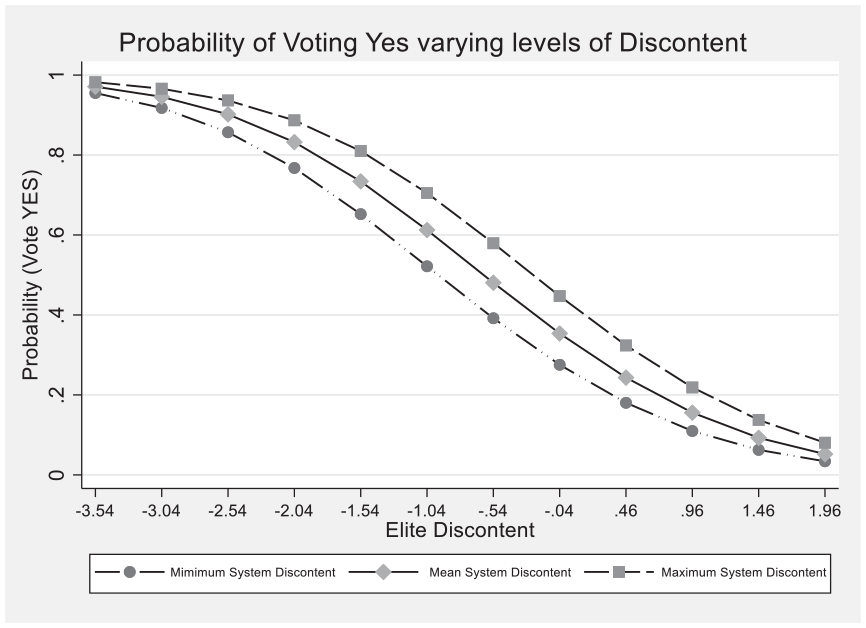
Probability of supporting the referendum by discontent levels.
Discussion and conclusion: Conflicting dimensions of protest
The Italian Constitutional Referendum of 2016 represented a political landmark due to its great consequences for government and citizens alike. The rejection by 6 voters out of 10 resulted in the resignation of Prime Minister Renzi. Commentators immediately noted the partisan nature of voting outcomes. Here, we developed an ancillary explanation: voters were motivated by expressions of protest and discontent (Bergman, 2019b). Discontent has both elite and systemic components. Consistent with voting patterns in the Italian general election of 2013 (Bellucci, 2014; ITANES, 2013), logistic regression indicated that a focused discontent with elites and the economic direction of the country drove voters to reject the referendum.
From a theoretical perspective, the high levels of systemic discontent would have predicted greater levels of support for reforming the system. The results have indeed shown that, controlling for socio-demographic, partisan, and attitudes of elite discontent, those with greater amounts of systemic discontent were more likely to support the referendum. In other words, motivations of elite discontent and system discontent conflict. Italian voters experienced a conflicting mix of attitudes: encompassing ‘positive’ feelings for the policies promoted by the referendum that addressed their ‘negative’ feelings for the parties of the establishment and the system as a whole.
Numerous conclusions for the theoretical literature can be drawn from this analysis. First, unlike the results of the Italian election of 2013, systemic discontent does play an independent role in determining opinions and actions towards the referendum (Passarelli and Tuorto, 2018). While elections, especially in proportional systems (Birch and Dennison, 2019), might not provide the best avenues for expressing system discontent, referendum participation can. Here, voters are not asked specifically to support one party in a system they do not agree with, and they can vote sincerely for the changes they wish to see.
This reinforces a second contribution: elite and systemic discontent can work in opposing directions. Here, elite discontent has played an important role in driving and emphasizing the protest vote, yet system discontent worked against such motivations promoting YES vote in the referendum. Motivations of protest and discontent acted even beyond the relevant socio-demographic factors like age (with youth keener to dislike the reform) and geographical aspects identified by previous scholars. Crucial to our argument, our multivariate analysis indicated that the discontent variables acted above and beyond partisan aspects of the referendum identified by others as explanations of the outcome (Ceccarini and Bordignon, 2017).
Finally, the statistical analysis of the independent variables suggests that the effect of the elite discontent and the system discontent is independent of one another, in that protest attitudes have a multidimensional character to them. Protest voting behaviour is a complex phenomenon that cannot be reduced to a single underlying dimension (Birch and Dennison, 2019). Our results show that in addition to the 2016 Italian referendum serving as a partisan vote on the current government, referendum votes can also serve as an avenue to express systemic displeasure. Future research should not downplay the role that broader discontent has in explanations for political behaviour. In the case of Italian politics, the two dimensions of discontent – elite and systemic – seem to produce outcomes in the same direction when it comes to voting for legislative representatives (Passarelli and Tuorto, 2018), but opposite directions in the case of referendum voting. Given the independent nature of the underlying constructs, future scholars should focus on classifying instances when these dimensions work at odds and when in concert. In particular, independence referenda advocated by regional elites (such as those in Scotland and Catalonia) would perhaps be an area ripe for future investigation.
Supplemental Material
sj-pdf-1-pol-10.1177_0263395720974975 – Supplemental material for Conflicting messages of electoral protest: The role of systemic and elite discontent in the Italian 2016 constitutional referendum
Supplemental material, sj-pdf-1-pol-10.1177_0263395720974975 for Conflicting messages of electoral protest: The role of systemic and elite discontent in the Italian 2016 constitutional referendum by Matthew E Bergman and Gianluca Passarelli in Politics
Footnotes
Acknowledgements
We would like to thank the reviewers who have critically engaged with earlier versions of this manuscript to help us sharpen our argument and empirics. Praise is also graciously offered to Dr James Strong and the Politics journal editorial team for their consistent and constructive communication. Special thanks to Italian National Election Survey (ITANES) for the preparation and dissemination of the 2016 Italian Referendum survey dataset.
Funding
The author(s) received no financial support for the research, authorship, and/or publication of this article.

Supplemental Information
Additional supplementary information may be found with the online version of this article.
Notes
Author biographies
References
Supplementary Material
Please find the following supplemental material available below.
For Open Access articles published under a Creative Commons License, all supplemental material carries the same license as the article it is associated with.
For non-Open Access articles published, all supplemental material carries a non-exclusive license, and permission requests for re-use of supplemental material or any part of supplemental material shall be sent directly to the copyright owner as specified in the copyright notice associated with the article.
