




Abstract
Many school systems integrate the teaching of economic and civic issues in one subject. This raises the question, whether economic and civic literacy should be considered unified or distinct domains. This paper examines the relationship between these two domains using data from two large-scale assessments using the same representative sample of 2848 Grade 8 students in Germany: Economic Literacy – Assessing the Status Quo in Grade 8 and the International Civic and Citizenship Education Study 2022. In these large-scale assessments, standardised tests measured economic and civic literacy and the respective self-efficacies. Exploratory factor analyses and structural equation modelling support a two-domain structure of economic and civic literacy observed in large-scale assessment data. The analysis reveals distinct results regarding the influence of literacy levels on self-efficacy in both civic and economic literacy. Moreover, the correlations between economic and civic literacy are specific to school types in the tracked school system in Germany. The analysis is based on a cross-sectional study, limiting the possibility for causal inferences. Despite its limitations, the study underscores the need for educational strategies that treat economic and civic education as distinct domains to enhance specific literacies and self-efficacy in both domains.
Keywords
Introduction
Understanding literacy and self-efficacy in economics and politics is crucial for comprehending individual behaviour and societal dynamics. Schools play a central societal role since one of their aims is to maintain and further develop the economic and civic system. In doing so, schools equip students for active participation in the economic and civic systems of their societies. Consequently, both economic and civic literacy are essential for students and society alike (Fend, 2009; Parsons, 1967).
Economic and civic literacy as well as economic and civic self-efficacy are often considered to be strongly interconnected. In existing research, strong empirical associations between economic and civic competencies are frequently interpreted as evidence of conceptual unity (Hedtke, 2023; Kultusministerkonferenz [KMK], 2018; Ministerium für Schule und Bildung des Landes Nordrhein-Westfalen [MSB], 2021). However, such interpretations often overlook domain-theoretical and psychometric considerations that allow for substantial empirical overlap while maintaining theoretical distinctiveness. Large-scale assessment research has reported comparable cross-domain associations. For example, Pokropek et al. (2022), analysing PISA data across 33 countries, showed that substantial shared variance across domains can coexist with distinct domain-specific factors. This study addresses the question to what extent can economic and civic literacy be distinguished by conducting a differential analysis for the external validation of domain-specific constructs. It examines not only the distinctiveness of economic literacy and civic literacy but also their respective significance for individual behaviour. A deeper understanding of these relationships can enrich theoretical debates and can provide practical implications for educational policy and instruction. This approach is based on the assumption that economic and civic literacy rely on partially distinct knowledge structures, problem-solving demands, and normative orientations, even when they are taught within integrated curricular frameworks.
Building on this, it is also important to consider the role of self-efficacy in educational contexts. The appropriate level of differentiation in the diagnostics of self-efficacy in educational contexts is discussed with a particular focus on whether it is advisable, from a psychometric perspective, to assume general academic self-efficacy, or subject-specific self-efficacy. Feng et al. (2015) provide empirical evidence for the convergent-discriminant validity of domain-specific self-efficacy by comparing general-factor and subject-specific measurement models using exploratory and confirmatory factor analyses. Their results showed that models with correlated subject-specific factors fitted the data substantially better than general self-efficacy models and that performance indicators were more strongly related to matching subject-specific self-efficacy scales than to non-matching domains. In other words: literacy in domain A better predicts self-efficacy A, while literacy in domain B better predicts self-efficacy B (Rost and Feng, 2024). In order to test convergent and/or discriminant validity, it is sensible to refer specifically to internal self-efficacy as it is conceptually more closely linked to individual knowledge and is less dependent on specific civic and economic contextual conditions. Against this theoretical background, this study examines the relationships between economic and civic literacy (independent variables) and civic self-efficacy and economic self-efficacy (dependent variables) using representative Grade 8 student data from North Rhine-Westphalia, Germany (N = 2848). By linking domain-specific literacy assessments with corresponding measures of self-efficacy, the study contributes to ongoing debates on domain differentiation and measurement in the social sciences.
Theoretical background
What is a domain?
According to Weinert (2001), domains are defined as specific content areas that can be construed either narrowly or broadly. Examples include chess playing, piano playing, driving, mathematical problem solving, foreign languages, or rhetoric (Hedtke, 2023; Weinert, 2001). Rather than referring to isolated skills, the concept of a domain addresses the distinct characteristics of broader areas of teaching and learning. In this sense, it raises the question of whether instructional effectiveness and learning processes differ significantly across subject areas, given that these domains involve distinct knowledge structures, problem-solving demands, and normative orientations. Specifically, it posits that the principles and patterns of teaching and learning may not be universally applicable across all fields. Instead, specific domains may possess unique characteristics and requirements that necessitate specialised instructional strategies and assessment methods (Beck, 2005).
Building on this understanding, Weißeno and Eck conceptualise domains as content areas in which literacy develops through the acquisition and interconnection of concepts, thereby suggesting that domain-specific approaches may be particularly relevant for effective teaching and learning (Weißeno and Eck, 2016).
For the purposes of developing national education standards, domains have been described as subject areas characterised by various requirements (Klieme et al., 2003; Winther, 2010). However, Tenorth (2004) argues that gaps can be revealed in the attempt to categorise domains as competency expectations in terms of ‘linguistic and literary, mathematical and scientific, historical and social, [and] aesthetic and expressive understanding’ (Tenorth, 2004). These competency expectations address general education and are shaped by curriculum-related conceptions of general education in the German context. Overlaps between areas, though relevant, are insufficiently captured by such categorisations. Accordingly, definitions of individual domains should be able to contain interdisciplinary elements. The tasks and problems, which predominantly pertain to one subject area, often require the application of interdisciplinary concepts to resolve them. A domain encompasses more than isolated actions or behaviours in specific situations or single curricular units. Rather, it refers to a broader and coherent field of knowledge and action, comparable to the objectives and core content areas of an academic subject, which may be realised differently across school types depending on curricular adaptation (Winther, 2010).
From an empirical quantitative perspective empirical studies in large-scale assessment contexts demonstrate that domains can be statistically separable, particularly when multidimensional measurement models are applied (Jude, 2008; Pokropek et al., 2022). This perspective highlights that conceptual relatedness between constructs does not necessarily imply empirical unidimensionality, an assumption that is central to domain differentiation in educational research.
Economic literacy
Economic literacy is commonly understood as the ability to act competently and autonomously in economically shaped situations of everyday life (Albers, 1995). In the tradition of economic education, this perspective emphasises responsible participation in private, professional, and societal economic contexts, and is closely linked to normative educational goals such as autonomy, responsibility, and informed judgement (Albers, 1995; Dubs, 2014). From this viewpoint, economic literacy is not limited to factual knowledge but includes the capacity to reflect on economic decisions and their consequences.
While these conceptions provide an important educational orientation, they do not, by themselves, specify how economic literacy can be empirically captured as a domain-specific construct. Domain-oriented approaches therefore focus on structured economic knowledge, authentic economic problem solving, and context-sensitive reasoning processes, for example, reasoning about incentives, trade-offs, constraints, and unintended consequences in economic contexts, that can be systematically assessed (Nicolini and Cude, 2022; Winther, 2010) From this perspective, economic literacy is distinguished from general cognitive abilities by its reliance on economic concepts and modes of reasoning that are characteristic of economic contexts. Empirical analyses of economic competence tests support this theoretical distinction, suggesting that such reasoning processes represent distinct latent dimensions that can be differentiated from general cognitive ability (Fortunati et al., 2024a).
In line with this domain-specific understanding, economic literacy in the large-scale assessment Economic Literacy – Assessing the Status Quo in Grade 8 (ECON, 2022) is defined as the ability to successfully handle economically influenced demands of everyday life across personal-financial, professional-entrepreneurial, and socioeconomic contexts, while taking sustainability aspects into account (Winther and Abs, 2024). Economic situations are expected to be comprehended, analysed, and evaluated using both linguistic-argumentative and mathematical-analytical strategies, leading to reasoned and reflective decisions and actions (Fortunati et al., 2024b). For instance, economically literate students should be able to interpret everyday economic situations (e.g., budgeting, pricing, or policy-related trade-offs) using core economic concepts rather than relying on general opinions.
In the present study, economic literacy is conceptualised as a domain-specific construct grounded in economically structured knowledge and context-sensitive reasoning. The corresponding operationalisation in ECON 2022 and its indicators are described in detail in Section [3.2].
Civic literacy
Civic literacy has been conceptualised in different ways within political science and educational research. A prominent knowledge-based conception is provided by Delli Carpini and Keeter, who define political knowledge as ‘the range of factual information about politics that is stored in long-term memory’ (Delli Carpini and Keeter, 1996: 10). This approach focuses primarily on individual's knowledge of political instructions, actors, and processes and has been widely used in empirical research on political knowledge.
Broader competence-oriented frameworks extend this knowledge-based perspective by integrating analytical and evaluative abilities. For example, Alscher et al. (2022) define civic literacy as the knowledge and abilities required to make informed decisions regarding socially relevant issues, including an understanding of civic and societal structures as well as the ability to analyse and evaluate civic processes and their impacts (Alscher et al., 2022). Within the ICCS framework, civic literacy has been operationalised through cognitive test designs that differentiate conceptual knowledge from analytical and evaluative reasoning (Schulz et al., 2025b). Similar to economic literacy, civic literacy therefore goes beyond knowledge and includes domain-specific reasoning about political problems and decisions.
In contrast to economic literacy, though, some models of civic literacy strongly emphasise value-based orientations and democratic principles as central components of civic education. The Council of Europe's model of competences for democratic culture, for instance, highlights values such as human dignity, human rights, democracy, and cultural diversity, alongside critical analytical and thinking skills (Council of Europe, 2018). While such frameworks provide an important normative orientation for civic education, they are not originally conceived as test-theoretically grounded, empirically operationalisable models of domain-specific literacy.
In empirical educational research, civic literacy is seen as an essential prerequisite for the active and self-determined participation in democratic life. It enables individuals to analyse civic phenomena, critically question political decisions, and become active themselves by developing a well-founded perspective on civic events (Hahn-Laudenberg, 2017). In the present study, civic literacy is conceptualised as a domain-specific construct that focuses on structured civic knowledge and analytical reasoning relevant for understanding and evaluating political processes. Normative orientations are treated as an important educational context and related outcome, rather than as defining features of the literacy construct itself. For example, civically literate students should be able to interpret political issues such as policy decisions or institutional responsibilities using civic concepts, rather than relying solely on personal opinions.
Delimitation of domains: economics and politics
Empirical research often reports strong associations between economic and civic literacy (Hedtke, 2023; Wahlström, 2022). However, empirical interrelations alone do not resolve the question of domain specificity. Rather, they underline the importance of a theoretically grounded distinction between overlapping but analytically separate domains. In this sense, previous analyses of social science competencies report correlations in the moderate-to-high range while still supporting multidimensional models of literacy (Pokropek et al., 2022).
Within social sciences, economic and civic education are frequently discussed within an integrative framework that emphasises the close interrelation of economic and political phenomena (Hedtke, 2023). It is highlighted that economic and political processes are deeply intertwined in shaping societal outcomes and in informing educational goals aimed at fostering informed and engaged citizens. At the same time, several authors have explicitly pointed out that substantial overlap between economic and civic education does not imply identical educational foci. Detjen and Kruber (2015), as well as Seeber (2016), emphasise that areas such as economic order, economic policy, or international economic relations are characterised by intersections between economic and politics, while remaining anchored in distinct analytical perspectives. As described above, each domain relies on specific concepts, problem types, and modes of reasoning, even when addressing related societal phenomena. In essence: the core similarity of both literacies relates to the competencies to engage not only with other people but also with structures in specific roles (i.e., consumer and citizen). However, there are also major dissimilarities. On the one hand, political literacy deals with the organization and governance of a society, including power, laws, and decision-making. On the other hand, economic literacy focuses on resource allocation, distribution, and consumption of goods to satisfy people's needs.
Teaching economic and civic literacy in lower secondary schools in Germany
As an institution, school faces the particular challenge of preparing young people to be active members of society. The effectiveness of domain-specific educational processes largely depends on the quality of instruction, as well as on curricular frameworks that define learning opportunities within and across subject areas (Hedtke, 2023). Since the sample for our empirical analyses draws exclusively on students from North Rhine-Westphalia (NRW), Germany, this section outlines key features of the school system and curricular context using the federal state of North Rhine-Westphalia (NRW) as an illustrative case.
This approach makes sense, because education policy in Germany is the responsibility of the sixteen federal states, resulting in substantial variation in school structures and curricula. NRW, the largest federal state, accounts for approximately 20% of the German population and provides a relevant context for examining the teaching of economic and civic literacy. The school system in NRW is characterised by early tracking, which begins in Grade 5 (∼age 10), when students are allocated to different school types based on achievement. These school types vary in curricular focus, degree of academic orientation, and expected achievement levels (Bundesministerium für Wirtschaft und Klimaschutz [BMWK], 2024; KMK, 2021).
Empirical research consistently demonstrates pronounced achievement differences between students attending grammar schools, which primarily prepare for university education, and those enrolled in other school types (Hahn-Laudenberg et al., 2024). Grammar schools typically place a stronger emphasis on subject-specific academic learning. This means that the teaching in grammar schools is closer to the academic domains as they are taught at universities. The institutional differences shape students’ learning opportunities and are therefore highly relevant for the development of domain-specific literacies.
As part of a curriculum reform in the year 2020/2021, the NRW government strengthened the subject area of economic education (MSB, 2021). Still, the core curricula for all school types aim to convey civic and economic literacy but also for all students (MSB, 2021). However, the integration of subject areas (civics together with economy, history and geography) differs between school types. The provision with formally qualified teachers and the profile of the subjects differ between grammar schools and the other comprehensive or less academic and more vocation-oriented school types (Hellmich, 2025). The lower number of formally qualified teachers in all non-grammar schools might be particularly significant because integrating economic and civic education into the curriculum through interdisciplinary teaching faces a particular challenge (Ziegler, 2018). Further on, the domains are represented differently in the curricula which further might lead to systematic school type specific profiles of economic and citizenship literacy and affect the degree to which they can be empirically understood as one or two domains. Eventually, the different integration of economic and civic literacy in the curricula of different school types indicates the need analyse them also separately.
Economic and civic self-efficacy
Self-efficacy constitutes a central construct in relation to economic and civic literacy, as knowledge alone is insufficient to explain individuals’ decision-making and action in complex contexts (Brandl, 2013; Diedrich et al., 2022). In psychological research, self-efficacy is defined as individuals’ beliefs in their capability to successfully cope with new or challenging situations based on their own competencies (Barysch, 2016; Schwarzer and Jerusalem, 2002). These beliefs influence motivation, persistence, and the willingness to engage with demanding tasks, even in the presence of obstacles (Barysch, 2016).
The concept of self-efficacy is rooted in Bandura's (1977) social-cognitive theory and refers to task- and domain-specific expectations of success. It is therefore distinct from broader constructs such as self-concept, which encompasses more general self-perceptions and evaluations of one's abilities (Weißeno, 2019). This distinction is particularly relevant in educational research as empirical research indicates that domain-specific measures of self-efficacy are more closely associated with domain-related learning outcomes than general self-efficacy measures (Rost and Feng, 2024).
In line with this perspective, domain-specific forms of self-efficacy can be distinguished into forms that relate to particular areas of learning and action. School-related self-efficacy refers to students’ beliefs about their ability to successfully meet subject-specific demands, whereas general self-efficacy is not tied to specific domains or instructional contexts (Weißeno, 2019; Weißeno and Schmidt, 2019). Empirical evidence underscores that the predictive power of self-efficacy varies across domains, highlighting the importance of subject-specific measurement (Rost and Feng, 2024).
Economic self-efficacy refers to individuals’ confidence in their ability to understand and manage economic situations and to make informed economic decisions. This belief is increasingly relevant in the context of globalised and complex economic decision-making situations (Bartsch and Blümelhuber, 2015; Bögeholz, 2007). Beyond acquiring economic knowledge, students need to develop confidence in their capability to apply this knowledge, persist in problem-solving processes, and act autonomously in economic contexts (Diedrich et al., 2022; Henicz et al., 2024a).
At the operational level, economic self-efficacy is reflected in individuals’ perceived ability to handle typical economic tasks and decision-making demands. These include managing personal financial situations, analysing consumption and pricing information, critically evaluating market-related influences, such as advertising, communicating economic knowledge to others, and applying numerical and conceptual economic knowledge when making informed economic decisions (Henicz et al., 2024b). Empirical findings further suggest that economic self-efficacy is shaped not only by knowledge acquisition but also by contextualised learning opportunities and everyday economic decision-making experiences (Diedrich et al., 2022).
Civic self-efficacy is considered a central factor for civic participation and a fundamental prerequisite for democratic engagement. It encompasses individuals’ beliefs in their ability to understand civic matters, evaluate political processes, and engage effectively in civic life (Maurissen, 2020; Ziemes and Deimel, 2024). Research shows that higher levels of civic self-efficacy are associated with increased civic engagement and participation, making it a central construct for understanding learning outcomes (Maurissen, 2020; Ziemes and Deimel, 2024).
From an operational perspective, civic self-efficacy is expressed through individuals’ confidence in dealing with typical civic and political demands. These include communicative activities such as articulating and defending one's views in public, participatory actions such as organising collective initiatives or assuming representative roles, and evaluative competencies such as following political debates and assessing the credibility of information on civic or social issues (Ziemes and Deimel, 2024).
Building on these conceptual distinctions, the present study treats economic and civic self-efficacy as domain-specific constructs that correspond to economic and civic literacy, respectively. While both forms of self-efficacy share a common theoretical foundation, they relate to distinct domains of knowledge, problem types, and action contexts. These domain-specific indicators are reflected in the task-oriented self-efficacy items used in the empirical analyses.
The present study
This study examines preregistered hypotheses aimed at assessing the domain specificity of economic and civic literacy and their relationships with domain-specific self-efficacy (Welsandt et al., 2024). Hypotheses 1 and 2 are non-directional and focus on conceptual distinctness and domain-specific associations rather than on assumptions of casual ordering (Figure 1):
Economic and civic literacy can be separated into independent domains.
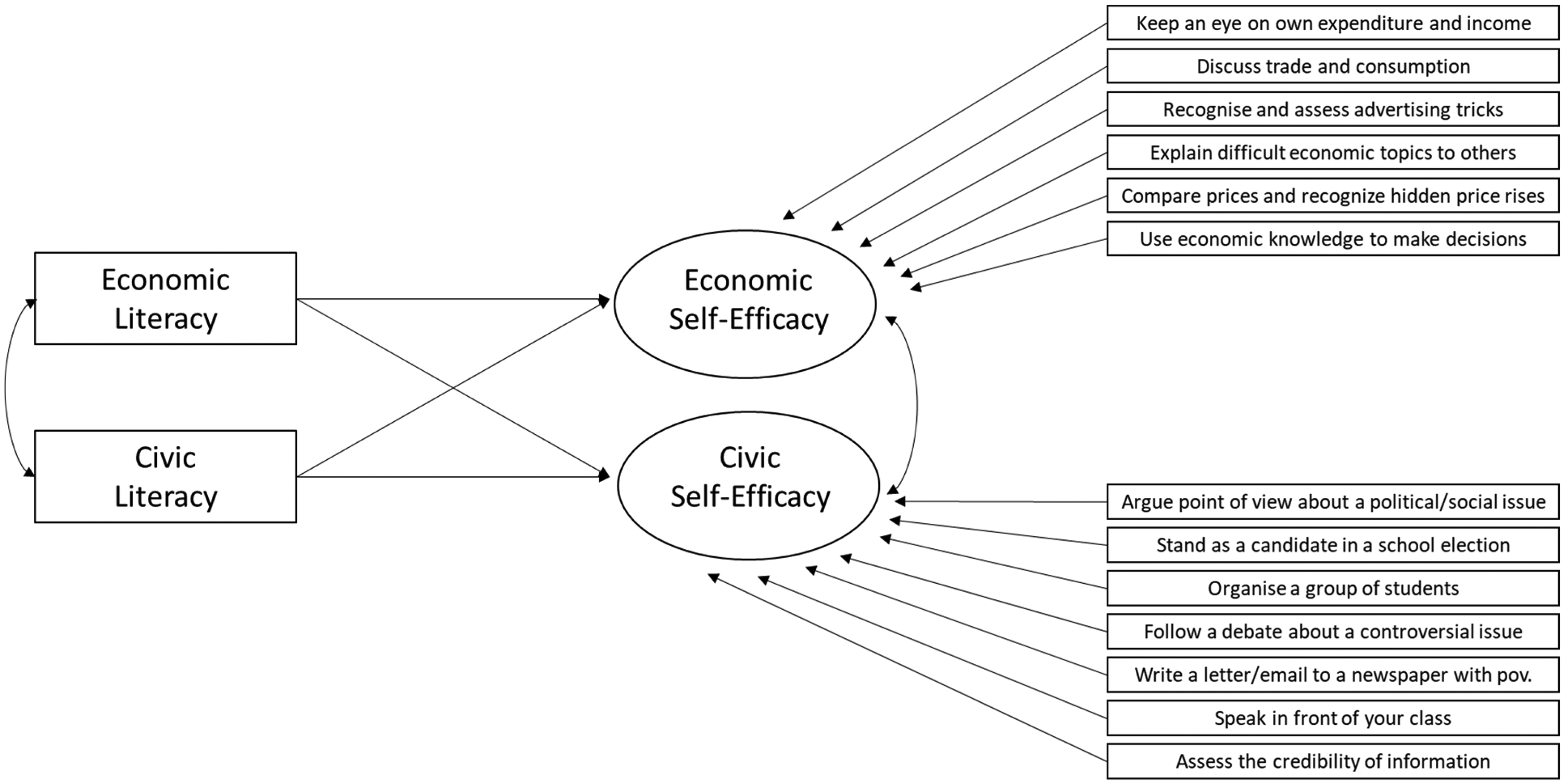
Schematic illustration of the analysed relationships.
Rather than assuming weak associations between the two constructs, this hypothesis specifies an upper threshold for acceptable overlap. A correlation below .7 is interpreted as indicating substantial relatedness while still allowing for conceptual differentiation between the domains, in line with conventions in multivariate research (Tabachnick and Fidell, 2014).
In line with the assumptions for literacy outcomes, economic and civic self-efficacy are expected to show a certain overlap without implying conceptual unity.
It is hypothesised that students at higher educational levels receive more specialised and in-depth training in both domains, leading to a clearer distinction between economic and civic literacy. Therefore, the correlation between the tests should be weaker in these schools, reflecting a higher degree of domain specificity.
At schools with the highest level of education, students are likely to develop more nuanced and distinct perceptions of their abilities in economic and civic domains. Thus, the correlation between economic and civic self-efficacy should be weaker, indicating that students differentiate their confidence in each area more clearly.
The two literacy tests allow specific predictions of students’ economic and civic self-efficacy.
If the literacy tests are valid, economic literacy should be a better predictor of economic self-efficacy compared to civic self-efficacy. This hypothesis assumes that students’ perceived ability in economics is more directly influenced by their actual literacy than their civic literacy.
Conversely, civic literacy should be a stronger predictor of civic self-efficacy. This suggests that students’ confidence in their civic understanding is more heavily based on their actual civic literacy, than their economic literacy reinforcing the idea that these are distinct but related domains.
Although alternative model specifications are conceivable, the analytical focus on literacy as a predictor of self-efficacy is theoretically grounded in the assumption that structured domain-specific knowledge provides an important basis for the development of task-related confidence. Limitations of this modelling decision are addressed in the discussion.
Methodological approach
Sample
For the analyses, data from the Economic Literacy – Assessing the Status Quo in Grade 8 Study (ECON, 2022) and the International Civic and Citizenship Education Study 2022 (ICCS, 2022); (Abs et al., 2024; Winther and Abs, 2024) were used. ECON 2022 was conducted as a national add-on study in direct connection with ICCS 2022 and complements the ICCS framework with a curriculum-aligned assessment of economic literacy for the federal state of North Rhine-Westphalia (NRW). Both studies were administered to the same representative sample of Grade 8 students in NRW with an average age of 14 years. For the present analysis, valid data were available for 145 schools and 2848 students (Deimel and Welsandt, 2024; Welsandt and Deimel, 2024).
A stratified two-stage cluster sampling design was employed to adequately account for school context conditions and to increase the precision of parameter estimates (Döring and Bortz, 2016). In a first step, the target population was stratified by school type and by the proportion of students with a migration background (cut-off value: 33%). Within strata, schools were selected using probability proportional to size (PPS) sampling. Overall, the procedure results in a representative sample of the Grade 8 student population in NRW (Deimel and Welsandt, 2024; Welsandt and Deimel, 2024).
The following figures represent the percentage share of the weighted population: 45% of the students identified as female, 54% identified as male, and 2% identified with the gender category Further Gender. Overall, 67% of the students had at least one parent who had been born in Germany; 22% of the students were born in Germany but their parents had immigrated; and 11% of the students reported having immigrated with their parents. The socioeconomic status (SES) of the students consisted of an integrated scale comprising three indicators: the parents’ occupation, parents’ level of education, and the number of books in the household. For group-based analyses, an additional variable with three levels (1 = low SES; 2 = medium SES; and 3 = high SES) was created by dividing the interval of the metric scale into three parts of equal size (Fortunati et al., 2024a).
All students completed assessment each of civic knowledge, civic self-efficacy, economic literacy, and economic self-efficacy. Detailed descriptions of the study designs, sampling procedures, data collection methods, and scaling approaches are provided in the official ICCS 2022 (Abs et al., 2024; Deimel and Welsandt, 2024) and ECON 2022 (Welsandt and Deimel, 2024; Winther and Abs, 2024) reports.
Analyses were conducted using SPSS Version 27 (International Business Machines Corporation [IBM], 2021) and Mplus Version 8.0 (Muthén and Muthén, 1998–2018). Due to the rotated booklet design employed in ICCS 2022, achievement measures were provided as five plausible values, which were incorporated using the IMPUTATION option in Mplus. Further, the COMPLEX analysis option was used to account for the nested structure of the data. The estimator used was MLR (maximum likelihood estimation with robust standard errors).
Measurement instruments
This section describes the individual scales and provides a complete list of the sets of items:
Civic literacy was assessed using the cognitive test developed for ICCS 2022, following international framework guidelines and established procedures for large-scale assessments (Schulz et al., 2025b). Test scores are reported on a scale with a mean of 500 and a standard deviation of 100, where the mean is anchored to the international average in ICCS 2009.
Economic literacy was assessed using the ECON 2022 test, which was developed following a domain-specific curricular analysis (Fortunati and Winther, 2024). ECON scores are likewise reported on a scale with a mean of 500 and a standard deviation of 100. The scale mean refers to the overall test, which integrates both numeracy-related and literacy-related economic items, which renders it possible to analyse these aspects of economic literacy separately. This common standardisation ensures that differences between subgroups can be interpreted in a comparable way across both tests.
Detailed descriptions of item development, scaling procedures and (Rasch) analysis are provided in the respective ECON 2022 and ICCS 2022 reports (Abs et al., 2024; Schulz et al., 2024; Schulz et al., 2025a; Winther and Abs, 2024).
Both scales were administered following their respective tests, introduced with an identical item stem (‘How well do you think you would do the following activities?’), and utilised a four-point Likert scale (1 = very well to 4 = not at all) as the response format. The total duration of the test session was 275 min, including the two tests followed by questionnaires and multiple breaks.
Civic self-efficacy
Civic self-efficacy was measured using a scale that has been employed in ICCS cycles since 2009 (Schulz et al., 2024), demonstrating good reliability (Cronbach's α = .88); see (Ziemes and Deimel, 2024). The scale captures student's self-assessed ability to engage in civic-related activities that vary in complexity and communicative demand. The items are:
Argue your point of view about a controversial civic or social issue Stand as a candidate in a school election Organise a group of students in order to achieve changes at school Follow a debate about a controversial issue Write a letter or email to a newspaper giving your view on a current issue Speak in front of your class about a social or civic issue Assess the credibility of information about civic or social issues
Together, these items reflect central aspects of civic engagement, communication, and evaluation that are conceptually aligned with the civic literacy framework underlying ICCS (Schulz et al., 2023).
Economic self-efficacy
The scale for measuring economic self-efficacy was adapted from the civic self-efficacy scale talking also into account the scales on ‘attitudes towards confidence and financial matters’ used for measuring financial literacy in the 2018 Programme for International Student Assessment (Organization for Economic Cooperation and Development [OECD], 2017a, 2017b), and was aligned with the economic domain model applied in ECON 2022. The scale demonstrates good reliability (Cronbach's α = .79) (Henicz et al., 2024c). The items are:
Always keep an eye on own expenditure and income Discuss trade and consumption Recognise and assess advertising tricks Explain difficult economic topics to others (e.g., the business cycle) Compare prices and recognise hidden price rises Consciously use economic knowledge to make decisions (e.g., contracting of mobile phone insurance) Calculate discounts in euros and percentages
The items capture students’ self-assessed ability to apply economic knowledge in everyday decision-making, communication, and calculation tasks. While the scale follows the same response structure as the civic self-efficacy instrument, it reflects domain-specific demands characteristic of economic contexts (Henicz et al., 2024c).
For our analysis, it was relevant to consider the length of the test session and the scales’ positioning within the overall assessment. Van Laar and Braeken, who analysed data from the 2015 Trends in International Mathematics and Science Study (TIMSS), show that the position of scales within long assessments is associated with an increased prevalence of random responses, with later scales being more affected by this than earlier ones (van Laar and Braeken, 2024). Although the testing conditions and total duration differ between TIMSS and the present study, these findings indicate that scale position may constitute a relevant contextual factor. In ECON 2022, the economic self-efficacy scale was positioned at the end of the student questionnaire, which should be taken into account when analysing our own results.
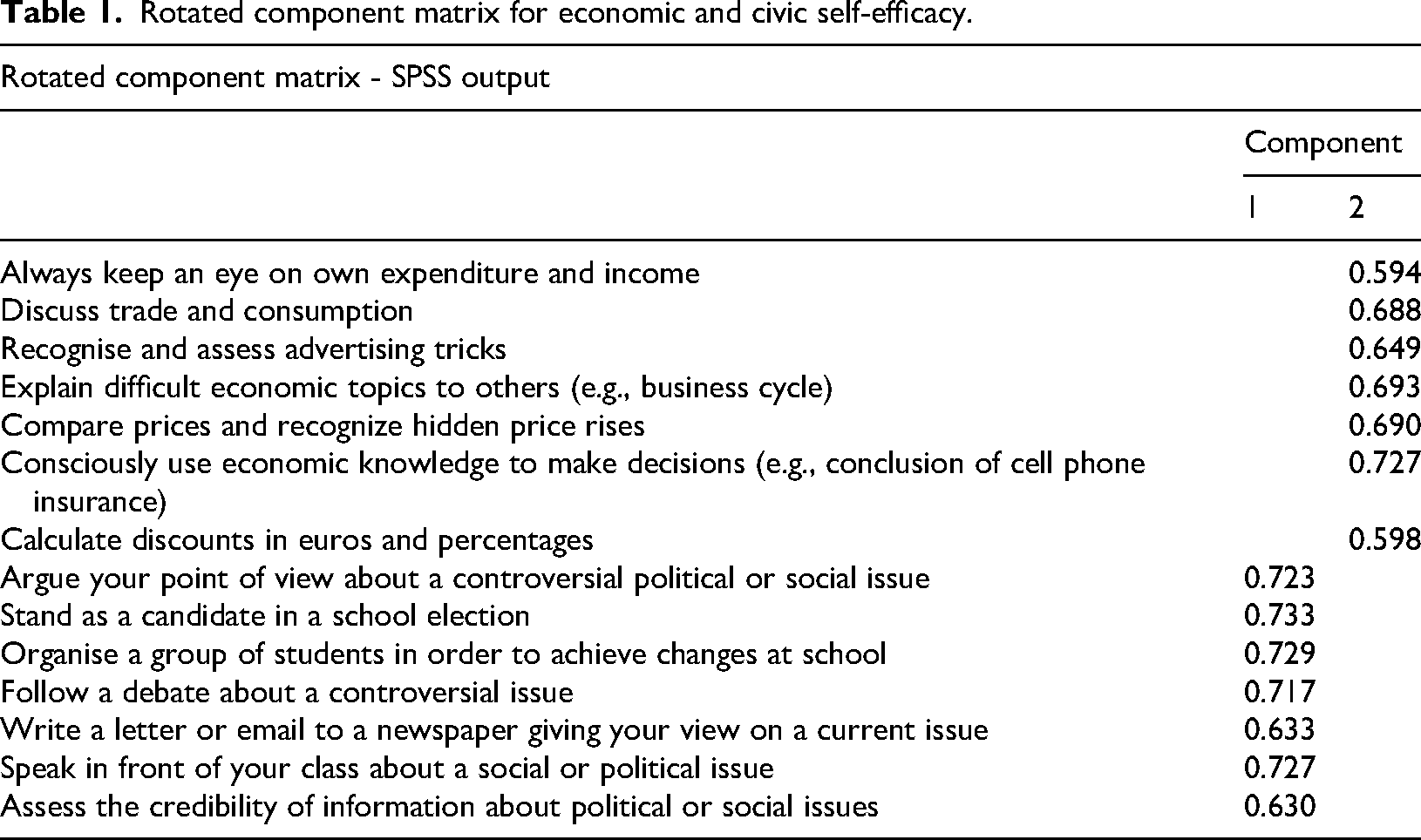
Rotated component matrix for economic and civic self-efficacy.
Statistical analyses
First, the scales for civic and economic self-efficacy were examined using exploratory factor analysis (EFA) (Moosbrugger and Kelava, 2020). This step aimed to verify the structure and validity of the scales to ensure that the underlying concepts of economic and civic self-efficacy were adequately captured. Potential issues such as ambiguities or redundancies could be identified and addressed at this stage. For this analysis, no weights were used in the calculations in SPSS (Table 1).
In a second step, the results of the two independent literacy tests were correlated to conduct a preliminary investigation into whether there was a significant correlation between the results of the two literacy tests.
Subsequently, independent regressions for civic and economic self-efficacy were calculated using the IDB-Analyzer (International Association for the Evaluation of Educational Achievement [IEA], 2022). Test scores from both the economic and civic literacy tests were used as predictors. The IDB-Analyzer employs weights to calculate population-based estimates. It also automatically corrects standard errors to accommodate the clustered nature of the school based data set (IEA, 2022). These regressions aimed to examine the specific predictive power of the test results for each domain of self-efficacy, distinguishing between civic and economic self-efficacy. By conducting these analyses separately for both domains, we were able to identify whether the relationships between the test results and each type of self-efficacy differed.
Finally, to address our hypotheses, the analyses were conducted using a latent structural equation model (SEM) in MPlus 8.0.
Results
Descriptive results
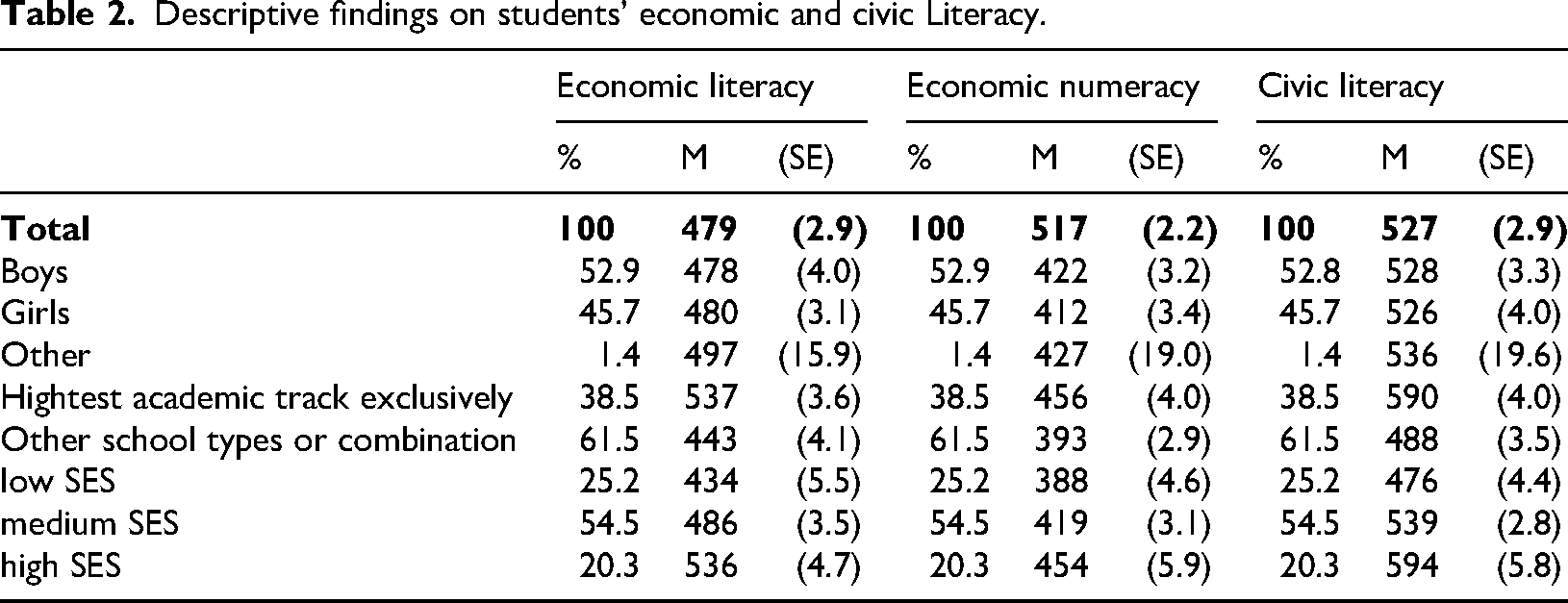
Table 2 offers a description of the demographic composition within the tested students and their test results based on demographic subgroups. The group differences for economic numeracy are considerably higher than for the two literacies, while the group differences within the two literacies are more similar. Further, students who had a high SES and who attended schools that exclusively serve the highest academic track consistently demonstrated higher levels of economic and civic literacy across all tests, exhibiting the highest overall proficiency in these areas (Fortunati et al., 2024a; Hahn-Laudenberg et al., 2024). These differences aligning with expectations that SES and school type play a significant role in the development of these literacies.
Descriptive findings on students’ economic and civic Literacy.
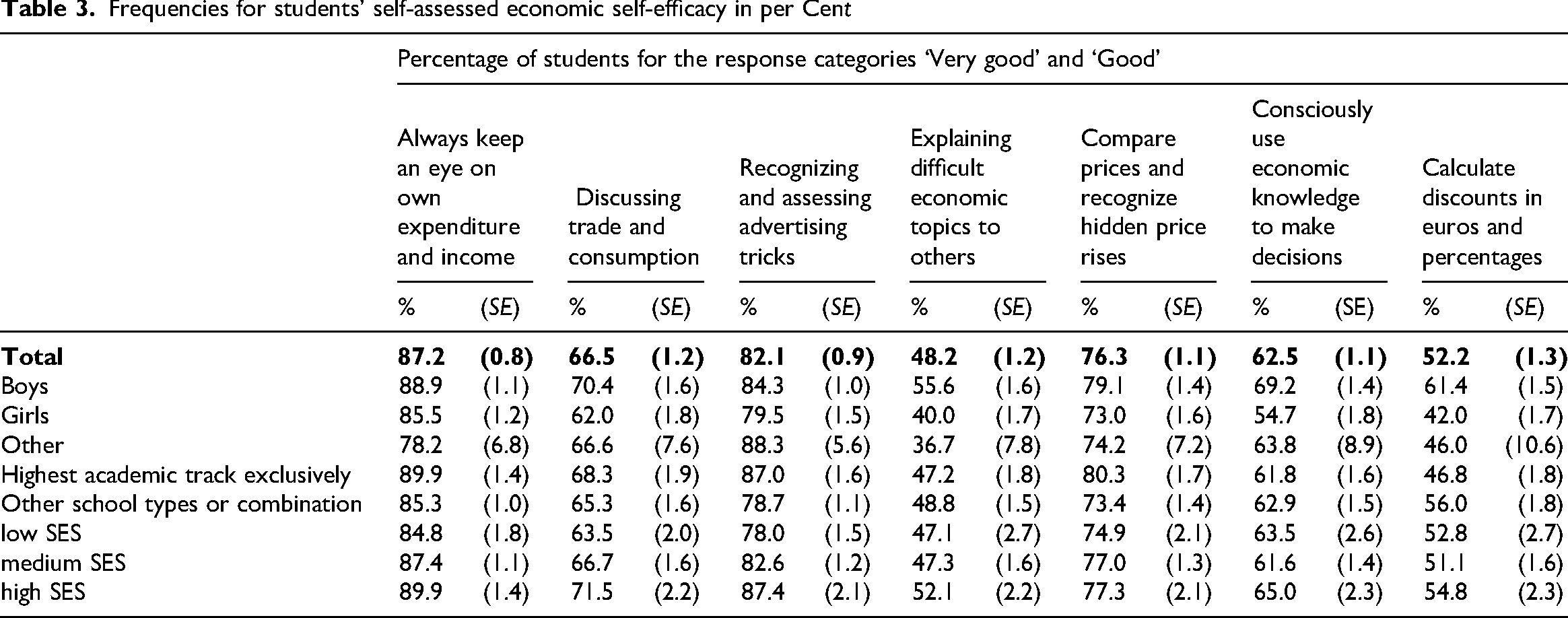
Descriptive analyses of the weighted economic self-efficacy scale (n = 2459), based on a four-point Likert scale (1 = very good, 2 = good, 3 = not so good, 4 = not good at all), showed an average value of M = 2.85 (SD = .54). Thus, students generally perceived themselves as relatively economically self-efficacious. Table 3 presents the frequencies (in percentages for the two assertive categories) of students’ self-assessment for economic actions. Notably, students exhibited significant variation in their self-assessments depending on the action context. Overall, most students (about 87%) rated their ability to keep track of their own financial situation as high. Similarly, approximately 82% of students rated their ability to recognise and assess advertising tricks as high. Boys tended to report higher economic self-efficacy than girls. The greatest gender differences can be seen in the items ‘Explain difficult economic topics to others’ and ‘Consciously use economic knowledge to make decisions’. Furthermore, students from the highest academic track often reported higher self-efficacy in specific economic competencies. The greatest effect of school type is seen in the item ‘Recognise and assess advertising tricks’. Additionally, students with a high SES reported the highest self-efficacy (Henicz et al., 2024a).
Frequencies for students’ self-assessed economic self-efficacy in per Cent
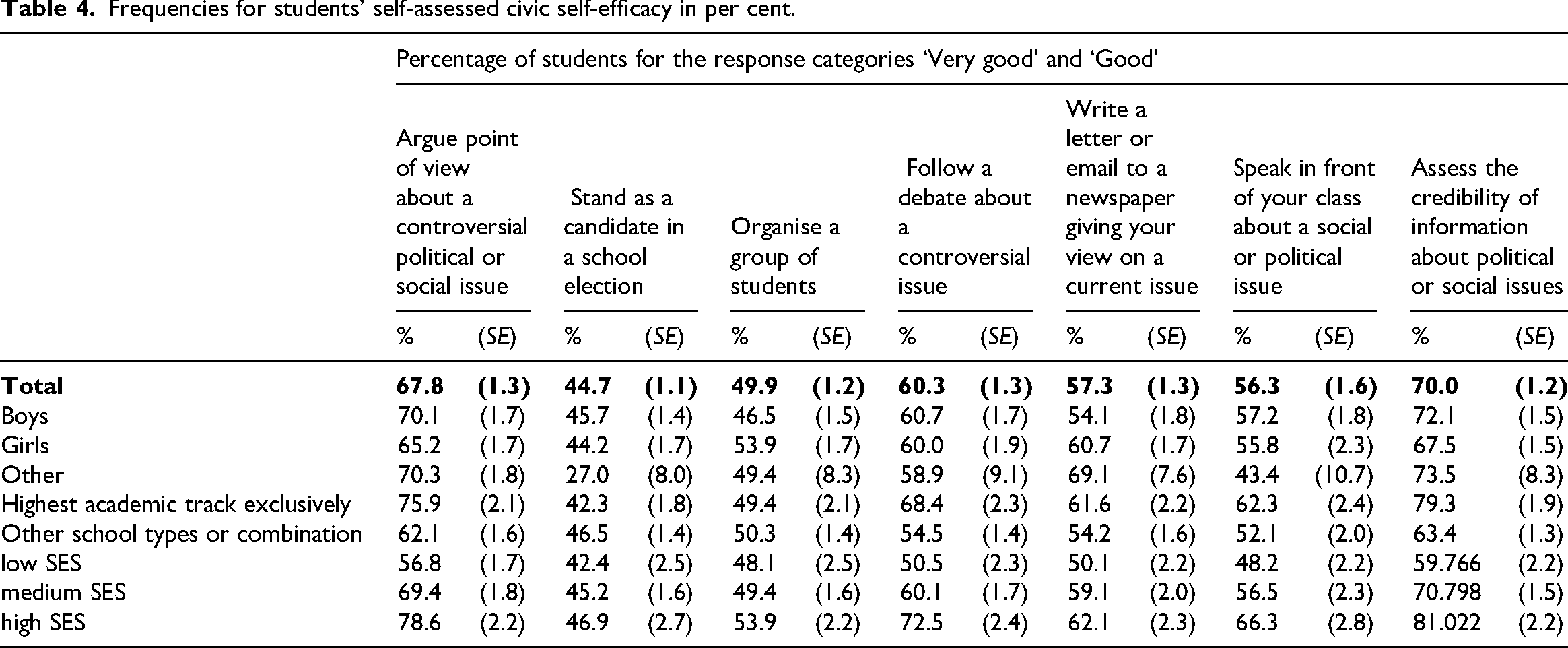
For the weighted civic self-efficacy scale (n = 2470), an average score of M = 2.65 (SD = 0.62) was calculated. Table 4 illustrates the students’ self-assessed civic efficacy. Overall, 70% of students rated their ability to assess the credibility of information as high. Furthermore, they had confidence in their ability to justify their stance on a controversial issue (approximately 67%). Students from the highest academic track often reported higher self-efficacy in specific civic competencies. Exceptions to this were the items ‘Stand as a candidate in a school election’, and ‘Organise a group of students’. Here, there was a slightly reversed effect of school type. As with economic self-efficacy, students with a high SES consistently reported greater self-efficacy. No significant gender differences were observed in the civic self-efficacy items.
Frequencies for students’ self-assessed civic self-efficacy in per cent.
The weighted correlation analyses were conducted using MPlus. Table 5 illustrates the relationships between the variables economic literacy, economic numeracy, civic literacy, economic self-efficacy, and civic self-efficacy. A strong positive correlation was observed between economic literacy and civic literacy (r = .67, p < .01). Additionally, there was a moderate positive correlation between economic self-efficacy and civic self-efficacy (r = .37, p < .01). Moreover, a slight yet significant positive correlation was noted between civic literacy and economic self-efficacy (r = .19, p < .01).
Correlations of the investigated constructs.
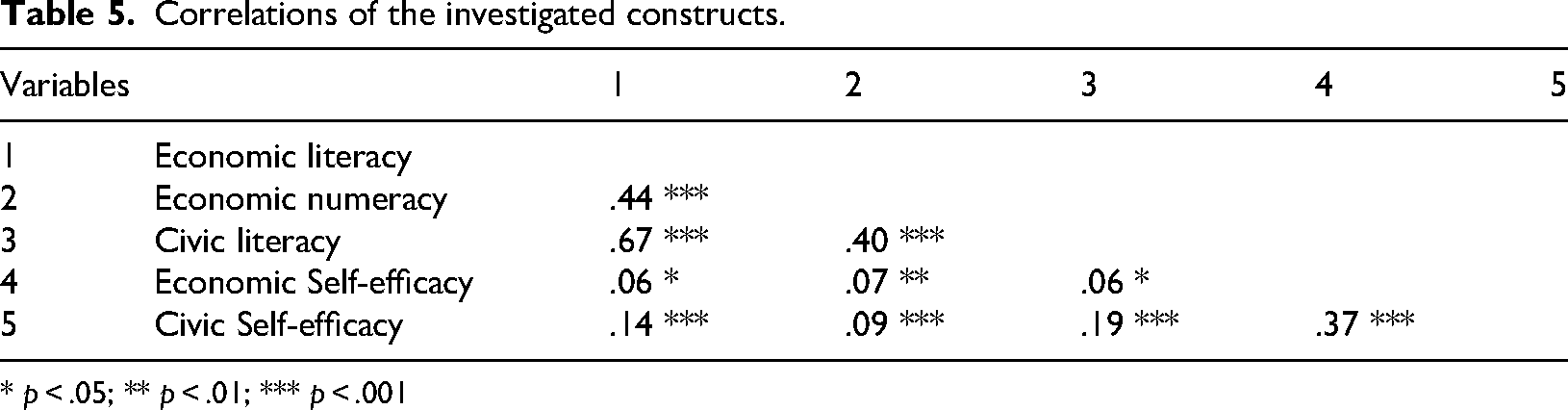
* p < .05; ** p < .01; *** p < .001
Economic numeracy was initially included in the analyses to provide a comprehensive understanding of the students’ literacy in economic contexts, considering both literacy and numeracy aspects. However, economic numeracy was not included in further analyses due to lower improved comparability with civic literacy. Economic numeracy and the mathematically-oriented item G (‘Calculate discounts in euros and percentages’) from the economic literacy questionnaire were excluded from further analyses. The methodological argument to do so, is that it otherwise would have been easier to proof our hypotheses.
Relationships between economic literacy, civic literacy, economic self-efficacy, and civic self-efficacy
The final SEM was constructed step by step to examine the relationships between economic literacy, civic literacy, economic self-efficacy, and civic self-efficacy. Before testing the full hypothesised model, smaller sub-models were created to verify individual paths.
First, the relationships between economic literacy and economic self-efficacy and those between civic literacy and civic self-efficacy were examined in separate models. The latent variable economic self-efficacy was measured by six manifest variables, while the latent variable civic self-efficacy was measured by seven manifest variables. These variables represented items that measure economic and civic self-efficacy, respectively. A small, yet significant correlation of r = .064 (p < .05) was found between economic literacy and economic self-efficacy, while a stronger correlation of r = .224 (p < .001) was observed between civic literacy and civic self-efficacy.
The model indicated that both economic and civic self-efficacy are predicted by specific literacy variables. The distributions remained stable, with only minimal deviations when the model became slightly more complex in the next step and the relationships were calculated within one model.
In the model, the two items ‘Argue your point of view about a controversial civic or social issue’ and ‘Stand as a candidate in a school election’ were correlated because both pertain to deliberative democratic activities which involve active engagement in democratic processes. In contrast, the item ‘Speak in front of your class about a social or civic issue’ might simply refer to giving a presentation, which does not necessarily involve democratic deliberation.
Upon recalculation of the model, a significant correlation of β = .061 (p < .05) was observed between economic literacy and economic self-efficacy, and a stronger correlation of β = .214 (p < .001) between civic literacy and civic self-efficacy (see Figure 2). The standardised parameters on the arrows in Figure 2 indicate the predictive strength of each relationship, where higher values suggest stronger associations between the variables. The proposed path model achieved a good model fit with the following fit indices: CFI = .91, TLI = .89, RMSEA = .05, and SRMR = .05.
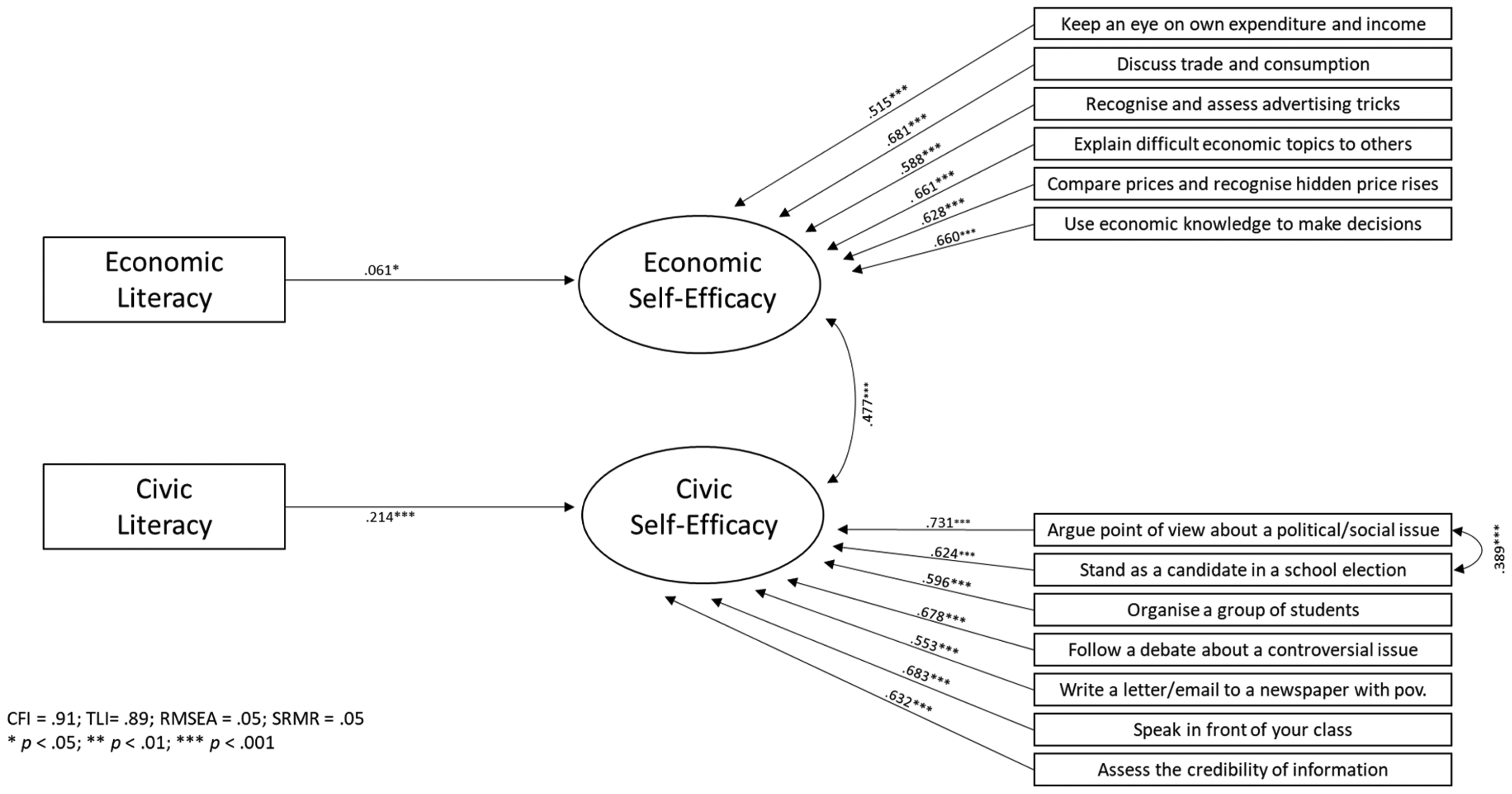
Structural equation model of the relationships between economic literacy, civic literacy, economic self-efficacy, and civic self-efficacy.
Figure 3 presents the structural equation model as a result of the final analysis. The proposed path model achieved a good model fit after including residual correlations based on modification indices between IS4G29C_inverse and IS4G29B_inverse: CFI = .91, TLI = .89, RMSEA = .05, and SRMR = .04. To verify the multidimensionality and the associated distinction between economics and politics, the measurement model was recalculated in a unified manner. In this approach, economic literacy and civic literacy were not considered separately but rather as a single, cohesive domain. In other words, the model was designed to assume a unified, undifferentiated structure for both areas of literacy instead of treating them as separate and independent factors. The aim of this recalculation was to determine whether the data would fit better with a model that views economics and politics as a single domain. However, the results indicated that this unified model did not provide better fit indices, leading to the conclusion that a two-factor solution appears more appropriate.
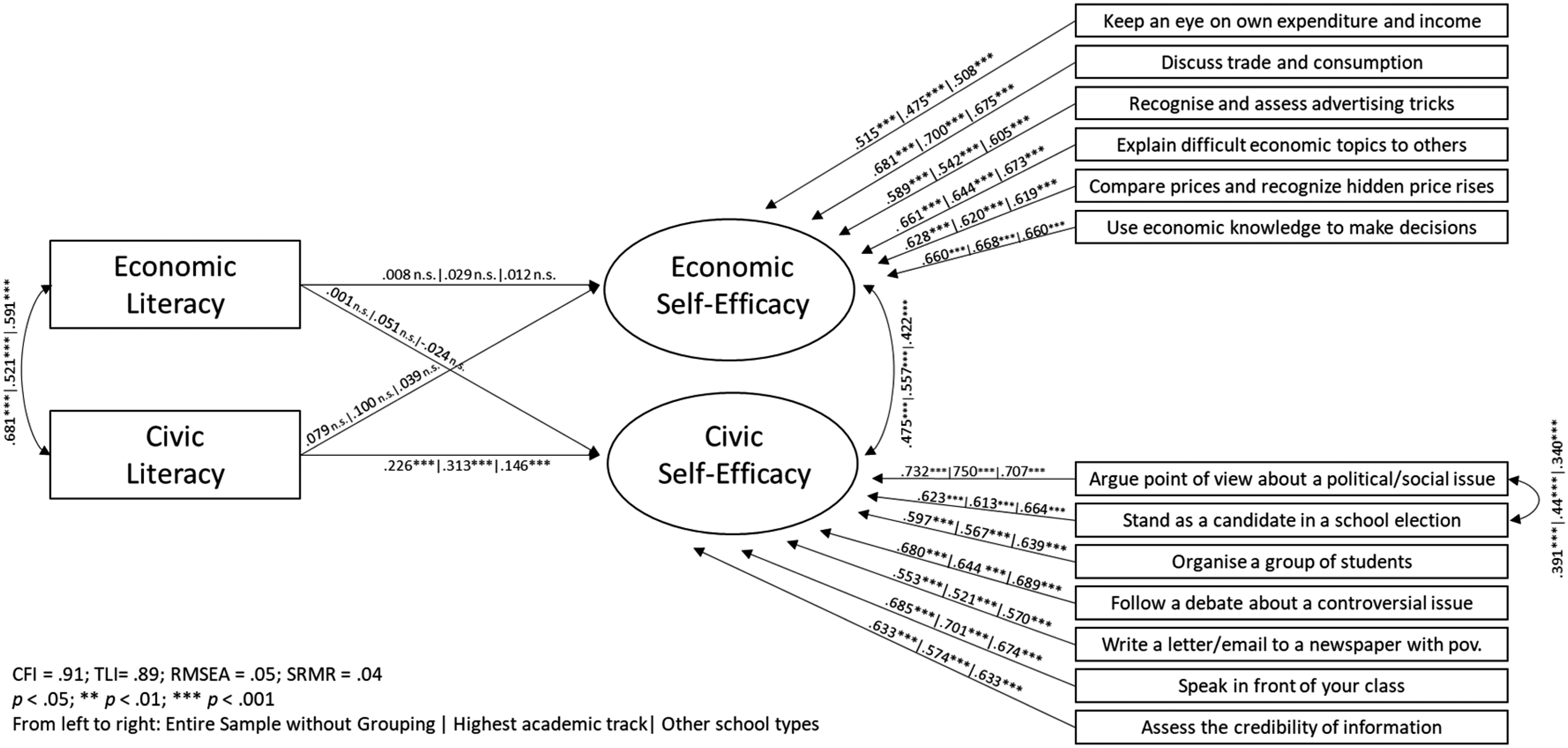
Structural equation model of the interactions between economic literacy and civic literacy and their self-efficacy.
Regarding Hypothesis 1.1, the research findings (see Figure 3) showed that the correlation between civic literacy and economic literacy in the entire sample was r = .681 (SE = .015, p < .001). This correlation is below the maximum assumed value of r = .7. However, and as expected, it suggests a considerable relationship between the two constructs of civic and economic literacy. The correlation indicates that while economic and civic literacy share some conceptual space, they are sufficiently distinct to be treated as separate domains. In the context of social science research, such correlations are common when measuring related but distinct constructs, and the correlation below r = .7 suggests that they are not identical or redundant. The moderate overlap points to shared elements between the two literacies, but not to the extent that they collapse into one construct. This is consistent with the conceptual distinction between economic and civic literacy, which, despite some commonalities in their underlying components, focus on separate sets of knowledge and skills.
The results for Hypothesis 1.2 indicated that civic self-efficacy was measured strongly by all individual items, and likewise, economic self-efficacy was strongly represented by its respective individual items. The correlation between civic self-efficacy and economic self-efficacy was r = .475 (SE = .028, p < .001), which falls well below the maximum assumed correlation of r = .7. This moderate positive correlation suggests that while economic self-efficacy and civic self-efficacy share some cognitive and motivational components, they remain distinct. The overlap reflects a shared self-confidence in one's abilities across both areas, but it is not sufficient to merge them into a single self-efficacy construct. These findings support the hypothesis that the two constructs, while related, are independent, reinforcing the conceptual separation between economic and civic self-efficacy.
School type specific analyses for Hypothesis 1.3 showed that in grammar schools, a correlation of r = .521 (SE = .030; p < .001) existed between civic literacy and economic literacy, while the correlation for other school types was r = .591 (SE = .019, p < .001). The weaker correlation in grammar schools supported the hypothesis that the correlation between literacy tests is school type specific and indicated that the domains are more distinct in these schools.
The results for Hypothesis 1.4 indicated that the correlation between civic self-efficacy and economic self-efficacy in grammar schools was r = .557 (SE = .040, p < .001), while in other school types it was r = .422 (SE = .041, p < .001). Although the self-efficacy aspects varied by school type, the hypothesis of a lower correlation in grammar schools was not supported.
Furthermore, the results for Hypothesis 2.1 showed that economic literacy had no significant predictive power for economic self-efficacy in the entire sample (β = .008, SE = .041; n.s), when we control for effect of civic literacy in the model. In grammar schools, the predictive power was β = .029 (SE = .063; n.s.), and in other school types, it was β = .012 (SE = .045, n.s.). These results contradicted the hypothesis that economic literacy explains more variance in economic self-efficacy than in civic self-efficacy.
The results for Hypothesis 2.2 indicated that civic literacy had significant predictive power for civic self-efficacy in the entire sample (β = .226; SE = .037; p < .001). In grammar schools, the highest significant predictive power was observed (β = .313; SE = .052; p < .001), while it was also significant but slightly weaker in other school types (β = .146; SE = .041; p < .001). This finding further confirmed the hypothesis that civic literacy explains more variance in civic self-efficacy than in economic self-efficacy.
Discussion
The present study investigates the distinctions and relationships between economic and civic literacy and their respective influence on (domain-specific) self-efficacy with a particular focus on the validity of treating these literacies as separate domains. The findings contribute to a better understanding of how economic and civic literacy independently and jointly shape individuals’ confidence in their abilities to perform tasks within these domains, which can inform educational interventions and policy decisions aimed at fostering informed and engaged citizens. From a subject-didactic perspective, these findings contribute to ongoing debates about the relationship between economic and civic education. While integrative socio-economic approaches emphasise the interconnectedness of societal issues (Hedtke, 2023), the present results suggest that learners nevertheless develop partially distinct competence structures. This supports the assumption that economic and civic education may share thematic overlaps while maintaining different epistemic logics and learning trajectories.
Empirically, the results indicate that, while the literacy tests from ECON 2022 and ICCS 2022 are positively correlated, economic and civic literacy can and should be considered separate domains. This finding supports the validity of modelling these literacies as separate but related constructs. Importantly, the observed correlation is of a magnitude that is typical for theoretically neighboring domains within the social sciences and does not, in itself, contradict the assumption of domain-specificity. Rather, such correlations can be interpreted as reflecting shared foundational cognitive and educational processes, while still supporting meaningful domain-specific variance.
Findings from bifactor modelling approaches indicate that a substantial proportion of the shared variance across domains can be attributed to a general factor, while additional domain-specific variance remains, with its magnitude varying across domains (Pokropek et al., 2022). Theoretically, strong associations between related competencies are to be expected when they develop and are assessed within similar educational contexts. Research on language competencies for example demonstrates that substantial overlap can coexist with clearly distinguishable dimensions, provided that measurement is sufficiently fine-grained (Jude, 2008).
Developmental perspectives further suggest that competence structures become more differentiated as overall proficiency increases: at lower levels, more general patterns tend to dominate, whereas higher levels of competence allow clearer separation between subdomains. Such differentiation may become visible when learners increasingly recognise that economic questions invite model-based abstraction, whereas civic questions require weighing competing societal perspectives and normative arguments. Evidence from large-scale assessments supports this view, showing that multidimensional structures are more apparent among higher-performing groups, while lower-performing groups often exhibit a dominant general factor (Jude, 2008). Thus, the observed correlation between economic and civic literacy does not call their distinctiveness into question but rather reflects a combination of shared cognitive resources and domain-specific knowledge structures.
Rather than representing purely statistical distinctions, the identified domains can also be interpreted as reflecting different subject cultures that structure how knowledge is produced, discussed, and legitimised in classroom settings. Therefore, high quality school education might help students to differentiate between these two domains. From a subject-didactic perspective, this differentiation may indicate that more specialised curricular structures and subject-specific instructions support clearer domain distinctions. This aligns with discussions suggesting that disciplinary depth fosters differentiated competence development in socio-scientific domains. The results underscore the need to treat economic and civic education as distinct disciplines in educational planning and policy. For educational practice, this means that teachers should consider both domains separately and promote specific content and literacy in these areas. An integrated approach that emphasises the intersections but respects the independence of each domain could help students develop a strong foundation in both economic and civic areas. Teachers should not only highlight the intersections between economic and civic knowledge but also ensure that both domains are addressed independently to promote comprehensive literacy and self-efficacy. Rather than advocating strict subject separation, the findings suggest that integrative curricula may benefit from explicitly addressing the distinct analytical lenses of economic and civic education. Didactic approaches that make these perspectives transparent could help learners navigate the intersections between on the one hand consumer and further economic roles as well as on the other hand citizen roles more consciously. An integrated approach emphasizing both overlap and independence will support a balanced development of economic and civic competencies in students.
The results suggest that targeted promotion of domain-specific literacy can also enhance domain-specific self-efficacy. This is particularly important as the study shows a significant correlation between literacy and self-efficacy in both areas. The civic and economic self-efficacy constructs should be considered distinct due to their moderate positive correlations and their differing relationships with civic and economic literacy. The comparatively small association between economic literacy and economic self-efficacy (β = .008), contrasted with the stronger association between civic literacy and civic self-efficacy (β = .226), suggests that economic self-efficacy may depend less on cognitive proficiency alone and more on contextualised- learning experiences and opportunities for application. Similar patterns have been documented in achievement–belief research, where knowledge measures explain only limited variance in motivational constructs (Honicke and Broadbent, 2016). Rather than indicating a lack of relationship, this pattern highlights the conceptual distinction between competence and beliefs and supports the assumption that domain-specific self-efficacy is shaped by both cognitive and experiential factors. This finding aligns with the broader educational assumption that competence development and motivational beliefs are related but not reducible to one another (Jude, 2008). Consequently, the finding indicates that economic education requires opportunities for contextual application, such as engagement with contexts close to the lifeworld to strengthen learners’ self-efficacy.
In contrast, the finding that civic literacy is a stronger predictor of civic self-efficacy (β = .226) aligns with the understanding that civic education often provides direct opportunities for practical engagement, which are crucial for developing confidence in one's civic abilities. Educational environments, particularly grammar schools, appear to offer more resources and formats that allow students to apply civic knowledge in contextualised settings (Deimel et al., 2024). Such opportunities for active engagement foster greater civic self-efficacy by enabling students to experience agency in democratic processes. Hedtke's (2023) emphasis on the role of educational environments in shaping domain-specific literacy and self-efficacy supports this interpretation.
In summary, the results of the here presented analyses suggest that the importance of literacy for self-efficacy depends on both the type of literacy and the educational environment. While civic literacy provides a strong basis for developing civic self-efficacy in grammar schools, economic literacy alone does not seem sufficient to promote high economic self-efficacy. These findings highlight the need to design educational programmes in a differentiated manner, addressing the specific needs and conditions of real-world and personally relevant contexts across different school types.
Despite the insights gained, the study has some limitations. First, the analysis was based on a cross-sectional study design, limiting the ability to draw causal inferences between literacy and self-efficacy. Longitudinal studies would be needed to better understand any causal relationships and to examine the long-term development of these constructs. Second, the analysis was based solely on data from the German federal state of NRW, which limits the generalisability of the results to other regions or countries. Future studies should therefore conduct similar analyses in different cultural contexts to examine the transferability of the findings. Third, it should be noted that the assessment of economic self-efficacy was placed at the end of the lengthy assessment period, which might have promoted deviations in response behaviour due to fatigue. Finally, the respective tests measure not only different domains, but also different proficiency levels. Particularly, the ECON 2022 test includes also questions on economic numeracy and is mainly therefore more challenging than the ICCS 2022 test, which might also lead to deviations in student responses.
The study raises several questions for future research. It would be interesting to investigate the dynamics and interactions between economic and civic education in different age groups in more detail. This could provide insights into how the relationships between literacy and self-efficacy develop over the course of students’ school careers. Furthermore, qualitative studies could complement the quantitative analyses by providing valuable insights into the subjective experiences and perceptions of students regarding their self-efficacy and literacy in the assessed areas.
Importantly, the aim of this study is not to demonstrate a strict separation or independence between economic and civic literacy in the sense of non-overlapping constructs. Rather, its contribution lies in showing that both literacies represent empirically distinguishable domains that share foundational cognitive resources while remaining meaningfully domain-specific. From this perspective, substantial correlations do not undermine construct validity but instead reflect the embeddedness of domain-specific literacies within broader educational and developmental contexts.
In conclusion, the findings do not argue for dissolving interdisciplinary teaching approaches. Instead, they highlight the importance of recognising disciplinary perspectives within integrated socio-economic education. Empirically, learners appear capable of developing differentiated economic and civic literacy structures even within shared curricular frameworks, suggesting that domain-sensitive didactic designs may strengthen both literacies simultaneously. The results underscore the importance of the targeted promotion of both areas of literacy and self-efficacy to enable students to act competently and confidently in society. In this sense, understanding how literacy and self-efficacy develop across economic and civic domains contributes to explaining how individuals navigate complex societal contexts and participate in economic and democratic life.
Footnotes
Acknowledgements
This research study is part of the ECON 2022 (ECON 2022 Economic Literacy – Assessing the Status Quo in Grade 8) project, funded by the Ministry of School and Education of the State of North Rhine-Westphalia (https://www.uni-due.de/edu-research/econ2022_en.php) and of the ICCS 2022 (International Civic and Citizenship Education Study 2022) project, funded by the Ministry of Education and Research ( ).
).
Authors’ contributions
NW had the lead on authorship, drafted and developed the manuscript, and analysed the data. JZ supported the data analysis. The research was supervised by Prof. HJA. All authors designed the study. All authors have approved the manuscript for submission.
Funding
The authors disclosed receipt of the following financial support for the research, authorship, and/or publication of this article: This work was funded by the Ministry of School and Education of the State of North Rhine-Westphalia as part of the ECON 2022 project and by the Federal Ministry of Education and Research as part of the ICCS 2022 project.
Declaration of conflicting interests
The authors declared no potential conflicts of interest with respect to the research, authorship, and/or publication of this article.
Availability of data and materials
All data are available from the corresponding author on reasonable request.