




Abstract
The aim of the theme issue is to provide analysis of intersections of historical and democratic consciousness expressed in official curriculum documents such as syllabuses that focus on history in eleven countries. Each of the nation states were selected for their diverse trajectories of democratic developments and political cultures. Drawing on comparative education, policy enactment, and critical discourse analysis the content in the official curriculum documents is approached as texts that are informed by historical ideas of the purposes of education that influence present and future orientations and actions. The articles in this theme issue address the following key questions: 1. How is the intersection between historical consciousness and democratic consciousness described in curriculum and/or syllabus documents regarding the history subject in the selected countries?; 2. What kind of consequences for history education do the descriptions in the curriculum and/or syllabus entail?; and 3. How are the democracy traditions of each selected country reflected in the official knowledge of the various curriculum documents?
Keywords
Introduction
Today history teaching in democratic nations is often expected to develop students’ critical and multilayered thinking and commitment to democratic values and human rights; yet History teaching has also served as an instrument for undemocratic and nationalist ideas (Carretero, 2011; Karlsson, 1999). While notions of democratic citizenship and associated values can be an aim of history teaching, the subject does not in and of itself guarantee that democracy will be taught—or learnt. There is a need to scientifically explore the interlink between historical and democratic consciousness. It is recurringly emphasized that democracy is a vague term often taken for granted and as such emptied of meaning (Nancy, 2011), or understood in a variety of, and sometimes contradictory, ways (Nancy, 2006; Ranciére, 2011). The open character of democracy can be seen as a necessity for being vibrant, but at the same time if it means everything it becomes meaningless (Säfström and Biesta, 2001). Even though democracy can be approached in a variety of ways, it stands out compared to other governing forms, especially in enabling support for equity and providing choice and freedom of self-determination for citizens of various nation-states, governing districts such as councils and local government areas, and other geographically bound areas where people reside. Consciousness and democratic consciousness form an international perspective in more depth. Democratic consciousness here is understood as ideas about democracy expressed through a complex set of historically loaded values, ideas, and practices expressed through language (Edling et al., 2020) and analysed through a discourse-historical approach (Wodak, 2015). Without a temporal orientation that is sensitive to both continuities and discontinuities in people's meaning-making, there is a limited space for pluralism and democracy; democratic pluralism is hinged upon the aim of people working for a better future while recognising the past both as a resource and a restraint to their thoughts and actions in the present.
It is possible, and certainly common, to argue that the notion of democracy was created in Ancient Greece about 500 BCE, due to circumstances stemming from a deep interest of people living in this geographical locale for fairness and equal opportunities. Indeed, democracy “develops out of what we might call the logic of equality” (Dahl, 1998, p. 10) and an idea that every single person in a constitution is “considered as politically equal (p. 37). It is not by any means a perfect system of government, but it can be argued is the only one that aims at “exercising moral responsibility” (p. 55) and has the potential to do less harm to the interests and fundamental rights to culturally diverse citizens in a nation (p. 48). The path of democracy as a governing form is not straight forward but has erupted in various parts of the world as a response against hierarchy and the dominance of the few and subsequently as a hope for a more just and equal co-existence between citizens of diverse backgrounds and national origins. When the interest in maintaining citizen equality no longer exists, democracy as an idea cherishing plurality as well as actionable and practical forms of governing ceases to exist. Bluntly put, what makes democracy different from other governing forms is that it not only accepts but protects ‘the fact that individuals within society have different conceptions of the good life, different values, and different ideas about what matters to them’ (Biesta, 2010, p. 24).
The brutality of the two world wars in the twentieth century led to a rebirth of democracy in European nation states; with their educational systems largely seen as a remedy against various forms of fundamentalism and dogmatism (Edling and Mooney Simmie, 2020; Sant, 2019). From an educational point of view, a democratic mindset is not something that we are born with but can be seen as a ‘cultivated imagination’ stimulated in a community with others in which the individuals can learn to pay regard to others (Barber, 1992, p. 43). Although, democracy today is a global phenomenon (Peterson, 2011), and the number of nations adopting this system of government has increased between 1990 and 2020, it is currently being contested in many countries, even those with seemingly stable democratic traditions (Galston, 2020), strengthening autocracies to continue being a globally dominant regime (Alizada et al., 2021). Democracy is believed to be under pressure because of an increased mistrust towards the liberal democracy's capability to handle equity through distribution and recognition (Fracer, 2017) challenged by neoliberalism, meritocracy, and globalization. It has also been weakened, due to the strengthening of fundamentalism and right-wing populist movements based on dichotomies like for example, majority contra minority, homogenous ‘good’ people against dangerous foreigners, order against disorder, the elitists against the real people, and so forth. Finally, the restrictions that accompanied government responses to the covid-19 pandemic have tended to remain (Brown et al., 2020) and can be used for creating new restraints that obstruct people's fundamental human rights and freedom (Lopez Facal and Schugurency, 2023; Rapeli and Saikkonen, 2020). Considering this, history education plays a pivotal role in challenging populist and simplified narratives of the past (Bentrovato & Schulze, 2016; Council of Europe, 2021).
Different aims for history education can be found in national curricular documents of various nation states. They range from supporting specific identities to character education and developing student skills in critical thinking in the context of interpreting historical sources or evaluating uses of history in political discourses. Among the aims of education, it is common to find the supporting of democratic skills and sustaining student's adherence to democratic values in society explicitly outlined in various curriculum documents.
However, the connection between history education and democracy education is generally not explicitly described where the beneficial effect of learning history on student's democratic citizenship derives from and how learning history actively contributes to democratic citizenship. The two ideas of historical thinking and democracy are not brought together, for example, whether some historical topics are particularly relevant for the purpose of promoting students’ democratic orientation and how they could be approached in the classroom is not a focus in curriculum documents Other key considerations such as which historical actors and agents would be important to discuss and what kind of questions should be posed to students; what role students take in history learning that can best cultivate their democratic orientation; and importantly, how developing students’ democratic citizenship connects with developing their moral sensitivity and reasoning––their moral consciousness––in the context of history learning.
The contents of written history curricula do not necessarily fully coincide with what takes place in the history classroom—the enacted curriculum—but the written documentation is an authoritative statement on what should be the focus and the objective of teaching and learning. When education systems or jurisdictions have high stakes, external examinations set for the student body, there can be strong claims made that the written document is being followed (Sharpn, 2019). In different national settings, the process of constructing the curriculum may take different forms, for example, documentation may be structured differently, content deemed important and suitable to teach school students across various countries differs significantly, and how the teaching and learning requirements are documented is not heterogenous. Therefore, comparison across different nation states requires careful understanding of each nation's context and how they can be compared and contrasted across different education contexts or jurisdictions. This is crucial to take into account in a joint international curriculum study like the one whose results are reported in this special issue. The curriculum and syllabus documents from the following countries is analysed: Australia, Denmark, Finland, Ghana, Norway, Spain, Israel, Sweden, and Turkey. Whatever its form, the formal curriculum is intended to serve as the mandated requirement to schools and teachers for implementation. In that role an analysis of the formal curriculum is of central importance to understand how democracy education and history education are considered, explicitly or implicitly, to connect.
Aim and main research questions
The issues identified above present challenges for addressing the development of democracy in relation to history education. Contemporary challenges towards democracy as a governing form, revives the need to learn about the past and explore ways in which democracy comes into play in history education. It is important to define the boundaries and establish a basic common ground for what democracy is and what it represents. While in some nation-states elections are free and open and the outcome is not pre-determined, in other jurisdictions elections are a closed entity with the winner being known in advance and intimidation tactics used to either deter people from voting or to enforce their voting for a specific candidate. In this second way, democracy is less a government system but rather a label applied to governance.
It is common and popular for media commentators, politicians, and the general public to refer to a kind of ‘golden age’ of the past in a nation's history when societal ideals are discussed. This is particularly the case when there are economic and social difficulties present—people look back with rose tinted glasses, considering a time when the nation was prosperous—or at least seemed that way. This has been seen in recent years via the United States Make America Great Again populist movement and its predecessor Tea Party Movement, for example. Those who are key players in this movement, have expressed anti-democratic sentiments and believe that there should be a return to a different, usually undefined, time in the nation's history (Lepore, 2010)—this is exemplified through the key word in their slogan, Again, historical perspectives are central when looking for ideals of a democratic society. History is often used as a tool to argue and to legitimize various political perspectives and is often co-opted to motivate particular practical actions. History as teaching and education—not just a political concept—is expected to convey knowledge about the past in order to prepare students to be citizens, taking responsibility for systems of government. In some countries governmental projects aiming at educating for democracy have been criticized as simplified and instrumental ways of using the past. However, historical perspectives have the potential to stimulate reflective thinking over time or between layers of time. A historical perspective can explain why the present society is organized as it is. Turning to the past can also help us understand how life was in different times and also opens conversations for considerations on what is worth keeping and bringing into the future as well as how the future could be framed. This way of reflecting on meaningful temporal relations is described as a historical consciousness.
The aim of the theme issue is to provide analysis of intersections of historical and democratic consciousness expressed in official curriculum documents such as syllabuses that focus on history in eleven countries. Each of the nation states were selected for their diverse trajectories of democratic developments and political cultures. Drawing on comparative education (Kazamias, 2009; Kallo, 2012), policy enactment (Ball et al., 2012), and critical discourse analysis (Wodak, 2015) the content in the official curriculum documents is approached as texts that are informed by historical ideas of the purposes of education that influence present and future orientations and actions. The articles in this theme issue address the following key questions:
How is the intersection between historical consciousness and democratic consciousness described in curriculum and/or syllabus documents regarding the history subject in the selected countries?; What kind of consequences for history education do the descriptions in the curriculum and/or syllabus entail?; and How are the democracy traditions of each selected country reflected in the official knowledge of the various curriculum documents?
The mode of relating to meaning-making temporality (i.e., historical consciousness), and commitment to democracy as a complex set of historically loaded values, ideas, and practices (democratic consciousness) is analysed using a critical discourse studies approach, thus providing a nuanced road-map of democratic ideas in history education as well as their directions for educational practice in a variety of countries.
Democracy and democratic education
Understanding democracy in dichotomies such as procedure and democracy as a form of life (Dewey, 1916), thin and thick democracy (Carr, 2008), or shallow and deep democracy (Furman & Shields, 2005) all give the impression that democracy stands between two distinct choices. Rather than either–or, black and white alternatives, we maintain that it is rather a question about where the scope of the responsibilities and rights linked to democratic aspirations should be drawn. A thicker democracy stresses the need to work with reflection in which citizens need to understand themselves as part of a public society where they have rights, knowledge, and obligations to strive for the common good where participation and plurality is cherished. A thinner and more authoritarian democracy is founded on a narrower and at times unscrutinised form of knowledge that emphasizes certain bounded standards as the measure of a ‘good’ national citizen (Zyngier, 2016).
Over the course of time, democracy has taken shape in many different forms dependent on prevailing conditions. Democracy is the only governmental form that actively works against dominance and tyranny, that protects diverse individuals’ freedom, personal interests, rights, and self-determination, that stimulates individuals’ own moral responsibility, human development, peace and, individuals’ capacity to live a prosperous life, as theorized by Dahl (1998). He emphasized the need to combine democratic forms and to encourage growth of democratic culture with formal education such as schooling playing an important role in developing citizens’ capacity to learn about and engage with democracy, thus adhering to a broad definition of this concept. Following Held's (2006) models of democracy, the two dominant models of democracy today are liberal democracy and direct democracy where the latter seldom is used as a governmental base but rather as a support model in many countries. Liberal democracy can be both protective of and open for development of a current order. A protective liberal order can be strongly linked to legal democracy and to elitist competitive democracy with a specific relation to plurality. A developmental liberal democracy is also linked to a legal democracy but also opens to democratic traditions like deliberative democracy and participant democracy where the latter has connection to ideals within direct democracy. The notion of plurality is at the heart of developmental democracies. Parallel with these, Held's traditional models of grasping contemporary democracies can be further developed by Snyder's (2018) analysis where he argues that the liberal democratic model of democracy is under attack today by those advocating a society focusing on external threats. It means they are distanced from ideals which Dahl (1998) has argued are unique features of democracy like freedom, valuing plurality, peace, and equity (see also Edling and Macrine, 2021). Biesta (2011) suggests an interruptive democracy that only comes into being when people together strive for equity that breaks into order to change it. Whereas the other democratic traditions either aim to preserve an existing order or develop an order, the interruptive democracy regards democracy as a force that continuously breaks into a social order with the intention to change it, born out of a responsibility for equity and respect for plurality (cf. Biesta, 2022).
In relation to these different categorizations, from an educational point of view, democracy can be grasped as to be about democracy, in democracy, and for democracy. About democracy places the spotlight on the knowledge assignment and hence learning about democracy, its history and organization. Framed within the notion of teaching and learning about, in, and for democracy is teaching students about active and informed citizenship (cf Sharp & Zarmati, 2022). Learning in democracy highlights everyday practice with others, in school to negotiate in dialogue, cooperate and take decisions. Learning for democracy accentuates people's actual engagement and ability to involve for democracy (Alvén, 2017; Letiche et al., 2016). This can be regarded as a first aid to approach and navigate in understanding democratic consciousness in an educational approach.
Results of a comprehensive literature review that included 377 research articles on the topic of democracy in education show a variety of traditions ranging from protective to developmental but also traditions that see democracy as disruptions to the (liberal) democratic order (Sant, 2019). Below, inspired of Held and Biesta we have freely combined three models of democracy, protective, developmental, and interruptive, with the findings from Sant´s literature review as a frame for analysis between democratic consciousness and democratic education.
Protective democracy and education
A protective democracy stressing order, stability, majority, and prescription, can either be based on liberal values (Held, 2006) or be against or ignorant of liberal values (Edling and Macrine, 2021; Snyder, 2018) in ways that exceeds the uniqueness of democracy as a governing form described by Dahl (1998). These forms of democracies are narrow in that they do not strive to foster democratic values in everyday practice. Two categories of protective democracies are mentioned in Sant´s literature review, namely elitist and neoliberal democracy. The elitist tradition is based on an aggregated view and argues that political governance should be made up of a small elite whose task is to ensure stability in (democratic) societies. In relation to the practice of education, this tradition advocates that people generally do not need to be educated to participate in democracy as this is done by the elite, rendering the role of the people, besides voting, to be about upholding social order. In some cases, children and students are expected to automatically learn democracy just by attending school, or they are expected to learn facts about the structures of democracy to support the performance of the elite. There are also those who argue that all participating non-elite people need is to go and vote in election years, rendering plurality to be mainly about the right for different people to vote (Sant, 2019, 662–663).
Neoliberal democracy is based on a competitive democracy grounded on market logic and aggregate theory of democracy. Citizens are seen as rational customers or consumers whose desires need to be satisfied through a system that encourages competition and rivalry. Proponents of neoliberal democracy emphasise that individual freedom is expected to be affected by external (competitive) forces, cheating and social violence are automatically discouraged by market principles the private sphere needs to be protected from the demands of the state the market is the field in which democracy takes shape as individuals’ opinions compete with each other. In terms of educational practice, neoliberals aim for education to be governed by market logic rather than state intervention. Children, students, and parents are seen as plural customers and teachers and staff as vendors who provide customers with desirable goods. Equality or equity is limited to freedom of choice, that is children, students, and parents are allowed to choose a school based on a competitive system, allowing different groups in society to enter different schools and school systems, thereby increasing the diversity and quality of education—albeit on a consumer ‘user pays’ approach. Neoliberals argue against having a curriculum that explicitly emphasises the importance of shaping democratic citizens and working with conditions in educational practice because it affects the private sphere of the individual (Sant, 2019 p. 665–666).
Developmental democracy in education
Developmental democracies can be either deliberative and/or participatory (Held, 2006) which are both based on the ideals of liberal democracy. This form of liberal democracy recognises the importance of defending the equity of individuals beyond freedom of choice. The premise of liberal democracy is that there should be an unwritten contract between the state and citizens that ensures representative democracy and the equal value of people. The individual's self-realisation is in focus and needs to be protected from too much state intervention. Therefore, it also becomes important to consider people's rights and obligations, as they become a means of securing individual freedom. There is an assumption in this tradition that citizens are rational and will use their rationality to promote the social good. In liberal democracy, education has a prominent role because equality is achieved only by providing all people with knowledge and training as a means to responding to societal challenges through rational arguments. Unlike neoliberal democracy, it emphasises that education needs to actively shape democratic and critical citizens through knowledge, following democratic procedures and values in day-to-day practice (Sant, 2019, p. 663–664).
Drawing on the liberal platform, the deliberative democracy tradition emphasises the need to create public spaces where different voices are provided opportunity to discuss issues of societal relevance. The communication needs to be based on factual arguments, designed in an equitable way that enables common positions to be reached. Equality here refers to a desire to include different people in deliberative dialogues as a way of paying regard to plurality of perspectives. While representatives of liberal democracy argue that a state should mainly be governed by representative politicians, this tradition of democracy emphasises that all citizens should directly engage in and take responsibility for how a country is governed through deliberative discussions. In doing so, individuals gain valuable knowledge for democratic citizens who are moulded into a value system and an attitude that is important for a vibrant democracy. When it comes to education and training, advocates of deliberative democracy emphasise that different actors in an education system, such as students, parents, teachers and other key stakeholders, need to be given opportunities to participate in public forums to discuss and influence decisions concerning education. In these meetings, it is important not to discriminate against groups that think differently from the prevailing norm, to listen to what others have to say and generally treat people with respect. Fundamental to these discussions is reaching consensus based on the most reasonable arguments (Sant, 2019 p. 667–669).
In line with liberal democracy, albeit with a different focus, the participant democratic tradition stresses civic participation that is broader than discussions. This tradition can be either in line with developing an existing order in terms of social reproduction or act in ways that challenges it (see below). Participant democracy differs from deliberative democracy, which seeks to find consensus in objective communication with others in that participatory democracy draws attention to people's daily actions and practices as a way of learning to become a democratic citizen. From this stance, the private and public lives of individuals are regarded as intertwined. Based on participatory democracy, the best way to learn democracy is to participate in different democratic activities such as discussions, raising hands, being a sponsor, being active in different development projects, and sitting on student councils. Teachers are expected to create activities that involve and engage different children and young people to participate in shaping the common good both inside and outside the classroom (Sant, 2019, p. 672–674).
Interruptive democracy in education
One branch within participatory democracy is in favor of approaching participation beyond practicing and socialization (social reproduction), but as a means for real engagement and desire of change of problems perceived as real and urgent (Sant, 2019, p. 673–674). Besides participant democracy tradition, critical, multicultural, and agnostic democracy can be categorized as interruptive democracy in that they do not merely aim to develop an existing order but cultivate resistance against structures deemed as unmoral, unjust, and/or unequal. However, they all approach plurality and the relationship between individual and society differently.
Multicultural democracy consists of a broad set of perspectives on democracy that agree that what is most important to protect a democratic system is diversity. Like deliberative democracy, proponents of multicultural democracy argue that there should be formal and informal forums where different groups and individuals can meet and discuss common societal issues. But while deliberative democracy is partly based on liberalism, advocates of multicultural democracy argue that safeguarding plurality is more important than upholding liberal values. Equality in this tradition is essentially about including, cherishing and learning from a diversity of cultures in education and problematising norms and stereotypes. In an education based on multicultural democracy, teachers are expected, among other things, to help children and students to uphold and respect other cultures and to support children from different ethnicities and nationalities to understand their origins and ancestry. Heterogeneous classrooms are favoured over homogeneous ones because, according to these advocates, they enable encounters and learning from cultural differences. It becomes important to problematise norms and deviations from norms as this is a prerequisite for opening up different perspectives. In the classroom, the importance of teachers, children and pupils actively working with their own prejudices and making different identities and approaches visible to reduce harm to people who deviate from the norm is emphasised. In relation to this, the curriculum is expected to be designed in such a way that different cultures are included and protected (Sant, 2019, p. 669–672).
At the centre of critical democracy is the need to actively pursue social change that promotes equity. Proponents of critical democracy argue that neoliberal and liberal traditions are thin democracies because they only pay attention to principles or freedom of choice without considering the power imbalance and unequal conditions that are reproduced in daily practice. This tradition highlights the importance of recording the material conditions under which people live and actively working to ensure that all people have the conditions they need to develop. In this way, this democracy is about being vigilant of the conditions of all potentially marginalised groups and actively working to support them. In a country that claims to uphold democracy, education can still be undemocratic, according to critical democracy advocates, through the way people talk and behave in the specific educational context. Since a democratic government is not a guarantee that democracy is maintained in people's daily practice, it becomes important here to gain competences through education to be able to analyse how practice affects people's conditions. The purpose of education in this tradition is to foster, through knowledge and socialisation, self-empowerment and the capacity to intervene in society and actively change systems that tend to marginalise groups in society (Sant, 2019; p. 674–677).
Openness, contestation, and dissent are keywords of agonistic democracy. This tradition is critical, for example, of deliberative democracy's emphasis on consensus-building and critical democracy's tendency to regard some ideologies as good and others as evil in advance. Rather than seeing those who do not share the views of the majority as enemies, or ideologies as evil or good in themselves, agonistic democracy argues that these and similar issues need to be kept alive in discussions with others. Democracy is seen here as changeable; its content and forms are influenced by prevailing social contexts and times. An important task in democracies is to be self-critical and to be open for lively discussions that do not aim for consensus but also welcome dissent. Conflicts and dissenting views need to be highlighted rather than swept under the carpet. Sant has identified five different aspects that are important to consider when teaching agonistic democracy. First, it is important for teachers to create safe spaces where dissenters dare to meet and discuss, and to encourage children and students to learn from these encounters. Second, it is important to encourage individuals to meet and discuss as equals both inside and outside the classroom. Third, within the framework of agonistic democracy, citizens are educated to be able to face political opponents without seeing them as enemies to be silenced. Fourth, it is important to consider educational institutions as public spaces where the meaning of democracy and politics can be continuously made visible, problematised and understood. Finally, it emphasises the need to capture, problematise and learn from people's emotions, as emotions tend to influence society (Sant, 2019, p. 677–678).
Historical consciousness as a guide for democratic consciousness
As mentioned earlier, some terms on connections between democracy education and history education can be found in the history curricula, but it is not clarified nor described in that context how learning history may practically support students’ orientation as democratic citizens. Learning to critically analyse historical documents from multiple perspectives, assessing their credibility and making well-grounded interpretations based on them, are potentially useful civic skills in a democratic society, something akin to general media literacy. Learning history is in that respect a valuable resource for democracy education. However, it can be argued that the aforementioned civic skills can also be developed in some other school subjects, not only history; for example, literature and literacy studies in the national language (e.g., the school subject English in Anglo-sphere countries, Swedish in Sweden and so on), social sciences, and philosophy could be such school subjects. As to what the more specific or characteristic contribution of learning history to students’ democratic citizenship could be, it is proposed here that such a provision can come via the development of students’ historical consciousness.
Historical consciousness has been a central concept and a theoretical tool in much of the research on history education during the last 30 years. The concept is used to refer to the general human propensity to orientate in time by constructing meaningful connections between the past, the present, and the future. For example, experiences of the past are likely to have some effect on expectations of the future. Similarly, expectations of the future can shape memories of the past and how the past is viewed today. In this sense, humans are capable of seeing temporal relations and making use of them as a support for their orientation in their personal and social life. Historical consciousness can refer to both the collective and personal phenomenon in that, on the one hand, it can refer to the socio-cultural level, like when speaking of modern Western historical consciousness or historical consciousness as a common characteristic of all human beings. On the other hand, it can refer to the personal and individual level, each person having their specific relation to temporality and a historical consciousness that can develop so that it becomes, for example, more elaborate and more nuanced in how the past, the present and the future are connected with each other, in the person's own processing of temporal relations.
Theoretical and empirical findings from research on intersections of historical and moral consciousness, give insights in how historical and moral consciousness serve as preconditions to democratic education, for example by shedding light on the dynamics of perspective-taking and construction of possible futures (Ammert et al., 2020). These are essential human capacities in realisation of democratic citizenship in that taking other people's concerns and interests seriously requires mature empathy (Morrell, 2010) and participating in productive labour to make society better requires the skill to imagine social arrangements that are different from the present (Barton & Levstik, 2004). That is, historical consciousness entails awareness of the interplay of change and continuity, intentionality and contingency, so that the future is open but not arbitrary.
Methodology
This theme issue includes articles analysing how historical consciousness and democratic consciousness are expressed via a curriculum study from each country approaching the same elements (Adamson and Morris (2007). Each national study highlighted the intersections of democratic consciousness and historic consciousness in curriculum documents based on the same repertoire of research questions. A cross-nation comparative approach is taken in this special issue, whereby the analysis of each nation's curriculum documents is analysed against the research questions and not in comparison to each other, demands attention to cultural and contextual differences for more accuracy in the process of interpretation (Nóvoa and Yariv-Mashal, 2003). Therefore, each national study provides a contextual background regarding the respective educational system and the context of the curriculum document being analysed. For an explanation of various democratic traditions are juxtaposed with democratic sub-traditions, educational purposes, and historical consciousness see Table 1.
Democratic traditions.
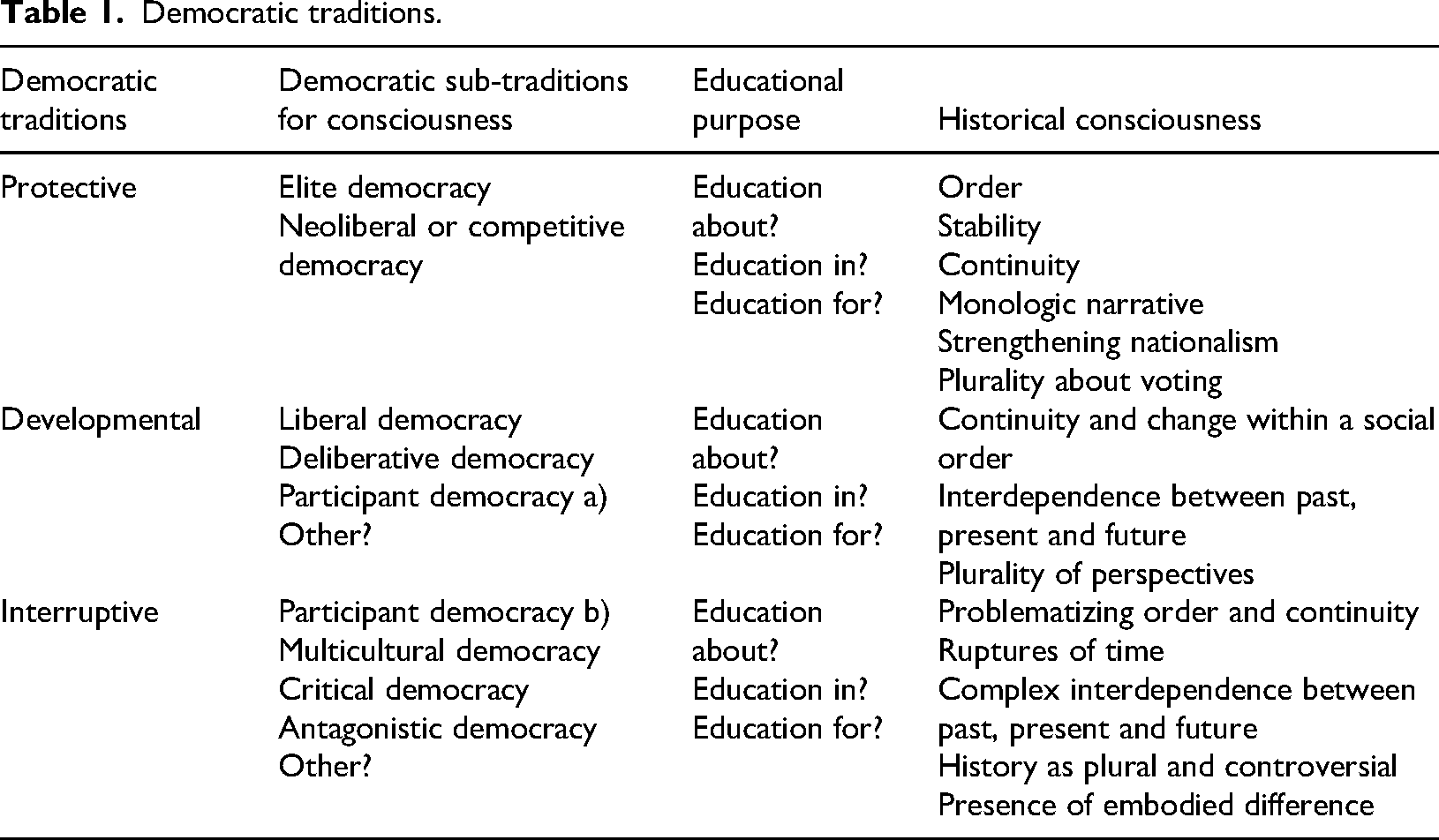
In this theme issue a heuristic model is used to investigate various curriculum documents in relation to expressions of democratic consciousness in curriculum documents either directly for, or influencing, history education in schools. Curriculum documents are understood to be political texts that are designed around specific discursive strategies. They are never neutral, but rather set the framework for policy enactment and action. Enactment highlights that policy needs to be actively interpreted based on a systematic analysis of language use and translated to specific historical and psychosocial contexts by actors (Ball et al., 2012, p. 71). It contains a focus on how the: a) material conditions look, in this case schools in each country; b) interpretive dimension, about meaning making through language; and c) discursive, namely a critical analysis of the consequences each policy text results in for practice and human conditions (Ball et al., 2012, p. 15).
The critical discourse analysis (CDA) approached applied in this study stems from the work of Wodak (Wodak, 2004; Wodak et al., 1999). Wodak's own work links CDA to history within the field of education and takes interest in how citizenship is expressed in current, national, political, and/or historical contexts. Text and the critical understanding of how language is constructed to communicate to its audience is a key factor of discourse analysis. The lens of CDA is consequently used to gain insights into how language use promotes certain frames for understanding that is based on dominating norms that both include and excludes a set of perspectives in ways that influence action and human conditions. CDA highlights existing power relations and in doing so, “…address[es] the ideological dimension of discourse” (Pennycook, 1994, p. 121). As Fairclough points out, CDA is in part “an element of social practices, which constitutes other elements as well as being shaped by them” (as cited in Wodak et al., 1999, p. vii). An important premise to identify is that CDA, along with other qualitative methodologies, recognizes that all language “is expressive of a particular discourse, and bears evidence of some hegemonic intent” (Widdowson, 1998, p. 146) important to make “visible the interconnectedness of things” and problematize it in relation to future desires and action (as cited in Wodak, 2004, p. 199).
In this network project, CDA is applied at a macro level, as an overarching tool for the variety of sources gathered and analyzed, rather than looking at the specific and grammatical functions of language (Martin & Wodak, 2003; Potter & Wetherell, 1994; van Dijk, 1997, 2001a, 2001b; and discussed by Threadgold, 2003, p. 20). Language is analyzed within its broader education and social context, specifically in History curricula. By doing this, the focus of analysis is on the categories and discourses that emerge through the texts explored.
The articles presented as case studies in this special issue analyse democratic and historical consciousness in curriculum and/or syllabus documents relevant to the educational jurisdiction of the nation state at the centre of each paper (see Table 2 for an overview).
Case study of historical and democratic consciousness.
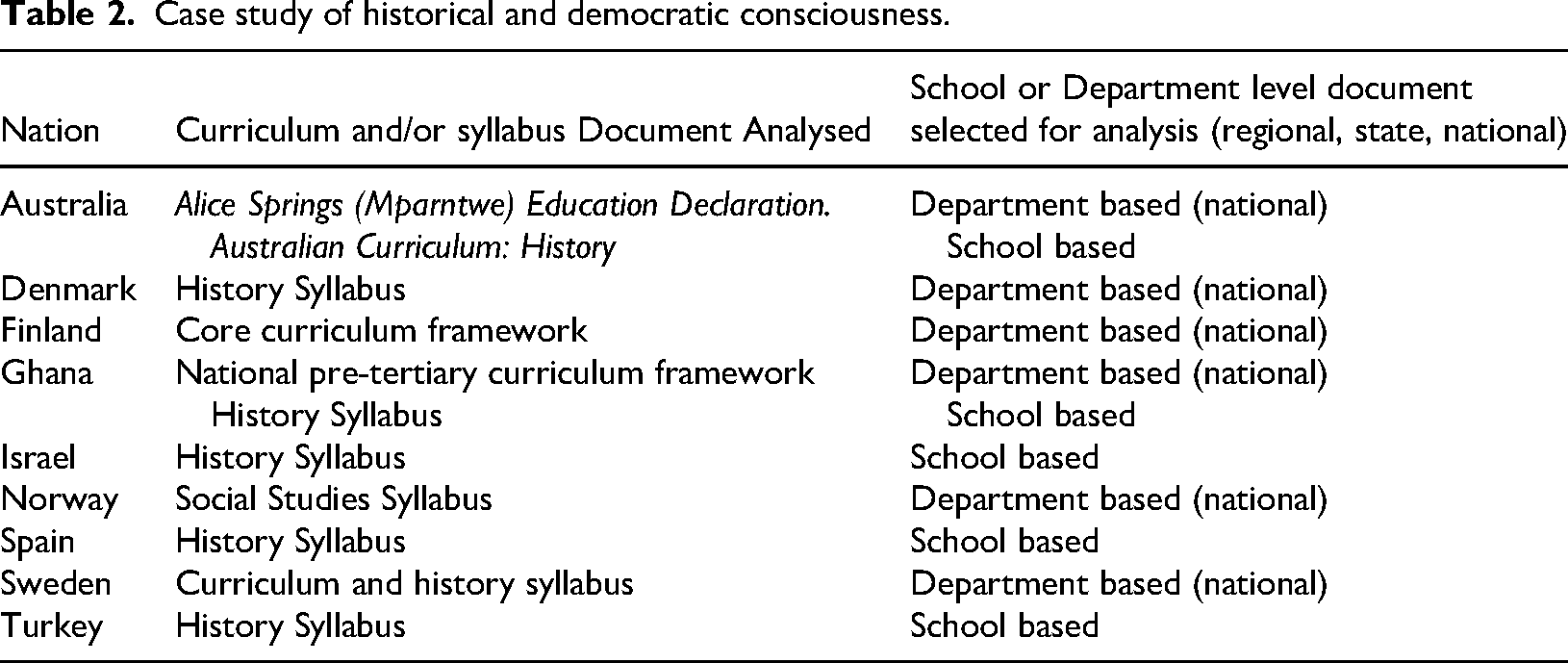
Analysing Australian curriculum documents, Nally and Sharp analyse examples of democratic values about forms of government as evident in the nationwide, combined state and federal governments created and issued Alice Springs (Mparntwe) Education Declaration as well as the Australian Curriculum: History. Their research examines forms of government as presented to students from their historical and any current day perspectives. The analysis of curriculum shows that opportunities to introduce into the classroom current day topics in relation to citizenship, democracy, and functions of government are missed in lieu of content that stays in the past within its own chronological historical context.
On the topic of the intersection between democratic and historical consciousness in the Danish History curriculum, Alvén and Eskelund Knudsen investigate how Danish school students are encouraged through curriculum documents to understand history and orient themselves in time. They find that democracy is lived on a day-to-day basis to support decision making for the betterment of both the individual and society at large. Löfström's analysis of the Finnish core curriculum focuses on how history teaching develops students’ democratic citizenship as an explicit aim. The paper suggests that the emphasis on the skills to construct, analyse and evaluate historical interpretations in the history curriculum overshadows more directly societal aims and political aspects of history teaching that are relevant and that bringing third-order concepts in the history curriculum could support students’ democratic citizenship and democratic consciousness by focusing on the personal meanings of history to the student.
Turning to the African continent, Boadu examines the intersections of historical and democratic consciousness in the pre-tertiary curriculum framework and primary school history curriculum of Ghana. Findings show that democratic and historical consciousness is strongly expressed through key concepts such as citizenship and community, and through democratic values such as honesty, respect and tolerance for diverse groups, cultures, and religions. Analysis of policy shows a social justice orientation and underscore history as a critical context for developing responsible national and global citizens who can contribute to democratic processes through connecting the past to the present and future. Tal examines how Israeli state-secular education integrates the principle of continuity and change through human agency into its history curriculum, in order to cultivate democratic consciousness. The article argues that, while the curriculum emphasises democratic values across various chapters from ancient times to the late twentieth century, it faces challenges in fostering historical consciousness that encourages students to act as agents of democratic change. Critical issues like relations between Jews and Arabs, or the tension between the country's Jewish and democratic identities are often neglected or not historicised, undermining a comprehensive view of modern Israeli society as a product of its history.
For the Norwegian Social Studies curriculum implemented in 2020, there is a fundamental historical perspective running through the curriculum, intended to support students’ understanding of society in the present and of varying conditions at different times. Historical knowledge and competencies are viewed as tools to understand and to influence society. Students are described as the main agents and the curriculum for Social Studies presents an ideal description of future citizens as participating, engaged and critical members of society. Moreno-Vera shows in the analysis of the Spanish curriculum that democratic consciousness features significantly—amplified—in the new curriculum that features both the SDGs developed by the United Nations and content about minority groups not previously included in the curriculum as a way to communicate ideological perspectives about democracy. Analysing the Swedish curriculum, Edling shows the curriculum is mainly based on a developmental democracy, including liberal democracy, deliberative democracy and participatory democracy stressing the continuity and enhancement of a given order. It is pointed out that history is central to all subjects. In comparison with the curriculum, the history syllabus is more radical in that it accentuates aspects linked to a disruptive democracy emphasising the change and resistance of a given order based on arguments of equity. Finally, focusing on Türkiye, Ozturk and Ozturk analyse how historical and democratic consciousness is shaped, changed, and transformed through education via the history curriculum. The data reveals themes such as ideological and political effects in history curricula, curriculum change and its effects, the curriculum's approach to multiculturalism, and the reflections of ethnic and religious diversity on the curriculum.
Footnotes
Declaration of conflicting interests
The authors declared no potential conflicts of interest with respect to the research, authorship, and/or publication of this article.
Funding
The authors received no financial support for the research, authorship, and/or publication of this article.
