




Abstract
This article elaborates on findings made in a special issue collection of research in Citizenship, Social and Economics Education, in terms of how History curricula in different countries frame the development of democratic and historical consciousness. Collectively, these contributions provided analyses across nine countries. The function of this present contribution is to weave together several threads introduced in this special issue and to foreshadow a potential trajectory for further research, guided by the inquiry question: What is the role of historical consciousness in facilitating democratic consciousness? First, an overview is provided of how historical consciousness influences the ways democracy is characterised and engaged with across the nine nations examined in the special issue. Second, the workings of a comparative methodology is explored that sketches out how protective, developmental, and disruptive types of democracy occur in various curriculum documents. It is followed by a discussion about the convergences and divergences between the curriculum texts, in terms of how forms of democracy are articulated in the curriculum. These considerations suggest how the History curriculum in each country influences how understandings of democratic consciousness are developed in tandem with moral and historical consciousness. The conclusion makes the case for how each country might cross-pollinate forms of democracy that are aligned with providing educational equity and producing active and informed citizens.
Keywords
Introduction
The early 2020s has been a highly uncertain time for the world as we know it, and this current era has been described by The Economist as “the rupture of the post-1945 order is gaining pace” (2025: 1). Progress and development have shifted into nationalism, reduced international cooperation, and brutal politics by the great powers. Several wars are occurring, gaining international attention, there is a renewed oil crisis via the Israel-US-Iran crisis reaching a recent flashpoint, and the impacts of climate change are increasingly becoming more obvious, disrupting the human and geographical landscape. In Australia, a nation that rarely sees extremist violence, the end of 2025 saw its worst terrorist attack occur with a massacre targeting Jewish people celebrating Hannukah on the popular Bondi Beach. While the new year of 2026 saw an escalation of extraneous Presidential powers used by US President Trump in what amounts to a kidnapping or “intervention” (Rothwell, 2026: 1) of the Venezuelan President Nicolás Maduro and his wife, Cilia Adela Flores de Maduro, illegal according to international law—showing that the world is in a state of crisis, flux, and strong democratic systems under pressure. Democracy as a preferred and accepted way of organizing society and governing a state is increasingly being challenged. There is an ongoing dissolution of democracy or rather trust in democracy and associated systems and institutions, even in nations which have historically strong and stable governments. It is becoming more acceptable for people in positions of power and influence as well as ordinary citizens to question facts, even those previously scientifically proven and widely accepted; to question human values such as equality, freedom, and justice under law. Even on the international stage, some influential national leaders have taken to suggesting the invasion of other countries’ territory, against international law and the UN Charter (United Nations, 1945), as seen in the example above. These range from American naval vessels threatening Venezuela to an Australian government report documenting that Iran “orchestrated at least two antisemitic attacks in Australia” (Morris-Grant and Burgess, 2025: para. 1), resulting in the Australian Government expelling Iran's ambassador to Australia and other officials —the first time this has occurred since World War II. Canonic interpretations of national histories have come under scrutiny, while simultaneously some contexts have experienced a renewed demand for these narratives (Grever and van der Vlies, 2017; Symcox and Wilschut, 2009; Taylor and Guyver, 2011). These points have manifested in instances of confronting and debating historical narratives that go against basic principles of democracy, freedom, equality, and universal human rights.
Against this backdrop, it is timely for a more coordinated approach to discussing and teaching about democracy occurring across borders, as a way of opening dialogue, debate, and a valuing of localised difference. Democracy, far from being a Western value—although proponents of this idea do point to Ancient Athens as being the birthplace of this system of government—albeit the Ancient Greeks had different perspectives to democracy than how most nation states in the twenty-first century administer this system of government. As 1998 Nobel Prize winner, Amartya Sen, an influential economist and thought leader on democracy reminds us, democracy is a universal value and should not be inferred as being a Western-centric system of government (Sen, 1999).
When considering the application of democracy to the school classroom, curriculum frameworks are key to this discussion, as they guide how education is implemented in different countries, usually with the intention of enabling members in their communities to address problems in the present. They also usually have an emphasis on students and teachers being able to envision what their futures – individual and shared – might look like (Boomer, 1992; Edling et al., 2025; Holloway and Hedegaard, 2023; Nally, 2024).
The contribution this article makes is an analysis of the similarities and differences in how democracy is expressed in History curricula across nine countries, to enable more effective collaboration between different regions. In several countries the subject of History has a specific responsibility to promote democracy and democratic values based on historical contexts. Furthermore, discussing history as meaning-making temporal orientation (historical consciousness), provides students with tools to analyze societal change, not least when democratic values are questioned or threatened. At the time of writing, such pan-national relationships are characterised by overarching frameworks provided by organisations such as UNESCO, to guide shared ideas of citizenship, the purpose of curriculum, and the intended impact of education (Deligiannis et al., 2021; Rauner, 1999). The purpose and scope of such documents, however, does not include discipline-specific nuances such as the relationship between historical consciousness and democratic consciousness. By contrast, there is a body of literature that heavily focusses on aligning teaching strategies and their intended impact on developing cognition and skills, with the assumption that such priorities will enable curriculum to be implemented in an authentic and socially equitable manner (Aubrey-Smith and Twining, 2023). These studies include the development of a Toolbox of individual-level interventions against online misinformation that fuses a focus on media, civic, and political literacy (Kozyreva et al., 2024). Other contributions try to strike a balance between theory, industry practice, and classroom realities, such as HISTOLAB's toolkit for history classes that is designed to cultivate historical thinking and critical literacy (González et al., 2024).
This article differs by aligning curriculum priorities with the forms of democracy emphasised in such documents. In this way, communities that define types of citizenship in their curriculum documents can consult documents from other countries that frame History education in similar terms. Such an approach would ensure that strategies are less generalised and more in keeping with the particular form of democracy that curriculum documents are aligned. Democratic models of organisation that distribute responsibility, expertise, and knowledge are frequently at odds with hierarchical structures that characterise educational systems across many nations (see for instance: Ahonen, 2017; Heggart & Kolber, 2022; Nally, 2025; Wescott, 2022).
The other purpose of this international comparative analysis is to explore how democratic values and ethics might be integrated into History education at the level of curriculum implementation and cultivating appropriate pedagogical stances. The intended impact is to enable educators to search for appropriate strategies and solutions to most effectively address disruptions that are taking place, at a local, regional, and global level. As a result, the delivery of curriculum will – in theory – be able to fulfil the ideal of a more equitable provision of education and catalyse cross-pollination about what works to preserve and promote democratic ideals. These intentions are highly significant in formulating strategies to address factors that disrupt democracy, particularly the undermining of merit in being a ‘good’ citizen (Zyngier, 2016), a slouching towards authoritarian politics that promises to guide the fate of individuals and societies, rather than allow for self-determination (cf. Coper, 2022; Justino, 2025; Justino et al., 2025; Pomerantzev, 2019). While there is faith in democracy as an ideal, confidence in political leaders – in government, and in community and business groups – has substantially declined since the beginning of the twenty-first century.
The first section of this article reviews the scope and context of the international project that this special issue is a part of: Democracy in the past, the present, and looking to the future (Edling et al., 2025), in terms of: what it is responding to; what the main findings were about the role of historical consciousness in curricula; and how this focus can be configured to foster the development of democratic consciousness. In that special issue, a backdrop to the analysis of each country's curriculum was the alignment of all articles with three inquiry questions:
How is the intersection between historical consciousness and democratic consciousness described in curriculum and/or syllabus documents regarding the history subject in the selected countries?; What types of democracy are expressed in key curriculum documents (e.g., protective, developmental, interruptive)?; and Whether the democracy traditions of each selected country is reflected in the official knowledge of the key curriculum documents?
The findings from these questions are elaborated upon in the second section of this article, and contribute to a fourth inquiry question that is designed to complement those previously broached (Edling et al., 2025): What is the role of historical consciousness in facilitating democratic consciousness? This question frames the consolidation of present trends in curricula across democracies, by examining areas of democratic consciousness present in these documents. This approach then frames discussions about the similarities and differences between how different countries frame democracy, national priorities, and values in their curriculum documents.
Democracy in the past, the present, and looking to the future investigates how historical, moral, and democratic consciousness can intersect to spark dialogue across borders: between institutions, regions, and nations. This focus includes democracy and other forms of government. The first section contributes to the aims of this project by sketching how historical consciousness contributes to the cultivation of democratic consciousness, by accounting for the types of democracy (protective, developmental, and interruptive) that exist in the nine countries that featured in the special issue. It therefore sets the foundation for the second section, which integrates critical discourse analysis (Wodak, 2004) as part of conducting a comparative analysis to identify areas of convergence and divergence between different national History curricula. The last section constitutes a discussion of these findings, with reflections about directions of future research into curriculum and democratic consciousness. This approach ensures that history curriculum and education theory act as an entry point for examining how education is directed to address current debates about democracy – which at times evolve into violent clashes – about the issues of cultural and ethnic diversity, citizenship, migration, integration, identity, and social inequality.
Historical consciousness and democratic education
Some connections between History education and democracy education are found in the curricula in many countries. However, it is not always clear how learning history can practically support students’ orientation as democratic citizens. Learning to critically analyze historical documents from multiple perspectives, assessing their credibility, and making well-grounded interpretations are potentially useful civic skills in a democratic society, akin to general media literacy (Innes, 2020). In this respect, learning about history is a valuable resource for democracy education. However, these civic skills can also be developed in other school subjects, such as literature and literacy studies in the national language (e.g., English in Anglophone countries, Swedish in Sweden, and so on), social sciences, and philosophy.
The specific contribution of learning history to students’ democratic citizenship can come through the development of their historical consciousness. Historical consciousness has been a central concept and theoretical tool in much of the research on History education over the last 30 years. It refers to the general human propensity to orient in time by constructing meaningful connections and relationships between the past, present, and perspectives on the future. For example, experiences of the past are likely to influence expectations of the future, and expectations of the future can shape memories of the past and how it is viewed today. The concept is therefore guided by the assumption that humans more generally are capable of seeing temporal relations and using them to support their personal and social life. However, the question remains, how can democracy become meaningful within notions of historical consciousness (Alvén, 2024)?
Although History is not the only school subject through which democratic principles and ideals may be addressed—indeed, democratic values can be understood as underpinning schooling processes more broadly—it is the subject in which systems of government are most consistently and explicitly embedded within the curriculum across national contexts. From Ancient Greece to the modern era, political systems and forms of governance constitute core historical content, providing structured opportunities for students to examine and compare political arrangements such as monarchy, oligarchy, fascism, communism, and democracy (see Edling et al., 2020).
Forms of democracy
The views and perspectives of democracy in history curricula have been categorized and analyzed in a theoretical framework related to educational contexts and what knowledge students are expected to develop at school. Framed within the notion of teaching and learning about, in, and for democracy is teaching students about active and informed citizenship (cf. Sharp and Zarmati, 2022). From this point of view, democracy can be described in terms of three components which are taught and learned about in schools:
Details about democracy: The spotlight here is on the knowledge assignment and hence learning (facts) about democracy, its history, development and organization; How to live in democracy: This element involves learning to “do” democracy. The description stresses everyday practice in different contexts (such as at school, in a sports club, or other community organization), to discuss, negotiate, and to make collective decisions; and Act for democracy: Accentuates how people engage with, and their ability to involve themselves in, initiatives that work for democracy (Alvén, 2017; Letiche et al., 2016). This element can be regarded as a first categorization to approach and navigate in understanding democratic consciousness in an educational approach.
These forms of democracy that are enacted through teaching and learning practices are framed by more theoretical discussions that have taken place in academic literature. A comprehensive literature review (inclusive of 377 articles) documented a multifaceted view of three main perspectives on democracy in education, ranging from protective to developmental, and traditions that see democracy as disruptive to the (liberal) democratic order (Sant, 2019). In the coming section the three overarching types of democratic traditions- protective, developmental, and interruptive - are combined with established theories about democracy that are drawn from Held (2006) as a frame for analysis—currently one of the most cited analyses of how democratic politics can operate. It also provides a set of chronological developments in democracy to show how it operates in a wide variety of contexts, from ancient Athens to variations in the current century.
Protective democracy
A protective democracy emphasises stability and majority rule, and can be either founded on liberal values (Held, 2006) or can oppose or disregard liberal values (Edling and Macrine, 2021). In these respects, it lies outside the distinctiveness of democracy as a governing form described by Dahl (1998). These types of democracies are limited in scope as they do not aim to cultivate democratic values in everyday practice. Two categories of protective democracy were identified in Sant's (2019) review: elitist and neoliberal democracy. The elitist tradition is based on an aggregated perspective, advocating that political governance should be managed by a small elite responsible for ensuring stability in democratic societies. Consequently, the role of the people, aside from voting, is to maintain social order. Additionally, some argue that the only requirement for non-elite participants is to vote during election years, with plurality primarily concerning the right of different individuals to vote (Sant, 2019).
Neoliberal democracy by contrast, is characterized by a competitive democracy grounded in market logic. Citizens are viewed as rational consumers whose desires could be met through a system that promotes competition. The private sphere should be protected from governmental demands, and the democratic arena is a marketplace where individuals’ opinions compete. In educational contexts, neoliberals advocate for education to be governed by market logic rather than state intervention. Children, students, and parents are seen as diverse customers, while teachers and staff are vendors providing desirable goods. Neoliberals oppose curricula that explicitly emphasize the importance of shaping democratic citizens, arguing that such efforts infringe on the individual's private sphere (Sant, 2019).
Developmental democracy
Developmental democracies are grounded in ideals of liberal democracy, and can be either participatory or deliberative (Held, 2006). This form of liberal democracy emphasizes the importance of defending individual equity beyond freedom of choice. It operates on the premise that there should be an unwritten contract between the state government and its citizens, expressing the mutual trust that is a foundation for democracy. The focus is on self-realization, which must be safeguarded from excessive state intervention. Consequently, it is crucial to consider people's rights and obligations as a means of securing individual freedom. This tradition assumes that citizens are rational and will use their rationality to promote the social good.
In liberal democracy, education plays a prominent role because equality is achieved by providing everyone with knowledge and training to address societal challenges through rational arguments. Unlike neoliberal democracy, it emphasizes that education should actively shape democratic and critical citizens through knowledge, adhering to democratic procedures and values in everyday practice (Sant, 2019). Communication should therefore follow a liberal tradition: based on factual arguments and designed equitably to enable common positions to be reached. Equality here means including different people in deliberative dialogues to respect the plurality of perspectives. In education, advocates of deliberative democracy stress the importance of involving various actors, such as students, parents, teachers, and other stakeholders, in public forums to discuss and influence educational decisions.
In line with liberal democracy but with a different focus, the participatory democratic tradition emphasizes broader civic participation beyond discussions. This tradition can either support the existing social order or challenge it. Unlike deliberative democracy, which seeks consensus through objective communication, participatory democracy focuses on people's daily actions and practices as a way of learning to become democratic citizens. According to participatory democracy, the best way to learn democracy is through active participation in various democratic activities, such as discussions, raising hands, engaging in development projects, and serving on student councils. Consequently, teachers are expected to create activities that involve and engage children and young people as part of preparing them for community and political participation (Sant, 2019).
Interruptive democracy
One branch within participatory democracy advocates for participation that is characterized by authentic engagement and a desire to address problems perceived as real and urgent (Sant, 2019). In addition to the tradition of participatory democracy, critical, multicultural, and agnostic democracy can be categorized as interruptive democracies. These forms do not merely aim to develop the existing order but seek to cultivate resistance against structures deemed immoral, unjust, and/or unequal. However, they each approach plurality and the relationship between the individual and society differently.
Multicultural democracy encompasses a broad set of perspectives that prioritize diversity as essential to protecting a democratic system. Similar to deliberative democracy, proponents of multicultural democracy argue for the existence of formal and informal forums where different groups and individuals can discuss common societal issues. In an education system based on multicultural democracy, teachers are expected to help children and students respect other cultures and support those from different ethnicities and nationalities in understanding their origins and ancestry. In the classroom, teachers and students are encouraged to actively work on their own prejudices and make different identities and approaches visible to reduce harm to those who deviate from the norm. Consequently, the curriculum is expected to be designed to include and protect different cultures (Sant, 2019).
Openness, contestation, and dissent are key concepts in agonistic democracy. This tradition critiques deliberative democracy's emphasis on consensus-building and critical democracy's tendency to pre-judge ideologies as good or evil. Instead of viewing those who disagree with the majority as enemies or ideologies as inherently good or bad, agonistic democracy argues that these issues should remain alive in discussions. Democracy is seen as changeable, influenced by prevailing social contexts and times. Conflicts and dissenting views should be highlighted rather than ignored.
Finally, an observation of curriculum documents analysed for the original project is that many countries did not consistently fit any of the ideal models of democracy. Instead, they functioned within a range that was determined by what varieties of politics have been (and are currently being) practiced. In light of diminishing trust in democracy, it may well be the case that localized practices are misaligned to an idealized version of democracy. This gap emphasises the importance of how democratic consciousness in curriculum documents informs the cultivation of democratic values, which influence the exercise of active and informed citizenship.
Method – comparative thematic analysis
This section sets out a comparison of the features of different curricula that work as catalysts for democratic consciousness and historical consciousness. Guiding this approach is a central focus on aligning key words with these two concepts, following elements of Wodak's (2004) critical discourse analysis. In the special issue, each article (Alvén and Knudsen, 2025; Ammert and Hovland, 2025; Boadu, 2025; Edling, 2025; Löfström, 2025; Moreno-Vera, 2025; Nally and Sharp, 2025; Tal, 2025; Zayimoglu Ozturk and Ozturk, 2025) was structured to align with inquiry questions that were outlined in the introduction to this article, and addressed how the curriculum content in different countries articulated conceptions of agreed-upon social contracts, civics and citizenship, and a shared sense of the past. These points of focus provided the means for gauging the points of similarities and differences between how each country's curriculum documents defined historical consciousness and democratic consciousness.
To communicate this breadth of contextual diversity, a comparative analysis was used across the articles to identify which curriculum documents guided approaches to education. These were then sorted into elements that corresponded with types of democracy and forms of government, the nature of the curriculum authority (such as local, regional, and national), and framed within a broader qualitative inquiry methodology (Denzin and Lincoln, ). This involved a focus on the implications of findings from the inquiry questions about how national identity was articulated across the nine different countries.
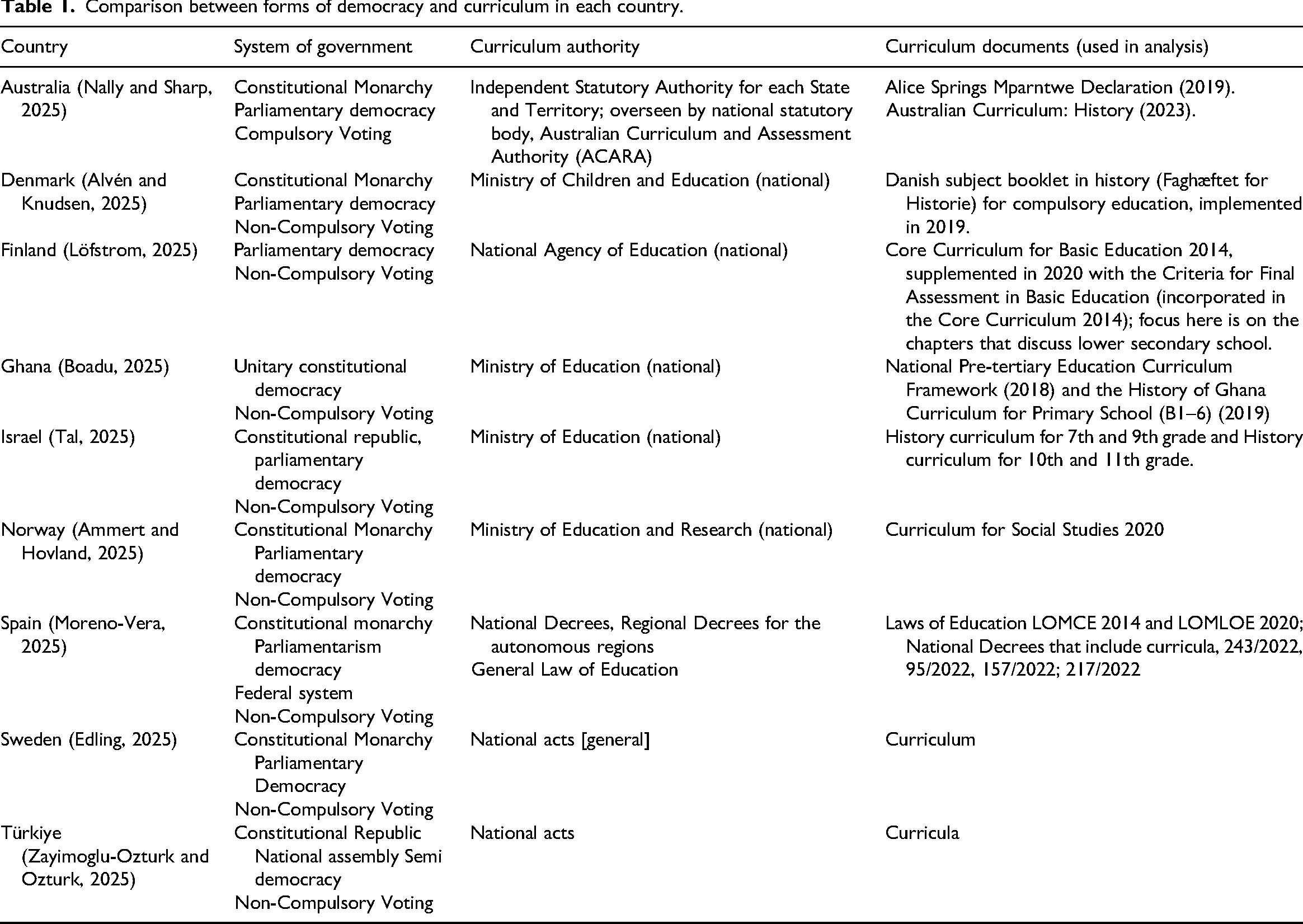
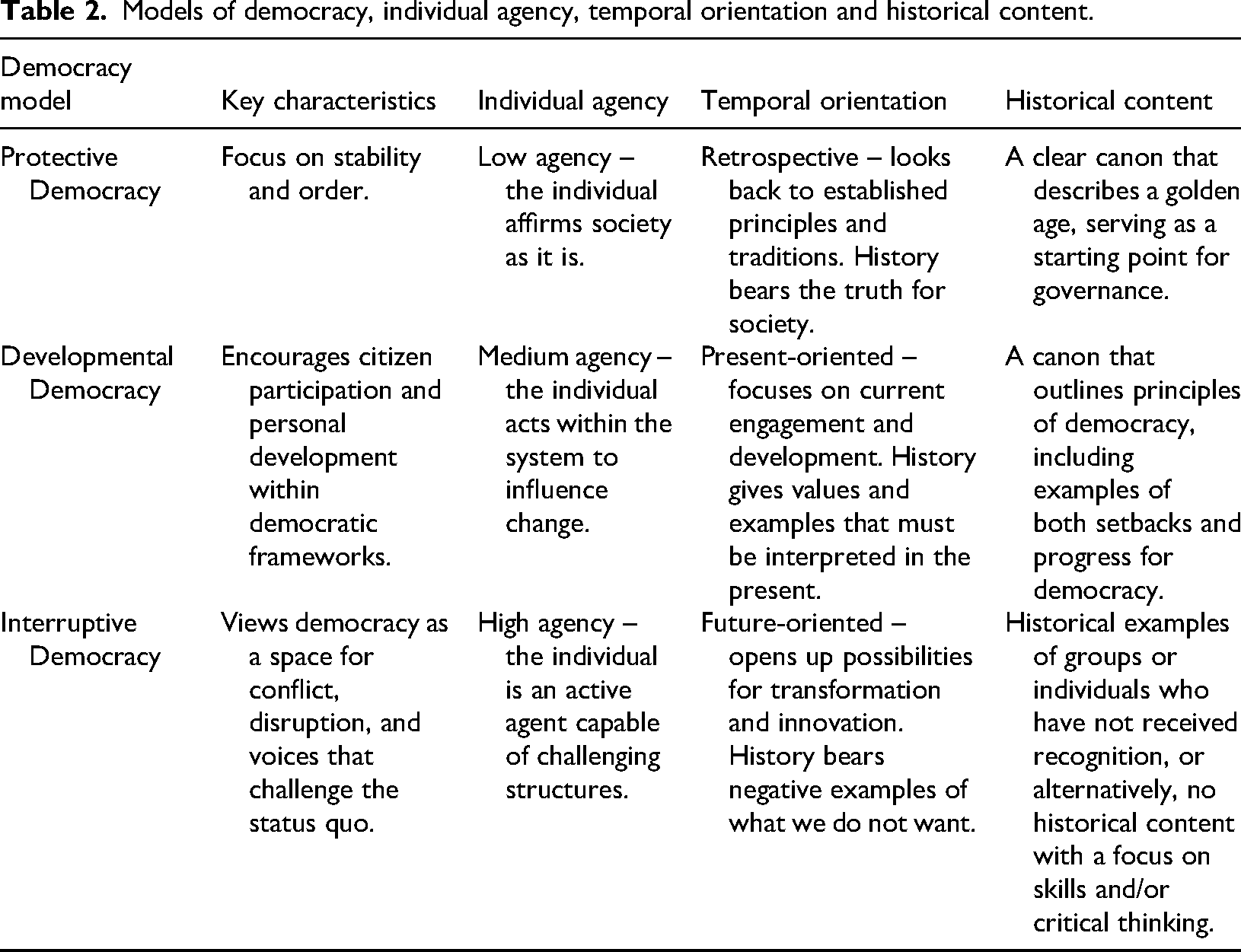
A key precedent for the present study is Jörn Rüsen's (2004) taxonomy that organizes historical consciousness into four types. In the articles across the special issue, democracy was categorized into three models: protective, developmental, and interruptive (Edling et al., 2025). Then, in order to trace how democracy informs the cultivation of democratic consciousness, characteristics were linked with each type (Table 1). Such features contribute to an additional layer of analysis (Table 2), which frames how governments and education statutory authorities under their direction catalyze degrees of agency amongst citizens in each country, via curriculum documents. Such agency is also underpinned by models of citizenship. Although some elements of the documents surveyed in the special issue look to the past for examples of what ‘good’ citizenship looks like, others are focused on transforming present student learning into future-focused, problem-solving forms of active citizenship (Table 3), and identifies features associated with individuals within each of the nine nation-states from the special issue.
Comparison between forms of democracy and curriculum in each country.
Models of democracy, individual agency, temporal orientation and historical content.
Steps towards a comparative framework
Democratic principles are framed in the curriculum documents of each country, and these are contextualized within localized histories. For this reason, an analysis that compares the curricula of each of the countries needs to be aligned within a frame that draws upon both theories of historical and democratic consciousness. For the former, Rüsen's taxonomy of historical narratives (2004) provides the basis for how historical consciousness can be developed. A second set of theory is drawn from Sant's theoretical review of democratic education, which characterizes democracy as a “floating signifier” (Sant, 2019: 684) that knits together the aspirational principles of a society. This alignment takes place along three lines: 1) Scale: universal and local; 2) Participation (inclusion/exclusion): community and individual; and 3) Access to knowledge: individual rationality, intersubjective, and experiential (Sant, 2019).
This approach allows the nine countries to be compared in terms of how historical consciousness frames the development of democratic consciousness, so there are shared and individual relationships that grow increasingly complex as a result of teachers’ and students’ protracted engagement with the history curriculum of their jurisdiction. As shown in Table 1, the documents analysed were either at the national or state level policy documents used by Departments of Education and schools to guide overall curriculum development (in the case of Australia, e.g.); or Syllabus documents used by schools and teachers to develop lesson content (e.g., in the case of Finland). Where the curriculum document selected was at the Syllabus level, typically junior high school compulsory subject of History, Social Science, or equivalent (see, e.g., Denmark) was selected. Two exceptions to this are Ghana which included primary and senior high school and Israel which included junior and senior high school curriculum documents. These observations are explicated here in four tables that organize data to document the relationship between democracy and curriculum:
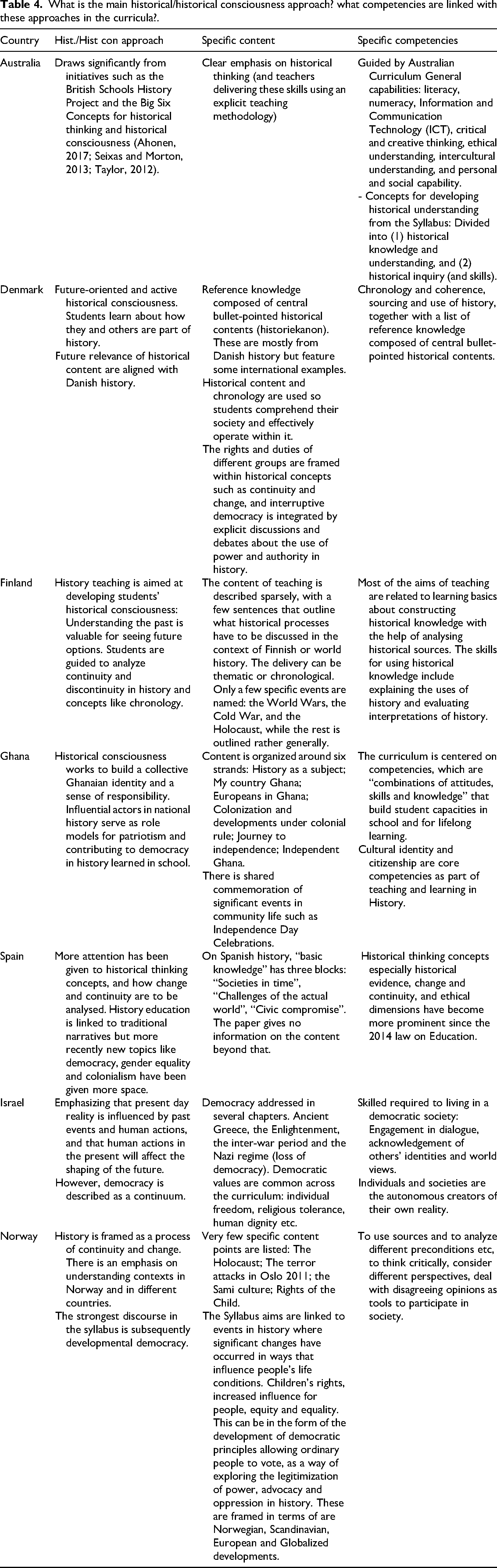
Table 1 identifies the system of government, the curriculum authority and which documents motivated or are the basis of instruction for the teaching of democracy in schools. These alignments are intended to show how the type of democracies that are identified in Table 3, correspond with how the implementation of curriculum takes place; Table 2 provides a scope of the purposes of democracy in each country, which are linked in terms of the role of individuals (as citizens and members of a community) within a democratic society. These elements from the table align with the attributes that citizenship is associated with in the curriculum documents which were subject to analysis in each article; and Table 4 offers a comparison of how the approaches to historical and democratic consciousness are framed across each of articles.
Table 2 displays how the forms of democratic governance are supported by types of historical understanding that are enabled through the curriculum documents. It represents a synthesis of the different democratic categories (protective, developmental, and interruptive) and Rüsen's narrative models. Certain democratic categories align more closely with specific narrative models, and together they form coherent and meaningful constellations. Table 2 is intended to be used to identify the emphasis of each set of documents, and where imbalances may occur in education across countries.
These points of comparison are intended to allow educators in different countries to note how similarities (and differences) in democratic systems refract onto how curriculum is enacted and implemented across jurisdictions. In turn, such individuals may look to other regions for inspiration in creating forms of learning opportunities that align with how they want to engage with historical and democratic consciousness. The findings suggest that democratic principles are directly linked with enabling choice (of individuals and groups), processes of inquiry (and becoming informed about the world), as well as the generation and transfer of knowledge to enable social cohesion and respect for difference.
Curriculum has direct influence over the way that democracy is taught, learned about, and interacted with in schools (Apple, 2018). It therefore has a significant influence over how each individual develops their conception of historical consciousness, as well as their understandings about the workings of the democracy they are a part of. Frequently, there is a disconnect between the ideas linked to democracy, and how it is articulated during the implementation of curriculum documents. Although democratic discourse characterizes processes of consultation about curriculum changes (prior to their being made), the discourse around the implementation is usually hegemonic (Baildon and Damico, 2019; Luke et al., 2018; Nally, 2024). The correlations between democracy, individual, temporality and historical context are mapped out in Table 3.
Democratic models and the role of the individual.
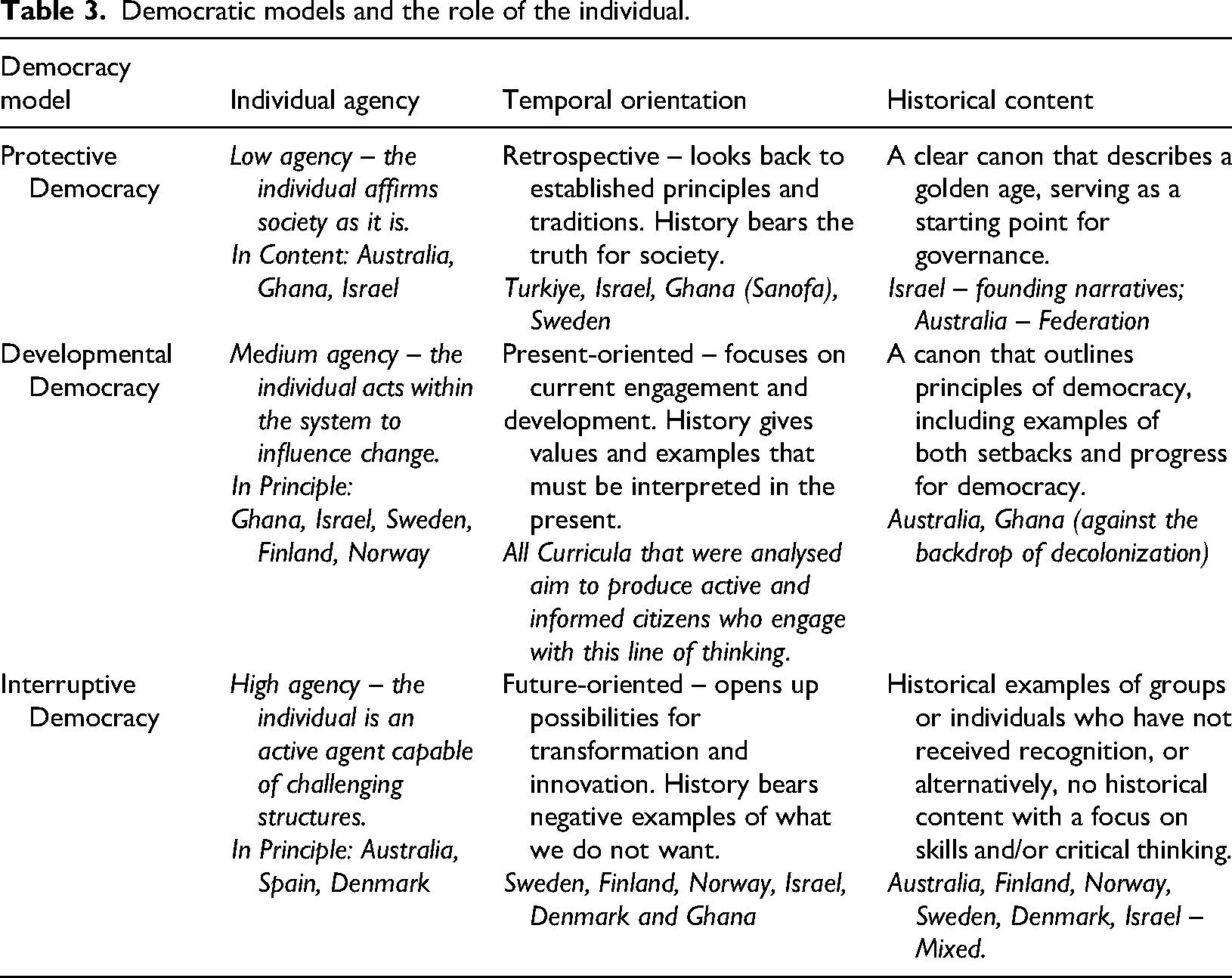
There are two significant points that come from a comparison of these countries. The first is that none of these countries’ curricula strictly follow any of the ideal models, due to historic and regional circumstances where national points of difference need to be clarified. While Australia's democracy grounds itself against a backdrop of Greco-Roman electoral traditions and the influence of the Washminster System (combination of Westminster and Washington parliamentary systems; Nally and Sharp, 2025), countries such as Israel link democracy as an unchanging tradition from the foundation of a republic that sustains a distinct national identity (Tal, 2025). Such a structure is reflected in Turkiye's transition to a secular, modern republic away from empire, with the inauguration of the Turkish Grand National Assembly in 1920 (Zayimoglu-Ozturk and Ozturk, 2025); just as for Finland, structures of liberal-democracy were established in the 1919 constitution (Löfström, 2025).
The second point is that democracy therefore functions as disruptive marker in the history of these nations. This motif is echoed in the Spanish curricula representing it as a transition away from dictatorship connected to a national narrative of historia magistra vitae prior to 1978 (Moreno-Vera, 2025); while for Ghana, democracy is tied with an independence that emerged against the backdrop of decolonization (Boadu, 2025). These historic circumstances connect democracy with generating a sense of historical awareness framed in collective values that are communicated through curricula, which in turn frames localized versions of historical consciousness. The process is perhaps epitomized by the anecdote reported by Zayimoglu-Ozturk and Ozturk (2025), who indicate that John Dewey was invited to Turkiye in 1924, and presented the idea to educators that democracy was a ‘shared and mutually transmitted experience’. Correspondingly, it is a system which orients each citizen (and to varying extents, other members of the communities) so they can define their imagined futures in individual terms, using a shared language and values. Taken together, Tables 2 and 3 show that in history curricula in a number of countries, democracy is expressed as a phenomenon with no pure form, but is instead characterized by the following attributes, which exist on a spectrum for each country:
Degrees of agency; Situatedness of a community in time, geography and values; The role/s and responsibilities of citizens – to maintain cohesion, support democratic structures, and disrupt an unjust status quo; and An enabling of critical thinking (and to varying extents, the appropriateness of critiquing tradition) to ensure democracy evolves, so governing agendas meet the challenges and opportunities presented by changing historical circumstances.
A second point is the importance of narratives to mapping these attributes into the context of each country. In this way, the history curricula becomes an archive of exemplary behaviors to imitate and learn from. The lesson of a more monolithic version of national history is consistently shown as the cause of conflict, as people are characterized as a homogenous body rather than a diverse community (Edling et al., 2025; Moreno-Vera, 2025). The plurality of voices therefore works against a monologic historical narrative by allowing a recognition of change over time, as well as defining what is disruptive, resilient, and what requires maintenance/protection.
These value sets directly influence how present political understandings are shaped in each country. The exceptions to these rules are found in how controlled narratives or difficult truths are engaged with. For Australia, this focus includes First Nations figures representing (largely) successful activism, and the conditions which they were reacting towards. Statistics that might suggest a protective form of democracy are largely omitted: for instance, 36 out of 44 public votes to change elements of the constitution (known as referendums) have been successful. The same approach applies to forms of Indigenous, feminist and environmental activism were met with ‘acute embarrassment’ or limited public media coverage, until the 1960s (Foley et al., 2016; Nally et al., 2025). In Israel, there is similarly little to no mention in the history curriculum of events that link democratic identities to more events such as the military rule imposed by the state on Arab-Israeli citizens between 1948 and 1966, the Kfar Qassim Massacre in 1956, the issue of land expropriation, to name a few (Tal, 2025). In both cases, the past is something to return to and learn from. In Ghana however there is a tradition of Sankofa, which reflects learning from history and the colonial past as essential to peace and order in the present (Boadu, 2025), whereas in Finnish curricula there is a reflection on efforts to maintain a distinct identity in spite of interference from the U.S.S.R. (Ahonen, 1992).
These examples are all instances where national stories operate to protect the structures that support democracy, by shaping requirements for selecting source material that is eventually chosen (or mandated) for use by educators in schools. Violent events in a nation's history are positioned to guide how citizens might act as part of a democratic system, to shape the trajectory of history away from such events in the future. In the context of protective democracy, the curriculum acts as a guide for agreed-upon collective actions, and how the shared responsibility for maintaining political cohesion is distributed across all elements of society. These points are borne out by comparing Table 1 with Table 4 with the former identifying how the system of government, curriculum authority and documents catalyze the teaching of democracy in schools. This data shows the ways that forms of government influence how historical knowledge is implemented through curricula, which provides the seeds for cultivating historical consciousness. These observations are discussed later, as part of identifying trends of convergence and divergence between the nine countries that were the focus of the special issue, to suggest future directions in the research.
What is the main historical/historical consciousness approach? what competencies are linked with these approaches in the curricula?.
Discussion
A significant finding from the comparison of nine countries is that despite all forms of government being democratic, there is no enactment of democracy that resembles an idealized form. This consistency is reflected in the History curriculum of each nation, which is tailored to align with core democratic principles that work in tandem with one another, to allow present and future citizens to think critically and influence society. Together, these elements of the curriculum inform ideas about citizenship in each country and are indicative of how this concept is enacted at varieties of scales, including individual, local, national, and global. This mapping of concepts to how they influence thoughts and actions ensures that citizenship is positioned in the history curriculum alongside moral consciousness (Edling et al., 2020, 2021) and historical consciousness (Gadamer, 1975; Löfström et al., 2021; Nordgren, 2019) as part of generating democratic consciousness (Edling et al., 2025; Nally et al., 2025). Interpretations of features linked with democracy (such as the notion that individual choice can contribute to social cohesion or disrupt it) therefore provide the scope for framing citizenship within a socio-cultural context. For History curriculum to be considered as a way that the past is framed to reinforce an aspired-to society, then these documents demonstrate how education authorities in each of the nine countries reframe the past to promote values that reinforce present (and future) norms through schooling. At the same time, it can be difficult to understand how the past in a curriculum should be interpreted, as Alvén and Knudsen (2025: 126) show in their contribution on Denmark: What primarily complicates the understanding of the democratic mission in the Danish curriculum is the question of how we should perceive and engage with the past: “Does the past demand responsibility and reverence towards the state of Denmark and its constitution, implying that abrupt changes are unwelcome? Or does knowledge of the past provide essential tools for effective and credible action in the present, even if such actions are abrupt?
Democracy is therefore closely associated with what story (or stories) that nation-states want to cultivate amongst their citizens as part of the curriculum, in addition to which ones they project outwards to other communities. In each of the nine countries, democratic values frame how historical consciousness involves the generation of dynamic relationships with the past. According to the information catalogued in Table 4, historical consciousness plays a key role in adapting, enlarging, and shifting the scope of what is deemed worth keeping and bringing into the future (Edling et al., 2025), as opposed to the curriculum containing what is categorized as usable knowledge at the time of writing. These points are most visibly manifested in episodes that are essential to national stories. For example, after Ghana's general election in 1951 following years of colonial agitations, the History curriculum includes information about the remaining military rule in several time periods designed to stabilize the country's politics (Boadu, 2025). In this context, historical consciousness is linked with a strengthening of nationhood, tied with civic responsibilities (Ahuma, 1971). A similar observation might be made about democracy in Finnish documents, as while the constitution was established in 1919, protracted political struggle into the 1930s, devastation of WWII and continued Soviet interference caused the practice of democracy to be disrupted (Ahonen, 1992; Löfström, 2025). As a result of more recent extention of democratic citizenship, however there is a more coherent importance articulated about providing for the needs of Sami and Roma students (Löfström, 2025), which have parallels with their mention in Sweden's and Norway's curricula (Ammert and Hovland, 2025; Edling, 2025). In these four contexts, democratic consciousness is articulated as a way of defining national identity against repressive and authoritarian forms of government, and as an assertion of values that are exemplified by key individuals and groups in both Ghana's and Finland's history. Additionally, there is an element of protective democracy in the inclusion of Indigenous peoples, as a reaction against a more homogenized past. These relationships reflect the exercise of power and ideology, to reinforce dominant, included and excluded perspectives (Apple, 2018).
Core concepts of democracy as they exist in the documents, are reflected in Table 1, there are several places where the curricula diverge. The place of the citizen is characterized in relation to the dominant discourse, but these significantly differ between each country. Where for Ghana it is a part of efforts to decolonize the country and define its own independence (Boadu, 2025), for Finland it is community cohesion and resistance against domination by foreign powers (Löfström, 2025), and Norway's is geared towards balancing its own identity against (and with) other Scandinavian countries as part of a liberal democratic tradition (Ammert and Hovland, 2025). In Australia on the other hand, citizenship is shown to be attempting to bring in groups traditionally on the fringe of the curriculum, for example Aboriginal and Torres Strait Islanders, and those from multicultural backgrounds, into the mainstream historical narrative—with an attempt to move away from the traditional archetypes of Indigenous-Settler-Coloniser (Nally and Sharp, 2025). Spain's curriculum documents meanwhile, promote the role of a citizen as part of an interruptive critique to ensure that democratic practices are adaptable to present circumstances (Moreno-Vera, 2025:103). Denmark wants to maintain a democracy where citizens take significant responsibility for the country's development, but based on a past that is difficult to define - who is and who is not part of this past? (Alvén and Knudsen, 2025). Based on these differences, although national narratives sit at the core of the history curricula, their characterization of what role/s individuals can play in their communities frame different forms of moral consciousness and historical consciousness.
A second significant difference is borne out by identifying which values are linked with democratic citizenship in history curricula. While Ghana's documents have explicit references to social justice orientations and national and global citizenship (Boadu, 2025), Finland's only have passing references to democracy and instead prioritise knowledge about parliamentary systems through historical epistemology (Khawaja et al., 2025; Löfström, 2025); and Türkiye focuses on democracy as connected to the individual. Israel's and Australia's curricula documents focus on protective and developmental democracy, and only more recent documents have given more emphasis to inquiring into more controversial historical issues such as the treatment of source material relating to discrimination against Indigenous and other marginalised groups (Nally and Sharp, 2025). Notably where Israel's curriculum differs is the promotion of how democracy developed over time, by encouraging educators who implement the curriculum to grapple with moral and historical dilemmas (Tal, 2025). For Sweden, there is an emphasis on interruptive democracy with that values the initiative of individuals, with inclinations towards developmental democracy. In Norway, students are expected to become active and responsible citizens within the framework of the existing political system. Australia, Spain, and the Nordic countries stand out amongst these nine countries, in the sense that the education authorities do not mandate a centrally authorised, nation-wide textbook. This diversity (generally based on competition between publishers) is a catalyst for democratic consciousness being cultivated in quite varied socio-economic contexts (Hogan et al., 2016), which in turn influences there being significant variation in views about democracy.
Conclusion
A key theme of this study of nine countries has been that curriculum documents play a significant influence in shaping how people behave democratically, so to reflect the governmental style of each country (Edling et al., 2025). These texts provided a starting point for how democratic consciousness might be generated in tandem with historical consciousness. A key element of realizing this ideal is to situate teachers and learners so they are more clearly positioned in relation to their contributions to national and global contexts. One significant finding from comparing the curriculum documents is that sustaining a democratic ethos is consistently linked with diagnosing the forms of historical consciousness that is evidence in curriculum documents, so democratic principles can be embedded in highly relevant, community-oriented and needs-based education.
A second essential component of democratic consciousness as part of implementing curriculum documents is teachers’ need to understand students’ personal attributes in order to effectively trace their learning, and more broadly, note how their learning is affected by enabling factors, inequalities and inequities of their context (Boomer, 1992; Luke et al., 2018). Such ideas realign the role of history curricula so they are conduits for shared and individual historical consciousness, which might in turn result in the cultivation of collective cultural capital. These parameters in turn, position members of a community within attributes that enable agency and suggest how it might be applied in relation to temporal locations (retrospective-future focussed) (Apple, 2018; Cunningham and Gibson, 2023), thereby sustaining democratic thinking, with the articles from the special issue as a basis for potential future collaborations. Research using a multi-country focus is likely to include an empirical approach to observing how to assess which pedagogies are catalysed by curriculum documents, to promote citizenship, retain an emancipatory focus from critical literacy (following Freire), with an implementation that is determined through a needs-based ethos (Sahlberg, 2021). This includes better understanding and analyzing the translation of policy level documents—such as syllabuses and other official curriculum documents to the pedagogical strategies and content choices made each day by teachers in the classroom, and their students’ responses, to take stock of student voice and teacher expertise as part of ‘negotiating the curriculum’ (Boomer, 1992) to integrate a democratic ethos. More explicitly, this includes carrying out empirical research of large-scale studies of how students and teachers perceive the democratic mission and its relationship to the school subject History including via interviews with these two cohorts and policy makers, studies of textbook content to consider the curriculum privileging of democratic consciousness within a history learning context, and observations of teaching including to determine alignment of pedagogical approaches to teaching about purposes and functions of democracy.
Footnotes

Ethical approval and informed consent statements
Ethical approval was not necessary for the research.
Funding
The authors disclosed receipt of the following financial support for the research, authorship, and/or publication of this article: The International Network of Historical Conscioussnes and Democracy (INoHiDe) was funded by the Swedish Research Council.
Declaration of conflicting interests
The authors declared no potential conflicts of interest with respect to the research, authorship, and/or publication of this article.