




Abstract
This study examines the intersections of historical and democratic consciousness in Ghana's pre-tertiary curriculum framework and primary school history curriculum. The study adopts a critical discourse analysis approach drawing on the work of Wodak to analyse the curriculum documents. Findings show that democratic and historical consciousness is strongly expressed through key concepts such as citizenship and community, and through democratic values such as honesty, respect and tolerance for diverse groups, cultures, and religions. Discourses reveal a social justice orientation and underscore history as a critical context for developing responsible national and global citizens who can contribute to democratic processes through connecting the past to the present and future. The study highlights opportunities to intensify democratic and historical consciousness in the conceptualisation of governance, curriculum content, and history teaching practices.
Introduction
Ghana was the first African nation to obtain independence from colonial rule in 1957. The West African nation is hailed as a good example of a liberal democratic nation in Africa (Afolayan, 2010; Resnick, 2019), however, this democracy often tends to be viewed narrowly from successful electoral processes only (Arthur, 2010; Abdulai and Crawford, 2010; Resnick, 2019). The achievement and practice of democracy in Ghana has a long history, with its roots traceable to colonial agitations for self-rule in the first half of the twentieth century and intellectual developments of the 19th and 20th centuries which adopted critical approaches to wrestle power from the British colonial government, end discrimination against Ghanaians, and create a sense of national and democratic consciousness (Boadu, 2019; Boadu and Baddoo, 2017). The fight for independence was a fight for democracy at all levels, a resentment of the abuse of power by imperialist colonial leaders, and a strong display of enlightenment and readiness for self-rule. The success of Ghana's first general elections in 1951 ushered in an era of self-rule and multi-party democracy with its ripples contributing to independence in 1957. Between 1957 and 1992, Ghana's political governance experienced alternations between authoritarian and notional democratic rule featuring three periods of military rule (1966–1969, 1972–1979, 1981–1992) and three periods of democratically elected government (Afolayan, 2010). Within the same period, successive governments deployed five different constitutions (Osafo-Danso, 2015). Currently, the 1992 Constitution of the Republic of Ghana guarantees the rights and freedoms of all Ghanaians within a liberal democratic environment (Republic of Ghana, 1992).
The relationship between history, citizenship, and democracy in Ghana is intricately linked to the teaching of local and national histories in schools. This is based on Ghana's curricular rationale that history should position students to appreciate the relevance of their national past to enable them gain consciousness of their national heritage and contribute to national development (Ministry of Education, 2010). Boadu (2021a) argues that this curricular motive reflects a nationalistic focus defined by patriotism and national consciousness which have connections to the historical knowledge people possess about Ghana and how they feel empowered to engage in democratic systems and processes and achieve social justice. Further, Ghanaian national history aims to address local personalities, ethnicities and events while building nationhood and a sense of national consciousness (Levstik and Groth, 2005). In the same way, historical narratives can influence students’ perspective of nationhood and their conception of citizens and their role in the nation-state (Barton and Levstik, 2004). This highlights how important local histories are in any effort to achieve historical consciousness and effective democracy. However, when history was introduced in Ghanaian schools by European merchants and later by the colonial administration, curricula focused on the history of Great Britain, with emphasis on the achievements of Britain as a leading power of the time (Adjepong and Kwarteng, 2017; Buah, 2002). The exploitation of history for imperialist motives hindered the realisation of importance of history and obstructed the engagement of citizens in democratic processes.
The current primary school curriculum uses national history to emphasise cultural identity and citizenship as core competencies in teaching and learning (Ministry of Education, 2019). Developments in geopolitical space in Ghana therefore depicts how history has been used as a tool to emphasise democracy and citizenship over time. However, in recent years, several developments have threatened democratic systems and structures in Ghana (Resnick, 2019). Since schools are key to fostering historical and democratic consciousness, the need arises, in the current context democratic fragility, to explore how historical and democratic consciousness are represented in Ghanaian curriculum documents. This documentary study examines the primary school history curriculum and National Pre-tertiary Education Curriculum Framework to understand the intersections of historical and democratic consciousness.
Education in Ghana
Ghana is a West African Nation and the first sub-Saharan African nation to gain independence from colonial administration. Ghana is a democratic republic with political officials elected by the public in general elections every four years. Several public servants are also the president who is head of government in accordance with the 1992 Constitution of the Republic of Ghana. Ghana practices a centralised education system whereby all educational policies are designed and managed by the Ministry of Education with support from its key agencies such as the Ghana Education Service and National Council for Curriculum and Assessment (Boadu, 2021a). Currently pre-tertiary education in Ghana comprises two years of kindergarten, six years of primary education, a three-year junior high school, and a three-year senior high school. In primary school, students study English Language, mathematics, science, history, creative arts, religious and moral education, physical education, French, Ghanaian language, and computing. At the junior high school level, students complete a common core program comprising languages, mathematics, science, creative arts and design, career technology, social studies, computing, religious and moral education, and physical and health education. In the new curriculum reform, senior high school students will take seven or eight subjects comprising core and elective subjects. School curricula under the new education reforms adopt a standards-based approach whereby student progress is gauged against predetermined levels of knowledge, skill and attitudes relevant to specific stages of education in various subjects (Ministry of Education, 2019).
History education in Ghana
History education in Ghana has undergone several changes since colonial times. The field is a contentious one as history educators have been vocal about developments and policies which seemed to undermine history and contributed to the decline of history in schools (Adjepong and Kwarteng, 2017; Adjepong et al., 2017; Oppong and Adjepong, 2022). Before the introduction of history at the primary school level in 2019, history only used to be an elective subject for General Arts students at the senior high school level (Boadu, 2021a). The current primary and senior high school history curricula aim to equip students to be conscious about their nation's past and to position them to contribute to national development (Ministry of Education, 2010; 2019). The curricula communicate a pedagogical motive, drawing attention to history as a subject whose study should not be limited to rote memorisation, and a nationalistic motive which emphasises values such as patriotism, national consciousness, and participatory democracy (Boadu, 2021a).
Historical and democratic consciousness
This article situated in the theoretical framing of historical consciousness and democratic consciousness. This section briefly discusses these concepts and their links to the Ghanaian context.
Historical consciousness is a widely debated and researched concept in history education. Several researchers have attempted to define and conceptualise the meaning, uses and educational applications of the concept (e.g., Clark and Peck, 2018; Van Boxtel, 2018). Zanazanian and Nordgren (2019) argue that the broad and elusive nature of the historical consciousness makes its definition and operationalisation challenging. Such difficulties are partly attributable to the “reliance on standard interpretations for conceptualising” the concept, conflations and confusions emanating from related concepts, and the complexity of translating the varied understandings and interpretations into workable and relevant pedagogies in the classroom (Zanazanian and Nordgren, 2019, p.771). Debates have featured perspectives focused on orientation in time and orientation to the past. Jorn Rusen, whose work has been influential in the field, considers historical consciousness as the ways in which “people orient themselves in time, and how they are bound by the historical and cultural contexts which shape their sense of temporality and collective memory” (Clark and Peck, 2018, p. 2). Rusen described historical consciousness as making sense of the past. The “past is interpreted for the sake of understanding the present and anticipating the future” (Clark and Peck, 2018, p. 2). This understanding of historical consciousness does not only underscore how people think about the past, but also reveals how people think about themselves (Clark & Peck, 2018). Van Boxtel (2018) views historical consciousness as “an individual's understanding of the past which helps to orientate him/her in time” (p. 61). Van Boxtel goes further to argue that historical consciousness is the integration of “historical interest, historical knowledge, understanding of the nature of history, and the ways people in the present relate to the past when a person thinks or reasons about the past” (p. 62). Chapman (2018) conceives historical consciousness as consciousness of the past, informed by his own work into students’ thinking about historical interpretations.
In the Ghanaian context, historical consciousness is evidenced in how people draw from knowledge of local and national histories to shape their present and future actions toward their local communities and country, reflecting both orientation to the past and orientation in time. Historical realities in Ghana demonstrate that a strong national consciousness has links with historical consciousness, as it took awareness of the devastating effects of colonial dominance and destruction of the nation to demand accountability and self-governance (Boadu and Baddoo, 2017). Boadu (2019) argues that without consciousness of the past and commitment to nationhood, Ghana's fight for independence would have further delayed. Recent developments related to the history of Ghana and public response to the developments also highlight Ghanaians’ heightened state of consciousness of the past (see Boadu, 2021b). Further, orientation to the past and in time is strongly evoked in the Ghanaian traditional philosophy of Sankofa which emphasises the importance of returning to the past to reclaim, learn from it and use it to inform the present and future. Sankofa articulates the view that cultural memory and retrieval of valuable knowledge from the past are critical to advancing the present and future (Odamtten & Getz, 2019; Temple, 2010). The symbolism of Sankofa reflects Ghana's complex historicity and demonstrates that indigenous practices are founded on a deep sense of historical consciousness. In current times where discourses are buffeted by false histories, fake news, and artificial intelligence, recourse to Sankofa as a model of historical consciousness provides a path to an informed view of the past for the present and future. In education, the Ghanaian primary school history curriculum expresses historical consciousness as a form of awareness of the past which informs our understanding of “how we acquired our identity and culture” and how we can “analyse, evaluate and interpret past events carefully in order to make informed decisions” (Ministry of Education, 2019) highlighting how people use the past to think about the present and imagine the future.
Like historical consciousness, the meaning and interpretation of democracy varies significantly. Democracy delineates a family of ideas (Held, 2006) and system of governance characterised by competition, participation, and civil liberties (Schmitter and Karl, 1991). Dahl (2015) observes that functioning democracies require multiple interconnected elements such as universal participation rights, equal voting opportunities, informed citizenry, and comprehensive adult inclusion in the political process. Genuine democratic systems require sophisticated institutional frameworks and ongoing civic engagement that go beyond electoral processes (Schmitter and Karl, 1991).
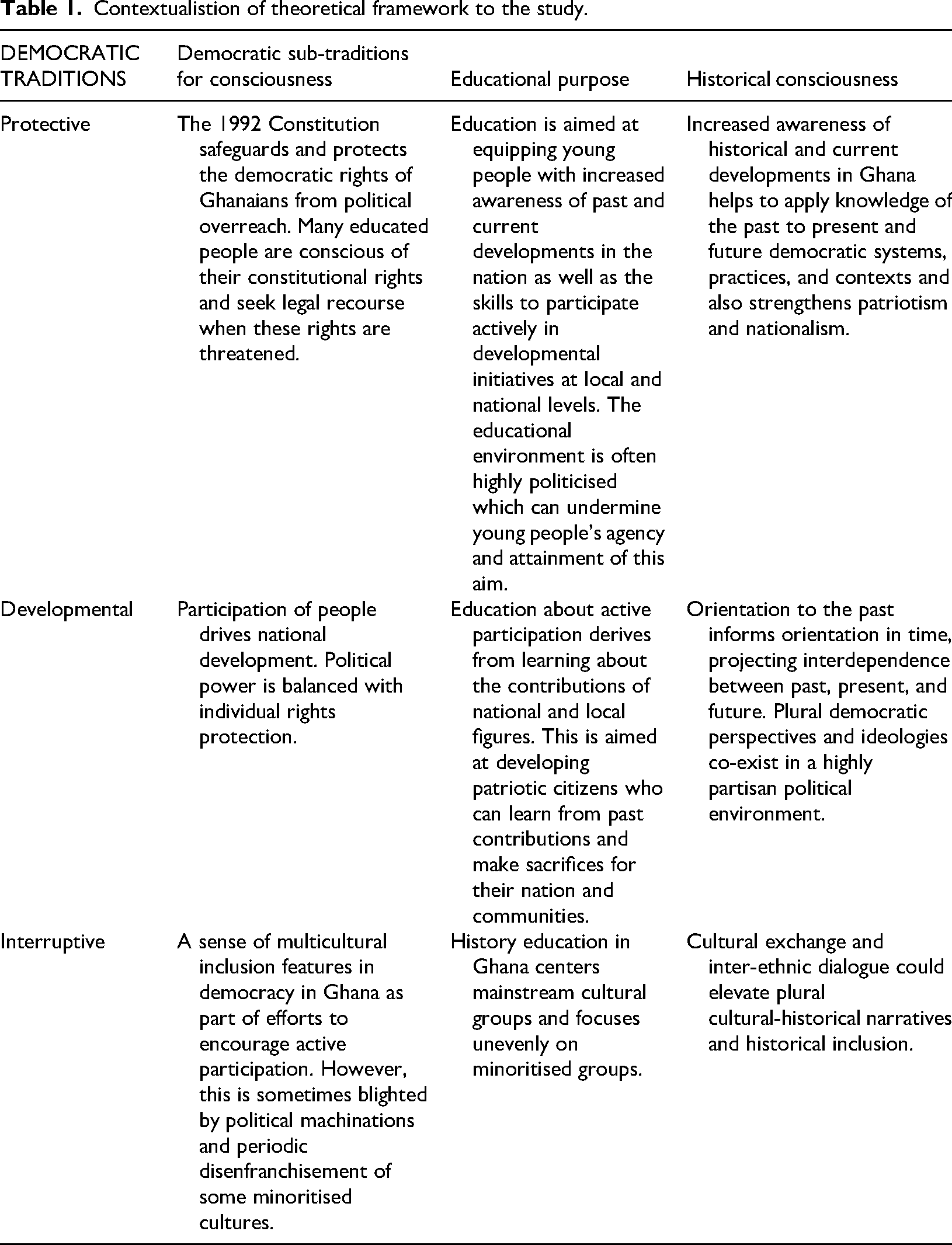
Held (2006) provides a comprehensive framework that identifies different theories of democratic governance, including classical, protective, developmental, and deliberative systems. 1 Liberal democracy, which is the form of democracy practised in Ghana, is a governance approach that integrates democratic principles with individual rights protections. Zakaria (2003) argues that liberal democracy differs from other democratic forms through its emphasis on constitutionalism. Zakaria (2003) goes further to add that the protection of individual liberties serves as essential safeguards against majority overreach, suggesting that robust civic organisations play a crucial role in maintaining liberal democratic principles through balancing power with individual rights protection (Diamond 2016). In Ghana, citizens elect their representatives, and the rights of citizens and balance of power are protected by the 1992 Constitution, showcasing a form of liberal, protective democracy. This representative democratic model guided by liberal principles has been successful since the introduction of the Fourth Republic in 1992.
Fukuyama (1992) asserts that liberal democracy is the ultimate form of government. However, critics challenge this view and highlight the inherent weaknesses associated with liberal democracy. Plattner (2010) observes that liberalism's emphasis on individual rights and democracy's focus on collective decision-making can result in strains that warrant ongoing negotiation and adjustment. Similarly, Mouffe (2000) critiques liberal democracy's reliance on consensus, arguing that it suppresses legitimate political conflict and plurality. Further, economic changes and social media affect democratic stability suggesting that liberal democratic systems must continue to adapt to maintain legitimacy in changing circumstances (Mounk, 2018).
Democratic consciousness reflects people's awareness of democratic values and their engagement in democratic processes. Citizens of countries that practice democratic governments may not be necessarily conscious of and involved in democratic processes. Welzel (2013) reveals that democratic consciousness can develop through educational processes, social interactions, political participation, and cultural practices. Biesta (2011) observes that schools contribute to democratic consciousness since democratic education involves more than learning about government structures but requires practical experience with democratic processes. In Ghanaian schools, the primary history curriculum aims to position young people as democratically and historically conscious citizens through learning about past figures which empowers them to develop patriotism and contribute to democratic systems (Ministry of Education, 2019).
Recent studies highlight challenges of democracy as a theory and governance system. Brown (2015) for example argues that market-oriented thinking has altered democratic institutions and public consciousness. Kymlicka (1996) mentions the challenge of developing democratic consciousness in diverse societies including how shared democratic beliefs can be built while maintaining respect for distinct cultural identities. Also, Levitsky and Ziblatt (2018) note how democratic systems can erode gradually through legal changes. They argue that maintaining democracy requires both strong institutions and democratic cultural norms. Zuboff (2019) criticises surveillance capitalism for undermining public trust and civic engagement. Nevertheless, high quality and trusted democratic systems that allow for active political and social participation of citizens while safeguarding their rights is forward-looking in nature rather than retrogressive and is indicative of a progressive democracy.
Research on intersections of historical and democratic consciousness in Ghana
Research on the intersections between historical and democratic consciousness in Ghana is in its infancy. Perhaps Levstik and Groth's (2005) study on the relationship between national history and students’ conceptions of citizenship in Ghana is the most explicit study on the subject. Levstik and Groth (2005) found that students recognised the important role of local histories in building a democratic understanding of their country. For many students, histories about colonialism, subjugation, struggle, and sacrifice ignited the desire to work towards unity amidst diversity, develop love for nation and local communities, and fight towards bravery and self-governance. The results suggest that historical experiences, whether good or bad, can generate an impetus for developing pluralist democracies and a sense of connection to nationhood. This idea is consistent with the view of one of Ghana's early intellectual historians, Attoh Ahuma, who asserted that a strong sense of nationhood dwells on consciousness of the nation's past and commitment to civic responsibilities (Ahuma, 1971). Ahuma argued that any form of historical and democratic consciousness must begin with a well-founded conception of nationhood and a realisation of people that they have a common course for privilege and responsibility (Boadu and Baddoo, 2017). He posited, “our chief duty as citizens is to build up our country, mould our nation and help to effect the uprising of our race” (Ahuma, 1971, p.12). Even though Ahuma's views were informed by developments in the early twentieth Century where the ideas of history, nationhood and citizenship were under a heavy threat of Europeanisation, they are relevant to current discussions on historical and democratic consciousness and highlight strong links between national consciousness and historical consciousness.
Quite recently, researchers have asked questions about if school curricula support the development of national consciousness within a democratic environment. Studies aimed at answering this question have sought to test the popular assumptions about the role of the history curriculum in building national consciousness in Ghana's modern multicultural democracy. Results show that the Ghanaian senior secondary history curriculum inculcates a sense of historical and national consciousness, even though more tailored content on the history of Ghana need be integrated into the curriculum to strengthen the curriculum's capacity in this area (Oppong, 2019). The study indicates that good citizenship in a democratic setting requires people to have consciousness of the past and be given opportunities to participate in democratic processes. History education can provide the context and useful examples for this to be achieved.
While the foregoing studies are somewhat explicit on the intersections between historical and democratic consciousness, a few other studies have implicitly revealed such intersections. Oppong et al.'s (2021) study on the representations of ethnic groups in the primary school history syllabus revealed that studying history from a multi-ethnic perspective consolidates understanding and practice of belongingness, active citizenship and tolerance for diverse perspectives, which in turn support and promote democracy. Further, researchers appear to concur that teaching history in schools fosters patriotism which results in good citizenship and progressive democracies (Adjepong and Kwarteng, 2017; Cobbold and Oppong, 2010). When students understand that the things they enjoy in the present are the results of contributions from the past, they are encouraged to make their own contributions to the present for the benefit of future generations (Cobbold and Oppong, 2010). These student perceptions however require deeper and wider scrunty in future research.
This article has so far established that historical consciousness and democratic consciousness intersect in many ways. In Ghana, a strong democracy can be achieved if the citizens are informed about the past, and history curricula that engages students with the nation's achievements, struggles and roles of people and groups in the past can build such informed citizenry. Consequently, the Akufo-Addo government in 2019 reformed school curricula and reintroduced history as a core subject in the primary school system. This reintroduction was welcomed as a critical way to strengthen historical consciousness among students and prepare informed future generations (Oppong and Adjepong, 2022). The introduction of the primary school history curriculum was informed by the National Pre-tertiary Education Curriculum Framework (NPECF), a broader national policy which seeks to lay a strong foundation for school education by keeping focus on “the essential knowledge, skills and competences that Ghana's young people need to become educated citizens” (Ministry of Education, 2018, p. 1). This documentary study examines how historical and democratic consciousness are expressed in the NPECF and primary school history curriculum of Ghana. The primary school history curriculum was chosen because the early years of schooling are critical for the inculcation of historical consciousness and democratic ideals, especially in the Ghanaian context where democratic structures are consistently challenged by internal and international forces. The study seeks to answer the question: How are democratic consciousness and historical consciousness discoursed in Ghana's primary history curriculum and National Pre-tertiary Education Curriculum Framework?
Methodology
Research design
This study uses a critical discourse analysis (CDA) approach. CDA, which is rooted in critical theory, focuses on “discourse and on relations between discourse and other social elements” including power relations, ideologies, institutional contexts, social identities, and social justice (Fairclough, 2013, p. 9). CDA is particularly defined by its concern with power – a tool by which social structures and “intertextuality and re-contextualisation of competing discourses” are shaped (Wodak, 2007, p. 187). CDA is applicable to this study as it reflects the historical abuse of political power in Ghana during colonial and authoritarian rule and the role of nationalist enlightenment agitations and campaigns in achieving emancipation, leading to the establishment of democratic processes and institutions. Democracy, which is a key concept in this study involves complex power relations (Beetham, 2005) and hence aligns suitably with CDA. The approach further resonates with this study since texts originate from negotiation of power differences between people, hence presenting a site where differing discourses compete for control and dominance (Wodak, 2007).
Wodak (2007) notes that texts use language for discoursing, and language is tangled in power in various ways through how it is used to index power, express power and challenge power (Wodak, 2007). Similarly, policy is conceived as discourse and text (Ball, 1993). Ball (1993) asserts that discourses are the framework by which policy is written, thought out and talked about, which in turn shape how policy texts are produced. Policy texts are entwined in power by how they are produced and interpreted by makers and users, and by how they influence interest groups, practice, outcomes, and political action (Ball, 2005; Vidovich, 2007). CDA is applied in this study to trace how the Ghanaian primary history curriculum and related policy documents discourse democratic and historical consciousness in explicit and implicit ways. Wodak (2007) notes that while ‘critical’ and other terminologies underpinning CDA such as ‘power’ could have manifold meanings in different research studies, to critique is to essentially explore and make visible how things are connected. In this study, focus is given to using the CDA approach to explore the connections between historical and democratic consciousness in key curriculum documents. The approach not only offers a lens through which to examine these intersections but also provides opportunities to discourse the ways in which key concepts, people, groups, topics in the documents are defined, described, included, intensified or mitigated in the broad context of historical and democratic consciousness.
Data
This study analyses the National Pre-tertiary Education Curriculum Framework (2018) and the History of Ghana Curriculum for Primary School (B1–6) (2019). These two documents were chosen because they are directly related to each other. The NPECF policy provided the overarching standards and core competencies that informed the development of the history curriculum and all other school curricula. Together, the documents exude power by how they determine the rationale and direction of history education in Ghana and the content that students are taught in schools. Both documents were selected for analysis to ensure that understandings generated reflect not only the history curriculum but also portrays how the broader national framework expresses democratic and historical consciousness.
The NPECF adopts a competency-based approach to education in Ghana. The competencies are conceptualised as the “combinations of attitudes, skills and knowledge that enhance learners’ ability to draw upon and build on what they know, how they think and what they can do in school, for lifelong learning, living and working” (Ministry of Education, 2018, p. 27). The competencies are complemented by specific curriculum standards that define what students should know and be able to demonstrate. The primary history curriculum reflects the standards and core competencies established in the NPECF and applies them to the study of history. The contents of the primary history curriculum are organised around six strands – History as a subject, my country Ghana, Europeans in Ghana, colonisation and developments under colonial rule, journey to independence, and independent Ghana. The content standards and achievement standards (indicators) are woven into each of the strands and sub-strands.
Analysis
To analyse discourses related to historical and democratic consciousness in the primary school history curriculum and the NPECF, the study uses Wodak's five constitutive questions as a lens for analysing the documents (Wodak, 2007, pp. 194–195).
2
These analytic questions align with CDA as it uses the power of language as a milieu to unveil how the documents discourse various concepts and topics in relation to historical and democratic consciousness.
How are individuals, events or groups of people named and referred to linguistically (i.e., what is the language used to describe people, topics and events, in relation to democracy, citizenship and/or forms of government)? What traits, characteristics, qualities and features are attributed to them? (i.e., in describing democracy, what is the language used in the sentences around the linguistic description and how is ideology evident in the information selected to be included in the curriculum text)? By means of what arguments and argumentation schemes do specific persons or social groups try to justify and legitimise the inclusion or exclusion of others? From what perspective or point of view are these labels, attribution and arguments exposed? Are the respective utterances articulated overtly, are they even intensified or are they mitigated.
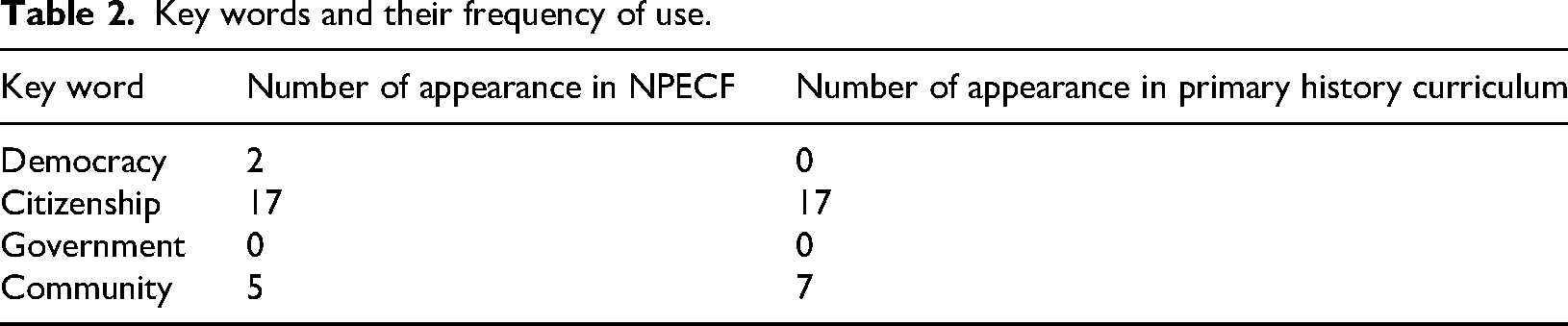
The first two questions were used for stage 1 (preliminary) analysis as they are descriptive while the last three questions were used for stage 2 (further) analysis as they required close reading and analysis. In the first stage of analysis (questions 1 and 2 above), the researcher searched both policy documents for key words using a truncation search format and recorded the number of times they are used the documents. Key words used for the search were Democracy (democ*), Citizenship (citiz*), Government (gov*), Community (commun*). The truncation search helped to identify the various iterations of the key words in the documents, for example, governance, democratic, communal. Aside from providing a numerical view of the frequency of appearance of the key words (see Table 2), the search also provided insights into the macro-level framings of democracy and historical consciousness in the selected documents. In the second stage of analysis, the context in which the words appeared in the policy documents were analysed and Wodak's questions 3–5 were used to bring depth to the analysis. For each of the key words, the researcher explored the key ideological underpinnings that shaped the discourse of historical and democratic consciousness in the documents. This stage of analysis was situated in the framing of historical consciousness and democratic consciousness, as explained in earlier sections, and linked to relevant policies and to past and current developments in Ghana's political and democratic context. Consideration was also made of the theoretical framework guiding the special issue
3
which has been contextualised for this study in Table 1 below. Analysis of each document was guided by table 3 (see appendix 1). Interpretations written for questions 3–5 in table 3 and associated notes informed stage 2 analysis.
Contextualistion of theoretical framework to the study.
Key words and their frequency of use.
Results
Preliminary analysis of NPECF and the primary school history curriculum shows that of the four key words, citizenship is the widely used key term, followed by community and democracy (Table 2).
The NPECF conceives education as means to achieving a democratic and sustainable society. Even though the policy document does not explicitly define democracy, it considers the vision of the Ghanaian school curriculum as developing “graduates who are problem solvers, have the ability to think creatively and have both the confidence and competence to participate fully in the Ghanaian society as responsible local and global citizens”. It further aims to prepare “well-balanced individuals with the requisite knowledge, skills, values, aptitudes and attitudes to become functional and productive citizens for the total development and the democratic advancement of the nation” (Ministry of Education, 2018, p. 123). By championing this, the NPECF aims to achieve social justice reducing inequalities and empowering citizens to contribute to democracy. There is a clear connection to historical consciousness as the policy highlights how acquiring knowledge of the past through the study of history is critical to identity development and civic responsibility within Ghana and beyond. Critically and within the context of globalisation, the [policy] framework identifies the need to close the trans-generational gap in the development of the Ghanaian child by introducing the study of History of Ghana into the national curriculum. The study of the History of Ghana, will enable learners to reconnect to the past, appreciate Ghana's heritage and values and develop into responsible citizens (p. 2). Educational experiences provided to Ghana's learners should inspire them to know about and value the history and traditions of their family, community and nation, as well provide them with the opportunity to critically examine the history and culture of other communities, and of other countries and peoples. That way, the Ghanaian child will not lose his or her identity as a result of the experiences provided through the educational system (pp. 18–19).
In the primary school history curriculum, democracy as a concept is not mentioned, however it is implied through ‘citizenship’ and expressed through democratic values such as tolerance, productive and responsible participation, honesty, respect, and national identity. The curriculum expresses the important place of historical consciousness to the promotion of democratic values such as unity and civic responsibility. As learners study Ghana's history, they would appreciate the life and sacrifices of our forebears and learn about the interconnectedness among the various ethnic groups to promote national integration, develop national pride and identity. Learners would learn about statesmen and women, chiefs and other individuals who played various roles to promote Ghana's development (Ministry of Education, 2019, p. iv).
This suggests that the curriculum considers history as a means for empowering oneself to know, value and appreciate the contributions of past peoples and by this identify the agency of oneself in future development agendas. The mention of different groups in history including men and women signposts an inclusive approach to history and a social justice orientation.
Representations of notions of democracy in the policies
Democracy is framed as an essential aspect of the Ghanaian society and therefore a key contemporary issue in the NPECF. The NPECF conceptualises education as the means to achieving a democratic and sustainable Ghanaian society and argues that good quality education produces citizens who have a better understanding of nation building and understand the need to contribute responsibly as active citizens. It states, “more educated people contribute to more democratic societies and sustainable economies and are less likely to be dependent on public aid” (p. 8). In this context, democracy is reflected from the perspective of the economic and social outcomes of education system. This perspective reflects the view that educated citizens are enlightened and well prepared to contribute to democracy and attain economic self-sufficiency. It further evidences the education system's commitment to fulfilling citizen's fundamental right to good quality education as safeguarded in the 1992 Constitution of Ghana, supporting a liberal democratic system. This enlightenment and awareness of citizen's own needs, interests and responsibilities is a key part of what critical theory aims to achieve (Wodak, 2007). Also, democracy is represented from a contemporary perspective and linked with peace, suggesting that democratic processes could lead to peace and stability. Peace and democracy are mentioned alongside other issues as climate change and green economy and reproductive health (p. 3). Generally, the NPECF gives an explicit focus on democracy as a core competency in the curriculum framework and portrays its connections to concepts of sustainability to emphasize long-term goals and aspirations of the Ghanaian society. While there is overt articulation of democracy and democratic societies in a contemporary world, the policy is silent on what type of democracy it aims to achieve. Further, even though links between democracy, educational outcomes and peace are evident and support a socially just system, which suggest that democratic processes such public elections could strengthen peacebuilding in Ghana, questions exist as to whether peace and economic independence of individuals are the only outcomes of a democratic system.
The primary school history curriculum does not mention democracy explicitly, so there are no clear linguistic representations or descriptions of it. It could be argued that not mentioning democracy in history curriculum is surprising for a country with a complex political history and whose constitution has clear democratic focus. Given the importance of democracy as a concept in the spheres of Ghana's political and democratic evolution, its overt use in the primary school history curriculum would have provided a good context to develop students’ democratic thinking and historical consciousness. Nevertheless, democracy is expressed through other concepts such as citizenship and its associated values and a sense of unity, community, and responsible participation.
Representations of notions of citizenship in the policies
Responsible citizenship is an important goal in the education system of Ghana aimed at developing people who can make meaningful contribution to the Ghanaian community. The NPECF recognises citizenship as the heart of education because it is purposed to develop young students into competent and responsible members of the society. “Through the education that Ghana's young people receive, the Ministry of Education expects that Ghana's young people will be nurtured into honest, creative and responsible citizens, making meaningful contribution to society” (Ministry of Education, 2018, p. ii). Such persons are empowered understand their rights and responsibilities as Ghanaians in a socially just environment through an understanding of the history and culture of Ghana. The NPECF reveals that the introduction of history in the school curriculum school is a means to helping young Ghanaians reconnect with the past and appreciate Ghana's heritage, suggesting that history is a legitimate tool through which responsible citizenship can be achieved. This is supported by the view that history “instil[s] in learners an understanding of Ghana's history, culture and traditions and of their rights and responsibilities as citizens” (Ministry of Education, 2018, p. 20). The introduction of history into primary schools demonstrates the instrumentality of history and the need to emphasise its role in the present and future as demonstrated by the quote “There is the need to preserve and pass on these values to the younger generation in order to prepare them to participate in and contribute meaningfully to the culture, society, and economy of the country as knowledgeable and active citizens” (p. 21). This resonates with Ghana's difficult pasts and how it took democratic values and persistence to gain self-rule and independence. It resounds how such values are pertinent to the present and future of Ghana and reflects critical sense of awareness and enlightenment against colonial use of power. Integrating history into primary school education also indicates a social justice orientation where young children are not denied access to the pasts of their nation and local communities. Further, cultural identity and global citizenship are competencies considered necessary in the study of history and in the education system as whole. Active citizenship in Ghana means that persons going through the education system should have clear understanding and awareness of the Ghanaian environment and its values as this would inform the actions and role they play to contribute not only to the Ghanaian society but also to the world as global citizens.
The above findings are reinforced by the primary school history curriculum. The curriculum portrays active and functional citizenship as a goal of history and the education system in general. Active and functional citizenship is represented as a common feature of the primary history curriculum, reflecting a strong national focus and commitment to the achievement of this educational outcome: “learners, as a result of the new knowledge, skills and values they have acquired through the new curriculum, will show a new sense of identity as creative, honest and responsible citizens” (Ministry of Education, 2019, p. i). History is expressed as subject that introduces students to a range of past actors and figures who can serve as good examples of cherished values from which students can learn. By describing, analysing, and evaluating the past students can learn useful lessons which can prepare them to contribute to the Ghanaian society. This is consistent with the philosophy of the history curriculum: “The philosophy of learning history is based on the need to produce citizens who are able to reconstruct the past by describing, analysing and evaluating past events” (p. iv).
The curriculum considers cultural identity and global citizenship as competencies that are necessary in the study of history, which is informed by the observation that informed and competent individuals are necessary to active citizenship. Citizenship is further underpinned by attitudes and values that are recognised as the cornerstone of Ghana's development. Aspects of national and global citizenship are portrayed in teaching and learning activities where students are exposed to Ghana's colonial history which depicts long periods of engagement with European nations and Britain. Through the teaching of this topic students appreciate Ghana's past trade relations and the continued engagement in mutually beneficial trade relationships with other nations. Pedagogically, teachers support students to use chronologies of events and draw on historical evidence to develop understanding of trade relationships between Ghana and the external world. Students learn about different nations and nationalities which deepens their knowledge and leads to global understanding and citizenship. Developing national identity is considered a means of strengthening national consciousness of what it means to be Ghanaian. The curriculum highlights respect for diversity and institutions, the rights and views of others, and adherence to laws as critical dimensions in the development of national identity and consciousness which counters injustice and projects adherence to the rule of law. National diversity is seen as a powerful tool for inclusive and socially just democratic nation building. These results suggest that citizenship can be nurtured through the Ghana education system by using history as a tool to highlight what it means to Ghanaian, the process of identity formation and consciousness of the values and responsibilities of citizens.
Representations of notions of government in the policies
The concept of government is clearly mitigated in the NPECF and primary school history curriculum as it is used 21 and 7 times respectively represent public offices or institutions and not how systems and nations are governed. References to political or public office is heavily represented portraying the seemingly excessive powers the Ghana Constitution attributes to political offices and institutions, with less focus on how such powers rest with the people and should be used for their good. This view is reinforced by researchers who note that governance in Ghana seems to rest in political offices who after elections tend to lose touch with the people (Afolayan, 2010; Resnick, 2019). As Afolayan (2010, pp 133–134) states, “beyond elections, democracy should make governments accountable to citizens – all citizens who fall under the jurisdiction of governing bodies.” The lack of functional use government in the curriculum is a great miss that portrays a potential lack of direct focus on the role of institutions, offices, and individuals in nation building. Interestingly, the 1992 Ghana Constitution mentions government 25 times, with 24 of the mentions linked to public office. Considering Ghana's checkered political history, this is a missed opportunity to explicitly teach students about governance and its effects on democratic, progressive nation building. It also potentially rids students of knowledge of their powerful place in the governance of their country.
Representations of notions of community in the policies
Ghanaians value community life and therefore the concept of community is introduced to children in their families even before formal schooling. Community is portrayed in the NPECF as an important part of Ghanaian social life and the education system seeks to support children's consciousness and appreciation of the history of family and community, which are micro units of a nation. The policy states; Essentially, the educational experiences provided to Ghana's learners should inspire them to know about and value the history and traditions of their family, community and nation, as well provide them with the opportunity to critically examine the history and culture of other communities, and of other countries and peoples (pp. 18–19)
The policy further emphasises the “intellectual, personal and social skills necessary for children to succeed in education, as members of society and as individuals with the capacity to contribute to their communities and continue learning throughout their lives” (p. 22). Membership of a community is strongly projected within this context. In this sense members of the Ghanaian community are expected to show responsibility to their community. Further, lifelong learning is reflected in this view of community participation as constant changes within community demand members’ willingness to learn new skills and adapt to community needs. Membership is also represented based on the expectation that they show responsibility to their community through fulfilling their roles, with focus on “young people's roles in, and responsibilities to, their families, community and society” (p. 23). This emphasises that Ghanaian family systems are essential units from which the ideas of community and society can the nurtured. In this light, the NPECF seeks to prepare students with skills and social characteristics that would enable them to understand and contribute to their communities. These social characteristics are expressed in the policy document as “learning of the norms, knowledge, values and skills needed for learners to play their roles in the family, school and community effectively” (p. 52). These are fundamental to exercising community responsibility. Active membership of a community is active citizenship when considered from a broader national scope, and the empowering posture of the policy consolidate student agency.
In the primary history curriculum, community is portrayed as an important part of Ghanaian social life, and the learning of history seeks to support students to “appreciate the history of themselves, their families and communities” (p. v). The concept of community is highly valued in Ghana as demonstrated through traditional approaches to socialising children within families. The curriculum content descriptions that highlight a community focus include sub-strand 4: community history – where learning activities include;
Recount history about their communities State the similarities and differences between the communities where learners live. Enquiry route: What is unique about your community? How similar/ different is your community from others? Compare sketches drawn with pictures of historical sites from other communities (p. 3)
Learning about the history of communities supports understanding of diversity – Ghana is a multicultural nation with diverse ethnic groups and communities. Analysing the commonalities and differences between communities supports respect for differences and encourages inquiry into the past. Further, communities in Ghana are seen as social groups that share common history and therefore engage in shared commemoration of significant events in their life such as Independence Day Celebrations (p. 42). Celebrating Independence Day as a community strengthens community life, giving life to diverse groups and bringing unity and equity in a multicultural nation.
Discussion and conclusion
Intersections of democratic and historical consciousness in the policies
This study aimed to underscore the intersections of democratic and historical consciousness in the NPECF and primary school history curriculum. Analysis shows that discourses in the two policy documents convey the democratic and historical aspirations of Ghana's education system with a social justice focus. This is particularly evident with the re-introduction of history in primary schools in 2019 and the attendant reinforcement of the place of history in the preparation of active citizens who are empowered to contribute to their nation's democracy. Democratic consciousness is strongly expressed through the concepts of citizenship and community, values such as honesty, respect and tolerance for diversity, and the privileges and responsibilities that come with them. This reflects prior findings that respect for diverse ethnic groups in Ghana can strengthen sense of belongingness, promote democracy (Oppong et al., 2021) remove the problem of inequality in Ghana (Afolayan, 2010). History as a subject provides a veritable context within which democratic consciousness and understanding are developed and firmed through a linkage of the past to the present and future. This is most important given that the practice of liberal democracy in Ghana is not without its underlying weaknesses (Afolayan, 2010).
Democratic consciousness is portrayed as a process-driven construct informed by an act of awareness and development of one's identity and participation as a Ghanaian national, which informs action and responsibility. It goes without saying that consciousness of one's Ghanaian national identity is foundational to their democratic participation. Ideas of inquiry and national consciousness are supported as the history curriculum provide opportunities for students to learn lessons from the nation's past to enable them to make informed judgements that can positively impact Ghana and the world. Specifically, there is overt articulation of how learning about key figures who contributed to the development of Ghana can encourage the younger generation to understand Ghanaian traditional values and become patriotic toward their nation (Ahuma, 1971; Sekyi, 1997). This suggests that the attainment of democracy is dependent on the acquisition of relevant democratic values derived from knowledge of peoples and cultures. The policies highlight the past as a tool for transmitting essential values across generations. Also, the education system helps students to understand that citizenship involves making “use of the knowledge, skills, competencies and attitudes acquired to contribute effectively towards the socioeconomic development of the country and the world at large” (Ministry of Education, 2019, p. vii). This connotes reflective action and decision making supported by capacity to infer from the past to shape the present. Both policies highlight democracy as a global necessity, meaning that the contributions that citizens make through the knowledge, values and skills obtained through history must not only be applied to Ghana but also to the whole world. The responsibilities of citizens to Ghana and the world are expressed in full participation and knowing and respecting the past, institutions, values, cultures, and traditions of Ghana and beyond.
A key aspect of democracy revealed through the analyses of the policy documents was a sense of community and community building. Community is represented from two perspectives. First, community is viewed from a historical perspective. In this context, the policies show that comparative examination and analysis of the history of different local and international communities can reveal underlying factors that have shaped communities and informed their current situation. Second, community is viewed from the perspective of responsibility where individuals use their skills and competencies gained through the study of history to contribute to community building. Here, the policies highlight democratic consciousness in how members of a community display commitment to their roles and responsibilities within the context of families, local communities and the broader national and international context. This reflects traditional practice in Ghana whereby responsibilities are exercised from within a family context and extended to the community and national levels. The policies emphasise the importance of valuing personal, family, community and national histories as appreciation of such histories is essential to living in the present and future. In this context, community is explicitly portrayed as an essential part of Ghana's past and present, with similarities and differences reflecting the diversities in Ghana's social landscape. Essentially, tracing personal, family and community histories can help students appreciate changed and continuity overtime, inform a common sense of identity and unity which could spur responsibility and encourage democratic participation. It also equips students with skills that contribute to successful living in Ghana and the global community. From the above, democratic consciousness and historical consciousness intersect overtly from a communal and social perspective as learning about past community shapes present day community-building practices and informs a sense of responsibility, which have been shown to be critical to progressive democracies (Ahuma, 1971; Boadu and Baddoo, 2017; Levstik and Groth, 2005). Further, even though the form of democracy practiced in Ghana is liberal democracy, results of this study reveal undertones of protective democracy as both policy documents place value on peace, order and stability in nation building. Also, links to developmental democracy are evident as the results highlight the active role of citizens in the nation development effort and reveal that optimal development can be attained in an environment where democratic traits such as respect for diverse groups and common sense of purpose are recognised and upheld.
Based on the preceding analysis and discussion, it can be concluded that discourses in the NPECF and primary history curriculum present a renewed focus on historical consciousness and social justice in Ghana's democratic context. Democratic consciousness and historical consciousness intersect and are overtly articulated and intensified across NPECF and primary history curriculum through language and descriptions that highlight national and global citizenship, national consciousness, sense of community and the values and competencies that result from the study of history and its application to the present and future. It is arguable from the study that democratic consciousness in Ghana is not isolated from strong knowledge base in Ghanaian history as well as skills and democratic values that result from studying about the past. Depictions of historical consciousness in the documents reflect orientation to the past and orientation in time as knowledge of the past is applied to present and future democratic systems, practices and contexts. However, critical analysis reveals that policy discourses seem to discount the essence and practical application of governance in favour of political institutions and offices as both documents do not overtly articulate the practice of governance and the place of the people in the governance of democratic nation. The 1992 Constitution of Ghana states that “The Sovereignty of Ghana resides in the people of Ghana in whose name and for whose welfare the powers of government are to be exercised” (Republic of Ghana, 1992, p.1). From this perspective, the narrow portrayal of government as public political office rather than agency of the people downplays the power and sovereignty the 1992 Constitution bestows on the people of Ghana. Such discoursal inequality between the people and public office could result in perceived and actual imbalance of power within social and political contexts which could result in overstretch of political dominance and potentially, people's resistance to democratic participation. Further, findings show that democratic consciousness could be intensified in the area of curriculum content descriptions and the suggested teaching practices to maximise the preparation of democratically conscious younger generation. The findings of the study highlight opportunities for policy developers and history teachers to consider a more overt representation of diverse people and social groups in the discourses relating to government in curriculum documents and history teaching, as this has implications for people's agency and inclusion in Ghana's democratic context. The findings reflect political intentions and aspirations for democratic and historical consciousness as framed in the policy documents analysed. Further research is needed to understand how this manifests in the actual delivery of history education in Ghana.
Footnotes
Declaration of conflicting interests
The author declared no potential conflicts of interest with respect to the research, authorship, and/or publication of this article.
Funding
The author disclosed receipt of the following financial support for the research, authorship, and/or publication of this article: Open access was supported by CAUL of which RMIT University is a member.

Notes
Appendix 1
Template for analysis.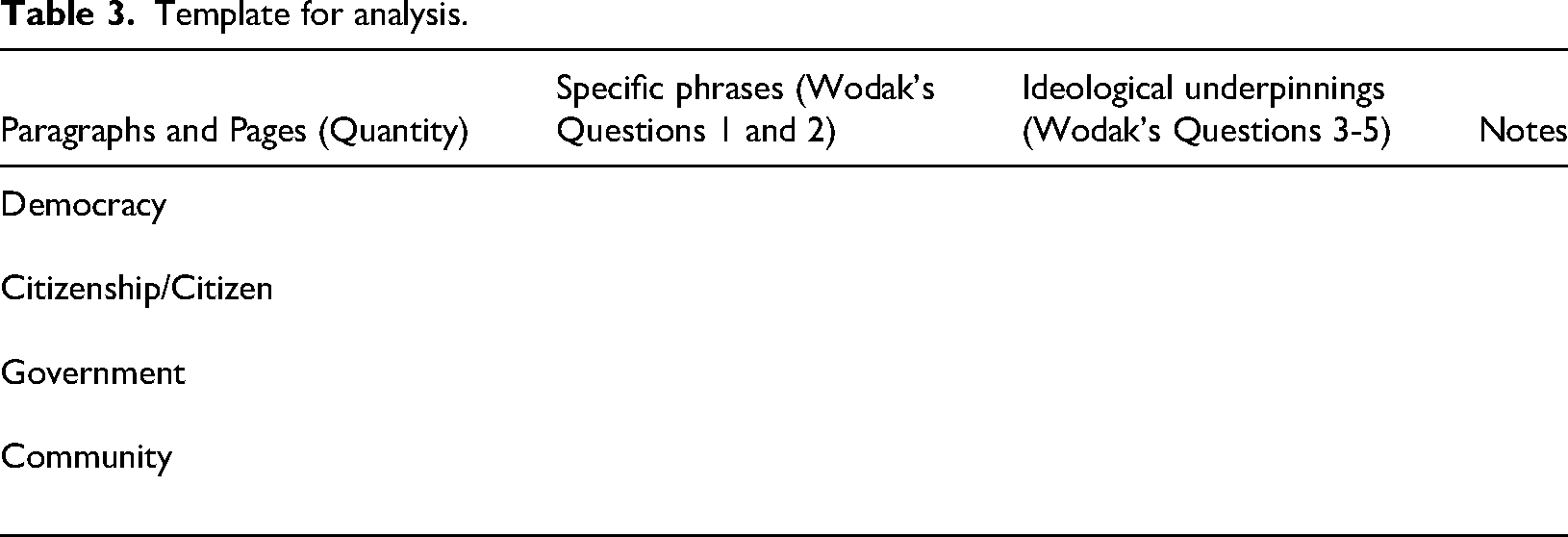
Paragraphs and Pages (Quantity)
Specific phrases (Wodak's
Questions 1 and 2)
Ideological underpinnings
(Wodak's Questions 3-5)
Notes
Democracy
Citizenship/Citizen
Government
Community