



Abstract
Sweden is a country with a long history of peace and liberal democracy. In the post war period, history education has been given a core position as a moulder of democratic citizens in Sweden. Since the 1990s, historical consciousness intertwined with democratic values has been used as a scientific grid for shaping citizens, not just in history education but also in the research field of didactics. This study is part of a comparative policy investigation into the curriculum/syllabus för history education drawing on a critical discourse analysis. The Swedish curriculum, which crosses through all subjects, is mainly based on a developmental democracy, including liberal democracy, deliberative democracy and participatory democracy, stressing the continuity and enhancement of a given order. It is pointed out that history is central to all subjects. However, the history syllabus is more radical, in that it mainly accentuates aspects linked to disruptive democracy stressing the change of and resistance to a given order based on arguments of equity. Primarily, concepts stemming from critical democracy are highlighted and nationalism are tuned down and replaced by terms such as local-global.
Introduction
The practices and arguments for democracy have been present in the Swedish political landscape since the 19th century in different and sometimes contested ways (Edquist, 2024) and were formally manifested through the right for election of men and women in 1921. However, it was not until 1962 that Swedish education formally established an elementary school based on democracy as a governing frame and ideology for the school system (Englund, 1986). Liberal democracy became the ideological frame that was intimately interwoven with the desire to build a strong universal welfare system in Sweden similar to that in Norway, Denmark and Finland, which is often is referred to as the ‘Nordic Model’ (Lundhal, 2016). In this process, history education was allotted a core position as a moulder of democratic citizens (Alvén, 2017) and historical consciousness. Since the 1990s this has functioned as a scientific platform for shaping citizens in many European countries, including Sweden (Ammert et al, 2017; e.g. Karlsson, 2009). Historical consciousness is thus intimately interconnected with history didactics (Ahonen, 2005, pp. 697-699) and democracy (Lukács, 1968/2009). Over the years, research on democracy and history education has been thoroughly investigated from various perspectives (see for instance Carrasco, 2023; Lytje, 2022; McCully, 2012; Monte-Santo, 2016). At the same time, the link between historical consciousness and democratic consciousness as it is expressed in curricula is less explored, rendering it interesting to study in-depth from an international perspective (see editorial Edling et al., 2025) with a particular focus on Sweden.
In the aftermath of the Second World War UNESCO (1947), the Council of Europe (1949) concluded that one central cause for wars to happen was the way in which history teaching was designed in terms of nationalism and a grand narrative of ‘historia magistra vitae’ that regarded its citizens as a homogenous organ in stark contrast to other cultures and worldviews. Indeed, it was argued that if history education could be seen as a tool to stimulate aggression, it could just as easily be used as a platform to foster critical, thoughtful and peaceful citizens (Lindmark, 2008; Council of Europe, 1949), in dialogue with an overarching democratic framework for the school system (cf. Ekman & Todosijevic, 2002; SOU 1948: 27). Even though understandings of democracy have changed in educational policy since 1948 (Englund, 1986), in Sweden the core values of democracy have been intertwined with a desire for equity and a consideration for plurality in different forms (Edling and Mooney Simmies, 2021).
However, like many countries in the world, liberal democracy is under pressure in Sweden too (cf. Mudde and Rovira Kaltwasser, 2012; Håkansson, 2023; Edling and Macrine, 2021; Edling et al., 2025). Before the refugee wave in 2015, Swedish public opinion was relatively non-hostile to immigration and the question of cultural plurality was not regarded as a ‘hot potato’ (Demker, 2014), even though the anti-immigration party Sweden Democrats managed to occupy seats in the national parliament already in 2010 (Emilsson, 2020). This image of Sweden as a rare exception in Europe changed after 2015, both regarding increasing negative sentiments towards immigration in the media and only accepting the EU’s minimum level of refugees (Emilsson, 2020; Bevelander and Hellström, 2019; Rydgren and van Meiden 2016). The changes can also be viewed in the light of strengthened school segregation between native Swedes and immigrants influenced by voucher schools based on individuals’ free choice of school attendance (Böhlemark and Lindahl, 2015) and challenges to the vision of ‘a school for all’, where various people and groups are to meet side by side in the classroom. Moreover, in line with OECD countries, Swedish education and approaches to knowledge have become more interconnected with economy and capitalism based on free choice and competition. Compared to other countries, in Sweden this trend has been faster and more radical (Lundahl and Olson, 2013; Lundahl, 2011). Since 2015 the Sweden Democrats, a far right party with roots in Nazism, have increased in strength, from 12.9% in 2014, 17.53% in 2017 to 20.5% in the latest election in 2022. 1 The current political government is a coalition party between the Conservatives, Liberals, Christian Democrats and the largest out of the four, Sweden Democrats, which decided to be a support party outside the government and parliament. Like other nationalistic, populist and conservative parties, the Sweden Democrats have an explicit historical consciousness in relation to history education that moves away from the pluralist platform that is central to all democratic ideologies, to a more homogenous narrative (cf. Håkansson, 2023). Seeing that history education plays an imperative role for shaping future citizens (Nygren, 2011), and that policy highlights political directives for educational practices (Ball and Maguire, 2012), it becomes particularly interesting to study how democratic consciousness intersects with historic consciousness in Swedish educational policy today, without maintaining that policy is the only road to understanding social change (Eklof 1986, p. 3).
The aim of the theme issue is to provide an overview and a deeper understanding of the intersections of historical and democratic consciousness expressed in curriculums/syllabuses focusing on history education in Sweden. More specifically the article asks the following questions:
How are implicit and explicit intersections between historical consciousness and democratic consciousness described in the curriculum/syllabus for history education for the elementary school in Sweden? What kind of consequences for history education in Sweden do the descriptions in the curriculum/syllabus entail? How can the descriptions of historical consciousness and democratic consciousness in Sweden be understood in relation to the country’s cultural- and historical development?
The article is divided into five parts: I. Background, II. Methodology, III Results a, IV Results b and V. Discussion. To begin with, an overview of how democracy in Sweden developed in relation to education is presented, followed by an overview of how democracy has been approached in history education. In section II, the theoretical framework and methodological consideration in this article are based on the introduction in the theme issue and will therefore not be added here. However, it does include: a) a presentation of Sweden as a country, b) policy structure and features and c) a description of the structure in the analytical process. The results of the study (sections III and IV) are then discussed and placed in dialogue with a larger research body seen as broader societal discourses drawing on the main findings of the study (section IV).
Background
Research on democracy in Swedish education from a historical perspective
In the 19th century, schools in Sweden became of interest to the state as a brick in the construction of the Swedish nation state (cf. Richardson, 2004; Lindesjö and Lundgren, 2014) and a tool for reproducing a society that would be better equipped to adhere to the needs of a rapidly changing society and the desires of those in power (Larsson, 2019). Mass schooling developed at the same time in many countries, such as Ontario, Canada (1841), Norway (1948), France (1833) and Denmark (1814) (Westberg, 2015).
The Swedish folk school, advocated for by the liberals and launched in 1842 as a compromise between different political parties, meant that each parish was obliged to establish similar schools and that all children without exception should be educated. The bishop and the cathedral chapter were responsible for monitoring the education. However, the so-called, folk school should not be confused with compulsory education (Westberg, 2014). A parallel school system existed at this time, which meant that children, with parental permission, could study at home. In 1868 only 65 per cent of children between the ages of 7-14 attended school (Ljungberg & Nilsson 2009, p. 80). As regards knowledge acquisition, the folk school had two levels with minimal requirements: a) Christian studies, church singing, writing, reading and arithmetic and b) geometry, history, geography and natural science (Lindmark 1992). Accordingly, the public school at this time was not expected to socialise citizens towards equality and criticality, but towards becoming obedient and Christian Swedes nurtured by a national consciousness, and who knew their Bible, but at the same time were prepared to stand up for the country as soldiers and servants when needed (Englund, 1986). The attitude towards others was coloured by Christian ethics that accepted unfair treatment and bowed to authority, motivated by the fact that it would enable them reach heaven (Hedin & Lahdenperä, 2000).
However, the slow process of creating a school system for the nation state meant that the power of the church and the king was reduced in favour of political parties. This incipient break between the state, the church and the king has been described by many as the beginning of democracy. It was first in 1974 that the Swedish monarchy was deprived of any political power (Wenander, 2020). On 1st January 2000 the Church of Sweden became officially separated from the state (Ekman & Todosijevic, 2002), and in 1962 the compulsory school system came to be based on democracy as an all-encompassing ideology (Mooney Simmies and Edling, 2016). Sweden differs when it comes to liberate education from external forces, such as religious representatives from countries like Ireland, where religious and democratic education are intertwined (Mooney Simmies and Edling, 2018). In Sweden, civic education began with the school reforms of 1918/19 that corresponded with the central democratic development of universal suffrage (Englund 1986). A curriculum was introduced stressing compulsory education for everyone about the same time as parliamentary democracy was established, thereby shifting responsibility for education from the church and home schooling to the state (Florin, 1987).
The compulsory school was further enhanced after 1945 when schools came to be seen as a collective social right with an important responsibility for safeguarding democracy (Ball and Larsson, 1989). The approach to democracy has not been static since the Second World War, but has oscillated between emphasising the education of good democrats, where schools are expected to actively socialise young people into democracy based on liberal values and become good employees with a focus on delivering the objective knowledge needed in the labour market (Englund, 1998, pp. 23-24). Approaches to democracy in Sweden have also moved between various epistemological foundations. While the Swedish political debates relating to democracy and education were influenced by John Dewey’s progressive ideals during the 1940s, interconnecting for instance the child’s growth with society’s need and knowledge with socialisation, the creation of the compulsory school in 1962 (Years 1-9) changed the focus to a more essentialist epistemology stressing rationalism and objective measurements. Democracy was here reduced to knowledge about democracy, thus omitting democratic socialisation (knowledge through democracy) as a responsibility for schools. These tendencies were criticised in the 1970s as overlooking human conditions and more progressive ideals returned in the centralised and detailed school curriculum for the 1980s (Englund, 1986).
When the curriculum of 1994 was launched, the school system had been decentralised in terms of moving power from the state to municipalities and schools. In this turn, a democratic value foundation was created based on liberal values, which was placed as a text at the beginning of the relatively slim political document, stressing that all practice in schools was to be based on these democratic values (Edling and Mooney Simmies, 2021). Plurality has been central to the Swedish educational approach to democracy (Edling, 2018), although until 2000 the educational policy understanding of plurality focused on dealing with the problems and shortcoming of ethnic cultures in terms of the assimilation of ethnic cultures (1970s) and integration and a respect for individual and cultural diversity (1990s onwards) (Brantefors, 2011). At the same time, democratic education was strongly influenced during 1989/90 by school reforms initiated by the Power Commission (SOU 1990:44), where a more individual- and market-oriented concept of democracy came to the fore (Wahlström, 2022). This resulted in tensions in the Swedish debate (Hultén, 2019), not least about democracy and education creating a rift between a society centred democracy and a consumer centred democracy (Olson, 2009). Deliberative democracy has been advocated as a strategy at policy level to counter-balance market-oriented approaches. Contrary to the individual and consumer focus, deliberative democracy highlights individuals’ participation in a communicative and respectful practice with others in questions concerning social good (Englund, 2000; Dahlsted and Olson, 2019).
Research on history education and democracy in the Swedish formal curriculum
Approaches to history tend to develop in times of crisis. After the Holocaust in 1945, the dominating Historismus, the grand or singular narrative of a national history, was seriously questioned in society (Rüsen, 2005). This crisis of Historismus is reflected in UNESCO (1947) and the Council of Europe (1949), both of which stressed that history education should be approached more humbly and as a gateway to fostering critical democratic citizens who paid attention to the plural dimensions of history (Lindmark, 2008; Council of Europe, 1949). History education in Sweden was thus given a central role to prepare future democratic citizens (Alvén, 2017; Jarhall, 2020), although the direction of this approach differed in the after-war period. Historical knowledge in the subject involves three dimensions of historical knowledge: skill-related, content-related and meaning-making aspects, and can fluctuate between knowledge about history, in history and the usefulness of history for human life and orientation (Jarhall, 2020).
In line with the changes in history education in Sweden during the 1950s and 1960s, the fostering dimensions and the need for tolerance (democracy through and knowledge in history) were not strongly stressed in policy. More specifically, the history curriculum for the upper secondary school in the 1950s stressed that history teaching should be based on objective facts, including history from economic, social, political cultural perspectives including critical perspectives like colonialism and race theory, which were to be approached in a neutral fashion, i.e. as facts (Nygren, 2011).
During the 1970s and 1980s the history curriculum was successfully transformed to become more in harmony with UNESCO’s desire to interconnect various perspectives in national history with the global and international understandings of history. In the history curriculum/syllabus for the elementary school in the 1980s it was emphasised that history should include non-European history and cultures. Awareness of the power-relations between men and women along with the positive connotations of immigration were added to the curriculum/syllabus in 1981. In the history curriculum/syllabus of 1994, historical consciousness was introduced as a starting point for historical orientation, based on an idea that the past, present and future were interconnected and that the individual needed history for a deeper understanding of the current challenges and strategies for moulding a better future. The importance of critically investigating plural worldviews in history was brought to the fore, including students’ cultural understanding as part of a society of others, influenced by inter-cultural perspectives. However, the syllabus of 1994 did not include local Swedish history (Nygren, 2011). Alvén (2017) shows in his analysis of the 1994 and 2011 history curriculum/syllabuses that there was a tension between objective facts and the need to foster democratic citizens in history education.
The strong focus on paying attention to pluralism has been questioned in Sweden through nationalistic forces, and a return to a historia magistra vitae is becoming more apparent in Swedish political discussions due to the influence of the Sweden Democrats In similar fashion, and like other nationalistic political organisations, the historical narrative starts in a monolithic and homogenous image as one nation, one folk, one culture and one cultural heritage, which they argue should be strengthened in Swedish education policy. This creates tensions in the Sweden Democrat’s approach to minorities, where they are pictured as having a historical right to nationhood, but without accepting their roots as a nation historically before the origins of Sweden (Håkansson, 2023).
Various democratic traditions
The intention in this section is to provide a brief overview of various democratic traditions based on a more in-depth description found in the editorial article. In a dialogue with different researchers, three strong branches of democracy can be found: a protective democracy, developmental democracy (Held, 2006) and disruptive or interruptive democracy (Biesta, 2020; Sant 2019). The focus on protective democratic forms like elitist- and neoliberal democracy is a desire to maintain order and stability by allowing a small elite to govern the majority. The democratic practices and, hence, plurality, are primarily visible through the system of voting, where education is not seen as an explicit platform for forming democratic citizens (Sant, 2019).
On the other hand, a developmental democracy is based on liberal democracy and its various sub-branches and stresses the process of well-grounded argumentation through dialogue and a developmental type of participatory democracy where citizens in a society practise democratic values and knowledge through participation in staged settings. All these developmental traditions believe that there is a need to cultivate the individual into a democratic society through education. Indeed, developmental democracy stresses the importance of protecting and stimulating individuals’ self-realisation, various forms of human rights, equity and free choice. The individual is seen as rational and in need of being shaped as a democratic citizen through democratic values and knowledge that are practised in day-to-day life.
Finally, interruptive or disruptive democracy traditions approach democracy as a force that can open up spaces for an engagement for plural voices with regard to current and pressing challenges as a means to stimulate real engagement for public good, rather than being viewed as a stable order that people are fostered into. The drive to oppose injustice and oppression is seen as an engine that creates ruptures or changes in the social order for the common good. In dialogue with this tradition, (some aspects of) participant-, critical-, multicultural- and agonistic democracy can be categorised as interruptive democracy, in that they do not only aim to develop an existing order but also cultivate resistance to structures deemed as immoral, unjust and/or unequal (cf. Sant, 2019).
Material and methodology
Sweden as a country: National context democracy and values
Sweden is often referred to as one of the Nordic countries, along with Denmark, Finland and Norway. Located in northern Europe, in 2023 Sweden had 10.55 million inhabitants with an approximate 50-50% division between genders. The increase in the number of inhabitants mainly stems from immigration. 2 In 2023/24, Sweden had just over 1 110 000 pupils registered in primary education; 1 500 pupils less than in the previous year. 3 Sweden is considered to be one of the oldest liberal democracies and the country has experienced the most extended era of peace in the world (Bjereld & Möller, 2016). The Swedish welfare system was created in the years after World War II guided by ideas of equity and universalism that were then challenged during the 1980s due to economic reasons and political criticism (Blomqvist and Palme, 2020). Sweden is part of the European Union, United Nations and recently (2024) became a member of NATO due to the war in Ukraine.
As regards the gender equality index, Sweden ranks highest in the EU-countries with 82.2 points out of 100. 4 When it comes to democracy, the ICCS survey from 2022 shows that pupils in Year eight are amongst the top performers regarding knowledge about democracy and engagement in social issues. Unfortunately, Sweden’s knowledge results have decreased since 2016 by fifteen points (565 points), but is still above average, while the gaps between high and low performing students have increased. 5 In the 2022 measurements of 15-year-old students’ knowledge in mathematics, reading and natural sciences in 37 OECD countries, Sweden was ranked 15th which is a decline since the last measurements. 6 Ranking systems regarding income, corruption and safety all point to the fact that Sweden is still amongst the top countries, even though there are tendencies to increased challenges regarding gang violence, growing inequality between natives and immigrants, a distrust of politicians amongst youth and a decline in voting (Sandahl et al, 2022).
Educational policy structure in Sweden at the compulsory school level
The governance of the Swedish Educational system is decentralised, meaning that the government sets the overall ideological, financial, legal and supervising structures for education but allows a certain amount of freedom to the municipality to realise the expected obligations. This brings with it differences between how schoolwork is conducted in the Swedish municipalities (Forsberg, 2014). The ideological frame for education in Sweden is democracy, which is in focus in this study in relation to what this ideological frame entails for history education.
Educational policy is hierarchically and relationally arranged, implying that the documents are in a hierarchical relationship to one another. At the top are the different Acts defined by Parliament [Riksdag] setting out what schools are obliged to do. Several Acts influence the school system, but the two most referred to are the School Act, where the state’s values and directives against violation are described, and the Discrimination Act, which obliges schools to counteract different kinds of discrimination. Directly in relation to the Acts are the Ordinances under the jurisdiction of the government [Regering]. The Ordinance in focus in this study is the curriculum and syllabus for history education in the elementary school. The curriculum describes the state’s values and the overarching mission for the school system in terms of the objectives and guidelines for education. The syllabuses for the different subjects describe the aims and goals of the education to be taught. There are also regulations in terms of state reports, although these are not highlighted in this study.
The theoretical frame of this study is historical consciousness as an ontological base for understanding democratic consciousness expressed through language. The methodology is based on Ball and Maguire’s policy enactment, Wodak’s (Wodak et al, 1999; Wodak and Meyer, 2015) critical discourse analysis and pays attention to directives on comparative studies. Drawing on democracy as a changeable construct that is intimately interconnected with a respect for plurality amongst people and equality (Dahl’s, 1998), Held’s (2006) democratic models highlighting protective democracy and interruptive democracy are placed in dialogue with Sant’s (2019) review of research on democracy and education highlighting democratic theories and including theories linked to an interruptive democracy. The various democratic theories give specific directions for democratic consciousness in connection with historical consciousness (for a fuller description in the editorial, see Edling et al., 2025).
Methodological questions drawing on the work of Wodak and Meyer (2015) have been used to answer the following key questions:
✓ Description of individuals, events or groups of people named and referred to linguistically. ✓ Drawing on these descriptions, what ideological underpinnings and perspectives can be found? ✓ What kind of education/pedagogy is encouraged in relation to the topics of democracy/citizenship? ✓ What is excluded and included in the material – who is made visible or invisible? What is explicit and implicit in the descriptions?
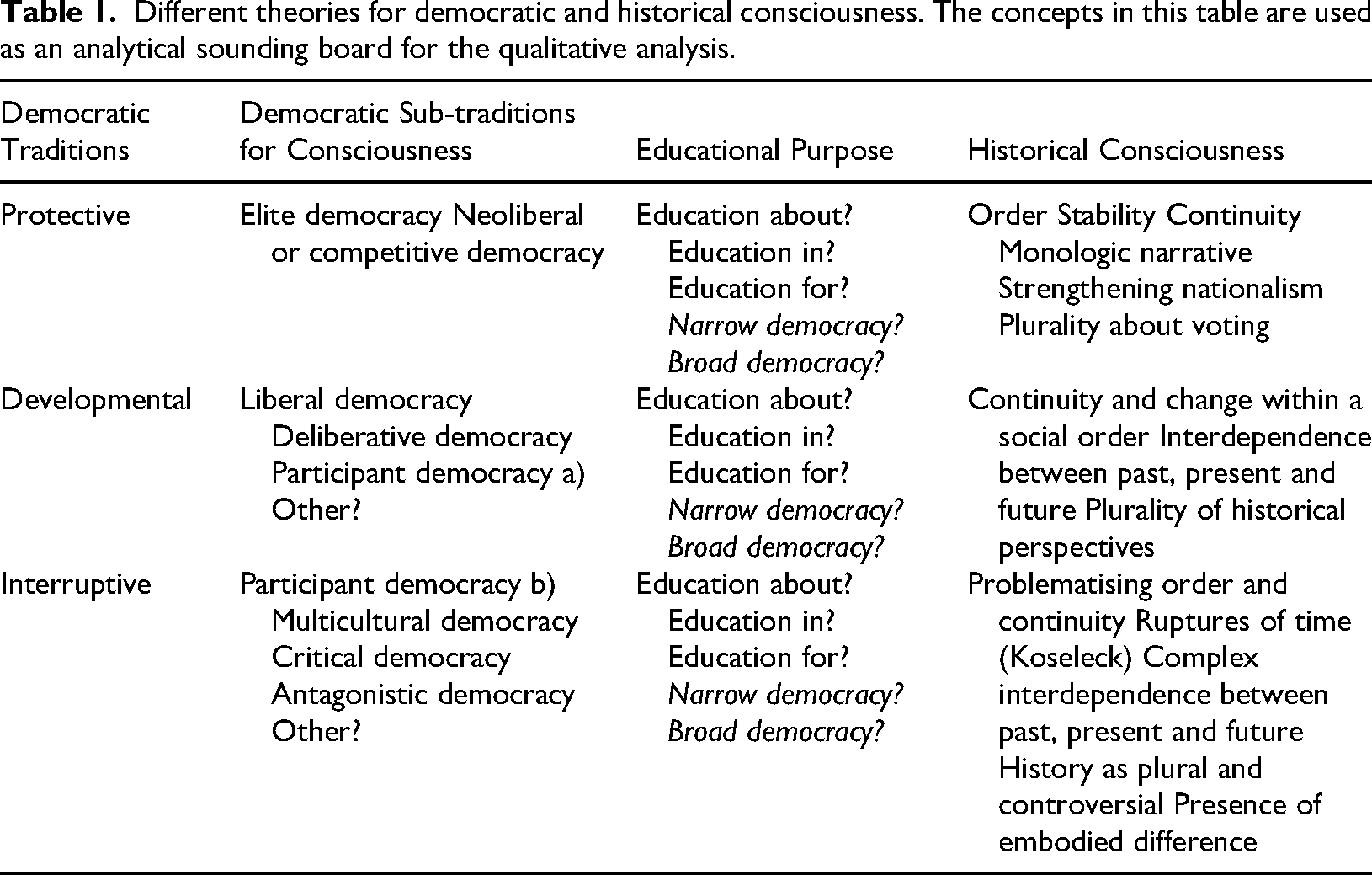
Seeing that the curriculum stands in direct relation to the syllabus for history education, the article analyses: a) the overarching frames in curriculum that history education needs to pay attention to and b) the syllabus for history education. The analysis is based on a systematic reading of policy texts highlighting the descriptions of democracy and history and structuring these findings into discourses that are then placed in dialogue with the analytical tools outlined in Table 1.
Different theories for democratic and historical consciousness. The concepts in this table are used as an analytical sounding board for the qualitative analysis.
Result: Curriculum, history and democracy
This section refers to chapters one and two (15 pages in all) in the curriculum and mainly focuses on knowledge about democracy in terms of socialisation. At the beginning of the curriculum is the heading ‘School’s fundamental value and mission’, which crosses horizontally through all subjects, including history education. In this chapter, democ* is mentioned 11 times and described as the fundamental framework for the school system in the introductory paragraphs. The approach to democracy is mainly located within developmental democracy in relation to liberal, ‘deliberate’ democracy, and to some degree to participatory democracy. When it comes to disruptive democracy, a few descriptions can be found linked to critical democracy and multicultural democracy.
Developmental democracy stressing development, continuity and progression
Liberal democracy is based on socialising young people into adhering to the fundamental values that people in a nation are believed to need to protect the individual’s freedom, equity, rights and responsibilities. It is referred to as “our society’s common values” that need to permeate action (Lgr-22, 11) – education through democracy and history. In the curriculum these values are referred to as the “fundamental democratic values/…/on which Swedish society rests” (Lgr-22, p. 5) and accentuates the unique individual being able to live in a communality and environment with others. The values are seen as a cultural heritage from the past being passed from one generation to another. The values stressed are the individual’s intrinsic values, respect for the environment, equity, gender equality and solidarity based on Christian ethics. To adhere to these values, students need to be socialised into acting in a tolerant, generous, law abiding and responsible manner: Everyone working in schools must also promote respect for the intrinsic value of each person and respect for our common environment. The inviolability of human life, the freedom and integrity of the individual, the equal value of all human beings, equality between men and women, and solidarity between people are the values that schools should embody and transmit. In accordance with the ethics of the Christian tradition and Western humanism, this is achieved through the individual's education in a sense of justice, generosity, tolerance and responsibility (Lgr-22, p. 5).
Aspects that are characteristic of deliberate democracy are also found in the material through recurring expressions stressing various perspectives for a better judgement processed along with an ethical stance that permeates practice and supports personal negotiations (Lgr-22, p. 9). Discussions with others are emphasised. The explicit ‘perspectives’ mentioned are ethical, environmental, historical and international. The historical perspective is thus something that cuts across all subjects/education and is given a central role for critical thinking: “Through a historical perspective, pupils can develop an understanding of the present and a readiness for the future, as well as develop their ability to think dynamically” (Lgr-22, p. 8). The relation to direct democracy that deliberative democracy activates is found in expressions like actively partaking in developing education and influencing it (8) by gaining well-grounded judgements from different perspectives on questions that concern them. This perspective should characterise the school's activities in order to provide a basis for and promote pupils’ ability to make personal decisions and act responsibly towards themselves and others. The school's mission to promote learning requires an active discussion in the individual school about concepts of knowledge, about what is important knowledge today and in the future, and about how knowledge development takes place. Different aspects of knowledge and learning are natural starting points for such a discussion (Lgr-22, p. 9). Pupils should be given a say in their education. They should be continuously encouraged to take an active part in the further development of their education and be kept informed about issues that concern them. The information and the ways in which pupils are involved should be adapted to their age and maturity. Pupils should always have the opportunity to take the initiative on issues to be dealt with within the framework of their influence on education (Lgr-22, p. 15).
Advocators of deliberative democracy stress the meeting between various (cultural) perspectives as competences, which the following sentence can be associated with: “[t]he school is a social and cultural meeting place which has both an opportunity and a responsibility to strengthen this ability in all those who work there” (Lgr-22, p. 6). More explicitly, the curriculum states that students need to practise a critical scrutiny of various perspectives as well as their consequences for action. Even power structures should be studied by the students critically rather than acted upon, rendering them more about deliberative democracy than critical democracy: “Education shall critically examine power structures linked to gender and honour-related violence and oppression” (Lgr-22, p. 8).
It is also necessary for students to develop their ability to critically examine information, facts and circumstances and to recognise the consequences of different options (Lgr-22, p. 7).
The teacher should/…/openly present and discuss differing values, perceptions and problems/…/visualise and discuss with pupils how different conceptions of what is female and male can affect people's opportunities and how gender patterns can limit their own life choices and living conditions (Lgr-11, p. 12).
Besides deliberative democracy as a sub-discourse, there are also traces of participant democracy in the material, for example: Teaching should be organised in a democratic way and prepare pupils for active participation in society. It should develop their ability to take personal responsibility. By participating in the planning and evaluation of daily teaching and being able to choose courses, subjects, themes and activities, pupils can develop their ability to exert influence and take responsibility (Lgr-22, p. 6).
The recurring concept of participation is interwoven with liberal democracies striving to foster democratic values and is not a participation that breaks outside a given order but is about practising activities within that order, such as planning education, choosing courses and so forth. Descriptions that could be linked to interruptive democracy are scarce in the material and are not explicitly linked to students.
Interruptive education, contesting and taking active measures against injustice
Concepts in relation to action that aim to change practices have similarities with multicultural democracies’ ideas about protecting different vulnerable groups, thereby rendering norm consciousness central: “take a democratic and norm-conscious approach”, the agent is everyone in school and not explicitly pupils (Lgr-22, p. 12). Terms like contest and active measures (against) injustices come into play in relation to equity and the Discrimination Act, stating that the school (as an agent) should stimulate empathy so that no discrimination occurs. If tendencies of discrimination arise they should be prevented (2) with knowledge, be ‘contested’ (4), and handled with ‘active measures’ (1). However, the contesting and active measures are not specified, neither is the agent to perform these acts, but refer to (all actors in) school: The school should promote understanding of other people and empathy. Education should be characterised by openness and respect for people's differences. No one shall be discriminated against at school on the grounds of gender, ethnicity, religion or other belief, transgender identity or expression, sexual orientation, age or disability, or on the grounds of any other offence. Intolerance, oppression and violence, such as racism, sexism and honour-related violence and oppression, shall be prevented and countered with knowledge and active measures (Lgr-22, p. 5). Schools also have a responsibility to make visible and counteract gender patterns that limit students’ learning, choices and development. How the school organises education, how pupils are treated and the demands and expectations placed on them help to shape their perceptions of what is female and male (Lgr-22, p. 6).
Some traces of agonistic democracy can be found in the way that teachers are to allow controversial values to be discussed, but it could also align well with the logic of deliberative democracy without further specification: “The teacher shall /…/ openly present and discuss differing values, perceptions and problems [with the pupils]” (Lgr-22, p. 12). Regarding temporality concepts, such as contest, prevent and actively measure, they implicitly activate some kind of change of pattern, an order and/or behaviour deemed as contesting equity and risk harming unique humans even though change is not explicitly mentioned at all in the analysed curriculum.
Result: Syllabus, history education and democracy
The syllabus for history education (pp. 180-184) is divided into an introductory part highlighting the framing ideas and purposes of history education that cross through all grades, followed by more specific content aims of what Years 1-3, 4-6 and 7-9 in elementary school should reach within a specific time frame.
Overarching ideas and aims
Historical consciousness and developmental democracy
Drawing on historical consciousness that is intimately interfused with democracy (Edling et al., 2021) and democratic values (Gadamer 1975/2006), students are expected to gain insights into history as a process of continuity and change. Understanding continuity (1) is consequently a central aim with history education, which can be associated with developmental democracy and, more specifically, deliberative democracy: In doing so, students should gain different perspectives on how the use of historical narratives and references can influence people's identities, values and beliefs. Teaching in the subject of history should provide students with the conditions to develop/…/ /…/ the ability to ask questions of historical sources and to interpret, critically analyse and evaluate them, and /…/ the ability to reflect on how history can be used in different contexts and for different purposes (Lgr-22, pp. 180-181).
Historical consciousness opening to interruptive democracy
Indeed, historical consciousness is the overarching framework used in Swedish history education, in that it highlights the way in which history impacts our lives, has different perspectives, is human made and that individuals’ perceptions of history makes it possible to scrutinise which patterns from the past influence the present and if there are insights from the past that require people to change the future. Change is mentioned 4 times and continuity once in the introduction. Even though democracy is not mentioned, the framework opens to ideas stemming from interruptive democracy through the words change and people’s power to change: People’s understanding of the past is intertwined with their perceptions of the present and perspectives on the future. In this way, the past influences both our lives today and our choices for the future. Throughout history, women and men have created historical narratives to interpret reality and influence their environment. A historical perspective gives us the tools to understand and change our own time (Lgr-22, p. 180).
Teaching should provide students with the prerequisites for acquiring a historical frame of reference and a chronological overview of how women and men throughout the ages have created and changed societies and cultures/…/By providing perspectives on long historical lines of relevance to the present, such as living conditions, migration and power, teaching should give students a deeper understanding of how historical development is characterised by both continuity and change (Lgr-22, p. 180).
This section highlights the ideas and purposes of history education that cross through all the different educations. The next section highlights the content aims of history education.
Central content aims in history education
Democra* as a concept is explicitly mentioned 4 times in the syllabus. The values described in the curriculum are mentioned in relation to “[m]änskliga rättigheter inklusive alla människors lika värde och barnets rättigheter i enlighet med FN:s konvention om barnets rättigheter (barnkonventionen)” [human rights including the equal worth of all people and children’s rights in accordance with the UN Convention on the Rights of the Child] (Lgr-22, Years 1-3, p. 182). The other values are mentioned more implicitly by how the aims direct attention to moments in time when (groups of) individuals’ life conditions, equity, equality and respect for human differences and rights came into play as forces in history. However, this is not done through examples of continuity, but through historical transformations and a reminder of the power of individuals to influence and be influenced by history. The strongest discourse in the syllabus is subsequently interruptive democracy.
Historical consciousness opening to interruptive democracy
Besides aims highlighting education about history/democracy, i.e. the specific historical knowledge that students need to know, education in history/democracy, which is about socialisation, is implicitly interwoven with the former through the way in which knowledge and values are pictured as interconnected. However, central in the syllabus is the indirect encouragement of a consciousness of people’s capacity to create change in the name of making all people’s lives better, i.e. education for history/democracy. The message in the syllabus for history education based on the patterns found is that ordinary people before us have stood up against oppression and therefore so can we.
Throughout the syllabus for history education the aims are linked to events in history where significant changes have occurred in ways that influence people’s life conditions. Concepts like change (19), reform (1), revolution (1), create opinion (1) and emergence (6) [framväxt] of something new (4). Continuity (5) is always mentioned together with change, entailing that continuity is not something that is emphasised as having a value in itself. Several examples of historical changes are mentioned in the aims and brought to fore through collective forces to make the conditions better for people, for example being conscious of children’s rights, increased influence for people, equity and equality. This can be in the form of the development of democratic principles allowing ordinary people to vote: “Basic democratic principles/…/ [w]hat freedom of opinion and expression and the majority principle can mean in school and in society” (Lgr-22, Years 1-3, p. 182).
The terms power (9), resistance (2), group struggles/battles (2), influence (1) and how various activities come with different consequences (15) for groups of people are recurringly mentioned in relation to changes that can be associated with ideas stemming from critical democracy: “[p]ower relations and living conditions in the Nordic region, approximately 1500–1800” which includes “[t]he struggle for political power in the Nordic countries/…/[t]he formation and emergence of a strong royal power in Sweden’ and ‘[p]roper and resistance to royal power” (Lgr-22, Years 4-6, p. 236). Moreover: “[r]evolutions and the emergence of new ideas, social classes and political ideologies” (Lgr-22, Years 7-9, p. 183) and “[a]nalysis of the use of history in relation to the time period, for example, how individuals and groups use history to criticise contemporary phenomena and influence our conceptions of the future” (Lgr-22, Years 7-9, p. 184).
Besides ‘parliamentary democracy’, the term democracy is referred to in the syllabus as a means for (gender) equality that stands in contrast to other governing forms and is a reaction against genocide and oppression through the will of the people. The way change is linked to (ordinary) people’s opinions and actions can be understood as education for democracy, in which people’s agency for change is placed in the centre of attention: ș European nationalism, imperialism and the emergence of various forms of democracy and dictatorship/…/the two world wars, their causes and consequences. oppression, expulsions and genocide the Holocaust and the Gulag People's resistance to oppression/…/Analysis of the use of history linked to the time period, for example how different actors use history to create public opinion or legitimise power (Lgr-22, Years 7-9, p. 183). Democratisation and increased globalisation, approx. 1900 to the present/…/Democratisation in Sweden and the emergence of the welfare society. The formation of political parties, new popular movements, such as the women's movement, and the struggle for universal suffrage for women and men (Lgr-22, Years 7-9, p. 184).
Open conversations in relation to difficult topics that affect students in Years 1-3 without an ambition to reach consensus are also mentioned and could be seen to have some links to agonistic democracy: Discussing and reflecting on moral and life issues of importance to the pupil, such as peer relationships, gender roles and death/…/Discussing and reflecting on norms and rules in the pupil's living environments, including at school and in digital environments (Lgr-22, Years 1-3, p. 181).
Discussion
The intention with this article has been to shed light on the intersections between historical and democratic consciousness in the Swedish curriculum/syllabus for history education, where consciousness can be interpreted as a chosen meaning of this intersection expressed through language. Compared to many other countries, Sweden is characterised by a long period of peace and the support of liberal democracy (Bjereld & Möller, 2016), which can be seen as having an impact on the content of the curriculum/syllabus. At the same time, Sweden is currently experiencing an increase in people supporting far-right parties. Sweden Democrats, a party with roots in Nazism, gained 20.5% of the votes in the parliamentary election in 2022, rendering them the second largest political party in the country. Like other nationalistic and conservative parties, they stress a historical consciousness that distances itself from the pluralist platform central to all democratic ideologies and align to a more homogenous narrative (Håkansson, 2023). It is argued that history education plays a key role in the formation of citizenship and democracy (Nygren, 2011; Lindmark, 2008), rendering it vital to study how the Swedish curriculum and syllabus verbally express democratic consciousness in relation to historical consciousness.
A central assumption in the article is that both researchers and educators orient in the world based on their historical consciousness (Ahonen, 2005), and a central function of research is to broaden and deepen human meaning-making (see for instance Jarhall, 2020). Whereas research highlighting the relationship between democracy and history education is relatively well developed, an awareness of how democracy comes into play in current policy documents for education is scarce (Edling et al., 2025). The various dimensions of democracy in Swedish educational policy can thus be used as a roadmap for deepening teachers and researchers understand regarding which threads from the past current policy activates. As such, it can help educators to better understand how democracy is politically approached in history education and add new knowledge to a research field that has as yet barely been investigated.
As far as can be ascertained, no similar study has been conducted before. One of the main results of the analysis is that the Swedish curriculum, which cuts through all subjects, mainly accentuates a developmental democracy based on liberal-, deliberative- and participatory democracy. Sub-discourses within the discourse of interruptive democracy, like critical, multicultural- and antagonistic democracy, are mentioned too, but not strongly and are pictured as a responsibility for the adults in school. Indeed, the curriculum does not primarily emphasise change but an ambition to develop students into a given order based on liberal values. Besides, the ambition to socialise unique students into these collective values, students are to develop an ability to scrutinise various perspectives before forming well-grounded judgements and practise roles defined within the democratic order.
Contrary to the strong emphasis on developmental democracy, the history education syllabus mainly encourages the dimensions that are stressed within interruptive democracy. This entails educational strategies that train students’ awareness of plausible injustices of social orders and encourages them to react and at times create change to make life better for people in society. Historical consciousness as an explicit theoretical frame in the Swedish curriculum places emphasis on the way in which history needs to be filtered through people’s understanding, with an awareness that people are both influenced through history and can influence it. People’s and students’ capacities for creating change are thus strongly accentuated in the syllabus for history education compared to the curriculum at large. The sub-discourse in the discourse of interruptive democracy is primarily critical democracy and, to some extent, multicultural and antagonist democracy. National and nationalism are tuned down to the extent that Swedish people/citizens or Swedes are not mentioned at all. Rather, the groups from the past that are explicitly referred to are humans/people, women, men and children, all of which are relatively basic for humanity in that they avoid the problems with inclusion/exclusion that may arise when naming other groups or individuals. The results of this article thus provide a specified map for educators and researchers that can be used for further explorations of how democratic and historical consciousness intersect in education.
