




Abstract
This article examines achievement motivation in connection with the political knowledge of upper secondary level pupils at german vocational grammar schools. The influence of achievement motivation in civic courses has been scarcely researched so far. In the expectancy-value model, expectations of success are important determinants of action in relation to academic achievements. Pupils’ expectations of success or failure in civics courses have a behaviour-regulating function. They influence pupils’ behaviour when learning about politics. In the cross-sectional survey of 470 pupils, results show lasting effects from an approach motivation (“hope of success”) and an avoidance motivation (“fear of failure”) studied. The data of this study confirmed the influence of achievement motivation in civics courses on the school-related political knowledge. While cultural capital makes no significant difference in the extent of the motivational constructs, a migrant background showed moderate but inconsistent effects and gender had clear negative effects for the girls. In this study, it was shown that based on the theoretical foundation described, the theory of domain-specific competency can be combined with the achievement motivation in Civics.
Keywords
Introduction and objective
So far, the influence of achievement motivation in civics education settings has not yet been explored. Little is known about the conditions of civics or social studies lessons at vocational schools (Berufsschulen) or vocational grammar schools (berufliche Gymnasien). Pupils in the german vocational grammar schools have already acquired an intermediate school diploma (Mittlerer Schulabschluss). The objective of the vocational grammar education is to achieve the highest school leaving certificate (Abitur). There are very few studies that give well-founded descriptions of the realities of politics lessons in vocational grammar schools.
It is often claimed that teachers find pupils have only a low achievement motivation to learn in civics lessons. Pupils do not have favourable preconditions for learning, this claim continues. However, results of evidence-based research on teaching methodologies in civics, in particular that from other school forms, have shown a more nuanced picture of pupils’ motivation in civics learning.
Achievement motivation in politics lessons is important for democratic learning. Democracies have become complicated. People need a deeper understanding of their political system and the foreign policies. This is not easy, and many pupils find it difficult. Here teachers are challenged. It is crucial that teachers are able to spark and encourage pupils’ interest and motivation in political topics. Pupils must learn to use the specialised political language in order to be able to describe and understand the actions of politicians. This study seeks to address these challenges. It aims to provide teachers with information on how to promote pupils’ effort in civics courses. Motivation for political topics is an important predictor of learning achievements and the pupils’ feeling of well-being in civics courses.
However, motivation cannot be directly observed. Instead, it acts as a filter for the reception of political information and influences decisions about behaviour. Motivation can therefore become observable to a certain degree in the pupils’ behaviour during politics lessons. Visible or measurable reactions to the subject of the lessons can then allow for conclusions to be drawn. When pupils are motivated to engage in political topics, they move in a specific direction. »Motivation is the driving force of all action and thus extremely important for all areas of life including teaching and learning processes« (Gronostay, 2022: 331). Teaching methods are meant to motivate pupils to enjoy learning about (sometimes controversial) political issues and contexts and then to describe these using political terms.
Learning motivation in Civics is a collective term for various types of motivation such as intrinsic and extrinsic motivation, interest, or expectations of success. Learning behaviour and expectations of success depend on the individual expectations of a learner. They can be stimulated by intra- or inter-personal conditions for behaviour and reflect the learners’ experiences with overcoming challenges. »The most central difference concerns the access an actor has to his or her own internal states versus an observer's reliance on external conditions in the understanding of others’ behavior« (Ryan and Connell, 1989: 749). Pupils’ achievement motivation in civics education settings can vary greatly, and it cannot be directly observed by teachers. On the one hand, this makes it more difficult to react appropriately. On the other hand, it depends on the teachers’ knowledge about the conditions of political behaviour and types of motivation in civics lessons.
The time and effort needed for civics as a school subject are very different depending on the individual. If a pupil needs more time, this does not necessarily lead to better achievements or to success. The strength of their motivation is also decisive. Another factor that influences behaviour is the pupils’ degree of social integration into the class. Pupils who are motivated by success and those motivated by failure become visible as they approach tasks in politics and learning situations differently. Terms such as diligence or ambitiousness are insufficient for describing the motivational situation. How pupils deal with a classroom requirement depends on their own assessment of their political competence and the standards they have for themselves.
The political competency model (Detjen et al., 2012) can be used to investigate the achievement-related decisions for completing tasks in civics lessons at vocational grammar schools. This is not an easy undertaking because the motivation which accompanies the learning process can change based on the cumulative learning experiences and social comparisons within the class. Motivation in politics originates in primary school and solidifies in adolescence due to experiences the pupils have. Atkinson's (1957) risk-preference model explains the psychological background for motivation based on success and failure. Research on vocational and civics education can build on these models. There are already several studies on various facets of motivation, but thus far there have not been any on expectations of success. The present study is therefore the first to look at this aspect and investigate the connection between expectations of success or failure in political topics and knowledge related to lessons at school.
The following section describes the theoretical background of the two constructs studied here: “political knowledge” as an achievement and “achievement motivation” as an individual pursuit of goals in politics lessons. The third section gives an overview of the state of the art. After the fourth section reports on the study design for the cross-sectional survey of 470 pupils, the results will then show the lasting effects produced by achievement motivation. Finally, the study's findings will be discussed.
Theoretical background
Achievement motivation refers to an individual's drive to succeed in a task or goal in civics courses. Pupils can retain observations, events and experiences in their memory in order to think about them and plan future actions. The process of carrying out actions is described in detail in the Rubicon model. It shows the interaction between motivation and volition by differentiating among four temporally sequential phases of carrying out an action: (1) to balance reasons; (2) to plan; (3) to act; (4) to review. The first phases focus on setting and selecting a goal, while the last phases describe the planning and pursuit of the goal. People must consider which desires are important and can be realised. This desire can then become a goal that is approached with planning. In doing so, the Rubicon is crossed. For the action, the pupils need to maintain the goal and reflect on whether they have reached it or why they have not yet reached it (Heckhausen and Heckhausen, 2018: 357f). In daily life, it is rare to be able to observe these phases in their ideal-typical form. Usually, many goals are pursued simultaneously and phases are skipped.
What is important is the implementation of goals by acting (action control). The pupils set a quality standard on their own behaviour. Achievement motivation refers to the attempt to reach or exceed individual or social quality standards (‘competition with some standard of excellence’, McClelland et al., 1953: 110). It forms an individual level of aspiration for the respective school subject. Those pupils who have achievement motivation try to master a task, do something particularly well or prove themselves in competition with others. They expect rewards for success or punishment for failure. Achievement motivation can be divided into an approach motivation (“hope of success”) and an avoidance motivation (“fear of failure”). Achievement motivation can be thought of as the disposition »to increase or keep up one's competency in those activities in which one considers a quality standard to be binding and reaching that standard can therefore either be successful or fail« (Heckhausen, 1965: 604). The achievement motivation theory focusses on the pursuit of success when tackling challenging tasks.
Achievement motivation research explains the performance action by the expectancy value principles. The risk-preference model views motivation as the result of subjectively assessing the value of a goal (incentive for success) and the expectancy of (im)possible success (probability of success). This is expressed in the anticipation of the feelings of joy / pride on the one hand and aggravation / shame on the other. In the expectancy-value model, expectations of success and value convictions are important determinants of action in relation to academic tasks in the individual subjects (Eccles and Wigfield, 2002). The model looks at the conditions that facilitate learning success in the subjects like politics (Hasselhorn and Gold, 2009: 106 ff).
Value convictions include, for example, the intrinsic value of a task in civics lessons, the importance of being successful, the utility of successfully completing the task and the costs for its completion. Components could be interest in politics, concept of self, learning strategies etc. Expectations of success are related to pupil's conviction of how well they will be able to master a future task in civics lessons (e.g., learning and achievement motivation). The pupils’ expectations of success have a behaviour-regulating function. They influence the pupils’ behaviour when learning about politics. The advantage of this theory lies in the high degree of subject specificity and in particular in the reciprocal direction in which the components of political knowledge and expectation of success affect one another.
The present study looks into the expectation components, which are viewed as an influencing factor for achievement. In challenging situations, pupils motivated by success reach maximum motivation with moderately difficult tasks and prefer tasks at this degree of moderate difficulty. Pupils motivated by failure avoid challenging situations and prefer very easy or very difficult tasks in civics courses. Those motivated by success prefer moderately difficult tasks because these tasks give them feedback about their own abilities. Those motivated by failure prefer very easy or very difficult tasks because they can then either avoid failure or avoid attributing it to their lack of ability. Mediation processes during class lead to motivated learning and the willingness to put in greater learning effort. Motivation is an important condition for accumulating political knowledge. Subject-specific achievement motivation can either drive or block learning. »In an achievement context, cognitions and emotions are thus closely associated, and theoretically the two also overlap at some points« (Frenzel et al., 2015: 216). Interest in political topics and trust in one's own ability to achieve in civics lessons are decisive for motivation.
Psychological theories on achievement motivation contributed to the model of political competency (Figure 1) with the competence dimension “attitudes and motivation”. The competency construct enables a thick description of the reality of lessons, while the achievement motivation theories claim a general validity beyond lesson situations. The psychological competency term, which is context-specific, can complement the numerous normative expectations of how civics lessons should be by looking at the status quo from a theoretical perspective. At its core, the methodological perspective looks to link the academic description of “civics lessons” as an experience with theories or models of political competency. Knowledge-based competencies enable learners to structure political knowledge while acquiring this knowledge cumulatively and reflecting on it. Conceptual political knowledge includes systematically interrelated pieces of information from the domain of politics, that is, from the defined area of reality “politics”. Political knowledge is related to political reality as well as to experience in lessons (e.g., in civics lessons). It is based in the academic reference disciplines, and in political science in particular. It represents its own area of knowledge, the definition of which includes experiences of everyday teaching. Competency is therefore a didactically defined, specific area of knowledge.
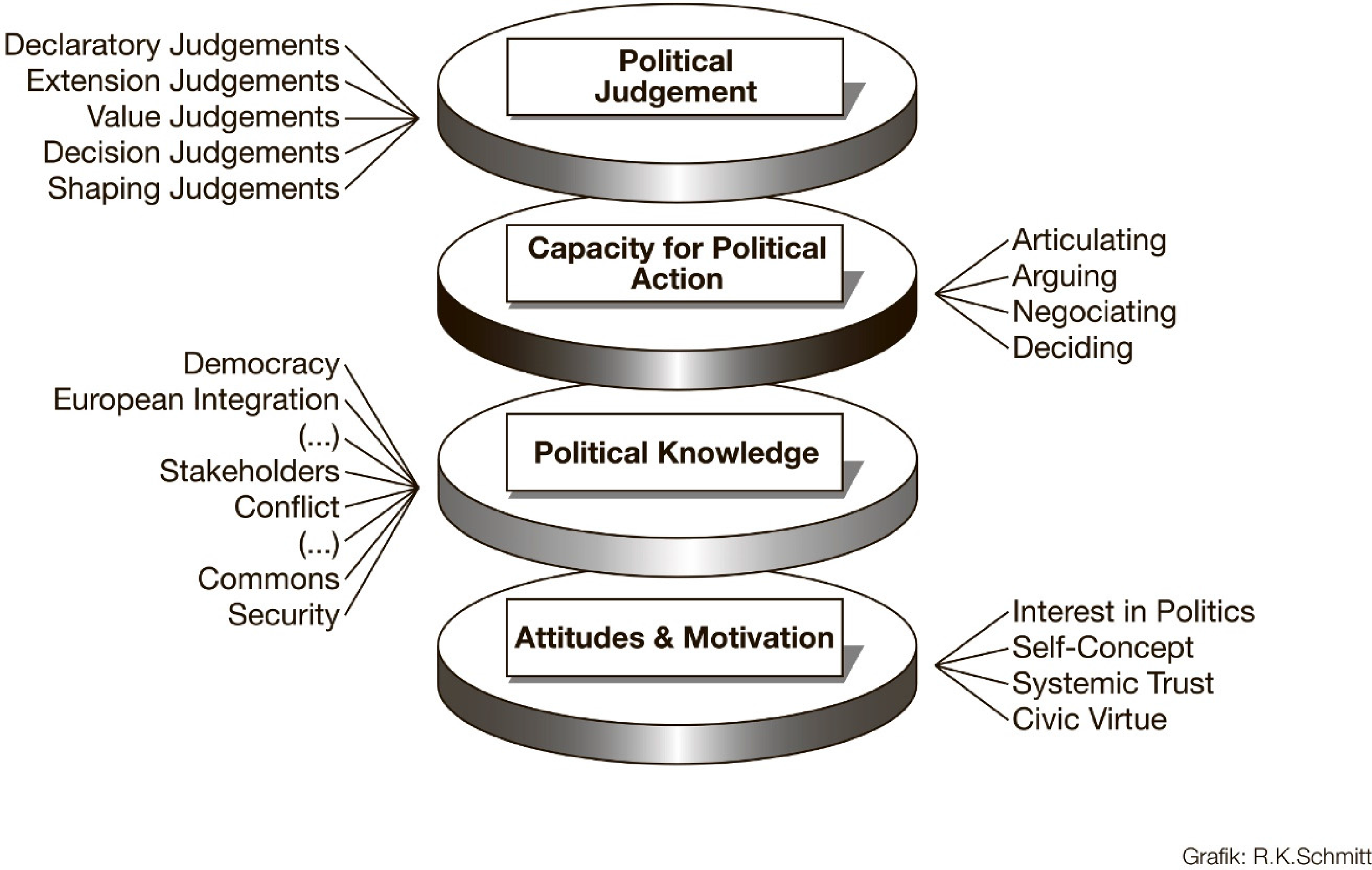
Model of political competence (Detjen et al., 2012: 15).
Beyond that, the model of political competence (Figure 1) includes the competency dimensions of political knowledge, political judgement and capacity for political action. It can therefore be used to determine the pupils’ lesson-related political knowledge and to formulate items. In addition, this social-constructivist model includes the competency dimension ‘attitudes and motivation’ that is particularly interesting here, as it represents competencies related to action and also the expectations of success. As Eccles and Wigfield (2002) had done previously, the model assumes a reciprocal relationship between achievement and motivation. In evidence-based research on civics teaching methodology, the model of political competence and the expectancy-value theory form the key theoretical background for empirical research. The present study is also based on these theoretical foundations.
Competency can be operationalised, as it can be seen in the performance when carrying out actions during civics lessons. The model views the political reality and the motivations that are relevant according to the psychology of learning as part of the challenging situations in lessons for the learners.
In this, motivation represents the desirable result of an interaction between the person and the political situation in the classroom context. The learners develop varying levels of individual standards that depend on their assumed probability of success and the incentive for success. Motivation expands the pupils’ own need for competency. It can arise from their desire to be able to actively achieve the positive result. Achievement motivation is therefore a necessary prerequisite for classroom achievement and is also called a willingness to act (Detjen et al., 2012: 90). The activity is usually also maintained even if difficulties arise. The effort and persistence with which pupils work on a task in civics courses as well as their feelings when working on the task depend on past experiences of success and failure. The more they are interested in the lesson material and the greater the utility seen in accomplishing the task, the higher their effort investment is (Trautwein, 2008: 568). The concept of self is characterised by consciously planned considerations and decisions about the individual goals of actions, i.e., whether pupils see themselves as capable of behaving in a way that leads to success. Context specificity is equally applicable to achievement motivation. It is domain-specific, and in civics lessons it is related to political knowledge, the capacity for political action and political judgement (Grobshäuser and Weisseno, 2021; Weisseno and Weisseno, 2021). Achievement in the classroom can be defined as political knowledge as well as the ability to present an argument and make a judgement (Weisseno, 2020: 501). These are given marks and listed in the report as achievements. In research, they are viewed as politically related classroom phenomena and examined in regard to whether and how they are influenced by various motivations, here specifically achievement motivation. They require a command of political language i.e. acquired in the classroom. During lessons, political science terms are presented as conceptual knowledge in the form of political concepts. According to the competence model (Figure 1), political didactics should clarify the basic political terms, their relationship to each other, and how they fit in the wider knowledge structure of political knowledge taught in school.
Learning specialised terms and concepts is key to building up knowledge in a content area (e.g., politics). A specialised concept is a term that represents a particular mental meaning and is thereby linked to other terms. Concepts are also specialised terms that are made up of many terms specific to the discipline. They also go far beyond a mere series of terms, as a specialised concept is characterised by linkages or relationships and fits into structured conceptual knowledge (see also e.g., Byrnes and Wasik, 1991: 777; Rittle-Johnson and Siegler, 1998: 77; Rittle-Johnson et al., 2001). When integrating these concepts into their existing political knowledge, pupils must construct coherent cognitive structures that model political reality. Processes of knowledge acquisition are thus structural learning processes that relate to content, whereby links exist among learned content (related to political knowledge) and the learners’ cognitive structures.
Specialised terms are needed to be able to describe the specific contextual content in teaching-learning processes so that learners can understand political topics situationally with examples from current political events. Specialised political language is what enables learners to discover political aspects in everyday life, and as a networking “scaffold”, it opens up the path to getting oriented in new learning situations. Pupils are continually introduced to subject knowledge by acquiring the specialised language of the subject. Ideally, during the learning process the pupil's memory engages in an expanding process of activation of and among the terms. Political characteristics from various texts can then be recognised by the learners and help to conceptually understand new content.
When choosing the specialised concepts, it is necessary to turn to political science to be able to make statements about political reality in lessons. From the perspective of subject didactics, in the model of political competency (Figure 1) the political-scientific theories, statements and empirical findings were depicted and reviewed in regard to their relevance in civics lessons. Cognitive psychological assumptions were also considered when constructing the network of knowledge to enable descriptions of how the world of political experience is processed by learners and teachers. According to the theory of information processing, in this process cognition is analysed “as a set of steps in which an abstract entity called ‘information’ is processed” (Anderson, 2005: 10). Political learning, as well, occurs when information and experiences are captured and processed in structures (cognitive maps) in the memory.
Subject knowledge is understood as the cognitive ability to name, analyse and explain knowledge of terms and, in particular, political concepts. This is made more concrete in a model with 30 political concepts and the associated constituting terms (approx. 200). Political information from the lessons can then survive to be processed further in relation to perceptions and meaning. For the learning process to take place, cognitive activities are necessary to learn something.
For lessons, this means that learners must be encouraged to understand key political concepts. Understanding the political concepts also includes orientation on political-scientific concepts. In addition, pupils will also sometimes express misconceptions that they are then expected to correct in the course of their school career (conceptual change). Over time, they also develop current concepts as an interim stage. These current concepts are more advanced than the misconceptions and, while they include some scientific concepts, they do not yet fully fulfil the standards of elaborated subject knowledge required in school (Hardy et al., 2006). It is possible to acquire knowledge using political concepts in the classroom because people retain information and experiences in a structured way. This gives rise to concepts that are no longer identical with the original perceptions or events.
Conceptual knowledge can be developed during instruction. Knowledge related to areas or content, which includes knowledge about the European Union, for example, arises when many details of perception are deleted in the brain and the important relationships between content elements are saved in the abstract: “We can abstract from specific experiences to general categories of the properties of that class of experiences. This sort of abstraction creates conceptual knowledge involving categories: for example, chairs and dogs” (Anderson, 2005: 154). However, conceptual understanding integrates applications and subjective experiences.
Domain-specific content knowledge encompasses 30 political concepts. According to the ACT-Theory and socio-constructivist educational theories, they are structured in different basic patterns. The concepts are “democracy, European integration, separation of powers, human rights, international relations, market, constitutional state, representation, welfare state, state, freedom, peace, justice, equality, human dignity, sustainability, public goods, security, European actors, interest groups, conflict, legitimacy, power, mass media, public sphere, opposition, parliament, parties, government and elections” (Weisseno et al., 2010: 15). Additional 200 terms are subsumed under these concepts.
These concepts and the related technical terms are not presented as isolated units of political knowledge to be memorized, but rather as points in a network of knowledge. Conceptual knowledge is verbalised with technical terms. The concepts, themselves, are interpreted by each individual pupil in his or her own way. Within these concepts, a series of technical terms are interwoven in a type of network and thereby carry the meaning of a statement. The pupil must then be able to use at least this defined political knowledge structure. Conceptual knowledge can be systematically modified and expanded during pupils’ time at schools by continual enrichment with technical terms (Weisseno et al., 2010: 13, 50, 193).
The political knowledge model narrows down school-related political knowledge for research and school practice by describing the corpus which is necessary for school lessons and sufficient for the number of classroom hours allotted. The number of terms in the lesson period is realistic and does not overload the civics lessons. It therefore does not limit the political topics of lessons. The specialist linguistic corpus is also what enables pupils to make political arguments and judgements on more complex intellectual issues (see also Weisseno, 2022: 255).
Knowledge is built up through learning when pupils actively and constructively receive new schemata, semantic networks or mental models and modify existing ones. There is a possibility of acquiring knowledge using political concepts in the classroom because pupils retain information and experiences in a structured way. This gives rise to conceptual knowledge that are no longer identical with the original perceptions or events. The use of activating methods in the classroom requires complex tasks, contradictions to existing political knowledge and multiple possible solutions.
Conceptual knowledge can also be presented by pupils in their answers to test questions. In this process, it must be ensured that all relevant dimensions of subject knowledge are represented in the items of a test. Just as in lessons, in tests political concepts are not taught directly, but instead the teacher determines whether pupils consciously use these concepts when applying their knowledge. The political concepts and their constituting terms are operationalised with the items. That is why political competency cannot be determined after a single observation when answering a question in the classroom or with only one single test item. Instead, a series of individual observations in various situations is necessary.
Example of a test item:
Suppose that Hungary decides to block the EU and votes from now on against every new bill to be passed by the Council of Ministers. What will happen?
The EU is not able to pass any more bills. The EU can continue to pass all bills. The EU can pass many but no longer all bills. [√] The EU has to draw lots to decide about passing bills.
The sample item show that memorizing certain facts is not enough. Instead, the items are formulated such that a semantic network is activated, and the pupils must solve the problem by searching for referents (anchor terms) in their own network of terms. The more expansive and precise their political knowledge is, the more easily and successfully they can answer the question.
That is why civics lessons must create a terminological field with related terms and political concepts that can be linked to one another with associations. Political concepts prove themselves to the pupils when these concepts can help explain various political contexts and examples and when they are recognised in new situations in lessons. In addition, political knowledge can be meaningfully expanded by continual enrichment with political vocabulary. This does not mean that they only need to name a political term. Instead, they must use it in a way that shows they understand it. Building up political language skills understood in this way is done differently than in everyday language, that is, the ability to interpret the political systems of symbols in everyday contexts.
Teachers cannot force pupils to make an effort or to direct their attention to a subject. However, they can offer their students cognitively activating lessons. The dependent variable is school achievement, in this case, political knowledge. The relationship between knowledge on the one hand and achievement motivation on the other can be described in this way.
State of the art
There have been numerous studies conducted on political knowledge for primary schools and lower and upper levels in secondary schools. The tests for the upper levels in vocational and general grammar schools all show acceptable goodness of fit values (Landwehr, 2017; Weisseno and Weisseno, 2021; Weisseno et al., 2019). The test instruments on political knowledge were validated with expected correlations to the marks in German, Mathematics and Civics and to fluid intelligence. These instruments were also used for this study. According to the studies on the upper secondary level at general and vocational grammar schools, the 12th year pupils at the vocational grammar schools know less than the 11th year pupils at the general grammar schools. Girls at the vocational grammar schools have less political knowledge than their male classmates. Pupils with migrant backgrounds also have lower levels of knowledge. Cultural capital, on the other hand, has beneficial effects on political knowledge.
Success and failure motivations have not yet been explicitly investigated by research into teaching methodology for the subject of civics. However, initial studies have been done on other factors of learning motivation at vocational grammar schools. One study looked into general learning motivation in the context of learning strategies. Learning motivation correlates very strongly with the use of a control strategy, less strongly with the use of a memorising strategy and comparatively weakly with an elaborating strategy. In this context, however, and in contrast to expectations, learning motivation does not affect political knowledge (Weisseno and Landwehr, 2017). Motivational factors such as subject interest and the concept of self in relation to politics have been investigated prominently. Empirically, a domain-specific concept of self can be delimited from a general performance-based or academic concept of self. Regarding the relationship to knowledge, both the domain-specific concept of self and the general performance-based concept of self have been shown to have positive effects on knowledge (Landwehr, 2017; see also Weisseno and Eck, 2013). It has also been demonstrated that girls have significantly more negative concepts of self in the area of politics than boys but not a more negative performance-based concept of self.
While the interest in the topics of civics lessons has only a small effect on school-related political knowledge and leads to a higher level of knowledge, in one study with upper secondary level pupils, the general concept of self had no effect on knowledge (Weisseno and Schmidt, 2019). Meta-cognitive strategies are used by pupils to cognitively deal with their own learning and success. One can say that the purpose of civics lessons is primarily to acquire conceptual political knowledge, motivation and suitable meta-cognitive strategies. A study for vocational grammar schools shows on this point that meta-cognitive strategies used while learning correlate positively with political knowledge (Weisseno et al., 2019). Girls may have better meta-cognitive strategies than boys, but the link between the two meta-cognitive constructs investigated in that study was not significant.
Based on the findings of these previous studies on motivational factors, for the present study we assume that the expectations of success will have a positive effect on performance while expectations of failure will have a negative effect.
Study design
In a cross-sectional survey, 470 pupils in the 12th year at vocational grammar schools in Baden-Wuerttemberg, Germany, were queried. The proportion of girls in the sample was relatively high at 64.8%, while the proportion of pupils with a migrant background was relatively low at 28.9%. Participation in the study was voluntary for the pupils. All responses are voluntary and confidential. The test was conducted by trained test administrators.
In a standardised questionnaire, the school-related political knowledge was collected based on the 30 concepts and its terms of political competency (Weisseno et al., 2010). Additionally, proven scales on the hope of success and fear of failure were adapted for the domain of politics with four items each (Krause et al., 2011; Stark et al., 2010; Wagner et al., 2013). One item on the hope of success stated “In politics lessons, I like trying out new and unknown things even if it might go wrong,” and one on the fear of failure was “In politics lessons, I feel ashamed if I am not able to do something successfully even if no one else notices.”
The knowledge items were constructed using the political concepts in the model of political competency (Weisseno et al., 2010). The questions included individual political concepts and technical terms. One item included several terms from various political concepts. This allowed the networking of political terms to be included in the knowledge test, and the political language relevant to school was used. The items were presented as multiple-choice questions with one correct answer and three distractors. One sample item on the political concept of democracy was: “Which action is harmful for democracy?” with the answer choices: “(a) when there are arguments in the Bundestag, (b) when a newspaper criticises the government, (c) when the president of the farmers’ association demands more money for farmers or (d) when a representative allows a company to gift him/her luxury holidays”. In this item, the following political terms and concepts were used: democracy, Bundestag, representative, government, mass media (newspaper), producers (company), interest groups (president of the farmer's association). In pupils’ mental models, these terms could be associated with others such as mandate, office, parliament, parties, communication etc. in order to solve the problem.
The 24 items for school political knowledge were taken in part from other studies. Ten items were taken from the POWIS study's item pool (Goll et al., 2010), and two from Hahn-Laudenberg (2017) were added. Twelve items were newly developed for pupils in the upper secondary level. The political concepts and the related constituting terms are included to varying degrees of frequency in the questions. One item can include multiple political concepts or constituting terms from various political concepts. This allows the networking of political terms to be included in the knowledge test. The items were presented as forced-choice questions with one correct answer and three distractors.
Both an expert review and the calculation of correlations with the basic cognitive abilities of the respondents were used to check the validity of the knowledge test. Basic cognitive abilities were measured using the IQB test to measure fluid and crystalline intelligence (Wilhelm and Schipolowski, 2012). In the present study, fluid intelligence was measured using a sub-scale on deductive reasoning related to figurate contents (figurative part (B), comprising 16 tasks). Fluid intelligence was suitable to serve as a distinction from competency because it is primarily an achievement disposition that is independent of previous knowledge, »whereby there is evidence of the trainability and influence of schooling on these intelligence achievements, as well» (Wilhelm and Schipolowski, 2012: 14). According to Wilhelm and Schipolowski (2012: 17), figurative-spatial tests have proven to be particularly well-suited to measuring fluid intelligence because these tests use abstract drawings and are therefore influenced very little by prior knowledge and linguistic abilities.
School-related political knowledge was IRT-scaled using ConQuest and the dichotomous Rasch model. The score reliability of the tests used 24 items with WLE PSR = 0.667 and was therefore acceptable (de Ayala, 2009). With one exception the items had a discriminatory power of ≥0.30. The item that fell under the cut-off value with a discriminatory power of 0.18 was retained due to the difficulty. In total, the measurements had a variance of 0.767. The goodness of fit for the individual model parameters was good with values of 0.91≤ (weighted) MNSQ ≥ 1.18 (OECD, 2014).
Because the pupils were divided into classes, there is a hierarchical data structure. This means that the observation units are not independent of one another, which is a key requirement for conventional statistical methods. Due to the dependencies in the data, the effective random sample size is reduced, leading to the potential for standard deviations of model parameters to be underestimated. In turn, this can lead to an underestimation of the p-value. Parameters are therefore deemed to be significant more frequently than is justified. In the present study, the hierarchical structure of the data was taken into consideration by selecting the analysis option Type = Complex and entering the cluster variables Class and the WLSMV-estimator in Mplus.
To determine the individual pupils’ abilities (level of political knowledge), weighted likelihood estimates (WLE) were carried out that were then included in the structural equation models to check the correlations between political knowledge and expectations of success and failure. In the calculations, the hierarchical structure of the data was taken into account. Gender, migrant background and the cultural capital of the home were included in the modelling as background variables.
Findings
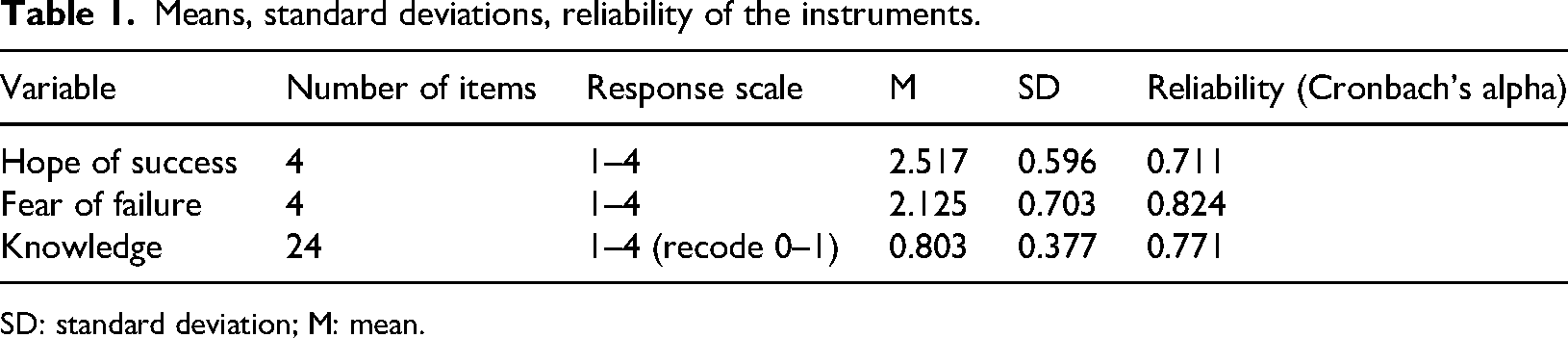
In Table 1, the descriptive results of the instruments used are reported. With M = 2.517 and SD = 0.596, the hope of success was on average very close to the theoretical mean of the scale. The scale reliability was acceptable with α = 0.711 and the measurement model showed a good fit: χ²(2) 1.112, p > 0.05, RMSEA = 0.000, CFI = 1.000, TLI = 1.005, SRMR = 0.006. Compared to the hope of success, the fear of failure was weaker with M = 2.125, but with SD = 0.703, it was more spread out around the mean. The scale reliability was acceptable with α = 0.824 and the measurement model also showed a good fit: χ²(2) 1.239, p > 0.05, RMSEA = 0.000, CFI = 1.000, TLI = 1.001, SRMR = 0.004. Due to their goodness of fit, both measurement models could be included in the structural equation model, which means that the constructs were modelled latently.
Means, standard deviations, reliability of the instruments.
SD: standard deviation; M: mean.
The school-related political knowledge had a fairly large spread around the mean of M = 0.803 with a standard deviation of SD = 0.377. Pupils therefore had very different levels of political knowledge, but on average they had a high level of knowledge. The reliability was considered acceptable with a Cronbach's alpha of α = 0.771.
To check the influence of achievement motivation on the learning achievement, first the school-related political knowledge was regressed in the form of WLE on the two motivational constructs (Figure 2). The goodness of fit was considered to still be acceptable (χ²(25) 79.970, p = 0.000, RMSEA = 0.068, CFI = 0.975, TLI = 0.965, SRMR = 0.051). The structural equation model showed small but expected effects for the constructs on political knowledge: The hope of success had a positive effect of β = 0.150*** on political knowledge, and the fear of failure had a negative effect of β = −0.223***. With R2 = 0.079, both constructs explained only a very small proportion of the overall variance in political knowledge. The two motivational constructs had a very low correlation (r = −0.096**) even though a high negative correlation would be expected according to the theoretical background.
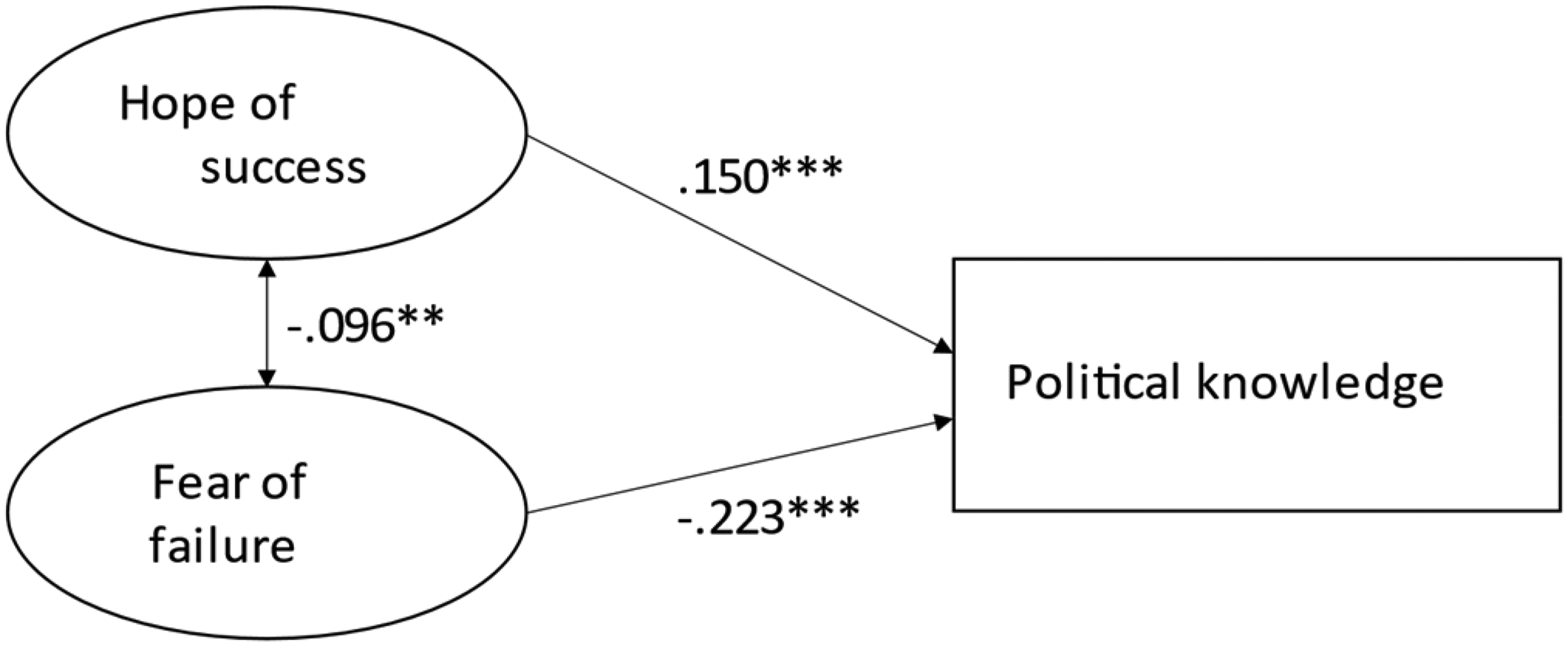
Correlations of political knowledge with achievement motivation. *p ≤ 0.05, **p ≤ 0.01, ***p ≤ 0.001.
When the background variables of gender, migrant background and cultural capital were included as independent variables for political knowledge in the modelling, the goodness of fit decreased and was no longer considered acceptable (χ²(49) 176.473, p = 0.000, RMSEA = 0.075, CFI = 0.925, TLI = 0.903, SRMR = 0.109). The findings cannot be interpreted on this basis, but they point toward the background variable gender having a large effect on political knowledge. The model should be modified to follow up on this indication.
In the modified structural equation model (Figure 3), the background variables were included as independent variables for political knowledge and for the motivational constructs. The goodness of fit was still considered acceptable (χ²(44) 85.367, p ≤ 0.001, RMSEA = 0.045, CFI = 0.976, TLI = 0.965, SRMR = 0.051) and the results could thus be interpreted. The effects of the motivational constructs were only slightly different: Hope of success had a positive effect on political knowledge with β = 0.140** while fear of failure had a negative effect with β = −0.151**. Cultural capital corresponds to more political knowledge (β = 0.142**), girls have less political knowledge (β = −0.261**), and pupils with a migrant background also did worse on the knowledge test (β = −0.293**). With R2 = 0.058, the background variables contributed to explaining more of the pupils’ political knowledge.
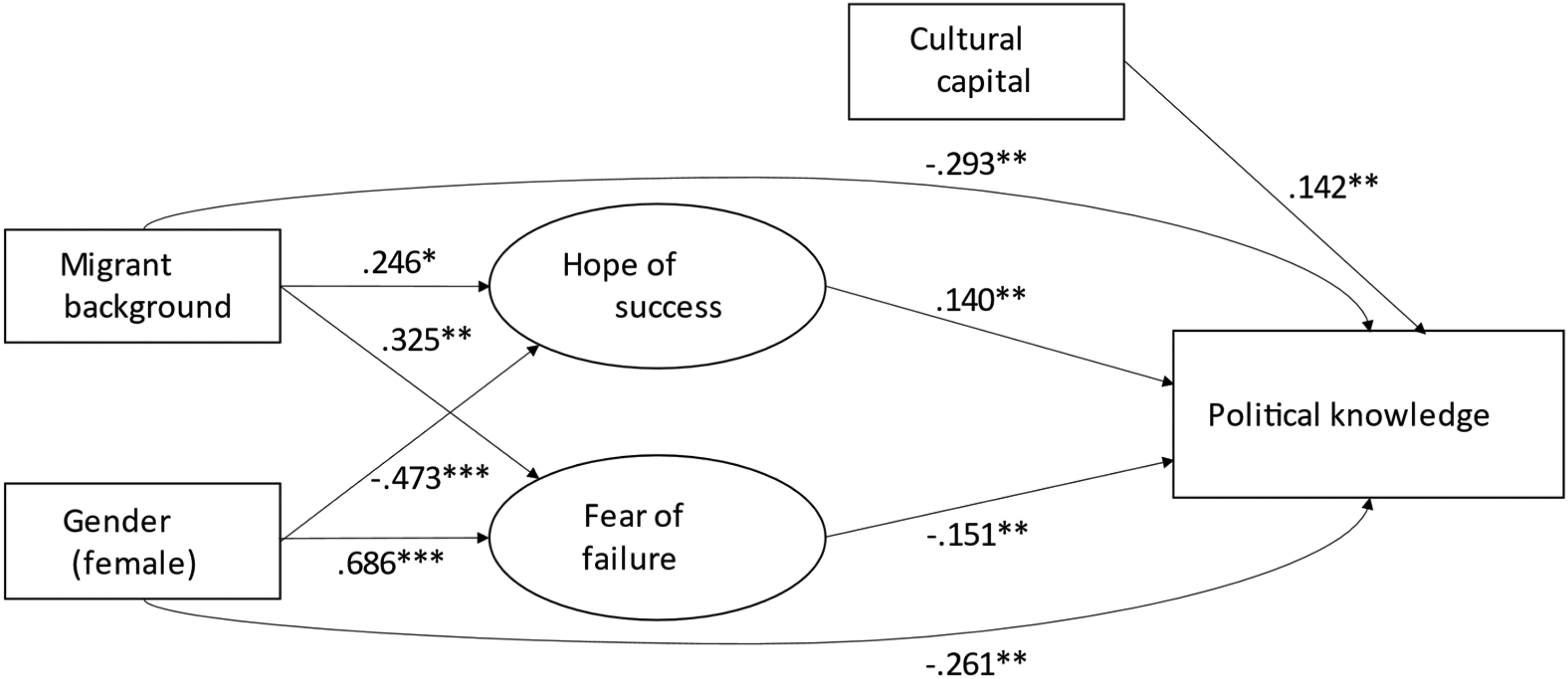
Correlations of political knowledge and the background variables with performance motivation. The correlation coefficients of continuous predictors are standardised, while the coefficients of dichotomous predictors (gender and migration background) are y-standardised. *p ≤ 0.05, **p ≤ 0.01, ***p ≤ 0.001.
However, the effects of the background variables on the motivation constructs were in part surprising: While cultural capital made no significant difference in the extent of the motivational constructs, a migrant background showed moderate but inconsistent effects and gender had clear negative effects for the girls. They had β = −0.473*** less hope of success in civics lessons and feared failure β = 0.686*** more than their male classmates.
Based on these findings, the model showed an indirect effect of gender on political knowledge mediated by the motivation constructs. The indirect effect was shown to be significant. Overall, β = −0.170* is mediated by the two motivational constructs, β = −0.066* of which is for the hope of success and β = −0.104* for the fear of failure. Together with the direct effect, female gender thus shows a total effect of β = −0.431*** on political knowledge.
Discussion
This article has investigated the question of whether the knowledge test is valid. A test was used at upper secondary level, based on the model of political competency. The scaling of the test and verification of model validity were carried out with a measurement model from item response theory. Along with political knowledge, this study also investigates the two motivation variables expectations of success and failure. The scale's measurement models display good fit values. Background variables are added: gender, migration background and the «books question«, enquiring how many books pupils have at home. The data of this study confirmed the influence of achievement motivation on the school-related political knowledge at vocational grammar schools.
In this study, it was shown that based on the theoretical foundation described, the theory of context-specific competency can be combined with the achievement motivation approach drawn from the psychology of learning. The empirical findings suggest that lasting learning effects arise from the achievement motivations examined. The findings shown here also reveal, however, that the competency dimension “attitudes and motivation” must be defined much more precisely and linked to more manifestations in lessons than was done so far in the model. The important role of achievement motivation must be determined more exactly.
The limitations of the study result from the small effect size. With the results, it cannot be determined whether the pupils have an acceptable achievement motivation for civics lessons or whether no challenging situations are required in daily lessons. It also cannot be determined why girls have achievement motivation and yet their achievements are not as good as those of their male classmates. One tentative possibility is that girls cannot influence the lessons to the extent that a classroom atmosphere of achievement motivation is produced or that performance is assessed by the teachers according to other (social?) norms and is therefore not worth the effort. In future, the test should include more difficult items in order to increase the variance. Additionally, the model was modified in an exploratory manner due to the data and replication using additional samples is therefore necessary.
Successful teaching should address the positive sides of motivation and strengthen achievement experiences by promoting political competency. The results of evidence-based research are thus far hardly discussed during the student teaching period, and at many universities they are also not systematically taught. Teaching methodology has developed in phases toward operationalising its normative and theoretical assumptions. Now, much is measurable and has been investigated in a scientifically sound manner. Normative individual ideas can be questioned using empirical findings based on theories. That would be a first step toward correcting the proven problem area of upper secondary level teaching, which in part can also be seen in this study.
The goal for teachers’ practical work should be to strengthen the upper secondary level pupils’ expectations of success using suitable and cognitively activating tasks. To this end, consistent teacher training is necessary. It could be helpful to take the lesson concepts that are still being taught in the student teaching seminars and revise them using theory and empirical evidence in continuing education courses. One conclusion to be drawn from this activity might be that a balanced mix of high-level and low-level tasks could help considerably. The ultimate objective is for lessons to use theory to support pupils in building up their skills in civics lessons according to the model of political competency.
Footnotes
Declaration of conflicting interests
The author(s) declared no potential conflicts of interest with respect to the research, authorship, and/or publication of this article.
Funding
The author(s) received no financial support for the research, authorship, and/or publication of this article.
