




Abstract
Very little research has been conducted on the contribution of political education to learning progress in Germany. Hence, there is a need for intervention studies measuring performance against the theoretical background of a political competence model. This model comprises three constructs: subject knowledge, motivation and attitudes. According to this model, politics lessons should not only convey knowledge but also arouse subject interest, promote political attitudes and develop problem-solving skills. This study investigates how knowledge acquisition is influenced by intervention using theory-oriented teaching materials on the European Union, intervention using conventional textbooks on the European Union and politics lessons without any reference to the European Union. It further asks how the performance-related self-concept and subject interest in political issues impact political knowledge and whether civic virtue and trust in the system are related to it. The sample comprises 1071 pupils. Theory-oriented politics classes lead to greater growth of pupils’ knowledge than in the control group. As anticipated, this study proves that a positive subject-specific self-concept impacts knowledge. The examination of political attitudes reveals a positive correlation between civic virtue and knowledge. There is no connection between trust in the political system and knowledge.
Keywords
Rationale and aims
There are an increasing number of studies on pupils’ political knowledge. The international comparative studies on civic education emphasise the significance of politics classes. ‘Prior to ICCS 2016, the IEA conducted three international comparative studies about civic and citizenship education, with a first survey implemented in 1971, a second one in 1999/2000 and third one in 2008/2009’ (Schulz et al., 2016: 2). Such cross-sectional studies are important. Since then, several cross-sectional studies have been conducted in Germany too.
Despite (inter)national assessment, politics classes’ contribution to learning progress in Germany remains unclear. Intervention studies are required here; there are only three which can be considered reliable (Landwehr, 2017; Weisseno and Eck, 2013; Weisseno et al., 2016). In order to develop scientifically substantiated theses in the field of political education, there is also a need for theories. To this end, a model of political competence (Detjen et al., 2012) has been developed in Germany which forms an indispensable foundation for identifying the skills pupils required for successful participation in politics classes. The skills are grounded in theory.
Empirical studies have already provided insights into the significance of subject knowledge according to the political competence model, yet the possibilities of targeted knowledge development by theory-oriented teaching have barely been researched. However, it is not only dissemination of knowledge that is at the forefront of politics classes. An important aim is also to promote motivation for aspects of politics. Not all pupils are confronted with politics at home. Not all of them watch the news or inform themselves via the Internet. Motivation regarding school subjects is an important prerequisite for successful learning.
In all modern societies, individuals form attitudes about politics in connection with other aspects of the individual orientation system, for example, religious convictions or economic interests. The political system itself influences perception of political content. Political attitudes, such as trust in the system, are individual peculiarities in evaluating concrete objects of perception. Attitudes make it easier or more difficult to process information. Knowledge can promote the development of attitudes.
This study seeks to empirically analyse knowledge growth in politics classes from a variety of perspectives. To this end, a pre–post study design was chosen. First, the effect of politics classes on knowledge growth is examined. Second, teaching itself is analysed in greater detail. Regular politics classes using textbooks and teachers’ own materials are contrasted with the competence model. Third, elements of the political competence model itself are subjected to empirical analysis. The cause–effect relationships between subject knowledge as dependent variables and the competence facets of political attitudes and motivation are examined more closely. The aim was to empirically test the theoretically postulated assumptions and their relationships. This study enters the domain from a (limited) empirical stance.
Theoretical background
Teaching in schools is subject to political supervision by the administration, which formulates what is expected from politics classes in the form of curricula documenting the goals negotiated by society, including the normative ideas of various societal institutions and political interest groups. The prerequisite skills are also normatively prescribed. The themes via which the goal is to be reached are compulsory elements of the curriculum.
Such requirements of politics classes are also a focus of political didactics, which also discusses goals and reflects on political demands. Its central role, however, is to theoretically and empirically describe classroom reality. As a scientific discipline, political didactics seeks to formulate a theory describing classroom reality and to test this theory empirically. This study seeks to contribute to this aim.
The study examines the construct of competence, the supporting factors of motivation and attitudes. First, these three constructs are considered from a theoretical perspective. Other constructs such as political participation or use of media are not considered here.
Cognitive psychology defines knowledge as ‘the retention, integration and organisation of information in the memory. […] Knowledge is organised information, it is part of a system or network of structured information’ (Solso, 2005: 242). In the case of knowledge, content, structure and process are the three components that interest us. Facts and relationships are relevant as sources of knowledge. This study takes this psychological view of knowledge into account.
Perceptory processes and individual experiences that can be further used by elementary processes of abstraction form this study’s point of departure. Additionally, cognitive operations can link prior knowledge with new insights. For knowledge to be easily retrieved and related to new experiences, it must be structured and categorised (Lohaus et al., 2010). In this respect, it is important to have (semantic) categories providing basic orientation. Building on this, learning is the reorganisation of concepts in the learner’s understanding, as well as both conceptual and skill-specific growth.
Political science also places emphasis on the importance of knowledge, for according to Delli Carpini and Keeter (1996), democracy works best when its citizens are politically informed: ‘Political knowledge is central to the discussion of citizen competence’ (Mondak and Davis, 2001: 219). Essential factors are the relevance and appropriateness of that knowledge. It is important to have knowledge that can judge which factors are central to a decision or assessment. Political science has yet to develop a model of citizens’ knowledge that specifically states the concepts and units of knowledge.
The postulates of political science and the idea of linked knowledge development combine the subject concepts and constituent terms of Weisseno et al. (2010) in a model of subject knowledge for the classroom. This model is based on 30 subject concepts as subject knowledge. To this end, they examined corresponding theories, statements and empirical findings of political science for their relevance for politics classes and adopted those statements that can be considered to be common sense both in political science and in political didactics. Further constituent terms were allocated to the individual subject concepts. The subject concepts and constituent terms are thus not isolated units of knowledge stored in the memory but a knowledge network. This defines the corpus of field-specific language that is to be acquired through classes. Learning requires active engagement with the technical terms in order to develop a richly connected and stable knowledge structure. The more learners engage with the object of learning in cognitively constructive fashion, the better concepts are understood and the more sustainable learning becomes (Kunter and Trautwein, 2013: 86). The competence-oriented German curricula require this particular handling of new information.
For Detjen et al. (2012), teaching should serve not only the communication of knowledge but also the promotion of attitudes and the development of problem-solving skills. This also corresponds to the normative expectations made of politics classes, which politics has thus far formulated as the basic condition of curricula. The political competence model, according to Detjen et al. (2012) in Figure 1, shows which facets must be displayed by theory-oriented, competence-oriented lessons and adopts the model of subject knowledge devised by Weisseno et al. (2010). The political competence that is to be developed and that pupils must be able to put into operation consists of subject knowledge, political judgement and the ability to act politically. These three domain-specific dimensions form the competence construct. While they can be separated empirically and analytically, they are not independent of one another, but connected. Linking several competence dimensions is usually necessary if tasks are to be successfully solved. Political attitudes and motivation are related to the development of competence. They are motivational prerequisites and beliefs.
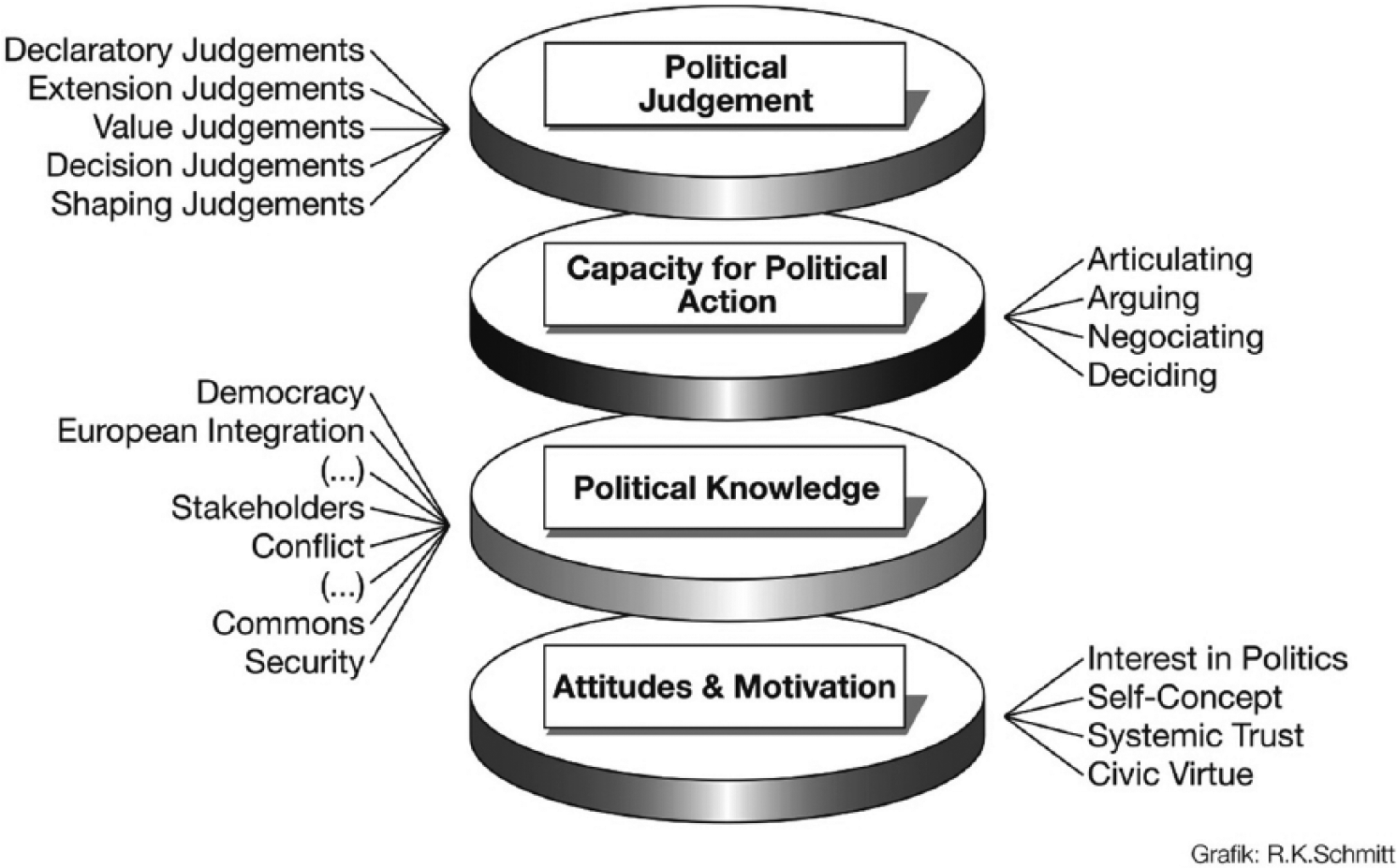
Model of political competence (Detjen et al., 2012).
In order for knowledge and motivation to be combined, learners must actively participate in knowledge acquisition (Reinmann-Rothmeier and Mandl, 1998). This participation is achieved by motivation and/or interest in the process or object of knowledge acquisition. According to general psychology, motivation influences the choice and strength of behavioural tendencies (Bergius, 1994). Motivation is conducive to learning and is a prerequisite for the absorption of knowledge.
For social psychology, motivation is determined ‘by what one can get (incentive) as well as by the likelihood of getting it (expectancy)’ (Weiner, 1985: 559). Personal expectations of success and the value attached to each success are the relevant determinants of motivation in task selection and pursuing goals during the execution of a task. Expectations and value vary from individual to individual. Eccles and Wigfield (2002) have developed their own model for the combination of expectations and value. In their expectancy-value model of performance, they stress personal expectations or expectations regarding effectiveness. Furthermore, factors such as personal perception of other people’s attitudes and their expectations and affective memory and one’s own interpretations of previous personal performance also influence task-specific beliefs.
Task-specific beliefs manifest in learners’ self-concept of ability, the perceived difficulty of the task, individual goals, self-schemas and affective memories have an influence on expectation and values. Expectation of learning success is examined via ability beliefs. Ability beliefs are individual assessments of competence in various spheres, but not the probability of success in an assigned task. Probability of success is defined as ‘individuals’ beliefs about how well they will do on upcoming tasks, either in the immediate or longer-term future’ (Eccles and Wigfield, 2002: 119). Probability of success also depends on the value of individual activities. Those tasks in which the individual thinks he or she will be successful have a particularly high value.
Furthermore, subjective task values impact success-related selections and performance. The intrinsic value aspects such as interest are closely connected to individual ability-related beliefs (Wigfield and Eccles, 2002). Value can thus also mean that an individual might feel able to perform a task but does not attach value to it and thus decides not to perform it.
The model combines interest and self-concept of ability. Interest is both a motivational condition and a goal of learning at school (Krapp, 1998); interest consists of stored knowledge, stored values and positive emotions. (Hidi et al., 2004). It is born of an individual’s interaction with his environment and connects people and objects (Krapp, 2005). In pedagogical psychology, interests are considered essential elements of the structure of the self-concept that are integrated into the personal self-concept (Todt and Schreiber, 1998). While interest-led activities are part of the personal self-concept, non-interest-led activities are independent of the self-concept (Hannover, 1998). This close connection between the two motivation variables could thus also impact knowledge.
The personal self-concept is developed through external and internal comparisons drawing on third parties or other aspects of the self as a frame of reference (Zimmerman, 2000). Self-appraisal is thus determined by temporally linked abilities, qualities and self-images from the past, the present and the future (Raynor and McFarlin, 1986). However, each individual forms not one single but diverse self-concepts (Güttler, 2003) related to various aspects of the self, thus influencing decisions for or against an activity, such as learning and learning itself. It is via these affective appraisals that the degree of self-value and self-esteem is determined. Once a self-concept has been formed, it also decides which information is considered important and how to react to it. Self-perception functions as a filter through which incoming information is processed, transformed and encoded (McCombs and Whisler, 1989).
Wigfield and Eccles’s theory is suited to modelling correlations among the abovementioned motivation constructs. For the purpose of our theory, self-concept and interest can be connected with knowledge.
The third construct examined in this study is political attitudes. For each of the political attitudes, we have to distinguish between civic virtues and trust in the system. The following three elements can be categorised as democratic civic virtues: engagement, civic norms and voting norms (Van Deth, 2012). Engagement refers to activities in clubs and associations and participation in politics without voting. Civic norms refer to autonomy, abiding by the law and solidarity. Voting norms imply that good citizens participate in elections.
There is an assumption that people who advocate civic virtues obey the law and are more politically engaged than people who reject them. Supporting social norms and thus probably civic virtues too is largely connected to individuals’ experiences of socialisation and their social environment. Individual personalities and attitudes are of relevance here (Abendschön, 2013). For children and adolescents, family and school are particularly influential in this respect. There is a causal link between social integration, socio-structural status, political attitudes and involvement in politics and support for civic virtues. Membership of social networks, such as associations and interest in achieving a common goal, is assumed to impact individual attitudes and social trust. It can thus be assumed that greater social integration results in greater support of civic virtues.
If we include under civic virtues the existence of democratic values, for adults these values correlate with knowledge and participation. But the period during which they develop and how they develop remain unclear (Jones, 1980: 203). ‘Civic knowledge promotes support for democratic values […]. The more knowledge citizens have of political principles and institutions, the more likely they are to support core democratic principles’ (Galston, 2001: 224). A theoretical model of civic virtues is yet to be devised. However, political knowledge could theoretically be considered a prerequisite for the development of democratic civil rights, which admittedly requires empirical investigation (Hooghe and Dassonneville, 2011).
Easton (1975) presumes that people have two motives for political support: performance-dependent (specific) support – if political acting brings them material advantages or allows specific expectations – or unconditional (diffuse) support independent of performance – in the case of general characteristics, such as trust and beliefs in legitimacy. Specific support entails assessment of specific system performances (output) such as the concrete satisfaction of particular demands or the performance of political authorities and is thus subject to faster swings. Diffuse support for a system is independent of the politics of the day or current performance and understands the political system as supporting public, community interests. It entails a reservoir of support; is relatively stable, permanent and difficult to change; and is thus relevant for the continued existence and legitimacy of a political system. In this case, trust develops via experiences over the course of time.
In the case of trust in the political system, individual perceptions and appraisals of political institutions are in the foreground. Political trust entails the way in which citizens perceive the political system and its actors (Gabriel, 1995). Support is either positive or negative and implies object-related trust and a liking for the political system (Easton and Dennis, 1969). For a political system to exist, there has to be minimum positive support. In the case of trust in the system, it appears that the construct in itself is discussed, but a theory-led connection to knowledge or the other variables examined has yet to be found. Thus, the correlations remain unexplained.
State of research
There are a number of systematic studies on pupils’ political knowledge (Goll et al., 2010; Landwehr, 2017; Oberle, 2012; Weisseno and Eck, 2013; Weisseno et al., 2015). The results for the political system of the Federal Republic of Germany and the European Union (EU) represent initial indications that the empirical investigation of the abovementioned model is auspicious. Goetzmann (2015) based her items in her primary school study on this model. We know from intervention studies that lessons dealing with subject concepts or technical vocabulary have a greater effect on learning than working with school textbooks (Landwehr, 2017; Weisseno et al., 2016). Theory-led learning appears to be more successful. We also know from political didactic research that in conventional politics lessons, very little happens to develop ideas of subject concepts (Manzel and Gronostay, 2013). Lessons have a low level of complexity, and the level of factual information is at 67% per hour of teaching. Another study demonstrates that cognitive activation has a positive effect on acquisition of knowledge (Weisseno and Landwehr, 2015).
In order to examine the interest construct for adolescents empirically, it is often necessary to turn to other disciplines. The International Association for the Evaluation of Educational Achievement (IEA) study, for instance, compares political interest in 28 countries (Maiello, 2003). German pupils are relatively interested in politics in comparison with other countries (41%), whereby boys display greater interest than girls. There is no connection made to knowledge here. Other studies also note greater interest in politics on the part of boys (Kroh, 2006; Van Deth et al., 2011; Westle, 2006, among others). Weisseno and Eck (2013) divide the interest construct further and demonstrate that only interest in the school subject of politics, not interest in politics in general, has an impact on knowledge. Weisseno and Landwehr (2015) were able to demonstrate that one’s academic self-concept and interest in politics have a moderately positive effect on educational success.
Studies on self-concept exist, but are often operationalised as self-efficacy. Westle (2006) sees a circuit between interest in politics, self-concept and knowledge. However, self-concept is normally developed only to a very low degree, while interest rises as time at school increases. While many studies make statements on the basis of correlations, few studies show positive directions. These studies demonstrate the impact of subject-specific self-concepts on, and in some cases interest in, knowledge (Weisseno and Eck, 2013; Weisseno et al., 2015).
Unfortunately, there are not as many empirical studies on civic virtues as there are on motivation constructs. Existing studies mostly examine civic virtues in adults. Wessa (2012) examines the connection between primary schoolchildren’s civic virtues (‘norms of citizenship’) and their knowledge about and interest in politics. On one hand, correlations indicate that the children’s support of civic virtues is independent of the quality of their political knowledge. On the other hand, interest in politics and civic virtues correlate slightly but highly significantly.
The study by the IEA demonstrates that the German concept of a good citizen is significantly lower than the international average (Torney-Purta et al., 2001). Studies of adults conducted by, among others, Abendschön (2013) and Van Deth (2013) emphasise solidarity, participation in elections, abiding by the law and independent formation of opinion as good citizens’ qualities and civic duties. Social and political participation by contrast are not as valued. Conover et al. (2004), however, suggest that a ‘good citizen’ should display societal engagement. Political activities, such as participation in elections or in political decision-making, are less important. Here, civic duties are those that preserve civic life, such as abiding by the law and upholding the political system.
According to the IEA International Civic and Citizenship Study (ICCS), in the majority of countries, 14- to 15-year-olds have trust in state institutions; figures range from 54% to 67% (Biedermann et al., 2010). Watermann (2005) examines trust in the political system and trust in institutions in seventh and tenth grade pupils (for the 1991–1992 and 1994–1995 school years) and finds that it decreases from the seventh to tenth grade. A three-wave survey by Quintelier and Van Deth (2014) combines interest, self-efficacy, civic virtues and trust. While interest in politics constantly increases over the three waves, self-efficacy and trust decrease. Civic virtues increase from the first to the second wave and then go down again.
In this study, motivation theory is applied to knowledge, and in the absence of theoretical foundations, political attitudes are correlated with knowledge. The empirical study will demonstrate whether the constructs are related as the model by Detjen et al. (2012) assumes.
Questions
The study’s central question is concerned with growth of knowledge in politics lessons. The aim is to discover knowledge acquisition which is influenced by (a) intervention using theory-oriented teaching material on the EU, (b) intervention using non-skill-oriented textbooks on the EU and (c) traditional lessons without relation to the EU.
Furthermore, questions are concerned with political attitudes and motivation. Do a performance-related self-concept and interest in political issues influence political knowledge? Are civic virtues and trust in the system related to political knowledge? How strong is the correlation between the constructs?
Study design
Data were collected using a pre–post study design in 51 ninth and tenth grades classes in Realschulen (secondary schools) and Gymnasien (grammar schools) in Baden-Württemberg between May 2012 and February 2013. The sample comprises 1071 pupils, 508 girls and 563 boys (47.4%–52.6%). Of these, 27.7% of pupils had a migration background. As it was a Jean Monnet Project, they received lessons on the EU. The number of pupils is divided into three groups who received different lessons during the period under investigation. The experimental group (EG) with 484 pupils received 7 hours of lessons on the EU based on the subject concepts of Weisseno et al. (2010) and the cooperative learning methods of Green and Green (2009). Materials and teaching prompts are available online (http://politik.ph-karlsruhe.de/jmp/en/). The control group (CG) with 373 pupils also dealt with the theme of the EU during 7 hours of lessons – but used different chapters of textbooks and teachers’ own materials. The blank (BL) group with 214 pupils received no teaching on the EU.
The questionnaire was undertaken using a supervised paper and pencil survey. Participation in the survey and conducting a lesson within the framework of the Jean Monnet Project (grant agreement: 2011-4143/34) were on a voluntary basis for both teachers and pupils. Data collection took place under the supervision of a test leader. The test was prefaced by a short introduction on data collection and testing procedures, and participants were informed that they would remain anonymous.
In order to empirically capture the competence facets identified in the competence model devised by Detjen et al. (2012), namely, political knowledge, attitude and motivation, the constructs must be converted into measurable sets of questions. The questions comprising this study were taken from other studies. Hence, it was not necessary to pilot the questionnaire. The subject concepts of Weisseno et al. (2010) are contained in the questions with varying frequency. The knowledge test comprises 35 tasks relating to the factual and conceptual knowledge of several content areas. The selected items were taken from Goll et al. (2010), Weisseno and Eck (2013) and Oberle (2012). The knowledge items are tested via closed-ended questions in a multiple choice format with one correct answer and three distractors.
Along with political knowledge, this study also investigates attitude and motivation variables. The questions regarding subject-specific self-concepts (example item: ‘When political issues or problems are being discussed, I usually have something to say’), interest in political issues (example item: ‘How much are you interested in the following issues? European Politics’.), civic virtue (example item: ‘There are different views about what a society should be like. We are interested in your views on this. How much do you agree or disagree with the following statements? People should be able to protest if they believe a law is unfair’.) and trust in the system (example item: ‘How much do you trust each of the following institutions? <National parliament>’) are taken from the ICCS study (Schulz et al., 2011). Characteristics are collected on the basis of a four-point Likert scale. The following background variables are added: gender, migration background and the ‘books question’, enquiring how many books participants have at home.
The scale’s measurement models display good fit values: knowledge (χ2(557) = 686.948, p < 0.001, comparative fit index (CFI) = 0.96, Tucker–Lewis index (TLI) = 0.95, root mean square error of approximation (RMSEA) = 0.02, weighted root-mean-square residual (WRMR) = 1.12); subject-specific self-concept (χ2(2) = 3.58, p = n.s., CFI/TLI = 1.0, RMSEA = 0.03, WRMR = 0.29); interest in political issues (χ2(2) = 3.12, p = n.s., CFI/TLI = 1.0, RMSEA = 0.02, WRMR = 0.3); civic virtue (χ(14) = 31.71, p ⩽ .01, CFI = 0.98, TLI = 0.97, RMSEA = 0.03, WRMR = 0.76); trust in the system (χ2(14) = 46.6, p ⩽ 0.001, CFI = 0.99, TLI = 0.98, RMSEA = 0.05, WRMR = 0.89). In the knowledge test, additional differential item functioning (DIF) tests were conducted in order to compare pre–post test results, a migration background, gender, EG, CG and types of school.
Results
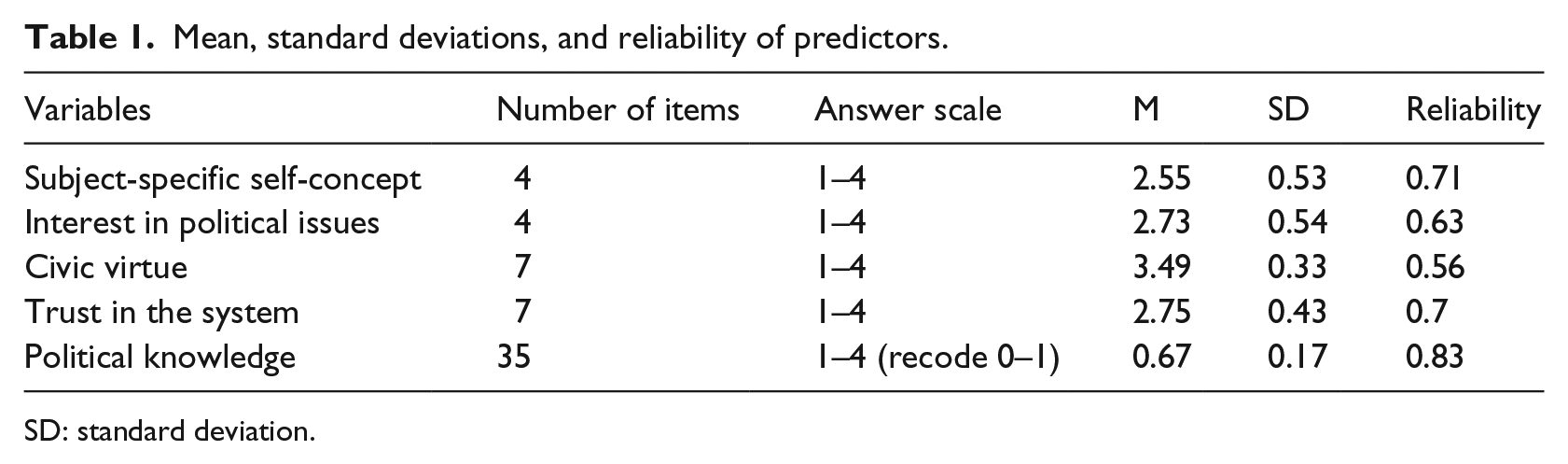
Table 1 provides an overview of the qualities of the instruments used. The reliability of the constructs ranges from satisfactory to good.
Mean, standard deviations, and reliability of predictors.
SD: standard deviation.
On the whole, the pupils tend to have a positive attitude towards the constructs under investigation. For the items on civic virtue, there is even strong consent. Whether and how this positive attitude impacts or correlates with political knowledge will be explained following the examination of the effect size.
In order to better consider the influence of an explanatory variable, data are analysed using Cohen’s d effect sizes. Type of school, gender and a migration background are employed as explanatory variables. A small effect is denoted by a d = 0.2, a medium effect by a d = 0.5 and a strong effect by a d = 0.8 (Cohen, 1992). Table 2 shows the analysis of effect sizes of the constructs investigated.
Effect sizes of the constructs investigated.
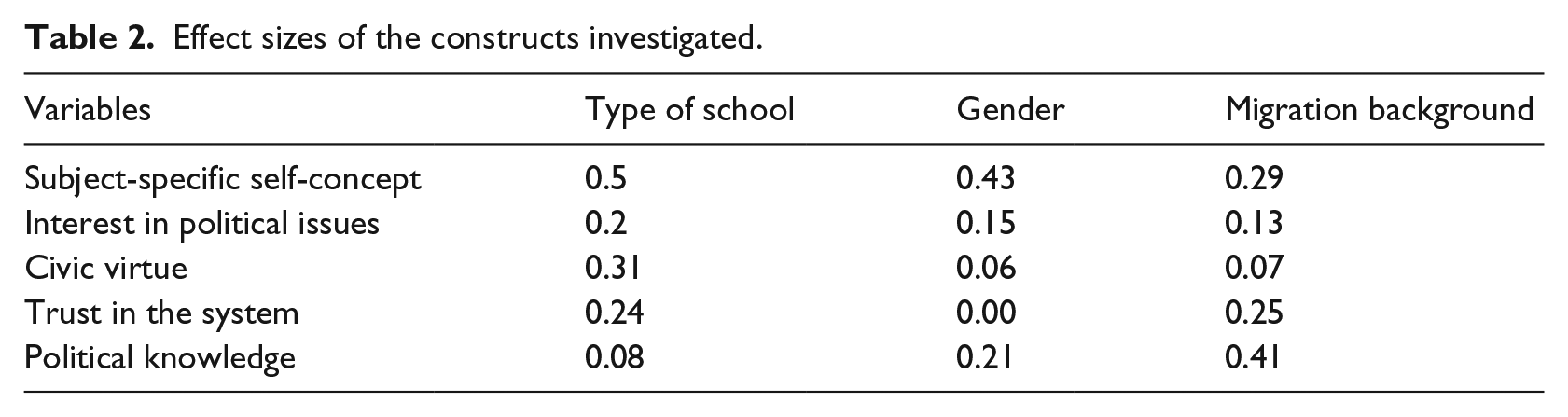
As anticipated, attending a certain type of school has the largest impact on political knowledge. Gender and a migration background have a small effect here. Relatively large effects are consistently displayed by the subject-specific self-concept for all explanatory variables, with small to medium effects. Political interest appears to be somewhat greater in Gymnasien, as is the understanding of civic virtue and trust in the system. There are no differences according to gender. Looking at migration background, only trust in the system displays a small effect.
Growth of knowledge in the various groups can also be investigated on the basis of effect size. Here, the BL group shows no growth of knowledge during the period under investigation, with d = 0.03. Small effects in growth of knowledge can be observed for both the EG (d = 0.32) and the CG (d = 0.24).
Whether the differences between the three groups are statistically significant is examined in latent change models. To this end, two groups are always compared for their effects.
The latent change model in Figure 2 draws on Geiser (2011). Overall, all groups show that prior knowledge impacts later knowledge. The model comparing the EG and the CG, like all subsequent models, shows good to very good model fits, with χ2= 53.938 (15), CFI = 0.98, TLI = 0.972, RMSEA = 0.055 and standardised root mean square residual (SRMR) = 0.047. While there are differences between the groups on the level of effect size, there is no significant difference in the latent transformation between time point t1 and time point t2. While the CG has learnt slightly less, the low value is not statistically significant. Comparison of the EG and the BL group produces striking results. The fit values – χ2= 64.71 (15), CFI = 0.971, TLI = 0.959, RMSEA = 0.069, SRMR = 0.058 – are satisfactory. The group difference of 0.33 in the latent transformation between t1 and t2 is of high statistical significance. Here, the pupils in the EG display a significant growth in learning compared to those in the BL group. If we compare the control and BL groups, the fit values are very good as well: χ2= 31.185 (15), CFI = 0.99, TLI = 0.985, RMSEA = 0.043, SRMR = 0.026. Nevertheless, the difference in growth of knowledge is visibly greater for the CG – but at 0.222 (p < 0.001) it is smaller in comparison with the EG. This could indicate that the EG has an advantage over the CG. The latent change models allow to answer the first set of questions. First, it is evident that politics lessons produce a growth in knowledge. The learning effect is not dependent on prior knowledge and demonstrates the relevance of thematic politics lessons. Both groups learn significantly more than the group without thematic politics lessons. External factors thus appear to have no impact on knowledge acquisition. Second, politics lessons according to the competence model developed by Detjen et al. (2012) and cooperative learning methods tend to lead to greater knowledge, even if these gains remain beneath the level of statistical significance.
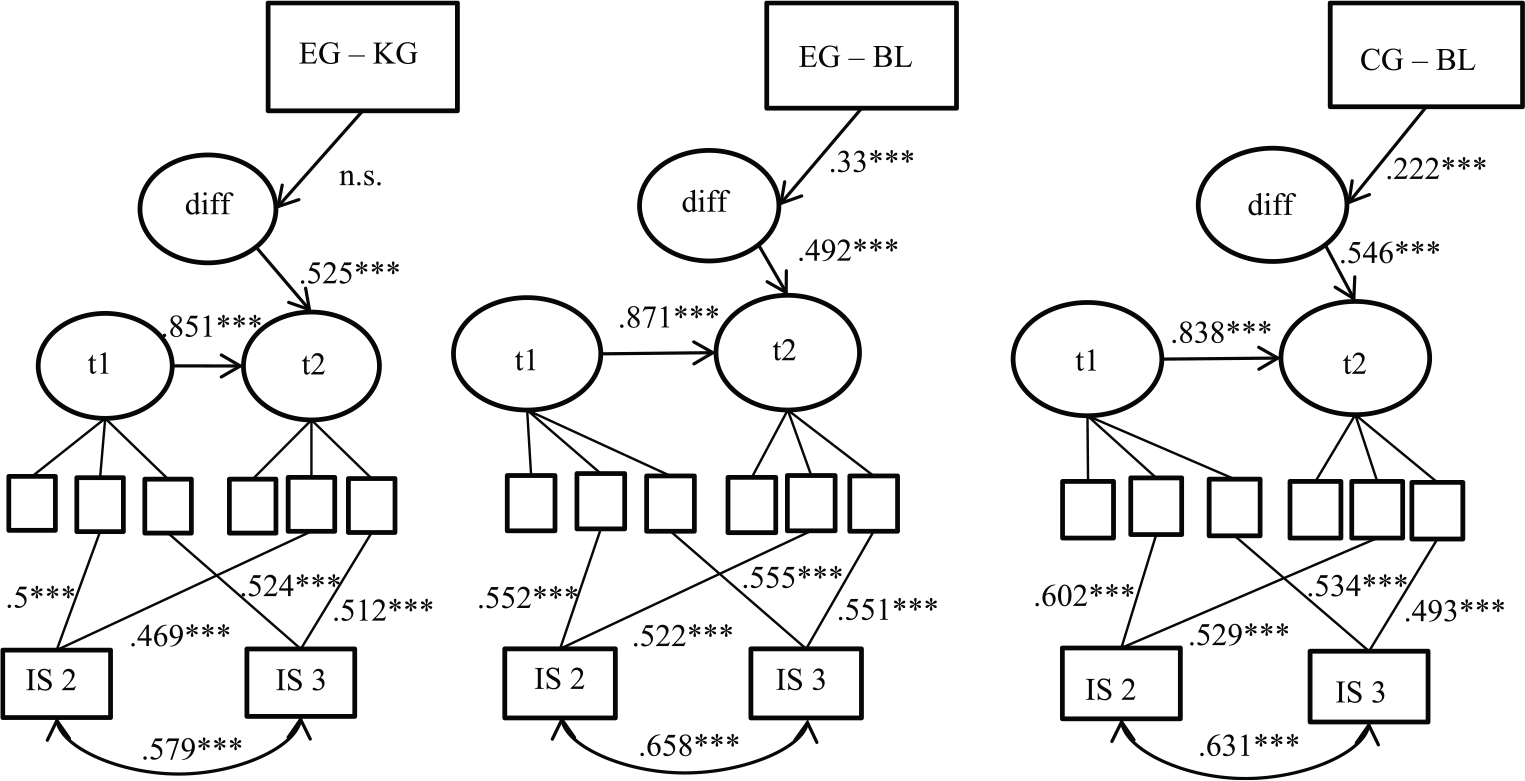
Latent change model between the three groups.
Since the descriptive data analysis also largely confirms expectations and is satisfactory, path analyses can now be modelled by adding independent variables. According to Wigfield and Eccles, political knowledge can be modelled in a theory-led approach as a dependent variable, and the motivation constructs can be modelled as independent variables. Since there are no theoretical models available for modelling directions for political attitudes, here we rely on correlations alone. The structural equation model shows the correlations between the motivation constructs of subject-specific self-concept and interest in politics issues, the political attitudes of civic virtue and trust in institutions, political knowledge and the background variables of gender, a migration background and books. The model illustrated in Figure 3 displays good fit values: χ2 = 647.165 (325), p ⩽ 0.001, CFI = 0.91, TLI = 0.9, RMSEA = 0.03, WRMR = 1.47.
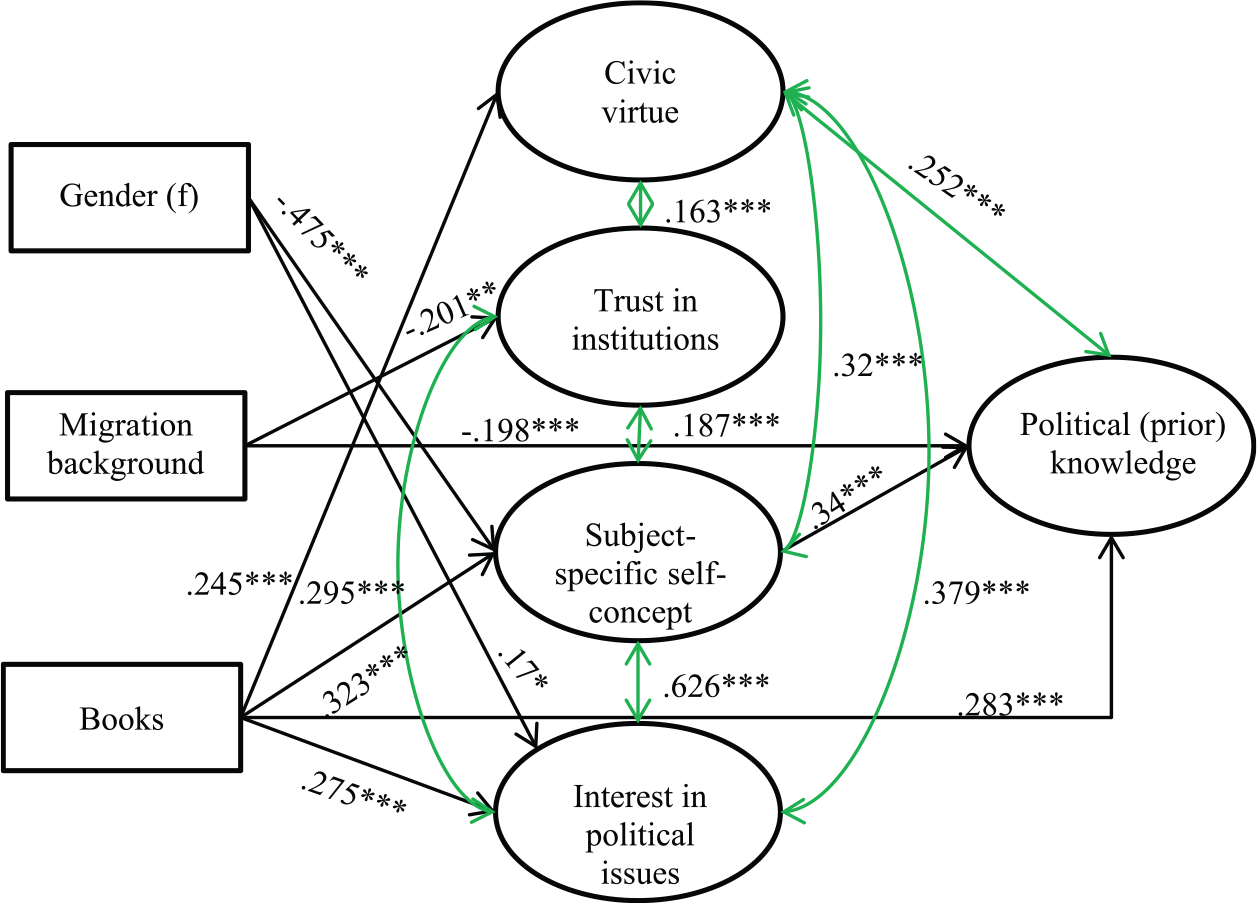
Path analyses testing the correlation between the supporting competence facets of political attitudes and motivation with subject knowledge.
A positive subject-specific self-concept has a positive effect on political knowledge. The presence of civic virtue correlates with political knowledge. A correlation between knowledge and interest in political issues and between knowledge and trust in the system cannot be observed. Hence, the correlations between the supporting competence facets and knowledge remain unclear. As far as the background variables are concerned, we can state that girls’ subject-specific self-concept is half a standard deviation lower, but their interest in political issues is slightly higher. Gender has only a slight indirect impact on knowledge. Pupils with a migration background have less knowledge and less trust in political institutions. Socio-economic background has a positive impact on all variables except trust in institutions.
Outlook
This study examined whether theory-oriented politics lessons lead to growth in pupils’ knowledge. The data captured confirm that this is indeed the case. These findings contradict surveys by Lange et al. (2013) and Oesterreich (2002), in which pupils state they use television, daily newspapers and websites as a source of political information and knowledge acquisition more frequently than they do school classes. The result for growth of knowledge in the EG and CG requires further investigation. In order to monitor more effectively whether in the test groups lesson design is realised in accordance with the competence model, it would aid comparison if lessons were held by externally trained teachers, such as trainee teachers for instance. Additionally, the duration of the intervention should be increased so that the effects of lessons using the competence model or using textbooks can be examined in greater detail. Despite the short duration of 7 hours of lessons, lesson interventions using the competence model seem auspicious.
A further aim of the study was the empirical examination of the relationship between competence and political attitudes and motivation. The correlations should be illustrated in a theory-led approach wherever possible. As anticipated, the study demonstrates that a positive subject-specific self-concept has a positive impact on knowledge. Interest in political issues has no discernible effect on political knowledge. Since several other studies show the effect of interest on learning (inter alia Weisseno and Eck, 2013; Weisseno et al., 2015), we must ask whether students perhaps interpreted the construct interest in politics in a different way. Further studies on various interest constructs with reference to Landwehr (2017) are required here. The analysis of political attitudes demonstrates that civic virtue correlates with knowledge. Trust in the system, however, does not.
Future research should focus on the impact of teaching on the transformation of motivation and attitude variables over time. Longer-term studies with systematic encouragement would be desirable. The knowledge tests must be further improved. It should be established whether the advantages of the theory-oriented lessons tested here hold for other topics and whether the theoretical model can be empirically tested in other aspects. There is a chance for theory-oriented politics classes if a content and process-oriented focus on competence takes root in schools. At the same time, it becomes very clear that there is a great need for further research on political didactics.
Footnotes
Declaration of Conflicting Interests
The author(s) declared no potential conflicts of interest with respect to the research, authorship, and/or publication of this article.
Funding
The author(s) disclosed receipt of the following financial support for the research, authorship, and/or publication of this article: This project has been funded with support from the European Commission. This article reflects the views only of the authors, and the Commission cannot be held responsible for any use which may be made of the information contained therein.