



Abstract
While now known globally as Scotland’s national poet, in November 1781 the daybook of surgeon Charles Fleeming simply records him as ‘Robert Burns, Lint Dresser’. Discovered in the 1950s, the daybook documents Fleeming’s treatment of Burns during a period of illness which would have a profound impact on the poet’s life and creative output. The book’s discovery added to the theories about the nature of Burns’s illness, often at odds with Burns’s own later descriptions. This paper presents a fresh examination of Burns’s treatment, challenging those theories by considering Fleeming’s prescriptions in the context of key medical authorities of the time. In considering Burns’s entry in the daybook in its entirety, the wider value of Fleeming’s daybook as a private record of medical practice at the time is highlighted, pointing to the potential value of this and other such volumes as underappreciated archival research material.
Introduction
In 1955, in the attic of a late-18th century house in Irvine, a collection of old papers was discovered. Among the papers was a daybook which documented the patients, prescriptions and fees charged in the course of the daily medical practice of Irvine surgeon Mr Charles Fleeming. I It is unclear how or when the papers were placed there, or by whom, although Fleeming has been reported as having lived in the house.1,II The homeowner and finder of the volume, Charles Balcombe, presumably on leafing through the pages, found an entry for November 1781 for a patient named Robert Burns, his occupation recorded as ‘Lint Dresser’. As a member of Irvine Burns Club and aware of the town’s history in relation to the same Robert Burns (1759–1796) now known as Scotland’s national bard, Balcombe recognised the coincidence in the dates of the record and Burns’s time in Irvine. He deduced this entry represented contemporaneous documentary evidence pertaining to a period of illness known to have affected the 22-year-old Burns in the final weeks of 1781 but about which little else was definitively known.
To preserve the record, the daybook was professionally rebound, with appropriate archival repairs for damage and preservation to prevent further deterioration. The volume was prefaced with a narrative describing the circumstances of its discovery and a commentary from Mr. C.G. Drummond, ‘a historical authority of the Pharmaceutical Society’, which transcribed the entry and provided opinion on possible reasons for the treatments prescribed. The volume was then entrusted to the care of Irvine Burns Club where it remains, held at the Wellwood Burns Centre and Museum.
In terms of Burns-related documentary sources, the daybook is a unique format, providing evidence relating to a time in Burns’s life pivotal in his development as a poet but before the 1786 publication of Poems, Chiefly in the Scottish Dialect which brought his name to public prominence and, importantly, relating to the mental health issues which were to punctuate his life. This uniqueness, however, also talks to the challenges of working with daybooks as a historical source. While many such items are held by a range of institutional repositories, they may be catalogued under a range of terms – daybooks, case books, consulting notes, for example – if they are catalogued at all. 2 Some will be held by smaller organisations, as Fleeming’s daybook is, and thus knowledge of their existence and their accessibility may both be limited. Other items may be held in private hands, their owners unaware of the potential resource in their possession. 3 Nor is there a standardisation of format and detail that might be contained. Lorkowski and Pokorski define medical records as containing patient identities, details of ‘health history, clinical symptoms and signs, diagnostic and treatment procedures, medications and justification for their use, and the follow-up continuity.’ 4 The range of volumes considered by Shepherd, by Fraser and Ayres, and by this article vary in their completeness in relation to this definition. Similarly, they vary in terms of their purposes, whether as personal records of practice prior to the formalisation of medical recordkeeping, as documents of professional reflection, or as the basis of teaching materials for other practitioners and trainees.2,3 Rather than a medical record or daybook, Fleeming’s volume might be more accurately described as a prescribing record, containing only details of the patients’ names and occupations, prescriptions, and fees charged and paid. Nevertheless, however the volume might be labelled, its preservation seems to have been by virtue of the entry relating to Burns. This gives it significance as both a source relating to aspects of 18th-century medical practice and to an otherwise thinly evidenced aspect of the biography of a significant literary figure. Despite the sparsity of information contained relative to other such records, the daybook also holds great potential as an archival resource. This article will explore the daybook’s entry for Robert Burns, considering both its significance in adding to what is already known about the poet’s life, and how the entry itself becomes a case study for what the daybook as a whole might reveal.
Treating Burns
Coined in 1786 by Henry Mackenzie in his review of Burns’s recently released volume of poetry, ‘the heaven-taught ploughman’ has become a defining description of Robert Burns. 5 Yet, in Fleeming’s daybook, he is described as a lint dresser, a vastly different occupation. This points to the purpose of Burns being in Irvine, a seaport approximately 13 miles north-west of Lochlea Farm which his father leased at the time. Part of the land at Lochlea had been given over to Burns and his brother for growing flax. Used for making linen, flax was in high demand and attracted an additional government premium for its production. III The Burns brothers concluded that being able to treat, or dress, the flax themselves would allow them to sell for a higher price than the raw crop. To that end, Robert travelled to Irvine in July 1781 to lodge with Alexander Peacock, possibly a cousin of his mother’s, and learn the necessary skills for flax dressing within the dark, dusty, noisy environment of the heckling shed.
Until the discovery of the daybook in 1955, it was known that Burns suffered a period of significant ill-health in November 1781, as indicated by a letter written to his father on 27th December, the only other contemporaneous source relating to this episode. In the letter, Burns reports that ‘[m]y health is much about what it was when you were here only my sleep is rather sounder and on the whole I am rather better than otherwise tho it is but by very slow degrees’. 6 Within the letter, little clue is given to the exact nature of the illness but symptomatically Burns reports ‘a weakness of my nerves’ with ‘the least anxiety, or perturbation in my breast, produce[ing] most unhappy effects on my whole frame’ and that he is ‘heartily tired’ of this life which he ‘could contentedly & gladly resign’. 6
Burns would later describe this period as being a time when ‘my hypochondriac complaint being irritated to such a degree, that for 3 months I was in diseased state of body and mind’. 7 Having also previously described this period in similar terms in his commonplace book in March 1784, Burns would continue to describe his most severe episodes of disturbed mood – those where the lowered mood was accompanied by headaches and stomach complaints – giving a clear indication of what he thought incapacitated him.8 –11 While it cannot be certain, it is not unreasonable to assume that Burns, if not already familiar with the term hypochondria, comes to know of it and applies it to himself as a result of its usage by Fleeming during the November 1781 consultations. However, with the discovery of Fleeming’s daybook, and particularly Drummond’s subsequent commentary, there seemed only to be more questions in the minds of Burns enthusiasts and scholars, challenging the poet’s own categorisation of his illness. Drummond details six visits during which Burns was prescribed an emetic, various preparations of rhubarb, an anodyne (analgesic) and Peruvian bark (cinchona). IV Drummond concludes Burns was being purged by vomiting and laxatives with concomitant treatment for pain relief and fever but is reluctant to commit to any diagnosis indicated by Fleeming’s prescriptions. Others conjecture that Burns was being treated for rheumatic heart disease, smallpox, malaria or typhoid with the hypochondria to which Burns refers being only secondary to any of these.12 –14
Examination of the entry by any modern researcher, as well as being challenged by the same issues of handwriting, abbreviations and unfamiliar terms that may have faced Drummond, is further hampered by the fact the entry is now significantly faded by light exposure (Figure 1).
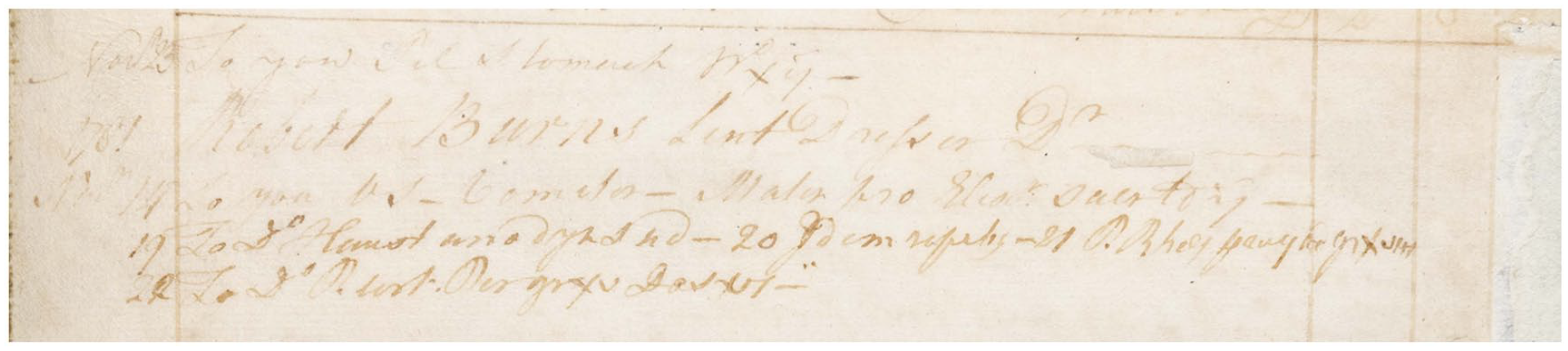
Robert Burns’s entry in Charles Fleeming’s daybook.
Digital photography, however, allows for manipulation of high-resolution images to compensate for these issues and show clarity of detail to a far higher level than Drummond could ever achieve by eye. Consequently, it is now possible to reassess the accuracy of Drummond’s reading and interrogate the later diagnostic conclusions drawn on the basis of his reading of Fleeming’s prescriptions (Figures 2 and 3).
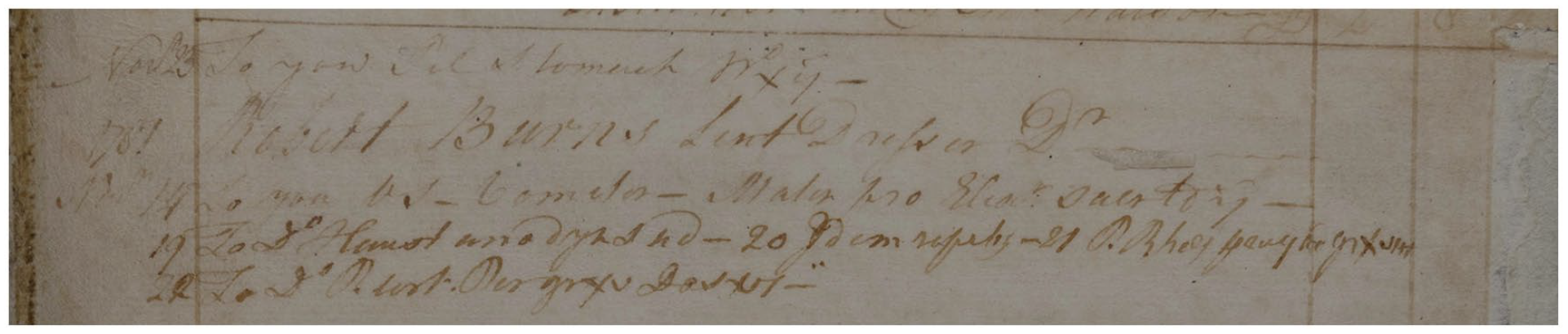
Colour-adjusted image of Burns’s entry in Fleeming’s daybook.
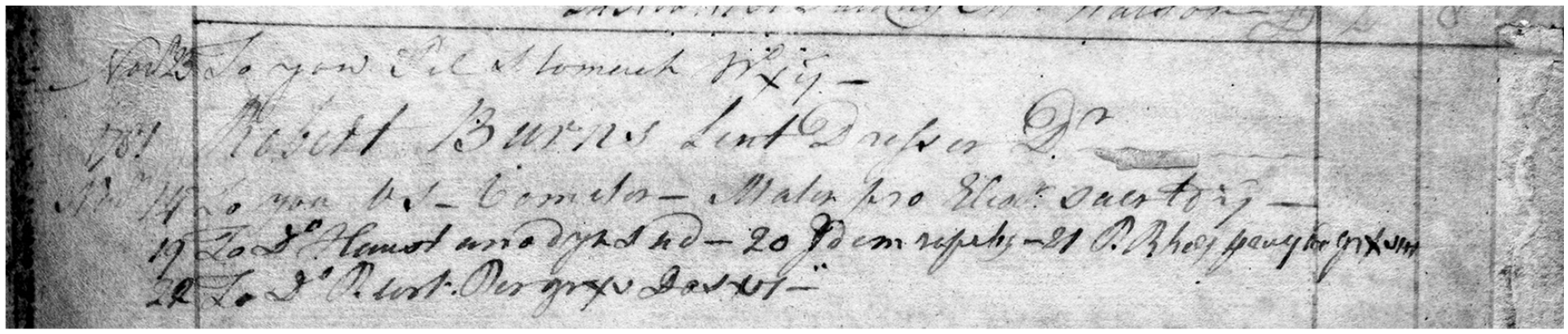
Negative image of Burns’s entry in Fleeming’s daybook.
Such a reassessment also creates an opportunity for considering Fleeming’s prescriptions within the contexts of contemporaneous medical knowledge and practice, something not previously undertaken in any consideration of Fleeming’s treatment of Burns. Three sources were selected for this purpose – the Pharmacopoeia Edinburgensis, William Buchan’s Domestic Medicine, and the consulting letters of William Cullen, physician and medical faculty in Edinburgh. Each were highly regarded in different ways and widely consulted by different groups – the Pharmacopoeia by university-trained physicians, Domestic Medicine by the general population, and Cullen by both professional and public alike. 15 These three sources provide contextualisation of Fleeming’s prescriptions within contemporaneous practice, offering new suggestions around the contents and purposes of Fleeming’s prescriptions and thus the condition he was treating, suggestions which sit more comfortably with Burns’s own later references to this episode in his life than those of later commentators.
Transcription of the entry reads as follows: V
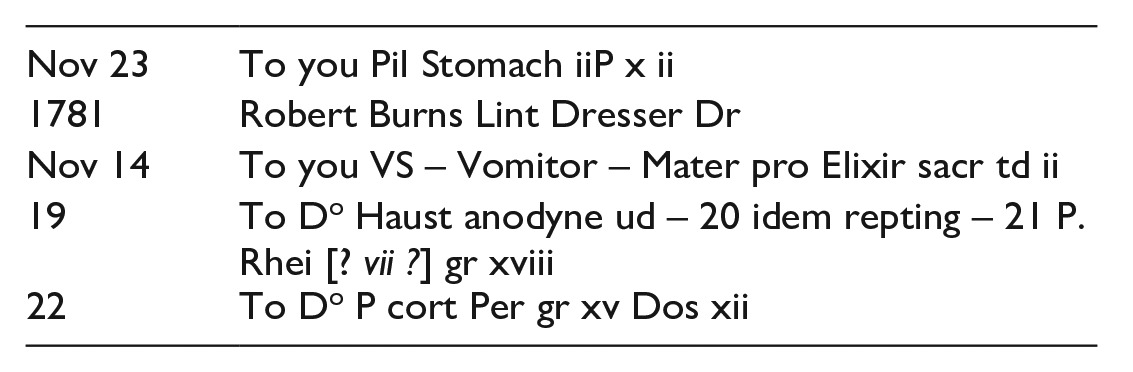
As previously noted, Fleeming’s entry is a combination of abbreviations and Latin, recording both the treatments prescribed and the doses to be taken. Translating and/or expanding these, the entry would read:
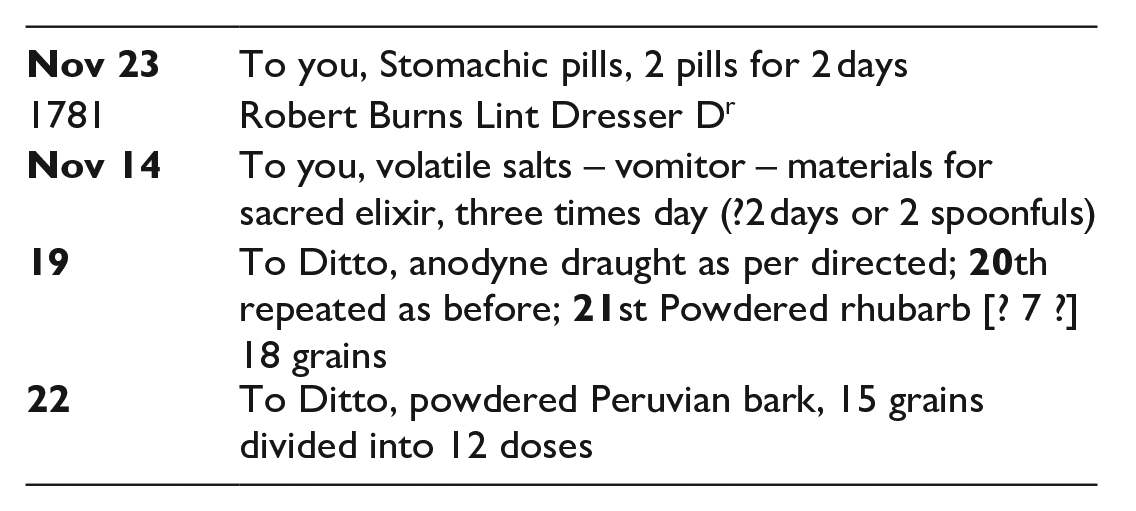
(Note that the dates of each visit have been emboldened for clarity, particularly for visits between the 19th and 21st which are not recorded on separate lines.).
Unpacking of the entry immediately corrects the miscount of five visits, detailing six prescriptions on the 14th, 19th, 20th, 21st, 22nd and 23rd November. Consultation of the Pharmacopoeia Edinburgensis and Buchan’s Domestic Medicine shed light on the ingredients of the items prescribed (Table 1).
Active ingredients in Fleeming’s prescriptions.
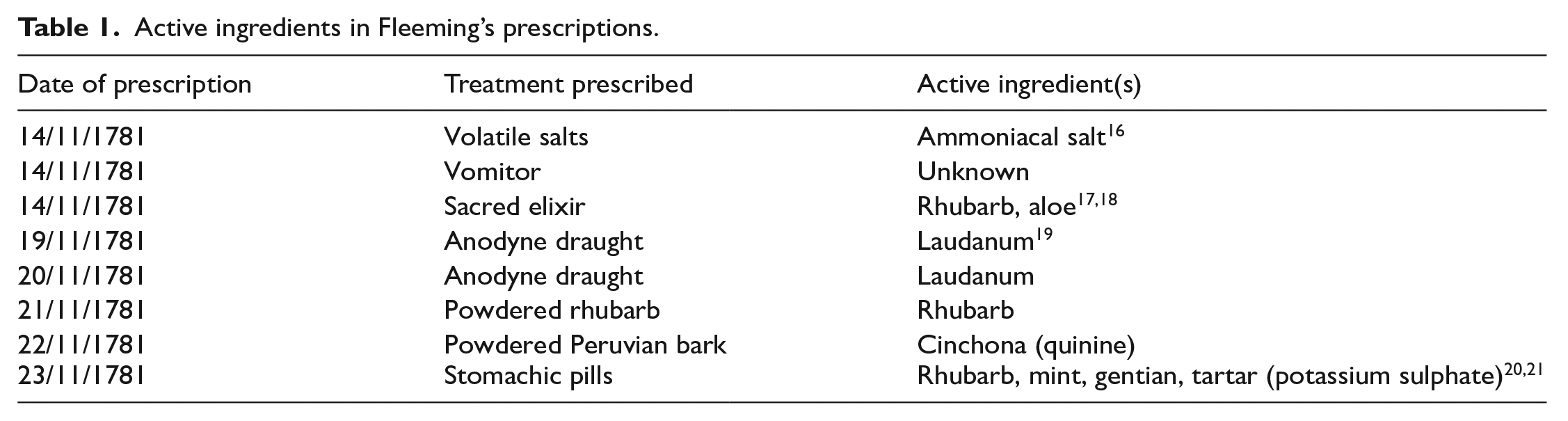
Broadly, what is described by the contemporaneous texts confirms Drummond’s commentary on what Burns was being prescribed by Fleeming. However, these sources, along with the consulting letters of William Cullen, also offer suggestions for the medical indications for these prescriptions based on their dosages. As something not previously considered in any scholarly examination of the daybook, this builds a clearer picture of the potential diagnoses being considered by Fleeming and adds to our understanding of Burns’s experience during a period which is otherwise scantily evidenced.
The record of Burns’s initial treatment on the 14th prescribes volatile salts of ammonia (smelling salts), an emetic labelled ‘vomitor’ and materials for sacred elixir which would likely be dissolved in some liquor for ingestion. Together, these paint an image of Burns being roused from his bed, vomiting being induced to prepare his stomach for treatment, and commencement of that treatment with sacred elixir. Buchan advocates for inducing a vomit ‘to cleanse the stomach and bowels’ prior to starting other treatments, as this ‘not only renders the application of other medicines more safe, but likewise more efficacious’. 22 There is no indication of the contents of Fleeming’s vomitor but Buchan points to drinking warm water or camomile tea. 23 Given ipecacuanha is specifically itemised in other records within the daybook, this suggests it was not a component of Fleeming’s vomitor as proposed by Drummond’s commentary.
Following the idea of gently cleansing rather than harshly purging, Cullen describes sacred elixir as gently opening the gastrointestinal tract. 24 This points to Fleeming’s diagnosis including some aspect of gastrointestinal obstruction which required gentle clearing. As noted, Buchan points to such abdominal upsets often being nervous in origin, while Cullen explicitly states the strong correlation between the occurrence of nervous disorders and costiveness (constipation).25,26
The daybook suggests Burns continued his thrice-daily dosing of sacred elixir at least until Fleeming’s further prescriptions of the 19th and 20th, when he prescribed an anodyne draught. Containing laudanum, this has previously been assumed to have been prescribed as pain relief, laudanum being an opiate. Buchan, however, also recommends a low dose of laudanum to settle stomach cramps associated with ‘an increased degree of sensibility’, while Cullen indicates it as appropriate for treating colic where there is no costiveness, a possibility in Burns’s case after 5 days of sacred elixir.27,28 Fleeming records administration as ‘u.d.’ (use as directed) but with no indication of dosage, thus shedding no light on whether he was aiming to settle Burns’s stomach, settle his nerves, or alleviate pain. Within the context of the preceding sacred elixir, it is possible it was a combination of at least two of these, the settling of both stomach and nerves.
On the 21st November Burns’s treatment moves to include powdered rhubarb. As with the sacred elixir, which also contains rhubarb, Buchan and Cullen agree on this being an appropriate treatment to gently settle the stomach, open the bowels and promote appetite.26,29 Again, it is indicated by both for gastrointestinal symptoms related to nervous disorder. While Fleeming is clearly continuing to treat Burns for costiveness which may have been nervous in origin, the use of laudanum also raises the possibility that Fleeming was seeking to treat a costiveness arising from the use of an opiate.
Just as modern theories may erroneously presume that Fleeming used laudanum as an analgesic, there is a similar error in assessing the use of Peruvian bark. A source of quinine, it was widely recognised as an effective treatment for intermittent fever, particularly the fever associated with malaria, a condition for which quinine is still indicated and the likely basis of more recent suggestions that this is what ailed Burns. Buchan makes clear, however, that treatment of malaria requires far higher doses of Peruvian bark that those recorded by Fleeming in his treatment of Burns. Buchan records that intermittent fever requires two ounces of Peruvian bark (875 grains) to be divided into 24 doses (36.5 grains) and taken every two hours whereas Fleeming prescribes Burns only 15 grains divided into 12 doses (1.25 grains per dose).30,VI Pertinently, Buchan explicitly recommends lower doses of bark for the strengthening of the stomach in hypochondriac complaints, noting that the doses which can be tolerated in such conditions are often too small to have any other effect. 31 The introduction of Peruvian bark at this low dose gives the clearest indication yet that Fleeming has diagnosed Burns’s illness as hypochondria.
Fleeming’s final prescription, on the 23rd November, is for stomachic pills. Again, containing rhubarb along with several other natural ingredients, these are indicated for keeping open and invigorating the stomach, strengthening the bowels, and promoting appetite.20,32 Fleeming seems only to prescribe these for 2 days which, along with no further prescriptions, suggests Burns’s physical symptoms were sufficiently resolved that continued care could be undertaken by others, perhaps following ongoing instructions from Fleeming.
Almost all treatments prescribed by Fleeming point to Burns being treated for hypochondria, a nervous disorder with associated abdominal upset; only the anodyne draught is ambiguous in its indication, possibly for analgesia or for colic. The contents and dosages of Fleeming’s prescriptions for Burns argue against explanations of malaria, smallpox or typhoid suggested by other commentators, as well as challenging the suggestion that hypochondria was a secondary condition. To this can also be added a recorded instance of Fleeming consulting Cullen for advice on an earlier patient affected by a nervous ailment. Cullen advises Fleeming to administer bark for purging, small doses of opiates to settle the nerves, and small doses of a gentle laxative when no bark is being given. It is reasonable that, having consulted a physician as esteemed as Cullen, Fleeming would continue to follow this advice for subsequent patients presenting with similar symptoms. 33
That Fleeming likely diagnosed Burns with a nervous disorder, more specifically hypochondria, brings us back to the fact that that Burns never refers to his Irvine episode in any terms other than those of a nervous illness, that he would describe this and other similar periods as part of his ‘constitutional hypochondriac taint’. 7 The evidence of the daybook, read within the wider evidence of Burns’s correspondence and accounts of his life, points to this being Burns’s first major episode of hypochondria, an episode which subsequent examination suggests might now be described as a period of clinical depression. 34 Such similar episodes – incapacitating, associated with low mood and a bleak outlook, sometimes accompanied by physical symptoms such as headaches and abdominal upsets – would punctuate Burns’s life and are now thought by some to represent the depressive pole of Type II bipolar disorder.34,35 That Fleeming was even consulted, let alone prescribing across 8 days, talks to the perceived severity of Burns’s illness in Irvine. What is certain is that Burns’s experience during this Irvine episode would give him a lifelong fear of further such episodes, that he was ‘blasted with a deep incurable taint of hypochondria, which poison[ed his] existence’ and that he carried a sense of helplessness, that there was ‘nothing in the Materia Medica which can heal a diseased SPIRIT’.36,37
The Daybook Beyond Burns
Work to learn more about Charles Fleeming himself is ongoing. What little is currently known mainly comes from his obituary in the August 1809 issue of Scots Magazine; it reports his death on 18th June 1809 at the age of 89, noting his service as a naval surgeon during the battle of Carthagena, after which he eventually travelled to and settled in Irvine in 1745 where he continued his medical practice ‘with much success and reputation, till within a year or two of his death’. 38 While the existence of his obituary points to Fleeming as being a person of some note, he is now, like his daybook, mainly remembered as a consequence of his association with Burns in the days before he achieved his popular and critical acclaim as a poet.
Thus, while re-examination of Burns’s entry in the daybook undoubtedly adds to our understanding of his experience in late 1781 and, in turn, our understanding of why he was so fearful of further periods of melancholy and hypochondria, it also acts as a salutary case study of what can be lost in not recognising daybooks as a rich source of primary historical evidence, even those which seem to be restricted in the range of information recorded.
Burns’s entry provides detail on his occupation at the time, the treatments he was prescribed and the timeline along which they were prescribed. There is a sense of Fleeming not expecting Burns to become a long-term patient, another record starting lower down the page rather than leaving it blank. For many patients recorded in Fleeming’s daybook, there are entries of a similar nature with occupations such as sailor or labourer, talking to the transient nature of a proportion of Irvine’s population. As a busy seaport with ships constantly docking and sailing, Fleeming also appears to be providing medical care to multiple individuals on a vessel, all listed under the header of the captain’s name, his involvement here perhaps recommended as a consequence of his previous role as ship’s surgeon prior to his settling in Irvine. 38
These entries, however, make up a smaller proportion of the daybook than those which indicate Fleeming’s practice consisting of more established relationships. Entries under any given name might indicate prescriptions for other family members such as wives and children as well as the named individual. Generally, the header name is male – the father or husband of a family – unless the patient is a widow, but even in these cases the name of the deceased husband will often be noted. Some entries are indicated as being records carried forward from previous daybooks or carried over into subsequent volumes (Figure 4). The total number of daybooks filled by Fleeming during his c.60-year practice in Irvine is unknown but evidence would suggest this surviving volume is number five in the sequence.

entry for Widow Baird showing indicators of the record being brought forward from Book 4 and carried onto Book 6.
This all talks to the loss of a great deal of evidence and, again, testament to this volume surviving only because of the intrinsic value of the entry relating to Burns. VII Nevertheless, what does survive in this daybook offers the possibility of reconstructing a snapshot of a period of Fleeming’s practice, a chronological sequence of who he is treating, possibly even down to the level of the day-by-day in some places. Details of the prescriptions afford fascinating insights into the common treatments used by a community practitioner at the time, perhaps indicative of what is available. Details of the occupations of Fleeming’s patients adds sociodemographic depth to such an analysis, allowing for the possibility of comparisons of treatments provided to individuals of different backgrounds, as well as an understanding of just who would actually consult Fleeming. As well as the sailors, labourers and lint dressers, individuals such as Lady Caddell, Baillie William Watson and the Laird of Eglinton talk to the diversity of Fleeming’s patient list; that he is treating local notables also talks to that excellent reputation recorded in his obituary.
Many of the entries include details of the fees charged for the various prescriptions, highlighting the fact that, in many cases, Fleeming being consulted at all would have come down to cost and the perceived seriousness of the condition being treated. This, in itself, raises further questions about Burns’s interaction with Fleeming. Fee information for Burns was never recorded but comparison with entries for similar prescriptions for other patients allows the fee payable by Burns to be calculated at something in the region of four shillings and seven pence. Given that Burns likely had limited funds available at the time – it’s unclear if he was being paid for his work in the heckling shed and he writes to his father that he must borrow some meal to feed himself ‘until I can get more’ – the cost of the treatment would represent another unwelcome burden on his financial resources at a time when the average weekly wage for a labourer was around ten shillings. 6 There is no note on Burns’s entry noting payment of the debt, as there are on many other records, but similarly there are other records with no fees or record of payment entered. Without thorough examination and investigation of the daybook, it is difficult to discern any pattern or potential reason for this, but it may talk to local reports which claim Fleeming was paid by the burgh council to treat the most impoverished. VIII
Conclusion
In a March 1784 entry in his commonplace book, Robert Burns would describe a period during his stay in Irvine where he ‘was attacked by the most dreadful distemper, a hypochondria or confirmed melancholy.’ It is an experience that would continue to haunt him, a ‘wretched state, the recollection of which makes me yet shudder’, a condition the return of which he would always fear. 39 Burns is clear on the nature of the illness which affected him. Charles Fleeming’s daybook survives by virtue of the evidence it offers on this significant moment in Burns’s life. Initial assessments of the information gave rise to theories which contradicted Burns’s own descriptions of his illness, but these were assessments grounded in an incomplete consideration of both the individual entry for Burns and the daybook as a complete resource. Re-examination of this record, accounting for doses as well contents of the prescriptions, strongly suggests that Fleeming was treating what he judged to be a severe episode of a nervous disorder. This episode, as far as currently available evidence indicates, represents the first major episode of the hypochondria that would punctuate the rest of Burns’s life and adds to our understanding of that experience as mediated through Burns’s correspondence.34,35 It also challenges other potential diagnoses offered, some of which suggest a reliance on Drummond’s assessment, itself derived only from what is contained within the entry for Burns and not the daybook as whole resource.
That the whole volume was preserved, and not simply the page referring to Burns, affords the opportunity to appreciate the daybook as a rich source of information that can be further contextualised with other contemporary sources. It is an opportunity to build a picture of the life of a medical professional working within his local community – the conditions being treated, the treatments being offered, the living afforded by such a practice – as well as a window into the demographics of his patient population. The information in this single daybook is a stark reminder of that which has been lost in those companion volumes not preserved, as well as to the potential value of the other similar items held in other repositories, especially those which include more detail than Fleeming’s record. Together, they represent a collection which adds colour and detail to the life of the ordinary medical professional, providing both a contrast and complement to what is known about the professional lives of more eminent individuals such as William Cullen who were so often consulted by individuals such as Charles Fleeming.
Footnotes
Acknowledgements
Grateful thanks to the Wellwood Burns Centre and Museum, owned and run by Irvine Burns Club, for access to their archives and resources, including Fleeming’s daybook, and their support of this work.
Declaration of conflicting interests
The author(s) declared no potential conflicts of interest with respect to the research, authorship, and/or publication of this article.
Funding
The author(s) disclosed receipt of the following financial support for the research, authorship, and/or publication of this article: Funding for the digital imaging of Fleeming’s daybook was generously supported by the Baillies’ Fund at the Royal College of Physicians and Surgeons of Glasgow, the Baillie’s fund at the University of Glasgow’s Scottish History department, and the Frank and Susan Shaw fund at the University of Glasgow’s Centre for Robert Burns Studies. This work draws on the author’s PhD research which was funded by a Lord Kelvin Adam Smith doctoral scholarship from the University of Glasgow.